
A English
Amphibolic Pathway Questions in English
Class 11 Biology · Respiration in Plants · Amphibolic Pathway
64+
Questions
English
Language
100%
With Solutions
Showing 14 of 64 questions in English
51
MediumMCQ
From the oxidation of one molecule of palmitic acid (fatty acid),the number of $ATP$ molecules gained as net are
A
$131$
B
$129$
C
$38$
D
$142$
Solution
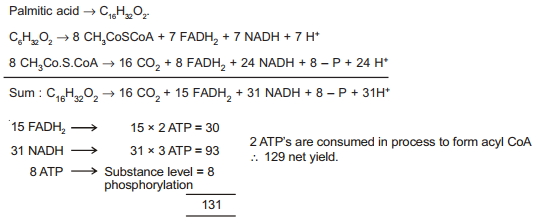
(B) Palmitic acid $(C_{16}H_{32}O_2)$ undergoes $\beta$-oxidation to produce $8$ molecules of Acetyl-CoA,$7$ $FADH_2$,and $7$ $NADH$.
Each Acetyl-CoA enters the Krebs cycle to produce $3$ $NADH$,$1$ $FADH_2$,and $1$ $ATP$ (or $GTP$).
For $8$ Acetyl-CoA,the total yield is $24$ $NADH$,$8$ $FADH_2$,and $8$ $ATP$.
Adding the products from $\beta$-oxidation ($7$ $FADH_2$ and $7$ $NADH$),the total yield is $31$ $NADH$,$15$ $FADH_2$,and $8$ $ATP$.
Using standard conversion factors ($1$ $NADH = 2.5$ $ATP$ and $1$ $FADH_2 = 1.5$ $ATP$): $31 \times 2.5 = 77.5$ $ATP$ and $15 \times 1.5 = 22.5$ $ATP$.
Total $ATP = 77.5 + 22.5 + 8 = 108$ $ATP$.
However,considering the older convention ($1$ $NADH = 3$ $ATP$ and $1$ $FADH_2 = 2$ $ATP$): $31 \times 3 = 93$ $ATP$ and $15 \times 2 = 30$ $ATP$.
Total gross $ATP = 93 + 30 + 8 = 131$ $ATP$.
Since $2$ $ATP$ equivalents are consumed for the activation of fatty acid into Acyl-CoA,the net gain is $131 - 2 = 129$ $ATP$.
Each Acetyl-CoA enters the Krebs cycle to produce $3$ $NADH$,$1$ $FADH_2$,and $1$ $ATP$ (or $GTP$).
For $8$ Acetyl-CoA,the total yield is $24$ $NADH$,$8$ $FADH_2$,and $8$ $ATP$.
Adding the products from $\beta$-oxidation ($7$ $FADH_2$ and $7$ $NADH$),the total yield is $31$ $NADH$,$15$ $FADH_2$,and $8$ $ATP$.
Using standard conversion factors ($1$ $NADH = 2.5$ $ATP$ and $1$ $FADH_2 = 1.5$ $ATP$): $31 \times 2.5 = 77.5$ $ATP$ and $15 \times 1.5 = 22.5$ $ATP$.
Total $ATP = 77.5 + 22.5 + 8 = 108$ $ATP$.
However,considering the older convention ($1$ $NADH = 3$ $ATP$ and $1$ $FADH_2 = 2$ $ATP$): $31 \times 3 = 93$ $ATP$ and $15 \times 2 = 30$ $ATP$.
Total gross $ATP = 93 + 30 + 8 = 131$ $ATP$.
Since $2$ $ATP$ equivalents are consumed for the activation of fatty acid into Acyl-CoA,the net gain is $131 - 2 = 129$ $ATP$.
0 likes
View Solution52
MediumMCQ
$A$ : Fat breakdown yields fatty acids and glycerol.
$R$ : Glycerol enters glycolysis through serine formation.
$R$ : Glycerol enters glycolysis through serine formation.
A
Assertion and Reason both are correct and also correct explanation.
B
Assertion and Reason both are correct but not explanation of assertion.
C
Assertion is correct,but Reason is incorrect.
D
Both Assertion and Reason are incorrect.
Solution
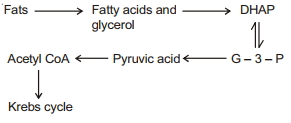
(C) The Assertion is correct: Fats are broken down by lipases into fatty acids and glycerol.
The Reason is incorrect: Glycerol is converted into $DHAP$ (Dihydroxyacetone phosphate),which then enters the glycolytic pathway. It does not enter through serine formation.
Therefore,the correct option is $C$.
The Reason is incorrect: Glycerol is converted into $DHAP$ (Dihydroxyacetone phosphate),which then enters the glycolytic pathway. It does not enter through serine formation.
Therefore,the correct option is $C$.
0 likes
View Solution53
MediumMCQ
$A$: The tricarboxylic acid $(TCA)$ cycle is an amphibolic pathway.
$R$: $A$ number of $TCA$ cycle intermediates are used in various catabolic reactions only.
$R$: $A$ number of $TCA$ cycle intermediates are used in various catabolic reactions only.
A
Assertion and Reason both are correct and Reason is the correct explanation of Assertion.
B
Assertion and Reason both are correct but Reason is not the correct explanation of Assertion.
C
Assertion is correct,but Reason is incorrect.
D
Both Assertion and Reason are incorrect.
Solution
(C) The $TCA$ cycle is considered an amphibolic pathway because it involves both catabolic and anabolic processes.
Catabolic reactions involve the breakdown of molecules to produce energy,while anabolic reactions use the intermediates of the $TCA$ cycle (such as $\alpha$-ketoglutarate,succinyl-$CoA$,and oxaloacetate) to synthesize other important biomolecules like amino acids,chlorophyll,and fatty acids.
Since the intermediates are used in both catabolic and anabolic reactions,the statement in the Reason that they are used in 'catabolic reactions only' is incorrect.
Therefore,the Assertion is correct,but the Reason is incorrect.
Catabolic reactions involve the breakdown of molecules to produce energy,while anabolic reactions use the intermediates of the $TCA$ cycle (such as $\alpha$-ketoglutarate,succinyl-$CoA$,and oxaloacetate) to synthesize other important biomolecules like amino acids,chlorophyll,and fatty acids.
Since the intermediates are used in both catabolic and anabolic reactions,the statement in the Reason that they are used in 'catabolic reactions only' is incorrect.
Therefore,the Assertion is correct,but the Reason is incorrect.
0 likes
View Solution54
MediumMCQ
The $Cori$ cycle is not found in muscles required for contraction at a slow pace and for a prolonged duration. Which organs does the $Cori$ cycle involve?
A
Liver
B
Muscles
C
Liver and muscles both
D
None of these
Solution
(C) The $Cori$ cycle,also known as the lactic acid cycle,describes the metabolic pathway in which lactate produced by anaerobic glycolysis in the muscles is transported to the liver.
In the liver,lactate is converted back to glucose through gluconeogenesis.
This glucose is then released back into the blood and returned to the muscles to be used as an energy source.
Therefore,the $Cori$ cycle involves both the liver and the muscles,with the blood acting as the transport medium between these two organs.
In the liver,lactate is converted back to glucose through gluconeogenesis.
This glucose is then released back into the blood and returned to the muscles to be used as an energy source.
Therefore,the $Cori$ cycle involves both the liver and the muscles,with the blood acting as the transport medium between these two organs.
0 likes
View Solution55
MediumMCQ
What substances are transported by $Xylem$ and $Phloem$ respectively?
A
$Xylem$: Water,mineral salts; $Phloem$: Organic substances
B
$Xylem$: Water,mineral salts,some organic nitrogen,hormones; $Phloem$: Organic and inorganic substances
C
$Xylem$: Water,mineral salts,some organic nitrogen,hormones; $Phloem$: Organic substances
D
$Xylem$: Water; $Phloem$: Organic substances
Solution
(C) $Xylem$ is responsible for the upward conduction of water and dissolved mineral salts from the roots to the aerial parts of the plant. It also transports some organic nitrogen and hormones.
$Phloem$ is responsible for the translocation of organic substances (mainly sucrose) synthesized in the leaves to other parts of the plant.
$Phloem$ is responsible for the translocation of organic substances (mainly sucrose) synthesized in the leaves to other parts of the plant.
0 likes
View Solution56
EasyMCQ
Identify the respiratory substrates for respiration.
A
Carbohydrates
B
Lipids
C
Proteins
D
All of the above
Solution
(D) Respiratory substrates are the organic compounds that are oxidized during the process of respiration to release energy.
Carbohydrates are the most common respiratory substrates.
However,proteins,fats (lipids),and organic acids can also be used as respiratory substrates under certain conditions,such as when carbohydrates are exhausted.
Therefore,all the given options are correct.
Carbohydrates are the most common respiratory substrates.
However,proteins,fats (lipids),and organic acids can also be used as respiratory substrates under certain conditions,such as when carbohydrates are exhausted.
Therefore,all the given options are correct.
0 likes
View Solution57
MediumMCQ
Where do proteins enter the respiratory pathway?
A
$DHAP$
B
Acetyl $CoA$
C
Glucose-$6$-phosphate
D
Pyruvic acid
Solution
(D) Proteins are first degraded by proteases into amino acids.
These amino acids are then deaminated to form various intermediates of the respiratory pathway.
Depending on the structure of the amino acid,they can enter the respiratory pathway at different stages,such as pyruvic acid,acetyl $CoA$,or intermediates of the Krebs cycle (like $\alpha$-ketoglutarate).
Among the given options,pyruvic acid is a common entry point for amino acids after deamination.
These amino acids are then deaminated to form various intermediates of the respiratory pathway.
Depending on the structure of the amino acid,they can enter the respiratory pathway at different stages,such as pyruvic acid,acetyl $CoA$,or intermediates of the Krebs cycle (like $\alpha$-ketoglutarate).
Among the given options,pyruvic acid is a common entry point for amino acids after deamination.
0 likes
View Solution58
MediumMCQ
Where do fatty acids enter the respiratory pathway?
A
$DHAP$
B
Acetyl $CoA$
C
Glucose-$6$-phosphate
D
Pyruvic acid
Solution
(B) Fatty acids are first broken down into glycerol and fatty acids.
The glycerol is converted into $DHAP$ and enters the respiratory pathway.
The fatty acids are broken down into acetyl $CoA$ through the process of $\beta$-oxidation.
Thus,fatty acids enter the respiratory pathway as acetyl $CoA$.
The glycerol is converted into $DHAP$ and enters the respiratory pathway.
The fatty acids are broken down into acetyl $CoA$ through the process of $\beta$-oxidation.
Thus,fatty acids enter the respiratory pathway as acetyl $CoA$.
0 likes
View Solution59
MediumMCQ
Where does glycerol enter the respiratory pathway?
A
$DHAP$
B
Acetyl $CoA$
C
Glucose-$6$-phosphate
D
Pyruvate
Solution
(A) Glycerol is a derivative of fatty acids and is converted into $DHAP$ (Dihydroxyacetone phosphate) during the breakdown of fats.
$DHAP$ is an intermediate of glycolysis.
Therefore,glycerol enters the respiratory pathway at the level of $DHAP$.
$DHAP$ is an intermediate of glycolysis.
Therefore,glycerol enters the respiratory pathway at the level of $DHAP$.
0 likes
View Solution60
MediumMCQ
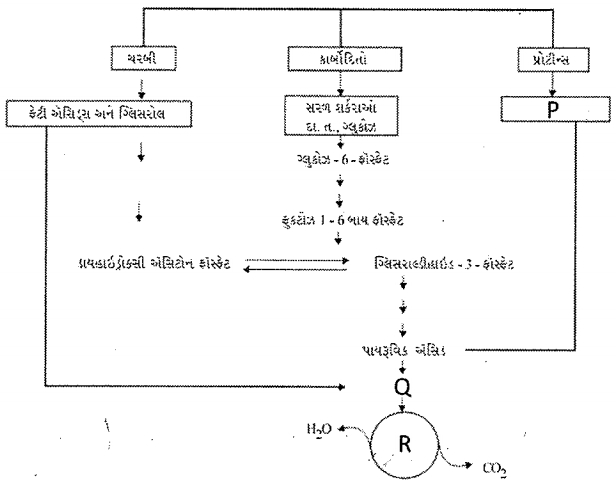
The following figure shows an amphibolic pathway. What are $P$,$Q$,and $R$?
A
Amino acids,Acetyl $CoA$,Krebs cycle
B
Amino acids,Acetyl $CoA$,Calvin cycle
C
Monosaccharides,Lactic acid,Krebs cycle
D
Monosaccharides,Lactic acid,Calvin cycle
Solution
(A) The provided figure illustrates the amphibolic pathway of cellular respiration,where both catabolic and anabolic processes occur.
$1$. Proteins are broken down into $P$,which are amino acids.
$2$. Fats are broken down into fatty acids and glycerol. Fatty acids are converted into $Q$,which is Acetyl $CoA$.
$3$. Carbohydrates are broken down into monosaccharides (like glucose),which enter glycolysis to form pyruvate,which is then converted into Acetyl $CoA$.
$4$. Acetyl $CoA$ $(Q)$ enters the $R$,which is the Krebs cycle ($TCA$ cycle),to produce $CO_2$ and $H_2O$.
Therefore,$P$ is amino acids,$Q$ is Acetyl $CoA$,and $R$ is the Krebs cycle.
$1$. Proteins are broken down into $P$,which are amino acids.
$2$. Fats are broken down into fatty acids and glycerol. Fatty acids are converted into $Q$,which is Acetyl $CoA$.
$3$. Carbohydrates are broken down into monosaccharides (like glucose),which enter glycolysis to form pyruvate,which is then converted into Acetyl $CoA$.
$4$. Acetyl $CoA$ $(Q)$ enters the $R$,which is the Krebs cycle ($TCA$ cycle),to produce $CO_2$ and $H_2O$.
Therefore,$P$ is amino acids,$Q$ is Acetyl $CoA$,and $R$ is the Krebs cycle.
0 likes
View Solution61
MediumMCQ
The breakdown of respiratory substrates is a $..........$ process.
A
Anabolic
B
Catabolic
C
Both
D
None of these
Solution
(B) Respiration involves the breakdown of complex organic molecules like glucose into simpler substances like $CO_2$ and $H_2O$ to release energy.
Since this process involves the degradation or breakdown of molecules,it is classified as a catabolic process.
While respiration is often called an amphibolic pathway because it involves both catabolic and anabolic reactions (e.g.,synthesis of precursors),the primary act of breaking down respiratory substrates is catabolic.
Since this process involves the degradation or breakdown of molecules,it is classified as a catabolic process.
While respiration is often called an amphibolic pathway because it involves both catabolic and anabolic reactions (e.g.,synthesis of precursors),the primary act of breaking down respiratory substrates is catabolic.
0 likes
View Solution62
EasyMCQ
Given below are two statements:
Statement $I$ - $A$ stepwise release of chemical bond energy facilitates the utilization of a relatively higher proportion of that energy in $ATP$ synthesis.
Statement $II$ - Due to stepwise oxidation of respiratory substrate,the same pathway may be used for synthesis of another biomolecule.
In light of above statements,select the correct answer from the options given below.
Statement $I$ - $A$ stepwise release of chemical bond energy facilitates the utilization of a relatively higher proportion of that energy in $ATP$ synthesis.
Statement $II$ - Due to stepwise oxidation of respiratory substrate,the same pathway may be used for synthesis of another biomolecule.
In light of above statements,select the correct answer from the options given below.
A
Both statement $I$ and statement $II$ are correct.
B
Both statement $I$ and statement $II$ are incorrect.
C
Statement $I$ is correct and statement $II$ is incorrect.
D
Statement $I$ is incorrect and statement $II$ is correct.
Solution
(A) Statement $I$ is correct: The oxidation of respiratory substrates occurs in a stepwise manner rather than a single-step combustion. This controlled release of energy allows the cell to capture a larger proportion of energy in the form of $ATP$ rather than losing it as heat.
Statement $II$ is correct: Because respiration is a stepwise process involving various intermediates (like $Pyruvic$ acid,$Acetyl-CoA$,etc.),these intermediates can be diverted from the respiratory pathway to synthesize other biomolecules like amino acids or fatty acids. This makes respiration an amphibolic pathway.
Therefore,both statements are correct.
Statement $II$ is correct: Because respiration is a stepwise process involving various intermediates (like $Pyruvic$ acid,$Acetyl-CoA$,etc.),these intermediates can be diverted from the respiratory pathway to synthesize other biomolecules like amino acids or fatty acids. This makes respiration an amphibolic pathway.
Therefore,both statements are correct.
0 likes
View Solution63
EasyMCQ
Given below are two statements:
Statement $I$ - Reactions involved in Krebs cycle are anabolic and catabolic.
Statement $II$ - During oxidation of acetyl $CoA$,stepwise oxidation of the acetyl part of acetyl $CoA$ occurs.
In light of the above statements,choose the most appropriate answer from the options given below.
Statement $I$ - Reactions involved in Krebs cycle are anabolic and catabolic.
Statement $II$ - During oxidation of acetyl $CoA$,stepwise oxidation of the acetyl part of acetyl $CoA$ occurs.
In light of the above statements,choose the most appropriate answer from the options given below.
A
Both statement $I$ and statement $II$ are correct.
B
Both statement $I$ and statement $II$ are incorrect.
C
Statement $I$ is correct and statement $II$ is incorrect.
D
Statement $I$ is incorrect and statement $II$ is correct.
Solution
(A) Statement $I$ is correct: The Krebs cycle (Tricarboxylic Acid cycle) is considered an amphibolic pathway because it involves both catabolic reactions (breakdown of acetyl $CoA$ to $CO_2$) and anabolic reactions (synthesis of precursors for amino acids,fatty acids,etc.).
Statement $II$ is correct: During the Krebs cycle,the acetyl group of acetyl $CoA$ undergoes stepwise oxidation,releasing $CO_2$ and generating reduced coenzymes ($NADH$ and $FADH_2$) and $ATP$ (or $GTP$).
Therefore,both statements are correct.
Statement $II$ is correct: During the Krebs cycle,the acetyl group of acetyl $CoA$ undergoes stepwise oxidation,releasing $CO_2$ and generating reduced coenzymes ($NADH$ and $FADH_2$) and $ATP$ (or $GTP$).
Therefore,both statements are correct.
0 likes
View Solution64
EasyMCQ
Which of the following is a $2C$ intermediate compound formed in the respiratory breakdown reaction of fats and carbohydrates?
A
Acetyl Co-$A$
B
Succinate
C
Pyruvic acid
D
Oxaloacetate
Solution
(A) Acetyl-Co-$A$ is a $2C$ compound formed during the respiratory breakdown of fats and carbohydrates.
Succinate and Oxaloacetate $(OAA)$ are $4C$ compounds.
Pyruvic acid is a $3C$ compound formed during glycolysis.
Succinate and Oxaloacetate $(OAA)$ are $4C$ compounds.
Pyruvic acid is a $3C$ compound formed during glycolysis.
0 likes
View SolutionRespiration in Plants — Amphibolic Pathway · Frequently Asked Questions
1Are these Respiration in Plants questions useful for JEE and NEET?
Yes. All questions in this section are mapped to JEE Main and NEET exam patterns. Previous year questions from JEE Main, NEET, GUJCET and state-level exams are included with full solutions.
2Can I switch to Hindi or Gujarati for these questions?
Yes. Use the language tabs in the hero section or the sidebar to view the same questions and solutions in English, Hindi or Gujarati.
3How do I generate a question paper from this subtopic?
Use the Vedclass Exam Paper Generator — select the chapter and subtopic, set difficulty, and generate Sets A, B, C, D automatically. First 3 chapters of every subject are free.
Vedclass Products
For Students
Vedclass Test Series
Mock tests in real JEE/NEET style with performance analysis. 5-day free trial.
Start Free TrialFor Teachers
Exam Paper Generator
Generate Set A/B/C/D papers from this chapter in 2 minutes. 3 chapters free.
Try FreeFor Institutes
Online Exam Module
Live online exams with unlimited students, 360° analytics & white-label branding.
See DemoFor Teachers & Institutes
Generate a Respiration in Plants Exam Paper in 2 Minutes
Select subtopic & difficulty — Sets A, B, C, D auto-generated with No Repeat logic.
First 3 chapters of every subject are free — no payment required.