
A English
Light reaction Questions in English
Class 11 Biology · Photosynthesis in Higher Plants · Light reaction
383+
Questions
English
Language
100%
With Solutions
Showing 32 of 383 questions in English
351
MediumMCQ
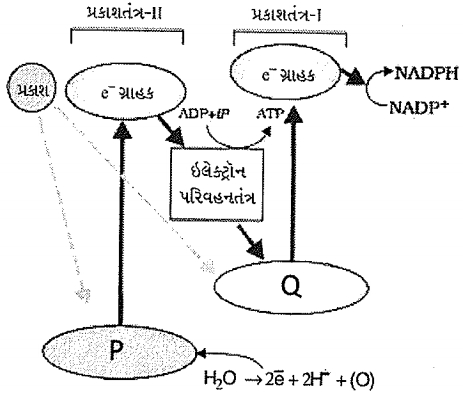
The following figure shows the $Z$-scheme of the light reaction. What are $P$ and $Q$?
A
$PS-I, PS-II$
B
$PS-II, PS-I$
C
Pigment-$a$,Accessory pigments
D
Accessory pigments,Pigment-$a$
Solution
(B) In the $Z$-scheme of light-dependent reactions,the process begins with the photolysis of water,which provides electrons to $PS-II$.
Therefore,$P$ represents $PS-II$.
After the electron transport chain,these electrons are transferred to $PS-I$ to replace the electrons lost during photoexcitation.
Therefore,$Q$ represents $PS-I$.
Thus,the correct sequence is $P = PS-II$ and $Q = PS-I$.
Therefore,$P$ represents $PS-II$.
After the electron transport chain,these electrons are transferred to $PS-I$ to replace the electrons lost during photoexcitation.
Therefore,$Q$ represents $PS-I$.
Thus,the correct sequence is $P = PS-II$ and $Q = PS-I$.
0 likes
View Solution352
MediumMCQ
Identify the correct pathway of electron transport in the $Z$-scheme.
A
$H_2O \rightarrow PS-II \rightarrow ETS \rightarrow PS-I \rightarrow NADP^+$
B
$H_2O \rightarrow PS-I \rightarrow ETS \rightarrow PS-II \rightarrow NADP^+$
C
$PS-I \rightarrow ETS \rightarrow PS-I$
D
$PS-II \rightarrow ETS \rightarrow PS-II$
Solution
(A) The $Z$-scheme represents the non-cyclic photophosphorylation process in photosynthesis.
$1$. Water $(H_2O)$ is split by photolysis at $PS-II$,releasing electrons.
$2$. These electrons are excited by light and transferred to the Electron Transport System $(ETS)$.
$3$. From the $ETS$,electrons are passed to $PS-I$.
$4$. Finally,electrons from $PS-I$ are transferred to $NADP^+$ to form $NADPH$.
Thus,the correct sequence is $H_2O \rightarrow PS-II \rightarrow ETS \rightarrow PS-I \rightarrow NADP^+$.
$1$. Water $(H_2O)$ is split by photolysis at $PS-II$,releasing electrons.
$2$. These electrons are excited by light and transferred to the Electron Transport System $(ETS)$.
$3$. From the $ETS$,electrons are passed to $PS-I$.
$4$. Finally,electrons from $PS-I$ are transferred to $NADP^+$ to form $NADPH$.
Thus,the correct sequence is $H_2O \rightarrow PS-II \rightarrow ETS \rightarrow PS-I \rightarrow NADP^+$.
0 likes
View Solution353
MediumMCQ
Select the correct option for the $ATP$ produced in the $Z-$scheme of the light reaction.
A
Oxidative phosphorylation
B
Photophosphorylation
C
Substrate-level phosphorylation
D
All of the above
Solution
(B) The $Z-$scheme represents the electron transport chain during the light-dependent reactions of photosynthesis.
In this process,light energy is used to drive the synthesis of $ATP$ from $ADP$ and inorganic phosphate $(Pi)$.
Since this synthesis of $ATP$ is driven by light energy,it is specifically termed as $Photophosphorylation$.
Oxidative phosphorylation occurs in mitochondria during cellular respiration,and substrate-level phosphorylation occurs in glycolysis and the Krebs cycle.
In this process,light energy is used to drive the synthesis of $ATP$ from $ADP$ and inorganic phosphate $(Pi)$.
Since this synthesis of $ATP$ is driven by light energy,it is specifically termed as $Photophosphorylation$.
Oxidative phosphorylation occurs in mitochondria during cellular respiration,and substrate-level phosphorylation occurs in glycolysis and the Krebs cycle.
0 likes
View Solution354
MediumMCQ
The electrons produced by the splitting of water are received by ......
A
$PS - I$
B
$PS - II$
C
$CO_2$
D
$C_6H_{12}O_6$
Solution
(B) During the light reaction of photosynthesis,water splitting (photolysis) occurs at the inner side of the thylakoid membrane.
This process releases electrons,protons $(H^+)$,and oxygen $(O_2)$.
The electrons released from the splitting of water are used to replace the electrons lost by the reaction center of $PS - II$ (P680) during the electron transport chain.
Therefore,the electrons produced by water splitting are received by $PS - II$.
This process releases electrons,protons $(H^+)$,and oxygen $(O_2)$.
The electrons released from the splitting of water are used to replace the electrons lost by the reaction center of $PS - II$ (P680) during the electron transport chain.
Therefore,the electrons produced by water splitting are received by $PS - II$.
0 likes
View Solution355
MediumMCQ
During the photolysis of water,which of the following is $NOT$ produced?
A
$O_2$
B
$H^+$
C
Electrons
D
$H_2$
Solution
(D) The photolysis of water (splitting of water) occurs in the lumen of the thylakoid during the light-dependent reactions of photosynthesis.
The reaction is represented as: $2H_2O \rightarrow 4H^+ + 4e^- + O_2$.
From this equation,it is clear that water splitting produces protons $(H^+)$,electrons $(e^-)$,and oxygen $(O_2)$.
Hydrogen gas $(H_2)$ is not produced during this process.
The reaction is represented as: $2H_2O \rightarrow 4H^+ + 4e^- + O_2$.
From this equation,it is clear that water splitting produces protons $(H^+)$,electrons $(e^-)$,and oxygen $(O_2)$.
Hydrogen gas $(H_2)$ is not produced during this process.
0 likes
View Solution356
MediumMCQ
Where does the release of oxygen occur in the chloroplast?
A
Intermembrane space
B
Stroma
C
Thylakoid lumen
D
All of the above
Solution
(C) During the light-dependent reactions of photosynthesis,the photolysis of water occurs.
This process takes place on the inner side of the thylakoid membrane,specifically within the thylakoid lumen.
As a result of the splitting of water molecules $(2H_2O \rightarrow 4H^+ + O_2 + 4e^-)$,oxygen is released into the thylakoid lumen.
This process takes place on the inner side of the thylakoid membrane,specifically within the thylakoid lumen.
As a result of the splitting of water molecules $(2H_2O \rightarrow 4H^+ + O_2 + 4e^-)$,oxygen is released into the thylakoid lumen.
0 likes
View Solution357
MediumMCQ
In which region of the chloroplast does cyclic photophosphorylation primarily occur?
A
Stroma lamellae
B
Thylakoid membrane
C
Stroma
D
Outer membrane of chloroplast
Solution
(A) Cyclic photophosphorylation involves only $PS-I$ and occurs when light of wavelength beyond $680 \ nm$ is available for excitation.
It takes place in the $Stroma \ lamellae$ of the chloroplast.
The $Stroma \ lamellae$ membranes lack both $PS-II$ and the enzyme $NADP$ reductase.
As a result,the cyclic flow of electrons results only in the synthesis of $ATP$,not $NADPH + H^+$,and no oxygen is evolved.
It takes place in the $Stroma \ lamellae$ of the chloroplast.
The $Stroma \ lamellae$ membranes lack both $PS-II$ and the enzyme $NADP$ reductase.
As a result,the cyclic flow of electrons results only in the synthesis of $ATP$,not $NADPH + H^+$,and no oxygen is evolved.
0 likes
View Solution358
MediumMCQ
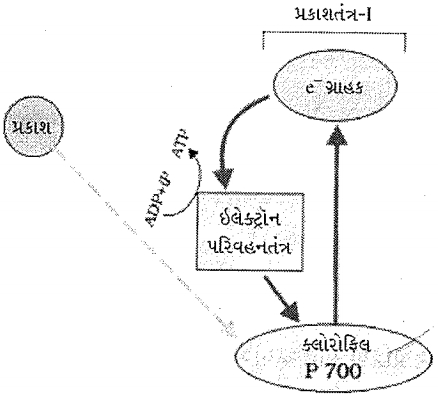
Identify the process shown in the given figure.
A
Non-cyclic photophosphorylation
B
Cyclic photophosphorylation
C
Cyclic photophosphorylation
D
Non-cyclic photophosphorylation
Solution
(B) The figure shows the movement of electrons starting from $P_{700}$ (Photosystem-$I$),passing through an electron transport system,and returning back to $P_{700}$.
Since the electron returns to the same reaction center,this process is known as cyclic photophosphorylation.
In this process,only $ATP$ is synthesized,and no $NADPH$ is produced. It occurs in the stroma lamellae.
Since the electron returns to the same reaction center,this process is known as cyclic photophosphorylation.
In this process,only $ATP$ is synthesized,and no $NADPH$ is produced. It occurs in the stroma lamellae.
0 likes
View Solution359
MediumMCQ
Which photosystem is involved in non-cyclic photophosphorylation?
A
Only $PS-I$
B
Only $PS-II$
C
Both $PS-I$ and $PS-II$
D
None of these
Solution
(C) In non-cyclic photophosphorylation,both photosystems,$PS-II$ and $PS-I$,work in series.
$1$. Electrons are released from $PS-II$ upon light absorption and travel through an electron transport chain to $PS-I$.
$2$. $PS-I$ then absorbs light,gets excited,and transfers electrons to $NADP^+$ to form $NADPH + H^+$.
$3$. Since the electrons lost by $PS-II$ are replaced by the photolysis of water,the flow of electrons is non-cyclic.
Therefore,both photosystems are required.
$1$. Electrons are released from $PS-II$ upon light absorption and travel through an electron transport chain to $PS-I$.
$2$. $PS-I$ then absorbs light,gets excited,and transfers electrons to $NADP^+$ to form $NADPH + H^+$.
$3$. Since the electrons lost by $PS-II$ are replaced by the photolysis of water,the flow of electrons is non-cyclic.
Therefore,both photosystems are required.
0 likes
View Solution360
MediumMCQ
Which photosystem is involved in cyclic photophosphorylation?
A
Only $PS-I$
B
Only $PS-II$
C
Both
D
None
Solution
(A) Cyclic photophosphorylation occurs when only light of wavelengths beyond $680 \ nm$ is available for excitation,or when the activity of $PS-II$ is inhibited.
In this process,the electron is circulated within the $PS-I$ photosystem.
The excited electron from the reaction center $P700$ of $PS-I$ is passed to an electron acceptor and then travels through the electron transport system back to $PS-I$.
During this transport,$ATP$ is synthesized from $ADP$ and inorganic phosphate.
Therefore,only $PS-I$ is involved in cyclic photophosphorylation.
In this process,the electron is circulated within the $PS-I$ photosystem.
The excited electron from the reaction center $P700$ of $PS-I$ is passed to an electron acceptor and then travels through the electron transport system back to $PS-I$.
During this transport,$ATP$ is synthesized from $ADP$ and inorganic phosphate.
Therefore,only $PS-I$ is involved in cyclic photophosphorylation.
0 likes
View Solution361
MediumMCQ
Select the correct option for cyclic photophosphorylation.
A
$O_2$ is not evolved.
B
$NADPH + H^+$ is not formed.
C
$ATP$ is formed.
D
All of the above.
Solution
(D) Cyclic photophosphorylation occurs in the stroma lamellae of chloroplasts.
In this process,only Photosystem $I$ $(PS I)$ is involved.
$1$. Since water splitting does not occur,$O_2$ is not evolved.
$2$. The electron transport chain leads to the synthesis of $ATP$,but $NADP$ reductase is absent,so $NADPH + H^+$ is not formed.
Therefore,all the given statements are correct.
In this process,only Photosystem $I$ $(PS I)$ is involved.
$1$. Since water splitting does not occur,$O_2$ is not evolved.
$2$. The electron transport chain leads to the synthesis of $ATP$,but $NADP$ reductase is absent,so $NADPH + H^+$ is not formed.
Therefore,all the given statements are correct.
0 likes
View Solution362
MediumMCQ
In which direction does the proton gradient develop in the chloroplast?
A
From the thylakoid lumen to the stroma
B
From the stroma to the thylakoid lumen
C
From the stroma to the intermembrane space
D
From the intermembrane space to the stroma
Solution
(B) During the light reaction of photosynthesis,protons ($H^+$ ions) are accumulated in the thylakoid lumen.
This accumulation occurs due to the photolysis of water $(H_2O \rightarrow 2H^+ + 1/2O_2 + 2e^-)$ inside the lumen and the pumping of protons from the stroma into the lumen by the cytochrome $b_6f$ complex.
As a result,the concentration of protons becomes much higher inside the thylakoid lumen compared to the stroma.
This creates a proton gradient across the thylakoid membrane,where the gradient is directed from the stroma to the thylakoid lumen.
This accumulation occurs due to the photolysis of water $(H_2O \rightarrow 2H^+ + 1/2O_2 + 2e^-)$ inside the lumen and the pumping of protons from the stroma into the lumen by the cytochrome $b_6f$ complex.
As a result,the concentration of protons becomes much higher inside the thylakoid lumen compared to the stroma.
This creates a proton gradient across the thylakoid membrane,where the gradient is directed from the stroma to the thylakoid lumen.
0 likes
View Solution363
MediumMCQ
Protons accumulate in the thylakoid lumen due to the . . . . . . .
A
Splitting of $NADPH + H^+$
B
Splitting of $H_2O$
C
Splitting of $C_6H_{12}O_6$
D
All of the above
Solution
(B) During the light reaction of photosynthesis,the photolysis (splitting) of water occurs on the inner side of the thylakoid membrane.
This reaction is represented as: $2H_2O \rightarrow 4H^+ + O_2 + 4e^-$.
As a result of this splitting,protons ($H^+$ ions) are released directly into the thylakoid lumen.
This accumulation of protons creates a proton gradient across the thylakoid membrane,which is essential for the synthesis of $ATP$ via $ATP$ synthase.
This reaction is represented as: $2H_2O \rightarrow 4H^+ + O_2 + 4e^-$.
As a result of this splitting,protons ($H^+$ ions) are released directly into the thylakoid lumen.
This accumulation of protons creates a proton gradient across the thylakoid membrane,which is essential for the synthesis of $ATP$ via $ATP$ synthase.
0 likes
View Solution364
MediumMCQ
Protons $(H^+)$ move from the thylakoid lumen to the stroma through which of the following?
A
$F_1$ particle
B
$F_0$ particle
C
Cytochrome $b$ and $f$
D
$PS-I$ and $PS-II$
Solution
(B) During the light reaction of photosynthesis,a proton gradient is created across the thylakoid membrane,with a higher concentration of $H^+$ in the lumen compared to the stroma.
This proton gradient is broken down when protons move across the membrane into the stroma through the transmembrane channel of the $ATP$ synthase enzyme.
The $ATP$ synthase enzyme consists of two parts: $F_0$ and $F_1$.
The $F_0$ part is embedded in the thylakoid membrane and forms a transmembrane channel that allows the facilitated diffusion of protons across the membrane.
The $F_1$ part protrudes towards the outer surface of the thylakoid membrane on the stroma side and contains the site for $ATP$ synthesis.
This proton gradient is broken down when protons move across the membrane into the stroma through the transmembrane channel of the $ATP$ synthase enzyme.
The $ATP$ synthase enzyme consists of two parts: $F_0$ and $F_1$.
The $F_0$ part is embedded in the thylakoid membrane and forms a transmembrane channel that allows the facilitated diffusion of protons across the membrane.
The $F_1$ part protrudes towards the outer surface of the thylakoid membrane on the stroma side and contains the site for $ATP$ synthesis.
0 likes
View Solution365
MediumMCQ
At which site of the $ATP$ synthase enzyme does $ATP$ synthesis occur?
A
$F_0$
B
$F_1$
C
$PS-I$
D
$PS-II$
Solution
(B) The $ATP$ synthase enzyme consists of two major components: $F_0$ and $F_1$.
$F_0$ is an integral membrane protein complex that forms a transmembrane channel,which allows protons to diffuse across the membrane.
$F_1$ is a peripheral membrane protein complex that protrudes into the stroma (in chloroplasts) or matrix (in mitochondria).
$ATP$ synthesis occurs at the $F_1$ headpiece,which contains the catalytic sites for the phosphorylation of $ADP$ to $ATP$ using the energy derived from the proton gradient.
$F_0$ is an integral membrane protein complex that forms a transmembrane channel,which allows protons to diffuse across the membrane.
$F_1$ is a peripheral membrane protein complex that protrudes into the stroma (in chloroplasts) or matrix (in mitochondria).
$ATP$ synthesis occurs at the $F_1$ headpiece,which contains the catalytic sites for the phosphorylation of $ADP$ to $ATP$ using the energy derived from the proton gradient.
0 likes
View Solution366
MediumMCQ
Chemiosmosis requires which of the following?
$I-$ Membrane,$II-$ Proton pump,$III-$ Proton gradient,$IV-$ $ATP$ synthase
$I-$ Membrane,$II-$ Proton pump,$III-$ Proton gradient,$IV-$ $ATP$ synthase
A
$III, IV$
B
$II, III, IV$
C
$I, II, III, IV$
D
$I, II, IV$
Solution
(C) Chemiosmosis is a process that requires four essential components to function effectively:
$1$. $A$ $Membrane$: It acts as a barrier to separate the two compartments and maintain the gradient.
$2$. $A$ $Proton \text{ } pump$: It is required to move protons across the membrane against their concentration gradient.
$3$. $A$ $Proton \text{ } gradient$: This is the potential energy stored due to the difference in proton concentration across the membrane.
$4$. $ATP \text{ } synthase$: This enzyme allows protons to diffuse back across the membrane, utilizing the energy released to synthesize $ATP$ from $ADP$ and inorganic phosphate.
Therefore, all four components $(I, II, III, IV)$ are necessary for chemiosmosis.
$1$. $A$ $Membrane$: It acts as a barrier to separate the two compartments and maintain the gradient.
$2$. $A$ $Proton \text{ } pump$: It is required to move protons across the membrane against their concentration gradient.
$3$. $A$ $Proton \text{ } gradient$: This is the potential energy stored due to the difference in proton concentration across the membrane.
$4$. $ATP \text{ } synthase$: This enzyme allows protons to diffuse back across the membrane, utilizing the energy released to synthesize $ATP$ from $ADP$ and inorganic phosphate.
Therefore, all four components $(I, II, III, IV)$ are necessary for chemiosmosis.
0 likes
View Solution367
MediumMCQ
State the location of $F_1$ particles.
A
Protruding towards the inner surface of the thylakoid membrane
B
Embedded in the thylakoid membrane
C
Protruding towards the outer surface of the thylakoid membrane
D
All of the above
Solution
(C) The $F_0-F_1$ $ATP$ synthase complex is involved in the synthesis of $ATP$ during photosynthesis.
It consists of two parts: $F_0$ and $F_1$.
The $F_0$ part is a transmembrane protein that is embedded in the thylakoid membrane and forms a proton channel.
The $F_1$ part is a peripheral membrane protein complex that protrudes towards the outer surface (stroma side) of the thylakoid membrane.
This $F_1$ headpiece contains the catalytic sites for $ATP$ synthesis.
It consists of two parts: $F_0$ and $F_1$.
The $F_0$ part is a transmembrane protein that is embedded in the thylakoid membrane and forms a proton channel.
The $F_1$ part is a peripheral membrane protein complex that protrudes towards the outer surface (stroma side) of the thylakoid membrane.
This $F_1$ headpiece contains the catalytic sites for $ATP$ synthesis.
0 likes
View Solution368
MediumMCQ
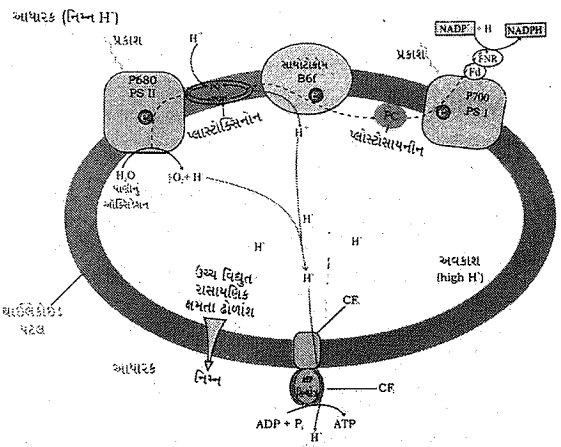
What does the given figure represent?
A
Light reaction
B
Dark reaction
C
Krebs cycle
D
Both $A$ and $B$
Solution
(A) The provided figure illustrates the $Z$-scheme of electron transport and the chemiosmotic hypothesis occurring in the thylakoid membrane of the chloroplast.
This process involves the light-dependent reactions of photosynthesis,where light energy is used to split water,generate a proton gradient across the thylakoid membrane,and synthesize $ATP$ and $NADPH$.
Therefore,the figure represents the light reaction.
This process involves the light-dependent reactions of photosynthesis,where light energy is used to split water,generate a proton gradient across the thylakoid membrane,and synthesize $ATP$ and $NADPH$.
Therefore,the figure represents the light reaction.
0 likes
View Solution369
DifficultMCQ
Identify the correct statements regarding chemiosmotic hypothesis :
$(a)$ Splitting of the water molecule takes place on the inner side of the membrane.
$(b)$ Protons accumulate within the lumen of the thylakoids.
$(c)$ Primary acceptor of electron transfers the electrons to an electron carrier.
$(d)$ $NADP$ reductase enzyme is located on the stroma side of the membrane.
$(e)$ Protons increase in number in stroma.
Choose the correct answer from the options given below:
$(a)$ Splitting of the water molecule takes place on the inner side of the membrane.
$(b)$ Protons accumulate within the lumen of the thylakoids.
$(c)$ Primary acceptor of electron transfers the electrons to an electron carrier.
$(d)$ $NADP$ reductase enzyme is located on the stroma side of the membrane.
$(e)$ Protons increase in number in stroma.
Choose the correct answer from the options given below:
A
$(a), (b)$ and $(e)$
B
$(a), (b)$ and $(d)$
C
$(b), (c)$ and $(d)$
D
$(b), (c)$ and $(e)$
Solution
(B) According to the chemiosmotic hypothesis,$ATP$ synthesis is linked to the development of a proton gradient across the thylakoid membrane.
$(a)$ The splitting of water molecules occurs on the inner side of the thylakoid membrane,which releases protons $(H^+)$ into the lumen.
$(b)$ Protons accumulate within the lumen of the thylakoids due to water splitting and the pumping of protons from the stroma.
$(c)$ The primary electron acceptor transfers electrons to an electron transport system,which facilitates the movement of protons.
$(d)$ The $NADP$ reductase enzyme is located on the stroma side of the membrane. It uses electrons from $Fd$ and protons from the stroma to reduce $NADP^+$ to $NADPH + H^+$.
$(e)$ Protons decrease in number in the stroma because they are consumed by $NADP$ reductase and pumped into the lumen,making this statement incorrect.
Therefore,statements $(a), (b),$ and $(d)$ are correct.
$(a)$ The splitting of water molecules occurs on the inner side of the thylakoid membrane,which releases protons $(H^+)$ into the lumen.
$(b)$ Protons accumulate within the lumen of the thylakoids due to water splitting and the pumping of protons from the stroma.
$(c)$ The primary electron acceptor transfers electrons to an electron transport system,which facilitates the movement of protons.
$(d)$ The $NADP$ reductase enzyme is located on the stroma side of the membrane. It uses electrons from $Fd$ and protons from the stroma to reduce $NADP^+$ to $NADPH + H^+$.
$(e)$ Protons decrease in number in the stroma because they are consumed by $NADP$ reductase and pumped into the lumen,making this statement incorrect.
Therefore,statements $(a), (b),$ and $(d)$ are correct.
0 likes
View Solution370
MediumMCQ
The reaction centre in $PS$ $II$ has an absorption maxima at $............\,nm$.
A
$780$
B
$680$
C
$700$
D
$660$
Solution
(B) In $PS-I$,the reaction centre chlorophyll $a$ has an absorption peak at $700\,nm$.
In $PS-II$,the reaction centre chlorophyll $a$ has an absorption maxima at $680\,nm$.
In $PS-II$,the reaction centre chlorophyll $a$ has an absorption maxima at $680\,nm$.
0 likes
View Solution371
MediumMCQ
Which of the following combinations is required for chemiosmosis?
A
Proton pump,electron gradient,$NADP$ synthase
B
Membrane,proton pump,proton gradient,$ATP$ synthase
C
Membrane,proton pump,proton gradient,$NADP$ synthase
D
Proton pump,electron gradient,$ATP$ synthase
Solution
(B) Chemiosmosis is the movement of ions across a semi-permeable membrane down their electrochemical gradient.
In photosynthesis,it specifically requires:
$1$. $A$ membrane (e.g.,the thylakoid membrane).
$2$. $A$ proton pump (to create a proton gradient).
$3$. $A$ proton gradient (accumulation of $H^+$ ions in the lumen).
$4$. $ATP$ synthase (the enzyme that uses the energy of the proton gradient to synthesize $ATP$ from $ADP$ and inorganic phosphate).
In photosynthesis,it specifically requires:
$1$. $A$ membrane (e.g.,the thylakoid membrane).
$2$. $A$ proton pump (to create a proton gradient).
$3$. $A$ proton gradient (accumulation of $H^+$ ions in the lumen).
$4$. $ATP$ synthase (the enzyme that uses the energy of the proton gradient to synthesize $ATP$ from $ADP$ and inorganic phosphate).
0 likes
View Solution372
MediumMCQ
The membrane of the thylakoids encloses a space called as $......$
A
Lamella
B
Lumen
C
Grana
D
Stroma
Solution
(B) The chloroplasts contain flattened membranous sacs called thylakoids arranged in stacks like piles of coins called grana.
The membrane of the thylakoids encloses a space called the lumen.
This lumen is involved in the accumulation of protons during the light-dependent reactions of photosynthesis.
The membrane of the thylakoids encloses a space called the lumen.
This lumen is involved in the accumulation of protons during the light-dependent reactions of photosynthesis.
0 likes
View Solution373
MediumMCQ
Assertion $(A) :-$ The whole scheme of transfer of electrons starting from $PS-II$ to $NADP^{+}$ is called $Z-scheme$.
Reason $(R) :-$ When all the carriers of this scheme are placed in sequence on a redox potential scale,they appear like $Z$.
In the light of the above statements,choose the correct answer from the options given below:
Reason $(R) :-$ When all the carriers of this scheme are placed in sequence on a redox potential scale,they appear like $Z$.
In the light of the above statements,choose the correct answer from the options given below:
A
Both $A$ and $R$ are true but $R$ is $NOT$ the correct explanation of $A$.
B
$A$ is true but $R$ is false.
C
$A$ is false but $R$ is true.
D
Both $A$ and $R$ are true and $R$ is the correct explanation of $A$.
Solution
(D) The electron transport chain in the light reaction of photosynthesis involves the movement of electrons from $PS-II$ through various carriers (plastoquinone,cytochrome complex,plastocyanin) to $PS-I$ and finally to $NADP^{+}$.
This entire process is known as the $Z-scheme$ due to its characteristic shape.
When these electron carriers are arranged in a sequence based on their redox potential (from negative to positive values),the resulting diagram takes the shape of the letter $Z$.
Therefore,both the assertion and the reason are true,and the reason correctly explains why it is called the $Z-scheme$.
This entire process is known as the $Z-scheme$ due to its characteristic shape.
When these electron carriers are arranged in a sequence based on their redox potential (from negative to positive values),the resulting diagram takes the shape of the letter $Z$.
Therefore,both the assertion and the reason are true,and the reason correctly explains why it is called the $Z-scheme$.
0 likes
View Solution374
MediumMCQ
In photosynthesis, which phase involves the following phenomena?
$(I)$ Water is split $(photolysis)$
$(II)$ Oxygen is liberated
$(III)$ $NADPH$ is formed
$(I)$ Water is split $(photolysis)$
$(II)$ Oxygen is liberated
$(III)$ $NADPH$ is formed
A
$I$ and $II$ in photochemical phase while $III$ in biosynthetic phase
B
$I$ in photochemical phase while $II$ and $III$ in biosynthetic phase
C
$I, II,$ and $III$ in photochemical phase
D
$I, II,$ and $III$ in biosynthetic phase
Solution
(C) In photosynthesis, the light-dependent reaction (photochemical phase) occurs in the thylakoid membranes of the chloroplast.
During this phase, the following events take place:
$1$. Photolysis of water: Water molecules are split into protons $(H^+)$, electrons $(e^-)$, and oxygen $(O_2)$.
$2$. Liberation of oxygen: Oxygen is released as a byproduct of water splitting.
$3$. Formation of $NADPH$: Electrons are transferred through the electron transport chain to $NADP^+$, reducing it to $NADPH$.
Since all three processes ($I, II,$ and $III$) occur during the light-dependent reactions, option $C$ is correct.
During this phase, the following events take place:
$1$. Photolysis of water: Water molecules are split into protons $(H^+)$, electrons $(e^-)$, and oxygen $(O_2)$.
$2$. Liberation of oxygen: Oxygen is released as a byproduct of water splitting.
$3$. Formation of $NADPH$: Electrons are transferred through the electron transport chain to $NADP^+$, reducing it to $NADPH$.
Since all three processes ($I, II,$ and $III$) occur during the light-dependent reactions, option $C$ is correct.
0 likes
View Solution375
MediumMCQ
Assertion $(A) : H^+$ gradient across the thylakoid membrane is essential for the formation of $\text{ATP}$.
Reason $(R) :$ Breakdown of $H^+$ gradient due to the movement of protons through $F_0$ of $\text{ATP}$ synthase releases enough energy to activate $\text{ATP}$ synthase enzyme that catalyses the formation of $\text{ATP}$.
Reason $(R) :$ Breakdown of $H^+$ gradient due to the movement of protons through $F_0$ of $\text{ATP}$ synthase releases enough energy to activate $\text{ATP}$ synthase enzyme that catalyses the formation of $\text{ATP}$.
A
$A$ and $R$ are true and $R$ is the correct explanation of $A$.
B
$A$ and $R$ are true but $R$ is not the correct explanation of $A$.
C
$A$ is true,$R$ is false.
D
$A$ is false,$R$ is true.
Solution
(A) The chemiosmotic hypothesis explains the mechanism of $\text{ATP}$ synthesis in chloroplasts.
$1$. $A$ proton gradient ($H^+$ gradient) is created across the thylakoid membrane due to the photolysis of water,electron transport,and the pumping of protons into the lumen.
$2$. This gradient is essential because the potential energy stored in the proton gradient drives the synthesis of $\text{ATP}$.
$3$. The breakdown of this gradient occurs when protons move from the thylakoid lumen to the stroma through the $F_0$ channel of the $\text{ATP}$ synthase enzyme.
$4$. This movement releases sufficient energy to induce a conformational change in the $F_1$ particle of the $\text{ATP}$ synthase,which activates the enzyme to catalyze the phosphorylation of $\text{ADP}$ to form $\text{ATP}$.
Therefore,both the assertion and the reason are true,and the reason correctly explains the assertion.
$1$. $A$ proton gradient ($H^+$ gradient) is created across the thylakoid membrane due to the photolysis of water,electron transport,and the pumping of protons into the lumen.
$2$. This gradient is essential because the potential energy stored in the proton gradient drives the synthesis of $\text{ATP}$.
$3$. The breakdown of this gradient occurs when protons move from the thylakoid lumen to the stroma through the $F_0$ channel of the $\text{ATP}$ synthase enzyme.
$4$. This movement releases sufficient energy to induce a conformational change in the $F_1$ particle of the $\text{ATP}$ synthase,which activates the enzyme to catalyze the phosphorylation of $\text{ADP}$ to form $\text{ATP}$.
Therefore,both the assertion and the reason are true,and the reason correctly explains the assertion.
0 likes
View Solution376
MediumMCQ
The electrons needed to replace those removed from photosystem $I$ are provided by $:$
A
$NADPH+H^{+}$
B
Ferredoxin
C
$PS \ II$
D
$H_2 O$
Solution
(C) In the $Z$-scheme of light reaction,electrons are excited from photosystem $I$ $(PS \ I)$ and are eventually used to reduce $NADP^+$ to $NADPH+H^+$.
To maintain the continuous flow of electrons,the electrons lost by $PS \ I$ are replaced by electrons coming from photosystem $II$ $(PS \ II)$ through the electron transport chain.
Photosystem $II$ $(PS \ II)$ itself gets its electrons replaced by the photolysis of water $(H_2 O)$.
To maintain the continuous flow of electrons,the electrons lost by $PS \ I$ are replaced by electrons coming from photosystem $II$ $(PS \ II)$ through the electron transport chain.
Photosystem $II$ $(PS \ II)$ itself gets its electrons replaced by the photolysis of water $(H_2 O)$.
0 likes
View Solution377
MediumMCQ
Photosystem $I$ $(PS I)$ and photosystem $II$ $(PS II)$ are named:
A
in the sequence of their discovery
B
in the sequence in which they function during light reaction
C
in the sequence of their positions
D
in the sequence of electron transfer
Solution
(A) Photosystems are functional units of the light-dependent reactions of photosynthesis.
Although $PS II$ functions first in the non-cyclic electron transport chain ($Z$-scheme) to split water and provide electrons,it was discovered after $PS I$.
Therefore,the naming of $PS I$ and $PS II$ is based on the chronological order of their discovery,not the order in which they function in the light reaction.
Although $PS II$ functions first in the non-cyclic electron transport chain ($Z$-scheme) to split water and provide electrons,it was discovered after $PS I$.
Therefore,the naming of $PS I$ and $PS II$ is based on the chronological order of their discovery,not the order in which they function in the light reaction.
0 likes
View Solution378
MediumMCQ
Water splitting complex is physically located:
A
on outer side of granal thylakoid membrane
B
on outer side of stromal thylakoid membrane
C
on inner side of stromal thylakoid membrane
D
on inner side of granal thylakoid membrane
Solution
(D) The water-splitting complex,also known as the Oxygen Evolving Complex $(OEC)$,is associated with Photosystem $II$ $(PSII)$.
$PSII$ is primarily located in the appressed regions of the thylakoid membranes,known as the grana.
The water-splitting reaction involves the photolysis of water to release electrons,protons $(H^+)$,and oxygen $(O_2)$.
For the efficient release of protons into the thylakoid lumen to create a proton gradient,the water-splitting complex is physically located on the inner side (lumenal side) of the granal thylakoid membrane.
$PSII$ is primarily located in the appressed regions of the thylakoid membranes,known as the grana.
The water-splitting reaction involves the photolysis of water to release electrons,protons $(H^+)$,and oxygen $(O_2)$.
For the efficient release of protons into the thylakoid lumen to create a proton gradient,the water-splitting complex is physically located on the inner side (lumenal side) of the granal thylakoid membrane.
0 likes
View Solution379
MediumMCQ
Assertion : Non-cyclic photophosphorylation is also called as $Z$-scheme.
Reason : When all the carriers are placed in a sequence on a redox potential scale,it gives its characteristic shape.
Reason : When all the carriers are placed in a sequence on a redox potential scale,it gives its characteristic shape.
A
Both Assertion and Reason are True and Reason is the correct explanation of the Assertion.
B
Both Assertion and Reason are True but Reason is not the correct explanation of the Assertion.
C
Assertion is True but Reason is False.
D
Both Assertion and Reason are False.
Solution
(A) In non-cyclic photophosphorylation,the electron transport chain involves the movement of electrons from $PSII$ to $PSI$ and finally to $NADP^+$.
When these electron carriers are arranged in a sequence based on their redox potential values,the resulting diagram resembles the letter '$Z$'.
Therefore,this process is commonly referred to as the '$Z$-scheme'.
Both the assertion and the reason are correct,and the reason provides the correct explanation for why it is named the '$Z$-scheme'.
When these electron carriers are arranged in a sequence based on their redox potential values,the resulting diagram resembles the letter '$Z$'.
Therefore,this process is commonly referred to as the '$Z$-scheme'.
Both the assertion and the reason are correct,and the reason provides the correct explanation for why it is named the '$Z$-scheme'.
0 likes
View Solution380
EasyMCQ
During chemiosmotic synthesis of $ATP$ in photosynthesis,
A
the protons accumulate in the intermembrane space of chloroplast
B
the proton gradient is not required
C
the protons accumulate in the intermembrane space of mitochondrion
D
the protons accumulate within the lumen of the thylakoids
Solution
(D) The correct answer is $D$.
In photosynthesis,$ATP$ synthesis is linked to the development of a proton gradient across the thylakoid membrane.
During the light reaction,protons ($H^+$ ions) are actively pumped into the lumen of the thylakoids.
This accumulation of protons creates a high concentration of $H^+$ inside the lumen compared to the stroma,resulting in a proton gradient.
The movement of these protons back into the stroma through the $CF_0-CF_1$ $ATP$ synthase enzyme provides the energy required for the phosphorylation of $ADP$ to form $ATP$.
In photosynthesis,$ATP$ synthesis is linked to the development of a proton gradient across the thylakoid membrane.
During the light reaction,protons ($H^+$ ions) are actively pumped into the lumen of the thylakoids.
This accumulation of protons creates a high concentration of $H^+$ inside the lumen compared to the stroma,resulting in a proton gradient.
The movement of these protons back into the stroma through the $CF_0-CF_1$ $ATP$ synthase enzyme provides the energy required for the phosphorylation of $ADP$ to form $ATP$.
0 likes
View Solution381
EasyMCQ
Electrons from excited chlorophyll molecules of photosystem $II$ are accepted first by
A
ferredoxin
B
phaeophytin
C
cytochrome $b$
D
cytochrome $f$
Solution
(B) The correct answer is $B$.
Electrons from excited chlorophyll molecules of photosystem $II$ ($PS$ $II$) are first accepted by phaeophytin.
Phaeophytin acts as the primary electron acceptor in the light-dependent reactions of photosynthesis.
After receiving the electrons,phaeophytin transfers them to the plastoquinone $(PQ)$ pool,which then initiates the electron transport chain.
Electrons from excited chlorophyll molecules of photosystem $II$ ($PS$ $II$) are first accepted by phaeophytin.
Phaeophytin acts as the primary electron acceptor in the light-dependent reactions of photosynthesis.
After receiving the electrons,phaeophytin transfers them to the plastoquinone $(PQ)$ pool,which then initiates the electron transport chain.
0 likes
View Solution382
EasyMCQ
Which one of the following statements about the events of non-cyclic photophosphorylation is not correct?
A
Only one photosystem participates
B
$ATP$ and $NADPH$ are not produced
C
Photolysis of water takes place
D
$O_2$ is released
Solution
(A) The correct answer is $A$.
In non-cyclic photophosphorylation,both photosystems ($PS \ I$ and $PS \ II$) participate in the electron transport chain.
Option $B$ is incorrect because both $ATP$ and $NADPH$ are produced during this process.
Photolysis of water occurs at $PS \ II$ to provide electrons,and as a byproduct,$O_2$ is released.
In non-cyclic photophosphorylation,both photosystems ($PS \ I$ and $PS \ II$) participate in the electron transport chain.
Option $B$ is incorrect because both $ATP$ and $NADPH$ are produced during this process.
Photolysis of water occurs at $PS \ II$ to provide electrons,and as a byproduct,$O_2$ is released.
0 likes
View SolutionPhotosynthesis in Higher Plants — Light reaction · Frequently Asked Questions
1Are these Photosynthesis in Higher Plants questions useful for JEE and NEET?
Yes. All questions in this section are mapped to JEE Main and NEET exam patterns. Previous year questions from JEE Main, NEET, GUJCET and state-level exams are included with full solutions.
2Can I switch to Hindi or Gujarati for these questions?
Yes. Use the language tabs in the hero section or the sidebar to view the same questions and solutions in English, Hindi or Gujarati.
3How do I generate a question paper from this subtopic?
Use the Vedclass Exam Paper Generator — select the chapter and subtopic, set difficulty, and generate Sets A, B, C, D automatically. First 3 chapters of every subject are free.
Vedclass Products
For Students
Vedclass Test Series
Mock tests in real JEE/NEET style with performance analysis. 5-day free trial.
Start Free TrialFor Teachers
Exam Paper Generator
Generate Set A/B/C/D papers from this chapter in 2 minutes. 3 chapters free.
Try FreeFor Institutes
Online Exam Module
Live online exams with unlimited students, 360° analytics & white-label branding.
See DemoFor Teachers & Institutes
Generate a Photosynthesis in Higher Plants Exam Paper in 2 Minutes
Select subtopic & difficulty — Sets A, B, C, D auto-generated with No Repeat logic.
First 3 chapters of every subject are free — no payment required.