
A English
Factors affecting photosynthesis Questions in English
Class 11 Biology · Photosynthesis in Higher Plants · Factors affecting photosynthesis
144+
Questions
English
Language
100%
With Solutions
Showing 44 of 144 questions in English
101
Medium
Why does the rate of photosynthesis decrease at higher temperatures?
Solution
(N/A) Photosynthesis is a process catalyzed by enzymes. Each enzyme functions optimally within a specific temperature range. When the temperature increases beyond this optimal level (typically $25-35^{\circ}C$),the enzymes undergo denaturation or lose their functional efficiency. Consequently,the rate of photosynthesis decreases.
0 likes
View Solution102
MediumMCQ
What is the relationship between habitat and temperature in the context of photosynthesis?
A
Temperature optimum is independent of the habitat.
B
Tropical plants have a lower temperature optimum than temperate plants.
C
The temperature optimum for photosynthesis depends on the habitat to which the plant is adapted.
D
All plants have the same temperature optimum regardless of their habitat.
Solution
(C) The temperature optimum for photosynthesis in different plants depends on the habitat to which they are adapted.
- $C_{4}$ plants generally respond to higher temperatures and exhibit a higher rate of photosynthesis compared to $C_{3}$ plants.
- $C_{3}$ plants typically have a much lower temperature optimum for photosynthesis.
- For example,plants native to tropical regions have a higher temperature optimum compared to plants adapted to temperate climates,as their enzymes and metabolic processes are evolved to function efficiently at those specific environmental temperatures.
- $C_{4}$ plants generally respond to higher temperatures and exhibit a higher rate of photosynthesis compared to $C_{3}$ plants.
- $C_{3}$ plants typically have a much lower temperature optimum for photosynthesis.
- For example,plants native to tropical regions have a higher temperature optimum compared to plants adapted to temperate climates,as their enzymes and metabolic processes are evolved to function efficiently at those specific environmental temperatures.
0 likes
View Solution103
MediumMCQ
What damage occurs in plants due to water stress?
A
Stomata remain open
B
Increased $CO_{2}$ availability
C
Stomata close and leaves wilt
D
Increased metabolic activity
Solution
(C) Water stress causes the stomata to close.
- This reduces the $CO_{2}$ availability for photosynthesis.
- Besides,water stress also causes leaves to wilt.
- This reduces the surface area of the leaves and their metabolic activity as well.
- This reduces the $CO_{2}$ availability for photosynthesis.
- Besides,water stress also causes leaves to wilt.
- This reduces the surface area of the leaves and their metabolic activity as well.
0 likes
View Solution104
Medium
Does moonlight support photosynthesis? Find out.
Solution
(N/A) Plants cannot perform photosynthesis in moonlight because moonlight does not have sufficient intensity or energy to stimulate chlorophyll molecules.
Photosynthesis requires light of a specific intensity to initiate the light-dependent reactions.
Since moonlight is reflected sunlight with very low intensity,it fails to trigger the electron transport chain in $PS-I$ and $PS-II$.
Therefore,photosynthesis does not occur under moonlight conditions.
Photosynthesis requires light of a specific intensity to initiate the light-dependent reactions.
Since moonlight is reflected sunlight with very low intensity,it fails to trigger the electron transport chain in $PS-I$ and $PS-II$.
Therefore,photosynthesis does not occur under moonlight conditions.
0 likes
View Solution105
Medium
How can plants be grown under limited water supply without compromising on metabolic activities?
Solution
(N/A) Plants adapt to limited water supply by reducing the rate of transpiration through the closure of stomata.
Despite this reduction in water loss,they continue to perform essential metabolic activities such as photosynthesis,respiration,and the translocation of food materials.
By regulating stomatal aperture,plants maintain internal water potential to sustain these vital physiological processes even under water-stressed conditions.
Despite this reduction in water loss,they continue to perform essential metabolic activities such as photosynthesis,respiration,and the translocation of food materials.
By regulating stomatal aperture,plants maintain internal water potential to sustain these vital physiological processes even under water-stressed conditions.
0 likes
View Solution106
MediumMCQ
Which adaptations do plants possess to prevent transpiration?
A
Shedding leaves
B
Developing $CAM$ pathway
C
Keeping stomata closed during the day
D
All of the above
Solution
(D) Plants living in arid or water-scarce environments have evolved several adaptations to minimize water loss through transpiration:
$1$. Shedding leaves: Many desert plants shed their leaves during dry seasons to reduce the surface area available for transpiration.
$2$. $CAM$ (Crassulacean Acid Metabolism) pathway: This is a specialized photosynthetic adaptation where plants open their stomata at night to take in $CO_2$ and keep them closed during the hot,dry day to prevent water loss.
$3$. Stomatal regulation: Keeping stomata closed during the day is a direct mechanism to reduce transpiration rates in high-temperature environments.
Therefore,all the mentioned options are correct adaptations.
$1$. Shedding leaves: Many desert plants shed their leaves during dry seasons to reduce the surface area available for transpiration.
$2$. $CAM$ (Crassulacean Acid Metabolism) pathway: This is a specialized photosynthetic adaptation where plants open their stomata at night to take in $CO_2$ and keep them closed during the hot,dry day to prevent water loss.
$3$. Stomatal regulation: Keeping stomata closed during the day is a direct mechanism to reduce transpiration rates in high-temperature environments.
Therefore,all the mentioned options are correct adaptations.
0 likes
View Solution107
MediumMCQ
$C_{3}$-plants show optimum photosynthesis at
A
High $O_{2}$
B
High $CO_{2}$
C
Low $O_{2}$
D
High temperature $45^{\circ}C$
Solution
(B) $C_{3}$-plants exhibit optimum rates of photosynthesis under conditions of high $CO_{2}$ concentration. This is because $C_{3}$-plants are prone to photorespiration,a process where the enzyme $RuBisCO$ binds with $O_{2}$ instead of $CO_{2}$. By increasing the concentration of $CO_{2}$,the probability of $RuBisCO$ binding with $CO_{2}$ increases,thereby minimizing photorespiration and maximizing the efficiency of the Calvin cycle.
0 likes
View Solution108
MediumMCQ
The concentration of $CO_{2}$ in the atmosphere is between
A
$0.03-0.04 \%$
B
$300-400 \;ppm$
C
$400-600 \;ppm$
D
Either $(a)$ or $(b)$
Solution
(D) Carbon dioxide is a major limiting factor for photosynthesis.
The concentration of $CO_{2}$ in the atmosphere is very low,ranging between $0.03-0.04 \%$ or $300-400 \;ppm$.
An increase in concentration up to $0.05 \%$ can cause an increase in $CO_{2}$ fixation rates.
Beyond this level,high concentrations can become damaging to plants over longer periods.
The concentration of $CO_{2}$ in the atmosphere is very low,ranging between $0.03-0.04 \%$ or $300-400 \;ppm$.
An increase in concentration up to $0.05 \%$ can cause an increase in $CO_{2}$ fixation rates.
Beyond this level,high concentrations can become damaging to plants over longer periods.
0 likes
View Solution109
MediumMCQ
Which of the following factors affecting photosynthesis does not have a direct effect on the process?
$I$. Light
$II$. Water
$III$. Temperature
$IV$. Carbon Dioxide
Select the correct option.
$I$. Light
$II$. Water
$III$. Temperature
$IV$. Carbon Dioxide
Select the correct option.
A
$I$
B
$II$
C
$III$
D
$IV$
Solution
(B) Photosynthesis is influenced by several external factors,including light,temperature,$CO_2$ concentration,and water.
$1$. Light: Light is an essential factor for photosynthesis. It affects the rate directly through its intensity,quality,and duration.
$2$. Carbon Dioxide $(CO_2)$: $CO_2$ is a major limiting factor. It is directly involved as a substrate in the Calvin cycle (dark reactions) for the synthesis of carbohydrates.
$3$. Temperature: The dark reactions of photosynthesis are enzymatic and are directly controlled by temperature. The light reactions are also temperature-sensitive,though to a lesser extent.
$4$. Water: Water is a reactant in photosynthesis,but its effect on the process is primarily indirect. Water stress causes the stomata to close,which reduces $CO_2$ availability for gaseous exchange. Additionally,water stress causes leaves to wilt,reducing the surface area available for photosynthesis and decreasing metabolic activity. Therefore,water acts more through its physiological effect on the plant rather than directly on the photosynthetic machinery.
$1$. Light: Light is an essential factor for photosynthesis. It affects the rate directly through its intensity,quality,and duration.
$2$. Carbon Dioxide $(CO_2)$: $CO_2$ is a major limiting factor. It is directly involved as a substrate in the Calvin cycle (dark reactions) for the synthesis of carbohydrates.
$3$. Temperature: The dark reactions of photosynthesis are enzymatic and are directly controlled by temperature. The light reactions are also temperature-sensitive,though to a lesser extent.
$4$. Water: Water is a reactant in photosynthesis,but its effect on the process is primarily indirect. Water stress causes the stomata to close,which reduces $CO_2$ availability for gaseous exchange. Additionally,water stress causes leaves to wilt,reducing the surface area available for photosynthesis and decreasing metabolic activity. Therefore,water acts more through its physiological effect on the plant rather than directly on the photosynthetic machinery.
0 likes
View Solution110
MediumMCQ
Which is the most important limiting factor in normal conditions for photosynthesis?
A
Light
B
Carbon dioxide
C
Water
D
Temperature
Solution
(B) The Law of Limiting Factors was proposed by Blackman in $1905$.
He stated that when a process is conditioned as to its rate by a number of separate factors,the rate of the process is determined by the pace of the slowest factor.
Carbon dioxide is usually the most important limiting factor in photosynthesis under normal field conditions,particularly on clear summer days when light and water are available in adequate amounts.
He stated that when a process is conditioned as to its rate by a number of separate factors,the rate of the process is determined by the pace of the slowest factor.
Carbon dioxide is usually the most important limiting factor in photosynthesis under normal field conditions,particularly on clear summer days when light and water are available in adequate amounts.
0 likes
View Solution111
MediumMCQ
The correct sequence of the rate of photosynthesis in different light wavelengths is:
A
Red $>$ Blue $>$ Green
B
Blue $>$ Red $>$ Green
C
Green $>$ Blue $>$ Red
D
Green $>$ Red $>$ Blue
Solution
(A) The rate of photosynthesis is dependent on the absorption spectrum of chlorophyll pigments.
Chlorophyll $a$ and $b$ show maximum absorption in the red and blue regions of the visible spectrum.
Experimental data indicates that the rate of photosynthesis is highest in red light $(660 \; nm)$,followed by blue light $(440 \; nm)$.
Green light is largely reflected or transmitted by leaves,resulting in the minimum rate of photosynthesis.
Therefore,the correct sequence is Red $>$ Blue $>$ Green.
Chlorophyll $a$ and $b$ show maximum absorption in the red and blue regions of the visible spectrum.
Experimental data indicates that the rate of photosynthesis is highest in red light $(660 \; nm)$,followed by blue light $(440 \; nm)$.
Green light is largely reflected or transmitted by leaves,resulting in the minimum rate of photosynthesis.
Therefore,the correct sequence is Red $>$ Blue $>$ Green.
0 likes
View Solution112
MediumMCQ
If a chemical process is affected by more than one factor,then its rate will be determined by:
A
Two closely related factors
B
Only one factor,which is close to its minimal value
C
Only one factor,which is close to its maximum value
D
Only one factor,which is close to its appropriate value
Solution
(B) The rate of a chemical process is determined by the factor that is closest to its minimal value. This is known as the $Law$ $of$ $Limiting$ $Factors$,proposed by $F. F.$ $Blackman$ in $1905$. It states that when a process is conditioned by a number of separate factors,the rate of the process is limited by the pace of the slowest factor,i.e.,the factor present in the minimum amount relative to its requirement.
0 likes
View Solution113
MediumMCQ
Water stress causes the stomata to $A$ hence reducing the $B$ availability. Here $A$ and $B$ refer to:
A
$A$-open; $B-H_{2}O$
B
$A$-close; $B-H_{2}O$
C
$A$-close; $B-CO_{2}$
D
$A$-open; $B-CO_{2}$
Solution
(C) The correct answer is $C$.
Water stress occurs when the plant lacks sufficient water.
To prevent excessive water loss through transpiration,the guard cells lose turgidity,causing the stomata to close ($A$-close).
Since the stomata are the primary sites for gas exchange,their closure prevents the entry of atmospheric carbon dioxide into the leaf.
Therefore,this reduces the availability of $CO_{2}$ $(B-CO_{2})$ for the process of photosynthesis.
Water stress occurs when the plant lacks sufficient water.
To prevent excessive water loss through transpiration,the guard cells lose turgidity,causing the stomata to close ($A$-close).
Since the stomata are the primary sites for gas exchange,their closure prevents the entry of atmospheric carbon dioxide into the leaf.
Therefore,this reduces the availability of $CO_{2}$ $(B-CO_{2})$ for the process of photosynthesis.
0 likes
View Solution114
MediumMCQ
Beyond the saturation point,the rate of photosynthesis begins to decline because of:
$I$. Photo-inhibition
$II$. Photo-oxidation
$III$. Photo-reduction
Select the correct option:
$I$. Photo-inhibition
$II$. Photo-oxidation
$III$. Photo-reduction
Select the correct option:
A
$I$ and $III$
B
$III$ and $II$
C
$I, II,$ and $III$
D
$I$ and $II$
Solution
(D) Beyond the saturation point (the light intensity at which the plant achieves maximum photosynthesis),the rate of photosynthesis begins to decline due to the following two reasons:
$1$. Photo-inhibition: This occurs due to the reduction in hydration and the closing of stomata.
$2$. Photo-oxidation: This occurs due to the oxidation of photosynthetic pigments and enzymes.
Therefore,both $I$ and $II$ are correct.
$1$. Photo-inhibition: This occurs due to the reduction in hydration and the closing of stomata.
$2$. Photo-oxidation: This occurs due to the oxidation of photosynthetic pigments and enzymes.
Therefore,both $I$ and $II$ are correct.
0 likes
View Solution115
MediumMCQ
Light compensation point is the point where:
A
Gaseous exchange occurs in photosynthesis
B
Gaseous exchange does not occur in photosynthesis
C
Gaseous exchange reduces in photosynthesis
D
Light intensity becomes appropriate for photosynthesis
Solution
(B) The light compensation point is the specific light intensity at which the rate of photosynthesis exactly equals the rate of respiration. At this point,the amount of $CO_2$ fixed by photosynthesis is equal to the amount of $CO_2$ released by respiration,and the amount of $O_2$ consumed by respiration is equal to the amount of $O_2$ produced by photosynthesis. Consequently,there is no net gaseous exchange with the external environment.
0 likes
View Solution116
MediumMCQ
$A$ plants have a higher temperature optimum than the plants adapted to $B$ climate. Here $A$ and $B$ refer to:
A
$A-Desert; B-Tropical$
B
$A-Temperate; B-Tropical$
C
$A-Tropical; B-Temperate$
D
$A-Desert; B-Temperate$
Solution
$A$ refers to Tropical plants and $B$ refers to Temperate climate.
Tropical plants are adapted to warmer environments and therefore possess a higher temperature optimum for photosynthesis compared to plants adapted to temperate climates, which are adapted to cooler conditions.
Tropical plants are adapted to warmer environments and therefore possess a higher temperature optimum for photosynthesis compared to plants adapted to temperate climates, which are adapted to cooler conditions.
0 likes
View Solution117
MediumMCQ
Compensation point refers to
A
Rate of photosynthesis = Rate of respiration
B
Rate of photosynthesis = Rate of $H_{2}O$ splitting
C
Rate of photosynthesis = $PGA$ formation
D
Rate of photosynthesis = $RuBP$ formation
Solution
(A) Compensation point refers to the light intensity at which the rate of respiration by a photosynthetic cell or organ is equal to the rate of photosynthesis.
At this point,there is no net gain or loss of $O_{2}$ or $CO_{2}$ from the structure.
At this point,there is no net gain or loss of $O_{2}$ or $CO_{2}$ from the structure.
0 likes
View Solution118
EasyMCQ
The Law of Limiting Factors was proposed in which year?
A
$1950$
B
$1905$
C
$1920$
D
$1915$
Solution
(B) The Law of Limiting Factors was proposed by $F$.$F$. Blackman in $1905$.
According to this law,if a chemical process is affected by more than one factor,then its rate will be determined by the factor which is nearest to its minimal value,as it is the factor which directly affects the process if its quantity is changed.
According to this law,if a chemical process is affected by more than one factor,then its rate will be determined by the factor which is nearest to its minimal value,as it is the factor which directly affects the process if its quantity is changed.
0 likes
View Solution119
MediumMCQ
Which of the following would rarely be a limiting factor for photosynthesis?
A
Chlorophyll
B
Light
C
Carbon dioxide
D
Temperature
Solution
(A) According to Blackman's Law of Limiting Factors,the rate of a physiological process is limited by the factor that is present in the least amount relative to its optimum requirement.
$CO_2$ is usually a limiting factor in nature because its atmospheric concentration is very low $(0.03-0.04\%)$.
Light is a limiting factor at low intensities.
Temperature affects the enzymatic activity of the process.
Chlorophyll is present in the leaves in sufficient quantities to capture light energy and is rarely a limiting factor under normal physiological conditions.
$CO_2$ is usually a limiting factor in nature because its atmospheric concentration is very low $(0.03-0.04\%)$.
Light is a limiting factor at low intensities.
Temperature affects the enzymatic activity of the process.
Chlorophyll is present in the leaves in sufficient quantities to capture light energy and is rarely a limiting factor under normal physiological conditions.
0 likes
View Solution120
MediumMCQ
$A$ linear relationship exists between incident light and the rate of $CO_2$ fixation at/in:
A
High light intensity
B
Low light intensity
C
Dense forests
D
More than one option is correct
Solution
(B) The rate of photosynthesis is directly proportional to the intensity of incident light at low light intensities.
As light intensity increases,the rate of $CO_2$ fixation increases linearly.
At higher light intensities,the rate of photosynthesis eventually reaches a saturation point where other factors become limiting,and the relationship is no longer linear.
As light intensity increases,the rate of $CO_2$ fixation increases linearly.
At higher light intensities,the rate of photosynthesis eventually reaches a saturation point where other factors become limiting,and the relationship is no longer linear.
0 likes
View Solution121
MediumMCQ
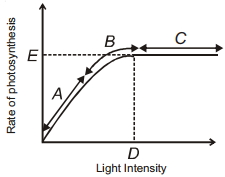
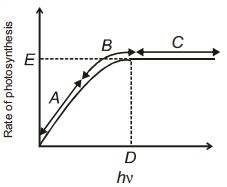
Choose the correct labelling for the given figure.
A
$D$-Saturation point,$E$-Maximum photosynthesis
B
$A$-Achieved at high light intensity
C
$D$-$10\%$ of total sunlight,$E$-Compensation point
D
$A$-Light saturation at $10\%$ of total sunlight
Solution
(A) In the given graph showing the effect of light intensity on the rate of photosynthesis:
$D$ represents the light saturation point,which is the intensity at which the rate of photosynthesis becomes maximum and does not increase further with an increase in light intensity.
$E$ represents the maximum rate of photosynthesis achieved at the saturation point.
Therefore,$D$-Saturation point and $E$-Maximum photosynthesis is the correct labelling.
$D$ represents the light saturation point,which is the intensity at which the rate of photosynthesis becomes maximum and does not increase further with an increase in light intensity.
$E$ represents the maximum rate of photosynthesis achieved at the saturation point.
Therefore,$D$-Saturation point and $E$-Maximum photosynthesis is the correct labelling.
0 likes
View Solution122
MediumMCQ
$A$: Dark reactions of photosynthesis are temperature-controlled processes.
$R$: Most of the reactions are enzymatic in nature.
$R$: Most of the reactions are enzymatic in nature.
A
Assertion and Reason both are correct and Reason is the correct explanation of Assertion.
B
Assertion and Reason both are correct but Reason is not the correct explanation of Assertion.
C
Assertion is correct,but Reason is incorrect.
D
Both Assertion and Reason are incorrect.
Solution
(A) The dark reactions of photosynthesis (also known as the Calvin cycle) involve a series of biochemical reactions that are catalyzed by specific enzymes,such as $RuBisCO$.
Since these reactions are enzymatic in nature,they are highly sensitive to temperature changes.
Therefore,the rate of dark reactions is significantly influenced by temperature,making them temperature-controlled processes.
Thus,both the Assertion and the Reason are correct,and the Reason provides the correct explanation for the Assertion.
Since these reactions are enzymatic in nature,they are highly sensitive to temperature changes.
Therefore,the rate of dark reactions is significantly influenced by temperature,making them temperature-controlled processes.
Thus,both the Assertion and the Reason are correct,and the Reason provides the correct explanation for the Assertion.
0 likes
View Solution123
EasyMCQ
Plants requiring low light intensity for optimum photosynthesis are called
A
Heliophytes
B
Pteridophytes
C
Sciophytes
D
Bryophytes
Solution
(C) Sciophytes,also known as shade plants,are those that thrive in environments with moderate or low light intensity.
These plants achieve their optimum photosynthetic rate and growth when exposed to light intensity that is approximately $10-30 \%$ of full sunlight.
These plants achieve their optimum photosynthetic rate and growth when exposed to light intensity that is approximately $10-30 \%$ of full sunlight.
0 likes
View Solution124
MediumMCQ
Which abiotic factor is not essential for the early growth of a plant,but growth is sustained only in its presence?
A
Water
B
Oxygen
C
Nutrients
D
Light
Solution
(D) Abiotic factors are non-living components of the environment.
$1$. Water,nutrients,and oxygen are essential for the germination of seeds and the early stages of plant growth.
$2$. Light is not strictly required for the initial germination or early growth of many plants,as they can utilize stored food reserves in the seed.
$3$. However,once the plant exhausts its stored reserves,it must perform photosynthesis to continue growing,which requires light. Therefore,sustained growth is dependent on the presence of light.
$1$. Water,nutrients,and oxygen are essential for the germination of seeds and the early stages of plant growth.
$2$. Light is not strictly required for the initial germination or early growth of many plants,as they can utilize stored food reserves in the seed.
$3$. However,once the plant exhausts its stored reserves,it must perform photosynthesis to continue growing,which requires light. Therefore,sustained growth is dependent on the presence of light.
0 likes
View Solution125
MediumMCQ
Photosynthetic yield is maximum at the
A
Equator region
B
Polar region
C
Both $(a)$ and $(b)$
D
Arid region
Solution
(A) Photosynthetic yield is directly dependent on the availability of sunlight and favorable climatic conditions.
In tropical regions near the equator,the intensity and duration of sunlight are significantly higher throughout the year compared to other regions.
This abundance of solar energy,combined with optimal temperature and moisture,leads to maximum photosynthetic productivity in these areas.
In tropical regions near the equator,the intensity and duration of sunlight are significantly higher throughout the year compared to other regions.
This abundance of solar energy,combined with optimal temperature and moisture,leads to maximum photosynthetic productivity in these areas.
0 likes
View Solution126
Medium
Light plays an important role in the life of all organisms. Name any three physiological processes in plants which are affected by light.
Solution
(N/A) Three physiological processes in plants that are affected by light are:
$1$. Photosynthesis: Light is the primary energy source for the synthesis of organic compounds.
$2$. Transpiration: Light influences the opening and closing of stomata,which regulates the rate of water loss.
$3$. Flowering (Photoperiodism): The duration of light exposure (photoperiod) is critical for the induction of flowering in many plant species.
$1$. Photosynthesis: Light is the primary energy source for the synthesis of organic compounds.
$2$. Transpiration: Light influences the opening and closing of stomata,which regulates the rate of water loss.
$3$. Flowering (Photoperiodism): The duration of light exposure (photoperiod) is critical for the induction of flowering in many plant species.
0 likes
View Solution127
MediumMCQ
The rate of photosynthesis is maximum in the $P$ region of light and minimum in the $Q$ region of light.
A
$P$ - Green, $Q$ - Blue and Red
B
$P$ - Green and Blue, $Q$ - Red
C
$P$ - Blue and Red, $Q$ - Green
D
$P$ - Red, $Q$ - Red and Blue
Solution
(C) Photosynthesis occurs primarily due to the absorption of light by chlorophyll pigments.
Chlorophyll $a$ and $b$ show maximum absorption in the blue and red regions of the visible spectrum.
Therefore, the rate of photosynthesis is highest in the blue and red regions of light $(P = \text{Blue and Red})$.
Green light is mostly reflected or transmitted by the leaves, which is why plants appear green.
Consequently, the rate of photosynthesis is minimum in the green region of light $(Q = \text{Green})$.
Chlorophyll $a$ and $b$ show maximum absorption in the blue and red regions of the visible spectrum.
Therefore, the rate of photosynthesis is highest in the blue and red regions of light $(P = \text{Blue and Red})$.
Green light is mostly reflected or transmitted by the leaves, which is why plants appear green.
Consequently, the rate of photosynthesis is minimum in the green region of light $(Q = \text{Green})$.
0 likes
View Solution128
EasyMCQ
Who proposed the "Law of Limiting Factors"?
A
Blackman
B
Robert Hill
C
Jan Ingenhousz
D
Joseph Priestley
Solution
(A) The "Law of Limiting Factors" was proposed by $F.F. Blackman$ in $1905$.
This law states that if a chemical process is affected by more than one factor, then its rate will be determined by the factor which is nearest to its minimal value, as it is the factor which directly affects the process the most.
This law states that if a chemical process is affected by more than one factor, then its rate will be determined by the factor which is nearest to its minimal value, as it is the factor which directly affects the process the most.
0 likes
View Solution129
MediumMCQ
Categorize the following factors affecting photosynthesis into internal and external factors:
$I-$ Light
$II-$ Temperature
$III-$ Age and size of leaf
$IV-$ Leaf orientation
$V-$ Mesophyll cells and chloroplasts
$VI-$ $CO_2$ concentration
$VII-$ Water
$VIII-$ Chlorophyll content
$IX-$ Internal $CO_2$ concentration
Identify the correct sequence for internal factors and external factors respectively.
$I-$ Light
$II-$ Temperature
$III-$ Age and size of leaf
$IV-$ Leaf orientation
$V-$ Mesophyll cells and chloroplasts
$VI-$ $CO_2$ concentration
$VII-$ Water
$VIII-$ Chlorophyll content
$IX-$ Internal $CO_2$ concentration
Identify the correct sequence for internal factors and external factors respectively.
A
$II, III, IV, V, VIII, IX$ and $I, VI, VII$
B
$III, IV, V, VIII, IX$ and $I, II, VI, VII$
C
$III, IV, V, VII, VIII, IX$ and $I, II, VI$
D
$I, II, III, IV, V, VII, VIII, IX$ and $VI$
Solution
(B) Photosynthesis is influenced by various factors,which are broadly classified into internal (plant) factors and external (environmental) factors.
$1.$ Internal factors: These are related to the plant itself,such as the number,size,age,and orientation of leaves,mesophyll cells and chloroplasts,internal $CO_2$ concentration,and the amount of chlorophyll. These correspond to $III, IV, V, VIII,$ and $IX$.
$2.$ External factors: These are environmental conditions such as sunlight (light),temperature,$CO_2$ concentration in the atmosphere,and water availability. These correspond to $I, II, VI,$ and $VII$.
Therefore,the correct sequence for internal factors and external factors is $III, IV, V, VIII, IX$ and $I, II, VI, VII$.
$1.$ Internal factors: These are related to the plant itself,such as the number,size,age,and orientation of leaves,mesophyll cells and chloroplasts,internal $CO_2$ concentration,and the amount of chlorophyll. These correspond to $III, IV, V, VIII,$ and $IX$.
$2.$ External factors: These are environmental conditions such as sunlight (light),temperature,$CO_2$ concentration in the atmosphere,and water availability. These correspond to $I, II, VI,$ and $VII$.
Therefore,the correct sequence for internal factors and external factors is $III, IV, V, VIII, IX$ and $I, II, VI, VII$.
0 likes
View Solution130
MediumMCQ
If a plant is provided with optimal temperature,light,and $CO_2$ for photosynthesis,but water is supplied in limited amounts,the rate of photosynthesis will follow which of the following factors?
A
Temperature
B
Light
C
$CO_2$
D
Water
Solution
(D) According to Blackman's Law of Limiting Factors,if a physiological process is controlled by several factors,the rate of the process is limited by the factor present in the lowest concentration relative to its optimum requirement.
In this scenario,temperature,light,and $CO_2$ are provided at optimal levels,meaning they are not limiting the process.
Since water is supplied in limited amounts,it becomes the limiting factor.
Therefore,the rate of photosynthesis will be determined by the availability of water.
In this scenario,temperature,light,and $CO_2$ are provided at optimal levels,meaning they are not limiting the process.
Since water is supplied in limited amounts,it becomes the limiting factor.
Therefore,the rate of photosynthesis will be determined by the availability of water.
0 likes
View Solution131
MediumMCQ
Light saturation for photosynthesis occurs at $...........\%$ of full sunlight.
A
$5$
B
$10$
C
$50$
D
$100$
Solution
(B) Light is a crucial factor for photosynthesis.
As the intensity of light increases,the rate of photosynthesis also increases up to a certain point.
Beyond this point,the rate of photosynthesis does not increase further even if light intensity is increased,because other factors become limiting.
This point is known as the light saturation point.
For most plants,light saturation occurs at about $10\%$ of the intensity of full sunlight.
Therefore,except for plants in shade or in dense forests,light is rarely a limiting factor in nature.
As the intensity of light increases,the rate of photosynthesis also increases up to a certain point.
Beyond this point,the rate of photosynthesis does not increase further even if light intensity is increased,because other factors become limiting.
This point is known as the light saturation point.
For most plants,light saturation occurs at about $10\%$ of the intensity of full sunlight.
Therefore,except for plants in shade or in dense forests,light is rarely a limiting factor in nature.
0 likes
View Solution132
MediumMCQ
What happens when light intensity is increased beyond a certain limit on a plant?
A
The rate of photosynthesis decreases.
B
Chlorophyll undergoes photo-oxidation and breaks down.
C
The excess light is not effectively utilized.
D
All of the above.
0 likes
View Solution133
MediumMCQ
The concentration of $CO_2$ in the atmosphere is $...............$ and if the concentration of $CO_2$ is increased up to $\ldots \ldots \ldots$,it can lead to an increase in the rate of $CO_2$ fixation.
A
$0.01$ to $0.02 \%, 0.05 \%$
B
$0.1$ to $0.2 \%, 0.05 \%$
C
$0.3$ to $0.4 \%, 0.5 \%$
D
$0.03$ to $0.04 \%, 0.05 \%$
Solution
(D) The concentration of $CO_2$ in the atmosphere is very low,ranging between $0.03 \%$ and $0.04 \%$.
$CO_2$ is a major limiting factor for photosynthesis.
If the concentration of $CO_2$ is increased up to $0.05 \%$,it can cause an increase in the rate of $CO_2$ fixation in many plants.
Beyond this level,it can become damaging over longer periods.
$CO_2$ is a major limiting factor for photosynthesis.
If the concentration of $CO_2$ is increased up to $0.05 \%$,it can cause an increase in the rate of $CO_2$ fixation in many plants.
Beyond this level,it can become damaging over longer periods.
0 likes
View Solution134
MediumMCQ
$C_4$ plants show saturation at $.....P.....$ and $C_3$ plants show saturation at $.....Q.....$.
A
$360 \mu L L^{-1} \quad 450 \mu L L^{-1}$
B
$450 \mu L L^{-1} \quad 360 \mu L L^{-1}$
C
$350 \mu L L^{-1} \quad 460 \mu L L^{-1}$
D
$460 \mu L L^{-1} \quad 350 \mu L L^{-1}$
Solution
(A) The concentration of $CO_2$ is a major factor affecting the rate of photosynthesis.
$C_3$ plants show saturation at about $450 \mu L L^{-1}$ of $CO_2$ concentration.
$C_4$ plants show saturation at about $360 \mu L L^{-1}$ of $CO_2$ concentration.
Therefore,$P = 360 \mu L L^{-1}$ and $Q = 450 \mu L L^{-1}$.
Thus,the correct option is $A$.
$C_3$ plants show saturation at about $450 \mu L L^{-1}$ of $CO_2$ concentration.
$C_4$ plants show saturation at about $360 \mu L L^{-1}$ of $CO_2$ concentration.
Therefore,$P = 360 \mu L L^{-1}$ and $Q = 450 \mu L L^{-1}$.
Thus,the correct option is $A$.
0 likes
View Solution135
MediumMCQ
The level of $CO_2$ available in the atmosphere is limiting for $........$ plants.
A
$C_2$
B
$C_3$
C
$C_4$
D
All of the above
Solution
(B) The concentration of $CO_2$ is a major factor affecting the rate of photosynthesis.
$C_3$ plants show an increase in the rate of photosynthesis at higher $CO_2$ concentrations because their enzyme $RuBisCO$ has a lower affinity for $CO_2$ and also acts as an oxygenase.
In contrast,$C_4$ plants show saturation at about $360 \mu L L^{-1}$,meaning they are already efficient at low $CO_2$ concentrations.
Therefore,the current atmospheric level of $CO_2$ is limiting for $C_3$ plants.
$C_3$ plants show an increase in the rate of photosynthesis at higher $CO_2$ concentrations because their enzyme $RuBisCO$ has a lower affinity for $CO_2$ and also acts as an oxygenase.
In contrast,$C_4$ plants show saturation at about $360 \mu L L^{-1}$,meaning they are already efficient at low $CO_2$ concentrations.
Therefore,the current atmospheric level of $CO_2$ is limiting for $C_3$ plants.
0 likes
View Solution136
MediumMCQ
Select the incorrect option regarding the effect of temperature on photosynthesis.
A
The light reactions are more sensitive to temperature than the dark reactions.
B
$C_3$ plants have a lower temperature optimum than $C_4$ plants.
C
Tropical plants have a higher temperature optimum than temperate plants.
D
Temperature affects metabolic processes.
Solution
(A) The dark reactions of photosynthesis are enzymatic processes (Calvin cycle),which are highly sensitive to temperature. In contrast,the light reactions are primarily photochemical and are less affected by temperature. Therefore,the statement that light reactions are more sensitive to temperature than dark reactions is incorrect. $C_4$ plants are adapted to warmer climates and have a higher temperature optimum compared to $C_3$ plants. Tropical plants,living in warmer regions,naturally have a higher temperature optimum than plants from temperate regions. Temperature significantly influences the activity of enzymes involved in metabolic pathways.
0 likes
View Solution137
MediumMCQ
Identify the effect of water on photosynthesis.
A
Water acts as a reactant,so a decrease in water leads to a decrease in the rate of photosynthesis.
B
$A$ decrease in water causes stomata to close,which reduces the availability of $CO_2$.
C
Water stress causes leaves to wilt,reducing the surface area of the leaves.
D
All of the above.
Solution
(D) Water is a critical factor affecting photosynthesis in the following ways:
$1$. Water acts as a reactant in the light-dependent reactions (photolysis of water),so its deficiency directly limits the rate of photosynthesis.
$2$. Water stress leads to the closure of stomata,which restricts the entry of $CO_2$ into the leaves,thereby reducing the rate of photosynthesis.
$3$. Water stress causes wilting of leaves,which reduces the effective surface area of the leaves and their metabolic activity,further decreasing the rate of photosynthesis.
Therefore,all the given statements are correct.
$1$. Water acts as a reactant in the light-dependent reactions (photolysis of water),so its deficiency directly limits the rate of photosynthesis.
$2$. Water stress leads to the closure of stomata,which restricts the entry of $CO_2$ into the leaves,thereby reducing the rate of photosynthesis.
$3$. Water stress causes wilting of leaves,which reduces the effective surface area of the leaves and their metabolic activity,further decreasing the rate of photosynthesis.
Therefore,all the given statements are correct.
0 likes
View Solution138
MediumMCQ
Identify the graph that shows the effect of light intensity on the rate of photosynthesis from the four given graphs.
A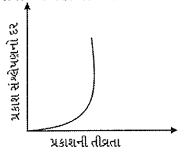
B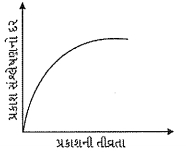
C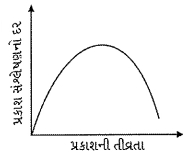
D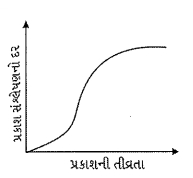
Solution
(B) The rate of photosynthesis increases with an increase in light intensity at low light intensities.
As light intensity increases further,the rate of photosynthesis continues to increase until it reaches a saturation point,where other factors become limiting.
Beyond this saturation point,further increases in light intensity do not increase the rate of photosynthesis.
Graph $B$ correctly represents this relationship,showing a steady increase followed by a plateau (saturation) as light intensity increases.
As light intensity increases further,the rate of photosynthesis continues to increase until it reaches a saturation point,where other factors become limiting.
Beyond this saturation point,further increases in light intensity do not increase the rate of photosynthesis.
Graph $B$ correctly represents this relationship,showing a steady increase followed by a plateau (saturation) as light intensity increases.
0 likes
View Solution139
EasyMCQ
Photosynthetic rate and productivity will increase by increasing $CO_2$ concentration in :-
A
Sugarcane and sorghum
B
Bell pepper and tomatoes
C
Maize and sugarcane
D
Sugarcane and potato
Solution
(B) The rate of photosynthesis and productivity in $C_3$ plants increases with an increase in $CO_2$ concentration because $C_3$ plants show $CO_2$ saturation at levels much lower than current atmospheric concentrations.
$C_4$ plants,such as sugarcane,sorghum,and maize,do not show an increase in photosynthetic rate at high $CO_2$ concentrations because they have a mechanism to concentrate $CO_2$ around the enzyme $RuBisCO$.
Bell pepper and tomatoes are $C_3$ plants,which respond positively to increased $CO_2$ levels (often used in greenhouse crops to increase yield).
Therefore,the correct answer is Bell pepper and tomatoes.
$C_4$ plants,such as sugarcane,sorghum,and maize,do not show an increase in photosynthetic rate at high $CO_2$ concentrations because they have a mechanism to concentrate $CO_2$ around the enzyme $RuBisCO$.
Bell pepper and tomatoes are $C_3$ plants,which respond positively to increased $CO_2$ levels (often used in greenhouse crops to increase yield).
Therefore,the correct answer is Bell pepper and tomatoes.
0 likes
View Solution140
MediumMCQ
Assertion $:$ Except for plants in shade or in dense forests,light is rarely a limiting factor in nature.
Reason $: C_4$ plants respond to high light intensities.
Reason $: C_4$ plants respond to high light intensities.
A
Both Assertion $\&$ Reason are True $\&$ the Reason is a correct explanation of the Assertion.
B
Both Assertion $\&$ Reason are True but Reason is not a correct explanation of the Assertion.
C
Assertion is True but the Reason is False.
D
Both Assertion $\&$ Reason are False.
Solution
(B) The Assertion is true because,in natural ecosystems,light is usually available in abundance for most plants,except for those growing in deep shade or dense forest canopies where light becomes a limiting factor.
The Reason is also true because $C_4$ plants have evolved to efficiently utilize high light intensities for photosynthesis without showing light saturation at lower levels compared to $C_3$ plants.
However,the Reason does not explain why light is rarely a limiting factor in nature for most plants. The availability of light in the environment is an ecological condition,whereas the response of $C_4$ plants to high light is a physiological adaptation. Therefore,the Reason is not the correct explanation for the Assertion.
The Reason is also true because $C_4$ plants have evolved to efficiently utilize high light intensities for photosynthesis without showing light saturation at lower levels compared to $C_3$ plants.
However,the Reason does not explain why light is rarely a limiting factor in nature for most plants. The availability of light in the environment is an ecological condition,whereas the response of $C_4$ plants to high light is a physiological adaptation. Therefore,the Reason is not the correct explanation for the Assertion.
0 likes
View Solution141
EasyMCQ
What specialized photosynthetic pathway do some desert plants have?
A
$CAM$ pathway
B
$C_4$ pathway
C
$C_3$ pathway
D
$C_3$ and $C_4$ pathway
Solution
(A) The correct answer is $A$.
Desert plants,such as succulents,utilize the Crassulacean Acid Metabolism $(CAM)$ pathway.
This specialized photosynthetic pathway allows these plants to open their stomata at night to take in $CO_2$ and store it as organic acids,which helps in minimizing water loss through transpiration during the hot,dry day.
Desert plants,such as succulents,utilize the Crassulacean Acid Metabolism $(CAM)$ pathway.
This specialized photosynthetic pathway allows these plants to open their stomata at night to take in $CO_2$ and store it as organic acids,which helps in minimizing water loss through transpiration during the hot,dry day.
0 likes
View Solution142
EasyMCQ
In an experiment demonstrating the evolution of oxygen in $Hydrilla$,sodium bicarbonate is added to water in the experimental set-up. What would happen if all other conditions are favourable?
A
Amount of oxygen evolved decreases as the availability of carbon dioxide increases.
B
Amount of oxygen evolved increases as carbon dioxide in water is absorbed by sodium bicarbonate.
C
Amount of oxygen evolved decreases as carbon dioxide in water is absorbed by sodium bicarbonate.
D
Amount of oxygen evolved increases as the availability of carbon dioxide increases.
Solution
(D) is the correct answer.
In the experiment with $Hydrilla$,adding sodium bicarbonate $(NaHCO_3)$ increases the availability of carbon dioxide $(CO_2)$ in the water.
$CO_2$ is a key substrate for photosynthesis.
This enhanced availability of carbon dioxide improves the rate of photosynthesis,which,in turn,increases the amount of oxygen $(O_2)$ evolved as a byproduct.
In the experiment with $Hydrilla$,adding sodium bicarbonate $(NaHCO_3)$ increases the availability of carbon dioxide $(CO_2)$ in the water.
$CO_2$ is a key substrate for photosynthesis.
This enhanced availability of carbon dioxide improves the rate of photosynthesis,which,in turn,increases the amount of oxygen $(O_2)$ evolved as a byproduct.
0 likes
View Solution143
EasyMCQ
Greenhouse crops such as tomatoes and bell pepper produce higher yields. This is due to
A
$CO_2$ enriched atmosphere leads to higher yields
B
$CO_2$ is a limiting factor to photosynthesis
C
diffused light in greenhouse
D
tomatoes and bell pepper are not $C_3$ plants
Solution
(A) is the correct answer.
Greenhouse crops such as tomatoes and bell pepper produce higher yields because they are grown in a $CO_2$ enriched atmosphere.
These plants are $C_3$ plants,which respond to higher concentrations of $CO_2$ by increasing their rate of photosynthesis,as $CO_2$ is often a limiting factor for them in normal atmospheric conditions.
Greenhouse crops such as tomatoes and bell pepper produce higher yields because they are grown in a $CO_2$ enriched atmosphere.
These plants are $C_3$ plants,which respond to higher concentrations of $CO_2$ by increasing their rate of photosynthesis,as $CO_2$ is often a limiting factor for them in normal atmospheric conditions.
0 likes
View Solution144
EasyMCQ
The law of limiting factors was proposed with particular reference to photosynthesis. Identify the scientist who proposed this law.
A
Weismann
B
Calvin
C
Blackmann
D
Emerson
Solution
(C) Blackmann.
The law of limiting factors was proposed by $F.F. Blackmann$ in $1905$ with specific reference to the rate of photosynthesis.
According to this law,if a chemical process is affected by more than one factor,then its rate will be determined by the factor which is nearest to its minimal value,known as the limiting factor.
The law of limiting factors was proposed by $F.F. Blackmann$ in $1905$ with specific reference to the rate of photosynthesis.
According to this law,if a chemical process is affected by more than one factor,then its rate will be determined by the factor which is nearest to its minimal value,known as the limiting factor.
0 likes
View SolutionPhotosynthesis in Higher Plants — Factors affecting photosynthesis · Frequently Asked Questions
1Are these Photosynthesis in Higher Plants questions useful for JEE and NEET?
Yes. All questions in this section are mapped to JEE Main and NEET exam patterns. Previous year questions from JEE Main, NEET, GUJCET and state-level exams are included with full solutions.
2Can I switch to Hindi or Gujarati for these questions?
Yes. Use the language tabs in the hero section or the sidebar to view the same questions and solutions in English, Hindi or Gujarati.
3How do I generate a question paper from this subtopic?
Use the Vedclass Exam Paper Generator — select the chapter and subtopic, set difficulty, and generate Sets A, B, C, D automatically. First 3 chapters of every subject are free.
Vedclass Products
For Students
Vedclass Test Series
Mock tests in real JEE/NEET style with performance analysis. 5-day free trial.
Start Free TrialFor Teachers
Exam Paper Generator
Generate Set A/B/C/D papers from this chapter in 2 minutes. 3 chapters free.
Try FreeFor Institutes
Online Exam Module
Live online exams with unlimited students, 360° analytics & white-label branding.
See DemoFor Teachers & Institutes
Generate a Photosynthesis in Higher Plants Exam Paper in 2 Minutes
Select subtopic & difficulty — Sets A, B, C, D auto-generated with No Repeat logic.
First 3 chapters of every subject are free — no payment required.