
A English
Factors affecting photosynthesis Questions in English
Class 11 Biology · Photosynthesis in Higher Plants · Factors affecting photosynthesis
144+
Questions
English
Language
100%
With Solutions
Showing 50 of 144 questions in English
51
MediumMCQ
If the concentration of $CO_2$ in the atmosphere is as high as $400 \ ppm$,then......
A
All plants will die
B
Plants will not grow properly
C
Plants will grow for some time and then die
D
Plants will show enhanced growth
Solution
(D) Carbon dioxide $(CO_2)$ is a major limiting factor for photosynthesis.
Under normal atmospheric conditions,the concentration of $CO_2$ is approximately $360-400 \ ppm$.
Most $C_3$ plants show increased rates of photosynthesis and biomass production at higher $CO_2$ concentrations (up to $500-600 \ ppm$),a phenomenon known as $CO_2$ fertilization effect.
Therefore,a concentration of $400 \ ppm$ is well within the range that promotes healthy growth and photosynthesis in plants.
Under normal atmospheric conditions,the concentration of $CO_2$ is approximately $360-400 \ ppm$.
Most $C_3$ plants show increased rates of photosynthesis and biomass production at higher $CO_2$ concentrations (up to $500-600 \ ppm$),a phenomenon known as $CO_2$ fertilization effect.
Therefore,a concentration of $400 \ ppm$ is well within the range that promotes healthy growth and photosynthesis in plants.
0 likes
View Solution52
MediumMCQ
The accumulation of food material in the assimilatory cells results in .........
A
Increase in the rate of photosynthesis
B
Decrease in the rate of photosynthesis
C
No effect
D
Increase or decrease
Solution
(B) The accumulation of end products of photosynthesis,such as sugars and starch,in the assimilatory cells (mesophyll cells) leads to a feedback inhibition of the process. This is known as product inhibition. As the concentration of these products increases,the rate of photosynthesis decreases because the plant cannot utilize or transport the synthesized food fast enough to maintain the initial rate of metabolic activity.
0 likes
View Solution53
MediumMCQ
During photosynthesis,what percentage of incident solar radiation is utilized by higher plants?
A
$100\%$
B
$10\%$
C
$5\%$
D
$1-2\%$
Solution
(D) The sun is the ultimate source of energy for all ecosystems on Earth.
However,only a small fraction of the incident solar radiation is photosynthetically active radiation $(PAR)$.
Plants capture only about $2-10\%$ of the $PAR$.
When considering the total incident solar radiation reaching the Earth's surface,higher plants utilize only about $1-2\%$ of it for the process of photosynthesis to produce organic matter.
However,only a small fraction of the incident solar radiation is photosynthetically active radiation $(PAR)$.
Plants capture only about $2-10\%$ of the $PAR$.
When considering the total incident solar radiation reaching the Earth's surface,higher plants utilize only about $1-2\%$ of it for the process of photosynthesis to produce organic matter.
0 likes
View Solution54
MediumMCQ
Solarization is a phenomenon in which .....
A
Sugar is formed with the help of solar energy.
B
Chlorophyll is formed.
C
Chlorophyll is destroyed,resulting in the death of cellular components.
D
Dynamics of light energy.
Solution
(C) Solarization is a phenomenon where excessive light intensity leads to the photo-oxidation and destruction of chlorophyll pigments. This process inhibits photosynthesis and can eventually lead to the death of cellular components or the plant tissue itself due to the accumulation of reactive oxygen species.
0 likes
View Solution55
MediumMCQ
What are the essential conditions for photosynthesis?
A
Light and optimum temperature
B
Chlorophyll and water
C
Carbon dioxide
D
All of the above
Solution
(D) Photosynthesis is a complex physiological process that requires several key factors to occur efficiently.
$1$. $Light$: It provides the energy required for the excitation of electrons in chlorophyll.
$2$. $Chlorophyll$: This pigment is essential for capturing light energy.
$3$. $Water$ $(H_2O)$: It acts as a source of electrons and protons through photolysis.
$4$. $Carbon dioxide$ $(CO_2)$: It is the raw material for the synthesis of carbohydrates.
$5$. $Optimum temperature$: Enzymes involved in the Calvin cycle and light reactions function optimally within a specific temperature range.
Since all these factors are necessary for the process, the correct answer is $D$.
$1$. $Light$: It provides the energy required for the excitation of electrons in chlorophyll.
$2$. $Chlorophyll$: This pigment is essential for capturing light energy.
$3$. $Water$ $(H_2O)$: It acts as a source of electrons and protons through photolysis.
$4$. $Carbon dioxide$ $(CO_2)$: It is the raw material for the synthesis of carbohydrates.
$5$. $Optimum temperature$: Enzymes involved in the Calvin cycle and light reactions function optimally within a specific temperature range.
Since all these factors are necessary for the process, the correct answer is $D$.
0 likes
View Solution56
MediumMCQ
The rate of photosynthesis does not depend on .........
A
Duration of light
B
Light intensity
C
Quality of light
D
Temperature
Solution
(A) The rate of photosynthesis is influenced by several external factors such as light intensity,light quality (wavelength),carbon dioxide concentration,and temperature.
Duration of light (photoperiod) primarily affects flowering and other developmental processes in plants rather than the immediate rate of photosynthesis.
Therefore,the rate of photosynthesis does not directly depend on the duration of light.
Duration of light (photoperiod) primarily affects flowering and other developmental processes in plants rather than the immediate rate of photosynthesis.
Therefore,the rate of photosynthesis does not directly depend on the duration of light.
0 likes
View Solution57
EasyMCQ
Photosynthesis is maximum during:
A
Continuous dim light
B
Continuous intense light
C
Moderate light
D
None of the above
Solution
(C) Photosynthesis is a light-dependent process. As light intensity increases,the rate of photosynthesis increases up to a certain point. However,at very high light intensities,the rate of photosynthesis does not increase further because other factors (like $CO_2$ concentration or temperature) become limiting. Furthermore,extremely intense light can cause photo-oxidation of chlorophyll,leading to a decrease in the rate of photosynthesis. Therefore,photosynthesis is maximum at moderate light intensities,not continuous intense light.
0 likes
View Solution58
MediumMCQ
Which is the major limiting factor for photosynthesis during the day?
A
Chlorophyll
B
Light
C
$CO_2$
D
Water
Solution
(C) According to Blackman's Law of Limiting Factors,the rate of a physiological process is limited by the factor that is present in the least amount relative to its optimum requirement.
In the atmosphere,the concentration of $CO_2$ is very low $(0.03-0.04\%)$,which is far below the saturation point for photosynthesis in most $C_3$ and $C_4$ plants.
Therefore,$CO_2$ concentration is the major limiting factor for photosynthesis under normal field conditions during the day.
In the atmosphere,the concentration of $CO_2$ is very low $(0.03-0.04\%)$,which is far below the saturation point for photosynthesis in most $C_3$ and $C_4$ plants.
Therefore,$CO_2$ concentration is the major limiting factor for photosynthesis under normal field conditions during the day.
0 likes
View Solution59
MediumMCQ
Generally,atmospheric $CO_2$ is not a limiting factor for hydrophytes because...
A
Hydrophytes fix $H_2S$ during their photosynthesis.
B
Such plants obtain $CO_2$ from water in the form of $HCO_3^-$.
C
They do not require glucose for their respiration.
D
All of the above.
Solution
(B) Hydrophytes (aquatic plants) live submerged in water. While atmospheric $CO_2$ diffusion into water is slow,these plants have adapted to utilize the bicarbonate ions $(HCO_3^-)$ dissolved in the water as a source of carbon for photosynthesis. Therefore,they are not strictly limited by the low concentration of dissolved $CO_2$ in the water,as they can efficiently convert $HCO_3^-$ into $CO_2$ within their tissues.
0 likes
View Solution60
EasyMCQ
The Law of Limiting Factors for photosynthesis was proposed by ........
A
$R$. Hill
B
Krebs
C
Calvin
D
Blackman
Solution
(D) The Law of Limiting Factors was proposed by $F.F. Blackman$ in $1905$.
According to this law,if a chemical process is affected by more than one factor,then its rate will be determined by the factor which is nearest to its minimal value,as it is the factor which directly affects the process if its quantity is changed.
According to this law,if a chemical process is affected by more than one factor,then its rate will be determined by the factor which is nearest to its minimal value,as it is the factor which directly affects the process if its quantity is changed.
0 likes
View Solution61
MediumMCQ
The Law of Limiting Factors was proposed by .........
A
Hill
B
$F$. $F$. Blackman
C
Willstatter and Stoll
D
Calvin
Solution
(B) The Law of Limiting Factors was proposed by $F. F. Blackman$ in $1905$.
According to this law,if a chemical process is affected by more than one factor,then its rate will be determined by the factor which is nearest to its minimal value.
This factor is directly responsible for limiting the rate of the process and is known as the limiting factor.
According to this law,if a chemical process is affected by more than one factor,then its rate will be determined by the factor which is nearest to its minimal value.
This factor is directly responsible for limiting the rate of the process and is known as the limiting factor.
0 likes
View Solution62
MediumMCQ
The optimum temperature for photosynthesis is ......... .
A
$10 - 15 ^\circ C$
B
$20 - 25 ^\circ C$
C
$20 - 35 ^\circ C$
D
$35 - 50 ^\circ C$
Solution
(C) Photosynthesis is an enzymatic process,and the activity of enzymes is highly dependent on temperature.
For most $C_3$ plants,the optimum temperature for photosynthesis ranges between $20 ^\circ C$ and $25 ^\circ C$.
For $C_4$ plants,the optimum temperature is generally higher,often ranging between $30 ^\circ C$ and $45 ^\circ C$.
Considering the general range provided in standard textbooks for photosynthesis,the most appropriate range is $20 - 35 ^\circ C$ as it encompasses the optimal activity levels for various plant types.
For most $C_3$ plants,the optimum temperature for photosynthesis ranges between $20 ^\circ C$ and $25 ^\circ C$.
For $C_4$ plants,the optimum temperature is generally higher,often ranging between $30 ^\circ C$ and $45 ^\circ C$.
Considering the general range provided in standard textbooks for photosynthesis,the most appropriate range is $20 - 35 ^\circ C$ as it encompasses the optimal activity levels for various plant types.
0 likes
View Solution63
MediumMCQ
At the compensation point,there will be no:
A
Photosynthesis of any kind
B
Gaseous exchange between the plant and the environment
C
Respiration in plants
D
Loss of water in the dark
Solution
(B) The compensation point is the light intensity at which the rate of photosynthesis exactly equals the rate of respiration in a plant.
At this specific point,the amount of $CO_2$ produced during respiration is exactly consumed by photosynthesis,and the amount of $O_2$ produced during photosynthesis is exactly consumed by respiration.
Therefore,there is no net gaseous exchange between the plant and the surrounding environment.
At this specific point,the amount of $CO_2$ produced during respiration is exactly consumed by photosynthesis,and the amount of $O_2$ produced during photosynthesis is exactly consumed by respiration.
Therefore,there is no net gaseous exchange between the plant and the surrounding environment.
0 likes
View Solution64
EasyMCQ
Who proposed the Law of Limiting Factors in photosynthesis?
A
$R$. Hill
B
Calvin
C
Blackman
D
Arnon
Solution
(C) The Law of Limiting Factors was proposed by $F.F. Blackman$ in $1905$. According to this law,if a chemical process is affected by more than one factor,then its rate will be determined by the factor which is nearest to its minimal value. This factor is known as the limiting factor because it directly affects the rate of the process.
0 likes
View Solution65
MediumMCQ
If the temperature increases beyond $35^{\circ}C$,what will happen?
A
The rate of decrease in respiration will be faster than the rate of decrease in photosynthesis.
B
The rate of decrease in photosynthesis will be faster than the rate of decrease in respiration.
C
Both will decrease at the same rate.
D
Neither will show a specific pattern.
Solution
(B) Photosynthesis is an enzymatic process that is highly sensitive to temperature. Most enzymes involved in the Calvin cycle and light reactions have an optimal temperature range. When the temperature exceeds $35^{\circ}C$,the enzymes involved in photosynthesis (such as RuBisCO) begin to denature or lose their efficiency rapidly. Respiration,while also enzymatic,is generally more heat-stable than photosynthesis. Therefore,as temperatures rise significantly above the optimum,the rate of photosynthesis declines much more sharply and rapidly than the rate of respiration.
0 likes
View Solution66
EasyMCQ
The formation of chlorophyll in young plant seedlings is induced by .........
A
Gibberellins
B
Indole acetic acid
C
Kinetin
D
Light
Solution
(D) The formation of chlorophyll in young plant seedlings is a light-dependent process.
In the absence of light,seedlings become etiolated (pale and elongated).
When exposed to light,the synthesis of chlorophyll is triggered,allowing the plant to begin photosynthesis.
Therefore,light is the essential factor that induces chlorophyll formation.
In the absence of light,seedlings become etiolated (pale and elongated).
When exposed to light,the synthesis of chlorophyll is triggered,allowing the plant to begin photosynthesis.
Therefore,light is the essential factor that induces chlorophyll formation.
0 likes
View Solution67
EasyMCQ
In the presence of .........,the synthesis of chlorophyll is observed in angiosperms.
A
Phytochrome
B
Light
C
Cytochrome
D
None of the above
Solution
(B) The synthesis of chlorophyll in angiosperms is a light-dependent process.
Light acts as a signal for the activation of enzymes required for chlorophyll biosynthesis.
In the absence of light,plants become etiolated and fail to produce chlorophyll,leading to a pale yellow appearance.
Therefore,light is essential for the synthesis of chlorophyll in angiosperms.
Light acts as a signal for the activation of enzymes required for chlorophyll biosynthesis.
In the absence of light,plants become etiolated and fail to produce chlorophyll,leading to a pale yellow appearance.
Therefore,light is essential for the synthesis of chlorophyll in angiosperms.
0 likes
View Solution68
MediumMCQ
Which of the following is an effect of a herbicide?
A
Inhibition of photolysis of water
B
Inhibition of $O_2$ evolution
C
Inhibition of translocation of organic solutes
D
All of the above
Solution
(D) Herbicides are chemicals used to control or kill unwanted plants (weeds).
Many herbicides,such as those belonging to the urea or triazine groups,act by interfering with the photosynthetic process.
$1$. They inhibit the photolysis of water,which is the splitting of water molecules into $H^+$,electrons,and $O_2$ during the light-dependent reactions.
$2$. Consequently,this leads to the inhibition of $O_2$ evolution.
$3$. Some herbicides also interfere with the transport or translocation of organic solutes (assimilates) from source to sink,thereby starving the plant.
Since all these effects are associated with the action of various herbicides,the correct answer is $D$.
Many herbicides,such as those belonging to the urea or triazine groups,act by interfering with the photosynthetic process.
$1$. They inhibit the photolysis of water,which is the splitting of water molecules into $H^+$,electrons,and $O_2$ during the light-dependent reactions.
$2$. Consequently,this leads to the inhibition of $O_2$ evolution.
$3$. Some herbicides also interfere with the transport or translocation of organic solutes (assimilates) from source to sink,thereby starving the plant.
Since all these effects are associated with the action of various herbicides,the correct answer is $D$.
0 likes
View Solution69
MediumMCQ
Which of the following is an effect of herbicides?
A
Inhibition of photolysis of water
B
Inhibition of $O_2$ evolution
C
Inhibition of translocation of organic solutes
D
All of the above
Solution
(D) Herbicides are chemical substances used to control or kill unwanted plants (weeds).
Many herbicides,such as $DCMU$ ($3$-($3$,$4$-dichlorophenyl)$-1,1-$dimethylurea),act by blocking the electron transport chain in photosynthesis.
Specifically,they inhibit the photolysis of water,which is the light-dependent splitting of water molecules.
Since the photolysis of water is responsible for the release of $O_2$ during photosynthesis,its inhibition directly leads to the inhibition of $O_2$ evolution.
Furthermore,some herbicides interfere with the metabolic processes required for the translocation of organic solutes (sugars) through the phloem.
Therefore,all the listed options are recognized effects of various types of herbicides.
Many herbicides,such as $DCMU$ ($3$-($3$,$4$-dichlorophenyl)$-1,1-$dimethylurea),act by blocking the electron transport chain in photosynthesis.
Specifically,they inhibit the photolysis of water,which is the light-dependent splitting of water molecules.
Since the photolysis of water is responsible for the release of $O_2$ during photosynthesis,its inhibition directly leads to the inhibition of $O_2$ evolution.
Furthermore,some herbicides interfere with the metabolic processes required for the translocation of organic solutes (sugars) through the phloem.
Therefore,all the listed options are recognized effects of various types of herbicides.
0 likes
View Solution70
EasyMCQ
Which of the following is not an external factor for plants?
A
Enzyme
B
Light
C
Water
D
Pollutants
Solution
(A) External factors are environmental conditions that influence the growth and development of plants.
Light,water,and pollutants are all environmental (external) factors.
Enzymes are biological catalysts that are synthesized within the plant cells to regulate metabolic processes; therefore,they are considered internal factors.
Light,water,and pollutants are all environmental (external) factors.
Enzymes are biological catalysts that are synthesized within the plant cells to regulate metabolic processes; therefore,they are considered internal factors.
0 likes
View Solution71
MediumMCQ
With reference to factors affecting the rate of photosynthesis,which of the following statements is not correct?
A
Increasing atmospheric $CO_2$ concentration up to $0.05\%$ can enhance $CO_2$ fixation rate.
B
$C_3$ plants respond to higher temperature with enhanced photosynthesis while $C_4$ plants have much lower temperature optimum.
C
Tomato is a greenhouse crop which can be grown in $CO_2$-enriched atmosphere for higher yield.
D
Light saturation for $CO_2$ fixation occurs at $10\%$ of full sunlight.
Solution
(B) The correct answer is $B$.
Statement $B$ is incorrect because $C_4$ plants show higher rates of photosynthesis at higher temperatures,whereas $C_3$ plants have a lower temperature optimum.
$C_4$ plants are adapted to warmer environments and possess a mechanism to minimize photorespiration,allowing them to perform efficiently at higher temperatures.
Conversely,$C_3$ plants perform better at cooler temperatures.
Other statements are correct:
$1$. Increasing $CO_2$ concentration up to $0.05\%$ acts as a fertilizer for $C_3$ plants.
$2$. Tomato and bell pepper are greenhouse crops grown in $CO_2$-enriched environments.
$3$. Light saturation for $CO_2$ fixation occurs at $10\%$ of full sunlight,except for plants in shade or dense forests.
Statement $B$ is incorrect because $C_4$ plants show higher rates of photosynthesis at higher temperatures,whereas $C_3$ plants have a lower temperature optimum.
$C_4$ plants are adapted to warmer environments and possess a mechanism to minimize photorespiration,allowing them to perform efficiently at higher temperatures.
Conversely,$C_3$ plants perform better at cooler temperatures.
Other statements are correct:
$1$. Increasing $CO_2$ concentration up to $0.05\%$ acts as a fertilizer for $C_3$ plants.
$2$. Tomato and bell pepper are greenhouse crops grown in $CO_2$-enriched environments.
$3$. Light saturation for $CO_2$ fixation occurs at $10\%$ of full sunlight,except for plants in shade or dense forests.
0 likes
View Solution72
MediumMCQ
For which of the following plants is light rarely a limiting factor?
A
Banyan tree
B
Plants growing in shade
C
Plants growing in desert
D
Plants growing on water surface
Solution
(C) Light is a limiting factor for plants that grow in shade or in dense forests where light intensity is low.
However,for plants growing in deserts,light is abundant and rarely a limiting factor because they are exposed to direct sunlight for most of the day.
In such environments,other factors like water availability or temperature are more likely to be limiting factors for photosynthesis.
However,for plants growing in deserts,light is abundant and rarely a limiting factor because they are exposed to direct sunlight for most of the day.
In such environments,other factors like water availability or temperature are more likely to be limiting factors for photosynthesis.
0 likes
View Solution73
EasyMCQ
The Law of Limiting Factors was proposed by:
A
Joseph Priestley
B
Jan Ingenhousz
C
$F$.$F$. Blackman
D
Julius von Sachs
Solution
(C) The Law of Limiting Factors was proposed by $F.F. Blackman$ in $1905$.
According to this law,if a physiological process is controlled by a number of separate factors,the rate of the process is limited by the factor which is present in the least amount relative to its optimum requirement.
This factor is known as the limiting factor.
According to this law,if a physiological process is controlled by a number of separate factors,the rate of the process is limited by the factor which is present in the least amount relative to its optimum requirement.
This factor is known as the limiting factor.
0 likes
View Solution74
MediumMCQ
Identify the incorrect sentences:
$(I)$ Humidity in the atmosphere is relatively higher in areas where light becomes a limiting factor for plants.
$(II)$ An increase in light intensity beyond a certain point causes the breakdown of chlorophyll,leading to a decrease in the rate of photosynthesis.
$(III)$ $C_4$ plants respond to higher temperatures and show higher rates of photosynthesis,while $C_3$ plants have a much lower temperature optimum.
$(I)$ Humidity in the atmosphere is relatively higher in areas where light becomes a limiting factor for plants.
$(II)$ An increase in light intensity beyond a certain point causes the breakdown of chlorophyll,leading to a decrease in the rate of photosynthesis.
$(III)$ $C_4$ plants respond to higher temperatures and show higher rates of photosynthesis,while $C_3$ plants have a much lower temperature optimum.
A
$I, II$
B
$I, III$
C
Only $III$
D
None
Solution
(D) Statement $(I)$ is correct: In dense forests or shaded areas where light is a limiting factor,humidity is generally higher due to reduced evaporation and transpiration.
Statement $(II)$ is correct: High light intensity leads to photo-oxidation of chlorophyll,which damages the pigment and reduces the rate of photosynthesis.
Statement $(III)$ is correct: $C_4$ plants are adapted to high temperatures and exhibit higher photosynthetic efficiency at higher temperatures compared to $C_3$ plants,which have a lower temperature optimum.
Since all statements $(I)$,$(II)$,and $(III)$ are factually correct,there are no incorrect sentences.
Therefore,the correct option is $D$.
Statement $(II)$ is correct: High light intensity leads to photo-oxidation of chlorophyll,which damages the pigment and reduces the rate of photosynthesis.
Statement $(III)$ is correct: $C_4$ plants are adapted to high temperatures and exhibit higher photosynthetic efficiency at higher temperatures compared to $C_3$ plants,which have a lower temperature optimum.
Since all statements $(I)$,$(II)$,and $(III)$ are factually correct,there are no incorrect sentences.
Therefore,the correct option is $D$.
0 likes
View Solution75
MediumMCQ
Maximum photosynthesis occurs in.......
A
Red light
B
Green light
C
Pink light
D
Yellow light
Solution
(A) Photosynthesis is driven by the absorption of light energy by photosynthetic pigments,primarily chlorophyll $a$ and $b$.
According to the action spectrum of photosynthesis,the rate of photosynthesis is highest in the red and blue regions of the visible light spectrum.
Among the given options,red light is the most effective for photosynthesis,while green light is the least effective because it is mostly reflected by leaves.
According to the action spectrum of photosynthesis,the rate of photosynthesis is highest in the red and blue regions of the visible light spectrum.
Among the given options,red light is the most effective for photosynthesis,while green light is the least effective because it is mostly reflected by leaves.
0 likes
View Solution76
MediumMCQ
Which $C_3$ plants are used in greenhouse crops?
A
Sugarcane
B
Pinus
C
Carrot
D
Bell pepper
Solution
(D) The correct answer is $D$ (Bell pepper).
$C_3$ plants are those that perform the Calvin cycle as the primary pathway for carbon fixation.
Bell pepper $(Capsicum \text{ } annuum)$ is a $C_3$ plant commonly grown in greenhouses to optimize yield and quality.
Sugarcane is a $C_4$ plant.
Pinus is a gymnosperm and not typically classified as a greenhouse crop in this context.
Carrot is a root vegetable, but bell pepper is the classic example of a $C_3$ greenhouse crop mentioned in the context of $CO_2$ fertilization experiments.
$C_3$ plants are those that perform the Calvin cycle as the primary pathway for carbon fixation.
Bell pepper $(Capsicum \text{ } annuum)$ is a $C_3$ plant commonly grown in greenhouses to optimize yield and quality.
Sugarcane is a $C_4$ plant.
Pinus is a gymnosperm and not typically classified as a greenhouse crop in this context.
Carrot is a root vegetable, but bell pepper is the classic example of a $C_3$ greenhouse crop mentioned in the context of $CO_2$ fertilization experiments.
0 likes
View Solution77
MediumMCQ
$A-$ The $C_3$ and $C_4$ plants respond differently to $CO_2$ concentrations.
$R -$ The concentration of $CO_2$ in the atmosphere is between $0.03$ and $0.04$ percent. An increase in concentration up to $0.05$ percent can cause an increase in $CO_2$ fixation rates.
$R -$ The concentration of $CO_2$ in the atmosphere is between $0.03$ and $0.04$ percent. An increase in concentration up to $0.05$ percent can cause an increase in $CO_2$ fixation rates.
A
$A$ and $R$ both are correct.
B
$A$ and $R$ both are incorrect.
C
$A$ is correct and $R$ is incorrect.
D
$A$ is incorrect and $R$ is correct.
Solution
(A) is correct: $C_3$ plants show increased photosynthesis with higher $CO_2$ levels,whereas $C_4$ plants show saturation at much lower levels of $CO_2$.
$R$ is correct: The current atmospheric concentration of $CO_2$ is $0.03-0.04$ percent. An increase in concentration up to $0.05$ percent (or $500 \ ppm$) leads to an increase in $CO_2$ fixation rates in many plants,particularly $C_3$ plants.
$R$ is correct: The current atmospheric concentration of $CO_2$ is $0.03-0.04$ percent. An increase in concentration up to $0.05$ percent (or $500 \ ppm$) leads to an increase in $CO_2$ fixation rates in many plants,particularly $C_3$ plants.
0 likes
View Solution78
MediumMCQ
Choose the incorrect statement.
A
Increase in incident light beyond a point causes the breakdown of chlorophyll and a decrease in photosynthesis.
B
$C_3$ plants respond to increased $CO_2$ concentration and saturation is seen only beyond $450 \ \mu L L^{-1}$.
C
$C_3$ plants respond to higher $CO_2$ concentration by showing increased rates of photosynthesis.
D
$C_4$ plants show saturation at about $360 \ \mu L L^{-1}$.
Solution
(D) The correct answer is $D$.
$A$: High light intensity causes photo-oxidation of chlorophyll,which leads to a decrease in the rate of photosynthesis. This is a correct statement.
$B$: $C_3$ plants show a response to increased $CO_2$ levels,and saturation occurs at levels beyond $450 \ \mu L L^{-1}$. This is a correct statement.
$C$: $C_3$ plants show increased rates of photosynthesis with higher $CO_2$ concentrations,as they are limited by current $CO_2$ levels. This is a correct statement.
$D$: $C_4$ plants show saturation at about $360 \ \mu L L^{-1}$,not $260 \ \mu L L^{-1}$. Therefore,this statement is incorrect.
$A$: High light intensity causes photo-oxidation of chlorophyll,which leads to a decrease in the rate of photosynthesis. This is a correct statement.
$B$: $C_3$ plants show a response to increased $CO_2$ levels,and saturation occurs at levels beyond $450 \ \mu L L^{-1}$. This is a correct statement.
$C$: $C_3$ plants show increased rates of photosynthesis with higher $CO_2$ concentrations,as they are limited by current $CO_2$ levels. This is a correct statement.
$D$: $C_4$ plants show saturation at about $360 \ \mu L L^{-1}$,not $260 \ \mu L L^{-1}$. Therefore,this statement is incorrect.
0 likes
View Solution79
EasyMCQ
The Law of Limiting Factors was proposed by:
A
$T$. $W$. Engelmann
B
Julius von Sachs
C
Blackman
D
Priestley
Solution
(C) The Law of Limiting Factors was proposed by $F. F. Blackman$ in $1905$.
It states that if a chemical process is affected by more than one factor,then its rate will be determined by the factor which is nearest to its minimal value.
This factor is directly responsible for limiting the rate of the process,hence it is called the limiting factor.
It states that if a chemical process is affected by more than one factor,then its rate will be determined by the factor which is nearest to its minimal value.
This factor is directly responsible for limiting the rate of the process,hence it is called the limiting factor.
0 likes
View Solution80
MediumMCQ
Blackman's law is concerned with
A
Photosynthesis
B
Respiration
C
Transpiration
D
Root pressure
Solution
(A) Blackman's law of limiting factors states that when a process is conditioned as to its rapidity by a number of separate factors,the rate of the process is limited by the pace of the slowest factor.
This law was proposed by $F.F. \text{Blackman}$ in $1905$ specifically in the context of the rate of photosynthesis.
According to this law,if a plant is photosynthesizing,its rate will be determined by the factor that is present in the least amount relative to its requirement,such as light intensity,$CO_2$ concentration,or temperature.
This law was proposed by $F.F. \text{Blackman}$ in $1905$ specifically in the context of the rate of photosynthesis.
According to this law,if a plant is photosynthesizing,its rate will be determined by the factor that is present in the least amount relative to its requirement,such as light intensity,$CO_2$ concentration,or temperature.
0 likes
View Solution81
EasyMCQ
Which external factors affect plants?
A
Light
B
Water
C
Temperature
D
All of the above
Solution
(D) Plants are living organisms that interact with their environment to survive and grow.
External factors, also known as abiotic factors, play a crucial role in plant physiology and development.
$1$. $Light$: Essential for photosynthesis, phototropism, and flowering.
$2$. $Water$: Necessary for metabolic processes, nutrient transport, and maintaining turgidity.
$3$. $Temperature$: Influences the rate of enzymatic reactions, respiration, and transpiration.
Since all these factors significantly influence plant life, the correct answer is $\text{All of the above}$.
External factors, also known as abiotic factors, play a crucial role in plant physiology and development.
$1$. $Light$: Essential for photosynthesis, phototropism, and flowering.
$2$. $Water$: Necessary for metabolic processes, nutrient transport, and maintaining turgidity.
$3$. $Temperature$: Influences the rate of enzymatic reactions, respiration, and transpiration.
Since all these factors significantly influence plant life, the correct answer is $\text{All of the above}$.
0 likes
View Solution82
MediumMCQ
In terrestrial habitats,how are temperature and rainfall conditions primarily influenced?
A
Water transformation
B
Transpiration
C
Thermal periodicity
D
Migration
Solution
(B) In terrestrial habitats,plants play a significant role in influencing the local climate,specifically temperature and rainfall patterns.
Transpiration is the process by which water evaporates from the aerial parts of plants,such as leaves.
This process releases water vapor into the atmosphere,which contributes to local humidity and can influence cloud formation and rainfall.
Additionally,the cooling effect of transpiration helps regulate the temperature of the surrounding environment.
Therefore,transpiration is a key biological process that affects the microclimate of terrestrial ecosystems.
Transpiration is the process by which water evaporates from the aerial parts of plants,such as leaves.
This process releases water vapor into the atmosphere,which contributes to local humidity and can influence cloud formation and rainfall.
Additionally,the cooling effect of transpiration helps regulate the temperature of the surrounding environment.
Therefore,transpiration is a key biological process that affects the microclimate of terrestrial ecosystems.
0 likes
View Solution83
MediumMCQ
Which surface is better adapted for gas exchange in plant leaves?
A
Lower surface trichomes
B
Multilayered epidermis
C
Waxy cuticle
D
Stomata on the lower surface away from direct sunlight
Solution
(D) In most dicotyledonous plants,the lower surface of the leaf is better adapted for gas exchange because it contains a higher density of stomata. Placing stomata on the lower surface helps in reducing the rate of transpiration by keeping them away from direct sunlight,while still allowing efficient $CO_2$ uptake and $O_2$ release for photosynthesis.
0 likes
View Solution84
MediumMCQ
In the eastern states of India,rice production decreases during the monsoon season. Which factor is primarily responsible for this?
A
$CO_2$
B
Light
C
Temperature
D
Water
Solution
(B) In the eastern states of India,the monsoon season is characterized by heavy cloud cover.
Photosynthesis is a light-dependent process.
During the monsoon,the intensity and duration of sunlight reaching the plants are significantly reduced due to persistent cloud cover.
Since light is a limiting factor for photosynthesis,the reduced availability of light leads to a decrease in the rate of photosynthesis,which ultimately results in lower rice production.
Photosynthesis is a light-dependent process.
During the monsoon,the intensity and duration of sunlight reaching the plants are significantly reduced due to persistent cloud cover.
Since light is a limiting factor for photosynthesis,the reduced availability of light leads to a decrease in the rate of photosynthesis,which ultimately results in lower rice production.
0 likes
View Solution85
MediumMCQ
Who proposed the Law of Limiting Factors?
A
Blackman
B
Hill
C
Arnon
D
Liebig
Solution
(A) The Law of Limiting Factors was proposed by $F.F. Blackman$ in $1905$.
According to this law,if a chemical process is affected by more than one factor,then its rate will be determined by the factor which is nearest to its minimal value,and this factor is known as the limiting factor.
According to this law,if a chemical process is affected by more than one factor,then its rate will be determined by the factor which is nearest to its minimal value,and this factor is known as the limiting factor.
0 likes
View Solution86
MediumMCQ
If a plant receives low-intensity light,then:
A
The plant develops broader photosynthetic units to capture sunlight.
B
The plant fixes a higher amount of $CO_2$ in sunlight.
C
The root system expands significantly.
D
Leaves are modified into leaf spines.
Solution
(A) When plants grow in low-intensity light (shade conditions),they often undergo morphological and physiological adaptations to maximize light capture. One such adaptation is the development of broader leaves or an increase in the size of photosynthetic units to increase the surface area for light absorption. This allows the plant to maintain an efficient rate of photosynthesis despite the limited light availability.
0 likes
View Solution87
MediumMCQ
Which of the following statements is $NOT$ consistent regarding the factors affecting the rate of photosynthesis?
A
Light saturation for $CO_2$ fixation occurs at $10\%$ of full sunlight.
B
An increase in atmospheric $CO_2$ concentration up to $0.05\%$ causes an increase in the rate of $CO_2$ fixation.
C
$C_3$ plants respond to higher temperatures with enhanced photosynthesis,while $C_4$ plants have a much lower optimum temperature.
D
Tomato is a greenhouse crop that can be grown in $CO_2$-enriched atmosphere for higher yields.
Solution
(C) The correct answer is $C$.
$C_3$ plants have a lower optimum temperature for photosynthesis,whereas $C_4$ plants have a higher optimum temperature and show response to higher temperatures.
Option $A$ is correct as light saturation for $CO_2$ fixation occurs at $10\%$ of full sunlight.
Option $B$ is correct because current atmospheric $CO_2$ concentration is limiting for $C_3$ plants,and an increase up to $0.05\%$ enhances the rate of photosynthesis.
Option $D$ is correct as tomato and bell pepper are greenhouse crops grown in $CO_2$-enriched environments to increase yield.
$C_3$ plants have a lower optimum temperature for photosynthesis,whereas $C_4$ plants have a higher optimum temperature and show response to higher temperatures.
Option $A$ is correct as light saturation for $CO_2$ fixation occurs at $10\%$ of full sunlight.
Option $B$ is correct because current atmospheric $CO_2$ concentration is limiting for $C_3$ plants,and an increase up to $0.05\%$ enhances the rate of photosynthesis.
Option $D$ is correct as tomato and bell pepper are greenhouse crops grown in $CO_2$-enriched environments to increase yield.
0 likes
View Solution88
MediumMCQ
What happens when the temperature increases above $35^{\circ}C$?
A
The rate of photosynthesis decreases more than the rate of respiration.
B
The rate of respiration decreases more than the rate of photosynthesis.
C
There is no definite pattern.
D
Both rates become parallel to each other.
Solution
(A) Photosynthesis is an enzymatic process,and enzymes are sensitive to temperature. As the temperature rises above $35^{\circ}C$,the enzymes involved in photosynthesis (such as RuBisCO) begin to denature,leading to a sharp decline in the rate of photosynthesis. Conversely,respiration is less sensitive to high temperatures compared to photosynthesis. Therefore,at temperatures above $35^{\circ}C$,the rate of photosynthesis decreases significantly faster than the rate of respiration.
0 likes
View Solution89
EasyMCQ
In which of the following are stomata absent?
A
Hydrophytes
B
Mesophytes
C
Xerophytes
D
Submerged hydrophytes
Solution
(D) Stomata are small pores present on the epidermis of leaves and other aerial parts of plants,which facilitate gas exchange and transpiration.
In submerged hydrophytes (plants that grow completely underwater),stomata are absent because gas exchange occurs directly through the general body surface via diffusion in the water.
Therefore,the correct option is $D$.
In submerged hydrophytes (plants that grow completely underwater),stomata are absent because gas exchange occurs directly through the general body surface via diffusion in the water.
Therefore,the correct option is $D$.
0 likes
View Solution90
MediumMCQ
Assertion : The atmospheric concentration of $CO_2$ at which photosynthesis just compensates for respiration is referred to as $CO_2$ compensation point.
Reason : The $CO_2$ compensation point is reached when the amount of $CO_2$ uptake is less than that generated through respiration because the level of $CO_2$ in the atmosphere is more than that required for achieving $CO_2$ compensation point.
Reason : The $CO_2$ compensation point is reached when the amount of $CO_2$ uptake is less than that generated through respiration because the level of $CO_2$ in the atmosphere is more than that required for achieving $CO_2$ compensation point.
A
If both Assertion and Reason are correct and the Reason is a correct explanation of the Assertion.
B
If both Assertion and Reason are correct but Reason is not a correct explanation of the Assertion.
C
If the Assertion is correct but Reason is incorrect.
D
If both the Assertion and Reason are incorrect.
Solution
(C) The $CO_2$ compensation point is defined as the specific atmospheric concentration of $CO_2$ at which the rate of photosynthesis exactly equals the rate of respiration in a plant.
At this point,the net exchange of $CO_2$ between the plant and the atmosphere is zero,meaning the $CO_2$ produced by respiration is entirely consumed by photosynthesis.
The Assertion is correct.
The Reason states that the compensation point is reached when $CO_2$ uptake is less than that generated through respiration,which is incorrect.
At the compensation point,the rate of $CO_2$ uptake is exactly equal to the rate of $CO_2$ release (respiration).
Therefore,the Assertion is correct,but the Reason is incorrect.
At this point,the net exchange of $CO_2$ between the plant and the atmosphere is zero,meaning the $CO_2$ produced by respiration is entirely consumed by photosynthesis.
The Assertion is correct.
The Reason states that the compensation point is reached when $CO_2$ uptake is less than that generated through respiration,which is incorrect.
At the compensation point,the rate of $CO_2$ uptake is exactly equal to the rate of $CO_2$ release (respiration).
Therefore,the Assertion is correct,but the Reason is incorrect.
0 likes
View Solution91
MediumMCQ
Assertion : $D.C.M.U.$ is a photosynthetic inhibitor.
Reason : $D.C.M.U.$ inhibits the photolysis of water.
Reason : $D.C.M.U.$ inhibits the photolysis of water.
A
If both Assertion and Reason are correct and the Reason is a correct explanation of the Assertion.
B
If both Assertion and Reason are correct but Reason is not a correct explanation of the Assertion.
C
If the Assertion is correct but Reason is incorrect.
D
If both the Assertion and Reason are incorrect.
Solution
(A) $D.C.M.U.$ (Dichlorophenyl dimethyl urea) is a potent herbicide that acts as a photosynthetic inhibitor.
It specifically blocks the electron flow from Photosystem $II$ $(PSII)$ to plastoquinone by binding to the $Q_B$ binding site.
Because the electron transport chain is blocked,the photolysis of water (which requires a continuous supply of electrons to the oxidized $P_{680}$ reaction center) is also inhibited.
Therefore,both the Assertion and the Reason are correct,and the Reason provides a correct explanation for the Assertion.
It specifically blocks the electron flow from Photosystem $II$ $(PSII)$ to plastoquinone by binding to the $Q_B$ binding site.
Because the electron transport chain is blocked,the photolysis of water (which requires a continuous supply of electrons to the oxidized $P_{680}$ reaction center) is also inhibited.
Therefore,both the Assertion and the Reason are correct,and the Reason provides a correct explanation for the Assertion.
0 likes
View Solution92
Easy
Look at leaves of the same plant on the shady side and compare them with the leaves on the sunny side. Or,compare the potted plants kept in the sunlight with those in the shade. Which of them has leaves that are darker green? Why?
Solution
(N/A) Light is a limiting factor for photosynthesis. Leaves receive less light for photosynthesis when they are in the shade.
Therefore,the leaves or plants in the shade perform less photosynthesis compared to those kept in direct sunlight.
To compensate and increase the efficiency of light absorption,the leaves in the shade develop a higher concentration of chlorophyll pigments.
This increased chlorophyll content makes the leaves appear darker green to capture as much available light as possible.
Thus,the leaves or plants in the shade are darker green than those kept in the sun.
Therefore,the leaves or plants in the shade perform less photosynthesis compared to those kept in direct sunlight.
To compensate and increase the efficiency of light absorption,the leaves in the shade develop a higher concentration of chlorophyll pigments.
This increased chlorophyll content makes the leaves appear darker green to capture as much available light as possible.
Thus,the leaves or plants in the shade are darker green than those kept in the sun.
0 likes
View Solution93
Easy
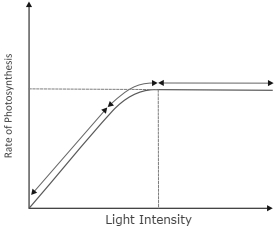
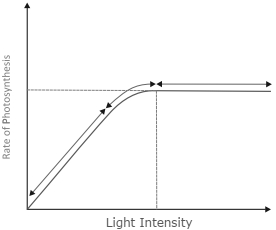
The figure shows the effect of light on the rate of photosynthesis. Based on the graph,answer the following questions:
$(a)$ In which region/s (indicated by arrows) is light a limiting factor?
$(b)$ What could be the limiting factor/s in the region where the rate of photosynthesis becomes constant?
$(c)$ What does the point where the curve flattens represent?
$(a)$ In which region/s (indicated by arrows) is light a limiting factor?
$(b)$ What could be the limiting factor/s in the region where the rate of photosynthesis becomes constant?
$(c)$ What does the point where the curve flattens represent?
Solution
(N/A) Light is a limiting factor in the region where the rate of photosynthesis increases linearly with an increase in light intensity. In the given graph,this corresponds to the initial rising region indicated by the first arrow.
$(b)$ In the region where the rate of photosynthesis becomes constant (plateau region),light is no longer a limiting factor. Other factors such as temperature,carbon dioxide concentration,or water availability become the limiting factors.
$(c)$ The point where the curve flattens represents the light saturation point. At this intensity,the rate of photosynthesis reaches its maximum,and further increases in light intensity do not increase the rate of photosynthesis.
$(b)$ In the region where the rate of photosynthesis becomes constant (plateau region),light is no longer a limiting factor. Other factors such as temperature,carbon dioxide concentration,or water availability become the limiting factors.
$(c)$ The point where the curve flattens represents the light saturation point. At this intensity,the rate of photosynthesis reaches its maximum,and further increases in light intensity do not increase the rate of photosynthesis.
0 likes
View Solution94
Medium
Explain the factors affecting photosynthesis.
Solution
(N/A) Photosynthesis is influenced by both internal and external factors.
Internal factors: These include the number,size,age,and orientation of leaves,mesophyll cells,chloroplasts,internal $CO_2$ concentration,and the amount of chlorophyll.
Blackman's Law of Limiting Factors: If a chemical process is affected by more than one factor,its rate is determined by the factor nearest to its minimal value. This factor directly limits the process if its quantity is changed.
External Factors:
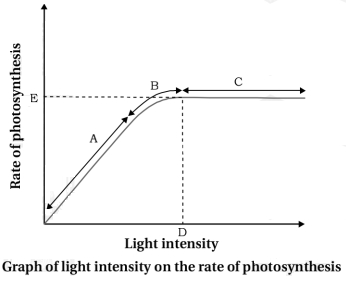
$1$. Light: There is a linear relationship between incident light and $CO_2$ fixation at low light intensities. At higher intensities,the rate plateaus as other factors become limiting. Light saturation occurs at $10\%$ of full sunlight. Excessive light can cause chlorophyll breakdown.
$2$. Carbon dioxide concentration: $CO_2$ is a major limiting factor. Atmospheric concentration is low $(0.03-0.04\%)$. $C_3$ and $C_4$ plants respond differently; $C_4$ plants saturate at $360 \mu l L^{-1}$,while $C_3$ plants saturate beyond $450 \mu l L^{-1}$.
$3$. Temperature: Dark reactions are enzymatic and temperature-sensitive. $C_4$ plants have a higher temperature optimum compared to $C_3$ plants. Tropical plants generally have higher temperature optima than temperate plants.
$4$. Water: Water stress causes stomata to close,reducing $CO_2$ availability. It also causes leaf wilting,reducing surface area and metabolic activity.
Internal factors: These include the number,size,age,and orientation of leaves,mesophyll cells,chloroplasts,internal $CO_2$ concentration,and the amount of chlorophyll.
Blackman's Law of Limiting Factors: If a chemical process is affected by more than one factor,its rate is determined by the factor nearest to its minimal value. This factor directly limits the process if its quantity is changed.
External Factors:
$1$. Light: There is a linear relationship between incident light and $CO_2$ fixation at low light intensities. At higher intensities,the rate plateaus as other factors become limiting. Light saturation occurs at $10\%$ of full sunlight. Excessive light can cause chlorophyll breakdown.
$2$. Carbon dioxide concentration: $CO_2$ is a major limiting factor. Atmospheric concentration is low $(0.03-0.04\%)$. $C_3$ and $C_4$ plants respond differently; $C_4$ plants saturate at $360 \mu l L^{-1}$,while $C_3$ plants saturate beyond $450 \mu l L^{-1}$.
$3$. Temperature: Dark reactions are enzymatic and temperature-sensitive. $C_4$ plants have a higher temperature optimum compared to $C_3$ plants. Tropical plants generally have higher temperature optima than temperate plants.
$4$. Water: Water stress causes stomata to close,reducing $CO_2$ availability. It also causes leaf wilting,reducing surface area and metabolic activity.
0 likes
View Solution95
EasyMCQ
How does light affect photosynthesis?
A
Light intensity is directly proportional to the rate of photosynthesis.
B
Light quality (wavelength) affects the absorption spectrum of chlorophyll.
C
Duration of light exposure influences the total photosynthetic yield.
D
All of the above.
Solution
(D) Light affects the process of photosynthesis in three main ways:
$1$. Light Intensity: The rate of photosynthesis increases with an increase in light intensity,although very high intensity can lead to the photo-oxidation of chlorophyll.
$2$. Light Quality: The visible spectrum $(400-700 \ nm)$ is most effective for photosynthesis,with red and blue light being absorbed most efficiently by chlorophyll.
$3$. Light Duration: The duration of exposure to light influences the total photosynthetic yield over time.
Therefore,the correct answer is $D$.
$1$. Light Intensity: The rate of photosynthesis increases with an increase in light intensity,although very high intensity can lead to the photo-oxidation of chlorophyll.
$2$. Light Quality: The visible spectrum $(400-700 \ nm)$ is most effective for photosynthesis,with red and blue light being absorbed most efficiently by chlorophyll.
$3$. Light Duration: The duration of exposure to light influences the total photosynthetic yield over time.
Therefore,the correct answer is $D$.
0 likes
View Solution96
Medium
Write the effect of concentration of $CO_2$ on $C_3$ and $C_4$ plants.
Solution
(N/A) The concentration of $CO_2$ is a major limiting factor for photosynthesis.
$1$. $C_3$ plants: These plants show an increase in the rate of photosynthesis with an increase in $CO_2$ concentration up to $450 \ \mu L/L$. Since $RuBisCO$ has a lower affinity for $CO_2$ and also acts as an oxygenase,higher $CO_2$ levels suppress photorespiration,thereby increasing productivity.
$2$. $C_4$ plants: These plants show saturation at much lower levels of $CO_2$ (around $360 \ \mu L/L$). Because $C_4$ plants have a $CO_2$ concentrating mechanism (the $C_4$ cycle) that ensures $RuBisCO$ operates in a high $CO_2$ environment,they do not show significant increases in photosynthesis at higher $CO_2$ concentrations compared to $C_3$ plants.
$1$. $C_3$ plants: These plants show an increase in the rate of photosynthesis with an increase in $CO_2$ concentration up to $450 \ \mu L/L$. Since $RuBisCO$ has a lower affinity for $CO_2$ and also acts as an oxygenase,higher $CO_2$ levels suppress photorespiration,thereby increasing productivity.
$2$. $C_4$ plants: These plants show saturation at much lower levels of $CO_2$ (around $360 \ \mu L/L$). Because $C_4$ plants have a $CO_2$ concentrating mechanism (the $C_4$ cycle) that ensures $RuBisCO$ operates in a high $CO_2$ environment,they do not show significant increases in photosynthesis at higher $CO_2$ concentrations compared to $C_3$ plants.
0 likes
View Solution97
MediumMCQ
State the saturation point of $C_3$ and $C_4$ plants with respect to the concentration of $CO_2$.
A
$C_3$: $450 \mu L L^{-1}$,$C_4$: $360 \mu L L^{-1}$
B
$C_3$: $360 \mu L L^{-1}$,$C_4$: $450 \mu L L^{-1}$
C
$C_3$: $500 \mu L L^{-1}$,$C_4$: $500 \mu L L^{-1}$
D
$C_3$: $200 \mu L L^{-1}$,$C_4$: $200 \mu L L^{-1}$
Solution
(A) The concentration of $CO_2$ is a major limiting factor for photosynthesis.
$C_3$ plants show saturation at about $450 \mu L L^{-1}$ of $CO_2$ concentration.
$C_4$ plants show saturation at about $360 \mu L L^{-1}$ of $CO_2$ concentration.
Therefore,$C_3$ plants respond to higher $CO_2$ concentrations and show increased rates of photosynthesis at higher levels compared to $C_4$ plants,which saturate at lower levels.
$C_3$ plants show saturation at about $450 \mu L L^{-1}$ of $CO_2$ concentration.
$C_4$ plants show saturation at about $360 \mu L L^{-1}$ of $CO_2$ concentration.
Therefore,$C_3$ plants respond to higher $CO_2$ concentrations and show increased rates of photosynthesis at higher levels compared to $C_4$ plants,which saturate at lower levels.
0 likes
View Solution98
MediumMCQ
State the effect of temperature on $C_3$ and $C_4$ plants.
A
$C_3$ plants have a higher temperature optimum than $C_4$ plants.
B
$C_4$ plants have a higher temperature optimum than $C_3$ plants.
C
Both $C_3$ and $C_4$ plants have the same temperature optimum.
D
Temperature has no effect on $C_3$ and $C_4$ plants.
Solution
(B) The effect of temperature on photosynthesis varies between $C_3$ and $C_4$ plants due to their different photosynthetic pathways.
$C_4$ plants respond to higher temperatures and show higher rates of photosynthesis at higher temperatures compared to $C_3$ plants.
$C_3$ plants have a lower temperature optimum,typically ranging from $20^{\circ}C$ to $25^{\circ}C$.
$C_4$ plants have a higher temperature optimum,typically ranging from $30^{\circ}C$ to $45^{\circ}C$.
Therefore,$C_4$ plants are better adapted to warmer climates.
$C_4$ plants respond to higher temperatures and show higher rates of photosynthesis at higher temperatures compared to $C_3$ plants.
$C_3$ plants have a lower temperature optimum,typically ranging from $20^{\circ}C$ to $25^{\circ}C$.
$C_4$ plants have a higher temperature optimum,typically ranging from $30^{\circ}C$ to $45^{\circ}C$.
Therefore,$C_4$ plants are better adapted to warmer climates.
0 likes
View Solution99
Medium
Photosynthetic organisms occur at different depths in the ocean. Do they receive qualitatively and quantitatively the same light? How do they adapt to carry out photosynthesis under these conditions?
Solution
(N/A) No,photosynthetic organisms at different depths in the ocean do not receive the same quality and quantity of light. As depth increases,light intensity decreases (quantitative change) and the spectral quality changes because water absorbs different wavelengths of light at different rates (qualitative change).
To adapt to these conditions,organisms possess diverse photosynthetic pigments that can absorb specific wavelengths of light available at their respective depths:
$1$. Green Algae (Chlorophyceae): Contain Chlorophyll-$a$ and Chlorophyll-$b$,which are efficient at absorbing red and violet-blue light,typically found in shallower waters.
$2$. Brown Algae (Phaeophyceae): Contain Chlorophyll-$a$,$c$,and the accessory pigment Fucoxanthin,which helps in absorbing green and yellow light.
$3$. Red Algae (Rhodophyceae): Contain Chlorophyll-$a$,$d$,and the accessory pigment Phycoerythrin,which is highly effective at absorbing blue-green light that penetrates deeper into the ocean.
To adapt to these conditions,organisms possess diverse photosynthetic pigments that can absorb specific wavelengths of light available at their respective depths:
$1$. Green Algae (Chlorophyceae): Contain Chlorophyll-$a$ and Chlorophyll-$b$,which are efficient at absorbing red and violet-blue light,typically found in shallower waters.
$2$. Brown Algae (Phaeophyceae): Contain Chlorophyll-$a$,$c$,and the accessory pigment Fucoxanthin,which helps in absorbing green and yellow light.
$3$. Red Algae (Rhodophyceae): Contain Chlorophyll-$a$,$d$,and the accessory pigment Phycoerythrin,which is highly effective at absorbing blue-green light that penetrates deeper into the ocean.
0 likes
View Solution100
EasyMCQ
In tropical rain forests,the canopy is thick and shorter plants growing below it receive filtered light. How are they able to carry out photosynthesis?
A
They do not perform photosynthesis.
B
They have adapted to perform photosynthesis under low light intensity.
C
They use moonlight for photosynthesis.
D
They obtain energy from the soil.
Solution
(B) The rate of photosynthesis is influenced by the intensity and quality of light.
Plants growing in the understory of tropical rain forests have adapted to low light conditions.
These plants possess specialized pigments and leaf structures that allow them to efficiently capture and utilize the filtered light that reaches the forest floor.
Therefore,they can perform photosynthesis even at lower light intensities,although the rate of photosynthesis may be lower compared to plants in direct sunlight.
Plants growing in the understory of tropical rain forests have adapted to low light conditions.
These plants possess specialized pigments and leaf structures that allow them to efficiently capture and utilize the filtered light that reaches the forest floor.
Therefore,they can perform photosynthesis even at lower light intensities,although the rate of photosynthesis may be lower compared to plants in direct sunlight.
0 likes
View SolutionPhotosynthesis in Higher Plants — Factors affecting photosynthesis · Frequently Asked Questions
1Are these Photosynthesis in Higher Plants questions useful for JEE and NEET?
Yes. All questions in this section are mapped to JEE Main and NEET exam patterns. Previous year questions from JEE Main, NEET, GUJCET and state-level exams are included with full solutions.
2Can I switch to Hindi or Gujarati for these questions?
Yes. Use the language tabs in the hero section or the sidebar to view the same questions and solutions in English, Hindi or Gujarati.
3How do I generate a question paper from this subtopic?
Use the Vedclass Exam Paper Generator — select the chapter and subtopic, set difficulty, and generate Sets A, B, C, D automatically. First 3 chapters of every subject are free.
Vedclass Products
For Students
Vedclass Test Series
Mock tests in real JEE/NEET style with performance analysis. 5-day free trial.
Start Free TrialFor Teachers
Exam Paper Generator
Generate Set A/B/C/D papers from this chapter in 2 minutes. 3 chapters free.
Try FreeFor Institutes
Online Exam Module
Live online exams with unlimited students, 360° analytics & white-label branding.
See DemoFor Teachers & Institutes
Generate a Photosynthesis in Higher Plants Exam Paper in 2 Minutes
Select subtopic & difficulty — Sets A, B, C, D auto-generated with No Repeat logic.
First 3 chapters of every subject are free — no payment required.