
A English
Factors affecting photosynthesis Questions in English
Class 11 Biology · Photosynthesis in Higher Plants · Factors affecting photosynthesis
144+
Questions
English
Language
100%
With Solutions
Showing 50 of 144 questions in English
1
EasyMCQ
Thick cuticle on leaves is typical of plants growing in
A
Wet habitats
B
Warm habitats
C
Dry habitats
D
Cool habitats
Solution
(C) The correct answer is $C$.
In dry habitats (xerophytic conditions),plants possess a thick,waxy cuticle on the surface of their leaves.
This adaptation is essential to minimize the rate of transpiration and prevent excessive water loss,allowing the plant to survive in water-scarce environments.
In dry habitats (xerophytic conditions),plants possess a thick,waxy cuticle on the surface of their leaves.
This adaptation is essential to minimize the rate of transpiration and prevent excessive water loss,allowing the plant to survive in water-scarce environments.
0 likes
View Solution2
MediumMCQ
Stomata open at night and close during the day in
A
Xerophytes
B
Gametophytes
C
Mesophytes
D
Hydrophytes
Solution
(A) Stomata that open at night and close during the day are known as $scotoactive$ stomata.
This mechanism is an adaptation to reduce water loss through transpiration in arid environments.
These are typically found in succulent plants such as $Opuntia$,$Aloe$,and $Bryophyllum$,which are classified as $Xerophytes$.
This mechanism is an adaptation to reduce water loss through transpiration in arid environments.
These are typically found in succulent plants such as $Opuntia$,$Aloe$,and $Bryophyllum$,which are classified as $Xerophytes$.
0 likes
View Solution3
MediumMCQ
Transpiration ratio is the ratio of moles of ${H_2}O$ transpired to moles of $CO_2$ fixed. This ratio is a measure of:
A
The efficiency of guard cells on stomatal movement
B
Effectiveness of stomata in maximizing photosynthesis while minimizing water loss
C
Distinguishing a xerophyte from a glycophyte
D
Stomatal pore size of the leaves
Solution
(B) The transpiration ratio is defined as the amount of water lost through transpiration per unit of $CO_2$ fixed during photosynthesis.
Since plants need to open their stomata to take in $CO_2$ for photosynthesis,they inevitably lose water vapor through the same pores.
$A$ lower transpiration ratio indicates that the plant is highly efficient at fixing $CO_2$ while losing the minimum amount of water.
Therefore,this ratio serves as a measure of the effectiveness of stomata in balancing the trade-off between maximizing photosynthesis and minimizing water loss.
Since plants need to open their stomata to take in $CO_2$ for photosynthesis,they inevitably lose water vapor through the same pores.
$A$ lower transpiration ratio indicates that the plant is highly efficient at fixing $CO_2$ while losing the minimum amount of water.
Therefore,this ratio serves as a measure of the effectiveness of stomata in balancing the trade-off between maximizing photosynthesis and minimizing water loss.
0 likes
View Solution4
MediumMCQ
Increase in $CO_2$ concentration around the leaf results in:
A
Rapid opening of stomata
B
Partial closing of stomata
C
Complete closure of stomata
D
There will be no effect on stomatal opening
Solution
(B) Mansfield $(1965)$ reported that the removal of $CO_2$ maintains stomatal opening even in the dark.
Conversely,stomata tend to close in the presence of light if the $CO_2$ concentration is increased around the leaf surface.
Therefore,an increase in $CO_2$ concentration leads to the partial closing of stomata.
Conversely,stomata tend to close in the presence of light if the $CO_2$ concentration is increased around the leaf surface.
Therefore,an increase in $CO_2$ concentration leads to the partial closing of stomata.
0 likes
View Solution5
EasyMCQ
Who explained the scotoactive opening of stomata?
A
Nishida
B
Palls
C
Ehrler
D
None of the above
Solution
(A) Scotoactive stomata are those that open during the night and remain closed during the day. This phenomenon is typically observed in succulent plants ($CAM$ plants). The mechanism of scotoactive stomatal opening was explained by Nishida in $1963$.
0 likes
View Solution6
MediumMCQ
In which of the following plants would metabolism be hindered if the leaves are coated with wax on their upper surface?
A
Hydrilla
B
Lotus
C
Pistia
D
Vallisneria
Solution
(B) In plants like $Lotus$ (Nelumbo),the leaves are $epistomatic$,meaning stomata are present only on the upper surface of the leaves.
Coating the upper surface with wax will block these stomata,thereby inhibiting gaseous exchange ($CO_2$ uptake for photosynthesis and $O_2$ release) and stomatal transpiration.
Since $Hydrilla$,$Pistia$,and $Vallisneria$ are aquatic plants with different stomatal distributions or adaptations (often $hypostomatic$ or submerged),the impact of waxing the upper surface is most critical in $Lotus$ where the upper surface is the primary site for gas exchange.
Coating the upper surface with wax will block these stomata,thereby inhibiting gaseous exchange ($CO_2$ uptake for photosynthesis and $O_2$ release) and stomatal transpiration.
Since $Hydrilla$,$Pistia$,and $Vallisneria$ are aquatic plants with different stomatal distributions or adaptations (often $hypostomatic$ or submerged),the impact of waxing the upper surface is most critical in $Lotus$ where the upper surface is the primary site for gas exchange.
0 likes
View Solution7
EasyMCQ
The law of limiting factors for photosynthesis was enunciated by
A
Blackman
B
Hill
C
Ruben
D
Kalmen
Solution
(A) The law of limiting factors for photosynthesis was proposed by $F.F. Blackman$ in $1905$.
According to this law,if a chemical process is affected by more than one factor,then its rate will be determined by the factor which is nearest to its minimal value,as it is the factor which directly affects the process if its quantity is changed.
$Blackman$ also proposed the existence of a light-independent (dark) phase in photosynthesis.
According to this law,if a chemical process is affected by more than one factor,then its rate will be determined by the factor which is nearest to its minimal value,as it is the factor which directly affects the process if its quantity is changed.
$Blackman$ also proposed the existence of a light-independent (dark) phase in photosynthesis.
0 likes
View Solution8
EasyMCQ
Who proposed the 'law of limiting factor' as the 'law of minimum'?
A
Blackman
B
Hill
C
Liebig
D
Priestley
Solution
(C) The 'law of minimum' was proposed by Justus von Liebig in $1840$.
It states that the growth of an organism is limited by the scarcest or 'limiting' resource,even if all other factors are abundant.
This concept was later adapted into the 'law of limiting factors' in plant physiology,particularly in the context of photosynthesis by Blackman.
It states that the growth of an organism is limited by the scarcest or 'limiting' resource,even if all other factors are abundant.
This concept was later adapted into the 'law of limiting factors' in plant physiology,particularly in the context of photosynthesis by Blackman.
0 likes
View Solution9
MediumMCQ
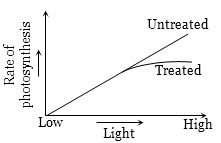
The graph given below shows the effect of potassium cyanide on the rate of photosynthesis of Chlorella at different light intensities. Which one of the following can be deduced from the graph?
A
Potassium cyanide appears to inhibit the light (Hill) reaction
B
Potassium cyanide appears to absorb more light at high light intensities
C
Potassium cyanide appears to inhibit photosynthesis equally at high and low light intensities
D
Potassium cyanide appears to have no inhibiting effect on photosynthesis at low light intensities
Solution
(D) The graph shows that at low light intensities,the rate of photosynthesis is the same for both untreated and treated $Chlorella$ samples,indicating that light is the limiting factor and potassium cyanide has no effect here.
As light intensity increases,the rate of photosynthesis in the untreated sample continues to rise,whereas in the treated sample,it plateaus.
Potassium cyanide is a known inhibitor of the dark reaction (Calvin cycle) by inhibiting enzymes like cytochrome oxidase. Since the dark reaction becomes the limiting factor at higher light intensities,the inhibition by potassium cyanide becomes apparent only at these higher intensities.
Therefore,it can be deduced that potassium cyanide has no inhibiting effect on photosynthesis at low light intensities,where the light reaction is the limiting factor.
As light intensity increases,the rate of photosynthesis in the untreated sample continues to rise,whereas in the treated sample,it plateaus.
Potassium cyanide is a known inhibitor of the dark reaction (Calvin cycle) by inhibiting enzymes like cytochrome oxidase. Since the dark reaction becomes the limiting factor at higher light intensities,the inhibition by potassium cyanide becomes apparent only at these higher intensities.
Therefore,it can be deduced that potassium cyanide has no inhibiting effect on photosynthesis at low light intensities,where the light reaction is the limiting factor.
0 likes
View Solution10
MediumMCQ
The percentage of light energy utilized for photosynthesis by higher plants is
A
$100\%$
B
$50\%$
C
$10\%$
D
$1$ to $2\%$
Solution
(D) The correct answer is $D$.
Plants capture only a small fraction of the total solar radiation reaching the Earth's surface.
Out of the total photosynthetically active radiation $(PAR)$,higher plants utilize only about $1-4\%$ of the light energy for the process of photosynthesis.
Therefore,$1$ to $2\%$ is the most appropriate range among the given options.
Plants capture only a small fraction of the total solar radiation reaching the Earth's surface.
Out of the total photosynthetically active radiation $(PAR)$,higher plants utilize only about $1-4\%$ of the light energy for the process of photosynthesis.
Therefore,$1$ to $2\%$ is the most appropriate range among the given options.
0 likes
View Solution11
EasyMCQ
Intensity of light can be measured by
A
Lux meter
B
Wilmott's bubbler
C
Ganong's potometer
D
Farmer's potometer
Solution
(A) $Lux$ meter is an instrument specifically designed to measure the intensity of light in $lux$ units.
$Wilmott's$ bubbler is used to measure the rate of photosynthesis by counting oxygen bubbles.
$Ganong's$ potometer and $Farmer's$ potometer are used to measure the rate of transpiration in plants.
Therefore,the correct instrument for measuring light intensity is the $Lux$ meter.
$Wilmott's$ bubbler is used to measure the rate of photosynthesis by counting oxygen bubbles.
$Ganong's$ potometer and $Farmer's$ potometer are used to measure the rate of transpiration in plants.
Therefore,the correct instrument for measuring light intensity is the $Lux$ meter.
0 likes
View Solution12
MediumMCQ
What is the common value of $PQ$ (photosynthetic quotient) of a leaf?
A
$> 1$
B
$< 1$
C
One
D
Zero
Solution
(C) The photosynthetic quotient $(PQ)$ is defined as the ratio of the volume of $O_2$ evolved to the volume of $CO_2$ consumed during photosynthesis.
For a typical green leaf performing photosynthesis,the chemical equation is $6CO_2 + 12H_2O \rightarrow C_6H_{12}O_6 + 6O_2 + 6H_2O$.
Since the volume of $O_2$ released is equal to the volume of $CO_2$ absorbed,the ratio is $6/6 = 1$.
Therefore,the common value of $PQ$ for a leaf is $1$.
For a typical green leaf performing photosynthesis,the chemical equation is $6CO_2 + 12H_2O \rightarrow C_6H_{12}O_6 + 6O_2 + 6H_2O$.
Since the volume of $O_2$ released is equal to the volume of $CO_2$ absorbed,the ratio is $6/6 = 1$.
Therefore,the common value of $PQ$ for a leaf is $1$.
0 likes
View Solution13
MediumMCQ
Solarisation is
A
Formation of chlorophyll
B
Destruction of chlorophyll
C
Utilisation of sunlight
D
Effects of solar light
Solution
(B) Solarisation is a phenomenon where high-intensity light causes the photo-oxidation and subsequent destruction of chlorophyll pigments in plants.
This process typically occurs when plants are exposed to excessive solar radiation,leading to a reduction in photosynthetic efficiency.
This process typically occurs when plants are exposed to excessive solar radiation,leading to a reduction in photosynthetic efficiency.
0 likes
View Solution14
MediumMCQ
Why does the rate of photosynthesis decline at very strong light intensities? It may be due to:
A
Increased respiration
B
Decreased hydration
C
Photo-oxidation of chlorophyll
D
All the above
Solution
(D) At very high light intensities,the rate of photosynthesis declines due to several factors:
$1$. Photo-oxidation of chlorophyll: Excessive light energy can damage the chlorophyll molecules,leading to their breakdown.
$2$. Increased respiration: High light intensity is often accompanied by high temperatures,which increase the rate of respiration,thereby consuming more of the produced carbohydrates.
$3$. Decreased hydration: High light intensity and heat lead to increased transpiration,which can cause water stress and stomatal closure,limiting $CO_2$ availability.
Therefore,all these factors contribute to the decline in the rate of photosynthesis.
$1$. Photo-oxidation of chlorophyll: Excessive light energy can damage the chlorophyll molecules,leading to their breakdown.
$2$. Increased respiration: High light intensity is often accompanied by high temperatures,which increase the rate of respiration,thereby consuming more of the produced carbohydrates.
$3$. Decreased hydration: High light intensity and heat lead to increased transpiration,which can cause water stress and stomatal closure,limiting $CO_2$ availability.
Therefore,all these factors contribute to the decline in the rate of photosynthesis.
0 likes
View Solution15
MediumMCQ
Plants adapted to low light intensity have
A
More extended root system
B
Leaves modified to spines
C
Higher rate of $CO_2$ fixation than the sun plants
D
Larger photosynthetic unit size than the sun plants
Solution
(D) The correct option is $D$.
The proteinaceous photosynthetic unit $(PSU)$ size increases as light levels decline.
At lower light levels,chloroplasts have a larger $PSU$ to increase the probability that a photon will strike the chlorophyll antenna.
Therefore,plants adapted to low light intensity have a larger photosynthetic unit size compared to sun plants.
Plants adapted to low light intensity do not have a higher rate of $CO_2$ fixation,nor do they typically have more extended root systems or leaves modified into spines (which are adaptations for arid environments).
Thus,the correct answer is option $D$.
The proteinaceous photosynthetic unit $(PSU)$ size increases as light levels decline.
At lower light levels,chloroplasts have a larger $PSU$ to increase the probability that a photon will strike the chlorophyll antenna.
Therefore,plants adapted to low light intensity have a larger photosynthetic unit size compared to sun plants.
Plants adapted to low light intensity do not have a higher rate of $CO_2$ fixation,nor do they typically have more extended root systems or leaves modified into spines (which are adaptations for arid environments).
Thus,the correct answer is option $D$.
0 likes
View Solution16
EasyMCQ
The value of $Q_{10}$ for photosynthesis is
A
$4$
B
$6$
C
$7$
D
$2$
Solution
(D) The temperature coefficient $(Q_{10})$ is defined as the ratio of the rate of a reaction at a temperature $T + 10^{\circ}C$ to the rate of the reaction at temperature $T$.
For most biological processes,including photosynthesis,the $Q_{10}$ value is approximately $2$ within the physiological temperature range.
This means that for every $10^{\circ}C$ rise in temperature,the rate of photosynthesis approximately doubles,provided other factors are not limiting.
For most biological processes,including photosynthesis,the $Q_{10}$ value is approximately $2$ within the physiological temperature range.
This means that for every $10^{\circ}C$ rise in temperature,the rate of photosynthesis approximately doubles,provided other factors are not limiting.
0 likes
View Solution17
MediumMCQ
Water budget (transpiration ratio) required to produce $1$ gm of dry matter by $C_3$ and $C_4$ plants is approximately:
A
$610$ gm each
B
$300$ gm each
C
$300$ gm and $610$ gm respectively
D
$610$ gm and $300$ gm respectively
Solution
(D) $C_3$ plants are less water-efficient compared to $C_4$ plants.
To produce $1$ gm of dry matter,$C_3$ plants typically require approximately $600-650$ gm of water (average $610$ gm).
In contrast,$C_4$ plants are highly efficient and require only about $250-350$ gm of water (average $300$ gm) to produce the same amount of dry matter.
Therefore,the water requirement for $C_3$ and $C_4$ plants is $610$ gm and $300$ gm respectively.
To produce $1$ gm of dry matter,$C_3$ plants typically require approximately $600-650$ gm of water (average $610$ gm).
In contrast,$C_4$ plants are highly efficient and require only about $250-350$ gm of water (average $300$ gm) to produce the same amount of dry matter.
Therefore,the water requirement for $C_3$ and $C_4$ plants is $610$ gm and $300$ gm respectively.
0 likes
View Solution18
MediumMCQ
In cold and foggy areas,the limiting factor for photosynthesis is
A
Temperature
B
Light
C
Both $(a)$ and $(b)$
D
None of the above
Solution
(C) In cold and foggy areas,the intensity of light is significantly reduced due to the presence of fog.
Additionally,the ambient temperature is low,which reduces the rate of enzymatic reactions involved in photosynthesis.
According to Blackman's Law of Limiting Factors,when multiple factors affect a process,the rate is determined by the factor that is nearest to its minimal value.
In such environments,both light and temperature act as limiting factors,as they are both present at suboptimal levels for the photosynthetic process.
Additionally,the ambient temperature is low,which reduces the rate of enzymatic reactions involved in photosynthesis.
According to Blackman's Law of Limiting Factors,when multiple factors affect a process,the rate is determined by the factor that is nearest to its minimal value.
In such environments,both light and temperature act as limiting factors,as they are both present at suboptimal levels for the photosynthetic process.
0 likes
View Solution19
EasyMCQ
The algae found in high-temperature ponds are capable of performing photosynthesis up to (in $^\circ C$)
A
$30$
B
$75$
C
$90$
D
$100$
Solution
(B) The correct answer is $B$.
Certain species of algae that inhabit hot springs or high-temperature ponds have evolved to perform photosynthesis at significantly higher temperatures than typical plants.
Research indicates that while most plants cease photosynthetic activity at lower temperatures,these specialized algae can maintain photosynthetic processes at temperatures up to $75^\circ C$.
Certain species of algae that inhabit hot springs or high-temperature ponds have evolved to perform photosynthesis at significantly higher temperatures than typical plants.
Research indicates that while most plants cease photosynthetic activity at lower temperatures,these specialized algae can maintain photosynthetic processes at temperatures up to $75^\circ C$.
0 likes
View Solution20
MediumMCQ
What is called Warburg's effect on photosynthesis?
A
Low rate of the process due to $O_2$ supply
B
Low rate of the process due to $CO_2$ supply
C
Both $(a)$ and $(b)$
D
None of the above
Solution
(A) The German scientist Warburg $(1920)$ reported in the alga $Chlorella$ that a high $O_2$ level inhibits the rate of photosynthesis.
This inhibition of photosynthesis caused by an increased $O_2$ concentration is known as the Warburg effect.
This inhibition of photosynthesis caused by an increased $O_2$ concentration is known as the Warburg effect.
0 likes
View Solution21
MediumMCQ
When $NaHCO_3$ is added in small quantity in an experiment showing photosynthesis,what will be the effect on it?
A
Rate will be lowered
B
Rate will be increased
C
Rate will be normal
D
Process will stop
Solution
(B) When $NaHCO_3$ (sodium bicarbonate) is added to the experimental setup,it acts as a source of $CO_2$.
Since $CO_2$ is a limiting factor for photosynthesis,its increased availability enhances the rate of the photosynthetic process.
Therefore,the rate of photosynthesis will be increased.
Since $CO_2$ is a limiting factor for photosynthesis,its increased availability enhances the rate of the photosynthetic process.
Therefore,the rate of photosynthesis will be increased.
0 likes
View Solution22
MediumMCQ
Compensation point is
A
Where there is neither photosynthesis nor respiration
B
When rate of photosynthesis is equal to the rate of respiration
C
When entire food synthesized in photosynthesis remains utilized
D
When there is enough water just to meet the requirements of the plant
Solution
(B) The compensation point is the light intensity at which the rate of photosynthesis exactly equals the rate of respiration. At this point,the amount of $CO_2$ produced during respiration is exactly equal to the amount of $CO_2$ consumed during photosynthesis. Consequently,there is no net exchange of $CO_2$ or $O_2$ with the atmosphere. This typically occurs during the early morning and late evening hours when light intensity is low.
0 likes
View Solution23
MediumMCQ
Which one of the following is not a limiting factor for photosynthesis?
A
Oxygen
B
Carbon dioxide
C
Chlorophyll
D
Light
Solution
(A) According to Blackman's Law of Limiting Factors,when several factors affect any biochemical process,the rate of the process is limited by the factor which is nearest to its minimal value.
Factors such as $CO_2$ concentration,light intensity,temperature,and water are external limiting factors.
Chlorophyll is an internal factor that influences the rate of photosynthesis.
Oxygen is a byproduct of photosynthesis and is not a limiting factor for the process itself under normal physiological conditions.
Factors such as $CO_2$ concentration,light intensity,temperature,and water are external limiting factors.
Chlorophyll is an internal factor that influences the rate of photosynthesis.
Oxygen is a byproduct of photosynthesis and is not a limiting factor for the process itself under normal physiological conditions.
0 likes
View Solution24
MediumMCQ
If the rate of translocation of food is slow,what will be the effect on photosynthesis?
A
It will increase
B
It will remain same
C
Becomes double
D
It will decrease
Solution
(D) Photosynthesis produces carbohydrates (food) in the leaves.
These carbohydrates are translocated to other parts of the plant through the phloem.
If the rate of translocation is slow,the synthesized food accumulates in the leaves.
This accumulation of end products (feedback inhibition) inhibits the process of photosynthesis,leading to a decrease in its rate.
These carbohydrates are translocated to other parts of the plant through the phloem.
If the rate of translocation is slow,the synthesized food accumulates in the leaves.
This accumulation of end products (feedback inhibition) inhibits the process of photosynthesis,leading to a decrease in its rate.
0 likes
View Solution25
EasyMCQ
$A$ plant is kept in $300 \, ppm$ $CO_2$ concentration. What will happen to it?
A
Plant will die soon
B
Plant will grow but will not die
C
Plant will show normal photosynthesis
D
Respiration will be greatly decreased
Solution
(C) The atmospheric concentration of $CO_2$ is approximately $0.03\%$ to $0.04\%$,which is equivalent to $300-400 \, ppm$. Since $300 \, ppm$ is the ambient level of $CO_2$ in the atmosphere,the plant will perform photosynthesis at its normal,baseline rate. Therefore,the correct option is $(c)$.
0 likes
View Solution26
MediumMCQ
What will be the effect of intermittent light on photosynthesis?
A
It will increase
B
It will decrease
C
Will not be affected
D
Process will stop
Solution
(A) The light reaction is significantly faster than the dark reaction. In continuous light,there is an accumulation of $ATP$ and $NADPH_2$,which can lead to a reduction in the overall rate of photosynthesis due to feedback inhibition. However,in intermittent (discontinuous) light,the $ATP$ and $NADPH_2$ produced during the light phase are efficiently consumed during the dark phase for the reduction of $CO_2$ into carbohydrates. This prevents the accumulation of products and allows the photosynthetic process to proceed more efficiently,thereby increasing the overall rate.
0 likes
View Solution27
MediumMCQ
What will be the effect when very high intensity of light is supplied to a photosynthesis system?
A
Process will increase
B
Process will decrease
C
Process will stop due to solarization
D
None of the above
Solution
(C) When a plant is exposed to very high light intensity,it leads to a phenomenon known as solarization or photo-oxidation.
In this process,the chlorophyll pigments are damaged,and the photosynthetic apparatus is destroyed.
Consequently,the rate of photosynthesis decreases significantly and may eventually stop.
In this process,the chlorophyll pigments are damaged,and the photosynthetic apparatus is destroyed.
Consequently,the rate of photosynthesis decreases significantly and may eventually stop.
0 likes
View Solution28
MediumMCQ
If water supply to the plant is extremely meagre so as to cause wilting of leaves,the rate of photosynthesis may
A
Increase
B
Decrease
C
First increase then decrease
D
First decrease then increase
Solution
(B) Water is a vital reactant in the process of photosynthesis. When water supply is extremely low,it leads to the wilting of leaves.
Wilting causes the stomata to close to prevent further water loss through transpiration.
Closing of stomata restricts the entry of $CO_2$ into the leaves,which is essential for the dark reaction of photosynthesis.
Additionally,water stress affects the metabolic activities of the plant and the structural integrity of the chloroplasts.
Therefore,under conditions of severe water stress,the rate of photosynthesis decreases significantly.
Wilting causes the stomata to close to prevent further water loss through transpiration.
Closing of stomata restricts the entry of $CO_2$ into the leaves,which is essential for the dark reaction of photosynthesis.
Additionally,water stress affects the metabolic activities of the plant and the structural integrity of the chloroplasts.
Therefore,under conditions of severe water stress,the rate of photosynthesis decreases significantly.
0 likes
View Solution29
EasyMCQ
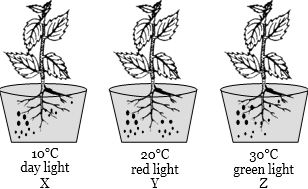
The diagram below shows three plants with identical leaf surface areas. Assuming all other conditions were identical for all three plants,which of the plants would likely photosynthesize slowest,and which fastest?
A
$Y$ slowest,$Z$ fastest
B
$Z$ slowest,$X$ fastest
C
$X$ slowest,$Z$ fastest
D
$Z$ slowest,$Y$ fastest
Solution
(D) The rate of photosynthesis is influenced by light quality (wavelength) and temperature.
$1$. Light Quality: Photosynthesis is most efficient in red and blue light and least efficient in green light,as chlorophyll reflects green light.
$2$. Temperature: According to the $Q_{10}$ effect (often related to Van't Hoff's law),the rate of enzymatic reactions like photosynthesis generally increases with temperature up to an optimum point (around $30^{\circ}C$ to $35^{\circ}C$).
- Plant $X$ is at $10^{\circ}C$ in daylight (white light,which contains red and blue wavelengths).
- Plant $Y$ is at $20^{\circ}C$ in red light (highly effective for photosynthesis).
- Plant $Z$ is at $30^{\circ}C$ in green light (least effective for photosynthesis).
Comparing these,plant $Z$ will photosynthesize the slowest because green light is poorly absorbed by chlorophyll,despite the higher temperature. Plant $Y$ will photosynthesize the fastest because it is exposed to red light at a favorable temperature $(20^{\circ}C)$. Therefore,$Z$ is slowest and $Y$ is fastest.
$1$. Light Quality: Photosynthesis is most efficient in red and blue light and least efficient in green light,as chlorophyll reflects green light.
$2$. Temperature: According to the $Q_{10}$ effect (often related to Van't Hoff's law),the rate of enzymatic reactions like photosynthesis generally increases with temperature up to an optimum point (around $30^{\circ}C$ to $35^{\circ}C$).
- Plant $X$ is at $10^{\circ}C$ in daylight (white light,which contains red and blue wavelengths).
- Plant $Y$ is at $20^{\circ}C$ in red light (highly effective for photosynthesis).
- Plant $Z$ is at $30^{\circ}C$ in green light (least effective for photosynthesis).
Comparing these,plant $Z$ will photosynthesize the slowest because green light is poorly absorbed by chlorophyll,despite the higher temperature. Plant $Y$ will photosynthesize the fastest because it is exposed to red light at a favorable temperature $(20^{\circ}C)$. Therefore,$Z$ is slowest and $Y$ is fastest.
0 likes
View Solution30
MediumMCQ
In nature,the rate of photosynthesis is primarily limited by which of the following factors?
A
Light
B
Temperature
C
$CO_2$
D
Moisture and wind
Solution
(C) According to Blackman's Law of Limiting Factors,if a chemical process is affected by more than one factor,then its rate will be determined by the factor which is nearest to its minimal value: it is the factor which directly affects the process if its quantity is changed.
In nature,$CO_2$ concentration is usually the major limiting factor for photosynthesis because its atmospheric concentration is very low $(0.03-0.04\%)$ compared to the requirement for optimal photosynthetic activity. While light and temperature also affect the rate,$CO_2$ is frequently the limiting factor under natural conditions.
In nature,$CO_2$ concentration is usually the major limiting factor for photosynthesis because its atmospheric concentration is very low $(0.03-0.04\%)$ compared to the requirement for optimal photosynthetic activity. While light and temperature also affect the rate,$CO_2$ is frequently the limiting factor under natural conditions.
0 likes
View Solution31
MediumMCQ
The main factor which limits the rate of photosynthesis on a clear day is
A
Chlorophyll
B
Light
C
$CO_2$
D
Water
Solution
(C) According to Blackman's Law of Limiting Factors,when several factors affect any biochemical process,the rate of the process is limited by the factor which is present in the lowest concentration relative to its optimum requirement.
On a clear,sunny day,light is abundant and water is usually sufficient. However,the atmospheric concentration of $CO_2$ is very low (approximately $0.03-0.04\%$) compared to the amount required for optimal photosynthesis.
Therefore,$CO_2$ acts as the primary limiting factor for photosynthesis under these conditions.
On a clear,sunny day,light is abundant and water is usually sufficient. However,the atmospheric concentration of $CO_2$ is very low (approximately $0.03-0.04\%$) compared to the amount required for optimal photosynthesis.
Therefore,$CO_2$ acts as the primary limiting factor for photosynthesis under these conditions.
0 likes
View Solution32
MediumMCQ
The rate of photosynthesis is independent of:
A
Quality of light
B
Intensity of light
C
Duration of light
D
Temperature
Solution
(C) The rate of photosynthesis is influenced by several external and internal factors.
$1$. Light quality (wavelength) affects the absorption spectra of pigments like chlorophyll $a$ and $b$.
$2$. Light intensity directly affects the rate of the light-dependent reactions.
$3$. Temperature affects the activity of enzymes like $RuBisCO$ involved in the Calvin cycle.
$4$. Duration of light (photoperiod) generally affects flowering and plant growth,but the instantaneous rate of photosynthesis is not directly dependent on the duration of light exposure.
$1$. Light quality (wavelength) affects the absorption spectra of pigments like chlorophyll $a$ and $b$.
$2$. Light intensity directly affects the rate of the light-dependent reactions.
$3$. Temperature affects the activity of enzymes like $RuBisCO$ involved in the Calvin cycle.
$4$. Duration of light (photoperiod) generally affects flowering and plant growth,but the instantaneous rate of photosynthesis is not directly dependent on the duration of light exposure.
0 likes
View Solution33
MediumMCQ
Blackman's law of limiting factor is applied to
A
Growth
B
Respiration
C
Transpiration
D
Photosynthesis
Solution
(D) The law of limiting factor was proposed by Blackman in $1905$.
He stated that when a process is conditioned by a number of separate factors,the rate of the process is limited by the pace of the slowest factor.
This law is specifically applied to the process of photosynthesis,where factors like light intensity,$CO_2$ concentration,and temperature act as limiting factors.
He stated that when a process is conditioned by a number of separate factors,the rate of the process is limited by the pace of the slowest factor.
This law is specifically applied to the process of photosynthesis,where factors like light intensity,$CO_2$ concentration,and temperature act as limiting factors.
0 likes
View Solution34
MediumMCQ
Which factor is not limiting under normal conditions for photosynthesis?
A
Air
B
$CO_2$
C
Water
D
Chlorophyll
Solution
(C) According to Blackman's Law of Limiting Factors,photosynthesis is limited by the factor that is present in the lowest concentration relative to its optimum requirement.
Under normal environmental conditions,$CO_2$ and light are often limiting factors.
Water is rarely a limiting factor for photosynthesis because even a slight decrease in water content leads to the closure of stomata,which primarily affects $CO_2$ availability rather than acting as a direct limiting factor for the photosynthetic process itself.
However,among the given options,water is the factor that is least likely to be limiting under normal conditions compared to the others.
Under normal environmental conditions,$CO_2$ and light are often limiting factors.
Water is rarely a limiting factor for photosynthesis because even a slight decrease in water content leads to the closure of stomata,which primarily affects $CO_2$ availability rather than acting as a direct limiting factor for the photosynthetic process itself.
However,among the given options,water is the factor that is least likely to be limiting under normal conditions compared to the others.
0 likes
View Solution35
MediumMCQ
Photosynthesis will proceed up to:
A
Limit of light
B
Limit of wind
C
Limit of moisture
D
None of the above
Solution
(D) Photosynthesis is a physiological process that is governed by Blackman's Law of Limiting Factors.
According to this law,if a chemical process is affected by more than one factor,then its rate will be determined by the factor which is nearest to its minimal value.
Light,wind,and moisture are environmental factors,but photosynthesis does not simply stop at a 'limit' of these in a linear sense; rather,the rate of the process is limited by the factor in the shortest supply.
Therefore,none of the options provided correctly describe the physiological limit of photosynthesis in a scientific context.
According to this law,if a chemical process is affected by more than one factor,then its rate will be determined by the factor which is nearest to its minimal value.
Light,wind,and moisture are environmental factors,but photosynthesis does not simply stop at a 'limit' of these in a linear sense; rather,the rate of the process is limited by the factor in the shortest supply.
Therefore,none of the options provided correctly describe the physiological limit of photosynthesis in a scientific context.
0 likes
View Solution36
MediumMCQ
If half of the leaves of a plant are removed,the rate of photosynthesis would be
A
More and the photosynthetic yield is also more
B
More but the photosynthetic yield is less
C
Less and the photosynthetic yield is also less
D
Less but the photosynthetic yield is more
Solution
(C) Photosynthesis is the process by which green plants synthesize food using chlorophyll,sunlight,water,and $CO_2$.
Leaves are the primary sites of photosynthesis.
When half of the leaves are removed,the total surface area available for light absorption and gas exchange is significantly reduced.
Consequently,the overall rate of photosynthesis for the entire plant decreases.
Since the rate of photosynthesis is lower,the total amount of food (photosynthetic yield) produced by the plant will also be less.
Leaves are the primary sites of photosynthesis.
When half of the leaves are removed,the total surface area available for light absorption and gas exchange is significantly reduced.
Consequently,the overall rate of photosynthesis for the entire plant decreases.
Since the rate of photosynthesis is lower,the total amount of food (photosynthetic yield) produced by the plant will also be less.
0 likes
View Solution37
MediumMCQ
The compensation point is developed in:
A
Daylight
B
Twilight
C
Night time
D
Noon hours
Solution
(B) The compensation point is the light intensity at which the rate of photosynthesis exactly equals the rate of respiration.
At this point,the net gas exchange is zero,meaning the $CO_2$ produced during respiration is entirely consumed by photosynthesis,and the $O_2$ produced during photosynthesis is entirely consumed by respiration.
This condition typically occurs during $Twilight$ (dawn or dusk),when the light intensity is low and gradually changing,allowing the photosynthetic rate to match the respiratory rate.
At this point,the net gas exchange is zero,meaning the $CO_2$ produced during respiration is entirely consumed by photosynthesis,and the $O_2$ produced during photosynthesis is entirely consumed by respiration.
This condition typically occurs during $Twilight$ (dawn or dusk),when the light intensity is low and gradually changing,allowing the photosynthetic rate to match the respiratory rate.
0 likes
View Solution38
MediumMCQ
If the carbon dioxide content of the atmosphere is as high as $300 \, ppm$,what will be the effect on plants?
A
All plants will be killed
B
The plants would not grow properly
C
Plants would grow for some time and then die
D
The plants would thrive well
Solution
(D) The correct option is $D$.
Atmospheric carbon dioxide $(CO_2)$ is a limiting factor for photosynthesis.
At a concentration of $300 \, ppm$ (which is approximately the current ambient level),plants can perform photosynthesis efficiently.
Since $CO_2$ is a primary substrate for the Calvin cycle,this concentration supports optimal carbon fixation,allowing plants to thrive and grow well.
Atmospheric carbon dioxide $(CO_2)$ is a limiting factor for photosynthesis.
At a concentration of $300 \, ppm$ (which is approximately the current ambient level),plants can perform photosynthesis efficiently.
Since $CO_2$ is a primary substrate for the Calvin cycle,this concentration supports optimal carbon fixation,allowing plants to thrive and grow well.
0 likes
View Solution39
EasyMCQ
When the intake of $CO_2$ and the release of $O_2$ are equal during photosynthesis and respiration,the condition is known as:
A
Red drop
B
Solarization
C
Null point
D
Compensation point
Solution
(D) The compensation point is the specific light intensity at which the rate of photosynthesis exactly equals the rate of respiration.
At this point,the amount of $CO_2$ produced during respiration is exactly consumed by photosynthesis,and the amount of $O_2$ produced during photosynthesis is exactly consumed by respiration.
Therefore,there is no net exchange of gases with the external environment.
At this point,the amount of $CO_2$ produced during respiration is exactly consumed by photosynthesis,and the amount of $O_2$ produced during photosynthesis is exactly consumed by respiration.
Therefore,there is no net exchange of gases with the external environment.
0 likes
View Solution40
MediumMCQ
During $24$ hours,there is a specific time when plants neither release $O_2$ nor $CO_2$. This is the time of:
A
Night
B
Daylight
C
Twilight
D
None of these
Solution
(C) Plants perform photosynthesis during the day (releasing $O_2$) and respiration throughout the $24$-hour cycle (releasing $CO_2$). At twilight (dawn or dusk),the light intensity is such that the rate of photosynthesis exactly equals the rate of respiration. This is known as the compensation point. At this specific intensity,the $O_2$ produced in photosynthesis is entirely consumed by respiration,and the $CO_2$ produced in respiration is entirely consumed by photosynthesis. Consequently,there is no net exchange of gases with the atmosphere.
0 likes
View Solution41
MediumMCQ
Which of the following statements is incorrect?
A
Stomatal opening is influenced by many factors and potassium ions.
B
All enzymes are proteins,but all proteins are not enzymes.
C
All angiosperms have seeds,but all seed-bearing plants are not angiosperms.
D
Factors that affect respiration influence photosynthesis,but the reverse is not possible.
Solution
(D) . Stomatal opening is indeed regulated by various environmental factors and the influx of $K^+$ ions.
$B$. While most enzymes are proteins (ribozymes being the exception),not all proteins function as enzymes.
$C$. All angiosperms are seed-bearing,but gymnosperms are also seed-bearing plants,making the statement correct.
$D$. This statement is incorrect. Factors that affect respiration (like temperature,$CO_2$ concentration,and $O_2$ availability) also significantly influence photosynthesis,and vice versa. Both processes are metabolically linked and influenced by similar environmental parameters.
$B$. While most enzymes are proteins (ribozymes being the exception),not all proteins function as enzymes.
$C$. All angiosperms are seed-bearing,but gymnosperms are also seed-bearing plants,making the statement correct.
$D$. This statement is incorrect. Factors that affect respiration (like temperature,$CO_2$ concentration,and $O_2$ availability) also significantly influence photosynthesis,and vice versa. Both processes are metabolically linked and influenced by similar environmental parameters.
0 likes
View Solution42
MediumMCQ
If the temperature is increased (above $35^{\circ}C$),what is the effect on the rates of photosynthesis and respiration?
A
Rate of decline of respiration will be earlier than decline of photosynthesis.
B
Rate of decline of photosynthesis will be earlier than decline of respiration.
C
Both decline simultaneously.
D
Both do not show any fixed pattern.
Solution
(B) Photosynthesis is a process that is highly sensitive to temperature because it involves enzymes like RuBisCO,which are easily denatured at higher temperatures.
Respiration,on the other hand,is a catabolic process involving a series of enzymatic reactions that are generally more heat-stable than those involved in photosynthesis.
Therefore,when the temperature exceeds $35^{\circ}C$,the rate of photosynthesis begins to decline due to the thermal inactivation of enzymes and the closure of stomata,while the rate of respiration continues to increase or remains stable for a longer period before it eventually declines.
Thus,the rate of decline of photosynthesis occurs earlier than the decline of respiration.
Respiration,on the other hand,is a catabolic process involving a series of enzymatic reactions that are generally more heat-stable than those involved in photosynthesis.
Therefore,when the temperature exceeds $35^{\circ}C$,the rate of photosynthesis begins to decline due to the thermal inactivation of enzymes and the closure of stomata,while the rate of respiration continues to increase or remains stable for a longer period before it eventually declines.
Thus,the rate of decline of photosynthesis occurs earlier than the decline of respiration.
0 likes
View Solution43
MediumMCQ
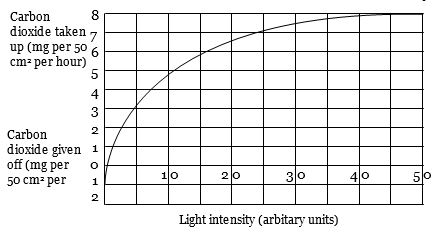
The graph shows the relationship between light intensity and the exchange of carbon dioxide by plant leaves. Why is the maximum amount of carbon dioxide released when the light intensity is $0$ units?
A
Because it is just the start of the experiment.
B
Only respiration is taking place at this intensity of light.
C
Only photosynthesis is taking place at this intensity of light.
D
The rate of photosynthesis is equivalent to the rate of respiration.
Solution
(B) At a light intensity of $0$ units,photosynthesis cannot occur because light is an essential requirement for the light-dependent reactions of photosynthesis.
However,plant cells continue to perform cellular respiration $24$ hours a day to generate energy $(ATP)$ for survival.
During respiration,plants consume oxygen and release carbon dioxide as a byproduct.
Since there is no photosynthesis to consume the carbon dioxide produced by respiration,the net result is the release of carbon dioxide into the environment.
However,plant cells continue to perform cellular respiration $24$ hours a day to generate energy $(ATP)$ for survival.
During respiration,plants consume oxygen and release carbon dioxide as a byproduct.
Since there is no photosynthesis to consume the carbon dioxide produced by respiration,the net result is the release of carbon dioxide into the environment.
0 likes
View Solution44
MediumMCQ
$DCMU$ is a herbicide which kills the plant by
A
Checking respiration
B
Destroying chloroplast
C
Inhibiting carbon dioxide fixation as it is a strong inhibitor of pigment $system-II$
D
Inhibiting photolysis of water as it is a strong inhibitor of pigment $system-I$
Solution
(C) $DCMU$ (Dichlorophenyl dimethyl urea) is a potent herbicide.
It acts by inhibiting the electron transport chain in photosynthesis.
Specifically,$DCMU$ binds to the $Q_B$ binding site of the $D1$ protein in $PS-II$ (Photosystem $II$),thereby blocking electron flow from $PS-II$ to plastoquinone.
This inhibition stops the light-dependent reactions,preventing the formation of $ATP$ and $NADPH$,which are essential for carbon dioxide fixation in the Calvin cycle.
Therefore,it effectively kills the plant by inhibiting carbon dioxide fixation.
It acts by inhibiting the electron transport chain in photosynthesis.
Specifically,$DCMU$ binds to the $Q_B$ binding site of the $D1$ protein in $PS-II$ (Photosystem $II$),thereby blocking electron flow from $PS-II$ to plastoquinone.
This inhibition stops the light-dependent reactions,preventing the formation of $ATP$ and $NADPH$,which are essential for carbon dioxide fixation in the Calvin cycle.
Therefore,it effectively kills the plant by inhibiting carbon dioxide fixation.
0 likes
View Solution45
MediumMCQ
The excess amount of $CO_2$:
A
Retards growth
B
Accelerates growth
C
Affects the growth slowly
D
Does not affect growth
Solution
(A) The concentration of $CO_2$ is a critical factor for photosynthesis. While $CO_2$ is essential for plant growth,an excess amount of $CO_2$ beyond the optimal level can lead to physiological stress and toxicity in plants. High concentrations of $CO_2$ can cause stomatal closure,reduce transpiration,and inhibit metabolic processes,which ultimately retards the overall growth of the plant.
0 likes
View Solution46
MediumMCQ
If plants are given only visible light,their growth will:
A
Increase
B
Decrease
C
Show unusual form
D
None of these
Solution
(A) Visible light (specifically the photosynthetically active radiation or $PAR$) is the primary source of energy for plants to perform photosynthesis. Since photosynthesis is the fundamental process for biomass production and growth,providing plants with visible light allows them to synthesize carbohydrates,which directly supports their normal growth and development.
0 likes
View Solution47
MediumMCQ
Of the several gases in the atmosphere,plant life mostly depends upon
A
Concentration of $O_2$
B
Availability of $CO_2$
C
Both $(a)$ and $(b)$
D
Concentration of $N_2$
Solution
(B) Plants primarily depend on $CO_2$ for the process of photosynthesis,which is essential for their growth and survival.
While plants also require $O_2$ for cellular respiration,the primary gas that defines their autotrophic nature and biomass production is $CO_2$.
Therefore,the availability of $CO_2$ is the most critical factor for plant life among the given options.
While plants also require $O_2$ for cellular respiration,the primary gas that defines their autotrophic nature and biomass production is $CO_2$.
Therefore,the availability of $CO_2$ is the most critical factor for plant life among the given options.
0 likes
View Solution48
MediumMCQ
One of the effects of dust is to cause
A
Opening of stomata
B
Closure of stomata
C
Coiling of leaves
D
Yellowing of leaves
Solution
(B) The accumulation of dust on the leaf surface acts as a physical barrier.
This layer of dust reduces the intensity of sunlight reaching the leaf surface.
Since the opening of stomata is light-dependent,a reduction in light intensity leads to the closure of stomata.
This layer of dust reduces the intensity of sunlight reaching the leaf surface.
Since the opening of stomata is light-dependent,a reduction in light intensity leads to the closure of stomata.
0 likes
View Solution49
MediumMCQ
Maximum solar energy may be trapped by
A
Growing grasses
B
Planting trees
C
Growing algae in large water bodies
D
More cultivation of crop plants
Solution
(C) The correct answer is $C$.
Algae are primary producers in aquatic ecosystems.
In large water bodies,the surface area available for photosynthetic activity is vast,and the density of phytoplankton (like algae) is extremely high.
These organisms efficiently capture solar energy to synthesize organic food material through photosynthesis.
Compared to terrestrial plants,the rapid growth rate and high biomass production of algae in large water bodies allow for a higher total capture of solar energy per unit area.
Algae are primary producers in aquatic ecosystems.
In large water bodies,the surface area available for photosynthetic activity is vast,and the density of phytoplankton (like algae) is extremely high.
These organisms efficiently capture solar energy to synthesize organic food material through photosynthesis.
Compared to terrestrial plants,the rapid growth rate and high biomass production of algae in large water bodies allow for a higher total capture of solar energy per unit area.
0 likes
View Solution50
MediumMCQ
What is the compensation point?
A
When the rate of photorespiration becomes equal to the rate of respiration.
B
When the rate of photosynthesis becomes equal to the rate of respiration.
C
When all the food produced by photosynthesis remains unused.
D
When the water requirement is equal to its availability.
Solution
(B) The compensation point is the specific light intensity at which the rate of photosynthesis exactly equals the rate of respiration in a plant.
At this point,the amount of $CO_2$ produced during respiration is exactly consumed by photosynthesis,and the amount of $O_2$ produced during photosynthesis is exactly consumed by respiration.
Consequently,there is no net exchange of gases between the plant and the atmosphere.
Therefore,the correct option is $B$.
At this point,the amount of $CO_2$ produced during respiration is exactly consumed by photosynthesis,and the amount of $O_2$ produced during photosynthesis is exactly consumed by respiration.
Consequently,there is no net exchange of gases between the plant and the atmosphere.
Therefore,the correct option is $B$.
0 likes
View SolutionPhotosynthesis in Higher Plants — Factors affecting photosynthesis · Frequently Asked Questions
1Are these Photosynthesis in Higher Plants questions useful for JEE and NEET?
Yes. All questions in this section are mapped to JEE Main and NEET exam patterns. Previous year questions from JEE Main, NEET, GUJCET and state-level exams are included with full solutions.
2Can I switch to Hindi or Gujarati for these questions?
Yes. Use the language tabs in the hero section or the sidebar to view the same questions and solutions in English, Hindi or Gujarati.
3How do I generate a question paper from this subtopic?
Use the Vedclass Exam Paper Generator — select the chapter and subtopic, set difficulty, and generate Sets A, B, C, D automatically. First 3 chapters of every subject are free.
Vedclass Products
For Students
Vedclass Test Series
Mock tests in real JEE/NEET style with performance analysis. 5-day free trial.
Start Free TrialFor Teachers
Exam Paper Generator
Generate Set A/B/C/D papers from this chapter in 2 minutes. 3 chapters free.
Try FreeFor Institutes
Online Exam Module
Live online exams with unlimited students, 360° analytics & white-label branding.
See DemoFor Teachers & Institutes
Generate a Photosynthesis in Higher Plants Exam Paper in 2 Minutes
Select subtopic & difficulty — Sets A, B, C, D auto-generated with No Repeat logic.
First 3 chapters of every subject are free — no payment required.