
A English
Early Experiments Questions in English
Class 11 Biology · Photosynthesis in Higher Plants · Early Experiments
99+
Questions
English
Language
100%
With Solutions
Showing 50 of 99 questions in English
1
MediumMCQ
Bacterial photosynthesis is very peculiar because it takes place
A
Without $CO_2$
B
Without photosynthetic pigments
C
Without light
D
Without water
Solution
(D) Bacterial photosynthesis is unique because it does not use water $(H_2O)$ as an electron donor. Instead,bacteria use other compounds such as hydrogen sulfide $(H_2S)$,molecular hydrogen $(H_2)$,or organic acids as electron donors. Consequently,oxygen $(O_2)$ is not evolved as a byproduct in bacterial photosynthesis,unlike in green plant photosynthesis where water is split to release oxygen.
0 likes
View Solution2
EasyMCQ
When did the research on photosynthesis begin?
A
In the $17^{th}$ century
B
In the $18^{th}$ century
C
In the $19^{th}$ century
D
In the $20^{th}$ century
Solution
(A) Scientific research on photosynthesis began in the $17^{th}$ century. One of the earliest notable experiments was conducted by Stephen Hales in $1727$,but the foundational work is often attributed to the $17^{th}$ century observations by Jan Baptist van Helmont,who demonstrated that plants derive their mass from water rather than soil.
0 likes
View Solution3
EasyMCQ
Most of the plants contain a green colouring pigment which is responsible for photosynthesis. This pigment was named chlorophyll by
A
Melvin Calvin
B
Jean Senebier
C
Julius Robert Mayer
D
Pelletier and Caventou
Solution
(D) . Pelletier and Caventou $(1818)$ discovered and named the green pigment as chlorophyll.
They successfully extracted this pigment from leaves by boiling them in alcohol.
Chlorophyll is the primary pigment responsible for trapping light energy during the process of photosynthesis.
They successfully extracted this pigment from leaves by boiling them in alcohol.
Chlorophyll is the primary pigment responsible for trapping light energy during the process of photosynthesis.
0 likes
View Solution4
EasyMCQ
'Photosynthesis is the conversion of light energy within a plant' was first stated by
A
Willstatter and Stoll
B
Mayor and Anderson
C
Benson and Calvin
D
Robert Mayer
Solution
(D) . Robert Mayer $(1845)$ proposed that light has radiant energy and this radiant energy is converted into chemical energy by plants,which serves to maintain the life of the plants and also animals.
0 likes
View Solution5
MediumMCQ
The significance of light and chlorophyll in photosynthesis was discovered by
A
Priestley
B
Ingenhousz
C
Englemann
D
Blackman
Solution
(B) The correct answer is $(b)$.
Jan Ingenhousz $(1779)$ demonstrated that sunlight is essential to the plant process that somehow purifies air fouled by burning candles or breathing animals.
He showed that only the green parts of plants could release oxygen in the presence of sunlight,thereby establishing the significance of light and chlorophyll in photosynthesis.
Jan Ingenhousz $(1779)$ demonstrated that sunlight is essential to the plant process that somehow purifies air fouled by burning candles or breathing animals.
He showed that only the green parts of plants could release oxygen in the presence of sunlight,thereby establishing the significance of light and chlorophyll in photosynthesis.
0 likes
View Solution6
MediumMCQ
The statement "The amount of $CO_2$ absorbed and $O_2$ released during photosynthesis are in equal volumes" was proved by:
A
Englemann
B
Robert Mayer
C
Priestley
D
Bousingault
Solution
(D) . Bousingault $(1860)$ reported that the amount of $O_2$ evolved in photosynthesis is equal to the amount of $CO_2$ absorbed, and both these processes occur simultaneously as soon as light is provided.
0 likes
View Solution7
MediumMCQ
The first important biological investigation which led to the conclusion that plants make their substance from water and not from soil was carried out by
A
Lamarck
B
De Vries
C
Von Helmont
D
Darwin
Solution
(C) The correct answer is $C$. Jan Baptist van Helmont conducted a famous experiment with a willow tree. He planted a $5 \ lb$ willow tree in $200 \ lb$ of dried soil and watered it for $5$ years. After $5$ years,the tree weighed $169 \ lb$ and $3 \ oz$,while the soil weight remained almost the same. He concluded that the plant's mass was derived from water and not from the soil.
0 likes
View Solution8
EasyMCQ
Early studies on the pathway of $CO_2$ fixation in plants were made during the $1940$s in:
A
Unicellular green algae by Calvin
B
Isolated chloroplast of spinach by Hill
C
Mesophyll cells of variegated leaves by Arnon
D
Bundle sheath cells of maize by Hatch and Slack
Solution
(A) Early studies on the pathway of $CO_2$ fixation in plants were conducted by Melvin Calvin and his colleagues during the $1940$s.
They used radioactive $C^{14}$ in algal photosynthesis studies,specifically using unicellular green algae like $Chlorella$ and $Scenedesmus$.
This research led to the discovery of the Calvin cycle,which describes the dark reactions of photosynthesis.
They used radioactive $C^{14}$ in algal photosynthesis studies,specifically using unicellular green algae like $Chlorella$ and $Scenedesmus$.
This research led to the discovery of the Calvin cycle,which describes the dark reactions of photosynthesis.
0 likes
View Solution9
MediumMCQ
The law of limiting factors in photosynthesis was proposed by Blackman in $1905$. Which of the following scientists criticised this law?
A
James and Harder
B
Mayer and Anderson
C
Willstatter and Stoll
D
Hill and Scarisbrick
Solution
(A) The law of limiting factors,proposed by $F.F. Blackman$ in $1905$,states that when a process is conditioned as to its rapidity by a number of separate factors,the rate of the process is limited by the pace of the slowest factor.
This law was criticised by $James$ and $Harder$ because they observed that the rate of photosynthesis does not always increase linearly with the increase in the intensity of a limiting factor; rather,it often shows a gradual transition or a 'curvilinear' response near the saturation point.
This law was criticised by $James$ and $Harder$ because they observed that the rate of photosynthesis does not always increase linearly with the increase in the intensity of a limiting factor; rather,it often shows a gradual transition or a 'curvilinear' response near the saturation point.
0 likes
View Solution10
MediumMCQ
The scientist who proved that bacteria use $H_2S$ gas and $CO_2$ to synthesize carbohydrates is
A
Van Niel
B
Ruben
C
Jean Senebier
D
Julius Robert Mayer
Solution
(A) In $1930$,$C.B. Van Niel$ proved that purple and green sulphur bacteria use $H_2S$ (in place of water) and $CO_2$ to synthesize carbohydrates as follows:
$6CO_2 + 12H_2S \xrightarrow{Light} C_6H_{12}O_6 + 6H_2O + 12S$
This led $Van Niel$ to the postulation that in green plants,water $(H_2O)$ is utilized in place of $H_2S$ and $O_2$ is evolved as a byproduct in place of sulphur $(S)$. He indicated that water is the electron donor in photosynthesis.
$6CO_2 + 12H_2O \xrightarrow{Light} C_6H_{12}O_6 + 6H_2O + 6O_2$
$6CO_2 + 12H_2S \xrightarrow{Light} C_6H_{12}O_6 + 6H_2O + 12S$
This led $Van Niel$ to the postulation that in green plants,water $(H_2O)$ is utilized in place of $H_2S$ and $O_2$ is evolved as a byproduct in place of sulphur $(S)$. He indicated that water is the electron donor in photosynthesis.
$6CO_2 + 12H_2O \xrightarrow{Light} C_6H_{12}O_6 + 6H_2O + 6O_2$
0 likes
View Solution11
MediumMCQ
Which of the following radioactive oxygen isotopes was used to detect the source of oxygen in photosynthesis?
A
$O^{12}$
B
$O^{16}$
C
$O^{18}$
D
$O^{15}$
Solution
(C) The correct answer is $C$. Ruben and Kamen used the heavy isotope of oxygen,$O^{18}$,in water $(H_2O^{18})$ instead of normal water $(H_2O^{16})$ during their experiments.
They observed that the oxygen liberated during photosynthesis contains $O^{18}$ derived from water,not from $CO_2$.
The chemical equation for this process is:
$6CO_2 + 12H_2O^{18} \xrightarrow{\text{Light, Chlorophyll}} C_6H_{12}O_6 + 6O_2^{18} + 6H_2O$
They observed that the oxygen liberated during photosynthesis contains $O^{18}$ derived from water,not from $CO_2$.
The chemical equation for this process is:
$6CO_2 + 12H_2O^{18} \xrightarrow{\text{Light, Chlorophyll}} C_6H_{12}O_6 + 6O_2^{18} + 6H_2O$
0 likes
View Solution12
MediumMCQ
If in a photosynthetic system,${H_2O}^{18}$ is provided,what will be the type of oxygen released in the process?
A
$O^{18}$
B
$O^{16}$
C
$O_2$ (normal)
D
None of the above
Solution
(A) In the process of photosynthesis,the oxygen released as a byproduct comes from the photolysis of water $(H_2O)$.
When water labeled with the heavy isotope of oxygen,$^{18}O$,is provided to the photosynthetic system,the oxygen gas $(O_2)$ released during the light-dependent reactions will also contain the $^{18}O$ isotope.
This experiment,famously conducted by Ruben,Hassid,and Kamen,confirmed that the source of oxygen in photosynthesis is water,not carbon dioxide.
When water labeled with the heavy isotope of oxygen,$^{18}O$,is provided to the photosynthetic system,the oxygen gas $(O_2)$ released during the light-dependent reactions will also contain the $^{18}O$ isotope.
This experiment,famously conducted by Ruben,Hassid,and Kamen,confirmed that the source of oxygen in photosynthesis is water,not carbon dioxide.
0 likes
View Solution13
EasyMCQ
Warburg studied his effect on
A
Chlamydomonas
B
Chlorella
C
Volvox
D
All the above
Solution
(B) The Warburg effect refers to the observation that high concentrations of oxygen inhibit the rate of photosynthesis in plants. Otto Warburg $(1919)$ conducted his experiments on the green alga $Chlorella$ to study the kinetics of photosynthesis and the influence of light and oxygen concentration on the process.
0 likes
View Solution14
MediumMCQ
During photosynthesis,the oxygen in glucose $(C_6H_{12}O_6)$ comes from which of the following?
A
Water $(H_2O)$
B
Carbon dioxide $(CO_2)$
C
Both from $CO_2$ and water
D
Oxygen in air $(O_2)$
Solution
(B) During the process of photosynthesis,the chemical equation is $6CO_2 + 12H_2O \rightarrow C_6H_{12}O_6 + 6H_2O + 6O_2$.
According to the experiments conducted by $C$.$B$. van Niel using purple and green sulfur bacteria,it was demonstrated that oxygen released during photosynthesis comes from water $(H_2O)$,not from carbon dioxide $(CO_2)$.
Furthermore,isotopic labeling studies using $^{18}O$ have confirmed that the oxygen atoms present in the glucose molecule $(C_6H_{12}O_6)$ are derived from the carbon dioxide $(CO_2)$ molecules,while the oxygen released as a byproduct comes from water $(H_2O)$.
According to the experiments conducted by $C$.$B$. van Niel using purple and green sulfur bacteria,it was demonstrated that oxygen released during photosynthesis comes from water $(H_2O)$,not from carbon dioxide $(CO_2)$.
Furthermore,isotopic labeling studies using $^{18}O$ have confirmed that the oxygen atoms present in the glucose molecule $(C_6H_{12}O_6)$ are derived from the carbon dioxide $(CO_2)$ molecules,while the oxygen released as a byproduct comes from water $(H_2O)$.
0 likes
View Solution15
EasyMCQ
The experimental material that has largely been responsible for making rapid advances in research on photosynthesis is
A
Chlamydomonas
B
Spinach leaf
C
Chlorella
D
Hydrilla
Solution
(C) The correct answer is $C$.
$Chlorella$ is a unicellular green alga that has been extensively used in research on photosynthesis.
It was notably used by researchers such as $Ruben$,$Kamen$,and $Warburg$ to study the light-independent reactions and the path of carbon in photosynthesis.
$Chlorella$ is preferred because it is easy to culture,has a simple structure,and performs photosynthesis very efficiently,accounting for a significant portion of global photosynthetic activity.
$Chlorella$ is a unicellular green alga that has been extensively used in research on photosynthesis.
It was notably used by researchers such as $Ruben$,$Kamen$,and $Warburg$ to study the light-independent reactions and the path of carbon in photosynthesis.
$Chlorella$ is preferred because it is easy to culture,has a simple structure,and performs photosynthesis very efficiently,accounting for a significant portion of global photosynthetic activity.
0 likes
View Solution16
EasyMCQ
The oxygen produced during photosynthesis comes from the photolysis of water was first proved by:
A
Ruben and Kamen
B
Robert Mayer
C
Melvin Calvin
D
Blackman
Solution
(A) The fact that oxygen released during photosynthesis originates from water was first demonstrated by Ruben and Kamen using the isotope tracer technique $(O^{18})$.
Photolysis of water occurs in the presence of light and requires $Mn^{++}$ and $Cl^-$ ions as catalysts for water oxidation:
$4H_2O \xrightarrow{Mn^{++}, Cl^-} 4(OH)^- + 4H^+$
Subsequently,the hydroxyl radicals form water and release oxygen as a byproduct:
$4OH \rightarrow 2H_2O + O_2 \uparrow$
Photolysis of water occurs in the presence of light and requires $Mn^{++}$ and $Cl^-$ ions as catalysts for water oxidation:
$4H_2O \xrightarrow{Mn^{++}, Cl^-} 4(OH)^- + 4H^+$
Subsequently,the hydroxyl radicals form water and release oxygen as a byproduct:
$4OH \rightarrow 2H_2O + O_2 \uparrow$
0 likes
View Solution17
EasyMCQ
The first experiments on photosynthesis in flashing light were carried out by
A
$F$. $F$. Blackman
B
Robert Emerson and Arnold
C
Melvin Calvin
D
Robert Hill
Solution
(B) The correct answer is $B$.
Robert Emerson and William Arnold conducted experiments on photosynthesis using flashing light in $1932$.
They observed that the rate of photosynthesis could be increased by using short flashes of light followed by dark periods,which provided evidence for the existence of light-dependent and light-independent (dark) reactions.
Robert Emerson and William Arnold conducted experiments on photosynthesis using flashing light in $1932$.
They observed that the rate of photosynthesis could be increased by using short flashes of light followed by dark periods,which provided evidence for the existence of light-dependent and light-independent (dark) reactions.
0 likes
View Solution18
EasyMCQ
Moll's experiment shows that:
A
Unequal transpiration from two surfaces of leaf
B
Relation between transpiration and absorption
C
$CO_2$ is required for photosynthesis
D
Chlorophyll is essential for photosynthesis
Solution
(C) Moll's half-leaf experiment is a classic demonstration used to prove that $CO_2$ is essential for the process of photosynthesis. In this experiment,half of a leaf is inserted into a bottle containing potassium hydroxide $(KOH)$ solution,which absorbs $CO_2$. The other half remains exposed to the atmosphere. After keeping the plant in sunlight,the starch test (using iodine solution) shows that the part of the leaf exposed to air turns blue-black (indicating starch presence),while the part inside the bottle does not,proving that $CO_2$ is necessary for photosynthesis.
0 likes
View Solution19
EasyMCQ
The algae used by Melvin Calvin and his associates for photosynthetic research is:
A
Chlorella
B
Chlamydomonas
C
Volvox
D
All of the above
Solution
(A) Melvin Calvin and his associates used the unicellular green alga $Chlorella$ for their research on photosynthesis.
They utilized radioactive carbon isotope $^{14}C$ to trace the path of carbon fixation in the Calvin cycle.
This experiment helped in understanding how carbon dioxide is converted into sugars during the light-independent reactions of photosynthesis.
They utilized radioactive carbon isotope $^{14}C$ to trace the path of carbon fixation in the Calvin cycle.
This experiment helped in understanding how carbon dioxide is converted into sugars during the light-independent reactions of photosynthesis.
0 likes
View Solution20
MediumMCQ
Isotopes popularly known to have been used in the study of photosynthesis are
A
$C^{14}$ and $O^{18}$
B
$C^{11}$ and $P^{32}$
C
$O^{16}$ and $N^{15}$
D
$P^{32}$ and $C^{15}$
Solution
(A) The isotope $C^{14}$ is used to trace the carbon fixation pathway (Calvin cycle) in photosynthesis.
$O^{18}$ is a stable isotope of oxygen used to demonstrate that the oxygen evolved during photosynthesis comes from the splitting of water $(H_2O)$ molecules,not from carbon dioxide $(CO_2)$.
$O^{18}$ is a stable isotope of oxygen used to demonstrate that the oxygen evolved during photosynthesis comes from the splitting of water $(H_2O)$ molecules,not from carbon dioxide $(CO_2)$.
0 likes
View Solution21
MediumMCQ
When a rat was placed into a closed container,it got suffocated and died,but when a plant was also introduced into it,the rat survived. Who performed this experiment?
A
Ingenhousz
B
Priestley
C
Englemann
D
Thimann
Solution
(B) Joseph Priestley performed this experiment in $1774$. He demonstrated that plants restore to the air whatever breathing animals and burning candles remove. He placed a burning candle in a bell jar,which soon got extinguished,and a mouse in a similar bell jar would soon suffocate. However,when he placed a mint plant in the same bell jars,the candle continued to burn and the mouse stayed alive. This experiment proved that plants release oxygen,which is essential for respiration and combustion.
0 likes
View Solution22
MediumMCQ
Which plant is commonly used in a laboratory experiment to demonstrate the evolution of oxygen during photosynthesis?
A
Sunflower
B
Hydrilla
C
Croton
D
Balsam
Solution
(B) The experiment to demonstrate the evolution of oxygen during photosynthesis is known as the 'Hydrilla experiment'.
In this experiment,a twig of the aquatic plant $Hydrilla$ is placed in a beaker filled with water and covered with a funnel.
$A$ test tube filled with water is inverted over the stem of the funnel.
When the setup is exposed to sunlight,bubbles of gas are seen rising from the cut end of the $Hydrilla$ twig and collecting in the test tube.
These bubbles are identified as oxygen,which is released as a byproduct of photosynthesis.
In this experiment,a twig of the aquatic plant $Hydrilla$ is placed in a beaker filled with water and covered with a funnel.
$A$ test tube filled with water is inverted over the stem of the funnel.
When the setup is exposed to sunlight,bubbles of gas are seen rising from the cut end of the $Hydrilla$ twig and collecting in the test tube.
These bubbles are identified as oxygen,which is released as a byproduct of photosynthesis.
0 likes
View Solution23
MediumMCQ
Two plants $A$ and $B$ are supplied with $CO_2$ with $H_2O^{18}$ and $CO_2^{18}$ with $H_2O$ respectively. Which of the following plants releases $O^{18}$ type oxygen in photosynthesis?
A
$A$ plant
B
$B$ plant
C
Both $(a)$ and $(b)$
D
First $(a)$ and then $(b)$
Solution
(A) During photosynthesis,the $O_2$ evolved is derived from the photolysis (hydrolysis) of water.
Since plant $A$ is supplied with $H_2O^{18}$,the oxygen released during the light-dependent reaction will be of the $O^{18}$ isotope type.
Plant $B$ is supplied with $CO_2^{18}$ and normal $H_2O$,so it will release normal $O_2$ because the oxygen in $CO_2$ is incorporated into carbohydrates,not released as gas.
Therefore,plant $A$ releases $O^{18}$ type oxygen.
Since plant $A$ is supplied with $H_2O^{18}$,the oxygen released during the light-dependent reaction will be of the $O^{18}$ isotope type.
Plant $B$ is supplied with $CO_2^{18}$ and normal $H_2O$,so it will release normal $O_2$ because the oxygen in $CO_2$ is incorporated into carbohydrates,not released as gas.
Therefore,plant $A$ releases $O^{18}$ type oxygen.
0 likes
View Solution24
DifficultMCQ
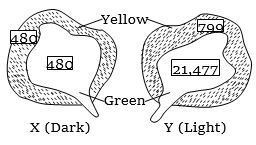
Variegated leaves of a plant were supplied with radioactive carbon dioxide $(^{14}CO_2)$ during an experiment. Leaf $X$ was kept in the dark and leaf $Y$ was kept in the light. At the end of the experiment,the radioactivity in the leaves was measured and found to be as shown in the diagram. What is the most likely explanation for the level of radioactivity found in the yellow zone of leaf $Y$?
A
Photosynthesis occurs but no storage of starch occurs in this zone.
B
Radioactive carbon dioxide diffuses into the leaf and accumulates here.
C
Products of photosynthesis diffuse into the yellow zone.
D
Photosynthesis proceeds slowly in the absence of chlorophyll $a$ and $b$.
Solution
(C) Variegated leaves contain green areas (with chlorophyll) and yellow areas (lacking chlorophyll). Photosynthesis,which fixes carbon dioxide into organic compounds,occurs only in the green areas where chlorophyll is present. The radioactive $^{14}C$ from the supplied $^{14}CO_2$ is incorporated into the products of photosynthesis (like sugars) in the green parts. The presence of radioactivity in the non-photosynthetic yellow zone of leaf $Y$ (which was kept in the light) is due to the translocation of these radioactive photosynthetic products from the green areas to the yellow areas through the phloem. Therefore,the most likely explanation is that the products of photosynthesis diffuse or are transported into the yellow zone.
0 likes
View Solution25
MediumMCQ
Engelmann's experiment with $Spirogyra$ demonstrated that
A
The full spectrum of sunlight is needed for photosynthesis
B
Only red wavelengths are effective in causing photosynthesis
C
Only blue wavelengths are effective
D
Both blue and red wavelengths are effective
Solution
(D) $Engelmann$'s experiment used a prism to split light into its spectral components and illuminated $Spirogyra$ placed in a suspension of aerobic bacteria.
He observed that the bacteria accumulated mainly in the regions of blue and red light of the split spectrum.
Since these bacteria require oxygen for respiration,their accumulation indicated that the rate of photosynthesis was highest in these regions.
Therefore,it demonstrated that both blue and red wavelengths are effective for photosynthesis.
He observed that the bacteria accumulated mainly in the regions of blue and red light of the split spectrum.
Since these bacteria require oxygen for respiration,their accumulation indicated that the rate of photosynthesis was highest in these regions.
Therefore,it demonstrated that both blue and red wavelengths are effective for photosynthesis.
0 likes
View Solution26
EasyMCQ
Continued evolution of $O_2$ in a suspension of an isolated chloroplast in light in the presence of ferric salt,viologen dyes,etc.,is called:
A
Emmerson's reaction
B
Hill's reaction
C
Blackman's reaction
D
Oxygenation
Solution
(B) In $1937$,Robert Hill demonstrated that isolated chloroplasts,when exposed to light in the presence of an artificial electron acceptor (like ferric salts or viologen dyes),can evolve $O_2$ even in the absence of $CO_2$. This process is known as the Hill reaction. It proves that the oxygen evolved during photosynthesis comes from the photolysis of water.
0 likes
View Solution27
MediumMCQ
Hill's reaction in photosynthesis demonstrates that:
A
Electron excitation
B
Removal of water
C
Fixation of $CO_2$
D
$O_2$ is obtained from water
Solution
(D) Robert Hill demonstrated that isolated chloroplasts,when illuminated in the presence of an artificial electron acceptor (like ferric oxalate or $DCPIP$),can evolve oxygen even in the absence of $CO_2$.
This experiment proved that the oxygen evolved during photosynthesis comes from the photolysis of water $(H_2O)$,not from $CO_2$.
This experiment proved that the oxygen evolved during photosynthesis comes from the photolysis of water $(H_2O)$,not from $CO_2$.
0 likes
View Solution28
EasyMCQ
Photolysis of water by isolated chloroplasts was demonstrated by
A
Robin Hill
B
Van Niel
C
Liebig
D
Calvin
Solution
(A) Robert Hill $(1939)$ first demonstrated that if chloroplasts extracted from the leaves of $Stellaria \text{ } media$ and $Lamium \text{ } album$ are suspended in a test tube containing a suitable electron acceptor, such as potassium ferrooxalate or potassium ferricyanide, $O_2$ is released due to the photochemical splitting of water. This process is known as the Hill reaction.
0 likes
View Solution29
EasyMCQ
In which plant did Melvin Calvin experiment using radioactive isotopes to discover the first stable product of the $C_3$ cycle?
A
Chlorella
B
Cycas
C
Carrot
D
Tobacco
Solution
(A) Melvin Calvin used radioactive $^{14}C$ in algal photosynthesis studies.
He performed these experiments on the green alga $Chlorella$ and $Scenedesmus$.
Through these experiments,he discovered that the first stable product of carbon fixation in the $C_3$ cycle is $3$-phosphoglyceric acid ($3$-$PGA$).
Therefore,the correct option is $A$.
He performed these experiments on the green alga $Chlorella$ and $Scenedesmus$.
Through these experiments,he discovered that the first stable product of carbon fixation in the $C_3$ cycle is $3$-phosphoglyceric acid ($3$-$PGA$).
Therefore,the correct option is $A$.
0 likes
View Solution30
MediumMCQ
In bacterial photosynthesis,the hydrogen donor is:
A
$H_2S$
B
$NH_3$
C
$H_2O$
D
$H_2SO_4$
Solution
(A) In bacterial photosynthesis,such as in purple and green sulfur bacteria,$H_2S$ (hydrogen sulfide) acts as the hydrogen donor instead of $H_2O$.
The general reaction is: $CO_2 + 2H_2S \xrightarrow{\text{Light}} (CH_2O) + 2S + H_2O + \text{Energy}$.
Unlike oxygenic photosynthesis in plants where $H_2O$ is the donor and $O_2$ is released,bacterial photosynthesis is anoxygenic and releases sulfur $(S)$ as a byproduct.
The general reaction is: $CO_2 + 2H_2S \xrightarrow{\text{Light}} (CH_2O) + 2S + H_2O + \text{Energy}$.
Unlike oxygenic photosynthesis in plants where $H_2O$ is the donor and $O_2$ is released,bacterial photosynthesis is anoxygenic and releases sulfur $(S)$ as a byproduct.
0 likes
View Solution31
MediumMCQ
What is the by-product of bacterial photosynthesis?
A
$O_2$
B
$H_2O$
C
$S$
D
$H_2S$
Solution
(C) In bacterial photosynthesis,such as in purple and green sulfur bacteria,$H_2S$ (hydrogen sulfide) is used as a hydrogen donor instead of $H_2O$ (water).
Because $H_2S$ is used,the by-product released is elemental sulfur $(S)$ or sulfates,rather than oxygen $(O_2)$.
Therefore,the correct by-product of bacterial photosynthesis is $S$.
Because $H_2S$ is used,the by-product released is elemental sulfur $(S)$ or sulfates,rather than oxygen $(O_2)$.
Therefore,the correct by-product of bacterial photosynthesis is $S$.
0 likes
View Solution32
MediumMCQ
Englemann $(1882)$ observed the accumulation of aerobic bacteria around the blue and red light regions of a chloroplast in the green alga $Cladophora$. He therefore concluded that:
A
Chlorophyll absorbs green light
B
The absorption spectrum of $O_2$ evolution is blue and red
C
$O_2$ is released from $H_2O$ in the light reaction
D
$O_2$ is released from $CO_2$ in the light reaction
Solution
(B) Theodor Englemann used a prism to split light into its spectral components and illuminated the green alga $Cladophora$ placed in a suspension of aerobic bacteria.
He observed that the bacteria accumulated mainly in the regions of blue and red light.
Since aerobic bacteria require oxygen for survival,their accumulation indicated that these specific wavelengths of light were most effective for photosynthesis,leading to the maximum evolution of $O_2$.
Thus,he concluded that the action spectrum of photosynthesis (which corresponds to $O_2$ evolution) resembles the absorption spectrum of chlorophyll $a$ and $b$,showing peaks in the blue and red regions.
He observed that the bacteria accumulated mainly in the regions of blue and red light.
Since aerobic bacteria require oxygen for survival,their accumulation indicated that these specific wavelengths of light were most effective for photosynthesis,leading to the maximum evolution of $O_2$.
Thus,he concluded that the action spectrum of photosynthesis (which corresponds to $O_2$ evolution) resembles the absorption spectrum of chlorophyll $a$ and $b$,showing peaks in the blue and red regions.
0 likes
View Solution33
MediumMCQ
Which is the evidence to show that $O_2$ released in photosynthesis comes from water?
A
Isotopic $O_2$ supplied as $H_2O$ appears in the $O_2$ released in photosynthesis.
B
Isolated chloroplast in water releases $O_2$ if supplied with potassium ferrocyanide or some other reducing agent.
C
Photosynthetic bacteria use $H_2S$ and $CO_2$ to make carbohydrates.
D
All the above.
Solution
(D) The evidence that $O_2$ released in photosynthesis comes from water is supported by multiple observations:
$1$. $C.B. \text{ van Niel}$ demonstrated that photosynthetic bacteria use $H_2S$ instead of $H_2O$ to produce carbohydrates, releasing sulfur instead of oxygen, which suggested that $O_2$ in plants comes from $H_2O$.
$2$. The use of isotopic oxygen $(^{18}O)$ in $H_2O$ showed that the $O_2$ released during photosynthesis is labeled with the same isotope, confirming its origin from water.
$3$. The Hill reaction showed that isolated chloroplasts can evolve $O_2$ in the presence of an artificial electron acceptor (like potassium ferrocyanide) when illuminated, even without $CO_2$ fixation, proving that water splitting (photolysis) is the source of $O_2$.
$1$. $C.B. \text{ van Niel}$ demonstrated that photosynthetic bacteria use $H_2S$ instead of $H_2O$ to produce carbohydrates, releasing sulfur instead of oxygen, which suggested that $O_2$ in plants comes from $H_2O$.
$2$. The use of isotopic oxygen $(^{18}O)$ in $H_2O$ showed that the $O_2$ released during photosynthesis is labeled with the same isotope, confirming its origin from water.
$3$. The Hill reaction showed that isolated chloroplasts can evolve $O_2$ in the presence of an artificial electron acceptor (like potassium ferrocyanide) when illuminated, even without $CO_2$ fixation, proving that water splitting (photolysis) is the source of $O_2$.
0 likes
View Solution34
EasyMCQ
The hypothesis that all photosynthetic organisms require a source of hydrogen was first proposed by
A
Van Niel
B
Hatch and Slack
C
Robin Hill
D
Ruben and Kamen
Solution
(A) Cornelius Van Niel,based on his studies of purple and green sulfur bacteria,demonstrated that photosynthesis is essentially a light-dependent reaction in which hydrogen from a suitable oxidizable compound reduces carbon dioxide to carbohydrates. He proposed that in green plants,water $(H_2O)$ acts as the hydrogen donor,releasing oxygen as a byproduct,whereas in sulfur bacteria,hydrogen sulfide $(H_2S)$ acts as the hydrogen donor.
0 likes
View Solution35
EasyMCQ
Which of the following isotopes are used to study the process of photosynthesis?
A
$S^{35}$ and $P^{32}$
B
$C^{14}$ and $O^{18}$
C
$N^{14}$ and $Co^{60}$
D
$N^{14}$ and $O^{18}$
Solution
(B) The process of photosynthesis involves the fixation of carbon dioxide and the photolysis of water.
$C^{14}$ (a radioactive isotope of carbon) is used to trace the path of carbon in the Calvin cycle (dark reactions).
$O^{18}$ (a heavy isotope of oxygen) is used to demonstrate that the oxygen evolved during photosynthesis comes from water and not from carbon dioxide.
Therefore,$C^{14}$ and $O^{18}$ are the correct isotopes used in these studies.
$C^{14}$ (a radioactive isotope of carbon) is used to trace the path of carbon in the Calvin cycle (dark reactions).
$O^{18}$ (a heavy isotope of oxygen) is used to demonstrate that the oxygen evolved during photosynthesis comes from water and not from carbon dioxide.
Therefore,$C^{14}$ and $O^{18}$ are the correct isotopes used in these studies.
0 likes
View Solution36
EasyMCQ
$PGA$ was discovered as the first product of $CO_2$ fixation in the photosynthesis of:
A
Bryophytes
B
Gymnosperms
C
Angiosperms
D
Algae
Solution
(D) The discovery of the first stable product of $CO_2$ fixation was made by Melvin Calvin and his colleagues using radioactive $^{14}C$ in algal photosynthesis experiments.
Specifically,they used the green alga $Chlorella$ and $Scenedesmus$.
They found that $3$-phosphoglyceric acid $(PGA)$,a $3$-carbon compound,was the first stable product formed during the dark reaction of photosynthesis.
Therefore,$PGA$ was discovered as the first product of $CO_2$ fixation in the photosynthesis of algae.
Specifically,they used the green alga $Chlorella$ and $Scenedesmus$.
They found that $3$-phosphoglyceric acid $(PGA)$,a $3$-carbon compound,was the first stable product formed during the dark reaction of photosynthesis.
Therefore,$PGA$ was discovered as the first product of $CO_2$ fixation in the photosynthesis of algae.
0 likes
View Solution37
MediumMCQ
The biochemical phase of photosynthesis was first discovered by .........
A
Calvin
B
Blackman
C
Arnon
D
Hill
Solution
(B) The biochemical phase of photosynthesis,also known as the dark reaction or the Calvin cycle,involves the fixation of $CO_2$ into carbohydrates. This phase was first elucidated by $F.F. Blackman$ in $1905$. He demonstrated that photosynthesis consists of two distinct phases: a light-dependent phase and a light-independent (biochemical) phase. Therefore,the correct answer is $Blackman$.
1 likes
View Solution38
EasyMCQ
The carbon isotope used for the study of photosynthesis is ........
A
$C^{13}$
B
$C^{14}$
C
$C^{15}$
D
$C^{16}$
Solution
(B) The radioactive isotope of carbon,$C^{14}$,was used by Melvin Calvin in his experiments to trace the path of carbon in photosynthesis.
This led to the discovery of the Calvin cycle (also known as the $C_3$ cycle).
Therefore,$C^{14}$ is the correct isotope used for studying the carbon fixation pathway in photosynthesis.
This led to the discovery of the Calvin cycle (also known as the $C_3$ cycle).
Therefore,$C^{14}$ is the correct isotope used for studying the carbon fixation pathway in photosynthesis.
0 likes
View Solution39
MediumMCQ
What is the byproduct of bacterial photosynthesis?
A
$O_2$
B
$H_2O$
C
$S$
D
$H_2S$
Solution
(C) In bacterial photosynthesis,such as in purple and green sulfur bacteria,$H_2S$ (hydrogen sulfide) is used as a hydrogen donor instead of $H_2O$ (water).
Because $H_2S$ is used as the electron donor,the byproduct released is sulfur $(S)$ or sulfate,rather than oxygen $(O_2)$.
This is a key distinction between oxygenic photosynthesis (found in plants and cyanobacteria) and anoxygenic photosynthesis (found in many bacteria).
Because $H_2S$ is used as the electron donor,the byproduct released is sulfur $(S)$ or sulfate,rather than oxygen $(O_2)$.
This is a key distinction between oxygenic photosynthesis (found in plants and cyanobacteria) and anoxygenic photosynthesis (found in many bacteria).
0 likes
View Solution40
EasyMCQ
Name the scientist who first suggested that plants purify foul air through the bell jar experiment.
A
Willstatter
B
Robert Hooke
C
Priestley
D
Jean Senebier
Solution
(C) Joseph Priestley,in $1774$,performed a series of experiments that revealed the essential role of air in the growth of green plants. He placed a burning candle and a mouse in a closed bell jar,which eventually extinguished the candle and suffocated the mouse. However,when he placed a mint plant in the same bell jar,the candle continued to burn and the mouse remained alive. This led him to conclude that plants restore to the air whatever breathing animals and burning candles remove. Thus,he suggested that plants purify foul air.
0 likes
View Solution41
MediumMCQ
Mohl's experiment demonstrates that...
A
Carbon dioxide is essential for photosynthesis.
B
Chlorophyll and water are necessary for photosynthesis.
C
Water and light are essential for photosynthesis.
D
All of the above are correct.
Solution
(A) Mohl's half-leaf experiment is a classic demonstration used to prove that $CO_2$ is essential for the process of photosynthesis.
In this experiment,a part of a leaf is enclosed in a bottle containing $KOH$ (potassium hydroxide),which absorbs $CO_2$,while the other part remains exposed to the atmosphere.
After some time,the leaf is tested for starch using iodine solution.
The part of the leaf exposed to air turns blue-black (indicating the presence of starch),while the part inside the bottle remains pale (indicating no starch formation due to the absence of $CO_2$).
In this experiment,a part of a leaf is enclosed in a bottle containing $KOH$ (potassium hydroxide),which absorbs $CO_2$,while the other part remains exposed to the atmosphere.
After some time,the leaf is tested for starch using iodine solution.
The part of the leaf exposed to air turns blue-black (indicating the presence of starch),while the part inside the bottle remains pale (indicating no starch formation due to the absence of $CO_2$).
0 likes
View Solution42
DifficultMCQ
The importance of light and chlorophyll in photosynthesis was discovered by ......
A
Priestley
B
Ingenhousz
C
Engelmann
D
Blackman
Solution
(B) Jan Ingenhousz $(1730-1799)$ performed a series of experiments with aquatic plants.
He showed that in bright sunlight,small bubbles were formed around the green parts of the plant,while in the dark,they did not.
He later identified these bubbles to be of oxygen.
Hence,he concluded that sunlight is essential to the plant process that somehow purifies the air fouled by burning candles or breathing animals.
He also demonstrated that only the green parts of the plants could release oxygen.
He showed that in bright sunlight,small bubbles were formed around the green parts of the plant,while in the dark,they did not.
He later identified these bubbles to be of oxygen.
Hence,he concluded that sunlight is essential to the plant process that somehow purifies the air fouled by burning candles or breathing animals.
He also demonstrated that only the green parts of the plants could release oxygen.
0 likes
View Solution43
EasyMCQ
Photophosphorylation was first demonstrated by ......... .
A
Hill
B
Willstatter and Stoll
C
Arnon
D
Park and Biggins
Solution
(C) Photophosphorylation is the process of synthesizing $ATP$ from $ADP$ and inorganic phosphate in the presence of light in chloroplasts.
This phenomenon was first demonstrated by $Daniel \text{ } I. \text{ } Arnon$ and his colleagues in $1954$ using isolated chloroplasts from spinach leaves.
Therefore, the correct option is $C$.
This phenomenon was first demonstrated by $Daniel \text{ } I. \text{ } Arnon$ and his colleagues in $1954$ using isolated chloroplasts from spinach leaves.
Therefore, the correct option is $C$.
0 likes
View Solution44
MediumMCQ
The oxygen released during photosynthesis comes from..........
A
Carbon dioxide
B
Water
C
Chlorophyll
D
Phosphoglyceric acid
Solution
(B) The oxygen released during photosynthesis is derived from the photolysis of water $(H_2O)$.
This was experimentally proven by $C$.$B$. van Niel,who demonstrated that photosynthesis is a light-dependent reaction in which hydrogen from a suitable oxidizable compound reduces carbon dioxide to carbohydrates.
In green plants,water acts as the hydrogen donor and is oxidized to release oxygen $(O_2)$ as a byproduct.
This was experimentally proven by $C$.$B$. van Niel,who demonstrated that photosynthesis is a light-dependent reaction in which hydrogen from a suitable oxidizable compound reduces carbon dioxide to carbohydrates.
In green plants,water acts as the hydrogen donor and is oxidized to release oxygen $(O_2)$ as a byproduct.
0 likes
View Solution45
MediumMCQ
The fact that oxygen released during photosynthesis comes from water was proved by $O^{18}$ isotope experiments conducted by:
A
Ruben and Kamen
B
Hill
C
Warburg
D
Blackman
Solution
(A) The experiment using the $O^{18}$ isotope was conducted by $Ruben$ and $Kamen$ in $1941$.
They used the heavy isotope of oxygen $(O^{18})$ to trace the source of oxygen evolved during photosynthesis.
They provided water containing $O^{18}$ $(H_2O^{18})$ to the green algae $Chlorella$.
It was observed that the oxygen evolved during photosynthesis was $O^{18}$,which confirmed that the oxygen released during photosynthesis comes from water and not from carbon dioxide.
They used the heavy isotope of oxygen $(O^{18})$ to trace the source of oxygen evolved during photosynthesis.
They provided water containing $O^{18}$ $(H_2O^{18})$ to the green algae $Chlorella$.
It was observed that the oxygen evolved during photosynthesis was $O^{18}$,which confirmed that the oxygen released during photosynthesis comes from water and not from carbon dioxide.
0 likes
View Solution46
EasyMCQ
$R$. Hill used which of the following dyes for his well-known Hill reaction?
A
Dichlorophenol indophenol $(DCPIP)$
B
Sulfur green
C
Methylene blue
D
Eosin
Solution
(A) Robert Hill $(1937)$ demonstrated that isolated chloroplasts,when illuminated in the presence of an artificial electron acceptor,can evolve oxygen even in the absence of $CO_2$.
This process is known as the Hill reaction.
He used $2,6$-dichlorophenol indophenol $(DCPIP)$ as an artificial electron acceptor (dye) which changes color from blue to colorless upon reduction,serving as an indicator for the light-dependent reaction of photosynthesis.
This process is known as the Hill reaction.
He used $2,6$-dichlorophenol indophenol $(DCPIP)$ as an artificial electron acceptor (dye) which changes color from blue to colorless upon reduction,serving as an indicator for the light-dependent reaction of photosynthesis.
0 likes
View Solution47
MediumMCQ
Name the scientist who demonstrated the effect of different wavelengths of light on photosynthesis using green algae and aerobic bacteria.
A
Priestley
B
Ingenhousz
C
$K$.$V$. Thimann
D
Engelmann
Solution
(D) $T$.$W$. Engelmann $(1883)$ performed a classic experiment using the green alga Cladophora and aerobic bacteria.
He split light into its spectral components using a prism and then illuminated the alga.
The aerobic bacteria were used to detect the sites of oxygen evolution.
He observed that the bacteria accumulated mainly in the region of blue and red light of the split spectrum,demonstrating that these wavelengths are most effective for photosynthesis.
He split light into its spectral components using a prism and then illuminated the alga.
The aerobic bacteria were used to detect the sites of oxygen evolution.
He observed that the bacteria accumulated mainly in the region of blue and red light of the split spectrum,demonstrating that these wavelengths are most effective for photosynthesis.
0 likes
View Solution48
EasyMCQ
Who proved that the oxygen evolved during photosynthesis comes from water?
A
Calvin
B
Meyer
C
Blackman
D
Ruben, Hassid, and Kamen
Solution
(D) In $1941$, $Samuel \text{ } Ruben$, $William \text{ } Hassid$, and $Martin \text{ } Kamen$ used the heavy isotope of oxygen $(^{18}O)$ to trace the source of oxygen evolved during photosynthesis.
They performed experiments using the green alga $Chlorella \text{ } pyrenoidosa$.
By providing water labeled with $^{18}O$ $(H_2^{18}O)$, they observed that the oxygen released as a byproduct was also labeled with $^{18}O$.
This confirmed that the oxygen released during photosynthesis is derived from the splitting of water molecules $(photolysis \text{ } of \text{ } water)$, not from carbon dioxide $(CO_2)$.
They performed experiments using the green alga $Chlorella \text{ } pyrenoidosa$.
By providing water labeled with $^{18}O$ $(H_2^{18}O)$, they observed that the oxygen released as a byproduct was also labeled with $^{18}O$.
This confirmed that the oxygen released during photosynthesis is derived from the splitting of water molecules $(photolysis \text{ } of \text{ } water)$, not from carbon dioxide $(CO_2)$.
0 likes
View Solution49
EasyMCQ
Which isotopes were used in the study of photosynthesis?
A
$C^{11}$ and $P^{32}$
B
$C^{15}$ and $P^{32}$
C
$C^{16}$ and $P^{15}$
D
$C^{14}$ and $O^{18}$
Solution
(D) In the study of photosynthesis,radioactive isotopes were used to trace the pathways of carbon and the source of oxygen.
$1$. Melvin Calvin used the radioactive isotope $C^{14}$ to trace the path of carbon in the Calvin cycle (dark reaction).
$2$. Scientists used the heavy isotope of oxygen,$O^{18}$,to demonstrate that the oxygen evolved during photosynthesis comes from water $(H_2O)$ and not from carbon dioxide $(CO_2)$.
$1$. Melvin Calvin used the radioactive isotope $C^{14}$ to trace the path of carbon in the Calvin cycle (dark reaction).
$2$. Scientists used the heavy isotope of oxygen,$O^{18}$,to demonstrate that the oxygen evolved during photosynthesis comes from water $(H_2O)$ and not from carbon dioxide $(CO_2)$.
0 likes
View Solution50
EasyMCQ
Who discovered that green plants take in $CO_2$ and release $O_2$?
A
Meyer
B
Jan Ingenhousz
C
Senebier
D
Priestley
Solution
(B) Jan Ingenhousz ($1730$–$1799$) performed a series of experiments with aquatic plants.
He showed that in bright sunlight,small bubbles were formed around the green parts of the plant,while in the dark,they did not.
He later identified these bubbles to be of oxygen $(O_2)$.
He also demonstrated that green plants release oxygen only in the presence of sunlight and take in carbon dioxide $(CO_2)$ for photosynthesis.
He showed that in bright sunlight,small bubbles were formed around the green parts of the plant,while in the dark,they did not.
He later identified these bubbles to be of oxygen $(O_2)$.
He also demonstrated that green plants release oxygen only in the presence of sunlight and take in carbon dioxide $(CO_2)$ for photosynthesis.
0 likes
View SolutionPhotosynthesis in Higher Plants — Early Experiments · Frequently Asked Questions
1Are these Photosynthesis in Higher Plants questions useful for JEE and NEET?
Yes. All questions in this section are mapped to JEE Main and NEET exam patterns. Previous year questions from JEE Main, NEET, GUJCET and state-level exams are included with full solutions.
2Can I switch to Hindi or Gujarati for these questions?
Yes. Use the language tabs in the hero section or the sidebar to view the same questions and solutions in English, Hindi or Gujarati.
3How do I generate a question paper from this subtopic?
Use the Vedclass Exam Paper Generator — select the chapter and subtopic, set difficulty, and generate Sets A, B, C, D automatically. First 3 chapters of every subject are free.
Vedclass Products
For Students
Vedclass Test Series
Mock tests in real JEE/NEET style with performance analysis. 5-day free trial.
Start Free TrialFor Teachers
Exam Paper Generator
Generate Set A/B/C/D papers from this chapter in 2 minutes. 3 chapters free.
Try FreeFor Institutes
Online Exam Module
Live online exams with unlimited students, 360° analytics & white-label branding.
See DemoFor Teachers & Institutes
Generate a Photosynthesis in Higher Plants Exam Paper in 2 Minutes
Select subtopic & difficulty — Sets A, B, C, D auto-generated with No Repeat logic.
First 3 chapters of every subject are free — no payment required.