
A English
Early Experiments Questions in English
Class 11 Biology · Photosynthesis in Higher Plants · Early Experiments
99+
Questions
English
Language
100%
With Solutions
Showing 49 of 99 questions in English
51
DifficultMCQ
Who first suggested that light energy is converted into chemical energy within the plant body?
A
Meyer and Anderson
B
Calvin
C
Robert Mayer
D
Willstatter and Stoll
Solution
(C) Robert Mayer,a German physician and physicist,was the first to propose in $1845$ that plants convert light energy into chemical energy. He recognized that the energy stored in the chemical bonds of organic compounds produced by plants originates from sunlight.
0 likes
View Solution52
MediumMCQ
$PGA$ as the first $CO_2$ fixation product was discovered in photosynthesis of
A
bryophyte
B
gymnosperm
C
angiosperm
D
alga
Solution
(D) The correct answer is $D$. Calvin,Benson,and their colleagues in California,$U.S.A.$,conducted experiments using radioactive $^{14}C$ in carbon dioxide to feed $Chlorella$ and $Scenedesmus$ (which are algae).
Radioactive carbon,$^{14}C$,has a half-life of $5568$ years,allowing the path of $CO_2$ fixation to be traced.
Algal suspension,while performing photosynthesis,was supplied with $^{14}CO_2$.
The algae were killed at specific intervals in near-boiling methanol,which immediately stopped photosynthetic activity due to the denaturation of enzymes.
After evaporating the alcohol and crushing the algae,the resulting paste was analyzed using two-dimensional paper chromatography.
Calvin and his co-workers discovered that after three seconds,radioactivity appeared in phosphoglyceric acid $(PGA)$.
Thus,$PGA$ was identified as the first stable product of photosynthesis in algae.
Radioactive carbon,$^{14}C$,has a half-life of $5568$ years,allowing the path of $CO_2$ fixation to be traced.
Algal suspension,while performing photosynthesis,was supplied with $^{14}CO_2$.
The algae were killed at specific intervals in near-boiling methanol,which immediately stopped photosynthetic activity due to the denaturation of enzymes.
After evaporating the alcohol and crushing the algae,the resulting paste was analyzed using two-dimensional paper chromatography.
Calvin and his co-workers discovered that after three seconds,radioactivity appeared in phosphoglyceric acid $(PGA)$.
Thus,$PGA$ was identified as the first stable product of photosynthesis in algae.
0 likes
View Solution53
MediumMCQ
Match the following:
| $1. 1733-1804$ | $p. Jan Ingenhousz$ |
| $2. 1730-1799$ | $q. T.W. Engelmann$ |
| $3. 1897-1985$ | $r. Joseph Priestley$ |
| $4. 1843-1909$ | $s. Cornelius Van Niel$ |
A
$(1-p), (2-q), (3-r), (4-s)$
B
$(1-q), (2-p), (3-s), (4-r)$
C
$(1-r), (2-p), (3-s), (4-q)$
D
$(1-s), (2-r), (3-p), (4-q)$
Solution
(C) The correct matches based on historical timelines of scientists are:
$1. 1733-1804$: $r. Joseph Priestley$ (Known for his experiments with bell jars and candles).
$2. 1730-1799$: $p. Jan Ingenhousz$ (Known for his experiments with aquatic plants showing sunlight is essential for photosynthesis).
$3. 1897-1985$: $s. Cornelius Van Niel$ (Known for his studies on purple and green sulfur bacteria).
$4. 1843-1909$: $q. T.W. Engelmann$ (Known for his action spectrum experiment using Cladophora).
Therefore,the correct sequence is $(1-r), (2-p), (3-s), (4-q)$.
$1. 1733-1804$: $r. Joseph Priestley$ (Known for his experiments with bell jars and candles).
$2. 1730-1799$: $p. Jan Ingenhousz$ (Known for his experiments with aquatic plants showing sunlight is essential for photosynthesis).
$3. 1897-1985$: $s. Cornelius Van Niel$ (Known for his studies on purple and green sulfur bacteria).
$4. 1843-1909$: $q. T.W. Engelmann$ (Known for his action spectrum experiment using Cladophora).
Therefore,the correct sequence is $(1-r), (2-p), (3-s), (4-q)$.
0 likes
View Solution54
MediumMCQ
Who provided evidence for the production of glucose when plants grow?
A
Engelman
B
Julius von Sachs
C
Niel
D
Ingenhousz
Solution
(B) Julius von Sachs provided evidence for the production of glucose when plants grow.
In $1854$,he demonstrated that glucose is produced in plants and is usually stored as starch.
He showed that the green parts in plants are where glucose is made,and this glucose is then stored as starch.
In $1854$,he demonstrated that glucose is produced in plants and is usually stored as starch.
He showed that the green parts in plants are where glucose is made,and this glucose is then stored as starch.
0 likes
View Solution55
MediumMCQ
Evaluate the following statements regarding $T$. $W$. Engelmann's experiment:
$1.$ $T$. $W$. Engelmann stated that chlorophyll present in algae absorbs light of green and orange colors,splits water molecules by photolysis,and releases $O_2$.
$2.$ Aerobic bacteria accumulate near the algae to utilize the released $O_2$.
$1.$ $T$. $W$. Engelmann stated that chlorophyll present in algae absorbs light of green and orange colors,splits water molecules by photolysis,and releases $O_2$.
$2.$ Aerobic bacteria accumulate near the algae to utilize the released $O_2$.
A
$1, 2$ true
B
$1, 2$ false
C
$1$ true,$2$ false
D
$1$ false,$2$ true
Solution
(D) Statement $1$ is false because $T$. $W$. Engelmann's experiment demonstrated that photosynthesis occurs primarily in the blue and red regions of the light spectrum,not green and orange. Furthermore,the photolysis of water is a complex process not explicitly described by his action spectrum experiment.
Statement $2$ is true. Engelmann used aerobic bacteria as a tool to detect the sites of $O_2$ evolution. He observed that these bacteria accumulated mainly in the regions of blue and red light,indicating that these are the areas where maximum photosynthesis (and thus $O_2$ release) occurs.
Statement $2$ is true. Engelmann used aerobic bacteria as a tool to detect the sites of $O_2$ evolution. He observed that these bacteria accumulated mainly in the regions of blue and red light,indicating that these are the areas where maximum photosynthesis (and thus $O_2$ release) occurs.
0 likes
View Solution56
MediumMCQ
Name the scientist who demonstrated by the bell jar experiment that plants purify the air.
A
Willstatter
B
Robert Hooke
C
Priestley
D
Ingenhousz
Solution
(C) Joseph Priestley,in $1770$,performed a series of experiments that revealed the essential role of air in the growth of green plants.
He placed a burning candle in a closed space (a bell jar) which soon got extinguished.
Similarly,a mouse kept in a closed space would soon suffocate.
He concluded that a burning candle or an animal that breathes the air both somehow damage the air.
When he placed a mint plant in the same bell jar,he found that the mouse stayed alive and the candle continued to burn.
Priestley hypothesized that plants restore to the air whatever breathing animals and burning candles remove.
Thus,he demonstrated that plants purify the air.
He placed a burning candle in a closed space (a bell jar) which soon got extinguished.
Similarly,a mouse kept in a closed space would soon suffocate.
He concluded that a burning candle or an animal that breathes the air both somehow damage the air.
When he placed a mint plant in the same bell jar,he found that the mouse stayed alive and the candle continued to burn.
Priestley hypothesized that plants restore to the air whatever breathing animals and burning candles remove.
Thus,he demonstrated that plants purify the air.
0 likes
View Solution57
MediumMCQ
Theodore $W$. Engelmann illuminated a spectrum on which alga to perform his classic experiment?
A
Chlamydomonas
B
Cladophora
C
Anabaena
D
Nostoc
Solution
(B) Theodore $W$. Engelmann performed a classic experiment using a prism to split light into its spectral components and then illuminated the green alga $Cladophora$ placed in a suspension of aerobic bacteria.
$1$. The bacteria were used to detect the sites of $O_2$ evolution.
$2$. He observed that the bacteria accumulated mainly in the region of blue and red light of the split spectrum.
$3$. This was the first action spectrum of photosynthesis described,which resembles the absorption spectra of chlorophyll $a$ and $b$.
$1$. The bacteria were used to detect the sites of $O_2$ evolution.
$2$. He observed that the bacteria accumulated mainly in the region of blue and red light of the split spectrum.
$3$. This was the first action spectrum of photosynthesis described,which resembles the absorption spectra of chlorophyll $a$ and $b$.
0 likes
View Solution58
MediumMCQ
Which statement was provided by Julius Von Sachs?
A
He proved that air is required for plant growth.
B
He proved that in bright sunlight,small bubbles were formed around the green parts in aquatic plants.
C
He found that the green parts in plants are where glucose is made and that the glucose is usually stored as starch.
D
It represents that $O_2$ is released from $H_2O$ and not from $CO_2$.
Solution
(C) Julius Von Sachs $(1854)$ provided evidence for the production of glucose when plants grow. He demonstrated that the green parts in plants are the sites where glucose is made and that this glucose is usually stored as starch. He also studied the role of chlorophyll in plants.
0 likes
View Solution59
MediumMCQ
Which sentence is concerned with Cornelius Van Niel?
A
In bright sunlight,small bubbles are formed around aquatic green plants,while in the dark,they do not.
B
The green parts in plants are where glucose is made,and that glucose is usually stored as starch.
C
In green plants,$O_2$ released is from water,not from $CO_2$.
D
He used a prism to split light into its spectrum and studied aerobic bacteria.
Solution
(C) Cornelius Van Niel performed studies on purple and green sulfur bacteria.
He demonstrated that photosynthesis is essentially a light-dependent reaction in which hydrogen from a suitable oxidizable compound reduces carbon dioxide to carbohydrates.
In green plants,$H_2O$ acts as the hydrogen donor and is oxidized to $O_2$.
Thus,he concluded that the $O_2$ evolved during photosynthesis comes from water $(H_2O)$ and not from carbon dioxide $(CO_2)$.
He demonstrated that photosynthesis is essentially a light-dependent reaction in which hydrogen from a suitable oxidizable compound reduces carbon dioxide to carbohydrates.
In green plants,$H_2O$ acts as the hydrogen donor and is oxidized to $O_2$.
Thus,he concluded that the $O_2$ evolved during photosynthesis comes from water $(H_2O)$ and not from carbon dioxide $(CO_2)$.
0 likes
View Solution60
MediumMCQ
Which scientist demonstrated that only the green parts of plants are capable of releasing oxygen?
A
Jan Ingenhousz
B
$T$. $W$. Engelmann
C
Julius von Sachs
D
Cornelius Van Niel
Solution
(A) Jan Ingenhousz $(1730-1799)$ performed a series of experiments with aquatic plants.
He observed that in bright sunlight,small bubbles were formed around the green parts of the plant,while in the dark,they did not form.
He identified these bubbles as oxygen.
Thus,he concluded that only the green parts of plants can release oxygen in the presence of sunlight.
He observed that in bright sunlight,small bubbles were formed around the green parts of the plant,while in the dark,they did not form.
He identified these bubbles as oxygen.
Thus,he concluded that only the green parts of plants can release oxygen in the presence of sunlight.
0 likes
View Solution61
MediumMCQ
Which isotope is used to study photosynthesis?
A
$^{13}C$
B
$^{14}C$
C
$^{15}C$
D
$^{11}C$
Solution
(B) Melvin Calvin used the radioactive isotope $^{14}C$ in algal photosynthesis studies to trace the path of carbon in the dark reaction of photosynthesis.
This led to the discovery of the Calvin cycle,which describes how carbon dioxide is fixed into organic compounds.
This led to the discovery of the Calvin cycle,which describes how carbon dioxide is fixed into organic compounds.
0 likes
View Solution62
MediumMCQ
If a photosynthetic plant releases $18$ $O_2$ more than usual,what must the plant have received?
A
$O_3$
B
$H_2^{18}O$
C
$C^{18}O_2$
D
$C_6H_{12}^{18}O_6$ along with $18$ $O_2$
Solution
(B) The oxygen released during photosynthesis comes from the photolysis of water $(H_2O)$.
According to the experiments conducted by Ruben,Hassid,and Kamen using the heavy isotope of oxygen $(^{18}O)$,it was proven that the $O_2$ evolved during photosynthesis is derived from water and not from carbon dioxide $(CO_2)$.
Therefore,if a plant releases $O_2$ containing the heavy isotope $^{18}O$,it must have been provided with water labeled with the heavy isotope,i.e.,$H_2^{18}O$.
According to the experiments conducted by Ruben,Hassid,and Kamen using the heavy isotope of oxygen $(^{18}O)$,it was proven that the $O_2$ evolved during photosynthesis is derived from water and not from carbon dioxide $(CO_2)$.
Therefore,if a plant releases $O_2$ containing the heavy isotope $^{18}O$,it must have been provided with water labeled with the heavy isotope,i.e.,$H_2^{18}O$.
0 likes
View Solution63
EasyMCQ
The discovery that the first stable product of $CO_2$ fixation in photosynthesis is $3$-phosphoglyceric acid $(PGA)$ was made by whom?
A
Bryophytes
B
Gymnosperms
C
Angiosperms
D
Algae
Solution
(D) The discovery that the first stable product of $CO_2$ fixation in photosynthesis is $3$-phosphoglyceric acid $(PGA)$ was made by Melvin Calvin and his colleagues. They used radioactive $^{14}C$ in algal photosynthesis studies,specifically using the green alga $Chlorella$ and $Scenedesmus$. Therefore,the research was conducted using algae.
0 likes
View Solution64
MediumMCQ
Through the use of oxygen $-18$ (heavy oxygen),scientists have found that the oxygen released during photosynthesis comes from molecules of
A
carbon dioxide
B
water
C
glucose
D
chlorophyll
Solution
(B) The oxygen released during photosynthesis originates from water molecules. During the light-dependent reactions of photosynthesis,light energy is captured by chlorophyll in the chloroplasts. This energy facilitates the photolysis of water,which is the splitting of water molecules into protons,electrons,and oxygen gas.
The chemical process is represented as:
$4H_2O \rightleftharpoons 4H^+ + 4OH^-$
$4OH^- \xrightarrow{Mn^{2+}, Cl^-} 2H_2O + O_2 \uparrow + 4e^-$
The chemical process is represented as:
$4H_2O \rightleftharpoons 4H^+ + 4OH^-$
$4OH^- \xrightarrow{Mn^{2+}, Cl^-} 2H_2O + O_2 \uparrow + 4e^-$
0 likes
View Solution65
MediumMCQ
One scientist cultured Cladophora in a suspension of Azotobacter and illuminated the culture by splitting light through a prism. He observed that bacteria accumulated mainly in the region of
A
Violet and green light
B
Indigo and green light
C
Orange and yellow light
D
Blue and red light
Solution
(D) The experiment described is the famous action spectrum experiment performed by $T$.$W$. Engelmann in $1883$.
He used the green alga $Cladophora$ and placed it in a suspension of aerobic bacteria $(Azotobacter)$.
These bacteria were used to detect the sites of $O_2$ evolution.
He split light using a prism to create a spectrum and illuminated the alga.
He observed that the bacteria accumulated mainly in the regions of blue and red light,where the rate of photosynthesis was highest,leading to maximum $O_2$ release.
He used the green alga $Cladophora$ and placed it in a suspension of aerobic bacteria $(Azotobacter)$.
These bacteria were used to detect the sites of $O_2$ evolution.
He split light using a prism to create a spectrum and illuminated the alga.
He observed that the bacteria accumulated mainly in the regions of blue and red light,where the rate of photosynthesis was highest,leading to maximum $O_2$ release.
0 likes
View Solution66
Medium
Explain the experiment of two leaves to demonstrate the formation of starch during photosynthesis.
Solution
(N/A) leaf of a healthy plant is partially covered with black paper.
$(B)$ The other leaf is left fully exposed to sunlight.
$\Rightarrow$ After some time,both leaves are tested for the presence of starch using a dilute iodine solution.
$\Rightarrow$ Observation: Starch is formed in the leaf that was exposed to light (it turns blue-black with iodine).
$\Rightarrow$ The part of the leaf covered by black paper does not turn blue-black,indicating no starch formation.
$\Rightarrow$ Conclusion: This experiment demonstrates that photosynthesis,which leads to starch formation,occurs only in the presence of sunlight.
$(B)$ The other leaf is left fully exposed to sunlight.
$\Rightarrow$ After some time,both leaves are tested for the presence of starch using a dilute iodine solution.
$\Rightarrow$ Observation: Starch is formed in the leaf that was exposed to light (it turns blue-black with iodine).
$\Rightarrow$ The part of the leaf covered by black paper does not turn blue-black,indicating no starch formation.
$\Rightarrow$ Conclusion: This experiment demonstrates that photosynthesis,which leads to starch formation,occurs only in the presence of sunlight.
0 likes
View Solution67
Medium
Explain the half-leaf experiment.
Solution
(N/A) $\Rightarrow$ In this experiment,one half of a leaf is enclosed in a test tube containing cotton soaked in potassium hydroxide $(KOH)$,which absorbs $CO_{2}$,while the other half remains exposed to the atmosphere.
$\Rightarrow$ Test: After some time,the leaf is tested for the presence of starch using an iodine solution.
$\Rightarrow$ Observation: It is observed that the part of the leaf inside the test tube (deprived of $CO_{2}$) does not show the presence of starch,whereas the part exposed to the air tests positive for starch.
$\Rightarrow$ Conclusion: This experiment demonstrates that $CO_{2}$ is essential for the process of photosynthesis.
$\Rightarrow$ Test: After some time,the leaf is tested for the presence of starch using an iodine solution.
$\Rightarrow$ Observation: It is observed that the part of the leaf inside the test tube (deprived of $CO_{2}$) does not show the presence of starch,whereas the part exposed to the air tests positive for starch.
$\Rightarrow$ Conclusion: This experiment demonstrates that $CO_{2}$ is essential for the process of photosynthesis.
0 likes
View Solution68
Medium
Describe the experiment of Priestley.
Solution
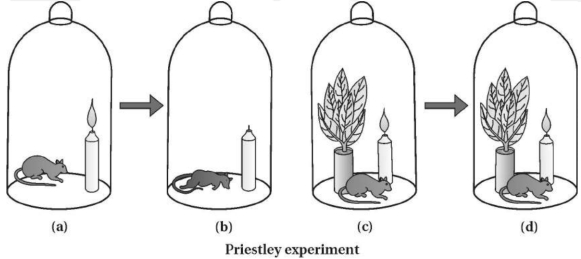
(N/A) Joseph Priestley $(1733-1804)$ performed a series of experiments in $1770$ that revealed the essential role of air in the growth of green plants.
- Priestley observed that a candle burning in a closed space (a bell jar) soon gets extinguished (Figure $a, b$).
- Similarly,a mouse kept in a closed space would soon suffocate.
- Based on these observations,he concluded that a burning candle or an animal that breathes the air,both somehow damage the air.
- However,when he placed a mint plant in the same bell jar,he found that the mouse stayed alive and the candle continued to burn (Figure $c, d$).
- Priestley hypothesized that plants restore to the air whatever breathing animals and burning candles remove.
- Later,in $1774$,Priestley discovered oxygen.
- Priestley observed that a candle burning in a closed space (a bell jar) soon gets extinguished (Figure $a, b$).
- Similarly,a mouse kept in a closed space would soon suffocate.
- Based on these observations,he concluded that a burning candle or an animal that breathes the air,both somehow damage the air.
- However,when he placed a mint plant in the same bell jar,he found that the mouse stayed alive and the candle continued to burn (Figure $c, d$).
- Priestley hypothesized that plants restore to the air whatever breathing animals and burning candles remove.
- Later,in $1774$,Priestley discovered oxygen.
0 likes
View Solution69
Medium
Explain the experiment of Jan Ingenhousz.
Solution
(N/A) $\Rightarrow$ Jan Ingenhousz $(1730-1799)$ used a setup similar to the one used by Priestley.
$\Rightarrow$ He performed the experiment once in the dark and once in sunlight.
$\Rightarrow$ It was concluded that sunlight is essential to the plant process.
$\Rightarrow$ Sunlight somehow purifies the air fouled by burning candles or breathing animals.
$\Rightarrow$ In an elegant experiment with an aquatic plant,Ingenhousz showed that in bright sunlight,small bubbles were formed around the green parts.
$\Rightarrow$ While in the dark,these bubbles did not occur.
$\Rightarrow$ Later,he identified these bubbles to be of oxygen.
$\Rightarrow$ Hence,he demonstrated that only the green parts of the plants can release oxygen.
$\Rightarrow$ He performed the experiment once in the dark and once in sunlight.
$\Rightarrow$ It was concluded that sunlight is essential to the plant process.
$\Rightarrow$ Sunlight somehow purifies the air fouled by burning candles or breathing animals.
$\Rightarrow$ In an elegant experiment with an aquatic plant,Ingenhousz showed that in bright sunlight,small bubbles were formed around the green parts.
$\Rightarrow$ While in the dark,these bubbles did not occur.
$\Rightarrow$ Later,he identified these bubbles to be of oxygen.
$\Rightarrow$ Hence,he demonstrated that only the green parts of the plants can release oxygen.
0 likes
View Solution70
Easy
Explain the experiment of Julius von Sachs.
Solution
(N/A) Julius von Sachs provided evidence for the production of glucose when plants grow in $1854$.
Glucose is usually stored as starch in plants.
His later studies demonstrated that the green substance in plants,now known as chlorophyll,is located within special structures called chloroplasts.
He concluded that the green parts of plants are the sites where glucose is synthesized,and this glucose is subsequently stored as starch.
Glucose is usually stored as starch in plants.
His later studies demonstrated that the green substance in plants,now known as chlorophyll,is located within special structures called chloroplasts.
He concluded that the green parts of plants are the sites where glucose is synthesized,and this glucose is subsequently stored as starch.
0 likes
View Solution71
Medium
Explain the experiment of $T$. $W$. Engelmann $(1843 - 1909)$.
Solution
(N/A) $\Rightarrow$ $T$. $W$. Engelmann used a prism to split light into its spectral components.
$\Rightarrow$ He then illuminated a green alga,$Cladophora$,which was placed in a suspension of aerobic bacteria.
$\Rightarrow$ The bacteria were used to detect the sites of $O_{2}$ evolution.
$\Rightarrow$ He observed that the bacteria accumulated mainly in the regions of blue and red light of the split spectrum.
$\Rightarrow$ Thus,the first action spectrum of photosynthesis was described.
$\Rightarrow$ This spectrum roughly resembles the absorption spectra of chlorophyll $a$ and $b$.
$\Rightarrow$ He then illuminated a green alga,$Cladophora$,which was placed in a suspension of aerobic bacteria.
$\Rightarrow$ The bacteria were used to detect the sites of $O_{2}$ evolution.
$\Rightarrow$ He observed that the bacteria accumulated mainly in the regions of blue and red light of the split spectrum.
$\Rightarrow$ Thus,the first action spectrum of photosynthesis was described.
$\Rightarrow$ This spectrum roughly resembles the absorption spectra of chlorophyll $a$ and $b$.
0 likes
View Solution72
Medium
What was the contribution of Cornelius van Niel to the study of photosynthesis?
Solution
(N/A) $\Rightarrow$ $A$ milestone contribution to the understanding of photosynthesis was made by the microbiologist Cornelius van Niel ($1897$-$1985$),whose studies were based on purple and green bacteria.
$\Rightarrow$ He demonstrated that photosynthesis is essentially a light-dependent reaction,in which hydrogen from a suitable oxidizable compound reduces carbon dioxide to carbohydrates.
$\Rightarrow$ General equation: $2H_{2}A + CO_{2} \xrightarrow{\text{light}} 2A + CH_{2}O + H_{2}O$.
$\Rightarrow$ In green plants,$H_{2}O$ is the hydrogen donor and is oxidized to $O_{2}$.
$\Rightarrow$ Some organisms do not release $O_{2}$ during photosynthesis. For purple and green sulfur bacteria,$H_{2}S$ acts as the hydrogen donor.
$\Rightarrow$ The 'oxidation' product in these bacteria is sulfur or sulfate,depending on the organism,and not $O_{2}$.
$\Rightarrow$ Conclusion: He inferred that the $O_{2}$ evolved by green plants comes from $H_{2}O$ and not from carbon dioxide. This was later proven using radioisotopic techniques.
$\Rightarrow$ The correct equation representing the overall process of photosynthesis is: $6CO_{2} + 12H_{2}O \xrightarrow{\text{Light}} C_{6}H_{12}O_{6} + 6H_{2}O + 6O_{2}$.
$\Rightarrow$ Here,$C_{6}H_{12}O_{6}$ represents glucose. The $O_{2}$ released originates from water.
$\Rightarrow$ He demonstrated that photosynthesis is essentially a light-dependent reaction,in which hydrogen from a suitable oxidizable compound reduces carbon dioxide to carbohydrates.
$\Rightarrow$ General equation: $2H_{2}A + CO_{2} \xrightarrow{\text{light}} 2A + CH_{2}O + H_{2}O$.
$\Rightarrow$ In green plants,$H_{2}O$ is the hydrogen donor and is oxidized to $O_{2}$.
$\Rightarrow$ Some organisms do not release $O_{2}$ during photosynthesis. For purple and green sulfur bacteria,$H_{2}S$ acts as the hydrogen donor.
$\Rightarrow$ The 'oxidation' product in these bacteria is sulfur or sulfate,depending on the organism,and not $O_{2}$.
$\Rightarrow$ Conclusion: He inferred that the $O_{2}$ evolved by green plants comes from $H_{2}O$ and not from carbon dioxide. This was later proven using radioisotopic techniques.
$\Rightarrow$ The correct equation representing the overall process of photosynthesis is: $6CO_{2} + 12H_{2}O \xrightarrow{\text{Light}} C_{6}H_{12}O_{6} + 6H_{2}O + 6O_{2}$.
$\Rightarrow$ Here,$C_{6}H_{12}O_{6}$ represents glucose. The $O_{2}$ released originates from water.
0 likes
View Solution73
EasyMCQ
What does the experiment of two leaves explain in the context of photosynthesis?
A
Requirement of light for photosynthesis
B
Requirement of chlorophyll for photosynthesis
C
Requirement of carbon dioxide for photosynthesis
D
Requirement of water for photosynthesis
Solution
(B) The experiment of two leaves (often referred to as the variegated leaf experiment) is a classic demonstration used to show that chlorophyll is essential for photosynthesis.
In this experiment,a variegated leaf (a leaf with green and non-green patches) is exposed to light.
After testing with iodine,it is observed that starch is formed only in the green parts of the leaf,which contained chlorophyll.
The non-green parts,lacking chlorophyll,do not produce starch.
Therefore,this experiment proves that chlorophyll is necessary for the process of photosynthesis.
In this experiment,a variegated leaf (a leaf with green and non-green patches) is exposed to light.
After testing with iodine,it is observed that starch is formed only in the green parts of the leaf,which contained chlorophyll.
The non-green parts,lacking chlorophyll,do not produce starch.
Therefore,this experiment proves that chlorophyll is necessary for the process of photosynthesis.
0 likes
View Solution74
Medium
Name two important researches of Priestley.
Solution
(N/A) Joseph Priestley performed a series of experiments in $1770$ that revealed the essential role of air in the growth of green plants.
$1$. He demonstrated that a burning candle or a breathing mouse would soon get extinguished or die in a closed space (bell jar).
$2$. He showed that when a mint plant was placed in the same bell jar,the candle continued to burn and the mouse stayed alive,proving that plants restore to the air whatever breathing animals and burning candles remove.
$1$. He demonstrated that a burning candle or a breathing mouse would soon get extinguished or die in a closed space (bell jar).
$2$. He showed that when a mint plant was placed in the same bell jar,the candle continued to burn and the mouse stayed alive,proving that plants restore to the air whatever breathing animals and burning candles remove.
0 likes
View Solution75
MediumMCQ
What was the difference between Priestley and Ingenhousz's experiment?
A
Priestley used a candle,while Ingenhousz used a plant.
B
Priestley showed that plants restore air,while Ingenhousz showed that sunlight is essential for this process.
C
Priestley used aquatic plants,while Ingenhousz used terrestrial plants.
D
There was no difference between their experiments.
Solution
(B) Joseph Priestley $(1770)$ performed a series of experiments that revealed the essential role of air in the growth of green plants. He demonstrated that plants restore to the air whatever breathing animals and burning candles remove.
Jan Ingenhousz $(1779)$,with a similar setup,showed that sunlight is essential to the plant process that somehow purifies the air fouled by burning candles or breathing animals.
Ingenhousz demonstrated in an elegant experiment with an aquatic plant that in bright sunlight,small bubbles were formed around the green parts,while in the dark,they did not. Later,he identified these bubbles to be of oxygen.
Therefore,the key difference is that Ingenhousz specifically identified the role of sunlight and the release of oxygen bubbles in the process.
Jan Ingenhousz $(1779)$,with a similar setup,showed that sunlight is essential to the plant process that somehow purifies the air fouled by burning candles or breathing animals.
Ingenhousz demonstrated in an elegant experiment with an aquatic plant that in bright sunlight,small bubbles were formed around the green parts,while in the dark,they did not. Later,he identified these bubbles to be of oxygen.
Therefore,the key difference is that Ingenhousz specifically identified the role of sunlight and the release of oxygen bubbles in the process.
0 likes
View Solution76
MediumMCQ
In which of the following forms is glucose usually stored in plants?
A
Lipid
B
Carbohydrates
C
Protein
D
Starch
Solution
(D) Julius von Sachs provided evidence for the production of glucose when plants grow.
Glucose is usually stored as starch.
His later studies showed that the green substance in plants (chlorophyll as we know it now) is located in special bodies (later called chloroplasts) within plant cells.
He found that the green parts in plants are where glucose is made,and that the glucose is usually stored as starch.
Glucose is usually stored as starch.
His later studies showed that the green substance in plants (chlorophyll as we know it now) is located in special bodies (later called chloroplasts) within plant cells.
He found that the green parts in plants are where glucose is made,and that the glucose is usually stored as starch.
0 likes
View Solution77
MediumMCQ
In photosynthesis,the action and absorption spectrum were related by:
A
Von Helmont
B
Englemann
C
Emerson
D
Lavoisier
Solution
(B) The relationship between the action spectrum and the absorption spectrum of photosynthesis was first demonstrated by $T.W. Englemann$.
He used the green alga $Cladophora$ and placed it in a suspension of aerobic bacteria.
He observed that the bacteria accumulated mainly in the regions of blue and red light of the split spectrum.
This experiment showed that the rate of photosynthesis is highest in the blue and red regions of the visible spectrum,which corresponds to the absorption peaks of chlorophyll $a$ and $b$.
He used the green alga $Cladophora$ and placed it in a suspension of aerobic bacteria.
He observed that the bacteria accumulated mainly in the regions of blue and red light of the split spectrum.
This experiment showed that the rate of photosynthesis is highest in the blue and red regions of the visible spectrum,which corresponds to the absorption peaks of chlorophyll $a$ and $b$.
0 likes
View Solution78
EasyMCQ
$PGA$ as the first carbon dioxide fixation product was discovered in photosynthesis of
A
Bryophyte
B
Gymnosperm
C
Angiosperm
D
Alga
Solution
(D) The use of radioactive $^{14}C$ by Melvin Calvin in algal (Chlorella) photosynthesis studies led to the discovery that the first carbon dioxide fixation product was a $3$-carbon organic acid.
The first product identified was $3$-phosphoglyceric acid $(PGA)$.
The first product identified was $3$-phosphoglyceric acid $(PGA)$.
0 likes
View Solution79
MediumMCQ
Who discovered that light is essential for releasing oxygen in plants?
A
Stephen Hales
B
Lavoisier
C
Jan Ingenhousz
D
Von Helmont
Solution
(C) Using a similar setup as used by Priestley,but by placing the experimental plant once in the dark and once in sunlight,Jan Ingenhousz $(1730-1799)$ demonstrated that sunlight is essential to the plant process that purifies the air. He showed that in sunlight,small bubbles were formed around the green parts of the plant,which were identified as oxygen.
0 likes
View Solution80
MediumMCQ
$A$ milestone contribution to the understanding of photosynthesis was made by Cornelius van Niel,which was based on the studies of
A
Bacteria
B
Algae
C
Angiospermic plants
D
Lower plants
Solution
(A) Cornelius van Niel conducted pioneering studies on purple and green sulphur bacteria.
He demonstrated that photosynthesis is a light-dependent reaction in which hydrogen from a suitable oxidizable compound reduces carbon dioxide to carbohydrates.
In these bacteria,hydrogen sulphide $(H_2S)$ acts as the hydrogen donor instead of water $(H_2O)$,and sulphur or sulphate is produced as an oxidation product instead of oxygen $(O_2)$.
By comparing this with the process in green plants,he inferred that in green plants,$H_2O$ is the hydrogen donor and $O_2$ is evolved as a byproduct,not $CO_2$.
He demonstrated that photosynthesis is a light-dependent reaction in which hydrogen from a suitable oxidizable compound reduces carbon dioxide to carbohydrates.
In these bacteria,hydrogen sulphide $(H_2S)$ acts as the hydrogen donor instead of water $(H_2O)$,and sulphur or sulphate is produced as an oxidation product instead of oxygen $(O_2)$.
By comparing this with the process in green plants,he inferred that in green plants,$H_2O$ is the hydrogen donor and $O_2$ is evolved as a byproduct,not $CO_2$.
0 likes
View Solution81
MediumMCQ
The essential role of air in the growth of green plants was revealed by
A
Priestley
B
Van Niel
C
Blackmann
D
Emerson
Solution
(A) Joseph Priestley,in $1770$,performed a series of experiments that revealed the essential role of air in the growth of green plants.
He demonstrated that plants restore to the air whatever breathing animals and burning candles remove.
He placed a burning candle in a closed bell jar,which soon extinguished,and a mouse in a similar jar,which soon suffocated.
When he placed a mint plant in the same bell jars,he found that the candle continued to burn and the mouse stayed alive,proving that plants purify the air.
He demonstrated that plants restore to the air whatever breathing animals and burning candles remove.
He placed a burning candle in a closed bell jar,which soon extinguished,and a mouse in a similar jar,which soon suffocated.
When he placed a mint plant in the same bell jars,he found that the candle continued to burn and the mouse stayed alive,proving that plants purify the air.
0 likes
View Solution82
MediumMCQ
Moll's half leaf experiment was done to show ...................... was required for photosynthesis.
A
$H_2O$
B
Chlorophyll
C
Light
D
$CO_2$
Solution
(D) In this experiment,half of a leaf was enclosed in a test tube containing $KOH$ (which absorbs $CO_2$),while the other half remained in the air.
When both halves were tested for starch using iodine solution,the part of the leaf exposed to air showed a positive test (blue-black color),whereas the part inside the test tube did not.
This result demonstrates that $CO_2$ is essential for the process of photosynthesis.
When both halves were tested for starch using iodine solution,the part of the leaf exposed to air showed a positive test (blue-black color),whereas the part inside the test tube did not.
This result demonstrates that $CO_2$ is essential for the process of photosynthesis.
0 likes
View Solution83
MediumMCQ
The curve showing the effectiveness of different wavelengths of light in photosynthesis was first given by Engelmann using all,except:
A
Filamentous green alga Cladophora
B
Unicellular green alga Chlorella
C
Suspension of aerobic bacteria
D
Prism to split the light into its components
Solution
(B) The first action spectrum of photosynthesis was described by $T$.$W$. Engelmann. He used a prism to split light into its spectral components and then illuminated a green alga,$Cladophora$,placed in a suspension of aerobic bacteria. The bacteria were used to detect the sites of $O_2$ evolution. He observed that the bacteria accumulated mainly in the region of blue and red light of the split spectrum. $Chlorella$ was used by Robert Hill in his experiments to study the light and dark phases of photosynthesis,not by Engelmann.
0 likes
View Solution84
MediumMCQ
Essentiality of $CO_2$ in photosynthesis can be demonstrated using
A
Moll's half leaf experiment
B
Ganong screen
C
Inverted funnel experiment
D
$KOH$ solution
Solution
(A) In this experiment,half of a leaf is enclosed in a test tube containing $KOH$ (which absorbs $CO_2$),while the other half remains exposed to the air.
After some time,when both halves are tested for the presence of starch using iodine solution,the part of the leaf exposed to air shows a positive starch test (turns blue-black),whereas the part inside the tube does not.
This demonstrates that $CO_2$ is essential for the process of photosynthesis.
After some time,when both halves are tested for the presence of starch using iodine solution,the part of the leaf exposed to air shows a positive starch test (turns blue-black),whereas the part inside the tube does not.
This demonstrates that $CO_2$ is essential for the process of photosynthesis.
0 likes
View Solution85
MediumMCQ
If a photosynthesising plant releases oxygen containing more than the normal amount of $^{18}O$,it is concluded that the plant has been supplied with:
A
$C_{6}H_{12}O_{6}$ containing $^{18}O$
B
$H_{2}O$ containing $^{18}O$
C
$CO_{2}$ containing $^{18}O$
D
Oxygen in the form of ozone
Solution
(B) During the process of photosynthesis,the oxygen released as a byproduct comes from the photolysis of water $(H_{2}O)$,not from carbon dioxide $(CO_{2})$.
This was experimentally proven by Ruben and Kamen using the heavy isotope of oxygen,$^{18}O$.
Therefore,if a plant releases oxygen containing $^{18}O$,it indicates that the water supplied to the plant contained the $^{18}O$ isotope.
This was experimentally proven by Ruben and Kamen using the heavy isotope of oxygen,$^{18}O$.
Therefore,if a plant releases oxygen containing $^{18}O$,it indicates that the water supplied to the plant contained the $^{18}O$ isotope.
0 likes
View Solution86
MediumMCQ
Select the correct option regarding the experiments on photosynthesis.
A
Half-leaf experiment - $CO_2$ is essential for photosynthesis.
B
Half-leaf experiment - Light is essential for photosynthesis.
C
Moll's half-leaf experiment - $CO_2$ is essential for photosynthesis.
D
Both $A$ and $C$.
Solution
(D) The 'Half-leaf experiment' is famously known as 'Moll's half-leaf experiment'.
In this experiment,a part of a leaf is enclosed in a test tube containing $KOH$ soaked cotton (which absorbs $CO_2$),while the other half is exposed to air.
After some time,the leaf is tested for starch using iodine solution.
The part exposed to air turns blue-black (indicating starch presence),while the part inside the tube does not.
This proves that $CO_2$ is essential for photosynthesis.
Therefore,both option $A$ and option $C$ refer to the same correct scientific experiment.
In this experiment,a part of a leaf is enclosed in a test tube containing $KOH$ soaked cotton (which absorbs $CO_2$),while the other half is exposed to air.
After some time,the leaf is tested for starch using iodine solution.
The part exposed to air turns blue-black (indicating starch presence),while the part inside the tube does not.
This proves that $CO_2$ is essential for photosynthesis.
Therefore,both option $A$ and option $C$ refer to the same correct scientific experiment.
0 likes
View Solution87
MediumMCQ
Which scientist proposed the hypothesis that 'plants restore to the air whatever breathing animals and burning candles remove'?
A
Joseph Priestley
B
Jan Ingenhousz
C
Julius von Sachs
D
$T$.$W$. Engelmann
Solution
(A) In $1770$,Joseph Priestley performed a series of experiments that revealed the essential role of air in the growth of green plants. He observed that a mouse kept in a closed space (bell jar) would soon suffocate and die. Similarly,a burning candle would soon get extinguished in a closed space. However,when he placed a mint plant in the same bell jar,he found that the mouse stayed alive and the candle continued to burn. Based on these observations,he concluded that plants restore to the air whatever breathing animals and burning candles remove.
0 likes
View Solution88
MediumMCQ
In photosynthesis,if we radiolabel the oxygen atom in $CO_2$,which product will become radiolabeled?
A
$H_2O$
B
$C_6H_{12}O_6$
C
$O_2$
D
All of the above
Solution
(B) In the process of photosynthesis,the chemical equation is $6CO_2 + 12H_2O \rightarrow C_6H_{12}O_6 + 6H_2O + 6O_2$.
According to the experiments conducted by Van Niel and later confirmed by Ruben and Kamen using radioactive isotopes,the oxygen released as a byproduct $(O_2)$ comes from the water $(H_2O)$ molecule,not from $CO_2$.
Conversely,the carbon and oxygen atoms from $CO_2$ are incorporated into the glucose $(C_6H_{12}O_6)$ molecule during the Calvin cycle (dark reaction).
Therefore,if the oxygen in $CO_2$ is radiolabeled,the radiolabel will appear in the glucose $(C_6H_{12}O_6)$ produced.
According to the experiments conducted by Van Niel and later confirmed by Ruben and Kamen using radioactive isotopes,the oxygen released as a byproduct $(O_2)$ comes from the water $(H_2O)$ molecule,not from $CO_2$.
Conversely,the carbon and oxygen atoms from $CO_2$ are incorporated into the glucose $(C_6H_{12}O_6)$ molecule during the Calvin cycle (dark reaction).
Therefore,if the oxygen in $CO_2$ is radiolabeled,the radiolabel will appear in the glucose $(C_6H_{12}O_6)$ produced.
0 likes
View Solution89
MediumMCQ
Which scientist used aerobic bacteria,a prism,and green algae in his experiment?
A
Joseph Priestley
B
Jan Ingenhousz
C
Julius von Sachs
D
$T$. $W$. Engelmann
Solution
(D) $T$. $W$. Engelmann $(1882)$ performed a classic experiment using the green alga $Cladophora$ placed in a suspension of aerobic bacteria. He used a prism to split light into its spectral components and then illuminated the alga. The bacteria were used to detect the sites of $O_2$ evolution. He observed that the bacteria accumulated mainly in the region of blue and red light of the split spectrum,demonstrating that these wavelengths are most effective for photosynthesis.
0 likes
View Solution90
MediumMCQ
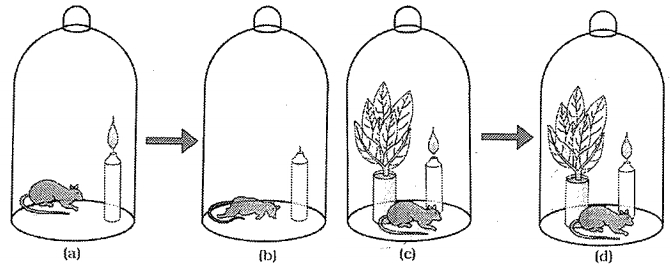
Which scientist conducted the experiment shown below?
A
Joseph Priestley
B
Jan Ingenhousz
C
Julius von Sachs
D
$T$. $W$. Engelmann
Solution
(A) The experiment shown in the image is the famous 'Bell Jar Experiment' conducted by Joseph Priestley in $1774$.
In this experiment,Priestley demonstrated that plants restore to the air whatever breathing animals and burning candles remove.
He observed that a mouse kept in a closed space (bell jar) would soon suffocate and die,and a burning candle would soon extinguish.
However,when he placed a mint plant in the same bell jar,the mouse stayed alive and the candle continued to burn.
This led to the discovery of oxygen (which he called 'dephlogisticated air').
In this experiment,Priestley demonstrated that plants restore to the air whatever breathing animals and burning candles remove.
He observed that a mouse kept in a closed space (bell jar) would soon suffocate and die,and a burning candle would soon extinguish.
However,when he placed a mint plant in the same bell jar,the mouse stayed alive and the candle continued to burn.
This led to the discovery of oxygen (which he called 'dephlogisticated air').
0 likes
View Solution91
MediumMCQ
Which scientist performed the experiment where a burning candle and a mouse were placed in a closed bell jar to demonstrate the role of air in the growth of plants?
A
Joseph Priestley
B
Jan Ingenhousz
C
Julius von Sachs
D
$T$. $W$. Engelmann
Solution
(A) In $1770$,Joseph Priestley performed a series of experiments that revealed the essential role of air in the growth of green plants.
He observed that a mouse kept in a closed space (a bell jar) would soon suffocate and die.
Similarly,a burning candle would soon get extinguished in a closed space.
However,when he placed a mint plant in the same bell jar,he found that the mouse stayed alive and the candle continued to burn.
This led him to conclude that plants restore to the air whatever breathing animals and burning candles remove.
He observed that a mouse kept in a closed space (a bell jar) would soon suffocate and die.
Similarly,a burning candle would soon get extinguished in a closed space.
However,when he placed a mint plant in the same bell jar,he found that the mouse stayed alive and the candle continued to burn.
This led him to conclude that plants restore to the air whatever breathing animals and burning candles remove.
0 likes
View Solution92
MediumMCQ
$..............$ provided evidence for the production of glucose when plants grow. Glucose is usually stored as starch.
A
Joseph Priestley
B
Jan Ingenhousz
C
Julius von Sachs
D
$T$. $W$. Engelmann
Solution
(C) Julius von Sachs provided evidence for the production of glucose when plants grow. He demonstrated that glucose is usually stored as starch. His studies showed that the green substance in plants (chlorophyll) is located in special bodies (later called chloroplasts) within plant cells. He found that the green parts in plants is where glucose is made,and that the glucose is usually stored as starch.
0 likes
View Solution93
MediumMCQ
$T$. $W$. Engelmann performed experiments on $.......$.
A
Cladophora and aerobic bacteria
B
Cladophora and anaerobic bacteria
C
Chlorella and aerobic bacteria
D
Chlorella and anaerobic bacteria
Solution
(A) $T$. $W$. Engelmann $(1883)$ performed a classic experiment using a green alga,$Cladophora$,placed in a suspension of aerobic bacteria.
He used a prism to split light into its spectral components and then illuminated the alga.
The aerobic bacteria were used to detect the sites of $O_2$ evolution.
He observed that the bacteria accumulated mainly in the region of blue and red light of the split spectrum.
Thus,he described the first action spectrum of photosynthesis.
He used a prism to split light into its spectral components and then illuminated the alga.
The aerobic bacteria were used to detect the sites of $O_2$ evolution.
He observed that the bacteria accumulated mainly in the region of blue and red light of the split spectrum.
Thus,he described the first action spectrum of photosynthesis.
0 likes
View Solution94
MediumMCQ
$...........$ demonstrated that photosynthesis is essentially a light-dependent reaction in which hydrogen from a suitable oxidizable compound reduces carbon dioxide to carbohydrates.
A
Jan Ingenhousz
B
$T$. $W$. Engelmann
C
Julius von Sachs
D
Cornelius van Niel
Solution
(D) Cornelius van Niel,based on his studies of purple and green sulfur bacteria,demonstrated that photosynthesis is essentially a light-dependent reaction in which hydrogen from a suitable oxidizable compound reduces carbon dioxide to carbohydrates.
In green plants,$H_2O$ is the hydrogen donor and is oxidized to $O_2$.
This was a significant step in understanding the mechanism of photosynthesis.
In green plants,$H_2O$ is the hydrogen donor and is oxidized to $O_2$.
This was a significant step in understanding the mechanism of photosynthesis.
0 likes
View Solution95
MediumMCQ
During photosynthesis,the oxygen evolved is released from $...........$.
A
$H_2O$
B
$CO_2$
C
$C_6H_{12}O_6$
D
Both $A$ and $B$
Solution
(A) The oxygen released during photosynthesis comes from the photolysis of water $(H_2O)$.
This was experimentally proven by $C$.$B$. van Niel,who studied purple and green sulfur bacteria.
He demonstrated that in these bacteria,when $H_2S$ is used instead of $H_2O$,sulfur or sulfate is produced instead of oxygen.
This led to the conclusion that in green plants,the oxygen evolved during photosynthesis originates from water $(H_2O)$ and not from carbon dioxide $(CO_2)$.
This was experimentally proven by $C$.$B$. van Niel,who studied purple and green sulfur bacteria.
He demonstrated that in these bacteria,when $H_2S$ is used instead of $H_2O$,sulfur or sulfate is produced instead of oxygen.
This led to the conclusion that in green plants,the oxygen evolved during photosynthesis originates from water $(H_2O)$ and not from carbon dioxide $(CO_2)$.
0 likes
View Solution96
MediumMCQ
In higher plants,the hydrogen donor is $.........$ and for purple and green sulfur bacteria,the hydrogen donor is $............$.
A
$H_2O, H_2S$
B
$H_2S, H_2O$
C
$H_2O, H_2O$
D
$H_2S, H_2S$
Solution
(A) In higher plants,photosynthesis involves the photolysis of water $(H_2O)$,which acts as the hydrogen donor to reduce $CO_2$ into carbohydrates,releasing oxygen as a byproduct.
In contrast,purple and green sulfur bacteria do not use water as a hydrogen donor. Instead,they use hydrogen sulfide $(H_2S)$ as the hydrogen donor,which results in the release of sulfur or sulfate instead of oxygen.
In contrast,purple and green sulfur bacteria do not use water as a hydrogen donor. Instead,they use hydrogen sulfide $(H_2S)$ as the hydrogen donor,which results in the release of sulfur or sulfate instead of oxygen.
0 likes
View Solution97
MediumMCQ
Which of the following did the scientist Melvin Calvin use to discover the biosynthetic pathway of photosynthesis?
A
Algae and radioactive ${}^{14}C$
B
Algae and radioactive ${}^{32}P$
C
Angiosperms and radioactive ${}^{14}C$
D
Angiosperms and radioactive ${}^{32}P$
Solution
(A) Melvin Calvin used radioactive ${}^{14}C$ in algal photosynthesis studies to trace the path of carbon fixation.
He used the technique of radioactive labeling to identify the intermediate compounds formed during the dark reaction of photosynthesis,which is now known as the Calvin cycle.
Therefore,the correct combination is algae and radioactive ${}^{14}C$.
He used the technique of radioactive labeling to identify the intermediate compounds formed during the dark reaction of photosynthesis,which is now known as the Calvin cycle.
Therefore,the correct combination is algae and radioactive ${}^{14}C$.
0 likes
View Solution98
MediumMCQ
Match the column and select the correct option $:-$
| Column-$I$ | Column-$II$ |
| $(a)$ Priestley | $(i)$ Sulphur bacteria |
| $(b)$ Engelmann | $(ii)$ Bell jar |
| $(c)$ Van Niel | $(iii)$ Aquatic plant |
| $(d)$ Ingenhousz | $(iv)$ Cladophora |
A
$a-ii, b-iii, c-iv, d-i$
B
$a-ii, b-iv, c-i, d-iii$
C
$a-iii, b-iv, c-ii, d-i$
D
$a-ii, b-i, c-iii, d-iv$
Solution
(B) The correct matches are as follows:
$1$. Priestley $(a)$ used a bell jar experiment to show that plants restore air for breathing animals $(ii)$.
$2$. Engelmann $(b)$ used the green alga Cladophora to demonstrate the action spectrum of photosynthesis $(iv)$.
$3$. Van Niel $(c)$ worked on purple and green sulphur bacteria to show that photosynthesis is a light-dependent reaction in which hydrogen from a suitable oxidizable compound reduces carbon dioxide to carbohydrates $(i)$.
$4$. Ingenhousz $(d)$ demonstrated that sunlight is essential to the plant process that somehow purifies the air fouled by burning candles or breathing animals,using an aquatic plant $(iii)$.
Thus,the correct sequence is $a-ii, b-iv, c-i, d-iii$.
$1$. Priestley $(a)$ used a bell jar experiment to show that plants restore air for breathing animals $(ii)$.
$2$. Engelmann $(b)$ used the green alga Cladophora to demonstrate the action spectrum of photosynthesis $(iv)$.
$3$. Van Niel $(c)$ worked on purple and green sulphur bacteria to show that photosynthesis is a light-dependent reaction in which hydrogen from a suitable oxidizable compound reduces carbon dioxide to carbohydrates $(i)$.
$4$. Ingenhousz $(d)$ demonstrated that sunlight is essential to the plant process that somehow purifies the air fouled by burning candles or breathing animals,using an aquatic plant $(iii)$.
Thus,the correct sequence is $a-ii, b-iv, c-i, d-iii$.
0 likes
View Solution99
MediumMCQ
Who demonstrated that photosynthesis is essentially a light dependent reaction in which hydrogen from a suitable oxidisable compound reduces $CO_2$ to carbohydrates?
A
Julius Von Sachs
B
$T.W.$ Engelmann
C
Cornelius Van Niel
D
Jan Ingenhousz
Solution
(C) Cornelius Van Niel,based on his studies of purple and green sulfur bacteria,demonstrated that photosynthesis is essentially a light-dependent reaction.
He showed that hydrogen from a suitable oxidisable compound reduces $CO_2$ to carbohydrates.
In green plants,$H_2O$ acts as the hydrogen donor and is oxidised to $O_2$.
He showed that hydrogen from a suitable oxidisable compound reduces $CO_2$ to carbohydrates.
In green plants,$H_2O$ acts as the hydrogen donor and is oxidised to $O_2$.
0 likes
View SolutionPhotosynthesis in Higher Plants — Early Experiments · Frequently Asked Questions
1Are these Photosynthesis in Higher Plants questions useful for JEE and NEET?
Yes. All questions in this section are mapped to JEE Main and NEET exam patterns. Previous year questions from JEE Main, NEET, GUJCET and state-level exams are included with full solutions.
2Can I switch to Hindi or Gujarati for these questions?
Yes. Use the language tabs in the hero section or the sidebar to view the same questions and solutions in English, Hindi or Gujarati.
3How do I generate a question paper from this subtopic?
Use the Vedclass Exam Paper Generator — select the chapter and subtopic, set difficulty, and generate Sets A, B, C, D automatically. First 3 chapters of every subject are free.
Vedclass Products
For Students
Vedclass Test Series
Mock tests in real JEE/NEET style with performance analysis. 5-day free trial.
Start Free TrialFor Teachers
Exam Paper Generator
Generate Set A/B/C/D papers from this chapter in 2 minutes. 3 chapters free.
Try FreeFor Institutes
Online Exam Module
Live online exams with unlimited students, 360° analytics & white-label branding.
See DemoFor Teachers & Institutes
Generate a Photosynthesis in Higher Plants Exam Paper in 2 Minutes
Select subtopic & difficulty — Sets A, B, C, D auto-generated with No Repeat logic.
First 3 chapters of every subject are free — no payment required.