
A English
Neuron as Structural and Functional Unit of Neural System Questions in English
Class 11 Biology · Neural Control and Coordination · Neuron as Structural and Functional Unit of Neural System
183+
Questions
English
Language
100%
With Solutions
Showing 33 of 183 questions in English
151
EasyMCQ
What are the two primary types of cells found in the nervous system?
A
Alveoli and veins
B
Alveoli and bronchioles
C
Neurons and nephrons
D
Neurons and glia
Solution
(D) The nervous system is primarily composed of two main categories of cells:
$(i)$ Neurons: These are the structural and functional units of the nervous system responsible for the transmission of nerve impulses.
$(ii)$ Glial cells (Neuroglia): These are non-neuronal cells that provide support,protection,and nutrition to the neurons. They are much more numerous than neurons.
While other specialized cells like ependymal cells and neurosecretory cells exist,the fundamental classification of nervous tissue cells is into neurons and glia.
$(i)$ Neurons: These are the structural and functional units of the nervous system responsible for the transmission of nerve impulses.
$(ii)$ Glial cells (Neuroglia): These are non-neuronal cells that provide support,protection,and nutrition to the neurons. They are much more numerous than neurons.
While other specialized cells like ependymal cells and neurosecretory cells exist,the fundamental classification of nervous tissue cells is into neurons and glia.
0 likes
View Solution152
EasyMCQ
Bipolar neurons occur in
A
Vertebrate embryos
B
Retina of eye
C
Brain and spinal cord
D
Skeletal muscles
Solution
(B) Bipolar neurons are neurons that possess one axon and one dendrite extending from opposite poles of the cell body. These neurons are specialized for sensory transmission and are found in specific locations such as the retina of the eye,the olfactory epithelium,and the inner ear.
0 likes
View Solution153
MediumMCQ
The ..... nerve fibres are enveloped with Schwann cells,which form a myelin sheath around the axon.
A
Myelinated
B
Non-myelinated
C
Afferent
D
Efferent
Solution
(A) Myelinated nerve fibres are those that are enveloped with Schwann cells,which form a myelin sheath around the axon.
In contrast,non-myelinated nerve fibres are enclosed by a Schwann cell that does not form a myelin sheath around the axon.
In contrast,non-myelinated nerve fibres are enclosed by a Schwann cell that does not form a myelin sheath around the axon.
0 likes
View Solution154
MediumMCQ
Dendrites transmit impulses towards the
A
Cell body
B
Axon
C
Both $(a)$ and $(b)$
D
None of these
Solution
(A) Dendrites are the short,branched processes of a neuron that receive signals from other neurons or sensory receptors.
These impulses are then transmitted towards the cell body (also known as the soma or cyton) of the neuron.
In contrast,the axon transmits impulses away from the cell body.
These impulses are then transmitted towards the cell body (also known as the soma or cyton) of the neuron.
In contrast,the axon transmits impulses away from the cell body.
0 likes
View Solution155
MediumMCQ
The cell body of a neuron contains:
A
Cytoplasm
B
Cell organelles
C
Granular bodies
D
All of these
Solution
(D) The cell body (soma) of a neuron contains cytoplasm,which includes typical cell organelles such as mitochondria,Golgi apparatus,and endoplasmic reticulum. Additionally,it contains characteristic granular bodies known as Nissl's granules,which are clusters of rough endoplasmic reticulum and ribosomes.
0 likes
View Solution156
MediumMCQ
The highly specialized cells called neurons can:
A
Detect stimuli
B
Receive stimuli
C
Transmit stimuli
D
All of the above
Solution
(D) Neurons are highly specialized cells that form the structural and functional unit of the nervous system.
$1$. They possess the ability to detect stimuli through their receptors.
$2$. They receive these stimuli as electrical or chemical signals.
$3$. They transmit these signals to other neurons,muscles,or glands.
Therefore,all the given functions are performed by neurons.
$1$. They possess the ability to detect stimuli through their receptors.
$2$. They receive these stimuli as electrical or chemical signals.
$3$. They transmit these signals to other neurons,muscles,or glands.
Therefore,all the given functions are performed by neurons.
0 likes
View Solution157
MediumMCQ
Which of the following statements are correct for a nerve cell?
$(I)$. Each neuron has a cell body
$(II)$. Each neuron has a single axon
$(III)$. Neurons are the functional units of the nervous system
Select the correct option.
$(I)$. Each neuron has a cell body
$(II)$. Each neuron has a single axon
$(III)$. Neurons are the functional units of the nervous system
Select the correct option.
A
$(I)$ and $(II)$
B
$(II)$ and $(III)$
C
All are incorrect
D
All are correct
Solution
(D) All statements $(I)$,$(II)$,and $(III)$ are correct.
Each neuron consists of three main parts: a cell body (cyton),an axon,and one or more dendrites.
The cell body contains the nucleus and cytoplasm.
The axon is a long,slender projection that conducts nerve impulses away from the cell body,and each neuron typically possesses a single axon.
Neurons are the structural and functional units of the nervous system,responsible for the generation and transmission of nerve impulses.
Each neuron consists of three main parts: a cell body (cyton),an axon,and one or more dendrites.
The cell body contains the nucleus and cytoplasm.
The axon is a long,slender projection that conducts nerve impulses away from the cell body,and each neuron typically possesses a single axon.
Neurons are the structural and functional units of the nervous system,responsible for the generation and transmission of nerve impulses.
0 likes
View Solution158
EasyMCQ
The supporting and nutritive cells found in the brain are
A
Ependymal cells
B
Microglia
C
Astrocytes
D
Oligodendrocytes
Solution
(A) Ependymal cells are specialized epithelial cells that line the ventricles of the brain and the central canal of the spinal cord. They are ciliated and play a crucial role in the production and circulation of cerebrospinal fluid $(CSF)$,providing both structural support and nutritional maintenance for the central nervous system $(CNS)$.
Microglia are small glial cells that act as the primary immune defense in the $CNS$,functioning as phagocytes to remove cellular debris and pathogens.
Astrocytes are star-shaped cells that provide structural and metabolic support to neurons,regulate the chemical environment,and contribute to the formation of the blood-brain barrier.
Oligodendrocytes are responsible for the formation of the myelin sheath around axons in the $CNS$.
Microglia are small glial cells that act as the primary immune defense in the $CNS$,functioning as phagocytes to remove cellular debris and pathogens.
Astrocytes are star-shaped cells that provide structural and metabolic support to neurons,regulate the chemical environment,and contribute to the formation of the blood-brain barrier.
Oligodendrocytes are responsible for the formation of the myelin sheath around axons in the $CNS$.
0 likes
View Solution159
MediumMCQ
Which of the following statements is correct about the nodes of Ranvier?
A
Axolemma is discontinuous
B
Myelin sheath is discontinuous
C
Both neurilemma and myelin sheath are discontinuous
D
Covered by myelin sheath
Solution
(B) The myelin sheath is a fatty insulating layer that surrounds the axon of many neurons. However,this sheath is not continuous along the entire length of the axon. It is interrupted at regular intervals by gaps known as the nodes of Ranvier. These nodes allow for saltatory conduction of nerve impulses,which significantly increases the speed of signal transmission.
0 likes
View Solution160
MediumMCQ
Which of the following statements are correct?
$I$. Dendrites are long fibres with branched distal ends.
$II$. Axons are short fibres which arise from the cell body.
$III$. The cell body of a neuron contains cytoplasm,a nucleus with cell organelles,and Nissl's granules.
$IV$. Dendrites transmit nerve impulses away from the cell body to a synapse.
The correct option is:
$I$. Dendrites are long fibres with branched distal ends.
$II$. Axons are short fibres which arise from the cell body.
$III$. The cell body of a neuron contains cytoplasm,a nucleus with cell organelles,and Nissl's granules.
$IV$. Dendrites transmit nerve impulses away from the cell body to a synapse.
The correct option is:
A
Only $III$
B
$I$ and $II$
C
$I, II$ and $III$
D
$I, II$ and $IV$
Solution
(A) neuron consists of a cell body,an axon,and dendrites.
Statement $I$ is incorrect because dendrites are short fibres,not long.
Statement $II$ is incorrect because axons are long fibres,not short.
Statement $III$ is correct as the cell body (cyton) contains cytoplasm,a nucleus,cell organelles,and characteristic Nissl's granules.
Statement $IV$ is incorrect because dendrites transmit nerve impulses towards the cell body,whereas the axon transmits impulses away from the cell body.
Therefore,only statement $III$ is correct.
Statement $I$ is incorrect because dendrites are short fibres,not long.
Statement $II$ is incorrect because axons are long fibres,not short.
Statement $III$ is correct as the cell body (cyton) contains cytoplasm,a nucleus,cell organelles,and characteristic Nissl's granules.
Statement $IV$ is incorrect because dendrites transmit nerve impulses towards the cell body,whereas the axon transmits impulses away from the cell body.
Therefore,only statement $III$ is correct.
0 likes
View Solution161
MediumMCQ
Which of the following statements is true?
A
Saltatory conduction is seen in non-myelinated nerve fibres
B
Nissl's granules are found in muscles fibres
C
Non-myelinated nerve fibres do not possess nodes of Ranvier
D
Non-myelinated nerve fibres are completely enclosed by myelin sheath
Solution
(C) In myelinated nerve fibres, the myelin sheath is not continuous and remains interrupted at some places. These gaps are known as nodes of $Ranvier$.
These nodes help in the saltatory conduction of nerve impulses.
Non-myelinated nerve fibres do not possess nodes of $Ranvier$ because they lack the myelin sheath interruptions.
Therefore, the statement that non-myelinated nerve fibres do not possess nodes of $Ranvier$ is correct.
These nodes help in the saltatory conduction of nerve impulses.
Non-myelinated nerve fibres do not possess nodes of $Ranvier$ because they lack the myelin sheath interruptions.
Therefore, the statement that non-myelinated nerve fibres do not possess nodes of $Ranvier$ is correct.
0 likes
View Solution162
MediumMCQ
Choose the correct statements about Nissl's granules from the codes given below:
$I.$ There are regular masses of ribosomes
$II.$ There are irregular masses of ribosomes and $ER$
$III.$ There are granular bodies
$IV.$ They synthesise proteins in the cell
$I.$ There are regular masses of ribosomes
$II.$ There are irregular masses of ribosomes and $ER$
$III.$ There are granular bodies
$IV.$ They synthesise proteins in the cell
A
Only $I$
B
$I$ and $III$
C
$I$ and $IV$
D
$II, III$ and $IV$
Solution
(D) Nissl's granules are granular bodies found in the cell body (cyton) of neurons.
They are composed of irregular masses of ribosomes and rough endoplasmic reticulum $(ER)$.
These structures are primarily responsible for the synthesis of proteins within the neuron.
Therefore,statements $II, III,$ and $IV$ are correct.
They are composed of irregular masses of ribosomes and rough endoplasmic reticulum $(ER)$.
These structures are primarily responsible for the synthesis of proteins within the neuron.
Therefore,statements $II, III,$ and $IV$ are correct.
0 likes
View Solution163
MediumMCQ
Mark the following statements as true/false and choose the correct option from the codes given below:
$I.$ Neuroglial cells are the packing and supporting cells found in the brain and spinal cord.
$II.$ Oligodendrocytes are a category of glial cells that form myelin sheaths around the axon.
$III.$ Microglia provide mechanical support to the neurons.
$IV.$ Astrocytes communicate with one another through potassium channels.
$I.$ Neuroglial cells are the packing and supporting cells found in the brain and spinal cord.
$II.$ Oligodendrocytes are a category of glial cells that form myelin sheaths around the axon.
$III.$ Microglia provide mechanical support to the neurons.
$IV.$ Astrocytes communicate with one another through potassium channels.
A
$I-$ True,$II-$ True,$III-$ False,$IV-$ False.
B
$I-$ False,$II-$ True,$III-$ True,$IV-$ False.
C
$I-$ False,$II-$ False,$III-$ True,$IV-$ True.
D
$I-$ True,$II-$ False,$III-$ True,$IV-$ False.
Solution
(A) $I -$ True: Neuroglial cells are indeed the supporting and packing cells of the central nervous system.
$II -$ True: Oligodendrocytes are responsible for forming the myelin sheath around axons in the central nervous system.
$III -$ False: Microglia are primarily phagocytic cells that act as the immune defense of the central nervous system,not mechanical support.
$IV -$ False: Astrocytes communicate with one another primarily through gap junctions,which allow the passage of ions and small molecules,rather than just potassium channels.
$II -$ True: Oligodendrocytes are responsible for forming the myelin sheath around axons in the central nervous system.
$III -$ False: Microglia are primarily phagocytic cells that act as the immune defense of the central nervous system,not mechanical support.
$IV -$ False: Astrocytes communicate with one another primarily through gap junctions,which allow the passage of ions and small molecules,rather than just potassium channels.
0 likes
View Solution164
MediumMCQ
Cytoplasm with typical cell organelles and $Nissl's$ granules is present in the:
A
Axon Hillock
B
Cell body
C
Axon
D
Synaptic vesicles
Solution
(B) The neuron consists of three main parts: the cell body (cyton),dendrites,and the axon.
The cell body (cyton) contains cytoplasm with typical cell organelles and characteristic granular bodies called $Nissl's$ granules.
These $Nissl's$ granules are composed of rough endoplasmic reticulum and ribosomes,which are involved in protein synthesis.
$Nissl's$ granules are absent in the axon and the axon hillock.
The cell body (cyton) contains cytoplasm with typical cell organelles and characteristic granular bodies called $Nissl's$ granules.
These $Nissl's$ granules are composed of rough endoplasmic reticulum and ribosomes,which are involved in protein synthesis.
$Nissl's$ granules are absent in the axon and the axon hillock.
0 likes
View Solution165
MediumMCQ
The Nissl's granules are present in:
A
$a$ only
B
$a, b$ and $c$
C
$a$ and $c$
D
$a, b, c$ and $d$
Solution
(C) Nissl's granules are irregular masses of rough endoplasmic reticulum $(RER)$ with ribosomes,which are involved in protein synthesis.
They are found in the cell body (cyton) and the dendrites of a neuron.
They are characteristically absent in the axon and the axon hillock.
They are found in the cell body (cyton) and the dendrites of a neuron.
They are characteristically absent in the axon and the axon hillock.
0 likes
View Solution166
MediumMCQ
Multipolar neurons are found in the
A
Retina of eye
B
Embryonic stage
C
Both $(a)$ and $(b)$
D
Cerebral cortex
Solution
(D) Multipolar neurons are characterized by one axon and two or more dendrites. They are commonly found in the cerebral cortex of the brain.
Bipolar neurons,which have one axon and one dendrite,are found in the retina of the eye.
Unipolar neurons,which have a cell body with one axon only,are typically found in the embryonic stage.
Bipolar neurons,which have one axon and one dendrite,are found in the retina of the eye.
Unipolar neurons,which have a cell body with one axon only,are typically found in the embryonic stage.
0 likes
View Solution167
MediumMCQ
How many of the following cells are excitable?
Neuroglia,Muscle fiber,Fibroblast,Mast cell,Neuron,Macrophage
Neuroglia,Muscle fiber,Fibroblast,Mast cell,Neuron,Macrophage
A
$2$
B
$3$
C
$4$
D
$5$
Solution
(A) Excitable cells are those that can generate and conduct electrical impulses (action potentials) in response to stimuli.
$1$. Neuroglia: These are non-excitable supporting cells of the nervous system.
$2$. Muscle fiber: These are excitable cells capable of contraction upon stimulation.
$3$. Fibroblast: These are connective tissue cells involved in matrix production; they are non-excitable.
$4$. Mast cell: These are immune cells involved in inflammatory responses; they are non-excitable.
$5$. Neuron: These are the primary excitable cells of the nervous system.
$6$. Macrophage: These are phagocytic immune cells; they are non-excitable.
Among the given list,only Muscle fibers and Neurons are excitable cells.
Therefore,the total count is $2$.
$1$. Neuroglia: These are non-excitable supporting cells of the nervous system.
$2$. Muscle fiber: These are excitable cells capable of contraction upon stimulation.
$3$. Fibroblast: These are connective tissue cells involved in matrix production; they are non-excitable.
$4$. Mast cell: These are immune cells involved in inflammatory responses; they are non-excitable.
$5$. Neuron: These are the primary excitable cells of the nervous system.
$6$. Macrophage: These are phagocytic immune cells; they are non-excitable.
Among the given list,only Muscle fibers and Neurons are excitable cells.
Therefore,the total count is $2$.
0 likes
View Solution168
MediumMCQ
Which of the following is the structural and functional unit of the nervous system?
A
Neuroglia
B
Neuron
C
Fibroblast
D
Both $A$ and $B$
Solution
(B) The nervous system is composed of two main types of cells: neurons and neuroglia.
Neurons (nerve cells) are the structural and functional units of the nervous system,responsible for the reception,conduction,and transmission of nerve impulses.
Neuroglia are supporting cells that protect and support neurons but do not conduct nerve impulses.
Therefore,the correct answer is $B$.
Neurons (nerve cells) are the structural and functional units of the nervous system,responsible for the reception,conduction,and transmission of nerve impulses.
Neuroglia are supporting cells that protect and support neurons but do not conduct nerve impulses.
Therefore,the correct answer is $B$.
0 likes
View Solution169
MediumMCQ
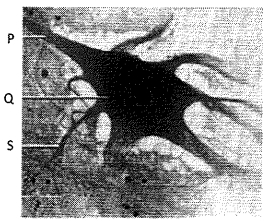
Identify $P, Q,$ and $R$ in the given neuron.
A
Dendrite,Cell body,Axon
B
Axon,Dendrite,Cell body
C
Axon,Cell body,Dendrite
D
Dendrite,Axon,Cell body
Solution
(A) In the provided image of a neuron:
$P$ points to the branched processes extending from the cell body,which are known as dendrites.
$Q$ points to the central part of the neuron containing the nucleus and cytoplasm,known as the cell body (or cyton/soma).
$R$ (labeled as $S$ in the image,but referring to the long projection) points to the axon,which is the long,slender projection that conducts nerve impulses away from the cell body.
Therefore,the correct sequence is $P$ = Dendrite,$Q$ = Cell body,$R$ = Axon.
Thus,the correct option is $A$.
$P$ points to the branched processes extending from the cell body,which are known as dendrites.
$Q$ points to the central part of the neuron containing the nucleus and cytoplasm,known as the cell body (or cyton/soma).
$R$ (labeled as $S$ in the image,but referring to the long projection) points to the axon,which is the long,slender projection that conducts nerve impulses away from the cell body.
Therefore,the correct sequence is $P$ = Dendrite,$Q$ = Cell body,$R$ = Axon.
Thus,the correct option is $A$.
0 likes
View Solution170
MediumMCQ
What is the structural and functional unit of the neural system?
A
Epithelial cell
B
Fibroblast
C
Muscle cell
D
Neuron
Solution
(D) The neural system is composed of highly specialized cells called neurons. $A$ neuron (or nerve cell) is the structural and functional unit of the neural system. It is responsible for the reception,integration,and transmission of nerve impulses throughout the body.
0 likes
View Solution171
EasyMCQ
Identify the function of a neuron.
A
Detect stimuli
B
Receive stimuli
C
Conduct stimuli
D
All of the above
Solution
(D) neuron is the structural and functional unit of the nervous system. Its primary functions include:
$1$. Detecting stimuli through sensory receptors.
$2$. Receiving these stimuli as electrical signals.
$3$. Conducting these signals (nerve impulses) to other neurons,muscles,or glands.
Therefore,all the listed options are correct functions of a neuron.
$1$. Detecting stimuli through sensory receptors.
$2$. Receiving these stimuli as electrical signals.
$3$. Conducting these signals (nerve impulses) to other neurons,muscles,or glands.
Therefore,all the listed options are correct functions of a neuron.
0 likes
View Solution172
MediumMCQ
$A$ neuron is a microscopic structure composed of $.......$ major parts.
A
$2$
B
$3$
C
$4$
D
$5$
Solution
(B) neuron is a microscopic structure composed of $3$ major parts: the cell body (cyton/soma),dendrites,and the axon.
$1$. Cell body: Contains cytoplasm with typical cell organelles and Nissl's granules.
$2$. Dendrites: Short fibers which branch repeatedly and project out of the cell body.
$3$. Axon: $A$ long fiber,the distal end of which is branched.
$1$. Cell body: Contains cytoplasm with typical cell organelles and Nissl's granules.
$2$. Dendrites: Short fibers which branch repeatedly and project out of the cell body.
$3$. Axon: $A$ long fiber,the distal end of which is branched.
0 likes
View Solution173
MediumMCQ
Where are the $Nissl$ granules found?
A
Axon
B
Dendrites
C
Both $B$ and $D$
D
Cell body
Solution
(C) The $Nissl$ granules are granular bodies found in the cell body ($cyton$ or $soma$) and the dendrites of a neuron. They are composed of rough endoplasmic reticulum and ribosomes,which are responsible for protein synthesis. They are notably absent in the axon.
0 likes
View Solution174
MediumMCQ
Match the following columns:
| Column-$I$ | Column-$II$ |
| $P$. Unipolar neuron | $I$. Embryonic stage |
| $Q$. Bipolar neuron | $II$. Cerebral cortex |
| $R$. Multipolar neuron | $III$. Retina of eye |
A
$(P-I), (Q-III), (R-II)$
B
$(P-II), (Q-III), (R-I)$
C
$(P-III), (Q-II), (R-I)$
D
$(P-I), (Q-II), (R-III)$
Solution
(A) The classification of neurons based on the number of axons and dendrites is as follows:
$1$. Unipolar neurons: These have a cell body with only one axon. They are typically found in the embryonic stage.
$2$. Bipolar neurons: These have one axon and one dendrite. They are found in the retina of the eye.
$3$. Multipolar neurons: These have one axon and two or more dendrites. They are commonly found in the cerebral cortex.
Therefore, the correct matching is: $P-I, Q-III, R-II$.
$1$. Unipolar neurons: These have a cell body with only one axon. They are typically found in the embryonic stage.
$2$. Bipolar neurons: These have one axon and one dendrite. They are found in the retina of the eye.
$3$. Multipolar neurons: These have one axon and two or more dendrites. They are commonly found in the cerebral cortex.
Therefore, the correct matching is: $P-I, Q-III, R-II$.
0 likes
View Solution175
MediumMCQ
The gap between two adjacent myelin sheaths is called ........
A
Synaptic knob
B
Node of Ranvier
C
Dendrite
D
Cell body
Solution
(B) The myelin sheath is an insulating layer that surrounds the axons of many neurons.
It is not continuous along the entire length of the axon.
The gaps or interruptions between adjacent myelin sheaths are known as the $Node of Ranvier$.
These nodes allow for the rapid conduction of nerve impulses through saltatory conduction.
It is not continuous along the entire length of the axon.
The gaps or interruptions between adjacent myelin sheaths are known as the $Node of Ranvier$.
These nodes allow for the rapid conduction of nerve impulses through saltatory conduction.
0 likes
View Solution176
MediumMCQ
Select the correct option for dendrites and axons.
$I -$ Short fibers,$II -$ Long fibers,$III -$ Transmit impulses away from the cell body,$IV -$ Transmit impulses towards the cell body,$V -$ Highly branched fibers,$VI -$ Unbranched fibers
Dendrites $\quad$ $\quad$ Axon
$I -$ Short fibers,$II -$ Long fibers,$III -$ Transmit impulses away from the cell body,$IV -$ Transmit impulses towards the cell body,$V -$ Highly branched fibers,$VI -$ Unbranched fibers
Dendrites $\quad$ $\quad$ Axon
A
$I, III, V \quad\quad II, IV, VI$
B
$II, III, VI \quad\quad I, IV, V$
C
$I, IV, V \quad\quad II, III, VI$
D
$II, IV, VI \quad\quad I, III, V$
Solution
(C) Dendrites are short,highly branched fibers that receive nerve impulses and transmit them towards the cell body $(I, IV, V)$.
Axons are typically long,unbranched fibers that transmit nerve impulses away from the cell body $(II, III, VI)$.
Axons are typically long,unbranched fibers that transmit nerve impulses away from the cell body $(II, III, VI)$.
0 likes
View Solution177
EasyMCQ
The axon of a neuron ends in .......
A
Another neuron
B
Peripheral glands
C
Muscles
D
All of the above
Solution
(D) The axon of a neuron terminates at a specialized junction called a synapse.
This synapse can be formed between the axon terminal of one neuron and the dendrites or cell body of another neuron.
Additionally,axons can terminate at neuromuscular junctions (connecting to muscles) or neuroglandular junctions (connecting to glands).
Therefore,the axon can end in another neuron,muscles,or glands.
Thus,the correct option is $D$.
This synapse can be formed between the axon terminal of one neuron and the dendrites or cell body of another neuron.
Additionally,axons can terminate at neuromuscular junctions (connecting to muscles) or neuroglandular junctions (connecting to glands).
Therefore,the axon can end in another neuron,muscles,or glands.
Thus,the correct option is $D$.
0 likes
View Solution178
MediumMCQ
In a neuron,ion channels are made of $.....P....$ and are located in $.....Q.....$.
$\quad\quad P\quad\quad Q$
$\quad\quad P\quad\quad Q$
A
Carbohydrates $\quad$ Cytoplasm
B
Carbohydrates $\quad$ Neural membrane
C
Proteins $\quad$ Cytoplasm
D
Proteins $\quad$ Neural membrane
Solution
(D) Ion channels are specialized transmembrane proteins that allow specific ions to pass through the cell membrane.
In neurons,these ion channels are embedded within the neural membrane (axolemma) to facilitate the movement of ions like $Na^+$ and $K^+$ during the generation and conduction of a nerve impulse.
Therefore,$P$ is Proteins and $Q$ is Neural membrane.
In neurons,these ion channels are embedded within the neural membrane (axolemma) to facilitate the movement of ions like $Na^+$ and $K^+$ during the generation and conduction of a nerve impulse.
Therefore,$P$ is Proteins and $Q$ is Neural membrane.
0 likes
View Solution179
DifficultMCQ
Match List $- I$ with List $- II$:
Choose the correct answer from the options given below:
| List $- I$ | List $- II$ |
| $a$. Multipolar neuron | $i$. Somatic neural system |
| $b$. Bipolar neuron | $ii$. Cerebral cortex |
| $c$. Myelinated nerve fibre | $iii$. Retina of eye |
| $d$. Unmyelinated nerve fibre | $iv$. Spinal nerves |
Choose the correct answer from the options given below:
A
$(a) - (iii), (b) - (i), (c) - (iv), (d) - (ii)$
B
$(a) - (ii), (b) - (iv), (c) - (iii), (d) - (i)$
C
$(a) - (ii), (b) - (iii), (c) - (i), (d) - (iv)$
D
$(a) - (ii), (b) - (iii), (c) - (iv), (d) - (i)$
Solution
(D) The correct matching is as follows:
$1$. Multipolar neurons have one axon and two or more dendrites and are found in the cerebral cortex $(a - ii)$.
$2$. Bipolar neurons have one axon and one dendrite and are found in the retina of the eye $(b - iii)$.
$3$. Myelinated nerve fibres are found in spinal and cranial nerves $(c - iv)$.
$4$. Unmyelinated nerve fibres are commonly found in the autonomous and the somatic neural systems $(d - i)$.
Therefore,the correct sequence is $(a - ii, b - iii, c - iv, d - i)$.
$1$. Multipolar neurons have one axon and two or more dendrites and are found in the cerebral cortex $(a - ii)$.
$2$. Bipolar neurons have one axon and one dendrite and are found in the retina of the eye $(b - iii)$.
$3$. Myelinated nerve fibres are found in spinal and cranial nerves $(c - iv)$.
$4$. Unmyelinated nerve fibres are commonly found in the autonomous and the somatic neural systems $(d - i)$.
Therefore,the correct sequence is $(a - ii, b - iii, c - iv, d - i)$.
0 likes
View Solution180
MediumMCQ
In the following list,how many structures are included in grey matter?
Cell body,myelinated axon,unmyelinated axon,and dendron.
Cell body,myelinated axon,unmyelinated axon,and dendron.
A
$2$
B
$5$
C
$3$
D
$4$
Solution
(C) Grey matter in the central nervous system is primarily composed of neuronal cell bodies,dendrites,and unmyelinated axons.
Myelinated axons are primarily found in the white matter,as the myelin sheath gives the tissue a white appearance.
Therefore,the structures included in the grey matter from the given list are:
$1$. Cell body
$2$. Unmyelinated axon
$3$. Dendron
Thus,there are $3$ structures included in the grey matter.
Myelinated axons are primarily found in the white matter,as the myelin sheath gives the tissue a white appearance.
Therefore,the structures included in the grey matter from the given list are:
$1$. Cell body
$2$. Unmyelinated axon
$3$. Dendron
Thus,there are $3$ structures included in the grey matter.
0 likes
View Solution181
EasyMCQ
Which of the following statements is $INCORRECT$?
A
Ependymal cells lining the central canal of the spinal cord produce $CSF$.
B
White matter of $CNS$ contains myelinated nerve fibres.
C
Axon is a single,long process of a neuron and contains neurofibrils.
D
Astrocytes mediate immune response in the $CNS$.
Solution
(D) The statement 'Astrocytes mediate immune response in the $CNS$' is incorrect.
Microglial cells are the specialized immune cells of the $CNS$ that mediate immune responses,such as phagocytosis of debris and pathogens.
Astrocytes primarily function to provide structural and metabolic support to neurons,maintain the blood-brain barrier $(BBB)$,regulate the chemical environment (including neurotransmitter uptake),and assist in the repair of neural tissue.
Microglial cells are the specialized immune cells of the $CNS$ that mediate immune responses,such as phagocytosis of debris and pathogens.
Astrocytes primarily function to provide structural and metabolic support to neurons,maintain the blood-brain barrier $(BBB)$,regulate the chemical environment (including neurotransmitter uptake),and assist in the repair of neural tissue.
0 likes
View Solution182
EasyMCQ
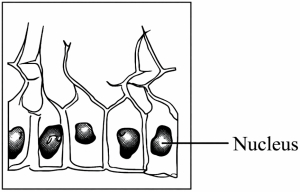
Match the type of glial cell shown in the figure with its function. Select the correct option.
A
Glial cell - Microglia; Function - Phagocytosis
B
Glial cell - Astrocyte; Function - Production of myelin sheath
C
Glial cell - Ependymal cell; Function - Production of $CSF$
D
Glial cell - Satellite cell; Function - Mechanical support to the neuron
Solution
(C) The figure shows Ependymal cells,which are ciliated epithelial cells lining the ventricles of the brain and the central canal of the spinal cord.
These cells are responsible for the production and circulation of Cerebrospinal Fluid $(CSF)$.
Therefore,the correct match is: Glial cell - Ependymal cell; Function - Production of $CSF$.
These cells are responsible for the production and circulation of Cerebrospinal Fluid $(CSF)$.
Therefore,the correct match is: Glial cell - Ependymal cell; Function - Production of $CSF$.
0 likes
View Solution183
EasyMCQ
Neuroglia cells show the following characters $EXCEPT$:
A
Nourishment
B
Regeneration
C
Excitability
D
Phagocytosis
Solution
(C) Neuroglia (or glial cells) are non-neuronal cells in the nervous system that provide support and protection for neurons.
They perform functions such as providing nourishment (e.g.,astrocytes),phagocytosis (e.g.,microglia),and they retain the ability to divide (regeneration).
However,unlike neurons,neuroglia cells do not possess the property of excitability,which is the ability to generate and conduct nerve impulses (action potentials).
Therefore,excitability is the correct answer.
They perform functions such as providing nourishment (e.g.,astrocytes),phagocytosis (e.g.,microglia),and they retain the ability to divide (regeneration).
However,unlike neurons,neuroglia cells do not possess the property of excitability,which is the ability to generate and conduct nerve impulses (action potentials).
Therefore,excitability is the correct answer.
0 likes
View SolutionNeural Control and Coordination — Neuron as Structural and Functional Unit of Neural System · Frequently Asked Questions
1Are these Neural Control and Coordination questions useful for JEE and NEET?
Yes. All questions in this section are mapped to JEE Main and NEET exam patterns. Previous year questions from JEE Main, NEET, GUJCET and state-level exams are included with full solutions.
2Can I switch to Hindi or Gujarati for these questions?
Yes. Use the language tabs in the hero section or the sidebar to view the same questions and solutions in English, Hindi or Gujarati.
3How do I generate a question paper from this subtopic?
Use the Vedclass Exam Paper Generator — select the chapter and subtopic, set difficulty, and generate Sets A, B, C, D automatically. First 3 chapters of every subject are free.
Vedclass Products
For Students
Vedclass Test Series
Mock tests in real JEE/NEET style with performance analysis. 5-day free trial.
Start Free TrialFor Teachers
Exam Paper Generator
Generate Set A/B/C/D papers from this chapter in 2 minutes. 3 chapters free.
Try FreeFor Institutes
Online Exam Module
Live online exams with unlimited students, 360° analytics & white-label branding.
See DemoFor Teachers & Institutes
Generate a Neural Control and Coordination Exam Paper in 2 Minutes
Select subtopic & difficulty — Sets A, B, C, D auto-generated with No Repeat logic.
First 3 chapters of every subject are free — no payment required.