
A English
Neuron as Structural and Functional Unit of Neural System Questions in English
Class 11 Biology · Neural Control and Coordination · Neuron as Structural and Functional Unit of Neural System
183+
Questions
English
Language
100%
With Solutions
Showing 50 of 183 questions in English
1
MediumMCQ
Most of the neurons of our body are
A
Unipolar
B
Bipolar
C
Pseudounipolar
D
Multipolar
Solution
(D) . Multipolar neurons have several dendrites and one axon.
Most neurons in the brain and spinal cord of our body are of this type.
Most neurons in the brain and spinal cord of our body are of this type.
0 likes
View Solution2
EasyMCQ
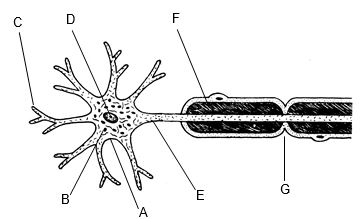
In the diagram of a multipolar myelinated neuron given below,different parts have been indicated by alphabets. Choose the option in which these alphabets have been correctly matched with the parts they indicate.
A
$A$ = Cell body,$B$ = Nissl bodies,$C$ = Nucleus,$D$ = Dendrites,$E$ = Naked portion of axon,$F$ = Myelin sheath,$G$ = Node of Ranvier
B
$A$ = Cell body,$B$ = Nissl bodies,$C$ = Naked portion of axon,$D$ = Dendrites,$E$ = Nucleus,$F$ = Myelin sheath,$G$ = Node of Ranvier
C
$A$ = Cell body,$B$ = Nissl bodies,$C$ = Naked portion of axon,$D$ = Nucleus,$E$ = Dendrites,$F$ = Myelin sheath,$G$ = Node of Ranvier
D
$A$ = Cell body,$B$ = Nissl bodies,$C$ = Dendrites,$D$ = Nucleus,$E$ = Naked portion of axon,$F$ = Myelin sheath,$G$ = Node of Ranvier
Solution
(D) By observing the provided diagram of the neuron:
$1$. $A$ points to the main body of the neuron,which is the Cell body (Cyton).
$2$. $B$ points to the granular structures within the cytoplasm,known as Nissl bodies.
$3$. $C$ points to the branched processes extending from the cell body,which are Dendrites.
$4$. $D$ points to the central spherical structure,the Nucleus.
$5$. $E$ points to the initial segment of the axon that lacks a myelin sheath,the Naked portion of axon.
$6$. $F$ points to the insulating layer surrounding the axon,the Myelin sheath.
$7$. $G$ points to the gap between two myelin sheaths,the Node of Ranvier.
Therefore,the correct matching is $A$ = Cell body,$B$ = Nissl bodies,$C$ = Dendrites,$D$ = Nucleus,$E$ = Naked portion of axon,$F$ = Myelin sheath,$G$ = Node of Ranvier.
$1$. $A$ points to the main body of the neuron,which is the Cell body (Cyton).
$2$. $B$ points to the granular structures within the cytoplasm,known as Nissl bodies.
$3$. $C$ points to the branched processes extending from the cell body,which are Dendrites.
$4$. $D$ points to the central spherical structure,the Nucleus.
$5$. $E$ points to the initial segment of the axon that lacks a myelin sheath,the Naked portion of axon.
$6$. $F$ points to the insulating layer surrounding the axon,the Myelin sheath.
$7$. $G$ points to the gap between two myelin sheaths,the Node of Ranvier.
Therefore,the correct matching is $A$ = Cell body,$B$ = Nissl bodies,$C$ = Dendrites,$D$ = Nucleus,$E$ = Naked portion of axon,$F$ = Myelin sheath,$G$ = Node of Ranvier.
0 likes
View Solution3
MediumMCQ
Nerve fibre is different from the muscle fibre due to the presence of
A
Myofibrils
B
Lines
C
Sarcolemma
D
Dendrites
Solution
(D) Nerve fibres are specialized structures of neurons,consisting of axons or dendrites.
Muscle fibres are characterized by the presence of myofibrils,which are contractile elements,and a specialized plasma membrane called the sarcolemma.
In contrast,nerve fibres possess dendrites,which are branched projections that receive signals and carry them toward the cell body,a feature absent in muscle fibres.
Therefore,the presence of dendrites is a distinguishing feature of nerve fibres.
Muscle fibres are characterized by the presence of myofibrils,which are contractile elements,and a specialized plasma membrane called the sarcolemma.
In contrast,nerve fibres possess dendrites,which are branched projections that receive signals and carry them toward the cell body,a feature absent in muscle fibres.
Therefore,the presence of dendrites is a distinguishing feature of nerve fibres.
0 likes
View Solution4
EasyMCQ
The embryonic cells from which neurons arise are called:
A
Neuroblast
B
Cytoblast
C
Dendrocyte
D
All of the above
Solution
(A) Neurons are derived from the ectodermal germ layer during embryonic development. The specific precursor cells that differentiate into neurons are known as neuroblasts. These cells undergo division and migration to form the mature nervous system.
0 likes
View Solution5
EasyMCQ
Neurons with long axons are called
A
Golgi type $I$
B
Golgi type $II$
C
Golgi type $III$
D
Golgi type $IV$
Solution
(A) Neurons are classified into two types based on the length of their axons: Golgi type-$I$ and Golgi type-$II$.
Golgi type-$I$ neurons possess very long axons that extend far from the cell body.
Golgi type-$II$ neurons have short axons that do not extend far from the cell body.
Golgi type-$I$ neurons possess very long axons that extend far from the cell body.
Golgi type-$II$ neurons have short axons that do not extend far from the cell body.
0 likes
View Solution6
EasyMCQ
Myelin sheath is a layer covering
A
$A$ nerve fibre in an insect
B
$A$ chick embryo
C
$A$ muscle fibre in a vertebrate
D
$A$ nerve fibre in a vertebrate
Solution
(D) The myelin sheath is a lipid-rich insulating layer that surrounds the axons of many neurons in the vertebrate nervous system.
It is formed by Schwann cells in the peripheral nervous system and by oligodendrocytes in the central nervous system.
This sheath increases the speed of electrical impulses along the nerve fibre.
Therefore,it is a characteristic feature of vertebrate nerve fibres.
It is formed by Schwann cells in the peripheral nervous system and by oligodendrocytes in the central nervous system.
This sheath increases the speed of electrical impulses along the nerve fibre.
Therefore,it is a characteristic feature of vertebrate nerve fibres.
0 likes
View Solution7
EasyMCQ
Neuroglia cells differ from neurons in having
A
No Nissl's granules
B
No radiating processes
C
No cyton
D
No nucleus
Solution
(A) Neuroglia cells are the supporting cells of the nervous system that provide protection and structural support to neurons.
Unlike neurons,neuroglia cells do not possess Nissl's granules,which are specialized rough endoplasmic reticulum involved in protein synthesis.
Therefore,the correct distinction is that they lack Nissl's granules.
Unlike neurons,neuroglia cells do not possess Nissl's granules,which are specialized rough endoplasmic reticulum involved in protein synthesis.
Therefore,the correct distinction is that they lack Nissl's granules.
0 likes
View Solution8
MediumMCQ
The junction between two adjacent Schwann cells in a myelinated nerve fiber is known as:
A
Plasmalemma
B
Node of Ranvier
C
Dendrons
D
Synapse
Solution
(B) In myelinated nerve fibers,the myelin sheath is not continuous but is interrupted at regular intervals by gaps known as the Nodes of Ranvier.
These nodes represent the junction or space between two adjacent Schwann cells.
Therefore,the correct option is $(b)$.
These nodes represent the junction or space between two adjacent Schwann cells.
Therefore,the correct option is $(b)$.
0 likes
View Solution9
MediumMCQ
Some cells of our body can be over a foot long. These are
A
Nerve cells
B
Muscle cells
C
Bone cells
D
Gland cells
Solution
(A) Nerve cells (neurons) are the longest cells in the human body. Some nerve cells,such as those that extend from the spinal cord to the feet,can reach lengths of over a foot $(30 \ cm)$ or more. They are specialized for the transmission of electrical impulses throughout the body.
0 likes
View Solution10
EasyMCQ
Nissl's granules are characteristically found in
A
Nephrons
B
Neurons
C
Cytons
D
Dendrites
Solution
(C) Nissl's granules,also known as Nissl bodies,are basophilic structures of various shapes such as angular,conical,or rhomboidal.
They consist of rough endoplasmic reticulum with free polyribosomes.
These granules are characteristically found in the cell body (cyton) and dendrites of neurons,but they are most prominently located in the cyton.
They consist of rough endoplasmic reticulum with free polyribosomes.
These granules are characteristically found in the cell body (cyton) and dendrites of neurons,but they are most prominently located in the cyton.
0 likes
View Solution11
EasyMCQ
Nissl's granules are found in the cyton of nerve cells. These have an affinity for basic dyes. The granules are made up of:
A
Mitochondria
B
Cell metabolites
C
Fat granules
D
Ribosomes
Solution
(D) Nissl's granules are characteristic features of the nerve cell body (cyton) and dendrites.
They are composed of rough endoplasmic reticulum $(RER)$ and free ribosomes.
Because they contain a high concentration of ribosomal $RNA$ $(rRNA)$,which is acidic,they show a strong affinity for basic dyes (basophilic).
Therefore,the correct answer is Ribosomes.
They are composed of rough endoplasmic reticulum $(RER)$ and free ribosomes.
Because they contain a high concentration of ribosomal $RNA$ $(rRNA)$,which is acidic,they show a strong affinity for basic dyes (basophilic).
Therefore,the correct answer is Ribosomes.
0 likes
View Solution12
EasyMCQ
The afferent process of a neuron is known as:
A
Axon
B
Dendrite
C
Cyton
D
Neurofibrillae
Solution
(B) The correct answer is $B$.
Neurons consist of three main parts: the cell body (cyton),dendrites,and the axon.
Dendrites are short,branched extensions that act as the afferent processes,meaning they receive electrical impulses from other neurons or sensory receptors and transmit them toward the cell body.
In contrast,the axon is the efferent process that carries impulses away from the cell body.
Neurons consist of three main parts: the cell body (cyton),dendrites,and the axon.
Dendrites are short,branched extensions that act as the afferent processes,meaning they receive electrical impulses from other neurons or sensory receptors and transmit them toward the cell body.
In contrast,the axon is the efferent process that carries impulses away from the cell body.
0 likes
View Solution13
EasyMCQ
Cell bodies or cyton are found in
A
Brain
B
Spinal cord
C
Brain and ganglia
D
Brain,spinal cord,and ganglia
Solution
(D) The cell body,also known as the cyton or soma,is the metabolic center of a neuron.
In the central nervous system $(CNS)$,cell bodies are concentrated in the grey matter of the brain and the spinal cord.
In the peripheral nervous system $(PNS)$,cell bodies are found in clusters known as ganglia.
Therefore,cell bodies are present in the brain,spinal cord,and ganglia.
In the central nervous system $(CNS)$,cell bodies are concentrated in the grey matter of the brain and the spinal cord.
In the peripheral nervous system $(PNS)$,cell bodies are found in clusters known as ganglia.
Therefore,cell bodies are present in the brain,spinal cord,and ganglia.
0 likes
View Solution14
EasyMCQ
Neurons are classified on the basis of
A
Number of nucleus present
B
Number of processes arising from the cell body
C
Number of dendrites present
D
Number of axons present
Solution
(B) Neurons are classified on the basis of the number and nature of their processes (dendrites and axons) arising from the cell body (cyton).
Based on this,neurons are classified into four types:
$(i)$ Apolar or non-polar neurons: These lack any processes.
$(ii)$ Unipolar neurons: These have a single process arising from the cell body.
$(iii)$ Bipolar neurons: These have two processes,one axon and one dendrite.
$(iv)$ Multipolar neurons: These have one axon and multiple dendrites.
Based on this,neurons are classified into four types:
$(i)$ Apolar or non-polar neurons: These lack any processes.
$(ii)$ Unipolar neurons: These have a single process arising from the cell body.
$(iii)$ Bipolar neurons: These have two processes,one axon and one dendrite.
$(iv)$ Multipolar neurons: These have one axon and multiple dendrites.
0 likes
View Solution15
MediumMCQ
The function of neuroglial cells is:
A
Acts as packing cells
B
Provide nutrition to the neurons
C
Help in memory processes as these store information in the form of an $RNA$ code
D
All of the above
Solution
(D) Neuroglial cells (or glia) are non-neuronal cells in the central and peripheral nervous systems that do not produce electrical impulses.
They perform several critical functions:
$1$. They act as packing cells that support and protect neurons.
$2$. They provide metabolic support and nutrition to neurons.
$3$. Some theories suggest they play a role in memory storage by modulating synaptic plasticity and potentially storing information via $RNA$ codes.
Therefore,all the given statements are correct.
They perform several critical functions:
$1$. They act as packing cells that support and protect neurons.
$2$. They provide metabolic support and nutrition to neurons.
$3$. Some theories suggest they play a role in memory storage by modulating synaptic plasticity and potentially storing information via $RNA$ codes.
Therefore,all the given statements are correct.
0 likes
View Solution16
MediumMCQ
Node of Ranvier is found in
A
Right auricle
B
Muscle bundles
C
Dendrite
D
Axon
Solution
(D) The $Node$ of $Ranvier$ is a gap in the myelin sheath of a nerve cell.
These nodes are found along the $Axon$ of myelinated neurons.
They facilitate the rapid conduction of nerve impulses through saltatory conduction.
Therefore,the correct option is $D$.
These nodes are found along the $Axon$ of myelinated neurons.
They facilitate the rapid conduction of nerve impulses through saltatory conduction.
Therefore,the correct option is $D$.
0 likes
View Solution17
EasyMCQ
What is the $Axon$ $hillock$?
A
Group of axons
B
$A$ swelling of axon
C
The part of cyton from where the axon arises
D
Plasma membrane of axon
Solution
(C) The $Axon$ $hillock$ is a specialized region of the cell body $(cyton)$ of a neuron. It is the conical-shaped area from which the axon originates. This region is significant because it is typically the site where action potentials are initiated.
0 likes
View Solution18
MediumMCQ
Which of the following structures are the specialty of nerve cells?
A
Nucleus and cytoplasm
B
Axon and dendrites
C
Vacuoles and fibres
D
Synapse and ganglia
Solution
(B) Nerve cells,or neurons,are the structural and functional units of the neural system.
They are specialized cells designed to transmit electrical impulses.
The defining structural features that distinguish neurons from other cell types are the $Axon$ and $Dendrites$.
$Dendrites$ receive signals from other neurons,while the $Axon$ conducts impulses away from the cell body to other neurons or effector organs.
They are specialized cells designed to transmit electrical impulses.
The defining structural features that distinguish neurons from other cell types are the $Axon$ and $Dendrites$.
$Dendrites$ receive signals from other neurons,while the $Axon$ conducts impulses away from the cell body to other neurons or effector organs.
0 likes
View Solution19
EasyMCQ
The axon contains in its axis cylinder a fibrillar component of $90 \ \mathring{A}$ thick called
A
Axial fibrils
B
Myofibrils
C
Neurofibrils
D
Myelinfibrils
Solution
(C) The axon is the long,slender projection of a nerve cell (neuron) that conducts electrical impulses away from the cell body.
Inside the axon,the cytoplasm is referred to as the axoplasm,and the central core is known as the axis cylinder.
The axoplasm contains fine,thread-like structures known as neurofibrils.
These neurofibrils are proteinaceous filaments,typically about $90 \ \mathring{A}$ in diameter,which provide structural support and assist in the transport of materials along the axon.
Inside the axon,the cytoplasm is referred to as the axoplasm,and the central core is known as the axis cylinder.
The axoplasm contains fine,thread-like structures known as neurofibrils.
These neurofibrils are proteinaceous filaments,typically about $90 \ \mathring{A}$ in diameter,which provide structural support and assist in the transport of materials along the axon.
0 likes
View Solution20
EasyMCQ
The neurilemma surrounds the
A
Axis cylinder
B
Cell body
C
Myelin sheath
D
Endoneurium
Solution
(C) The $neurilemma$ (or $neurolemma$) is the outermost nucleated cytoplasmic layer of $Schwann$ cells that surrounds the axon of the neuron.
In peripheral nerve fibers,$Schwann$ cells wrap around the axon to form the $myelin$ $sheath$.
After the formation of the $myelin$ $sheath$,the remaining cytoplasm and the nucleus of the $Schwann$ cell are pushed to the periphery,forming the $neurilemma$.
Therefore,the $neurilemma$ surrounds the $myelin$ $sheath$.
In peripheral nerve fibers,$Schwann$ cells wrap around the axon to form the $myelin$ $sheath$.
After the formation of the $myelin$ $sheath$,the remaining cytoplasm and the nucleus of the $Schwann$ cell are pushed to the periphery,forming the $neurilemma$.
Therefore,the $neurilemma$ surrounds the $myelin$ $sheath$.
0 likes
View Solution21
EasyMCQ
Myelin sheath is the covering of
A
Muscle cells
B
Axon of neurons
C
Blood vessels
D
Osteocytes
Solution
(B) The myelin sheath is an electrically insulating layer that surrounds the axons of many neurons.
It is formed by glial cells,specifically Schwann cells in the peripheral nervous system and oligodendrocytes in the central nervous system.
This sheath increases the speed at which electrical impulses propagate along the myelinated fiber.
It is formed by glial cells,specifically Schwann cells in the peripheral nervous system and oligodendrocytes in the central nervous system.
This sheath increases the speed at which electrical impulses propagate along the myelinated fiber.
0 likes
View Solution22
MediumMCQ
Which type of neurons are found in the retina?
A
Unipolar
B
Pseudo-unipolar
C
Multipolar
D
Bipolar
Solution
(D) . Bipolar neurons are typically spindle-shaped,having the axon at one pole and a dendron at the other.
They are found in the retina,spiral ganglion of the cochlea,vestibular ganglion,and olfactory neuroepithelium.
They are found in the retina,spiral ganglion of the cochlea,vestibular ganglion,and olfactory neuroepithelium.
0 likes
View Solution23
EasyMCQ
The efferent process of the neuron is called:
A
Synapse
B
Dendrite
C
Boutons terminaux
D
Axon
Solution
(D) neuron consists of three main parts: the cell body (cyton),dendrites,and the axon.
$1$. Dendrites are the afferent processes that receive signals and conduct them towards the cell body.
$2$. The axon is the single,long,efferent process that conducts nerve impulses away from the cell body to another neuron or effector organ.
Therefore,the efferent process of the neuron is called the axon.
$1$. Dendrites are the afferent processes that receive signals and conduct them towards the cell body.
$2$. The axon is the single,long,efferent process that conducts nerve impulses away from the cell body to another neuron or effector organ.
Therefore,the efferent process of the neuron is called the axon.
0 likes
View Solution24
MediumMCQ
Which of the following is regarded as a unit of nervous tissue?
A
Axons
B
Dendrites
C
Neurons
D
Myelin sheath
Solution
(C) . Neurons are the structural and functional units of nervous tissue.
They are specialized cells responsible for receiving,processing,and transmitting information through electrical and chemical signals.
Their number is quite high,exceeding $1 \times 10^{12}$ in the human brain alone.
They are specialized cells responsible for receiving,processing,and transmitting information through electrical and chemical signals.
Their number is quite high,exceeding $1 \times 10^{12}$ in the human brain alone.
0 likes
View Solution25
EasyMCQ
Which one of the following is not essentially a part of the nervous system?
A
Cyton
B
Axon
C
Myelin sheath
D
Intermedin
Solution
(D) The nervous system is composed of neurons,which consist of a cell body $(Cyton)$,an axon $(Axon)$,and often a protective covering called the $Myelin$ $sheath$.
$Intermedin$,also known as $Melanocyte-Stimulating$ $Hormone$ $(MSH)$,is a hormone secreted by the intermediate lobe of the pituitary gland,which is part of the endocrine system,not the nervous system.
$Intermedin$,also known as $Melanocyte-Stimulating$ $Hormone$ $(MSH)$,is a hormone secreted by the intermediate lobe of the pituitary gland,which is part of the endocrine system,not the nervous system.
0 likes
View Solution26
EasyMCQ
Nissl's granules are absent in
A
Axon
B
Cyton
C
Dendrite
D
Schwann cells
Solution
(A) Nissl's granules are characteristic granular bodies found in the cell body (cyton) and dendrites of neurons. They are composed of rough endoplasmic reticulum and ribosomes,which are involved in protein synthesis. These granules are absent in the axon and the axon hillock.
0 likes
View Solution27
EasyMCQ
The most appropriate definition of Neuroglial cells is that they are:
A
Nonsensory supporting cells
B
Secretory cells
C
Sensory cells
D
Sensory and supporting cells
Solution
(A) Neuroglial cells,also known as glial cells or glia,are non-neuronal cells in the central nervous system and peripheral nervous system.
They do not produce electrical impulses like neurons.
Their primary function is to provide structural support,protection,insulation,and nourishment to neurons.
Therefore,they are best defined as nonsensory supporting cells.
They do not produce electrical impulses like neurons.
Their primary function is to provide structural support,protection,insulation,and nourishment to neurons.
Therefore,they are best defined as nonsensory supporting cells.
0 likes
View Solution28
EasyMCQ
Non-excitable cells,found among the neurons are called
A
Dendrite
B
Axon
C
Schwann's cells
D
Nissl's body
Solution
(C) The nervous tissue is composed of neurons and neuroglial cells. Neurons are excitable cells,whereas neuroglial cells (which include Schwann's cells) are non-excitable,supporting cells that protect and support the neurons. Therefore,the correct answer is $C$.
0 likes
View Solution29
MediumMCQ
Which one of the following is essential for the formation of the myelin sheath?
A
Zinc
B
Sodium
C
Iron
D
Phosphorus
Solution
(D) The myelin sheath is a lipid-rich insulating layer that surrounds the axons of neurons.
Phosphorus is a critical component of phospholipids,which are the primary structural lipids forming the myelin sheath.
Therefore,phosphorus is essential for the synthesis and maintenance of the myelin sheath.
Phosphorus is a critical component of phospholipids,which are the primary structural lipids forming the myelin sheath.
Therefore,phosphorus is essential for the synthesis and maintenance of the myelin sheath.
0 likes
View Solution30
EasyMCQ
The efferent process of a neuron is known as:
A
Axon
B
Dendrites
C
Cyton
D
Neurofibrillae
Solution
(A) neuron consists of a cell body (cyton),dendrites,and an axon.
$1$. Dendrites are the afferent processes that receive signals and conduct them towards the cell body.
$2$. The axon is the single,long,efferent process that conducts nerve impulses away from the cell body to a synapse or effector organ.
Therefore,the efferent process is the axon.
$1$. Dendrites are the afferent processes that receive signals and conduct them towards the cell body.
$2$. The axon is the single,long,efferent process that conducts nerve impulses away from the cell body to a synapse or effector organ.
Therefore,the efferent process is the axon.
0 likes
View Solution31
EasyMCQ
Bundles of nerve fibres are enclosed in a sheath called
A
Fascicle
B
Endoneurium
C
Epineurium
D
Perineurium
Solution
(D) In a nerve,nerve fibres are organized into bundles known as fascicles. Each fascicle is surrounded by a connective tissue sheath called the perineurium. The entire nerve is then enclosed by the epineurium,while individual nerve fibres are wrapped in the endoneurium.
0 likes
View Solution32
EasyMCQ
The weakest current strength that can excite a tissue is called:
A
Chronaxia
B
Rheobase
C
Saltatory
D
Reflex arc
Solution
(B) The weakest current strength that can excite a tissue is known as the $Rheobase$.
$Chronaxia$ is the minimum time required for a current of twice the $Rheobase$ strength to excite a tissue.
$Saltatory$ conduction refers to the jumping of nerve impulses along myelinated axons.
$Reflex$ $arc$ is the neural pathway that controls a reflex action.
$Chronaxia$ is the minimum time required for a current of twice the $Rheobase$ strength to excite a tissue.
$Saltatory$ conduction refers to the jumping of nerve impulses along myelinated axons.
$Reflex$ $arc$ is the neural pathway that controls a reflex action.
0 likes
View Solution33
EasyMCQ
Nissl's granules are present in the ....... and are made up of ....... respectively.
A
Muscle cells and deoxyribonucleic acid
B
Mast cells and $RNA$
C
Osteocytes and $DNA$
D
Neuron and $RNA$
Solution
(D) Nissl's granules are characteristic structures found in the cell body (cyton) and dendrites of neurons.
These granules are composed of rough endoplasmic reticulum $(RER)$ and free ribosomes.
Since ribosomes are primarily composed of ribosomal $RNA$ $(rRNA)$ and proteins,they are essentially sites of protein synthesis.
Therefore,Nissl's granules are present in neurons and are made up of $RNA$ and proteins.
These granules are composed of rough endoplasmic reticulum $(RER)$ and free ribosomes.
Since ribosomes are primarily composed of ribosomal $RNA$ $(rRNA)$ and proteins,they are essentially sites of protein synthesis.
Therefore,Nissl's granules are present in neurons and are made up of $RNA$ and proteins.
0 likes
View Solution34
EasyMCQ
Which of the following is the immediate covering of a nerve fibre?
A
Sarcoplasm
B
Perineurium
C
Epineurium
D
Endoneurium
Solution
(D) nerve fibre is surrounded by three layers of connective tissue.
$1$. The $Endoneurium$ is the innermost layer that directly covers individual nerve fibres (axons).
$2$. The $Perineurium$ surrounds a bundle of nerve fibres known as a fascicle.
$3$. The $Epineurium$ is the outermost layer that encloses the entire nerve.
Therefore,the immediate covering of a nerve fibre is the $Endoneurium$.
$1$. The $Endoneurium$ is the innermost layer that directly covers individual nerve fibres (axons).
$2$. The $Perineurium$ surrounds a bundle of nerve fibres known as a fascicle.
$3$. The $Epineurium$ is the outermost layer that encloses the entire nerve.
Therefore,the immediate covering of a nerve fibre is the $Endoneurium$.
0 likes
View Solution35
MediumMCQ
The largest cell in the human body is:
A
Lymph
B
Osteocyte
C
Neuron
D
Chromatophore
Solution
(C) The correct answer is $C$.
The neuron (nerve cell) is considered the largest cell in the human body in terms of length.
Some neurons,such as those extending from the spinal cord to the feet,can reach a length of nearly $1 \ m$ or more,which is significantly longer than any other cell type in the body.
The neuron (nerve cell) is considered the largest cell in the human body in terms of length.
Some neurons,such as those extending from the spinal cord to the feet,can reach a length of nearly $1 \ m$ or more,which is significantly longer than any other cell type in the body.
0 likes
View Solution36
EasyMCQ
The dorsal root ganglion is:
A
Mixed
B
Motor
C
Sensory
D
None of these
Solution
(C) The dorsal root ganglion contains the cell bodies of sensory neurons. These neurons carry sensory information from the peripheral receptors toward the central nervous system. Therefore,the dorsal root ganglion is classified as sensory.
0 likes
View Solution37
MediumMCQ
When degeneration of nerve cells occurs,which part will be affected first?
A
Dendrites
B
Motor end plates
C
Nissl granules
D
Schwann cells
Solution
(C) Nissl granules are specialized rough endoplasmic reticulum found in the cell body (cyton) of neurons. They are highly active in protein synthesis,which is essential for maintaining the structural and functional integrity of the nerve cell. During the early stages of nerve cell degeneration (chromatolysis),the Nissl granules are the first to undergo dissolution or fragmentation,making them the most sensitive indicators of neuronal injury.
0 likes
View Solution38
EasyMCQ
Ventricles of the brain are lined by cells called:
A
Ependymal cells
B
Neurons
C
Neuroglia
D
Schwann cells
Solution
(A) The ventricles of the brain and the central canal of the spinal cord are lined by a specialized type of epithelial tissue known as ependymal cells.
These cells are a type of glial cell that plays a crucial role in the production,circulation,and monitoring of cerebrospinal fluid $(CSF)$.
These cells are a type of glial cell that plays a crucial role in the production,circulation,and monitoring of cerebrospinal fluid $(CSF)$.
0 likes
View Solution39
MediumMCQ
Which of the following has non-myelinated nerve fibres?
A
Optic nerves
B
Cranial nerves
C
Spinal nerves
D
Autonomic nerves
Solution
(D) The neural system is composed of neurons,which are classified based on the presence or absence of a myelin sheath.
$1$. Myelinated nerve fibres are found in spinal and cranial nerves.
$2$. Non-myelinated nerve fibres are enclosed by a Schwann cell that does not form a myelin sheath around the axon and is commonly found in autonomous and the somatic neural systems.
Therefore,autonomic nerves contain non-myelinated nerve fibres.
$1$. Myelinated nerve fibres are found in spinal and cranial nerves.
$2$. Non-myelinated nerve fibres are enclosed by a Schwann cell that does not form a myelin sheath around the axon and is commonly found in autonomous and the somatic neural systems.
Therefore,autonomic nerves contain non-myelinated nerve fibres.
0 likes
View Solution40
MediumMCQ
Myelin sheath covers
A
Muscle fibre
B
Nerve fibre
C
Collagen fibre
D
Tendon
Solution
(B) The myelin sheath,also known as the medullary sheath,is a lipid-rich layer that surrounds the axons of many neurons.
It acts as an insulating layer that increases the speed of electrical impulses along the nerve fibres.
In the $CNS$ (Central Nervous System),myelin is produced by oligodendrocytes,while in the $PNS$ (Peripheral Nervous System),it is produced by Schwann cells.
Therefore,the correct answer is $B$.
It acts as an insulating layer that increases the speed of electrical impulses along the nerve fibres.
In the $CNS$ (Central Nervous System),myelin is produced by oligodendrocytes,while in the $PNS$ (Peripheral Nervous System),it is produced by Schwann cells.
Therefore,the correct answer is $B$.
0 likes
View Solution41
EasyMCQ
Nodes of Ranvier are found in
A
Axon
B
Sperm
C
Muscle fibre
D
Neuron
Solution
(A) Nodes of Ranvier are the periodic gaps in the myelin sheath of an axon.
These gaps allow for saltatory conduction,which increases the speed of nerve impulse transmission.
Therefore,they are specifically located along the axon of a neuron.
These gaps allow for saltatory conduction,which increases the speed of nerve impulse transmission.
Therefore,they are specifically located along the axon of a neuron.
0 likes
View Solution42
MediumMCQ
Nissl's granules are absent in
A
Axon
B
Cyton
C
Dendron
D
Both $A$ and $B$
Solution
(A) The $Axon$ is a single,long process of uniform thickness that extends from the cell body.
It contains neurofibrils and neurotubules but lacks $Nissl's$ granules,the $Golgi$ complex,and ribosomes.
$Nissl's$ granules are typically found in the $Cyton$ (cell body) and $Dendrites$ (dendrons) of the neuron,where they are involved in protein synthesis.
It contains neurofibrils and neurotubules but lacks $Nissl's$ granules,the $Golgi$ complex,and ribosomes.
$Nissl's$ granules are typically found in the $Cyton$ (cell body) and $Dendrites$ (dendrons) of the neuron,where they are involved in protein synthesis.
0 likes
View Solution43
EasyMCQ
Which of the following parts of a neuron is covered by a fatty sheath?
A
Axon
B
Cyton
C
Dendrite
D
Node of Ranvier
Solution
(A) The correct answer is $A$.
Myelinated or medullated nerve fibers $(Axon)$ are surrounded by an inner thick medullary sheath composed of a fatty substance called myelin.
This myelin sheath acts as an electrical insulator and increases the speed of nerve impulse conduction.
Myelinated or medullated nerve fibers $(Axon)$ are surrounded by an inner thick medullary sheath composed of a fatty substance called myelin.
This myelin sheath acts as an electrical insulator and increases the speed of nerve impulse conduction.
0 likes
View Solution44
MediumMCQ
Nissl's granules are found in
A
Liver cells
B
Nerve cells
C
Intestinal cells
D
Kidney
Solution
(B) $Nissl's$ granules are specialized structures found in the cell body $(cyton)$ and dendrites of neurons.
They are composed of rough endoplasmic reticulum $(RER)$ with free ribosomes and are responsible for protein synthesis within the nerve cell.
They are composed of rough endoplasmic reticulum $(RER)$ with free ribosomes and are responsible for protein synthesis within the nerve cell.
0 likes
View Solution45
MediumMCQ
Four healthy people in their twenties were involved in injuries resulting in damage and death of a few cells of the following types. Which of these cells are least likely to be replaced by new cells?
A
Osteocytes
B
Malpighian layer of the skin
C
Liver cells
D
Neurons
Solution
(D) . Neurons are the specialized cells of the nervous system.
Neurons in the central nervous system lack the ability to divide or regenerate once they have reached maturity. Therefore,if they are damaged or die,they are not replaced by new cells,unlike skin cells,liver cells,or osteocytes,which possess varying degrees of regenerative capacity.
Neurons in the central nervous system lack the ability to divide or regenerate once they have reached maturity. Therefore,if they are damaged or die,they are not replaced by new cells,unlike skin cells,liver cells,or osteocytes,which possess varying degrees of regenerative capacity.
0 likes
View Solution46
EasyMCQ
Nerve cells do not possess
A
Neurilemma
B
Sarcolemma
C
Dendrite
D
Axon
Solution
(B) Nerve cells (neurons) consist of a cell body,dendrites,and an axon. Neurilemma is the outermost nucleated cytoplasmic layer of Schwann cells that surrounds the axon of the neuron.
Sarcolemma is the fine transparent tubular sheath which envelops the fibers of skeletal muscles. Therefore,nerve cells do not possess sarcolemma.
Sarcolemma is the fine transparent tubular sheath which envelops the fibers of skeletal muscles. Therefore,nerve cells do not possess sarcolemma.
0 likes
View Solution47
MediumMCQ
The neuron terminates in the muscles; the terminal part is known as:
A
Button
B
Synapse
C
End plate
D
Terminal plate
Solution
(C) The junction between a motor neuron and a muscle fiber is called the neuromuscular junction. The terminal part of the motor neuron that contacts the muscle fiber is specifically referred to as the motor end plate or simply the end plate. This structure contains receptors for neurotransmitters like acetylcholine,which facilitate the transmission of nerve impulses to the muscle,triggering contraction.
0 likes
View Solution48
MediumMCQ
The dendrite carries impulses
A
Towards the cyton
B
Away from cyton
C
Across the body
D
From one neuron to another
Solution
(A) The dendrites are short,branched processes that project from the cell body $(cyton)$.
They contain neurofibrils,neurotubules,and $Nissl$ granules.
Their primary function is to receive nerve impulses and conduct them towards the cell body $(cyton)$.
They contain neurofibrils,neurotubules,and $Nissl$ granules.
Their primary function is to receive nerve impulses and conduct them towards the cell body $(cyton)$.
0 likes
View Solution49
EasyMCQ
Some cells in our body can be over a foot long. They are:
A
$A$ muscle cell
B
$A$ bone cell
C
$A$ nerve cell
D
$A$ gland cell
Solution
(C) The correct answer is $C$.
Nerve cells,also known as neurons,are the longest cells in the human body.
Some neurons,such as those extending from the spinal cord to the feet,can reach lengths of over a foot ($30 \ cm$ or more).
These cells are specialized for transmitting electrical impulses over long distances throughout the body.
Nerve cells,also known as neurons,are the longest cells in the human body.
Some neurons,such as those extending from the spinal cord to the feet,can reach lengths of over a foot ($30 \ cm$ or more).
These cells are specialized for transmitting electrical impulses over long distances throughout the body.
0 likes
View Solution50
MediumMCQ
The medullary sheath of the nerve fibre is interrupted at intervals by
A
Septa
B
Nodes of Ranvier
C
Synapses
D
Glia
Solution
(B) The medullary sheath (myelin sheath) is not continuous along the entire length of the nerve fibre.
It is interrupted at regular intervals by gaps known as $Nodes \text{ of } Ranvier$.
In these regions, the $Schwann$ cells are absent, which results in the discontinuity of the myelin sheath.
It is interrupted at regular intervals by gaps known as $Nodes \text{ of } Ranvier$.
In these regions, the $Schwann$ cells are absent, which results in the discontinuity of the myelin sheath.
0 likes
View SolutionNeural Control and Coordination — Neuron as Structural and Functional Unit of Neural System · Frequently Asked Questions
1Are these Neural Control and Coordination questions useful for JEE and NEET?
Yes. All questions in this section are mapped to JEE Main and NEET exam patterns. Previous year questions from JEE Main, NEET, GUJCET and state-level exams are included with full solutions.
2Can I switch to Hindi or Gujarati for these questions?
Yes. Use the language tabs in the hero section or the sidebar to view the same questions and solutions in English, Hindi or Gujarati.
3How do I generate a question paper from this subtopic?
Use the Vedclass Exam Paper Generator — select the chapter and subtopic, set difficulty, and generate Sets A, B, C, D automatically. First 3 chapters of every subject are free.
Vedclass Products
For Students
Vedclass Test Series
Mock tests in real JEE/NEET style with performance analysis. 5-day free trial.
Start Free TrialFor Teachers
Exam Paper Generator
Generate Set A/B/C/D papers from this chapter in 2 minutes. 3 chapters free.
Try FreeFor Institutes
Online Exam Module
Live online exams with unlimited students, 360° analytics & white-label branding.
See DemoFor Teachers & Institutes
Generate a Neural Control and Coordination Exam Paper in 2 Minutes
Select subtopic & difficulty — Sets A, B, C, D auto-generated with No Repeat logic.
First 3 chapters of every subject are free — no payment required.