
A English
Generation and conduction of Nerve Impulse Questions in English
Class 11 Biology · Neural Control and Coordination · Generation and conduction of Nerve Impulse
120+
Questions
English
Language
100%
With Solutions
Showing 49 of 120 questions in English
51
MediumMCQ
Regarding the $Na^+ - K^+$ pump:
$(A)$ It transports $3\, Na^+$ ions inside and $2\, K^+$ ions outside.
$(B)$ It maintains the ionic gradient through active transport.
$(C)$ It works against the concentration gradient.
Which of the above statements are incorrect?
$(A)$ It transports $3\, Na^+$ ions inside and $2\, K^+$ ions outside.
$(B)$ It maintains the ionic gradient through active transport.
$(C)$ It works against the concentration gradient.
Which of the above statements are incorrect?
A
$A$ only
B
$B$ and $C$
C
$A$ and $B$
D
$A, B,$ and $C$
Solution
(A) The $Na^+ - K^+$ pump is an active transport mechanism that maintains the resting membrane potential in neurons.
$1$. Statement $(A)$ is incorrect because the pump transports $3\, Na^+$ ions $OUTSIDE$ the cell and $2\, K^+$ ions $INSIDE$ the cell.
$2$. Statement $(B)$ is correct; it uses $ATP$ to maintain the ionic gradient via active transport.
$3$. Statement $(C)$ is correct; it moves ions against their respective concentration gradients (pumping $Na^+$ out where it is already high and $K^+$ in where it is already high).
Since only statement $(A)$ is incorrect,the answer is $A$ only.
$1$. Statement $(A)$ is incorrect because the pump transports $3\, Na^+$ ions $OUTSIDE$ the cell and $2\, K^+$ ions $INSIDE$ the cell.
$2$. Statement $(B)$ is correct; it uses $ATP$ to maintain the ionic gradient via active transport.
$3$. Statement $(C)$ is correct; it moves ions against their respective concentration gradients (pumping $Na^+$ out where it is already high and $K^+$ in where it is already high).
Since only statement $(A)$ is incorrect,the answer is $A$ only.
0 likes
View Solution52
EasyMCQ
What is the resting membrane potential of a neuron (in millivolts)?
A
$+70$
B
$+30$
C
$-30$
D
$-70$
Solution
(D) The resting membrane potential of a neuron is the electrical potential difference across the plasma membrane when the neuron is at rest.
In a typical resting neuron,the intracellular fluid is negatively charged relative to the extracellular fluid.
This potential difference is maintained primarily by the $Na^+/K^+$ pump and the differential permeability of the membrane to ions.
The value of this resting membrane potential is approximately $-70 \ mV$.
In a typical resting neuron,the intracellular fluid is negatively charged relative to the extracellular fluid.
This potential difference is maintained primarily by the $Na^+/K^+$ pump and the differential permeability of the membrane to ions.
The value of this resting membrane potential is approximately $-70 \ mV$.
0 likes
View Solution53
MediumMCQ
What happens during depolarization of the nerve membrane?
A
$Na^+$ ions move rapidly into the cell.
B
$Na^+$ ions move rapidly out of the cell.
C
$K^+$ ions move rapidly out of the cell.
D
$K^+$ ions move rapidly into the cell.
Solution
(A) During the resting state,the axonal membrane is more permeable to $K^+$ ions and nearly impermeable to $Na^+$ ions.
When a stimulus is applied at a site on the polarized membrane,the permeability of the membrane to $Na^+$ ions increases significantly.
This leads to a rapid influx of $Na^+$ ions into the cell,which causes the reversal of the polarity at that site,known as depolarization.
Therefore,the correct answer is that $Na^+$ ions move rapidly into the cell.
When a stimulus is applied at a site on the polarized membrane,the permeability of the membrane to $Na^+$ ions increases significantly.
This leads to a rapid influx of $Na^+$ ions into the cell,which causes the reversal of the polarity at that site,known as depolarization.
Therefore,the correct answer is that $Na^+$ ions move rapidly into the cell.
0 likes
View Solution54
MediumMCQ
Repolarization of a nerve fiber is caused by which of the following?
A
$K^+$ influx
B
$Na^+$ influx
C
$K^+$ efflux
D
$Na^+$ efflux
Solution
(C) During the action potential,the depolarization phase is caused by the rapid influx of $Na^+$ ions into the neuron.
Following this,the repolarization phase occurs to restore the resting membrane potential.
Repolarization is primarily caused by the closure of voltage-gated $Na^+$ channels and the opening of voltage-gated $K^+$ channels.
As a result,$K^+$ ions move out of the neuron (efflux),which makes the inside of the membrane negative again relative to the outside.
Following this,the repolarization phase occurs to restore the resting membrane potential.
Repolarization is primarily caused by the closure of voltage-gated $Na^+$ channels and the opening of voltage-gated $K^+$ channels.
As a result,$K^+$ ions move out of the neuron (efflux),which makes the inside of the membrane negative again relative to the outside.
0 likes
View Solution55
MediumMCQ
The conduction of a nerve impulse is ....
A
Faster in non-myelinated fibers
B
Faster in myelinated nerve fibers
C
The same in both myelinated and non-myelinated fibers
D
None of the above
Solution
(B) The conduction of a nerve impulse is faster in myelinated nerve fibers because of saltatory conduction.
In myelinated fibers,the myelin sheath acts as an electrical insulator.
This forces the action potential to 'jump' from one Node of Ranvier to the next,which significantly increases the speed of transmission compared to continuous conduction in non-myelinated fibers.
In myelinated fibers,the myelin sheath acts as an electrical insulator.
This forces the action potential to 'jump' from one Node of Ranvier to the next,which significantly increases the speed of transmission compared to continuous conduction in non-myelinated fibers.
0 likes
View Solution56
MediumMCQ
When a neuron is in resting state,$i.e.$,not conducting any impulse,the axonal membrane is
A
comparatively more permeable to $Na^+$ ions and nearly impermeable to $K^+$ ions
B
equally permeable to both $Na^+$ and $K^+$ ions
C
impermeable to both $Na^+$ and $K^+$ ions
D
comparatively more permeable to $K^+$ ions and nearly impermeable to $Na^+$ ions.
Solution
(D) In the resting state,the axonal membrane of a neuron is significantly more permeable to potassium ions $(K^+)$ due to the presence of leak channels,while it remains nearly impermeable to sodium ions $(Na^+)$.
This differential permeability,combined with the action of the $Na^+-K^+$ pump,helps maintain the resting membrane potential.
This differential permeability,combined with the action of the $Na^+-K^+$ pump,helps maintain the resting membrane potential.
0 likes
View Solution57
MediumMCQ
During the propagation of a nerve impulse,the action potential results from the movement of
A
$K^+$ ions from intracellular fluid to extracellular fluid
B
$Na^+$ ions from extracellular fluid to intracellular fluid
C
$K^+$ ions from extracellular fluid to extracellular fluid
D
$Na^+$ ions from intracellular fluid to extracellular fluid
Solution
(B) : Action potential is the change in electrical potential that occurs across a plasma membrane during the passage of a nerve impulse.
As an impulse travels in a wavelike manner along the axon of a nerve,it causes a localized and transient switch in electric potential across the membrane from $-60 \ mV$ (resting potential) to $+45 \ mV$.
This depolarization is primarily due to the rapid opening of voltage-gated sodium channels.
As a result,these channels permit the massive influx of $Na^+$ ions from the extracellular fluid into the intracellular fluid via diffusion,leading to the generation of the action potential.
As an impulse travels in a wavelike manner along the axon of a nerve,it causes a localized and transient switch in electric potential across the membrane from $-60 \ mV$ (resting potential) to $+45 \ mV$.
This depolarization is primarily due to the rapid opening of voltage-gated sodium channels.
As a result,these channels permit the massive influx of $Na^+$ ions from the extracellular fluid into the intracellular fluid via diffusion,leading to the generation of the action potential.
0 likes
View Solution58
MediumMCQ
During the transmission of a nerve impulse through a nerve fibre,the potential on the inner side of the plasma membrane has which type of electric change?
A
First positive,then negative and continue to be negative
B
First negative,then positive and continue to be positive
C
First positive,then negative and again back to positive
D
First negative,then positive and again back to negative.
Solution
(D) The correct answer is $D$.
$1$. At the resting state,the inner side of the axonal membrane is negatively charged relative to the outer side due to the differential permeability of the membrane to $K^+$ and $Na^+$ ions.
$2$. When a stimulus is applied,the membrane becomes permeable to $Na^+$ ions,causing an influx of $Na^+$. This leads to depolarization,where the inner side becomes positively charged.
$3$. Subsequently,the membrane becomes permeable to $K^+$ ions,which move out,leading to repolarization,where the inner side returns to its original negative state.
$4$. Thus,the potential changes from negative to positive and back to negative during the transmission of an action potential.
$1$. At the resting state,the inner side of the axonal membrane is negatively charged relative to the outer side due to the differential permeability of the membrane to $K^+$ and $Na^+$ ions.
$2$. When a stimulus is applied,the membrane becomes permeable to $Na^+$ ions,causing an influx of $Na^+$. This leads to depolarization,where the inner side becomes positively charged.
$3$. Subsequently,the membrane becomes permeable to $K^+$ ions,which move out,leading to repolarization,where the inner side returns to its original negative state.
$4$. Thus,the potential changes from negative to positive and back to negative during the transmission of an action potential.
0 likes
View Solution59
MediumMCQ
In which condition,the axonal membrane is comparatively more permeable to potassium ions and nearly impermeable to sodium ions?
A
Resting condition
B
Active condition
C
$A$ and $B$ both
D
None of the above
Solution
(A) During the resting state of a neuron,the axonal membrane is significantly more permeable to potassium ions $(K^+)$ due to the presence of many open potassium leak channels.
Conversely,it is nearly impermeable to sodium ions $(Na^+)$ because most sodium channels are closed.
This selective permeability,combined with the action of the $Na^+/K^+$ pump,maintains the resting membrane potential,which is typically around $-70 \text{ mV}$.
Conversely,it is nearly impermeable to sodium ions $(Na^+)$ because most sodium channels are closed.
This selective permeability,combined with the action of the $Na^+/K^+$ pump,maintains the resting membrane potential,which is typically around $-70 \text{ mV}$.
0 likes
View Solution60
MediumMCQ
Which of the following processes are responsible for the transport of $Na^+$ from outside to the inner side of the axon membrane during the generation of a nerve impulse?
A
Stimulus
B
Permeability of membrane
C
Negatively charged proteins and low concentration of $Na^+$
D
All of the above
Solution
(D) During the resting state of a neuron,the axonal membrane is more permeable to $K^+$ ions and nearly impermeable to $Na^+$ ions.
When a stimulus is applied to the site on the polarized membrane,the permeability of the membrane to $Na^+$ ions increases rapidly.
This influx of $Na^+$ ions from the outside to the inside of the axon occurs due to the concentration gradient (high concentration outside,low inside) and the electrochemical gradient created by the negatively charged proteins inside the axoplasm.
Therefore,all the mentioned factors contribute to the transport of $Na^+$ ions during depolarization.
When a stimulus is applied to the site on the polarized membrane,the permeability of the membrane to $Na^+$ ions increases rapidly.
This influx of $Na^+$ ions from the outside to the inside of the axon occurs due to the concentration gradient (high concentration outside,low inside) and the electrochemical gradient created by the negatively charged proteins inside the axoplasm.
Therefore,all the mentioned factors contribute to the transport of $Na^+$ ions during depolarization.
0 likes
View Solution61
MediumMCQ
During resting potential,the axonal membrane is more permeable to.........
A
Potassium ion
B
Sodium ion
C
Protein molecule
D
Calcium ion
Solution
(A) During the resting state of a neuron,the axonal membrane is significantly more permeable to $K^+$ ions than to $Na^+$ ions.
This is due to the presence of a large number of 'leak' channels for $K^+$ in the membrane,which allow $K^+$ to diffuse out of the cell down its concentration gradient.
Conversely,the membrane is nearly impermeable to $Na^+$ ions and negatively charged proteins present in the axoplasm.
This differential permeability,along with the action of the $Na^+-K^+$ pump,maintains the resting membrane potential.
This is due to the presence of a large number of 'leak' channels for $K^+$ in the membrane,which allow $K^+$ to diffuse out of the cell down its concentration gradient.
Conversely,the membrane is nearly impermeable to $Na^+$ ions and negatively charged proteins present in the axoplasm.
This differential permeability,along with the action of the $Na^+-K^+$ pump,maintains the resting membrane potential.
0 likes
View Solution62
MediumMCQ
When a neuron is in resting state $I$ not conducting any impulse,the axonal membrane is :
A
Comparatively more permeable to $Na^+$ ions and nearly impermeable to $K^+$ ions
B
Equally permeable to both $Na^+$ and $K^+$ ions
C
Impermeable to both $Na^+$ and $K^+$ ions
D
Comparatively more permeable to $K^+$ ions and nearly impermeable to $Na^+$ ions
Solution
(D) In the resting state,the axonal membrane of a neuron is significantly more permeable to potassium ions $(K^+)$ due to the presence of leak channels.
Conversely,the membrane is nearly impermeable to sodium ions $(Na^+)$.
This differential permeability,along with the action of the $Na^+-K^+$ pump,helps maintain the resting membrane potential,where the inside of the axon is negatively charged relative to the outside.
Conversely,the membrane is nearly impermeable to sodium ions $(Na^+)$.
This differential permeability,along with the action of the $Na^+-K^+$ pump,helps maintain the resting membrane potential,where the inside of the axon is negatively charged relative to the outside.
0 likes
View Solution63
MediumMCQ
For the maintenance of ionic gradients across the resting membrane,the sodium-potassium pump transports:
A
$3Na^+$ outwards for $2K^+$ into the cell
B
$2Na^+$ outwards for $2K^+$ into the cell
C
$3Na^+$ inwards for $2K^+$ out the cell
D
$2Na^+$ inwards for $2K^+$ out the cell
Solution
(A) The sodium-potassium pump ($Na^+/K^+$-ATPase) is an active transport mechanism that maintains the resting membrane potential of a neuron.
It functions by pumping $3Na^+$ ions out of the cell and $2K^+$ ions into the cell against their respective concentration gradients.
This process requires energy in the form of $ATP$ hydrolysis.
Therefore,the correct transport ratio is $3Na^+$ outwards for $2K^+$ into the cell.
It functions by pumping $3Na^+$ ions out of the cell and $2K^+$ ions into the cell against their respective concentration gradients.
This process requires energy in the form of $ATP$ hydrolysis.
Therefore,the correct transport ratio is $3Na^+$ outwards for $2K^+$ into the cell.
0 likes
View Solution64
MediumMCQ
Resting membrane potential is maintained by
A
Hormone
B
Neurotransmitter
C
Ion pumps
D
None of these
Solution
(C) The resting membrane potential is the electrical potential difference across the plasma membrane of a resting neuron.
It is primarily maintained by the active transport of ions via the $Na^+-K^+$ pump (an ion pump).
This pump actively transports $3$ $Na^+$ ions out of the cell and $2$ $K^+$ ions into the cell,consuming $ATP$ in the process.
Additionally,the differential permeability of the membrane to $K^+$ and $Na^+$ ions contributes to this potential.
It is primarily maintained by the active transport of ions via the $Na^+-K^+$ pump (an ion pump).
This pump actively transports $3$ $Na^+$ ions out of the cell and $2$ $K^+$ ions into the cell,consuming $ATP$ in the process.
Additionally,the differential permeability of the membrane to $K^+$ and $Na^+$ ions contributes to this potential.
0 likes
View Solution65
MediumMCQ
An action potential in a nerve fiber is generated when the $+ve$ and $-ve$ charges on the outside and inside of the axon membrane are reversed because ...........
A
More potassium ions enter the nerve fiber than sodium ions leave.
B
More sodium ions enter the nerve fiber than potassium ions leave.
C
All potassium ions leave the nerve fiber.
D
All sodium ions enter the nerve fiber.
Solution
(B) When a stimulus is applied to a site on the polarized membrane,the permeability of the membrane to $Na^+$ ions increases rapidly.
This leads to a massive influx of $Na^+$ ions into the axon from the extracellular fluid.
As a result,the inner side of the membrane becomes positively charged relative to the outer side,which is known as depolarization.
This rapid influx of $Na^+$ ions is significantly greater than the efflux of $K^+$ ions,causing the reversal of polarity (action potential).
This leads to a massive influx of $Na^+$ ions into the axon from the extracellular fluid.
As a result,the inner side of the membrane becomes positively charged relative to the outer side,which is known as depolarization.
This rapid influx of $Na^+$ ions is significantly greater than the efflux of $K^+$ ions,causing the reversal of polarity (action potential).
0 likes
View Solution66
MediumMCQ
During the resting state of a neural membrane,if diffusion is allowed due to concentration gradients,which ion is allowed to enter the cell?
A
$K^+$ into the cell
B
$K^+$ and $Na^+$ out of the cell
C
$Na^+$ into the cell
D
$Na^+$ out of the cell
Solution
(C) In the resting state of a neural membrane,the axonal membrane is significantly more permeable to potassium ions $(K^+)$ and nearly impermeable to sodium ions $(Na^+)$.
Due to the concentration gradient,$K^+$ ions tend to diffuse out of the cell,while $Na^+$ ions are prevented from entering.
However,if we consider the permeability and the electrochemical gradient,the resting membrane potential is primarily maintained by the leakage of $K^+$ out of the cell.
If the question asks which ion is allowed to enter the cell during specific conditions or if we look at the permeability of the membrane,$Na^+$ is generally restricted,but the question implies the movement across the membrane.
Given the options provided and the standard physiological context,$Na^+$ is the ion that would enter the cell if the membrane permeability were to change (as in an action potential),but in the resting state,the membrane is selectively permeable to $K^+$.
However,based on standard textbook questions of this type,the correct answer is $Na^+$ entering the cell when the membrane becomes permeable during depolarization.
Due to the concentration gradient,$K^+$ ions tend to diffuse out of the cell,while $Na^+$ ions are prevented from entering.
However,if we consider the permeability and the electrochemical gradient,the resting membrane potential is primarily maintained by the leakage of $K^+$ out of the cell.
If the question asks which ion is allowed to enter the cell during specific conditions or if we look at the permeability of the membrane,$Na^+$ is generally restricted,but the question implies the movement across the membrane.
Given the options provided and the standard physiological context,$Na^+$ is the ion that would enter the cell if the membrane permeability were to change (as in an action potential),but in the resting state,the membrane is selectively permeable to $K^+$.
However,based on standard textbook questions of this type,the correct answer is $Na^+$ entering the cell when the membrane becomes permeable during depolarization.
0 likes
View Solution67
MediumMCQ
For the propagation of a nerve impulse along a nerve fiber,what is the sequence of change in the electrical potential difference across the axolemma?
A
Initially positive,then negative,and then positive.
B
Initially negative,then positive,and then negative again.
C
Initially positive,then negative,and then negative again.
D
Initially negative,then negative,and then positive.
Solution
(B) $1$. In the resting state,the axolemma is polarized,meaning the inside is negative relative to the outside (resting membrane potential is approximately $-70 \ mV$).
$2$. When a stimulus is applied,the membrane becomes permeable to $Na^+$ ions,causing depolarization,where the inside becomes positive relative to the outside (action potential).
$3$. Following this,the membrane undergoes repolarization,where $K^+$ ions move out,restoring the original negative charge inside the axolemma.
$4$. Therefore,the sequence of potential change is negative $\rightarrow$ positive $\rightarrow$ negative.
$2$. When a stimulus is applied,the membrane becomes permeable to $Na^+$ ions,causing depolarization,where the inside becomes positive relative to the outside (action potential).
$3$. Following this,the membrane undergoes repolarization,where $K^+$ ions move out,restoring the original negative charge inside the axolemma.
$4$. Therefore,the sequence of potential change is negative $\rightarrow$ positive $\rightarrow$ negative.
0 likes
View Solution68
MediumMCQ
The propagation of an action potential during nerve impulse conduction is made possible by the movement of:
A
$K^+$ ions from extracellular fluid to intracellular fluid
B
$Na^+$ ions from intracellular fluid to extracellular fluid
C
$K^+$ ions from intracellular fluid to extracellular fluid
D
$Na^+$ ions from extracellular fluid to intracellular fluid
Solution
(D) During the conduction of a nerve impulse,the resting membrane potential is disturbed by a stimulus.
This stimulus causes the voltage-gated $Na^+$ channels to open,leading to a rapid influx of $Na^+$ ions from the extracellular fluid $(ECF)$ into the intracellular fluid $(ICF)$.
This process is known as depolarization,which generates the action potential.
Therefore,the propagation of the action potential is primarily driven by the movement of $Na^+$ ions from the $ECF$ to the $ICF$.
This stimulus causes the voltage-gated $Na^+$ channels to open,leading to a rapid influx of $Na^+$ ions from the extracellular fluid $(ECF)$ into the intracellular fluid $(ICF)$.
This process is known as depolarization,which generates the action potential.
Therefore,the propagation of the action potential is primarily driven by the movement of $Na^+$ ions from the $ECF$ to the $ICF$.
0 likes
View Solution69
MediumMCQ
When a neuron is in a resting state,i.e.,not conducting any impulse,the axonal membrane is:
A
Comparatively more permeable to $Na^+$ ions and nearly impermeable to $K^+$ ions.
B
Equally permeable to both $Na^+$ and $K^+$ ions.
C
Impermeable to both $Na^+$ and $K^+$ ions.
D
Comparatively more permeable to $K^+$ ions and nearly impermeable to $Na^+$ ions.
Solution
(D) In the resting state of a neuron,the axonal membrane is significantly more permeable to potassium ions $(K^+)$ due to the presence of leakage channels.
Conversely,the membrane is nearly impermeable to sodium ions $(Na^+)$.
This differential permeability,along with the action of the $Na^+-K^+$ pump,maintains the resting membrane potential where the inside of the axon is negatively charged relative to the outside.
Conversely,the membrane is nearly impermeable to sodium ions $(Na^+)$.
This differential permeability,along with the action of the $Na^+-K^+$ pump,maintains the resting membrane potential where the inside of the axon is negatively charged relative to the outside.
0 likes
View Solution70
MediumMCQ
Which of the following ions are required for nerve conduction?
A
$Ca^{++}, Na^+$ and $K^+$
B
$Ca^{++}$ and $Mg^{++}$
C
$Mg^{++}$ and $K^+$
D
$Na^+$ and $K^+$
Solution
(D) Nerve conduction,or the transmission of a nerve impulse along an axon,primarily relies on the movement of $Na^+$ and $K^+$ ions across the neuronal membrane.
During the resting state,the axonal membrane is more permeable to $K^+$ ions and nearly impermeable to $Na^+$ ions.
When a stimulus is applied,the membrane becomes permeable to $Na^+$ ions,leading to a rapid influx of $Na^+$ into the cell,which causes depolarization.
Following this,the membrane becomes permeable to $K^+$ ions,leading to an efflux of $K^+$ out of the cell,which causes repolarization.
Thus,$Na^+$ and $K^+$ are the essential ions for the generation and conduction of nerve impulses.
During the resting state,the axonal membrane is more permeable to $K^+$ ions and nearly impermeable to $Na^+$ ions.
When a stimulus is applied,the membrane becomes permeable to $Na^+$ ions,leading to a rapid influx of $Na^+$ into the cell,which causes depolarization.
Following this,the membrane becomes permeable to $K^+$ ions,leading to an efflux of $K^+$ out of the cell,which causes repolarization.
Thus,$Na^+$ and $K^+$ are the essential ions for the generation and conduction of nerve impulses.
0 likes
View Solution71
MediumMCQ
Assertion: The imbalance in concentration of $Na^+$,$K^+$ and proteins generates resting potential.
Reason: To maintain the unequal distribution of $Na^+$ and $K^+$,the neurons use electrical energy.
Reason: To maintain the unequal distribution of $Na^+$ and $K^+$,the neurons use electrical energy.
A
If both Assertion and Reason are correct and the Reason is a correct explanation of the Assertion.
B
If both Assertion and Reason are correct but Reason is not a correct explanation of the Assertion.
C
If the Assertion is correct but Reason is incorrect.
D
If both the Assertion and Reason are incorrect.
Solution
(C) The resting membrane potential is generated due to the differential permeability of the axonal membrane to $Na^+$ and $K^+$ ions and the active transport of these ions by the $Na^+-K^+$ pump.
This pump requires metabolic energy in the form of $ATP$ (chemical energy),not electrical energy,to maintain the unequal distribution of ions against their concentration gradients.
Therefore,the Assertion is correct,but the Reason is incorrect because it mentions electrical energy instead of chemical energy $(ATP)$.
This pump requires metabolic energy in the form of $ATP$ (chemical energy),not electrical energy,to maintain the unequal distribution of ions against their concentration gradients.
Therefore,the Assertion is correct,but the Reason is incorrect because it mentions electrical energy instead of chemical energy $(ATP)$.
0 likes
View Solution72
MediumMCQ
Assertion $(A)$: The axonal membrane of the neuron is more permeable to sodium ion $(Na^+)$ and nearly impermeable to potassium $(K^+)$.
Reason $(R)$: In a resting state,a neuron does not conduct any impulse.
Reason $(R)$: In a resting state,a neuron does not conduct any impulse.
A
If both Assertion and Reason are correct and the Reason is a correct explanation of the Assertion.
B
If both Assertion and Reason are correct but Reason is not a correct explanation of the Assertion.
C
If the Assertion is correct but Reason is incorrect.
D
If the Assertion is incorrect but the Reason is correct.
Solution
(D) The axonal membrane of a neuron in a resting state is significantly more permeable to potassium ions $(K^+)$ and nearly impermeable to sodium ions $(Na^+)$. Therefore,the Assertion $(A)$ is incorrect.
In a resting state,the neuron is polarized and does not conduct any nerve impulse. Therefore,the Reason $(R)$ is correct.
In a resting state,the neuron is polarized and does not conduct any nerve impulse. Therefore,the Reason $(R)$ is correct.
0 likes
View Solution73
Easy
How does the conduction of a nerve impulse occur?
Solution
(N/A) $ \Rightarrow $ Neurons are excitable cells because their membranes are in a polarised state.
Different types of ion channels are present on the neural membrane. These ion channels are selectively permeable to different ions.
When a neuron is not conducting any impulse, i.e., at rest, the axonal membrane is comparatively more permeable to $ K^{+} $ and nearly impermeable to $ Na^{+} $.
- Similarly, the membrane is impermeable to negatively charged proteins present in the axoplasm.
The axoplasm inside the axon contains a high concentration of $ K^{+} $ and negatively charged proteins and a low concentration of $ Na^{+} $.
In contrast, outside the axon, a low concentration of $ K^{+} $ and a high concentration of $ Na^{+} $ form a concentration gradient.
These ionic gradients across the resting membrane are maintained by the active transport of $ 3 Na^{+} $ outwards and $ 2 K^{+} $ inside the cell.
As a result, the outer surface of the axonal membrane is positively charged and its inner surface becomes negatively charged; therefore, it is polarised.
The electrical potential difference across the resting membrane is called the resting potential.
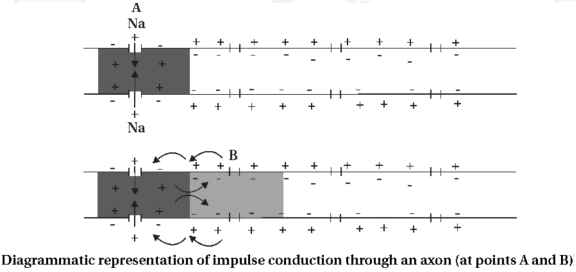
When a stimulus is applied at point $ A $ on the polarised membrane, it becomes freely permeable to $ Na^{+} $. $ Na^{+} $ influx is followed by the reversal of the polarity, i.e., the outer membrane is negatively charged and the inner side is positively charged.
The polarity at the site $ A $ is reversed and hence depolarised. The electrical potential difference across the plasma membrane at the site $ A $ is called the action potential, which is in fact termed as a nerve impulse.
At sites immediately ahead, the axon membrane has a positive charge on the outer surface and a negative charge on its inner surface. As a result, a current flows on the inner surface from site $ A $ to site $ B $. On the outer surface, current flows from site $ B $ to site $ A $ to complete the circuit of current flow. Hence, the polarity at the site is reversed and an action potential is generated at site $ B $.
Thus, the impulse (action potential) generated at site $ A $ arrives at site $ B $.
The sequence is repeated along the length of the axon, and consequently, the impulse is conducted.
The rise in the stimulus-induced permeability to $ Na^{+} $ is short-lived. It is quickly followed by the rise in permeability to $ K^{+} $. Within a fraction of a second, $ K^{+} $ diffuses outside and restores the resting potential of the membrane.
Different types of ion channels are present on the neural membrane. These ion channels are selectively permeable to different ions.
When a neuron is not conducting any impulse, i.e., at rest, the axonal membrane is comparatively more permeable to $ K^{+} $ and nearly impermeable to $ Na^{+} $.
- Similarly, the membrane is impermeable to negatively charged proteins present in the axoplasm.
The axoplasm inside the axon contains a high concentration of $ K^{+} $ and negatively charged proteins and a low concentration of $ Na^{+} $.
In contrast, outside the axon, a low concentration of $ K^{+} $ and a high concentration of $ Na^{+} $ form a concentration gradient.
These ionic gradients across the resting membrane are maintained by the active transport of $ 3 Na^{+} $ outwards and $ 2 K^{+} $ inside the cell.
As a result, the outer surface of the axonal membrane is positively charged and its inner surface becomes negatively charged; therefore, it is polarised.
The electrical potential difference across the resting membrane is called the resting potential.
When a stimulus is applied at point $ A $ on the polarised membrane, it becomes freely permeable to $ Na^{+} $. $ Na^{+} $ influx is followed by the reversal of the polarity, i.e., the outer membrane is negatively charged and the inner side is positively charged.
The polarity at the site $ A $ is reversed and hence depolarised. The electrical potential difference across the plasma membrane at the site $ A $ is called the action potential, which is in fact termed as a nerve impulse.
At sites immediately ahead, the axon membrane has a positive charge on the outer surface and a negative charge on its inner surface. As a result, a current flows on the inner surface from site $ A $ to site $ B $. On the outer surface, current flows from site $ B $ to site $ A $ to complete the circuit of current flow. Hence, the polarity at the site is reversed and an action potential is generated at site $ B $.
Thus, the impulse (action potential) generated at site $ A $ arrives at site $ B $.
The sequence is repeated along the length of the axon, and consequently, the impulse is conducted.
The rise in the stimulus-induced permeability to $ Na^{+} $ is short-lived. It is quickly followed by the rise in permeability to $ K^{+} $. Within a fraction of a second, $ K^{+} $ diffuses outside and restores the resting potential of the membrane.
0 likes
View Solution74
Easy
What is resting potential? How does the conduction of a nerve impulse take place?
Solution
(N/A) Resting potential is the electrical potential difference across the resting axonal membrane.
Neurons are excitable cells because their membranes are in a polarised state.
Different types of ion channels are present on the neural membrane,which are selectively permeable to different ions.
When a neuron is not conducting any impulse (resting state),the axonal membrane is comparatively more permeable to $K^{+}$ and nearly impermeable to $Na^{+}$.
Similarly,the membrane is impermeable to negatively charged proteins present in the axoplasm.
The axoplasm inside the axon contains a high concentration of $K^{+}$ and negatively charged proteins,and a low concentration of $Na^{+}$.
In contrast,outside the axon,there is a low concentration of $K^{+}$ and a high concentration of $Na^{+}$,forming a concentration gradient.
These ionic gradients across the resting membrane are maintained by the active transport of $3 Na^{+}$ outwards and $2 K^{+}$ inwards by the $Na^{+}-K^{+}$ pump.
As a result,the outer surface of the axonal membrane is positively charged and its inner surface becomes negatively charged; thus,it is polarised.
When a stimulus is applied at point $A$ on the polarised membrane,it becomes freely permeable to $Na^{+}$. The influx of $Na^{+}$ causes a reversal of polarity (depolarisation),where the outer membrane becomes negatively charged and the inner side becomes positively charged.
The electrical potential difference across the plasma membrane at the site $A$ is called the action potential,which is termed a nerve impulse.
At sites immediately ahead (e.g.,site $B$),the axon membrane still has a positive charge on the outer surface and a negative charge on its inner surface.
As a result,a current flows on the inner surface from site $A$ to site $B$,and on the outer surface,current flows from site $B$ to site $A$ to complete the circuit.
Consequently,the polarity at site $B$ is reversed,and an action potential is generated there.
This sequence is repeated along the length of the axon,conducting the impulse.
The stimulus-induced permeability to $Na^{+}$ is short-lived and is quickly followed by a rise in permeability to $K^{+}$. Within a fraction of a second,$K^{+}$ diffuses outside,restoring the resting potential of the membrane.
Neurons are excitable cells because their membranes are in a polarised state.
Different types of ion channels are present on the neural membrane,which are selectively permeable to different ions.
When a neuron is not conducting any impulse (resting state),the axonal membrane is comparatively more permeable to $K^{+}$ and nearly impermeable to $Na^{+}$.
Similarly,the membrane is impermeable to negatively charged proteins present in the axoplasm.
The axoplasm inside the axon contains a high concentration of $K^{+}$ and negatively charged proteins,and a low concentration of $Na^{+}$.
In contrast,outside the axon,there is a low concentration of $K^{+}$ and a high concentration of $Na^{+}$,forming a concentration gradient.
These ionic gradients across the resting membrane are maintained by the active transport of $3 Na^{+}$ outwards and $2 K^{+}$ inwards by the $Na^{+}-K^{+}$ pump.
As a result,the outer surface of the axonal membrane is positively charged and its inner surface becomes negatively charged; thus,it is polarised.
When a stimulus is applied at point $A$ on the polarised membrane,it becomes freely permeable to $Na^{+}$. The influx of $Na^{+}$ causes a reversal of polarity (depolarisation),where the outer membrane becomes negatively charged and the inner side becomes positively charged.
The electrical potential difference across the plasma membrane at the site $A$ is called the action potential,which is termed a nerve impulse.
At sites immediately ahead (e.g.,site $B$),the axon membrane still has a positive charge on the outer surface and a negative charge on its inner surface.
As a result,a current flows on the inner surface from site $A$ to site $B$,and on the outer surface,current flows from site $B$ to site $A$ to complete the circuit.
Consequently,the polarity at site $B$ is reversed,and an action potential is generated there.
This sequence is repeated along the length of the axon,conducting the impulse.
The stimulus-induced permeability to $Na^{+}$ is short-lived and is quickly followed by a rise in permeability to $K^{+}$. Within a fraction of a second,$K^{+}$ diffuses outside,restoring the resting potential of the membrane.
0 likes
View Solution75
Easy
Differentiate between Resting potential and Action potential.
Solution
(N/A)
| Resting potential | Action potential |
|---|---|
| $1$. Nerve fiber is polarized. | $1$. Nerve fiber is depolarized (not polarized). |
| $2$. Inner side of the plasmalemma is negatively charged,and the outer side is positively charged. | $2$. Inner side of the plasmalemma is positively charged,and the outer side is negatively charged. |
0 likes
View Solution76
Easy
Give scientific reasons:
$(1)$ There is no physical connection between sequential neurons,yet nerve impulses are conducted through them.
$(2)$ The neuroplasm of a neuron contains a high $K^+$ concentration during the maintenance of the resting potential.
$(1)$ There is no physical connection between sequential neurons,yet nerve impulses are conducted through them.
$(2)$ The neuroplasm of a neuron contains a high $K^+$ concentration during the maintenance of the resting potential.
Solution
(N/A) $(1)$ At the end of a branched axon,a knob-like swollen structure called the synaptic knob is present. It contains secretory vesicles that produce neurotransmitter substances,such as acetylcholine.
Acetylcholine is released into the synaptic cleft and binds to receptors on the postsynaptic membrane,allowing the conduction of nerve impulses across the synapse.
$(2)$ For the maintenance of the resting membrane potential,ion pumps and ion channels play a significant role. Through the $Na^+-K^+$ pump,$3 Na^+$ ions are actively transported out of the neuroplasm,while $2 K^+$ ions are transported inside. This active transport,combined with the selective permeability of the membrane,results in a higher concentration of $K^+$ ions inside the neuron compared to the extracellular fluid.
Acetylcholine is released into the synaptic cleft and binds to receptors on the postsynaptic membrane,allowing the conduction of nerve impulses across the synapse.
$(2)$ For the maintenance of the resting membrane potential,ion pumps and ion channels play a significant role. Through the $Na^+-K^+$ pump,$3 Na^+$ ions are actively transported out of the neuroplasm,while $2 K^+$ ions are transported inside. This active transport,combined with the selective permeability of the membrane,results in a higher concentration of $K^+$ ions inside the neuron compared to the extracellular fluid.
0 likes
View Solution77
Medium
Give scientific reasons:
$(1)$ In an excited nerve fibre region,a positive charge is created inside the plasma membrane.
$(2)$ In some animals,the conduction of nerve impulses is saltatory.
$(1)$ In an excited nerve fibre region,a positive charge is created inside the plasma membrane.
$(2)$ In some animals,the conduction of nerve impulses is saltatory.
Solution
(N/A) $(1)$ In the excited region,$Na^+$ ion channels open. At this time,the interior of the neurilemma contains negatively charged proteins and a lower concentration of $Na^+$. Consequently,a large amount of $Na^+$ enters the cell through ion channels,resulting in the formation of a positive charge inside the neurilemma.
$(2)$ In myelinated nerve fibres,the medullary sheath is not continuous. At regular intervals,it forms nodes of Ranvier. The action potential (conduction of nerve impulse) jumps from one node to the next,which is why it is called saltatory conduction.
$(2)$ In myelinated nerve fibres,the medullary sheath is not continuous. At regular intervals,it forms nodes of Ranvier. The action potential (conduction of nerve impulse) jumps from one node to the next,which is why it is called saltatory conduction.
0 likes
View Solution78
Easy
Define the following terms:
$(1)$ Nerve impulse
$(2)$ Resting potential
$(1)$ Nerve impulse
$(2)$ Resting potential
Solution
(N/A) $(1)$ When a nerve fiber is stimulated by touch,smell,or chemical changes,its polarized state changes,which is known as a nerve impulse or action potential.
$(2)$ The electrical potential difference across the resting plasma membrane of a neuron is known as the resting potential.
$(2)$ The electrical potential difference across the resting plasma membrane of a neuron is known as the resting potential.
0 likes
View Solution79
Easy
During resting potential,the axonal membrane is polarised. Indicate the movement of $+ve$ and $-ve$ ions leading to polarisation diagrammatically.
Solution
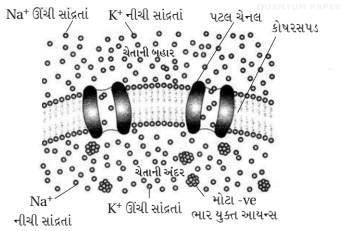
(N/A) During the resting state,the axonal membrane is selectively permeable to $K^+$ ions and nearly impermeable to $Na^+$ ions.
This is maintained by the $Na^+-K^+$ pump,which actively transports $3$ $Na^+$ ions outwards for every $2$ $K^+$ ions into the neuron.
As a result,the outer surface of the axonal membrane possesses a positive charge,while the inner surface becomes negatively charged due to the presence of negatively charged proteins and high $K^+$ concentration inside.
This electrical potential difference across the resting plasma membrane is called the resting potential.
This is maintained by the $Na^+-K^+$ pump,which actively transports $3$ $Na^+$ ions outwards for every $2$ $K^+$ ions into the neuron.
As a result,the outer surface of the axonal membrane possesses a positive charge,while the inner surface becomes negatively charged due to the presence of negatively charged proteins and high $K^+$ concentration inside.
This electrical potential difference across the resting plasma membrane is called the resting potential.
0 likes
View Solution80
EasyMCQ
What is a polarised nerve fiber?
A
$A$ state where the axonal membrane has a positive charge on the outside and a negative charge on the inside.
B
$A$ state where the axonal membrane has a negative charge on the outside and a positive charge on the inside.
C
$A$ state where the axonal membrane has no charge on either side.
D
$A$ state where the axonal membrane has a positive charge on both sides.
Solution
(A) nerve fiber is said to be polarised when it is in a resting state.
In this state,the axonal membrane is more permeable to $K^+$ ions and nearly impermeable to $Na^+$ ions.
Consequently,the outer surface of the axonal membrane becomes positively charged due to the higher concentration of $Na^+$ ions outside.
Simultaneously,the inner surface becomes negatively charged due to the presence of negatively charged proteins and $K^+$ ions inside.
This difference in electrical charge across the membrane is known as the resting membrane potential,and the fiber is described as polarised.
In this state,the axonal membrane is more permeable to $K^+$ ions and nearly impermeable to $Na^+$ ions.
Consequently,the outer surface of the axonal membrane becomes positively charged due to the higher concentration of $Na^+$ ions outside.
Simultaneously,the inner surface becomes negatively charged due to the presence of negatively charged proteins and $K^+$ ions inside.
This difference in electrical charge across the membrane is known as the resting membrane potential,and the fiber is described as polarised.
0 likes
View Solution81
EasyMCQ
What is action potential?
A
$A$ state of resting membrane potential
B
The electrical potential difference across the plasma membrane at a depolarized site
C
The process of repolarization
D
The threshold stimulus required for nerve impulse
Solution
(B) When a stimulus is applied at a site on the polarized membrane,the permeability of the membrane to $Na^+$ ions increases. This leads to a rapid influx of $Na^+$ ions,causing a reversal of polarity at that site,which is known as depolarization. The electrical potential difference across the plasma membrane at this depolarized site is called the action potential.
0 likes
View Solution82
EasyMCQ
The potential difference across the membrane of a relaxed muscle fibre is called resting potential. It amounts to about
A
$-70$ mV
B
$50$ mV
C
$100$ mV
D
$50-100$ mV
Solution
(A) The resting membrane potential of a relaxed muscle fibre or a neuron is approximately $-70 \; mV$.
This potential difference is maintained due to the unequal distribution of ions across the plasma membrane, resulting in a negative charge inside the cell relative to the outside.
This potential difference is maintained due to the unequal distribution of ions across the plasma membrane, resulting in a negative charge inside the cell relative to the outside.
0 likes
View Solution83
MediumMCQ
The nerve fibre in its resting stage is
A
More permeable to $K^{+}$
B
Semi-permeable to $K^{+}$
C
Less permeable to $K^{+}$
D
All of these
Solution
(A) In a resting nerve fibre (a nerve fibre that is not conducting an impulse),sodium ions $(Na^{+})$ predominate in the extracellular fluid,whereas potassium ions $(K^{+})$ predominate in the intracellular fluid (within the fibre).
This results in the fact that the resting membrane has a very low permeability for $Na^{+}$ ions,whereas it has a significantly higher permeability for $K^{+}$ ions.
This results in the fact that the resting membrane has a very low permeability for $Na^{+}$ ions,whereas it has a significantly higher permeability for $K^{+}$ ions.
0 likes
View Solution84
MediumMCQ
Saltatory conduction occurs in
A
Myelinated nerve fibres
B
Non-myelinated nerve fibres
C
Liver cells
D
All of the above
Solution
(A) The myelin sheath of myelinated nerve fibres prevents the flow of ions between the extracellular fluid and the axoplasm.
Exchange of ions can occur only at the nodes of $Ranvier$.
Therefore,the action potential jumps from node to node and passes along the myelinated axon faster than the series of smaller local currents in a non-myelinated axon.
This process is called saltatory conduction.
Exchange of ions can occur only at the nodes of $Ranvier$.
Therefore,the action potential jumps from node to node and passes along the myelinated axon faster than the series of smaller local currents in a non-myelinated axon.
This process is called saltatory conduction.
0 likes
View Solution85
MediumMCQ
During the conduction of a nerve impulse,the action potential results from the movement of
A
$K^{+}$ ions from extracellular fluid to intracellular fluid
B
$Na^{+}$ ions from intracellular fluid to extracellular fluid
C
$K^{+}$ ions from intracellular fluid to extracellular fluid
D
$Na^{+}$ ions from extracellular fluid to intracellular fluid
Solution
(D) During the conduction of a nerve impulse,the resting membrane potential is disturbed by a stimulus.
This stimulus causes the opening of voltage-gated $Na^{+}$ channels.
As a result,there is a rapid influx of $Na^{+}$ ions from the extracellular fluid into the intracellular fluid.
This sudden change in membrane potential is known as the action potential.
This stimulus causes the opening of voltage-gated $Na^{+}$ channels.
As a result,there is a rapid influx of $Na^{+}$ ions from the extracellular fluid into the intracellular fluid.
This sudden change in membrane potential is known as the action potential.
0 likes
View Solution86
MediumMCQ
Maintenance of the ionic gradients across the resting membrane is done by the
A
Active transport of ions
B
Passive transport of ions
C
Active transport of proteins
D
Passive transport of proteins
Solution
(A) The maintenance of ionic gradients across the resting membrane is achieved by the $Na^{+}-K^{+}$ pump.
This pump utilizes energy in the form of $ATP$ to actively transport $3 Na^{+}$ ions out of the cell and $2 K^{+}$ ions into the cell.
Since this process moves ions against their concentration gradient,it is classified as the active transport of ions.
This pump utilizes energy in the form of $ATP$ to actively transport $3 Na^{+}$ ions out of the cell and $2 K^{+}$ ions into the cell.
Since this process moves ions against their concentration gradient,it is classified as the active transport of ions.
0 likes
View Solution87
MediumMCQ
Which of these processes occur during repolarisation of nerve fibre?
$(I)$. Open $Na^+$ channel
$(II)$. Closed $Na^+$ channel
$(III)$. Closed $K^+$ channel
$(IV)$. Open $K^+$ channel
$(I)$. Open $Na^+$ channel
$(II)$. Closed $Na^+$ channel
$(III)$. Closed $K^+$ channel
$(IV)$. Open $K^+$ channel
A
$(II)$ and $(IV)$
B
$(I)$ and $(III)$
C
$(II)$ and $(III)$
D
$(I)$ and $(II)$
Solution
(A) Repolarization is the process of restoring the resting membrane potential of a neuron after depolarization.
During depolarization,the membrane is highly permeable to $Na^+$. As the action potential reaches its peak,the voltage-gated $Na^+$ channels close (Process $II$).
Simultaneously,the voltage-gated $K^+$ channels open (Process $IV$),allowing $K^+$ ions to flow out of the nerve fibre.
This efflux of $K^+$ ions makes the interior of the membrane negative again relative to the exterior,thereby restoring the resting potential.
Therefore,the correct processes are the closing of $Na^+$ channels and the opening of $K^+$ channels.
During depolarization,the membrane is highly permeable to $Na^+$. As the action potential reaches its peak,the voltage-gated $Na^+$ channels close (Process $II$).
Simultaneously,the voltage-gated $K^+$ channels open (Process $IV$),allowing $K^+$ ions to flow out of the nerve fibre.
This efflux of $K^+$ ions makes the interior of the membrane negative again relative to the exterior,thereby restoring the resting potential.
Therefore,the correct processes are the closing of $Na^+$ channels and the opening of $K^+$ channels.
0 likes
View Solution88
MediumMCQ
In the resting stage of a neuron,the concentration gradient is generated due to:
A
High concentration of $K^+$ and low concentration of $Na^+$ inside the axon
B
High concentration of $Na^+$ and low concentration of $K^+$ inside the axon
C
Low concentration of $Na^+$ outside the axon
D
Low concentration of $K^+$ outside the axon
Solution
(A) The correct answer is $A$.
When a neuron is not conducting any impulse (resting stage),the axonal membrane is comparatively more permeable to potassium ions $(K^+)$ and nearly impermeable to sodium ions $(Na^+)$.
Additionally,the membrane is impermeable to negatively charged proteins present in the axoplasm.
Consequently,the axoplasm inside the axon contains a high concentration of $K^+$ and negatively charged proteins,and a low concentration of $Na^+$.
In contrast,the fluid outside the axon contains a low concentration of $K^+$ and a high concentration of $Na^+$,which establishes the concentration gradient.
When a neuron is not conducting any impulse (resting stage),the axonal membrane is comparatively more permeable to potassium ions $(K^+)$ and nearly impermeable to sodium ions $(Na^+)$.
Additionally,the membrane is impermeable to negatively charged proteins present in the axoplasm.
Consequently,the axoplasm inside the axon contains a high concentration of $K^+$ and negatively charged proteins,and a low concentration of $Na^+$.
In contrast,the fluid outside the axon contains a low concentration of $K^+$ and a high concentration of $Na^+$,which establishes the concentration gradient.
0 likes
View Solution89
MediumMCQ
Consider the statements as True/False:
$I$. The axoplasm inside the axon contains a high concentration of $K^{+}$ and negatively charged proteins.
$II$. The axoplasm inside the axon contains a low concentration of $Na^{+}$.
$III$. The fluid outside the axon contains a low concentration of $K^{+}$.
$IV$. The fluid outside the axon contains a high concentration of $Mg^{++}$ and negatively charged proteins.
The correct option is:
$I$. The axoplasm inside the axon contains a high concentration of $K^{+}$ and negatively charged proteins.
$II$. The axoplasm inside the axon contains a low concentration of $Na^{+}$.
$III$. The fluid outside the axon contains a low concentration of $K^{+}$.
$IV$. The fluid outside the axon contains a high concentration of $Mg^{++}$ and negatively charged proteins.
The correct option is:
A
$I-$ True,$II-$ False,$III-$ False,$IV-$ True
B
$I-$ True,$II-$ True,$III-$ True,$IV-$ False
C
$I-$ True,$II-$ True,$III-$ False,$IV-$ True
D
$I-$ False,$II-$ True,$III-$ False,$IV-$ False
Solution
(B) When a neuron is in a resting state,the axonal membrane is more permeable to $K^{+}$ ions and nearly impermeable to $Na^{+}$ ions.
Additionally,the membrane is impermeable to the negatively charged proteins present in the axoplasm.
Therefore,the axoplasm inside the axon contains a high concentration of $K^{+}$ and negatively charged proteins,and a low concentration of $Na^{+}$.
In contrast,the extracellular fluid outside the axon contains a low concentration of $K^{+}$ and a high concentration of $Na^{+}$.
Statement $I$ is True ($K^{+}$ and proteins are high inside).
Statement $II$ is True ($Na^{+}$ is low inside).
Statement $III$ is True ($K^{+}$ is low outside).
Statement $IV$ is False (the fluid outside contains high $Na^{+}$,not $Mg^{++}$ or negatively charged proteins).
Thus,the correct sequence is $I-$ True,$II-$ True,$III-$ True,$IV-$ False.
Additionally,the membrane is impermeable to the negatively charged proteins present in the axoplasm.
Therefore,the axoplasm inside the axon contains a high concentration of $K^{+}$ and negatively charged proteins,and a low concentration of $Na^{+}$.
In contrast,the extracellular fluid outside the axon contains a low concentration of $K^{+}$ and a high concentration of $Na^{+}$.
Statement $I$ is True ($K^{+}$ and proteins are high inside).
Statement $II$ is True ($Na^{+}$ is low inside).
Statement $III$ is True ($K^{+}$ is low outside).
Statement $IV$ is False (the fluid outside contains high $Na^{+}$,not $Mg^{++}$ or negatively charged proteins).
Thus,the correct sequence is $I-$ True,$II-$ True,$III-$ True,$IV-$ False.
0 likes
View Solution90
MediumMCQ
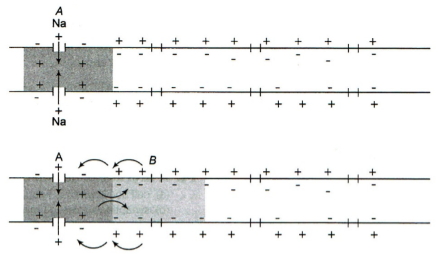
Given is the diagrammatic representation of impulse conduction through an axon (at points $A$ and $B$). View the diagram and arrange the steps of impulse conduction.
$I.$ The polarity of the membrane at site $A$ is reversed and depolarized,i.e.,the outer surface becomes negatively charged and the inner side becomes positively charged,generating a nerve impulse.
$II.$ $A$ stimulus causes a disturbance to the membrane at site $A$ of the nerve fibre,resulting in the leakage of $Na^+$ ions inside the nerve fibre.
$III.$ On the outer surface,current flows from site $B$ to site $A$ to complete the circuit of current flow. Hence,the polarity at the site is reversed,and an action potential is generated at site $B$. The impulse (action potential) generated at site $A$ arrives at site $B$. The sequence is repeated along the length of the axon and consequently,the impulse is conducted.
$IV.$ Immediately ahead,the axon (e.g.,site $B$) membrane has a positive charge on the outer surface and a negative charge on its inner surface. As a result,a current flows on the inner surface from site $A$ to site $B$.
$I.$ The polarity of the membrane at site $A$ is reversed and depolarized,i.e.,the outer surface becomes negatively charged and the inner side becomes positively charged,generating a nerve impulse.
$II.$ $A$ stimulus causes a disturbance to the membrane at site $A$ of the nerve fibre,resulting in the leakage of $Na^+$ ions inside the nerve fibre.
$III.$ On the outer surface,current flows from site $B$ to site $A$ to complete the circuit of current flow. Hence,the polarity at the site is reversed,and an action potential is generated at site $B$. The impulse (action potential) generated at site $A$ arrives at site $B$. The sequence is repeated along the length of the axon and consequently,the impulse is conducted.
$IV.$ Immediately ahead,the axon (e.g.,site $B$) membrane has a positive charge on the outer surface and a negative charge on its inner surface. As a result,a current flows on the inner surface from site $A$ to site $B$.
A
$I \rightarrow II \rightarrow IV \rightarrow III$
B
$II \rightarrow I \rightarrow III \rightarrow IV$
C
$II \rightarrow I \rightarrow IV \rightarrow III$
D
$I \rightarrow IV \rightarrow III \rightarrow II$
Solution
(C) The process of nerve impulse conduction occurs in the following sequence:
$1$. Initially,a stimulus causes a disturbance to the membrane at site $A$,which leads to the opening of voltage-gated $Na^+$ channels,resulting in the rapid influx of $Na^+$ ions into the nerve fibre $(II)$.
$2$. Due to the influx of $Na^+$ ions,the polarity of the membrane at site $A$ is reversed (depolarization),where the outer surface becomes negatively charged and the inner side becomes positively charged,generating a nerve impulse $(I)$.
$3$. Immediately ahead of the depolarized site $A$,the membrane at site $B$ is still in a resting state,having a positive charge on the outer surface and a negative charge on the inner surface. Consequently,a current flows on the inner surface from site $A$ to site $B$ $(IV)$.
$4$. To complete the circuit,current flows on the outer surface from site $B$ to site $A$. This causes the polarity at site $B$ to reverse,generating an action potential at site $B$. This sequence repeats along the axon,conducting the impulse $(III)$.
Therefore,the correct sequence is $II \rightarrow I \rightarrow IV \rightarrow III$.
$1$. Initially,a stimulus causes a disturbance to the membrane at site $A$,which leads to the opening of voltage-gated $Na^+$ channels,resulting in the rapid influx of $Na^+$ ions into the nerve fibre $(II)$.
$2$. Due to the influx of $Na^+$ ions,the polarity of the membrane at site $A$ is reversed (depolarization),where the outer surface becomes negatively charged and the inner side becomes positively charged,generating a nerve impulse $(I)$.
$3$. Immediately ahead of the depolarized site $A$,the membrane at site $B$ is still in a resting state,having a positive charge on the outer surface and a negative charge on the inner surface. Consequently,a current flows on the inner surface from site $A$ to site $B$ $(IV)$.
$4$. To complete the circuit,current flows on the outer surface from site $B$ to site $A$. This causes the polarity at site $B$ to reverse,generating an action potential at site $B$. This sequence repeats along the axon,conducting the impulse $(III)$.
Therefore,the correct sequence is $II \rightarrow I \rightarrow IV \rightarrow III$.
0 likes
View Solution91
MediumMCQ
In a resting neuron,the axonal membrane is
A
Nearly impermeable to potassium ions $(K^+)$
B
Impermeable to positively charged proteins present in the axoplasm
C
Comparatively more permeable to $K^+$
D
Completely permeable to sodium ions $(Na^+)$
Solution
(C) In a resting state,the axonal membrane is significantly more permeable to $K^+$ ions compared to $Na^+$ ions.
This is due to the presence of a large number of $K^+$ 'leaky' channels that remain open,allowing $K^+$ to diffuse out of the neuron.
Conversely,the membrane is nearly impermeable to $Na^+$ ions and negatively charged proteins present in the axoplasm.
This is due to the presence of a large number of $K^+$ 'leaky' channels that remain open,allowing $K^+$ to diffuse out of the neuron.
Conversely,the membrane is nearly impermeable to $Na^+$ ions and negatively charged proteins present in the axoplasm.
0 likes
View Solution92
MediumMCQ
The ionic gradients across the resting membrane are maintained by the
A
Ion channels
B
Sodium-potassium pumps
C
Electrical synapses
D
Chemical synapses
Solution
(B) The ionic gradients across the resting membrane are partially due to the opening of $K^+$ leaky channels,but they are primarily maintained by the $Na^+-K^+$ pump.
This pump continuously transports $3Na^+$ ions outwards in exchange for $2K^+$ ions inwards,utilizing energy in the form of $ATP$ to maintain the resting membrane potential.
This pump continuously transports $3Na^+$ ions outwards in exchange for $2K^+$ ions inwards,utilizing energy in the form of $ATP$ to maintain the resting membrane potential.
0 likes
View Solution93
MediumMCQ
Action potential is also termed as
A
Nerve impulse
B
Reflex action
C
Repolarisation
D
Polarisation
Solution
(A) An action potential is a rapid sequence of changes in the voltage across a membrane.
It is the fundamental mechanism by which information is transmitted along the axon of a neuron.
Therefore,the transmission of a nerve impulse is essentially the propagation of an action potential along the nerve fiber.
It is the fundamental mechanism by which information is transmitted along the axon of a neuron.
Therefore,the transmission of a nerve impulse is essentially the propagation of an action potential along the nerve fiber.
0 likes
View Solution94
MediumMCQ
On application of a stimulus on the axonal membrane,
A
There is a rapid influx of $K^+$ at that site
B
There is a rapid efflux of $Na^+$ at that site
C
There is a rapid influx of $Na^+$ at that site
D
There is a rapid efflux of $K^+$ at that site
Solution
(C) When a stimulus is applied to the axonal membrane,the $Na^+$ voltage-gated channels open at that specific site. This leads to a rapid influx of $Na^+$ ions from the extracellular fluid into the intracellular space,causing depolarization of the membrane.
0 likes
View Solution95
MediumMCQ
Which of the following acts is responsible for the depolarisation of the neuron?
A
Opening of voltage-gated $K^+$ channel
B
Opening of voltage-gated $Na^+$ channel
C
Closure of voltage-gated $K^+$ channel
D
Closure of voltage-gated $Na^+$ channel
Solution
(B) The depolarisation of the neuron is primarily caused by the rapid influx of $Na^+$ ions into the cell.
When a stimulus is applied,the voltage-gated $Na^+$ channels open,allowing $Na^+$ to move down its electrochemical gradient into the neuron.
This influx of positive charge makes the inner side of the neuronal membrane less negative (or more positive) compared to the resting state.
This change in membrane potential is known as depolarisation.
When a stimulus is applied,the voltage-gated $Na^+$ channels open,allowing $Na^+$ to move down its electrochemical gradient into the neuron.
This influx of positive charge makes the inner side of the neuronal membrane less negative (or more positive) compared to the resting state.
This change in membrane potential is known as depolarisation.
0 likes
View Solution96
MediumMCQ
If the inside of the membrane becomes more negative,it leads to:
A
Depolarisation
B
Repolarisation
C
Hyperpolarisation
D
Polarisation
Solution
(C) When the inside of the neuronal membrane becomes more negative than the resting membrane potential,it is known as hyperpolarisation.
This occurs due to the prolonged opening of $K^+$ channels,which leads to an increased efflux of $K^+$ ions out of the cell,making the interior more negative.
This occurs due to the prolonged opening of $K^+$ channels,which leads to an increased efflux of $K^+$ ions out of the cell,making the interior more negative.
0 likes
View Solution97
MediumMCQ
$A$: In the nervous system,the generation of an action potential depends upon the influx of sodium ions into the axoplasm.
$R$: The influx of sodium ions during nerve impulse generation is due to the efflux of potassium ions.
$R$: The influx of sodium ions during nerve impulse generation is due to the efflux of potassium ions.
A
Assertion and Reason both are correct and Reason is the correct explanation of Assertion.
B
Assertion and Reason both are correct but Reason is not the correct explanation of Assertion.
C
Assertion is correct,but Reason is incorrect.
D
Both Assertion and Reason are incorrect.
Solution
(C) The generation of an action potential in the nervous system occurs due to the rapid influx of $Na^+$ ions into the axoplasm through voltage-gated sodium channels.
This influx causes depolarization of the axonal membrane.
The Reason statement is incorrect because the influx of $Na^+$ ions is driven by the electrochemical gradient,not by the efflux of $K^+$ ions.
In fact,during the depolarization phase,$K^+$ channels are typically closed.
This influx causes depolarization of the axonal membrane.
The Reason statement is incorrect because the influx of $Na^+$ ions is driven by the electrochemical gradient,not by the efflux of $K^+$ ions.
In fact,during the depolarization phase,$K^+$ channels are typically closed.
0 likes
View Solution98
MediumMCQ
$A$: Presence of myelin sheath increases the rate of conduction of nerve impulse.
$R$: Ionic channels are absent in the area covered by myelin sheath; therefore,depolarization occurs only at the nodes of Ranvier,resulting in saltatory or jumping conduction.
$R$: Ionic channels are absent in the area covered by myelin sheath; therefore,depolarization occurs only at the nodes of Ranvier,resulting in saltatory or jumping conduction.
A
Assertion and Reason both are correct and Reason is the correct explanation of Assertion.
B
Assertion and Reason both are correct but Reason is not the correct explanation of Assertion.
C
Assertion is correct,but Reason is incorrect.
D
Both Assertion and Reason are incorrect.
Solution
(A) The myelin sheath acts as an electrical insulator around the axon.
Because of this insulation,ionic channels (voltage-gated $Na^+$ channels) are largely absent in the internodal regions covered by the myelin sheath.
Consequently,depolarization can only occur at the nodes of Ranvier,where these channels are highly concentrated.
This forces the action potential to 'jump' from one node to the next,a process known as saltatory conduction,which significantly increases the speed of nerve impulse transmission.
Because of this insulation,ionic channels (voltage-gated $Na^+$ channels) are largely absent in the internodal regions covered by the myelin sheath.
Consequently,depolarization can only occur at the nodes of Ranvier,where these channels are highly concentrated.
This forces the action potential to 'jump' from one node to the next,a process known as saltatory conduction,which significantly increases the speed of nerve impulse transmission.
0 likes
View Solution99
MediumMCQ
$A$ : The imbalance in the concentration of $Na^+, K^+$ and proteins generates the resting potential.
$R$ : To maintain the unequal distribution of $Na^+$ and $K^+$,the neurons use electrical energy.
$R$ : To maintain the unequal distribution of $Na^+$ and $K^+$,the neurons use electrical energy.
A
Assertion and Reason both are correct and Reason is the correct explanation of Assertion.
B
Assertion and Reason both are correct but Reason is not the correct explanation of Assertion.
C
Assertion is correct,but Reason is incorrect.
D
Both Assertion and Reason are incorrect.
Solution
(C) The resting membrane potential is generated due to the differential permeability of the axonal membrane to $K^+$ and $Na^+$ ions and the presence of negatively charged proteins inside the axoplasm.
During the resting state,the axonal membrane is significantly more permeable to $K^+$ ions and nearly impermeable to $Na^+$ ions.
This leads to the efflux of $K^+$ ions,creating a negative charge inside the membrane.
To maintain this unequal distribution of ions,neurons utilize metabolic energy in the form of $ATP$ (chemical energy),not electrical energy,via the $Na^+-K^+$ pump.
Therefore,the Assertion is correct,but the Reason is incorrect.
During the resting state,the axonal membrane is significantly more permeable to $K^+$ ions and nearly impermeable to $Na^+$ ions.
This leads to the efflux of $K^+$ ions,creating a negative charge inside the membrane.
To maintain this unequal distribution of ions,neurons utilize metabolic energy in the form of $ATP$ (chemical energy),not electrical energy,via the $Na^+-K^+$ pump.
Therefore,the Assertion is correct,but the Reason is incorrect.
0 likes
View SolutionNeural Control and Coordination — Generation and conduction of Nerve Impulse · Frequently Asked Questions
1Are these Neural Control and Coordination questions useful for JEE and NEET?
Yes. All questions in this section are mapped to JEE Main and NEET exam patterns. Previous year questions from JEE Main, NEET, GUJCET and state-level exams are included with full solutions.
2Can I switch to Hindi or Gujarati for these questions?
Yes. Use the language tabs in the hero section or the sidebar to view the same questions and solutions in English, Hindi or Gujarati.
3How do I generate a question paper from this subtopic?
Use the Vedclass Exam Paper Generator — select the chapter and subtopic, set difficulty, and generate Sets A, B, C, D automatically. First 3 chapters of every subject are free.
Vedclass Products
For Students
Vedclass Test Series
Mock tests in real JEE/NEET style with performance analysis. 5-day free trial.
Start Free TrialFor Teachers
Exam Paper Generator
Generate Set A/B/C/D papers from this chapter in 2 minutes. 3 chapters free.
Try FreeFor Institutes
Online Exam Module
Live online exams with unlimited students, 360° analytics & white-label branding.
See DemoFor Teachers & Institutes
Generate a Neural Control and Coordination Exam Paper in 2 Minutes
Select subtopic & difficulty — Sets A, B, C, D auto-generated with No Repeat logic.
First 3 chapters of every subject are free — no payment required.