
A English
Hypothalamus Questions in English
Class 11 Biology · Chemical Coordination and Integration · Hypothalamus
98+
Questions
English
Language
100%
With Solutions
Showing 48 of 98 questions in English
51
MediumMCQ
The hypothalamus is the:
A
Anterior part of diencephalon
B
Posterior part of diencephalon
C
Interior part of diencephalon
D
Basal part of diencephalon
Solution
(D) The hypothalamus is the basal part of the diencephalon. It contains a number of centers which control body temperature,urge for eating and drinking. It also contains several groups of neurosecretory cells,which secrete hormones called hypothalamic hormones.
0 likes
View Solution52
EasyMCQ
The hypothalamus contains several groups of neurosecretory cells called:
A
Nuclei
B
Hormones
C
Pituitary gland
D
Protoplasm
Solution
(A) The hypothalamus is a part of the forebrain that contains several groups of neurosecretory cells,which are known as $Nuclei$. These cells produce hormones that regulate the synthesis and secretion of pituitary hormones. Therefore,the correct option is $A$.
0 likes
View Solution53
MediumMCQ
What is the function of somatostatin released from the hypothalamus gland?
A
Activates the release of growth hormone
B
Inhibits the release of growth hormone
C
Inhibits the release of enzymes in the digestive tract
D
Activates the release of hormones of the pineal gland
Solution
(B) The hypothalamus secretes two primary hormones that regulate the secretion of growth hormone $(GH)$ from the anterior pituitary gland.
$1$. Growth Hormone-Releasing Hormone $(GHRH)$ stimulates the release of growth hormone.
$2$. Somatostatin,also known as Growth Hormone-Inhibiting Hormone $(GHIH)$,inhibits the release of growth hormone from the anterior pituitary.
Therefore,the correct function of somatostatin is to inhibit the release of growth hormone.
$1$. Growth Hormone-Releasing Hormone $(GHRH)$ stimulates the release of growth hormone.
$2$. Somatostatin,also known as Growth Hormone-Inhibiting Hormone $(GHIH)$,inhibits the release of growth hormone from the anterior pituitary.
Therefore,the correct function of somatostatin is to inhibit the release of growth hormone.
0 likes
View Solution54
MediumMCQ
$A$ large number of hormones are secreted by
A
Pituitary
B
Thyroid
C
Hypothalamus
D
Adrenal
Solution
(C) The $Hypothalamus$ is a part of the diencephalon and contains several groups of neurosecretory cells called nuclei,which produce hormones.
These hormones regulate the synthesis and secretion of pituitary hormones.
While the pituitary gland is often called the 'master gland' because it controls other endocrine glands,the $Hypothalamus$ acts as the master control center by secreting a wide variety of releasing and inhibiting hormones (e.g.,$TRH, GnRH, CRH, GHRH, Somatostatin, Dopamine$).
Therefore,the $Hypothalamus$ is responsible for secreting a large number of regulatory hormones.
These hormones regulate the synthesis and secretion of pituitary hormones.
While the pituitary gland is often called the 'master gland' because it controls other endocrine glands,the $Hypothalamus$ acts as the master control center by secreting a wide variety of releasing and inhibiting hormones (e.g.,$TRH, GnRH, CRH, GHRH, Somatostatin, Dopamine$).
Therefore,the $Hypothalamus$ is responsible for secreting a large number of regulatory hormones.
0 likes
View Solution55
MediumMCQ
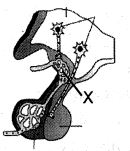
Identify $X$ from the figure.
A
Portal circulation
B
Posterior circulation
C
Hypothalamic neurons
D
Anterior pituitary
Solution
(A) The figure illustrates the connection between the hypothalamus and the pituitary gland.
$X$ points to the vascular connection between the hypothalamus and the anterior pituitary gland,which is known as the hypothalamic-hypophyseal portal system or portal circulation.
This system allows hypothalamic hormones to reach the anterior pituitary directly to regulate its secretions.
$X$ points to the vascular connection between the hypothalamus and the anterior pituitary gland,which is known as the hypothalamic-hypophyseal portal system or portal circulation.
This system allows hypothalamic hormones to reach the anterior pituitary directly to regulate its secretions.
0 likes
View Solution56
MediumMCQ
Select the correct option on the basis of the following sentences:
$(I)$ Hypothalamus is the basal part of diencephalon.
$(II)$ It regulates a wide spectrum of body functions.
$(III)$ Two types of hormones are produced by the hypothalamus.
$(IV)$ Gonadotropins are hypothalamic hormones.
$(I)$ Hypothalamus is the basal part of diencephalon.
$(II)$ It regulates a wide spectrum of body functions.
$(III)$ Two types of hormones are produced by the hypothalamus.
$(IV)$ Gonadotropins are hypothalamic hormones.
A
Only $I$
B
Only $I$ and $II$
C
$I, II$ and $III$
D
$I, II, III$ and $IV$
Solution
(C) Statement $(I)$ is correct: The hypothalamus is the basal part of the diencephalon.
Statement $(II)$ is correct: It regulates a wide spectrum of body functions,including homeostasis,temperature,and hunger.
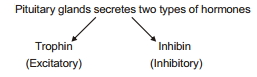
Statement $(III)$ is correct: The hypothalamus produces two types of hormones: releasing hormones (which stimulate secretion of pituitary hormones) and inhibiting hormones (which inhibit secretion of pituitary hormones).
Statement $(IV)$ is incorrect: Gonadotropins (like $LH$ and $FSH$) are secreted by the anterior pituitary gland,not the hypothalamus. The hypothalamus secretes Gonadotropin-Releasing Hormone $(GnRH)$,which stimulates the release of gonadotropins.
Therefore,statements $(I), (II),$ and $(III)$ are correct.
Statement $(II)$ is correct: It regulates a wide spectrum of body functions,including homeostasis,temperature,and hunger.
Statement $(III)$ is correct: The hypothalamus produces two types of hormones: releasing hormones (which stimulate secretion of pituitary hormones) and inhibiting hormones (which inhibit secretion of pituitary hormones).
Statement $(IV)$ is incorrect: Gonadotropins (like $LH$ and $FSH$) are secreted by the anterior pituitary gland,not the hypothalamus. The hypothalamus secretes Gonadotropin-Releasing Hormone $(GnRH)$,which stimulates the release of gonadotropins.
Therefore,statements $(I), (II),$ and $(III)$ are correct.
0 likes
View Solution57
EasyMCQ
Which part of the human brain is associated with the regulation of body temperature?
A
Cerebellum
B
Cerebrum
C
Hypothalamus
D
Medulla oblongata
Solution
(C) The $Hypothalamus$ is a small but crucial region of the brain located at the base of the diencephalon.
It acts as the body's smart control coordinating center.
One of its primary functions is thermoregulation,which involves maintaining the body's internal temperature at a constant set point.
It receives information from thermoreceptors and initiates responses such as sweating or shivering to regulate heat.
It acts as the body's smart control coordinating center.
One of its primary functions is thermoregulation,which involves maintaining the body's internal temperature at a constant set point.
It receives information from thermoreceptors and initiates responses such as sweating or shivering to regulate heat.
0 likes
View Solution58
EasyMCQ
The neural centers that regulate body temperature and the urge for eating are located in the.......
A
Hypothalamus
B
Pons
C
Cerebellum
D
Thalamus
Solution
(A) The $Hypothalamus$ is a part of the $Diencephalon$ in the forebrain.
It contains a number of centers which control body temperature,urge for eating and drinking.
It also contains several groups of neurosecretory cells,which secrete hormones called hypothalamic hormones.
Therefore,the correct option is $A$.
It contains a number of centers which control body temperature,urge for eating and drinking.
It also contains several groups of neurosecretory cells,which secrete hormones called hypothalamic hormones.
Therefore,the correct option is $A$.
0 likes
View Solution59
EasyMCQ
Which of the following functions will be affected if the $Hypothalamus$ is injured?
A
Short-term memory
B
Coordination during locomotion
C
Executive functions like decision-making
D
Regulation of body temperature
Solution
(D) The $Hypothalamus$ is a crucial part of the $Diencephalon$ in the human brain.
It contains a number of centers which control body temperature,urge for eating and drinking.
It also contains several groups of neurosecretory cells,which secrete hormones called $Hypothalamic$ hormones.
Therefore,an injury to the $Hypothalamus$ would directly affect the regulation of body temperature.
It contains a number of centers which control body temperature,urge for eating and drinking.
It also contains several groups of neurosecretory cells,which secrete hormones called $Hypothalamic$ hormones.
Therefore,an injury to the $Hypothalamus$ would directly affect the regulation of body temperature.
0 likes
View Solution60
MediumMCQ
Which part of the brain is responsible for thermoregulation?
A
Cerebrum
B
Hypothalamus
C
Corpus callosum
D
Medulla oblongata
Solution
(B) The $Hypothalamus$ is a small but vital part of the brain located at the base of the $Diencephalon$.
It acts as the body's thermostat,playing a crucial role in thermoregulation by maintaining the body's internal temperature at a constant level.
It also controls other essential functions such as hunger,thirst,and the release of hormones from the pituitary gland.
It acts as the body's thermostat,playing a crucial role in thermoregulation by maintaining the body's internal temperature at a constant level.
It also controls other essential functions such as hunger,thirst,and the release of hormones from the pituitary gland.
0 likes
View Solution61
Medium
Give information about the hormones secreted by the hypothalamus. State their target/function in the body.
Solution
(A) The hypothalamus is the basal part of the diencephalon,forebrain.
It regulates major body functions.
It contains several groups of neurosecretory cells called nuclei which produce hormones.
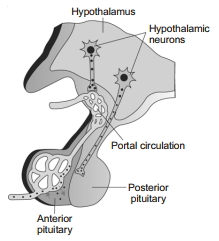
$Hypothalamus$ is connected to the anterior pituitary gland by the hypophyseal portal vein and to the posterior pituitary gland by axons of neurons.
$Hypothalamus$ produces two types of hormones: $(i)$ Releasing hormones $(RH)$ which stimulate the secretion of pituitary hormones,and $(ii)$ Inhibiting hormones which inhibit the secretion of pituitary hormones.
For example,the hypothalamic hormone called Gonadotrophin-releasing hormone $(GnRH)$ stimulates the pituitary synthesis and release of gonadotrophins.
Somatostatin from the hypothalamus inhibits the release of growth hormone from the pituitary.
These hormones,originating in the hypothalamic neurons,pass through axons and are released from their nerve endings.
These hormones reach the pituitary gland through a portal circulatory system and regulate the functions of the anterior pituitary.
The posterior pituitary is under the direct neural regulation of the hypothalamus.
It regulates major body functions.
It contains several groups of neurosecretory cells called nuclei which produce hormones.
$Hypothalamus$ is connected to the anterior pituitary gland by the hypophyseal portal vein and to the posterior pituitary gland by axons of neurons.
$Hypothalamus$ produces two types of hormones: $(i)$ Releasing hormones $(RH)$ which stimulate the secretion of pituitary hormones,and $(ii)$ Inhibiting hormones which inhibit the secretion of pituitary hormones.
For example,the hypothalamic hormone called Gonadotrophin-releasing hormone $(GnRH)$ stimulates the pituitary synthesis and release of gonadotrophins.
Somatostatin from the hypothalamus inhibits the release of growth hormone from the pituitary.
These hormones,originating in the hypothalamic neurons,pass through axons and are released from their nerve endings.
These hormones reach the pituitary gland through a portal circulatory system and regulate the functions of the anterior pituitary.
The posterior pituitary is under the direct neural regulation of the hypothalamus.
0 likes
View Solution62
EasyMCQ
Analogy type question:
$(1)$ Tongue : Taste buds :: Ear : ........
$(2)$ Structure surrounded by cerebrum : Thalamus :: Structure located at the base of the thalamus : ......
$(1)$ Tongue : Taste buds :: Ear : ........
$(2)$ Structure surrounded by cerebrum : Thalamus :: Structure located at the base of the thalamus : ......
A
Hearing : Hypothalamus
B
Balance : Cerebellum
C
Hearing : Midbrain
D
Vision : Pons
Solution
(A) $(1)$ The tongue perceives taste through taste buds. Similarly,the ear is the sensory organ responsible for hearing.
$(2)$ The thalamus is a major structure surrounded by the cerebrum. The structure located at the base of the thalamus is the hypothalamus,which regulates various homeostatic functions.
$(2)$ The thalamus is a major structure surrounded by the cerebrum. The structure located at the base of the thalamus is the hypothalamus,which regulates various homeostatic functions.
0 likes
View Solution63
Medium
Hypothalamus is a super master endocrine gland. Elaborate.
Solution
(N/A) The hypothalamus is the basal part of the diencephalon,forebrain.
It regulates major body functions.
It contains several groups of neurosecretory cells called nuclei which produce hormones.
Hypothalamus is connected to the anterior pituitary gland by the hypophyseal portal vein and to the posterior pituitary gland by axons of the neurons.
Hypothalamus produces two types of hormones: $(i)$ Releasing hormones $(RH)$ which stimulate the secretion of pituitary hormones,and $(ii)$ Inhibiting hormones which inhibit the secretions of pituitary hormones.
For example,the hypothalamic hormone called Gonadotrophin-releasing hormone $(GnRH)$ stimulates the pituitary synthesis and release of gonadotrophins.
Somatostatin from the hypothalamus inhibits the release of growth hormone from the pituitary.
These hormones originate in the hypothalamic neurons,pass through axons,and are released from their nerve endings.
These hormones reach the pituitary gland through a portal circulatory system and regulate the functions of the anterior pituitary.
The posterior pituitary is under the direct neural regulation of the hypothalamus.
It regulates major body functions.
It contains several groups of neurosecretory cells called nuclei which produce hormones.
Hypothalamus is connected to the anterior pituitary gland by the hypophyseal portal vein and to the posterior pituitary gland by axons of the neurons.
Hypothalamus produces two types of hormones: $(i)$ Releasing hormones $(RH)$ which stimulate the secretion of pituitary hormones,and $(ii)$ Inhibiting hormones which inhibit the secretions of pituitary hormones.
For example,the hypothalamic hormone called Gonadotrophin-releasing hormone $(GnRH)$ stimulates the pituitary synthesis and release of gonadotrophins.
Somatostatin from the hypothalamus inhibits the release of growth hormone from the pituitary.
These hormones originate in the hypothalamic neurons,pass through axons,and are released from their nerve endings.
These hormones reach the pituitary gland through a portal circulatory system and regulate the functions of the anterior pituitary.
The posterior pituitary is under the direct neural regulation of the hypothalamus.
0 likes
View Solution64
EasyMCQ
State the location of the hypothalamus gland.
A
Dorsal part of the diencephalon
B
Basal part of the diencephalon
C
Lateral part of the midbrain
D
Posterior part of the hindbrain
Solution
(B) The hypothalamus is the basal part of the diencephalon,which is a region of the forebrain. It serves as the master control center for the endocrine system.
0 likes
View Solution65
EasyMCQ
Which two types of hormones are secreted by the hypothalamus?
A
Releasing hormones and Inhibiting hormones
B
Tropic hormones and Stimulating hormones
C
Steroid hormones and Peptide hormones
D
Excitatory hormones and Suppressive hormones
Solution
(A) The hypothalamus produces two types of hormones:
$(i)$ Releasing hormones $(RH)$,which stimulate the secretion of pituitary hormones.
$(ii)$ Inhibiting hormones,which inhibit the secretion of pituitary hormones.
$(i)$ Releasing hormones $(RH)$,which stimulate the secretion of pituitary hormones.
$(ii)$ Inhibiting hormones,which inhibit the secretion of pituitary hormones.
0 likes
View Solution66
MediumMCQ
Which gland releases the hormone that initiates the process of spermatogenesis?
A
Pituitary
B
Testis
C
Hypothalamus
D
Ovary
Solution
(C) The process of spermatogenesis is initiated due to an increase in the secretion of Gonadotropin-Releasing Hormone $(GnRH)$ from the hypothalamus.
$GnRH$ acts on the anterior pituitary gland and stimulates the secretion of two gonadotropins: Luteinizing Hormone $(LH)$ and Follicle-Stimulating Hormone $(FSH)$.
$LH$ acts on the Leydig cells and stimulates the synthesis and secretion of androgens,while $FSH$ acts on the Sertoli cells and stimulates the secretion of some factors which help in the process of spermiogenesis.
Therefore,the hypothalamus is the primary gland that initiates this process by releasing $GnRH$.
$GnRH$ acts on the anterior pituitary gland and stimulates the secretion of two gonadotropins: Luteinizing Hormone $(LH)$ and Follicle-Stimulating Hormone $(FSH)$.
$LH$ acts on the Leydig cells and stimulates the synthesis and secretion of androgens,while $FSH$ acts on the Sertoli cells and stimulates the secretion of some factors which help in the process of spermiogenesis.
Therefore,the hypothalamus is the primary gland that initiates this process by releasing $GnRH$.
0 likes
View Solution67
DifficultMCQ
Which of the following integrates the nervous and endocrine systems?
A
Hypothalamus
B
Pineal gland
C
Adrenal gland
D
Thymus
Solution
(A) The hypothalamus acts as the primary link between the nervous system and the endocrine system. It receives signals from various parts of the nervous system and,in response,secretes hormones that regulate the pituitary gland,which in turn controls many other endocrine glands in the body.
0 likes
View Solution68
EasyMCQ
In which part of the brain are the satiety centres present?
A
Cerebellum
B
Medulla oblongata
C
Cerebral hemisphere
D
Hypothalamus
Solution
(D) The satiety centre is located in the ventro-medial nucleus of the hypothalamus.
This region plays a crucial role in regulating appetite and signaling the feeling of fullness after eating.
This region plays a crucial role in regulating appetite and signaling the feeling of fullness after eating.
0 likes
View Solution69
MediumMCQ
Which of the following is $NOT$ controlled by the hypothalamus?
A
Hunger and satiety
B
Thermoregulation
C
Diurnal rhythm
D
Emotions
Solution
(C) The hypothalamus is a vital part of the diencephalon that acts as a control centre for the autonomic nervous system and endocrine system.
It regulates essential body functions including hunger,thirst,thermoregulation (body temperature control),and various emotional responses such as love,anger,and pleasure.
However,the diurnal rhythm (circadian rhythm) is primarily controlled by the pineal gland,which secretes melatonin in response to light and dark cycles.
Therefore,the hypothalamus does not directly control the diurnal rhythm.
It regulates essential body functions including hunger,thirst,thermoregulation (body temperature control),and various emotional responses such as love,anger,and pleasure.
However,the diurnal rhythm (circadian rhythm) is primarily controlled by the pineal gland,which secretes melatonin in response to light and dark cycles.
Therefore,the hypothalamus does not directly control the diurnal rhythm.
0 likes
View Solution70
EasyMCQ
Which centre is stimulated during increase in body temperature?
A
Hypothalamus
B
Hind Brain
C
Limbic system
D
Basal ganglion
Solution
(A) The $Hypothalamus$ is the primary coordinating and control centre for the autonomic nervous system.
Its anterior part functions as the thermoregulatory centre.
Therefore,the $Hypothalamus$ is often referred to as the thermostat of the body,as it gets stimulated to initiate cooling mechanisms when the body temperature increases.
Its anterior part functions as the thermoregulatory centre.
Therefore,the $Hypothalamus$ is often referred to as the thermostat of the body,as it gets stimulated to initiate cooling mechanisms when the body temperature increases.
0 likes
View Solution71
MediumMCQ
Which of the following statements is correct regarding hypothalamic control of pituitary function?
A
All the hypothalamic hormones are synthesized and secreted by neurons
B
Blood flows from the anterior pituitary to the hypothalamus in the portal vessels
C
The hypothalamic releasing hormones reach the general circulation in significant amounts
D
Loss of dopaminergic neurons in the hypothalamus is likely to lead to a fall in the secretion of prolactin
Solution
(A) The hypothalamus regulates the function of the anterior pituitary by means of the hormones it secretes into the portal vessels of the hypothalamo-hypophyseal system.
Blood flows from the hypothalamus to the anterior pituitary gland.
The quantities of hormones secreted are very small and cannot be detected in the general circulation.
All hypothalamic hormones are synthesized and secreted by neurosecretory cells (neurons) located in the hypothalamus.
Blood flows from the hypothalamus to the anterior pituitary gland.
The quantities of hormones secreted are very small and cannot be detected in the general circulation.
All hypothalamic hormones are synthesized and secreted by neurosecretory cells (neurons) located in the hypothalamus.
0 likes
View Solution72
EasyMCQ
What is the function of somatostatin released from the hypothalamus gland?
A
Activates the release of growth hormone
B
Inhibits the release of growth hormone
C
Inhibits the release of enzymes in the digestive tract
D
Activates the release of enzymes from the pineal gland
Solution
(B) Somatostatin,also known as Growth Hormone-Inhibiting Hormone $(GHIH)$,is a peptide hormone produced by the hypothalamus. Its primary function is to inhibit the release of growth hormone $(GH)$ from the anterior pituitary gland. Therefore,the correct option is $B$.
0 likes
View Solution73
MediumMCQ
Hypothalamus forms an important link between
A
Digestive system and nervous system
B
Nervous system and respiratory system
C
Nervous system and endocrine system
D
Integumentary system and reproductive system
Solution
(C) The hypothalamus acts as an anatomical and physiological link between the nervous system and the endocrine system.
- The hypothalamus is located in the basal part of the diencephalon (forebrain) and is connected to the pituitary gland via the infundibulum.
- It contains several groups of neurosecretory cells called nuclei,which produce hormones that regulate the synthesis and secretion of pituitary hormones.
- The hypothalamus is located in the basal part of the diencephalon (forebrain) and is connected to the pituitary gland via the infundibulum.
- It contains several groups of neurosecretory cells called nuclei,which produce hormones that regulate the synthesis and secretion of pituitary hormones.
0 likes
View Solution74
EasyMCQ
The neurosecretory cells of the hypothalamus which produce hormones are called
A
Nephrons
B
Nuclei
C
Granular cells
D
Globular cells
Solution
(B) The hypothalamus contains several groups of neurosecretory cells,which are referred to as nuclei (e.g.,supraoptic and paraventricular nuclei).
These nuclei produce hormones like oxytocin and vasopressin $(ADH)$,which are transported through axons to the posterior pituitary gland for storage and release.
Nephrons are the functional units of the kidney,not the brain.
Granular cells and globular cells are not the standard terms used for the hormone-producing neurosecretory clusters in the hypothalamus.
These nuclei produce hormones like oxytocin and vasopressin $(ADH)$,which are transported through axons to the posterior pituitary gland for storage and release.
Nephrons are the functional units of the kidney,not the brain.
Granular cells and globular cells are not the standard terms used for the hormone-producing neurosecretory clusters in the hypothalamus.
0 likes
View Solution75
EasyMCQ
Hypothalamic hormones directly regulate the synthesis and secretion of
A
Thyroid hormones
B
Pituitary hormones
C
Adrenal hormones
D
Parathormone
Solution
(B) The hypothalamus acts as the master control center of the endocrine system. It produces releasing and inhibitory hormones that travel to the anterior pituitary gland via the hypophyseal portal system.
These hypothalamic hormones directly regulate the synthesis and secretion of pituitary hormones.
The pituitary hormones,in turn,regulate the synthesis and secretion of hormones from other endocrine glands,such as the thyroid gland,adrenal glands,and gonads.
These hypothalamic hormones directly regulate the synthesis and secretion of pituitary hormones.
The pituitary hormones,in turn,regulate the synthesis and secretion of hormones from other endocrine glands,such as the thyroid gland,adrenal glands,and gonads.
0 likes
View Solution76
EasyMCQ
Somatostatin inhibits the release of
A
Prolactin
B
Melanin
C
Thymosin
D
Growth hormone
Solution
(D) Somatostatin is also known as growth hormone inhibitory hormone $(GHIH)$.
It is secreted by the hypothalamus and acts on the anterior pituitary gland to inhibit the release of growth hormone $(GH)$.
It is secreted by the hypothalamus and acts on the anterior pituitary gland to inhibit the release of growth hormone $(GH)$.
0 likes
View Solution77
MediumMCQ
The neuroendocrine structure is
A
Hypothalamus
B
Adrenal cortex
C
Pancreas
D
Thyroid
Solution
(A) The neuroendocrine structure is the $Hypothalamus$,which is considered the connecting link between the nervous system and the endocrine system.
It secretes releasing and inhibiting hormones that regulate the pituitary gland,thereby bridging the two major control systems of the body.
It secretes releasing and inhibiting hormones that regulate the pituitary gland,thereby bridging the two major control systems of the body.
0 likes
View Solution78
EasyMCQ
Regulating hormones from the hypothalamus reach the adenohypophysis through:
A
Neuron
B
Neuroendocrine cells
C
Portal blood vessel
D
Diffusion
Solution
(C) The hypothalamus produces regulating hormones (releasing and inhibitory hormones) that control the secretion of the anterior pituitary gland (adenohypophysis).
These hormones are released by neurosecretory cells into the primary capillary plexus of the median eminence.
From there,they are transported through the hypophyseal portal blood vessels directly to the anterior pituitary gland to regulate its activity.
These hormones are released by neurosecretory cells into the primary capillary plexus of the median eminence.
From there,they are transported through the hypophyseal portal blood vessels directly to the anterior pituitary gland to regulate its activity.
0 likes
View Solution79
MediumMCQ
What is the function of the hypothalamus?
A
Regulation of body temperature
B
Control of urge for eating and drinking
C
Regulation of emotional reactions
D
All of the above
Solution
(D) The hypothalamus is located at the base of the thalamus.
It contains a number of centers which control body temperature,urge for eating and drinking.
It also contains several groups of neurosecretory cells,which secrete hormones called hypothalamic hormones.
Therefore,it performs multiple functions including the regulation of body temperature,hunger,thirst,and emotional reactions.
It contains a number of centers which control body temperature,urge for eating and drinking.
It also contains several groups of neurosecretory cells,which secrete hormones called hypothalamic hormones.
Therefore,it performs multiple functions including the regulation of body temperature,hunger,thirst,and emotional reactions.
0 likes
View Solution80
MediumMCQ
Select the incorrect option regarding the $Hypothalamus$.
A
It is located at the base of the $Thalamus$.
B
It contains a group of neurosecretory cells,which secrete hormones called $Hypothalamic$ hormones.
C
It is controlled by the $Pituitary$ gland.
D
The $Hypothalamus$ is involved in both the nervous system and the endocrine system.
Solution
(C) The $Hypothalamus$ is a part of the $Diencephalon$ located at the base of the $Thalamus$.
It contains several groups of neurosecretory cells called nuclei,which produce hormones that regulate the synthesis and secretion of $Pituitary$ hormones.
Therefore,the $Hypothalamus$ controls the $Pituitary$ gland,not the other way around.
Thus,option $C$ is incorrect as it states that the $Hypothalamus$ is controlled by the $Pituitary$ gland.
It contains several groups of neurosecretory cells called nuclei,which produce hormones that regulate the synthesis and secretion of $Pituitary$ hormones.
Therefore,the $Hypothalamus$ controls the $Pituitary$ gland,not the other way around.
Thus,option $C$ is incorrect as it states that the $Hypothalamus$ is controlled by the $Pituitary$ gland.
0 likes
View Solution81
MediumMCQ
Which of the following functions is $NOT$ performed by the hypothalamus?
A
Regulation of body temperature
B
Regulation of the urge for eating
C
Regulation of gastric secretions
D
Regulation of the urge for drinking
Solution
(C) The hypothalamus is a vital part of the diencephalon in the brain. It contains a number of centers which control body temperature,urge for eating and drinking. It also contains several groups of neurosecretory cells,which secrete hormones called hypothalamic hormones. However,the regulation of gastric secretions is primarily controlled by the autonomic nervous system and the enteric nervous system,not directly by the hypothalamus. Therefore,option $C$ is the correct answer.
0 likes
View Solution82
MediumMCQ
Which of the following acts as both an endocrine gland and a neural organ?
A
Pituitary gland
B
Hypothalamus
C
Pineal gland
D
Thymus
Solution
(B) The $Hypothalamus$ is a part of the diencephalon and serves as a vital link between the nervous system and the endocrine system.
It contains several groups of neurosecretory cells called nuclei,which produce hormones.
These hormones regulate the synthesis and secretion of pituitary hormones.
Because it performs both neural functions (controlling body temperature,hunger,etc.) and endocrine functions (secreting releasing and inhibiting hormones),it is considered both a neural organ and an endocrine gland.
It contains several groups of neurosecretory cells called nuclei,which produce hormones.
These hormones regulate the synthesis and secretion of pituitary hormones.
Because it performs both neural functions (controlling body temperature,hunger,etc.) and endocrine functions (secreting releasing and inhibiting hormones),it is considered both a neural organ and an endocrine gland.
0 likes
View Solution83
MediumMCQ
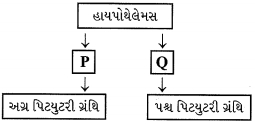
What are $P$ and $Q$ in the given chart?
A
$P -$ Hypophyseal portal vein,$Q -$ Axons of neurosecretory cells
B
$P -$ Axons of neurosecretory cells,$Q -$ Hypophyseal portal vein
C
$P -$ Hypophyseal portal vein,$Q -$ Hypophyseal portal vein
D
$P -$ Axons of neurosecretory cells,$Q -$ Axons of neurosecretory cells
Solution
(A) The hypothalamus regulates the pituitary gland through two distinct pathways:
$1$. The anterior pituitary gland is regulated by releasing and inhibiting hormones that travel from the hypothalamus to the anterior pituitary via the hypophyseal portal system (represented by $P$).
$2$. The posterior pituitary gland is under the direct neural control of the hypothalamus. Hormones are synthesized in the hypothalamic neurons and transported down their axons (represented by $Q$) to the posterior pituitary for storage and release.
Therefore,$P$ represents the hypophyseal portal vein and $Q$ represents the axons of neurosecretory cells.
$1$. The anterior pituitary gland is regulated by releasing and inhibiting hormones that travel from the hypothalamus to the anterior pituitary via the hypophyseal portal system (represented by $P$).
$2$. The posterior pituitary gland is under the direct neural control of the hypothalamus. Hormones are synthesized in the hypothalamic neurons and transported down their axons (represented by $Q$) to the posterior pituitary for storage and release.
Therefore,$P$ represents the hypophyseal portal vein and $Q$ represents the axons of neurosecretory cells.
0 likes
View Solution84
MediumMCQ
Where are the synthesis,storage,and action of $ADH$ (Antidiuretic Hormone) located,respectively?
A
Hypothalamus,Posterior Pituitary gland,Kidney
B
Posterior Pituitary gland,Hypothalamus,Kidney
C
Anterior Pituitary gland,Hypothalamus,Kidney
D
Hypothalamus,Anterior Pituitary gland,Kidney
Solution
(A) $ADH$ (Antidiuretic Hormone),also known as vasopressin,is synthesized by the neurosecretory cells of the hypothalamus.
It is then transported to the posterior pituitary gland (neurohypophysis),where it is stored and released into the bloodstream.
The primary target organ for $ADH$ is the kidney,specifically the distal convoluted tubules and collecting ducts,where it promotes water reabsorption to regulate fluid balance.
It is then transported to the posterior pituitary gland (neurohypophysis),where it is stored and released into the bloodstream.
The primary target organ for $ADH$ is the kidney,specifically the distal convoluted tubules and collecting ducts,where it promotes water reabsorption to regulate fluid balance.
0 likes
View Solution85
MediumMCQ
Identify the location of the hypothalamus.
A
Floor of the diencephalon located in the midbrain
B
Roof of the diencephalon located in the forebrain
C
Floor of the diencephalon located in the forebrain
D
Roof of the diencephalon located in the midbrain
Solution
(C) The hypothalamus is a part of the forebrain.
It is located at the base (floor) of the diencephalon.
It contains a number of centers which control body temperature,urge for eating and drinking.
It also contains several groups of neurosecretory cells,which secrete hormones called hypothalamic hormones.
It is located at the base (floor) of the diencephalon.
It contains a number of centers which control body temperature,urge for eating and drinking.
It also contains several groups of neurosecretory cells,which secrete hormones called hypothalamic hormones.
0 likes
View Solution86
MediumMCQ
The pituitary gland is under the control of ........
A
Adrenal cortex
B
Thyroid
C
Hypothalamus
D
Adrenal medulla
Solution
(C) The pituitary gland,often referred to as the master endocrine gland,is regulated by the hypothalamus.
It secretes releasing and inhibitory hormones that control the secretion of hormones from the anterior pituitary gland.
Additionally,the posterior pituitary gland is under the direct neural control of the hypothalamus.
It secretes releasing and inhibitory hormones that control the secretion of hormones from the anterior pituitary gland.
Additionally,the posterior pituitary gland is under the direct neural control of the hypothalamus.
0 likes
View Solution87
MediumMCQ
The site of origin of Gonadotropin Releasing Hormone $(GnRH)$ is $- P$.
The site of origin of Gonadotropin hormones is $- Q$.
Choose the correct option for $P$ and $Q$.
$\quad \quad P \quad \quad Q$
The site of origin of Gonadotropin hormones is $- Q$.
Choose the correct option for $P$ and $Q$.
$\quad \quad P \quad \quad Q$
A
Gonads $\quad$ Pituitary gland
B
Pituitary gland $\quad$ Gonads
C
Pituitary gland $\quad$ Hypothalamus
D
Hypothalamus $\quad$ Pituitary gland
Solution
(D) The Gonadotropin Releasing Hormone $(GnRH)$ is secreted by the hypothalamus.
It acts on the anterior pituitary gland to stimulate the secretion of gonadotropins.
The gonadotropins,which include Luteinizing Hormone $(LH)$ and Follicle Stimulating Hormone $(FSH)$,are secreted by the anterior pituitary gland.
Therefore,$P$ is the hypothalamus and $Q$ is the pituitary gland.
It acts on the anterior pituitary gland to stimulate the secretion of gonadotropins.
The gonadotropins,which include Luteinizing Hormone $(LH)$ and Follicle Stimulating Hormone $(FSH)$,are secreted by the anterior pituitary gland.
Therefore,$P$ is the hypothalamus and $Q$ is the pituitary gland.
0 likes
View Solution88
MediumMCQ
Which of the following hormones released from the pituitary is actually synthesized in the hypothalamus?
A
Luteinizing hormone $(LH)$
B
Anti-diuretic hormone $(ADH)$
C
Follicle-stimulating hormone $(FSH)$
D
Adenocorticotrophic hormone $(ACTH)$
Solution
(B) The posterior pituitary (neurohypophysis) does not synthesize hormones itself.
It stores and releases two hormones: Oxytocin and Anti-diuretic hormone $(ADH)$ (also known as Vasopressin).
These hormones are synthesized in the hypothalamus by the supraoptic and paraventricular nuclei.
They are transported along the axons of the hypothalamic neurons to the posterior pituitary for storage and subsequent release into the bloodstream.
In contrast,hormones like $LH$,$FSH$,and $ACTH$ are synthesized and secreted by the anterior pituitary (adenohypophysis).
It stores and releases two hormones: Oxytocin and Anti-diuretic hormone $(ADH)$ (also known as Vasopressin).
These hormones are synthesized in the hypothalamus by the supraoptic and paraventricular nuclei.
They are transported along the axons of the hypothalamic neurons to the posterior pituitary for storage and subsequent release into the bloodstream.
In contrast,hormones like $LH$,$FSH$,and $ACTH$ are synthesized and secreted by the anterior pituitary (adenohypophysis).
0 likes
View Solution89
MediumMCQ
Group of neurosecretory cells are present in :-
A
Thymus
B
Hypothalamus
C
Thyroid
D
$ (2) \& (3) $ both
Solution
(B) The $Hypothalamus$ contains several groups of neurosecretory cells called nuclei, which produce hormones. These hormones regulate the synthesis and secretion of pituitary hormones. Therefore, the correct answer is $Hypothalamus$.
0 likes
View Solution90
MediumMCQ
The neural centre which controls sexual behaviour and the urge for drinking is associated with $:-$
A
Thalamus
B
Hypothalamus
C
Pons
D
Cerebellum
Solution
(B) The $Hypothalamus$ is a vital part of the diencephalon located at the base of the thalamus.
It contains a number of centres which control body temperature, urge for eating and drinking, and sexual behaviour.
It also contains several groups of neurosecretory cells, which secrete hormones called hypothalamic hormones.
Therefore, the correct option is $B$.
It contains a number of centres which control body temperature, urge for eating and drinking, and sexual behaviour.
It also contains several groups of neurosecretory cells, which secrete hormones called hypothalamic hormones.
Therefore, the correct option is $B$.
0 likes
View Solution91
EasyMCQ
Osmoreceptors are present in the
A
Hypothalamus
B
Hypophysis
C
Epiphysis
D
Epithalamus
Solution
(A) Osmoreceptors are specialized sensory neurons located in the $Hypothalamus$ of the brain.
These receptors are highly sensitive to changes in blood osmolarity.
When there is an increase in blood osmolarity (e.g.,due to dehydration),osmoreceptors are activated.
This activation stimulates the $Hypothalamus$ to release $Antidiuretic$ $Hormone$ $(ADH)$ or $Vasopressin$ from the neurohypophysis,which promotes water reabsorption in the kidneys to maintain fluid balance.
These receptors are highly sensitive to changes in blood osmolarity.
When there is an increase in blood osmolarity (e.g.,due to dehydration),osmoreceptors are activated.
This activation stimulates the $Hypothalamus$ to release $Antidiuretic$ $Hormone$ $(ADH)$ or $Vasopressin$ from the neurohypophysis,which promotes water reabsorption in the kidneys to maintain fluid balance.
0 likes
View Solution92
EasyMCQ
Which hypothalamic hormones directly act on kidney tubules and uterus respectively?
A
Vasopressin and GnRH
B
Vasopressin and Adreno Corticotropin releasing hormone
C
Vasopressin and oxytocin
D
Oxytocin and Adreno corticotropin releasing hormone
Solution
(C) The hypothalamus produces two hormones,$Vasopressin$ $(ADH)$ and $Oxytocin$,which are transported axonally to the neurohypophysis (posterior pituitary) and stored there.
$1$. $Vasopressin$ ($Antidiuretic$ $Hormone$ or $ADH$) acts primarily on the kidney tubules to stimulate the reabsorption of water and electrolytes,thereby reducing water loss through urine.
$2$. $Oxytocin$ acts on the smooth muscles of the uterus and stimulates their contraction during childbirth (parturition) and also acts on the mammary glands to stimulate milk ejection.
Therefore,the correct pair is $Vasopressin$ and $Oxytocin$.
$1$. $Vasopressin$ ($Antidiuretic$ $Hormone$ or $ADH$) acts primarily on the kidney tubules to stimulate the reabsorption of water and electrolytes,thereby reducing water loss through urine.
$2$. $Oxytocin$ acts on the smooth muscles of the uterus and stimulates their contraction during childbirth (parturition) and also acts on the mammary glands to stimulate milk ejection.
Therefore,the correct pair is $Vasopressin$ and $Oxytocin$.
0 likes
View Solution93
EasyMCQ
Part of the brain which acts as the link between the endocrine system and the nervous system is . . . . . . .
A
epithalamus
B
hypothalamus
C
corpus callosum
D
corpus striatum
Solution
(B) The $hypothalamus$ is a small but crucial part of the brain located at the base of the diencephalon.
It serves as a vital bridge between the nervous system and the endocrine system.
It regulates the secretion of hormones from the pituitary gland through the release of releasing and inhibiting hormones.
Therefore, it acts as the master control center for both systems.
It serves as a vital bridge between the nervous system and the endocrine system.
It regulates the secretion of hormones from the pituitary gland through the release of releasing and inhibiting hormones.
Therefore, it acts as the master control center for both systems.
0 likes
View Solution94
EasyMCQ
Given below is a list of different hormones:
$(a)$ Prostaglandins $\quad$ $(b)$ Relaxin
$(c)$ Oxytocin $\quad$ $(d)$ Aldosterone
$(e)$ $ADH$ $\quad$ $(f)$ GnRH
Select the hormones secreted by the hypothalamus.
$(a)$ Prostaglandins $\quad$ $(b)$ Relaxin
$(c)$ Oxytocin $\quad$ $(d)$ Aldosterone
$(e)$ $ADH$ $\quad$ $(f)$ GnRH
Select the hormones secreted by the hypothalamus.
A
$(c)$,$(d)$,$(e)$
B
$(a)$,$(b)$,$(c)$
C
$(c)$,$(e)$,$(f)$
D
$(b)$,$(c)$,$(e)$
Solution
(C) The hypothalamus secretes releasing and inhibiting hormones,such as $GnRH$ (Gonadotropin-releasing hormone).
Additionally,the hypothalamus produces two hormones,Oxytocin and $ADH$ (Vasopressin),which are transported to and stored in the posterior pituitary gland (neurohypophysis) for release.
Therefore,the hormones associated with the hypothalamus from the given list are Oxytocin $(c)$,$ADH$ $(e)$,and $GnRH$ $(f)$.
Prostaglandins are lipid compounds secreted by various tissues like the seminal vesicles.
Relaxin is secreted by the ovary.
Aldosterone is secreted by the adrenal cortex.
Additionally,the hypothalamus produces two hormones,Oxytocin and $ADH$ (Vasopressin),which are transported to and stored in the posterior pituitary gland (neurohypophysis) for release.
Therefore,the hormones associated with the hypothalamus from the given list are Oxytocin $(c)$,$ADH$ $(e)$,and $GnRH$ $(f)$.
Prostaglandins are lipid compounds secreted by various tissues like the seminal vesicles.
Relaxin is secreted by the ovary.
Aldosterone is secreted by the adrenal cortex.
0 likes
View Solution95
EasyMCQ
Given below are two statements.
Statement $I$: Hypothalamus is a link between nervous and endocrine system.
Statement $II$: Adenohypophysis secretes neurohormones.
In light of above statements,select the correct answer from the option given below.
Statement $I$: Hypothalamus is a link between nervous and endocrine system.
Statement $II$: Adenohypophysis secretes neurohormones.
In light of above statements,select the correct answer from the option given below.
A
Statement $I$ is correct and statement $II$ is incorrect.
B
Both statement $I$ and statement $II$ are incorrect.
C
Both statement $I$ and statement $II$ are correct.
D
Statement $I$ is incorrect and statement $II$ is correct.
Solution
(A) Statement $I$ is correct: The hypothalamus acts as a bridge between the nervous system and the endocrine system by regulating the pituitary gland.
Statement $II$ is incorrect: The hypothalamus secretes neurohormones (releasing and inhibiting hormones),whereas the adenohypophysis (anterior pituitary) secretes tropic hormones like $GH$,$PRL$,$TSH$,$ACTH$,$LH$,and $FSH$ under the influence of these neurohormones.
Statement $II$ is incorrect: The hypothalamus secretes neurohormones (releasing and inhibiting hormones),whereas the adenohypophysis (anterior pituitary) secretes tropic hormones like $GH$,$PRL$,$TSH$,$ACTH$,$LH$,and $FSH$ under the influence of these neurohormones.
0 likes
View Solution96
EasyMCQ
The coordinator between the nervous and endocrine system is:
A
Thalamus
B
Hypothalamus
C
Epithalamus
D
Colliculus
Solution
(B) The $Hypothalamus$ acts as a vital link between the nervous system and the endocrine system.
It regulates the release of hormones from the pituitary gland,which is often called the master gland.
By secreting releasing and inhibiting hormones,the $Hypothalamus$ controls the body's homeostasis,including temperature,hunger,and thirst,thereby integrating neural and hormonal signals.
It regulates the release of hormones from the pituitary gland,which is often called the master gland.
By secreting releasing and inhibiting hormones,the $Hypothalamus$ controls the body's homeostasis,including temperature,hunger,and thirst,thereby integrating neural and hormonal signals.
0 likes
View Solution97
EasyMCQ
Hypothalamus of the brain is not involved in this function.
A
Sleep-wake cycle
B
Osmoregulation and thirst
C
Temperature control
D
Accuracy of muscular movement
Solution
(D) The correct answer is $D$.
$1$. The hypothalamus is a vital part of the diencephalon that regulates several homeostatic functions,including the sleep-wake cycle,osmoregulation,thirst,and body temperature control.
$2$. The accuracy of muscular movement,coordination,posture,and balance are primarily controlled by the cerebellum,which is a part of the hindbrain.
$3$. Therefore,the hypothalamus is not involved in the regulation of muscular movement accuracy.
$1$. The hypothalamus is a vital part of the diencephalon that regulates several homeostatic functions,including the sleep-wake cycle,osmoregulation,thirst,and body temperature control.
$2$. The accuracy of muscular movement,coordination,posture,and balance are primarily controlled by the cerebellum,which is a part of the hindbrain.
$3$. Therefore,the hypothalamus is not involved in the regulation of muscular movement accuracy.
0 likes
View Solution98
EasyMCQ
$A$ man is admitted to a hospital. He is suffering from an abnormally low body temperature,loss of appetite,and extreme thirst. His brain scan would probably show a tumor in
A
cerebellum
B
hypothalamus
C
medulla oblongata
D
pons
Solution
(B) hypothalamus.
The hypothalamus is the part of the brain that acts as the body's thermostat and regulates essential homeostatic functions,including body temperature,hunger (appetite),and thirst.
$A$ tumor in the hypothalamus disrupts these regulatory centers,leading to the clinical presentation of abnormally low body temperature (hypothermia),loss of appetite,and extreme thirst (polydipsia).
The hypothalamus is the part of the brain that acts as the body's thermostat and regulates essential homeostatic functions,including body temperature,hunger (appetite),and thirst.
$A$ tumor in the hypothalamus disrupts these regulatory centers,leading to the clinical presentation of abnormally low body temperature (hypothermia),loss of appetite,and extreme thirst (polydipsia).
0 likes
View SolutionChemical Coordination and Integration — Hypothalamus · Frequently Asked Questions
1Are these Chemical Coordination and Integration questions useful for JEE and NEET?
Yes. All questions in this section are mapped to JEE Main and NEET exam patterns. Previous year questions from JEE Main, NEET, GUJCET and state-level exams are included with full solutions.
2Can I switch to Hindi or Gujarati for these questions?
Yes. Use the language tabs in the hero section or the sidebar to view the same questions and solutions in English, Hindi or Gujarati.
3How do I generate a question paper from this subtopic?
Use the Vedclass Exam Paper Generator — select the chapter and subtopic, set difficulty, and generate Sets A, B, C, D automatically. First 3 chapters of every subject are free.
Vedclass Products
For Students
Vedclass Test Series
Mock tests in real JEE/NEET style with performance analysis. 5-day free trial.
Start Free TrialFor Teachers
Exam Paper Generator
Generate Set A/B/C/D papers from this chapter in 2 minutes. 3 chapters free.
Try FreeFor Institutes
Online Exam Module
Live online exams with unlimited students, 360° analytics & white-label branding.
See DemoFor Teachers & Institutes
Generate a Chemical Coordination and Integration Exam Paper in 2 Minutes
Select subtopic & difficulty — Sets A, B, C, D auto-generated with No Repeat logic.
First 3 chapters of every subject are free — no payment required.