
A English
Ribosomes Questions in English
Class 11 Biology · Cell: The Unit of Life · Ribosomes
174+
Questions
English
Language
100%
With Solutions
Showing 24 of 174 questions in English
151
MediumMCQ
The subunits of ribosomes of a prokaryotic cell are
A
$60\,S$ and $40\,S$
B
$20\,S$ and $90\,S$
C
$50\,S$ and $30\,S$
D
$30\,S$ and $60\,S$
Solution
(C) Prokaryotic cells contain $70\,S$ type ribosomes.
These ribosomes are composed of two subunits: a larger subunit of $50\,S$ and a smaller subunit of $30\,S$.
These ribosomes are composed of two subunits: a larger subunit of $50\,S$ and a smaller subunit of $30\,S$.
0 likes
View Solution152
EasyMCQ
Which of the following cell organelles is known as the protein factory?
A
Lysosome
B
Mitochondria
C
Nucleolus
D
Ribosome
Solution
(D) Ribosomes $\rightarrow$ Protein factory (Site for protein synthesis).
Lysosome $\rightarrow$ Suicidal bags as they contain hydrolytic enzymes.
Nucleolus $\rightarrow$ Site for $rRNA$ synthesis.
Mitochondria $\rightarrow$ Powerhouse of the cell. It is the site for $ATP$ synthesis.
Lysosome $\rightarrow$ Suicidal bags as they contain hydrolytic enzymes.
Nucleolus $\rightarrow$ Site for $rRNA$ synthesis.
Mitochondria $\rightarrow$ Powerhouse of the cell. It is the site for $ATP$ synthesis.
0 likes
View Solution153
MediumMCQ
The type of ribosomes found inside the mitochondria is (in $;S$)
A
$90$
B
$60$
C
$80$
D
$70$
Solution
(D) Mitochondria are semi-autonomous organelles that contain their own genetic material and protein-synthesizing machinery.
The ribosomes found within the mitochondria are of the $70\;S$ type,which is similar to the ribosomes found in prokaryotic cells.
In contrast,the ribosomes found in the cytoplasm of eukaryotic cells are of the $80\;S$ type.
The ribosomes found within the mitochondria are of the $70\;S$ type,which is similar to the ribosomes found in prokaryotic cells.
In contrast,the ribosomes found in the cytoplasm of eukaryotic cells are of the $80\;S$ type.
0 likes
View Solution154
MediumMCQ
Which of the following statements is incorrect with respect to ribosomes?
A
The type of ribosomes in prokaryotes is $70S$.
B
Ribosomes were discovered by George Palade.
C
They are made up of $RNA$ only.
D
Ribosomes are also known as protein factories.
Solution
(C) Ribosomes are composed of $rRNA$ and various ribosomal proteins,not just $RNA$. Therefore,the statement that they are made up of $RNA$ only is incorrect.
0 likes
View Solution155
MediumMCQ
The function of a polysome in a bacterial cell is to
A
Translate the $mRNA$ into protein
B
Store reserve food materials
C
Synthesize pigments
D
Help in buoyancy
Solution
(A) polysome (or polyribosome) consists of several ribosomes attached to a single $mRNA$ molecule.
This structure allows for the simultaneous translation of a single $mRNA$ strand into multiple copies of a polypeptide chain,thereby increasing the efficiency of protein synthesis in bacterial cells.
This structure allows for the simultaneous translation of a single $mRNA$ strand into multiple copies of a polypeptide chain,thereby increasing the efficiency of protein synthesis in bacterial cells.
0 likes
View Solution156
MediumMCQ
The larger sub-unit of a ribosome is found to contain $28S$,$5.8S$ and $5S$ types of $RNA$. This ribosome is found in
A
Bacterium
B
Mitochondrion
C
Animal cell
D
Chloroplast
Solution
(C) Ribosomes are classified based on their sedimentation coefficient $(S)$.
Eukaryotic ribosomes are $80S$,which consist of a larger $60S$ subunit and a smaller $40S$ subunit.
The $60S$ larger subunit of eukaryotic ribosomes contains $28S$ $rRNA$,$5.8S$ $rRNA$,and $5S$ $rRNA$.
Since animal cells are eukaryotic,they contain $80S$ ribosomes.
Prokaryotes (bacteria),mitochondria,and chloroplasts contain $70S$ ribosomes.
Eukaryotic ribosomes are $80S$,which consist of a larger $60S$ subunit and a smaller $40S$ subunit.
The $60S$ larger subunit of eukaryotic ribosomes contains $28S$ $rRNA$,$5.8S$ $rRNA$,and $5S$ $rRNA$.
Since animal cells are eukaryotic,they contain $80S$ ribosomes.
Prokaryotes (bacteria),mitochondria,and chloroplasts contain $70S$ ribosomes.
0 likes
View Solution157
EasyMCQ
An element which helps in joining the subunits of ribosomes is
A
$Ca$
B
$Mg$
C
$K$
D
$S$
Solution
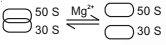
(B) Magnesium $(Mg^{2+})$ ions play a crucial role in maintaining the structural integrity of ribosomes.
They act as a bridge between the two ribosomal subunits (e.g.,$30S$ and $50S$ in prokaryotes).
At a specific concentration of $Mg^{2+}$,the two subunits remain associated to form a functional ribosome.
If the concentration of $Mg^{2+}$ decreases,the subunits dissociate into their individual components.
They act as a bridge between the two ribosomal subunits (e.g.,$30S$ and $50S$ in prokaryotes).
At a specific concentration of $Mg^{2+}$,the two subunits remain associated to form a functional ribosome.
If the concentration of $Mg^{2+}$ decreases,the subunits dissociate into their individual components.
0 likes
View Solution158
EasyMCQ
Which cell organelle is involved in the synthesis of proteins?
A
Nucleus
B
Ribosome
C
Cell wall
D
Plasma membrane
Solution
(B) The $Ribosome$ is the cell organelle primarily responsible for protein synthesis.
It translates messenger $RNA$ $(mRNA)$ into polypeptide chains,which then fold into functional proteins.
While the $Nucleus$ contains the genetic information $(DNA)$ required for protein synthesis,the actual assembly of amino acids occurs at the $Ribosome$.
It translates messenger $RNA$ $(mRNA)$ into polypeptide chains,which then fold into functional proteins.
While the $Nucleus$ contains the genetic information $(DNA)$ required for protein synthesis,the actual assembly of amino acids occurs at the $Ribosome$.
0 likes
View Solution159
EasyMCQ
What does '$S$' refer to in a $70S$ and an $80S$ ribosome?
A
Svedberg unit
B
Sedimentation coefficient
C
Both $A$ and $B$
D
Size of ribosome
Solution
(C) In the context of ribosomes,'$S$' stands for the Svedberg unit.
It is a measure of the rate at which a particle sediments in a centrifugal field.
It is also known as the sedimentation coefficient.
This unit reflects the size and density of the ribosome,which determines how fast it settles during ultracentrifugation.
It is a measure of the rate at which a particle sediments in a centrifugal field.
It is also known as the sedimentation coefficient.
This unit reflects the size and density of the ribosome,which determines how fast it settles during ultracentrifugation.
0 likes
View Solution160
MediumMCQ
What is the function of a polysome? (Gk. Poly = many,Soma = body)
A
To synthesize lipids
B
To translate mRNA into proteins
C
To store genetic information
D
To synthesize carbohydrates
Solution
(B) polysome (or polyribosome) is a structure consisting of multiple ribosomes attached to a single $mRNA$ molecule.
Its primary function is to translate the genetic code present on the $mRNA$ into a polypeptide chain (protein).
By having multiple ribosomes reading the same $mRNA$ simultaneously,the cell can produce many copies of the same protein efficiently during active protein synthesis.
Its primary function is to translate the genetic code present on the $mRNA$ into a polypeptide chain (protein).
By having multiple ribosomes reading the same $mRNA$ simultaneously,the cell can produce many copies of the same protein efficiently during active protein synthesis.
0 likes
View Solution161
EasyMCQ
Which of the following organelles is found in both prokaryotic and eukaryotic cells?
A
Ribosomes
B
Centriole
C
Nucleolus
D
All of the above
Solution
(A) Ribosomes are non-membrane-bound organelles found in all living cells,including both prokaryotes and eukaryotes.
In prokaryotes,they are $70S$ type,while in eukaryotes,they are $80S$ type in the cytoplasm and $70S$ type in organelles like mitochondria and chloroplasts.
Centrioles and nucleoli are membrane-less structures but are specific to eukaryotic cells only.
In prokaryotes,they are $70S$ type,while in eukaryotes,they are $80S$ type in the cytoplasm and $70S$ type in organelles like mitochondria and chloroplasts.
Centrioles and nucleoli are membrane-less structures but are specific to eukaryotic cells only.
0 likes
View Solution162
MediumMCQ
Which organelle is known as the factory of proteins?
A
Inclusion bodies
B
Polyribosomes
C
Nucleus
D
Golgi apparatus
Solution
(B) Ribosomes are the sites of protein synthesis in the cell. Because they are responsible for synthesizing proteins,they are commonly referred to as the 'protein factories' of the cell. Among the given options,polyribosomes (or polysomes) are chains of ribosomes attached to a single mRNA molecule,which are actively involved in protein synthesis.
0 likes
View Solution163
MediumMCQ
The size of ribosomes is $.......$
A
$15$ to $20 \text{ nm}$
B
$15$ to $20 \mu\text{m}$
C
$20$ to $25 \text{ nm}$
D
$20$ to $25 \mu\text{m}$
Solution
(A) Ribosomes are non-membrane-bound organelles found in both prokaryotic and eukaryotic cells.
They are composed of ribonucleic acids $(RNA)$ and proteins.
According to the $NCERT$ textbook,the size of ribosomes is approximately $15 \text{ nm}$ by $20 \text{ nm}$.
Therefore,the correct option is $A$.
They are composed of ribonucleic acids $(RNA)$ and proteins.
According to the $NCERT$ textbook,the size of ribosomes is approximately $15 \text{ nm}$ by $20 \text{ nm}$.
Therefore,the correct option is $A$.
0 likes
View Solution164
MediumMCQ
$70S$ ribosomes are composed of which subunits?
A
$50S + 20S$
B
$40S + 30S$
C
$50S + 30S$
D
$60S + 40S$
Solution
(C) Ribosomes are the granular structures first observed under the electron microscope as dense particles by George Palade in $1953$.
They are composed of ribonucleic acids $(RNA)$ and proteins and are not surrounded by any membrane.
Prokaryotic ribosomes are of the $70S$ type,which are composed of two subunits: a larger subunit $(50S)$ and a smaller subunit $(30S)$.
Eukaryotic ribosomes are of the $80S$ type,which are composed of a larger subunit $(60S)$ and a smaller subunit $(40S)$.
Therefore,$70S$ ribosomes consist of $50S$ and $30S$ subunits.
They are composed of ribonucleic acids $(RNA)$ and proteins and are not surrounded by any membrane.
Prokaryotic ribosomes are of the $70S$ type,which are composed of two subunits: a larger subunit $(50S)$ and a smaller subunit $(30S)$.
Eukaryotic ribosomes are of the $80S$ type,which are composed of a larger subunit $(60S)$ and a smaller subunit $(40S)$.
Therefore,$70S$ ribosomes consist of $50S$ and $30S$ subunits.
0 likes
View Solution165
EasyMCQ
Which cell organelle is known as the Palade particle?
A
Mitochondria
B
Ribosomes
C
Chloroplast
D
Endoplasmic reticulum
Solution
(B) The term $Palade$ $particle$ refers to $Ribosomes$.
These particles were first observed and described by the Romanian-American cell biologist $George$ $Emil$ $Palade$ in the $1950s$ using an electron microscope.
$Ribosomes$ are dense,granular structures composed of $RNA$ and proteins,and they are the sites of protein synthesis in the cell.
These particles were first observed and described by the Romanian-American cell biologist $George$ $Emil$ $Palade$ in the $1950s$ using an electron microscope.
$Ribosomes$ are dense,granular structures composed of $RNA$ and proteins,and they are the sites of protein synthesis in the cell.
0 likes
View Solution166
EasyMCQ
Which of the following is present in the structure of a ribosome?
A
Ribonucleic acid and protein
B
Ribonucleic acid and carbohydrate
C
Deoxyribonucleic acid and protein
D
Deoxyribonucleic acid and carbohydrate
Solution
(A) Ribosomes are non-membrane-bound organelles found in all living cells. They are composed of ribonucleic acid $(RNA)$ and proteins. They do not contain deoxyribonucleic acid $(DNA)$ or carbohydrates as their primary structural components. Therefore,the correct composition is $RNA$ and protein.
0 likes
View Solution167
MediumMCQ
$80S$ ribosomes $= .............$
A
$50S + 30S$
B
$60S + 20S$
C
$60S + 30S$
D
$60S + 40S$
Solution
(D) Ribosomes are the granular structures first observed under the electron microscope as dense particles by George Palade in $1953$.
They are composed of ribonucleic acids $(RNA)$ and proteins and are not surrounded by any membrane.
Eukaryotic ribosomes are of the $80S$ type,while prokaryotic ribosomes are of the $70S$ type.
Each ribosome consists of two subunits.
The $80S$ ribosome is composed of a larger subunit $(60S)$ and a smaller subunit $(40S)$.
They are composed of ribonucleic acids $(RNA)$ and proteins and are not surrounded by any membrane.
Eukaryotic ribosomes are of the $80S$ type,while prokaryotic ribosomes are of the $70S$ type.
Each ribosome consists of two subunits.
The $80S$ ribosome is composed of a larger subunit $(60S)$ and a smaller subunit $(40S)$.
0 likes
View Solution168
EasyMCQ
Which element stabilizes the structure of ribosomes?
A
Manganese
B
Magnesium
C
Sulfur
D
Iron
Solution
(B) Magnesium $(Mg^{2+})$ ions play a crucial role in maintaining the structural integrity of ribosomes. Ribosomes consist of two subunits,a larger and a smaller one. $Mg^{2+}$ ions are required to bind these two subunits together to form a functional ribosome during protein synthesis. If the concentration of $Mg^{2+}$ decreases,the subunits dissociate.
0 likes
View Solution169
MediumMCQ
How many different proteins does the ribosome consist of?
A
$20$
B
$80$
C
$60$
D
$40$
Solution
(B) The ribosome is a complex cellular structure composed of ribosomal $RNA$ $(rRNA)$ and various proteins. In eukaryotic cells,the ribosome consists of structural RNAs and approximately $80$ different proteins that work together to facilitate the process of protein synthesis (translation).
0 likes
View Solution170
MediumMCQ
From the statements given below,choose the correct option:
$A.$ The eukaryotic ribosomes are $80S$ and prokaryotic ribosomes are $70S$.
$B.$ Each ribosome has two sub-units.
$C.$ The two sub-units of $80S$ ribosome are $60S$ and $40S$,while those of $70S$ are $50S$ and $30S$.
$D.$ The two sub-units of $80S$ ribosome are $60S$ and $20S$,and those of $70S$ are $50S$ and $20S$.
$E.$ The two sub-units of $80S$ ribosome are $60S$ and $30S$,and those of $70S$ are $50S$ and $30S$.
$A.$ The eukaryotic ribosomes are $80S$ and prokaryotic ribosomes are $70S$.
$B.$ Each ribosome has two sub-units.
$C.$ The two sub-units of $80S$ ribosome are $60S$ and $40S$,while those of $70S$ are $50S$ and $30S$.
$D.$ The two sub-units of $80S$ ribosome are $60S$ and $20S$,and those of $70S$ are $50S$ and $20S$.
$E.$ The two sub-units of $80S$ ribosome are $60S$ and $30S$,and those of $70S$ are $50S$ and $30S$.
A
$A, B, C$ are true
B
$A, B, D$ are true
C
$A, B, E$ are true
D
$B, D, E$ are true
Solution
(A) Ribosomes are non-membrane-bound organelles found in both prokaryotic and eukaryotic cells.
Statement $A$ is true: Eukaryotic ribosomes are $80S$ (cytoplasmic) and prokaryotic ribosomes are $70S$.
Statement $B$ is true: Every ribosome consists of two sub-units (a larger and a smaller one).
Statement $C$ is true: The $80S$ ribosome is composed of $60S$ and $40S$ sub-units,while the $70S$ ribosome is composed of $50S$ and $30S$ sub-units.
Statements $D$ and $E$ are incorrect because they provide wrong combinations of sub-units.
Therefore,statements $A, B,$ and $C$ are correct.
Statement $A$ is true: Eukaryotic ribosomes are $80S$ (cytoplasmic) and prokaryotic ribosomes are $70S$.
Statement $B$ is true: Every ribosome consists of two sub-units (a larger and a smaller one).
Statement $C$ is true: The $80S$ ribosome is composed of $60S$ and $40S$ sub-units,while the $70S$ ribosome is composed of $50S$ and $30S$ sub-units.
Statements $D$ and $E$ are incorrect because they provide wrong combinations of sub-units.
Therefore,statements $A, B,$ and $C$ are correct.
0 likes
View Solution171
MediumMCQ
Ribosomes are composed of $-$
A
Ribonucleic acid $\text{(RNA)}$ and Lipid
B
Deoxyribonucleic acid $\text{(DNA)}$ and protein
C
Ribonucleic acid $\text{(RNA)}$ and protein
D
Deoxyribonucleic acid $\text{(DNA)}$ and Lipid
Solution
(C) Ribosomes are non-membrane-bound organelles found in both prokaryotic and eukaryotic cells.
They are the sites of protein synthesis.
Chemically,ribosomes are composed of Ribonucleic acid $\text{(RNA)}$ and proteins.
They do not contain $\text{DNA}$ or lipids as their primary structural components.
Therefore,the correct option is $C$.
They are the sites of protein synthesis.
Chemically,ribosomes are composed of Ribonucleic acid $\text{(RNA)}$ and proteins.
They do not contain $\text{DNA}$ or lipids as their primary structural components.
Therefore,the correct option is $C$.
0 likes
View Solution172
MediumMCQ
Besides the nucleus,eukaryotic cells have other membrane-bound distinct structures called organelles. Which one is odd according to the given statement?
A
$ER$
B
Golgi body
C
Ribosome
D
Lysosome
Solution
(C) Eukaryotic cells contain various membrane-bound organelles such as the Endoplasmic Reticulum $(ER)$,Golgi body,and Lysosomes.
Ribosomes are non-membrane-bound organelles found in both prokaryotic and eukaryotic cells.
Therefore,the Ribosome is the odd one out because it lacks a membrane.
Ribosomes are non-membrane-bound organelles found in both prokaryotic and eukaryotic cells.
Therefore,the Ribosome is the odd one out because it lacks a membrane.
0 likes
View Solution173
EasyMCQ
Which one of the following elements is an important binding agent in ribosomes during protein synthesis?
A
Magnesium
B
Sulphur
C
Phosphorus
D
Manganese
Solution
(A) $Mg^{2+}$ ions play a crucial role in maintaining the structural integrity of ribosomes.
During protein synthesis,$Mg^{2+}$ ions act as a binding agent that helps in the association of the two ribosomal subunits ($60S$ and $40S$ in eukaryotes,or $50S$ and $30S$ in prokaryotes) to form a functional $80S$ or $70S$ ribosome,respectively.
During protein synthesis,$Mg^{2+}$ ions act as a binding agent that helps in the association of the two ribosomal subunits ($60S$ and $40S$ in eukaryotes,or $50S$ and $30S$ in prokaryotes) to form a functional $80S$ or $70S$ ribosome,respectively.
0 likes
View Solution174
EasyMCQ
Non-membrane bound cell organelles found in both prokaryotic and eukaryotic cells are . . . . . . .
A
Lysosomes
B
Centrosomes
C
Mitochondria
D
Ribosomes
Solution
(D) Ribosomes are non-membrane bound cell organelles found in both prokaryotic and eukaryotic cells.
In prokaryotes,they are $70S$ ribosomes,whereas in eukaryotes,they can be $80S$ (cytosol) or $70S$ (organelles like mitochondria and chloroplasts).
Lysosomes,centrosomes,and mitochondria are membrane-bound organelles.
In prokaryotes,they are $70S$ ribosomes,whereas in eukaryotes,they can be $80S$ (cytosol) or $70S$ (organelles like mitochondria and chloroplasts).
Lysosomes,centrosomes,and mitochondria are membrane-bound organelles.
0 likes
View SolutionCell: The Unit of Life — Ribosomes · Frequently Asked Questions
1Are these Cell: The Unit of Life questions useful for JEE and NEET?
Yes. All questions in this section are mapped to JEE Main and NEET exam patterns. Previous year questions from JEE Main, NEET, GUJCET and state-level exams are included with full solutions.
2Can I switch to Hindi or Gujarati for these questions?
Yes. Use the language tabs in the hero section or the sidebar to view the same questions and solutions in English, Hindi or Gujarati.
3How do I generate a question paper from this subtopic?
Use the Vedclass Exam Paper Generator — select the chapter and subtopic, set difficulty, and generate Sets A, B, C, D automatically. First 3 chapters of every subject are free.
Vedclass Products
For Students
Vedclass Test Series
Mock tests in real JEE/NEET style with performance analysis. 5-day free trial.
Start Free TrialFor Teachers
Exam Paper Generator
Generate Set A/B/C/D papers from this chapter in 2 minutes. 3 chapters free.
Try FreeFor Institutes
Online Exam Module
Live online exams with unlimited students, 360° analytics & white-label branding.
See DemoFor Teachers & Institutes
Generate a Cell: The Unit of Life Exam Paper in 2 Minutes
Select subtopic & difficulty — Sets A, B, C, D auto-generated with No Repeat logic.
First 3 chapters of every subject are free — no payment required.