
A English
Lysosome Questions in English
Class 11 Biology · Cell: The Unit of Life · Lysosome
89+
Questions
English
Language
100%
With Solutions
Showing 39 of 89 questions in English
51
EasyMCQ
Which of the following organelles contains hydrolytic enzymes?
A
Endoplasmic reticulum
B
Lysosomes
C
Golgi apparatus
D
Mitochondria
Solution
(B) Lysosomes are membrane-bound vesicular structures formed by the process of packaging in the Golgi apparatus.
These organelles are rich in hydrolytic enzymes such as lipases,proteases,and carbohydrases.
These enzymes are optimally active at the acidic $pH$ and are capable of digesting carbohydrates,proteins,lipids,and nucleic acids.
Therefore,the correct option is $B$.
These organelles are rich in hydrolytic enzymes such as lipases,proteases,and carbohydrases.
These enzymes are optimally active at the acidic $pH$ and are capable of digesting carbohydrates,proteins,lipids,and nucleic acids.
Therefore,the correct option is $B$.
0 likes
View Solution52
EasyMCQ
Which of the following organelles is responsible for the degradation of cellular components and foreign materials?
A
Ribosome
B
Centrosome
C
Lysosome
D
Golgi apparatus
Solution
(C) Lysosomes are membrane-bound vesicular structures formed by the process of packaging in the Golgi apparatus. They are rich in hydrolytic enzymes (hydrolases - lipases,proteases,carbohydrases) optimally active at the acidic pH. These enzymes are capable of digesting carbohydrates,proteins,lipids,and nucleic acids. Therefore,lysosomes are responsible for the degradation of worn-out cellular components and foreign materials entering the cell.
0 likes
View Solution53
EasyMCQ
Which of the following is a single-membrane-bound organelle?
A
Mitochondria
B
Lysosome
C
Ribosomes
D
Nucleus
Solution
(B) The cell organelles can be classified based on the number of membranes they possess:
$1$. Double-membrane-bound organelles: Mitochondria,Chloroplasts,and Nucleus.
$2$. Single-membrane-bound organelles: Lysosomes,Vacuoles,Golgi apparatus,and Endoplasmic Reticulum.
$3$. Non-membrane-bound organelles: Ribosomes and Centrosomes.
Among the given options,the Lysosome is a single-membrane-bound organelle. Mitochondria are double-membrane-bound,Ribosomes are non-membrane-bound,and the Nucleus is double-membrane-bound.
$1$. Double-membrane-bound organelles: Mitochondria,Chloroplasts,and Nucleus.
$2$. Single-membrane-bound organelles: Lysosomes,Vacuoles,Golgi apparatus,and Endoplasmic Reticulum.
$3$. Non-membrane-bound organelles: Ribosomes and Centrosomes.
Among the given options,the Lysosome is a single-membrane-bound organelle. Mitochondria are double-membrane-bound,Ribosomes are non-membrane-bound,and the Nucleus is double-membrane-bound.
0 likes
View Solution54
EasyMCQ
Which organelle is known as the 'suicide bag' of the cell?
A
Lysosome
B
Ribosome
C
Golgi apparatus
D
Mitochondria
Solution
(A) Lysosomes are membrane-bound vesicular structures formed by the process of packaging in the Golgi apparatus. They contain hydrolytic enzymes (hydrolases like lipases,proteases,and carbohydrases) that are optimally active at the acidic $pH$. These enzymes are capable of digesting carbohydrates,proteins,lipids,and nucleic acids. When the cell gets damaged or its metabolic processes are disturbed,lysosomes may burst,and the enzymes digest their own cell organelles. Hence,they are known as the 'suicide bags' of the cell.
0 likes
View Solution55
MediumMCQ
Which of the following statements is false?
A
Lysosomes contain hydrolytic enzymes.
B
Lysosomes are known as suicidal bags.
C
Lysosomes are capable of digesting almost all macromolecules.
D
Lysosomes are surrounded by a double-layered membrane.
Solution
(D) Lysosomes are membrane-bound vesicular structures formed by the process of packaging in the Golgi apparatus.
They contain hydrolytic enzymes (hydrolases - lipases,proteases,carbohydrases) that are optimally active at the acidic $pH$.
These enzymes are capable of digesting carbohydrates,proteins,lipids,and nucleic acids,hence they are often called 'suicidal bags' of the cell.
However,lysosomes are single-membrane-bound organelles,not double-membrane-bound. Therefore,the statement that they are surrounded by a double-layered membrane is false.
They contain hydrolytic enzymes (hydrolases - lipases,proteases,carbohydrases) that are optimally active at the acidic $pH$.
These enzymes are capable of digesting carbohydrates,proteins,lipids,and nucleic acids,hence they are often called 'suicidal bags' of the cell.
However,lysosomes are single-membrane-bound organelles,not double-membrane-bound. Therefore,the statement that they are surrounded by a double-layered membrane is false.
0 likes
View Solution56
MediumMCQ
$A$: Hydrolase type enzymes can digest all macromolecules.
$R$: Lysosomes are associated with phagocytosis and pinocytosis.
$R$: Lysosomes are associated with phagocytosis and pinocytosis.
A
$A$ and $R$ are both true and $R$ is the correct explanation of $A$.
B
$A$ is false and $R$ is true.
C
$A$ is true and $R$ is false.
D
$A$ and $R$ are both true,but $R$ is not the correct explanation of $A$.
Solution
(B) is false because hydrolase enzymes (like lipases,proteases,and carbohydrases) are specific to their substrates and cannot digest all types of macromolecules indiscriminately.
$R$ is true because lysosomes contain various hydrolytic enzymes and are involved in intracellular digestion,including the digestion of materials taken in by phagocytosis (cell eating) and pinocytosis (cell drinking).
$R$ is true because lysosomes contain various hydrolytic enzymes and are involved in intracellular digestion,including the digestion of materials taken in by phagocytosis (cell eating) and pinocytosis (cell drinking).
0 likes
View Solution57
MediumMCQ
The organelle important for phagocytosis and pinocytosis is ........
A
Lysosome
B
Vacuole
C
Plasma membrane
D
Mitochondria
Solution
(A) Phagocytosis (cell eating) and pinocytosis (cell drinking) are processes of endocytosis.
Lysosomes are membrane-bound vesicular structures formed by the process of packaging in the Golgi apparatus.
They contain hydrolytic enzymes (hydrolases - lipases,proteases,carbohydrases) that are optimally active at the acidic $pH$.
These enzymes are responsible for the digestion of macromolecules,including materials taken into the cell via phagocytosis or pinocytosis,as well as the digestion of worn-out cell organelles (autophagy).
Lysosomes are membrane-bound vesicular structures formed by the process of packaging in the Golgi apparatus.
They contain hydrolytic enzymes (hydrolases - lipases,proteases,carbohydrases) that are optimally active at the acidic $pH$.
These enzymes are responsible for the digestion of macromolecules,including materials taken into the cell via phagocytosis or pinocytosis,as well as the digestion of worn-out cell organelles (autophagy).
0 likes
View Solution58
MediumMCQ
$A$ cell organelle containing hydrolytic enzymes is
A
lysosome
B
microsome
C
ribosome
D
mesosome
Solution
(A) : Lysosomes are small vesicles bounded by a single membrane that contain hydrolytic enzymes in the form of minute crystalline or semicrystalline granules of $5-8 \ nm$.
About $50$ enzymes have been recorded to occur in them.
All the enzymes do not occur in the same lysosome,but there are different sets of enzymes in different types of lysosomes.
The important enzymes include acid phosphatases,sulphatases,proteases,peptidases,nucleases,lipases,and carbohydrases.
They are also called acid hydrolases because these digestive enzymes usually function in an acidic medium with a $pH$ of $4-5$.
About $50$ enzymes have been recorded to occur in them.
All the enzymes do not occur in the same lysosome,but there are different sets of enzymes in different types of lysosomes.
The important enzymes include acid phosphatases,sulphatases,proteases,peptidases,nucleases,lipases,and carbohydrases.
They are also called acid hydrolases because these digestive enzymes usually function in an acidic medium with a $pH$ of $4-5$.
0 likes
View Solution59
EasyMCQ
Which one of the following cell organelles is enclosed by a single membrane?
A
Lysosomes
B
Nuclei
C
Mitochondria
D
Chloroplasts
Solution
(A) : Lysosomes are small vesicles bounded by a single membrane and contain hydrolytic enzymes.
Nucleus,mitochondria,and chloroplasts are double-membrane-bound cell organelles.
Nucleus,mitochondria,and chloroplasts are double-membrane-bound cell organelles.
0 likes
View Solution60
EasyMCQ
Which kind of enzymes are present in lysosomes?
A
Hydrolases
B
Oxido-reductases
C
Ligases
D
Transferases
Solution
(A) Lysosomes are membrane-bound vesicular structures formed by the process of packaging in the Golgi apparatus.
These organelles are rich in hydrolytic enzymes (hydrolases) such as lipases,proteases,and carbohydrases.
These enzymes are optimally active at the acidic $pH$ level.
Therefore,the correct option is $A$.
These organelles are rich in hydrolytic enzymes (hydrolases) such as lipases,proteases,and carbohydrases.
These enzymes are optimally active at the acidic $pH$ level.
Therefore,the correct option is $A$.
0 likes
View Solution61
EasyMCQ
Which of the following is a single-membrane-bound organelle?
A
Mitochondrion
B
Chloroplast
C
Lysosome
D
Nucleolus
Solution
(C) $1$. Mitochondria and Chloroplasts are double-membrane-bound organelles.
$2$. The Nucleolus is a non-membrane-bound structure found within the nucleus.
$3$. Lysosomes are single-membrane-bound organelles containing hydrolytic enzymes.
$2$. The Nucleolus is a non-membrane-bound structure found within the nucleus.
$3$. Lysosomes are single-membrane-bound organelles containing hydrolytic enzymes.
0 likes
View Solution62
MediumMCQ
Which organelle is involved in phagocytosis?
A
Cell membrane
B
Lysosome
C
Nucleus
D
Ribosomes
Solution
(B) Phagocytosis is a process by which cells engulf large particles or microorganisms.
Lysosomes are membrane-bound organelles containing hydrolytic enzymes that are responsible for the digestion of these engulfed materials.
Once the phagosome (the vesicle containing the engulfed material) fuses with a lysosome,the enzymes break down the contents,making the lysosome the primary organelle involved in the intracellular digestion phase of phagocytosis.
Lysosomes are membrane-bound organelles containing hydrolytic enzymes that are responsible for the digestion of these engulfed materials.
Once the phagosome (the vesicle containing the engulfed material) fuses with a lysosome,the enzymes break down the contents,making the lysosome the primary organelle involved in the intracellular digestion phase of phagocytosis.
0 likes
View Solution63
EasyMCQ
What happens if a lysosome present in a cell bursts?
A
Cell becomes turgid
B
Cell dies
C
Cell shrinks
D
No process occurs
Solution
(B) Lysosomes contain powerful digestive enzymes (hydrolytic enzymes) that are capable of breaking down all types of organic materials. When a lysosome bursts, these enzymes are released into the cytoplasm of the cell. These enzymes begin to digest the cell's own organelles and cellular components. Because of this self-digesting activity, lysosomes are often referred to as the '$suicide \text{ bags}$' of the cell. Consequently, the cell undergoes autolysis and eventually dies.
0 likes
View Solution64
MediumMCQ
Which sentences are correct for lysosomes?
$1-$ It is a suicidal bag.
$2-$ It possesses one layer.
$3-$ It is a self-replicating organelle.
$4-$ It contains hydrolase type of digestive enzymes.
$5-$ It is always seen near the nucleus.
$6-$ It plays an important role in phagocytosis and pinocytosis.
$7-$ It is present in animal cells and also in plant cells.
$1-$ It is a suicidal bag.
$2-$ It possesses one layer.
$3-$ It is a self-replicating organelle.
$4-$ It contains hydrolase type of digestive enzymes.
$5-$ It is always seen near the nucleus.
$6-$ It plays an important role in phagocytosis and pinocytosis.
$7-$ It is present in animal cells and also in plant cells.
A
$1, 6, 5, 4, 2$
B
$2, 3, 6, 7, 4$
C
$1, 3, 5, 7, 4$
D
$1, 2, 4, 6, 7$
Solution
(D) Lysosomes are membrane-bound vesicular structures formed by the process of packaging in the Golgi apparatus.
$1-$ They are known as 'suicidal bags' due to the presence of hydrolytic enzymes that can digest the cell itself.
$2-$ They are single-membrane-bound organelles.
$3-$ Lysosomes are not self-replicating organelles (unlike mitochondria and chloroplasts).
$4-$ They contain various hydrolytic enzymes (hydrolases like lipases,proteases,carbohydrases) which are optimally active at acidic $pH$.
$5-$ They are not restricted to being near the nucleus; they are distributed throughout the cytoplasm.
$6-$ They play a crucial role in intracellular digestion,including phagocytosis and pinocytosis.
$7-$ Lysosomes are primarily found in animal cells,though similar structures (vacuoles) perform related functions in plant cells,they are generally considered characteristic of animal cells.
Therefore,statements $1, 2, 4, 6,$ and $7$ are correct.
$1-$ They are known as 'suicidal bags' due to the presence of hydrolytic enzymes that can digest the cell itself.
$2-$ They are single-membrane-bound organelles.
$3-$ Lysosomes are not self-replicating organelles (unlike mitochondria and chloroplasts).
$4-$ They contain various hydrolytic enzymes (hydrolases like lipases,proteases,carbohydrases) which are optimally active at acidic $pH$.
$5-$ They are not restricted to being near the nucleus; they are distributed throughout the cytoplasm.
$6-$ They play a crucial role in intracellular digestion,including phagocytosis and pinocytosis.
$7-$ Lysosomes are primarily found in animal cells,though similar structures (vacuoles) perform related functions in plant cells,they are generally considered characteristic of animal cells.
Therefore,statements $1, 2, 4, 6,$ and $7$ are correct.
0 likes
View Solution65
MediumMCQ
Which is another function of $Golgi$ bodies other than the formation of secretory vesicles?
A
Formation of lysosomes
B
Formation of spindle fibers
C
Formation of endoplasmic reticulum
D
All of the above
Solution
(A) $Golgi$ bodies are primarily involved in the packaging and modification of proteins and lipids.
Apart from the formation of secretory vesicles,$Golgi$ bodies play a crucial role in the formation of lysosomes.
Lysosomes are membrane-bound organelles that contain digestive enzymes,which are synthesized in the rough endoplasmic reticulum and then processed and packaged by the $Golgi$ apparatus.
Spindle fibers are formed by microtubules (tubulin proteins),and the endoplasmic reticulum is a distinct organelle system,so options $B$ and $C$ are incorrect.
Apart from the formation of secretory vesicles,$Golgi$ bodies play a crucial role in the formation of lysosomes.
Lysosomes are membrane-bound organelles that contain digestive enzymes,which are synthesized in the rough endoplasmic reticulum and then processed and packaged by the $Golgi$ apparatus.
Spindle fibers are formed by microtubules (tubulin proteins),and the endoplasmic reticulum is a distinct organelle system,so options $B$ and $C$ are incorrect.
0 likes
View Solution66
MediumMCQ
Which of the following orders is correct for the synthesis of a hydrolase enzyme until its packaging into a lysosome?
A
$RER \rightarrow \text{Cis-Golgi} \rightarrow \text{Trans-Golgi} \rightarrow \text{Lysosome}$
B
$SER \rightarrow RER \rightarrow \text{Cis-Golgi} \rightarrow \text{Lysosome}$
C
$RER \rightarrow \text{Trans-Golgi} \rightarrow \text{Cis-Golgi} \rightarrow \text{Lysosome}$
D
$RER \rightarrow \text{Vesicle} \rightarrow \text{Trans-Golgi} \rightarrow \text{Lysosome}$
Solution
(A) The synthesis and transport of lysosomal hydrolases follow a specific pathway:
$1$. Synthesis: Hydrolase enzymes are proteins synthesized by ribosomes attached to the $RER$ (Rough Endoplasmic Reticulum).
$2$. Transport to Golgi: These proteins are transported from the $RER$ to the $Cis$ face of the Golgi apparatus via transport vesicles.
$3$. Processing: Inside the Golgi apparatus,the enzymes move from the $Cis$ face to the $Trans$ face,where they undergo modification and maturation.
$4$. Packaging: Finally,the mature hydrolases are packaged into vesicles that bud off from the $Trans$ face of the Golgi to form lysosomes.
Therefore,the correct sequence is $RER \rightarrow \text{Cis-Golgi} \rightarrow \text{Trans-Golgi} \rightarrow \text{Lysosome}$.
$1$. Synthesis: Hydrolase enzymes are proteins synthesized by ribosomes attached to the $RER$ (Rough Endoplasmic Reticulum).
$2$. Transport to Golgi: These proteins are transported from the $RER$ to the $Cis$ face of the Golgi apparatus via transport vesicles.
$3$. Processing: Inside the Golgi apparatus,the enzymes move from the $Cis$ face to the $Trans$ face,where they undergo modification and maturation.
$4$. Packaging: Finally,the mature hydrolases are packaged into vesicles that bud off from the $Trans$ face of the Golgi to form lysosomes.
Therefore,the correct sequence is $RER \rightarrow \text{Cis-Golgi} \rightarrow \text{Trans-Golgi} \rightarrow \text{Lysosome}$.
0 likes
View Solution67
EasyMCQ
Which cell organelle contains hydrolase enzymes?
A
$ER$
B
Golgi body
C
Nucleus
D
Lysosome
Solution
(D) Lysosomes are membrane-bound vesicular structures formed by the process of packaging in the Golgi apparatus.
These organelles are rich in almost all types of hydrolytic enzymes (hydrolases like lipases,proteases,and carbohydrases).
These enzymes are optimally active at the acidic $pH$ of the lysosome.
Therefore,lysosomes are known as the digestive system of the cell.
These organelles are rich in almost all types of hydrolytic enzymes (hydrolases like lipases,proteases,and carbohydrases).
These enzymes are optimally active at the acidic $pH$ of the lysosome.
Therefore,lysosomes are known as the digestive system of the cell.
0 likes
View Solution68
MediumMCQ
What is the membrane-bound sac containing hydrolytic enzymes used for the intracellular digestion of macromolecules called?
A
Endoplasmic reticulum
B
Nucleosome
C
Lysosome
D
Phagosome
Solution
(C) Lysosomes are membrane-bound vesicular structures formed by the process of packaging in the Golgi apparatus.
These organelles are rich in hydrolytic enzymes (hydrolases like lipases,proteases,and carbohydrases) that are optimally active at an acidic $pH$.
These enzymes are capable of digesting carbohydrates,proteins,lipids,and nucleic acids,making them essential for intracellular digestion and the removal of worn-out cell organelles.
These organelles are rich in hydrolytic enzymes (hydrolases like lipases,proteases,and carbohydrases) that are optimally active at an acidic $pH$.
These enzymes are capable of digesting carbohydrates,proteins,lipids,and nucleic acids,making them essential for intracellular digestion and the removal of worn-out cell organelles.
0 likes
View Solution69
EasyMCQ
The cell organelles that contain hydrolytic/digestive enzymes are . . . . . . .
A
Peroxisomes
B
Lysosomes
C
Ribosomes
D
Mesosomes
Solution
(B) Lysosomes are membrane-bound vesicular structures formed by the process of packaging in the Golgi apparatus.
These organelles are rich in almost all types of hydrolytic enzymes (hydrolases like lipases,proteases,and carbohydrases) optimally active at the acidic $pH$.
These enzymes are capable of digesting carbohydrates,proteins,lipids,and nucleic acids,which is why lysosomes are often referred to as the 'suicide bags' of the cell.
These organelles are rich in almost all types of hydrolytic enzymes (hydrolases like lipases,proteases,and carbohydrases) optimally active at the acidic $pH$.
These enzymes are capable of digesting carbohydrates,proteins,lipids,and nucleic acids,which is why lysosomes are often referred to as the 'suicide bags' of the cell.
0 likes
View Solution70
EasyMCQ
Lysosomes contain a high concentration of which of the following?
A
Hydrolytic enzymes
B
Lipoproteins
C
Polyribosomes
D
$DNA$ ligases
Solution
(A) Lysosomes are membrane-bound vesicular structures formed by the process of packaging in the Golgi apparatus.
These organelles are rich in hydrolytic enzymes (hydrolases - lipases,proteases,carbohydrases) that are optimally active at the acidic $pH$ of the lysosome.
These enzymes are capable of digesting carbohydrates,proteins,lipids,and nucleic acids.
These organelles are rich in hydrolytic enzymes (hydrolases - lipases,proteases,carbohydrases) that are optimally active at the acidic $pH$ of the lysosome.
These enzymes are capable of digesting carbohydrates,proteins,lipids,and nucleic acids.
0 likes
View Solution71
MediumMCQ
Lysosomes are the storage sacs of ..........
A
$RNA$ and proteins
B
Fats
C
Secretory glycoproteins
D
Hydrolytic enzymes
Solution
(D) Lysosomes are membrane-bound vesicular structures formed by the process of packaging in the Golgi apparatus.
These organelles are rich in various hydrolytic enzymes (hydrolases like lipases,proteases,and carbohydrases).
These enzymes are optimally active at the acidic $pH$ level.
Therefore,lysosomes are known as the storage sacs of hydrolytic enzymes,which are capable of digesting carbohydrates,proteins,lipids,and nucleic acids.
These organelles are rich in various hydrolytic enzymes (hydrolases like lipases,proteases,and carbohydrases).
These enzymes are optimally active at the acidic $pH$ level.
Therefore,lysosomes are known as the storage sacs of hydrolytic enzymes,which are capable of digesting carbohydrates,proteins,lipids,and nucleic acids.
0 likes
View Solution72
EasyMCQ
Which organelle contains hydrolytic enzymes?
A
Ribosome
B
Mesosome
C
Lysosome
D
Microsome
Solution
(C) Lysosomes are membrane-bound vesicular structures formed by the process of packaging in the Golgi apparatus. They are rich in hydrolytic enzymes (hydrolases - lipases,proteases,carbohydrases) that are optimally active at the acidic $pH$. These enzymes are capable of digesting carbohydrates,proteins,lipids,and nucleic acids.
0 likes
View Solution73
EasyMCQ
Which of the following cell organelles is surrounded by a single membrane?
A
Chloroplast
B
Lysosomes
C
Nucleolus
D
Mitochondria
Solution
(B) $1$. Chloroplast is a double-membrane-bound organelle.
$2$. Lysosomes are single-membrane-bound organelles containing hydrolytic enzymes.
$3$. Nucleolus is a non-membrane-bound structure found inside the nucleus.
$4$. Mitochondria is a double-membrane-bound organelle.
Therefore, the correct answer is Lysosomes.
$2$. Lysosomes are single-membrane-bound organelles containing hydrolytic enzymes.
$3$. Nucleolus is a non-membrane-bound structure found inside the nucleus.
$4$. Mitochondria is a double-membrane-bound organelle.
Therefore, the correct answer is Lysosomes.
0 likes
View Solution74
MediumMCQ
Which of the following statements is not correct?
A
Lysosomes have numerous hydrolytic enzymes.
B
The hydrolytic enzymes of lysosomes are active under acidic $pH$.
C
Lysosomes are membrane-bound structures.
D
Lysosomes are formed by the process of packaging in the endoplasmic reticulum.
Solution
(D) Lysosomes are membrane-bound vesicular structures formed by the process of packaging in the Golgi apparatus,not the endoplasmic reticulum.
Therefore,the statement that lysosomes are formed by the process of packaging in the endoplasmic reticulum is incorrect.
Lysosomes contain numerous hydrolytic enzymes (hydrolases - lipases,proteases,carbohydrases) which are optimally active at acidic $pH$.
Therefore,the statement that lysosomes are formed by the process of packaging in the endoplasmic reticulum is incorrect.
Lysosomes contain numerous hydrolytic enzymes (hydrolases - lipases,proteases,carbohydrases) which are optimally active at acidic $pH$.
0 likes
View Solution75
Medium
Write a short note on Lysosomes.
Solution
(N/A) $\Rightarrow$ These are membrane-bound vesicular structures formed by the process of packaging in the $Golgi$ apparatus.
$\Rightarrow$ They are found to be very rich in almost all types of hydrolytic enzymes (hydrolases - lipases,proteases,carbohydrases) that are optimally active at an acidic $pH$.
$\Rightarrow$ These enzymes are capable of digesting carbohydrates,proteins,lipids,and nucleic acids.
$\Rightarrow$ They are found to be very rich in almost all types of hydrolytic enzymes (hydrolases - lipases,proteases,carbohydrases) that are optimally active at an acidic $pH$.
$\Rightarrow$ These enzymes are capable of digesting carbohydrates,proteins,lipids,and nucleic acids.
0 likes
View Solution76
Easy
Explain: Lysosomes can digest any biomolecules.
Solution
(N/A) $\Rightarrow$ Lysosomes are membrane-bound vesicular structures formed by the process of packaging in the Golgi apparatus.
$\Rightarrow$ They are very rich in almost all types of hydrolytic enzymes (hydrolases such as lipases,proteases,and carbohydrases) that are optimally active at an acidic $pH$.
$\Rightarrow$ Because these enzymes can break down various substrates,lysosomes are capable of digesting carbohydrates,proteins,lipids,and nucleic acids.
$\Rightarrow$ They are very rich in almost all types of hydrolytic enzymes (hydrolases such as lipases,proteases,and carbohydrases) that are optimally active at an acidic $pH$.
$\Rightarrow$ Because these enzymes can break down various substrates,lysosomes are capable of digesting carbohydrates,proteins,lipids,and nucleic acids.
0 likes
View Solution77
Easy
Give scientific reason: Lysosomes are called suicidal bags.
Solution
(N/A) $\Rightarrow$ Lysosomes are membrane-bound vesicular structures formed by the process of packaging in the Golgi apparatus.
$\Rightarrow$ They contain a variety of hydrolytic enzymes (hydrolases,lipases,proteases,and carbohydrases) that are optimally active at acidic pH.
$\Rightarrow$ These enzymes are capable of digesting carbohydrates,proteins,lipids,and nucleic acids.
$\Rightarrow$ Under normal conditions,the membrane of the lysosome remains intact,keeping these enzymes contained and preventing them from damaging the cell.
$\Rightarrow$ However,if the cell is damaged or undergoes metabolic disturbances,the lysosomal membrane may rupture,releasing these digestive enzymes into the cytoplasm.
$\Rightarrow$ Once released,these enzymes digest the cell's own organelles and components,leading to the destruction of the cell. Hence,lysosomes are known as 'suicidal bags'.
$\Rightarrow$ They contain a variety of hydrolytic enzymes (hydrolases,lipases,proteases,and carbohydrases) that are optimally active at acidic pH.
$\Rightarrow$ These enzymes are capable of digesting carbohydrates,proteins,lipids,and nucleic acids.
$\Rightarrow$ Under normal conditions,the membrane of the lysosome remains intact,keeping these enzymes contained and preventing them from damaging the cell.
$\Rightarrow$ However,if the cell is damaged or undergoes metabolic disturbances,the lysosomal membrane may rupture,releasing these digestive enzymes into the cytoplasm.
$\Rightarrow$ Once released,these enzymes digest the cell's own organelles and components,leading to the destruction of the cell. Hence,lysosomes are known as 'suicidal bags'.
0 likes
View Solution78
MediumMCQ
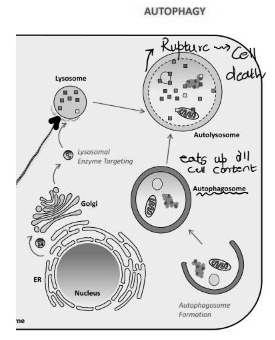
What would happen if lysosomes get ruptured in a cell?
A
Cell dies
B
Cell shrinks
C
Cell swell up
D
Nothing would happen
Solution
(A) Lysosomes are membrane-bound organelles that contain hydrolytic enzymes capable of digesting major biomolecules.
If lysosomes rupture within a cell,these hydrolytic enzymes are released into the cytoplasm.
These enzymes then digest the cellular components,leading to the destruction of the cell,which is why lysosomes are often referred to as the 'suicide bags' of the cell.
If lysosomes rupture within a cell,these hydrolytic enzymes are released into the cytoplasm.
These enzymes then digest the cellular components,leading to the destruction of the cell,which is why lysosomes are often referred to as the 'suicide bags' of the cell.
0 likes
View Solution79
EasyMCQ
Lysosomes contain
A
carbohydrates
B
hormones
C
nucleic acids
D
hydrolases
Solution
(D) Lysosomes are membrane-bound organelles that originate from the $Golgi$ complex. They contain a wide variety of hydrolytic enzymes,collectively known as $hydrolases$ (such as $lipases$,$proteases$,and $carbohydrases$). These enzymes are optimally active at an acidic $pH$.
0 likes
View Solution80
EasyMCQ
Choose the incorrect match.
A
Nucleus - $RNA$
B
Lysosome - Protein synthesis
C
Mitochondria - Respiration
D
Cytoskeleton - Microtubules
Solution
(B) Protein synthesis occurs in ribosomes,which are either free in the cytoplasm or attached to the surface of the rough endoplasmic reticulum.
Lysosomes are membrane-bound organelles containing about $50$ different hydrolytic enzymes,such as proteases,nucleases,glycosidases,lipases,and phosphatases,which function in the digestion of macromolecules.
These enzymes are acid hydrolases that are optimally active at an acidic $pH$ of approximately $5.0$.
Therefore,the association of lysosomes with protein synthesis is incorrect.
Lysosomes are membrane-bound organelles containing about $50$ different hydrolytic enzymes,such as proteases,nucleases,glycosidases,lipases,and phosphatases,which function in the digestion of macromolecules.
These enzymes are acid hydrolases that are optimally active at an acidic $pH$ of approximately $5.0$.
Therefore,the association of lysosomes with protein synthesis is incorrect.
0 likes
View Solution81
MediumMCQ
Which of the following statements is incorrect with respect to lysosomes?
A
Lysosomes are simple tiny spherical sac-like structures.
B
They are distributed in the cytoplasm of the cell.
C
The enzymes of lysosomes work in basic conditions.
D
The enzymes of lysosomes are synthesized by $RER$.
Solution
(C) Lysosomes contain hydrolytic enzymes (hydrolases - lipases,proteases,carbohydrases) that are optimally active at acidic $pH$. Therefore,the statement that they work in basic conditions is incorrect.
0 likes
View Solution82
EasyMCQ
Which of the following organelles shows polymorphism?
A
Golgi apparatus
B
Lysosome
C
Mitochondria
D
Chloroplast
Solution
(B) Lysosomes are known as polymorphic organelles because they can exist in different morphological forms within the same cell depending on their functional state. These forms include primary lysosomes,secondary lysosomes (phagolysosomes),residual bodies,and autophagic vacuoles.
0 likes
View Solution83
MediumMCQ
Certain $Golgian$ vesicles,which are budded out from the $trans$-face,contain acid hydrolases. Such vesicles are better termed as:
A
Heterophagosomes
B
Microsomes
C
Phragmosomes
D
Primary lysosomes
Solution
(D) The $Golgian$ vesicles that bud off from the $trans$-face of the $Golgi$ apparatus and contain acid hydrolases (hydrolytic enzymes) in an inactive state are known as $Primary$ $lysosomes$.
These vesicles are formed by the $Golgi$ body and contain enzymes synthesized by the rough $Endoplasmic$ $Reticulum$ $(RER)$.
These vesicles are formed by the $Golgi$ body and contain enzymes synthesized by the rough $Endoplasmic$ $Reticulum$ $(RER)$.
0 likes
View Solution84
MediumMCQ
$A$ : Lysosomes help in the digestion of foreign particles in animal cells.
$R$ : They have respiratory enzymes.
$R$ : They have respiratory enzymes.
A
Assertion and Reason both are correct and Reason is the correct explanation of Assertion.
B
Assertion and Reason both are correct but Reason is not the correct explanation of Assertion.
C
Assertion is correct,but Reason is incorrect.
D
Both Assertion and Reason are incorrect.
Solution
(C) Assertion $(A)$ is correct because lysosomes contain various hydrolytic enzymes (hydrolases like lipases,proteases,and carbohydrases) that digest foreign materials entering the cell and worn-out cell organelles.
Reason $(R)$ is incorrect because lysosomes contain hydrolytic enzymes,not respiratory enzymes. Respiratory enzymes are primarily found in the mitochondria.
Reason $(R)$ is incorrect because lysosomes contain hydrolytic enzymes,not respiratory enzymes. Respiratory enzymes are primarily found in the mitochondria.
0 likes
View Solution85
MediumMCQ
Mention a single membrane bound organelle which is rich in hydrolytic enzymes.
A
Lysosome
B
Mitochondria
C
Ribosome
D
Vacuole
Solution
(A) $\Rightarrow$ The organelle rich in hydrolytic enzymes is the Lysosome.
$\Rightarrow$ Lysosomes are single membrane-bound vesicular structures formed by the process of packaging in the Golgi apparatus.
$\Rightarrow$ These organelles contain various hydrolytic enzymes (hydrolases - lipases,proteases,carbohydrases) that are optimally active at acidic $pH$.
$\Rightarrow$ These enzymes are capable of digesting carbohydrates,proteins,lipids,and nucleic acids.
$\Rightarrow$ Lysosomes are single membrane-bound vesicular structures formed by the process of packaging in the Golgi apparatus.
$\Rightarrow$ These organelles contain various hydrolytic enzymes (hydrolases - lipases,proteases,carbohydrases) that are optimally active at acidic $pH$.
$\Rightarrow$ These enzymes are capable of digesting carbohydrates,proteins,lipids,and nucleic acids.
0 likes
View Solution86
MediumMCQ
The enzymes present in lysosomes belong to which class of enzymes?
A
Hydrolases
B
Transferases
C
Oxidoreductases
D
Ligases
Solution
(A) Lysosomes are membrane-bound organelles containing a variety of hydrolytic enzymes (acid hydrolases).
These enzymes are optimally active at an acidic $pH$ (around $5.0$).
According to the International Union of Biochemistry and Molecular Biology $(IUBMB)$ classification,enzymes are categorized into six major classes.
Lysosomal enzymes,which catalyze the hydrolysis of various substrates (like proteins,lipids,nucleic acids,and carbohydrates),belong to the class of $Hydrolases$.
These enzymes are optimally active at an acidic $pH$ (around $5.0$).
According to the International Union of Biochemistry and Molecular Biology $(IUBMB)$ classification,enzymes are categorized into six major classes.
Lysosomal enzymes,which catalyze the hydrolysis of various substrates (like proteins,lipids,nucleic acids,and carbohydrates),belong to the class of $Hydrolases$.
0 likes
View Solution87
EasyMCQ
Lysosomal enzymes function at a $pH$ of:
A
Acidic
B
Alkaline
C
Neutral
D
All of the above
Solution
(A) Lysosomes are membrane-bound organelles that contain hydrolytic enzymes (acid hydrolases).
These enzymes are optimally active at an acidic $pH$ (typically around $pH$ $5.0$).
The membrane of the lysosome maintains this acidic environment by pumping hydrogen ions $(H^+)$ into the lumen,which protects the rest of the cell from the digestive activity of these enzymes.
These enzymes are optimally active at an acidic $pH$ (typically around $pH$ $5.0$).
The membrane of the lysosome maintains this acidic environment by pumping hydrogen ions $(H^+)$ into the lumen,which protects the rest of the cell from the digestive activity of these enzymes.
0 likes
View Solution88
MediumMCQ
Lysosomes derive their materials from $...........$.
A
Endoplasmic reticulum
B
Golgi apparatus
C
Nucleus
D
Cytosol
Solution
(B) Lysosomes are membrane-bound vesicular structures formed by the process of packaging in the Golgi apparatus.
The enzymes (acid hydrolases) present in lysosomes are synthesized by the rough endoplasmic reticulum $(RER)$ and then transported to the Golgi apparatus for processing and packaging into vesicles,which eventually become lysosomes.
Therefore,the Golgi apparatus is the site where these materials are packaged and derived.
The enzymes (acid hydrolases) present in lysosomes are synthesized by the rough endoplasmic reticulum $(RER)$ and then transported to the Golgi apparatus for processing and packaging into vesicles,which eventually become lysosomes.
Therefore,the Golgi apparatus is the site where these materials are packaged and derived.
0 likes
View Solution89
MediumMCQ
If the $pH$ in lysosomes is increased to alkaline,what will be the outcome?
A
Hydrolytic enzymes will function more efficiently
B
Hydrolytic enzymes will become inactive
C
Lysosomal enzymes will be released into the cytoplasm
D
Lysosomal enzymes will be more active
Solution
(B) Lysosomes contain hydrolytic enzymes (acid hydrolases) that are specifically adapted to function in an acidic environment,typically around $pH$ $5.0$.
These enzymes require an acidic medium to maintain their structural integrity and catalytic activity.
If the $pH$ inside the lysosome is increased to an alkaline level,the environment becomes unsuitable for these enzymes.
As a result,the hydrolytic enzymes will lose their functional conformation and become inactive.
These enzymes require an acidic medium to maintain their structural integrity and catalytic activity.
If the $pH$ inside the lysosome is increased to an alkaline level,the environment becomes unsuitable for these enzymes.
As a result,the hydrolytic enzymes will lose their functional conformation and become inactive.
0 likes
View SolutionCell: The Unit of Life — Lysosome · Frequently Asked Questions
1Are these Cell: The Unit of Life questions useful for JEE and NEET?
Yes. All questions in this section are mapped to JEE Main and NEET exam patterns. Previous year questions from JEE Main, NEET, GUJCET and state-level exams are included with full solutions.
2Can I switch to Hindi or Gujarati for these questions?
Yes. Use the language tabs in the hero section or the sidebar to view the same questions and solutions in English, Hindi or Gujarati.
3How do I generate a question paper from this subtopic?
Use the Vedclass Exam Paper Generator — select the chapter and subtopic, set difficulty, and generate Sets A, B, C, D automatically. First 3 chapters of every subject are free.
Vedclass Products
For Students
Vedclass Test Series
Mock tests in real JEE/NEET style with performance analysis. 5-day free trial.
Start Free TrialFor Teachers
Exam Paper Generator
Generate Set A/B/C/D papers from this chapter in 2 minutes. 3 chapters free.
Try FreeFor Institutes
Online Exam Module
Live online exams with unlimited students, 360° analytics & white-label branding.
See DemoFor Teachers & Institutes
Generate a Cell: The Unit of Life Exam Paper in 2 Minutes
Select subtopic & difficulty — Sets A, B, C, D auto-generated with No Repeat logic.
First 3 chapters of every subject are free — no payment required.