
A English
Cell wall Questions in English
Class 11 Biology · Cell: The Unit of Life · Cell wall
134+
Questions
English
Language
100%
With Solutions
Showing 34 of 134 questions in English
101
EasyMCQ
What is the outermost layer of a plant cell?
A
Cell wall
B
Vacuole
C
Tonoplast
D
Plasma membrane
Solution
(A) In plant cells,the outermost layer is the $Cell \ wall$.
It is a rigid,non-living structure that provides mechanical support and protection to the cell.
Inside the cell wall lies the $Plasma \ membrane$,which is the outermost boundary of the protoplast.
$Vacuoles$ are membrane-bound spaces found in the cytoplasm,and the $Tonoplast$ is the membrane surrounding the vacuole.
It is a rigid,non-living structure that provides mechanical support and protection to the cell.
Inside the cell wall lies the $Plasma \ membrane$,which is the outermost boundary of the protoplast.
$Vacuoles$ are membrane-bound spaces found in the cytoplasm,and the $Tonoplast$ is the membrane surrounding the vacuole.
0 likes
View Solution102
MediumMCQ
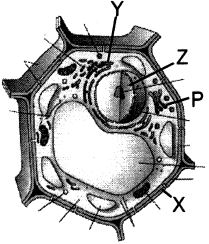
The organelle labelled by which alphabet is absent in animal cells?
A
$Y$
B
$Z$
C
$P$
D
$X$
Solution
(D) In the provided diagram of a plant cell,the labels represent the following structures:
$X$: Cell wall
$Y$: Endoplasmic reticulum
$Z$: Nucleolus
$P$: Golgi apparatus
Among these,the cell wall (labelled as $X$) is a characteristic feature of plant cells and is absent in animal cells. Animal cells are bounded only by the plasma membrane.
$X$: Cell wall
$Y$: Endoplasmic reticulum
$Z$: Nucleolus
$P$: Golgi apparatus
Among these,the cell wall (labelled as $X$) is a characteristic feature of plant cells and is absent in animal cells. Animal cells are bounded only by the plasma membrane.
0 likes
View Solution103
MediumMCQ
Which of the following is correct for the middle lamella of a eukaryotic cell?
A
It is formed in plant cells.
B
It mainly consists of $Ca$-pectate.
C
It holds different neighbouring cells together.
D
All of the above.
Solution
(D) The middle lamella is a layer which cements the cell walls of two adjoining plant cells together.
It is primarily composed of calcium and magnesium pectates ($Ca$-pectate and $Mg$-pectate).
It is a characteristic feature of plant cells and is absent in animal cells.
Therefore,all the given statements are correct.
It is primarily composed of calcium and magnesium pectates ($Ca$-pectate and $Mg$-pectate).
It is a characteristic feature of plant cells and is absent in animal cells.
Therefore,all the given statements are correct.
0 likes
View Solution104
EasyMCQ
What is the nature of the cell wall in terms of permeability?
A
Fully permeable
B
Semi-permeable
C
Differentially permeable
D
Impermeable
Solution
(A) The cell wall is a rigid,non-living structure that surrounds the plasma membrane of plants,fungi,and bacteria. It is composed primarily of cellulose in plants. Because of its porous nature,it allows the free movement of water,solutes,and various molecules,making it fully permeable to most substances.
0 likes
View Solution105
MediumMCQ
The addition of new molecules to the pre-existing cell wall is known as .........
A
Accretion
B
Separation
C
Intussusception
D
Aggregation
Solution
(C) The growth of the cell wall occurs through two main processes: Apposition and Intussusception.
Apposition refers to the deposition of new wall material on the surface of the existing wall.
Intussusception refers to the process where new wall materials (such as cellulose microfibrils and matrix substances) are deposited within the existing cell wall structure,allowing it to expand.
Therefore,the addition of new molecules to the pre-existing cell wall is known as Intussusception.
Apposition refers to the deposition of new wall material on the surface of the existing wall.
Intussusception refers to the process where new wall materials (such as cellulose microfibrils and matrix substances) are deposited within the existing cell wall structure,allowing it to expand.
Therefore,the addition of new molecules to the pre-existing cell wall is known as Intussusception.
0 likes
View Solution106
EasyMCQ
What are plasmodesmata?
A
Locomotory structures.
B
Nuclei with nuclear membranes.
C
Connections between cells.
D
Lignified layers between cells.
Solution
(C) Plasmodesmata are microscopic channels that traverse the cell walls of plant cells and some algal cells.
They enable transport and communication between individual cells.
These channels create cytoplasmic bridges that connect the cytoplasm of adjacent cells,allowing for the movement of molecules such as proteins,$RNA$,and nutrients.
They enable transport and communication between individual cells.
These channels create cytoplasmic bridges that connect the cytoplasm of adjacent cells,allowing for the movement of molecules such as proteins,$RNA$,and nutrients.
0 likes
View Solution107
EasyMCQ
Which of the following structures is an effective transport pathway between two adjacent cells?
A
Plasmodesmata
B
Plastoquinone
C
Endoplasmic reticulum
D
Cell membrane
Solution
(A) Plasmodesmata are microscopic channels that traverse the cell walls of plant cells and some algal cells,enabling transport and communication between them.
They act as an effective transport pathway by connecting the cytoplasm of adjacent cells,allowing the movement of water,nutrients,and signaling molecules.
They act as an effective transport pathway by connecting the cytoplasm of adjacent cells,allowing the movement of water,nutrients,and signaling molecules.
0 likes
View Solution108
EasyMCQ
$A$ protoplast is a cell that is:
A
Without a plasma membrane
B
Without a nucleus
C
Capable of division
D
Without a cell wall
Solution
(D) protoplast is defined as a plant,bacterial,or fungal cell whose cell wall has been removed,either mechanically or enzymatically. It consists of the plasma membrane and the entire contents of the cell (protoplasm) enclosed within it. Therefore,a protoplast is a cell without a cell wall.
0 likes
View Solution109
EasyMCQ
Assertion: Cell wall is not found in animal cells.
Reason: Animal cells are covered by a cell membrane.
Reason: Animal cells are covered by a cell membrane.
A
If both Assertion and Reason are correct and the Reason is a correct explanation of the Assertion.
B
If both Assertion and Reason are correct but Reason is not a correct explanation of the Assertion.
C
If the Assertion is correct but Reason is incorrect.
D
If both the Assertion and Reason are incorrect.
Solution
(B) Animal cells are covered by a semipermeable plasma membrane (cell membrane).
Cell wall is absent in animal cells because the cell wall is a rigid structure that would be incompatible with the way in which an animal moves and grows.
While both statements are factually correct,the presence of a cell membrane is a universal feature of all cells (including plant cells which also have a cell wall) and does not explain why animal cells specifically lack a cell wall.
Therefore,the Reason is not the correct explanation for the Assertion.
Cell wall is absent in animal cells because the cell wall is a rigid structure that would be incompatible with the way in which an animal moves and grows.
While both statements are factually correct,the presence of a cell membrane is a universal feature of all cells (including plant cells which also have a cell wall) and does not explain why animal cells specifically lack a cell wall.
Therefore,the Reason is not the correct explanation for the Assertion.
0 likes
View Solution110
Medium
Give information about the chemical composition and function of the cell wall.
Solution
(N/A) $\Rightarrow$ $A$ non-living rigid structure called the cell wall forms an outer covering for the plasma membrane of fungi and plants.
$\Rightarrow$ The cell wall not only gives shape to the cell and protects the cell from mechanical damage and infection,but it also helps in cell-to-cell interaction and provides a barrier to undesirable macromolecules.
$\Rightarrow$ Algae have a cell wall made of cellulose,galactans,mannans,and minerals like calcium carbonate.
$\Rightarrow$ In other plants,it consists of cellulose,hemicellulose,pectins,and proteins.
$\Rightarrow$ The cell wall of a young plant cell,the primary wall,is capable of growth,which gradually diminishes as the cell matures and the secondary wall is formed on the inner side of the cell.
$\Rightarrow$ The middle lamella is a layer mainly of calcium pectate which holds or glues the different neighbouring cells together.
$\Rightarrow$ The cell wall and middle lamellae may be traversed by plasmodesmata which connect the cytoplasm of neighbouring cells.
$\Rightarrow$ The cell wall not only gives shape to the cell and protects the cell from mechanical damage and infection,but it also helps in cell-to-cell interaction and provides a barrier to undesirable macromolecules.
$\Rightarrow$ Algae have a cell wall made of cellulose,galactans,mannans,and minerals like calcium carbonate.
$\Rightarrow$ In other plants,it consists of cellulose,hemicellulose,pectins,and proteins.
$\Rightarrow$ The cell wall of a young plant cell,the primary wall,is capable of growth,which gradually diminishes as the cell matures and the secondary wall is formed on the inner side of the cell.
$\Rightarrow$ The middle lamella is a layer mainly of calcium pectate which holds or glues the different neighbouring cells together.
$\Rightarrow$ The cell wall and middle lamellae may be traversed by plasmodesmata which connect the cytoplasm of neighbouring cells.
0 likes
View Solution111
Easy
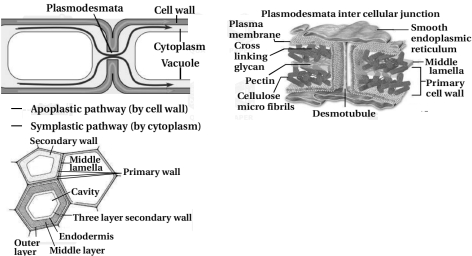
Each of the following terms has some anatomical significance. What do these terms mean? Explain with the help of line diagrams.
$(A)$ Plasmodesmata
$(B)$ Middle lamella
$(C)$ Secondary wall
$(A)$ Plasmodesmata
$(B)$ Middle lamella
$(C)$ Secondary wall
Solution
(N/A) Plasmodesmata:
$\Rightarrow$ Structure: These are narrow channels that traverse the cell walls of plant cells and some algal cells,enabling transport and communication between them.
Function: They facilitate the movement of molecules between adjacent plant cells through the symplastic pathway.
$(B)$ Middle lamella:
$\Rightarrow$ Structure: It is a thin,cementing layer located between the primary walls of adjacent cells. It is primarily composed of calcium and magnesium pectates.
Function: It acts as a glue,holding adjacent plant cells together.
$(C)$ Secondary wall:
$\Rightarrow$ Structure: It is a thick,rigid layer formed inside the primary cell wall once the cell has stopped growing. It is composed of cellulose,hemicellulose,and often lignin.
Function: It provides mechanical strength and structural support to the plant cell.
$\Rightarrow$ Structure: These are narrow channels that traverse the cell walls of plant cells and some algal cells,enabling transport and communication between them.
Function: They facilitate the movement of molecules between adjacent plant cells through the symplastic pathway.
$(B)$ Middle lamella:
$\Rightarrow$ Structure: It is a thin,cementing layer located between the primary walls of adjacent cells. It is primarily composed of calcium and magnesium pectates.
Function: It acts as a glue,holding adjacent plant cells together.
$(C)$ Secondary wall:
$\Rightarrow$ Structure: It is a thick,rigid layer formed inside the primary cell wall once the cell has stopped growing. It is composed of cellulose,hemicellulose,and often lignin.
Function: It provides mechanical strength and structural support to the plant cell.
0 likes
View Solution112
Medium
Write the importance of plasmodesmata.
Solution
(N/A) Plasmodesmata are microscopic channels that traverse the cell walls of plant cells and some algal cells,enabling transport and communication between them.
$\Rightarrow$ They facilitate the symplastic pathway,allowing water,ions,and small molecules to move directly from the cytoplasm of one cell to another without crossing the plasma membrane repeatedly.
$\Rightarrow$ They allow the movement of larger molecules,such as proteins,transcription factors,and $RNA$,which is essential for cell-to-cell signaling and coordination of development.
$\Rightarrow$ They play a crucial role in the transport of nutrients and signaling molecules over long distances within the plant body.
$\Rightarrow$ They help in maintaining the continuity of the cytoplasm between adjacent cells,which is vital for the physiological integration of the plant tissue.
$\Rightarrow$ They facilitate the symplastic pathway,allowing water,ions,and small molecules to move directly from the cytoplasm of one cell to another without crossing the plasma membrane repeatedly.
$\Rightarrow$ They allow the movement of larger molecules,such as proteins,transcription factors,and $RNA$,which is essential for cell-to-cell signaling and coordination of development.
$\Rightarrow$ They play a crucial role in the transport of nutrients and signaling molecules over long distances within the plant body.
$\Rightarrow$ They help in maintaining the continuity of the cytoplasm between adjacent cells,which is vital for the physiological integration of the plant tissue.
0 likes
View Solution113
MediumMCQ
Which is not a characteristic of plant cell walls?
A
Found only in the sporophyte phase of the life cycle
B
Contains compounds built of simple sugars
C
May contain enzymes that are biologically active
D
Often contain strengthening polymers
Solution
(A) The plant cell wall is a characteristic feature of plant cells and is present in both the sporophytic and gametophytic phases of the life cycle. Therefore,the statement that it is found only in the sporophyte phase is incorrect.
0 likes
View Solution114
MediumMCQ
$I.$ Found only in sporophytic phase of life cycle
$II.$ May contain enzymes that are biologically active
$III.$ Often contain strengthening polymers
Select the correct option for cell wall
$II.$ May contain enzymes that are biologically active
$III.$ Often contain strengthening polymers
Select the correct option for cell wall
A
All are correct except $I$
B
All are correct except $II$
C
All are correct except $III$
D
All are correct
Solution
(A) The cell wall is a characteristic feature of plant cells and is present in both the sporophytic and gametophytic phases of the plant life cycle.
Statement $I$ is incorrect because the cell wall is not restricted to the sporophytic phase.
Statement $II$ is correct as the cell wall contains various enzymes,such as peroxidases and hydrolases,which are biologically active.
Statement $III$ is correct as the cell wall contains strengthening polymers like cellulose,hemicellulose,and lignin,which provide structural support.
Statement $I$ is incorrect because the cell wall is not restricted to the sporophytic phase.
Statement $II$ is correct as the cell wall contains various enzymes,such as peroxidases and hydrolases,which are biologically active.
Statement $III$ is correct as the cell wall contains strengthening polymers like cellulose,hemicellulose,and lignin,which provide structural support.
0 likes
View Solution115
MediumMCQ
$A$ student placed two cells in the same solution in two different containers. The observation was given in the table:
Which structure maintains the shape of the cell present in container $2$ and provides the most significant difference between the two cells?
| Container | Observation |
| $1$ | Cell burst |
| $2$ | Cell does not change its shape |
Which structure maintains the shape of the cell present in container $2$ and provides the most significant difference between the two cells?
A
Nucleus
B
Cell wall
C
Chloroplast
D
Cell membrane
Solution
$(B)$ When a cell is placed in a hypotonic solution, water enters the cell. If the cell lacks a rigid outer covering, it swells and eventually bursts due to osmotic pressure.
In container $1$, the cell burst, indicating it is likely an animal cell which lacks a cell wall.
In container $2$, the cell maintained its shape, indicating it is likely a plant cell or a bacterial cell possessing a rigid cell wall.
The cell wall is a non-living, rigid structure that provides protection, maintains the shape of the cell, and prevents it from bursting under hypotonic conditions.
Therefore, the cell wall is the structure that maintains the shape of the cell in container $2$ and distinguishes it from the cell in container $1$.
In container $1$, the cell burst, indicating it is likely an animal cell which lacks a cell wall.
In container $2$, the cell maintained its shape, indicating it is likely a plant cell or a bacterial cell possessing a rigid cell wall.
The cell wall is a non-living, rigid structure that provides protection, maintains the shape of the cell, and prevents it from bursting under hypotonic conditions.
Therefore, the cell wall is the structure that maintains the shape of the cell in container $2$ and distinguishes it from the cell in container $1$.
0 likes
View Solution116
EasyMCQ
In which of the following are the cells held together by a $Ca$-pectate layer?
A
Primary cell wall
B
Secondary cell wall
C
Middle lamella
D
Tertiary cell wall
Solution
(C) The middle lamella is a thin,amorphous layer that acts as a cementing material between adjacent plant cells. It is primarily composed of calcium and magnesium pectates,which provide structural stability and adhesion to the cell walls.
0 likes
View Solution117
MediumMCQ
Which of the following determines the shape of the cells and provides a strong structural support to prevent the bacterium from bursting or collapsing?
A
Plasmids
B
Cell wall
C
Mesosome
D
Cell membrane
Solution
(B) The cell wall is a tough,flexible,and rigid layer that surrounds the cell membrane. It determines the shape of the cell and provides strong structural support to prevent the bacterium from bursting or collapsing due to osmotic pressure.
0 likes
View Solution118
MediumMCQ
Which of the following is not a function of the cell wall?
$(i)$ Provides shape to the cell.
$(ii)$ Protects the cell from mechanical damage and infection.
$(iii)$ Helps in cell-to-cell interaction.
$(iv)$ Provides a barrier to undesirable macromolecules.
$(i)$ Provides shape to the cell.
$(ii)$ Protects the cell from mechanical damage and infection.
$(iii)$ Helps in cell-to-cell interaction.
$(iv)$ Provides a barrier to undesirable macromolecules.
A
Only $(i)$
B
Only $(iv)$
C
Only $(ii), (iii)$ and $(iv)$
D
None of the above
Solution
(D) The cell wall is a non-living,rigid structure that forms an outer covering for the plasma membrane of fungi and plants.
Its primary functions include:
$1$. It provides a definite shape to the cell.
$2$. It protects the cell from mechanical damage and infection.
$3$. It helps in cell-to-cell interaction.
$4$. It provides a barrier to undesirable macromolecules.
Since all the listed statements $(i), (ii), (iii),$ and $(iv)$ are correct functions of the cell wall,none of the options represent a non-function.
Its primary functions include:
$1$. It provides a definite shape to the cell.
$2$. It protects the cell from mechanical damage and infection.
$3$. It helps in cell-to-cell interaction.
$4$. It provides a barrier to undesirable macromolecules.
Since all the listed statements $(i), (ii), (iii),$ and $(iv)$ are correct functions of the cell wall,none of the options represent a non-function.
0 likes
View Solution119
MediumMCQ
The cell wall consists of
A
Lignin,hemicellulose,protein and lipid.
B
Hemicellulose,cellulose,tubulin and lignin.
C
Lignin,hemicellulose,pectin and lipid cellulose.
D
Lignin,hemicellulose,pectin and cellulose.
Solution
(D) The cell wall of plants is a non-living,rigid structure that forms an outer covering for the plasma membrane. It is primarily composed of cellulose,hemicellulose,pectin,and proteins. In many mature plant cells,lignin is also deposited in the cell wall to provide structural support and rigidity.
0 likes
View Solution120
EasyMCQ
Robert Hooke discovered the . . . . . . of a cell.
A
Cell membrane
B
Nucleus
C
Cell wall
D
Cytoplasm
Solution
(C) Robert Hooke observed thin slices of cork under a microscope and discovered the cell wall,which appeared as box-like compartments.
Nucleus was discovered by Robert Brown in $1831$.
Cell membrane was described by Theodor Schwann in $1838$.
Cytoplasm was termed by Strasburger in $1882$.
Nucleus was discovered by Robert Brown in $1831$.
Cell membrane was described by Theodor Schwann in $1838$.
Cytoplasm was termed by Strasburger in $1882$.
0 likes
View Solution121
MediumMCQ
Which of the following statements is incorrect?
A
Middle lamella is chiefly made up of calcium and magnesium pectate.
B
Secondary cell wall is found in harder woody parts of a plant.
C
Plasmodesmata are cytoplasmic bridges that connect the neighbouring plant cells.
D
Secondary wall is formed on the outer side of the cell.
Solution
(D) The correct answer is $D$. The secondary cell wall is deposited on the inner surface of the primary cell wall (towards the plasma membrane) as the cell matures,not on the outer side. The middle lamella is indeed composed of calcium and magnesium pectate,secondary walls provide strength to woody tissues,and plasmodesmata serve as cytoplasmic connections between adjacent cells.
0 likes
View Solution122
MediumMCQ
Select the correct combination of the statements regarding the characteristics of the middle lamella:
$a$. It holds the different neighbouring cells together.
$b$. It is composed of $Mg$ pectate only.
$c$. It gets dissolved during the ripening of fruits.
Correct statements is/are:
$a$. It holds the different neighbouring cells together.
$b$. It is composed of $Mg$ pectate only.
$c$. It gets dissolved during the ripening of fruits.
Correct statements is/are:
A
$a$ and $c$
B
$b$ and $c$
C
Only $a$
D
$a, b$ and $c$
Solution
(A) The middle lamella is a thin layer that acts as a cementing material between the cell walls of adjacent plant cells.
Statement $a$ is correct: It holds different neighbouring cells together.
Statement $b$ is incorrect: The middle lamella is primarily composed of calcium pectate and magnesium pectate,not just magnesium pectate.
Statement $c$ is correct: During the ripening of fruits,the middle lamella dissolves due to the action of enzymes like pectinase,which leads to the softening of the fruit.
Therefore,the correct statements are $a$ and $c$.
Statement $a$ is correct: It holds different neighbouring cells together.
Statement $b$ is incorrect: The middle lamella is primarily composed of calcium pectate and magnesium pectate,not just magnesium pectate.
Statement $c$ is correct: During the ripening of fruits,the middle lamella dissolves due to the action of enzymes like pectinase,which leads to the softening of the fruit.
Therefore,the correct statements are $a$ and $c$.
0 likes
View Solution123
MediumMCQ
$RBC$ and a plant cell (with thick cell wall) are placed in distilled water. The solute concentration is the same in both the cells. What changes would be observed in them?
A
Both plant cell and $RBC$ would not undergo any change
B
The $RBC$ would increase in size and burst,while the plant cell would remain about the same size
C
The plant cell would increase in size and burst,while the $RBC$ would remain about the same size
D
Both plant cell and $RBC$ would decrease in size and collapse
Solution
(B) When $RBC$ and a plant cell are placed in distilled water,endosmosis occurs because the water potential of distilled water is higher than that of the cell cytoplasm.
As a result,water enters both cells.
The $RBC$ lacks a cell wall,so it swells and eventually bursts due to the high internal osmotic pressure.
In contrast,the plant cell has a rigid cell wall that exerts turgor pressure,preventing the cell from bursting and keeping it nearly the same size.
As a result,water enters both cells.
The $RBC$ lacks a cell wall,so it swells and eventually bursts due to the high internal osmotic pressure.
In contrast,the plant cell has a rigid cell wall that exerts turgor pressure,preventing the cell from bursting and keeping it nearly the same size.
0 likes
View Solution124
EasyMCQ
The element present in the middle lamella is
A
$Zn$
B
$Cu$
C
$Ca$
D
$K$
Solution
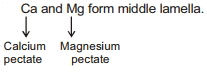
(C) The middle lamella is a layer that cements the cell walls of two adjacent plant cells together.
It is primarily composed of calcium pectate and magnesium pectate.
Among the given options,$Ca$ (Calcium) is the element present in the middle lamella as calcium pectate.
It is primarily composed of calcium pectate and magnesium pectate.
Among the given options,$Ca$ (Calcium) is the element present in the middle lamella as calcium pectate.
0 likes
View Solution125
MediumMCQ
The middle lamella is found in which of the following?
A
Animals
B
Plants
C
Yeast
D
Bacteria
Solution
(B) The middle lamella is a layer that cements the cell walls of two adjacent plant cells together.
It is primarily composed of calcium and magnesium pectates.
It is a characteristic feature of plant cells and is absent in animal cells,bacteria,and fungi (like yeast).
It is primarily composed of calcium and magnesium pectates.
It is a characteristic feature of plant cells and is absent in animal cells,bacteria,and fungi (like yeast).
0 likes
View Solution126
MediumMCQ
Which of the following statements is inconsistent with the function of the cell wall?
A
It determines the shape of the cell.
B
It provides a strong structural framework.
C
It remains in contact with the external environment.
D
It prevents the bacterium from bursting or collapsing.
Solution
(NONE) The cell wall is a rigid,non-living structure that surrounds the plasma membrane of plants,fungi,and many bacteria.
Its primary functions include:
$1$. Determining the shape of the cell.
$2$. Providing a strong structural framework for the cell.
$3$. Protecting the cell from mechanical damage and infection.
$4$. Preventing the cell from bursting (lysis) or collapsing (plasmolysis) due to osmotic pressure.
Since all the provided options ($A$,$B$,$C$,and $D$) are actually correct functions or characteristics of the cell wall,there is no 'inconsistent' statement among the choices provided. However,in the context of typical biology questions,all these are standard functions.
Its primary functions include:
$1$. Determining the shape of the cell.
$2$. Providing a strong structural framework for the cell.
$3$. Protecting the cell from mechanical damage and infection.
$4$. Preventing the cell from bursting (lysis) or collapsing (plasmolysis) due to osmotic pressure.
Since all the provided options ($A$,$B$,$C$,and $D$) are actually correct functions or characteristics of the cell wall,there is no 'inconsistent' statement among the choices provided. However,in the context of typical biology questions,all these are standard functions.
0 likes
View Solution127
EasyMCQ
Which structure connects the cytoplasm of two adjacent cells?
A
Middle lamella
B
Plasmodesmata
C
Cell wall
D
Plasma membrane
Solution
(B) Plasmodesmata are microscopic channels that traverse the cell walls of plant cells and some algal cells,enabling transport and communication between them.
These channels connect the cytoplasm of adjacent cells,allowing the movement of molecules such as water,nutrients,and signaling proteins.
Therefore,the correct answer is $B$ (Plasmodesmata).
These channels connect the cytoplasm of adjacent cells,allowing the movement of molecules such as water,nutrients,and signaling proteins.
Therefore,the correct answer is $B$ (Plasmodesmata).
0 likes
View Solution128
EasyMCQ
Which structure keeps adjacent cells in contact with each other?
A
Middle lamella
B
Plasmodesmata
C
Cell wall
D
Plasma membrane
Solution
(A) The $Middle \text{ } lamella$ is a layer rich in calcium pectate that glues the adjacent cells together. It acts as a cementing layer between the cell walls of neighboring plant cells, ensuring they remain in contact.
0 likes
View Solution129
MediumMCQ
Match the following columns regarding cell wall composition:
| Column-$I$ | Column-$II$ |
|---|---|
| $P$. Algae | $I$. Absent |
| $Q$. Fungi | $II$. Chitin |
| $R$. Plants | $III$. Cellulose,Hemicellulose,Pectins,Proteins |
| $S$. Animals | $IV$. Cellulose,Galactans,Mannans,$CaCO_3$ |
A
$(P-IV), (Q-II), (R-III), (S-I)$
B
$(P-III), (Q-II), (R-IV), (S-I)$
C
$(P-II), (Q-IV), (R-III), (S-I)$
D
$(P-IV), (Q-II), (R-I), (S-III)$
Solution
(A) The cell wall composition varies across different groups of organisms:
$1$. Algae $(P)$ have cell walls composed of cellulose,galactans,mannans,and minerals like calcium carbonate $(CaCO_3)$. Thus,$P-IV$.
$2$. Fungi $(Q)$ have cell walls made of chitin. Thus,$Q-II$.
$3$. Plants $(R)$ have cell walls composed of cellulose,hemicellulose,pectins,and proteins. Thus,$R-III$.
$4$. Animals $(S)$ lack a cell wall. Thus,$S-I$.
Therefore,the correct matching is $(P-IV), (Q-II), (R-III), (S-I)$.
$1$. Algae $(P)$ have cell walls composed of cellulose,galactans,mannans,and minerals like calcium carbonate $(CaCO_3)$. Thus,$P-IV$.
$2$. Fungi $(Q)$ have cell walls made of chitin. Thus,$Q-II$.
$3$. Plants $(R)$ have cell walls composed of cellulose,hemicellulose,pectins,and proteins. Thus,$R-III$.
$4$. Animals $(S)$ lack a cell wall. Thus,$S-I$.
Therefore,the correct matching is $(P-IV), (Q-II), (R-III), (S-I)$.
0 likes
View Solution130
MediumMCQ
Which of the following is a function of the cell wall?
A
Protection from mechanical damage and infection
B
Provides a barrier to undesirable macromolecules
C
Non-living rigid structure
D
All of the above
Solution
(D) The cell wall is a non-living,rigid structure that forms an outer covering for the plasma membrane of fungi and plants.
Its primary functions include:
$1$. It provides a definite shape to the cell.
$2$. It protects the cell from mechanical damage and infection.
$3$. It helps in cell-to-cell interaction.
$4$. It provides a barrier to undesirable macromolecules.
Therefore,all the given options are correct functions or characteristics of the cell wall.
Its primary functions include:
$1$. It provides a definite shape to the cell.
$2$. It protects the cell from mechanical damage and infection.
$3$. It helps in cell-to-cell interaction.
$4$. It provides a barrier to undesirable macromolecules.
Therefore,all the given options are correct functions or characteristics of the cell wall.
0 likes
View Solution131
EasyMCQ
The cell wall is a ...... membrane.
A
Selectively permeable membrane
B
Semi-permeable membrane
C
Permeable membrane
D
Impermeable membrane
Solution
(C) The cell wall is the outermost,rigid,and non-living layer of plant cells. It is composed mainly of cellulose,hemicellulose,and pectin. Due to its porous nature,it allows the free movement of water,solutes,and gases through it. Therefore,the cell wall is considered a permeable membrane.
0 likes
View Solution132
EasyMCQ
Which of the following structures provides strong structural support to prevent a bacterium from bursting or collapsing?
A
Cell membrane
B
Fimbriae
C
Cell wall
D
Slime layer
Solution
(C) The $Cell$ $\text{wall}$ is a rigid, protective outer layer found in most bacteria. Its primary function is to provide structural support and maintain the shape of the cell. By acting as a strong barrier, it prevents the bacterium from bursting (lysis) due to high internal osmotic pressure or collapsing in hypotonic or hypertonic environments, respectively.
0 likes
View Solution133
EasyMCQ
Which of the following is absent in the cell wall of a plant?
A
Cellulose
B
Hemicellulose
C
Galactans
D
Chitin
Solution
(D) The plant cell wall is primarily composed of cellulose,hemicellulose,pectins,and proteins.
Cellulose,hemicellulose,and pectins are essential structural components of the plant cell wall.
Chitin is a polysaccharide found in the cell walls of fungi and the exoskeletons of arthropods,not in plant cell walls.
Therefore,chitin is absent in the cell wall of a plant.
Cellulose,hemicellulose,and pectins are essential structural components of the plant cell wall.
Chitin is a polysaccharide found in the cell walls of fungi and the exoskeletons of arthropods,not in plant cell walls.
Therefore,chitin is absent in the cell wall of a plant.
0 likes
View Solution134
EasyMCQ
The cell wall of a root hair is . . . . . . .
A
selectively permeable
B
freely permeable
C
semipermeable
D
impermeable
Solution
(B) The cell wall of a plant cell,including the root hair,is composed primarily of cellulose,hemicellulose,and pectin. It is a rigid,non-living structure that allows the free movement of water,solutes,and various molecules through it. Therefore,the cell wall is considered to be freely permeable,whereas the plasma membrane (cell membrane) beneath it is selectively permeable.
0 likes
View SolutionCell: The Unit of Life — Cell wall · Frequently Asked Questions
1Are these Cell: The Unit of Life questions useful for JEE and NEET?
Yes. All questions in this section are mapped to JEE Main and NEET exam patterns. Previous year questions from JEE Main, NEET, GUJCET and state-level exams are included with full solutions.
2Can I switch to Hindi or Gujarati for these questions?
Yes. Use the language tabs in the hero section or the sidebar to view the same questions and solutions in English, Hindi or Gujarati.
3How do I generate a question paper from this subtopic?
Use the Vedclass Exam Paper Generator — select the chapter and subtopic, set difficulty, and generate Sets A, B, C, D automatically. First 3 chapters of every subject are free.
Vedclass Products
For Students
Vedclass Test Series
Mock tests in real JEE/NEET style with performance analysis. 5-day free trial.
Start Free TrialFor Teachers
Exam Paper Generator
Generate Set A/B/C/D papers from this chapter in 2 minutes. 3 chapters free.
Try FreeFor Institutes
Online Exam Module
Live online exams with unlimited students, 360° analytics & white-label branding.
See DemoFor Teachers & Institutes
Generate a Cell: The Unit of Life Exam Paper in 2 Minutes
Select subtopic & difficulty — Sets A, B, C, D auto-generated with No Repeat logic.
First 3 chapters of every subject are free — no payment required.