
A English
Cytokinesis Questions in English
Class 11 Biology · Cell Cycle and Cell Division · Cytokinesis
61+
Questions
English
Language
100%
With Solutions
Showing 11 of 61 questions in English
51
MediumMCQ
Choose the correct sequence of two main events in mitosis. Karyokinesis is followed by:
A
cytokinesis
B
Cytokinesis followed by karyokinesis
C
Karyokinesis followed by non-separation of the daughter cells
D
Cytokinesis followed by separation of the daughter cells
Solution
(A) Mitosis is divided into two main phases: $1$. Karyokinesis,which is the division of the nucleus. $2$. Cytokinesis,which is the division of the cytoplasm. The correct sequence is that karyokinesis occurs first,followed by cytokinesis,which ultimately leads to the physical separation of the daughter cells.
0 likes
View Solution52
MediumMCQ
The division of the cytoplasm is termed as
A
Karyokinesis
B
Mitosis
C
Cytokinesis
D
Meiosis
Solution
(C) Cell division involves two primary processes: the division of the nucleus and the division of the cytoplasm.
$1$. The division of the nucleus is known as $Karyokinesis$.
$2$. The division of the cytoplasm is known as $Cytokinesis$.
Therefore,the correct term for the division of the cytoplasm is $Cytokinesis$.
$1$. The division of the nucleus is known as $Karyokinesis$.
$2$. The division of the cytoplasm is known as $Cytokinesis$.
Therefore,the correct term for the division of the cytoplasm is $Cytokinesis$.
0 likes
View Solution53
MediumMCQ
Which stage of mitosis is known for the occurrence of cytokinesis?
A
Metaphase
B
Telophase
C
Anaphase
D
None of these
Solution
(B) Cytokinesis is the process of cytoplasmic division that physically separates the cell into two daughter cells.
While it is a distinct process,it typically begins during the late $Telophase$ stage of mitosis.
During $Telophase$,the chromosomes reach the opposite poles and begin to decondense,and the nuclear envelope reforms around each set of chromosomes.
As the nuclear division concludes,the cell membrane begins to constrict (in animal cells) or a cell plate begins to form (in plant cells),marking the initiation of cytokinesis.
While it is a distinct process,it typically begins during the late $Telophase$ stage of mitosis.
During $Telophase$,the chromosomes reach the opposite poles and begin to decondense,and the nuclear envelope reforms around each set of chromosomes.
As the nuclear division concludes,the cell membrane begins to constrict (in animal cells) or a cell plate begins to form (in plant cells),marking the initiation of cytokinesis.
0 likes
View Solution54
MediumMCQ
$A$ cell plate is laid down during
A
Cytokinesis
B
Karyokinesis
C
Interphase
D
None of these
Solution
(A) In plant cells,cytokinesis occurs through the formation of a cell plate. During this process,the spindle fibers do not degenerate completely but instead contribute to the formation of the phragmoplast,which eventually develops into the cell plate,separating the two daughter cells.
0 likes
View Solution55
MediumMCQ
..................... phase marks the end of $M$-phase.
A
Karyokinesis
B
Prophase
C
Cytokinesis
D
Telophase
Solution
(C) $M$-phase (Mitosis phase) consists of two main processes: karyokinesis (nuclear division) and cytokinesis (cytoplasmic division).
Karyokinesis is the first part of the $M$-phase,which includes prophase,metaphase,anaphase,and telophase.
Cytokinesis is the final stage of the $M$-phase,where the cytoplasm divides to form two daughter cells,thereby marking the end of the $M$-phase.
Karyokinesis is the first part of the $M$-phase,which includes prophase,metaphase,anaphase,and telophase.
Cytokinesis is the final stage of the $M$-phase,where the cytoplasm divides to form two daughter cells,thereby marking the end of the $M$-phase.
0 likes
View Solution56
EasyMCQ
If karyokinesis is not followed by cytokinesis,then it gives rise to:
A
Zygote
B
Fertilised egg
C
Multinucleate condition
D
Embryo
Solution
(C) Karyokinesis refers to the division of the nucleus,while cytokinesis refers to the division of the cytoplasm.
If karyokinesis occurs without being followed by cytokinesis,the nucleus divides repeatedly,but the cytoplasm remains undivided.
This results in a single cell containing multiple nuclei,which is known as a multinucleate condition (also called a syncytium or coenocyte).
If karyokinesis occurs without being followed by cytokinesis,the nucleus divides repeatedly,but the cytoplasm remains undivided.
This results in a single cell containing multiple nuclei,which is known as a multinucleate condition (also called a syncytium or coenocyte).
0 likes
View Solution57
MediumMCQ
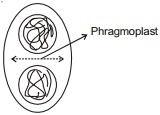
Phragmoplast is formed by the Golgi complex and grows:
A
Centripetally to form a cell plate
B
Centrifugally to form a cell plate
C
Centripetally to produce a cleavage furrow
D
Centrifugally to form a cleavage furrow
Solution
(B) In plant cells,cytokinesis occurs through the formation of a cell plate.
The phragmoplast is a plant cell-specific structure that forms during late cytokinesis.
It serves as a scaffold for cell plate assembly and subsequent formation of a new cell wall between the two daughter cells.
The phragmoplast and the developing cell plate grow centrifugally,meaning they expand from the center of the cell toward the existing cell walls (periphery).
The phragmoplast is a plant cell-specific structure that forms during late cytokinesis.
It serves as a scaffold for cell plate assembly and subsequent formation of a new cell wall between the two daughter cells.
The phragmoplast and the developing cell plate grow centrifugally,meaning they expand from the center of the cell toward the existing cell walls (periphery).
0 likes
View Solution58
MediumMCQ
Cytokinesis in a plant cell is achieved by the formation of a cell plate instead of a cleavage furrow,which is formed in:
A
Centripetal manner
B
Centrifugal manner
C
Both centripetal and centrifugal manner
D
Equational manner
Solution
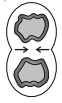
(B) In plant cells,cytokinesis occurs through the formation of a cell plate. The cell plate begins to form in the center of the cell and grows outward towards the existing cell walls. This outward growth from the center to the periphery is known as the centrifugal manner.
In contrast,animal cells undergo cytokinesis by the formation of a cleavage furrow,which starts from the periphery and moves inward towards the center,known as the centripetal manner.
In contrast,animal cells undergo cytokinesis by the formation of a cleavage furrow,which starts from the periphery and moves inward towards the center,known as the centripetal manner.
0 likes
View Solution59
MediumMCQ
Failure of cytokinesis after $A$ stage of cell division results in an increase in a whole set of chromosomes in an organism called $B$.
A
$A$-prophase,$B$-polyploidy
B
$A$-metaphase,$B$-polyploidy
C
$A$-anaphase,$B$-polyploidy
D
$A$-telophase,$B$-polyploidy
Solution
(D) Cytokinesis is the process of cytoplasmic division that follows nuclear division (karyokinesis).
If cytokinesis fails to occur after the $A$-telophase stage of cell division,the cell remains with double the number of chromosomes or extra sets of chromosomes.
This condition,where an organism possesses more than two complete sets of chromosomes,is known as $B$-polyploidy.
Polyploidy is common in plants and is often induced artificially to create larger fruits or flowers.
If cytokinesis fails to occur after the $A$-telophase stage of cell division,the cell remains with double the number of chromosomes or extra sets of chromosomes.
This condition,where an organism possesses more than two complete sets of chromosomes,is known as $B$-polyploidy.
Polyploidy is common in plants and is often induced artificially to create larger fruits or flowers.
0 likes
View Solution60
MediumMCQ
Select the correct option for centripetal cytokinesis and centrifugal cytokinesis,respectively.
A
Plant cell,Bacteria
B
Plant cell,Protozoa
C
Plant cell,Animal cell
D
Animal cell,Plant cell
Solution
(D) Cytokinesis is the process of cytoplasmic division that follows nuclear division.
In animal cells,cytokinesis occurs by the formation of a cleavage furrow that moves from the periphery towards the center,which is known as centripetal cytokinesis.
In plant cells,cytokinesis occurs by the formation of a cell plate (phragmoplast) that grows from the center towards the periphery,which is known as centrifugal cytokinesis.
Therefore,the correct sequence is Animal cell (centripetal) and Plant cell (centrifugal).
In animal cells,cytokinesis occurs by the formation of a cleavage furrow that moves from the periphery towards the center,which is known as centripetal cytokinesis.
In plant cells,cytokinesis occurs by the formation of a cell plate (phragmoplast) that grows from the center towards the periphery,which is known as centrifugal cytokinesis.
Therefore,the correct sequence is Animal cell (centripetal) and Plant cell (centrifugal).
0 likes
View Solution61
MediumMCQ
Plant cells do not divide their cytoplasm by forming a furrow in the cell membrane like animal cells; rather,they divide by forming a cell plate because:
A
Plant cells do not have centrioles
B
Nuclear membrane formation begins with the formation of the cell plate
C
Plant cells are enclosed by a relatively inextensible wall
D
Plant cells are enclosed by a relatively extensible wall
Solution
(C) In animal cells,cytokinesis occurs by the formation of a cleavage furrow in the plasma membrane,which deepens centripetally until the cell is divided into two.
However,plant cells are enclosed by a rigid,relatively inextensible cell wall.
Due to this rigid wall,the plasma membrane cannot invaginate or form a furrow.
Instead,plant cells undergo cytokinesis by the formation of a cell plate (phragmoplast) that grows centrifugally from the center of the cell towards the existing cell walls.
However,plant cells are enclosed by a rigid,relatively inextensible cell wall.
Due to this rigid wall,the plasma membrane cannot invaginate or form a furrow.
Instead,plant cells undergo cytokinesis by the formation of a cell plate (phragmoplast) that grows centrifugally from the center of the cell towards the existing cell walls.
0 likes
View SolutionCell Cycle and Cell Division — Cytokinesis · Frequently Asked Questions
1Are these Cell Cycle and Cell Division questions useful for JEE and NEET?
Yes. All questions in this section are mapped to JEE Main and NEET exam patterns. Previous year questions from JEE Main, NEET, GUJCET and state-level exams are included with full solutions.
2Can I switch to Hindi or Gujarati for these questions?
Yes. Use the language tabs in the hero section or the sidebar to view the same questions and solutions in English, Hindi or Gujarati.
3How do I generate a question paper from this subtopic?
Use the Vedclass Exam Paper Generator — select the chapter and subtopic, set difficulty, and generate Sets A, B, C, D automatically. First 3 chapters of every subject are free.
Vedclass Products
For Students
Vedclass Test Series
Mock tests in real JEE/NEET style with performance analysis. 5-day free trial.
Start Free TrialFor Teachers
Exam Paper Generator
Generate Set A/B/C/D papers from this chapter in 2 minutes. 3 chapters free.
Try FreeFor Institutes
Online Exam Module
Live online exams with unlimited students, 360° analytics & white-label branding.
See DemoFor Teachers & Institutes
Generate a Cell Cycle and Cell Division Exam Paper in 2 Minutes
Select subtopic & difficulty — Sets A, B, C, D auto-generated with No Repeat logic.
First 3 chapters of every subject are free — no payment required.