
A English
Exchange of gases Questions in English
Class 11 Biology · Breathing and Exchange of Gases · Exchange of gases
116+
Questions
English
Language
100%
With Solutions
Showing 50 of 116 questions in English
51
MediumMCQ
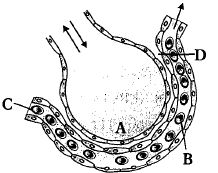
The given figure shows a small part of the human lung where gas exchange occurs. Identify the part $A, B, C,$ or $D$ correctly with its function from the given options.
A
$C$: Arterial capillary - passes oxygen to tissues.
B
$A$: Alveolar cavity - the primary site of respiratory gas exchange.
C
$D$: Capillary wall - site of oxygen and carbon dioxide exchange.
D
$B$: Red blood cells - primarily transport $CO_2$.
Solution
(B) In the given diagram of the alveolus and its associated capillary network:
- $A$ represents the Alveolar cavity,which is the primary site for the exchange of respiratory gases ($O_2$ and $CO_2$) between the air in the alveoli and the blood in the capillaries.
- $B$ represents Red Blood Cells (RBCs),which are responsible for the transport of both $O_2$ and $CO_2$.
- $C$ represents the arterial end of the capillary.
- $D$ represents the capillary wall (endothelium),which along with the alveolar wall forms the respiratory membrane.
Therefore,option $B$ correctly identifies $A$ as the alveolar cavity,which is the primary site of gas exchange.
- $A$ represents the Alveolar cavity,which is the primary site for the exchange of respiratory gases ($O_2$ and $CO_2$) between the air in the alveoli and the blood in the capillaries.
- $B$ represents Red Blood Cells (RBCs),which are responsible for the transport of both $O_2$ and $CO_2$.
- $C$ represents the arterial end of the capillary.
- $D$ represents the capillary wall (endothelium),which along with the alveolar wall forms the respiratory membrane.
Therefore,option $B$ correctly identifies $A$ as the alveolar cavity,which is the primary site of gas exchange.
0 likes
View Solution52
MediumMCQ
What is the partial pressure of oxygen $(pO_2)$ in the alveoli of the lungs compared to the blood?
A
Lower than in the blood
B
Lower than carbon dioxide
C
Equal to that in the blood
D
Higher than in the blood
Solution
(D) The partial pressure of oxygen $(pO_2)$ in the alveoli is approximately $104 \ mmHg$.
In the deoxygenated blood arriving at the lungs via the pulmonary arteries,the $pO_2$ is approximately $40 \ mmHg$.
Since the partial pressure of oxygen in the alveoli $(104 \ mmHg)$ is significantly higher than the partial pressure of oxygen in the blood $(40 \ mmHg)$,oxygen diffuses from the alveoli into the blood.
Therefore,the partial pressure of oxygen in the alveoli is higher than in the blood.
In the deoxygenated blood arriving at the lungs via the pulmonary arteries,the $pO_2$ is approximately $40 \ mmHg$.
Since the partial pressure of oxygen in the alveoli $(104 \ mmHg)$ is significantly higher than the partial pressure of oxygen in the blood $(40 \ mmHg)$,oxygen diffuses from the alveoli into the blood.
Therefore,the partial pressure of oxygen in the alveoli is higher than in the blood.
0 likes
View Solution53
MediumMCQ
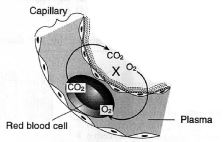
The diagram below represents part of a capillary in a specific region of the human body. The region labeled $X$ represents part of
A
a glomerulus
B
an alveolus
C
a villus
D
the liver
Solution
(B) An alveolus is a tiny air sac in the lung. It is the actual part of the lung where the exchange of atmospheric oxygen $(O_2)$ and carbon dioxide $(CO_2)$ occurs with the blood.
In the diagram,the exchange of gases ($O_2$ entering the blood and $CO_2$ leaving the blood) indicates that region $X$ is the alveolar space.
$A$ glomerulus is a network of capillaries in the kidneys for filtration,a villus is a projection in the small intestine for nutrient absorption,and the liver is involved in metabolic processes like bile production.
In the diagram,the exchange of gases ($O_2$ entering the blood and $CO_2$ leaving the blood) indicates that region $X$ is the alveolar space.
$A$ glomerulus is a network of capillaries in the kidneys for filtration,a villus is a projection in the small intestine for nutrient absorption,and the liver is involved in metabolic processes like bile production.
0 likes
View Solution54
DifficultMCQ
During oxygen transport,the oxyhaemoglobin at the tissue level liberates oxygen to the cells because in tissue:
A
$O_2$ concentration is high and $CO_2$ is low
B
$O_2$ concentration is low and $CO_2$ is high
C
$O_2$ tension is high and $CO_2$ tension is low
D
$O_2$ tension is low and $CO_2$ tension is high
Solution
(D) At the tissue level,cellular respiration consumes oxygen and produces carbon dioxide.
Consequently,the partial pressure (tension) of $O_2$ is low,and the partial pressure (tension) of $CO_2$ is high in the tissues compared to the blood.
According to the Bohr effect,high $CO_2$ concentration and low $O_2$ tension shift the oxygen-haemoglobin dissociation curve to the right,facilitating the dissociation of oxygen from oxyhaemoglobin.
Therefore,oxyhaemoglobin releases oxygen to the cells.
Consequently,the partial pressure (tension) of $O_2$ is low,and the partial pressure (tension) of $CO_2$ is high in the tissues compared to the blood.
According to the Bohr effect,high $CO_2$ concentration and low $O_2$ tension shift the oxygen-haemoglobin dissociation curve to the right,facilitating the dissociation of oxygen from oxyhaemoglobin.
Therefore,oxyhaemoglobin releases oxygen to the cells.
0 likes
View Solution55
MediumMCQ
Diffusion of gases occurs in the alveolar region only and not in the other parts of the respiratory system. Why?
A
Alveoli have thick walls.
B
Alveoli have a large surface area and thin,permeable membranes.
C
Other parts of the respiratory system are blocked.
D
Blood does not reach other parts of the respiratory system.
Solution
(B) Each alveolus is composed of highly permeable and thin layers of squamous epithelial cells. Similarly,the blood capillaries consist of thin layers of squamous epithelial cells.
The exchange of $O_2$ and $CO_2$ occurs between the blood capillaries surrounding the alveoli and the air present in the alveoli.
This exchange happens via simple diffusion due to pressure or concentration gradients. The barrier between the alveoli and the capillaries is extremely thin,allowing gases to diffuse from an area of higher partial pressure to an area of lower partial pressure.
The venous blood reaching the alveoli has a lower partial pressure of $O_2$ and a higher partial pressure of $CO_2$ compared to the alveolar air. Consequently,oxygen diffuses into the blood,while carbon dioxide diffuses out of the blood into the alveoli.
The exchange of $O_2$ and $CO_2$ occurs between the blood capillaries surrounding the alveoli and the air present in the alveoli.
This exchange happens via simple diffusion due to pressure or concentration gradients. The barrier between the alveoli and the capillaries is extremely thin,allowing gases to diffuse from an area of higher partial pressure to an area of lower partial pressure.
The venous blood reaching the alveoli has a lower partial pressure of $O_2$ and a higher partial pressure of $CO_2$ compared to the alveolar air. Consequently,oxygen diffuses into the blood,while carbon dioxide diffuses out of the blood into the alveoli.
1 likes
View Solution56
EasyMCQ
What will be the $pO_{2}$ and $pCO_{2}$ in the atmospheric air compared to those in the alveolar air?
A
$pO_{2}$ higher,$pCO_{2}$ lesser
B
$pO_{2}$ lesser,$pCO_{2}$ higher
C
$pO_{2}$ higher,$pCO_{2}$ higher
D
$pO_{2}$ lesser,$pCO_{2}$ lesser
Solution
(A) The correct answer is $A$.
The partial pressure of oxygen $(pO_{2})$ in atmospheric air is higher than that of oxygen in alveolar air. In atmospheric air,$pO_{2}$ is approximately $159 \, mm \, Hg$,whereas in alveolar air,it is about $104 \, mm \, Hg$.
The partial pressure of carbon dioxide $(pCO_{2})$ in atmospheric air is significantly lower than that of carbon dioxide in alveolar air. In atmospheric air,$pCO_{2}$ is about $0.3 \, mm \, Hg$,while in alveolar air,it is approximately $40 \, mm \, Hg$.
The partial pressure of oxygen $(pO_{2})$ in atmospheric air is higher than that of oxygen in alveolar air. In atmospheric air,$pO_{2}$ is approximately $159 \, mm \, Hg$,whereas in alveolar air,it is about $104 \, mm \, Hg$.
The partial pressure of carbon dioxide $(pCO_{2})$ in atmospheric air is significantly lower than that of carbon dioxide in alveolar air. In atmospheric air,$pCO_{2}$ is about $0.3 \, mm \, Hg$,while in alveolar air,it is approximately $40 \, mm \, Hg$.
0 likes
View Solution57
Easy
Explain the exchange of gases in short.
Solution
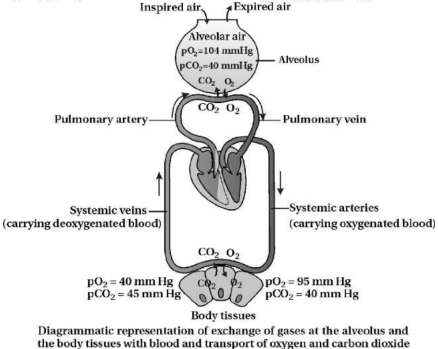
(N/A) Alveoli are the primary sites of exchange of gases. Exchange of gases also occurs between blood and tissues.
$O_{2}$ and $CO_{2}$ are exchanged in these sites by simple diffusion,mainly based on pressure/concentration gradients.
Solubility of the gases as well as the thickness of the membranes involved in diffusion are also important factors that affect the rate of diffusion.
Pressure contributed by an individual gas in a mixture of gases is called partial pressure and is represented as $pO_{2}$ for oxygen and $pCO_{2}$ for carbon dioxide.
Partial pressures of gases (in $mmHg$) at different sites are given in the table below:
$O_{2}$ and $CO_{2}$ are exchanged in these sites by simple diffusion,mainly based on pressure/concentration gradients.
Solubility of the gases as well as the thickness of the membranes involved in diffusion are also important factors that affect the rate of diffusion.
Pressure contributed by an individual gas in a mixture of gases is called partial pressure and is represented as $pO_{2}$ for oxygen and $pCO_{2}$ for carbon dioxide.
Partial pressures of gases (in $mmHg$) at different sites are given in the table below:
| Respiratory Gas | Atmospheric Air | Alveoli | Blood (Deoxygenated) | Blood (Oxygenated) | Tissues |
|---|---|---|---|---|---|
| $O_{2}$ | $159$ | $104$ | $40$ | $95$ | $40$ |
| $CO_{2}$ | $0.3$ | $40$ | $45$ | $40$ | $45$ |
0 likes
View Solution58
Easy
Explain: $(1)$ Exchange of gases by alveolus surface. $(2)$ Exchange of gases in tissues.
Solution
(N/A) $(1)$ Exchange of gases by alveolus surface:
The partial pressure of $O_{2}$ $(pO_{2})$ in deoxygenated blood reaching the alveoli is $40 \ mm \ Hg$,and the partial pressure of $CO_{2}$ $(pCO_{2})$ is $45 \ mm \ Hg$.
In the alveoli,the partial pressure of $O_{2}$ is $104 \ mm \ Hg$ and $pCO_{2}$ is $40 \ mm \ Hg$.
Due to this pressure gradient,$O_{2}$ diffuses from the alveoli into the blood,and $CO_{2}$ diffuses from the blood into the alveoli.
$(2)$ Exchange of gases in tissues:
In tissues,the exchange of gases occurs between the blood and the tissue cells via the interstitial fluid (tissue fluid).
Oxygenated blood reaching the tissues has a $pO_{2}$ of $95-100 \ mm \ Hg$,while the $pO_{2}$ in the metabolically active tissue cells is $40 \ mm \ Hg$.
The $pCO_{2}$ in the tissues is $45 \ mm \ Hg$,while in the blood,it is $40 \ mm \ Hg$.
Due to these partial pressure gradients,$O_{2}$ diffuses from the blood into the tissues,and $CO_{2}$ diffuses from the tissues into the blood.
The partial pressure of $O_{2}$ $(pO_{2})$ in deoxygenated blood reaching the alveoli is $40 \ mm \ Hg$,and the partial pressure of $CO_{2}$ $(pCO_{2})$ is $45 \ mm \ Hg$.
In the alveoli,the partial pressure of $O_{2}$ is $104 \ mm \ Hg$ and $pCO_{2}$ is $40 \ mm \ Hg$.
Due to this pressure gradient,$O_{2}$ diffuses from the alveoli into the blood,and $CO_{2}$ diffuses from the blood into the alveoli.
$(2)$ Exchange of gases in tissues:
In tissues,the exchange of gases occurs between the blood and the tissue cells via the interstitial fluid (tissue fluid).
Oxygenated blood reaching the tissues has a $pO_{2}$ of $95-100 \ mm \ Hg$,while the $pO_{2}$ in the metabolically active tissue cells is $40 \ mm \ Hg$.
The $pCO_{2}$ in the tissues is $45 \ mm \ Hg$,while in the blood,it is $40 \ mm \ Hg$.
Due to these partial pressure gradients,$O_{2}$ diffuses from the blood into the tissues,and $CO_{2}$ diffuses from the tissues into the blood.
0 likes
View Solution59
Easy
Explain: Diffusion of $O_2$ from alveoli to tissues and of $CO_2$ from tissues to alveoli.
Solution
(N/A) The exchange of gases occurs primarily by diffusion based on pressure gradients. The following table summarizes the partial pressures (in $mm Hg$) of respiratory gases:
The data indicates a concentration gradient for $O_2$ from alveoli to blood and from blood to tissues. Similarly, a gradient exists for $CO_2$ in the opposite direction, from tissues to blood and from blood to alveoli.
Since the solubility of $CO_2$ is $20-25$ times higher than that of $O_2$, the amount of $CO_2$ that can diffuse through the diffusion membrane per unit difference in partial pressure is much higher than that of $O_2$.
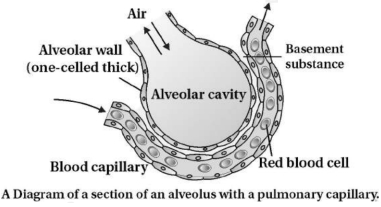
The diffusion membrane is composed of three major layers:
$(1)$ Thin squamous epithelium of alveoli.
$(2)$ The endothelium of alveolar capillaries.
$(3)$ The basement membrane in between them.
The total thickness of this membrane is much less than a millimeter, facilitating rapid diffusion. Thus, all factors are favourable for the diffusion of $O_2$ from alveoli to tissues and $CO_2$ from tissues to alveoli.
| Respiratory Gas | Atmospheric Air | Alveoli | Blood (Deoxygenated) | Blood (Oxygenated) | Tissues |
| $O_2$ | $159$ | $104$ | $40$ | $95$ | $40$ |
| $CO_2$ | $0.3$ | $40$ | $45$ | $40$ | $45$ |
The data indicates a concentration gradient for $O_2$ from alveoli to blood and from blood to tissues. Similarly, a gradient exists for $CO_2$ in the opposite direction, from tissues to blood and from blood to alveoli.
Since the solubility of $CO_2$ is $20-25$ times higher than that of $O_2$, the amount of $CO_2$ that can diffuse through the diffusion membrane per unit difference in partial pressure is much higher than that of $O_2$.
The diffusion membrane is composed of three major layers:
$(1)$ Thin squamous epithelium of alveoli.
$(2)$ The endothelium of alveolar capillaries.
$(3)$ The basement membrane in between them.
The total thickness of this membrane is much less than a millimeter, facilitating rapid diffusion. Thus, all factors are favourable for the diffusion of $O_2$ from alveoli to tissues and $CO_2$ from tissues to alveoli.
0 likes
View Solution60
Easy
Compared to $O_2$,the diffusion rate of $CO_2$ through the diffusion membrane per unit difference in partial pressure is much higher. Explain.
Solution
(N/A) The solubility of $CO_2$ is $20-25$ times higher than that of $O_2$. Due to this high solubility,the amount of $CO_2$ that diffuses across the diffusion membrane per unit difference in partial pressure is significantly greater than that of $O_2$.
0 likes
View Solution61
EasyMCQ
Analogy type question:
$(1)$ Atmospheric air enters: Inspiration :: Alveolar air released out: ..........
$(2)$ $O_2$ in alveoli: $104 \, mm \, Hg$ :: $CO_2$ in alveoli: ..........
$(1)$ Atmospheric air enters: Inspiration :: Alveolar air released out: ..........
$(2)$ $O_2$ in alveoli: $104 \, mm \, Hg$ :: $CO_2$ in alveoli: ..........
A
Expiration,$40 \, mm \, Hg$
B
Inspiration,$45 \, mm \, Hg$
C
Expiration,$45 \, mm \, Hg$
D
Inspiration,$40 \, mm \, Hg$
Solution
(A) $(1)$ The process of moving atmospheric air into the lungs is called inspiration. Conversely,the process of releasing alveolar air out of the lungs is called expiration.
$(2)$ The partial pressure of oxygen $(pO_2)$ in the alveoli is $104 \, mm \, Hg$. The partial pressure of carbon dioxide $(pCO_2)$ in the alveoli is $40 \, mm \, Hg$.
$(2)$ The partial pressure of oxygen $(pO_2)$ in the alveoli is $104 \, mm \, Hg$. The partial pressure of carbon dioxide $(pCO_2)$ in the alveoli is $40 \, mm \, Hg$.
0 likes
View Solution62
Medium
What is partial pressure? How is it represented?
Solution
(N/A) Partial pressure is the pressure contributed by an individual gas in a mixture of gases. It is represented by the letter $p$ followed by the chemical formula of the gas. For example,the partial pressure of oxygen is represented as $pO_{2}$ and the partial pressure of carbon dioxide is represented as $pCO_{2}$.
0 likes
View Solution63
MediumMCQ
The diffusion membrane is made up of which layers?
A
Squamous epithelium of alveoli,endothelium of alveolar capillaries,and basement membrane.
B
Columnar epithelium of alveoli,endothelium of alveolar capillaries,and basement membrane.
C
Squamous epithelium of alveoli,mesothelium of alveolar capillaries,and basement membrane.
D
Cuboidal epithelium of alveoli,endothelium of alveolar capillaries,and basement membrane.
Solution
(A) The diffusion membrane is made up of three major layers:
$(1)$ The thin squamous epithelium of the alveoli.
$(2)$ The endothelium of the alveolar capillaries.
$(3)$ The basement substance (basement membrane) in between them.
These three layers together have a total thickness of less than a millimeter,which facilitates the rapid diffusion of oxygen and carbon dioxide.
$(1)$ The thin squamous epithelium of the alveoli.
$(2)$ The endothelium of the alveolar capillaries.
$(3)$ The basement substance (basement membrane) in between them.
These three layers together have a total thickness of less than a millimeter,which facilitates the rapid diffusion of oxygen and carbon dioxide.
0 likes
View Solution64
MediumMCQ
Name the primary site of exchange of gases in our body?
A
Trachea
B
Bronchi
C
Alveoli
D
Lungs
Solution
(C) The $Alveoli$ are the primary sites for the exchange of gases in the human body.
They possess very thin walls and a dense network of blood capillaries.
This structure facilitates the easy diffusion of $O_2$ and $CO_2$ between the air in the alveoli and the blood.
They possess very thin walls and a dense network of blood capillaries.
This structure facilitates the easy diffusion of $O_2$ and $CO_2$ between the air in the alveoli and the blood.
0 likes
View Solution65
EasyMCQ
Gaseous movement into and out of the plants occurs indirectly through
A
Osmosis
B
Diffusion
C
Transpiration
D
Imbibition
Solution
(B) Diffusion is the process by which molecules move from a region of higher concentration to a region of lower concentration. In plants,the exchange of gases like $O_2$ and $CO_2$ between the internal tissues and the external environment occurs primarily through the stomata and lenticels via the process of diffusion.
0 likes
View Solution66
MediumMCQ
Partial pressure of a gas is the pressure contributed by
A
All gases in a mixture
B
Individual gas in a mixture
C
Pressure exerted by atmosphere on gases
D
Atmosphere on $O_{2}$ only
Solution
(B) The pressure contributed by an individual gas in a mixture of gases is known as its partial pressure. It is represented as $pO_{2}$ for oxygen and $pCO_{2}$ for carbon dioxide.
0 likes
View Solution67
MediumMCQ
Exchange of $O_{2}$ and $CO_{2}$ between the blood and tissue is based on
A
Pressure/concentration gradient
B
Inspiratory capacity
C
Osmotic gradient
D
Tidal volume
Solution
(A) The exchange of gases between the blood and tissues occurs through the process of simple diffusion.
This process is driven by the partial pressure gradient of the gases involved.
Oxygen $(O_{2})$ moves from the blood into the tissues because the partial pressure of $O_{2}$ is higher in the blood than in the tissues.
Conversely,carbon dioxide $(CO_{2})$ moves from the tissues into the blood because the partial pressure of $CO_{2}$ is higher in the tissues than in the blood.
Therefore,the exchange is primarily based on the pressure/concentration gradient.
This process is driven by the partial pressure gradient of the gases involved.
Oxygen $(O_{2})$ moves from the blood into the tissues because the partial pressure of $O_{2}$ is higher in the blood than in the tissues.
Conversely,carbon dioxide $(CO_{2})$ moves from the tissues into the blood because the partial pressure of $CO_{2}$ is higher in the tissues than in the blood.
Therefore,the exchange is primarily based on the pressure/concentration gradient.
0 likes
View Solution68
EasyMCQ
Exchange of gases in man takes place at the level of
A
Trachea
B
Bronchus
C
Alveoli
D
All of these
Solution
(C) In humans,the exchange of gases ($O_2$ and $CO_2$) occurs at the level of the alveoli. The alveoli are thin-walled,bag-like structures surrounded by a network of capillaries,which facilitate the diffusion of gases between the air in the lungs and the blood.
0 likes
View Solution69
MediumMCQ
How many layers are present in the diffusion membrane of the alveolus capillary?
A
$5$
B
$3$
C
$2$
D
$4$
Solution
(B) The diffusion membrane is composed of three major layers: the thin squamous epithelium of the alveoli,the endothelium of the alveolar capillaries,and the basement membrane (basement substance) located between them.
These three layers facilitate the efficient exchange of gases.
Despite having three layers,the total thickness of the diffusion membrane is much less than a millimeter,which is highly favorable for the diffusion of $O_{2}$ from the alveoli to the tissues and $CO_{2}$ from the tissues to the alveoli.
These three layers facilitate the efficient exchange of gases.
Despite having three layers,the total thickness of the diffusion membrane is much less than a millimeter,which is highly favorable for the diffusion of $O_{2}$ from the alveoli to the tissues and $CO_{2}$ from the tissues to the alveoli.
0 likes
View Solution70
MediumMCQ
The diffusion membrane is made up of:
A
Thin squamous epithelium of alveoli
B
Endothelium of alveolar capillaries
C
Basement substance in between the two mentioned above
D
All of the above
Solution
(D) The diffusion membrane is composed of three major layers:
$(i)$ The thin squamous epithelium of the alveoli.
$(ii)$ The endothelium of the alveolar capillaries.
$(iii)$ The basement substance (basement membrane) located between the squamous epithelium of the alveoli and the endothelium of the alveolar capillaries.
Therefore,all the mentioned components contribute to the structure of the diffusion membrane.
$(i)$ The thin squamous epithelium of the alveoli.
$(ii)$ The endothelium of the alveolar capillaries.
$(iii)$ The basement substance (basement membrane) located between the squamous epithelium of the alveoli and the endothelium of the alveolar capillaries.
Therefore,all the mentioned components contribute to the structure of the diffusion membrane.
0 likes
View Solution71
EasyMCQ
Exchange of gases in lungs occurs through
A
Simple diffusion
B
Active transport
C
Osmosis
D
Plasmolysis
Solution
(A) Exchange of gases in the lungs is known as external respiration.
In this process,oxygen moves from the alveoli into the pulmonary capillary blood,while carbon dioxide moves from the pulmonary capillaries into the alveoli.
The exchange of gases across the alveocapillary membrane is a purely physical process known as simple diffusion.
This process is driven by partial pressure gradients and does not involve any active transport or chemical reactions.
In this process,oxygen moves from the alveoli into the pulmonary capillary blood,while carbon dioxide moves from the pulmonary capillaries into the alveoli.
The exchange of gases across the alveocapillary membrane is a purely physical process known as simple diffusion.
This process is driven by partial pressure gradients and does not involve any active transport or chemical reactions.
0 likes
View Solution72
MediumMCQ
The partial pressure of oxygen in the alveolar air is
A
$45\; mm\; Hg$
B
$95\; mm\; Hg$
C
$104\; mm\; Hg$
D
$110\; mm\; Hg$
Solution
(C) The partial pressure of oxygen $(pO_2)$ in the atmospheric air is approximately $159\; mm\; Hg$.
In the alveoli,the partial pressure of oxygen is $104\; mm\; Hg$.
This high partial pressure in the alveoli compared to the deoxygenated blood $(40\; mm\; Hg)$ facilitates the diffusion of oxygen into the blood.
In the alveoli,the partial pressure of oxygen is $104\; mm\; Hg$.
This high partial pressure in the alveoli compared to the deoxygenated blood $(40\; mm\; Hg)$ facilitates the diffusion of oxygen into the blood.
0 likes
View Solution73
MediumMCQ
The solubility of $CO_{2}$ in the blood is
A
$10-15$ times higher than that of $O_{2}$
B
$20-25$ times higher than that of $O_{2}$
C
Slightly higher than that of $O_{2}$
D
Slightly lower than that of $O_{2}$
Solution
(B) The solubility of $CO_{2}$ in the blood is $20-25$ times higher than that of $O_{2}$.
This high solubility allows $CO_{2}$ to diffuse much more readily across the diffusion membrane per unit difference in partial pressure compared to $O_{2}$.
This high solubility allows $CO_{2}$ to diffuse much more readily across the diffusion membrane per unit difference in partial pressure compared to $O_{2}$.
0 likes
View Solution74
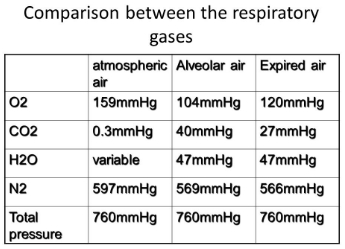
MediumMCQ
The partial pressure of $O_{2}$ and $CO_{2}$ in atmospheric air as compared to those in alveolar air is:
| Gas | Alveolar Air $(X/A)$ | Atmospheric Air $(Y/B)$ |
|---|---|---|
| $pO_{2}$ | $X$ | $Y$ |
| $pCO_{2}$ | $A$ | $B$ |
A
$X > Y$ and $A > B$
B
$X < Y$ and $A < B$
C
$X > Y$ and $A < B$
D
$X < Y$ and $A > B$
Solution
(D) The partial pressure of $O_{2}$ in atmospheric air is $159 \text{ mmHg}$,while in alveolar air it is $104 \text{ mmHg}$. Thus,$X (104) < Y (159)$.
The partial pressure of $CO_{2}$ in atmospheric air is $0.3 \text{ mmHg}$,while in alveolar air it is $40 \text{ mmHg}$. Thus,$A (40) > B (0.3)$.
Therefore,the correct relationship is $X < Y$ and $A > B$.
The partial pressure of $CO_{2}$ in atmospheric air is $0.3 \text{ mmHg}$,while in alveolar air it is $40 \text{ mmHg}$. Thus,$A (40) > B (0.3)$.
Therefore,the correct relationship is $X < Y$ and $A > B$.
0 likes
View Solution75
MediumMCQ
Which structure of the lungs is directly involved in $O_2 / CO_2$ exchange between air and blood capillary?
A
Bronchi
B
Trachea
C
Alveoli
D
Secondary bronchi
Solution
(C) The primary bronchus of the lungs divides to form secondary bronchi,which further divide to form tertiary bronchi.
The tertiary bronchi subdivide into bronchioles.
The bronchioles open into the alveoli through alveolar ducts,atria,and alveolar sacs.
The alveoli have very thin walls consisting of squamous epithelium.
The wall of the alveoli has an extensive network of blood capillaries.
Due to the very intimate contact of blood capillaries with the alveoli,the exchange of gases takes place easily.
The tertiary bronchi subdivide into bronchioles.
The bronchioles open into the alveoli through alveolar ducts,atria,and alveolar sacs.
The alveoli have very thin walls consisting of squamous epithelium.
The wall of the alveoli has an extensive network of blood capillaries.
Due to the very intimate contact of blood capillaries with the alveoli,the exchange of gases takes place easily.
0 likes
View Solution76
MediumMCQ
Why do human beings face difficulty breathing at high elevations?
A
Lower percentage of $O_{2}$
B
Lower temperature
C
High pressure
D
Low partial pressure of $O_{2}$
Solution
(D) At high altitudes,the total atmospheric pressure is lower than at sea level.
Because the total atmospheric pressure is lower,the partial pressure of oxygen $(pO_{2})$ is also significantly lower.
Breathing involves the diffusion of oxygen from the atmosphere into the blood,which depends on the pressure gradient.
Since the partial pressure of oxygen in the atmosphere is low at high elevations,the diffusion of oxygen into the blood becomes difficult,leading to breathing difficulties.
Because the total atmospheric pressure is lower,the partial pressure of oxygen $(pO_{2})$ is also significantly lower.
Breathing involves the diffusion of oxygen from the atmosphere into the blood,which depends on the pressure gradient.
Since the partial pressure of oxygen in the atmosphere is low at high elevations,the diffusion of oxygen into the blood becomes difficult,leading to breathing difficulties.
0 likes
View Solution77
MediumMCQ
Which of the following factors affect the rate of diffusion?
A
Pressure gradient
B
Solubility of gases
C
Thickness of membranes
D
All of these
Solution
(D) The rate of diffusion is influenced by several factors,including the pressure or concentration gradient,the solubility of the gases involved,and the thickness of the membranes through which diffusion occurs. $A$ steeper pressure gradient,higher solubility of the gas,and thinner membranes all facilitate a faster rate of diffusion. Therefore,all the listed factors affect the rate of diffusion.
0 likes
View Solution78
MediumMCQ
Partial pressure (in $mm \ Hg$) of oxygen and carbon dioxide at different parts involved in diffusion in comparison to those in the atmosphere. Identify $A$ and $B$ and choose the correct option accordingly.
| Gas | Atmospheric Air | Alveoli |
| $O_{2}$ | $159$ | $A$ |
| $CO_{2}$ | $0.3$ | $B$ |
A
$A - 50; B - 50$
B
$A - 104; B - 40$
C
$A - 40; B - 104$
D
$A - 101; B - 45$
Solution
(B) The partial pressure of respiratory gases in the atmosphere and alveoli are as follows:
$1$. For $O_{2}$, the partial pressure in atmospheric air is $159 \ mm \ Hg$, and in the alveoli, it is $104 \ mm \ Hg$ (represented as $A$).
$2$. For $CO_{2}$, the partial pressure in atmospheric air is $0.3 \ mm \ Hg$, and in the alveoli, it is $40 \ mm \ Hg$ (represented as $B$).
Therefore, $A = 104$ and $B = 40$.
$1$. For $O_{2}$, the partial pressure in atmospheric air is $159 \ mm \ Hg$, and in the alveoli, it is $104 \ mm \ Hg$ (represented as $A$).
$2$. For $CO_{2}$, the partial pressure in atmospheric air is $0.3 \ mm \ Hg$, and in the alveoli, it is $40 \ mm \ Hg$ (represented as $B$).
Therefore, $A = 104$ and $B = 40$.
0 likes
View Solution79
MediumMCQ
In humans,exchange of gases occurs
A
By diffusion
B
Between blood and tissue
C
Between alveoli and pulmonary blood capillary
D
All of the above
Solution
(D) Alveoli are the primary site of exchange of gases.
Exchange of gases also occurs between the blood and tissues.
$O_{2}$ and $CO_{2}$ are exchanged at these sites by simple diffusion,primarily based on the pressure/concentration gradient.
The pressure/concentration gradient,solubility of gases,and the thickness of the membranes involved in diffusion are some important factors that affect the rate of diffusion.
Exchange of gases also occurs between the blood and tissues.
$O_{2}$ and $CO_{2}$ are exchanged at these sites by simple diffusion,primarily based on the pressure/concentration gradient.
The pressure/concentration gradient,solubility of gases,and the thickness of the membranes involved in diffusion are some important factors that affect the rate of diffusion.
0 likes
View Solution80
MediumMCQ
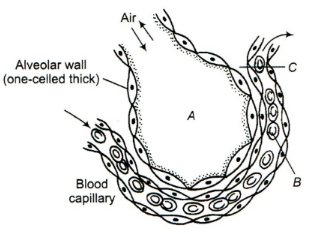
Identify $A, B$ and $C$ in the given diagram and choose the correct option accordingly.
A
$A-$ Alveolar cavity,$B-$ $WBC$,$C-$ Capillary wall
B
$A-$ Alveolar cavity,$B-$ $RBC$,$C-$ Systemic wall
C
$A-$ Alveolar cavity,$B-$ $RBC$,$C-$ Basement substance
D
$A-$ Alveolar cavity,$B-$ $WBC$,$C-$ Systemic wall
Solution
(C) In the provided diagram of the alveolar-capillary interface:
$A$ represents the Alveolar cavity,which is the space inside the alveolus where air is present.
$B$ represents the Red Blood Cells (RBCs) present within the blood capillary.
$C$ represents the basement substance (basement membrane) that lies between the alveolar wall and the capillary wall,facilitating the diffusion of gases.
Therefore,the correct identification is $A-$ Alveolar cavity,$B-$ $RBC$,$C-$ Basement substance.
$A$ represents the Alveolar cavity,which is the space inside the alveolus where air is present.
$B$ represents the Red Blood Cells (RBCs) present within the blood capillary.
$C$ represents the basement substance (basement membrane) that lies between the alveolar wall and the capillary wall,facilitating the diffusion of gases.
Therefore,the correct identification is $A-$ Alveolar cavity,$B-$ $RBC$,$C-$ Basement substance.
0 likes
View Solution81
MediumMCQ
Almost the same $pCO_{2}$ in humans is found in
A
Oxygenated blood and tissues
B
Deoxygenated blood and oxygenated blood
C
Deoxygenated blood and tissues
D
All of the above
Solution
(C) In the human respiratory system,the partial pressure of carbon dioxide $(pCO_{2})$ in deoxygenated blood is approximately $45 \ mmHg$.
Similarly,the $pCO_{2}$ in the systemic tissues is also approximately $45 \ mmHg$.
Since the partial pressures are nearly equal,this facilitates the diffusion of $CO_{2}$ from the tissues into the blood.
Similarly,the $pCO_{2}$ in the systemic tissues is also approximately $45 \ mmHg$.
Since the partial pressures are nearly equal,this facilitates the diffusion of $CO_{2}$ from the tissues into the blood.
0 likes
View Solution82
MediumMCQ
$PCO_{2}$ is higher in tissues due to
A
Anabolism
B
Catabolism
C
Building up of carbohydrates
D
Building up of proteins
Solution
(B) In the tissues,cellular respiration involves the breakdown of nutrients,a process known as catabolism.
During catabolism,oxygen is consumed and carbon dioxide $(CO_{2})$ is produced as a metabolic byproduct.
Because $CO_{2}$ is continuously generated in the tissues,its partial pressure $(PCO_{2})$ becomes higher in the tissues compared to the blood.
This concentration gradient allows $CO_{2}$ to diffuse from the tissues into the blood,where it is transported to the lungs for exhalation.
During catabolism,oxygen is consumed and carbon dioxide $(CO_{2})$ is produced as a metabolic byproduct.
Because $CO_{2}$ is continuously generated in the tissues,its partial pressure $(PCO_{2})$ becomes higher in the tissues compared to the blood.
This concentration gradient allows $CO_{2}$ to diffuse from the tissues into the blood,where it is transported to the lungs for exhalation.
0 likes
View Solution83
MediumMCQ
Which of the following statements is not true?
A
The partial pressure of oxygen in deoxygenated blood is $40\; mm\; Hg$.
B
The partial pressure of oxygen in oxygenated blood is $95\; mm\; Hg$.
C
The partial pressure of oxygen in the alveolar air is $104\; mm\; Hg$.
D
The partial pressure of carbon dioxide in deoxygenated blood is $95\; mm\; Hg$.
Solution
(D) The partial pressure of gases in the blood and alveoli are as follows:
$1$. The partial pressure of oxygen $(pO_2)$ in deoxygenated blood is $40\; mm\; Hg$.
$2$. The partial pressure of oxygen $(pO_2)$ in oxygenated blood is $95\; mm\; Hg$.
$3$. The partial pressure of oxygen $(pO_2)$ in alveolar air is $104\; mm\; Hg$.
$4$. The partial pressure of carbon dioxide $(pCO_2)$ in deoxygenated blood is $45\; mm\; Hg$ (not $95\; mm\; Hg$).
Therefore,the statement in option $D$ is incorrect because the $pCO_2$ in deoxygenated blood is $45\; mm\; Hg$.
$1$. The partial pressure of oxygen $(pO_2)$ in deoxygenated blood is $40\; mm\; Hg$.
$2$. The partial pressure of oxygen $(pO_2)$ in oxygenated blood is $95\; mm\; Hg$.
$3$. The partial pressure of oxygen $(pO_2)$ in alveolar air is $104\; mm\; Hg$.
$4$. The partial pressure of carbon dioxide $(pCO_2)$ in deoxygenated blood is $45\; mm\; Hg$ (not $95\; mm\; Hg$).
Therefore,the statement in option $D$ is incorrect because the $pCO_2$ in deoxygenated blood is $45\; mm\; Hg$.
0 likes
View Solution84
EasyMCQ
Amount of $CO_{2}$ in expired air is about (in $\%$)
A
$0.04$
B
$0.03$
C
$4.5$
D
$2.1$
Solution
(C) The amount of $CO_{2}$ in expired (exhaled) air is approximately $4.4 \%$.
Atmospheric air (inhaled air) contains about $0.04 \%$ $CO_{2}$.
Exhaled air contains about $4 \%$ to $4.5 \%$ $CO_{2}$.
Therefore,exhaled air contains approximately $100$ times the concentration of $CO_{2}$ compared to inhaled air.
Atmospheric air (inhaled air) contains about $0.04 \%$ $CO_{2}$.
Exhaled air contains about $4 \%$ to $4.5 \%$ $CO_{2}$.
Therefore,exhaled air contains approximately $100$ times the concentration of $CO_{2}$ compared to inhaled air.
0 likes
View Solution85
EasyMCQ
What is the main site of the human respiratory system where the exchange of gases occurs?
A
Alveoli
B
Bronchiole
C
Primary and secondary bronchi
D
Trachea
Solution
(A) The membrane of the alveoli is very thin,irregular,and richly supplied with blood capillaries.
Due to the very close contact of blood capillaries with the alveoli,the exchange of gases ($O_2$ and $CO_2$) takes place easily by simple diffusion.
Due to the very close contact of blood capillaries with the alveoli,the exchange of gases ($O_2$ and $CO_2$) takes place easily by simple diffusion.
0 likes
View Solution86
MediumMCQ
Partial pressure for oxygen and $CO_2$ is represented as
A
$pO$ and $pCO$
B
$Po$ and $P_{CO_2}$
C
$pO_2$ and $pCO_2$
D
$O_2p$ and $CO_2p$
Solution
(C) The partial pressure of a gas is the pressure contributed by an individual gas in a mixture of gases.
It is denoted by the letter '$p$' followed by the chemical formula of the gas.
Therefore,the partial pressure of oxygen is represented as $pO_2$ and the partial pressure of carbon dioxide is represented as $pCO_2$.
It is denoted by the letter '$p$' followed by the chemical formula of the gas.
Therefore,the partial pressure of oxygen is represented as $pO_2$ and the partial pressure of carbon dioxide is represented as $pCO_2$.
0 likes
View Solution87
MediumMCQ
What will be the $pO_{2}$ and $pCO_{2}$ in atmospheric air as compared to alveoli?
A
High $pO_{2}$ and low $pCO_{2}$
B
High $pCO_{2}$ and low $pO_{2}$
C
Both are equal $(pCO_{2} = pO_{2})$
D
Low $pO_{2}$ and low $pCO_{2}$
Solution
(A) The partial pressure of gases in atmospheric air is $pO_{2} = 159 \; mmHg$ and $pCO_{2} = 0.3 \; mmHg$.
In the alveoli,the partial pressure of gases is $pO_{2} = 104 \; mmHg$ and $pCO_{2} = 40 \; mmHg$.
Comparing these values,the atmospheric air has a higher $pO_{2}$ $(159 \; mmHg > 104 \; mmHg)$ and a lower $pCO_{2}$ $(0.3 \; mmHg < 40 \; mmHg)$ than the alveoli.
Therefore,the correct option is $A$.
In the alveoli,the partial pressure of gases is $pO_{2} = 104 \; mmHg$ and $pCO_{2} = 40 \; mmHg$.
Comparing these values,the atmospheric air has a higher $pO_{2}$ $(159 \; mmHg > 104 \; mmHg)$ and a lower $pCO_{2}$ $(0.3 \; mmHg < 40 \; mmHg)$ than the alveoli.
Therefore,the correct option is $A$.
0 likes
View Solution88
MediumMCQ
What is the value of $pCO_2$ in atmospheric air,alveoli,and tissues respectively?
A
$0.3 \; mm \; Hg, 40 \; mm \; Hg$ and $95 \; mm \; Hg$
B
$95 \; mm \; Hg, 40 \; mm \; Hg$ and $159 \; mm \; Hg$
C
$45 \; mm \; Hg, 0.3 \; mm \; Hg$ and $40 \; mm \; Hg$
D
$0.3 \; mm \; Hg, 40 \; mm \; Hg$ and $45 \; mm \; Hg$
Solution
(D) The partial pressure of carbon dioxide $(pCO_2)$ varies in different parts of the respiratory system to facilitate gas exchange. Based on standard physiological values:
$1$. In atmospheric air,the $pCO_2$ is approximately $0.3 \; mm \; Hg$.
$2$. In the alveoli,the $pCO_2$ is $40 \; mm \; Hg$.
$3$. In the tissues,where metabolic activity produces $CO_2$,the $pCO_2$ is $45 \; mm \; Hg$.
Therefore,the correct sequence is $0.3 \; mm \; Hg, 40 \; mm \; Hg$,and $45 \; mm \; Hg$.
$1$. In atmospheric air,the $pCO_2$ is approximately $0.3 \; mm \; Hg$.
$2$. In the alveoli,the $pCO_2$ is $40 \; mm \; Hg$.
$3$. In the tissues,where metabolic activity produces $CO_2$,the $pCO_2$ is $45 \; mm \; Hg$.
Therefore,the correct sequence is $0.3 \; mm \; Hg, 40 \; mm \; Hg$,and $45 \; mm \; Hg$.
0 likes
View Solution89
EasyMCQ
How much $CO_2$ is delivered to the alveoli by every $100 \;ml$ of deoxygenated blood (in $;ml$)?
A
$6$
B
$4$
C
$5$
D
$3$
Solution
(B) Every $100 \;ml$ of deoxygenated blood carries approximately $4 \;ml$ of $CO_2$ to the alveoli for elimination.
This process occurs during the exchange of gases at the alveolar surface,where the partial pressure of $CO_2$ is higher in the blood compared to the alveoli.
This process occurs during the exchange of gases at the alveolar surface,where the partial pressure of $CO_2$ is higher in the blood compared to the alveoli.
0 likes
View Solution90
EasyMCQ
Solubility of $CO_2$ is . . . . . . times higher than that of $O_2$.
A
$40 - 45$
B
$20 - 25$
C
$100 - 200$
D
$200 - 300$
Solution
(B) The solubility of gases in blood is a critical factor for gas exchange in the lungs and tissues.
$CO_2$ is significantly more soluble in blood plasma than $O_2$.
Experimental data indicates that the solubility of $CO_2$ is approximately $20 - 25$ times higher than that of $O_2$.
Therefore,the correct option is $B$.
$CO_2$ is significantly more soluble in blood plasma than $O_2$.
Experimental data indicates that the solubility of $CO_2$ is approximately $20 - 25$ times higher than that of $O_2$.
Therefore,the correct option is $B$.
0 likes
View Solution91
MediumMCQ
What is the function of the respiratory part of the human respiratory system?
A
It clears the incoming air from foreign particles.
B
It brings the temperature of air up to the body temperature.
C
It transports the atmospheric air.
D
It exchanges $O_2$ and $CO_2$ between blood and atmospheric air.
Solution
(D) The respiratory part of the human respiratory system includes the alveoli and their ducts.
It is the primary site of the human respiratory system where the diffusion of gases ($O_2$ and $CO_2$) occurs between the blood and the atmospheric air.
It is the primary site of the human respiratory system where the diffusion of gases ($O_2$ and $CO_2$) occurs between the blood and the atmospheric air.
0 likes
View Solution92
MediumMCQ
What is the value of $pO_2$ in alveoli and tissues respectively?
A
$104 \; mm \; Hg$ and $150 \; mm \; Hg$
B
$45 \; mm \; Hg$ and $0.3 \; mm \; Hg$
C
$104 \; mm \; Hg$ and $40 \; mm \; Hg$
D
$95 \; mm \; Hg$ and $159 \; mm \; Hg$
Solution
(C) The partial pressure of oxygen $(pO_2)$ varies in different parts of the respiratory system to facilitate gas exchange through diffusion.
$1$. In the alveoli,the $pO_2$ is approximately $104 \; mm \; Hg$,which is higher than the $pO_2$ in the deoxygenated blood arriving at the lungs $(40 \; mm \; Hg)$,allowing oxygen to diffuse into the blood.
$2$. In the systemic tissues,the $pO_2$ is approximately $40 \; mm \; Hg$,which is lower than the $pO_2$ in the oxygenated blood arriving from the lungs $(95 \; mm \; Hg)$,allowing oxygen to diffuse from the blood into the tissues.
Therefore,the values are $104 \; mm \; Hg$ in the alveoli and $40 \; mm \; Hg$ in the tissues.
$1$. In the alveoli,the $pO_2$ is approximately $104 \; mm \; Hg$,which is higher than the $pO_2$ in the deoxygenated blood arriving at the lungs $(40 \; mm \; Hg)$,allowing oxygen to diffuse into the blood.
$2$. In the systemic tissues,the $pO_2$ is approximately $40 \; mm \; Hg$,which is lower than the $pO_2$ in the oxygenated blood arriving from the lungs $(95 \; mm \; Hg)$,allowing oxygen to diffuse from the blood into the tissues.
Therefore,the values are $104 \; mm \; Hg$ in the alveoli and $40 \; mm \; Hg$ in the tissues.
0 likes
View Solution93
MediumMCQ
Which are the three main layers that form the diffusion membrane?
A
Thin squamous epithelium of alveoli,basement membrane of bronchioles and basement substance
B
Thin squamous epithelium of alveoli,endothelium of alveolar capillaries and the basement substance
C
Basement substance,cuboidal epithelium of alveoli and stratified epithelium of bronchiole
D
Ciliated epithelium of trachea,endothelium of capillaries and basement substance
Solution
(B) The diffusion membrane is composed of three major layers:
$1$. The thin squamous epithelium of the alveoli.
$2$. The endothelium of the alveolar capillaries.
$3$. The basement substance (basement membrane) in between them.
These layers facilitate the exchange of $O_2$ and $CO_2$ by diffusion due to their extremely thin nature.
$1$. The thin squamous epithelium of the alveoli.
$2$. The endothelium of the alveolar capillaries.
$3$. The basement substance (basement membrane) in between them.
These layers facilitate the exchange of $O_2$ and $CO_2$ by diffusion due to their extremely thin nature.
0 likes
View Solution94
MediumMCQ
$A$: Diffusion of carbon dioxide is $20$ times faster than oxygen.
$R$: It is due to difference in partial pressure as well as solubility of diffusing gases.
$R$: It is due to difference in partial pressure as well as solubility of diffusing gases.
A
Assertion and Reason both are correct and Reason is the correct explanation of Assertion.
B
Assertion and Reason both are correct but Reason is not the correct explanation of Assertion.
C
Assertion is correct,but Reason is incorrect.
D
Both Assertion and Reason are incorrect.
Solution
(A) The diffusion rate of a gas across the alveolar membrane is directly proportional to its solubility and the partial pressure gradient.
Carbon dioxide $(CO_2)$ is $20-25$ times more soluble than oxygen $(O_2)$ in the blood and alveolar membranes.
Due to this significantly higher solubility,the diffusion rate of $CO_2$ is much faster than that of $O_2$ for the same partial pressure gradient.
Therefore,both the assertion and the reason are correct,and the reason provides the correct explanation for the assertion.
Carbon dioxide $(CO_2)$ is $20-25$ times more soluble than oxygen $(O_2)$ in the blood and alveolar membranes.
Due to this significantly higher solubility,the diffusion rate of $CO_2$ is much faster than that of $O_2$ for the same partial pressure gradient.
Therefore,both the assertion and the reason are correct,and the reason provides the correct explanation for the assertion.
0 likes
View Solution95
MediumMCQ
The low partial pressure of oxygen $(PO_2)$ in the body cells results in:
A
Release of $CO_2$ from the cell
B
Formation of haemoglobin
C
Production of bicarbonate
D
Formation of carbonic acid
Solution
(A) The partial pressure of oxygen $(PO_2)$ in the blood capillary is higher $(95 \; mm \; Hg)$ than that of the body cells $(40 \; mm \; Hg)$.
Due to this pressure gradient,oxygen diffuses from the capillary blood into the body cells.
Conversely,the partial pressure of carbon dioxide $(PCO_2)$ is higher in the body cells $(45 \; mm \; Hg)$ compared to the blood capillary $(40 \; mm \; Hg)$.
This concentration gradient facilitates the diffusion of $CO_2$ from the body cells into the blood capillary,which is the process of releasing $CO_2$ from the cell.
Due to this pressure gradient,oxygen diffuses from the capillary blood into the body cells.
Conversely,the partial pressure of carbon dioxide $(PCO_2)$ is higher in the body cells $(45 \; mm \; Hg)$ compared to the blood capillary $(40 \; mm \; Hg)$.
This concentration gradient facilitates the diffusion of $CO_2$ from the body cells into the blood capillary,which is the process of releasing $CO_2$ from the cell.
0 likes
View Solution96
MediumMCQ
Maximum amount of oxygen is lost from the blood in the
A
Capillaries surrounding the tissue cells
B
Arteries of the body
C
Capillaries surrounding the alveoli
D
Left auricle of the heart
Solution
(A) Gaseous exchange between blood and tissue cells occurs in the systemic capillaries.
As blood flows through the capillary networks in various tissues,it supplies oxygen to the cells in exchange for carbon dioxide.
The partial pressure of oxygen $(P_{O_2})$ in tissue fluids is approximately $40 \; mm \; Hg$,whereas in the arterial blood supplying the tissues,it is about $95 \; mm \; Hg$.
This significant pressure gradient ensures the rapid dissociation of oxyhaemoglobin and the diffusion of oxygen into the tissue cells.
Therefore,the maximum amount of oxygen is lost from the blood as it passes through the capillaries surrounding the tissue cells.
As blood flows through the capillary networks in various tissues,it supplies oxygen to the cells in exchange for carbon dioxide.
The partial pressure of oxygen $(P_{O_2})$ in tissue fluids is approximately $40 \; mm \; Hg$,whereas in the arterial blood supplying the tissues,it is about $95 \; mm \; Hg$.
This significant pressure gradient ensures the rapid dissociation of oxyhaemoglobin and the diffusion of oxygen into the tissue cells.
Therefore,the maximum amount of oxygen is lost from the blood as it passes through the capillaries surrounding the tissue cells.
0 likes
View Solution97
MediumMCQ
The partial pressures (in $mm \ Hg$) of oxygen $(O_{2})$ and carbon dioxide $(CO_{2})$ at the alveoli (the site of diffusion) are:
A
$pO_{2} = 104$ and $pCO_{2} = 40$
B
$pO_{2} = 40$ and $pCO_{2} = 45$
C
$pO_{2} = 95$ and $pCO_{2} = 40$
D
$pO_{2} = 159$ and $pCO_{2} = 0.3$
Solution
(A) In the human respiratory system,the exchange of gases occurs at the alveoli by simple diffusion based on pressure gradients.
At the alveoli,the partial pressure of oxygen $(pO_{2})$ is $104 \ mm \ Hg$.
The partial pressure of carbon dioxide $(pCO_{2})$ at the alveoli is $40 \ mm \ Hg$.
These values facilitate the diffusion of $O_{2}$ from the alveoli into the blood and $CO_{2}$ from the blood into the alveoli.
At the alveoli,the partial pressure of oxygen $(pO_{2})$ is $104 \ mm \ Hg$.
The partial pressure of carbon dioxide $(pCO_{2})$ at the alveoli is $40 \ mm \ Hg$.
These values facilitate the diffusion of $O_{2}$ from the alveoli into the blood and $CO_{2}$ from the blood into the alveoli.
0 likes
View Solution98
MediumMCQ
Select the correct option for the shape of guard cells in stomata.
| Stomata of Monocots | Stomata of Dicots | |
| $A$. | Bean-shaped | Dumbbell-shaped |
| $B$. | Dumbbell-shaped | Bean-shaped |
| $C$. | Bean-shaped | Bean-shaped |
| $D$. | Dumbbell-shaped | Dumbbell-shaped |
A
$A$
B
$B$
C
$C$
D
$D$
Solution
$(B)$ In most dicotyledonous plants, the guard cells are bean-shaped or kidney-shaped.
In many monocotyledonous plants, the guard cells are dumbbell-shaped.
Therefore, the correct matching is: Monocots = Dumbbell-shaped, Dicots = Bean-shaped.
This corresponds to option $B$.
In many monocotyledonous plants, the guard cells are dumbbell-shaped.
Therefore, the correct matching is: Monocots = Dumbbell-shaped, Dicots = Bean-shaped.
This corresponds to option $B$.
0 likes
View Solution99
MediumMCQ
Body cells must continuously receive $P$ and release $Q$ produced by the cells. What are $P$ and $Q$ in the given statement?
$P \quad Q$
$P \quad Q$
A
$CO_2 \quad O_2$
B
$O_2 \quad CO_2$
C
$CO \quad O_2$
D
$O_2 \quad CO$
Solution
(B) The process of respiration involves the exchange of gases between the body cells and the environment.
Cells require $O_2$ (Oxygen) for cellular respiration to produce energy in the form of $ATP$.
As a byproduct of cellular respiration,$CO_2$ (Carbon dioxide) is produced,which must be removed from the cells to prevent toxicity.
Therefore,$P$ is $O_2$ and $Q$ is $CO_2$.
Cells require $O_2$ (Oxygen) for cellular respiration to produce energy in the form of $ATP$.
As a byproduct of cellular respiration,$CO_2$ (Carbon dioxide) is produced,which must be removed from the cells to prevent toxicity.
Therefore,$P$ is $O_2$ and $Q$ is $CO_2$.
0 likes
View Solution100
MediumMCQ
Which of the following is true for the exchange part of the respiratory system?
A
It is also called the respiratory exchange part.
B
It includes the alveoli and their ducts.
C
It performs the exchange of $O_2$ and $CO_2$ between atmospheric air and blood.
D
All of the above.
Solution
(D) The human respiratory system is divided into two parts: the conducting part and the exchange part.
$1$. The conducting part includes the external nostrils,nasal passage,pharynx,larynx,trachea,bronchi,and bronchioles,which transport atmospheric air to the alveoli.
$2$. The exchange part consists of the alveoli and their ducts,where the actual diffusion of $O_2$ and $CO_2$ occurs between the blood and atmospheric air.
$3$. Therefore,all the given statements are correct regarding the exchange part of the respiratory system.
$1$. The conducting part includes the external nostrils,nasal passage,pharynx,larynx,trachea,bronchi,and bronchioles,which transport atmospheric air to the alveoli.
$2$. The exchange part consists of the alveoli and their ducts,where the actual diffusion of $O_2$ and $CO_2$ occurs between the blood and atmospheric air.
$3$. Therefore,all the given statements are correct regarding the exchange part of the respiratory system.
0 likes
View SolutionBreathing and Exchange of Gases — Exchange of gases · Frequently Asked Questions
1Are these Breathing and Exchange of Gases questions useful for JEE and NEET?
Yes. All questions in this section are mapped to JEE Main and NEET exam patterns. Previous year questions from JEE Main, NEET, GUJCET and state-level exams are included with full solutions.
2Can I switch to Hindi or Gujarati for these questions?
Yes. Use the language tabs in the hero section or the sidebar to view the same questions and solutions in English, Hindi or Gujarati.
3How do I generate a question paper from this subtopic?
Use the Vedclass Exam Paper Generator — select the chapter and subtopic, set difficulty, and generate Sets A, B, C, D automatically. First 3 chapters of every subject are free.
Vedclass Products
For Students
Vedclass Test Series
Mock tests in real JEE/NEET style with performance analysis. 5-day free trial.
Start Free TrialFor Teachers
Exam Paper Generator
Generate Set A/B/C/D papers from this chapter in 2 minutes. 3 chapters free.
Try FreeFor Institutes
Online Exam Module
Live online exams with unlimited students, 360° analytics & white-label branding.
See DemoFor Teachers & Institutes
Generate a Breathing and Exchange of Gases Exam Paper in 2 Minutes
Select subtopic & difficulty — Sets A, B, C, D auto-generated with No Repeat logic.
First 3 chapters of every subject are free — no payment required.