
A English
Internal structure of leaf Questions in English
Class 11 Biology · Anatomy of Flowering Plants · Internal structure of leaf
84+
Questions
English
Language
100%
With Solutions
Showing 34 of 84 questions in English
51
Easy
Give scientific reasons: Bulliform cells are present in maize leaves.
Solution
(N/A) $\Rightarrow$ In a maize leaf,a group of $5$ to $7$ large,thin-walled cells without chloroplasts and cuticle are located at certain intervals in the upper epidermis.
$\Rightarrow$ When atmospheric moisture decreases and dryness increases,these cells lose water and become flaccid. As a result,the leaf lamina curls inward. This reduction in the exposed surface area of the leaf helps in preventing excessive transpiration.
$\Rightarrow$ In a humid atmosphere,these cells absorb water and regain their turgidity,causing the leaf to unroll and become exposed again. Due to this water-absorbing property,they are also known as water-absorbent cells.
$\Rightarrow$ Because these cells facilitate the rolling and unrolling movements of the leaf,they are also referred to as motor cells or mechanical cells.
$\Rightarrow$ When atmospheric moisture decreases and dryness increases,these cells lose water and become flaccid. As a result,the leaf lamina curls inward. This reduction in the exposed surface area of the leaf helps in preventing excessive transpiration.
$\Rightarrow$ In a humid atmosphere,these cells absorb water and regain their turgidity,causing the leaf to unroll and become exposed again. Due to this water-absorbing property,they are also known as water-absorbent cells.
$\Rightarrow$ Because these cells facilitate the rolling and unrolling movements of the leaf,they are also referred to as motor cells or mechanical cells.
0 likes
View Solution52
Medium
Define the following terms:
$(i)$ Dorsiventral leaf
$(ii)$ Periderm
$(i)$ Dorsiventral leaf
$(ii)$ Periderm
Solution
(N/A) $(i)$ In a dicot leaf,the mesophyll tissue is differentiated into palisade parenchyma and spongy parenchyma,which are located towards the upper and lower epidermis,respectively. Due to this differentiation,it is called a dorsiventral leaf.
$(ii)$ The phellogen (cork cambium),phellem (cork),and phelloderm (secondary cortex) are collectively known as the periderm.
$(ii)$ The phellogen (cork cambium),phellem (cork),and phelloderm (secondary cortex) are collectively known as the periderm.
0 likes
View Solution53
Medium
Point out the differences in the anatomy of the leaf of peepal $(Ficus \text{ } religiosa)$ and maize $(Zea \text{ } mays)$. Describe the key anatomical differences.
Solution
(N/A) The leaf of peepal $(Ficus \text{ } religiosa)$ is a dicot leaf, while the leaf of maize $(Zea \text{ } mays)$ is a monocot leaf. The key differences are as follows:
$1$. Stomata: In dicot leaves (peepal), stomata are generally present more on the abaxial surface. In monocot leaves (maize), stomata are present on both the adaxial and abaxial surfaces.
$2$. Mesophyll: In dicot leaves, the mesophyll is differentiated into palisade parenchyma and spongy parenchyma. In monocot leaves, the mesophyll is not differentiated and consists of similar cells.
$3$. Bulliform cells: These are absent in dicot leaves but are present in the adaxial epidermis of monocot leaves (maize) to help in leaf rolling during water stress.
$4$. Vascular bundles: Dicot leaves show reticulate venation, resulting in vascular bundles of different sizes. Monocot leaves show parallel venation, resulting in vascular bundles of similar sizes.
$1$. Stomata: In dicot leaves (peepal), stomata are generally present more on the abaxial surface. In monocot leaves (maize), stomata are present on both the adaxial and abaxial surfaces.
$2$. Mesophyll: In dicot leaves, the mesophyll is differentiated into palisade parenchyma and spongy parenchyma. In monocot leaves, the mesophyll is not differentiated and consists of similar cells.
$3$. Bulliform cells: These are absent in dicot leaves but are present in the adaxial epidermis of monocot leaves (maize) to help in leaf rolling during water stress.
$4$. Vascular bundles: Dicot leaves show reticulate venation, resulting in vascular bundles of different sizes. Monocot leaves show parallel venation, resulting in vascular bundles of similar sizes.
0 likes
View Solution54
EasyMCQ
Large,empty,colourless cells of the adaxial epidermis along the veins of grass leaves are:
A
Bulliform cells
B
Lenticels
C
Guard cells
D
Bundle sheath cells
Solution
(A) In grasses (monocots),certain adaxial epidermal cells along the veins modify themselves into large,empty,colourless cells. These are known as $Bulliform$ cells. When these cells absorb water and become turgid,they make the leaf surface exposed. When they become flaccid due to water stress,they make the leaves curl inwards to minimize water loss.
0 likes
View Solution55
MediumMCQ
Bulliform cells are found in:
A
Seeds of sunflower
B
Leaf of wheat
C
Pod of pea
D
Tuber of potato
Solution
(B) Bulliform cells,also known as motor cells,are large,bubble-shaped epidermal cells found in groups on the upper surface of leaves in many monocotyledonous plants,such as wheat,maize,and grasses.
These cells are characterized by their large vacuoles and thin walls.
When water availability is low,these cells lose turgor pressure,causing the leaves to roll inwards to minimize water loss through transpiration.
These cells are characterized by their large vacuoles and thin walls.
When water availability is low,these cells lose turgor pressure,causing the leaves to roll inwards to minimize water loss through transpiration.
0 likes
View Solution56
MediumMCQ
Bulliform cells are the modification of
A
Abaxial epidermis cell
B
Adaxial epidermis cell
C
Mesophyll
D
Vascular tissue
Solution
(B) In grasses,certain adaxial epidermal cells along the veins modify themselves into large,empty,colourless cells. These are called bulliform cells.
When the bulliform cells in the leaves have absorbed water and are turgid,the leaf surface is exposed.
When they are flaccid due to water stress,they make the leaves curl inwards to minimise water loss.
When the bulliform cells in the leaves have absorbed water and are turgid,the leaf surface is exposed.
When they are flaccid due to water stress,they make the leaves curl inwards to minimise water loss.
0 likes
View Solution57
MediumMCQ
Plant cells that are photosynthetically active are found in the $A$ layer of leaves and are $B$. Choose the correct combination of $A$ and $B$ from the below given options.
A
$A-$ mesophyll,$B-$ parenchymatous
B
$A-$ mesophyll,$B-$ collenchymatous
C
$A-$ mesophyll,$B-$ sclerenchymatous
D
$A-$ mesophyll,$B-$ merismatic
Solution
(A) The photosynthetic cells in leaves are located in the mesophyll tissue.
These cells are specialized for photosynthesis and are parenchymatous in nature,containing numerous chloroplasts.
These cells are specialized for photosynthesis and are parenchymatous in nature,containing numerous chloroplasts.
0 likes
View Solution58
MediumMCQ
$I.$ Sunflower seed
$II.$ $A$ wheat leaf
$III.$ Pea plant
$IV.$ Leaf blade of grass
Bulliform cells are present in which of the above plants?
$II.$ $A$ wheat leaf
$III.$ Pea plant
$IV.$ Leaf blade of grass
Bulliform cells are present in which of the above plants?
A
$I$ and $II$
B
$II$ and $III$
C
$III$ and $IV$
D
$II$ and $IV$
Solution
(D) Bulliform cells are specialized large,empty,colorless epidermal cells found in the upper epidermis of leaves of many monocotyledonous plants.
These cells are responsible for the rolling and unrolling of leaves to minimize water loss during dry conditions.
Among the given options,wheat $(II)$ and grass $(IV)$ are monocots,which possess bulliform cells.
Sunflower and pea plants are dicots and do not possess bulliform cells.
These cells are responsible for the rolling and unrolling of leaves to minimize water loss during dry conditions.
Among the given options,wheat $(II)$ and grass $(IV)$ are monocots,which possess bulliform cells.
Sunflower and pea plants are dicots and do not possess bulliform cells.
0 likes
View Solution59
MediumMCQ
The vertical section of a dorsoventral leaf through the lamina shows three main parts namely,epidermis,$A$,and vascular system. The epidermis,which covers the upper surface is $B$ and the lower surface is covered by $C$ of the leaf. Choose the correct combination of $A$,$B$,and $C$.
A
$A-$ mesophyll,$B-$ adaxial epidermis,$C-$ abaxial epidermis
B
$A-$ endodermis,$B-$ adaxial epidermis,$C-$ abaxial epidermis
C
$A-$ endodermis,$B-$ abaxial epidermis,$C-$ adaxial epidermis
D
$A-$ mesophyll,$B-$ abaxial epidermis,$C-$ adaxial epidermis
Solution
(A) The vertical section of a dorsoventral (dicot) leaf through the lamina reveals three primary components: the epidermis,the mesophyll,and the vascular system.
$1$. The epidermis covers both surfaces of the leaf.
$2$. The upper surface is known as the adaxial epidermis.
$3$. The lower surface is known as the abaxial epidermis.
$4$. Therefore,$A$ is mesophyll,$B$ is adaxial epidermis,and $C$ is abaxial epidermis.
$1$. The epidermis covers both surfaces of the leaf.
$2$. The upper surface is known as the adaxial epidermis.
$3$. The lower surface is known as the abaxial epidermis.
$4$. Therefore,$A$ is mesophyll,$B$ is adaxial epidermis,and $C$ is abaxial epidermis.
0 likes
View Solution60
MediumMCQ
The epidermis in a dorsiventral leaf:
$(a)$ Covers both adaxial and abaxial surfaces
$(b)$ Is not covered by cuticle
$(c)$ Bears more stomata on the upper side
$(d)$ May even lack stomata on the upper side
Which of the above statements are correct?
$(a)$ Covers both adaxial and abaxial surfaces
$(b)$ Is not covered by cuticle
$(c)$ Bears more stomata on the upper side
$(d)$ May even lack stomata on the upper side
Which of the above statements are correct?
A
$(a) \text{ and } (c)$
B
$(b) \text{ and } (d)$
C
$(a) \text{ and } (d)$
D
$(b) \text{ and } (c)$
Solution
(C) dorsiventral leaf (typically a dicot leaf) has an epidermis that covers both the adaxial (upper) and abaxial (lower) surfaces. This epidermis is covered by a waxy layer called the cuticle to prevent water loss. In dorsiventral leaves,stomata are more abundant on the abaxial surface compared to the adaxial surface,and in many cases,the adaxial surface may completely lack stomata. Therefore,statements $(a)$ and $(d)$ are correct.
0 likes
View Solution61
MediumMCQ
Choose the correct option with respect to spongy mesophyll in a dicot leaf.
A
Numerous large spaces and air cavities between its cells
B
$A$ large number of chloroplasts
C
Present on the adaxial surface
D
Vertical and parallel arrangement of cells
Solution
(A) In a dicot leaf,the mesophyll is differentiated into palisade and spongy parenchyma.
$1$. Palisade parenchyma is present on the adaxial (upper) surface,consists of vertically and parallelly arranged cells,and contains a large number of chloroplasts.
$2$. Spongy parenchyma is present on the abaxial (lower) surface and is characterized by the presence of numerous large spaces and air cavities between its cells to facilitate gas exchange.
Therefore,the correct option is $A$.
$1$. Palisade parenchyma is present on the adaxial (upper) surface,consists of vertically and parallelly arranged cells,and contains a large number of chloroplasts.
$2$. Spongy parenchyma is present on the abaxial (lower) surface and is characterized by the presence of numerous large spaces and air cavities between its cells to facilitate gas exchange.
Therefore,the correct option is $A$.
0 likes
View Solution62
MediumMCQ
The size of vascular bundles in a dorsiventral leaf is dependent on
A
Size of lamina
B
Size of veins
C
Number of stomata
D
Number of veins
Solution
(B) In a dorsiventral leaf,the vascular bundles are found within the veins. The size of the vascular bundle is directly proportional to the size of the vein it supports. Larger veins contain larger vascular bundles to facilitate the transport of water,minerals,and food throughout the leaf lamina,while smaller veins contain smaller vascular bundles.
0 likes
View Solution63
MediumMCQ
The stomata in an isobilateral leaf:
A
Are present only on the adaxial epidermis
B
Are present only on the abaxial epidermis
C
Are absent on both the surfaces of the epidermis
D
Are present on both the surfaces of the epidermis
Solution
(D) An isobilateral leaf is typically found in monocotyledonous plants. In these leaves,the mesophyll is not differentiated into palisade and spongy parenchyma. Since the leaf is exposed to similar light conditions on both sides,the stomata are present on both the adaxial (upper) and abaxial (lower) surfaces of the epidermis to facilitate efficient gas exchange.
0 likes
View Solution64
MediumMCQ
During water stress,the bulliform cells:
$(a)$ Become turgid
$(b)$ Become flaccid
$(c)$ Make the leaves curl inwards
$(d)$ Make the leaf surface exposed
The correct options are:
$(a)$ Become turgid
$(b)$ Become flaccid
$(c)$ Make the leaves curl inwards
$(d)$ Make the leaf surface exposed
The correct options are:
A
$(a) \text{ and } (c)$
B
$(b) \text{ and } (d)$
C
$(a) \text{ and } (d)$
D
$(b) \text{ and } (c)$
Solution
(D) Bulliform cells are large,empty,colorless epidermal cells present in the leaves of many grasses.
When there is sufficient water,these cells are turgid,making the leaf surface flat and exposed.
During water stress,these cells lose water and become flaccid.
This loss of turgidity causes the leaves to curl inwards to minimize the exposed surface area,thereby reducing transpiration and water loss.
When there is sufficient water,these cells are turgid,making the leaf surface flat and exposed.
During water stress,these cells lose water and become flaccid.
This loss of turgidity causes the leaves to curl inwards to minimize the exposed surface area,thereby reducing transpiration and water loss.
0 likes
View Solution65
MediumMCQ
Vascular bundles in dicot leaves are:
A
Scattered,conjoint,collateral,open
B
Scattered,conjoint,collateral,closed
C
Ringed,conjoint,collateral,open
D
Ringed,conjoint,collateral,closed
Solution
(B) In dicot leaves,the vascular bundles are scattered within the mesophyll tissue. They are described as conjoint (xylem and phloem present together in the same bundle),collateral (phloem lies towards the outer side and xylem towards the inner side),and closed (cambium is absent,as secondary growth does not occur in leaves).
0 likes
View Solution66
EasyMCQ
Sunken stomata are found in the leaves of
A
Trifolium
B
Lemna
C
Nerium
D
Lilium
Solution
(C) Generally,stomata are responsible for water loss through transpiration. However,plants that grow in xeric (dry) habitats have sunken stomata located in the lower epidermis of their leaves to minimize water loss. An example of such a plant is $Nerium$.
0 likes
View Solution67
MediumMCQ
When the conditions are dry,a grass leaf curls inward to minimize water loss due to the pressure of
A
Thick cuticle
B
Large xylem cavities
C
Parallel venation
D
Bulliform cells
Solution
(D) In many monocotyledonous leaves,the adaxial (upper) epidermis contains specialized large,thin-walled,and empty cells known as $Bulliform$ cells.
These cells are responsible for the rolling and unrolling of the leaf.
When the water content is high,these cells become turgid,causing the leaf to open.
Conversely,under dry conditions,these cells lose water and become flaccid,which causes the leaf to curl inward to minimize the surface area exposed to the atmosphere,thereby reducing water loss through transpiration.
These cells are responsible for the rolling and unrolling of the leaf.
When the water content is high,these cells become turgid,causing the leaf to open.
Conversely,under dry conditions,these cells lose water and become flaccid,which causes the leaf to curl inward to minimize the surface area exposed to the atmosphere,thereby reducing water loss through transpiration.
0 likes
View Solution68
MediumMCQ
Select an incorrect statement.
A
Guard cells are dumb-bell shaped in monocots.
B
Inner wall of the guard cell is thin and elastic in dicots.
C
Cellulosic microfibrils are arranged radially in guard cells.
D
Guard cells are surrounded by subsidiary cells.
Solution
(B) The inner wall of the guard cell (facing the stomatal aperture) is thick and inelastic,while the outer wall (away from the aperture) is thin and elastic. This structural difference is crucial for the opening and closing of stomata. Therefore,the statement that the inner wall is thin and elastic is incorrect.
0 likes
View Solution69
MediumMCQ
What are the cells that make the leaves curl in plants during water stress?
A
Guard cells
B
Bulliform cells
C
Subsidiary cells
D
Mesophyll cells
Solution
(B) The correct answer is Bulliform cells.
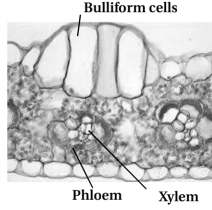
Bulliform cells are large,bubble-shaped epidermal cells present in the upper epidermis of leaves in many grasses.
When water is available,these cells are turgid and keep the leaf blade expanded.
During water stress,these cells lose water and become flaccid (lose turgidity).
This loss of turgidity causes the leaves to curl inwards,which reduces the surface area exposed to the atmosphere,thereby minimizing water loss through transpiration.
Bulliform cells are large,bubble-shaped epidermal cells present in the upper epidermis of leaves in many grasses.
When water is available,these cells are turgid and keep the leaf blade expanded.
During water stress,these cells lose water and become flaccid (lose turgidity).
This loss of turgidity causes the leaves to curl inwards,which reduces the surface area exposed to the atmosphere,thereby minimizing water loss through transpiration.
0 likes
View Solution70
MediumMCQ
In a dorsiventral leaf,identify the correct terms for the following:
Adaxial epidermis - $P$
Abaxial epidermis - $Q$
Select the correct option for $P$ and $Q$.
Adaxial epidermis - $P$
Abaxial epidermis - $Q$
Select the correct option for $P$ and $Q$.
A
Abaxial epidermis,Abaxial epidermis
B
Adaxial epidermis,Adaxial epidermis
C
Adaxial epidermis,Abaxial epidermis
D
Abaxial epidermis,Adaxial epidermis
Solution
(C) In a dorsiventral leaf (typically a dicot leaf),the leaf is differentiated into two surfaces:
$1$. The upper surface is known as the adaxial surface,and its epidermis is called the adaxial epidermis.
$2$. The lower surface is known as the abaxial surface,and its epidermis is called the abaxial epidermis.
Therefore,$P$ corresponds to the adaxial epidermis and $Q$ corresponds to the abaxial epidermis.
$1$. The upper surface is known as the adaxial surface,and its epidermis is called the adaxial epidermis.
$2$. The lower surface is known as the abaxial surface,and its epidermis is called the abaxial epidermis.
Therefore,$P$ corresponds to the adaxial epidermis and $Q$ corresponds to the abaxial epidermis.
0 likes
View Solution71
MediumMCQ
Stomata are present in equal numbers on both surfaces of the leaf in:
A
Monocot leaf
B
Dicot leaf
C
Both
D
None of these
Solution
(A) In $isobilateral$ leaves,which are typically found in monocotyledonous plants (like grasses),the stomata are present in equal numbers on both the $abaxial$ (lower) and $adaxial$ (upper) surfaces. In contrast,$dorsiventral$ leaves,which are characteristic of dicotyledonous plants,have more stomata on the $abaxial$ surface compared to the $adaxial$ surface. Therefore,the correct answer is $A$.
0 likes
View Solution72
MediumMCQ
In a dorsiventral leaf,what is the position of the xylem and phloem?
A
Towards the abaxial epidermis,towards the abaxial epidermis
B
Towards the abaxial epidermis,towards the adaxial epidermis
C
Towards the adaxial epidermis,towards the adaxial epidermis
D
Towards the adaxial epidermis,towards the abaxial epidermis
Solution
(D) In a dorsiventral leaf (typical of dicots),the vascular bundles are found in the veins.
In these bundles,the xylem is located towards the adaxial (upper) surface of the leaf.
The phloem is located towards the abaxial (lower) surface of the leaf.
Therefore,the correct arrangement is xylem towards the adaxial epidermis and phloem towards the abaxial epidermis.
In these bundles,the xylem is located towards the adaxial (upper) surface of the leaf.
The phloem is located towards the abaxial (lower) surface of the leaf.
Therefore,the correct arrangement is xylem towards the adaxial epidermis and phloem towards the abaxial epidermis.
0 likes
View Solution73
MediumMCQ
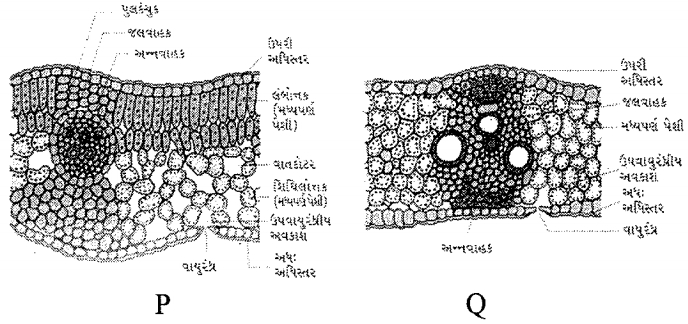
Identify the internal structure of the plant organs shown in the image below.
A
Dicot leaf,Monocot leaf
B
Monocot leaf,Dicot leaf
C
Monocot stem,Monocot stem
D
Dicot stem,Monocot stem
Solution
(A) In the provided image,structure $P$ represents a Dicot leaf (Dorsiventral leaf),which is characterized by the presence of distinct palisade parenchyma (columnar cells) and spongy parenchyma.
Structure $Q$ represents a Monocot leaf (Isobilateral leaf),which is characterized by the absence of differentiation into palisade and spongy parenchyma,and the presence of bulliform cells.
Therefore,$P$ is a Dicot leaf and $Q$ is a Monocot leaf.
Structure $Q$ represents a Monocot leaf (Isobilateral leaf),which is characterized by the absence of differentiation into palisade and spongy parenchyma,and the presence of bulliform cells.
Therefore,$P$ is a Dicot leaf and $Q$ is a Monocot leaf.
0 likes
View Solution74
MediumMCQ
The location of bulliform cells is $...................$
A
Abaxial epidermis of isobilateral leaf
B
Adaxial epidermis of dorsiventral leaf
C
Adaxial epidermis of isobilateral leaf
D
Abaxial epidermis of dorsiventral leaf
Solution
(C) Bulliform cells,also known as motor cells,are large,bubble-shaped epidermal cells found in groups on the adaxial surface of leaves in many monocots,particularly grasses (isobilateral leaves).
These cells are responsible for the rolling and unrolling of leaves in response to water stress to minimize transpiration.
Therefore,they are located in the adaxial epidermis of isobilateral leaves.
These cells are responsible for the rolling and unrolling of leaves in response to water stress to minimize transpiration.
Therefore,they are located in the adaxial epidermis of isobilateral leaves.
0 likes
View Solution75
MediumMCQ
In the leaf of a plant,the vascular bundles are located in the $..............$
A
Epidermis
B
Mesophyll
C
Veins
D
All of the above
Solution
(C) In the anatomy of a flowering plant leaf,the vascular bundles are primarily found within the veins.
These veins are the continuation of the vascular system of the stem and are embedded within the mesophyll tissue.
They provide structural support and facilitate the transport of water,minerals,and photosynthetic products.
Therefore,the correct location for vascular bundles in a leaf is the veins.
These veins are the continuation of the vascular system of the stem and are embedded within the mesophyll tissue.
They provide structural support and facilitate the transport of water,minerals,and photosynthetic products.
Therefore,the correct location for vascular bundles in a leaf is the veins.
0 likes
View Solution76
MediumMCQ
What is the shape of the mesophyll cells in a leaf?
A
Elongated
B
Round and oval
C
Amoeboid
D
Branched and long
Solution
(B) Mesophyll cells are specialized plant cells found in the leaves.
These cells are primarily responsible for photosynthesis.
According to the $NCERT$ textbook,mesophyll cells are typically round and oval in shape to facilitate efficient gas exchange and light absorption.
These cells are primarily responsible for photosynthesis.
According to the $NCERT$ textbook,mesophyll cells are typically round and oval in shape to facilitate efficient gas exchange and light absorption.
0 likes
View Solution77
MediumMCQ
In which type of leaf is the number of stomata greater on the abaxial surface than on the adaxial surface?
A
Dorsiventral leaf
B
Isobilateral leaf
C
Both
D
None of these
Solution
(A) In a $Dorsiventral$ leaf (typically found in dicotyledonous plants),the two surfaces are differentiated into the adaxial (upper) and abaxial (lower) surfaces.
Stomata are generally more abundant on the abaxial surface to reduce water loss through transpiration.
In contrast,an $Isobilateral$ leaf (typically found in monocotyledonous plants) has an equal distribution of stomata on both surfaces.
Stomata are generally more abundant on the abaxial surface to reduce water loss through transpiration.
In contrast,an $Isobilateral$ leaf (typically found in monocotyledonous plants) has an equal distribution of stomata on both surfaces.
0 likes
View Solution78
MediumMCQ
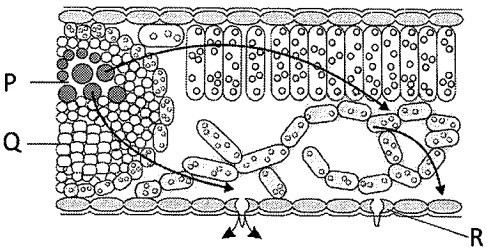
Identify the labels $P$,$Q$,and $R$ in the given cross-section of a leaf.
A
$P$: Xylem,$Q$: Phloem,$R$: Epidermal cell
B
$P$: Xylem,$Q$: Phloem,$R$: Guard cell
C
$P$: Phloem,$Q$: Xylem,$R$: Guard cell
D
$P$: Phloem,$Q$: Xylem,$R$: Epidermal cell
Solution
(B) In the provided cross-section of a leaf:
$P$ points to the larger,thick-walled vessels located in the vascular bundle,which represent the Xylem.
$Q$ points to the smaller,thin-walled cells located in the vascular bundle,which represent the Phloem.
$R$ points to the specialized cells surrounding the stomatal pore,which are the Guard cells.
Therefore,the correct identification is $P$: Xylem,$Q$: Phloem,$R$: Guard cell.
$P$ points to the larger,thick-walled vessels located in the vascular bundle,which represent the Xylem.
$Q$ points to the smaller,thin-walled cells located in the vascular bundle,which represent the Phloem.
$R$ points to the specialized cells surrounding the stomatal pore,which are the Guard cells.
Therefore,the correct identification is $P$: Xylem,$Q$: Phloem,$R$: Guard cell.
0 likes
View Solution79
MediumMCQ
Bulliform cells are responsible for
A
Protecting the plant from salt stress.
B
Increased photosynthesis in monocots.
C
Providing large spaces for storage of sugars.
D
Inward curling of leaves in monocots.
Solution
(D) In grasses,certain adaxial epidermal cells along the veins modify themselves into large,empty,colourless cells. These are called bulliform cells.
When the bulliform cells in the leaves have absorbed water and are turgid,the leaf surface is exposed.
When they are flaccid due to water stress,they make the leaves curl inwards to minimise water loss.
When the bulliform cells in the leaves have absorbed water and are turgid,the leaf surface is exposed.
When they are flaccid due to water stress,they make the leaves curl inwards to minimise water loss.
0 likes
View Solution80
EasyMCQ
Large,empty,colourless cells present on the upper surface of grass leaves are known as:
A
Palisade parenchyma
B
Spongy parenchyma
C
Subsidiary cells
D
Bulliform cells
Solution
(D) In grasses,certain adaxial epidermal cells along the veins modify themselves into large,empty,colourless cells. These are called $Bulliform$ cells. When these cells in the leaves have absorbed water and are turgid,the leaf surface is exposed. When they become flaccid due to water stress,they make the leaves curl inwards to minimize water loss. Therefore,the correct option is $D$.
0 likes
View Solution81
EasyMCQ
Large,empty,colourless cells present on the upper surface of grass leaves are $:-$
A
Palisade parenchyma
B
Spongy parenchyma
C
Subsidiary cells
D
Bulliform cells
Solution
(D) In grasses,certain adaxial epidermal cells along the veins modify themselves into large,empty,colourless cells. These are called $Bulliform$ cells.
When these cells in the leaves have absorbed water and are turgid,they make the leaf surface exposed.
When they become flaccid due to water stress,they make the leaves curl inwards to minimize water loss.
Therefore,the correct option is $D$.
When these cells in the leaves have absorbed water and are turgid,they make the leaf surface exposed.
When they become flaccid due to water stress,they make the leaves curl inwards to minimize water loss.
Therefore,the correct option is $D$.
0 likes
View Solution82
MediumMCQ
Assertion :- Vascular bundles of dorsiventral leaves are dissimilar in size.
Reason :- The thickness of veins vary in dorsiventral leaves.
Reason :- The thickness of veins vary in dorsiventral leaves.
A
Both Assertion & Reason are True & the Reason is a correct explanation of the Assertion.
B
Both Assertion & Reason are True but Reason is not a correct explanation of the Assertion.
C
Assertion is True but the Reason is False.
D
Both Assertion & Reason are False.
Solution
(A) In dorsiventral leaves (typical of dicots),the vascular bundles are present in the veins and the midrib.
The size of the vascular bundles is dependent on the size of the veins.
Since the veins in a leaf vary in thickness (the midrib is the thickest,followed by primary,secondary,and tertiary veins),the vascular bundles associated with them also vary in size.
Therefore,the vascular bundles are dissimilar in size because of the variation in vein thickness.
Thus,both Assertion and Reason are true,and the Reason is the correct explanation of the Assertion.
The size of the vascular bundles is dependent on the size of the veins.
Since the veins in a leaf vary in thickness (the midrib is the thickest,followed by primary,secondary,and tertiary veins),the vascular bundles associated with them also vary in size.
Therefore,the vascular bundles are dissimilar in size because of the variation in vein thickness.
Thus,both Assertion and Reason are true,and the Reason is the correct explanation of the Assertion.
0 likes
View Solution83
EasyMCQ
Which of the following plants contains dumb-bell shaped guard cells?
A
Mango
B
Wheat
C
Gram
D
Potato
Solution
(B) Guard cells are specialized cells that surround the stomata and regulate the opening and closing of the stomatal pore.
In dicotyledonous plants,guard cells are typically bean-shaped or kidney-shaped.
In monocotyledonous plants,such as grasses (e.g.,wheat,maize,rice),the guard cells are dumb-bell shaped.
Among the given options,Wheat is a monocotyledonous plant,while Mango,Gram,and Potato are dicotyledonous plants.
Therefore,Wheat contains dumb-bell shaped guard cells.
In dicotyledonous plants,guard cells are typically bean-shaped or kidney-shaped.
In monocotyledonous plants,such as grasses (e.g.,wheat,maize,rice),the guard cells are dumb-bell shaped.
Among the given options,Wheat is a monocotyledonous plant,while Mango,Gram,and Potato are dicotyledonous plants.
Therefore,Wheat contains dumb-bell shaped guard cells.
0 likes
View Solution84
MediumMCQ
The main function of bulliform cells in grasses is:
A
$(1)$ to perform photosynthesis.
B
$(2)$ to minimize water loss during water stress.
C
$(3)$ to make the leaf impermeable to fungal spores.
D
$(4)$ to transport water.
Solution
(B) Bulliform cells are large,bubble-shaped epidermal cells present in the leaves of many grasses.
When water is abundant,they become turgid,causing the leaf to expand.
During water stress,they lose turgidity,causing the leaf to roll inward to minimize the surface area exposed to the atmosphere,thereby reducing transpiration and water loss.
When water is abundant,they become turgid,causing the leaf to expand.
During water stress,they lose turgidity,causing the leaf to roll inward to minimize the surface area exposed to the atmosphere,thereby reducing transpiration and water loss.
0 likes
View SolutionAnatomy of Flowering Plants — Internal structure of leaf · Frequently Asked Questions
1Are these Anatomy of Flowering Plants questions useful for JEE and NEET?
Yes. All questions in this section are mapped to JEE Main and NEET exam patterns. Previous year questions from JEE Main, NEET, GUJCET and state-level exams are included with full solutions.
2Can I switch to Hindi or Gujarati for these questions?
Yes. Use the language tabs in the hero section or the sidebar to view the same questions and solutions in English, Hindi or Gujarati.
3How do I generate a question paper from this subtopic?
Use the Vedclass Exam Paper Generator — select the chapter and subtopic, set difficulty, and generate Sets A, B, C, D automatically. First 3 chapters of every subject are free.
Vedclass Products
For Students
Vedclass Test Series
Mock tests in real JEE/NEET style with performance analysis. 5-day free trial.
Start Free TrialFor Teachers
Exam Paper Generator
Generate Set A/B/C/D papers from this chapter in 2 minutes. 3 chapters free.
Try FreeFor Institutes
Online Exam Module
Live online exams with unlimited students, 360° analytics & white-label branding.
See DemoFor Teachers & Institutes
Generate a Anatomy of Flowering Plants Exam Paper in 2 Minutes
Select subtopic & difficulty — Sets A, B, C, D auto-generated with No Repeat logic.
First 3 chapters of every subject are free — no payment required.