
A English
Mix Examples - Some Applications of Trigonometry Questions in English
Class 10 Mathematics · Some Applications of Trigonometry · Mix Examples - Some Applications of Trigonometry
125+
Questions
English
Language
100%
With Solutions
Showing 25 of 125 questions in English
101
MediumMCQ
Observing an object from the point of observation,if one gets the angle of depression,then the object under observation is $\ldots \ldots \ldots . . .$
A
opposite to the horizontal ray
B
below the horizontal ray
C
above the horizontal ray
D
below the ray of vision
Solution
(B) The angle of depression is defined as the angle formed by the line of sight with the horizontal level when the object is below the horizontal level.
Since the observer is looking down at the object,the object must be situated below the horizontal line passing through the observer's eye.
Therefore,the correct option is $B$.
Since the observer is looking down at the object,the object must be situated below the horizontal line passing through the observer's eye.
Therefore,the correct option is $B$.
0 likes
View Solution102
MediumMCQ
Watching from a point $A$ on the ground $x \ m$ away from the base of the building. The height of the building is $y$ and the angle of elevation of the top of the building is found to be $25^\circ$. Then,$\ldots \ldots \ldots \ldots .$
A
$x = y$
B
$x < y$
C
$x > y$
D
$2x = y$
Solution
(C) Let the height of the building be $y$ and the distance from the base be $x$. The angle of elevation is $\theta = 25^\circ$.
In the right-angled triangle formed by the building,the ground,and the line of sight,we have:
$\tan(\theta) = \frac{\text{height}}{\text{base}} = \frac{y}{x}$.
Therefore,$\tan(25^\circ) = \frac{y}{x}$,which implies $y = x \cdot \tan(25^\circ)$.
Since the value of $\tan(25^\circ)$ is approximately $0.466$,which is less than $1$ $(0 < \tan(25^\circ) < 1)$,
we have $y = x \cdot (0.466)$.
This means $y < x$,or $x > y$.
In the right-angled triangle formed by the building,the ground,and the line of sight,we have:
$\tan(\theta) = \frac{\text{height}}{\text{base}} = \frac{y}{x}$.
Therefore,$\tan(25^\circ) = \frac{y}{x}$,which implies $y = x \cdot \tan(25^\circ)$.
Since the value of $\tan(25^\circ)$ is approximately $0.466$,which is less than $1$ $(0 < \tan(25^\circ) < 1)$,
we have $y = x \cdot (0.466)$.
This means $y < x$,or $x > y$.
0 likes
View Solution103
MediumMCQ
$A$ person is watching from a point $A$ on the ground,which is $x \ m$ away from the base of a building. The height of the building is $y \ m$ and the angle of elevation of the top of the building is found to be $70^\circ$. Then:
A
$x = y$
B
$x < y$
C
$x > y$
D
$x = 2y$
Solution
(B) In the right-angled triangle formed,the height of the building is $y$ (opposite side) and the distance from the base is $x$ (adjacent side).
Using the trigonometric ratio,$\tan(70^\circ) = \frac{\text{opposite}}{\text{adjacent}} = \frac{y}{x}$.
We know that $\tan(45^\circ) = 1$.
Since the tangent function is increasing in the interval $(0^\circ, 90^\circ)$,and $70^\circ > 45^\circ$,it follows that $\tan(70^\circ) > \tan(45^\circ)$.
Therefore,$\tan(70^\circ) > 1$.
Substituting the ratio,$\frac{y}{x} > 1$.
Since $x$ and $y$ are lengths (positive values),we can multiply both sides by $x$ to get $y > x$,which is equivalent to $x < y$.
Using the trigonometric ratio,$\tan(70^\circ) = \frac{\text{opposite}}{\text{adjacent}} = \frac{y}{x}$.
We know that $\tan(45^\circ) = 1$.
Since the tangent function is increasing in the interval $(0^\circ, 90^\circ)$,and $70^\circ > 45^\circ$,it follows that $\tan(70^\circ) > \tan(45^\circ)$.
Therefore,$\tan(70^\circ) > 1$.
Substituting the ratio,$\frac{y}{x} > 1$.
Since $x$ and $y$ are lengths (positive values),we can multiply both sides by $x$ to get $y > x$,which is equivalent to $x < y$.

0 likes
View Solution104
MediumMCQ
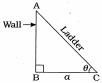
$A$ ladder leans against a wall such that its lower end makes an angle of measure $\theta$ with the ground. If its lower end is $a \ m$ away from the base of the wall,then the ladder reaches the wall at a height of $\ldots \ldots \ldots \ldots \ldots \ m$.
A
$a \cot \theta$
B
$a \tan \theta$
C
$a \sec \theta$
D
$a \operatorname{cosec} \theta$
Solution
(B) Let the wall be $AB$ and the ground be $BC$. The ladder is $AC$.
Given that the distance of the lower end of the ladder from the base of the wall is $BC = a \ m$.
The angle made by the ladder with the ground is $\angle C = \theta$.
In the right-angled triangle $\triangle ABC$,we have:
$\tan \theta = \frac{\text{Opposite side}}{\text{Adjacent side}} = \frac{AB}{BC}$
$\tan \theta = \frac{AB}{a}$
Therefore,the height at which the ladder reaches the wall is $AB = a \tan \theta \ m$.
Given that the distance of the lower end of the ladder from the base of the wall is $BC = a \ m$.
The angle made by the ladder with the ground is $\angle C = \theta$.
In the right-angled triangle $\triangle ABC$,we have:
$\tan \theta = \frac{\text{Opposite side}}{\text{Adjacent side}} = \frac{AB}{BC}$
$\tan \theta = \frac{AB}{a}$
Therefore,the height at which the ladder reaches the wall is $AB = a \tan \theta \ m$.
0 likes
View Solution105
MediumMCQ
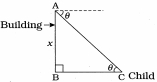
Watching from the top of the $x \ m$ high building,the angle of depression of a child on the ground is found to be $\theta$. Then,the distance of the child from the base of the building is..........
A
$x \sin \theta$
B
$x \cos \theta$
C
$x \tan \theta$
D
$x \cot \theta$
Solution
(D) Let $AB$ be the building of height $x \ m$ and $C$ be the position of the child on the ground.
The angle of depression from the top $A$ to the child at $C$ is $\theta$.
Since the horizontal line at $A$ is parallel to the ground $BC$,the angle of elevation from $C$ to $A$ is also $\theta$ (alternate interior angles).
In the right-angled triangle $\triangle ABC$,we have:
$\tan \theta = \frac{\text{Opposite}}{\text{Adjacent}} = \frac{AB}{BC}$
$\tan \theta = \frac{x}{BC}$
Therefore,$BC = \frac{x}{\tan \theta} = x \cot \theta \ m$.
Thus,the distance of the child from the base of the building is $x \cot \theta \ m$.
The angle of depression from the top $A$ to the child at $C$ is $\theta$.
Since the horizontal line at $A$ is parallel to the ground $BC$,the angle of elevation from $C$ to $A$ is also $\theta$ (alternate interior angles).
In the right-angled triangle $\triangle ABC$,we have:
$\tan \theta = \frac{\text{Opposite}}{\text{Adjacent}} = \frac{AB}{BC}$
$\tan \theta = \frac{x}{BC}$
Therefore,$BC = \frac{x}{\tan \theta} = x \cot \theta \ m$.
Thus,the distance of the child from the base of the building is $x \cot \theta \ m$.
0 likes
View Solution106
MediumMCQ
$A$ cable tied to the top of an electric pole is fixed at a point on the ground. The length of the cable is $20 \, m$. If it makes an angle of $30^{\circ}$ with the ground,then the height of the electric pole is ........ (in $, m$)
A
$10$
B
$20$
C
$30$
D
$40$
Solution
(A) Let $AB$ be the height of the electric pole and $AC$ be the length of the cable.
In the right-angled triangle $ABC$,the angle of elevation is $\angle C = 30^{\circ}$.
The length of the hypotenuse $AC = 20 \, m$.
Using the trigonometric ratio $\sin \theta = \frac{\text{Opposite side}}{\text{Hypotenuse}}$:
$\sin 30^{\circ} = \frac{AB}{AC}$
$\frac{1}{2} = \frac{AB}{20}$
$AB = \frac{20}{2} = 10 \, m$.
Thus,the height of the electric pole is $10 \, m$.
In the right-angled triangle $ABC$,the angle of elevation is $\angle C = 30^{\circ}$.
The length of the hypotenuse $AC = 20 \, m$.
Using the trigonometric ratio $\sin \theta = \frac{\text{Opposite side}}{\text{Hypotenuse}}$:
$\sin 30^{\circ} = \frac{AB}{AC}$
$\frac{1}{2} = \frac{AB}{20}$
$AB = \frac{20}{2} = 10 \, m$.
Thus,the height of the electric pole is $10 \, m$.

0 likes
View Solution107
MediumMCQ
$A$ pole stands on the ground. Watching from the top of the pole,the angle of depression of a stone on the ground $10 \, m$ away from the pole is $60^{\circ}$. Then the height of the pole is $\ldots \ldots \ldots \, m$. (Take $\sqrt{3} = 1.73$.)
A
$173$
B
$17.3$
C
$1.73$
D
$1730$
Solution
(B) Let $AB$ be the height of the pole and $BC$ be the distance of the stone from the base of the pole.
Given,$BC = 10 \, m$ and the angle of depression is $60^{\circ}$.
Since the angle of depression equals the angle of elevation,the angle of elevation of the top of the pole from the stone is $\angle C = 60^{\circ}$.
In $\triangle ABC$,$\tan 60^{\circ} = \frac{AB}{BC}$.
$\sqrt{3} = \frac{AB}{10}$.
$AB = 10 \times \sqrt{3}$.
Given $\sqrt{3} = 1.73$,so $AB = 10 \times 1.73 = 17.3 \, m$.
Thus,the height of the pole is $17.3 \, m$.
Given,$BC = 10 \, m$ and the angle of depression is $60^{\circ}$.
Since the angle of depression equals the angle of elevation,the angle of elevation of the top of the pole from the stone is $\angle C = 60^{\circ}$.
In $\triangle ABC$,$\tan 60^{\circ} = \frac{AB}{BC}$.
$\sqrt{3} = \frac{AB}{10}$.
$AB = 10 \times \sqrt{3}$.
Given $\sqrt{3} = 1.73$,so $AB = 10 \times 1.73 = 17.3 \, m$.
Thus,the height of the pole is $17.3 \, m$.

0 likes
View Solution108
MediumMCQ
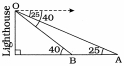
The angles of depression of two boats $A$ and $B$ from the top of a lighthouse are $25^{\circ}$ and $40^{\circ}$ respectively. Then $\ldots \ldots \ldots \ldots$ from the lighthouse.
A
$A$ and $B$ are at the same distance.
B
The distance of $B$ is greater than $A$.
C
The distance of $A$ is greater than $B$.
D
We cannot say anything about the distances of $A$ and $B$.
Solution
(C) Let $h$ be the height of the lighthouse. Let $d_A$ and $d_B$ be the distances of boats $A$ and $B$ from the base of the lighthouse respectively.
From the given angles of depression,the angles of elevation from the boats to the top of the lighthouse are $25^{\circ}$ and $40^{\circ}$ respectively.
Using the tangent ratio: $\tan(25^{\circ}) = \frac{h}{d_A}$ and $\tan(40^{\circ}) = \frac{h}{d_B}$.
Since $\tan(40^{\circ}) > \tan(25^{\circ})$,it follows that $\frac{h}{d_B} > \frac{h}{d_A}$.
Therefore,$d_A > d_B$. Thus,the distance of boat $A$ from the lighthouse is greater than the distance of boat $B$.
From the given angles of depression,the angles of elevation from the boats to the top of the lighthouse are $25^{\circ}$ and $40^{\circ}$ respectively.
Using the tangent ratio: $\tan(25^{\circ}) = \frac{h}{d_A}$ and $\tan(40^{\circ}) = \frac{h}{d_B}$.
Since $\tan(40^{\circ}) > \tan(25^{\circ})$,it follows that $\frac{h}{d_B} > \frac{h}{d_A}$.
Therefore,$d_A > d_B$. Thus,the distance of boat $A$ from the lighthouse is greater than the distance of boat $B$.
0 likes
View Solution109
MediumMCQ
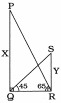
The angle of elevation of building $Y$ from the bottom of building $X$ is $45^{\circ}$ and the angle of elevation of building $X$ from the bottom of building $Y$ is $65^{\circ}.$ Then:
A
Height of $Y$ is greater than $X$
B
Height of $X$ and $Y$ are same
C
Height of $X$ is greater than $Y$
D
We cannot say anything about the heights of $X$ and $Y$
Solution
(C) Let $X$ be the height of building $PQ$ and $Y$ be the height of building $SR$. Let $QR$ be the distance between the bases of the two buildings.
In right-angled $\Delta SQR$,$\tan(45^{\circ}) = \frac{SR}{QR} = \frac{Y}{QR}$.
Since $\tan(45^{\circ}) = 1$,we have $Y = QR$.
In right-angled $\Delta PQR$,$\tan(65^{\circ}) = \frac{PQ}{QR} = \frac{X}{QR}$.
Since $\tan(65^{\circ}) > 1$,we have $\frac{X}{QR} > 1$,which implies $X > QR$.
Since $Y = QR$ and $X > QR$,it follows that $X > Y$.
Therefore,the height of building $X$ is greater than the height of building $Y$.
In right-angled $\Delta SQR$,$\tan(45^{\circ}) = \frac{SR}{QR} = \frac{Y}{QR}$.
Since $\tan(45^{\circ}) = 1$,we have $Y = QR$.
In right-angled $\Delta PQR$,$\tan(65^{\circ}) = \frac{PQ}{QR} = \frac{X}{QR}$.
Since $\tan(65^{\circ}) > 1$,we have $\frac{X}{QR} > 1$,which implies $X > QR$.
Since $Y = QR$ and $X > QR$,it follows that $X > Y$.
Therefore,the height of building $X$ is greater than the height of building $Y$.
0 likes
View Solution110
MediumMCQ
In a right triangle,if the length of the hypotenuse is $12$ and the measure of one of the angles is $30^{\circ}$,then the measure of the side opposite to the angle is $\ldots \ldots \ldots \ldots$
A
$6 \sqrt{3}$
B
$6$
C
$\frac{6}{\sqrt{3}}$
D
$\frac{12}{\sqrt{3}}$
Solution
(B) In a right-angled triangle,the side opposite to the $30^{\circ}$ angle is given by the formula: $\text{Side opposite to } 30^{\circ} = \text{Hypotenuse} \times \sin(30^{\circ})$.
Given that the hypotenuse is $12$ and $\sin(30^{\circ}) = \frac{1}{2}$.
Therefore,the measure of the side opposite to the angle is $12 \times \frac{1}{2} = 6$.
Given that the hypotenuse is $12$ and $\sin(30^{\circ}) = \frac{1}{2}$.
Therefore,the measure of the side opposite to the angle is $12 \times \frac{1}{2} = 6$.
0 likes
View Solution111
MediumMCQ
In a right triangle,if the measure of one of the angles is $60^{\circ}$,then the measure of the side opposite to the angle with measure $60^{\circ}$ is $\ldots \ldots$ times the measure of the hypotenuse.

A
$\frac{1}{2}$
B
$\frac{\sqrt{3}}{2}$
C
$\frac{1}{\sqrt{2}}$
D
$\sqrt{2}$
Solution
(B) Consider a right-angled triangle $ABC$ where $\angle B = 90^{\circ}$ and $\angle C = 60^{\circ}$.
In this triangle,the side opposite to $\angle C$ is $AB$ and the hypotenuse is $AC$.
Using the trigonometric ratio $\sin \theta = \frac{\text{opposite side}}{\text{hypotenuse}}$,we have:
$\sin 60^{\circ} = \frac{AB}{AC}$
Since $\sin 60^{\circ} = \frac{\sqrt{3}}{2}$,we get:
$\frac{\sqrt{3}}{2} = \frac{AB}{AC}$
Therefore,$AB = \frac{\sqrt{3}}{2} AC$.
Thus,the measure of the side opposite to the angle of $60^{\circ}$ is $\frac{\sqrt{3}}{2}$ times the measure of the hypotenuse.
In this triangle,the side opposite to $\angle C$ is $AB$ and the hypotenuse is $AC$.
Using the trigonometric ratio $\sin \theta = \frac{\text{opposite side}}{\text{hypotenuse}}$,we have:
$\sin 60^{\circ} = \frac{AB}{AC}$
Since $\sin 60^{\circ} = \frac{\sqrt{3}}{2}$,we get:
$\frac{\sqrt{3}}{2} = \frac{AB}{AC}$
Therefore,$AB = \frac{\sqrt{3}}{2} AC$.
Thus,the measure of the side opposite to the angle of $60^{\circ}$ is $\frac{\sqrt{3}}{2}$ times the measure of the hypotenuse.

0 likes
View Solution112
MediumMCQ
In $\Delta ABC$,$\angle B$ is a right angle. If $AC = 16$ and $BC = 8$,then $m \angle C = \dots$ (in $^{\circ}$)
A
$30$
B
$45$
C
$60$
D
$90$
Solution
(C) In $\Delta ABC$,$\angle B = 90^{\circ}$.
Given $AC = 16$ (hypotenuse) and $BC = 8$ (side adjacent to $\angle C$).
Using the trigonometric ratio for cosine:
$\cos C = \frac{\text{Adjacent side}}{\text{Hypotenuse}} = \frac{BC}{AC} = \frac{8}{16} = \frac{1}{2}$.
Since $\cos 60^{\circ} = \frac{1}{2}$,we have $m \angle C = 60^{\circ}$.
Given $AC = 16$ (hypotenuse) and $BC = 8$ (side adjacent to $\angle C$).
Using the trigonometric ratio for cosine:
$\cos C = \frac{\text{Adjacent side}}{\text{Hypotenuse}} = \frac{BC}{AC} = \frac{8}{16} = \frac{1}{2}$.
Since $\cos 60^{\circ} = \frac{1}{2}$,we have $m \angle C = 60^{\circ}$.

0 likes
View Solution113
MediumMCQ
In a right triangle,if the measure of one of the angles is $45^{\circ}$,then the measure of the side opposite to the angle with measure $45^{\circ}$ is $\ldots \ldots \ldots$ times the measure of the hypotenuse.
A
$2$
B
$\frac{1}{2}$
C
$\sqrt{2}$
D
$\frac{1}{\sqrt{2}}$
Solution
(D) Let the right triangle be $\triangle ABC$,where $\angle B = 90^{\circ}$ and $\angle C = 45^{\circ}$.
In $\triangle ABC$,the side opposite to $\angle C$ is $AB$ and the hypotenuse is $AC$.
Using the trigonometric ratio $\sin \theta = \frac{\text{opposite side}}{\text{hypotenuse}}$:
$\sin 45^{\circ} = \frac{AB}{AC}$
Since $\sin 45^{\circ} = \frac{1}{\sqrt{2}}$,we have:
$\frac{1}{\sqrt{2}} = \frac{AB}{AC}$
Therefore,$AB = \frac{1}{\sqrt{2}} AC$.
Thus,the measure of the side opposite to the angle of $45^{\circ}$ is $\frac{1}{\sqrt{2}}$ times the measure of the hypotenuse.
In $\triangle ABC$,the side opposite to $\angle C$ is $AB$ and the hypotenuse is $AC$.
Using the trigonometric ratio $\sin \theta = \frac{\text{opposite side}}{\text{hypotenuse}}$:
$\sin 45^{\circ} = \frac{AB}{AC}$
Since $\sin 45^{\circ} = \frac{1}{\sqrt{2}}$,we have:
$\frac{1}{\sqrt{2}} = \frac{AB}{AC}$
Therefore,$AB = \frac{1}{\sqrt{2}} AC$.
Thus,the measure of the side opposite to the angle of $45^{\circ}$ is $\frac{1}{\sqrt{2}}$ times the measure of the hypotenuse.

0 likes
View Solution114
MediumMCQ
The angle of elevation of the top of a pole from a point $x \, m$ away from the base of the pole is $60^{\circ}$. Then,the height of the pole is $\ldots \ldots \ldots \, m$.
A
$x$
B
$\sqrt{3} x$
C
$\frac{1}{\sqrt{3}} x$
D
$\frac{\sqrt{3}}{2} x$
Solution
(B) Let the height of the pole be $AB$ and the distance from the base of the pole to the point $C$ be $BC = x \, m$.
In the right-angled triangle $ABC$,the angle of elevation is $\angle C = 60^{\circ}$.
Using the trigonometric ratio $\tan \theta = \frac{\text{Opposite side}}{\text{Adjacent side}}$,we have:
$\tan 60^{\circ} = \frac{AB}{BC}$
Since $\tan 60^{\circ} = \sqrt{3}$,we get:
$\sqrt{3} = \frac{AB}{x}$
Therefore,$AB = \sqrt{3} x \, m$.
Thus,the height of the pole is $\sqrt{3} x \, m$.
In the right-angled triangle $ABC$,the angle of elevation is $\angle C = 60^{\circ}$.
Using the trigonometric ratio $\tan \theta = \frac{\text{Opposite side}}{\text{Adjacent side}}$,we have:
$\tan 60^{\circ} = \frac{AB}{BC}$
Since $\tan 60^{\circ} = \sqrt{3}$,we get:
$\sqrt{3} = \frac{AB}{x}$
Therefore,$AB = \sqrt{3} x \, m$.
Thus,the height of the pole is $\sqrt{3} x \, m$.

0 likes
View Solution115
MediumMCQ
The angle of elevation of the top of the tower from a point $x \, m$ away from the tower is $30^{\circ}$. Then the height of the tower is $\ldots \ldots \ldots \, m$.
A
$x$
B
$\sqrt{3} x$
C
$\frac{1}{\sqrt{3}} x$
D
$\frac{1}{\sqrt{2}} x$
Solution
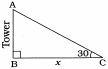
(C) Let $AB$ be the height of the tower and $BC = x \, m$ be the distance from the base of the tower to the point of observation $C$.
In the right-angled triangle $ABC$,the angle of elevation is $\angle C = 30^{\circ}$.
Using the trigonometric ratio $\tan \theta = \frac{\text{opposite side}}{\text{adjacent side}}$:
$\tan 30^{\circ} = \frac{AB}{BC}$
Substituting the values:
$\frac{1}{\sqrt{3}} = \frac{AB}{x}$
Therefore,the height of the tower $AB = \frac{x}{\sqrt{3}} \, m$.
In the right-angled triangle $ABC$,the angle of elevation is $\angle C = 30^{\circ}$.
Using the trigonometric ratio $\tan \theta = \frac{\text{opposite side}}{\text{adjacent side}}$:
$\tan 30^{\circ} = \frac{AB}{BC}$
Substituting the values:
$\frac{1}{\sqrt{3}} = \frac{AB}{x}$
Therefore,the height of the tower $AB = \frac{x}{\sqrt{3}} \, m$.
0 likes
View Solution116
MediumMCQ
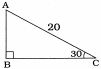
In right-angled $\Delta ABC$,$m\angle B = 90^\circ$. If $AC = 20$ and $m\angle C = 30^\circ$,then $BC = \ldots$
A
$20$
B
$40$
C
$10$
D
$17.3$
Solution
(D) In the right-angled $\Delta ABC$,we are given the hypotenuse $AC = 20$ and the angle $m\angle C = 30^\circ$.
We need to find the adjacent side $BC$.
Using the trigonometric ratio $\cos \theta = \frac{\text{adjacent}}{\text{hypotenuse}}$,we have:
$\cos 30^\circ = \frac{BC}{AC}$
Substituting the values:
$\frac{\sqrt{3}}{2} = \frac{BC}{20}$
$BC = 20 \times \frac{\sqrt{3}}{2}$
$BC = 10\sqrt{3}$
Using $\sqrt{3} \approx 1.73$:
$BC = 10 \times 1.73 = 17.3$
We need to find the adjacent side $BC$.
Using the trigonometric ratio $\cos \theta = \frac{\text{adjacent}}{\text{hypotenuse}}$,we have:
$\cos 30^\circ = \frac{BC}{AC}$
Substituting the values:
$\frac{\sqrt{3}}{2} = \frac{BC}{20}$
$BC = 20 \times \frac{\sqrt{3}}{2}$
$BC = 10\sqrt{3}$
Using $\sqrt{3} \approx 1.73$:
$BC = 10 \times 1.73 = 17.3$
0 likes
View Solution117
MediumMCQ
$A$ tower stands vertically on the ground. The angle of elevation of the top of the tower from a point $100 \, m$ away from the base of the tower is $60^\circ$. The height of the tower is $\ldots \ldots \ldots \ldots \, m$.
A
$1.73$
B
$1.41$
C
$17.3$
D
$173$
Solution
(D) Let $AB$ be the height of the tower and $BC$ be the distance from the base of the tower to the point $C$ on the ground.
Given: $BC = 100 \, m$ and the angle of elevation $\angle C = 60^\circ$.
In the right-angled triangle $\triangle ABC$,we have:
$\tan C = \frac{\text{Opposite side}}{\text{Adjacent side}} = \frac{AB}{BC}$
$\tan 60^\circ = \frac{AB}{100}$
Since $\tan 60^\circ = \sqrt{3} \approx 1.732$,
$\sqrt{3} = \frac{AB}{100}$
$AB = 100 \times \sqrt{3}$
$AB = 100 \times 1.732 = 173.2 \, m$.
Rounding to the nearest whole number as per the options,the height is $173 \, m$.
Given: $BC = 100 \, m$ and the angle of elevation $\angle C = 60^\circ$.
In the right-angled triangle $\triangle ABC$,we have:
$\tan C = \frac{\text{Opposite side}}{\text{Adjacent side}} = \frac{AB}{BC}$
$\tan 60^\circ = \frac{AB}{100}$
Since $\tan 60^\circ = \sqrt{3} \approx 1.732$,
$\sqrt{3} = \frac{AB}{100}$
$AB = 100 \times \sqrt{3}$
$AB = 100 \times 1.732 = 173.2 \, m$.
Rounding to the nearest whole number as per the options,the height is $173 \, m$.

0 likes
View Solution118
MediumMCQ
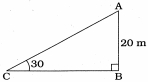
The angle of elevation of the top of the temple on the bank of the river from a point exactly opposite to the temple on the other bank of the river is $30^{\circ}$. If the height of the temple is $20 \ m$,then the breadth of the river is $\ldots \ldots \ldots \ldots \ m$.
A
$17.3$
B
$173$
C
$346$
D
$34.6$
Solution
(D) Let $AB$ be the height of the temple,where $AB = 20 \ m$.
Let $BC$ be the breadth of the river.
The angle of elevation from point $C$ to the top $A$ is $\angle ACB = 30^{\circ}$.
In the right-angled triangle $ABC$:
$\tan 30^{\circ} = \frac{AB}{BC}$
$\frac{1}{\sqrt{3}} = \frac{20}{BC}$
$BC = 20 \sqrt{3} \ m$
Using $\sqrt{3} \approx 1.73$:
$BC = 20 \times 1.73 = 34.6 \ m$.
Thus,the breadth of the river is $34.6 \ m$.
Let $BC$ be the breadth of the river.
The angle of elevation from point $C$ to the top $A$ is $\angle ACB = 30^{\circ}$.
In the right-angled triangle $ABC$:
$\tan 30^{\circ} = \frac{AB}{BC}$
$\frac{1}{\sqrt{3}} = \frac{20}{BC}$
$BC = 20 \sqrt{3} \ m$
Using $\sqrt{3} \approx 1.73$:
$BC = 20 \times 1.73 = 34.6 \ m$.
Thus,the breadth of the river is $34.6 \ m$.
0 likes
View Solution119
MediumMCQ
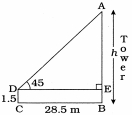
An observer $1.5\, m$ tall is $28.5\, m$ away from a tower. The angle of elevation of the top of the tower from his eyes is $45^\circ$. Then the height of the tower is ............ $m$.
A
$20$
B
$30$
C
$15$
D
$25$
Solution
(B) Let the height of the tower be $h$. The observer is $1.5\, m$ tall,so the height of the triangle formed is $AE = h - 1.5$.
Given the distance from the tower is $DE = 28.5\, m$ and the angle of elevation is $45^\circ$.
In $\triangle ADE$,$\tan 45^\circ = \frac{AE}{DE}$.
Since $\tan 45^\circ = 1$,we have $1 = \frac{AE}{28.5}$.
Therefore,$AE = 28.5\, m$.
The total height of the tower $h = AE + EB = 28.5 + 1.5 = 30\, m$.
Given the distance from the tower is $DE = 28.5\, m$ and the angle of elevation is $45^\circ$.
In $\triangle ADE$,$\tan 45^\circ = \frac{AE}{DE}$.
Since $\tan 45^\circ = 1$,we have $1 = \frac{AE}{28.5}$.
Therefore,$AE = 28.5\, m$.
The total height of the tower $h = AE + EB = 28.5 + 1.5 = 30\, m$.
0 likes
View Solution120
EasyMCQ
The union of the horizontal ray and the ray of vision forms the angle of elevation; then the object under observation is $\ldots \ldots \ldots . .$
A
opposite to the horizontal ray
B
below the horizontal ray
C
above the horizontal ray
D
below the ray of vision
Solution
(C) The angle of elevation is defined as the angle formed by the line of sight (ray of vision) with the horizontal line (horizontal ray) when the object is located above the horizontal level of the observer's eye.
Therefore,if the angle of elevation is formed,the object must be situated above the horizontal ray.
Therefore,if the angle of elevation is formed,the object must be situated above the horizontal ray.
0 likes
View Solution121
MediumMCQ
$A$ pole stands vertically on the ground. The length of the shadow of the pole is $\frac{1}{\sqrt{3}}$ times the height of the pole. Then,the angle of elevation of the sun is $\ldots \ldots \ldots \ldots . . .$ (in $^\circ$)
A
$30$
B
$45$
C
$60$
D
$90$
Solution
(C) Let the height of the pole be $h$ and the length of the shadow be $s$.
According to the problem,$s = \frac{1}{\sqrt{3}} h$.
Let $\theta$ be the angle of elevation of the sun.
In the right-angled triangle formed by the pole and its shadow,we have $\tan(\theta) = \frac{\text{height}}{\text{shadow}} = \frac{h}{s}$.
Substituting the value of $s$,we get $\tan(\theta) = \frac{h}{\frac{1}{\sqrt{3}} h} = \sqrt{3}$.
Since $\tan(60^\circ) = \sqrt{3}$,the angle of elevation $\theta = 60^\circ$.
According to the problem,$s = \frac{1}{\sqrt{3}} h$.
Let $\theta$ be the angle of elevation of the sun.
In the right-angled triangle formed by the pole and its shadow,we have $\tan(\theta) = \frac{\text{height}}{\text{shadow}} = \frac{h}{s}$.
Substituting the value of $s$,we get $\tan(\theta) = \frac{h}{\frac{1}{\sqrt{3}} h} = \sqrt{3}$.
Since $\tan(60^\circ) = \sqrt{3}$,the angle of elevation $\theta = 60^\circ$.
0 likes
View Solution122
MediumMCQ
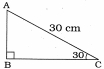
In $\Delta ABC$,$m\angle B = 90^\circ$,$m\angle C = 30^\circ$ and $AC = 30 \text{ cm}$,then $AB = \ldots \text{ cm}$.
A
$15$
B
$14.1$
C
$17.3$
D
$30$
Solution
(A) In right-angled $\Delta ABC$,we are given the hypotenuse $AC = 30 \text{ cm}$ and $\angle C = 30^\circ$.
We need to find the side $AB$,which is opposite to $\angle C$.
Using the trigonometric ratio $\sin \theta = \frac{\text{opposite side}}{\text{hypotenuse}}$:
$\sin 30^\circ = \frac{AB}{AC}$
Since $\sin 30^\circ = \frac{1}{2}$,we have:
$\frac{1}{2} = \frac{AB}{30}$
$AB = \frac{30}{2} = 15 \text{ cm}$.
We need to find the side $AB$,which is opposite to $\angle C$.
Using the trigonometric ratio $\sin \theta = \frac{\text{opposite side}}{\text{hypotenuse}}$:
$\sin 30^\circ = \frac{AB}{AC}$
Since $\sin 30^\circ = \frac{1}{2}$,we have:
$\frac{1}{2} = \frac{AB}{30}$
$AB = \frac{30}{2} = 15 \text{ cm}$.
0 likes
View Solution123
DifficultMCQ
Two poles are $x$ metres apart and the height of one is double than that of the other. If from the midpoint of the line joining their feet,an observer finds the angle of elevation of their tops to be complementary,then the height of the shorter pole is $\ldots \ldots \ldots \ldots$
A
$\frac{x}{4}$
B
$\frac{x}{\sqrt{2}}$
C
$\sqrt{2} x$
D
$\frac{x}{2 \sqrt{2}}$
Solution
(D) Let the height of the shorter pole be $h$ and the height of the taller pole be $2h$.
Let the distance between the two poles be $x$.
The midpoint of the line joining their feet divides the distance $x$ into two equal parts,each of length $\frac{x}{2}$.
Let the angles of elevation from the midpoint be $\theta$ and $90^\circ - \theta$.
For the shorter pole: $\tan(90^\circ - \theta) = \frac{h}{x/2} = \frac{2h}{x}$.
Since $\tan(90^\circ - \theta) = \cot \theta$,we have $\cot \theta = \frac{2h}{x}$.
For the taller pole: $\tan \theta = \frac{2h}{x/2} = \frac{4h}{x}$.
Multiplying the two equations: $\tan \theta \cdot \cot \theta = \left(\frac{4h}{x}\right) \cdot \left(\frac{2h}{x}\right)$.
$1 = \frac{8h^2}{x^2}$.
$h^2 = \frac{x^2}{8}$.
$h = \sqrt{\frac{x^2}{8}} = \frac{x}{2\sqrt{2}}$.
Let the distance between the two poles be $x$.
The midpoint of the line joining their feet divides the distance $x$ into two equal parts,each of length $\frac{x}{2}$.
Let the angles of elevation from the midpoint be $\theta$ and $90^\circ - \theta$.
For the shorter pole: $\tan(90^\circ - \theta) = \frac{h}{x/2} = \frac{2h}{x}$.
Since $\tan(90^\circ - \theta) = \cot \theta$,we have $\cot \theta = \frac{2h}{x}$.
For the taller pole: $\tan \theta = \frac{2h}{x/2} = \frac{4h}{x}$.
Multiplying the two equations: $\tan \theta \cdot \cot \theta = \left(\frac{4h}{x}\right) \cdot \left(\frac{2h}{x}\right)$.
$1 = \frac{8h^2}{x^2}$.
$h^2 = \frac{x^2}{8}$.
$h = \sqrt{\frac{x^2}{8}} = \frac{x}{2\sqrt{2}}$.
0 likes
View Solution124
MediumMCQ
When observed from the top of a tower,the angles of depression of two houses $A$ and $B$ in the Eastern and Western directions are $30^{\circ}$ and $60^{\circ}$ respectively. Then........
A
House $A$ is nearer to the tower than House $B$
B
House $B$ is nearer to the tower than House $A$
C
House $A$ and House $B$ are equidistant from the tower
D
None of the given three
Solution
(B) Let the height of the tower be $h$ and the foot of the tower be $O$.
Let $x_A$ be the distance of house $A$ from the tower and $x_B$ be the distance of house $B$ from the tower.
From the geometry of the problem,the angle of depression equals the angle of elevation.
For house $A$: $\tan(30^{\circ}) = \frac{h}{x_A} \implies \frac{1}{\sqrt{3}} = \frac{h}{x_A} \implies x_A = h\sqrt{3}$.
For house $B$: $\tan(60^{\circ}) = \frac{h}{x_B} \implies \sqrt{3} = \frac{h}{x_B} \implies x_B = \frac{h}{\sqrt{3}}$.
Comparing the distances,since $\sqrt{3} > \frac{1}{\sqrt{3}}$,it follows that $x_A > x_B$.
Therefore,house $B$ is closer to the tower than house $A$.
Let $x_A$ be the distance of house $A$ from the tower and $x_B$ be the distance of house $B$ from the tower.
From the geometry of the problem,the angle of depression equals the angle of elevation.
For house $A$: $\tan(30^{\circ}) = \frac{h}{x_A} \implies \frac{1}{\sqrt{3}} = \frac{h}{x_A} \implies x_A = h\sqrt{3}$.
For house $B$: $\tan(60^{\circ}) = \frac{h}{x_B} \implies \sqrt{3} = \frac{h}{x_B} \implies x_B = \frac{h}{\sqrt{3}}$.
Comparing the distances,since $\sqrt{3} > \frac{1}{\sqrt{3}}$,it follows that $x_A > x_B$.
Therefore,house $B$ is closer to the tower than house $A$.
0 likes
View Solution125
MediumMCQ
On walking for search of a ball $x$ metres on a hill making an angle of $30^{\circ}$ with the ground,one can reach a height of $y$ metres from the ground. Then $\ldots \ldots \ldots . . .$
A
$x=y$
B
$x=2y$
C
$2x=\sqrt{3}y$
D
$2x=y$
Solution
(B) Let the hill be represented by a right-angled triangle where the hypotenuse is the distance walked on the hill,$x$ metres.
The angle of elevation with the ground is $\theta = 30^{\circ}$.
The height reached from the ground is the side opposite to the angle,$y$ metres.
Using the trigonometric ratio $\sin(\theta) = \frac{\text{opposite}}{\text{hypotenuse}}$,we have:
$\sin(30^{\circ}) = \frac{y}{x}$
Since $\sin(30^{\circ}) = \frac{1}{2}$,we get:
$\frac{1}{2} = \frac{y}{x}$
Cross-multiplying gives $x = 2y$.
Therefore,the correct option is $B$.
The angle of elevation with the ground is $\theta = 30^{\circ}$.
The height reached from the ground is the side opposite to the angle,$y$ metres.
Using the trigonometric ratio $\sin(\theta) = \frac{\text{opposite}}{\text{hypotenuse}}$,we have:
$\sin(30^{\circ}) = \frac{y}{x}$
Since $\sin(30^{\circ}) = \frac{1}{2}$,we get:
$\frac{1}{2} = \frac{y}{x}$
Cross-multiplying gives $x = 2y$.
Therefore,the correct option is $B$.
0 likes
View SolutionSome Applications of Trigonometry — Mix Examples - Some Applications of Trigonometry · Frequently Asked Questions
1Are these Some Applications of Trigonometry questions useful for JEE and NEET?
Yes. All questions in this section are mapped to JEE Main and NEET exam patterns. Previous year questions from JEE Main, NEET, GUJCET and state-level exams are included with full solutions.
2Can I switch to Hindi or Gujarati for these questions?
Yes. Use the language tabs in the hero section or the sidebar to view the same questions and solutions in English, Hindi or Gujarati.
3How do I generate a question paper from this subtopic?
Use the Vedclass Exam Paper Generator — select the chapter and subtopic, set difficulty, and generate Sets A, B, C, D automatically. First 3 chapters of every subject are free.
Vedclass Products
For Students
Vedclass Test Series
Mock tests in real JEE/NEET style with performance analysis. 5-day free trial.
Start Free TrialFor Teachers
Exam Paper Generator
Generate Set A/B/C/D papers from this chapter in 2 minutes. 3 chapters free.
Try FreeFor Institutes
Online Exam Module
Live online exams with unlimited students, 360° analytics & white-label branding.
See DemoFor Teachers & Institutes
Generate a Some Applications of Trigonometry Exam Paper in 2 Minutes
Select subtopic & difficulty — Sets A, B, C, D auto-generated with No Repeat logic.
First 3 chapters of every subject are free — no payment required.