
A English
Textbook - Some Applications of Trigonometry Questions in English
Class 10 Mathematics · Some Applications of Trigonometry · Textbook - Some Applications of Trigonometry
23+
Questions
English
Language
100%
With Solutions
Showing 23 of 23 questions in English
1
Easy
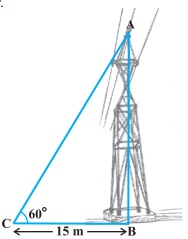
$A$ tower stands vertically on the ground. From a point on the ground,which is $15\, m$ away from the foot of the tower,the angle of elevation of the top of the tower is found to be $60^{\circ}.$ Find the height of the tower. (in $m$)
Solution
$(15\sqrt{3})$ First,let us represent the problem with a right-angled triangle $ABC$ (as shown in the figure),where $AB$ is the height of the tower,$BC = 15\, m$ is the distance of the point from the foot of the tower,and $\angle ACB = 60^{\circ}$ is the angle of elevation.
In the right-angled triangle $ABC$,we have:
$\tan \theta = \frac{\text{Opposite side}}{\text{Adjacent side}}$
$\tan 60^{\circ} = \frac{AB}{BC}$
Since $\tan 60^{\circ} = \sqrt{3}$,we substitute the values:
$\sqrt{3} = \frac{AB}{15}$
$AB = 15\sqrt{3}\, m$
Thus,the height of the tower is $15\sqrt{3}\, m$.
In the right-angled triangle $ABC$,we have:
$\tan \theta = \frac{\text{Opposite side}}{\text{Adjacent side}}$
$\tan 60^{\circ} = \frac{AB}{BC}$
Since $\tan 60^{\circ} = \sqrt{3}$,we substitute the values:
$\sqrt{3} = \frac{AB}{15}$
$AB = 15\sqrt{3}\, m$
Thus,the height of the tower is $15\sqrt{3}\, m$.
1 likes
View Solution2
Medium
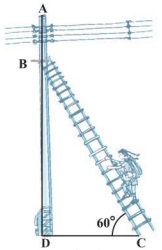
An electrician has to repair an electric fault on a pole of height $5\, m$. She needs to reach a point $1.3\, m$ below the top of the pole to undertake the repair work (see figure). What should be the length of the ladder that she should use which,when inclined at an angle of $60^{\circ}$ to the horizontal,would enable her to reach the required position? Also,how far from the foot of the pole should she place the foot of the ladder? (You may take $\sqrt{3}=1.73$)
Solution
(N/A) In the figure,the electrician is required to reach the point $B$ on the pole $AD$.
So,
$BD = AD - AB = (5 - 1.3)\, m = 3.7\, m$
Here,$BC$ represents the ladder. We need to find its length,i.e.,the hypotenuse of the right triangle $BDC$.
Now,we consider the trigonometric ratio $\sin 60^{\circ}$.
So,$\frac{BD}{BC} = \sin 60^{\circ}$ or $\frac{3.7}{BC} = \frac{\sqrt{3}}{2}$
Therefore,$BC = \frac{3.7 \times 2}{\sqrt{3}} = \frac{7.4}{1.73} \approx 4.28\, m$.
i.e.,the length of the ladder should be $4.28\, m$.
Now,$\frac{DC}{BD} = \cot 60^{\circ} = \frac{1}{\sqrt{3}}$.
i.e.,$DC = \frac{3.7}{\sqrt{3}} = \frac{3.7}{1.73} \approx 2.14\, m$.
Therefore,she should place the foot of the ladder at a distance of $2.14\, m$ from the pole.
So,
$BD = AD - AB = (5 - 1.3)\, m = 3.7\, m$
Here,$BC$ represents the ladder. We need to find its length,i.e.,the hypotenuse of the right triangle $BDC$.
Now,we consider the trigonometric ratio $\sin 60^{\circ}$.
So,$\frac{BD}{BC} = \sin 60^{\circ}$ or $\frac{3.7}{BC} = \frac{\sqrt{3}}{2}$
Therefore,$BC = \frac{3.7 \times 2}{\sqrt{3}} = \frac{7.4}{1.73} \approx 4.28\, m$.
i.e.,the length of the ladder should be $4.28\, m$.
Now,$\frac{DC}{BD} = \cot 60^{\circ} = \frac{1}{\sqrt{3}}$.
i.e.,$DC = \frac{3.7}{\sqrt{3}} = \frac{3.7}{1.73} \approx 2.14\, m$.
Therefore,she should place the foot of the ladder at a distance of $2.14\, m$ from the pole.
0 likes
View Solution3
MediumMCQ
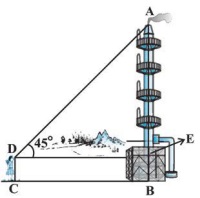
An observer $1.5\, m$ tall is $28.5\, m$ away from a chimney. The angle of elevation of the top of the chimney from her eyes is $45^{\circ}$. What is the height of the chimney? (in $m$)
A
$15$
B
$28.5$
C
$30$
D
$60$
Solution
(C) Let $AB$ be the chimney,$CD$ be the observer,and $\angle ADE$ be the angle of elevation. In this case,$\triangle ADE$ is a right-angled triangle at $E$,and we need to find the height of the chimney.
We have $AB = AE + BE = AE + 1.5\, m$.
Also,$DE = CB = 28.5\, m$.
To determine $AE$,we use the tangent trigonometric ratio,which involves both $AE$ and $DE$:
$\tan 45^{\circ} = \frac{AE}{DE}$
Since $\tan 45^{\circ} = 1$,we have:
$1 = \frac{AE}{28.5}$
$AE = 28.5\, m$.
Therefore,the height of the chimney $AB = AE + BE = 28.5\, m + 1.5\, m = 30\, m$.
We have $AB = AE + BE = AE + 1.5\, m$.
Also,$DE = CB = 28.5\, m$.
To determine $AE$,we use the tangent trigonometric ratio,which involves both $AE$ and $DE$:
$\tan 45^{\circ} = \frac{AE}{DE}$
Since $\tan 45^{\circ} = 1$,we have:
$1 = \frac{AE}{28.5}$
$AE = 28.5\, m$.
Therefore,the height of the chimney $AB = AE + BE = 28.5\, m + 1.5\, m = 30\, m$.
0 likes
View Solution4
Difficult
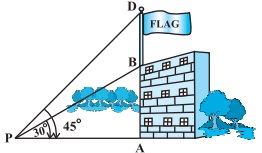
From a point $P$ on the ground,the angle of elevation of the top of a $10 \, m$ tall building is $30^{\circ}$. $A$ flag is hoisted at the top of the building and the angle of elevation of the top of the flagstaff from $P$ is $45^{\circ}$. Find the length of the flagstaff and the distance of the building from the point $P$. (You may take $\sqrt{3} = 1.732$)
Solution
(N/A) In the figure,$AB$ denotes the height of the building,$BD$ the flagstaff,and $P$ the given point. Note that there are two right-angled triangles,$\triangle PAB$ and $\triangle PAD$. We are required to find the length of the flagstaff,i.e.,$DB$,and the distance of the building from the point $P$,i.e.,$PA$.
Since we know the height of the building $AB = 10 \, m$,we will first consider the right $\triangle PAB$.
We have $\tan 30^{\circ} = \frac{AB}{AP}$.
i.e.,$\frac{1}{\sqrt{3}} = \frac{10}{AP}$.
Therefore,$AP = 10\sqrt{3} \, m$.
i.e.,the distance of the building from $P$ is $10 \times 1.732 = 17.32 \, m$.
Next,let us suppose the length of the flagstaff $BD = x \, m$. Then the total height $AD = (10 + x) \, m$.
Now,in right $\triangle PAD$,$\tan 45^{\circ} = \frac{AD}{AP} = \frac{10 + x}{10\sqrt{3}}$.
Since $\tan 45^{\circ} = 1$,we have $1 = \frac{10 + x}{10\sqrt{3}}$.
Therefore,$10\sqrt{3} = 10 + x$.
$x = 10\sqrt{3} - 10 = 10(\sqrt{3} - 1) = 10(1.732 - 1) = 10(0.732) = 7.32 \, m$.
Thus,the length of the flagstaff is $7.32 \, m$ and the distance of the building from $P$ is $17.32 \, m$.
Since we know the height of the building $AB = 10 \, m$,we will first consider the right $\triangle PAB$.
We have $\tan 30^{\circ} = \frac{AB}{AP}$.
i.e.,$\frac{1}{\sqrt{3}} = \frac{10}{AP}$.
Therefore,$AP = 10\sqrt{3} \, m$.
i.e.,the distance of the building from $P$ is $10 \times 1.732 = 17.32 \, m$.
Next,let us suppose the length of the flagstaff $BD = x \, m$. Then the total height $AD = (10 + x) \, m$.
Now,in right $\triangle PAD$,$\tan 45^{\circ} = \frac{AD}{AP} = \frac{10 + x}{10\sqrt{3}}$.
Since $\tan 45^{\circ} = 1$,we have $1 = \frac{10 + x}{10\sqrt{3}}$.
Therefore,$10\sqrt{3} = 10 + x$.
$x = 10\sqrt{3} - 10 = 10(\sqrt{3} - 1) = 10(1.732 - 1) = 10(0.732) = 7.32 \, m$.
Thus,the length of the flagstaff is $7.32 \, m$ and the distance of the building from $P$ is $17.32 \, m$.
1 likes
View Solution5
Medium
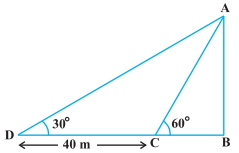
The shadow of a tower standing on a level ground is found to be $40 \, m$ longer when the Sun's altitude is $30^{\circ}$ than when it is $60^{\circ} .$ Find the height of the tower.
Solution
(N/A) Let $AB$ be the tower of height $h \, m$ and $BC$ be the length of the shadow when the Sun's altitude is $60^{\circ}$. Let $BC = x \, m$.
When the Sun's altitude is $30^{\circ}$,the length of the shadow is $DB = (x + 40) \, m$.
In $\triangle ABC$,$\tan 60^{\circ} = \frac{AB}{BC} \implies \sqrt{3} = \frac{h}{x} \implies h = x\sqrt{3} \dots (1)$.
In $\triangle ABD$,$\tan 30^{\circ} = \frac{AB}{BD} \implies \frac{1}{\sqrt{3}} = \frac{h}{x + 40} \implies h = \frac{x + 40}{\sqrt{3}} \dots (2)$.
Equating $(1)$ and $(2)$,we get $x\sqrt{3} = \frac{x + 40}{\sqrt{3}}$.
$3x = x + 40 \implies 2x = 40 \implies x = 20 \, m$.
Substituting $x = 20$ in $(1)$,$h = 20\sqrt{3} \, m$.
Thus,the height of the tower is $20\sqrt{3} \, m$ (or approximately $34.64 \, m$).
When the Sun's altitude is $30^{\circ}$,the length of the shadow is $DB = (x + 40) \, m$.
In $\triangle ABC$,$\tan 60^{\circ} = \frac{AB}{BC} \implies \sqrt{3} = \frac{h}{x} \implies h = x\sqrt{3} \dots (1)$.
In $\triangle ABD$,$\tan 30^{\circ} = \frac{AB}{BD} \implies \frac{1}{\sqrt{3}} = \frac{h}{x + 40} \implies h = \frac{x + 40}{\sqrt{3}} \dots (2)$.
Equating $(1)$ and $(2)$,we get $x\sqrt{3} = \frac{x + 40}{\sqrt{3}}$.
$3x = x + 40 \implies 2x = 40 \implies x = 20 \, m$.
Substituting $x = 20$ in $(1)$,$h = 20\sqrt{3} \, m$.
Thus,the height of the tower is $20\sqrt{3} \, m$ (or approximately $34.64 \, m$).
0 likes
View Solution6
Difficult
The angles of depression of the top and the bottom of an $8 \, m$ tall building from the top of a multi-storeyed building are $30^{\circ}$ and $45^{\circ}$,respectively. Find the height of the multi-storeyed building and the distance between the two buildings.
Solution
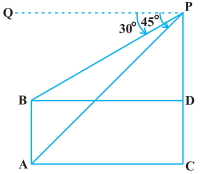
(N/A) Let $PC$ be the multi-storeyed building and $AB$ be the $8 \, m$ tall building. We need to find the height of the multi-storeyed building $(PC)$ and the distance between the two buildings $(AC)$.
From the figure,$PQ$ is the horizontal line from the top of the building $P$. Since $PQ \parallel BD$,the alternate interior angles are equal.
Therefore,$\angle PBD = 30^{\circ}$ and $\angle PAC = 45^{\circ}$.
In right-angled $\triangle PBD$:
$\tan 30^{\circ} = \frac{PD}{BD} \implies \frac{1}{\sqrt{3}} = \frac{PD}{BD} \implies BD = PD\sqrt{3}$.
In right-angled $\triangle PAC$:
$\tan 45^{\circ} = \frac{PC}{AC} \implies 1 = \frac{PC}{AC} \implies PC = AC$.
Since $AC = BD$ and $PC = PD + DC$,where $DC = AB = 8 \, m$:
$PD + 8 = AC = BD = PD\sqrt{3}$.
Solving for $PD$:
$PD\sqrt{3} - PD = 8 \implies PD(\sqrt{3} - 1) = 8 \implies PD = \frac{8}{\sqrt{3} - 1}$.
Rationalizing the denominator:
$PD = \frac{8(\sqrt{3} + 1)}{3 - 1} = \frac{8(\sqrt{3} + 1)}{2} = 4(\sqrt{3} + 1) \, m$.
Height of the multi-storeyed building $PC = PD + DC = 4\sqrt{3} + 4 + 8 = 4\sqrt{3} + 12 = 4(3 + \sqrt{3}) \, m$.
Distance between the buildings $AC = PC = 4(3 + \sqrt{3}) \, m$.
From the figure,$PQ$ is the horizontal line from the top of the building $P$. Since $PQ \parallel BD$,the alternate interior angles are equal.
Therefore,$\angle PBD = 30^{\circ}$ and $\angle PAC = 45^{\circ}$.
In right-angled $\triangle PBD$:
$\tan 30^{\circ} = \frac{PD}{BD} \implies \frac{1}{\sqrt{3}} = \frac{PD}{BD} \implies BD = PD\sqrt{3}$.
In right-angled $\triangle PAC$:
$\tan 45^{\circ} = \frac{PC}{AC} \implies 1 = \frac{PC}{AC} \implies PC = AC$.
Since $AC = BD$ and $PC = PD + DC$,where $DC = AB = 8 \, m$:
$PD + 8 = AC = BD = PD\sqrt{3}$.
Solving for $PD$:
$PD\sqrt{3} - PD = 8 \implies PD(\sqrt{3} - 1) = 8 \implies PD = \frac{8}{\sqrt{3} - 1}$.
Rationalizing the denominator:
$PD = \frac{8(\sqrt{3} + 1)}{3 - 1} = \frac{8(\sqrt{3} + 1)}{2} = 4(\sqrt{3} + 1) \, m$.
Height of the multi-storeyed building $PC = PD + DC = 4\sqrt{3} + 4 + 8 = 4\sqrt{3} + 12 = 4(3 + \sqrt{3}) \, m$.
Distance between the buildings $AC = PC = 4(3 + \sqrt{3}) \, m$.
0 likes
View Solution7
Medium
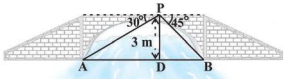
From a point on a bridge across a river,the angles of depression of the banks on opposite sides of the river are $30^{\circ}$ and $45^{\circ}$,respectively. If the bridge is at a height of $3 \, m$ from the banks,find the width of the river.
Solution
(N/A) Let $A$ and $B$ represent points on the bank on opposite sides of the river,so that $AB$ is the width of the river. Let $P$ be a point on the bridge at a height of $3 \, m$ from the river level,i.e.,$PD = 3 \, m$,where $D$ is the point on the river surface directly below $P$.
In right-angled $\triangle APD$,$\angle PAD = 30^{\circ}$.
Using trigonometry,$\tan 30^{\circ} = \frac{PD}{AD}$.
$\frac{1}{\sqrt{3}} = \frac{3}{AD} \implies AD = 3\sqrt{3} \, m$.
In right-angled $\triangle PBD$,$\angle PBD = 45^{\circ}$.
Using trigonometry,$\tan 45^{\circ} = \frac{PD}{BD}$.
$1 = \frac{3}{BD} \implies BD = 3 \, m$.
The total width of the river is $AB = AD + BD = 3\sqrt{3} + 3 = 3(\sqrt{3} + 1) \, m$.
In right-angled $\triangle APD$,$\angle PAD = 30^{\circ}$.
Using trigonometry,$\tan 30^{\circ} = \frac{PD}{AD}$.
$\frac{1}{\sqrt{3}} = \frac{3}{AD} \implies AD = 3\sqrt{3} \, m$.
In right-angled $\triangle PBD$,$\angle PBD = 45^{\circ}$.
Using trigonometry,$\tan 45^{\circ} = \frac{PD}{BD}$.
$1 = \frac{3}{BD} \implies BD = 3 \, m$.
The total width of the river is $AB = AD + BD = 3\sqrt{3} + 3 = 3(\sqrt{3} + 1) \, m$.
0 likes
View Solution8
EasyMCQ
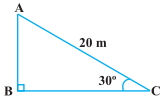
$A$ circus artist is climbing a $20\, m$ long rope,which is tightly stretched and tied from the top of a vertical pole to the ground. Find the height of the pole,if the angle made by the rope with the ground level is $30^{\circ}$ (see figure). (in $m$)
A
$20$
B
$30$
C
$15$
D
$10$
Solution
(D) From the figure,let $AB$ be the vertical pole and $AC$ be the rope of length $20\, m$.
In the right-angled triangle $\triangle ABC$,the angle made by the rope with the ground is $\angle C = 30^{\circ}$.
We need to find the height of the pole,which is $AB$.
Using the trigonometric ratio $\sin \theta = \frac{\text{Opposite side}}{\text{Hypotenuse}}$,we have:
$\sin 30^{\circ} = \frac{AB}{AC}$
Since $\sin 30^{\circ} = \frac{1}{2}$ and $AC = 20\, m$,we get:
$\frac{1}{2} = \frac{AB}{20}$
$AB = \frac{20}{2} = 10\, m$.
Thus,the height of the pole is $10\, m$.
In the right-angled triangle $\triangle ABC$,the angle made by the rope with the ground is $\angle C = 30^{\circ}$.
We need to find the height of the pole,which is $AB$.
Using the trigonometric ratio $\sin \theta = \frac{\text{Opposite side}}{\text{Hypotenuse}}$,we have:
$\sin 30^{\circ} = \frac{AB}{AC}$
Since $\sin 30^{\circ} = \frac{1}{2}$ and $AC = 20\, m$,we get:
$\frac{1}{2} = \frac{AB}{20}$
$AB = \frac{20}{2} = 10\, m$.
Thus,the height of the pole is $10\, m$.
0 likes
View Solution9
Medium
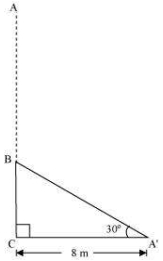
$A$ tree breaks due to a storm and the broken part bends so that the top of the tree touches the ground,making an angle of $30^{\circ}$ with it. The distance between the foot of the tree and the point where the top touches the ground is $8\, m$. Find the height of the tree.
Solution
(N/A) Let $AB$ be the original height of the tree. Let the tree break at point $B$,and the top $A$ touches the ground at point $A^{\prime}$.
In the right-angled triangle $\triangle BCA^{\prime}$,where $\angle BCA^{\prime} = 90^{\circ}$ and $\angle BA^{\prime}C = 30^{\circ}$:
Given $CA^{\prime} = 8\, m$.
Using $\tan 30^{\circ} = \frac{BC}{CA^{\prime}}$:
$\frac{BC}{8} = \frac{1}{\sqrt{3}} \implies BC = \frac{8}{\sqrt{3}}\, m$.
Using $\cos 30^{\circ} = \frac{CA^{\prime}}{BA^{\prime}}$:
$\frac{8}{BA^{\prime}} = \frac{\sqrt{3}}{2} \implies BA^{\prime} = \frac{16}{\sqrt{3}}\, m$.
The total height of the tree is $AB = BC + BA^{\prime}$ (since $BA^{\prime} = BA$):
$AB = \frac{8}{\sqrt{3}} + \frac{16}{\sqrt{3}} = \frac{24}{\sqrt{3}}\, m$.
Rationalizing the denominator:
$AB = \frac{24 \sqrt{3}}{3} = 8\sqrt{3}\, m$.
Thus,the height of the tree is $8\sqrt{3}\, m$.
In the right-angled triangle $\triangle BCA^{\prime}$,where $\angle BCA^{\prime} = 90^{\circ}$ and $\angle BA^{\prime}C = 30^{\circ}$:
Given $CA^{\prime} = 8\, m$.
Using $\tan 30^{\circ} = \frac{BC}{CA^{\prime}}$:
$\frac{BC}{8} = \frac{1}{\sqrt{3}} \implies BC = \frac{8}{\sqrt{3}}\, m$.
Using $\cos 30^{\circ} = \frac{CA^{\prime}}{BA^{\prime}}$:
$\frac{8}{BA^{\prime}} = \frac{\sqrt{3}}{2} \implies BA^{\prime} = \frac{16}{\sqrt{3}}\, m$.
The total height of the tree is $AB = BC + BA^{\prime}$ (since $BA^{\prime} = BA$):
$AB = \frac{8}{\sqrt{3}} + \frac{16}{\sqrt{3}} = \frac{24}{\sqrt{3}}\, m$.
Rationalizing the denominator:
$AB = \frac{24 \sqrt{3}}{3} = 8\sqrt{3}\, m$.
Thus,the height of the tree is $8\sqrt{3}\, m$.
0 likes
View Solution10
Medium
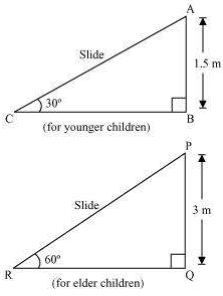
$A$ contractor plans to install two slides for the children to play in a park. For the children below the age of $5$ years,she prefers to have a slide whose top is at a height of $1.5 \, m$,and is inclined at an angle of $30^{\circ}$ to the ground,whereas for elder children,she wants to have a steep slide at a height of $3 \, m$,and inclined at an angle of $60^{\circ}$ to the ground. What should be the length of the slide in each case?
Solution
(N/A) It can be observed that $AC$ and $PR$ are the slides for younger and elder children respectively.
In $\triangle ABC$:
$\sin 30^{\circ} = \frac{\text{Opposite}}{\text{Hypotenuse}} = \frac{AB}{AC}$
$\frac{1}{2} = \frac{1.5}{AC}$
$AC = 3 \, m$
In $\triangle PQR$:
$\sin 60^{\circ} = \frac{\text{Opposite}}{\text{Hypotenuse}} = \frac{PQ}{PR}$
$\frac{\sqrt{3}}{2} = \frac{3}{PR}$
$PR = \frac{6}{\sqrt{3}} = 2\sqrt{3} \, m \approx 3.46 \, m$
In $\triangle ABC$:
$\sin 30^{\circ} = \frac{\text{Opposite}}{\text{Hypotenuse}} = \frac{AB}{AC}$
$\frac{1}{2} = \frac{1.5}{AC}$
$AC = 3 \, m$
In $\triangle PQR$:
$\sin 60^{\circ} = \frac{\text{Opposite}}{\text{Hypotenuse}} = \frac{PQ}{PR}$
$\frac{\sqrt{3}}{2} = \frac{3}{PR}$
$PR = \frac{6}{\sqrt{3}} = 2\sqrt{3} \, m \approx 3.46 \, m$
0 likes
View Solution11
Medium
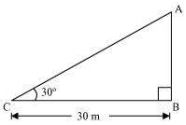
The angle of elevation of the top of a tower from a point on the ground,which is $30\, m$ away from the foot of the tower,is $30^{\circ}$. Find the height of the tower.
Solution
(N/A) Let $AB$ be the tower and the angle of elevation from point $C$ (on the ground) is $30^{\circ}$.
In $\triangle ABC$,
$\frac{AB}{BC} = \tan 30^{\circ}$
$\frac{AB}{30} = \frac{1}{\sqrt{3}}$
$AB = \frac{30}{\sqrt{3}} = \frac{30}{\sqrt{3}} \times \frac{\sqrt{3}}{\sqrt{3}} = \frac{30\sqrt{3}}{3} = 10\sqrt{3}\, m$
Therefore,the height of the tower is $10\sqrt{3}\, m$.
In $\triangle ABC$,
$\frac{AB}{BC} = \tan 30^{\circ}$
$\frac{AB}{30} = \frac{1}{\sqrt{3}}$
$AB = \frac{30}{\sqrt{3}} = \frac{30}{\sqrt{3}} \times \frac{\sqrt{3}}{\sqrt{3}} = \frac{30\sqrt{3}}{3} = 10\sqrt{3}\, m$
Therefore,the height of the tower is $10\sqrt{3}\, m$.
0 likes
View Solution12
Difficult
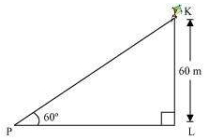
$A$ kite is flying at a height of $60\, m$ above the ground. The string attached to the kite is temporarily tied to a point on the ground. The inclination of the string with the ground is $60^{\circ}$. Find the length of the string,assuming that there is no slack in the string.
Solution
$(40\sqrt{3}\, m) $ Let $K$ be the position of the kite and $P$ be the point on the ground where the string is tied. Let $L$ be the point on the ground directly below the kite.
In the right-angled triangle $\triangle KLP$:
$KL = 60\, m$ (height of the kite)
$\angle KPL = 60^{\circ}$ (angle of inclination)
We need to find the length of the string,which is the hypotenuse $KP$.
Using the trigonometric ratio $\sin \theta = \frac{\text{Opposite}}{\text{Hypotenuse}}$:
$\sin 60^{\circ} = \frac{KL}{KP}$
$\frac{\sqrt{3}}{2} = \frac{60}{KP}$
$KP = \frac{60 \times 2}{\sqrt{3}}$
$KP = \frac{120}{\sqrt{3}} \times \frac{\sqrt{3}}{\sqrt{3}}$
$KP = \frac{120\sqrt{3}}{3} = 40\sqrt{3}\, m$
Thus,the length of the string is $40\sqrt{3}\, m$ (approximately $69.28\, m$).
In the right-angled triangle $\triangle KLP$:
$KL = 60\, m$ (height of the kite)
$\angle KPL = 60^{\circ}$ (angle of inclination)
We need to find the length of the string,which is the hypotenuse $KP$.
Using the trigonometric ratio $\sin \theta = \frac{\text{Opposite}}{\text{Hypotenuse}}$:
$\sin 60^{\circ} = \frac{KL}{KP}$
$\frac{\sqrt{3}}{2} = \frac{60}{KP}$
$KP = \frac{60 \times 2}{\sqrt{3}}$
$KP = \frac{120}{\sqrt{3}} \times \frac{\sqrt{3}}{\sqrt{3}}$
$KP = \frac{120\sqrt{3}}{3} = 40\sqrt{3}\, m$
Thus,the length of the string is $40\sqrt{3}\, m$ (approximately $69.28\, m$).
0 likes
View Solution13
Difficult
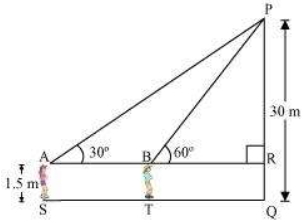
$A$ $1.5 \, m$ tall boy is standing at some distance from a $30 \, m$ tall building. The angle of elevation from his eyes to the top of the building increases from $30^{\circ}$ to $60^{\circ}$ as he walks towards the building. Find the distance he walked towards the building.
Solution
(N/A) Let the boy be standing at point $A$ initially. He walks towards the building and reaches point $B$.
Let $PQ$ be the building of height $30 \, m$. The boy's height is $1.5 \, m$.
Therefore,the height of the triangle $PR = PQ - RQ = 30 - 1.5 = 28.5 \, m = \frac{57}{2} \, m$.
In $\triangle PAR$,$\tan 30^{\circ} = \frac{PR}{AR} \implies \frac{1}{\sqrt{3}} = \frac{57/2}{AR} \implies AR = \frac{57\sqrt{3}}{2} \, m$.
In $\triangle PBR$,$\tan 60^{\circ} = \frac{PR}{BR} \implies \sqrt{3} = \frac{57/2}{BR} \implies BR = \frac{57}{2\sqrt{3}} = \frac{19\sqrt{3}}{2} \, m$.
The distance walked towards the building is $AB = AR - BR$.
$AB = \frac{57\sqrt{3}}{2} - \frac{19\sqrt{3}}{2} = \frac{38\sqrt{3}}{2} = 19\sqrt{3} \, m$.
Thus,the boy walked $19\sqrt{3} \, m$ towards the building.
Let $PQ$ be the building of height $30 \, m$. The boy's height is $1.5 \, m$.
Therefore,the height of the triangle $PR = PQ - RQ = 30 - 1.5 = 28.5 \, m = \frac{57}{2} \, m$.
In $\triangle PAR$,$\tan 30^{\circ} = \frac{PR}{AR} \implies \frac{1}{\sqrt{3}} = \frac{57/2}{AR} \implies AR = \frac{57\sqrt{3}}{2} \, m$.
In $\triangle PBR$,$\tan 60^{\circ} = \frac{PR}{BR} \implies \sqrt{3} = \frac{57/2}{BR} \implies BR = \frac{57}{2\sqrt{3}} = \frac{19\sqrt{3}}{2} \, m$.
The distance walked towards the building is $AB = AR - BR$.
$AB = \frac{57\sqrt{3}}{2} - \frac{19\sqrt{3}}{2} = \frac{38\sqrt{3}}{2} = 19\sqrt{3} \, m$.
Thus,the boy walked $19\sqrt{3} \, m$ towards the building.
0 likes
View Solution14
Easy
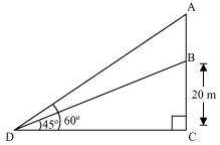
From a point on the ground,the angles of elevation of the bottom and the top of a transmission tower fixed at the top of a $20 \, m$ high building are $45^{\circ}$ and $60^{\circ}$ respectively. Find the height of the tower.
Solution
(N/A) Let $BC$ be the building,$AB$ be the transmission tower,and $D$ be the point on the ground from where the elevation angles are measured.
In $\triangle BCD$:
$\frac{BC}{CD} = \tan 45^{\circ}$
$\frac{20}{CD} = 1$
$CD = 20 \, m$
In $\triangle ACD$:
$\frac{AC}{CD} = \tan 60^{\circ}$
$\frac{AB + BC}{CD} = \sqrt{3}$
$\frac{AB + 20}{20} = \sqrt{3}$
$AB + 20 = 20\sqrt{3}$
$AB = 20\sqrt{3} - 20$
$AB = 20(\sqrt{3} - 1) \, m$
Therefore,the height of the transmission tower is $20(\sqrt{3} - 1) \, m$.
In $\triangle BCD$:
$\frac{BC}{CD} = \tan 45^{\circ}$
$\frac{20}{CD} = 1$
$CD = 20 \, m$
In $\triangle ACD$:
$\frac{AC}{CD} = \tan 60^{\circ}$
$\frac{AB + BC}{CD} = \sqrt{3}$
$\frac{AB + 20}{20} = \sqrt{3}$
$AB + 20 = 20\sqrt{3}$
$AB = 20\sqrt{3} - 20$
$AB = 20(\sqrt{3} - 1) \, m$
Therefore,the height of the transmission tower is $20(\sqrt{3} - 1) \, m$.
0 likes
View Solution15
Difficult
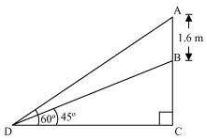
$A$ statue,$1.6 \, m$ tall,stands on the top of a pedestal. From a point on the ground,the angle of elevation of the top of the statue is $60^{\circ}$ and from the same point the angle of elevation of the top of the pedestal is $45^{\circ}$. Find the height of the pedestal.
Solution
(N/A) Let $AB$ be the statue,$BC$ be the pedestal,and $D$ be the point on the ground from where the angles of elevation are measured.
In $\triangle BCD$,we have:
$\frac{BC}{CD} = \tan 45^{\circ}$
$\frac{BC}{CD} = 1$
$BC = CD$
In $\triangle ACD$,we have:
$\frac{AC}{CD} = \tan 60^{\circ}$
$\frac{AB + BC}{CD} = \sqrt{3}$
Since $CD = BC$,we can write:
$\frac{1.6 + BC}{BC} = \sqrt{3}$
$1.6 + BC = BC \sqrt{3}$
$1.6 = BC(\sqrt{3} - 1)$
$BC = \frac{1.6}{\sqrt{3} - 1}$
Rationalizing the denominator:
$BC = \frac{1.6(\sqrt{3} + 1)}{(\sqrt{3} - 1)(\sqrt{3} + 1)}$
$BC = \frac{1.6(\sqrt{3} + 1)}{3 - 1}$
$BC = \frac{1.6(\sqrt{3} + 1)}{2}$
$BC = 0.8(\sqrt{3} + 1) \, m$
Thus,the height of the pedestal is $0.8(\sqrt{3} + 1) \, m$.
In $\triangle BCD$,we have:
$\frac{BC}{CD} = \tan 45^{\circ}$
$\frac{BC}{CD} = 1$
$BC = CD$
In $\triangle ACD$,we have:
$\frac{AC}{CD} = \tan 60^{\circ}$
$\frac{AB + BC}{CD} = \sqrt{3}$
Since $CD = BC$,we can write:
$\frac{1.6 + BC}{BC} = \sqrt{3}$
$1.6 + BC = BC \sqrt{3}$
$1.6 = BC(\sqrt{3} - 1)$
$BC = \frac{1.6}{\sqrt{3} - 1}$
Rationalizing the denominator:
$BC = \frac{1.6(\sqrt{3} + 1)}{(\sqrt{3} - 1)(\sqrt{3} + 1)}$
$BC = \frac{1.6(\sqrt{3} + 1)}{3 - 1}$
$BC = \frac{1.6(\sqrt{3} + 1)}{2}$
$BC = 0.8(\sqrt{3} + 1) \, m$
Thus,the height of the pedestal is $0.8(\sqrt{3} + 1) \, m$.
0 likes
View Solution16
Easy
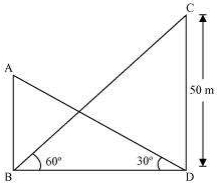
The angle of elevation of the top of a building from the foot of the tower is $30^{\circ}$ and the angle of elevation of the top of the tower from the foot of the building is $60^{\circ}$. If the tower is $50\, m$ high,find the height of the building.
Solution
(N/A) Let $AB$ be the building and $CD$ be the tower.
In $\triangle CDB$,
$\frac{CD}{BD} = \tan 60^{\circ}$
$\frac{50}{BD} = \sqrt{3}$
$BD = \frac{50}{\sqrt{3}}$
In $\triangle ABD$,
$\frac{AB}{BD} = \tan 30^{\circ}$
$AB = BD \times \tan 30^{\circ} = \frac{50}{\sqrt{3}} \times \frac{1}{\sqrt{3}} = \frac{50}{3} = 16 \frac{2}{3} \, m$
Therefore,the height of the building is $16 \frac{2}{3} \, m$.
In $\triangle CDB$,
$\frac{CD}{BD} = \tan 60^{\circ}$
$\frac{50}{BD} = \sqrt{3}$
$BD = \frac{50}{\sqrt{3}}$
In $\triangle ABD$,
$\frac{AB}{BD} = \tan 30^{\circ}$
$AB = BD \times \tan 30^{\circ} = \frac{50}{\sqrt{3}} \times \frac{1}{\sqrt{3}} = \frac{50}{3} = 16 \frac{2}{3} \, m$
Therefore,the height of the building is $16 \frac{2}{3} \, m$.
0 likes
View Solution17
Difficult
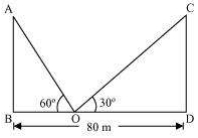
Two poles of equal heights are standing opposite each other on either side of the road,which is $80\, m$ wide. From a point between them on the road,the angles of elevation of the top of the poles are $60^{\circ}$ and $30^{\circ},$ respectively. Find the height of the poles and the distances of the point from the poles.
Solution
(N/A) Let $AB$ and $CD$ be the poles of equal height $h$,and $O$ be the point on the road $BD$ such that $BD = 80\, m$.
Let $BO = x\, m$,then $OD = (80 - x)\, m$.
In $\triangle ABO$,$\tan 60^{\circ} = \frac{AB}{BO} \implies \sqrt{3} = \frac{h}{x} \implies h = x\sqrt{3} \quad \dots(1)$.
In $\triangle CDO$,$\tan 30^{\circ} = \frac{CD}{OD} \implies \frac{1}{\sqrt{3}} = \frac{h}{80 - x} \implies h = \frac{80 - x}{\sqrt{3}} \quad \dots(2)$.
Equating $(1)$ and $(2)$:
$x\sqrt{3} = \frac{80 - x}{\sqrt{3}}$
$3x = 80 - x$
$4x = 80 \implies x = 20\, m$.
So,$BO = 20\, m$ and $OD = 80 - 20 = 60\, m$.
Substituting $x$ in $(1)$:
$h = 20\sqrt{3}\, m$.
Thus,the height of the poles is $20\sqrt{3}\, m$ and the distances of the point from the poles are $20\, m$ and $60\, m$.
Let $BO = x\, m$,then $OD = (80 - x)\, m$.
In $\triangle ABO$,$\tan 60^{\circ} = \frac{AB}{BO} \implies \sqrt{3} = \frac{h}{x} \implies h = x\sqrt{3} \quad \dots(1)$.
In $\triangle CDO$,$\tan 30^{\circ} = \frac{CD}{OD} \implies \frac{1}{\sqrt{3}} = \frac{h}{80 - x} \implies h = \frac{80 - x}{\sqrt{3}} \quad \dots(2)$.
Equating $(1)$ and $(2)$:
$x\sqrt{3} = \frac{80 - x}{\sqrt{3}}$
$3x = 80 - x$
$4x = 80 \implies x = 20\, m$.
So,$BO = 20\, m$ and $OD = 80 - 20 = 60\, m$.
Substituting $x$ in $(1)$:
$h = 20\sqrt{3}\, m$.
Thus,the height of the poles is $20\sqrt{3}\, m$ and the distances of the point from the poles are $20\, m$ and $60\, m$.
0 likes
View Solution18
Difficult
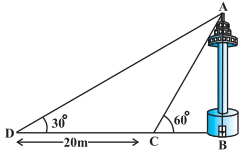
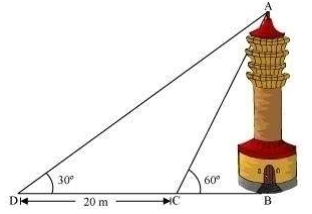
$A$ $TV$ tower stands vertically on a bank of a canal. From a point on the other bank directly opposite the tower,the angle of elevation of the top of the tower is $60^{\circ}$. From another point $20 \, m$ away from this point on the line joining this point to the foot of the tower,the angle of elevation of the top of the tower is $30^{\circ}$ (see figure). Find the height of the tower and the width of the canal.
Solution
(N/A) Let the height of the $TV$ tower be $AB = h$ and the width of the canal be $BC = x$.
In $\triangle ABC$,we have:
$\frac{AB}{BC} = \tan 60^{\circ}$
$\frac{h}{x} = \sqrt{3} \implies h = x\sqrt{3} \quad \dots(1)$
In $\triangle ABD$,we have:
$\frac{AB}{BD} = \tan 30^{\circ}$
$\frac{h}{x + 20} = \frac{1}{\sqrt{3}} \implies h\sqrt{3} = x + 20 \quad \dots(2)$
Substituting the value of $h$ from equation $(1)$ into equation $(2)$:
$(x\sqrt{3})\sqrt{3} = x + 20$
$3x = x + 20$
$2x = 20 \implies x = 10 \, m$
Now,substituting $x = 10$ into equation $(1)$:
$h = 10\sqrt{3} \, m$
Therefore,the height of the tower is $10\sqrt{3} \, m$ and the width of the canal is $10 \, m$.
In $\triangle ABC$,we have:
$\frac{AB}{BC} = \tan 60^{\circ}$
$\frac{h}{x} = \sqrt{3} \implies h = x\sqrt{3} \quad \dots(1)$
In $\triangle ABD$,we have:
$\frac{AB}{BD} = \tan 30^{\circ}$
$\frac{h}{x + 20} = \frac{1}{\sqrt{3}} \implies h\sqrt{3} = x + 20 \quad \dots(2)$
Substituting the value of $h$ from equation $(1)$ into equation $(2)$:
$(x\sqrt{3})\sqrt{3} = x + 20$
$3x = x + 20$
$2x = 20 \implies x = 10 \, m$
Now,substituting $x = 10$ into equation $(1)$:
$h = 10\sqrt{3} \, m$
Therefore,the height of the tower is $10\sqrt{3} \, m$ and the width of the canal is $10 \, m$.
0 likes
View Solution19
Difficult
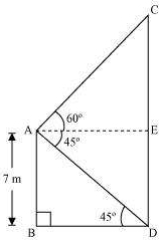
From the top of a $7 \,m$ high building,the angle of elevation of the top of a cable tower is $60^{\circ}$ and the angle of depression of its foot is $45^{\circ}$. Determine the height of the tower.
Solution
(N/A) Let $AB$ be the building of height $7 \,m$ and $CD$ be the cable tower.
In $\triangle ABD$,$\angle ABD = 90^{\circ}$ and $\angle ADB = 45^{\circ}$.
$\tan 45^{\circ} = \frac{AB}{BD}$
$1 = \frac{7}{BD}$
$BD = 7 \,m$.
Since $ABED$ is a rectangle,$AE = BD = 7 \,m$ and $ED = AB = 7 \,m$.
In $\triangle ACE$,$\angle AEC = 90^{\circ}$ and $\angle CAE = 60^{\circ}$.
$\tan 60^{\circ} = \frac{CE}{AE}$
$\sqrt{3} = \frac{CE}{7}$
$CE = 7\sqrt{3} \,m$.
The total height of the tower $CD = CE + ED = 7\sqrt{3} + 7 = 7(\sqrt{3} + 1) \,m$.
Thus,the height of the tower is $7(\sqrt{3} + 1) \,m$.
In $\triangle ABD$,$\angle ABD = 90^{\circ}$ and $\angle ADB = 45^{\circ}$.
$\tan 45^{\circ} = \frac{AB}{BD}$
$1 = \frac{7}{BD}$
$BD = 7 \,m$.
Since $ABED$ is a rectangle,$AE = BD = 7 \,m$ and $ED = AB = 7 \,m$.
In $\triangle ACE$,$\angle AEC = 90^{\circ}$ and $\angle CAE = 60^{\circ}$.
$\tan 60^{\circ} = \frac{CE}{AE}$
$\sqrt{3} = \frac{CE}{7}$
$CE = 7\sqrt{3} \,m$.
The total height of the tower $CD = CE + ED = 7\sqrt{3} + 7 = 7(\sqrt{3} + 1) \,m$.
Thus,the height of the tower is $7(\sqrt{3} + 1) \,m$.
0 likes
View Solution20
Difficult
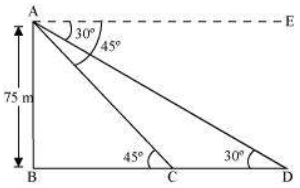
As observed from the top of a $75 \, m$ high lighthouse from the sea-level,the angles of depression of two ships are $30^{\circ}$ and $45^{\circ}$. If one ship is exactly behind the other on the same side of the lighthouse,find the distance between the two ships.
Solution
(N/A) Let $AB$ be the lighthouse and the two ships be at points $C$ and $D$ respectively.
In $\triangle ABC$,
$\frac{AB}{BC} = \tan 45^{\circ}$
$\frac{75}{BC} = 1$
$BC = 75 \, m$
In $\triangle ABD$,
$\frac{AB}{BD} = \tan 30^{\circ}$
$\frac{75}{BC + CD} = \frac{1}{\sqrt{3}}$
$\frac{75}{75 + CD} = \frac{1}{\sqrt{3}}$
$75\sqrt{3} = 75 + CD$
$CD = 75(\sqrt{3} - 1) \, m$
Therefore,the distance between the two ships is $75(\sqrt{3} - 1) \, m$.
In $\triangle ABC$,
$\frac{AB}{BC} = \tan 45^{\circ}$
$\frac{75}{BC} = 1$
$BC = 75 \, m$
In $\triangle ABD$,
$\frac{AB}{BD} = \tan 30^{\circ}$
$\frac{75}{BC + CD} = \frac{1}{\sqrt{3}}$
$\frac{75}{75 + CD} = \frac{1}{\sqrt{3}}$
$75\sqrt{3} = 75 + CD$
$CD = 75(\sqrt{3} - 1) \, m$
Therefore,the distance between the two ships is $75(\sqrt{3} - 1) \, m$.
0 likes
View Solution21
Difficult
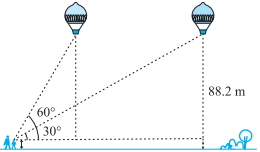
$A$ $1.2\, m$ tall girl spots a balloon moving with the wind in a horizontal line at a height of $88.2\, m$ from the ground. The angle of elevation of the balloon from the eyes of the girl at any instant is $60^{\circ}$. After some time,the angle of elevation reduces to $30^{\circ}$ (see $Fig.$). Find the distance travelled by the balloon during the interval.
Solution
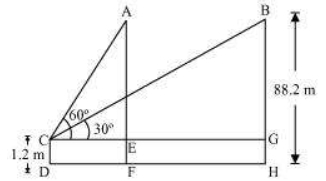
(N/A) Let the initial position of the balloon be $A$ and its final position be $B$. Let $CD$ be the girl,where $CD = 1.2\, m$.
The height of the balloon from the ground is $88.2\, m$. The height of the balloon from the eye level of the girl is $88.2\, m - 1.2\, m = 87\, m$.
Let the eye level of the girl be the horizontal line $CG$. Thus,$AE = BG = 87\, m$.
In $\triangle ACE$,$\tan 60^{\circ} = \frac{AE}{CE} \implies \sqrt{3} = \frac{87}{CE} \implies CE = \frac{87}{\sqrt{3}} = 29\sqrt{3}\, m$.
In $\triangle BCG$,$\tan 30^{\circ} = \frac{BG}{CG} \implies \frac{1}{\sqrt{3}} = \frac{87}{CG} \implies CG = 87\sqrt{3}\, m$.
The distance travelled by the balloon is $EG = CG - CE = 87\sqrt{3} - 29\sqrt{3} = 58\sqrt{3}\, m$.
The height of the balloon from the ground is $88.2\, m$. The height of the balloon from the eye level of the girl is $88.2\, m - 1.2\, m = 87\, m$.
Let the eye level of the girl be the horizontal line $CG$. Thus,$AE = BG = 87\, m$.
In $\triangle ACE$,$\tan 60^{\circ} = \frac{AE}{CE} \implies \sqrt{3} = \frac{87}{CE} \implies CE = \frac{87}{\sqrt{3}} = 29\sqrt{3}\, m$.
In $\triangle BCG$,$\tan 30^{\circ} = \frac{BG}{CG} \implies \frac{1}{\sqrt{3}} = \frac{87}{CG} \implies CG = 87\sqrt{3}\, m$.
The distance travelled by the balloon is $EG = CG - CE = 87\sqrt{3} - 29\sqrt{3} = 58\sqrt{3}\, m$.
0 likes
View Solution22
DifficultMCQ
$A$ straight highway leads to the foot of a tower. $A$ man standing at the top of the tower observes a car at an angle of depression of $30^{\circ}$,which is approaching the foot of the tower with a uniform speed. Six seconds later,the angle of depression of the car is found to be $60^{\circ}$. Find the time taken by the car to reach the foot of the tower from this point (in $seconds$).
A
$6$
B
$3$
C
$2$
D
$4$
Solution
(B) Let $AB$ be the tower of height $h$ and $C$ be the initial position of the car. After $6$ seconds,the car reaches point $D$.
In $\triangle ADB$,$\tan 60^{\circ} = \frac{AB}{DB} \implies \sqrt{3} = \frac{h}{DB} \implies DB = \frac{h}{\sqrt{3}}$.
In $\triangle ABC$,$\tan 30^{\circ} = \frac{AB}{BC} \implies \frac{1}{\sqrt{3}} = \frac{h}{BC} \implies BC = h\sqrt{3}$.
The distance covered in $6$ seconds is $CD = BC - DB = h\sqrt{3} - \frac{h}{\sqrt{3}} = \frac{3h - h}{\sqrt{3}} = \frac{2h}{\sqrt{3}}$.
Since the speed is uniform,the time taken to cover distance $CD$ is $6$ seconds.
Therefore,time taken to cover distance $DB = \frac{h}{\sqrt{3}}$ is $\frac{6 \times (h/\sqrt{3})}{2h/\sqrt{3}} = \frac{6}{2} = 3$ seconds.
In $\triangle ADB$,$\tan 60^{\circ} = \frac{AB}{DB} \implies \sqrt{3} = \frac{h}{DB} \implies DB = \frac{h}{\sqrt{3}}$.
In $\triangle ABC$,$\tan 30^{\circ} = \frac{AB}{BC} \implies \frac{1}{\sqrt{3}} = \frac{h}{BC} \implies BC = h\sqrt{3}$.
The distance covered in $6$ seconds is $CD = BC - DB = h\sqrt{3} - \frac{h}{\sqrt{3}} = \frac{3h - h}{\sqrt{3}} = \frac{2h}{\sqrt{3}}$.
Since the speed is uniform,the time taken to cover distance $CD$ is $6$ seconds.
Therefore,time taken to cover distance $DB = \frac{h}{\sqrt{3}}$ is $\frac{6 \times (h/\sqrt{3})}{2h/\sqrt{3}} = \frac{6}{2} = 3$ seconds.
0 likes
View Solution23
Medium
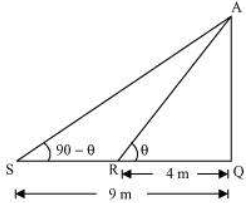
The angles of elevation of the top of a tower from two points at a distance of $4 \,m$ and $9 \,m$ from the base of the tower and in the same straight line with it are complementary. Prove that the height of the tower is $6 \,m$.
Solution
(N/A) Let $AQ$ be the tower and $R, S$ be the points at a distance of $4 \,m$ and $9 \,m$ from the base of the tower $(Q)$ respectively.
The angles of elevation are complementary. Therefore,if one angle is $\theta$,the other will be $(90^\circ - \theta)$.
In $\triangle AQR$,
$\tan \theta = \frac{AQ}{QR} = \frac{AQ}{4} \quad \dots(i)$
In $\triangle AQS$,
$\tan(90^\circ - \theta) = \frac{AQ}{SQ}$
$\cot \theta = \frac{AQ}{9} \quad \dots(ii)$
Multiplying equations $(i)$ and $(ii)$:
$\tan \theta \cdot \cot \theta = \left(\frac{AQ}{4}\right) \cdot \left(\frac{AQ}{9}\right)$
$1 = \frac{AQ^2}{36}$
$AQ^2 = 36$
$AQ = \sqrt{36} = 6 \,m$ (Since height cannot be negative).
Hence,the height of the tower is $6 \,m$.
The angles of elevation are complementary. Therefore,if one angle is $\theta$,the other will be $(90^\circ - \theta)$.
In $\triangle AQR$,
$\tan \theta = \frac{AQ}{QR} = \frac{AQ}{4} \quad \dots(i)$
In $\triangle AQS$,
$\tan(90^\circ - \theta) = \frac{AQ}{SQ}$
$\cot \theta = \frac{AQ}{9} \quad \dots(ii)$
Multiplying equations $(i)$ and $(ii)$:
$\tan \theta \cdot \cot \theta = \left(\frac{AQ}{4}\right) \cdot \left(\frac{AQ}{9}\right)$
$1 = \frac{AQ^2}{36}$
$AQ^2 = 36$
$AQ = \sqrt{36} = 6 \,m$ (Since height cannot be negative).
Hence,the height of the tower is $6 \,m$.
0 likes
View SolutionSome Applications of Trigonometry — Textbook - Some Applications of Trigonometry · Frequently Asked Questions
1Are these Some Applications of Trigonometry questions useful for JEE and NEET?
Yes. All questions in this section are mapped to JEE Main and NEET exam patterns. Previous year questions from JEE Main, NEET, GUJCET and state-level exams are included with full solutions.
2Can I switch to Hindi or Gujarati for these questions?
Yes. Use the language tabs in the hero section or the sidebar to view the same questions and solutions in English, Hindi or Gujarati.
3How do I generate a question paper from this subtopic?
Use the Vedclass Exam Paper Generator — select the chapter and subtopic, set difficulty, and generate Sets A, B, C, D automatically. First 3 chapters of every subject are free.
Vedclass Products
For Students
Vedclass Test Series
Mock tests in real JEE/NEET style with performance analysis. 5-day free trial.
Start Free TrialFor Teachers
Exam Paper Generator
Generate Set A/B/C/D papers from this chapter in 2 minutes. 3 chapters free.
Try FreeFor Institutes
Online Exam Module
Live online exams with unlimited students, 360° analytics & white-label branding.
See DemoFor Teachers & Institutes
Generate a Some Applications of Trigonometry Exam Paper in 2 Minutes
Select subtopic & difficulty — Sets A, B, C, D auto-generated with No Repeat logic.
First 3 chapters of every subject are free — no payment required.