
A English
Mix Examples - Polynomials Questions in English
Class 10 Mathematics · Polynomials · Mix Examples - Polynomials
252+
Questions
English
Language
100%
With Solutions
Showing 50 of 252 questions in English
1
MediumMCQ
If one zero of the quadratic polynomial $x^{2}+3x+k$ is $2$,then the value of $k$ is
A
$-10$
B
$10$
C
$5$
D
$-5$
Solution
(A) Let the polynomial be $p(x) = x^{2} + 3x + k$.
Since $2$ is a zero of the polynomial,$p(2) = 0$.
Substituting $x = 2$ into the polynomial:
$p(2) = (2)^{2} + 3(2) + k = 0$
$4 + 6 + k = 0$
$10 + k = 0$
$k = -10$
Since $2$ is a zero of the polynomial,$p(2) = 0$.
Substituting $x = 2$ into the polynomial:
$p(2) = (2)^{2} + 3(2) + k = 0$
$4 + 6 + k = 0$
$10 + k = 0$
$k = -10$
0 likes
View Solution2
EasyMCQ
Given that two of the zeroes of the cubic polynomial $ax^3 + bx^2 + cx + d$ are $0$,the third zero is
A
$\frac{b}{a}$
B
$\frac{-b}{a}$
C
$\frac{c}{a}$
D
$-\frac{d}{a}$
Solution
(B) Let the zeroes of the cubic polynomial $p(x) = ax^3 + bx^2 + cx + d$ be $\alpha, \beta,$ and $\gamma$.
Given that two zeroes are $0$,let $\alpha = 0$ and $\beta = 0$.
According to the relationship between zeroes and coefficients of a cubic polynomial,the sum of the product of zeroes taken two at a time is given by $\alpha\beta + \beta\gamma + \gamma\alpha = \frac{c}{a}$.
Substituting the values: $(0)(0) + (0)(\gamma) + (\gamma)(0) = 0 = \frac{c}{a}$. This implies $c = 0$.
The product of the zeroes is given by $\alpha\beta\gamma = -\frac{d}{a}$.
Substituting the known values: $(0)(0)(\gamma) = 0 = -\frac{d}{a}$. This implies $d = 0$.
The sum of the zeroes is given by $\alpha + \beta + \gamma = -\frac{b}{a}$.
Substituting $\alpha = 0$ and $\beta = 0$: $0 + 0 + \gamma = -\frac{b}{a}$.
Therefore,the third zero $\gamma = -\frac{b}{a}$.
Given that two zeroes are $0$,let $\alpha = 0$ and $\beta = 0$.
According to the relationship between zeroes and coefficients of a cubic polynomial,the sum of the product of zeroes taken two at a time is given by $\alpha\beta + \beta\gamma + \gamma\alpha = \frac{c}{a}$.
Substituting the values: $(0)(0) + (0)(\gamma) + (\gamma)(0) = 0 = \frac{c}{a}$. This implies $c = 0$.
The product of the zeroes is given by $\alpha\beta\gamma = -\frac{d}{a}$.
Substituting the known values: $(0)(0)(\gamma) = 0 = -\frac{d}{a}$. This implies $d = 0$.
The sum of the zeroes is given by $\alpha + \beta + \gamma = -\frac{b}{a}$.
Substituting $\alpha = 0$ and $\beta = 0$: $0 + 0 + \gamma = -\frac{b}{a}$.
Therefore,the third zero $\gamma = -\frac{b}{a}$.
0 likes
View Solution3
MediumMCQ
If one of the zeroes of the quadratic polynomial $(k-1) x^{2}+k x+1$ is $-3,$ then the value of $k$ is
A
$\frac{2}{3}$
B
$\frac{-2}{3}$
C
$\frac{4}{3}$
D
$\frac{-4}{3}$
Solution
(C) Given that,one of the zeroes of the quadratic polynomial $p(x) = (k-1)x^2 + kx + 1$ is $-3$.
Therefore,$p(-3) = 0$.
Substituting $x = -3$ in the polynomial:
$(k-1)(-3)^2 + k(-3) + 1 = 0$
$9(k-1) - 3k + 1 = 0$
$9k - 9 - 3k + 1 = 0$
$6k - 8 = 0$
$6k = 8$
$k = \frac{8}{6} = \frac{4}{3}$
Therefore,$p(-3) = 0$.
Substituting $x = -3$ in the polynomial:
$(k-1)(-3)^2 + k(-3) + 1 = 0$
$9(k-1) - 3k + 1 = 0$
$9k - 9 - 3k + 1 = 0$
$6k - 8 = 0$
$6k = 8$
$k = \frac{8}{6} = \frac{4}{3}$
0 likes
View Solution4
DifficultMCQ
$A$ quadratic polynomial, whose zeroes are $-3$ and $4,$ is
A
$x^{2}-x+12$
B
$x^{2}+x+12$
C
$2x^{2}+2x-24$
D
$\frac{x^{2}}{2}-\frac{x}{2}-6$
Solution
(D) Let the quadratic polynomial be $p(x) = k(x^2 - (\text{sum of zeroes})x + (\text{product of zeroes}))$, where $k$ is a non-zero constant.
Given zeroes are $\alpha = -3$ and $\beta = 4$.
Sum of zeroes $(\alpha + \beta) = -3 + 4 = 1$.
Product of zeroes $(\alpha \cdot \beta) = -3 \times 4 = -12$.
Substituting these values into the formula, we get $p(x) = k(x^2 - 1x + (-12)) = k(x^2 - x - 12)$.
If we choose $k = \frac{1}{2}$, the polynomial becomes $\frac{1}{2}(x^2 - x - 12) = \frac{x^2}{2} - \frac{x}{2} - 6$.
Since the zeroes of a polynomial remain unchanged when multiplied by a non-zero constant, option $D$ is a valid quadratic polynomial with the given zeroes.
Given zeroes are $\alpha = -3$ and $\beta = 4$.
Sum of zeroes $(\alpha + \beta) = -3 + 4 = 1$.
Product of zeroes $(\alpha \cdot \beta) = -3 \times 4 = -12$.
Substituting these values into the formula, we get $p(x) = k(x^2 - 1x + (-12)) = k(x^2 - x - 12)$.
If we choose $k = \frac{1}{2}$, the polynomial becomes $\frac{1}{2}(x^2 - x - 12) = \frac{x^2}{2} - \frac{x}{2} - 6$.
Since the zeroes of a polynomial remain unchanged when multiplied by a non-zero constant, option $D$ is a valid quadratic polynomial with the given zeroes.
0 likes
View Solution5
DifficultMCQ
If the zeroes of the quadratic polynomial $x^{2}+(a+1)x+b$ are $2$ and $-3$,then
A
$a=0, b=-6$
B
$a=2, b=-6$
C
$a=5, b=-1$
D
$a=-7, b=-1$
Solution
(A) Let $p(x) = x^{2} + (a+1)x + b$.
Given that $2$ and $-3$ are the zeroes of the quadratic polynomial $p(x)$.
Therefore,$p(2) = 0$ and $p(-3) = 0$.
For $x = 2$:
$2^{2} + (a+1)(2) + b = 0$
$4 + 2a + 2 + b = 0$
$2a + b = -6$ ..... $(i)$
For $x = -3$:
$(-3)^{2} + (a+1)(-3) + b = 0$
$9 - 3a - 3 + b = 0$
$-3a + b = -6$ ..... $(ii)$
Subtracting equation $(ii)$ from equation $(i)$:
$(2a + b) - (-3a + b) = -6 - (-6)$
$2a + b + 3a - b = 0$
$5a = 0 \Rightarrow a = 0$.
Substituting $a = 0$ in equation $(i)$:
$2(0) + b = -6 \Rightarrow b = -6$.
Thus,the required values are $a = 0$ and $b = -6$.
Given that $2$ and $-3$ are the zeroes of the quadratic polynomial $p(x)$.
Therefore,$p(2) = 0$ and $p(-3) = 0$.
For $x = 2$:
$2^{2} + (a+1)(2) + b = 0$
$4 + 2a + 2 + b = 0$
$2a + b = -6$ ..... $(i)$
For $x = -3$:
$(-3)^{2} + (a+1)(-3) + b = 0$
$9 - 3a - 3 + b = 0$
$-3a + b = -6$ ..... $(ii)$
Subtracting equation $(ii)$ from equation $(i)$:
$(2a + b) - (-3a + b) = -6 - (-6)$
$2a + b + 3a - b = 0$
$5a = 0 \Rightarrow a = 0$.
Substituting $a = 0$ in equation $(i)$:
$2(0) + b = -6 \Rightarrow b = -6$.
Thus,the required values are $a = 0$ and $b = -6$.
0 likes
View Solution6
DifficultMCQ
The number of polynomials having zeroes as $-2$ and $5$ is
A
$3$
B
more than $3$
C
$1$
D
$2$
Solution
(B) Let $p(x) = a(x^2 - (\text{sum of zeroes})x + (\text{product of zeroes}))$ be the general form of the polynomial.
Given zeroes are $\alpha = -2$ and $\beta = 5$.
Sum of zeroes $= \alpha + \beta = -2 + 5 = 3$.
Product of zeroes $= \alpha \cdot \beta = -2 \times 5 = -10$.
Thus, the polynomial is of the form $p(x) = a(x^2 - 3x - 10)$, where $a$ is any non-zero real constant.
Since $a$ can take any non-zero real value (e.g., $1, 2, 3, \dots, 0.5, \dots$), there are infinitely many such polynomials.
Therefore, the number of such polynomials is more than $3$.
Given zeroes are $\alpha = -2$ and $\beta = 5$.
Sum of zeroes $= \alpha + \beta = -2 + 5 = 3$.
Product of zeroes $= \alpha \cdot \beta = -2 \times 5 = -10$.
Thus, the polynomial is of the form $p(x) = a(x^2 - 3x - 10)$, where $a$ is any non-zero real constant.
Since $a$ can take any non-zero real value (e.g., $1, 2, 3, \dots, 0.5, \dots$), there are infinitely many such polynomials.
Therefore, the number of such polynomials is more than $3$.
0 likes
View Solution7
MediumMCQ
Given that one of the zeroes of the cubic polynomial $ax^3 + bx^2 + cx + d$ is zero,the product of the other two zeroes is
A
$-\frac{c}{a}$
B
$0$
C
$\frac{c}{a}$
D
$-\frac{b}{a}$
Solution
(C) Let $p(x) = ax^3 + bx^2 + cx + d$ be the cubic polynomial.
Let the zeroes of the polynomial be $\alpha, \beta,$ and $\gamma$.
Given that one of the zeroes is zero,let $\alpha = 0$.
According to the relationship between zeroes and coefficients of a cubic polynomial,the sum of the product of zeroes taken two at a time is given by $\alpha\beta + \beta\gamma + \gamma\alpha = \frac{c}{a}$.
Substituting $\alpha = 0$ into the equation:
$(0)\beta + \beta\gamma + \gamma(0) = \frac{c}{a}$
$0 + \beta\gamma + 0 = \frac{c}{a}$
$\beta\gamma = \frac{c}{a}$
Thus,the product of the other two zeroes is $\frac{c}{a}$.
Let the zeroes of the polynomial be $\alpha, \beta,$ and $\gamma$.
Given that one of the zeroes is zero,let $\alpha = 0$.
According to the relationship between zeroes and coefficients of a cubic polynomial,the sum of the product of zeroes taken two at a time is given by $\alpha\beta + \beta\gamma + \gamma\alpha = \frac{c}{a}$.
Substituting $\alpha = 0$ into the equation:
$(0)\beta + \beta\gamma + \gamma(0) = \frac{c}{a}$
$0 + \beta\gamma + 0 = \frac{c}{a}$
$\beta\gamma = \frac{c}{a}$
Thus,the product of the other two zeroes is $\frac{c}{a}$.
0 likes
View Solution8
DifficultMCQ
If one of the zeroes of the cubic polynomial $x^{3}+a x^{2}+b x+c$ is $-1,$ then the product of the other two zeroes is
A
$a-b-1$
B
$b-a-1$
C
$a-b+1$
D
$b-a+1$
Solution
(D) Let the cubic polynomial be $p(x) = x^{3} + a x^{2} + b x + c$.
Let the zeroes of the polynomial be $\alpha, \beta,$ and $\gamma$.
Given that one zero is $\alpha = -1$.
Since $\alpha = -1$ is a zero,$p(-1) = 0$.
Substituting $x = -1$ into the polynomial:
$(-1)^{3} + a(-1)^{2} + b(-1) + c = 0$
$-1 + a - b + c = 0$
$c = 1 - a + b$ ... $(i)$
We know that for a cubic polynomial $Ax^{3} + Bx^{2} + Cx + D$,the product of the zeroes is given by $-\frac{D}{A}$.
Here,the product of the zeroes is $\alpha \cdot \beta \cdot \gamma = -\frac{c}{1} = -c$.
Substituting $\alpha = -1$:
$(-1) \cdot \beta \cdot \gamma = -c$
$\beta \cdot \gamma = c$.
Substituting the value of $c$ from equation $(i)$:
$\beta \cdot \gamma = 1 - a + b$.
Thus,the product of the other two zeroes is $b - a + 1$.
Let the zeroes of the polynomial be $\alpha, \beta,$ and $\gamma$.
Given that one zero is $\alpha = -1$.
Since $\alpha = -1$ is a zero,$p(-1) = 0$.
Substituting $x = -1$ into the polynomial:
$(-1)^{3} + a(-1)^{2} + b(-1) + c = 0$
$-1 + a - b + c = 0$
$c = 1 - a + b$ ... $(i)$
We know that for a cubic polynomial $Ax^{3} + Bx^{2} + Cx + D$,the product of the zeroes is given by $-\frac{D}{A}$.
Here,the product of the zeroes is $\alpha \cdot \beta \cdot \gamma = -\frac{c}{1} = -c$.
Substituting $\alpha = -1$:
$(-1) \cdot \beta \cdot \gamma = -c$
$\beta \cdot \gamma = c$.
Substituting the value of $c$ from equation $(i)$:
$\beta \cdot \gamma = 1 - a + b$.
Thus,the product of the other two zeroes is $b - a + 1$.
0 likes
View Solution9
MediumMCQ
The zeroes of the quadratic polynomial $x^{2}+99x+127$ are
A
both negative
B
both positive
C
one positive and one negative
D
both equal
Solution
(A) Let the given quadratic polynomial be $p(x) = x^{2} + 99x + 127$.
Comparing $p(x)$ with the standard form $ax^{2} + bx + c$,we get $a = 1$,$b = 99$,and $c = 127$.
For a quadratic polynomial $ax^{2} + bx + c$,if $a, b, c > 0$,then the product of zeroes $\alpha \beta = \frac{c}{a} = 127 > 0$ and the sum of zeroes $\alpha + \beta = -\frac{b}{a} = -99 < 0$.
Since the product of the zeroes is positive,both zeroes must have the same sign.
Since the sum of the zeroes is negative,both zeroes must be negative.
Alternatively,using the quadratic formula $x = \frac{-b \pm \sqrt{b^{2} - 4ac}}{2a}$:
$x = \frac{-99 \pm \sqrt{99^{2} - 4(1)(127)}}{2(1)} = \frac{-99 \pm \sqrt{9801 - 508}}{2} = \frac{-99 \pm \sqrt{9293}}{2}$.
Since $\sqrt{9293} \approx 96.4$,the roots are approximately $\frac{-99 + 96.4}{2} = -1.3$ and $\frac{-99 - 96.4}{2} = -97.7$.
Thus,both zeroes are negative.
Comparing $p(x)$ with the standard form $ax^{2} + bx + c$,we get $a = 1$,$b = 99$,and $c = 127$.
For a quadratic polynomial $ax^{2} + bx + c$,if $a, b, c > 0$,then the product of zeroes $\alpha \beta = \frac{c}{a} = 127 > 0$ and the sum of zeroes $\alpha + \beta = -\frac{b}{a} = -99 < 0$.
Since the product of the zeroes is positive,both zeroes must have the same sign.
Since the sum of the zeroes is negative,both zeroes must be negative.
Alternatively,using the quadratic formula $x = \frac{-b \pm \sqrt{b^{2} - 4ac}}{2a}$:
$x = \frac{-99 \pm \sqrt{99^{2} - 4(1)(127)}}{2(1)} = \frac{-99 \pm \sqrt{9801 - 508}}{2} = \frac{-99 \pm \sqrt{9293}}{2}$.
Since $\sqrt{9293} \approx 96.4$,the roots are approximately $\frac{-99 + 96.4}{2} = -1.3$ and $\frac{-99 - 96.4}{2} = -97.7$.
Thus,both zeroes are negative.
0 likes
View Solution10
DifficultMCQ
The zeroes of the quadratic polynomial $x^{2}+kx+k, k \neq 0,$
A
cannot both be negative
B
cannot both be positive
C
are always unequal
D
are always equal
Solution
(B) Let $p(x) = x^{2} + kx + k, k \neq 0$.
For the zeroes to be real,the discriminant $D$ must be greater than or equal to $0$.
$D = b^{2} - 4ac = k^{2} - 4k \geq 0$.
$k(k - 4) \geq 0$.
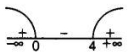
This implies $k \in (-\infty, 0] \cup [4, \infty)$. Since $k \neq 0$,$k \in (-\infty, 0) \cup [4, \infty)$.
Let the zeroes be $\alpha$ and $\beta$. Then:
Sum of zeroes $\alpha + \beta = -k/1 = -k$.
Product of zeroes $\alpha \beta = k/1 = k$.
Case $I$: If $k \in (-\infty, 0)$,then $k < 0$. Since the product $\alpha \beta = k < 0$,the zeroes must have opposite signs.
Case $II$: If $k \in [4, \infty)$,then $k > 0$. Since the product $\alpha \beta = k > 0$,both zeroes have the same sign. The sum $\alpha + \beta = -k < 0$,so both zeroes must be negative.
In both cases,the zeroes cannot both be positive.
For the zeroes to be real,the discriminant $D$ must be greater than or equal to $0$.
$D = b^{2} - 4ac = k^{2} - 4k \geq 0$.
$k(k - 4) \geq 0$.
This implies $k \in (-\infty, 0] \cup [4, \infty)$. Since $k \neq 0$,$k \in (-\infty, 0) \cup [4, \infty)$.
Let the zeroes be $\alpha$ and $\beta$. Then:
Sum of zeroes $\alpha + \beta = -k/1 = -k$.
Product of zeroes $\alpha \beta = k/1 = k$.
Case $I$: If $k \in (-\infty, 0)$,then $k < 0$. Since the product $\alpha \beta = k < 0$,the zeroes must have opposite signs.
Case $II$: If $k \in [4, \infty)$,then $k > 0$. Since the product $\alpha \beta = k > 0$,both zeroes have the same sign. The sum $\alpha + \beta = -k < 0$,so both zeroes must be negative.
In both cases,the zeroes cannot both be positive.
0 likes
View Solution11
MediumMCQ
If the zeroes of the quadratic polynomial $ax^{2} + bx + c, c \neq 0$ are equal,then
A
$c$ and $a$ have opposite signs
B
$c$ and $b$ have opposite signs
C
$c$ and $a$ have the same sign
D
$c$ and $b$ have the same sign
Solution
(C) For a quadratic polynomial $ax^{2} + bx + c$,the zeroes are equal if the discriminant $D = b^{2} - 4ac = 0$.
This implies $b^{2} = 4ac$.
Since $b^{2}$ is always non-negative for any real $b$,$4ac$ must be non-negative.
Given $c \neq 0$,if $a = 0$,it would not be a quadratic polynomial. Thus,$a \neq 0$.
Since $4ac = b^{2} \geq 0$,the product $ac$ must be greater than or equal to $0$.
Since $c \neq 0$ and $a \neq 0$,$ac > 0$,which means $a$ and $c$ must have the same sign.
For example:
$(i)$ $x^{2} + 4x + 4 = 0 \Rightarrow (x+2)^{2} = 0 \Rightarrow x = -2, -2$ (Here $a=1, c=4$,both positive).
$(ii)$ $x^{2} - 4x + 4 = 0 \Rightarrow (x-2)^{2} = 0 \Rightarrow x = 2, 2$ (Here $a=1, c=4$,both positive).
This implies $b^{2} = 4ac$.
Since $b^{2}$ is always non-negative for any real $b$,$4ac$ must be non-negative.
Given $c \neq 0$,if $a = 0$,it would not be a quadratic polynomial. Thus,$a \neq 0$.
Since $4ac = b^{2} \geq 0$,the product $ac$ must be greater than or equal to $0$.
Since $c \neq 0$ and $a \neq 0$,$ac > 0$,which means $a$ and $c$ must have the same sign.
For example:
$(i)$ $x^{2} + 4x + 4 = 0 \Rightarrow (x+2)^{2} = 0 \Rightarrow x = -2, -2$ (Here $a=1, c=4$,both positive).
$(ii)$ $x^{2} - 4x + 4 = 0 \Rightarrow (x-2)^{2} = 0 \Rightarrow x = 2, 2$ (Here $a=1, c=4$,both positive).
0 likes
View Solution12
DifficultMCQ
If one of the zeroes of a quadratic polynomial of the form $x^{2}+ax+b$ is the negative of the other,then it
A
can have a linear term but the constant term is positive
B
has no linear term and the constant term is positive
C
can have a linear term but the constant term is negative
D
has no linear term and the constant term is negative
Solution
(D) Let the zeroes of the quadratic polynomial $p(x) = x^{2} + ax + b$ be $\alpha$ and $-\alpha$.
Sum of zeroes = $-\frac{\text{coefficient of } x}{\text{coefficient of } x^{2}} = -a$.
Since $\alpha + (-\alpha) = 0$,we have $0 = -a$,which implies $a = 0$.
Product of zeroes = $\frac{\text{constant term}}{\text{coefficient of } x^{2}} = b$.
Since $\alpha \times (-\alpha) = -\alpha^{2}$,we have $-\alpha^{2} = b$.
Since $\alpha^{2}$ is always positive for non-zero $\alpha$,$- \alpha^{2}$ must be negative,so $b < 0$.
Therefore,the polynomial has no linear term $(a = 0)$ and the constant term is negative $(b < 0)$.
Sum of zeroes = $-\frac{\text{coefficient of } x}{\text{coefficient of } x^{2}} = -a$.
Since $\alpha + (-\alpha) = 0$,we have $0 = -a$,which implies $a = 0$.
Product of zeroes = $\frac{\text{constant term}}{\text{coefficient of } x^{2}} = b$.
Since $\alpha \times (-\alpha) = -\alpha^{2}$,we have $-\alpha^{2} = b$.
Since $\alpha^{2}$ is always positive for non-zero $\alpha$,$- \alpha^{2}$ must be negative,so $b < 0$.
Therefore,the polynomial has no linear term $(a = 0)$ and the constant term is negative $(b < 0)$.
0 likes
View Solution13
EasyMCQ
Which of the following is not the graph of a quadratic polynomial?
A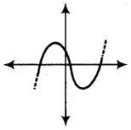
B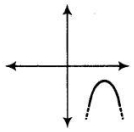
C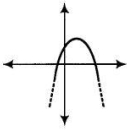
D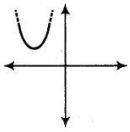
Solution
(A) For any quadratic polynomial $ax^{2} + bx + c$ $(a \neq 0)$,the graph of the corresponding equation $y = ax^{2} + bx + c$ is a parabola,which is either open upwards (if $a > 0$) or open downwards (if $a < 0$).
$1$. $A$ quadratic polynomial graph can intersect the $X$-axis at most at two points.
$2$. The graph in option $(A)$ shows a curve that intersects the $X$-axis at three distinct points,which is characteristic of a cubic polynomial,not a quadratic polynomial.
$3$. Therefore,the graph in option $(A)$ is not the graph of a quadratic polynomial.
$1$. $A$ quadratic polynomial graph can intersect the $X$-axis at most at two points.
$2$. The graph in option $(A)$ shows a curve that intersects the $X$-axis at three distinct points,which is characteristic of a cubic polynomial,not a quadratic polynomial.
$3$. Therefore,the graph in option $(A)$ is not the graph of a quadratic polynomial.
0 likes
View Solution14
EasyMCQ
Can $x-1$ be the remainder on division of a polynomial $p(x)$ by $2x+3$? Justify your answer.
A
Yes
B
No
C
Depends on $p(x)$
D
Cannot be determined
Solution
(B) No,$x-1$ cannot be the remainder.
According to the Division Algorithm for polynomials,if a polynomial $p(x)$ is divided by a divisor $g(x)$,the remainder $r(x)$ must satisfy the condition that either $r(x) = 0$ or the degree of $r(x)$ is strictly less than the degree of $g(x)$.
Here,the divisor is $g(x) = 2x+3$,which has a degree of $1$.
The proposed remainder is $r(x) = x-1$,which also has a degree of $1$.
Since the degree of the remainder is not less than the degree of the divisor,$x-1$ cannot be the remainder.
According to the Division Algorithm for polynomials,if a polynomial $p(x)$ is divided by a divisor $g(x)$,the remainder $r(x)$ must satisfy the condition that either $r(x) = 0$ or the degree of $r(x)$ is strictly less than the degree of $g(x)$.
Here,the divisor is $g(x) = 2x+3$,which has a degree of $1$.
The proposed remainder is $r(x) = x-1$,which also has a degree of $1$.
Since the degree of the remainder is not less than the degree of the divisor,$x-1$ cannot be the remainder.
0 likes
View Solution15
EasyMCQ
Is the following statement True or False? Justify your answer. If the zeroes of a quadratic polynomial $ax^2 + bx + c$ are both negative,then $a, b,$ and $c$ all have the same sign.
A
True
B
False
Solution
(A) The statement is True.
Let the zeroes of the quadratic polynomial $p(x) = ax^2 + bx + c$ be $\alpha$ and $\beta$,where $\alpha < 0$ and $\beta < 0$.
From the relationship between zeroes and coefficients:
$1$. The sum of the zeroes is $\alpha + \beta = -\frac{b}{a}$. Since both $\alpha$ and $\beta$ are negative,their sum $(\alpha + \beta)$ must be negative. Therefore,$-\frac{b}{a} < 0$,which implies $\frac{b}{a} > 0$. This means $a$ and $b$ must have the same sign.
$2$. The product of the zeroes is $\alpha \cdot \beta = \frac{c}{a}$. Since the product of two negative numbers is positive,$\frac{c}{a} > 0$. This means $a$ and $c$ must have the same sign.
Since $a$ and $b$ have the same sign,and $a$ and $c$ have the same sign,it follows that $a, b,$ and $c$ all have the same sign.
Let the zeroes of the quadratic polynomial $p(x) = ax^2 + bx + c$ be $\alpha$ and $\beta$,where $\alpha < 0$ and $\beta < 0$.
From the relationship between zeroes and coefficients:
$1$. The sum of the zeroes is $\alpha + \beta = -\frac{b}{a}$. Since both $\alpha$ and $\beta$ are negative,their sum $(\alpha + \beta)$ must be negative. Therefore,$-\frac{b}{a} < 0$,which implies $\frac{b}{a} > 0$. This means $a$ and $b$ must have the same sign.
$2$. The product of the zeroes is $\alpha \cdot \beta = \frac{c}{a}$. Since the product of two negative numbers is positive,$\frac{c}{a} > 0$. This means $a$ and $c$ must have the same sign.
Since $a$ and $b$ have the same sign,and $a$ and $c$ have the same sign,it follows that $a, b,$ and $c$ all have the same sign.
0 likes
View Solution16
Medium
Answer the following and justify: Can $x^{2}-1$ be the quotient on division of $x^{6}+2 x^{3}+x-1$ by a polynomial in $x$ of degree $5$?
Solution
(B) No. According to the division algorithm for polynomials,if $p(x)$ is the dividend and $g(x)$ is the divisor,then $p(x) = g(x) \cdot q(x) + r(x)$,where $\text{deg}(r(x)) < \text{deg}(g(x))$.
Given,$\text{deg}(p(x)) = 6$ and $\text{deg}(g(x)) = 5$.
If the quotient $q(x) = x^{2}-1$,then $\text{deg}(q(x)) = 2$.
The degree of the product $g(x) \cdot q(x)$ would be $\text{deg}(g(x)) + \text{deg}(q(x)) = 5 + 2 = 7$.
Since the degree of the dividend $p(x)$ is $6$,and the degree of the product $g(x) \cdot q(x)$ is $7$,it is impossible for $x^{2}-1$ to be the quotient because the degree of the product cannot exceed the degree of the dividend (assuming the remainder is zero or has a lower degree).
Therefore,$x^{2}-1$ cannot be the quotient.
Given,$\text{deg}(p(x)) = 6$ and $\text{deg}(g(x)) = 5$.
If the quotient $q(x) = x^{2}-1$,then $\text{deg}(q(x)) = 2$.
The degree of the product $g(x) \cdot q(x)$ would be $\text{deg}(g(x)) + \text{deg}(q(x)) = 5 + 2 = 7$.
Since the degree of the dividend $p(x)$ is $6$,and the degree of the product $g(x) \cdot q(x)$ is $7$,it is impossible for $x^{2}-1$ to be the quotient because the degree of the product cannot exceed the degree of the dividend (assuming the remainder is zero or has a lower degree).
Therefore,$x^{2}-1$ cannot be the quotient.
0 likes
View Solution17
Medium
Answer the following and justify: What will be the quotient and remainder on division of $ax^{2} + bx + c$ by $px^{3} + qx^{2} + nx + s$,where $p \neq 0$?
Solution
(N/A) Given that,the divisor is $px^{3} + qx^{2} + nx + s$ (where $p \neq 0$) and the dividend is $ax^{2} + bx + c$.
We observe that the degree of the divisor is $3$ and the degree of the dividend is $2$.
According to the division algorithm for polynomials,if the degree of the divisor is greater than the degree of the dividend,the division cannot be performed in the standard sense of obtaining a non-zero quotient.
Therefore,the quotient is $0$ and the remainder is equal to the dividend itself,which is $ax^{2} + bx + c$.
We observe that the degree of the divisor is $3$ and the degree of the dividend is $2$.
According to the division algorithm for polynomials,if the degree of the divisor is greater than the degree of the dividend,the division cannot be performed in the standard sense of obtaining a non-zero quotient.
Therefore,the quotient is $0$ and the remainder is equal to the dividend itself,which is $ax^{2} + bx + c$.
0 likes
View Solution18
Easy
Answer the following and justify:
If on division of a polynomial $p(x)$ by a polynomial $g(x)$,the quotient is zero,what is the relation between the degrees of $p(x)$ and $g(x)$?
If on division of a polynomial $p(x)$ by a polynomial $g(x)$,the quotient is zero,what is the relation between the degrees of $p(x)$ and $g(x)$?
Solution
(N/A) According to the division algorithm for polynomials,$p(x) = g(x) \cdot q(x) + r(x)$,where $q(x)$ is the quotient and $r(x)$ is the remainder.
Given that the quotient $q(x) = 0$,the equation becomes $p(x) = g(x) \cdot 0 + r(x)$,which simplifies to $p(x) = r(x)$.
In polynomial division,the degree of the remainder $r(x)$ must be strictly less than the degree of the divisor $g(x)$,i.e.,$\text{deg}(r(x)) < \text{deg}(g(x))$.
Since $p(x) = r(x)$,it follows that $\text{deg}(p(x)) < \text{deg}(g(x))$.
Therefore,the degree of $p(x)$ is less than the degree of $g(x)$.
Given that the quotient $q(x) = 0$,the equation becomes $p(x) = g(x) \cdot 0 + r(x)$,which simplifies to $p(x) = r(x)$.
In polynomial division,the degree of the remainder $r(x)$ must be strictly less than the degree of the divisor $g(x)$,i.e.,$\text{deg}(r(x)) < \text{deg}(g(x))$.
Since $p(x) = r(x)$,it follows that $\text{deg}(p(x)) < \text{deg}(g(x))$.
Therefore,the degree of $p(x)$ is less than the degree of $g(x)$.
0 likes
View Solution19
Medium
Answer the following and justify: If on division of a non-zero polynomial $p(x)$ by a polynomial $g(x)$,the remainder is zero,what is the relation between the degrees of $p(x)$ and $g(x)$?
Solution
(N/A) If a non-zero polynomial $p(x)$ is divided by a polynomial $g(x)$ and the remainder is zero,it implies that $g(x)$ is a factor of $p(x)$. According to the division algorithm for polynomials,$p(x) = g(x) \cdot q(x) + r(x)$,where $r(x) = 0$. Since $p(x)$ and $g(x)$ are non-zero polynomials,the degree of the product $g(x) \cdot q(x)$ must equal the degree of $p(x)$. Therefore,the degree of $g(x)$ must be less than or equal to the degree of $p(x)$,i.e.,$\text{deg}(g(x)) \le \text{deg}(p(x))$.
0 likes
View Solution20
Medium
Answer the following and justify:
Can the quadratic polynomial $x^{2}+kx+k$ have equal zeroes for some odd integer $k > 1$?
Can the quadratic polynomial $x^{2}+kx+k$ have equal zeroes for some odd integer $k > 1$?
Solution
(A) No. Let $p(x) = x^{2} + kx + k$. If $p(x)$ has equal zeroes,its discriminant $D$ must be equal to $0$.
The discriminant formula is $D = B^{2} - 4AC = 0$ ... $(i)$.
Comparing $p(x)$ with the standard form $Ax^{2} + Bx + C$,we get $A = 1$,$B = k$,and $C = k$.
Substituting these values into Eq. $(i)$:
$k^{2} - 4(1)(k) = 0$
$k^{2} - 4k = 0$
$k(k - 4) = 0$
This gives $k = 0$ or $k = 4$.
Since neither $0$ nor $4$ is an odd integer greater than $1$,the quadratic polynomial $x^{2} + kx + k$ cannot have equal zeroes for any odd integer $k > 1$.
The discriminant formula is $D = B^{2} - 4AC = 0$ ... $(i)$.
Comparing $p(x)$ with the standard form $Ax^{2} + Bx + C$,we get $A = 1$,$B = k$,and $C = k$.
Substituting these values into Eq. $(i)$:
$k^{2} - 4(1)(k) = 0$
$k^{2} - 4k = 0$
$k(k - 4) = 0$
This gives $k = 0$ or $k = 4$.
Since neither $0$ nor $4$ is an odd integer greater than $1$,the quadratic polynomial $x^{2} + kx + k$ cannot have equal zeroes for any odd integer $k > 1$.
0 likes
View Solution21
Medium
Are the following statements 'True' or 'False'? Justify your answers.
If the zeroes of a quadratic polynomial $ax^2 + bx + c$ are both positive,then $a, b$ and $c$ all have the same sign.
If the zeroes of a quadratic polynomial $ax^2 + bx + c$ are both positive,then $a, b$ and $c$ all have the same sign.
Solution
(B) The statement is False.
Let the zeroes of the quadratic polynomial $ax^2 + bx + c$ be $\alpha$ and $\beta$. Since both zeroes are positive,$\alpha > 0$ and $\beta > 0$.
From the relationship between zeroes and coefficients:
$1$. The product of zeroes $\alpha \cdot \beta = \frac{c}{a}$. Since $\alpha > 0$ and $\beta > 0$,their product $\alpha \cdot \beta > 0$. Therefore,$\frac{c}{a} > 0$,which means $a$ and $c$ must have the same sign.
$2$. The sum of zeroes $\alpha + \beta = -\frac{b}{a}$. Since $\alpha > 0$ and $\beta > 0$,their sum $\alpha + \beta > 0$. Therefore,$-\frac{b}{a} > 0$,which implies $\frac{b}{a} < 0$. This means $a$ and $b$ must have opposite signs.
Thus,$a$ and $c$ have the same sign,but $b$ has the opposite sign to $a$ and $c$. Hence,$a, b,$ and $c$ do not all have the same sign.
Let the zeroes of the quadratic polynomial $ax^2 + bx + c$ be $\alpha$ and $\beta$. Since both zeroes are positive,$\alpha > 0$ and $\beta > 0$.
From the relationship between zeroes and coefficients:
$1$. The product of zeroes $\alpha \cdot \beta = \frac{c}{a}$. Since $\alpha > 0$ and $\beta > 0$,their product $\alpha \cdot \beta > 0$. Therefore,$\frac{c}{a} > 0$,which means $a$ and $c$ must have the same sign.
$2$. The sum of zeroes $\alpha + \beta = -\frac{b}{a}$. Since $\alpha > 0$ and $\beta > 0$,their sum $\alpha + \beta > 0$. Therefore,$-\frac{b}{a} > 0$,which implies $\frac{b}{a} < 0$. This means $a$ and $b$ must have opposite signs.
Thus,$a$ and $c$ have the same sign,but $b$ has the opposite sign to $a$ and $c$. Hence,$a, b,$ and $c$ do not all have the same sign.
0 likes
View Solution22
Easy
Are the following statements 'True' or 'False'? Justify your answers.
If the graph of a polynomial intersects the $x$-axis at only one point,it cannot be a quadratic polynomial.
If the graph of a polynomial intersects the $x$-axis at only one point,it cannot be a quadratic polynomial.
Solution
(B) The statement is 'False'.
$A$ quadratic polynomial $p(x) = ax^2 + bx + c$ can intersect or touch the $x$-axis at only one point if the discriminant $D = b^2 - 4ac$ is equal to $0$.
In this case,the quadratic polynomial has two equal real roots,and the graph touches the $x$-axis at exactly one point (the vertex).
Therefore,a quadratic polynomial can indeed intersect the $x$-axis at only one point.
$A$ quadratic polynomial $p(x) = ax^2 + bx + c$ can intersect or touch the $x$-axis at only one point if the discriminant $D = b^2 - 4ac$ is equal to $0$.
In this case,the quadratic polynomial has two equal real roots,and the graph touches the $x$-axis at exactly one point (the vertex).
Therefore,a quadratic polynomial can indeed intersect the $x$-axis at only one point.
0 likes
View Solution23
Easy
Are the following statements 'True' or 'False'? Justify your answers.
If the graph of a polynomial intersects the $x$-axis at exactly two points,it need not be a quadratic polynomial.
If the graph of a polynomial intersects the $x$-axis at exactly two points,it need not be a quadratic polynomial.
Solution
(A) The statement is 'True'.
If the graph of a polynomial intersects the $x$-axis at exactly two points,it does not necessarily have to be a quadratic polynomial.
$A$ polynomial of degree $n > 2$ can also intersect the $x$-axis at exactly two points if it has two real roots and the remaining $(n-2)$ roots are imaginary (non-real complex roots).
For example,a polynomial of degree $4$ can have two real roots and two imaginary roots,resulting in a graph that crosses the $x$-axis at only two points.
If the graph of a polynomial intersects the $x$-axis at exactly two points,it does not necessarily have to be a quadratic polynomial.
$A$ polynomial of degree $n > 2$ can also intersect the $x$-axis at exactly two points if it has two real roots and the remaining $(n-2)$ roots are imaginary (non-real complex roots).
For example,a polynomial of degree $4$ can have two real roots and two imaginary roots,resulting in a graph that crosses the $x$-axis at only two points.
0 likes
View Solution24
MediumMCQ
Are the following statements 'True' or 'False'? Justify your answers.
If two of the zeroes of a cubic polynomial are zero,then it does not have linear and constant terms.
If two of the zeroes of a cubic polynomial are zero,then it does not have linear and constant terms.
A
True
B
False
Solution
(A) True. Let the zeroes of the cubic polynomial be $\alpha, \beta,$ and $\gamma$. It is given that two of the zeroes are $0$. Let $\alpha = 0$ and $\beta = 0$.
The cubic polynomial can be expressed as $f(x) = k(x - \alpha)(x - \beta)(x - \gamma)$,where $k$ is a non-zero constant.
Substituting the values: $f(x) = k(x - 0)(x - 0)(x - \gamma) = k(x^2)(x - \gamma) = k(x^3 - \gamma x^2) = kx^3 - k\gamma x^2$.
Comparing this with the general form $ax^3 + bx^2 + cx + d$,we see that the coefficients of the linear term $(c)$ and the constant term $(d)$ are both $0$. Thus,the polynomial does not have linear and constant terms.
The cubic polynomial can be expressed as $f(x) = k(x - \alpha)(x - \beta)(x - \gamma)$,where $k$ is a non-zero constant.
Substituting the values: $f(x) = k(x - 0)(x - 0)(x - \gamma) = k(x^2)(x - \gamma) = k(x^3 - \gamma x^2) = kx^3 - k\gamma x^2$.
Comparing this with the general form $ax^3 + bx^2 + cx + d$,we see that the coefficients of the linear term $(c)$ and the constant term $(d)$ are both $0$. Thus,the polynomial does not have linear and constant terms.
0 likes
View Solution25
Easy
Are the following statements 'True' or 'False'? Justify your answers.
If all the zeroes of a cubic polynomial are negative,then all the coefficients and the constant term of the polynomial have the same sign.
If all the zeroes of a cubic polynomial are negative,then all the coefficients and the constant term of the polynomial have the same sign.
Solution
(A) The statement is True.
Let the cubic polynomial be $f(x) = a(x - \alpha)(x - \beta)(x - \gamma)$,where $\alpha, \beta, \gamma < 0$ are the negative zeroes.
Let $\alpha = -p, \beta = -q, \gamma = -r$,where $p, q, r > 0$.
Then $f(x) = a(x + p)(x + q)(x + r)$.
Expanding this,we get $f(x) = a[x^3 + (p + q + r)x^2 + (pq + qr + rp)x + pqr]$.
Comparing this with the standard form $f(x) = ax^3 + bx^2 + cx + d$,we get:
$b = a(p + q + r)$
$c = a(pq + qr + rp)$
$d = a(pqr)$
Since $p, q, r > 0$,the terms $(p + q + r)$,$(pq + qr + rp)$,and $(pqr)$ are all positive.
Therefore,$a, b, c,$ and $d$ all have the same sign as $a$.
Let the cubic polynomial be $f(x) = a(x - \alpha)(x - \beta)(x - \gamma)$,where $\alpha, \beta, \gamma < 0$ are the negative zeroes.
Let $\alpha = -p, \beta = -q, \gamma = -r$,where $p, q, r > 0$.
Then $f(x) = a(x + p)(x + q)(x + r)$.
Expanding this,we get $f(x) = a[x^3 + (p + q + r)x^2 + (pq + qr + rp)x + pqr]$.
Comparing this with the standard form $f(x) = ax^3 + bx^2 + cx + d$,we get:
$b = a(p + q + r)$
$c = a(pq + qr + rp)$
$d = a(pqr)$
Since $p, q, r > 0$,the terms $(p + q + r)$,$(pq + qr + rp)$,and $(pqr)$ are all positive.
Therefore,$a, b, c,$ and $d$ all have the same sign as $a$.
0 likes
View Solution26
Difficult
Are the following statements 'True' or 'False'? Justify your answers.
If all three zeroes of a cubic polynomial $x^{3}+ax^{2}-bx+c$ are positive,then at least one of $a, b$ and $c$ is non-negative.
If all three zeroes of a cubic polynomial $x^{3}+ax^{2}-bx+c$ are positive,then at least one of $a, b$ and $c$ is non-negative.
Solution
(B) False. Let $\alpha, \beta$ and $\gamma$ be the three zeroes of the cubic polynomial $p(x) = x^{3}+ax^{2}-bx+c$.
According to the relationship between zeroes and coefficients:
$1$. Product of zeroes: $\alpha \beta \gamma = -\frac{c}{1} = -c$. Since $\alpha, \beta, \gamma > 0$,their product $\alpha \beta \gamma > 0$. Therefore,$-c > 0$,which implies $c < 0$.
$2$. Sum of zeroes: $\alpha + \beta + \gamma = -\frac{a}{1} = -a$. Since $\alpha, \beta, \gamma > 0$,their sum $\alpha + \beta + \gamma > 0$. Therefore,$-a > 0$,which implies $a < 0$.
$3$. Sum of product of zeroes taken two at a time: $\alpha \beta + \beta \gamma + \gamma \alpha = \frac{-b}{1} = -b$. Since $\alpha, \beta, \gamma > 0$,their sum of products $\alpha \beta + \beta \gamma + \gamma \alpha > 0$. Therefore,$-b > 0$,which implies $b < 0$.
Thus,for all three zeroes to be positive,$a, b$ and $c$ must all be negative. Hence,the statement that at least one of them is non-negative is False.
According to the relationship between zeroes and coefficients:
$1$. Product of zeroes: $\alpha \beta \gamma = -\frac{c}{1} = -c$. Since $\alpha, \beta, \gamma > 0$,their product $\alpha \beta \gamma > 0$. Therefore,$-c > 0$,which implies $c < 0$.
$2$. Sum of zeroes: $\alpha + \beta + \gamma = -\frac{a}{1} = -a$. Since $\alpha, \beta, \gamma > 0$,their sum $\alpha + \beta + \gamma > 0$. Therefore,$-a > 0$,which implies $a < 0$.
$3$. Sum of product of zeroes taken two at a time: $\alpha \beta + \beta \gamma + \gamma \alpha = \frac{-b}{1} = -b$. Since $\alpha, \beta, \gamma > 0$,their sum of products $\alpha \beta + \beta \gamma + \gamma \alpha > 0$. Therefore,$-b > 0$,which implies $b < 0$.
Thus,for all three zeroes to be positive,$a, b$ and $c$ must all be negative. Hence,the statement that at least one of them is non-negative is False.
0 likes
View Solution27
Medium
Are the following statements 'True' or 'False'? Justify your answers.
The only value of $k$ for which the quadratic polynomial $k x^{2}+x+k$ has equal zeros is $\frac{1}{2}$.
The only value of $k$ for which the quadratic polynomial $k x^{2}+x+k$ has equal zeros is $\frac{1}{2}$.
Solution
(B) False.
Let the quadratic polynomial be $f(x) = k x^{2} + x + k$.
For the polynomial to have equal zeros,its discriminant $D$ must be equal to $0$.
The discriminant is given by $D = b^{2} - 4ac$.
Here,$a = k$,$b = 1$,and $c = k$.
Substituting these values into the discriminant formula:
$D = (1)^{2} - 4(k)(k) = 0$
$1 - 4k^{2} = 0$
$4k^{2} = 1$
$k^{2} = \frac{1}{4}$
$k = \pm \frac{1}{2}$
Therefore,there are two values of $k$,which are $\frac{1}{2}$ and $-\frac{1}{2}$,for which the quadratic polynomial has equal zeros. Thus,the statement is false.
Let the quadratic polynomial be $f(x) = k x^{2} + x + k$.
For the polynomial to have equal zeros,its discriminant $D$ must be equal to $0$.
The discriminant is given by $D = b^{2} - 4ac$.
Here,$a = k$,$b = 1$,and $c = k$.
Substituting these values into the discriminant formula:
$D = (1)^{2} - 4(k)(k) = 0$
$1 - 4k^{2} = 0$
$4k^{2} = 1$
$k^{2} = \frac{1}{4}$
$k = \pm \frac{1}{2}$
Therefore,there are two values of $k$,which are $\frac{1}{2}$ and $-\frac{1}{2}$,for which the quadratic polynomial has equal zeros. Thus,the statement is false.
0 likes
View Solution28
Medium
Find the zeroes of the polynomial $x^{2}+\frac{1}{6} x-2,$ and verify the relation between the coefficients and the zeroes of the polynomial.
Solution
(A) To find the zeroes,set the polynomial to zero: $x^{2}+\frac{1}{6} x-2 = 0$.
Multiply by $6$ to simplify: $6x^{2}+x-12 = 0$.
Factorizing the quadratic: $6x^{2}+9x-8x-12 = 0$.
$3x(2x+3)-4(2x+3) = 0 \implies (3x-4)(2x+3) = 0$.
Thus,the zeroes are $\alpha = \frac{4}{3}$ and $\beta = -\frac{3}{2}$.
Verification:
Sum of zeroes: $\alpha + \beta = \frac{4}{3} - \frac{3}{2} = \frac{8-9}{6} = -\frac{1}{6}$.
From the polynomial $ax^2+bx+c$,sum $= -\frac{b}{a} = -\frac{1/6}{1} = -\frac{1}{6}$.
Product of zeroes: $\alpha \beta = \frac{4}{3} \times (-\frac{3}{2}) = -2$.
From the polynomial,product $= \frac{c}{a} = \frac{-2}{1} = -2$.
Both relations are verified.
Multiply by $6$ to simplify: $6x^{2}+x-12 = 0$.
Factorizing the quadratic: $6x^{2}+9x-8x-12 = 0$.
$3x(2x+3)-4(2x+3) = 0 \implies (3x-4)(2x+3) = 0$.
Thus,the zeroes are $\alpha = \frac{4}{3}$ and $\beta = -\frac{3}{2}$.
Verification:
Sum of zeroes: $\alpha + \beta = \frac{4}{3} - \frac{3}{2} = \frac{8-9}{6} = -\frac{1}{6}$.
From the polynomial $ax^2+bx+c$,sum $= -\frac{b}{a} = -\frac{1/6}{1} = -\frac{1}{6}$.
Product of zeroes: $\alpha \beta = \frac{4}{3} \times (-\frac{3}{2}) = -2$.
From the polynomial,product $= \frac{c}{a} = \frac{-2}{1} = -2$.
Both relations are verified.
0 likes
View Solution29
Medium
Find the zeroes of the following polynomial by the factorisation method and verify the relationship between the zeroes and the coefficients of the polynomial: $4x^2 - 3x - 1$
Solution
(N/A) Let $f(x) = 4x^2 - 3x - 1$.
To find the zeroes,we factorise the polynomial by splitting the middle term:
$f(x) = 4x^2 - 4x + x - 1$
$f(x) = 4x(x - 1) + 1(x - 1)$
$f(x) = (x - 1)(4x + 1)$
The zeroes are found by setting $f(x) = 0$:
$x - 1 = 0 \implies x = 1$
$4x + 1 = 0 \implies x = -\frac{1}{4}$
Thus,the zeroes are $\alpha = 1$ and $\beta = -\frac{1}{4}$.
Verification:
Sum of zeroes $= \alpha + \beta = 1 + (-\frac{1}{4}) = \frac{3}{4} = -\frac{-3}{4} = -\frac{\text{Coefficient of } x}{\text{Coefficient of } x^2}$.
Product of zeroes $= \alpha \cdot \beta = 1 \cdot (-\frac{1}{4}) = -\frac{1}{4} = \frac{-1}{4} = \frac{\text{Constant term}}{\text{Coefficient of } x^2}$.
Hence,the relationship is verified.
To find the zeroes,we factorise the polynomial by splitting the middle term:
$f(x) = 4x^2 - 4x + x - 1$
$f(x) = 4x(x - 1) + 1(x - 1)$
$f(x) = (x - 1)(4x + 1)$
The zeroes are found by setting $f(x) = 0$:
$x - 1 = 0 \implies x = 1$
$4x + 1 = 0 \implies x = -\frac{1}{4}$
Thus,the zeroes are $\alpha = 1$ and $\beta = -\frac{1}{4}$.
Verification:
Sum of zeroes $= \alpha + \beta = 1 + (-\frac{1}{4}) = \frac{3}{4} = -\frac{-3}{4} = -\frac{\text{Coefficient of } x}{\text{Coefficient of } x^2}$.
Product of zeroes $= \alpha \cdot \beta = 1 \cdot (-\frac{1}{4}) = -\frac{1}{4} = \frac{-1}{4} = \frac{\text{Constant term}}{\text{Coefficient of } x^2}$.
Hence,the relationship is verified.
0 likes
View Solution30
Medium
Find the zeroes of the following polynomial by the factorization method and verify the relationship between the zeroes and the coefficients of the polynomial:
$3x^2 + 4x - 4$
$3x^2 + 4x - 4$
Solution
(N/A) Let $f(x) = 3x^2 + 4x - 4$.
To find the zeroes,we factorize the polynomial by splitting the middle term:
$3x^2 + 6x - 2x - 4 = 3x(x + 2) - 2(x + 2) = (x + 2)(3x - 2)$.
The zeroes are found by setting $f(x) = 0$:
$(x + 2)(3x - 2) = 0$,which gives $x = -2$ or $x = \frac{2}{3}$.
Verification:
Sum of zeroes $= -2 + \frac{2}{3} = \frac{-6 + 2}{3} = -\frac{4}{3}$.
From the polynomial $ax^2 + bx + c$,where $a=3, b=4, c=-4$,the sum of zeroes is $-\frac{b}{a} = -\frac{4}{3}$.
Product of zeroes $= (-2) \times \frac{2}{3} = -\frac{4}{3}$.
From the polynomial,the product of zeroes is $\frac{c}{a} = \frac{-4}{3}$.
Since the sum and product match the coefficients,the relationship is verified.
To find the zeroes,we factorize the polynomial by splitting the middle term:
$3x^2 + 6x - 2x - 4 = 3x(x + 2) - 2(x + 2) = (x + 2)(3x - 2)$.
The zeroes are found by setting $f(x) = 0$:
$(x + 2)(3x - 2) = 0$,which gives $x = -2$ or $x = \frac{2}{3}$.
Verification:
Sum of zeroes $= -2 + \frac{2}{3} = \frac{-6 + 2}{3} = -\frac{4}{3}$.
From the polynomial $ax^2 + bx + c$,where $a=3, b=4, c=-4$,the sum of zeroes is $-\frac{b}{a} = -\frac{4}{3}$.
Product of zeroes $= (-2) \times \frac{2}{3} = -\frac{4}{3}$.
From the polynomial,the product of zeroes is $\frac{c}{a} = \frac{-4}{3}$.
Since the sum and product match the coefficients,the relationship is verified.
0 likes
View Solution31
Medium
Find the zeroes of the following polynomial by the factorisation method and verify the relationship between the zeroes and the coefficients of the polynomial:
$5 t^{2}+12 t+7$
$5 t^{2}+12 t+7$
Solution
(A) Let $f(t) = 5 t^{2}+12 t+7$.
To find the zeroes,we factorise the polynomial by splitting the middle term:
$5 t^{2}+12 t+7 = 5 t^{2}+5 t+7 t+7$
$= 5 t(t+1)+7(t+1)$
$= (5 t+7)(t+1)$
The zeroes are found by setting $f(t) = 0$:
$5 t+7 = 0 \implies t = -7/5$
$t+1 = 0 \implies t = -1$
Thus,the zeroes are $\alpha = -7/5$ and $\beta = -1$.
Verification:
Sum of zeroes $= \alpha + \beta = -7/5 - 1 = -12/5$.
From the polynomial $5 t^{2}+12 t+7$,the coefficient of $t$ is $12$ and the coefficient of $t^{2}$ is $5$.
Sum of zeroes $= -(\text{coefficient of } t) / (\text{coefficient of } t^{2}) = -12/5$.
Product of zeroes $= \alpha \cdot \beta = (-7/5) \cdot (-1) = 7/5$.
From the polynomial,the constant term is $7$ and the coefficient of $t^{2}$ is $5$.
Product of zeroes $= (\text{constant term}) / (\text{coefficient of } t^{2}) = 7/5$.
Hence,the relationship is verified.
To find the zeroes,we factorise the polynomial by splitting the middle term:
$5 t^{2}+12 t+7 = 5 t^{2}+5 t+7 t+7$
$= 5 t(t+1)+7(t+1)$
$= (5 t+7)(t+1)$
The zeroes are found by setting $f(t) = 0$:
$5 t+7 = 0 \implies t = -7/5$
$t+1 = 0 \implies t = -1$
Thus,the zeroes are $\alpha = -7/5$ and $\beta = -1$.
Verification:
Sum of zeroes $= \alpha + \beta = -7/5 - 1 = -12/5$.
From the polynomial $5 t^{2}+12 t+7$,the coefficient of $t$ is $12$ and the coefficient of $t^{2}$ is $5$.
Sum of zeroes $= -(\text{coefficient of } t) / (\text{coefficient of } t^{2}) = -12/5$.
Product of zeroes $= \alpha \cdot \beta = (-7/5) \cdot (-1) = 7/5$.
From the polynomial,the constant term is $7$ and the coefficient of $t^{2}$ is $5$.
Product of zeroes $= (\text{constant term}) / (\text{coefficient of } t^{2}) = 7/5$.
Hence,the relationship is verified.
0 likes
View Solution32
Difficult
Find the zeroes of the following polynomial by the factorisation method and verify the relationship between the zeroes and the coefficients of the polynomial:
$t^{3}-2 t^{2}-15 t$
$t^{3}-2 t^{2}-15 t$
Solution
(A) Let $f(t) = t^{3}-2 t^{2}-15 t$.
$= t(t^{2}-2 t-15)$
$= t(t^{2}-5 t+3 t-15)$ [by splitting the middle term]
$= t[t(t-5)+3(t-5)]$
$= t(t-5)(t+3)$
So,the value of $f(t)$ is zero when $t=0$,$t-5=0$,or $t+3=0$.
Thus,the zeroes are $t=0, t=5$,and $t=-3$.
Verification:
Sum of zeroes $= 0 + 5 + (-3) = 2 = -(-2)/1 = -(\text{Coefficient of } t^{2}) / (\text{Coefficient of } t^{3})$.
Sum of product of zeroes taken two at a time $= (0)(5) + (5)(-3) + (-3)(0) = 0 - 15 + 0 = -15 = (-15)/1 = (\text{Coefficient of } t) / (\text{Coefficient of } t^{3})$.
Product of zeroes $= (0)(5)(-3) = 0 = -(0)/1 = -(\text{Constant term}) / (\text{Coefficient of } t^{3})$.
Hence,the relationship is verified.
$= t(t^{2}-2 t-15)$
$= t(t^{2}-5 t+3 t-15)$ [by splitting the middle term]
$= t[t(t-5)+3(t-5)]$
$= t(t-5)(t+3)$
So,the value of $f(t)$ is zero when $t=0$,$t-5=0$,or $t+3=0$.
Thus,the zeroes are $t=0, t=5$,and $t=-3$.
Verification:
Sum of zeroes $= 0 + 5 + (-3) = 2 = -(-2)/1 = -(\text{Coefficient of } t^{2}) / (\text{Coefficient of } t^{3})$.
Sum of product of zeroes taken two at a time $= (0)(5) + (5)(-3) + (-3)(0) = 0 - 15 + 0 = -15 = (-15)/1 = (\text{Coefficient of } t) / (\text{Coefficient of } t^{3})$.
Product of zeroes $= (0)(5)(-3) = 0 = -(0)/1 = -(\text{Constant term}) / (\text{Coefficient of } t^{3})$.
Hence,the relationship is verified.
0 likes
View Solution33
Difficult
Find the zeroes of the following polynomial by the factorisation method and verify the relationship between the zeroes and the coefficients of the polynomial:
$2x^2 + \frac{7}{2}x + \frac{3}{4}$
$2x^2 + \frac{7}{2}x + \frac{3}{4}$
Solution
(N/A) Let $f(x) = 2x^2 + \frac{7}{2}x + \frac{3}{4}$.
To find the zeroes,we set $f(x) = 0$,so $2x^2 + \frac{7}{2}x + \frac{3}{4} = 0$.
Multiplying the entire equation by $4$,we get $8x^2 + 14x + 3 = 0$.
Splitting the middle term: $8x^2 + 12x + 2x + 3 = 0$.
$4x(2x + 3) + 1(2x + 3) = 0$.
$(2x + 3)(4x + 1) = 0$.
Thus,the zeroes are $x = -\frac{3}{2}$ and $x = -\frac{1}{4}$.
Verification:
Sum of zeroes $= -\frac{3}{2} + (-\frac{1}{4}) = -\frac{6}{4} - \frac{1}{4} = -\frac{7}{4}$.
Coefficient relation: $-\frac{\text{Coefficient of } x}{\text{Coefficient of } x^2} = -\frac{7/2}{2} = -\frac{7}{4}$.
Product of zeroes $= (-\frac{3}{2}) \times (-\frac{1}{4}) = \frac{3}{8}$.
Coefficient relation: $\frac{\text{Constant term}}{\text{Coefficient of } x^2} = \frac{3/4}{2} = \frac{3}{8}$.
Since both relations hold,the relationship is verified.
To find the zeroes,we set $f(x) = 0$,so $2x^2 + \frac{7}{2}x + \frac{3}{4} = 0$.
Multiplying the entire equation by $4$,we get $8x^2 + 14x + 3 = 0$.
Splitting the middle term: $8x^2 + 12x + 2x + 3 = 0$.
$4x(2x + 3) + 1(2x + 3) = 0$.
$(2x + 3)(4x + 1) = 0$.
Thus,the zeroes are $x = -\frac{3}{2}$ and $x = -\frac{1}{4}$.
Verification:
Sum of zeroes $= -\frac{3}{2} + (-\frac{1}{4}) = -\frac{6}{4} - \frac{1}{4} = -\frac{7}{4}$.
Coefficient relation: $-\frac{\text{Coefficient of } x}{\text{Coefficient of } x^2} = -\frac{7/2}{2} = -\frac{7}{4}$.
Product of zeroes $= (-\frac{3}{2}) \times (-\frac{1}{4}) = \frac{3}{8}$.
Coefficient relation: $\frac{\text{Constant term}}{\text{Coefficient of } x^2} = \frac{3/4}{2} = \frac{3}{8}$.
Since both relations hold,the relationship is verified.
0 likes
View Solution34
Medium
Find the zeroes of the following polynomial by the factorisation method and verify the relationship between the zeroes and the coefficients of the polynomial: $4x^{2} + 5\sqrt{2}x - 3$
Solution
(N/A) Let $f(x) = 4x^{2} + 5\sqrt{2}x - 3$.
To factorise,we split the middle term: $4x^{2} + 6\sqrt{2}x - \sqrt{2}x - 3$.
$= 2\sqrt{2}x(\sqrt{2}x + 3) - 1(\sqrt{2}x + 3)$.
$= (\sqrt{2}x + 3)(2\sqrt{2}x - 1)$.
Setting $f(x) = 0$,we get $\sqrt{2}x + 3 = 0$ or $2\sqrt{2}x - 1 = 0$.
Thus,the zeroes are $x = -\frac{3}{\sqrt{2}}$ and $x = \frac{1}{2\sqrt{2}}$.
Verification:
Sum of zeroes $= -\frac{3}{\sqrt{2}} + \frac{1}{2\sqrt{2}} = \frac{-6 + 1}{2\sqrt{2}} = -\frac{5}{2\sqrt{2}} = -\frac{5\sqrt{2}}{4}$.
Coefficient of $x$ is $5\sqrt{2}$ and coefficient of $x^{2}$ is $4$. So,$-\frac{\text{Coefficient of } x}{\text{Coefficient of } x^{2}} = -\frac{5\sqrt{2}}{4}$. (Verified)
Product of zeroes $= (-\frac{3}{\sqrt{2}}) \times (\frac{1}{2\sqrt{2}}) = -\frac{3}{4}$.
Constant term is $-3$ and coefficient of $x^{2}$ is $4$. So,$\frac{\text{Constant term}}{\text{Coefficient of } x^{2}} = -\frac{3}{4}$. (Verified)
To factorise,we split the middle term: $4x^{2} + 6\sqrt{2}x - \sqrt{2}x - 3$.
$= 2\sqrt{2}x(\sqrt{2}x + 3) - 1(\sqrt{2}x + 3)$.
$= (\sqrt{2}x + 3)(2\sqrt{2}x - 1)$.
Setting $f(x) = 0$,we get $\sqrt{2}x + 3 = 0$ or $2\sqrt{2}x - 1 = 0$.
Thus,the zeroes are $x = -\frac{3}{\sqrt{2}}$ and $x = \frac{1}{2\sqrt{2}}$.
Verification:
Sum of zeroes $= -\frac{3}{\sqrt{2}} + \frac{1}{2\sqrt{2}} = \frac{-6 + 1}{2\sqrt{2}} = -\frac{5}{2\sqrt{2}} = -\frac{5\sqrt{2}}{4}$.
Coefficient of $x$ is $5\sqrt{2}$ and coefficient of $x^{2}$ is $4$. So,$-\frac{\text{Coefficient of } x}{\text{Coefficient of } x^{2}} = -\frac{5\sqrt{2}}{4}$. (Verified)
Product of zeroes $= (-\frac{3}{\sqrt{2}}) \times (\frac{1}{2\sqrt{2}}) = -\frac{3}{4}$.
Constant term is $-3$ and coefficient of $x^{2}$ is $4$. So,$\frac{\text{Constant term}}{\text{Coefficient of } x^{2}} = -\frac{3}{4}$. (Verified)
0 likes
View Solution35
Difficult
Find the zeroes of the following polynomial by the factorisation method and verify the relationship between the zeroes and the coefficients of the polynomial:
$2s^{2} - (1 + 2\sqrt{2})s + \sqrt{2}$
$2s^{2} - (1 + 2\sqrt{2})s + \sqrt{2}$
Solution
(N/A) Let $f(s) = 2s^{2} - (1 + 2\sqrt{2})s + \sqrt{2}$.
$= 2s^{2} - s - 2\sqrt{2}s + \sqrt{2}$
$= s(2s - 1) - \sqrt{2}(2s - 1)$
$= (2s - 1)(s - \sqrt{2})$
The value of $f(s)$ is zero when $2s - 1 = 0$ or $s - \sqrt{2} = 0$.
Thus,$s = \frac{1}{2}$ or $s = \sqrt{2}$.
So,the zeroes of the polynomial are $\frac{1}{2}$ and $\sqrt{2}$.
Verification:
Sum of zeroes $= \frac{1}{2} + \sqrt{2} = \frac{1 + 2\sqrt{2}}{2} = \frac{-[-(1 + 2\sqrt{2})]}{2} = \frac{-(\text{Coefficient of } s)}{\text{Coefficient of } s^{2}}$.
Product of zeroes $= \frac{1}{2} \times \sqrt{2} = \frac{\sqrt{2}}{2} = \frac{1}{\sqrt{2}} = \frac{\text{Constant term}}{\text{Coefficient of } s^{2}}$.
Hence,the relationship between the zeroes and the coefficients is verified.
$= 2s^{2} - s - 2\sqrt{2}s + \sqrt{2}$
$= s(2s - 1) - \sqrt{2}(2s - 1)$
$= (2s - 1)(s - \sqrt{2})$
The value of $f(s)$ is zero when $2s - 1 = 0$ or $s - \sqrt{2} = 0$.
Thus,$s = \frac{1}{2}$ or $s = \sqrt{2}$.
So,the zeroes of the polynomial are $\frac{1}{2}$ and $\sqrt{2}$.
Verification:
Sum of zeroes $= \frac{1}{2} + \sqrt{2} = \frac{1 + 2\sqrt{2}}{2} = \frac{-[-(1 + 2\sqrt{2})]}{2} = \frac{-(\text{Coefficient of } s)}{\text{Coefficient of } s^{2}}$.
Product of zeroes $= \frac{1}{2} \times \sqrt{2} = \frac{\sqrt{2}}{2} = \frac{1}{\sqrt{2}} = \frac{\text{Constant term}}{\text{Coefficient of } s^{2}}$.
Hence,the relationship between the zeroes and the coefficients is verified.
0 likes
View Solution36
Difficult
Find the zeroes of the following polynomial by the factorisation method and verify the relationship between the zeroes and the coefficients of the polynomial:
$v^{2}+4 \sqrt{3} v-15$
$v^{2}+4 \sqrt{3} v-15$
Solution
(A) Let $f(v) = v^{2} + 4 \sqrt{3} v - 15$.
To factorise,we split the middle term: $v^{2} + (5 \sqrt{3} - \sqrt{3}) v - 15 = 0$.
$= v^{2} + 5 \sqrt{3} v - \sqrt{3} v - 15 = 0$.
$= v(v + 5 \sqrt{3}) - \sqrt{3}(v + 5 \sqrt{3}) = 0$.
$= (v + 5 \sqrt{3})(v - \sqrt{3}) = 0$.
Thus,the zeroes are $v = -5 \sqrt{3}$ and $v = \sqrt{3}$.
Verification:
Sum of zeroes $= -5 \sqrt{3} + \sqrt{3} = -4 \sqrt{3} = -\frac{\text{Coefficient of } v}{\text{Coefficient of } v^{2}}$.
Product of zeroes $= (-5 \sqrt{3})(\sqrt{3}) = -5 \times 3 = -15 = \frac{\text{Constant term}}{\text{Coefficient of } v^{2}}$.
Hence,the relationship is verified.
To factorise,we split the middle term: $v^{2} + (5 \sqrt{3} - \sqrt{3}) v - 15 = 0$.
$= v^{2} + 5 \sqrt{3} v - \sqrt{3} v - 15 = 0$.
$= v(v + 5 \sqrt{3}) - \sqrt{3}(v + 5 \sqrt{3}) = 0$.
$= (v + 5 \sqrt{3})(v - \sqrt{3}) = 0$.
Thus,the zeroes are $v = -5 \sqrt{3}$ and $v = \sqrt{3}$.
Verification:
Sum of zeroes $= -5 \sqrt{3} + \sqrt{3} = -4 \sqrt{3} = -\frac{\text{Coefficient of } v}{\text{Coefficient of } v^{2}}$.
Product of zeroes $= (-5 \sqrt{3})(\sqrt{3}) = -5 \times 3 = -15 = \frac{\text{Constant term}}{\text{Coefficient of } v^{2}}$.
Hence,the relationship is verified.
0 likes
View Solution37
Medium
Find the zeroes of the following polynomial by the factorisation method and verify the relationship between the zeroes and the coefficients of the polynomial:
$y^{2}+\frac{3}{2} \sqrt{5} y-5$
$y^{2}+\frac{3}{2} \sqrt{5} y-5$
Solution
(A) Let $f(y) = y^{2} + \frac{3}{2} \sqrt{5} y - 5$.
To find the zeroes,we set $f(y) = 0$,which implies $y^{2} + \frac{3}{2} \sqrt{5} y - 5 = 0$.
Multiplying by $2$,we get $2y^{2} + 3\sqrt{5}y - 10 = 0$.
Splitting the middle term: $2y^{2} + 4\sqrt{5}y - \sqrt{5}y - 10 = 0$.
$2y(y + 2\sqrt{5}) - \sqrt{5}(y + 2\sqrt{5}) = 0$.
$(y + 2\sqrt{5})(2y - \sqrt{5}) = 0$.
Thus,the zeroes are $y = -2\sqrt{5}$ and $y = \frac{\sqrt{5}}{2}$.
Verification:
Sum of zeroes $= -2\sqrt{5} + \frac{\sqrt{5}}{2} = \frac{-4\sqrt{5} + \sqrt{5}}{2} = -\frac{3\sqrt{5}}{2}$.
From the polynomial $y^{2} + \frac{3}{2} \sqrt{5} y - 5$,the coefficient of $y$ is $\frac{3\sqrt{5}}{2}$ and the coefficient of $y^{2}$ is $1$. Thus,$-\frac{\text{coefficient of } y}{\text{coefficient of } y^{2}} = -\frac{3\sqrt{5}}{2}$.
Product of zeroes $= (-2\sqrt{5}) \times (\frac{\sqrt{5}}{2}) = -5$.
The constant term is $-5$ and the coefficient of $y^{2}$ is $1$. Thus,$\frac{\text{constant term}}{\text{coefficient of } y^{2}} = -5$.
Hence,the relationship is verified.
To find the zeroes,we set $f(y) = 0$,which implies $y^{2} + \frac{3}{2} \sqrt{5} y - 5 = 0$.
Multiplying by $2$,we get $2y^{2} + 3\sqrt{5}y - 10 = 0$.
Splitting the middle term: $2y^{2} + 4\sqrt{5}y - \sqrt{5}y - 10 = 0$.
$2y(y + 2\sqrt{5}) - \sqrt{5}(y + 2\sqrt{5}) = 0$.
$(y + 2\sqrt{5})(2y - \sqrt{5}) = 0$.
Thus,the zeroes are $y = -2\sqrt{5}$ and $y = \frac{\sqrt{5}}{2}$.
Verification:
Sum of zeroes $= -2\sqrt{5} + \frac{\sqrt{5}}{2} = \frac{-4\sqrt{5} + \sqrt{5}}{2} = -\frac{3\sqrt{5}}{2}$.
From the polynomial $y^{2} + \frac{3}{2} \sqrt{5} y - 5$,the coefficient of $y$ is $\frac{3\sqrt{5}}{2}$ and the coefficient of $y^{2}$ is $1$. Thus,$-\frac{\text{coefficient of } y}{\text{coefficient of } y^{2}} = -\frac{3\sqrt{5}}{2}$.
Product of zeroes $= (-2\sqrt{5}) \times (\frac{\sqrt{5}}{2}) = -5$.
The constant term is $-5$ and the coefficient of $y^{2}$ is $1$. Thus,$\frac{\text{constant term}}{\text{coefficient of } y^{2}} = -5$.
Hence,the relationship is verified.
0 likes
View Solution38
Difficult
Find the zeroes of the following polynomial by the factorisation method and verify the relationship between the zeroes and the coefficients of the polynomial:
$7 y^{2}-\frac{11}{3} y-\frac{2}{3}$
$7 y^{2}-\frac{11}{3} y-\frac{2}{3}$
Solution
(A) Let $f(y) = 7y^2 - \frac{11}{3}y - \frac{2}{3}$.
To find the zeroes,set $f(y) = 0$,which implies $\frac{1}{3}(21y^2 - 11y - 2) = 0$,so $21y^2 - 11y - 2 = 0$.
Splitting the middle term: $21y^2 - 14y + 3y - 2 = 0$.
$7y(3y - 2) + 1(3y - 2) = 0$.
$(3y - 2)(7y + 1) = 0$.
Thus,the zeroes are $y = \frac{2}{3}$ and $y = -\frac{1}{7}$.
Verification:
Sum of zeroes = $\frac{2}{3} + (-\frac{1}{7}) = \frac{14 - 3}{21} = \frac{11}{21}$.
From the polynomial $7y^2 - \frac{11}{3}y - \frac{2}{3}$,the coefficient of $y$ is $-\frac{11}{3}$ and the coefficient of $y^2$ is $7$.
Sum of zeroes = $-\frac{\text{coefficient of } y}{\text{coefficient of } y^2} = -\frac{-11/3}{7} = \frac{11}{21}$.
Product of zeroes = $(\frac{2}{3})(-\frac{1}{7}) = -\frac{2}{21}$.
Constant term is $-\frac{2}{3}$,coefficient of $y^2$ is $7$.
Product of zeroes = $\frac{\text{constant term}}{\text{coefficient of } y^2} = \frac{-2/3}{7} = -\frac{2}{21}$.
Hence,the relationship is verified.
To find the zeroes,set $f(y) = 0$,which implies $\frac{1}{3}(21y^2 - 11y - 2) = 0$,so $21y^2 - 11y - 2 = 0$.
Splitting the middle term: $21y^2 - 14y + 3y - 2 = 0$.
$7y(3y - 2) + 1(3y - 2) = 0$.
$(3y - 2)(7y + 1) = 0$.
Thus,the zeroes are $y = \frac{2}{3}$ and $y = -\frac{1}{7}$.
Verification:
Sum of zeroes = $\frac{2}{3} + (-\frac{1}{7}) = \frac{14 - 3}{21} = \frac{11}{21}$.
From the polynomial $7y^2 - \frac{11}{3}y - \frac{2}{3}$,the coefficient of $y$ is $-\frac{11}{3}$ and the coefficient of $y^2$ is $7$.
Sum of zeroes = $-\frac{\text{coefficient of } y}{\text{coefficient of } y^2} = -\frac{-11/3}{7} = \frac{11}{21}$.
Product of zeroes = $(\frac{2}{3})(-\frac{1}{7}) = -\frac{2}{21}$.
Constant term is $-\frac{2}{3}$,coefficient of $y^2$ is $7$.
Product of zeroes = $\frac{\text{constant term}}{\text{coefficient of } y^2} = \frac{-2/3}{7} = -\frac{2}{21}$.
Hence,the relationship is verified.
0 likes
View Solution39
Medium
Find a quadratic polynomial,the sum and product of whose zeroes are $\sqrt{2}$ and $-\frac{3}{2},$ respectively. Also,find its zeroes.
Solution
(N/A) Let the quadratic polynomial be $p(x) = ax^2 + bx + c$ and its zeroes be $\alpha$ and $\beta$.
Given,sum of zeroes $\alpha + \beta = \sqrt{2}$ and product of zeroes $\alpha \beta = -\frac{3}{2}$.
$A$ quadratic polynomial is given by $k[x^2 - (\alpha + \beta)x + \alpha \beta]$.
Substituting the values,we get $k[x^2 - \sqrt{2}x - \frac{3}{2}]$.
For $k=2$,the polynomial is $2x^2 - 2\sqrt{2}x - 3$.
To find the zeroes,set $2x^2 - 2\sqrt{2}x - 3 = 0$.
$2x^2 - 3\sqrt{2}x + \sqrt{2}x - 3 = 0$.
$\sqrt{2}x(\sqrt{2}x - 3) + 1(\sqrt{2}x - 3) = 0$.
$(\sqrt{2}x + 1)(\sqrt{2}x - 3) = 0$.
Thus,the zeroes are $x = -\frac{1}{\sqrt{2}}$ and $x = \frac{3}{\sqrt{2}}$.
Given,sum of zeroes $\alpha + \beta = \sqrt{2}$ and product of zeroes $\alpha \beta = -\frac{3}{2}$.
$A$ quadratic polynomial is given by $k[x^2 - (\alpha + \beta)x + \alpha \beta]$.
Substituting the values,we get $k[x^2 - \sqrt{2}x - \frac{3}{2}]$.
For $k=2$,the polynomial is $2x^2 - 2\sqrt{2}x - 3$.
To find the zeroes,set $2x^2 - 2\sqrt{2}x - 3 = 0$.
$2x^2 - 3\sqrt{2}x + \sqrt{2}x - 3 = 0$.
$\sqrt{2}x(\sqrt{2}x - 3) + 1(\sqrt{2}x - 3) = 0$.
$(\sqrt{2}x + 1)(\sqrt{2}x - 3) = 0$.
Thus,the zeroes are $x = -\frac{1}{\sqrt{2}}$ and $x = \frac{3}{\sqrt{2}}$.
0 likes
View Solution40
Difficult
If the remainder on division of $x^{3}+2 x^{2}+k x+3$ by $x-3$ is $21$,find the quotient and the value of $k$. Hence,find the zeroes of the cubic polynomial $x^{3}+2 x^{2}+k x-18$.
Solution
(A) Let $p(x) = x^{3}+2 x^{2}+k x+3$.
By the Remainder Theorem,since $p(x)$ is divided by $x-3$,the remainder is $p(3)$.
Given $p(3) = 21$,we have:
$3^{3}+2(3)^{2}+k(3)+3 = 21$
$27 + 18 + 3k + 3 = 21$
$48 + 3k = 21$
$3k = 21 - 48 = -27$
$k = -9$.
Now,dividing $x^{3}+2 x^{2}-9 x+3$ by $x-3$ using long division:
$x^{3}+2 x^{2}-9 x+3 = (x-3)(x^{2}+5x+6) + 21$.
The quotient is $x^{2}+5x+6$.
To find the zeroes of $x^{3}+2 x^{2}-9 x-18$,we factorize it:
$x^{3}+2 x^{2}-9 x-18 = x^{2}(x+2) - 9(x+2)$
$= (x^{2}-9)(x+2)$
$= (x-3)(x+3)(x+2)$.
Setting the polynomial to $0$,the zeroes are $x = 3, -3, -2$.
By the Remainder Theorem,since $p(x)$ is divided by $x-3$,the remainder is $p(3)$.
Given $p(3) = 21$,we have:
$3^{3}+2(3)^{2}+k(3)+3 = 21$
$27 + 18 + 3k + 3 = 21$
$48 + 3k = 21$
$3k = 21 - 48 = -27$
$k = -9$.
Now,dividing $x^{3}+2 x^{2}-9 x+3$ by $x-3$ using long division:
$x^{3}+2 x^{2}-9 x+3 = (x-3)(x^{2}+5x+6) + 21$.
The quotient is $x^{2}+5x+6$.
To find the zeroes of $x^{3}+2 x^{2}-9 x-18$,we factorize it:
$x^{3}+2 x^{2}-9 x-18 = x^{2}(x+2) - 9(x+2)$
$= (x^{2}-9)(x+2)$
$= (x-3)(x+3)(x+2)$.
Setting the polynomial to $0$,the zeroes are $x = 3, -3, -2$.
0 likes
View Solution41
Medium
For each of the following,find a quadratic polynomial whose sum and product of the zeroes are as given respectively. Also,find the zeroes of these polynomials by factorisation.
Sum of zeroes $= -\frac{8}{3}$,Product of zeroes $= \frac{4}{3}$
Sum of zeroes $= -\frac{8}{3}$,Product of zeroes $= \frac{4}{3}$
Solution
(N/A) Given that,sum of zeroes $(S) = -\frac{8}{3}$ and product of zeroes $(P) = \frac{4}{3}$.
The general form of a quadratic polynomial is $f(x) = k(x^2 - Sx + P)$,where $k$ is a non-zero constant.
Substituting the values,we get $f(x) = x^2 - (-\frac{8}{3})x + \frac{4}{3} = x^2 + \frac{8}{3}x + \frac{4}{3}$.
To simplify,we can write the polynomial as $3x^2 + 8x + 4$.
To find the zeroes,we factorise $3x^2 + 8x + 4$:
$3x^2 + 6x + 2x + 4 = 3x(x + 2) + 2(x + 2) = (3x + 2)(x + 2)$.
Setting $f(x) = 0$,we get $(3x + 2)(x + 2) = 0$.
Therefore,$3x + 2 = 0 \implies x = -\frac{2}{3}$ and $x + 2 = 0 \implies x = -2$.
Hence,the zeroes of the polynomial are $-2$ and $-\frac{2}{3}$.
The general form of a quadratic polynomial is $f(x) = k(x^2 - Sx + P)$,where $k$ is a non-zero constant.
Substituting the values,we get $f(x) = x^2 - (-\frac{8}{3})x + \frac{4}{3} = x^2 + \frac{8}{3}x + \frac{4}{3}$.
To simplify,we can write the polynomial as $3x^2 + 8x + 4$.
To find the zeroes,we factorise $3x^2 + 8x + 4$:
$3x^2 + 6x + 2x + 4 = 3x(x + 2) + 2(x + 2) = (3x + 2)(x + 2)$.
Setting $f(x) = 0$,we get $(3x + 2)(x + 2) = 0$.
Therefore,$3x + 2 = 0 \implies x = -\frac{2}{3}$ and $x + 2 = 0 \implies x = -2$.
Hence,the zeroes of the polynomial are $-2$ and $-\frac{2}{3}$.
0 likes
View Solution42
Medium
For each of the following,find a quadratic polynomial whose sum and product of the zeroes are $\frac{21}{8}$ and $\frac{5}{16}$ respectively. Also,find the zeroes of these polynomials by factorisation.
Solution
(A) Given that,the sum of zeroes $S = \frac{21}{8}$ and the product of zeroes $P = \frac{5}{16}$.
The required quadratic polynomial is given by $f(x) = k(x^2 - Sx + P)$,where $k$ is a constant. Taking $k = 16$ to clear the denominators:
$f(x) = 16(x^2 - \frac{21}{8}x + \frac{5}{16}) = 16x^2 - 42x + 5$.
To find the zeroes,set $f(x) = 0$:
$16x^2 - 42x + 5 = 0$.
Splitting the middle term: $16x^2 - 40x - 2x + 5 = 0$.
$8x(2x - 5) - 1(2x - 5) = 0$.
$(8x - 1)(2x - 5) = 0$.
Thus,the zeroes are $x = \frac{1}{8}$ and $x = \frac{5}{2}$.
The required quadratic polynomial is given by $f(x) = k(x^2 - Sx + P)$,where $k$ is a constant. Taking $k = 16$ to clear the denominators:
$f(x) = 16(x^2 - \frac{21}{8}x + \frac{5}{16}) = 16x^2 - 42x + 5$.
To find the zeroes,set $f(x) = 0$:
$16x^2 - 42x + 5 = 0$.
Splitting the middle term: $16x^2 - 40x - 2x + 5 = 0$.
$8x(2x - 5) - 1(2x - 5) = 0$.
$(8x - 1)(2x - 5) = 0$.
Thus,the zeroes are $x = \frac{1}{8}$ and $x = \frac{5}{2}$.
0 likes
View Solution43
Difficult
For the given sum and product of zeroes,find the quadratic polynomial. Also,find the zeroes of this polynomial by factorization:
Sum of zeroes = $-2 \sqrt{3}$,Product of zeroes = $-9$.
Sum of zeroes = $-2 \sqrt{3}$,Product of zeroes = $-9$.
Solution
(N/A) Given that,sum of zeroes $(S)$ = $-2 \sqrt{3}$ and product of zeroes $(P)$ = $-9$.
The general form of a quadratic polynomial is $f(x) = x^{2} - Sx + P$.
Substituting the values,we get $f(x) = x^{2} - (-2 \sqrt{3})x + (-9) = x^{2} + 2 \sqrt{3}x - 9$.
To find the zeroes by factorization,we split the middle term $2 \sqrt{3}x$ into $3 \sqrt{3}x - \sqrt{3}x$:
$f(x) = x^{2} + 3 \sqrt{3}x - \sqrt{3}x - 9$
$f(x) = x(x + 3 \sqrt{3}) - \sqrt{3}(x + 3 \sqrt{3})$
$f(x) = (x + 3 \sqrt{3})(x - \sqrt{3})$
Setting $f(x) = 0$,we get $x + 3 \sqrt{3} = 0$ or $x - \sqrt{3} = 0$.
Therefore,the zeroes are $-3 \sqrt{3}$ and $\sqrt{3}$.
The general form of a quadratic polynomial is $f(x) = x^{2} - Sx + P$.
Substituting the values,we get $f(x) = x^{2} - (-2 \sqrt{3})x + (-9) = x^{2} + 2 \sqrt{3}x - 9$.
To find the zeroes by factorization,we split the middle term $2 \sqrt{3}x$ into $3 \sqrt{3}x - \sqrt{3}x$:
$f(x) = x^{2} + 3 \sqrt{3}x - \sqrt{3}x - 9$
$f(x) = x(x + 3 \sqrt{3}) - \sqrt{3}(x + 3 \sqrt{3})$
$f(x) = (x + 3 \sqrt{3})(x - \sqrt{3})$
Setting $f(x) = 0$,we get $x + 3 \sqrt{3} = 0$ or $x - \sqrt{3} = 0$.
Therefore,the zeroes are $-3 \sqrt{3}$ and $\sqrt{3}$.
0 likes
View Solution44
Medium
For the given sum and product of zeroes,find a quadratic polynomial. Also,find the zeroes of this polynomial by factorisation:
Sum of zeroes = $\frac{-3}{2 \sqrt{5}}$,Product of zeroes = $-\frac{1}{2}$
Sum of zeroes = $\frac{-3}{2 \sqrt{5}}$,Product of zeroes = $-\frac{1}{2}$
Solution
(N/A) Given that,Sum of zeroes $(S)$ = $-\frac{3}{2 \sqrt{5}}$ and Product of zeroes $(P)$ = $-\frac{1}{2}$.
The general form of a quadratic polynomial is $f(x) = k(x^2 - Sx + P)$,where $k$ is a constant.
Substituting the values,$f(x) = x^2 - (-\frac{3}{2 \sqrt{5}})x + (-\frac{1}{2}) = x^2 + \frac{3}{2 \sqrt{5}}x - \frac{1}{2}$.
To simplify,we can multiply by $2\sqrt{5}$ to get the polynomial $2\sqrt{5}x^2 + 3x - \sqrt{5}$.
Now,factorising $2\sqrt{5}x^2 + 3x - \sqrt{5}$:
$= 2\sqrt{5}x^2 + 5x - 2x - \sqrt{5}$
$= \sqrt{5}x(2x + \sqrt{5}) - 1(2x + \sqrt{5})$
$= (2x + \sqrt{5})(\sqrt{5}x - 1)$
Setting $f(x) = 0$,we get $2x + \sqrt{5} = 0$ or $\sqrt{5}x - 1 = 0$.
Therefore,the zeroes are $x = -\frac{\sqrt{5}}{2}$ and $x = \frac{1}{\sqrt{5}}$.
The general form of a quadratic polynomial is $f(x) = k(x^2 - Sx + P)$,where $k$ is a constant.
Substituting the values,$f(x) = x^2 - (-\frac{3}{2 \sqrt{5}})x + (-\frac{1}{2}) = x^2 + \frac{3}{2 \sqrt{5}}x - \frac{1}{2}$.
To simplify,we can multiply by $2\sqrt{5}$ to get the polynomial $2\sqrt{5}x^2 + 3x - \sqrt{5}$.
Now,factorising $2\sqrt{5}x^2 + 3x - \sqrt{5}$:
$= 2\sqrt{5}x^2 + 5x - 2x - \sqrt{5}$
$= \sqrt{5}x(2x + \sqrt{5}) - 1(2x + \sqrt{5})$
$= (2x + \sqrt{5})(\sqrt{5}x - 1)$
Setting $f(x) = 0$,we get $2x + \sqrt{5} = 0$ or $\sqrt{5}x - 1 = 0$.
Therefore,the zeroes are $x = -\frac{\sqrt{5}}{2}$ and $x = \frac{1}{\sqrt{5}}$.
0 likes
View Solution45
Difficult
Given that the zeroes of the cubic polynomial $x^{3}-6x^{2}+3x+10$ are of the form $a, a+b, a+2b$ for some real numbers $a$ and $b$,find the values of $a$ and $b$ as well as the zeroes of the given polynomial.
Solution
(A) Let $f(x) = x^{3}-6x^{2}+3x+10$.
Given that $a, (a+b),$ and $(a+2b)$ are the zeroes of $f(x)$.
Sum of the zeroes $= -\frac{\text{Coefficient of } x^{2}}{\text{Coefficient of } x^{3}} = -\frac{-6}{1} = 6$.
So,$a + (a+b) + (a+2b) = 6 \Rightarrow 3a + 3b = 6 \Rightarrow a+b = 2 \Rightarrow b = 2-a \dots (i)$.
Product of the zeroes $= -\frac{\text{Constant term}}{\text{Coefficient of } x^{3}} = -\frac{10}{1} = -10$.
So,$a(a+b)(a+2b) = -10$.
Substituting $a+b=2$ and $b=2-a$,we get $a(2)(a+2(2-a)) = -10$.
$2a(a+4-2a) = -10 \Rightarrow 2a(4-a) = -10 \Rightarrow 8a - 2a^{2} = -10$.
$2a^{2} - 8a - 10 = 0 \Rightarrow a^{2} - 4a - 5 = 0$.
$(a-5)(a+1) = 0$.
Thus,$a = 5$ or $a = -1$.
If $a = 5$,then $b = 2-5 = -3$. The zeroes are $5, 5-3, 5-6$,i.e.,$5, 2, -1$.
If $a = -1$,then $b = 2-(-1) = 3$. The zeroes are $-1, -1+3, -1+6$,i.e.,$-1, 2, 5$.
Thus,the values are $(a=5, b=-3)$ or $(a=-1, b=3)$,and the zeroes are $-1, 2, 5$.
Given that $a, (a+b),$ and $(a+2b)$ are the zeroes of $f(x)$.
Sum of the zeroes $= -\frac{\text{Coefficient of } x^{2}}{\text{Coefficient of } x^{3}} = -\frac{-6}{1} = 6$.
So,$a + (a+b) + (a+2b) = 6 \Rightarrow 3a + 3b = 6 \Rightarrow a+b = 2 \Rightarrow b = 2-a \dots (i)$.
Product of the zeroes $= -\frac{\text{Constant term}}{\text{Coefficient of } x^{3}} = -\frac{10}{1} = -10$.
So,$a(a+b)(a+2b) = -10$.
Substituting $a+b=2$ and $b=2-a$,we get $a(2)(a+2(2-a)) = -10$.
$2a(a+4-2a) = -10 \Rightarrow 2a(4-a) = -10 \Rightarrow 8a - 2a^{2} = -10$.
$2a^{2} - 8a - 10 = 0 \Rightarrow a^{2} - 4a - 5 = 0$.
$(a-5)(a+1) = 0$.
Thus,$a = 5$ or $a = -1$.
If $a = 5$,then $b = 2-5 = -3$. The zeroes are $5, 5-3, 5-6$,i.e.,$5, 2, -1$.
If $a = -1$,then $b = 2-(-1) = 3$. The zeroes are $-1, -1+3, -1+6$,i.e.,$-1, 2, 5$.
Thus,the values are $(a=5, b=-3)$ or $(a=-1, b=3)$,and the zeroes are $-1, 2, 5$.
0 likes
View Solution46
DifficultMCQ
Given that $\sqrt{2}$ is a zero of the cubic polynomial $6x^{3}+\sqrt{2}x^{2}-10x-4\sqrt{2}$,find its other two zeroes.
A
$\frac{1}{\sqrt{2}}, -\frac{4}{3\sqrt{2}}$
B
$-\frac{1}{\sqrt{2}}, -\frac{4}{3\sqrt{2}}$
C
$-\frac{1}{\sqrt{2}}, \frac{4}{3\sqrt{2}}$
D
$\frac{1}{\sqrt{2}}, \frac{4}{3\sqrt{2}}$
Solution
(B) Let $f(x) = 6x^{3}+\sqrt{2}x^{2}-10x-4\sqrt{2}$.
Since $\sqrt{2}$ is a zero of $f(x)$,$(x-\sqrt{2})$ is a factor of $f(x)$.
Dividing $f(x)$ by $(x-\sqrt{2})$:
$6x^{3}+\sqrt{2}x^{2}-10x-4\sqrt{2} = (x-\sqrt{2})(6x^{2}+7\sqrt{2}x+4)$.
Now,factorize the quadratic polynomial $6x^{2}+7\sqrt{2}x+4$:
$6x^{2}+4\sqrt{2}x+3\sqrt{2}x+4 = 2\sqrt{2}x(\sqrt{3}x+2) + ...$ (Wait,let's simplify correctly).
$6x^{2}+7\sqrt{2}x+4 = 6x^{2}+3\sqrt{2}x+4\sqrt{2}x+4 = 3\sqrt{2}x(\sqrt{2}x+1) + 4(\sqrt{2}x+1) = (3\sqrt{2}x+4)(\sqrt{2}x+1)$.
Setting these factors to zero:
$\sqrt{2}x+1 = 0 \implies x = -\frac{1}{\sqrt{2}}$.
$3\sqrt{2}x+4 = 0 \implies x = -\frac{4}{3\sqrt{2}}$.
Thus,the other two zeroes are $-\frac{1}{\sqrt{2}}$ and $-\frac{4}{3\sqrt{2}}$.
Since $\sqrt{2}$ is a zero of $f(x)$,$(x-\sqrt{2})$ is a factor of $f(x)$.
Dividing $f(x)$ by $(x-\sqrt{2})$:
$6x^{3}+\sqrt{2}x^{2}-10x-4\sqrt{2} = (x-\sqrt{2})(6x^{2}+7\sqrt{2}x+4)$.
Now,factorize the quadratic polynomial $6x^{2}+7\sqrt{2}x+4$:
$6x^{2}+4\sqrt{2}x+3\sqrt{2}x+4 = 2\sqrt{2}x(\sqrt{3}x+2) + ...$ (Wait,let's simplify correctly).
$6x^{2}+7\sqrt{2}x+4 = 6x^{2}+3\sqrt{2}x+4\sqrt{2}x+4 = 3\sqrt{2}x(\sqrt{2}x+1) + 4(\sqrt{2}x+1) = (3\sqrt{2}x+4)(\sqrt{2}x+1)$.
Setting these factors to zero:
$\sqrt{2}x+1 = 0 \implies x = -\frac{1}{\sqrt{2}}$.
$3\sqrt{2}x+4 = 0 \implies x = -\frac{4}{3\sqrt{2}}$.
Thus,the other two zeroes are $-\frac{1}{\sqrt{2}}$ and $-\frac{4}{3\sqrt{2}}$.
0 likes
View Solution47
Advanced
Find $k$ such that $x^{2}+2x+k$ is a factor of $2x^{4}+x^{3}-14x^{2}+5x+6$. Also,find all the zeroes of the two polynomials.
Solution
(C) Given that $(x^{2}+2x+k)$ is a factor of $2x^{4}+x^{3}-14x^{2}+5x+6$,the remainder must be zero when we perform polynomial division.
Performing long division of $2x^{4}+x^{3}-14x^{2}+5x+6$ by $(x^{2}+2x+k)$:
$1$. Divide $2x^{4}$ by $x^{2}$ to get $2x^{2}$. Multiply $(x^{2}+2x+k)$ by $2x^{2}$ to get $2x^{4}+4x^{3}+2kx^{2}$. Subtracting this from the dividend gives $-3x^{3}-(2k+14)x^{2}+5x+6$.
$2$. Divide $-3x^{3}$ by $x^{2}$ to get $-3x$. Multiply $(x^{2}+2x+k)$ by $-3x$ to get $-3x^{3}-6x^{2}-3kx$. Subtracting this gives $(6-2k-14)x^{2}+(3k+5)x+6 = (-8-2k)x^{2}+(3k+5)x+6$.
$3$. Divide $(-8-2k)x^{2}$ by $x^{2}$ to get $(-8-2k)$. Multiply $(x^{2}+2x+k)$ by $(-8-2k)$ to get $(-8-2k)x^{2} + 2(-8-2k)x + k(-8-2k)$.
Subtracting this from the previous remainder gives the final remainder: $(3k+5+16+4k)x + (6+8k+2k^{2}) = (7k+21)x + (2k^{2}+8k+6)$.
For the remainder to be zero,both coefficients must be zero:
$7k+21=0 \Rightarrow k=-3$.
$2k^{2}+8k+6=0 \Rightarrow 2(k^{2}+4k+3)=0 \Rightarrow 2(k+1)(k+3)=0 \Rightarrow k=-1$ or $k=-3$.
Since $k$ must satisfy both,$k=-3$.
With $k=-3$,the divisor is $x^{2}+2x-3 = (x+3)(x-1)$,so its zeroes are $x=-3, 1$.
The quotient is $2x^{2}-3x-2 = 2x^{2}-4x+x-2 = 2x(x-2)+1(x-2) = (2x+1)(x-2)$,so its zeroes are $x=-1/2, 2$.
Thus,the zeroes of $x^{2}+2x-3$ are $1, -3$ and the zeroes of $2x^{4}+x^{3}-14x^{2}+5x+6$ are $1, -3, 2, -1/2$.
Performing long division of $2x^{4}+x^{3}-14x^{2}+5x+6$ by $(x^{2}+2x+k)$:
$1$. Divide $2x^{4}$ by $x^{2}$ to get $2x^{2}$. Multiply $(x^{2}+2x+k)$ by $2x^{2}$ to get $2x^{4}+4x^{3}+2kx^{2}$. Subtracting this from the dividend gives $-3x^{3}-(2k+14)x^{2}+5x+6$.
$2$. Divide $-3x^{3}$ by $x^{2}$ to get $-3x$. Multiply $(x^{2}+2x+k)$ by $-3x$ to get $-3x^{3}-6x^{2}-3kx$. Subtracting this gives $(6-2k-14)x^{2}+(3k+5)x+6 = (-8-2k)x^{2}+(3k+5)x+6$.
$3$. Divide $(-8-2k)x^{2}$ by $x^{2}$ to get $(-8-2k)$. Multiply $(x^{2}+2x+k)$ by $(-8-2k)$ to get $(-8-2k)x^{2} + 2(-8-2k)x + k(-8-2k)$.
Subtracting this from the previous remainder gives the final remainder: $(3k+5+16+4k)x + (6+8k+2k^{2}) = (7k+21)x + (2k^{2}+8k+6)$.
For the remainder to be zero,both coefficients must be zero:
$7k+21=0 \Rightarrow k=-3$.
$2k^{2}+8k+6=0 \Rightarrow 2(k^{2}+4k+3)=0 \Rightarrow 2(k+1)(k+3)=0 \Rightarrow k=-1$ or $k=-3$.
Since $k$ must satisfy both,$k=-3$.
With $k=-3$,the divisor is $x^{2}+2x-3 = (x+3)(x-1)$,so its zeroes are $x=-3, 1$.
The quotient is $2x^{2}-3x-2 = 2x^{2}-4x+x-2 = 2x(x-2)+1(x-2) = (2x+1)(x-2)$,so its zeroes are $x=-1/2, 2$.
Thus,the zeroes of $x^{2}+2x-3$ are $1, -3$ and the zeroes of $2x^{4}+x^{3}-14x^{2}+5x+6$ are $1, -3, 2, -1/2$.
0 likes
View Solution48
AdvancedMCQ
Given that $x-\sqrt{5}$ is a factor of the cubic polynomial $x^{3}-3 \sqrt{5} x^{2}+13 x-3 \sqrt{5}$. Find all the zeroes of the polynomial.
A
$\sqrt{5}, (\sqrt{5}+\sqrt{3})$ and $(\sqrt{5}-\sqrt{3})$
B
$\sqrt{5}, (\sqrt{6}+\sqrt{2})$ and $(\sqrt{7}-\sqrt{2})$
C
$\sqrt{6}, (\sqrt{5}+\sqrt{2})$ and $(\sqrt{5}-\sqrt{2})$
D
$\sqrt{5}, (\sqrt{5}+\sqrt{2})$ and $(\sqrt{5}-\sqrt{2})$
Solution
(D) Let $f(x) = x^{3}-3 \sqrt{5} x^{2}+13 x-3 \sqrt{5}$.
Since $(x-\sqrt{5})$ is a factor,we divide $f(x)$ by $(x-\sqrt{5})$ to find the quotient.
Performing polynomial long division:
$x^{3}-3 \sqrt{5} x^{2}+13 x-3 \sqrt{5} = (x-\sqrt{5})(x^{2}-2 \sqrt{5} x+3)$.
Now,we find the roots of the quadratic factor $x^{2}-2 \sqrt{5} x+3 = 0$.
Using the quadratic formula $x = \frac{-b \pm \sqrt{b^{2}-4ac}}{2a}$:
$x = \frac{2 \sqrt{5} \pm \sqrt{(-2 \sqrt{5})^{2}-4(1)(3)}}{2(1)}$
$x = \frac{2 \sqrt{5} \pm \sqrt{20-12}}{2} = \frac{2 \sqrt{5} \pm \sqrt{8}}{2} = \frac{2 \sqrt{5} \pm 2 \sqrt{2}}{2} = \sqrt{5} \pm \sqrt{2}$.
Thus,the zeroes are $\sqrt{5}, (\sqrt{5}+\sqrt{2})$,and $(\sqrt{5}-\sqrt{2})$.
Since $(x-\sqrt{5})$ is a factor,we divide $f(x)$ by $(x-\sqrt{5})$ to find the quotient.
Performing polynomial long division:
$x^{3}-3 \sqrt{5} x^{2}+13 x-3 \sqrt{5} = (x-\sqrt{5})(x^{2}-2 \sqrt{5} x+3)$.
Now,we find the roots of the quadratic factor $x^{2}-2 \sqrt{5} x+3 = 0$.
Using the quadratic formula $x = \frac{-b \pm \sqrt{b^{2}-4ac}}{2a}$:
$x = \frac{2 \sqrt{5} \pm \sqrt{(-2 \sqrt{5})^{2}-4(1)(3)}}{2(1)}$
$x = \frac{2 \sqrt{5} \pm \sqrt{20-12}}{2} = \frac{2 \sqrt{5} \pm \sqrt{8}}{2} = \frac{2 \sqrt{5} \pm 2 \sqrt{2}}{2} = \sqrt{5} \pm \sqrt{2}$.
Thus,the zeroes are $\sqrt{5}, (\sqrt{5}+\sqrt{2})$,and $(\sqrt{5}-\sqrt{2})$.
0 likes
View Solution49
Difficult
For which values of $a$ and $b$ are the zeroes of $q(x) = x^{3} + 2x^{2} + a$ also the zeroes of the polynomial $p(x) = x^{5} - x^{4} - 4x^{3} + 3x^{2} + 3x + b$? Which zeroes of $p(x)$ are not the zeroes of $q(x)$?
Solution
(A) Given that the zeroes of $q(x) = x^{3} + 2x^{2} + a$ are also the zeroes of $p(x) = x^{5} - x^{4} - 4x^{3} + 3x^{2} + 3x + b$,it implies that $q(x)$ is a factor of $p(x)$.
Performing polynomial long division of $p(x)$ by $q(x)$:
Dividing $x^{5} - x^{4} - 4x^{3} + 3x^{2} + 3x + b$ by $x^{3} + 2x^{2} + a$ yields a quotient of $x^{2} - 3x + 2$ and a remainder of $-(1+a)x^{2} + (3+3a)x + (b-2a)$.
Since $q(x)$ is a factor,the remainder must be zero for all $x$,so the coefficients must be zero:
$-(1+a) = 0 \Rightarrow a = -1$
$3+3a = 0 \Rightarrow 3+3(-1) = 0$ (Consistent)
$b-2a = 0 \Rightarrow b = 2(-1) = -2$.
Thus,$a = -1$ and $b = -2$.
Substituting these values,$p(x) = (x^{3} + 2x^{2} - 1)(x^{2} - 3x + 2)$.
Factoring the quotient: $x^{2} - 3x + 2 = (x-1)(x-2)$.
The zeroes of $p(x)$ are the zeroes of $q(x)$ along with the zeroes of the quotient,which are $x=1$ and $x=2$. Therefore,the zeroes of $p(x)$ that are not zeroes of $q(x)$ are $1$ and $2$.
Performing polynomial long division of $p(x)$ by $q(x)$:
Dividing $x^{5} - x^{4} - 4x^{3} + 3x^{2} + 3x + b$ by $x^{3} + 2x^{2} + a$ yields a quotient of $x^{2} - 3x + 2$ and a remainder of $-(1+a)x^{2} + (3+3a)x + (b-2a)$.
Since $q(x)$ is a factor,the remainder must be zero for all $x$,so the coefficients must be zero:
$-(1+a) = 0 \Rightarrow a = -1$
$3+3a = 0 \Rightarrow 3+3(-1) = 0$ (Consistent)
$b-2a = 0 \Rightarrow b = 2(-1) = -2$.
Thus,$a = -1$ and $b = -2$.
Substituting these values,$p(x) = (x^{3} + 2x^{2} - 1)(x^{2} - 3x + 2)$.
Factoring the quotient: $x^{2} - 3x + 2 = (x-1)(x-2)$.
The zeroes of $p(x)$ are the zeroes of $q(x)$ along with the zeroes of the quotient,which are $x=1$ and $x=2$. Therefore,the zeroes of $p(x)$ that are not zeroes of $q(x)$ are $1$ and $2$.
0 likes
View Solution50
EasyMCQ
Identify the type of the given polynomial based on its degree: $p(x) = 3.14x^2 + 1.57x + 1$.
A
Linear polynomial
B
Quadratic polynomial
C
Cubic polynomial
D
Constant polynomial
Solution
(B) The given polynomial is $p(x) = 3.14x^2 + 1.57x + 1$.
The degree of a polynomial is the highest power of the variable present in the expression.
In this expression,the highest power of $x$ is $2$.
$A$ polynomial of degree $2$ is known as a quadratic polynomial.
Therefore,$p(x)$ is a quadratic polynomial.
The degree of a polynomial is the highest power of the variable present in the expression.
In this expression,the highest power of $x$ is $2$.
$A$ polynomial of degree $2$ is known as a quadratic polynomial.
Therefore,$p(x)$ is a quadratic polynomial.
0 likes
View SolutionPolynomials — Mix Examples - Polynomials · Frequently Asked Questions
1Are these Polynomials questions useful for JEE and NEET?
Yes. All questions in this section are mapped to JEE Main and NEET exam patterns. Previous year questions from JEE Main, NEET, GUJCET and state-level exams are included with full solutions.
2Can I switch to Hindi or Gujarati for these questions?
Yes. Use the language tabs in the hero section or the sidebar to view the same questions and solutions in English, Hindi or Gujarati.
3How do I generate a question paper from this subtopic?
Use the Vedclass Exam Paper Generator — select the chapter and subtopic, set difficulty, and generate Sets A, B, C, D automatically. First 3 chapters of every subject are free.
Vedclass Products
For Students
Vedclass Test Series
Mock tests in real JEE/NEET style with performance analysis. 5-day free trial.
Start Free TrialFor Teachers
Exam Paper Generator
Generate Set A/B/C/D papers from this chapter in 2 minutes. 3 chapters free.
Try FreeFor Institutes
Online Exam Module
Live online exams with unlimited students, 360° analytics & white-label branding.
See DemoFor Teachers & Institutes
Generate a Polynomials Exam Paper in 2 Minutes
Select subtopic & difficulty — Sets A, B, C, D auto-generated with No Repeat logic.
First 3 chapters of every subject are free — no payment required.