
A English
Mix Examples - Pair of Linear Equations in Two Variables Questions in English
Class 10 Mathematics · Pair of Linear Equations in Two Variables · Mix Examples - Pair of Linear Equations in Two Variables
360+
Questions
English
Language
100%
With Solutions
Showing 10 of 360 questions in English
351
MediumMCQ
Two years ago,the sum of the ages of a mother,father,and two daughters was $40$ years. After three years,what will be the sum of their ages?
A
$60$
B
$40$
C
$46$
D
$50$
Solution
(A) Let the sum of the ages of the mother,father,and two daughters two years ago be $S_{-2} = 40$ years.
There are $4$ people in total.
To find the sum of their ages today (present age),we add $2$ years for each of the $4$ people:
$S_{present} = 40 + (4 \times 2) = 40 + 8 = 48$ years.
To find the sum of their ages after $3$ years from now,we add $3$ years for each of the $4$ people:
$S_{+3} = 48 + (4 \times 3) = 48 + 12 = 60$ years.
Therefore,the sum of their ages after three years will be $60$ years.
There are $4$ people in total.
To find the sum of their ages today (present age),we add $2$ years for each of the $4$ people:
$S_{present} = 40 + (4 \times 2) = 40 + 8 = 48$ years.
To find the sum of their ages after $3$ years from now,we add $3$ years for each of the $4$ people:
$S_{+3} = 48 + (4 \times 3) = 48 + 12 = 60$ years.
Therefore,the sum of their ages after three years will be $60$ years.
0 likes
View Solution352
MediumMCQ
$x$ years ago,the sum of the ages of a mother,father,and two children was $y$ years. What will be the sum of their ages after $z$ years?
A
$y + 4x + 4z$
B
$x + y + z$
C
$4x + y + z$
D
$y + x + 4z$
Solution
(A) $1$. Let the sum of the ages of the mother,father,and two children $x$ years ago be $y$.
$2$. The total number of people is $4$ (mother,father,and two children).
$3$. Since $x$ years have passed since that time,each person has aged by $x$ years. Therefore,the current sum of their ages is $y + (4 \times x) = y + 4x$.
$4$. We need to find the sum of their ages after $z$ years from the current time.
$5$. In $z$ years,each of the $4$ people will age by $z$ years. Thus,the total increase in the sum of their ages will be $4 \times z = 4z$.
$6$. The sum of their ages after $z$ years will be $(y + 4x) + 4z = y + 4x + 4z$.
$2$. The total number of people is $4$ (mother,father,and two children).
$3$. Since $x$ years have passed since that time,each person has aged by $x$ years. Therefore,the current sum of their ages is $y + (4 \times x) = y + 4x$.
$4$. We need to find the sum of their ages after $z$ years from the current time.
$5$. In $z$ years,each of the $4$ people will age by $z$ years. Thus,the total increase in the sum of their ages will be $4 \times z = 4z$.
$6$. The sum of their ages after $z$ years will be $(y + 4x) + 4z = y + 4x + 4z$.
0 likes
View Solution353
DifficultMCQ
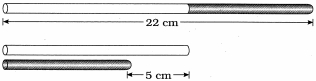
The diagram given below shows two sticks $-$ one $BLACK$ and the other $WHITE$. Based on the measurements shown,what is the length of the white stick? (in $cm$)
A
$17$
B
$5$
C
$8.5$
D
$13.5$
Solution
(D) Let the length of the white stick be $W$ and the length of the black stick be $B$.
From the first part of the diagram,the total length of the combined sticks is $22 \ cm$,so $W + B = 22$.
From the second part of the diagram,the white stick is longer than the black stick by $5 \ cm$,so $W - B = 5$.
Adding the two equations: $(W + B) + (W - B) = 22 + 5$,which gives $2W = 27$.
Therefore,$W = 27 / 2 = 13.5 \ cm$.
The length of the white stick is $13.5 \ cm$.
From the first part of the diagram,the total length of the combined sticks is $22 \ cm$,so $W + B = 22$.
From the second part of the diagram,the white stick is longer than the black stick by $5 \ cm$,so $W - B = 5$.
Adding the two equations: $(W + B) + (W - B) = 22 + 5$,which gives $2W = 27$.
Therefore,$W = 27 / 2 = 13.5 \ cm$.
The length of the white stick is $13.5 \ cm$.
0 likes
View Solution354
MediumMCQ
Which of the following groups truly matches the data of Part $I$ with the data of Part $II$?
| Part $I$ | Part $II$ |
| $1.$ The solution of $2x - y = 4$ and $3x - 2y = 5$ | $a.$ $x = 3, y = 2$ |
| $2.$ The solution of $5x - y = 14$ and $4x - 3y = 9$ | $b.$ $x = 3, y = 1$ |
| $3.$ The solution of $4x - 3y = 5$ and $3x - y = 5$ | $c.$ $x = 2, y = 1$ |
| $4.$ The solution of $3x - 2y = -1$ and $2x - 5y = -8$ | $d.$ $x = 1, y = 2$ |
A
$(1-a), (2-b), (3-c), (4-d)$
B
$(1-b), (2-c), (3-d), (4-a)$
C
$(1-d), (2-a), (3-b), (4-c)$
D
$(1-c), (2-d), (3-a), (4-b)$
Solution
(B) To find the correct matches,we solve each system of linear equations:
$1.$ $2x - y = 4$ and $3x - 2y = 5$. From the first,$y = 2x - 4$. Substituting into the second: $3x - 2(2x - 4) = 5 \implies 3x - 4x + 8 = 5 \implies -x = -3 \implies x = 3$. Then $y = 2(3) - 4 = 2$. So,$(1-b)$.
$2.$ $5x - y = 14$ and $4x - 3y = 9$. From the first,$y = 5x - 14$. Substituting into the second: $4x - 3(5x - 14) = 9 \implies 4x - 15x + 42 = 9 \implies -11x = -33 \implies x = 3$. Then $y = 5(3) - 14 = 1$. So,$(2-c)$.
$3.$ $4x - 3y = 5$ and $3x - y = 5$. From the second,$y = 3x - 5$. Substituting into the first: $4x - 3(3x - 5) = 5 \implies 4x - 9x + 15 = 5 \implies -5x = -10 \implies x = 2$. Then $y = 3(2) - 5 = 1$. So,$(3-d)$.
$4.$ $3x - 2y = -1$ and $2x - 5y = -8$. Multiplying the first by $5$ and the second by $2$: $15x - 10y = -5$ and $4x - 10y = -16$. Subtracting: $11x = 11 \implies x = 1$. Then $3(1) - 2y = -1 \implies -2y = -4 \implies y = 2$. So,$(4-a)$.
The correct matching is $(1-b), (2-c), (3-d), (4-a)$.
$1.$ $2x - y = 4$ and $3x - 2y = 5$. From the first,$y = 2x - 4$. Substituting into the second: $3x - 2(2x - 4) = 5 \implies 3x - 4x + 8 = 5 \implies -x = -3 \implies x = 3$. Then $y = 2(3) - 4 = 2$. So,$(1-b)$.
$2.$ $5x - y = 14$ and $4x - 3y = 9$. From the first,$y = 5x - 14$. Substituting into the second: $4x - 3(5x - 14) = 9 \implies 4x - 15x + 42 = 9 \implies -11x = -33 \implies x = 3$. Then $y = 5(3) - 14 = 1$. So,$(2-c)$.
$3.$ $4x - 3y = 5$ and $3x - y = 5$. From the second,$y = 3x - 5$. Substituting into the first: $4x - 3(3x - 5) = 5 \implies 4x - 9x + 15 = 5 \implies -5x = -10 \implies x = 2$. Then $y = 3(2) - 5 = 1$. So,$(3-d)$.
$4.$ $3x - 2y = -1$ and $2x - 5y = -8$. Multiplying the first by $5$ and the second by $2$: $15x - 10y = -5$ and $4x - 10y = -16$. Subtracting: $11x = 11 \implies x = 1$. Then $3(1) - 2y = -1 \implies -2y = -4 \implies y = 2$. So,$(4-a)$.
The correct matching is $(1-b), (2-c), (3-d), (4-a)$.
0 likes
View Solution355
MediumMCQ
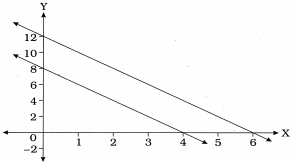
Given below is a graph showing two lines. Which of the following statements is true about the solution$(s)$ of the pair of equations represented by these lines?
A
We cannot predict the number of solutions without knowing the algebraic form of these equations.
B
They have a unique solution.
C
They do not have any solution.
D
They have infinite solutions.
Solution
(C) From the given graph,it is observed that the two lines are parallel to each other.
Parallel lines never intersect each other at any point.
Since the solution of a pair of linear equations is the point of intersection of the lines,and these lines do not intersect,there is no common point between them.
Therefore,the pair of equations represented by these lines has no solution.
Parallel lines never intersect each other at any point.
Since the solution of a pair of linear equations is the point of intersection of the lines,and these lines do not intersect,there is no common point between them.
Therefore,the pair of equations represented by these lines has no solution.
0 likes
View Solution356
DifficultMCQ
The pair of equations represented by the above figures is:

A
$3x = 4y, x + 2y = 10$
B
$x = y, 2x + y = 10$
C
$2x = y, 2x + y = 10$
D
$x = 2y, x + 2y = 10$
Solution
(A) Let the weight of one circle be $x$ and the weight of one square be $y$.
From the first balance,we have $3$ circles on the left and $4$ squares on the right,which are in equilibrium. Therefore,$3x = 4y$.
From the second balance,we have $1$ circle and $2$ squares on the left,and a weight of $10$ units on the right. Therefore,$x + 2y = 10$.
Thus,the pair of equations is $3x = 4y$ and $x + 2y = 10$.
From the first balance,we have $3$ circles on the left and $4$ squares on the right,which are in equilibrium. Therefore,$3x = 4y$.
From the second balance,we have $1$ circle and $2$ squares on the left,and a weight of $10$ units on the right. Therefore,$x + 2y = 10$.
Thus,the pair of equations is $3x = 4y$ and $x + 2y = 10$.
0 likes
View Solution357
MediumMCQ
Naresh has double the money that Yogesh has. If Naresh gives Yogesh ₹ $20$,then both have equal money. The pair of equations obtained from this data is $\ldots \ldots \ldots \ldots .$
A
$x = 2y, x - 20 = y + 20$
B
$x = 2y, y - 20 = x - 20$
C
$x = 2y, x - 20 = y$
D
$x = 2y, x - 20 = y - 20$
Solution
(A) Let the amount of money Naresh has be $x$ and the amount of money Yogesh has be $y$.
According to the first condition,Naresh has double the money of Yogesh,so $x = 2y$.
According to the second condition,if Naresh gives ₹ $20$ to Yogesh,Naresh's money becomes $(x - 20)$ and Yogesh's money becomes $(y + 20)$.
Since they now have equal amounts,we have the equation $x - 20 = y + 20$.
Thus,the pair of equations is $x = 2y$ and $x - 20 = y + 20$.
According to the first condition,Naresh has double the money of Yogesh,so $x = 2y$.
According to the second condition,if Naresh gives ₹ $20$ to Yogesh,Naresh's money becomes $(x - 20)$ and Yogesh's money becomes $(y + 20)$.
Since they now have equal amounts,we have the equation $x - 20 = y + 20$.
Thus,the pair of equations is $x = 2y$ and $x - 20 = y + 20$.
0 likes
View Solution358
MediumMCQ
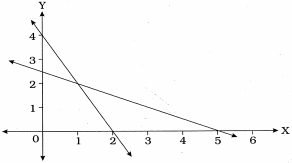
Two lines are shown in the following figure.
Which option from the following options is true for the solution of the pair of linear equations in two variables?
Which option from the following options is true for the solution of the pair of linear equations in two variables?
A
The solution of them is unique.
B
They do not have any solution.
C
The solution set of them is infinite.
D
They have two solutions.
Solution
(A) In the given figure,the two lines intersect each other at a single point.
According to the geometric interpretation of linear equations in two variables,if two lines intersect at a single point,the pair of linear equations has a unique solution (exactly one solution).
Therefore,the correct option is $A$.
According to the geometric interpretation of linear equations in two variables,if two lines intersect at a single point,the pair of linear equations has a unique solution (exactly one solution).
Therefore,the correct option is $A$.
0 likes
View Solution359
MediumMCQ
Two lines (coincident) are shown in the following graph. Which option from the following is true for the solution of the pair of linear equations in two variables?
A
The solution of them is unique.
B
Their solution set is an infinite set.
C
They do not have any solution set.
D
They have two solutions.
Solution
(B) When two lines are coincident,every point on the line is a common solution to both equations.
Since a line consists of an infinite number of points,the pair of linear equations has infinitely many solutions.
Therefore,the correct option is $B$.
Since a line consists of an infinite number of points,the pair of linear equations has infinitely many solutions.
Therefore,the correct option is $B$.
0 likes
View Solution360
DifficultMCQ
Which of the following groups matches the data of Part $I$ with the data of Part $II$?
| Part $I$ | Part $II$ |
| $1. x+2y=3, 2x+4y=5$ | $a. \text{Solution set is a singleton set.}$ |
| $2. 2x+3y=6, x+\frac{3}{2}y=3$ | $b. \text{Solution set is an empty set.}$ |
| $3. 3x-y=0, x-y+6=0$ | $c. \text{Solution set is an infinite set.}$ |
| $d. \text{Solution set contains two members.}$ |
A
$(1-c), (2-d), (3-a)$
B
$(1-b), (2-c), (3-a)$
C
$(1-a), (2-b), (3-d)$
D
$(1-d), (2-a), (3-c)$
Solution
(B) For a system of linear equations $a_1x + b_1y = c_1$ and $a_2x + b_2y = c_2$:
$1$. If $\frac{a_1}{a_2} = \frac{b_1}{b_2} \neq \frac{c_1}{c_2}$,the system has no solution (empty set).
$2$. If $\frac{a_1}{a_2} = \frac{b_1}{b_2} = \frac{c_1}{c_2}$,the system has infinitely many solutions (infinite set).
$3$. If $\frac{a_1}{a_2} \neq \frac{b_1}{b_2}$,the system has a unique solution (singleton set).
Analysis:
$1. x+2y=3, 2x+4y=5$: Here $\frac{1}{2} = \frac{2}{4} \neq \frac{3}{5}$. This corresponds to $b$ (empty set).
$2. 2x+3y=6, x+\frac{3}{2}y=3$: Here $\frac{2}{1} = \frac{3}{1.5} = \frac{6}{3} = 2$. This corresponds to $c$ (infinite set).
$3. 3x-y=0, x-y+6=0$: Here $\frac{3}{1} \neq \frac{-1}{-1}$. This corresponds to $a$ (singleton set).
Thus,the correct match is $(1-b), (2-c), (3-a)$.
$1$. If $\frac{a_1}{a_2} = \frac{b_1}{b_2} \neq \frac{c_1}{c_2}$,the system has no solution (empty set).
$2$. If $\frac{a_1}{a_2} = \frac{b_1}{b_2} = \frac{c_1}{c_2}$,the system has infinitely many solutions (infinite set).
$3$. If $\frac{a_1}{a_2} \neq \frac{b_1}{b_2}$,the system has a unique solution (singleton set).
Analysis:
$1. x+2y=3, 2x+4y=5$: Here $\frac{1}{2} = \frac{2}{4} \neq \frac{3}{5}$. This corresponds to $b$ (empty set).
$2. 2x+3y=6, x+\frac{3}{2}y=3$: Here $\frac{2}{1} = \frac{3}{1.5} = \frac{6}{3} = 2$. This corresponds to $c$ (infinite set).
$3. 3x-y=0, x-y+6=0$: Here $\frac{3}{1} \neq \frac{-1}{-1}$. This corresponds to $a$ (singleton set).
Thus,the correct match is $(1-b), (2-c), (3-a)$.
0 likes
View SolutionPair of Linear Equations in Two Variables — Mix Examples - Pair of Linear Equations in Two Variables · Frequently Asked Questions
1Are these Pair of Linear Equations in Two Variables questions useful for JEE and NEET?
Yes. All questions in this section are mapped to JEE Main and NEET exam patterns. Previous year questions from JEE Main, NEET, GUJCET and state-level exams are included with full solutions.
2Can I switch to Hindi or Gujarati for these questions?
Yes. Use the language tabs in the hero section or the sidebar to view the same questions and solutions in English, Hindi or Gujarati.
3How do I generate a question paper from this subtopic?
Use the Vedclass Exam Paper Generator — select the chapter and subtopic, set difficulty, and generate Sets A, B, C, D automatically. First 3 chapters of every subject are free.
Vedclass Products
For Students
Vedclass Test Series
Mock tests in real JEE/NEET style with performance analysis. 5-day free trial.
Start Free TrialFor Teachers
Exam Paper Generator
Generate Set A/B/C/D papers from this chapter in 2 minutes. 3 chapters free.
Try FreeFor Institutes
Online Exam Module
Live online exams with unlimited students, 360° analytics & white-label branding.
See DemoFor Teachers & Institutes
Generate a Pair of Linear Equations in Two Variables Exam Paper in 2 Minutes
Select subtopic & difficulty — Sets A, B, C, D auto-generated with No Repeat logic.
First 3 chapters of every subject are free — no payment required.