
Class 12PhysicsElectric Potential and CapacitanceEquivalent Capacitance of Capacitor connected in Series and Parallel
DifficultSeven capacitors,each of capacitance $2\,\mu F$,are to be connected in a configuration to obtain an effective capacitance of $\left( \frac{6}{13} \right)\,\mu F$. Which of the combinations,shown in figures below,will achieve the desired value?
- A
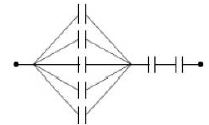
- B
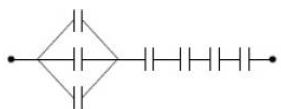
- C
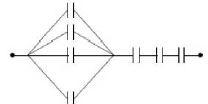
- D
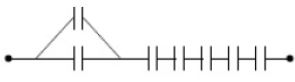
Explore More
Similar Questions
Three capacitors $3 \mu F$,$6 \mu F$,and $6 \mu F$ are connected in series to a source of $120 V$. The potential difference,in volts,across the $3 \mu F$ capacitor will be:
The network of four capacitors is connected to a battery as shown in the figure. The ratio of charges on capacitors $C_2$ and $C_4$ is
DifficultMHT CET 2022
View SolutionFour plates of equal area $A$ are separated by equal distances $d$ and are arranged as shown in the figure. The equivalent capacity is
Medium
View Solution$A$ capacitor of capacitance $1 \mu F$ withstands a maximum voltage of $6 kV$,while a capacitor of capacitance $2.0 \mu F$ withstands a maximum voltage of $4 kV$. If the two capacitors are connected in series,then the two capacitors combined can take up a maximum voltage of ... $kV$.
Difficult
View SolutionThe diagram shows three capacitors with their capacitances and their respective breakdown voltages. What should be the maximum value of the external $emf$ $(E)$ of the source such that no capacitor breaks down?
Medium
View SolutionVedclass Products
For Students
Vedclass Test Series
Mock tests in real JEE/NEET style with performance analysis. 5-day free trial.
Start Free TrialFor Teachers
Exam Paper Generator
Generate Set A/B/C/D exam papers from 7.5L+ questions in 2 minutes. 3 chapters free.
Try FreeFor Institutes
Online Exam Module
Live online exams with unlimited students, 360° analytics & white-label branding.
See Demo