
$A$ charge $Q$ is uniformly distributed over the surface of a nonconducting disc of radius $R$. The disc rotates about an axis perpendicular to its plane and passing through its centre with an angular velocity $\omega$. As a result of this rotation,a magnetic field of induction $B$ is obtained at the centre of the disc. If we keep both the amount of charge placed on the disc and its angular velocity constant and vary the radius of the disc,then the variation of the magnetic induction at the centre of the disc will be represented by which of the following figures?
- A
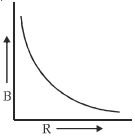
- B
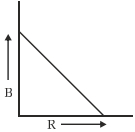
- C
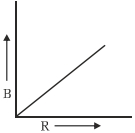
- D
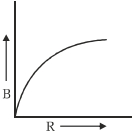
Explore More
Similar Questions
$A$ uniform beam of positively charged particles is moving with a constant velocity parallel to another beam of negatively charged particles moving with the same velocity in the opposite direction,separated by a distance $d$. The variation of the magnetic field $B$ along a perpendicular line drawn between the two beams is best represented by:
The electric charge in uniform motion produces
Easy
View SolutionTwo straight long conductors $AOB$ and $COD$ are perpendicular to each other and carry currents $i_1$ and $i_2$. The magnitude of the magnetic induction at a point $P$ at a distance $a$ from the point $O$ in a direction perpendicular to the plane $ACBD$ is
Medium
View SolutionTwo protons move parallel to each other,keeping a distance $r$ between them,both moving with the same velocity $\vec{v}$. Then the ratio of the electric force to the magnetic force of interaction between them is:
Which of the following is not a unit of magnetic induction?
Vedclass Products
For Students
Vedclass Test Series
Mock tests in real JEE/NEET style with performance analysis. 5-day free trial.
Start Free TrialFor Teachers
Exam Paper Generator
Generate Set A/B/C/D exam papers from 7.5L+ questions in 2 minutes. 3 chapters free.
Try FreeFor Institutes
Online Exam Module
Live online exams with unlimited students, 360° analytics & white-label branding.
See Demo