
A English
Number Series Questions in English
Competitive Exam Quantitative Aptitude · Number Series · Number Series
473+
Questions
English
Language
100%
With Solutions
Showing 50 of 473 questions in English
51
EasyMCQ
Find the next number in the series: $1, 4, 10, 22, 46, ?$
A
$64$
B
$86$
C
$94$
D
$122$
Solution
(C) The pattern in the series is as follows:
$1 + 3 = 4$
$4 + 6 = 10$
$10 + 12 = 22$
$22 + 24 = 46$
In this series,the difference between consecutive terms doubles each time $(3, 6, 12, 24, ...)$.
Therefore,the next difference should be $24 \times 2 = 48$.
Adding this to the last term: $46 + 48 = 94$.
$1 + 3 = 4$
$4 + 6 = 10$
$10 + 12 = 22$
$22 + 24 = 46$
In this series,the difference between consecutive terms doubles each time $(3, 6, 12, 24, ...)$.
Therefore,the next difference should be $24 \times 2 = 48$.
Adding this to the last term: $46 + 48 = 94$.
0 likes
View Solution52
EasyMCQ
Find the next term in the series: $0.5, 0.55, 0.65, 0.8, ?$
A
$0.9$
B
$0.82$
C
$1$
D
$0.95$
Solution
(C) Analyze the difference between consecutive terms:
$0.55 - 0.5 = 0.05$
$0.65 - 0.55 = 0.10$
$0.8 - 0.65 = 0.15$
The differences are increasing by $0.05$ each time $(0.05, 0.10, 0.15, ...)$.
Therefore,the next difference should be $0.15 + 0.05 = 0.20$.
Adding this to the last term: $0.8 + 0.20 = 1.0$.
$0.55 - 0.5 = 0.05$
$0.65 - 0.55 = 0.10$
$0.8 - 0.65 = 0.15$
The differences are increasing by $0.05$ each time $(0.05, 0.10, 0.15, ...)$.
Therefore,the next difference should be $0.15 + 0.05 = 0.20$.
Adding this to the last term: $0.8 + 0.20 = 1.0$.
0 likes
View Solution53
EasyMCQ
Find the missing number in the series: $5, 6, 9, 15, ?, 40$.
A
$21$
B
$25$
C
$27$
D
$33$
Solution
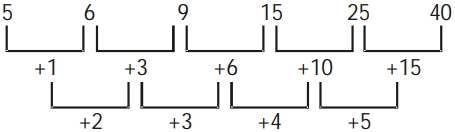
(B) The given series is $5, 6, 9, 15, ?, 40$.
Let's analyze the differences between consecutive terms:
$6 - 5 = 1$
$9 - 6 = 3$
$15 - 9 = 6$
The differences are $1, 3, 6, ...$
Now,let's look at the differences of these differences:
$3 - 1 = 2$
$6 - 3 = 3$
This shows that the second-level differences are increasing by $1$ $(2, 3, 4, 5, ...)$.
Following this pattern,the next difference in the first level should be $6 + 4 = 10$.
Therefore,the missing number is $15 + 10 = 25$.
To verify,the next difference should be $10 + 5 = 15$,and $25 + 15 = 40$,which matches the last term in the series.
Thus,the missing number is $25$.
Let's analyze the differences between consecutive terms:
$6 - 5 = 1$
$9 - 6 = 3$
$15 - 9 = 6$
The differences are $1, 3, 6, ...$
Now,let's look at the differences of these differences:
$3 - 1 = 2$
$6 - 3 = 3$
This shows that the second-level differences are increasing by $1$ $(2, 3, 4, 5, ...)$.
Following this pattern,the next difference in the first level should be $6 + 4 = 10$.
Therefore,the missing number is $15 + 10 = 25$.
To verify,the next difference should be $10 + 5 = 15$,and $25 + 15 = 40$,which matches the last term in the series.
Thus,the missing number is $25$.
0 likes
View Solution54
EasyMCQ
$1, 9, 25, 49, 81, ?$
A
$100$
B
$112$
C
$121$
D
$144$
Solution
(C) The given series is a sequence of squares of consecutive odd numbers:
$1^{2} = 1$
$3^{2} = 9$
$5^{2} = 25$
$7^{2} = 49$
$9^{2} = 81$
Following this pattern,the next odd number is $11$,and its square is $11^{2} = 121$.
$1^{2} = 1$
$3^{2} = 9$
$5^{2} = 25$
$7^{2} = 49$
$9^{2} = 81$
Following this pattern,the next odd number is $11$,and its square is $11^{2} = 121$.
0 likes
View Solution55
EasyMCQ
$1, 1, 4, 8, 9, 27, 16, ?$
A
$32$
B
$64$
C
$81$
D
$256$
Solution
(B) The given sequence is a combination of two alternating series.
The first series consists of the squares of natural numbers: $1^2, 2^2, 3^2, 4^2, \dots$ which are $1, 4, 9, 16$.
The second series consists of the cubes of natural numbers: $1^3, 2^3, 3^3, ?^3$ which are $1, 8, 27, ?$.
The next term in the sequence corresponds to the fourth term of the second series,which is $4^3 = 64$.
The first series consists of the squares of natural numbers: $1^2, 2^2, 3^2, 4^2, \dots$ which are $1, 4, 9, 16$.
The second series consists of the cubes of natural numbers: $1^3, 2^3, 3^3, ?^3$ which are $1, 8, 27, ?$.
The next term in the sequence corresponds to the fourth term of the second series,which is $4^3 = 64$.
0 likes
View Solution56
EasyMCQ
$4, 12, 36, 108, ?$
A
$144$
B
$216$
C
$304$
D
$324$
Solution
(D) The given series is a geometric progression where each term is obtained by multiplying the previous term by $3$.
$4 \times 3 = 12$
$12 \times 3 = 36$
$36 \times 3 = 108$
$108 \times 3 = 324$
Therefore,the next term in the series is $324$.
$4 \times 3 = 12$
$12 \times 3 = 36$
$36 \times 3 = 108$
$108 \times 3 = 324$
Therefore,the next term in the series is $324$.
0 likes
View Solution57
EasyMCQ
$1, 1, 2, 6, 24, ?, 720$
A
$100$
B
$104$
C
$108$
D
$120$
Solution
(D) The given series follows the pattern of multiplying the previous term by consecutive integers starting from $1$.
$1 \times 1 = 1$
$1 \times 2 = 2$
$2 \times 3 = 6$
$6 \times 4 = 24$
$24 \times 5 = 120$
$120 \times 6 = 720$
Therefore,the missing number is $120$.
$1 \times 1 = 1$
$1 \times 2 = 2$
$2 \times 3 = 6$
$6 \times 4 = 24$
$24 \times 5 = 120$
$120 \times 6 = 720$
Therefore,the missing number is $120$.
0 likes
View Solution58
EasyMCQ
Find the missing number in the series: $120, ?, 60, 20, 5, 1$.
A
$60$
B
$120$
C
$240$
D
$180$
Solution
(B) Observe the pattern of division in the series:
$120 \div 1 = 120$
$120 \div 2 = 60$
$60 \div 3 = 20$
$20 \div 4 = 5$
$5 \div 5 = 1$
Following this pattern,the missing number is $120 \div 1 = 120$.
$120 \div 1 = 120$
$120 \div 2 = 60$
$60 \div 3 = 20$
$20 \div 4 = 5$
$5 \div 5 = 1$
Following this pattern,the missing number is $120 \div 1 = 120$.
0 likes
View Solution59
EasyMCQ
$4, 6, 9, ?$
A
$13$
B
$19$
C
$11$
D
$12$
Solution
(A) The given series is $4, 6, 9, ?$.
Observe the pattern of differences between consecutive terms:
$6 - 4 = 2$
$9 - 6 = 3$
The differences are increasing by $1$ $(2, 3, 4, ...)$.
Following this pattern,the next difference should be $4$.
Therefore,the next term is $9 + 4 = 13$.
Observe the pattern of differences between consecutive terms:
$6 - 4 = 2$
$9 - 6 = 3$
The differences are increasing by $1$ $(2, 3, 4, ...)$.
Following this pattern,the next difference should be $4$.
Therefore,the next term is $9 + 4 = 13$.
0 likes
View Solution60
EasyMCQ
$5760, 960, ?, 48, 16, 8$
A
$120$
B
$160$
C
$192$
D
$240$
Solution
(C) The pattern of the series is based on division by decreasing integers starting from $6$.
$5760 \div 6 = 960$
$960 \div 5 = 192$
$192 \div 4 = 48$
$48 \div 3 = 16$
$16 \div 2 = 8$
Therefore,the missing number is $192$.
$5760 \div 6 = 960$
$960 \div 5 = 192$
$192 \div 4 = 48$
$48 \div 3 = 16$
$16 \div 2 = 8$
Therefore,the missing number is $192$.
0 likes
View Solution61
EasyMCQ
$1, 2, 6, 7, 21, 22, 66, 67, ?$
A
$70$
B
$134$
C
$201$
D
$301$
Solution
(C) The pattern in the series is as follows:
$1 + 1 = 2$
$2 \times 3 = 6$
$6 + 1 = 7$
$7 \times 3 = 21$
$21 + 1 = 22$
$22 \times 3 = 66$
$66 + 1 = 67$
Following this alternating pattern of adding $1$ and multiplying by $3$,the next step is to multiply by $3$:
$67 \times 3 = 201$
Therefore,the missing number is $201$.
$1 + 1 = 2$
$2 \times 3 = 6$
$6 + 1 = 7$
$7 \times 3 = 21$
$21 + 1 = 22$
$22 \times 3 = 66$
$66 + 1 = 67$
Following this alternating pattern of adding $1$ and multiplying by $3$,the next step is to multiply by $3$:
$67 \times 3 = 201$
Therefore,the missing number is $201$.
0 likes
View Solution62
MediumMCQ
$48, 24, 96, 48, 192, ?$
A
$76$
B
$90$
C
$96$
D
$192$
Solution
(C) The given series follows a repeating pattern of operations: $\div 2$ and $\times 4$.
$48 \div 2 = 24$
$24 \times 4 = 96$
$96 \div 2 = 48$
$48 \times 4 = 192$
Following this pattern,the next step is $192 \div 2 = 96$.
$48 \div 2 = 24$
$24 \times 4 = 96$
$96 \div 2 = 48$
$48 \times 4 = 192$
Following this pattern,the next step is $192 \div 2 = 96$.
0 likes
View Solution63
EasyMCQ
$1, 2, 3, 6, 9, 18, ?, 54$
A
$18$
B
$27$
C
$36$
D
$81$
Solution
(B) The given sequence is a combination of two alternating series.
First series (odd positions): $1, 3, 9, ?$
In this series,each term is multiplied by $3$ to get the next term ($1 \times 3 = 3$,$3 \times 3 = 9$,$9 \times 3 = 27$).
Second series (even positions): $2, 6, 18, 54$
In this series,each term is also multiplied by $3$ ($2 \times 3 = 6$,$6 \times 3 = 18$,$18 \times 3 = 54$).
Therefore,the missing term is $9 \times 3 = 27$.
First series (odd positions): $1, 3, 9, ?$
In this series,each term is multiplied by $3$ to get the next term ($1 \times 3 = 3$,$3 \times 3 = 9$,$9 \times 3 = 27$).
Second series (even positions): $2, 6, 18, 54$
In this series,each term is also multiplied by $3$ ($2 \times 3 = 6$,$6 \times 3 = 18$,$18 \times 3 = 54$).
Therefore,the missing term is $9 \times 3 = 27$.
0 likes
View Solution64
MediumMCQ
$165, 195, 255, 285, 345, ?$
A
$375$
B
$390$
C
$420$
D
$435$
Solution
(A) The pattern in the given series is an alternating addition of $30$ and $60$.
$165 + 30 = 195$
$195 + 60 = 255$
$255 + 30 = 285$
$285 + 60 = 345$
Following this pattern,the next step is to add $30$ to the last term:
$345 + 30 = 375$
Therefore,the missing number is $375$.
$165 + 30 = 195$
$195 + 60 = 255$
$255 + 30 = 285$
$285 + 60 = 345$
Following this pattern,the next step is to add $30$ to the last term:
$345 + 30 = 375$
Therefore,the missing number is $375$.
0 likes
View Solution65
EasyMCQ
$9, 27, 31, 155, 161, 1127, ?$
A
$316$
B
$1135$
C
$1288$
D
$2254$
Solution
(B) Observe the pattern in the given series:
$9 \times 3 = 27$
$27 + 4 = 31$
$31 \times 5 = 155$
$155 + 6 = 161$
$161 \times 7 = 1127$
Following the alternating pattern of multiplication and addition with increasing integers $(3, 4, 5, 6, 7, 8)$,the next step is to add $8$ to the last number:
$1127 + 8 = 1135$
$9 \times 3 = 27$
$27 + 4 = 31$
$31 \times 5 = 155$
$155 + 6 = 161$
$161 \times 7 = 1127$
Following the alternating pattern of multiplication and addition with increasing integers $(3, 4, 5, 6, 7, 8)$,the next step is to add $8$ to the last number:
$1127 + 8 = 1135$
0 likes
View Solution66
EasyMCQ
$2, 3, 3, 5, 10, 13, ?, 43, 172, 177$
A
$23$
B
$38$
C
$39$
D
$40$
Solution
(C) The pattern in the series is as follows:
$2 + 1 = 3$
$3 \times 1 = 3$
$3 + 2 = 5$
$5 \times 2 = 10$
$10 + 3 = 13$
$13 \times 3 = 39$
$39 + 4 = 43$
$43 \times 4 = 172$
$172 + 5 = 177$
Thus,the missing number is $39$.
$2 + 1 = 3$
$3 \times 1 = 3$
$3 + 2 = 5$
$5 \times 2 = 10$
$10 + 3 = 13$
$13 \times 3 = 39$
$39 + 4 = 43$
$43 \times 4 = 172$
$172 + 5 = 177$
Thus,the missing number is $39$.
0 likes
View Solution67
EasyMCQ
$3, 15, ?, 63, 99, 143$
A
$27$
B
$35$
C
$45$
D
$56$
Solution
(B) The given series follows the pattern of $(n^{2} - 1)$ for even numbers starting from $n = 2$.
$2^{2} - 1 = 4 - 1 = 3$
$4^{2} - 1 = 16 - 1 = 15$
$6^{2} - 1 = 36 - 1 = 35$
$8^{2} - 1 = 64 - 1 = 63$
$10^{2} - 1 = 100 - 1 = 99$
$12^{2} - 1 = 144 - 1 = 143$
Therefore,the missing term is $6^{2} - 1 = 35$.
$2^{2} - 1 = 4 - 1 = 3$
$4^{2} - 1 = 16 - 1 = 15$
$6^{2} - 1 = 36 - 1 = 35$
$8^{2} - 1 = 64 - 1 = 63$
$10^{2} - 1 = 100 - 1 = 99$
$12^{2} - 1 = 144 - 1 = 143$
Therefore,the missing term is $6^{2} - 1 = 35$.
0 likes
View Solution68
EasyMCQ
$7, 26, 63, 124, 215, 342, ?$
A
$391$
B
$421$
C
$481$
D
$511$
Solution
(D) The given series follows the pattern of $(n^{3} - 1)$ for $n = 2, 3, 4, 5, 6, 7, ...$
$2^{3} - 1 = 8 - 1 = 7$
$3^{3} - 1 = 27 - 1 = 26$
$4^{3} - 1 = 64 - 1 = 63$
$5^{3} - 1 = 125 - 1 = 124$
$6^{3} - 1 = 216 - 1 = 215$
$7^{3} - 1 = 343 - 1 = 342$
Following this pattern,the next term is $8^{3} - 1 = 512 - 1 = 511$.
$2^{3} - 1 = 8 - 1 = 7$
$3^{3} - 1 = 27 - 1 = 26$
$4^{3} - 1 = 64 - 1 = 63$
$5^{3} - 1 = 125 - 1 = 124$
$6^{3} - 1 = 216 - 1 = 215$
$7^{3} - 1 = 343 - 1 = 342$
Following this pattern,the next term is $8^{3} - 1 = 512 - 1 = 511$.
0 likes
View Solution69
EasyMCQ
$3, 7, 15, ?, 63, 127$
A
$30$
B
$31$
C
$47$
D
$52$
Solution
(B) The given series is $3, 7, 15, ?, 63, 127$.
Observe the pattern between consecutive terms:
$3 \times 2 + 1 = 7$
$7 \times 2 + 1 = 15$
Following this pattern,the next term is $15 \times 2 + 1 = 31$.
To verify,check the subsequent terms:
$31 \times 2 + 1 = 63$
$63 \times 2 + 1 = 127$
The pattern holds true.
Therefore,the missing term is $31$.
Observe the pattern between consecutive terms:
$3 \times 2 + 1 = 7$
$7 \times 2 + 1 = 15$
Following this pattern,the next term is $15 \times 2 + 1 = 31$.
To verify,check the subsequent terms:
$31 \times 2 + 1 = 63$
$63 \times 2 + 1 = 127$
The pattern holds true.
Therefore,the missing term is $31$.
0 likes
View Solution70
MediumMCQ
$4, 10, ?, 82, 244, 730$
A
$24$
B
$28$
C
$77$
D
$218$
Solution
(B) The given series follows the pattern: $x_{n+1} = x_n \times 3 - 2$.
Step $1$: $4 \times 3 - 2 = 12 - 2 = 10$
Step $2$: $10 \times 3 - 2 = 30 - 2 = 28$
Step $3$: $28 \times 3 - 2 = 84 - 2 = 82$
Step $4$: $82 \times 3 - 2 = 246 - 2 = 244$
Step $5$: $244 \times 3 - 2 = 732 - 2 = 730$
Thus,the missing term is $28$.
Step $1$: $4 \times 3 - 2 = 12 - 2 = 10$
Step $2$: $10 \times 3 - 2 = 30 - 2 = 28$
Step $3$: $28 \times 3 - 2 = 84 - 2 = 82$
Step $4$: $82 \times 3 - 2 = 246 - 2 = 244$
Step $5$: $244 \times 3 - 2 = 732 - 2 = 730$
Thus,the missing term is $28$.
0 likes
View Solution71
MediumMCQ
$3, 12, 27, 48, 75, 108, ?$
A
$147$
B
$162$
C
$183$
D
$192$
Solution
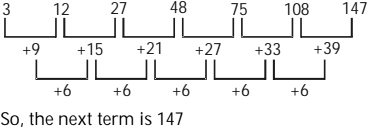
(A) The given series is $3, 12, 27, 48, 75, 108, ?$.
Let's find the difference between consecutive terms:
$12 - 3 = 9$
$27 - 12 = 15$
$48 - 27 = 21$
$75 - 48 = 27$
$108 - 75 = 33$
The differences are $9, 15, 21, 27, 33$.
Now,find the difference between these differences:
$15 - 9 = 6$
$21 - 15 = 6$
$27 - 21 = 6$
$33 - 27 = 6$
Since the second difference is constant $(6)$,the next difference in the first series will be $33 + 6 = 39$.
Therefore,the next term in the series is $108 + 39 = 147$.
Let's find the difference between consecutive terms:
$12 - 3 = 9$
$27 - 12 = 15$
$48 - 27 = 21$
$75 - 48 = 27$
$108 - 75 = 33$
The differences are $9, 15, 21, 27, 33$.
Now,find the difference between these differences:
$15 - 9 = 6$
$21 - 15 = 6$
$27 - 21 = 6$
$33 - 27 = 6$
Since the second difference is constant $(6)$,the next difference in the first series will be $33 + 6 = 39$.
Therefore,the next term in the series is $108 + 39 = 147$.
0 likes
View Solution72
MediumMCQ
$563, 647, 479, 815, ?$
A
$672$
B
$386$
C
$279$
D
$143$
Solution
(D) The pattern follows an alternating addition and subtraction of multiples of $84$ by powers of $2$.
$563 + 84 \times 2^0 = 563 + 84 = 647$
$647 - 84 \times 2^1 = 647 - 168 = 479$
$479 + 84 \times 2^2 = 479 + 336 = 815$
$815 - 84 \times 2^3 = 815 - 672 = 143$
Therefore,the next term in the series is $143$.
$563 + 84 \times 2^0 = 563 + 84 = 647$
$647 - 84 \times 2^1 = 647 - 168 = 479$
$479 + 84 \times 2^2 = 479 + 336 = 815$
$815 - 84 \times 2^3 = 815 - 672 = 143$
Therefore,the next term in the series is $143$.
0 likes
View Solution73
MediumMCQ
Find the next term in the series: $5, 2, 7, 9, 16, 25, ?$
A
$41$
B
$45$
C
$48$
D
$52$
Solution
(A) The given series is $5, 2, 7, 9, 16, 25, ?$.
Observe the pattern:
$5 + 2 = 7$
$2 + 7 = 9$
$7 + 9 = 16$
$9 + 16 = 25$
This is a Fibonacci-like series where each term is the sum of the two preceding terms.
Therefore,the next term is $16 + 25 = 41$.
Observe the pattern:
$5 + 2 = 7$
$2 + 7 = 9$
$7 + 9 = 16$
$9 + 16 = 25$
This is a Fibonacci-like series where each term is the sum of the two preceding terms.
Therefore,the next term is $16 + 25 = 41$.
0 likes
View Solution74
EasyMCQ
$10, 14, 26, 42, 70, ?$
A
$100$
B
$102$
C
$106$
D
$114$
Solution
(D) The pattern follows the rule: the next term is the sum of the previous two terms plus $2$.
$10 + 14 + 2 = 26$
$14 + 26 + 2 = 42$
$26 + 42 + 2 = 70$
$42 + 70 + 2 = 114$
Therefore,the missing number is $114$.
$10 + 14 + 2 = 26$
$14 + 26 + 2 = 42$
$26 + 42 + 2 = 70$
$42 + 70 + 2 = 114$
Therefore,the missing number is $114$.
0 likes
View Solution75
EasyMCQ
$2, 8, 16, 128, ?$
A
$2042$
B
$2046$
C
$2048$
D
$2056$
Solution
(C) The pattern in the series is that each term is the product of the two preceding terms.
$2 \times 8 = 16$
$8 \times 16 = 128$
$16 \times 128 = 2048$
Therefore,the next term in the series is $2048$.
$2 \times 8 = 16$
$8 \times 16 = 128$
$16 \times 128 = 2048$
Therefore,the next term in the series is $2048$.
0 likes
View Solution76
EasyMCQ
$3, 10, 101, ?$
A
$10101$
B
$10201$
C
$10202$
D
$11012$
Solution
(C) The pattern follows the rule $x_{n+1} = (x_n)^2 + 1$.
For the first term: $3^2 + 1 = 9 + 1 = 10$.
For the second term: $10^2 + 1 = 100 + 1 = 101$.
Following this pattern,the next term is: $101^2 + 1 = 10201 + 1 = 10202$.
For the first term: $3^2 + 1 = 9 + 1 = 10$.
For the second term: $10^2 + 1 = 100 + 1 = 101$.
Following this pattern,the next term is: $101^2 + 1 = 10201 + 1 = 10202$.
0 likes
View Solution77
EasyMCQ
$589654237, 89654237, 8965423, 965423, ?$
A
$58965$
B
$65423$
C
$89654$
D
$96542$
Solution
(D) The pattern follows the removal of one digit from the left and right ends alternatively.
$1$. Start: $589654237$
$2$. Remove left digit $(5)$: $89654237$
$3$. Remove right digit $(7)$: $8965423$
$4$. Remove left digit $(8)$: $965423$
$5$. Remove right digit $(3)$: $96542$
Therefore,the next number in the series is $96542$.
$1$. Start: $589654237$
$2$. Remove left digit $(5)$: $89654237$
$3$. Remove right digit $(7)$: $8965423$
$4$. Remove left digit $(8)$: $965423$
$5$. Remove right digit $(3)$: $96542$
Therefore,the next number in the series is $96542$.
0 likes
View Solution78
EasyMCQ
$5824, 5242, ?, 4247, 3823$
A
$4467$
B
$4718$
C
$4856$
D
$5164$
Solution
(B) The pattern follows the rule: $\text{Next term} = \text{Previous term} - \text{first } 3 \text{ digits of the previous term}$.
$5824 - 582 = 5242$
$5242 - 524 = 4718$
$4718 - 471 = 4247$
$4247 - 424 = 3823$
Thus,the missing term is $4718$.
$5824 - 582 = 5242$
$5242 - 524 = 4718$
$4718 - 471 = 4247$
$4247 - 424 = 3823$
Thus,the missing term is $4718$.
0 likes
View Solution79
MediumMCQ
$1, 3, 4, 8, 15, 27, ?$
A
$37$
B
$44$
C
$50$
D
$55$
Solution
(C) The pattern follows that each term is the sum of the three preceding terms,starting from the fourth term $(8)$:
$1 + 3 + 4 = 8$
$3 + 4 + 8 = 15$
$4 + 8 + 15 = 27$
Following this logic,the next term is the sum of the three terms preceding it:
$8 + 15 + 27 = 50$
Therefore,the next term in the series is $50$.
$1 + 3 + 4 = 8$
$3 + 4 + 8 = 15$
$4 + 8 + 15 = 27$
Following this logic,the next term is the sum of the three terms preceding it:
$8 + 15 + 27 = 50$
Therefore,the next term in the series is $50$.
0 likes
View Solution80
EasyMCQ
$66, 36, 18, ?$
A
$3$
B
$6$
C
$8$
D
$9$
Solution
(C) The pattern follows the multiplication of the digits of the previous number to obtain the next number.
$66 \rightarrow 6 \times 6 = 36$
$36 \rightarrow 3 \times 6 = 18$
$18 \rightarrow 1 \times 8 = 8$
Therefore,the next number in the series is $8$.
$66 \rightarrow 6 \times 6 = 36$
$36 \rightarrow 3 \times 6 = 18$
$18 \rightarrow 1 \times 8 = 8$
Therefore,the next number in the series is $8$.
0 likes
View Solution81
MediumMCQ
$0, 4, 6, 3, 7, 9, 6, ?, 12$
A
$8$
B
$10$
C
$11$
D
$12$
Solution
(B) The given sequence is a combination of $3$ alternating series.
$1^{\text{st}}$ series: $0, 3, 6, \dots$ (each term increases by $3$)
$2^{\text{nd}}$ series: $4, 7, ?$
$3^{\text{rd}}$ series: $6, 9, 12, \dots$ (each term increases by $3$)
In the $2^{\text{nd}}$ series,each term is obtained by adding $3$ to the previous term. Therefore,the missing term is $7 + 3 = 10$.
$1^{\text{st}}$ series: $0, 3, 6, \dots$ (each term increases by $3$)
$2^{\text{nd}}$ series: $4, 7, ?$
$3^{\text{rd}}$ series: $6, 9, 12, \dots$ (each term increases by $3$)
In the $2^{\text{nd}}$ series,each term is obtained by adding $3$ to the previous term. Therefore,the missing term is $7 + 3 = 10$.
0 likes
View Solution82
MediumMCQ
$8, 9, 8, 7, 10, 9, 6, 11, 10, ?, 12$
A
$5$
B
$7$
C
$8$
D
$11$
Solution
(A) The given series is a combination of $3$ alternating series.
$1^{\text{st}}$ series: $8, 7, 6, ?$
In this series,each term is obtained by subtracting $1$ from the previous term $(8-1=7, 7-1=6, 6-1=5)$.
$2^{\text{nd}}$ series: $9, 10, 11, 12$
In this series,each term is obtained by adding $1$ to the previous term $(9+1=10, 10+1=11, 11+1=12)$.
$3^{\text{rd}}$ series: $8, 9, 10, \dots$
In this series,each term is obtained by adding $1$ to the previous term $(8+1=9, 9+1=10)$.
Following the pattern of the $1^{\text{st}}$ series,the missing term is $6-1=5$.
$1^{\text{st}}$ series: $8, 7, 6, ?$
In this series,each term is obtained by subtracting $1$ from the previous term $(8-1=7, 7-1=6, 6-1=5)$.
$2^{\text{nd}}$ series: $9, 10, 11, 12$
In this series,each term is obtained by adding $1$ to the previous term $(9+1=10, 10+1=11, 11+1=12)$.
$3^{\text{rd}}$ series: $8, 9, 10, \dots$
In this series,each term is obtained by adding $1$ to the previous term $(8+1=9, 9+1=10)$.
Following the pattern of the $1^{\text{st}}$ series,the missing term is $6-1=5$.
0 likes
View Solution83
EasyMCQ
Find the missing term in the series: $7, 4, 5, 9, ?, 52.5, 160.5$
A
$18$
B
$19.5$
C
$20$
D
$20.5$
Solution
(C) The pattern of the series is as follows:
$7 \times 0.5 + 0.5 = 4$
$4 \times 1 + 1 = 5$
$5 \times 1.5 + 1.5 = 9$
$9 \times 2 + 2 = 20$
$20 \times 2.5 + 2.5 = 52.5$
$52.5 \times 3 + 3 = 160.5$
Thus,the missing term is $20$.
$7 \times 0.5 + 0.5 = 4$
$4 \times 1 + 1 = 5$
$5 \times 1.5 + 1.5 = 9$
$9 \times 2 + 2 = 20$
$20 \times 2.5 + 2.5 = 52.5$
$52.5 \times 3 + 3 = 160.5$
Thus,the missing term is $20$.
0 likes
View Solution84
MediumMCQ
Find the missing number in the series: $5, 348, 564, 689, ?, 780, 788$
A
$348$
B
$689$
C
$753$
D
$780$
Solution
(C) The series follows the pattern of adding cubes of consecutive decreasing integers:
$5 + 7^3 = 5 + 343 = 348$
$348 + 6^3 = 348 + 216 = 564$
$564 + 5^3 = 564 + 125 = 689$
$689 + 4^3 = 689 + 64 = 753$
$753 + 3^3 = 753 + 27 = 780$
$780 + 2^3 = 780 + 8 = 788$
Thus,the missing number is $753$.
$5 + 7^3 = 5 + 343 = 348$
$348 + 6^3 = 348 + 216 = 564$
$564 + 5^3 = 564 + 125 = 689$
$689 + 4^3 = 689 + 64 = 753$
$753 + 3^3 = 753 + 27 = 780$
$780 + 2^3 = 780 + 8 = 788$
Thus,the missing number is $753$.
0 likes
View Solution85
MediumMCQ
Find the missing term in the series: $4.5, 16, ?, 33, 38.5, 42, 43.5$
A
$16$
B
$25.5$
C
$33$
D
$38.5$
Solution
(B) Observe the differences between consecutive terms in the series:
$16 - 4.5 = 11.5$
$33 - 25.5 = 7.5$
$38.5 - 33 = 5.5$
$42 - 38.5 = 3.5$
$43.5 - 42 = 1.5$
The differences are decreasing by $2$ at each step: $11.5, 9.5, 7.5, 5.5, 3.5, 1.5$.
Therefore,the missing term is $16 + 9.5 = 25.5$ and $25.5 + 7.5 = 33$.
Thus,the missing term is $25.5$.
$16 - 4.5 = 11.5$
$33 - 25.5 = 7.5$
$38.5 - 33 = 5.5$
$42 - 38.5 = 3.5$
$43.5 - 42 = 1.5$
The differences are decreasing by $2$ at each step: $11.5, 9.5, 7.5, 5.5, 3.5, 1.5$.
Therefore,the missing term is $16 + 9.5 = 25.5$ and $25.5 + 7.5 = 33$.
Thus,the missing term is $25.5$.
0 likes
View Solution86
MediumMCQ
$14, 18, 82, 118, 630, ?$
A
$730$
B
$692$
C
$711$
D
$682$
Solution
(A) The pattern follows the addition of squares and cubes of consecutive even numbers in an alternating sequence:
$14 + 2^2 = 14 + 4 = 18$
$18 + 4^3 = 18 + 64 = 82$
$82 + 6^2 = 82 + 36 = 118$
$118 + 8^3 = 118 + 512 = 630$
$630 + 10^2 = 630 + 100 = 730$
Therefore,the next number is $730$.
$14 + 2^2 = 14 + 4 = 18$
$18 + 4^3 = 18 + 64 = 82$
$82 + 6^2 = 82 + 36 = 118$
$118 + 8^3 = 118 + 512 = 630$
$630 + 10^2 = 630 + 100 = 730$
Therefore,the next number is $730$.
0 likes
View Solution87
MediumMCQ
$35, 76, 253, 488, 911, ?$
A
$1210$
B
$1325$
C
$1460$
D
$1575$
Solution
(C) The pattern follows the logic: $(5n) \times (n+1)^2 \pm (15 - n + 1)$ where $n$ starts from $1$.
For $n=1$: $5 \times 2^2 + 15 = 35$
For $n=2$: $10 \times 3^2 - 14 = 76$
For $n=3$: $15 \times 4^2 + 13 = 253$
For $n=4$: $20 \times 5^2 - 12 = 488$
For $n=5$: $25 \times 6^2 + 11 = 911$
For $n=6$: $30 \times 7^2 - 10 = 1460$
Thus,the next term in the series is $1460$.
For $n=1$: $5 \times 2^2 + 15 = 35$
For $n=2$: $10 \times 3^2 - 14 = 76$
For $n=3$: $15 \times 4^2 + 13 = 253$
For $n=4$: $20 \times 5^2 - 12 = 488$
For $n=5$: $25 \times 6^2 + 11 = 911$
For $n=6$: $30 \times 7^2 - 10 = 1460$
Thus,the next term in the series is $1460$.
0 likes
View Solution88
MediumMCQ
$19, 97, 162, 214, 253, ?$
A
$277$
B
$279$
C
$224$
D
$280$
Solution
(B) The pattern in the given series is based on adding multiples of $13$ in decreasing order:
$19 + (13 \times 6) = 19 + 78 = 97$
$97 + (13 \times 5) = 97 + 65 = 162$
$162 + (13 \times 4) = 162 + 52 = 214$
$214 + (13 \times 3) = 214 + 39 = 253$
Following this pattern,the next term is:
$253 + (13 \times 2) = 253 + 26 = 279$
$19 + (13 \times 6) = 19 + 78 = 97$
$97 + (13 \times 5) = 97 + 65 = 162$
$162 + (13 \times 4) = 162 + 52 = 214$
$214 + (13 \times 3) = 214 + 39 = 253$
Following this pattern,the next term is:
$253 + (13 \times 2) = 253 + 26 = 279$
0 likes
View Solution89
EasyMCQ
Find the next term in the series: $9, 15, 26, 42, 63, ?$
A
$79$
B
$87$
C
$89$
D
$77$
Solution
(C) Analyze the difference between consecutive terms:
$15 - 9 = 6$
$26 - 15 = 11$
$42 - 26 = 16$
$63 - 42 = 21$
The differences are $6, 11, 16, 21$,which form an arithmetic progression with a common difference of $5$.
The next difference should be $21 + 5 = 26$.
Therefore,the next term is $63 + 26 = 89$.
$15 - 9 = 6$
$26 - 15 = 11$
$42 - 26 = 16$
$63 - 42 = 21$
The differences are $6, 11, 16, 21$,which form an arithmetic progression with a common difference of $5$.
The next difference should be $21 + 5 = 26$.
Therefore,the next term is $63 + 26 = 89$.
0 likes
View Solution90
EasyMCQ
$6, 10, 37, 53, 178, ?$
A
$210$
B
$212$
C
$214$
D
$226$
Solution
(C) The pattern follows the addition of squares and cubes of consecutive integers starting from $2$:
$6 + 2^2 = 6 + 4 = 10$
$10 + 3^3 = 10 + 27 = 37$
$37 + 4^2 = 37 + 16 = 53$
$53 + 5^3 = 53 + 125 = 178$
$178 + 6^2 = 178 + 36 = 214$
Therefore,the next number in the series is $214$.
$6 + 2^2 = 6 + 4 = 10$
$10 + 3^3 = 10 + 27 = 37$
$37 + 4^2 = 37 + 16 = 53$
$53 + 5^3 = 53 + 125 = 178$
$178 + 6^2 = 178 + 36 = 214$
Therefore,the next number in the series is $214$.
0 likes
View Solution91
DifficultMCQ
In each of the following questions a number series is given. After the series a number is given followed by $(a), (b), (c), (d)$ and $(e).$ You have to complete the series starting with the number given,following the same pattern as the original series.
What will come in place of $(d)?$
| $12$ | $30$ | $120$ | $460$ | $1368$ | $2730$ |
| $16$ | $(a)$ | $(b)$ | $(c)$ | $(d)$ | $(e)$ |
What will come in place of $(d)?$
A
$1384$
B
$2642$
C
$2808$
D
$1988$
Solution
(C) The given series follows the pattern: $T_{n+1} = T_n \times (6-n) - (7-n) \times (6-n)$ for $n=0, 1, 2, 3, 4$.
Specifically:
$30 = 12 \times 6 - 7 \times 6 = 72 - 42 = 30$
$120 = 30 \times 5 - 6 \times 5 = 150 - 30 = 120$
$460 = 120 \times 4 - 5 \times 4 = 480 - 20 = 460$
$1368 = 460 \times 3 - 4 \times 3 = 1380 - 12 = 1368$
$2730 = 1368 \times 2 - 3 \times 2 = 2736 - 6 = 2730$
Applying the same pattern to the second series starting with $16$:
$(a) = 16 \times 6 - 7 \times 6 = 96 - 42 = 54$
$(b) = 54 \times 5 - 6 \times 5 = 270 - 30 = 240$
$(c) = 240 \times 4 - 5 \times 4 = 960 - 20 = 940$
$(d) = 940 \times 3 - 4 \times 3 = 2820 - 12 = 2808$
Therefore,the value in place of $(d)$ is $2808$.
Specifically:
$30 = 12 \times 6 - 7 \times 6 = 72 - 42 = 30$
$120 = 30 \times 5 - 6 \times 5 = 150 - 30 = 120$
$460 = 120 \times 4 - 5 \times 4 = 480 - 20 = 460$
$1368 = 460 \times 3 - 4 \times 3 = 1380 - 12 = 1368$
$2730 = 1368 \times 2 - 3 \times 2 = 2736 - 6 = 2730$
Applying the same pattern to the second series starting with $16$:
$(a) = 16 \times 6 - 7 \times 6 = 96 - 42 = 54$
$(b) = 54 \times 5 - 6 \times 5 = 270 - 30 = 240$
$(c) = 240 \times 4 - 5 \times 4 = 960 - 20 = 940$
$(d) = 940 \times 3 - 4 \times 3 = 2820 - 12 = 2808$
Therefore,the value in place of $(d)$ is $2808$.
0 likes
View Solution92
DifficultMCQ
In each of the following questions,a number series is given. After the series,a number is given followed by $(a), (b), (c), (d),$ and $(e).$ You have to complete the series starting with the number given,following the sequence of the original series and answer the questions that follow the series.
What will come in place of $(c)$ (in $.5$)?
| $7$ | $91$ | $1001$ | $7007$ | $35035$ | $105105$ |
| $14.5$ | $(a)$ | $(b)$ | $(c)$ | $(d)$ | $(e)$ |
What will come in place of $(c)$ (in $.5$)?
A
$21132$
B
$14514$
C
$20020$
D
$13864$
Solution
(B) The pattern in the original series is:
$7 \times 13 = 91$
$91 \times 11 = 1001$
$1001 \times 7 = 7007$
$7007 \times 5 = 35035$
$35035 \times 3 = 105105$
The multipliers are prime numbers in descending order: $13, 11, 7, 5, 3$.
Applying the same pattern to the new series starting with $14.5$:
$(a) = 14.5 \times 13 = 188.5$
$(b) = 188.5 \times 11 = 2073.5$
$(c) = 2073.5 \times 7 = 14514.5$
Thus,the value at $(c)$ is $14514.5$.
$7 \times 13 = 91$
$91 \times 11 = 1001$
$1001 \times 7 = 7007$
$7007 \times 5 = 35035$
$35035 \times 3 = 105105$
The multipliers are prime numbers in descending order: $13, 11, 7, 5, 3$.
Applying the same pattern to the new series starting with $14.5$:
$(a) = 14.5 \times 13 = 188.5$
$(b) = 188.5 \times 11 = 2073.5$
$(c) = 2073.5 \times 7 = 14514.5$
Thus,the value at $(c)$ is $14514.5$.
0 likes
View Solution93
MediumMCQ
In each of the following questions,a number series is given. After the series,a number is given followed by $(a), (b), (c), (d),$ and $(e).$ You have to complete the series starting with the number given,following the sequence of the original series,and answer the questions that follow the series.
What will come in place of $(d)?$
| $582$ | $574$ | $601$ | $537$ | $662$ | $446$ |
| $204$ | $(a)$ | $(b)$ | $(c)$ | $(d)$ | $(e)$ |
What will come in place of $(d)?$
A
$284$
B
$68$
C
$174$
D
$331$
Solution
(A) The pattern in the original series is as follows:
$582 - 2^3 = 582 - 8 = 574$
$574 + 3^3 = 574 + 27 = 601$
$601 - 4^3 = 601 - 64 = 537$
$537 + 5^3 = 537 + 125 = 662$
$662 - 6^3 = 662 - 216 = 446$
Applying the same pattern to the second series starting with $204$:
$(a) = 204 - 2^3 = 204 - 8 = 196$
$(b) = 196 + 3^3 = 196 + 27 = 223$
$(c) = 223 - 4^3 = 223 - 64 = 159$
$(d) = 159 + 5^3 = 159 + 125 = 284$
Thus,the value at $(d)$ is $284$.
$582 - 2^3 = 582 - 8 = 574$
$574 + 3^3 = 574 + 27 = 601$
$601 - 4^3 = 601 - 64 = 537$
$537 + 5^3 = 537 + 125 = 662$
$662 - 6^3 = 662 - 216 = 446$
Applying the same pattern to the second series starting with $204$:
$(a) = 204 - 2^3 = 204 - 8 = 196$
$(b) = 196 + 3^3 = 196 + 27 = 223$
$(c) = 223 - 4^3 = 223 - 64 = 159$
$(d) = 159 + 5^3 = 159 + 125 = 284$
Thus,the value at $(d)$ is $284$.
0 likes
View Solution94
MediumMCQ
In each of the following questions a number series is given. After the series a number is given followed by $(a),$ $(b),$ $(c),$ $(d),$ and $(e).$ You have to complete the series starting with the number given,following the sequence of the original series and answer the questions that follow the series.
What will come in place of $(c)?$
| $85$ | $43$ | $44$ | $67.5$ | $137$ | $345$ |
| $125$ | $(a)$ | $(b)$ | $(c)$ | $(d)$ | $(e)$ |
What will come in place of $(c)?$
A
$86$
B
$107.5$
C
$112.5$
D
$97.5$
Solution
(D) The pattern of the original series is as follows:
$85 \times 0.5 + 0.5 = 43$
$43 \times 1 + 1 = 44$
$44 \times 1.5 + 1.5 = 67.5$
$67.5 \times 2 + 2 = 137$
$137 \times 2.5 + 2.5 = 345$
Following the same logic for the second series starting with $125$:
$(a) = 125 \times 0.5 + 0.5 = 62.5 + 0.5 = 63$
$(b) = 63 \times 1 + 1 = 64$
$(c) = 64 \times 1.5 + 1.5 = 96 + 1.5 = 97.5$
Therefore,the value at $(c)$ is $97.5$.
$85 \times 0.5 + 0.5 = 43$
$43 \times 1 + 1 = 44$
$44 \times 1.5 + 1.5 = 67.5$
$67.5 \times 2 + 2 = 137$
$137 \times 2.5 + 2.5 = 345$
Following the same logic for the second series starting with $125$:
$(a) = 125 \times 0.5 + 0.5 = 62.5 + 0.5 = 63$
$(b) = 63 \times 1 + 1 = 64$
$(c) = 64 \times 1.5 + 1.5 = 96 + 1.5 = 97.5$
Therefore,the value at $(c)$ is $97.5$.
0 likes
View Solution95
MediumMCQ
$1, 6, 36, 240, 1960, ?$
A
$19660$
B
$3680$
C
$36800$
D
$19600$
Solution
(A) The pattern of the series is as follows:
$1 \times 2 + 2 \times 2 = 6$
$6 \times 4 + 4 \times 3 = 36$
$36 \times 6 + 6 \times 4 = 240$
$240 \times 8 + 8 \times 5 = 1960$
Following this logic,the next term is:
$1960 \times 10 + 10 \times 6 = 19600 + 60 = 19660$
$1 \times 2 + 2 \times 2 = 6$
$6 \times 4 + 4 \times 3 = 36$
$36 \times 6 + 6 \times 4 = 240$
$240 \times 8 + 8 \times 5 = 1960$
Following this logic,the next term is:
$1960 \times 10 + 10 \times 6 = 19600 + 60 = 19660$
0 likes
View Solution96
EasyMCQ
$949 \quad 189.8 \quad ? \quad 22.776 \quad 11.388 \quad 6.8328$
A
$48.24$
B
$53.86$
C
$74.26$
D
$56.94$
Solution
(D) The given series follows a pattern of multiplying by consecutive decimals: $0.2, 0.3, 0.4, 0.5, 0.6$.
$949 \times 0.2 = 189.8$
$189.8 \times 0.3 = 56.94$
$56.94 \times 0.4 = 22.776$
$22.776 \times 0.5 = 11.388$
$11.388 \times 0.6 = 6.8328$
Thus,the missing number is $56.94$.
$949 \times 0.2 = 189.8$
$189.8 \times 0.3 = 56.94$
$56.94 \times 0.4 = 22.776$
$22.776 \times 0.5 = 11.388$
$11.388 \times 0.6 = 6.8328$
Thus,the missing number is $56.94$.
0 likes
View Solution97
MediumMCQ
$14 \quad 43.5 \quad 264 \quad ? \quad 76188$
A
$3168$
B
$3176$
C
$1587$
D
$3174$
Solution
(D) The pattern follows the logic: $Term_{n+1} = Term_n \times (3 \times 2^{n-1}) + (1.5 \times 2^{n-1})$.
Step $1$: $14 \times 3 + 1.5 = 43.5$
Step $2$: $43.5 \times 6 + 3 = 264$
Step $3$: $264 \times 12 + 6 = 3174$
Step $4$: $3174 \times 24 + 12 = 76188$
Thus,the missing term is $3174$.
Step $1$: $14 \times 3 + 1.5 = 43.5$
Step $2$: $43.5 \times 6 + 3 = 264$
Step $3$: $264 \times 12 + 6 = 3174$
Step $4$: $3174 \times 24 + 12 = 76188$
Thus,the missing term is $3174$.
0 likes
View Solution98
MediumMCQ
$41 \quad 164 \quad 2624 \quad ? \quad 6045696$
A
$104244$
B
$94644$
C
$94464$
D
$102444$
Solution
(C) The pattern follows the multiplication of the previous term by consecutive even numbers squared:
$41 \times 2^{2} = 41 \times 4 = 164$
$164 \times 4^{2} = 164 \times 16 = 2624$
$2624 \times 6^{2} = 2624 \times 36 = 94464$
$94464 \times 8^{2} = 94464 \times 64 = 6045696$
Thus,the missing number is $94464$.
$41 \times 2^{2} = 41 \times 4 = 164$
$164 \times 4^{2} = 164 \times 16 = 2624$
$2624 \times 6^{2} = 2624 \times 36 = 94464$
$94464 \times 8^{2} = 94464 \times 64 = 6045696$
Thus,the missing number is $94464$.
0 likes
View Solution99
MediumMCQ
$12, 12, 18, 45, 180, 1170, ?$
A
$12285$
B
$10530$
C
$11700$
D
$12870$
Solution
(A) The pattern is based on multiplying the previous term by a factor that increases according to the sum of the previous two multipliers.
$12 \times 1 = 12$
$12 \times 1.5 = 18$
$18 \times (1 + 1.5) = 18 \times 2.5 = 45$
$45 \times (1.5 + 2.5) = 45 \times 4 = 180$
$180 \times (2.5 + 4) = 180 \times 6.5 = 1170$
$1170 \times (4 + 6.5) = 1170 \times 10.5 = 12285$
Thus,the next term is $12285$.
$12 \times 1 = 12$
$12 \times 1.5 = 18$
$18 \times (1 + 1.5) = 18 \times 2.5 = 45$
$45 \times (1.5 + 2.5) = 45 \times 4 = 180$
$180 \times (2.5 + 4) = 180 \times 6.5 = 1170$
$1170 \times (4 + 6.5) = 1170 \times 10.5 = 12285$
Thus,the next term is $12285$.
0 likes
View Solution100
MediumMCQ
$40280625, 732375, 16275, 465, 18.6, 1.24, ?$
A
$0.248$
B
$0.336$
C
$0.424$
D
$0.512$
Solution
(A) The pattern of the given series is as follows:
$40280625 \div 55 = 732375$
$732375 \div 45 = 16275$
$16275 \div 35 = 465$
$465 \div 25 = 18.6$
$18.6 \div 15 = 1.24$
In each step,the divisor decreases by $10$ $(55, 45, 35, 25, 15, ...)$.
Therefore,the next divisor will be $15 - 10 = 5$.
Next term $= 1.24 \div 5 = 0.248$.
$40280625 \div 55 = 732375$
$732375 \div 45 = 16275$
$16275 \div 35 = 465$
$465 \div 25 = 18.6$
$18.6 \div 15 = 1.24$
In each step,the divisor decreases by $10$ $(55, 45, 35, 25, 15, ...)$.
Therefore,the next divisor will be $15 - 10 = 5$.
Next term $= 1.24 \div 5 = 0.248$.
0 likes
View SolutionNumber Series — Number Series · Frequently Asked Questions
1Are these Number Series questions useful for JEE and NEET?
Yes. All questions in this section are mapped to JEE Main and NEET exam patterns. Previous year questions from JEE Main, NEET, GUJCET and state-level exams are included with full solutions.
2Can I switch to Hindi or Gujarati for these questions?
Yes. Use the language tabs in the hero section or the sidebar to view the same questions and solutions in English, Hindi or Gujarati.
3How do I generate a question paper from this subtopic?
Use the Vedclass Exam Paper Generator — select the chapter and subtopic, set difficulty, and generate Sets A, B, C, D automatically. First 3 chapters of every subject are free.
Vedclass Products
For Students
Vedclass Test Series
Mock tests in real JEE/NEET style with performance analysis. 5-day free trial.
Start Free TrialFor Teachers
Exam Paper Generator
Generate Set A/B/C/D papers from this chapter in 2 minutes. 3 chapters free.
Try FreeFor Institutes
Online Exam Module
Live online exams with unlimited students, 360° analytics & white-label branding.
See DemoFor Teachers & Institutes
Generate a Number Series Exam Paper in 2 Minutes
Select subtopic & difficulty — Sets A, B, C, D auto-generated with No Repeat logic.
First 3 chapters of every subject are free — no payment required.