
A English
Mix Example - NATURAL RESOURCES Questions in English
Class 9 Science · NATURAL RESOURCES · Mix Example - NATURAL RESOURCES
211+
Questions
English
Language
100%
With Solutions
Showing 50 of 211 questions in English
101
Medium
What is the difference between nitrification and denitrification?
Solution
(N/A)
| Nitrification | Denitrification |
|---|---|
| $(i)$ The process of conversion of ammonia to nitrites and then to nitrates. | $(i)$ The process of converting nitrates into free nitrogen gas $(N_2)$. |
| $(ii)$ This is an oxidative process where nitrogen is converted into a more usable form for plants. e.g.,Nitrosomonas and Nitrobacter. | $(ii)$ This is a reductive process in which nitrogen is released back into the atmosphere. e.g.,Pseudomonas and Clostridium. |
0 likes
View Solution102
Medium
State any two harmful effects each of:
$(a)$ Air pollution,and
$(b)$ Water pollution.
$(a)$ Air pollution,and
$(b)$ Water pollution.
Solution
(N/A) Two harmful effects of air pollution:
$(i)$ Respiratory problems like asthma and bronchitis.
$(ii)$ Acid rain,which damages buildings and aquatic life.
$(b)$ Two harmful effects of water pollution:
$(i)$ Spread of water-borne diseases such as typhoid,cholera,and jaundice.
$(ii)$ Eutrophication,which leads to oxygen depletion and death of aquatic organisms.
$(i)$ Respiratory problems like asthma and bronchitis.
$(ii)$ Acid rain,which damages buildings and aquatic life.
$(b)$ Two harmful effects of water pollution:
$(i)$ Spread of water-borne diseases such as typhoid,cholera,and jaundice.
$(ii)$ Eutrophication,which leads to oxygen depletion and death of aquatic organisms.
0 likes
View Solution103
Medium
Mention the three processes in which oxygen is used up from the atmosphere and the only process in which it is returned to the atmosphere.
Solution
(N/A) The three processes in which oxygen is consumed from the atmosphere are:
$1$. Combustion (burning of fuels).
$2$. Respiration (by living organisms).
$3$. Formation of oxides (e.g.,rusting of metals).
The only process by which oxygen is returned to the atmosphere is:
$1$. Photosynthesis (carried out by green plants).
$1$. Combustion (burning of fuels).
$2$. Respiration (by living organisms).
$3$. Formation of oxides (e.g.,rusting of metals).
The only process by which oxygen is returned to the atmosphere is:
$1$. Photosynthesis (carried out by green plants).
0 likes
View Solution104
Easy
Name any four carbon-containing molecules which are essential to life forms.
Solution
(N/A) The four essential carbon-containing molecules for life forms are:
$1$. $Proteins$: These are polymers of amino acids and are essential for structural and functional roles in cells.
$2$. $Carbohydrates$: These serve as the primary source of energy for living organisms.
$3$. $Fats$ $(Lipids)$: These are crucial for energy storage and the formation of cell membranes.
$4$. $Nucleic$ $acids$ ($DNA$ and $RNA$): These are responsible for the storage and transmission of genetic information.
$1$. $Proteins$: These are polymers of amino acids and are essential for structural and functional roles in cells.
$2$. $Carbohydrates$: These serve as the primary source of energy for living organisms.
$3$. $Fats$ $(Lipids)$: These are crucial for energy storage and the formation of cell membranes.
$4$. $Nucleic$ $acids$ ($DNA$ and $RNA$): These are responsible for the storage and transmission of genetic information.
0 likes
View Solution105
Easy
Explain the role of the atmosphere as a blanket. List the factors that decide the rainfall patterns.
Solution
(N/A) The atmosphere acts as a blanket because air is a bad conductor of heat. It prevents the sudden increase in temperature during the daylight hours and slows down the escape of heat into outer space during the night,thereby keeping the average temperature of the Earth fairly steady.
$(b)$ The factors that decide the rainfall patterns are:
$1$. The direction of prevailing winds.
$2$. The presence of mountain ranges or geographical barriers.
$3$. The proximity to large water bodies like oceans or seas.
$4$. The temperature variations in different regions.
$(b)$ The factors that decide the rainfall patterns are:
$1$. The direction of prevailing winds.
$2$. The presence of mountain ranges or geographical barriers.
$3$. The proximity to large water bodies like oceans or seas.
$4$. The temperature variations in different regions.
0 likes
View Solution106
Easy
Which symbiotic life forms can grow on stones and help in the formation of soil? Write the mode of their action for making soil from rocks.
Solution
(N/A) $(i)$ Lichens are the symbiotic life forms that can grow on bare rocks.
$(ii)$ They secrete certain organic acids while growing on the surface of rocks.
$(iii)$ These acids cause the rock surface to weather,creating small cracks and crevices.
$(iv)$ Over time,these cracks widen due to the accumulation of dead organic matter and the action of water and wind,eventually breaking the rock into smaller particles to form soil.
$(ii)$ They secrete certain organic acids while growing on the surface of rocks.
$(iii)$ These acids cause the rock surface to weather,creating small cracks and crevices.
$(iv)$ Over time,these cracks widen due to the accumulation of dead organic matter and the action of water and wind,eventually breaking the rock into smaller particles to form soil.
0 likes
View Solution107
Easy
What is meant by biogeochemical cycle? Name the two essentials which are transferred between different components of the biosphere.
Solution
(N/A) biogeochemical cycle is the cyclic flow or movement of nutrients and chemical elements between the living (biotic) and non-living (abiotic) components of the biosphere.
The two essentials that are transferred between different components of the biosphere are:
$1$. Matter (nutrients/chemical elements)
$2$. Energy
The two essentials that are transferred between different components of the biosphere are:
$1$. Matter (nutrients/chemical elements)
$2$. Energy
0 likes
View Solution108
Medium
Describe the role of photosynthesis and respiration in the carbon cycle.
Solution
(N/A) Photosynthesis:
$1$. $CO_{2}$ is absorbed from the atmosphere and incorporated into organic compounds by plants.
$2$. It converts $CO_{2}$ and water into glucose $(C_{6}H_{12}O_{6})$ using solar energy.
Respiration:
$1$. Living organisms break down glucose through cellular respiration to obtain energy.
$2$. This process releases $CO_{2}$ back into the atmosphere as a byproduct,completing the carbon cycle.
$1$. $CO_{2}$ is absorbed from the atmosphere and incorporated into organic compounds by plants.
$2$. It converts $CO_{2}$ and water into glucose $(C_{6}H_{12}O_{6})$ using solar energy.
Respiration:
$1$. Living organisms break down glucose through cellular respiration to obtain energy.
$2$. This process releases $CO_{2}$ back into the atmosphere as a byproduct,completing the carbon cycle.
0 likes
View Solution109
Medium
What are the two ways in which carbon dioxide is fixed in the environment?
Solution
(N/A) $(i)$ Conversion of $CO_{2}$ into glucose by green plants in the presence of sunlight during photosynthesis.
$(ii)$ Usage of carbonates dissolved in the sea water by marine animals to make their shells.
$(ii)$ Usage of carbonates dissolved in the sea water by marine animals to make their shells.
0 likes
View Solution110
Medium
Write the composition of soil. On what basis is the type of soil decided?
Solution
(N/A) $(i)$ Soil is a mixture of small rock particles,bits of decayed living organisms known as humus,and microscopic life forms.
$(ii)$ The type of soil is determined by the average size of the particles found in it,while the quality of the soil is determined by the amount of humus and the microscopic organisms present in it.
$(ii)$ The type of soil is determined by the average size of the particles found in it,while the quality of the soil is determined by the amount of humus and the microscopic organisms present in it.
0 likes
View Solution111
Medium
Explain the formation of soil. What is top soil? Why is it important?
Solution
(N/A) $(i)$ Soil is formed through the process of weathering,where rocks at or near the Earth's surface are broken down over long periods by physical,chemical,and biological factors.
$(ii)$ Topsoil is the uppermost layer of the soil profile,which is rich in humus,organic matter,and living organisms,along with fine soil particles.
$(iii)$ It is important because it provides essential nutrients for plant growth,supports the biodiversity of the area,and acts as a habitat for various microorganisms.
$(ii)$ Topsoil is the uppermost layer of the soil profile,which is rich in humus,organic matter,and living organisms,along with fine soil particles.
$(iii)$ It is important because it provides essential nutrients for plant growth,supports the biodiversity of the area,and acts as a habitat for various microorganisms.
0 likes
View Solution112
Medium
$(a)$ What makes the biosphere a stable system?
$(b)$ What happens when the components of the biosphere interact with each other?
$(b)$ What happens when the components of the biosphere interact with each other?
Solution
(N/A) The biosphere is a stable system due to the constant and balanced interaction between its biotic (living) and abiotic (non-living) components,which maintains a state of dynamic equilibrium.
$(b)$ When the components of the biosphere interact,there is a continuous transfer of matter (nutrients) and energy between them,which supports life processes and maintains the balance of the ecosystem.
$(b)$ When the components of the biosphere interact,there is a continuous transfer of matter (nutrients) and energy between them,which supports life processes and maintains the balance of the ecosystem.
0 likes
View Solution113
Medium
$(a)$ Where is the ozone layer found?
$(b)$ What is an ozone hole and how is it caused?
$(c)$ State the harmful effects of ozone depletion.
$(b)$ What is an ozone hole and how is it caused?
$(c)$ State the harmful effects of ozone depletion.
Solution
(N/A) The ozone layer is found in the stratosphere,which is the upper layer of the atmosphere.
$(b)$ An ozone hole refers to the significant thinning of the ozone layer in the stratosphere. It is primarily caused by the release of man-made chemicals,specifically chlorofluorocarbons $(CFCs)$,into the atmosphere. These $CFCs$ rise to the stratosphere,where they are broken down by ultraviolet radiation,releasing chlorine atoms that react with and destroy ozone $(O_3)$ molecules.
$(c)$ The harmful effects of ozone depletion include:
$1$. Increased penetration of harmful ultraviolet $(UV)$ radiation to the Earth's surface.
$2$. Higher incidence of skin cancer and cataracts in humans.
$3$. Damage to the immune system and disruption of various ecosystems,including the reduction of crop yields and harm to marine life.
$(b)$ An ozone hole refers to the significant thinning of the ozone layer in the stratosphere. It is primarily caused by the release of man-made chemicals,specifically chlorofluorocarbons $(CFCs)$,into the atmosphere. These $CFCs$ rise to the stratosphere,where they are broken down by ultraviolet radiation,releasing chlorine atoms that react with and destroy ozone $(O_3)$ molecules.
$(c)$ The harmful effects of ozone depletion include:
$1$. Increased penetration of harmful ultraviolet $(UV)$ radiation to the Earth's surface.
$2$. Higher incidence of skin cancer and cataracts in humans.
$3$. Damage to the immune system and disruption of various ecosystems,including the reduction of crop yields and harm to marine life.
0 likes
View Solution114
Medium
'Sun' as a natural factor helps in the formation of soil. Explain,how.
Solution
(N/A) $(i)$ The sun heats up the rocks during the day,causing them to expand.
$(ii)$ At night,the rocks cool down and contract.
$(iii)$ Since different parts of the rock expand and contract at different rates,this unequal stress causes the rocks to crack and break into smaller pieces over time,eventually forming soil.
$(ii)$ At night,the rocks cool down and contract.
$(iii)$ Since different parts of the rock expand and contract at different rates,this unequal stress causes the rocks to crack and break into smaller pieces over time,eventually forming soil.
0 likes
View Solution115
Medium
Write in brief about the harmful effects of water pollution.
Solution
(N/A) The harmful effects of water pollution are:
$(i)$ Addition of undesirable substances such as fertilizers,pesticides,and mercury salts used in paper industries. This results in changes to both the physical and chemical characteristics of water.
$(ii)$ Polluted water may contain disease-causing harmful bacteria such as those causing cholera,typhoid,etc.
$(iii)$ The reduction of dissolved oxygen levels adversely affects aquatic organisms.
$(iv)$ Any change in water temperature affects the breeding patterns of aquatic organisms.
$(v)$ The eggs and larvae of various aquatic animals are particularly susceptible to temperature changes.
$(i)$ Addition of undesirable substances such as fertilizers,pesticides,and mercury salts used in paper industries. This results in changes to both the physical and chemical characteristics of water.
$(ii)$ Polluted water may contain disease-causing harmful bacteria such as those causing cholera,typhoid,etc.
$(iii)$ The reduction of dissolved oxygen levels adversely affects aquatic organisms.
$(iv)$ Any change in water temperature affects the breeding patterns of aquatic organisms.
$(v)$ The eggs and larvae of various aquatic animals are particularly susceptible to temperature changes.
0 likes
View Solution116
Medium
$(a)$ The temperature inside a glass enclosure is higher than that of the surroundings. Give a reason.
$(b)$ How is the above phenomenon utilized by cold countries to their advantage?
$(c)$ Name a greenhouse gas.
$(b)$ How is the above phenomenon utilized by cold countries to their advantage?
$(c)$ Name a greenhouse gas.
Solution
(N/A) Glass allows short-wave solar radiation to enter but traps long-wave infrared radiation (heat) reflected from the interior,leading to an increase in temperature inside the enclosure.
$(b)$ Cold countries use this phenomenon,known as the greenhouse effect,to build glass houses (greenhouses) that trap heat,allowing them to grow tropical plants even in freezing external temperatures.
$(c)$ Carbon dioxide $(CO_{2})$ or Methane $(CH_{4})$.
$(b)$ Cold countries use this phenomenon,known as the greenhouse effect,to build glass houses (greenhouses) that trap heat,allowing them to grow tropical plants even in freezing external temperatures.
$(c)$ Carbon dioxide $(CO_{2})$ or Methane $(CH_{4})$.
0 likes
View Solution117
Medium
What are decomposers? Give their role in the ecosystem.
Solution
(N/A) Decomposers are organisms that break down the complex organic matter found in dead remains of plants and animals into simpler inorganic substances.
Role of decomposers in the ecosystem:
$(i)$ They act as nature's scavengers by cleaning the environment through the decomposition of dead organic matter.
$(ii)$ They play a crucial role in nutrient cycling by releasing essential minerals back into the soil,which are then reused by producers (plants).
$(iii)$ They help in maintaining the balance of nutrients in the biosphere by converting complex organic compounds into a usable form.
Role of decomposers in the ecosystem:
$(i)$ They act as nature's scavengers by cleaning the environment through the decomposition of dead organic matter.
$(ii)$ They play a crucial role in nutrient cycling by releasing essential minerals back into the soil,which are then reused by producers (plants).
$(iii)$ They help in maintaining the balance of nutrients in the biosphere by converting complex organic compounds into a usable form.
0 likes
View Solution118
Medium
Differentiate between renewable and non-renewable natural resources with examples.
Solution
(N/A)
| Renewable Resources | Non-renewable Resources |
|---|---|
| $(i)$ These resources can replenish themselves through quick natural cycles or human intervention within a reasonable time frame. | $(i)$ These resources cannot replenish themselves through recycling or replacement once they are consumed. |
| $(ii)$ They are inexhaustible if managed sustainably,e.g.,solar energy,wind energy,forests,and water. | $(ii)$ They are exhaustible and finite in quantity,e.g.,minerals,coal,petroleum,and natural gas. |
0 likes
View Solution119
Medium
How can soil be conserved?
Solution
(N/A) Soil can be conserved through the following methods:
$1.$ Restoration of soil fertility:
$(a)$ By using an optimum amount of fertilizers and manures.
$(b)$ Practicing crop rotation.
$(c)$ Growing leguminous plants to fix nitrogen.
$(d)$ Leaving the field fallow for a period to allow natural recovery.
$2.$ Prevention of soil erosion:
$(a)$ Growing protective vegetation to cover the soil surface,which reduces the impact of rain and wind.
$(b)$ Practicing terrace farming in hilly regions to reduce the speed of water runoff.
$(c)$ Constructing embankments (bandhs) to prevent soil wash-off.
$1.$ Restoration of soil fertility:
$(a)$ By using an optimum amount of fertilizers and manures.
$(b)$ Practicing crop rotation.
$(c)$ Growing leguminous plants to fix nitrogen.
$(d)$ Leaving the field fallow for a period to allow natural recovery.
$2.$ Prevention of soil erosion:
$(a)$ Growing protective vegetation to cover the soil surface,which reduces the impact of rain and wind.
$(b)$ Practicing terrace farming in hilly regions to reduce the speed of water runoff.
$(c)$ Constructing embankments (bandhs) to prevent soil wash-off.
0 likes
View Solution120
Medium
Distinguish between biodegradable and non-biodegradable natural resources.
Solution
(N/A)
| Biodegradable resources | Non-biodegradable resources |
| $1.$ The substances which get degraded into their simpler and harmless forms over a period of time by biological processes are known as biodegradable. | $1.$ The substances which do not get degraded into their simpler and harmless forms over a period of time by biological processes are known as non-biodegradable. |
| $2.$ They are generally not harmful to the environment; e.g.,cow dung,leaves,paper,etc. | $2.$ They are often harmful to plants and animals as they accumulate in the environment; e.g.,$DDT$,plastic,polyethylene,etc. |
0 likes
View Solution121
Easy
List any three human activities that would lead to environmental pollution.
Solution
(N/A) $(i)$ Burning of wood.
$(ii)$ Combustion of coal and petroleum fuels.
$(iii)$ Use of chemicals in the form of fertilizers and pesticides.
$(ii)$ Combustion of coal and petroleum fuels.
$(iii)$ Use of chemicals in the form of fertilizers and pesticides.
0 likes
View Solution122
Easy
Water is essential for life. Why? State three points.
Solution
(N/A) Water is essential for life due to the following reasons:
$1$. It regulates body temperature through processes like sweating and evaporation.
$2$. All cellular and metabolic processes occur in an aqueous medium.
$3$. It is necessary for the digestion of food and the transportation of nutrients and oxygen throughout the body via blood.
$4$. It plays a crucial role in the excretion of waste products from the body.
$1$. It regulates body temperature through processes like sweating and evaporation.
$2$. All cellular and metabolic processes occur in an aqueous medium.
$3$. It is necessary for the digestion of food and the transportation of nutrients and oxygen throughout the body via blood.
$4$. It plays a crucial role in the excretion of waste products from the body.
0 likes
View Solution123
Medium
"It is necessary to conserve natural resources". Explain.
Solution
(N/A) The conservation of natural resources is essential for the following reasons:
$1$. Natural resources are finite gifts from nature that sustain all life forms on Earth.
$2$. There is a deep interdependence between natural resources and living organisms; the depletion of one affects the survival of the other.
$3$. Resources must be used judiciously and sustainably to ensure they are available for future generations.
$4$. It is crucial to protect these resources from pollution and degradation to maintain ecological balance.
$5$. Promoting the recycling of waste materials helps reduce the pressure on raw natural resources.
$6$. Shifting towards alternative and renewable sources of energy is necessary to reduce the over-exploitation of non-renewable resources.
$1$. Natural resources are finite gifts from nature that sustain all life forms on Earth.
$2$. There is a deep interdependence between natural resources and living organisms; the depletion of one affects the survival of the other.
$3$. Resources must be used judiciously and sustainably to ensure they are available for future generations.
$4$. It is crucial to protect these resources from pollution and degradation to maintain ecological balance.
$5$. Promoting the recycling of waste materials helps reduce the pressure on raw natural resources.
$6$. Shifting towards alternative and renewable sources of energy is necessary to reduce the over-exploitation of non-renewable resources.
0 likes
View Solution124
Medium
How are $CFCs$ harmful for the environment and living beings?
Solution
(N/A) $CFCs$ (Chlorofluorocarbons) are harmful due to the following reasons:
$1$. $CFCs$ are chemically very stable and are not degraded by any natural biological process.
$2$. They persist in the atmosphere for a long time and eventually reach the stratosphere.
$3$. In the stratosphere,they react with the ozone $(O_3)$ layer,leading to its depletion and causing the formation of an 'ozone hole'.
$4$. The depletion of the ozone layer allows harmful ultraviolet $(UV)$ radiation from the sun to reach the Earth's surface.
$5$. These $UV$ rays are dangerous to living beings as they can cause skin cancer,cataracts,and damage to the immune system,while also disrupting ecosystems.
$1$. $CFCs$ are chemically very stable and are not degraded by any natural biological process.
$2$. They persist in the atmosphere for a long time and eventually reach the stratosphere.
$3$. In the stratosphere,they react with the ozone $(O_3)$ layer,leading to its depletion and causing the formation of an 'ozone hole'.
$4$. The depletion of the ozone layer allows harmful ultraviolet $(UV)$ radiation from the sun to reach the Earth's surface.
$5$. These $UV$ rays are dangerous to living beings as they can cause skin cancer,cataracts,and damage to the immune system,while also disrupting ecosystems.
0 likes
View Solution125
Medium
$(i)$ Name two biologically important compounds that contain both oxygen and nitrogen.
$(ii)$ What is the role of nitrogen-fixing bacteria?
$(ii)$ What is the role of nitrogen-fixing bacteria?
Solution
(N/A) $(i)$ Two biologically important compounds containing both oxygen and nitrogen are:
$(a)$ Nucleic acids ($DNA$ and $RNA$): These contain nitrogenous bases,sugars,and phosphate groups.
$(b)$ Proteins: These are polymers of amino acids,which contain both amino groups (nitrogen) and carboxyl groups (oxygen).
$(ii)$ Nitrogen-fixing bacteria (such as $Rhizobium$) live in the root nodules of leguminous plants. They convert atmospheric nitrogen $(N_2)$ into soluble forms like nitrates $(NO_3^-)$ and nitrites $(NO_2^-)$,which plants can easily absorb and utilize for the synthesis of proteins and other nitrogenous compounds.
$(a)$ Nucleic acids ($DNA$ and $RNA$): These contain nitrogenous bases,sugars,and phosphate groups.
$(b)$ Proteins: These are polymers of amino acids,which contain both amino groups (nitrogen) and carboxyl groups (oxygen).
$(ii)$ Nitrogen-fixing bacteria (such as $Rhizobium$) live in the root nodules of leguminous plants. They convert atmospheric nitrogen $(N_2)$ into soluble forms like nitrates $(NO_3^-)$ and nitrites $(NO_2^-)$,which plants can easily absorb and utilize for the synthesis of proteins and other nitrogenous compounds.
0 likes
View Solution126
Medium
What are the different ways in which water gets polluted? How does it affect the life forms?
Solution
(N/A) The addition of undesirable substances like fertilizers,pesticides,and poisonous substances such as mercury salts into water bodies. These can also include disease-causing organisms,such as the bacteria that cause cholera.
$(b)$ The removal of desirable substances like dissolved oxygen from the water adversely affects aquatic organisms.
$(c)$ $A$ sudden change in the temperature of water bodies is dangerous and affects the breeding of aquatic life. The eggs and larvae are particularly sensitive to these temperature changes.
$(b)$ The removal of desirable substances like dissolved oxygen from the water adversely affects aquatic organisms.
$(c)$ $A$ sudden change in the temperature of water bodies is dangerous and affects the breeding of aquatic life. The eggs and larvae are particularly sensitive to these temperature changes.
0 likes
View Solution127
Medium
How is 'soil formation' different from 'soil erosion'? Write two factors responsible for each one of them.
Solution
(N/A) Soil formation: It is the process of breaking down rocks into smaller particles through physical,chemical,and biological weathering.
Two factors: $1$. Sun (temperature changes causing expansion/contraction),$2$. Water (flowing water or freezing in cracks).
Soil erosion: It is the process where the top layer of soil is removed or carried away from one place to another.
Two factors: $1$. Deforestation (loss of root binding),$2$. Overgrazing (removal of vegetation cover).
Two factors: $1$. Sun (temperature changes causing expansion/contraction),$2$. Water (flowing water or freezing in cracks).
Soil erosion: It is the process where the top layer of soil is removed or carried away from one place to another.
Two factors: $1$. Deforestation (loss of root binding),$2$. Overgrazing (removal of vegetation cover).
0 likes
View Solution128
Medium
$(i)$ An increase in temperature of the water bodies would lead to water pollution: Explain.
$(ii)$ Suggest any two methods to prevent water pollution.
$(ii)$ Suggest any two methods to prevent water pollution.
Solution
(N/A) $(i)$ An increase in the temperature of water bodies leads to water pollution because it reduces the amount of dissolved oxygen available for aquatic organisms. Furthermore,many aquatic species are sensitive to temperature changes; higher temperatures can kill eggs and larvae,disrupt reproductive cycles,and alter the ecological balance of the ecosystem.
$(ii)$ Two methods to prevent water pollution are:
$1$. Do not dispose of industrial or domestic waste directly into water bodies.
$2$. Avoid washing clothes or bathing animals at river banks to prevent detergents and contaminants from entering the water.
$(ii)$ Two methods to prevent water pollution are:
$1$. Do not dispose of industrial or domestic waste directly into water bodies.
$2$. Avoid washing clothes or bathing animals at river banks to prevent detergents and contaminants from entering the water.
0 likes
View Solution129
Medium
$(a)$ Why does the Mathura refinery pose problems to the Taj Mahal?
$(b)$ Why do lichens not occur in Delhi,whereas they commonly grow in Manali or Darjeeling?
$(c)$ What is smog? Mention its harmful effects.
$(b)$ Why do lichens not occur in Delhi,whereas they commonly grow in Manali or Darjeeling?
$(c)$ What is smog? Mention its harmful effects.
Solution
(N/A) The Mathura refinery releases oxides of nitrogen and sulphur into the atmosphere. These gases react with water vapor to form acid rain,which causes the corrosion of the marble of the Taj Mahal.
$(b)$ Lichens are highly sensitive to sulphur dioxide $(SO_2)$ pollution. Delhi has high levels of air pollution due to industrial activities and vehicular emissions,which prevents the growth of lichens. In contrast,places like Manali and Darjeeling have cleaner,humid environments that are suitable for lichen growth.
$(c)$ Smog is a combination of smoke and fog particles in the atmosphere.
Harmful effects of smog:
$(i)$ It significantly reduces visibility,which disrupts road and air traffic.
$(ii)$ It causes severe respiratory and breathing problems in humans.
$(b)$ Lichens are highly sensitive to sulphur dioxide $(SO_2)$ pollution. Delhi has high levels of air pollution due to industrial activities and vehicular emissions,which prevents the growth of lichens. In contrast,places like Manali and Darjeeling have cleaner,humid environments that are suitable for lichen growth.
$(c)$ Smog is a combination of smoke and fog particles in the atmosphere.
Harmful effects of smog:
$(i)$ It significantly reduces visibility,which disrupts road and air traffic.
$(ii)$ It causes severe respiratory and breathing problems in humans.
0 likes
View Solution130
Medium
$(a)$ Explain how does burning of fossil fuels cause air pollution?
$(b)$ Justify "Dust is a pollutant".
$(b)$ Justify "Dust is a pollutant".
Solution
(N/A) Burning of fossil fuels releases gases such as $CO$, $CO_2$, $SO_2$, $NO_2$, and unburnt carbon particles or hydrocarbons, commonly known as suspended particulate matter.
$(i)$ The presence of $CO_2$ in large quantities leads to global warming.
$(ii)$ The presence of $SO_2$ and $NO_2$ in large quantities causes acid rain, which damages crops and buildings made of marble.
$(b)$ Dust is considered a pollutant because:
$(i)$ It reduces visibility and acts as condensation nuclei for water vapor, leading to the formation of smog.
$(ii)$ Inhalation of dust-laden air increases the incidence of respiratory allergies, lung cancer, and cardiovascular diseases.
$(i)$ The presence of $CO_2$ in large quantities leads to global warming.
$(ii)$ The presence of $SO_2$ and $NO_2$ in large quantities causes acid rain, which damages crops and buildings made of marble.
$(b)$ Dust is considered a pollutant because:
$(i)$ It reduces visibility and acts as condensation nuclei for water vapor, leading to the formation of smog.
$(ii)$ Inhalation of dust-laden air increases the incidence of respiratory allergies, lung cancer, and cardiovascular diseases.
0 likes
View Solution131
Medium
$(a)$ Use of fertilizers for a long period causes soil pollution. Explain it.
$(b)$ Water pollution leads to soil pollution. Justify this statement.
$(b)$ Water pollution leads to soil pollution. Justify this statement.
Solution
(N/A) Excessive use of fertilizers and pesticides over a long period leads to soil pollution in the following ways:
$(i)$ It kills useful soil microorganisms,such as nitrogen-fixing bacteria and earthworms,which are essential for maintaining soil fertility.
$(ii)$ It destroys the natural soil structure and alters the soil $pH$,making it either too acidic or too alkaline,which is harmful to plant growth.
$(iii)$ It leads to the accumulation of toxic chemicals,causing biological magnification in the food chain.
$(b)$ Water pollution leads to soil pollution through the following processes:
$(i)$ Irrigation with contaminated water: When water bodies are polluted with industrial waste or sewage,using this water for irrigation deposits toxic heavy metals and chemicals directly into the soil.
$(ii)$ Run-off and leaching: Pollutants present in water bodies can seep into the groundwater or be deposited on land during floods,thereby contaminating the soil profile.
$(i)$ It kills useful soil microorganisms,such as nitrogen-fixing bacteria and earthworms,which are essential for maintaining soil fertility.
$(ii)$ It destroys the natural soil structure and alters the soil $pH$,making it either too acidic or too alkaline,which is harmful to plant growth.
$(iii)$ It leads to the accumulation of toxic chemicals,causing biological magnification in the food chain.
$(b)$ Water pollution leads to soil pollution through the following processes:
$(i)$ Irrigation with contaminated water: When water bodies are polluted with industrial waste or sewage,using this water for irrigation deposits toxic heavy metals and chemicals directly into the soil.
$(ii)$ Run-off and leaching: Pollutants present in water bodies can seep into the groundwater or be deposited on land during floods,thereby contaminating the soil profile.
0 likes
View Solution132
Medium
Describe the various steps and processes involved in the nitrogen cycle. Also,explain the cycling of nitrogenous compounds in this cycle.
Solution
(N/A) $(i)$ Nitrogen fixation: It is the conversion of atmospheric nitrogen into water-soluble compounds (nitrates and nitrites) either by free-living bacteria or by $Rhizobium$ bacteria,which are found in the roots of legumes in special structures called root nodules. Atmospheric nitrogen also gets converted into nitrates and nitrites during lightning.
$(ii)$ Ammonification: The death and decay of plant bodies release ammonia. Animals excrete ammonia,urea,and uric acid as waste products. These nitrogenous compounds are converted into ammonia by putrefying bacteria,and this process is known as ammonification.
$(iii)$ Nitrification: Ammonia is converted first into nitrites and then into nitrates by nitrifying bacteria; this process is called nitrification. Plants generally take up nitrates and nitrites and convert them into amino acids,which are used to synthesize proteins.
$(iv)$ Denitrification: When plants or animals die,bacteria in the soil convert various nitrogenous compounds back into nitrates and nitrites. $A$ different type of bacteria,such as $Pseudomonas$,converts these nitrates and nitrites back into elemental nitrogen gas. This process is called denitrification. In this way,the cycle repeats continuously.
$(ii)$ Ammonification: The death and decay of plant bodies release ammonia. Animals excrete ammonia,urea,and uric acid as waste products. These nitrogenous compounds are converted into ammonia by putrefying bacteria,and this process is known as ammonification.
$(iii)$ Nitrification: Ammonia is converted first into nitrites and then into nitrates by nitrifying bacteria; this process is called nitrification. Plants generally take up nitrates and nitrites and convert them into amino acids,which are used to synthesize proteins.
$(iv)$ Denitrification: When plants or animals die,bacteria in the soil convert various nitrogenous compounds back into nitrates and nitrites. $A$ different type of bacteria,such as $Pseudomonas$,converts these nitrates and nitrites back into elemental nitrogen gas. This process is called denitrification. In this way,the cycle repeats continuously.
0 likes
View Solution133
Medium
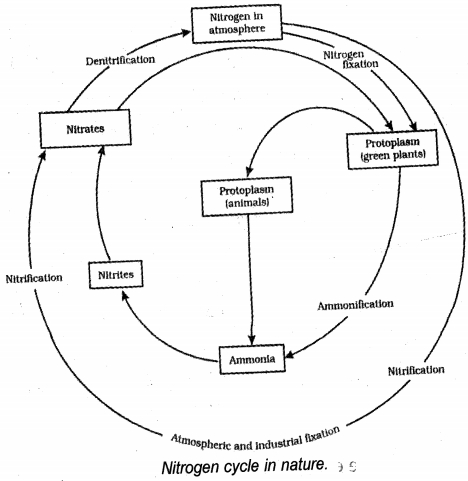
Describe the steps and process involved in the nitrogen cycle. Also,show the cycling of various nutrients in this cycle.
Solution
(N/A) The nitrogen cycle involves several key processes:
$1$. Nitrogen Fixation: Atmospheric $N_2$ is converted into ammonia or nitrates by nitrogen-fixing bacteria (e.g.,Rhizobium in root nodules of legumes) or through atmospheric and industrial processes.
$2$. Assimilation: Plants absorb these nitrogenous compounds to synthesize proteins and other organic molecules,which then enter the food chain as protoplasm in plants and animals.
$3$. Ammonification: Decomposers break down dead organic matter and waste products from plants and animals,releasing nitrogen back into the soil as ammonia.
$4$. Nitrification: Ammonia is converted into nitrites and then into nitrates by specific nitrifying bacteria in the soil.
$5$. Denitrification: Finally,certain bacteria convert nitrates back into atmospheric $N_2$ gas,completing the cycle.
$1$. Nitrogen Fixation: Atmospheric $N_2$ is converted into ammonia or nitrates by nitrogen-fixing bacteria (e.g.,Rhizobium in root nodules of legumes) or through atmospheric and industrial processes.
$2$. Assimilation: Plants absorb these nitrogenous compounds to synthesize proteins and other organic molecules,which then enter the food chain as protoplasm in plants and animals.
$3$. Ammonification: Decomposers break down dead organic matter and waste products from plants and animals,releasing nitrogen back into the soil as ammonia.
$4$. Nitrification: Ammonia is converted into nitrites and then into nitrates by specific nitrifying bacteria in the soil.
$5$. Denitrification: Finally,certain bacteria convert nitrates back into atmospheric $N_2$ gas,completing the cycle.
0 likes
View Solution134
Medium
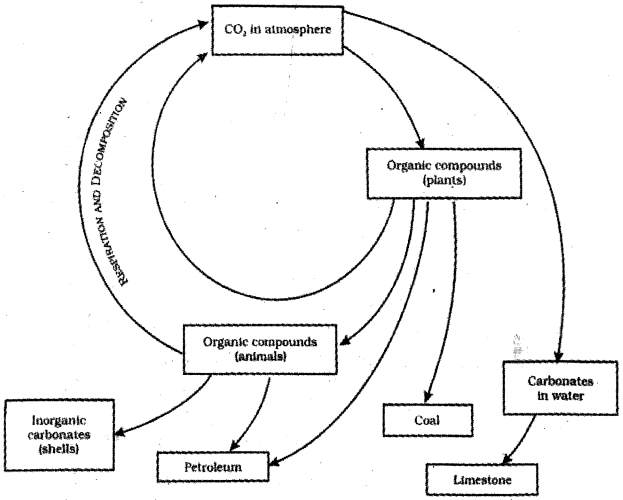
With the help of a labelled diagram,show the carbon cycle in nature. Describe the two ways in which carbon dioxide is fixed in the environment.
Solution
(N/A) The carbon cycle in nature is depicted in the provided diagram.
The two primary ways in which carbon dioxide $(CO_2)$ is fixed in the environment are:
$(i)$ Photosynthesis: Green plants absorb atmospheric $CO_2$ and convert it into glucose $(C_6H_{12}O_6)$ in the presence of sunlight and chlorophyll.
$(ii)$ Formation of Carbonates: Many marine animals use carbonates dissolved in sea water to synthesize their shells and skeletons,thereby fixing carbon in a solid form.
The two primary ways in which carbon dioxide $(CO_2)$ is fixed in the environment are:
$(i)$ Photosynthesis: Green plants absorb atmospheric $CO_2$ and convert it into glucose $(C_6H_{12}O_6)$ in the presence of sunlight and chlorophyll.
$(ii)$ Formation of Carbonates: Many marine animals use carbonates dissolved in sea water to synthesize their shells and skeletons,thereby fixing carbon in a solid form.
0 likes
View Solution135
Medium
$(a)$ How do forests influence the following?
$(i)$ Air
$(ii)$ Soil
$(iii)$ Water
$(b)$ Is the atmosphere on Venus and Mars different from our atmosphere? How?
$(i)$ Air
$(ii)$ Soil
$(iii)$ Water
$(b)$ Is the atmosphere on Venus and Mars different from our atmosphere? How?
Solution
(N/A)
$(i)$ Air: Forests act as a sink for $CO_{2}$ through photosynthesis. The absence of trees leads to an increase in $CO_{2}$ levels,contributing to global warming.
$(ii)$ Soil: Tree roots bind the soil particles together,preventing erosion. $A$ reduction in forest cover increases the risk of soil erosion caused by wind and floods.
$(iii)$ Water: Forests increase the water-holding capacity of the soil and facilitate groundwater recharge by slowing down surface runoff.
$(b)$ Yes,the atmosphere on Venus and Mars is significantly different from Earth's atmosphere.
Earth's atmosphere is composed mainly of nitrogen $(78\%)$ and oxygen $(21\%)$,which supports life. In contrast,the atmospheres of Venus and Mars are composed primarily of carbon dioxide $(CO_{2})$,which accounts for about $95-97\%$ of their atmospheric composition,making them inhospitable to life as we know it.
$(i)$ Air: Forests act as a sink for $CO_{2}$ through photosynthesis. The absence of trees leads to an increase in $CO_{2}$ levels,contributing to global warming.
$(ii)$ Soil: Tree roots bind the soil particles together,preventing erosion. $A$ reduction in forest cover increases the risk of soil erosion caused by wind and floods.
$(iii)$ Water: Forests increase the water-holding capacity of the soil and facilitate groundwater recharge by slowing down surface runoff.
$(b)$ Yes,the atmosphere on Venus and Mars is significantly different from Earth's atmosphere.
Earth's atmosphere is composed mainly of nitrogen $(78\%)$ and oxygen $(21\%)$,which supports life. In contrast,the atmospheres of Venus and Mars are composed primarily of carbon dioxide $(CO_{2})$,which accounts for about $95-97\%$ of their atmospheric composition,making them inhospitable to life as we know it.
0 likes
View Solution136
Medium
$(a)$ Differentiate between biodegradable and non-biodegradable substances.
$(b)$ How is acid rain causing harm to the 'Taj Mahal'?
$(c)$ What is smog?
$(b)$ How is acid rain causing harm to the 'Taj Mahal'?
$(c)$ What is smog?
Solution
(N/A) Biodegradable substances are those that can be broken down into simpler,harmless substances by biological processes (decomposers). They do not cause long-term pollution. Example: Organic waste.
Non-biodegradable substances are those that cannot be broken down by biological processes. They persist in the environment and cause significant pollution. Example: Plastic.
$(b)$ Acid rain contains high concentrations of sulfuric and nitric acids. When it falls on the 'Taj Mahal',it reacts with the calcium carbonate $(CaCO_3)$ present in the marble,leading to its corrosion and the formation of pits,which causes the monument to lose its luster and structural integrity.
$(c)$ Smog is a type of air pollution that is a mixture of smoke and fog. It often forms in industrial areas or cities with high vehicular traffic.
Non-biodegradable substances are those that cannot be broken down by biological processes. They persist in the environment and cause significant pollution. Example: Plastic.
$(b)$ Acid rain contains high concentrations of sulfuric and nitric acids. When it falls on the 'Taj Mahal',it reacts with the calcium carbonate $(CaCO_3)$ present in the marble,leading to its corrosion and the formation of pits,which causes the monument to lose its luster and structural integrity.
$(c)$ Smog is a type of air pollution that is a mixture of smoke and fog. It often forms in industrial areas or cities with high vehicular traffic.
0 likes
View Solution137
Medium
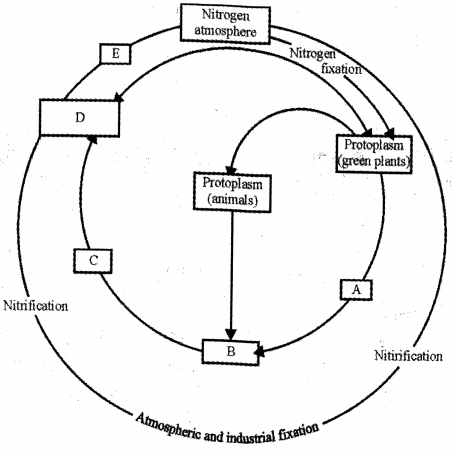
$(a)$ Study the given figure of the nitrogen cycle and mention what $A, B, C, D,$ and $E$ represent.
$(b)$ What will happen if step $A$ does not occur?
$(c)$ Write the role of nitrogen-fixing bacteria in the biosphere.
$(d)$ Name two biologically important compounds that contain both $O_2$ and $N_2$.
$(b)$ What will happen if step $A$ does not occur?
$(c)$ Write the role of nitrogen-fixing bacteria in the biosphere.
$(d)$ Name two biologically important compounds that contain both $O_2$ and $N_2$.
Solution
(A) Based on the nitrogen cycle diagram:
$A$ - Ammonification
$B$ - Ammonia $(NH_3)$
$C$ - Nitrites $(NO_2^-)$
$D$ - Nitrates $(NO_3^-)$
$E$ - Denitrification
$(b)$ If step $A$ (Ammonification) does not occur,the organic nitrogen present in dead plants and animals will not be converted into ammonia. Consequently,nitrogen will not be recycled back into the soil,leading to a deficiency of nitrogenous compounds for plants.
$(c)$ Nitrogen-fixing bacteria (e.g.,Rhizobium) play a crucial role in the biosphere by converting atmospheric nitrogen $(N_2)$ into nitrogenous compounds like ammonia,which can be easily absorbed and utilized by plants for protein synthesis.
$(d)$ Two biologically important compounds that contain both oxygen and nitrogen are proteins (amino acids) and nucleic acids ($DNA$ and $RNA$).
$A$ - Ammonification
$B$ - Ammonia $(NH_3)$
$C$ - Nitrites $(NO_2^-)$
$D$ - Nitrates $(NO_3^-)$
$E$ - Denitrification
$(b)$ If step $A$ (Ammonification) does not occur,the organic nitrogen present in dead plants and animals will not be converted into ammonia. Consequently,nitrogen will not be recycled back into the soil,leading to a deficiency of nitrogenous compounds for plants.
$(c)$ Nitrogen-fixing bacteria (e.g.,Rhizobium) play a crucial role in the biosphere by converting atmospheric nitrogen $(N_2)$ into nitrogenous compounds like ammonia,which can be easily absorbed and utilized by plants for protein synthesis.
$(d)$ Two biologically important compounds that contain both oxygen and nitrogen are proteins (amino acids) and nucleic acids ($DNA$ and $RNA$).
0 likes
View Solution138
Medium
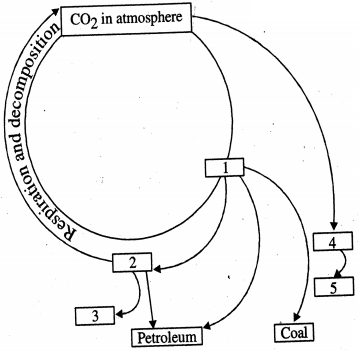
$(a)$ What do the blanks $1, 2, 3, 4$ and $5$ in the given cycle stand for?
$(b)$ Name two natural and one man-made process by which $CO_2$ returns to the atmosphere.
$(c)$ Carbon dioxide is necessary for plants but it is also a pollutant. Justify your answer.
$(b)$ Name two natural and one man-made process by which $CO_2$ returns to the atmosphere.
$(c)$ Carbon dioxide is necessary for plants but it is also a pollutant. Justify your answer.
Solution
(N/A) Based on the carbon cycle diagram:
$1$ - Organic compounds (plants)
$2$ - Organic compounds (animals)
$3$ - Inorganic carbonates (shells)
$4$ - Carbonates in water
$5$ - Limestone
$(b)$ Two natural processes: Respiration and Decomposition. One man-made process: Combustion of fossil fuels.
$(c)$ $CO_2$ is necessary for plants for photosynthesis to produce food. However,it is a pollutant because:
$(i)$ It is a greenhouse gas that traps heat,leading to an increase in the average global temperature.
$(ii)$ Excessive $CO_2$ is the primary driver of global warming and climate change.
$1$ - Organic compounds (plants)
$2$ - Organic compounds (animals)
$3$ - Inorganic carbonates (shells)
$4$ - Carbonates in water
$5$ - Limestone
$(b)$ Two natural processes: Respiration and Decomposition. One man-made process: Combustion of fossil fuels.
$(c)$ $CO_2$ is necessary for plants for photosynthesis to produce food. However,it is a pollutant because:
$(i)$ It is a greenhouse gas that traps heat,leading to an increase in the average global temperature.
$(ii)$ Excessive $CO_2$ is the primary driver of global warming and climate change.
0 likes
View Solution139
Medium
Explain in detail the formation of soil due to various factors. What is the function of humus in soil?
Solution
(N/A) Soil formation factors:
$1$. Sun: The heat from the sun causes rocks to expand during the day and contract at night. This uneven expansion and contraction lead to the formation of cracks,eventually breaking the rocks into smaller pieces.
$2$. Water: Water enters the cracks in rocks. During winter,this water freezes and expands,exerting pressure that widens the cracks,eventually breaking the rocks. Additionally,fast-flowing water carries rock particles,causing them to collide and wear down into smaller particles.
$3$. Wind: Strong winds carry sand and rock particles,which rub against larger rocks,causing erosion and breaking them down over time.
$4$. Living Organisms: Lichens growing on rock surfaces release chemicals that powder the rock surface. Mosses and other plant roots grow into the cracks,further breaking the rocks into fine soil particles.
$(b)$ Function of Humus:
Humus makes the soil more porous,which allows water and air to penetrate deep into the ground,facilitating the growth of roots and supporting soil fertility.
$1$. Sun: The heat from the sun causes rocks to expand during the day and contract at night. This uneven expansion and contraction lead to the formation of cracks,eventually breaking the rocks into smaller pieces.
$2$. Water: Water enters the cracks in rocks. During winter,this water freezes and expands,exerting pressure that widens the cracks,eventually breaking the rocks. Additionally,fast-flowing water carries rock particles,causing them to collide and wear down into smaller particles.
$3$. Wind: Strong winds carry sand and rock particles,which rub against larger rocks,causing erosion and breaking them down over time.
$4$. Living Organisms: Lichens growing on rock surfaces release chemicals that powder the rock surface. Mosses and other plant roots grow into the cracks,further breaking the rocks into fine soil particles.
$(b)$ Function of Humus:
Humus makes the soil more porous,which allows water and air to penetrate deep into the ground,facilitating the growth of roots and supporting soil fertility.
0 likes
View Solution140
Medium
Name four factors that help in the formation of soil from rocks.
Solution
(N/A) $(i)$ Strong winds: Wind causes erosion and physical weathering of rocks over time.
$(ii)$ Fast-flowing water: Water flowing over rocks causes abrasion and breaks them into smaller particles.
$(iii)$ Living organisms: Lichens,mosses,and fungi grow on rock surfaces,releasing chemicals that break down the rock and contribute to soil formation.
$(iv)$ Temperature variations: Repeated heating and cooling of rocks due to solar radiation causes expansion and contraction,leading to cracks and eventual disintegration.
$(ii)$ Fast-flowing water: Water flowing over rocks causes abrasion and breaks them into smaller particles.
$(iii)$ Living organisms: Lichens,mosses,and fungi grow on rock surfaces,releasing chemicals that break down the rock and contribute to soil formation.
$(iv)$ Temperature variations: Repeated heating and cooling of rocks due to solar radiation causes expansion and contraction,leading to cracks and eventual disintegration.
0 likes
View Solution141
Medium
Name the different states in which water is found during the water cycle.
Solution
(N/A) Water exists in three physical states during the water cycle:
$(a)$ Gas: Water vapour in the atmosphere and clouds.
$(b)$ Liquid: Water found in ponds,rivers,lakes,oceans,seas,and springs.
$(c)$ Solid: Water found as snow,hail,ice,or sleet.
$(a)$ Gas: Water vapour in the atmosphere and clouds.
$(b)$ Liquid: Water found in ponds,rivers,lakes,oceans,seas,and springs.
$(c)$ Solid: Water found as snow,hail,ice,or sleet.
0 likes
View Solution142
Medium
In what forms is water found on the Earth's surface? Describe in brief.
Solution
(N/A) - Most of the water on the Earth's surface is found in the liquid state in seas,oceans,rivers,lakes,ponds,etc.
- It is found in the solid state as ice on mountain peaks and in polar regions.
- Water is also found in the vapour state due to evaporation from the surface of water bodies,as moisture in the atmosphere,and through transpiration by plants and respiration by animals.
- It is found in the solid state as ice on mountain peaks and in polar regions.
- Water is also found in the vapour state due to evaporation from the surface of water bodies,as moisture in the atmosphere,and through transpiration by plants and respiration by animals.
0 likes
View Solution143
Medium
Describe how lichens and big trees influence the formation of soil.
Solution
(N/A) $(i)$ Lichens grow on the surface of rocks and release certain chemicals that cause the rock surface to powder down,creating a thin layer of soil.
$(ii)$ Mosses then grow on this surface,which further breaks down the rock material.
$(iii)$ The roots of big trees grow into the crevices of rocks,creating cracks and widening them over time,which eventually leads to the formation of soil.
$(ii)$ Mosses then grow on this surface,which further breaks down the rock material.
$(iii)$ The roots of big trees grow into the crevices of rocks,creating cracks and widening them over time,which eventually leads to the formation of soil.
0 likes
View Solution144
Medium
$(a)$ How are living organisms dependent on soil?
$(b)$ Are organisms that live in water totally independent of soil as a resource?
$(b)$ Are organisms that live in water totally independent of soil as a resource?
Solution
(N/A)
- Soil is an essential resource that determines the biodiversity of an area.
- The topsoil,which is the outermost layer,is rich in minerals and provides necessary nutrients to various life forms.
- It serves as a habitat for numerous microorganisms that assist in the recycling of nutrients.
- It supports vegetation,which in turn provides food and shelter for thousands of animal species.
$(b)$
- No,organisms living in water are not entirely independent of soil.
- The minerals and nutrients required by aquatic life are derived from the soil,which are carried into water bodies by rainwater or surface runoff.
- Soil is an essential resource that determines the biodiversity of an area.
- The topsoil,which is the outermost layer,is rich in minerals and provides necessary nutrients to various life forms.
- It serves as a habitat for numerous microorganisms that assist in the recycling of nutrients.
- It supports vegetation,which in turn provides food and shelter for thousands of animal species.
$(b)$
- No,organisms living in water are not entirely independent of soil.
- The minerals and nutrients required by aquatic life are derived from the soil,which are carried into water bodies by rainwater or surface runoff.
0 likes
View Solution145
Medium
What is the percentage of oxygen found in the atmosphere? Name two compounds of oxygen found in nature. Name any three processes in which oxygen is used up in the atmosphere.
Solution
(N/A) The percentage of oxygen in the atmosphere is approximately $21 \%$.
Two compounds of oxygen found in nature are water $(H_2O)$ and carbon dioxide $(CO_2)$.
Three processes in which oxygen is used up in the atmosphere are:
$(i)$ Respiration: Living organisms consume oxygen to break down glucose and release energy.
$(ii)$ Combustion: Burning of fuels requires oxygen to proceed.
$(iii)$ Formation of oxides of nitrogen: During lightning,nitrogen reacts with oxygen to form nitrogen oxides.
Two compounds of oxygen found in nature are water $(H_2O)$ and carbon dioxide $(CO_2)$.
Three processes in which oxygen is used up in the atmosphere are:
$(i)$ Respiration: Living organisms consume oxygen to break down glucose and release energy.
$(ii)$ Combustion: Burning of fuels requires oxygen to proceed.
$(iii)$ Formation of oxides of nitrogen: During lightning,nitrogen reacts with oxygen to form nitrogen oxides.
0 likes
View Solution146
Medium
$(a)$ How is soil pollution caused?
$(b)$ Write three ways to prevent soil pollution.
$(b)$ Write three ways to prevent soil pollution.
Solution
(N/A) Soil pollution is caused by the following factors:
- Dumping of industrial wastes in vacant sites,such as along roads,railway tracks,or in sanitary landfills.
- Accumulation of wastes from residences,cattle sheds,industries,and agricultural fields.
- Excessive and indiscriminate use of chemical fertilizers and pesticides in agriculture.
$(b)$ Three ways to prevent soil pollution are:
$(i)$ Judicious and controlled use of chemical fertilizers and pesticides.
$(ii)$ Proper management and scientific disposal of household and industrial waste.
$(iii)$ Adoption of sustainable agricultural practices such as intensive cropping and terrace farming to maintain soil health.
- Dumping of industrial wastes in vacant sites,such as along roads,railway tracks,or in sanitary landfills.
- Accumulation of wastes from residences,cattle sheds,industries,and agricultural fields.
- Excessive and indiscriminate use of chemical fertilizers and pesticides in agriculture.
$(b)$ Three ways to prevent soil pollution are:
$(i)$ Judicious and controlled use of chemical fertilizers and pesticides.
$(ii)$ Proper management and scientific disposal of household and industrial waste.
$(iii)$ Adoption of sustainable agricultural practices such as intensive cropping and terrace farming to maintain soil health.
0 likes
View Solution147
Medium
Define humus and state its function.
Solution
(N/A) Humus is the dark-coloured,partially decayed organic matter found in the top layer of soil.
Its functions are as follows:
$1$. It makes the soil porous,which increases the soil's water-holding capacity and air content.
$2$. It is rich in nutrients,which promotes the growth of plants.
$3$. It improves soil structure,allowing plant roots to penetrate the soil more easily.
Its functions are as follows:
$1$. It makes the soil porous,which increases the soil's water-holding capacity and air content.
$2$. It is rich in nutrients,which promotes the growth of plants.
$3$. It improves soil structure,allowing plant roots to penetrate the soil more easily.
0 likes
View Solution148
Medium
State reasons for the following:
$(i)$ Excess burning of coal causes greenhouse effect.
$(ii)$ Soil is a mixture.
$(iii)$ Temperature ranges from $-190^{\circ} C$ to $110^{\circ} C$ on the surface of the moon.
$(i)$ Excess burning of coal causes greenhouse effect.
$(ii)$ Soil is a mixture.
$(iii)$ Temperature ranges from $-190^{\circ} C$ to $110^{\circ} C$ on the surface of the moon.
Solution
(N/A) $(i)$ Excess burning of coal releases greenhouse gases such as carbon dioxide $(CO_2)$ and hydrocarbons into the atmosphere.
These gases have the property of trapping solar heat,which leads to the greenhouse effect and global warming.
$(ii)$ Soil is considered a mixture because it is composed of various substances including weathered rock particles of different sizes,organic matter (humus) from decayed living organisms,microscopic life forms,air,and water (moisture).
$(iii)$ The moon lacks an atmosphere. An atmosphere acts as a blanket that regulates surface temperature by preventing extreme fluctuations.
In the absence of an atmosphere on the moon,there is no mechanism to trap heat during the day or retain it at night,causing the temperature to fluctuate drastically from $-190^{\circ} C$ to $110^{\circ} C$.
These gases have the property of trapping solar heat,which leads to the greenhouse effect and global warming.
$(ii)$ Soil is considered a mixture because it is composed of various substances including weathered rock particles of different sizes,organic matter (humus) from decayed living organisms,microscopic life forms,air,and water (moisture).
$(iii)$ The moon lacks an atmosphere. An atmosphere acts as a blanket that regulates surface temperature by preventing extreme fluctuations.
In the absence of an atmosphere on the moon,there is no mechanism to trap heat during the day or retain it at night,causing the temperature to fluctuate drastically from $-190^{\circ} C$ to $110^{\circ} C$.
0 likes
View Solution149
Medium
Explain the role of the sun in the formation of soil. Justify the statement: "Dust is a pollutant."
Solution
(N/A) The sun plays a crucial role in soil formation through the process of weathering:
- Rocks heat up and expand during the day due to solar radiation.
- At night, these rocks cool down and contract.
- Because different parts of the rock expand and contract at different rates, this uneven heating and cooling causes cracks to develop, eventually breaking the rocks into smaller pieces, which eventually form soil.
$(b)$ Dust is considered a pollutant for the following reasons:
- Inhalation of dust particles can cause respiratory diseases such as asthma, bronchitis, and lung cancer.
- Dust, when combined with smoke and water vapor, forms smog, which reduces visibility and leads to accidents.
- Exposure to specific types of dust, such as cement, asbestos, or coal dust, can trigger severe allergies, sneezing, and chronic conditions like tuberculosis $(TB)$.
- Rocks heat up and expand during the day due to solar radiation.
- At night, these rocks cool down and contract.
- Because different parts of the rock expand and contract at different rates, this uneven heating and cooling causes cracks to develop, eventually breaking the rocks into smaller pieces, which eventually form soil.
$(b)$ Dust is considered a pollutant for the following reasons:
- Inhalation of dust particles can cause respiratory diseases such as asthma, bronchitis, and lung cancer.
- Dust, when combined with smoke and water vapor, forms smog, which reduces visibility and leads to accidents.
- Exposure to specific types of dust, such as cement, asbestos, or coal dust, can trigger severe allergies, sneezing, and chronic conditions like tuberculosis $(TB)$.
0 likes
View Solution150
Medium
List three human activities responsible for the pollution of water bodies.
Solution
(N/A) $(i)$ Excessive use of fertilizers and pesticides in agriculture.
$(ii)$ Disposal of untreated industrial waste containing toxic substances into water bodies.
$(iii)$ Discharge of untreated domestic sewage from households into water sources.
$(iv)$ Release of synthetic detergents and soaps from household washing activities.
$(v)$ Thermal pollution caused by the release of hot water from industrial cooling processes.
$(ii)$ Disposal of untreated industrial waste containing toxic substances into water bodies.
$(iii)$ Discharge of untreated domestic sewage from households into water sources.
$(iv)$ Release of synthetic detergents and soaps from household washing activities.
$(v)$ Thermal pollution caused by the release of hot water from industrial cooling processes.
0 likes
View SolutionNATURAL RESOURCES — Mix Example - NATURAL RESOURCES · Frequently Asked Questions
1Are these NATURAL RESOURCES questions useful for JEE and NEET?
Yes. All questions in this section are mapped to JEE Main and NEET exam patterns. Previous year questions from JEE Main, NEET, GUJCET and state-level exams are included with full solutions.
2Can I switch to Hindi or Gujarati for these questions?
Yes. Use the language tabs in the hero section or the sidebar to view the same questions and solutions in English, Hindi or Gujarati.
3How do I generate a question paper from this subtopic?
Use the Vedclass Exam Paper Generator — select the chapter and subtopic, set difficulty, and generate Sets A, B, C, D automatically. First 3 chapters of every subject are free.
Vedclass Products
For Students
Vedclass Test Series
Mock tests in real JEE/NEET style with performance analysis. 5-day free trial.
Start Free TrialFor Teachers
Exam Paper Generator
Generate Set A/B/C/D papers from this chapter in 2 minutes. 3 chapters free.
Try FreeFor Institutes
Online Exam Module
Live online exams with unlimited students, 360° analytics & white-label branding.
See DemoFor Teachers & Institutes
Generate a NATURAL RESOURCES Exam Paper in 2 Minutes
Select subtopic & difficulty — Sets A, B, C, D auto-generated with No Repeat logic.
First 3 chapters of every subject are free — no payment required.