
A English
Universe Questions in English
Class 12 Physics · Universe · Universe
75+
Questions
English
Language
100%
With Solutions
Showing 25 of 75 questions in English
51
EasyMCQ
The tail of a comet points
A
Towards the Sun
B
Away from the Sun
C
In an arbitrary direction
D
Away from the Earth
Solution
(B) The tail of a comet is formed by the solar wind and radiation pressure from the Sun. As the comet approaches the Sun,these forces push the gas and dust particles away from the comet's nucleus. Consequently,the tail always points away from the Sun,regardless of the direction in which the comet is moving.
0 likes
View Solution52
DifficultMCQ
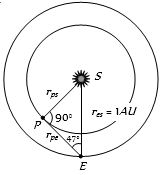
The angle of maximum elongation for Venus is $47^\circ$. The distance of Venus from the Sun in $AU$ is .......
A
$0.68$
B
$0.86$
C
$1$
D
$0.73$
Solution
(A) The angle of elongation $\varepsilon$ is the angle formed at the Earth between the direction of the planet and the direction of the Sun.
When the planet appears at its maximum elongation,the line of sight from Earth is tangent to the planet's orbit. Consequently,the angle subtended by the Sun and Earth at the planet is $90^\circ$.
From the geometry of the right-angled triangle formed by the Sun $(S)$,the planet $(P)$,and the Earth $(E)$:
$\cos \varepsilon = \frac{\text{Adjacent}}{\text{Hypotenuse}} = \frac{r_{PS}}{r_{ES}}$
Given $\varepsilon = 47^\circ$ and $r_{ES} = 1 \ AU$ (distance from Earth to Sun),
$r_{PS} = r_{ES} \cos 47^\circ$
$r_{PS} = 1 \ AU \times \cos 47^\circ \approx 1 \times 0.682 = 0.68 \ AU$.
Therefore,the distance of Venus from the Sun is approximately $0.68 \ AU$.
When the planet appears at its maximum elongation,the line of sight from Earth is tangent to the planet's orbit. Consequently,the angle subtended by the Sun and Earth at the planet is $90^\circ$.
From the geometry of the right-angled triangle formed by the Sun $(S)$,the planet $(P)$,and the Earth $(E)$:
$\cos \varepsilon = \frac{\text{Adjacent}}{\text{Hypotenuse}} = \frac{r_{PS}}{r_{ES}}$
Given $\varepsilon = 47^\circ$ and $r_{ES} = 1 \ AU$ (distance from Earth to Sun),
$r_{PS} = r_{ES} \cos 47^\circ$
$r_{PS} = 1 \ AU \times \cos 47^\circ \approx 1 \times 0.682 = 0.68 \ AU$.
Therefore,the distance of Venus from the Sun is approximately $0.68 \ AU$.
0 likes
View Solution53
EasyMCQ
The number of stars in our solar system is
A
$9$
B
$5$
C
$1$
D
More than $9$
Solution
(C) The solar system consists of the Sun and the objects that orbit it. The Sun is the only star in our solar system. Therefore,the number of stars is $1$.
0 likes
View Solution54
EasyMCQ
$A$ Black Hole is:
A
a super surface of the atmosphere
B
the ozone layer
C
a super dense celestial object
D
none of these
Solution
(C) Black Hole is a region of spacetime exhibiting gravitational acceleration so strong that nothing—no particles or even electromagnetic radiation such as light—can escape from it. It is formed due to the continued gravitational collapse of the core of a massive star during a supernova explosion,resulting in a super dense object.
0 likes
View Solution55
EasyMCQ
The farthest objects in our Universe discovered by modern astronomers are so distant that light emitted by them takes billions of years to reach the Earth. These objects (known as quasars) have many puzzling features,which have not yet been satisfactorily explained. What is the distance in $km$ of a quasar from which light takes $3.0$ billion years to reach us?
A
$1.4 \times 10^{18}$
B
$2.8 \times 10^{26}$
C
$1.4 \times 10^{20}$
D
$2.8 \times 10^{22}$
Solution
(D) Time taken by quasar light to reach Earth $= 3 \text{ billion years} = 3 \times 10^9 \text{ years}$.
Converting time into seconds:
$t = 3 \times 10^9 \times 365.25 \times 24 \times 60 \times 60 \text{ s} \approx 9.467 \times 10^{16} \text{ s}$.
Speed of light $c = 3 \times 10^8 \text{ m/s}$.
Distance $d = c \times t = (3 \times 10^8 \text{ m/s}) \times (9.467 \times 10^{16} \text{ s}) = 2.84 \times 10^{25} \text{ m}$.
Converting meters to kilometers $(1 \text{ km} = 10^3 \text{ m})$:
$d = 2.84 \times 10^{22} \text{ km}$.
Converting time into seconds:
$t = 3 \times 10^9 \times 365.25 \times 24 \times 60 \times 60 \text{ s} \approx 9.467 \times 10^{16} \text{ s}$.
Speed of light $c = 3 \times 10^8 \text{ m/s}$.
Distance $d = c \times t = (3 \times 10^8 \text{ m/s}) \times (9.467 \times 10^{16} \text{ s}) = 2.84 \times 10^{25} \text{ m}$.
Converting meters to kilometers $(1 \text{ km} = 10^3 \text{ m})$:
$d = 2.84 \times 10^{22} \text{ km}$.
0 likes
View Solution56
Medium
Describe the Ptolemaic model for planetary motion.
Solution
(N/A) The Ptolemaic model,proposed by Claudius Ptolemy in the $2^{nd}$ century $AD$,is a geocentric model of the universe.
$1$. It posits that the Earth is stationary at the center of the universe.
$2$. All celestial bodies,including the Sun,Moon,planets,and stars,revolve around the Earth in complex circular paths.
$3$. To explain the observed retrograde motion of planets (where they appear to move backward in the sky),Ptolemy introduced the concept of 'epicycles'.
$4$. In this system,each planet moves in a small circle called an 'epicycle',while the center of this epicycle moves along a larger circular path around the Earth called a 'deferent'.
$5$. This model was the dominant cosmological framework for over $1,400$ years until it was replaced by the heliocentric model proposed by Nicolaus Copernicus.
$1$. It posits that the Earth is stationary at the center of the universe.
$2$. All celestial bodies,including the Sun,Moon,planets,and stars,revolve around the Earth in complex circular paths.
$3$. To explain the observed retrograde motion of planets (where they appear to move backward in the sky),Ptolemy introduced the concept of 'epicycles'.
$4$. In this system,each planet moves in a small circle called an 'epicycle',while the center of this epicycle moves along a larger circular path around the Earth called a 'deferent'.
$5$. This model was the dominant cosmological framework for over $1,400$ years until it was replaced by the heliocentric model proposed by Nicolaus Copernicus.
0 likes
View Solution57
Easy
What were the thoughts of the ancient Indian sage and scientist Aryabhatta regarding planetary motion?
Solution
(N/A) Aryabhatta,a renowned ancient Indian mathematician and astronomer,proposed a revolutionary model for planetary motion in his work,the $Aryabhatiya$.
$1$. He correctly postulated that the Earth rotates on its own axis from west to east.
$2$. He explained that the apparent motion of stars and planets from east to west is due to the rotation of the Earth.
$3$. He suggested that the planets move in circular orbits around the Sun,which was a significant departure from the prevailing geocentric models of his time.
$4$. He also provided accurate calculations for the periods of planetary rotation and revolution,demonstrating a deep understanding of celestial mechanics long before modern astronomy.
$1$. He correctly postulated that the Earth rotates on its own axis from west to east.
$2$. He explained that the apparent motion of stars and planets from east to west is due to the rotation of the Earth.
$3$. He suggested that the planets move in circular orbits around the Sun,which was a significant departure from the prevailing geocentric models of his time.
$4$. He also provided accurate calculations for the periods of planetary rotation and revolution,demonstrating a deep understanding of celestial mechanics long before modern astronomy.
0 likes
View Solution58
Difficult
What are the approximate sizes of the observable universe and an atomic nucleus?
Solution
(N/A) The size of an atomic nucleus is approximately $10^{-14} \,m$.
The size of the observable universe is approximately $10^{26} \,m$.
The size of the observable universe is approximately $10^{26} \,m$.
0 likes
View Solution59
Easy
Write the range of masses encountered in the universe.
Solution
(N/A) The masses of objects encountered in the universe vary over a very wide range.
These masses range from the order of $10^{-30} \ kg$ (mass of an electron) to the huge mass of $10^{55} \ kg$ (mass of the observable universe).
These masses range from the order of $10^{-30} \ kg$ (mass of an electron) to the huge mass of $10^{55} \ kg$ (mass of the observable universe).
| Object | Mass $(kg)$ |
| Electron | $10^{-30}$ |
| Proton | $10^{-27}$ |
| Uranium atom | $10^{-25}$ |
| Red blood cell | $10^{-13}$ |
| Dust particle | $10^{-9}$ |
| Rain drop | $10^{-6}$ |
| Mosquito | $10^{-5}$ |
| Grape | $10^{-3}$ |
| Human | $10^{2}$ |
| Automobile | $10^{3}$ |
| Boeing $747$ Aircraft | $10^{8}$ |
| Moon | $10^{23}$ |
| Earth | $10^{25}$ |
| Sun | $10^{30}$ |
| Milky Way galaxy | $10^{41}$ |
| Observable universe | $10^{55}$ |
0 likes
View Solution60
EasyMCQ
What is the approximate ratio of the mass of the observable universe to the mass of an electron?
A
$10^{85}$
B
$10^{55}$
C
$10^{30}$
D
$10^{25}$
Solution
(A) The mass of an electron is approximately $m_e \approx 9.1 \times 10^{-31} \,kg$.
The mass of the observable universe is approximately $M_u \approx 10^{55} \,kg$.
The ratio of the mass of the observable universe to the mass of an electron is given by:
Ratio $= \frac{M_u}{m_e} \approx \frac{10^{55}}{10^{-31}} = 10^{55 - (-31)} = 10^{86}$.
Rounding to the nearest order of magnitude, the ratio is approximately $10^{85}$.
The mass of the observable universe is approximately $M_u \approx 10^{55} \,kg$.
The ratio of the mass of the observable universe to the mass of an electron is given by:
Ratio $= \frac{M_u}{m_e} \approx \frac{10^{55}}{10^{-31}} = 10^{55 - (-31)} = 10^{86}$.
Rounding to the nearest order of magnitude, the ratio is approximately $10^{85}$.
0 likes
View Solution61
Easy
What is the ratio of the maximum length to the minimum length in the universe?
Solution
(N/A) The distance to the boundary of the observable universe is approximately $10^{26} \ m$ (maximum length).
The size of a proton is approximately $10^{-15} \ m$ (minimum length).
Therefore,the ratio is calculated as:
$\text{Ratio} = \frac{10^{26} \ m}{10^{-15} \ m} = 10^{26 - (-15)} = 10^{41}$.
The size of a proton is approximately $10^{-15} \ m$ (minimum length).
Therefore,the ratio is calculated as:
$\text{Ratio} = \frac{10^{26} \ m}{10^{-15} \ m} = 10^{26 - (-15)} = 10^{41}$.
0 likes
View Solution62
EasyMCQ
What is the ratio of the maximum mass of the observable universe to the minimum mass of an electron?
A
$10^{85}$
B
$10^{40}$
C
$10^{25}$
D
$10^{100}$
Solution
(A) The maximum mass of the observable universe is approximately $10^{55} \ kg$.
The mass of an electron is approximately $9.1 \times 10^{-31} \ kg$,which is of the order of $10^{-30} \ kg$.
The ratio of the maximum mass to the mass of an electron is:
$\text{Ratio} = \frac{10^{55} \ kg}{10^{-30} \ kg} = 10^{55 - (-30)} = 10^{85}$.
Thus,the correct option is $A$.
The mass of an electron is approximately $9.1 \times 10^{-31} \ kg$,which is of the order of $10^{-30} \ kg$.
The ratio of the maximum mass to the mass of an electron is:
$\text{Ratio} = \frac{10^{55} \ kg}{10^{-30} \ kg} = 10^{55 - (-30)} = 10^{85}$.
Thus,the correct option is $A$.
0 likes
View Solution63
EasyMCQ
What is a Red Giant?
A
$A$ young,hot,blue star.
B
$A$ dying star in the late stages of stellar evolution.
C
$A$ small,dense star that has exhausted its nuclear fuel.
D
$A$ cloud of gas and dust in space.
Solution
(B) Red Giant is a luminous giant star of low or intermediate mass in a late phase of stellar evolution.
As the star exhausts the hydrogen fuel in its core,the core contracts and heats up,causing the outer layers of the star to expand and cool.
This expansion gives the star a reddish appearance and a significantly larger radius compared to its main-sequence phase.
Therefore,it is a dying star that has moved off the main sequence.
As the star exhausts the hydrogen fuel in its core,the core contracts and heats up,causing the outer layers of the star to expand and cool.
This expansion gives the star a reddish appearance and a significantly larger radius compared to its main-sequence phase.
Therefore,it is a dying star that has moved off the main sequence.
0 likes
View Solution64
Medium
What are inferior planets,and what is meant by the elongation of a planet?
Solution
(N/A) Inferior planets are those planets whose distance from the Sun is less than the distance of the Earth from the Sun.
Elongation of a planet is defined as the angle subtended at the Earth by the line joining the Earth to the Sun and the line joining the Earth to the planet,as they revolve in their respective orbits around the Sun.
Elongation of a planet is defined as the angle subtended at the Earth by the line joining the Earth to the Sun and the line joining the Earth to the planet,as they revolve in their respective orbits around the Sun.
0 likes
View Solution65
EasyMCQ
Who was the first Indian astronaut to travel into space?
A
Rakesh Sharma
B
Kalpana Chawla
C
Sunita Williams
D
Ravish Malhotra
Solution
(A) The first Indian astronaut to travel into space is $Rakesh$ $Sharma$. He flew aboard the Soviet spacecraft $Soyuz$ $T-11$ on $April$ $3, 1984$.
0 likes
View Solution66
EasyMCQ
The image shows a diagram of the solar system. Which of the following correctly identifies the planets in the order of their distance from the Sun?
A
Mercury,Venus,Earth,Mars,Jupiter,Saturn,Uranus,Neptune
B
Neptune,Uranus,Saturn,Jupiter,Mars,Earth,Venus,Mercury
C
Earth,Mars,Venus,Mercury,Saturn,Jupiter,Neptune,Uranus
D
Jupiter,Saturn,Uranus,Neptune,Mercury,Venus,Earth,Mars
Solution
(A) The solar system consists of the Sun at the center,with eight planets orbiting it. The order of the planets starting from the Sun is:
$1$. Mercury
$2$. Venus
$3$. Earth
$4$. Mars
$5$. Jupiter
$6$. Saturn
$7$. Uranus
$8$. Neptune
This sequence is based on their average distance from the Sun. Therefore,option $A$ is the correct sequence.
$1$. Mercury
$2$. Venus
$3$. Earth
$4$. Mars
$5$. Jupiter
$6$. Saturn
$7$. Uranus
$8$. Neptune
This sequence is based on their average distance from the Sun. Therefore,option $A$ is the correct sequence.
0 likes
View Solution67
MediumMCQ
Which of the following represents the correct order of the evolution of the universe?
A
Big Bang $\rightarrow$ Inflation $\rightarrow$ Nucleosynthesis $\rightarrow$ Recombination $\rightarrow$ Star Formation
B
Big Bang $\rightarrow$ Nucleosynthesis $\rightarrow$ Inflation $\rightarrow$ Recombination $\rightarrow$ Star Formation
C
Big Bang $\rightarrow$ Inflation $\rightarrow$ Recombination $\rightarrow$ Nucleosynthesis $\rightarrow$ Star Formation
D
Big Bang $\rightarrow$ Recombination $\rightarrow$ Inflation $\rightarrow$ Nucleosynthesis $\rightarrow$ Star Formation
Solution
(A) The evolution of the universe follows a specific chronological sequence:
$1$. $Big \ Bang$: The initial expansion of the universe.
$2$. $Inflation$: $A$ period of extremely rapid expansion occurring shortly after the Big Bang.
$3$. $Nucleosynthesis$: The formation of light elements (like Hydrogen and Helium) in the early universe.
$4$. $Recombination$: The epoch when electrons and protons combined to form neutral atoms,allowing light to travel freely (Cosmic Microwave Background).
$5$. $Star \ Formation$: The later stage where gravity caused matter to clump together to form stars and galaxies.
Thus,the correct order is $Big \ Bang \rightarrow Inflation \rightarrow Nucleosynthesis \rightarrow Recombination \rightarrow Star \ Formation$.
$1$. $Big \ Bang$: The initial expansion of the universe.
$2$. $Inflation$: $A$ period of extremely rapid expansion occurring shortly after the Big Bang.
$3$. $Nucleosynthesis$: The formation of light elements (like Hydrogen and Helium) in the early universe.
$4$. $Recombination$: The epoch when electrons and protons combined to form neutral atoms,allowing light to travel freely (Cosmic Microwave Background).
$5$. $Star \ Formation$: The later stage where gravity caused matter to clump together to form stars and galaxies.
Thus,the correct order is $Big \ Bang \rightarrow Inflation \rightarrow Nucleosynthesis \rightarrow Recombination \rightarrow Star \ Formation$.
0 likes
View Solution68
EasyMCQ
The image shows a diagram of the solar system. Which of the following planets is known as the 'Red Planet'?
A
Mercury
B
Venus
C
Earth
D
Mars
Solution
(D) The solar system consists of the Sun and the objects that orbit it,including eight planets.
Among these,Mars is famously known as the 'Red Planet' due to the prevalence of iron oxide (rust) on its surface,which gives it a reddish appearance.
Therefore,the correct option is $D$.
Among these,Mars is famously known as the 'Red Planet' due to the prevalence of iron oxide (rust) on its surface,which gives it a reddish appearance.
Therefore,the correct option is $D$.
0 likes
View Solution69
MediumMCQ
Which of the following is not true about the total lunar eclipse?
A
$A$ lunar eclipse can occur on a new moon and full moon day
B
The lunar eclipse would occur roughly every month,if the orbits of earth and moon were perfectly coplanar
C
The moon appears red during the eclipse because the blue light is absorbed in earth's atmosphere and red is transmitted
D
$A$ lunar eclipse can occur only on a full moon day
Solution
(A) lunar eclipse occurs only when the Earth is positioned between the Sun and the Moon,which happens exclusively during a full moon phase.
Option $(A)$ states that a lunar eclipse can occur on a new moon and full moon day,which is false because a new moon occurs when the Moon is between the Earth and the Sun.
Option $(B)$ is true because the orbital planes of the Earth and Moon are inclined at an angle of about $5^{\circ}$. If they were coplanar,the alignment would occur every month.
Option $(C)$ is true as the Earth's atmosphere scatters shorter wavelengths (blue) and allows longer wavelengths (red) to pass through,which then illuminate the Moon.
Option $(D)$ is true as it correctly identifies the phase required for a lunar eclipse.
Therefore,the statement that is not true is $(A)$.
Option $(A)$ states that a lunar eclipse can occur on a new moon and full moon day,which is false because a new moon occurs when the Moon is between the Earth and the Sun.
Option $(B)$ is true because the orbital planes of the Earth and Moon are inclined at an angle of about $5^{\circ}$. If they were coplanar,the alignment would occur every month.
Option $(C)$ is true as the Earth's atmosphere scatters shorter wavelengths (blue) and allows longer wavelengths (red) to pass through,which then illuminate the Moon.
Option $(D)$ is true as it correctly identifies the phase required for a lunar eclipse.
Therefore,the statement that is not true is $(A)$.
0 likes
View Solution70
MediumMCQ
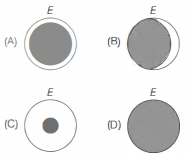
$A$ total solar eclipse is observed from the Earth. At the same time,an observer on the Moon views the Earth. She is most likely to see ($E$ denotes the Earth):
A
$A$
B
$B$
C
$C$
D
$D$
Solution
(C) The correct option is $C$.
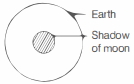
During a total solar eclipse,the Moon passes between the Sun and the Earth,casting its shadow on a small region of the Earth's surface.
The size of the Moon is much smaller than that of the Earth. Furthermore,the Moon is significantly closer to the Earth compared to the Sun.
Consequently,the shadow cast by the Moon on the Earth is relatively small,covering only a tiny portion of the Earth's visible disk as seen from the Moon. This is represented by the small shaded region within the larger circle $E$ in option $C$.
During a total solar eclipse,the Moon passes between the Sun and the Earth,casting its shadow on a small region of the Earth's surface.
The size of the Moon is much smaller than that of the Earth. Furthermore,the Moon is significantly closer to the Earth compared to the Sun.
Consequently,the shadow cast by the Moon on the Earth is relatively small,covering only a tiny portion of the Earth's visible disk as seen from the Moon. This is represented by the small shaded region within the larger circle $E$ in option $C$.
0 likes
View Solution71
MediumMCQ
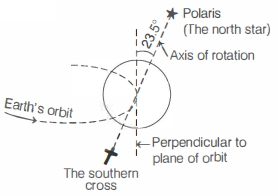
If the axis of rotation of the earth were extended into space,then it would pass close to
A
the moon
B
the sun
C
the pole star
D
the centre of mass of all the planets in the solar system
Solution
(C) The axis of rotation of the Earth is the imaginary line passing through the North and South Poles. When this axis is extended into space from the North Pole,it points very close to Polaris,which is commonly known as the Pole Star or the North Star. Due to the Earth's axial precession,this alignment changes very slowly over thousands of years,but at present,it passes very close to Polaris.
0 likes
View Solution72
MediumMCQ
If the average life of a person is taken as $100 \, s$,the age of the universe on this scale is of the order of ...... $s$.
A
$10^{10}$
B
$10^8$
C
$10^{17}$
D
$10^9$
Solution
(A) The actual average life of a human is approximately $70$ years,which is about $2.2 \times 10^9 \, s$. For the purpose of order of magnitude,we take it as $10^9 \, s$.
The actual age of the universe is approximately $13.8$ billion years,which is about $4.35 \times 10^{17} \, s$. For the purpose of order of magnitude,we take it as $10^{17} \, s$.
Let the scale factor be $k$. According to the problem,the human life on this scale is $100 \, s$.
Therefore,$k \times (10^9 \, s) = 100 \, s$,which gives $k = 10^{-7}$.
Now,the age of the universe on this scale is $k \times (10^{17} \, s) = 10^{-7} \times 10^{17} \, s = 10^{10} \, s$.
The actual age of the universe is approximately $13.8$ billion years,which is about $4.35 \times 10^{17} \, s$. For the purpose of order of magnitude,we take it as $10^{17} \, s$.
Let the scale factor be $k$. According to the problem,the human life on this scale is $100 \, s$.
Therefore,$k \times (10^9 \, s) = 100 \, s$,which gives $k = 10^{-7}$.
Now,the age of the universe on this scale is $k \times (10^{17} \, s) = 10^{-7} \times 10^{17} \, s = 10^{10} \, s$.
0 likes
View Solution73
EasyMCQ
The flash spectrum confirms a/an:
A
total solar eclipse
B
lunar eclipse
C
earthquake
D
magnetic storm
Solution
(A) The flash spectrum is a series of bright emission lines observed in the solar spectrum for a few seconds during a total solar eclipse. When the moon completely covers the bright photosphere of the sun,the thin layer of the chromosphere becomes visible,producing this unique emission spectrum.
0 likes
View Solution74
EasyMCQ
The faintest stars visible to the naked eye are called:
A
zero magnitude stars
B
second magnitude stars
C
sixth magnitude stars
D
dwarfs
Solution
(C) In the astronomical magnitude scale,the brightness of stars is classified by their apparent magnitude. The brightest stars have lower (or negative) magnitude values,while the faintest stars visible to the human eye under ideal conditions are classified as sixth magnitude stars.
0 likes
View Solution75
MediumMCQ
The temperature of the Earth without the greenhouse effect would be: (in $^{\circ} C$)
A
$0$
B
$-18$
C
$-10$
D
$-24$
Solution
(B) The greenhouse effect is a natural process that warms the Earth's surface.
When the Sun's energy reaches the Earth's atmosphere,some of it is reflected back to space and the rest is absorbed and re-radiated by greenhouse gases.
Without these naturally occurring greenhouse gases,the Earth's average surface temperature would be approximately $-18^{\circ} C$,which is significantly colder than the current average of about $+15^{\circ} C$.
When the Sun's energy reaches the Earth's atmosphere,some of it is reflected back to space and the rest is absorbed and re-radiated by greenhouse gases.
Without these naturally occurring greenhouse gases,the Earth's average surface temperature would be approximately $-18^{\circ} C$,which is significantly colder than the current average of about $+15^{\circ} C$.
0 likes
View SolutionUniverse — Universe · Frequently Asked Questions
1Are these Universe questions useful for JEE and NEET?
Yes. All questions in this section are mapped to JEE Main and NEET exam patterns. Previous year questions from JEE Main, NEET, GUJCET and state-level exams are included with full solutions.
2Can I switch to Hindi or Gujarati for these questions?
Yes. Use the language tabs in the hero section or the sidebar to view the same questions and solutions in English, Hindi or Gujarati.
3How do I generate a question paper from this subtopic?
Use the Vedclass Exam Paper Generator — select the chapter and subtopic, set difficulty, and generate Sets A, B, C, D automatically. First 3 chapters of every subject are free.
Vedclass Products
For Students
Vedclass Test Series
Mock tests in real JEE/NEET style with performance analysis. 5-day free trial.
Start Free TrialFor Teachers
Exam Paper Generator
Generate Set A/B/C/D papers from this chapter in 2 minutes. 3 chapters free.
Try FreeFor Institutes
Online Exam Module
Live online exams with unlimited students, 360° analytics & white-label branding.
See DemoFor Teachers & Institutes
Generate a Universe Exam Paper in 2 Minutes
Select subtopic & difficulty — Sets A, B, C, D auto-generated with No Repeat logic.
First 3 chapters of every subject are free — no payment required.