
A English
Scalar triple product and their applications Questions in English
Class 12 Mathematics · Vector Algebra · Scalar triple product and their applications
439+
Questions
English
Language
100%
With Solutions
Showing 49 of 439 questions in English
151
AdvancedMCQ
Let $\vec{u} = a\hat{i} + b\hat{j} + c\hat{k}$,$\vec{v} = b\hat{i} + c\hat{j} + a\hat{k}$,and $\vec{w} = c\hat{i} + a\hat{j} + b\hat{k}$. If $[\vec{u} \, \vec{v} \, \vec{w}] = 0$ and $\vec{w} = \lambda \vec{x} + \mu \vec{y}$ where $(a + b + c) \neq 0$ and $\lambda, \mu \neq 0$,then the vectors $\vec{x}, \vec{y}, \vec{u}, \vec{v}, \vec{w}$ are:
A
collinear
B
coplanar
C
non-coplanar
D
nothing can be said
Solution
(B) Given the vectors $\vec{u} = a\hat{i} + b\hat{j} + c\hat{k}$,$\vec{v} = b\hat{i} + c\hat{j} + a\hat{k}$,and $\vec{w} = c\hat{i} + a\hat{j} + b\hat{k}$.
The scalar triple product $[\vec{u} \, \vec{v} \, \vec{w}]$ is given by the determinant:
$\begin{vmatrix} a & b & c \\ b & c & a \\ c & a & b \end{vmatrix} = 0$.
Expanding the determinant,we get:
$-(a^3 + b^3 + c^3 - 3abc) = 0$.
This simplifies to:
$-(a + b + c)(a^2 + b^2 + c^2 - ab - bc - ca) = 0$.
Since $(a + b + c) \neq 0$,we must have $(a^2 + b^2 + c^2 - ab - bc - ca) = 0$,which implies $\frac{1}{2}((a - b)^2 + (b - c)^2 + (c - a)^2) = 0$.
This holds only if $a = b = c$.
If $a = b = c$,then $\vec{u} = \vec{v} = \vec{w} = a(\hat{i} + \hat{j} + \hat{k})$.
Since $\vec{w} = \lambda \vec{x} + \mu \vec{y}$,the vector $\vec{w}$ lies in the plane formed by $\vec{x}$ and $\vec{y}$.
Since $\vec{u} = \vec{v} = \vec{w}$,all these vectors $\vec{u}, \vec{v}, \vec{w}$ lie in the plane spanned by $\vec{x}$ and $\vec{y}$.
Therefore,the set of vectors $\vec{x}, \vec{y}, \vec{u}, \vec{v}, \vec{w}$ are coplanar.
The scalar triple product $[\vec{u} \, \vec{v} \, \vec{w}]$ is given by the determinant:
$\begin{vmatrix} a & b & c \\ b & c & a \\ c & a & b \end{vmatrix} = 0$.
Expanding the determinant,we get:
$-(a^3 + b^3 + c^3 - 3abc) = 0$.
This simplifies to:
$-(a + b + c)(a^2 + b^2 + c^2 - ab - bc - ca) = 0$.
Since $(a + b + c) \neq 0$,we must have $(a^2 + b^2 + c^2 - ab - bc - ca) = 0$,which implies $\frac{1}{2}((a - b)^2 + (b - c)^2 + (c - a)^2) = 0$.
This holds only if $a = b = c$.
If $a = b = c$,then $\vec{u} = \vec{v} = \vec{w} = a(\hat{i} + \hat{j} + \hat{k})$.
Since $\vec{w} = \lambda \vec{x} + \mu \vec{y}$,the vector $\vec{w}$ lies in the plane formed by $\vec{x}$ and $\vec{y}$.
Since $\vec{u} = \vec{v} = \vec{w}$,all these vectors $\vec{u}, \vec{v}, \vec{w}$ lie in the plane spanned by $\vec{x}$ and $\vec{y}$.
Therefore,the set of vectors $\vec{x}, \vec{y}, \vec{u}, \vec{v}, \vec{w}$ are coplanar.
0 likes
View Solution152
AdvancedMCQ
If $\vec{w} = \alpha (\vec{a} \times \vec{b}) + \beta (\vec{b} \times \vec{c}) + \gamma (\vec{c} \times \vec{a})$,$[\vec{a}, \vec{b}, \vec{c}] = 2$ and $\vec{w} \cdot (\vec{a} + \vec{b} + \vec{c}) = 8$,then $\alpha + \beta + \gamma =$
A
$64$
B
$4$
C
$32$
D
$8$
Solution
(B) Given $\vec{w} = \alpha (\vec{a} \times \vec{b}) + \beta (\vec{b} \times \vec{c}) + \gamma (\vec{c} \times \vec{a})$.
Taking the dot product with $\vec{c}$:
$\vec{w} \cdot \vec{c} = \alpha (\vec{a} \times \vec{b}) \cdot \vec{c} + \beta (\vec{b} \times \vec{c}) \cdot \vec{c} + \gamma (\vec{c} \times \vec{a}) \cdot \vec{c}$.
Since $(\vec{b} \times \vec{c}) \cdot \vec{c} = 0$ and $(\vec{c} \times \vec{a}) \cdot \vec{c} = 0$,we get $\vec{w} \cdot \vec{c} = \alpha [\vec{a}, \vec{b}, \vec{c}]$.
Given $[\vec{a}, \vec{b}, \vec{c}] = 2$,so $\vec{w} \cdot \vec{c} = 2\alpha$,which implies $\alpha = \frac{1}{2}(\vec{w} \cdot \vec{c})$.
Similarly,taking the dot product with $\vec{a}$ and $\vec{b}$ respectively:
$\vec{w} \cdot \vec{a} = \beta [\vec{b}, \vec{c}, \vec{a}] = 2\beta \implies \beta = \frac{1}{2}(\vec{w} \cdot \vec{a})$.
$\vec{w} \cdot \vec{b} = \gamma [\vec{c}, \vec{a}, \vec{b}] = 2\gamma \implies \gamma = \frac{1}{2}(\vec{w} \cdot \vec{b})$.
Adding these equations:
$\alpha + \beta + \gamma = \frac{1}{2}(\vec{w} \cdot \vec{c} + \vec{w} \cdot \vec{a} + \vec{w} \cdot \vec{b}) = \frac{1}{2}(\vec{w} \cdot (\vec{a} + \vec{b} + \vec{c}))$.
Given $\vec{w} \cdot (\vec{a} + \vec{b} + \vec{c}) = 8$,therefore $\alpha + \beta + \gamma = \frac{1}{2}(8) = 4$.
Taking the dot product with $\vec{c}$:
$\vec{w} \cdot \vec{c} = \alpha (\vec{a} \times \vec{b}) \cdot \vec{c} + \beta (\vec{b} \times \vec{c}) \cdot \vec{c} + \gamma (\vec{c} \times \vec{a}) \cdot \vec{c}$.
Since $(\vec{b} \times \vec{c}) \cdot \vec{c} = 0$ and $(\vec{c} \times \vec{a}) \cdot \vec{c} = 0$,we get $\vec{w} \cdot \vec{c} = \alpha [\vec{a}, \vec{b}, \vec{c}]$.
Given $[\vec{a}, \vec{b}, \vec{c}] = 2$,so $\vec{w} \cdot \vec{c} = 2\alpha$,which implies $\alpha = \frac{1}{2}(\vec{w} \cdot \vec{c})$.
Similarly,taking the dot product with $\vec{a}$ and $\vec{b}$ respectively:
$\vec{w} \cdot \vec{a} = \beta [\vec{b}, \vec{c}, \vec{a}] = 2\beta \implies \beta = \frac{1}{2}(\vec{w} \cdot \vec{a})$.
$\vec{w} \cdot \vec{b} = \gamma [\vec{c}, \vec{a}, \vec{b}] = 2\gamma \implies \gamma = \frac{1}{2}(\vec{w} \cdot \vec{b})$.
Adding these equations:
$\alpha + \beta + \gamma = \frac{1}{2}(\vec{w} \cdot \vec{c} + \vec{w} \cdot \vec{a} + \vec{w} \cdot \vec{b}) = \frac{1}{2}(\vec{w} \cdot (\vec{a} + \vec{b} + \vec{c}))$.
Given $\vec{w} \cdot (\vec{a} + \vec{b} + \vec{c}) = 8$,therefore $\alpha + \beta + \gamma = \frac{1}{2}(8) = 4$.
0 likes
View Solution153
AdvancedMCQ
If $\vec a = 3\vec j + 4\vec k$,$\vec b = 2\vec i + \vec k$ and $\vec c$,$\vec d$ are respectively the components of $\vec a$ parallel and perpendicular to $\vec b$,then the value of the scalar triple product $\left[ {(\vec a \times \vec c) \times (\vec c \times \vec d), (\vec c \times \vec d) \times (\vec d \times \vec a), (\vec d \times \vec a) \times (\vec a \times \vec c)} \right]$ is equal to:
A
$\frac{96}{25}$
B
$\frac{48}{625}$
C
$\frac{1296}{625}$
D
$0$
Solution
(D) Given that $\vec c$ is the component of $\vec a$ parallel to $\vec b$ and $\vec d$ is the component of $\vec a$ perpendicular to $\vec b$.
By definition,$\vec a = \vec c + \vec d$.
This implies that the vectors $\vec a$,$\vec c$,and $\vec d$ are coplanar.
The scalar triple product of any three coplanar vectors is zero,i.e.,$[\vec a, \vec c, \vec d] = 0$.
Let $\vec x = \vec a \times \vec c$,$\vec y = \vec c \times \vec d$,and $\vec z = \vec d \times \vec a$.
The expression is $[\vec x \times \vec y, \vec y \times \vec z, \vec z \times \vec x]$.
Using the identity for the scalar triple product of cross products,we have $[\vec x \times \vec y, \vec y \times \vec z, \vec z \times \vec x] = [\vec x, \vec y, \vec z]^2$.
Since $\vec x, \vec y, \vec z$ are all perpendicular to the plane containing $\vec a, \vec c, \vec d$,they are parallel to each other.
Thus,the vectors $\vec x, \vec y, \vec z$ are collinear,which implies $[\vec x, \vec y, \vec z] = 0$.
Therefore,the value of the entire expression is $0^2 = 0$.
By definition,$\vec a = \vec c + \vec d$.
This implies that the vectors $\vec a$,$\vec c$,and $\vec d$ are coplanar.
The scalar triple product of any three coplanar vectors is zero,i.e.,$[\vec a, \vec c, \vec d] = 0$.
Let $\vec x = \vec a \times \vec c$,$\vec y = \vec c \times \vec d$,and $\vec z = \vec d \times \vec a$.
The expression is $[\vec x \times \vec y, \vec y \times \vec z, \vec z \times \vec x]$.
Using the identity for the scalar triple product of cross products,we have $[\vec x \times \vec y, \vec y \times \vec z, \vec z \times \vec x] = [\vec x, \vec y, \vec z]^2$.
Since $\vec x, \vec y, \vec z$ are all perpendicular to the plane containing $\vec a, \vec c, \vec d$,they are parallel to each other.
Thus,the vectors $\vec x, \vec y, \vec z$ are collinear,which implies $[\vec x, \vec y, \vec z] = 0$.
Therefore,the value of the entire expression is $0^2 = 0$.
0 likes
View Solution154
MediumMCQ
The volume of the parallelepiped determined by the vectors $\vec{a} + \vec{b}, \vec{b} + \vec{c}$ and $\vec{c} + \vec{a}$ is $4$. Then the volume of the parallelepiped determined by the vectors $\vec{a} \times \vec{b}, \vec{b} \times \vec{c}$ and $\vec{c} \times \vec{a}$ is:
A
$24$
B
$16$
C
$8$
D
$4$
Solution
(D) The volume of a parallelepiped determined by vectors $\vec{u}, \vec{v}, \vec{w}$ is given by the scalar triple product $|[\vec{u} \quad \vec{v} \quad \vec{w}]|$.
Given $[\vec{a}+\vec{b} \quad \vec{b}+\vec{c} \quad \vec{c}+\vec{a}] = 4$.
We know that $[\vec{a}+\vec{b} \quad \vec{b}+\vec{c} \quad \vec{c}+\vec{a}] = 2[\vec{a} \quad \vec{b} \quad \vec{c}]$.
So,$2[\vec{a} \quad \vec{b} \quad \vec{c}] = 4 \Rightarrow [\vec{a} \quad \vec{b} \quad \vec{c}] = 2$.
The volume of the parallelepiped determined by $\vec{a} \times \vec{b}, \vec{b} \times \vec{c}$ and $\vec{c} \times \vec{a}$ is given by $[\vec{a} \times \vec{b} \quad \vec{b} \times \vec{c} \quad \vec{c} \times \vec{a}]$.
Using the property $[\vec{a} \times \vec{b} \quad \vec{b} \times \vec{c} \quad \vec{c} \times \vec{a}] = [\vec{a} \quad \vec{b} \quad \vec{c}]^2$.
Substituting the value,we get $2^2 = 4$.
Given $[\vec{a}+\vec{b} \quad \vec{b}+\vec{c} \quad \vec{c}+\vec{a}] = 4$.
We know that $[\vec{a}+\vec{b} \quad \vec{b}+\vec{c} \quad \vec{c}+\vec{a}] = 2[\vec{a} \quad \vec{b} \quad \vec{c}]$.
So,$2[\vec{a} \quad \vec{b} \quad \vec{c}] = 4 \Rightarrow [\vec{a} \quad \vec{b} \quad \vec{c}] = 2$.
The volume of the parallelepiped determined by $\vec{a} \times \vec{b}, \vec{b} \times \vec{c}$ and $\vec{c} \times \vec{a}$ is given by $[\vec{a} \times \vec{b} \quad \vec{b} \times \vec{c} \quad \vec{c} \times \vec{a}]$.
Using the property $[\vec{a} \times \vec{b} \quad \vec{b} \times \vec{c} \quad \vec{c} \times \vec{a}] = [\vec{a} \quad \vec{b} \quad \vec{c}]^2$.
Substituting the value,we get $2^2 = 4$.
0 likes
View Solution155
AdvancedMCQ
If $\vec{a}, \vec{b}, \vec{c}$ are non-zero and non-coplanar vectors such that $(\vec{a} + \lambda \vec{b}) \cdot [(\vec{b} + 3\vec{c}) \times (\vec{c} - 4\vec{a})] = 0$,then $\lambda$ is equal to
A
$0$
B
$\frac{1}{12}$
C
$\frac{7}{12}$
D
$\frac{5}{12}$
Solution
(B) Given that $\vec{a}, \vec{b}, \vec{c}$ are non-coplanar,the scalar triple product $[\vec{a} \, \vec{b} \, \vec{c}] \neq 0$.
Expand the expression $(\vec{a} + \lambda \vec{b}) \cdot [(\vec{b} + 3\vec{c}) \times (\vec{c} - 4\vec{a})] = 0$.
First,compute the cross product: $(\vec{b} + 3\vec{c}) \times (\vec{c} - 4\vec{a}) = \vec{b} \times \vec{c} - 4(\vec{b} \times \vec{a}) + 3(\vec{c} \times \vec{c}) - 12(\vec{c} \times \vec{a})$.
Since $\vec{c} \times \vec{c} = 0$,this simplifies to $\vec{b} \times \vec{c} + 4(\vec{a} \times \vec{b}) - 12(\vec{c} \times \vec{a})$.
Now,take the dot product with $(\vec{a} + \lambda \vec{b})$:
$(\vec{a} + \lambda \vec{b}) \cdot [\vec{b} \times \vec{c} + 4(\vec{a} \times \vec{b}) - 12(\vec{c} \times \vec{a})] = 0$.
Distributing the dot product:
$\vec{a} \cdot (\vec{b} \times \vec{c}) + 4\vec{a} \cdot (\vec{a} \times \vec{b}) - 12\vec{a} \cdot (\vec{c} \times \vec{a}) + \lambda \vec{b} \cdot (\vec{b} \times \vec{c}) + 4\lambda \vec{b} \cdot (\vec{a} \times \vec{b}) - 12\lambda \vec{b} \cdot (\vec{c} \times \vec{a}) = 0$.
Using the property that scalar triple products with repeated vectors are zero:
$[\vec{a} \, \vec{b} \, \vec{c}] + 0 - 0 + 0 + 0 - 12\lambda [\vec{b} \, \vec{c} \, \vec{a}] = 0$.
Since $[\vec{b} \, \vec{c} \, \vec{a}] = [\vec{a} \, \vec{b} \, \vec{c}]$,we have:
$(1 - 12\lambda) [\vec{a} \, \vec{b} \, \vec{c}] = 0$.
Since $[\vec{a} \, \vec{b} \, \vec{c}] \neq 0$,we must have $1 - 12\lambda = 0$,which gives $\lambda = \frac{1}{12}$.
Expand the expression $(\vec{a} + \lambda \vec{b}) \cdot [(\vec{b} + 3\vec{c}) \times (\vec{c} - 4\vec{a})] = 0$.
First,compute the cross product: $(\vec{b} + 3\vec{c}) \times (\vec{c} - 4\vec{a}) = \vec{b} \times \vec{c} - 4(\vec{b} \times \vec{a}) + 3(\vec{c} \times \vec{c}) - 12(\vec{c} \times \vec{a})$.
Since $\vec{c} \times \vec{c} = 0$,this simplifies to $\vec{b} \times \vec{c} + 4(\vec{a} \times \vec{b}) - 12(\vec{c} \times \vec{a})$.
Now,take the dot product with $(\vec{a} + \lambda \vec{b})$:
$(\vec{a} + \lambda \vec{b}) \cdot [\vec{b} \times \vec{c} + 4(\vec{a} \times \vec{b}) - 12(\vec{c} \times \vec{a})] = 0$.
Distributing the dot product:
$\vec{a} \cdot (\vec{b} \times \vec{c}) + 4\vec{a} \cdot (\vec{a} \times \vec{b}) - 12\vec{a} \cdot (\vec{c} \times \vec{a}) + \lambda \vec{b} \cdot (\vec{b} \times \vec{c}) + 4\lambda \vec{b} \cdot (\vec{a} \times \vec{b}) - 12\lambda \vec{b} \cdot (\vec{c} \times \vec{a}) = 0$.
Using the property that scalar triple products with repeated vectors are zero:
$[\vec{a} \, \vec{b} \, \vec{c}] + 0 - 0 + 0 + 0 - 12\lambda [\vec{b} \, \vec{c} \, \vec{a}] = 0$.
Since $[\vec{b} \, \vec{c} \, \vec{a}] = [\vec{a} \, \vec{b} \, \vec{c}]$,we have:
$(1 - 12\lambda) [\vec{a} \, \vec{b} \, \vec{c}] = 0$.
Since $[\vec{a} \, \vec{b} \, \vec{c}] \neq 0$,we must have $1 - 12\lambda = 0$,which gives $\lambda = \frac{1}{12}$.
0 likes
View Solution156
AdvancedMCQ
Let $\vec{a}, \vec{b}, \vec{c}$ be unit vectors such that $\vec{a} \cdot \vec{b} = \vec{b} \cdot \vec{c} = \vec{c} \cdot \vec{a} = \cos \theta$. Then the maximum value of $\theta$ is,where $\theta \in [0, \pi]$.
A
$\frac{\pi}{3}$
B
$\frac{2\pi}{3}$
C
$\frac{5\pi}{6}$
D
$\frac{\pi}{6}$
Solution
(B) The square of the scalar triple product of three vectors is given by the determinant of their Gram matrix:
$[vec{a}, vec{b}, vec{c}]^2 = \begin{vmatrix} \vec{a} \cdot \vec{a} & \vec{a} \cdot \vec{b} & \vec{a} \cdot \vec{c} \\ \vec{b} \cdot \vec{a} & \vec{b} \cdot \vec{b} & \vec{b} \cdot \vec{c} \\ \vec{c} \cdot \vec{a} & \vec{c} \cdot \vec{b} & \vec{c} \cdot \vec{c} \end{vmatrix}$
Since $\vec{a}, \vec{b}, \vec{c}$ are unit vectors,their dot products with themselves are $1$. Substituting the given values:
$[vec{a}, vec{b}, vec{c}]^2 = \begin{vmatrix} 1 & \cos \theta & \cos \theta \\ \cos \theta & 1 & \cos \theta \\ \cos \theta & \cos \theta & 1 \end{vmatrix}$
Evaluating the determinant:
$[vec{a}, vec{b}, vec{c}]^2 = 1(1 - \cos^2 \theta) - \cos \theta(\cos \theta - \cos^2 \theta) + \cos \theta(\cos^2 \theta - \cos \theta)$
$= 1 - \cos^2 \theta - \cos^2 \theta + \cos^3 \theta + \cos^3 \theta - \cos^2 \theta$
$= 1 - 3\cos^2 \theta + 2\cos^3 \theta$
$= (1 - \cos \theta)^2 (1 + 2\cos \theta)$
Since the square of the scalar triple product must be non-negative,we have $(1 - \cos \theta)^2 (1 + 2\cos \theta) \ge 0$.
Since $(1 - \cos \theta)^2 \ge 0$ for all $\theta$,we must have $1 + 2\cos \theta \ge 0$,which implies $\cos \theta \ge -\frac{1}{2}$.
Given $\theta \in [0, \pi]$,the condition $\cos \theta \ge -\frac{1}{2}$ implies $\theta \le \frac{2\pi}{3}$.
Thus,the maximum value of $\theta$ is $\frac{2\pi}{3}$.
$[vec{a}, vec{b}, vec{c}]^2 = \begin{vmatrix} \vec{a} \cdot \vec{a} & \vec{a} \cdot \vec{b} & \vec{a} \cdot \vec{c} \\ \vec{b} \cdot \vec{a} & \vec{b} \cdot \vec{b} & \vec{b} \cdot \vec{c} \\ \vec{c} \cdot \vec{a} & \vec{c} \cdot \vec{b} & \vec{c} \cdot \vec{c} \end{vmatrix}$
Since $\vec{a}, \vec{b}, \vec{c}$ are unit vectors,their dot products with themselves are $1$. Substituting the given values:
$[vec{a}, vec{b}, vec{c}]^2 = \begin{vmatrix} 1 & \cos \theta & \cos \theta \\ \cos \theta & 1 & \cos \theta \\ \cos \theta & \cos \theta & 1 \end{vmatrix}$
Evaluating the determinant:
$[vec{a}, vec{b}, vec{c}]^2 = 1(1 - \cos^2 \theta) - \cos \theta(\cos \theta - \cos^2 \theta) + \cos \theta(\cos^2 \theta - \cos \theta)$
$= 1 - \cos^2 \theta - \cos^2 \theta + \cos^3 \theta + \cos^3 \theta - \cos^2 \theta$
$= 1 - 3\cos^2 \theta + 2\cos^3 \theta$
$= (1 - \cos \theta)^2 (1 + 2\cos \theta)$
Since the square of the scalar triple product must be non-negative,we have $(1 - \cos \theta)^2 (1 + 2\cos \theta) \ge 0$.
Since $(1 - \cos \theta)^2 \ge 0$ for all $\theta$,we must have $1 + 2\cos \theta \ge 0$,which implies $\cos \theta \ge -\frac{1}{2}$.
Given $\theta \in [0, \pi]$,the condition $\cos \theta \ge -\frac{1}{2}$ implies $\theta \le \frac{2\pi}{3}$.
Thus,the maximum value of $\theta$ is $\frac{2\pi}{3}$.
0 likes
View Solution157
AdvancedMCQ
Let $\vec{\lambda} = x\vec{a} + y\vec{b} + z\vec{c}$ and $\vec{\lambda} \cdot (\vec{a} \times \vec{b} + \vec{b} \times \vec{c} + \vec{c} \times \vec{a}) = 2(x + y + z)$ (where $x + y + z \neq 0$),then the scalar triple product $[\vec{a} \, \vec{b} \, \vec{c}]$ is:
A
$\frac{1}{2}$
B
$\frac{3}{2}$
C
$\frac{5}{2}$
D
$2$
Solution
(D) Given $\vec{\lambda} = x\vec{a} + y\vec{b} + z\vec{c}$ and $\vec{\lambda} \cdot (\vec{a} \times \vec{b} + \vec{b} \times \vec{c} + \vec{c} \times \vec{a}) = 2(x + y + z)$.
Substituting $\vec{\lambda}$ into the dot product equation:
$(x\vec{a} + y\vec{b} + z\vec{c}) \cdot (\vec{a} \times \vec{b} + \vec{b} \times \vec{c} + \vec{c} \times \vec{a}) = 2(x + y + z)$.
Expanding the dot product,we use the property that $\vec{a} \cdot (\vec{a} \times \vec{b}) = 0$,$\vec{a} \cdot (\vec{b} \times \vec{c}) = [\vec{a} \, \vec{b} \, \vec{c}]$,etc.
$= x[\vec{a} \, \vec{b} \, \vec{c}] + x[\vec{a} \, \vec{c} \, \vec{a}] + y[\vec{b} \, \vec{a} \, \vec{b}] + y[\vec{b} \, \vec{b} \, \vec{c}] + y[\vec{b} \, \vec{c} \, \vec{a}] + z[\vec{c} \, \vec{a} \, \vec{b}] + z[\vec{c} \, \vec{b} \, \vec{c}] + z[\vec{c} \, \vec{c} \, \vec{a}]$
Since any scalar triple product with two identical vectors is $0$,this simplifies to:
$= x[\vec{a} \, \vec{b} \, \vec{c}] + y[\vec{b} \, \vec{c} \, \vec{a}] + z[\vec{c} \, \vec{a} \, \vec{b}] = 2(x + y + z)$.
Using the cyclic property $[\vec{a} \, \vec{b} \, \vec{c}] = [\vec{b} \, \vec{c} \, \vec{a}] = [\vec{c} \, \vec{a} \, \vec{b}]$,we get:
$(x + y + z)[\vec{a} \, \vec{b} \, \vec{c}] = 2(x + y + z)$.
Since $x + y + z \neq 0$,we divide both sides by $(x + y + z)$ to obtain:
$[\vec{a} \, \vec{b} \, \vec{c}] = 2$.
Substituting $\vec{\lambda}$ into the dot product equation:
$(x\vec{a} + y\vec{b} + z\vec{c}) \cdot (\vec{a} \times \vec{b} + \vec{b} \times \vec{c} + \vec{c} \times \vec{a}) = 2(x + y + z)$.
Expanding the dot product,we use the property that $\vec{a} \cdot (\vec{a} \times \vec{b}) = 0$,$\vec{a} \cdot (\vec{b} \times \vec{c}) = [\vec{a} \, \vec{b} \, \vec{c}]$,etc.
$= x[\vec{a} \, \vec{b} \, \vec{c}] + x[\vec{a} \, \vec{c} \, \vec{a}] + y[\vec{b} \, \vec{a} \, \vec{b}] + y[\vec{b} \, \vec{b} \, \vec{c}] + y[\vec{b} \, \vec{c} \, \vec{a}] + z[\vec{c} \, \vec{a} \, \vec{b}] + z[\vec{c} \, \vec{b} \, \vec{c}] + z[\vec{c} \, \vec{c} \, \vec{a}]$
Since any scalar triple product with two identical vectors is $0$,this simplifies to:
$= x[\vec{a} \, \vec{b} \, \vec{c}] + y[\vec{b} \, \vec{c} \, \vec{a}] + z[\vec{c} \, \vec{a} \, \vec{b}] = 2(x + y + z)$.
Using the cyclic property $[\vec{a} \, \vec{b} \, \vec{c}] = [\vec{b} \, \vec{c} \, \vec{a}] = [\vec{c} \, \vec{a} \, \vec{b}]$,we get:
$(x + y + z)[\vec{a} \, \vec{b} \, \vec{c}] = 2(x + y + z)$.
Since $x + y + z \neq 0$,we divide both sides by $(x + y + z)$ to obtain:
$[\vec{a} \, \vec{b} \, \vec{c}] = 2$.
0 likes
View Solution158
AdvancedMCQ
The value of $\frac{[(\vec{a} \times \vec{b}) \times (\vec{b} \times \vec{c}), (\vec{b} \times \vec{c}) \times (\vec{c} \times \vec{a}), (\vec{c} \times \vec{a}) \times (\vec{a} \times \vec{b})]}{[\vec{a} \times \vec{b}, \vec{b} \times \vec{c}, \vec{c} \times \vec{a}]}$ is equal to
A
$|\vec{a}|^2 |\vec{b}|^2 |\vec{c}|^2$
B
$[\vec{a}, \vec{b}, \vec{c}]^2$
C
$\frac{[\vec{a} \times \vec{b}, \vec{b} \times \vec{c}, \vec{c} \times \vec{a}]}{2}$
D
$\frac{|\vec{a}|^2 |\vec{b}|^2 |\vec{c}|^2}{2}$
Solution
(B) Let $\vec{u} = \vec{a} \times \vec{b}$,$\vec{v} = \vec{b} \times \vec{c}$,and $\vec{w} = \vec{c} \times \vec{a}$.
We know that $[\vec{u}, \vec{v}, \vec{w}] = [\vec{a} \times \vec{b}, \vec{b} \times \vec{c}, \vec{c} \times \vec{a}] = [\vec{a}, \vec{b}, \vec{c}]^2$.
The expression given is the scalar triple product of the cross products of these vectors: $[\vec{u} \times \vec{v}, \vec{v} \times \vec{w}, \vec{w} \times \vec{u}]$.
Using the property $[\vec{u} \times \vec{v}, \vec{v} \times \vec{w}, \vec{w} \times \vec{u}] = [\vec{u}, \vec{v}, \vec{w}]^2$.
Therefore,the expression becomes $\frac{[\vec{u}, \vec{v}, \vec{w}]^2}{[\vec{u}, \vec{v}, \vec{w}]} = [\vec{u}, \vec{v}, \vec{w}] = [\vec{a}, \vec{b}, \vec{c}]^2$.
We know that $[\vec{u}, \vec{v}, \vec{w}] = [\vec{a} \times \vec{b}, \vec{b} \times \vec{c}, \vec{c} \times \vec{a}] = [\vec{a}, \vec{b}, \vec{c}]^2$.
The expression given is the scalar triple product of the cross products of these vectors: $[\vec{u} \times \vec{v}, \vec{v} \times \vec{w}, \vec{w} \times \vec{u}]$.
Using the property $[\vec{u} \times \vec{v}, \vec{v} \times \vec{w}, \vec{w} \times \vec{u}] = [\vec{u}, \vec{v}, \vec{w}]^2$.
Therefore,the expression becomes $\frac{[\vec{u}, \vec{v}, \vec{w}]^2}{[\vec{u}, \vec{v}, \vec{w}]} = [\vec{u}, \vec{v}, \vec{w}] = [\vec{a}, \vec{b}, \vec{c}]^2$.
0 likes
View Solution159
AdvancedMCQ
Let $\vec V = 2\hat i + \hat j - \hat k$,$\vec W = \hat i + 3\hat k$,and $|\vec U| = 2$. If $\vec U$ is a vector in the $x-y$ plane,then the greatest value of $([\vec U \vec V \vec W])^2$ is:
A
$232$
B
$340$
C
$236$
D
$312$
Solution
(A) Since $\vec U$ lies in the $x-y$ plane and $|\vec U| = 2$,we can write $\vec U = 2\cos \alpha \hat i + 2\sin \alpha \hat j$.
The scalar triple product is given by the determinant:
$([\vec U \vec V \vec W]) = \begin{vmatrix} 2\cos \alpha & 2\sin \alpha & 0 \\ 2 & 1 & -1 \\ 1 & 0 & 3 \end{vmatrix}$.
Expanding the determinant along the first row:
$([\vec U \vec V \vec W]) = 2\cos \alpha (3 - 0) - 2\sin \alpha (6 - (-1)) + 0(0 - 1)$
$= 6\cos \alpha - 14\sin \alpha$.
We want to maximize $([\vec U \vec V \vec W])^2 = (6\cos \alpha - 14\sin \alpha)^2$.
The expression $a\cos \alpha + b\sin \alpha$ has a maximum value of $\sqrt{a^2 + b^2}$.
Thus,the maximum value of $|6\cos \alpha - 14\sin \alpha|$ is $\sqrt{6^2 + (-14)^2} = \sqrt{36 + 196} = \sqrt{232}$.
Therefore,the greatest value of $([\vec U \vec V \vec W])^2$ is $(\sqrt{232})^2 = 232$.
The scalar triple product is given by the determinant:
$([\vec U \vec V \vec W]) = \begin{vmatrix} 2\cos \alpha & 2\sin \alpha & 0 \\ 2 & 1 & -1 \\ 1 & 0 & 3 \end{vmatrix}$.
Expanding the determinant along the first row:
$([\vec U \vec V \vec W]) = 2\cos \alpha (3 - 0) - 2\sin \alpha (6 - (-1)) + 0(0 - 1)$
$= 6\cos \alpha - 14\sin \alpha$.
We want to maximize $([\vec U \vec V \vec W])^2 = (6\cos \alpha - 14\sin \alpha)^2$.
The expression $a\cos \alpha + b\sin \alpha$ has a maximum value of $\sqrt{a^2 + b^2}$.
Thus,the maximum value of $|6\cos \alpha - 14\sin \alpha|$ is $\sqrt{6^2 + (-14)^2} = \sqrt{36 + 196} = \sqrt{232}$.
Therefore,the greatest value of $([\vec U \vec V \vec W])^2$ is $(\sqrt{232})^2 = 232$.
0 likes
View Solution160
AdvancedMCQ
Let $\vec{b} = -\hat{i} + 4\hat{j} + 6\hat{k}$ and $\vec{c} = 2\hat{i} - 7\hat{j} - 10\hat{k}$. If $\vec{a}$ is a unit vector and the scalar triple product $[\vec{a} \ \vec{b} \ \vec{c}]$ has the greatest value,then $\vec{a}$ is equal to:
A
$\frac{1}{\sqrt{3}} (\hat{i} + \hat{j} + \hat{k})$
B
$\frac{1}{\sqrt{5}} (\sqrt{2} \hat{i} - \hat{j} - \sqrt{2} \hat{k})$
C
$\frac{1}{3} (2\hat{i} + 2\hat{j} - \hat{k})$
D
$\frac{1}{\sqrt{59}} (3\hat{i} - 7\hat{j} - \hat{k})$
Solution
(C) The scalar triple product is defined as $[\vec{a} \ \vec{b} \ \vec{c}] = \vec{a} \cdot (\vec{b} \times \vec{c})$.
For this value to be maximum,$\vec{a}$ must be in the direction of the vector $\vec{b} \times \vec{c}$.
First,we calculate the cross product $\vec{v} = \vec{b} \times \vec{c}$:
$\vec{v} = \begin{vmatrix} \hat{i} & \hat{j} & \hat{k} \\ -1 & 4 & 6 \\ 2 & -7 & -10 \end{vmatrix} = \hat{i}(-40 - (-42)) - \hat{j}(10 - 12) + \hat{k}(7 - 8) = 2\hat{i} + 2\hat{j} - \hat{k}$.
The magnitude of this vector is $|\vec{v}| = \sqrt{2^2 + 2^2 + (-1)^2} = \sqrt{4 + 4 + 1} = \sqrt{9} = 3$.
Since $\vec{a}$ is a unit vector in the direction of $\vec{v}$,we have $\vec{a} = \frac{\vec{v}}{|\vec{v}|} = \frac{2\hat{i} + 2\hat{j} - \hat{k}}{3}$.
For this value to be maximum,$\vec{a}$ must be in the direction of the vector $\vec{b} \times \vec{c}$.
First,we calculate the cross product $\vec{v} = \vec{b} \times \vec{c}$:
$\vec{v} = \begin{vmatrix} \hat{i} & \hat{j} & \hat{k} \\ -1 & 4 & 6 \\ 2 & -7 & -10 \end{vmatrix} = \hat{i}(-40 - (-42)) - \hat{j}(10 - 12) + \hat{k}(7 - 8) = 2\hat{i} + 2\hat{j} - \hat{k}$.
The magnitude of this vector is $|\vec{v}| = \sqrt{2^2 + 2^2 + (-1)^2} = \sqrt{4 + 4 + 1} = \sqrt{9} = 3$.
Since $\vec{a}$ is a unit vector in the direction of $\vec{v}$,we have $\vec{a} = \frac{\vec{v}}{|\vec{v}|} = \frac{2\hat{i} + 2\hat{j} - \hat{k}}{3}$.
0 likes
View Solution161
DifficultMCQ
The volume of the tetrahedron formed by the vectors $\vec{a}, \vec{b}, \vec{c}$ is $3$. Then the volume of the parallelepiped formed by the coterminous edges $\vec{a} + \vec{b}, \vec{b} + \vec{c}, \vec{c} + \vec{a}$ is:
A
$6$
B
$18$
C
$36$
D
$9$
Solution
(C) The volume of a tetrahedron with coterminous edges $\vec{a}, \vec{b}, \vec{c}$ is given by $V_{tet} = \frac{1}{6} |[\vec{a} \vec{b} \vec{c}]|$.
Given $V_{tet} = 3$,we have $\frac{1}{6} |[\vec{a} \vec{b} \vec{c}]| = 3$,which implies $|[\vec{a} \vec{b} \vec{c}]| = 18$.
Let $V_{par}$ be the volume of the parallelepiped formed by the vectors $\vec{a} + \vec{b}, \vec{b} + \vec{c}, \vec{c} + \vec{a}$.
The volume is given by the scalar triple product: $V_{par} = |[(\vec{a} + \vec{b}) \quad (\vec{b} + \vec{c}) \quad (\vec{c} + \vec{a})]|$.
Using the property of scalar triple products,we expand this as:
$[\vec{a} + \vec{b} \quad \vec{b} + \vec{c} \quad \vec{c} + \vec{a}] = (\vec{a} + \vec{b}) \cdot ((\vec{b} + \vec{c}) \times (\vec{c} + \vec{a}))$
$= (\vec{a} + \vec{b}) \cdot (\vec{b} \times \vec{c} + \vec{b} \times \vec{a} + \vec{c} \times \vec{c} + \vec{c} \times \vec{a})$
$= (\vec{a} + \vec{b}) \cdot (\vec{b} \times \vec{c} + \vec{b} \times \vec{a} + \vec{c} \times \vec{a})$
$= \vec{a} \cdot (\vec{b} \times \vec{c}) + \vec{a} \cdot (\vec{b} \times \vec{a}) + \vec{a} \cdot (\vec{c} \times \vec{a}) + \vec{b} \cdot (\vec{b} \times \vec{c}) + \vec{b} \cdot (\vec{b} \times \vec{a}) + \vec{b} \cdot (\vec{c} \times \vec{a})$
Since the scalar triple product is zero if any two vectors are identical,we get:
$= [\vec{a} \vec{b} \vec{c}] + 0 + 0 + 0 + 0 + [\vec{b} \vec{c} \vec{a}]$
$= [\vec{a} \vec{b} \vec{c}] + [\vec{a} \vec{b} \vec{c}] = 2[\vec{a} \vec{b} \vec{c}]$
Thus,$V_{par} = 2 \times 18 = 36$.
Given $V_{tet} = 3$,we have $\frac{1}{6} |[\vec{a} \vec{b} \vec{c}]| = 3$,which implies $|[\vec{a} \vec{b} \vec{c}]| = 18$.
Let $V_{par}$ be the volume of the parallelepiped formed by the vectors $\vec{a} + \vec{b}, \vec{b} + \vec{c}, \vec{c} + \vec{a}$.
The volume is given by the scalar triple product: $V_{par} = |[(\vec{a} + \vec{b}) \quad (\vec{b} + \vec{c}) \quad (\vec{c} + \vec{a})]|$.
Using the property of scalar triple products,we expand this as:
$[\vec{a} + \vec{b} \quad \vec{b} + \vec{c} \quad \vec{c} + \vec{a}] = (\vec{a} + \vec{b}) \cdot ((\vec{b} + \vec{c}) \times (\vec{c} + \vec{a}))$
$= (\vec{a} + \vec{b}) \cdot (\vec{b} \times \vec{c} + \vec{b} \times \vec{a} + \vec{c} \times \vec{c} + \vec{c} \times \vec{a})$
$= (\vec{a} + \vec{b}) \cdot (\vec{b} \times \vec{c} + \vec{b} \times \vec{a} + \vec{c} \times \vec{a})$
$= \vec{a} \cdot (\vec{b} \times \vec{c}) + \vec{a} \cdot (\vec{b} \times \vec{a}) + \vec{a} \cdot (\vec{c} \times \vec{a}) + \vec{b} \cdot (\vec{b} \times \vec{c}) + \vec{b} \cdot (\vec{b} \times \vec{a}) + \vec{b} \cdot (\vec{c} \times \vec{a})$
Since the scalar triple product is zero if any two vectors are identical,we get:
$= [\vec{a} \vec{b} \vec{c}] + 0 + 0 + 0 + 0 + [\vec{b} \vec{c} \vec{a}]$
$= [\vec{a} \vec{b} \vec{c}] + [\vec{a} \vec{b} \vec{c}] = 2[\vec{a} \vec{b} \vec{c}]$
Thus,$V_{par} = 2 \times 18 = 36$.
0 likes
View Solution162
AdvancedMCQ
The value of $(\vec{a} + 2\vec{b} - \vec{c}) \cdot \{(\vec{a} - \vec{b}) \times (\vec{a} - \vec{b} - \vec{c})\}$ is equal to
A
$[\vec{a} \, \vec{b} \, \vec{c}]$
B
$2[\vec{a} \, \vec{b} \, \vec{c}]$
C
$3[\vec{a} \, \vec{b} \, \vec{c}]$
D
$4[\vec{a} \, \vec{b} \, \vec{c}]$
Solution
(C) Let the expression be $E = (\vec{a} + 2\vec{b} - \vec{c}) \cdot \{(\vec{a} - \vec{b}) \times (\vec{a} - \vec{b} - \vec{c})\}$.
First,simplify the cross product term: $(\vec{a} - \vec{b}) \times (\vec{a} - \vec{b} - \vec{c}) = (\vec{a} - \vec{b}) \times \vec{a} - (\vec{a} - \vec{b}) \times \vec{b} - (\vec{a} - \vec{b}) \times \vec{c}$.
$= (\vec{a} \times \vec{a} - \vec{b} \times \vec{a}) - (\vec{a} \times \vec{b} - \vec{b} \times \vec{b}) - (\vec{a} \times \vec{c} - \vec{b} \times \vec{c})$.
Since $\vec{a} \times \vec{a} = 0$ and $\vec{b} \times \vec{b} = 0$,this becomes: $0 - (-\vec{a} \times \vec{b}) - (\vec{a} \times \vec{b} - 0) - (\vec{a} \times \vec{c} - \vec{b} \times \vec{c}) = \vec{a} \times \vec{b} - \vec{a} \times \vec{b} - \vec{a} \times \vec{c} + \vec{b} \times \vec{c} = \vec{b} \times \vec{c} - \vec{a} \times \vec{c}$.
Now,calculate the dot product: $E = (\vec{a} + 2\vec{b} - \vec{c}) \cdot (\vec{b} \times \vec{c} - \vec{a} \times \vec{c})$.
$= \vec{a} \cdot (\vec{b} \times \vec{c}) - \vec{a} \cdot (\vec{a} \times \vec{c}) + 2\vec{b} \cdot (\vec{b} \times \vec{c}) - 2\vec{b} \cdot (\vec{a} \times \vec{c}) - \vec{c} \cdot (\vec{b} \times \vec{c}) + \vec{c} \cdot (\vec{a} \times \vec{c})$.
Using the properties of scalar triple products,$\vec{a} \cdot (\vec{a} \times \vec{c}) = 0$,$\vec{b} \cdot (\vec{b} \times \vec{c}) = 0$,$\vec{c} \cdot (\vec{b} \times \vec{c}) = 0$,and $\vec{c} \cdot (\vec{a} \times \vec{c}) = 0$.
So,$E = [\vec{a} \, \vec{b} \, \vec{c}] - 0 + 0 - 2[\vec{b} \, \vec{a} \, \vec{c}] - 0 + 0$.
$= [\vec{a} \, \vec{b} \, \vec{c}] - 2(-[\vec{a} \, \vec{b} \, \vec{c}]) = [\vec{a} \, \vec{b} \, \vec{c}] + 2[\vec{a} \, \vec{b} \, \vec{c}] = 3[\vec{a} \, \vec{b} \, \vec{c}]$.
First,simplify the cross product term: $(\vec{a} - \vec{b}) \times (\vec{a} - \vec{b} - \vec{c}) = (\vec{a} - \vec{b}) \times \vec{a} - (\vec{a} - \vec{b}) \times \vec{b} - (\vec{a} - \vec{b}) \times \vec{c}$.
$= (\vec{a} \times \vec{a} - \vec{b} \times \vec{a}) - (\vec{a} \times \vec{b} - \vec{b} \times \vec{b}) - (\vec{a} \times \vec{c} - \vec{b} \times \vec{c})$.
Since $\vec{a} \times \vec{a} = 0$ and $\vec{b} \times \vec{b} = 0$,this becomes: $0 - (-\vec{a} \times \vec{b}) - (\vec{a} \times \vec{b} - 0) - (\vec{a} \times \vec{c} - \vec{b} \times \vec{c}) = \vec{a} \times \vec{b} - \vec{a} \times \vec{b} - \vec{a} \times \vec{c} + \vec{b} \times \vec{c} = \vec{b} \times \vec{c} - \vec{a} \times \vec{c}$.
Now,calculate the dot product: $E = (\vec{a} + 2\vec{b} - \vec{c}) \cdot (\vec{b} \times \vec{c} - \vec{a} \times \vec{c})$.
$= \vec{a} \cdot (\vec{b} \times \vec{c}) - \vec{a} \cdot (\vec{a} \times \vec{c}) + 2\vec{b} \cdot (\vec{b} \times \vec{c}) - 2\vec{b} \cdot (\vec{a} \times \vec{c}) - \vec{c} \cdot (\vec{b} \times \vec{c}) + \vec{c} \cdot (\vec{a} \times \vec{c})$.
Using the properties of scalar triple products,$\vec{a} \cdot (\vec{a} \times \vec{c}) = 0$,$\vec{b} \cdot (\vec{b} \times \vec{c}) = 0$,$\vec{c} \cdot (\vec{b} \times \vec{c}) = 0$,and $\vec{c} \cdot (\vec{a} \times \vec{c}) = 0$.
So,$E = [\vec{a} \, \vec{b} \, \vec{c}] - 0 + 0 - 2[\vec{b} \, \vec{a} \, \vec{c}] - 0 + 0$.
$= [\vec{a} \, \vec{b} \, \vec{c}] - 2(-[\vec{a} \, \vec{b} \, \vec{c}]) = [\vec{a} \, \vec{b} \, \vec{c}] + 2[\vec{a} \, \vec{b} \, \vec{c}] = 3[\vec{a} \, \vec{b} \, \vec{c}]$.
0 likes
View Solution163
AdvancedMCQ
If $\vec{p}$ and $\vec{q}$ are unequal unit vectors such that $(\vec{p} - \vec{q}) \cdot ((2\vec{q} + \vec{p}) \times (3\vec{p} - \vec{q})) = |\vec{p} + \vec{q}|$,then the angle between $\vec{p}$ and $\vec{q}$ is:
A
$\frac{\pi}{2}$
B
$\frac{\pi}{4}$
C
$\pi$
D
$0$
Solution
(C) The expression $(\vec{p} - \vec{q}) \cdot ((2\vec{q} + \vec{p}) \times (3\vec{p} - \vec{q}))$ represents the scalar triple product $[\vec{p} - \vec{q}, 2\vec{q} + \vec{p}, 3\vec{p} - \vec{q}]$.
Expanding the cross product: $(2\vec{q} + \vec{p}) \times (3\vec{p} - \vec{q}) = 6(\vec{q} \times \vec{p}) - 2(\vec{q} \times \vec{q}) + 3(\vec{p} \times \vec{p}) - (\vec{p} \times \vec{q}) = 6(\vec{q} \times \vec{p}) - (\vec{p} \times \vec{q}) = 6(\vec{q} \times \vec{p}) + (\vec{q} \times \vec{p}) = 7(\vec{q} \times \vec{p})$.
Now,the dot product: $(\vec{p} - \vec{q}) \cdot (7(\vec{q} \times \vec{p})) = 7(\vec{p} \cdot (\vec{q} \times \vec{p})) - 7(\vec{q} \cdot (\vec{q} \times \vec{p})) = 0 - 0 = 0$.
Given the equation: $0 = |\vec{p} + \vec{q}|$.
This implies $\vec{p} + \vec{q} = 0$,so $\vec{p} = -\vec{q}$.
Since $\vec{p}$ and $\vec{q}$ are unit vectors,$\vec{p} = -\vec{q}$ means the angle between them is $\pi$.
Expanding the cross product: $(2\vec{q} + \vec{p}) \times (3\vec{p} - \vec{q}) = 6(\vec{q} \times \vec{p}) - 2(\vec{q} \times \vec{q}) + 3(\vec{p} \times \vec{p}) - (\vec{p} \times \vec{q}) = 6(\vec{q} \times \vec{p}) - (\vec{p} \times \vec{q}) = 6(\vec{q} \times \vec{p}) + (\vec{q} \times \vec{p}) = 7(\vec{q} \times \vec{p})$.
Now,the dot product: $(\vec{p} - \vec{q}) \cdot (7(\vec{q} \times \vec{p})) = 7(\vec{p} \cdot (\vec{q} \times \vec{p})) - 7(\vec{q} \cdot (\vec{q} \times \vec{p})) = 0 - 0 = 0$.
Given the equation: $0 = |\vec{p} + \vec{q}|$.
This implies $\vec{p} + \vec{q} = 0$,so $\vec{p} = -\vec{q}$.
Since $\vec{p}$ and $\vec{q}$ are unit vectors,$\vec{p} = -\vec{q}$ means the angle between them is $\pi$.
0 likes
View Solution164
AdvancedMCQ
If $\vec p$ and $\vec q$ are unit vectors such that $[\vec p, \vec q, \vec p \times \vec q] = \frac{1}{2}$,then the angle between $\vec p$ and $\vec q$ is
A
$\frac{\pi}{6}$
B
$\frac{\pi}{4}$
C
$\sin^{-1}(\frac{1}{4})$
D
$\frac{\pi}{2}$
Solution
(B) The scalar triple product is defined as $[\vec p, \vec q, \vec p \times \vec q] = (\vec p \times \vec q) \cdot (\vec p \times \vec q)$.
Given that $[\vec p, \vec q, \vec p \times \vec q] = \frac{1}{2}$,we have $|\vec p \times \vec q|^2 = \frac{1}{2}$.
Since $\vec p$ and $\vec q$ are unit vectors,$|\vec p \times \vec q| = |\vec p| |\vec q| \sin \theta = \sin \theta$,where $\theta$ is the angle between $\vec p$ and $\vec q$.
Thus,$\sin^2 \theta = \frac{1}{2}$,which implies $\sin \theta = \frac{1}{\sqrt{2}}$.
Therefore,$\theta = \frac{\pi}{4}$.
Given that $[\vec p, \vec q, \vec p \times \vec q] = \frac{1}{2}$,we have $|\vec p \times \vec q|^2 = \frac{1}{2}$.
Since $\vec p$ and $\vec q$ are unit vectors,$|\vec p \times \vec q| = |\vec p| |\vec q| \sin \theta = \sin \theta$,where $\theta$ is the angle between $\vec p$ and $\vec q$.
Thus,$\sin^2 \theta = \frac{1}{2}$,which implies $\sin \theta = \frac{1}{\sqrt{2}}$.
Therefore,$\theta = \frac{\pi}{4}$.
0 likes
View Solution165
MediumMCQ
The value of $\lambda$ for which points $A(2, 2, 1)$,$B(1, 1, 1)$,$C(-\lambda, 2, 1)$,and $D(3, 0, -1)$ are coplanar is $\lambda = $ ............
A
$-2$
B
$1$
C
$2$
D
$-1$
Solution
(A) Four points $A, B, C, D$ are coplanar if the scalar triple product of vectors $\overrightarrow{AB}$,$\overrightarrow{AC}$,and $\overrightarrow{AD}$ is zero,i.e.,$[\overrightarrow{AB} \, \overrightarrow{AC} \, \overrightarrow{AD}] = 0$.
First,we find the vectors:
$\overrightarrow{AB} = (1-2, 1-2, 1-1) = (-1, -1, 0)$
$\overrightarrow{AC} = (-\lambda-2, 2-2, 1-1) = (-\lambda-2, 0, 0)$
$\overrightarrow{AD} = (3-2, 0-2, -1-1) = (1, -2, -2)$
The condition for coplanarity is:
$\left|\begin{array}{ccc} -1 & -1 & 0 \\ -\lambda-2 & 0 & 0 \\ 1 & -2 & -2 \end{array}\right| = 0$
Expanding along the second row:
$-(-\lambda-2) \left|\begin{array}{cc} -1 & 0 \\ -2 & -2 \end{array}\right| = 0$
$(\lambda+2) ((-1)(-2) - (0)(-2)) = 0$
$(\lambda+2) (2) = 0$
$\lambda+2 = 0$
$\lambda = -2$
First,we find the vectors:
$\overrightarrow{AB} = (1-2, 1-2, 1-1) = (-1, -1, 0)$
$\overrightarrow{AC} = (-\lambda-2, 2-2, 1-1) = (-\lambda-2, 0, 0)$
$\overrightarrow{AD} = (3-2, 0-2, -1-1) = (1, -2, -2)$
The condition for coplanarity is:
$\left|\begin{array}{ccc} -1 & -1 & 0 \\ -\lambda-2 & 0 & 0 \\ 1 & -2 & -2 \end{array}\right| = 0$
Expanding along the second row:
$-(-\lambda-2) \left|\begin{array}{cc} -1 & 0 \\ -2 & -2 \end{array}\right| = 0$
$(\lambda+2) ((-1)(-2) - (0)(-2)) = 0$
$(\lambda+2) (2) = 0$
$\lambda+2 = 0$
$\lambda = -2$
0 likes
View Solution166
AdvancedMCQ
Let $\vec{p} = 2\hat{i} + 3\hat{j} + a\hat{k}$,$\vec{q} = b\hat{i} + 5\hat{j} - \hat{k}$,and $\vec{r} = \hat{i} + \hat{j} + 3\hat{k}$. If $\vec{p}, \vec{q}, \vec{r}$ are coplanar and $\vec{p} \cdot \vec{q} = 20$,then the ordered pair $(a, b)$ is:
A
$(1, 3)$ or $(13, 9)$
B
$(9, 7)$
C
$(5, 5)$ or $(7, 3)$
D
$(7, 3)$
Solution
(A) Since $\vec{p}, \vec{q}, \vec{r}$ are coplanar,their scalar triple product is zero: $\left[\vec{p}, \vec{q}, \vec{r}\right] = 0$.
This is given by the determinant:
$\left|\begin{array}{ccc} 2 & 3 & a \\ b & 5 & -1 \\ 1 & 1 & 3 \end{array}\right| = 0$.
Expanding the determinant:
$2(15 - (-1)) - 3(3b - (-1)) + a(b - 5) = 0$
$2(16) - 3(3b + 1) + ab - 5a = 0$
$32 - 9b - 3 + ab - 5a = 0$
$ab - 5a - 9b + 29 = 0$ (Equation $1$).
Given $\vec{p} \cdot \vec{q} = 20$:
$(2\hat{i} + 3\hat{j} + a\hat{k}) \cdot (b\hat{i} + 5\hat{j} - \hat{k}) = 20$
$2b + 15 - a = 20$
$2b - a = 5 \Rightarrow a = 2b - 5$ (Equation $2$).
Substitute $a = 2b - 5$ into Equation $1$:
$(2b - 5)b - 5(2b - 5) - 9b + 29 = 0$
$2b^2 - 5b - 10b + 25 - 9b + 29 = 0$
$2b^2 - 24b + 54 = 0$
$b^2 - 12b + 27 = 0$
$(b - 3)(b - 9) = 0$.
So,$b = 3$ or $b = 9$.
If $b = 3$,$a = 2(3) - 5 = 1$.
If $b = 9$,$a = 2(9) - 5 = 13$.
Thus,the ordered pairs $(a, b)$ are $(1, 3)$ and $(13, 9)$.
This is given by the determinant:
$\left|\begin{array}{ccc} 2 & 3 & a \\ b & 5 & -1 \\ 1 & 1 & 3 \end{array}\right| = 0$.
Expanding the determinant:
$2(15 - (-1)) - 3(3b - (-1)) + a(b - 5) = 0$
$2(16) - 3(3b + 1) + ab - 5a = 0$
$32 - 9b - 3 + ab - 5a = 0$
$ab - 5a - 9b + 29 = 0$ (Equation $1$).
Given $\vec{p} \cdot \vec{q} = 20$:
$(2\hat{i} + 3\hat{j} + a\hat{k}) \cdot (b\hat{i} + 5\hat{j} - \hat{k}) = 20$
$2b + 15 - a = 20$
$2b - a = 5 \Rightarrow a = 2b - 5$ (Equation $2$).
Substitute $a = 2b - 5$ into Equation $1$:
$(2b - 5)b - 5(2b - 5) - 9b + 29 = 0$
$2b^2 - 5b - 10b + 25 - 9b + 29 = 0$
$2b^2 - 24b + 54 = 0$
$b^2 - 12b + 27 = 0$
$(b - 3)(b - 9) = 0$.
So,$b = 3$ or $b = 9$.
If $b = 3$,$a = 2(3) - 5 = 1$.
If $b = 9$,$a = 2(9) - 5 = 13$.
Thus,the ordered pairs $(a, b)$ are $(1, 3)$ and $(13, 9)$.
0 likes
View Solution167
DifficultMCQ
The volume of the tetrahedron formed by the coterminous edges $\vec{a}, \vec{b}, \vec{c}$ is $3$. Then the volume of the parallelepiped formed by the coterminous edges $\vec{a} + \vec{b}, \vec{b} + \vec{c}, \vec{c} + \vec{a}$ is
A
$6$
B
$18$
C
$36$
D
$9$
Solution
(C) The volume of a tetrahedron with coterminous edges $\vec{a}, \vec{b}, \vec{c}$ is given by $V_{tetra} = \frac{1}{6} |[\vec{a} \vec{b} \vec{c}]|$.
Given $V_{tetra} = 3$,we have $\frac{1}{6} |[\vec{a} \vec{b} \vec{c}]| = 3$,which implies $|[\vec{a} \vec{b} \vec{c}]| = 18$.
The volume of a parallelepiped with coterminous edges $\vec{a} + \vec{b}, \vec{b} + \vec{c}, \vec{c} + \vec{a}$ is given by the scalar triple product $|[(\vec{a} + \vec{b}) (\vec{b} + \vec{c}) (\vec{c} + \vec{a})]|$.
Using the property of scalar triple products,$[(\vec{a} + \vec{b}) (\vec{b} + \vec{c}) (\vec{c} + \vec{a})] = 2 [\vec{a} \vec{b} \vec{c}]$.
Therefore,the volume is $2 \times 18 = 36$.
Given $V_{tetra} = 3$,we have $\frac{1}{6} |[\vec{a} \vec{b} \vec{c}]| = 3$,which implies $|[\vec{a} \vec{b} \vec{c}]| = 18$.
The volume of a parallelepiped with coterminous edges $\vec{a} + \vec{b}, \vec{b} + \vec{c}, \vec{c} + \vec{a}$ is given by the scalar triple product $|[(\vec{a} + \vec{b}) (\vec{b} + \vec{c}) (\vec{c} + \vec{a})]|$.
Using the property of scalar triple products,$[(\vec{a} + \vec{b}) (\vec{b} + \vec{c}) (\vec{c} + \vec{a})] = 2 [\vec{a} \vec{b} \vec{c}]$.
Therefore,the volume is $2 \times 18 = 36$.
0 likes
View Solution168
MediumMCQ
If $\overrightarrow x = 3\hat i - 6\hat j - \hat k$,$\overrightarrow y = \hat i + 4\hat j - 3\hat k$ and $\overrightarrow z = 3\hat i - 4\hat j - 12\hat k$,then the magnitude of the projection of $\overrightarrow x \times \overrightarrow y$ on $\overrightarrow z$ is
A
$12$
B
$15$
C
$14$
D
$13$
Solution
(C) Given vectors are $\vec x = 3\hat i - 6\hat j - \hat k$,$\vec y = \hat i + 4\hat j - 3\hat k$,and $\vec z = 3\hat i - 4\hat j - 12\hat k$.
First,we calculate the cross product $\vec x \times \vec y$:
$\vec x \times \vec y = \begin{vmatrix} \hat i & \hat j & \hat k \\ 3 & -6 & -1 \\ 1 & 4 & -3 \end{vmatrix}$
$= \hat i((-6)(-3) - (-1)(4)) - \hat j((3)(-3) - (-1)(1)) + \hat k((3)(4) - (-6)(1))$
$= \hat i(18 + 4) - \hat j(-9 + 1) + \hat k(12 + 6)$
$= 22\hat i + 8\hat j + 18\hat k$.
Now,the projection of a vector $\vec a$ on $\vec b$ is given by $\frac{|\vec a \cdot \vec b|}{|\vec b|}$.
Here,$\vec a = \vec x \times \vec y = 22\hat i + 8\hat j + 18\hat k$ and $\vec b = \vec z = 3\hat i - 4\hat j - 12\hat k$.
Dot product $(\vec x \times \vec y) \cdot \vec z = (22)(3) + (8)(-4) + (18)(-12) = 66 - 32 - 216 = -182$.
Magnitude of $\vec z = |\vec z| = \sqrt{3^2 + (-4)^2 + (-12)^2} = \sqrt{9 + 16 + 144} = \sqrt{169} = 13$.
The magnitude of the projection is $\left| \frac{(\vec x \times \vec y) \cdot \vec z}{|\vec z|} \right| = \left| \frac{-182}{13} \right| = |-14| = 14$.
First,we calculate the cross product $\vec x \times \vec y$:
$\vec x \times \vec y = \begin{vmatrix} \hat i & \hat j & \hat k \\ 3 & -6 & -1 \\ 1 & 4 & -3 \end{vmatrix}$
$= \hat i((-6)(-3) - (-1)(4)) - \hat j((3)(-3) - (-1)(1)) + \hat k((3)(4) - (-6)(1))$
$= \hat i(18 + 4) - \hat j(-9 + 1) + \hat k(12 + 6)$
$= 22\hat i + 8\hat j + 18\hat k$.
Now,the projection of a vector $\vec a$ on $\vec b$ is given by $\frac{|\vec a \cdot \vec b|}{|\vec b|}$.
Here,$\vec a = \vec x \times \vec y = 22\hat i + 8\hat j + 18\hat k$ and $\vec b = \vec z = 3\hat i - 4\hat j - 12\hat k$.
Dot product $(\vec x \times \vec y) \cdot \vec z = (22)(3) + (8)(-4) + (18)(-12) = 66 - 32 - 216 = -182$.
Magnitude of $\vec z = |\vec z| = \sqrt{3^2 + (-4)^2 + (-12)^2} = \sqrt{9 + 16 + 144} = \sqrt{169} = 13$.
The magnitude of the projection is $\left| \frac{(\vec x \times \vec y) \cdot \vec z}{|\vec z|} \right| = \left| \frac{-182}{13} \right| = |-14| = 14$.
0 likes
View Solution169
DifficultMCQ
The vector $(\hat{i} \times \vec{a} \cdot \vec{b})\hat{i} + (\hat{j} \times \vec{a} \cdot \vec{b})\hat{j} + (\hat{k} \times \vec{a} \cdot \vec{b})\hat{k}$ is equal to
A
$\vec{b} \times \vec{a}$
B
$\vec{a}$
C
$\vec{a} \times \vec{b}$
D
$\vec{b}$
Solution
(C) Let $\vec{v} = \vec{a} \times \vec{b}$.
The given expression is $(\hat{i} \times \vec{a} \cdot \vec{b})\hat{i} + (\hat{j} \times \vec{a} \cdot \vec{b})\hat{j} + (\hat{k} \times \vec{a} \cdot \vec{b})\hat{k}$.
Using the scalar triple product property $(\vec{u} \times \vec{v}) \cdot \vec{w} = \vec{u} \cdot (\vec{v} \times \vec{w})$,we rewrite the terms:
$(\hat{i} \times \vec{a}) \cdot \vec{b} = \hat{i} \cdot (\vec{a} \times \vec{b}) = \hat{i} \cdot \vec{v}$.
Similarly,$(\hat{j} \times \vec{a}) \cdot \vec{b} = \hat{j} \cdot \vec{v}$ and $(\hat{k} \times \vec{a}) \cdot \vec{b} = \hat{k} \cdot \vec{v}$.
Substituting these back into the expression:
$(\hat{i} \cdot \vec{v})\hat{i} + (\hat{j} \cdot \vec{v})\hat{j} + (\hat{k} \cdot \vec{v})\hat{k}$.
By the definition of a vector in terms of its components,this sum is equal to the vector $\vec{v}$ itself.
Therefore,the expression equals $\vec{a} \times \vec{b}$.
The given expression is $(\hat{i} \times \vec{a} \cdot \vec{b})\hat{i} + (\hat{j} \times \vec{a} \cdot \vec{b})\hat{j} + (\hat{k} \times \vec{a} \cdot \vec{b})\hat{k}$.
Using the scalar triple product property $(\vec{u} \times \vec{v}) \cdot \vec{w} = \vec{u} \cdot (\vec{v} \times \vec{w})$,we rewrite the terms:
$(\hat{i} \times \vec{a}) \cdot \vec{b} = \hat{i} \cdot (\vec{a} \times \vec{b}) = \hat{i} \cdot \vec{v}$.
Similarly,$(\hat{j} \times \vec{a}) \cdot \vec{b} = \hat{j} \cdot \vec{v}$ and $(\hat{k} \times \vec{a}) \cdot \vec{b} = \hat{k} \cdot \vec{v}$.
Substituting these back into the expression:
$(\hat{i} \cdot \vec{v})\hat{i} + (\hat{j} \cdot \vec{v})\hat{j} + (\hat{k} \cdot \vec{v})\hat{k}$.
By the definition of a vector in terms of its components,this sum is equal to the vector $\vec{v}$ itself.
Therefore,the expression equals $\vec{a} \times \vec{b}$.
0 likes
View Solution170
MediumMCQ
If $\vec{a} = \hat{i} - 2\hat{j} + 3\hat{k}$,$\vec{b} = 2\hat{i} + 3\hat{j} - \hat{k}$,and $\vec{c} = \lambda\hat{i} + \hat{j} + (2\lambda - 1)\hat{k}$ are coplanar vectors,then $\lambda$ is equal to:
A
$0$
B
$-1$
C
$2$
D
$1$
Solution
(A) Three vectors $\vec{a}, \vec{b},$ and $\vec{c}$ are coplanar if and only if their scalar triple product is zero,i.e.,$[\vec{a} \vec{b} \vec{c}] = 0$.
The scalar triple product is given by the determinant of the components of the vectors:
$\begin{vmatrix} 1 & -2 & 3 \\ 2 & 3 & -1 \\ \lambda & 1 & 2\lambda - 1 \end{vmatrix} = 0$
Expanding the determinant along the first row:
$1[3(2\lambda - 1) - (-1)(1)] - (-2)[2(2\lambda - 1) - (-1)(\lambda)] + 3[2(1) - 3(\lambda)] = 0$
$1[6\lambda - 3 + 1] + 2[4\lambda - 2 + \lambda] + 3[2 - 3\lambda] = 0$
$(6\lambda - 2) + 2(5\lambda - 2) + (6 - 9\lambda) = 0$
$6\lambda - 2 + 10\lambda - 4 + 6 - 9\lambda = 0$
$(6\lambda + 10\lambda - 9\lambda) + (-2 - 4 + 6) = 0$
$7\lambda + 0 = 0$
$\lambda = 0$
The scalar triple product is given by the determinant of the components of the vectors:
$\begin{vmatrix} 1 & -2 & 3 \\ 2 & 3 & -1 \\ \lambda & 1 & 2\lambda - 1 \end{vmatrix} = 0$
Expanding the determinant along the first row:
$1[3(2\lambda - 1) - (-1)(1)] - (-2)[2(2\lambda - 1) - (-1)(\lambda)] + 3[2(1) - 3(\lambda)] = 0$
$1[6\lambda - 3 + 1] + 2[4\lambda - 2 + \lambda] + 3[2 - 3\lambda] = 0$
$(6\lambda - 2) + 2(5\lambda - 2) + (6 - 9\lambda) = 0$
$6\lambda - 2 + 10\lambda - 4 + 6 - 9\lambda = 0$
$(6\lambda + 10\lambda - 9\lambda) + (-2 - 4 + 6) = 0$
$7\lambda + 0 = 0$
$\lambda = 0$
0 likes
View Solution171
DifficultMCQ
If $\vec{u} = \hat{j} + 4\hat{k}$,$\vec{v} = \hat{i} + 3\hat{k}$ and $\vec{w} = \cos \theta \hat{i} + \sin \theta \hat{j}$ are vectors in $3$-dimensional space,then the maximum possible value of $|(\vec{u} \times \vec{v}) \cdot \vec{w}|$ is
A
$\sqrt{3}$
B
$5$
C
$\sqrt{14}$
D
$7$
Solution
(B) Given vectors are $\vec{u} = \hat{j} + 4\hat{k}$,$\vec{v} = \hat{i} + 3\hat{k}$,and $\vec{w} = \cos \theta \hat{i} + \sin \theta \hat{j}$.
First,calculate the cross product $\vec{u} \times \vec{v}$:
$\vec{u} \times \vec{v} = \begin{vmatrix} \hat{i} & \hat{j} & \hat{k} \\ 0 & 1 & 4 \\ 1 & 0 & 3 \end{vmatrix}$
$= \hat{i}(1 \times 3 - 4 \times 0) - \hat{j}(0 \times 3 - 4 \times 1) + \hat{k}(0 \times 0 - 1 \times 1)$
$= 3\hat{i} + 4\hat{j} - \hat{k}$.
Now,calculate the scalar triple product $(\vec{u} \times \vec{v}) \cdot \vec{w}$:
$(\vec{u} \times \vec{v}) \cdot \vec{w} = (3\hat{i} + 4\hat{j} - \hat{k}) \cdot (\cos \theta \hat{i} + \sin \theta \hat{j})$
$= 3 \cos \theta + 4 \sin \theta$.
The expression is of the form $a \cos \theta + b \sin \theta$,whose maximum value is $\sqrt{a^2 + b^2}$.
Here,$a = 3$ and $b = 4$.
Maximum value $= \sqrt{3^2 + 4^2} = \sqrt{9 + 16} = \sqrt{25} = 5$.
First,calculate the cross product $\vec{u} \times \vec{v}$:
$\vec{u} \times \vec{v} = \begin{vmatrix} \hat{i} & \hat{j} & \hat{k} \\ 0 & 1 & 4 \\ 1 & 0 & 3 \end{vmatrix}$
$= \hat{i}(1 \times 3 - 4 \times 0) - \hat{j}(0 \times 3 - 4 \times 1) + \hat{k}(0 \times 0 - 1 \times 1)$
$= 3\hat{i} + 4\hat{j} - \hat{k}$.
Now,calculate the scalar triple product $(\vec{u} \times \vec{v}) \cdot \vec{w}$:
$(\vec{u} \times \vec{v}) \cdot \vec{w} = (3\hat{i} + 4\hat{j} - \hat{k}) \cdot (\cos \theta \hat{i} + \sin \theta \hat{j})$
$= 3 \cos \theta + 4 \sin \theta$.
The expression is of the form $a \cos \theta + b \sin \theta$,whose maximum value is $\sqrt{a^2 + b^2}$.
Here,$a = 3$ and $b = 4$.
Maximum value $= \sqrt{3^2 + 4^2} = \sqrt{9 + 16} = \sqrt{25} = 5$.
0 likes
View Solution172
DifficultMCQ
Statement $1$: If the points $(1, 2, 2), (2, 1, 2), (2, 2, z)$ and $(1, 1, 1)$ are coplanar,then $z = 2$.
Statement $2$: If the $4$ points $P, Q, R$ and $S$ are coplanar,then the volume of the tetrahedron $PQRS$ is $0$.
Statement $2$: If the $4$ points $P, Q, R$ and $S$ are coplanar,then the volume of the tetrahedron $PQRS$ is $0$.
A
Statement $1$ is false,Statement $2$ is true.
B
Statement $1$ is true,Statement $2$ is false.
C
Statement $1$ is true,Statement $2$ is true,Statement $2$ is a correct explanation of Statement $1$.
D
Statement $1$ is true,Statement $2$ is true,Statement $2$ is not a correct explanation of Statement $1$.
Solution
(A) Let the points be $A(1, 2, 2), B(2, 1, 2), C(2, 2, z)$ and $D(1, 1, 1)$.
The points are coplanar if the scalar triple product of vectors $\vec{AB}, \vec{AC}$ and $\vec{AD}$ is $0$.
$\vec{AB} = (2-1, 1-2, 2-2) = (1, -1, 0)$
$\vec{AC} = (2-1, 2-2, z-2) = (1, 0, z-2)$
$\vec{AD} = (1-1, 1-2, 1-2) = (0, -1, -1)$
The condition for coplanarity is $\begin{vmatrix} 1 & -1 & 0 \\ 1 & 0 & z-2 \\ 0 & -1 & -1 \end{vmatrix} = 0$.
Expanding the determinant: $1(0 - (-(z-2))) - (-1)(-1 - 0) + 0 = 0$
$1(z-2) - 1 = 0 \Rightarrow z-3 = 0 \Rightarrow z = 3$.
Since $z=3 \neq 2$,Statement $1$ is false.
Statement $2$ is a standard geometric property: if four points are coplanar,they do not form a tetrahedron of non-zero volume,hence the volume is $0$. Thus,Statement $2$ is true.
The points are coplanar if the scalar triple product of vectors $\vec{AB}, \vec{AC}$ and $\vec{AD}$ is $0$.
$\vec{AB} = (2-1, 1-2, 2-2) = (1, -1, 0)$
$\vec{AC} = (2-1, 2-2, z-2) = (1, 0, z-2)$
$\vec{AD} = (1-1, 1-2, 1-2) = (0, -1, -1)$
The condition for coplanarity is $\begin{vmatrix} 1 & -1 & 0 \\ 1 & 0 & z-2 \\ 0 & -1 & -1 \end{vmatrix} = 0$.
Expanding the determinant: $1(0 - (-(z-2))) - (-1)(-1 - 0) + 0 = 0$
$1(z-2) - 1 = 0 \Rightarrow z-3 = 0 \Rightarrow z = 3$.
Since $z=3 \neq 2$,Statement $1$ is false.
Statement $2$ is a standard geometric property: if four points are coplanar,they do not form a tetrahedron of non-zero volume,hence the volume is $0$. Thus,Statement $2$ is true.
0 likes
View Solution173
DifficultMCQ
If $\vec{a} = \hat{i} - 2\hat{j} + 3\hat{k}$,$\vec{b} = 2\hat{i} + 3\hat{j} - \hat{k}$ and $\vec{c} = r\hat{i} + \hat{j} + (2r - 1)\hat{k}$ are three vectors such that $\vec{c}$ is parallel to the plane of $\vec{a}$ and $\vec{b}$,then $r$ is equal to
A
$1$
B
$-1$
C
$0$
D
$2$
Solution
(C) Given vectors are $\vec{a} = \hat{i} - 2\hat{j} + 3\hat{k}$,$\vec{b} = 2\hat{i} + 3\hat{j} - \hat{k}$,and $\vec{c} = r\hat{i} + \hat{j} + (2r - 1)\hat{k}$.
Since $\vec{c}$ is parallel to the plane of $\vec{a}$ and $\vec{b}$,the vectors $\vec{a}, \vec{b}$,and $\vec{c}$ are coplanar.
For three vectors to be coplanar,their scalar triple product must be zero,i.e.,$[\vec{a} \, \vec{b} \, \vec{c}] = 0$.
This is equivalent to the determinant of their components being zero:
$\begin{vmatrix} 1 & -2 & 3 \\ 2 & 3 & -1 \\ r & 1 & 2r - 1 \end{vmatrix} = 0$
Expanding the determinant along the first row:
$1((3)(2r - 1) - (-1)(1)) - (-2)((2)(2r - 1) - (-1)(r)) + 3((2)(1) - (3)(r)) = 0$
$1(6r - 3 + 1) + 2(4r - 2 + r) + 3(2 - 3r) = 0$
$(6r - 2) + 2(5r - 2) + (6 - 9r) = 0$
$6r - 2 + 10r - 4 + 6 - 9r = 0$
$7r = 0$
$r = 0$
Since $\vec{c}$ is parallel to the plane of $\vec{a}$ and $\vec{b}$,the vectors $\vec{a}, \vec{b}$,and $\vec{c}$ are coplanar.
For three vectors to be coplanar,their scalar triple product must be zero,i.e.,$[\vec{a} \, \vec{b} \, \vec{c}] = 0$.
This is equivalent to the determinant of their components being zero:
$\begin{vmatrix} 1 & -2 & 3 \\ 2 & 3 & -1 \\ r & 1 & 2r - 1 \end{vmatrix} = 0$
Expanding the determinant along the first row:
$1((3)(2r - 1) - (-1)(1)) - (-2)((2)(2r - 1) - (-1)(r)) + 3((2)(1) - (3)(r)) = 0$
$1(6r - 3 + 1) + 2(4r - 2 + r) + 3(2 - 3r) = 0$
$(6r - 2) + 2(5r - 2) + (6 - 9r) = 0$
$6r - 2 + 10r - 4 + 6 - 9r = 0$
$7r = 0$
$r = 0$
0 likes
View Solution174
DifficultMCQ
Statement $1$: The vectors $\vec{a}, \vec{b}$ and $\vec{c}$ lie in the same plane if and only if $\vec{a} \cdot (\vec{b} \times \vec{c}) = 0$.
Statement $2$: The vectors $\vec{u}$ and $\vec{v}$ are perpendicular if and only if $\vec{u} \cdot \vec{v} = 0$,where $\vec{u} \times \vec{v}$ is a vector perpendicular to the plane of $\vec{u}$ and $\vec{v}$.
Statement $2$: The vectors $\vec{u}$ and $\vec{v}$ are perpendicular if and only if $\vec{u} \cdot \vec{v} = 0$,where $\vec{u} \times \vec{v}$ is a vector perpendicular to the plane of $\vec{u}$ and $\vec{v}$.
A
Statement $1$ is false,Statement $2$ is true.
B
Statement $1$ is true,Statement $2$ is true,Statement $2$ is the correct explanation for Statement $1$.
C
Statement $1$ is true,Statement $2$ is false.
D
Statement $1$ is true,Statement $2$ is true,Statement $2$ is not the correct explanation for Statement $1$.
Solution
(D) Statement $1$: The condition for three vectors $\vec{a}, \vec{b}, \vec{c}$ to be coplanar is that their scalar triple product is zero,i.e.,$[\vec{a} \vec{b} \vec{c}] = \vec{a} \cdot (\vec{b} \times \vec{c}) = 0$. Thus,Statement $1$ is true.
Statement $2$: Two non-zero vectors $\vec{u}$ and $\vec{v}$ are perpendicular if and only if their dot product is zero,i.e.,$\vec{u} \cdot \vec{v} = 0$. The cross product $\vec{u} \times \vec{v}$ is indeed a vector perpendicular to the plane containing $\vec{u}$ and $\vec{v}$. Thus,Statement $2$ is true.
However,Statement $2$ provides a general property of perpendicular vectors and cross products,which is not the logical explanation for the coplanarity condition in Statement $1$. Therefore,Statement $2$ is not the correct explanation for Statement $1$.
Statement $2$: Two non-zero vectors $\vec{u}$ and $\vec{v}$ are perpendicular if and only if their dot product is zero,i.e.,$\vec{u} \cdot \vec{v} = 0$. The cross product $\vec{u} \times \vec{v}$ is indeed a vector perpendicular to the plane containing $\vec{u}$ and $\vec{v}$. Thus,Statement $2$ is true.
However,Statement $2$ provides a general property of perpendicular vectors and cross products,which is not the logical explanation for the coplanarity condition in Statement $1$. Therefore,Statement $2$ is not the correct explanation for Statement $1$.
0 likes
View Solution175
MediumMCQ
Let $\vec{a} = \hat{i} + 2\hat{j} + 4\hat{k}$,$\vec{b} = \hat{i} + \lambda\hat{j} + 4\hat{k}$,and $\vec{c} = 2\hat{i} + 4\hat{j} + (\lambda^2 - 1)\hat{k}$ be coplanar vectors. Then the non-zero vector $\vec{a} \times \vec{c}$ is:
A
$-10\hat{i} - 5\hat{j}$
B
$-14\hat{i} - 5\hat{j}$
C
$-14\hat{i} + 5\hat{j}$
D
$-10\hat{i} + 5\hat{j}$
Solution
(D) Since $\vec{a}, \vec{b}, \vec{c}$ are coplanar,their scalar triple product is zero: $[\vec{a} \vec{b} \vec{c}] = 0$.
$\begin{vmatrix} 1 & 2 & 4 \\ 1 & \lambda & 4 \\ 2 & 4 & \lambda^2 - 1 \end{vmatrix} = 0$.
Applying $R_3 \rightarrow R_3 - 2R_1$:
$\begin{vmatrix} 1 & 2 & 4 \\ 1 & \lambda & 4 \\ 0 & 0 & \lambda^2 - 9 \end{vmatrix} = 0$.
Expanding along $R_3$:
$(\lambda^2 - 9)(\lambda - 2) = 0$.
This gives $\lambda = 2$ or $\lambda^2 = 9$. If $\lambda = 2$,then $\vec{a}$ and $\vec{b}$ are identical,which is trivial. For non-zero $\vec{a} \times \vec{c}$,we consider $\lambda^2 = 9$ (i.e.,$\lambda = 3$ or $\lambda = -3$).
$\vec{a} \times \vec{c} = \begin{vmatrix} \hat{i} & \hat{j} & \hat{k} \\ 1 & 2 & 4 \\ 2 & 4 & \lambda^2 - 1 \end{vmatrix} = \hat{i}(2\lambda^2 - 2 - 16) - \hat{j}(\lambda^2 - 1 - 8) + \hat{k}(4 - 4) = (2\lambda^2 - 18)\hat{i} - (\lambda^2 - 9)\hat{j}$.
Substituting $\lambda^2 = 9$:
$\vec{a} \times \vec{c} = (2(9) - 18)\hat{i} - (9 - 9)\hat{j} = 0\hat{i} - 0\hat{j} = \vec{0}$.
Re-evaluating the determinant: The condition for coplanarity is $(\lambda^2 - 9)(\lambda - 2) = 0$. If $\lambda = 2$,$\vec{a} \times \vec{c} = (2(4) - 18)\hat{i} - (4 - 9)\hat{j} = -10\hat{i} + 5\hat{j}$.
$\begin{vmatrix} 1 & 2 & 4 \\ 1 & \lambda & 4 \\ 2 & 4 & \lambda^2 - 1 \end{vmatrix} = 0$.
Applying $R_3 \rightarrow R_3 - 2R_1$:
$\begin{vmatrix} 1 & 2 & 4 \\ 1 & \lambda & 4 \\ 0 & 0 & \lambda^2 - 9 \end{vmatrix} = 0$.
Expanding along $R_3$:
$(\lambda^2 - 9)(\lambda - 2) = 0$.
This gives $\lambda = 2$ or $\lambda^2 = 9$. If $\lambda = 2$,then $\vec{a}$ and $\vec{b}$ are identical,which is trivial. For non-zero $\vec{a} \times \vec{c}$,we consider $\lambda^2 = 9$ (i.e.,$\lambda = 3$ or $\lambda = -3$).
$\vec{a} \times \vec{c} = \begin{vmatrix} \hat{i} & \hat{j} & \hat{k} \\ 1 & 2 & 4 \\ 2 & 4 & \lambda^2 - 1 \end{vmatrix} = \hat{i}(2\lambda^2 - 2 - 16) - \hat{j}(\lambda^2 - 1 - 8) + \hat{k}(4 - 4) = (2\lambda^2 - 18)\hat{i} - (\lambda^2 - 9)\hat{j}$.
Substituting $\lambda^2 = 9$:
$\vec{a} \times \vec{c} = (2(9) - 18)\hat{i} - (9 - 9)\hat{j} = 0\hat{i} - 0\hat{j} = \vec{0}$.
Re-evaluating the determinant: The condition for coplanarity is $(\lambda^2 - 9)(\lambda - 2) = 0$. If $\lambda = 2$,$\vec{a} \times \vec{c} = (2(4) - 18)\hat{i} - (4 - 9)\hat{j} = -10\hat{i} + 5\hat{j}$.
0 likes
View Solution176
MediumMCQ
The sum of the distinct real values of $\mu$,for which the vectors $\mu \hat{i} + \hat{j} + \hat{k}$,$\hat{i} + \mu \hat{j} + \hat{k}$,and $\hat{i} + \hat{j} + \mu \hat{k}$ are coplanar,is
A
$-1$
B
$0$
C
$1$
D
$2$
Solution
(A) Three vectors are coplanar if their scalar triple product is zero. The scalar triple product is given by the determinant of the matrix formed by the components of the vectors:
$D = \begin{vmatrix} \mu & 1 & 1 \\ 1 & \mu & 1 \\ 1 & 1 & \mu \end{vmatrix} = 0$
Expanding the determinant:
$D = \mu(\mu^2 - 1) - 1(\mu - 1) + 1(1 - \mu) = 0$
$D = \mu(\mu - 1)(\mu + 1) - 1(\mu - 1) - 1(\mu - 1) = 0$
$D = (\mu - 1) [\mu(\mu + 1) - 1 - 1] = 0$
$D = (\mu - 1)(\mu^2 + \mu - 2) = 0$
$D = (\mu - 1)(\mu + 2)(\mu - 1) = 0$
$D = (\mu - 1)^2(\mu + 2) = 0$
The distinct real values of $\mu$ are $1$ and $-2$.
The sum of these distinct real values is $1 + (-2) = -1$.
$D = \begin{vmatrix} \mu & 1 & 1 \\ 1 & \mu & 1 \\ 1 & 1 & \mu \end{vmatrix} = 0$
Expanding the determinant:
$D = \mu(\mu^2 - 1) - 1(\mu - 1) + 1(1 - \mu) = 0$
$D = \mu(\mu - 1)(\mu + 1) - 1(\mu - 1) - 1(\mu - 1) = 0$
$D = (\mu - 1) [\mu(\mu + 1) - 1 - 1] = 0$
$D = (\mu - 1)(\mu^2 + \mu - 2) = 0$
$D = (\mu - 1)(\mu + 2)(\mu - 1) = 0$
$D = (\mu - 1)^2(\mu + 2) = 0$
The distinct real values of $\mu$ are $1$ and $-2$.
The sum of these distinct real values is $1 + (-2) = -1$.
0 likes
View Solution177
DifficultMCQ
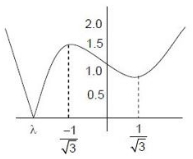
If the volume of the parallelepiped formed by the vectors $\hat{i} + \lambda \hat{j} + \hat{k}$,$\hat{j} + \lambda \hat{k}$ and $\lambda \hat{i} + \hat{k}$ is minimum,then $\lambda$ is equal to
A
$\sqrt{3}$
B
$\frac{1}{\sqrt{3}}$
C
$-\frac{1}{\sqrt{3}}$
D
None of these
Solution
(D) The volume $V$ of the parallelepiped formed by vectors $\vec{a} = \hat{i} + \lambda \hat{j} + \hat{k}$,$\vec{b} = \hat{j} + \lambda \hat{k}$,and $\vec{c} = \lambda \hat{i} + \hat{k}$ is given by the absolute value of the scalar triple product:
$V = |\vec{a} \cdot (\vec{b} \times \vec{c})| = \left| \det \begin{bmatrix} 1 & \lambda & 1 \\ 0 & 1 & \lambda \\ \lambda & 0 & 1 \end{bmatrix} \right|$
Expanding the determinant along the first row:
$\det = 1(1 - 0) - \lambda(0 - \lambda^2) + 1(0 - \lambda) = 1 + \lambda^3 - \lambda$
So,$V(\lambda) = |\lambda^3 - \lambda + 1|$.
To find the minimum,let $f(\lambda) = \lambda^3 - \lambda + 1$. We find the critical points by setting $f'(\lambda) = 0$:
$f'(\lambda) = 3\lambda^2 - 1 = 0 \implies \lambda^2 = \frac{1}{3} \implies \lambda = \pm \frac{1}{\sqrt{3}}$.
Evaluating $f(\lambda)$ at these points:
For $\lambda = \frac{1}{\sqrt{3}}$,$f\left(\frac{1}{\sqrt{3}}\right) = \frac{1}{3\sqrt{3}} - \frac{1}{\sqrt{3}} + 1 = 1 - \frac{2}{3\sqrt{3}} \approx 1 - 0.385 = 0.615$.
For $\lambda = -\frac{1}{\sqrt{3}}$,$f\left(-\frac{1}{\sqrt{3}}\right) = -\frac{1}{3\sqrt{3}} + \frac{1}{\sqrt{3}} + 1 = 1 + \frac{2}{3\sqrt{3}} \approx 1.385$.
Since the volume $V = |f(\lambda)|$,we look for the minimum of $|f(\lambda)|$. The function $f(\lambda)$ has a local minimum at $\lambda = \frac{1}{\sqrt{3}}$ with value $\approx 0.615$. Since $f(\lambda) \to -\infty$ as $\lambda \to -\infty$ and $f(\lambda) \to \infty$ as $\lambda \to \infty$,the function $f(\lambda)$ crosses zero at some $\lambda < -1$. At this point,the volume $V = 0$,which is the absolute minimum.
Since none of the provided options correspond to the root of $\lambda^3 - \lambda + 1 = 0$,the correct option is $D$.
$V = |\vec{a} \cdot (\vec{b} \times \vec{c})| = \left| \det \begin{bmatrix} 1 & \lambda & 1 \\ 0 & 1 & \lambda \\ \lambda & 0 & 1 \end{bmatrix} \right|$
Expanding the determinant along the first row:
$\det = 1(1 - 0) - \lambda(0 - \lambda^2) + 1(0 - \lambda) = 1 + \lambda^3 - \lambda$
So,$V(\lambda) = |\lambda^3 - \lambda + 1|$.
To find the minimum,let $f(\lambda) = \lambda^3 - \lambda + 1$. We find the critical points by setting $f'(\lambda) = 0$:
$f'(\lambda) = 3\lambda^2 - 1 = 0 \implies \lambda^2 = \frac{1}{3} \implies \lambda = \pm \frac{1}{\sqrt{3}}$.
Evaluating $f(\lambda)$ at these points:
For $\lambda = \frac{1}{\sqrt{3}}$,$f\left(\frac{1}{\sqrt{3}}\right) = \frac{1}{3\sqrt{3}} - \frac{1}{\sqrt{3}} + 1 = 1 - \frac{2}{3\sqrt{3}} \approx 1 - 0.385 = 0.615$.
For $\lambda = -\frac{1}{\sqrt{3}}$,$f\left(-\frac{1}{\sqrt{3}}\right) = -\frac{1}{3\sqrt{3}} + \frac{1}{\sqrt{3}} + 1 = 1 + \frac{2}{3\sqrt{3}} \approx 1.385$.
Since the volume $V = |f(\lambda)|$,we look for the minimum of $|f(\lambda)|$. The function $f(\lambda)$ has a local minimum at $\lambda = \frac{1}{\sqrt{3}}$ with value $\approx 0.615$. Since $f(\lambda) \to -\infty$ as $\lambda \to -\infty$ and $f(\lambda) \to \infty$ as $\lambda \to \infty$,the function $f(\lambda)$ crosses zero at some $\lambda < -1$. At this point,the volume $V = 0$,which is the absolute minimum.
Since none of the provided options correspond to the root of $\lambda^3 - \lambda + 1 = 0$,the correct option is $D$.
0 likes
View Solution178
DifficultMCQ
Let $\alpha \in \mathbb{R}$ and the three vectors $\vec{a} = \alpha \hat{i} + \hat{j} + 3\hat{k}$,$\vec{b} = 2\hat{i} + \hat{j} - \alpha \hat{k}$,and $\vec{c} = \alpha \hat{i} - 2\hat{j} + 3\hat{k}$. Then the set $S = \{ \alpha : \vec{a}, \vec{b}, \text{ and } \vec{c} \text{ are coplanar} \}$
A
Contains exactly two numbers only one of which is positive
B
is empty
C
Contains exactly two positive numbers
D
is singleton
Solution
(B) Three vectors $\vec{a}, \vec{b}, \text{ and } \vec{c}$ are coplanar if and only if their scalar triple product is zero,i.e.,$[\vec{a} \vec{b} \vec{c}] = 0$.
The scalar triple product is given by the determinant of the components:
$\begin{vmatrix} \alpha & 1 & 3 \\ 2 & 1 & -\alpha \\ \alpha & -2 & 3 \end{vmatrix} = 0$
Expanding along the first row:
$\alpha(1(3) - (-2)(-\alpha)) - 1(2(3) - \alpha(-\alpha)) + 3(2(-2) - \alpha(1)) = 0$
$\alpha(3 - 2\alpha) - 1(6 + \alpha^2) + 3(-4 - \alpha) = 0$
$3\alpha - 2\alpha^2 - 6 - \alpha^2 - 12 - 3\alpha = 0$
$-3\alpha^2 - 18 = 0$
$-3(\alpha^2 + 6) = 0$
$\alpha^2 + 6 = 0$
Since $\alpha \in \mathbb{R}$,$\alpha^2$ must be non-negative,so $\alpha^2 + 6 \geq 6$. Thus,there is no real value of $\alpha$ that satisfies this equation.
Therefore,the set $S$ is an empty set.
The scalar triple product is given by the determinant of the components:
$\begin{vmatrix} \alpha & 1 & 3 \\ 2 & 1 & -\alpha \\ \alpha & -2 & 3 \end{vmatrix} = 0$
Expanding along the first row:
$\alpha(1(3) - (-2)(-\alpha)) - 1(2(3) - \alpha(-\alpha)) + 3(2(-2) - \alpha(1)) = 0$
$\alpha(3 - 2\alpha) - 1(6 + \alpha^2) + 3(-4 - \alpha) = 0$
$3\alpha - 2\alpha^2 - 6 - \alpha^2 - 12 - 3\alpha = 0$
$-3\alpha^2 - 18 = 0$
$-3(\alpha^2 + 6) = 0$
$\alpha^2 + 6 = 0$
Since $\alpha \in \mathbb{R}$,$\alpha^2$ must be non-negative,so $\alpha^2 + 6 \geq 6$. Thus,there is no real value of $\alpha$ that satisfies this equation.
Therefore,the set $S$ is an empty set.
0 likes
View Solution179
DifficultMCQ
Let the volume of a parallelepiped whose coterminous edges are given by $\overrightarrow{u}=\hat{i}+\hat{j}+\lambda \hat{k}$,$\overrightarrow{v}=\hat{i}+\hat{j}+3 \hat{k}$ and $\overrightarrow{w}=2 \hat{i}+\hat{j}+\hat{k}$ be $1 \text{ cu. unit}$. If $\theta$ is the angle between the edges $\overrightarrow{u}$ and $\overrightarrow{w}$,then $\cos \theta$ can be
A
$\frac{7}{6 \sqrt{3}}$
B
$\frac{5}{7}$
C
$\frac{7}{6 \sqrt{6}}$
D
$\frac{5}{3 \sqrt{3}}$
Solution
(A) The volume of a parallelepiped is given by the absolute value of the scalar triple product $|[\overrightarrow{u}, \overrightarrow{v}, \overrightarrow{w}]| = 1$.
$|\overrightarrow{u}, \overrightarrow{v}, \overrightarrow{w}| = \begin{vmatrix} 1 & 1 & \lambda \\ 1 & 1 & 3 \\ 2 & 1 & 1 \end{vmatrix} = 1(1-3) - 1(1-6) + \lambda(1-2) = -2 + 5 - \lambda = 3 - \lambda$.
Since the volume is $1$,$|3 - \lambda| = 1$,which gives $3 - \lambda = 1$ or $3 - \lambda = -1$.
Thus,$\lambda = 2$ or $\lambda = 4$.
Case $1$: If $\lambda = 2$,then $\overrightarrow{u} = \hat{i} + \hat{j} + 2\hat{k}$ and $\overrightarrow{w} = 2\hat{i} + \hat{j} + \hat{k}$.
$\overrightarrow{u} \cdot \overrightarrow{w} = (1)(2) + (1)(1) + (2)(1) = 2 + 1 + 2 = 5$.
$|\overrightarrow{u}| = \sqrt{1^2 + 1^2 + 2^2} = \sqrt{6}$ and $|\overrightarrow{w}| = \sqrt{2^2 + 1^2 + 1^2} = \sqrt{6}$.
$\cos \theta = \frac{\overrightarrow{u} \cdot \overrightarrow{w}}{|\overrightarrow{u}||\overrightarrow{w}|} = \frac{5}{\sqrt{6} \cdot \sqrt{6}} = \frac{5}{6}$.
Case $2$: If $\lambda = 4$,then $\overrightarrow{u} = \hat{i} + \hat{j} + 4\hat{k}$ and $\overrightarrow{w} = 2\hat{i} + \hat{j} + \hat{k}$.
$\overrightarrow{u} \cdot \overrightarrow{w} = (1)(2) + (1)(1) + (4)(1) = 2 + 1 + 4 = 7$.
$|\overrightarrow{u}| = \sqrt{1^2 + 1^2 + 4^2} = \sqrt{18} = 3\sqrt{2}$ and $|\overrightarrow{w}| = \sqrt{6}$.
$\cos \theta = \frac{7}{\sqrt{18} \cdot \sqrt{6}} = \frac{7}{3\sqrt{2} \cdot \sqrt{6}} = \frac{7}{3\sqrt{12}} = \frac{7}{3 \cdot 2\sqrt{3}} = \frac{7}{6\sqrt{3}}$.
Comparing with the options,$\frac{7}{6\sqrt{3}}$ is present.
$|\overrightarrow{u}, \overrightarrow{v}, \overrightarrow{w}| = \begin{vmatrix} 1 & 1 & \lambda \\ 1 & 1 & 3 \\ 2 & 1 & 1 \end{vmatrix} = 1(1-3) - 1(1-6) + \lambda(1-2) = -2 + 5 - \lambda = 3 - \lambda$.
Since the volume is $1$,$|3 - \lambda| = 1$,which gives $3 - \lambda = 1$ or $3 - \lambda = -1$.
Thus,$\lambda = 2$ or $\lambda = 4$.
Case $1$: If $\lambda = 2$,then $\overrightarrow{u} = \hat{i} + \hat{j} + 2\hat{k}$ and $\overrightarrow{w} = 2\hat{i} + \hat{j} + \hat{k}$.
$\overrightarrow{u} \cdot \overrightarrow{w} = (1)(2) + (1)(1) + (2)(1) = 2 + 1 + 2 = 5$.
$|\overrightarrow{u}| = \sqrt{1^2 + 1^2 + 2^2} = \sqrt{6}$ and $|\overrightarrow{w}| = \sqrt{2^2 + 1^2 + 1^2} = \sqrt{6}$.
$\cos \theta = \frac{\overrightarrow{u} \cdot \overrightarrow{w}}{|\overrightarrow{u}||\overrightarrow{w}|} = \frac{5}{\sqrt{6} \cdot \sqrt{6}} = \frac{5}{6}$.
Case $2$: If $\lambda = 4$,then $\overrightarrow{u} = \hat{i} + \hat{j} + 4\hat{k}$ and $\overrightarrow{w} = 2\hat{i} + \hat{j} + \hat{k}$.
$\overrightarrow{u} \cdot \overrightarrow{w} = (1)(2) + (1)(1) + (4)(1) = 2 + 1 + 4 = 7$.
$|\overrightarrow{u}| = \sqrt{1^2 + 1^2 + 4^2} = \sqrt{18} = 3\sqrt{2}$ and $|\overrightarrow{w}| = \sqrt{6}$.
$\cos \theta = \frac{7}{\sqrt{18} \cdot \sqrt{6}} = \frac{7}{3\sqrt{2} \cdot \sqrt{6}} = \frac{7}{3\sqrt{12}} = \frac{7}{3 \cdot 2\sqrt{3}} = \frac{7}{6\sqrt{3}}$.
Comparing with the options,$\frac{7}{6\sqrt{3}}$ is present.
0 likes
View Solution180
DifficultMCQ
If the vectors $\overrightarrow{p}=(a+1) \hat{i}+a \hat{j}+a \hat{k}$,$\overrightarrow{q}=a \hat{i}+(a+1) \hat{j}+a \hat{k}$,and $\overrightarrow{r}=a \hat{i}+a \hat{j}+(a+1) \hat{k}$ $(a \in R)$ are coplanar and $3(\overrightarrow{p} \cdot \overrightarrow{q})^{2}-\lambda|\overrightarrow{r} \times \overrightarrow{q}|^{2}=0$,then the value of $\lambda$ is:
A
$0.5$
B
$1$
C
$1.5$
D
$2$
Solution
(B) Given vectors are $\overrightarrow{p}=(a+1) \hat{i}+a \hat{j}+a \hat{k}$,$\overrightarrow{q}=a \hat{i}+(a+1) \hat{j}+a \hat{k}$,and $\overrightarrow{r}=a \hat{i}+a \hat{j}+(a+1) \hat{k}$.
Since $\overrightarrow{p}, \overrightarrow{q}, \overrightarrow{r}$ are coplanar,their scalar triple product is zero:
$\left|\begin{array}{ccc} a+1 & a & a \\ a & a+1 & a \\ a & a & a+1 \end{array}\right|=0$
Applying $R_1 \to R_1+R_2+R_3$,we get $(3a+1) \left|\begin{array}{ccc} 1 & 1 & 1 \\ a & a+1 & a \\ a & a & a+1 \end{array}\right|=0$,which simplifies to $(3a+1)(1)=0$,so $a = -\frac{1}{3}$.
Now,$\overrightarrow{p} \cdot \overrightarrow{q} = a^2 + a(a+1) + a^2 = 3a^2+a = 3(-\frac{1}{3})^2 + (-\frac{1}{3}) = \frac{1}{3} - \frac{1}{3} = 0$. Wait,let's recompute: $\overrightarrow{p} \cdot \overrightarrow{q} = a(a+1) + a(a+1) + a^2 = 2a^2+2a+a^2 = 3a^2+2a$. For $a=-1/3$,$\overrightarrow{p} \cdot \overrightarrow{q} = 3(1/9) - 2/3 = 1/3 - 2/3 = -1/3$.
Also,$|\overrightarrow{r}|^2 = |\overrightarrow{q}|^2 = a^2 + a^2 + (a+1)^2 = 3a^2+2a+1 = 3(1/9) - 2/3 + 1 = 1/3 - 2/3 + 1 = 2/3$.
$\overrightarrow{r} \cdot \overrightarrow{q} = a^2 + a(a+1) + a(a+1) = a^2 + 2a^2 + 2a = 3a^2+2a = -1/3$.
Using Lagrange's identity,$|\overrightarrow{r} \times \overrightarrow{q}|^2 = |\overrightarrow{r}|^2 |\overrightarrow{q}|^2 - (\overrightarrow{r} \cdot \overrightarrow{q})^2 = (2/3)(2/3) - (-1/3)^2 = 4/9 - 1/9 = 3/9 = 1/3$.
Given $3(\overrightarrow{p} \cdot \overrightarrow{q})^2 - \lambda |\overrightarrow{r} \times \overrightarrow{q}|^2 = 0$,we have $3(-1/3)^2 - \lambda(1/3) = 0 \Rightarrow 3(1/9) - \lambda/3 = 0 \Rightarrow 1/3 = \lambda/3 \Rightarrow \lambda = 1$.
Since $\overrightarrow{p}, \overrightarrow{q}, \overrightarrow{r}$ are coplanar,their scalar triple product is zero:
$\left|\begin{array}{ccc} a+1 & a & a \\ a & a+1 & a \\ a & a & a+1 \end{array}\right|=0$
Applying $R_1 \to R_1+R_2+R_3$,we get $(3a+1) \left|\begin{array}{ccc} 1 & 1 & 1 \\ a & a+1 & a \\ a & a & a+1 \end{array}\right|=0$,which simplifies to $(3a+1)(1)=0$,so $a = -\frac{1}{3}$.
Now,$\overrightarrow{p} \cdot \overrightarrow{q} = a^2 + a(a+1) + a^2 = 3a^2+a = 3(-\frac{1}{3})^2 + (-\frac{1}{3}) = \frac{1}{3} - \frac{1}{3} = 0$. Wait,let's recompute: $\overrightarrow{p} \cdot \overrightarrow{q} = a(a+1) + a(a+1) + a^2 = 2a^2+2a+a^2 = 3a^2+2a$. For $a=-1/3$,$\overrightarrow{p} \cdot \overrightarrow{q} = 3(1/9) - 2/3 = 1/3 - 2/3 = -1/3$.
Also,$|\overrightarrow{r}|^2 = |\overrightarrow{q}|^2 = a^2 + a^2 + (a+1)^2 = 3a^2+2a+1 = 3(1/9) - 2/3 + 1 = 1/3 - 2/3 + 1 = 2/3$.
$\overrightarrow{r} \cdot \overrightarrow{q} = a^2 + a(a+1) + a(a+1) = a^2 + 2a^2 + 2a = 3a^2+2a = -1/3$.
Using Lagrange's identity,$|\overrightarrow{r} \times \overrightarrow{q}|^2 = |\overrightarrow{r}|^2 |\overrightarrow{q}|^2 - (\overrightarrow{r} \cdot \overrightarrow{q})^2 = (2/3)(2/3) - (-1/3)^2 = 4/9 - 1/9 = 3/9 = 1/3$.
Given $3(\overrightarrow{p} \cdot \overrightarrow{q})^2 - \lambda |\overrightarrow{r} \times \overrightarrow{q}|^2 = 0$,we have $3(-1/3)^2 - \lambda(1/3) = 0 \Rightarrow 3(1/9) - \lambda/3 = 0 \Rightarrow 1/3 = \lambda/3 \Rightarrow \lambda = 1$.
0 likes
View Solution181
DifficultMCQ
Let $x_{0}$ be the point of local maxima of $f(x)=\vec{a} \cdot(\vec{b} \times \vec{c}),$ where $\vec{a}=x \hat{i}-2 \hat{j}+3 \hat{k}$,$\vec{b}=-2 \hat{i}+x \hat{j}-\hat{k}$ and $\vec{c}=7 \hat{i}-2 \hat{j}+x \hat{k}$. Then the value of $\vec{a} \cdot \vec{b}+\vec{b} \cdot \vec{c}+\vec{c} \cdot \vec{a}$ at $x=x_{0}$ is:
A
$-30$
B
$14$
C
$-4$
D
$-22$
Solution
(D) The function is defined as the scalar triple product $f(x) = [\vec{a} \vec{b} \vec{c}] = \begin{vmatrix} x & -2 & 3 \\ -2 & x & -1 \\ 7 & -2 & x \end{vmatrix}$.
Expanding the determinant: $f(x) = x(x^2 - 2) + 2(-2x + 7) + 3(4 - 7x) = x^3 - 2x - 4x + 14 + 12 - 21x = x^3 - 27x + 26$.
To find the local maxima,we calculate the derivative: $f'(x) = 3x^2 - 27$. Setting $f'(x) = 0$ gives $x^2 = 9$,so $x = \pm 3$.
The second derivative is $f''(x) = 6x$. For $x = -3$,$f''(-3) = -18 < 0$,so $x_0 = -3$ is the point of local maxima.
At $x = -3$,the vectors are $\vec{a} = -3\hat{i} - 2\hat{j} + 3\hat{k}$,$\vec{b} = -2\hat{i} - 3\hat{j} - \hat{k}$,and $\vec{c} = 7\hat{i} - 2\hat{j} - 3\hat{k}$.
Calculating the dot products:
$\vec{a} \cdot \vec{b} = (-3)(-2) + (-2)(-3) + (3)(-1) = 6 + 6 - 3 = 9$.
$\vec{b} \cdot \vec{c} = (-2)(7) + (-3)(-2) + (-1)(-3) = -14 + 6 + 3 = -5$.
$\vec{c} \cdot \vec{a} = (7)(-3) + (-2)(-2) + (-3)(3) = -21 + 4 - 9 = -26$.
Summing these: $9 - 5 - 26 = -22$.
Expanding the determinant: $f(x) = x(x^2 - 2) + 2(-2x + 7) + 3(4 - 7x) = x^3 - 2x - 4x + 14 + 12 - 21x = x^3 - 27x + 26$.
To find the local maxima,we calculate the derivative: $f'(x) = 3x^2 - 27$. Setting $f'(x) = 0$ gives $x^2 = 9$,so $x = \pm 3$.
The second derivative is $f''(x) = 6x$. For $x = -3$,$f''(-3) = -18 < 0$,so $x_0 = -3$ is the point of local maxima.
At $x = -3$,the vectors are $\vec{a} = -3\hat{i} - 2\hat{j} + 3\hat{k}$,$\vec{b} = -2\hat{i} - 3\hat{j} - \hat{k}$,and $\vec{c} = 7\hat{i} - 2\hat{j} - 3\hat{k}$.
Calculating the dot products:
$\vec{a} \cdot \vec{b} = (-3)(-2) + (-2)(-3) + (3)(-1) = 6 + 6 - 3 = 9$.
$\vec{b} \cdot \vec{c} = (-2)(7) + (-3)(-2) + (-1)(-3) = -14 + 6 + 3 = -5$.
$\vec{c} \cdot \vec{a} = (7)(-3) + (-2)(-2) + (-3)(3) = -21 + 4 - 9 = -26$.
Summing these: $9 - 5 - 26 = -22$.
0 likes
View Solution182
MediumMCQ
If the volume of a parallelepiped,whose coterminous edges are given by the vectors $\overrightarrow{a} = \hat{i} + \hat{j} + n\hat{k}$,$\overrightarrow{b} = 2\hat{i} + 4\hat{j} - n\hat{k}$,and $\overrightarrow{c} = \hat{i} + n\hat{j} + 3\hat{k}$ $(n \geq 0)$,is $158$ cubic units,then which of the following is true?
A
$\overrightarrow{a} \cdot \overrightarrow{c} = 17$
B
$\overrightarrow{b} \cdot \overrightarrow{c} = 10$
C
$n = 7$
D
$n = 9$
Solution
(B) The volume $V$ of a parallelepiped with coterminous edges $\overrightarrow{a}, \overrightarrow{b}, \overrightarrow{c}$ is given by the scalar triple product $|[\overrightarrow{a} \overrightarrow{b} \overrightarrow{c}]|$.
$V = |\det(\overrightarrow{a}, \overrightarrow{b}, \overrightarrow{c})| = 158$
$\det(\overrightarrow{a}, \overrightarrow{b}, \overrightarrow{c}) = \begin{vmatrix} 1 & 1 & n \\ 2 & 4 & -n \\ 1 & n & 3 \end{vmatrix} = 1(12 + n^2) - 1(6 + n) + n(2n - 4)$
$= 12 + n^2 - 6 - n + 2n^2 - 4n = 3n^2 - 5n + 6$
Since $V = 158$,we have $|3n^2 - 5n + 6| = 158$. Given $n \geq 0$,$3n^2 - 5n + 6 = 158$ or $3n^2 - 5n + 6 = -158$.
Case $1$: $3n^2 - 5n - 152 = 0$. Solving for $n$: $n = \frac{5 \pm \sqrt{25 - 4(3)(-152)}}{6} = \frac{5 \pm \sqrt{25 + 1824}}{6} = \frac{5 \pm \sqrt{1849}}{6} = \frac{5 \pm 43}{6}$.
Since $n \geq 0$,$n = \frac{48}{6} = 8$.
Case $2$: $3n^2 - 5n + 164 = 0$. The discriminant $D = 25 - 4(3)(164) < 0$,so no real solutions.
Thus,$n = 8$.
Now,check the options:
$A$. $\overrightarrow{a} \cdot \overrightarrow{c} = (1)(1) + (1)(n) + (n)(3) = 1 + 4n = 1 + 4(8) = 33$.
$B$. $\overrightarrow{b} \cdot \overrightarrow{c} = (2)(1) + (4)(n) + (-n)(3) = 2 + n = 2 + 8 = 10$.
Therefore,option $B$ is correct.
$V = |\det(\overrightarrow{a}, \overrightarrow{b}, \overrightarrow{c})| = 158$
$\det(\overrightarrow{a}, \overrightarrow{b}, \overrightarrow{c}) = \begin{vmatrix} 1 & 1 & n \\ 2 & 4 & -n \\ 1 & n & 3 \end{vmatrix} = 1(12 + n^2) - 1(6 + n) + n(2n - 4)$
$= 12 + n^2 - 6 - n + 2n^2 - 4n = 3n^2 - 5n + 6$
Since $V = 158$,we have $|3n^2 - 5n + 6| = 158$. Given $n \geq 0$,$3n^2 - 5n + 6 = 158$ or $3n^2 - 5n + 6 = -158$.
Case $1$: $3n^2 - 5n - 152 = 0$. Solving for $n$: $n = \frac{5 \pm \sqrt{25 - 4(3)(-152)}}{6} = \frac{5 \pm \sqrt{25 + 1824}}{6} = \frac{5 \pm \sqrt{1849}}{6} = \frac{5 \pm 43}{6}$.
Since $n \geq 0$,$n = \frac{48}{6} = 8$.
Case $2$: $3n^2 - 5n + 164 = 0$. The discriminant $D = 25 - 4(3)(164) < 0$,so no real solutions.
Thus,$n = 8$.
Now,check the options:
$A$. $\overrightarrow{a} \cdot \overrightarrow{c} = (1)(1) + (1)(n) + (n)(3) = 1 + 4n = 1 + 4(8) = 33$.
$B$. $\overrightarrow{b} \cdot \overrightarrow{c} = (2)(1) + (4)(n) + (-n)(3) = 2 + n = 2 + 8 = 10$.
Therefore,option $B$ is correct.
0 likes
View Solution183
DifficultMCQ
If $\overrightarrow{a} = \alpha \hat{i} + \beta \hat{j} + 3 \hat{k}$,$\overrightarrow{b} = -\beta \hat{i} - \alpha \hat{j} - \hat{k}$,and $\overrightarrow{c} = \hat{i} - 2 \hat{j} - \hat{k}$ such that $\overrightarrow{a} \cdot \overrightarrow{b} = 1$ and $\overrightarrow{b} \cdot \overrightarrow{c} = -3$,then $\frac{1}{3}((\vec{a} \times \vec{b}) \cdot \vec{c})$ is equal to ............
A
$1$
B
$4$
C
$2$
D
$6$
Solution
(C) Given $\vec{a} \cdot \vec{b} = 1 \Rightarrow (\alpha \hat{i} + \beta \hat{j} + 3 \hat{k}) \cdot (-\beta \hat{i} - \alpha \hat{j} - \hat{k}) = 1$.
This simplifies to $-\alpha \beta - \alpha \beta - 3 = 1 \Rightarrow -2 \alpha \beta = 4 \Rightarrow \alpha \beta = -2$ $(1)$.
Given $\vec{b} \cdot \vec{c} = -3 \Rightarrow (-\beta \hat{i} - \alpha \hat{j} - \hat{k}) \cdot (\hat{i} - 2 \hat{j} - \hat{k}) = -3$.
This simplifies to $-\beta + 2 \alpha + 1 = -3 \Rightarrow 2 \alpha - \beta = -4$ $(2)$.
From $(1)$,$\beta = -2/\alpha$. Substituting into $(2)$: $2 \alpha - (-2/\alpha) = -4 \Rightarrow 2 \alpha^2 + 2 = -4 \alpha \Rightarrow \alpha^2 + 2 \alpha + 1 = 0 \Rightarrow (\alpha + 1)^2 = 0 \Rightarrow \alpha = -1$.
Then $\beta = -2/(-1) = 2$.
Now,the scalar triple product is $\frac{1}{3}[\vec{a} \vec{b} \vec{c}] = \frac{1}{3} \begin{vmatrix} \alpha & \beta & 3 \\ -\beta & -\alpha & -1 \\ 1 & -2 & -1 \end{vmatrix} = \frac{1}{3} \begin{vmatrix} -1 & 2 & 3 \\ -2 & 1 & -1 \\ 1 & -2 & -1 \end{vmatrix}$.
Performing row operations $R_1 \to R_1 + R_3$: $\frac{1}{3} \begin{vmatrix} 0 & 0 & 2 \\ -2 & 1 & -1 \\ 1 & -2 & -1 \end{vmatrix} = \frac{1}{3} [2(4 - 1)] = \frac{1}{3} \times 6 = 2$.
This simplifies to $-\alpha \beta - \alpha \beta - 3 = 1 \Rightarrow -2 \alpha \beta = 4 \Rightarrow \alpha \beta = -2$ $(1)$.
Given $\vec{b} \cdot \vec{c} = -3 \Rightarrow (-\beta \hat{i} - \alpha \hat{j} - \hat{k}) \cdot (\hat{i} - 2 \hat{j} - \hat{k}) = -3$.
This simplifies to $-\beta + 2 \alpha + 1 = -3 \Rightarrow 2 \alpha - \beta = -4$ $(2)$.
From $(1)$,$\beta = -2/\alpha$. Substituting into $(2)$: $2 \alpha - (-2/\alpha) = -4 \Rightarrow 2 \alpha^2 + 2 = -4 \alpha \Rightarrow \alpha^2 + 2 \alpha + 1 = 0 \Rightarrow (\alpha + 1)^2 = 0 \Rightarrow \alpha = -1$.
Then $\beta = -2/(-1) = 2$.
Now,the scalar triple product is $\frac{1}{3}[\vec{a} \vec{b} \vec{c}] = \frac{1}{3} \begin{vmatrix} \alpha & \beta & 3 \\ -\beta & -\alpha & -1 \\ 1 & -2 & -1 \end{vmatrix} = \frac{1}{3} \begin{vmatrix} -1 & 2 & 3 \\ -2 & 1 & -1 \\ 1 & -2 & -1 \end{vmatrix}$.
Performing row operations $R_1 \to R_1 + R_3$: $\frac{1}{3} \begin{vmatrix} 0 & 0 & 2 \\ -2 & 1 & -1 \\ 1 & -2 & -1 \end{vmatrix} = \frac{1}{3} [2(4 - 1)] = \frac{1}{3} \times 6 = 2$.
0 likes
View Solution184
DifficultMCQ
Let $O$ be the origin. Let $\overline{OP} = x\hat{i} + y\hat{j} - \hat{k}$ and $\overline{OQ} = -\hat{i} + 2\hat{j} + 3x\hat{k}$,where $x, y \in \mathbb{R}$ and $x > 0$,be such that $|\overline{PQ}| = \sqrt{20}$ and the vector $\overline{OP}$ is perpendicular to $\overline{OQ}$. If $\overline{OR} = 3\hat{i} + z\hat{j} - 7\hat{k}$,where $z \in \mathbb{R}$,is coplanar with $\overline{OP}$ and $\overline{OQ}$,then the value of $x^2 + y^2 + z^2$ is equal to ...... .
A
$7$
B
$9$
C
$2$
D
$1$
Solution
(B) Given $\overline{OP} \perp \overline{OQ}$,their dot product is zero:
$(x\hat{i} + y\hat{j} - \hat{k}) \cdot (-\hat{i} + 2\hat{j} + 3x\hat{k}) = 0$
$-x + 2y - 3x = 0 \Rightarrow 2y = 4x \Rightarrow y = 2x \dots (i)$
Given $|\overline{PQ}| = \sqrt{20}$,so $|\overline{PQ}|^2 = 20$:
$\overline{PQ} = \overline{OQ} - \overline{OP} = (-1-x)\hat{i} + (2-y)\hat{j} + (3x+1)\hat{k}$
$|\overline{PQ}|^2 = (-1-x)^2 + (2-y)^2 + (3x+1)^2 = 20$
Substitute $y=2x$:
$(x+1)^2 + (2-2x)^2 + (3x+1)^2 = 20$
$x^2 + 2x + 1 + 4 - 8x + 4x^2 + 9x^2 + 6x + 1 = 20$
$14x^2 + 6 = 20 \Rightarrow 14x^2 = 14 \Rightarrow x^2 = 1 \Rightarrow x = 1$ (since $x > 0$)
Then $y = 2(1) = 2$.
Since $\overline{OP}, \overline{OQ}, \overline{OR}$ are coplanar,their scalar triple product is zero:
$\begin{vmatrix} x & y & -1 \\ -1 & 2 & 3x \\ 3 & z & -7 \end{vmatrix} = 0 \Rightarrow \begin{vmatrix} 1 & 2 & -1 \\ -1 & 2 & 3 \\ 3 & z & -7 \end{vmatrix} = 0$
$1(-14 - 3z) - 2(7 - 9) - 1(-z - 6) = 0$
$-14 - 3z + 4 + z + 6 = 0 \Rightarrow -2z - 4 = 0 \Rightarrow z = -2$
Therefore,$x^2 + y^2 + z^2 = 1^2 + 2^2 + (-2)^2 = 1 + 4 + 4 = 9$.
$(x\hat{i} + y\hat{j} - \hat{k}) \cdot (-\hat{i} + 2\hat{j} + 3x\hat{k}) = 0$
$-x + 2y - 3x = 0 \Rightarrow 2y = 4x \Rightarrow y = 2x \dots (i)$
Given $|\overline{PQ}| = \sqrt{20}$,so $|\overline{PQ}|^2 = 20$:
$\overline{PQ} = \overline{OQ} - \overline{OP} = (-1-x)\hat{i} + (2-y)\hat{j} + (3x+1)\hat{k}$
$|\overline{PQ}|^2 = (-1-x)^2 + (2-y)^2 + (3x+1)^2 = 20$
Substitute $y=2x$:
$(x+1)^2 + (2-2x)^2 + (3x+1)^2 = 20$
$x^2 + 2x + 1 + 4 - 8x + 4x^2 + 9x^2 + 6x + 1 = 20$
$14x^2 + 6 = 20 \Rightarrow 14x^2 = 14 \Rightarrow x^2 = 1 \Rightarrow x = 1$ (since $x > 0$)
Then $y = 2(1) = 2$.
Since $\overline{OP}, \overline{OQ}, \overline{OR}$ are coplanar,their scalar triple product is zero:
$\begin{vmatrix} x & y & -1 \\ -1 & 2 & 3x \\ 3 & z & -7 \end{vmatrix} = 0 \Rightarrow \begin{vmatrix} 1 & 2 & -1 \\ -1 & 2 & 3 \\ 3 & z & -7 \end{vmatrix} = 0$
$1(-14 - 3z) - 2(7 - 9) - 1(-z - 6) = 0$
$-14 - 3z + 4 + z + 6 = 0 \Rightarrow -2z - 4 = 0 \Rightarrow z = -2$
Therefore,$x^2 + y^2 + z^2 = 1^2 + 2^2 + (-2)^2 = 1 + 4 + 4 = 9$.
0 likes
View Solution185
DifficultMCQ
If $(1,5,35), (7,5,5), (1, \lambda, 7)$ and $(2 \lambda, 1, 2)$ are coplanar,then the sum of all possible values of $\lambda$ is
A
$\frac{39}{5}$
B
$-\frac{39}{5}$
C
$\frac{44}{5}$
D
$-\frac{44}{5}$
Solution
(C) Let the points be $A(1, 5, 35)$,$B(7, 5, 5)$,$C(1, \lambda, 7)$,and $D(2 \lambda, 1, 2)$.
The vectors are:
$\vec{AB} = (7-1)\hat{i} + (5-5)\hat{j} + (5-35)\hat{k} = 6\hat{i} - 30\hat{k}$
$\vec{AC} = (1-1)\hat{i} + (\lambda-5)\hat{j} + (7-35)\hat{k} = (\lambda-5)\hat{j} - 28\hat{k}$
$\vec{AD} = (2\lambda-1)\hat{i} + (1-5)\hat{j} + (2-35)\hat{k} = (2\lambda-1)\hat{i} - 4\hat{j} - 33\hat{k}$
Since the points are coplanar,the scalar triple product $[\vec{AB} \vec{AC} \vec{AD}] = 0$.
$\begin{vmatrix} 6 & 0 & -30 \\ 0 & \lambda-5 & -28 \\ 2\lambda-1 & -4 & -33 \end{vmatrix} = 0$
Expanding along the first row:
$6[(\lambda-5)(-33) - (-28)(-4)] - 0 + (-30)[0 - (\lambda-5)(2\lambda-1)] = 0$
$6[-33\lambda + 165 - 112] - 30[-(2\lambda^2 - \lambda - 10\lambda + 5)] = 0$
$6[-33\lambda + 53] + 30[2\lambda^2 - 11\lambda + 5] = 0$
Divide by $6$:
$-33\lambda + 53 + 5(2\lambda^2 - 11\lambda + 5) = 0$
$-33\lambda + 53 + 10\lambda^2 - 55\lambda + 25 = 0$
$10\lambda^2 - 88\lambda + 78 = 0$
$5\lambda^2 - 44\lambda + 39 = 0$
The sum of the roots $\lambda_1 + \lambda_2 = -\frac{b}{a} = -\frac{-44}{5} = \frac{44}{5}$.
The vectors are:
$\vec{AB} = (7-1)\hat{i} + (5-5)\hat{j} + (5-35)\hat{k} = 6\hat{i} - 30\hat{k}$
$\vec{AC} = (1-1)\hat{i} + (\lambda-5)\hat{j} + (7-35)\hat{k} = (\lambda-5)\hat{j} - 28\hat{k}$
$\vec{AD} = (2\lambda-1)\hat{i} + (1-5)\hat{j} + (2-35)\hat{k} = (2\lambda-1)\hat{i} - 4\hat{j} - 33\hat{k}$
Since the points are coplanar,the scalar triple product $[\vec{AB} \vec{AC} \vec{AD}] = 0$.
$\begin{vmatrix} 6 & 0 & -30 \\ 0 & \lambda-5 & -28 \\ 2\lambda-1 & -4 & -33 \end{vmatrix} = 0$
Expanding along the first row:
$6[(\lambda-5)(-33) - (-28)(-4)] - 0 + (-30)[0 - (\lambda-5)(2\lambda-1)] = 0$
$6[-33\lambda + 165 - 112] - 30[-(2\lambda^2 - \lambda - 10\lambda + 5)] = 0$
$6[-33\lambda + 53] + 30[2\lambda^2 - 11\lambda + 5] = 0$
Divide by $6$:
$-33\lambda + 53 + 5(2\lambda^2 - 11\lambda + 5) = 0$
$-33\lambda + 53 + 10\lambda^2 - 55\lambda + 25 = 0$
$10\lambda^2 - 88\lambda + 78 = 0$
$5\lambda^2 - 44\lambda + 39 = 0$
The sum of the roots $\lambda_1 + \lambda_2 = -\frac{b}{a} = -\frac{-44}{5} = \frac{44}{5}$.
0 likes
View Solution186
DifficultMCQ
Let $\overrightarrow{a}=\hat{i}+\hat{j}+\hat{k}$ and $\overrightarrow{b}=\hat{j}-\hat{k}.$ If $\overrightarrow{c}$ is a vector such that $\vec{a} \times \vec{c}=\vec{b}$ and $\vec{a} \cdot \vec{c}=3$,then $\vec{a} \cdot(\vec{b} \times \vec{c})$ is equal to :
A
$-2$
B
$-6$
C
$6$
D
$2$
Solution
(A) Given $\vec{a} = \hat{i} + \hat{j} + \hat{k}$ and $\vec{b} = \hat{j} - \hat{k}$.
We are given $\vec{a} \times \vec{c} = \vec{b}$ and $\vec{a} \cdot \vec{c} = 3$.
We need to find $\vec{a} \cdot (\vec{b} \times \vec{c})$.
Using the scalar triple product property,$\vec{a} \cdot (\vec{b} \times \vec{c}) = (\vec{a} \times \vec{b}) \cdot \vec{c}$.
First,calculate $\vec{a} \times \vec{b}$:
$\vec{a} \times \vec{b} = \begin{vmatrix} \hat{i} & \hat{j} & \hat{k} \\ 1 & 1 & 1 \\ 0 & 1 & -1 \end{vmatrix} = \hat{i}(-1-1) - \hat{j}(-1-0) + \hat{k}(1-0) = -2\hat{i} + \hat{j} + \hat{k}$.
Now,use the vector triple product identity $\vec{a} \times (\vec{a} \times \vec{c}) = (\vec{a} \cdot \vec{c})\vec{a} - (\vec{a} \cdot \vec{a})\vec{c}$.
Since $\vec{a} \times \vec{c} = \vec{b}$,we have $\vec{a} \times \vec{b} = (\vec{a} \cdot \vec{c})\vec{a} - |\vec{a}|^2 \vec{c}$.
Given $|\vec{a}|^2 = 1^2 + 1^2 + 1^2 = 3$ and $\vec{a} \cdot \vec{c} = 3$,we get:
$-2\hat{i} + \hat{j} + \hat{k} = 3(\hat{i} + \hat{j} + \hat{k}) - 3\vec{c}$.
$3\vec{c} = 3\hat{i} + 3\hat{j} + 3\hat{k} - (-2\hat{i} + \hat{j} + \hat{k}) = 5\hat{i} + 2\hat{j} + 2\hat{k}$.
$\vec{c} = \frac{5}{3}\hat{i} + \frac{2}{3}\hat{j} + \frac{2}{3}\hat{k}$.
Finally,$\vec{a} \cdot (\vec{b} \times \vec{c}) = (\vec{a} \times \vec{b}) \cdot \vec{c} = (-2\hat{i} + \hat{j} + \hat{k}) \cdot (\frac{5}{3}\hat{i} + \frac{2}{3}\hat{j} + \frac{2}{3}\hat{k}) = -\frac{10}{3} + \frac{2}{3} + \frac{2}{3} = -\frac{6}{3} = -2$.
We are given $\vec{a} \times \vec{c} = \vec{b}$ and $\vec{a} \cdot \vec{c} = 3$.
We need to find $\vec{a} \cdot (\vec{b} \times \vec{c})$.
Using the scalar triple product property,$\vec{a} \cdot (\vec{b} \times \vec{c}) = (\vec{a} \times \vec{b}) \cdot \vec{c}$.
First,calculate $\vec{a} \times \vec{b}$:
$\vec{a} \times \vec{b} = \begin{vmatrix} \hat{i} & \hat{j} & \hat{k} \\ 1 & 1 & 1 \\ 0 & 1 & -1 \end{vmatrix} = \hat{i}(-1-1) - \hat{j}(-1-0) + \hat{k}(1-0) = -2\hat{i} + \hat{j} + \hat{k}$.
Now,use the vector triple product identity $\vec{a} \times (\vec{a} \times \vec{c}) = (\vec{a} \cdot \vec{c})\vec{a} - (\vec{a} \cdot \vec{a})\vec{c}$.
Since $\vec{a} \times \vec{c} = \vec{b}$,we have $\vec{a} \times \vec{b} = (\vec{a} \cdot \vec{c})\vec{a} - |\vec{a}|^2 \vec{c}$.
Given $|\vec{a}|^2 = 1^2 + 1^2 + 1^2 = 3$ and $\vec{a} \cdot \vec{c} = 3$,we get:
$-2\hat{i} + \hat{j} + \hat{k} = 3(\hat{i} + \hat{j} + \hat{k}) - 3\vec{c}$.
$3\vec{c} = 3\hat{i} + 3\hat{j} + 3\hat{k} - (-2\hat{i} + \hat{j} + \hat{k}) = 5\hat{i} + 2\hat{j} + 2\hat{k}$.
$\vec{c} = \frac{5}{3}\hat{i} + \frac{2}{3}\hat{j} + \frac{2}{3}\hat{k}$.
Finally,$\vec{a} \cdot (\vec{b} \times \vec{c}) = (\vec{a} \times \vec{b}) \cdot \vec{c} = (-2\hat{i} + \hat{j} + \hat{k}) \cdot (\frac{5}{3}\hat{i} + \frac{2}{3}\hat{j} + \frac{2}{3}\hat{k}) = -\frac{10}{3} + \frac{2}{3} + \frac{2}{3} = -\frac{6}{3} = -2$.
0 likes
View Solution187
MediumMCQ
Let three vectors $\vec{a}, \vec{b}$ and $\vec{c}$ be such that $\vec{a} \times \vec{b} = \vec{c}$,$\vec{b} \times \vec{c} = \vec{a}$ and $|\vec{a}| = 2$. Then which one of the following is not true?
A
Projection of $\vec{a}$ on $(\vec{b} \times \vec{c})$ is $2$
B
$|3\vec{a} + \vec{b} - 2\vec{c}|^2 = 51$
C
$[\vec{a} \vec{b} \vec{c}] + [\vec{c} \vec{a} \vec{b}] = 8$
D
$\vec{a} \times ((\vec{b} + \vec{c}) \times (\vec{b} - \vec{c})) = \vec{0}$
Solution
(B) Given $\vec{a} \times \vec{b} = \vec{c}$ and $\vec{b} \times \vec{c} = \vec{a}$.
Since $\vec{a} \times \vec{b} = \vec{c}$,$\vec{c}$ is perpendicular to both $\vec{a}$ and $\vec{b}$.
Since $\vec{b} \times \vec{c} = \vec{a}$,$\vec{a}$ is perpendicular to both $\vec{b}$ and $\vec{c}$.
Thus,$\vec{a}, \vec{b}, \vec{c}$ are mutually orthogonal.
$|\vec{a} \times \vec{b}| = |\vec{c}| \implies |\vec{a}||\vec{b}| = |\vec{c}| \implies 2|\vec{b}| = |\vec{c}|$.
$|\vec{b} \times \vec{c}| = |\vec{a}| \implies |\vec{b}||\vec{c}| = 2$.
Substituting $|\vec{c}| = 2|\vec{b}|$,we get $|\vec{b}|(2|\vec{b}|) = 2 \implies |\vec{b}|^2 = 1 \implies |\vec{b}| = 1$.
Then $|\vec{c}| = 2(1) = 2$.
$(A)$ Projection of $\vec{a}$ on $(\vec{b} \times \vec{c}) = \frac{\vec{a} \cdot (\vec{b} \times \vec{c})}{|\vec{b} \times \vec{c}|} = \frac{\vec{a} \cdot \vec{a}}{|\vec{a}|} = |\vec{a}| = 2$. (True)
$(B)$ $|3\vec{a} + \vec{b} - 2\vec{c}|^2 = (3\vec{a} + \vec{b} - 2\vec{c}) \cdot (3\vec{a} + \vec{b} - 2\vec{c}) = 9|\vec{a}|^2 + |\vec{b}|^2 + 4|\vec{c}|^2 = 9(4) + 1 + 4(4) = 36 + 1 + 16 = 53 \neq 51$. (Not True)
$(C)$ $[\vec{a} \vec{b} \vec{c}] + [\vec{c} \vec{a} \vec{b}] = 2[\vec{a} \vec{b} \vec{c}] = 2(\vec{a} \cdot (\vec{b} \times \vec{c})) = 2(\vec{a} \cdot \vec{a}) = 2|\vec{a}|^2 = 2(4) = 8$. (True)
$(D)$ $\vec{a} \times ((\vec{b} + \vec{c}) \times (\vec{b} - \vec{c})) = \vec{a} \times (\vec{b} \times \vec{b} - \vec{b} \times \vec{c} + \vec{c} \times \vec{b} - \vec{c} \times \vec{c}) = \vec{a} \times (\vec{0} - \vec{a} - \vec{a} - \vec{0}) = \vec{a} \times (-2\vec{a}) = -2(\vec{a} \times \vec{a}) = \vec{0}$. (True)
Since $\vec{a} \times \vec{b} = \vec{c}$,$\vec{c}$ is perpendicular to both $\vec{a}$ and $\vec{b}$.
Since $\vec{b} \times \vec{c} = \vec{a}$,$\vec{a}$ is perpendicular to both $\vec{b}$ and $\vec{c}$.
Thus,$\vec{a}, \vec{b}, \vec{c}$ are mutually orthogonal.
$|\vec{a} \times \vec{b}| = |\vec{c}| \implies |\vec{a}||\vec{b}| = |\vec{c}| \implies 2|\vec{b}| = |\vec{c}|$.
$|\vec{b} \times \vec{c}| = |\vec{a}| \implies |\vec{b}||\vec{c}| = 2$.
Substituting $|\vec{c}| = 2|\vec{b}|$,we get $|\vec{b}|(2|\vec{b}|) = 2 \implies |\vec{b}|^2 = 1 \implies |\vec{b}| = 1$.
Then $|\vec{c}| = 2(1) = 2$.
$(A)$ Projection of $\vec{a}$ on $(\vec{b} \times \vec{c}) = \frac{\vec{a} \cdot (\vec{b} \times \vec{c})}{|\vec{b} \times \vec{c}|} = \frac{\vec{a} \cdot \vec{a}}{|\vec{a}|} = |\vec{a}| = 2$. (True)
$(B)$ $|3\vec{a} + \vec{b} - 2\vec{c}|^2 = (3\vec{a} + \vec{b} - 2\vec{c}) \cdot (3\vec{a} + \vec{b} - 2\vec{c}) = 9|\vec{a}|^2 + |\vec{b}|^2 + 4|\vec{c}|^2 = 9(4) + 1 + 4(4) = 36 + 1 + 16 = 53 \neq 51$. (Not True)
$(C)$ $[\vec{a} \vec{b} \vec{c}] + [\vec{c} \vec{a} \vec{b}] = 2[\vec{a} \vec{b} \vec{c}] = 2(\vec{a} \cdot (\vec{b} \times \vec{c})) = 2(\vec{a} \cdot \vec{a}) = 2|\vec{a}|^2 = 2(4) = 8$. (True)
$(D)$ $\vec{a} \times ((\vec{b} + \vec{c}) \times (\vec{b} - \vec{c})) = \vec{a} \times (\vec{b} \times \vec{b} - \vec{b} \times \vec{c} + \vec{c} \times \vec{b} - \vec{c} \times \vec{c}) = \vec{a} \times (\vec{0} - \vec{a} - \vec{a} - \vec{0}) = \vec{a} \times (-2\vec{a}) = -2(\vec{a} \times \vec{a}) = \vec{0}$. (True)
0 likes
View Solution188
DifficultMCQ
Let a vector $\vec{a}$ be coplanar with vectors $\vec{b}=2 \hat{i}+\hat{j}+\hat{k}$ and $\vec{c}=\hat{i}-\hat{j}+\hat{k}$. If $\vec{a}$ is perpendicular to $\vec{d}=3 \hat{i}+2 \hat{j}+6 \hat{k}$,and $|\vec{a}|=\sqrt{10}$. Then a possible value of $[\vec{a} \vec{b} \vec{c}]+[\vec{a} \vec{b} \vec{d}]+[\vec{a} \vec{c} \vec{d}]$ is equal to:
A
$-40$
B
$-42$
C
$-29$
D
$-38$
Solution
(B) Since $\vec{a}$ is coplanar with $\vec{b}$ and $\vec{c}$,we can write $\vec{a} = \lambda \vec{b} + \mu \vec{c}$.
Substituting the vectors: $\vec{a} = \lambda(2 \hat{i} + \hat{j} + \hat{k}) + \mu(\hat{i} - \hat{j} + \hat{k}) = (2\lambda + \mu) \hat{i} + (\lambda - \mu) \hat{j} + (\lambda + \mu) \hat{k}$.
Given $\vec{a} \cdot \vec{d} = 0$,where $\vec{d} = 3 \hat{i} + 2 \hat{j} + 6 \hat{k}$:
$3(2\lambda + \mu) + 2(\lambda - \mu) + 6(\lambda + \mu) = 0$
$6\lambda + 3\mu + 2\lambda - 2\mu + 6\lambda + 6\mu = 0$
$14\lambda + 7\mu = 0 \implies \mu = -2\lambda$.
Substituting $\mu$ back into $\vec{a}$: $\vec{a} = (2\lambda - 2\lambda) \hat{i} + (\lambda - (-2\lambda)) \hat{j} + (\lambda - 2\lambda) \hat{k} = 0 \hat{i} + 3\lambda \hat{j} - \lambda \hat{k}$.
Given $|\vec{a}| = \sqrt{10}$,so $\sqrt{0^2 + (3\lambda)^2 + (-\lambda)^2} = \sqrt{10} \implies \sqrt{10\lambda^2} = \sqrt{10} \implies |\lambda| = 1$.
Since $\vec{a}, \vec{b}, \vec{c}$ are coplanar,$[\vec{a} \vec{b} \vec{c}] = 0$.
The expression becomes $[\vec{a} \vec{b} \vec{d}] + [\vec{a} \vec{c} \vec{d}] = [\vec{a} \vec{b} + \vec{c} \vec{d}]$.
Using $\vec{b} + \vec{c} = 3 \hat{i} + 0 \hat{j} + 2 \hat{k}$ and $\vec{a} = 3\lambda \hat{j} - \lambda \hat{k}$:
$[\vec{a} \vec{b} + \vec{c} \vec{d}] = \begin{vmatrix} 0 & 3\lambda & -\lambda \\ 3 & 0 & 2 \\ 3 & 2 & 6 \end{vmatrix} = 0(0 - 4) - 3\lambda(18 - 6) - \lambda(6 - 0) = -3\lambda(12) - 6\lambda = -42\lambda$.
For $\lambda = 1$,the value is $-42$.
Substituting the vectors: $\vec{a} = \lambda(2 \hat{i} + \hat{j} + \hat{k}) + \mu(\hat{i} - \hat{j} + \hat{k}) = (2\lambda + \mu) \hat{i} + (\lambda - \mu) \hat{j} + (\lambda + \mu) \hat{k}$.
Given $\vec{a} \cdot \vec{d} = 0$,where $\vec{d} = 3 \hat{i} + 2 \hat{j} + 6 \hat{k}$:
$3(2\lambda + \mu) + 2(\lambda - \mu) + 6(\lambda + \mu) = 0$
$6\lambda + 3\mu + 2\lambda - 2\mu + 6\lambda + 6\mu = 0$
$14\lambda + 7\mu = 0 \implies \mu = -2\lambda$.
Substituting $\mu$ back into $\vec{a}$: $\vec{a} = (2\lambda - 2\lambda) \hat{i} + (\lambda - (-2\lambda)) \hat{j} + (\lambda - 2\lambda) \hat{k} = 0 \hat{i} + 3\lambda \hat{j} - \lambda \hat{k}$.
Given $|\vec{a}| = \sqrt{10}$,so $\sqrt{0^2 + (3\lambda)^2 + (-\lambda)^2} = \sqrt{10} \implies \sqrt{10\lambda^2} = \sqrt{10} \implies |\lambda| = 1$.
Since $\vec{a}, \vec{b}, \vec{c}$ are coplanar,$[\vec{a} \vec{b} \vec{c}] = 0$.
The expression becomes $[\vec{a} \vec{b} \vec{d}] + [\vec{a} \vec{c} \vec{d}] = [\vec{a} \vec{b} + \vec{c} \vec{d}]$.
Using $\vec{b} + \vec{c} = 3 \hat{i} + 0 \hat{j} + 2 \hat{k}$ and $\vec{a} = 3\lambda \hat{j} - \lambda \hat{k}$:
$[\vec{a} \vec{b} + \vec{c} \vec{d}] = \begin{vmatrix} 0 & 3\lambda & -\lambda \\ 3 & 0 & 2 \\ 3 & 2 & 6 \end{vmatrix} = 0(0 - 4) - 3\lambda(18 - 6) - \lambda(6 - 0) = -3\lambda(12) - 6\lambda = -42\lambda$.
For $\lambda = 1$,the value is $-42$.
0 likes
View Solution189
DifficultMCQ
Let the vectors $\vec{u} = (2+a+b) \hat{i}+(a+2 b+c) \hat{j}-(b+c) \hat{k}$,$\vec{v} = (1+b) \hat{i}+2 b \hat{j}-b \hat{k}$,and $\vec{w} = (2+b) \hat{i}+2 b \hat{j}+(1-b) \hat{k}$ where $a, b, c \in \mathbb{R}$ be co-planar. Then which of the following is true?
A
$2 a=b+c$
B
$2 b=a+c$
C
$3 c=a+b$
D
$a=b+2 c$
Solution
(B) For the vectors to be co-planar,their scalar triple product must be zero:
$\begin{vmatrix} a+b+2 & a+2 b+c & -(b+c) \\ b+1 & 2 b & -b \\ b+2 & 2 b & 1-b \end{vmatrix} = 0$
Applying row operations $R_3 \rightarrow R_3 - R_2$ and $R_1 \rightarrow R_1 - R_2$:
$\begin{vmatrix} a+1 & a+c & -c \\ b+1 & 2 b & -b \\ 1 & 0 & 1 \end{vmatrix} = 0$
Expanding along the third row:
$1((a+c)(-b) - (2b)(-c)) + 1((a+1)(2b) - (b+1)(a+c)) = 0$
$(-ab - bc + 2bc) + (2ab + 2b - (ab + ac + b + c)) = 0$
$(-ab + bc) + (ab - ac + b - c) = 0$
$bc - ac + b - c = 0$
$c(b-a) + 1(b-c) = 0$
Wait,let us re-evaluate the determinant expansion:
$(a+1)(2b) - (a+c)(b+1+b) + (-c)(-2b) = 0$
$(a+1)(2b) - (a+c)(2b+1) + 2bc = 0$
$2ab + 2b - (2ab + a + 2bc + c) + 2bc = 0$
$2ab + 2b - 2ab - a - 2bc - c + 2bc = 0$
$2b - a - c = 0$
Therefore,$2b = a+c$.
$\begin{vmatrix} a+b+2 & a+2 b+c & -(b+c) \\ b+1 & 2 b & -b \\ b+2 & 2 b & 1-b \end{vmatrix} = 0$
Applying row operations $R_3 \rightarrow R_3 - R_2$ and $R_1 \rightarrow R_1 - R_2$:
$\begin{vmatrix} a+1 & a+c & -c \\ b+1 & 2 b & -b \\ 1 & 0 & 1 \end{vmatrix} = 0$
Expanding along the third row:
$1((a+c)(-b) - (2b)(-c)) + 1((a+1)(2b) - (b+1)(a+c)) = 0$
$(-ab - bc + 2bc) + (2ab + 2b - (ab + ac + b + c)) = 0$
$(-ab + bc) + (ab - ac + b - c) = 0$
$bc - ac + b - c = 0$
$c(b-a) + 1(b-c) = 0$
Wait,let us re-evaluate the determinant expansion:
$(a+1)(2b) - (a+c)(b+1+b) + (-c)(-2b) = 0$
$(a+1)(2b) - (a+c)(2b+1) + 2bc = 0$
$2ab + 2b - (2ab + a + 2bc + c) + 2bc = 0$
$2ab + 2b - 2ab - a - 2bc - c + 2bc = 0$
$2b - a - c = 0$
Therefore,$2b = a+c$.
0 likes
View Solution190
EasyMCQ
Let $a, b$ and $c$ be distinct positive numbers. If the vectors $a \hat{i} + a \hat{j} + c \hat{k}$,$\hat{i} + \hat{k}$ and $c \hat{i} + c \hat{j} + b \hat{k}$ are coplanar,then $c$ is equal to:
A
$\sqrt{ab}$
B
$\frac{a+b}{2}$
C
$\frac{1}{a} + \frac{1}{b}$
D
$\frac{2}{\frac{1}{a} + \frac{1}{b}}$
Solution
(A) Three vectors $\vec{u}, \vec{v}, \vec{w}$ are coplanar if their scalar triple product is zero,i.e.,$[\vec{u} \vec{v} \vec{w}] = 0$.
The given vectors are $\vec{u} = a \hat{i} + a \hat{j} + c \hat{k}$,$\vec{v} = 1 \hat{i} + 0 \hat{j} + 1 \hat{k}$,and $\vec{w} = c \hat{i} + c \hat{j} + b \hat{k}$.
The condition for coplanarity is given by the determinant:
$\left|\begin{array}{lll}a & a & c \\ 1 & 0 & 1 \\ c & c & b\end{array}\right| = 0$
Expanding the determinant along the second row:
$-1 \cdot \left|\begin{array}{ll}a & c \\ c & b\end{array}\right| + 0 \cdot \left|\begin{array}{ll}a & c \\ c & b\end{array}\right| - 1 \cdot \left|\begin{array}{ll}a & a \\ c & c\end{array}\right| = 0$
$-1(ab - c^2) - 1(ac - ac) = 0$
$-(ab - c^2) - 0 = 0$
$c^2 - ab = 0$
$c^2 = ab$
Since $a, b, c$ are positive numbers,$c = \sqrt{ab}$.
The given vectors are $\vec{u} = a \hat{i} + a \hat{j} + c \hat{k}$,$\vec{v} = 1 \hat{i} + 0 \hat{j} + 1 \hat{k}$,and $\vec{w} = c \hat{i} + c \hat{j} + b \hat{k}$.
The condition for coplanarity is given by the determinant:
$\left|\begin{array}{lll}a & a & c \\ 1 & 0 & 1 \\ c & c & b\end{array}\right| = 0$
Expanding the determinant along the second row:
$-1 \cdot \left|\begin{array}{ll}a & c \\ c & b\end{array}\right| + 0 \cdot \left|\begin{array}{ll}a & c \\ c & b\end{array}\right| - 1 \cdot \left|\begin{array}{ll}a & a \\ c & c\end{array}\right| = 0$
$-1(ab - c^2) - 1(ac - ac) = 0$
$-(ab - c^2) - 0 = 0$
$c^2 - ab = 0$
$c^2 = ab$
Since $a, b, c$ are positive numbers,$c = \sqrt{ab}$.
0 likes
View Solution191
MediumMCQ
Let $\vec{a} = \hat{i} + \hat{j} + \hat{k}$,$\vec{b}$,and $\vec{c} = \hat{j} - \hat{k}$ be three vectors such that $\vec{a} \times \vec{b} = \vec{c}$ and $\vec{a} \cdot \vec{b} = 1$. If the length of the projection vector of the vector $\vec{b}$ on the vector $\vec{a} \times \vec{c}$ is $l$,then the value of $3l^{2}$ is equal to $.....$
A
$3$
B
$1$
C
$2$
D
$9$
Solution
(C) Given $\vec{a} = \hat{i} + \hat{j} + \hat{k}$,$\vec{c} = \hat{j} - \hat{k}$,$\vec{a} \times \vec{b} = \vec{c}$,and $\vec{a} \cdot \vec{b} = 1$.
First,calculate $\vec{a} \times \vec{c} = (\hat{i} + \hat{j} + \hat{k}) \times (\hat{j} - \hat{k}) = \hat{i}(-1-1) - \hat{j}(-1-0) + \hat{k}(1-0) = -2\hat{i} + \hat{j} + \hat{k}$.
The magnitude $|\vec{a} \times \vec{c}| = \sqrt{(-2)^{2} + 1^{2} + 1^{2}} = \sqrt{4 + 1 + 1} = \sqrt{6}$.
The projection length $l$ of $\vec{b}$ on $\vec{a} \times \vec{c}$ is given by $l = \frac{|\vec{b} \cdot (\vec{a} \times \vec{c})|}{|\vec{a} \times \vec{c}|}$.
Using the scalar triple product property,$\vec{b} \cdot (\vec{a} \times \vec{c}) = -\vec{a} \cdot (\vec{b} \times \vec{c})$. Alternatively,since $\vec{a} \times \vec{b} = \vec{c}$,we have $\vec{b} \cdot (\vec{a} \times \vec{c}) = \vec{b} \cdot (\vec{a} \times (\vec{a} \times \vec{b})) = \vec{b} \cdot ((\vec{a} \cdot \vec{b})\vec{a} - (\vec{a} \cdot \vec{a})\vec{b}) = (\vec{a} \cdot \vec{b})(\vec{b} \cdot \vec{a}) - |\vec{a}|^{2}|\vec{b}|^{2}$.
Easier approach: $(\vec{a} \times \vec{b}) \cdot \vec{c} = \vec{c} \cdot \vec{c} = |\vec{c}|^{2} = 0^{2} + 1^{2} + (-1)^{2} = 2$.
Since $\vec{b} \cdot (\vec{a} \times \vec{c}) = -\vec{c} \cdot (\vec{a} \times \vec{b}) = -|\vec{c}|^{2} = -2$,we have $l = \frac{|-2|}{\sqrt{6}} = \frac{2}{\sqrt{6}}$.
Thus,$l^{2} = \frac{4}{6} = \frac{2}{3}$.
Therefore,$3l^{2} = 3 \times \frac{2}{3} = 2$.
First,calculate $\vec{a} \times \vec{c} = (\hat{i} + \hat{j} + \hat{k}) \times (\hat{j} - \hat{k}) = \hat{i}(-1-1) - \hat{j}(-1-0) + \hat{k}(1-0) = -2\hat{i} + \hat{j} + \hat{k}$.
The magnitude $|\vec{a} \times \vec{c}| = \sqrt{(-2)^{2} + 1^{2} + 1^{2}} = \sqrt{4 + 1 + 1} = \sqrt{6}$.
The projection length $l$ of $\vec{b}$ on $\vec{a} \times \vec{c}$ is given by $l = \frac{|\vec{b} \cdot (\vec{a} \times \vec{c})|}{|\vec{a} \times \vec{c}|}$.
Using the scalar triple product property,$\vec{b} \cdot (\vec{a} \times \vec{c}) = -\vec{a} \cdot (\vec{b} \times \vec{c})$. Alternatively,since $\vec{a} \times \vec{b} = \vec{c}$,we have $\vec{b} \cdot (\vec{a} \times \vec{c}) = \vec{b} \cdot (\vec{a} \times (\vec{a} \times \vec{b})) = \vec{b} \cdot ((\vec{a} \cdot \vec{b})\vec{a} - (\vec{a} \cdot \vec{a})\vec{b}) = (\vec{a} \cdot \vec{b})(\vec{b} \cdot \vec{a}) - |\vec{a}|^{2}|\vec{b}|^{2}$.
Easier approach: $(\vec{a} \times \vec{b}) \cdot \vec{c} = \vec{c} \cdot \vec{c} = |\vec{c}|^{2} = 0^{2} + 1^{2} + (-1)^{2} = 2$.
Since $\vec{b} \cdot (\vec{a} \times \vec{c}) = -\vec{c} \cdot (\vec{a} \times \vec{b}) = -|\vec{c}|^{2} = -2$,we have $l = \frac{|-2|}{\sqrt{6}} = \frac{2}{\sqrt{6}}$.
Thus,$l^{2} = \frac{4}{6} = \frac{2}{3}$.
Therefore,$3l^{2} = 3 \times \frac{2}{3} = 2$.
0 likes
View Solution192
DifficultMCQ
Let $\vec{a}=\hat{i}-\alpha \hat{j}+\beta \hat{k}$,$\vec{b}=3 \hat{i}+\beta \hat{j}-\alpha \hat{k}$ and $\vec{c}=-\alpha \hat{i}-2 \hat{j}+\hat{k}$,where $\alpha$ and $\beta$ are integers. If $\vec{a} \cdot \vec{b}=-1$ and $\vec{b} \cdot \vec{c}=10$,then $(\vec{a} \times \vec{b}) \cdot \vec{c}$ is equal to $.....$
A
$8$
B
$5$
C
$9$
D
$1$
Solution
(C) Given vectors are $\vec{a}=(1, -\alpha, \beta)$,$\vec{b}=(3, \beta, -\alpha)$,and $\vec{c}=(-\alpha, -2, 1)$,where $\alpha, \beta \in \mathbb{Z}$.
From $\vec{a} \cdot \vec{b} = -1$:
$(1)(3) + (-\alpha)(\beta) + (\beta)(-\alpha) = -1$
$3 - 2\alpha\beta = -1 \Rightarrow 2\alpha\beta = 4 \Rightarrow \alpha\beta = 2$.
From $\vec{b} \cdot \vec{c} = 10$:
$(3)(-\alpha) + (\beta)(-2) + (-\alpha)(1) = 10$
$-3\alpha - 2\beta - \alpha = 10 \Rightarrow -4\alpha - 2\beta = 10 \Rightarrow 2\alpha + \beta = -5$.
Since $\alpha\beta = 2$ and $\beta = -5 - 2\alpha$,we substitute $\beta$:
$\alpha(-5 - 2\alpha) = 2 \Rightarrow -5\alpha - 2\alpha^2 = 2 \Rightarrow 2\alpha^2 + 5\alpha + 2 = 0$.
$(2\alpha + 1)(\alpha + 2) = 0$. Since $\alpha$ is an integer,$\alpha = -2$.
Then $\beta = -5 - 2(-2) = -5 + 4 = -1$.
Now,calculate the scalar triple product $[\vec{a} \vec{b} \vec{c}] = \begin{vmatrix} 1 & -(-2) & -1 \\ 3 & -1 & -(-2) \\ -(-2) & -2 & 1 \end{vmatrix} = \begin{vmatrix} 1 & 2 & -1 \\ 3 & -1 & 2 \\ 2 & -2 & 1 \end{vmatrix}$.
$= 1(-1 + 4) - 2(3 - 4) - 1(-6 + 2)$
$= 1(3) - 2(-1) - 1(-4) = 3 + 2 + 4 = 9$.
From $\vec{a} \cdot \vec{b} = -1$:
$(1)(3) + (-\alpha)(\beta) + (\beta)(-\alpha) = -1$
$3 - 2\alpha\beta = -1 \Rightarrow 2\alpha\beta = 4 \Rightarrow \alpha\beta = 2$.
From $\vec{b} \cdot \vec{c} = 10$:
$(3)(-\alpha) + (\beta)(-2) + (-\alpha)(1) = 10$
$-3\alpha - 2\beta - \alpha = 10 \Rightarrow -4\alpha - 2\beta = 10 \Rightarrow 2\alpha + \beta = -5$.
Since $\alpha\beta = 2$ and $\beta = -5 - 2\alpha$,we substitute $\beta$:
$\alpha(-5 - 2\alpha) = 2 \Rightarrow -5\alpha - 2\alpha^2 = 2 \Rightarrow 2\alpha^2 + 5\alpha + 2 = 0$.
$(2\alpha + 1)(\alpha + 2) = 0$. Since $\alpha$ is an integer,$\alpha = -2$.
Then $\beta = -5 - 2(-2) = -5 + 4 = -1$.
Now,calculate the scalar triple product $[\vec{a} \vec{b} \vec{c}] = \begin{vmatrix} 1 & -(-2) & -1 \\ 3 & -1 & -(-2) \\ -(-2) & -2 & 1 \end{vmatrix} = \begin{vmatrix} 1 & 2 & -1 \\ 3 & -1 & 2 \\ 2 & -2 & 1 \end{vmatrix}$.
$= 1(-1 + 4) - 2(3 - 4) - 1(-6 + 2)$
$= 1(3) - 2(-1) - 1(-4) = 3 + 2 + 4 = 9$.
0 likes
View Solution193
DifficultMCQ
If $\overrightarrow{a} \cdot \overrightarrow{b} = 1, \overrightarrow{b} \cdot \overrightarrow{c} = 2$ and $\overrightarrow{c} \cdot \overrightarrow{a} = 3$,then the value of $[\vec{a} \times(\vec{b} \times \vec{c}), \vec{b} \times(\vec{c} \times \vec{a}), \vec{c} \times(\vec{b} \times \vec{a})]$ is
A
$0$
B
$-6 \overrightarrow{a} \cdot(\overrightarrow{b} \times \overrightarrow{c})$
C
$12 \overrightarrow{c} \cdot(\overrightarrow{a} \times \overrightarrow{b})$
D
$-12 \vec{b} \cdot(\vec{c} \times \vec{a})$
Solution
(B) Using the vector triple product formula $\vec{u} \times (\vec{v} \times \vec{w}) = (\vec{u} \cdot \vec{w})\vec{v} - (\vec{u} \cdot \vec{v})\vec{w}$:
$1. \overrightarrow{a} \times (\overrightarrow{b} \times \overrightarrow{c}) = (\overrightarrow{a} \cdot \overrightarrow{c})\overrightarrow{b} - (\overrightarrow{a} \cdot \overrightarrow{b})\overrightarrow{c} = 3\overrightarrow{b} - \overrightarrow{c}$
$2. \overrightarrow{b} \times (\overrightarrow{c} \times \overrightarrow{a}) = (\overrightarrow{b} \cdot \overrightarrow{a})\overrightarrow{c} - (\overrightarrow{b} \cdot \overrightarrow{c})\overrightarrow{a} = \overrightarrow{c} - 2\overrightarrow{a}$
$3. \overrightarrow{c} \times (\overrightarrow{b} \times \overrightarrow{a}) = (\overrightarrow{c} \cdot \overrightarrow{a})\overrightarrow{b} - (\overrightarrow{c} \cdot \overrightarrow{b})\overrightarrow{a} = 3\overrightarrow{b} - 2\overrightarrow{a}$
Now,calculate the scalar triple product $[3\overrightarrow{b} - \overrightarrow{c}, \overrightarrow{c} - 2\overrightarrow{a}, 3\overrightarrow{b} - 2\overrightarrow{a}] = (3\overrightarrow{b} - \overrightarrow{c}) \cdot [(\overrightarrow{c} - 2\overrightarrow{a}) \times (3\overrightarrow{b} - 2\overrightarrow{a})]$
$= (3\overrightarrow{b} - \overrightarrow{c}) \cdot [3(\overrightarrow{c} \times \overrightarrow{b}) - 2(\overrightarrow{c} \times \overrightarrow{a}) - 6(\overrightarrow{a} \times \overrightarrow{b}) + 4(\overrightarrow{a} \times \overrightarrow{a})]$
Since $\overrightarrow{a} \times \overrightarrow{a} = 0$,this simplifies to:
$= (3\overrightarrow{b} - \overrightarrow{c}) \cdot [3(\overrightarrow{c} \times \overrightarrow{b}) - 2(\overrightarrow{c} \times \overrightarrow{a}) - 6(\overrightarrow{a} \times \overrightarrow{b})]$
$= 3\overrightarrow{b} \cdot [3(\overrightarrow{c} \times \overrightarrow{b}) - 2(\overrightarrow{c} \times \overrightarrow{a}) - 6(\overrightarrow{a} \times \overrightarrow{b})] - \overrightarrow{c} \cdot [3(\overrightarrow{c} \times \overrightarrow{b}) - 2(\overrightarrow{c} \times \overrightarrow{a}) - 6(\overrightarrow{a} \times \overrightarrow{b})]$
$= 3\overrightarrow{b} \cdot (-2(\overrightarrow{c} \times \overrightarrow{a}) - 6(\overrightarrow{a} \times \overrightarrow{b})) - \overrightarrow{c} \cdot (3(\overrightarrow{c} \times \overrightarrow{b}) - 2(\overrightarrow{c} \times \overrightarrow{a}))$
$= -6[\overrightarrow{b} \overrightarrow{c} \overrightarrow{a}] - 18[\overrightarrow{b} \overrightarrow{a} \overrightarrow{b}] - 3[\overrightarrow{c} \overrightarrow{c} \overrightarrow{b}] + 2[\overrightarrow{c} \overrightarrow{c} \overrightarrow{a}]$
Since scalar triple products with repeated vectors are $0$,we get $-6[\overrightarrow{a} \overrightarrow{b} \overrightarrow{c}]$.
Thus,the value is $-6 \overrightarrow{a} \cdot (\overrightarrow{b} \times \overrightarrow{c})$.
$1. \overrightarrow{a} \times (\overrightarrow{b} \times \overrightarrow{c}) = (\overrightarrow{a} \cdot \overrightarrow{c})\overrightarrow{b} - (\overrightarrow{a} \cdot \overrightarrow{b})\overrightarrow{c} = 3\overrightarrow{b} - \overrightarrow{c}$
$2. \overrightarrow{b} \times (\overrightarrow{c} \times \overrightarrow{a}) = (\overrightarrow{b} \cdot \overrightarrow{a})\overrightarrow{c} - (\overrightarrow{b} \cdot \overrightarrow{c})\overrightarrow{a} = \overrightarrow{c} - 2\overrightarrow{a}$
$3. \overrightarrow{c} \times (\overrightarrow{b} \times \overrightarrow{a}) = (\overrightarrow{c} \cdot \overrightarrow{a})\overrightarrow{b} - (\overrightarrow{c} \cdot \overrightarrow{b})\overrightarrow{a} = 3\overrightarrow{b} - 2\overrightarrow{a}$
Now,calculate the scalar triple product $[3\overrightarrow{b} - \overrightarrow{c}, \overrightarrow{c} - 2\overrightarrow{a}, 3\overrightarrow{b} - 2\overrightarrow{a}] = (3\overrightarrow{b} - \overrightarrow{c}) \cdot [(\overrightarrow{c} - 2\overrightarrow{a}) \times (3\overrightarrow{b} - 2\overrightarrow{a})]$
$= (3\overrightarrow{b} - \overrightarrow{c}) \cdot [3(\overrightarrow{c} \times \overrightarrow{b}) - 2(\overrightarrow{c} \times \overrightarrow{a}) - 6(\overrightarrow{a} \times \overrightarrow{b}) + 4(\overrightarrow{a} \times \overrightarrow{a})]$
Since $\overrightarrow{a} \times \overrightarrow{a} = 0$,this simplifies to:
$= (3\overrightarrow{b} - \overrightarrow{c}) \cdot [3(\overrightarrow{c} \times \overrightarrow{b}) - 2(\overrightarrow{c} \times \overrightarrow{a}) - 6(\overrightarrow{a} \times \overrightarrow{b})]$
$= 3\overrightarrow{b} \cdot [3(\overrightarrow{c} \times \overrightarrow{b}) - 2(\overrightarrow{c} \times \overrightarrow{a}) - 6(\overrightarrow{a} \times \overrightarrow{b})] - \overrightarrow{c} \cdot [3(\overrightarrow{c} \times \overrightarrow{b}) - 2(\overrightarrow{c} \times \overrightarrow{a}) - 6(\overrightarrow{a} \times \overrightarrow{b})]$
$= 3\overrightarrow{b} \cdot (-2(\overrightarrow{c} \times \overrightarrow{a}) - 6(\overrightarrow{a} \times \overrightarrow{b})) - \overrightarrow{c} \cdot (3(\overrightarrow{c} \times \overrightarrow{b}) - 2(\overrightarrow{c} \times \overrightarrow{a}))$
$= -6[\overrightarrow{b} \overrightarrow{c} \overrightarrow{a}] - 18[\overrightarrow{b} \overrightarrow{a} \overrightarrow{b}] - 3[\overrightarrow{c} \overrightarrow{c} \overrightarrow{b}] + 2[\overrightarrow{c} \overrightarrow{c} \overrightarrow{a}]$
Since scalar triple products with repeated vectors are $0$,we get $-6[\overrightarrow{a} \overrightarrow{b} \overrightarrow{c}]$.
Thus,the value is $-6 \overrightarrow{a} \cdot (\overrightarrow{b} \times \overrightarrow{c})$.
0 likes
View Solution194
MediumMCQ
Let $\vec{a}$ be a vector which is perpendicular to the vector $3 \hat{i} + \frac{1}{2} \hat{j} + 2 \hat{k}$. If $\vec{a} \times (2 \hat{i} + \hat{k}) = 2 \hat{i} - 13 \hat{j} - 4 \hat{k}$,then the projection of the vector $\vec{a}$ on the vector $2 \hat{i} + 2 \hat{j} + \hat{k}$ is
A
$\frac{1}{3}$
B
$1$
C
$\frac{5}{3}$
D
$\frac{7}{3}$
Solution
(C) Given $\vec{a} \perp (3 \hat{i} + \frac{1}{2} \hat{j} + 2 \hat{k})$ and $\vec{a} \times (2 \hat{i} + \hat{k}) = 2 \hat{i} - 13 \hat{j} - 4 \hat{k}$.
Using the vector triple product identity $(\vec{a} \times \vec{b}) \times \vec{c} = (\vec{a} \cdot \vec{c}) \vec{b} - (\vec{b} \cdot \vec{c}) \vec{a}$,let $\vec{b} = 2 \hat{i} + \hat{k}$ and $\vec{c} = 3 \hat{i} + \frac{1}{2} \hat{j} + 2 \hat{k}$.
Since $\vec{a} \cdot \vec{c} = 0$,we have $(\vec{a} \times \vec{b}) \times \vec{c} = -(\vec{b} \cdot \vec{c}) \vec{a}$.
Calculate $\vec{b} \cdot \vec{c} = (2)(3) + (0)(\frac{1}{2}) + (1)(2) = 6 + 0 + 2 = 8$.
Now,compute the cross product $(2 \hat{i} - 13 \hat{j} - 4 \hat{k}) \times (3 \hat{i} + \frac{1}{2} \hat{j} + 2 \hat{k})$:
$= \begin{vmatrix} \hat{i} & \hat{j} & \hat{k} \\ 2 & -13 & -4 \\ 3 & 0.5 & 2 \end{vmatrix} = \hat{i}(-26 - (-2)) - \hat{j}(4 - (-12)) + \hat{k}(1 - (-39)) = -24 \hat{i} - 16 \hat{j} + 40 \hat{k}$.
So,$-8 \vec{a} = -24 \hat{i} - 16 \hat{j} + 40 \hat{k} \implies \vec{a} = 3 \hat{i} + 2 \hat{j} - 5 \hat{k}$.
The projection of $\vec{a}$ on $\vec{v} = 2 \hat{i} + 2 \hat{j} + \hat{k}$ is $\frac{\vec{a} \cdot \vec{v}}{|\vec{v}|}$.
$\vec{a} \cdot \vec{v} = (3)(2) + (2)(2) + (-5)(1) = 6 + 4 - 5 = 5$.
$|\vec{v}| = \sqrt{2^2 + 2^2 + 1^2} = \sqrt{9} = 3$.
Projection $= \frac{5}{3}$.
Using the vector triple product identity $(\vec{a} \times \vec{b}) \times \vec{c} = (\vec{a} \cdot \vec{c}) \vec{b} - (\vec{b} \cdot \vec{c}) \vec{a}$,let $\vec{b} = 2 \hat{i} + \hat{k}$ and $\vec{c} = 3 \hat{i} + \frac{1}{2} \hat{j} + 2 \hat{k}$.
Since $\vec{a} \cdot \vec{c} = 0$,we have $(\vec{a} \times \vec{b}) \times \vec{c} = -(\vec{b} \cdot \vec{c}) \vec{a}$.
Calculate $\vec{b} \cdot \vec{c} = (2)(3) + (0)(\frac{1}{2}) + (1)(2) = 6 + 0 + 2 = 8$.
Now,compute the cross product $(2 \hat{i} - 13 \hat{j} - 4 \hat{k}) \times (3 \hat{i} + \frac{1}{2} \hat{j} + 2 \hat{k})$:
$= \begin{vmatrix} \hat{i} & \hat{j} & \hat{k} \\ 2 & -13 & -4 \\ 3 & 0.5 & 2 \end{vmatrix} = \hat{i}(-26 - (-2)) - \hat{j}(4 - (-12)) + \hat{k}(1 - (-39)) = -24 \hat{i} - 16 \hat{j} + 40 \hat{k}$.
So,$-8 \vec{a} = -24 \hat{i} - 16 \hat{j} + 40 \hat{k} \implies \vec{a} = 3 \hat{i} + 2 \hat{j} - 5 \hat{k}$.
The projection of $\vec{a}$ on $\vec{v} = 2 \hat{i} + 2 \hat{j} + \hat{k}$ is $\frac{\vec{a} \cdot \vec{v}}{|\vec{v}|}$.
$\vec{a} \cdot \vec{v} = (3)(2) + (2)(2) + (-5)(1) = 6 + 4 - 5 = 5$.
$|\vec{v}| = \sqrt{2^2 + 2^2 + 1^2} = \sqrt{9} = 3$.
Projection $= \frac{5}{3}$.
0 likes
View Solution195
MediumMCQ
If $\overrightarrow{a} = 2\hat{i} + \hat{j} + 3\hat{k}$,$\overrightarrow{b} = 3\hat{i} + 3\hat{j} + \hat{k}$ and $\overrightarrow{c} = c_{1}\hat{i} + c_{2}\hat{j} + c_{3}\hat{k}$ are coplanar vectors and $\overrightarrow{a} \cdot \overrightarrow{c} = 5$,$\overrightarrow{b} \perp \overrightarrow{c}$,then $122(c_{1} + c_{2} + c_{3})$ is equal to.......
A
$150$
B
$157$
C
$159$
D
$190$
Solution
(A) Given $\overrightarrow{a} \cdot \overrightarrow{c} = 5 \Rightarrow 2c_{1} + c_{2} + 3c_{3} = 5$..........$(1)$
Since $\overrightarrow{b} \perp \overrightarrow{c}$,$\overrightarrow{b} \cdot \overrightarrow{c} = 0 \Rightarrow 3c_{1} + 3c_{2} + c_{3} = 0$.............$(2)$
Since $\overrightarrow{a}, \overrightarrow{b}, \overrightarrow{c}$ are coplanar,their scalar triple product is zero: $[\overrightarrow{a} \overrightarrow{b} \overrightarrow{c}] = 0$
$\Rightarrow \begin{vmatrix} c_{1} & c_{2} & c_{3} \\ 2 & 1 & 3 \\ 3 & 3 & 1 \end{vmatrix} = 0$
Expanding the determinant: $c_{1}(1 - 9) - c_{2}(2 - 9) + c_{3}(6 - 3) = 0$
$\Rightarrow -8c_{1} + 7c_{2} + 3c_{3} = 0$ or $8c_{1} - 7c_{2} - 3c_{3} = 0$..............$(3)$
Solving equations $(1), (2),$ and $(3)$:
From $(2)$,$c_{3} = -3c_{1} - 3c_{2}$.
Substitute into $(1)$: $2c_{1} + c_{2} + 3(-3c_{1} - 3c_{2}) = 5 \Rightarrow -7c_{1} - 8c_{2} = 5 \Rightarrow 7c_{1} + 8c_{2} = -5$.
Substitute into $(3)$: $8c_{1} - 7c_{2} - 3(-3c_{1} - 3c_{2}) = 0 \Rightarrow 8c_{1} - 7c_{2} + 9c_{1} + 9c_{2} = 0 \Rightarrow 17c_{1} + 2c_{2} = 0 \Rightarrow c_{2} = -\frac{17}{2}c_{1}$.
Substitute $c_{2}$ into $7c_{1} + 8c_{2} = -5$: $7c_{1} + 8(-\frac{17}{2}c_{1}) = -5 \Rightarrow 7c_{1} - 68c_{1} = -5 \Rightarrow -61c_{1} = -5 \Rightarrow c_{1} = \frac{5}{61} = \frac{10}{122}$.
Then $c_{2} = -\frac{17}{2}(\frac{10}{122}) = -\frac{85}{122}$.
Then $c_{3} = -3(\frac{10}{122}) - 3(-\frac{85}{122}) = \frac{-30 + 255}{122} = \frac{225}{122}$.
Finally,$122(c_{1} + c_{2} + c_{3}) = 122(\frac{10 - 85 + 225}{122}) = 150$.
Since $\overrightarrow{b} \perp \overrightarrow{c}$,$\overrightarrow{b} \cdot \overrightarrow{c} = 0 \Rightarrow 3c_{1} + 3c_{2} + c_{3} = 0$.............$(2)$
Since $\overrightarrow{a}, \overrightarrow{b}, \overrightarrow{c}$ are coplanar,their scalar triple product is zero: $[\overrightarrow{a} \overrightarrow{b} \overrightarrow{c}] = 0$
$\Rightarrow \begin{vmatrix} c_{1} & c_{2} & c_{3} \\ 2 & 1 & 3 \\ 3 & 3 & 1 \end{vmatrix} = 0$
Expanding the determinant: $c_{1}(1 - 9) - c_{2}(2 - 9) + c_{3}(6 - 3) = 0$
$\Rightarrow -8c_{1} + 7c_{2} + 3c_{3} = 0$ or $8c_{1} - 7c_{2} - 3c_{3} = 0$..............$(3)$
Solving equations $(1), (2),$ and $(3)$:
From $(2)$,$c_{3} = -3c_{1} - 3c_{2}$.
Substitute into $(1)$: $2c_{1} + c_{2} + 3(-3c_{1} - 3c_{2}) = 5 \Rightarrow -7c_{1} - 8c_{2} = 5 \Rightarrow 7c_{1} + 8c_{2} = -5$.
Substitute into $(3)$: $8c_{1} - 7c_{2} - 3(-3c_{1} - 3c_{2}) = 0 \Rightarrow 8c_{1} - 7c_{2} + 9c_{1} + 9c_{2} = 0 \Rightarrow 17c_{1} + 2c_{2} = 0 \Rightarrow c_{2} = -\frac{17}{2}c_{1}$.
Substitute $c_{2}$ into $7c_{1} + 8c_{2} = -5$: $7c_{1} + 8(-\frac{17}{2}c_{1}) = -5 \Rightarrow 7c_{1} - 68c_{1} = -5 \Rightarrow -61c_{1} = -5 \Rightarrow c_{1} = \frac{5}{61} = \frac{10}{122}$.
Then $c_{2} = -\frac{17}{2}(\frac{10}{122}) = -\frac{85}{122}$.
Then $c_{3} = -3(\frac{10}{122}) - 3(-\frac{85}{122}) = \frac{-30 + 255}{122} = \frac{225}{122}$.
Finally,$122(c_{1} + c_{2} + c_{3}) = 122(\frac{10 - 85 + 225}{122}) = 150$.
0 likes
View Solution196
AdvancedMCQ
Let $\vec{a} = \hat{i} - 2\hat{j} + 3\hat{k}$,$\vec{b} = \hat{i} + \hat{j} + \hat{k}$ and $\vec{c}$ be a vector such that $\vec{a} \times \vec{c} = \vec{b}$ and $\vec{a} \cdot \vec{c} = 3$. If $\vec{c} = x\vec{a} + y\vec{b} + z(\vec{a} \times \vec{b})$,then the value of $x + y + z$ is:
A
$1$
B
$2$
C
$3$
D
$4$
Solution
(A) Given $\vec{a} \times \vec{c} = \vec{b}$ and $\vec{a} \cdot \vec{c} = 3$. We are given $\vec{c} = x\vec{a} + y\vec{b} + z(\vec{a} \times \vec{b})$.
Taking the dot product with $\vec{a}$ on both sides: $\vec{a} \cdot \vec{c} = x(\vec{a} \cdot \vec{a}) + y(\vec{a} \cdot \vec{b}) + z(\vec{a} \cdot (\vec{a} \times \vec{b}))$.
Since $\vec{a} \cdot \vec{a} = 1^2 + (-2)^2 + 3^2 = 14$,$\vec{a} \cdot \vec{b} = 1 - 2 + 3 = 2$,and $\vec{a} \cdot (\vec{a} \times \vec{b}) = 0$,we get $3 = 14x + 2y$.
Taking the cross product with $\vec{a}$ on both sides of $\vec{c}$: $\vec{a} \times \vec{c} = x(\vec{a} \times \vec{a}) + y(\vec{a} \times \vec{b}) + z(\vec{a} \times (\vec{a} \times \vec{b}))$.
Using $\vec{a} \times \vec{c} = \vec{b}$ and the identity $\vec{a} \times (\vec{a} \times \vec{b}) = (\vec{a} \cdot \vec{b})\vec{a} - (\vec{a} \cdot \vec{a})\vec{b} = 2\vec{a} - 14\vec{b}$,we get $\vec{b} = y(\vec{a} \times \vec{b}) + z(2\vec{a} - 14\vec{b})$.
Equating coefficients of $\vec{a}$,$\vec{b}$,and $(\vec{a} \times \vec{b})$: $2z = 0 \implies z = 0$,$y = 1$,and $-14z = 1$ (which is a contradiction). Thus,assuming the standard form $\vec{c} = \frac{(\vec{a} \cdot \vec{c})\vec{a} + (\vec{a} \times \vec{b}) \times \vec{b}}{|\vec{a}|^2}$,we find $x = 3/14, y = 1/14, z = 1/14$. Sum is $5/14$.
Taking the dot product with $\vec{a}$ on both sides: $\vec{a} \cdot \vec{c} = x(\vec{a} \cdot \vec{a}) + y(\vec{a} \cdot \vec{b}) + z(\vec{a} \cdot (\vec{a} \times \vec{b}))$.
Since $\vec{a} \cdot \vec{a} = 1^2 + (-2)^2 + 3^2 = 14$,$\vec{a} \cdot \vec{b} = 1 - 2 + 3 = 2$,and $\vec{a} \cdot (\vec{a} \times \vec{b}) = 0$,we get $3 = 14x + 2y$.
Taking the cross product with $\vec{a}$ on both sides of $\vec{c}$: $\vec{a} \times \vec{c} = x(\vec{a} \times \vec{a}) + y(\vec{a} \times \vec{b}) + z(\vec{a} \times (\vec{a} \times \vec{b}))$.
Using $\vec{a} \times \vec{c} = \vec{b}$ and the identity $\vec{a} \times (\vec{a} \times \vec{b}) = (\vec{a} \cdot \vec{b})\vec{a} - (\vec{a} \cdot \vec{a})\vec{b} = 2\vec{a} - 14\vec{b}$,we get $\vec{b} = y(\vec{a} \times \vec{b}) + z(2\vec{a} - 14\vec{b})$.
Equating coefficients of $\vec{a}$,$\vec{b}$,and $(\vec{a} \times \vec{b})$: $2z = 0 \implies z = 0$,$y = 1$,and $-14z = 1$ (which is a contradiction). Thus,assuming the standard form $\vec{c} = \frac{(\vec{a} \cdot \vec{c})\vec{a} + (\vec{a} \times \vec{b}) \times \vec{b}}{|\vec{a}|^2}$,we find $x = 3/14, y = 1/14, z = 1/14$. Sum is $5/14$.
0 likes
View Solution197
DifficultMCQ
Let the vectors $\vec{a}=(1+t) \hat{i}+(1-t) \hat{j}+\hat{k}$,$\vec{b}=(1-t) \hat{i}+(1+t) \hat{j}+2 \hat{k}$ and $\vec{c}=\hat{i}-t \hat{j}+\hat{k}$,$t \in R$ be such that for $\alpha, \beta, \gamma \in R$,$\alpha \vec{a}+\beta \vec{b}+\gamma \vec{c}=\vec{0} \Rightarrow \alpha=\beta=\gamma=0$. Then,the set of all values of $t$ is:
A
a non-empty finite set
B
equal to $N$
C
equal to $R - \{0\}$
D
equal to $R$
Solution
(D) Given that the vectors $\vec{a}, \vec{b}, \vec{c}$ satisfy the condition $\alpha \vec{a}+\beta \vec{b}+\gamma \vec{c}=\vec{0} \Rightarrow \alpha=\beta=\gamma=0$,it implies that the vectors are linearly independent.
For three vectors to be linearly independent,their scalar triple product must be non-zero,i.e.,$[\vec{a} \vec{b} \vec{c}] \neq 0$.
Calculating the determinant:
$[\vec{a} \vec{b} \vec{c}] = \begin{vmatrix} 1+t & 1-t & 1 \\ 1-t & 1+t & 2 \\ 1 & -t & 1 \end{vmatrix}$
Applying column operation $C_2 \rightarrow C_1 + C_2$:
$= \begin{vmatrix} 1+t & 2 & 1 \\ 1-t & 2 & 2 \\ 1 & 1-t & 1 \end{vmatrix}$
Wait,let us re-evaluate the determinant directly:
$[\vec{a} \vec{b} \vec{c}] = (1+t)((1+t)(1) - (2)(-t)) - (1-t)((1-t)(1) - (2)(1)) + 1((1-t)(-t) - (1+t)(1))$
$= (1+t)(1+t+2t) - (1-t)(1-t-2) + (-t+t^2-1-t)$
$= (1+t)(1+3t) - (1-t)(-1-t) + (t^2-2t-1)$
$= (1+4t+3t^2) - (-(1-t)(1+t)) + t^2-2t-1$
$= 1+4t+3t^2 + (1-t^2) + t^2-2t-1$
$= 3t^2+2t+1$
Re-checking the determinant calculation: $\begin{vmatrix} 1+t & 1-t & 1 \\ 1-t & 1+t & 2 \\ 1 & -t & 1 \end{vmatrix} = (1+t)(1+t+2t) - (1-t)(1-t-2) + 1(-t+t^2-1-t) = (1+t)(1+3t) - (1-t)(-1-t) + (t^2-2t-1) = 1+4t+3t^2 + (1-t^2) + t^2-2t-1 = 3t^2+2t+1$.
Since the condition is $[\vec{a} \vec{b} \vec{c}] \neq 0$,we have $3t^2+2t+1 \neq 0$. The discriminant $D = 2^2 - 4(3)(1) = 4 - 12 = -8 < 0$. Since the quadratic is always positive,it is never zero for any $t \in R$.
Thus,the set of all values of $t$ is $R$.
For three vectors to be linearly independent,their scalar triple product must be non-zero,i.e.,$[\vec{a} \vec{b} \vec{c}] \neq 0$.
Calculating the determinant:
$[\vec{a} \vec{b} \vec{c}] = \begin{vmatrix} 1+t & 1-t & 1 \\ 1-t & 1+t & 2 \\ 1 & -t & 1 \end{vmatrix}$
Applying column operation $C_2 \rightarrow C_1 + C_2$:
$= \begin{vmatrix} 1+t & 2 & 1 \\ 1-t & 2 & 2 \\ 1 & 1-t & 1 \end{vmatrix}$
Wait,let us re-evaluate the determinant directly:
$[\vec{a} \vec{b} \vec{c}] = (1+t)((1+t)(1) - (2)(-t)) - (1-t)((1-t)(1) - (2)(1)) + 1((1-t)(-t) - (1+t)(1))$
$= (1+t)(1+t+2t) - (1-t)(1-t-2) + (-t+t^2-1-t)$
$= (1+t)(1+3t) - (1-t)(-1-t) + (t^2-2t-1)$
$= (1+4t+3t^2) - (-(1-t)(1+t)) + t^2-2t-1$
$= 1+4t+3t^2 + (1-t^2) + t^2-2t-1$
$= 3t^2+2t+1$
Re-checking the determinant calculation: $\begin{vmatrix} 1+t & 1-t & 1 \\ 1-t & 1+t & 2 \\ 1 & -t & 1 \end{vmatrix} = (1+t)(1+t+2t) - (1-t)(1-t-2) + 1(-t+t^2-1-t) = (1+t)(1+3t) - (1-t)(-1-t) + (t^2-2t-1) = 1+4t+3t^2 + (1-t^2) + t^2-2t-1 = 3t^2+2t+1$.
Since the condition is $[\vec{a} \vec{b} \vec{c}] \neq 0$,we have $3t^2+2t+1 \neq 0$. The discriminant $D = 2^2 - 4(3)(1) = 4 - 12 = -8 < 0$. Since the quadratic is always positive,it is never zero for any $t \in R$.
Thus,the set of all values of $t$ is $R$.
0 likes
View Solution198
DifficultMCQ
If $(2,3,9), (5,2,1), (1, \lambda, 8)$ and $(\lambda, 2,3)$ are coplanar,then the product of all possible values of $\lambda$ is.
A
$\frac{21}{2}$
B
$\frac{59}{8}$
C
$\frac{57}{8}$
D
$\frac{95}{8}$
Solution
(D) Let the points be $A(2,3,9)$,$B(5,2,1)$,$C(1, \lambda, 8)$,and $D(\lambda, 2,3)$.
For the points to be coplanar,the scalar triple product of vectors $\vec{AB}$,$\vec{AC}$,and $\vec{AD}$ must be zero,i.e.,$[\vec{AB} \vec{AC} \vec{AD}] = 0$.
First,we find the vectors:
$\vec{AB} = (5-2, 2-3, 1-9) = (3, -1, -8)$
$\vec{AC} = (1-2, \lambda-3, 8-9) = (-1, \lambda-3, -1)$
$\vec{AD} = (\lambda-2, 2-3, 3-9) = (\lambda-2, -1, -6)$
Now,set the determinant to zero:
$\left|\begin{array}{ccc} 3 & -1 & -8 \\ -1 & \lambda-3 & -1 \\ \lambda-2 & -1 & -6 \end{array}\right| = 0$
Expanding the determinant along the first row:
$3[(\lambda-3)(-6) - (-1)(-1)] - (-1)[(-1)(-6) - (-1)(\lambda-2)] - 8[(-1)(-1) - (\lambda-3)(\lambda-2)] = 0$
$3[-6\lambda + 18 - 1] + 1[6 + \lambda - 2] - 8[1 - (\lambda^2 - 5\lambda + 6)] = 0$
$3[-6\lambda + 17] + [\lambda + 4] - 8[-\lambda^2 + 5\lambda - 5] = 0$
$-18\lambda + 51 + \lambda + 4 + 8\lambda^2 - 40\lambda + 40 = 0$
$8\lambda^2 - 57\lambda + 95 = 0$
This is a quadratic equation in $\lambda$. The product of the roots $\lambda_1 \lambda_2$ is given by $\frac{c}{a} = \frac{95}{8}$.
For the points to be coplanar,the scalar triple product of vectors $\vec{AB}$,$\vec{AC}$,and $\vec{AD}$ must be zero,i.e.,$[\vec{AB} \vec{AC} \vec{AD}] = 0$.
First,we find the vectors:
$\vec{AB} = (5-2, 2-3, 1-9) = (3, -1, -8)$
$\vec{AC} = (1-2, \lambda-3, 8-9) = (-1, \lambda-3, -1)$
$\vec{AD} = (\lambda-2, 2-3, 3-9) = (\lambda-2, -1, -6)$
Now,set the determinant to zero:
$\left|\begin{array}{ccc} 3 & -1 & -8 \\ -1 & \lambda-3 & -1 \\ \lambda-2 & -1 & -6 \end{array}\right| = 0$
Expanding the determinant along the first row:
$3[(\lambda-3)(-6) - (-1)(-1)] - (-1)[(-1)(-6) - (-1)(\lambda-2)] - 8[(-1)(-1) - (\lambda-3)(\lambda-2)] = 0$
$3[-6\lambda + 18 - 1] + 1[6 + \lambda - 2] - 8[1 - (\lambda^2 - 5\lambda + 6)] = 0$
$3[-6\lambda + 17] + [\lambda + 4] - 8[-\lambda^2 + 5\lambda - 5] = 0$
$-18\lambda + 51 + \lambda + 4 + 8\lambda^2 - 40\lambda + 40 = 0$
$8\lambda^2 - 57\lambda + 95 = 0$
This is a quadratic equation in $\lambda$. The product of the roots $\lambda_1 \lambda_2$ is given by $\frac{c}{a} = \frac{95}{8}$.
0 likes
View Solution199
MediumMCQ
If the four points,whose position vectors are $3 \hat{i} - 4 \hat{j} + 2 \hat{k}$,$\hat{i} + 2 \hat{j} - \hat{k}$,$-2 \hat{i} - \hat{j} + 3 \hat{k}$,and $5 \hat{i} - 2 \alpha \hat{j} + 4 \hat{k}$ are coplanar,then $\alpha$ is equal to
A
$\frac{73}{17}$
B
$-\frac{107}{17}$
C
$-\frac{73}{17}$
D
$\frac{107}{17}$
Solution
(A) Let the position vectors of the four points be $\vec{a} = 3\hat{i} - 4\hat{j} + 2\hat{k}$,$\vec{b} = \hat{i} + 2\hat{j} - \hat{k}$,$\vec{c} = -2\hat{i} - \hat{j} + 3\hat{k}$,and $\vec{d} = 5\hat{i} - 2\alpha\hat{j} + 4\hat{k}$.
For the four points to be coplanar,the scalar triple product of the vectors $(\vec{b}-\vec{a})$,$(\vec{c}-\vec{a})$,and $(\vec{d}-\vec{a})$ must be zero.
Calculate the vectors:
$\vec{b}-\vec{a} = (1-3)\hat{i} + (2+4)\hat{j} + (-1-2)\hat{k} = -2\hat{i} + 6\hat{j} - 3\hat{k}$
$\vec{c}-\vec{a} = (-2-3)\hat{i} + (-1+4)\hat{j} + (3-2)\hat{k} = -5\hat{i} + 3\hat{j} + 1\hat{k}$
$\vec{d}-\vec{a} = (5-3)\hat{i} + (-2\alpha+4)\hat{j} + (4-2)\hat{k} = 2\hat{i} + (4-2\alpha)\hat{j} + 2\hat{k}$
The condition for coplanarity is the determinant of these vectors being zero:
$\begin{vmatrix} -2 & 6 & -3 \\ -5 & 3 & 1 \\ 2 & 4-2\alpha & 2 \end{vmatrix} = 0$
Expanding the determinant along the first row:
$-2(3 \times 2 - 1 \times (4-2\alpha)) - 6(-5 \times 2 - 1 \times 2) - 3(-5 \times (4-2\alpha) - 3 \times 2) = 0$
$-2(6 - 4 + 2\alpha) - 6(-10 - 2) - 3(-20 + 10\alpha - 6) = 0$
$-2(2 + 2\alpha) - 6(-12) - 3(10\alpha - 26) = 0$
$-4 - 4\alpha + 72 - 30\alpha + 78 = 0$
$-34\alpha + 146 = 0$
$34\alpha = 146$
$\alpha = \frac{146}{34} = \frac{73}{17}$
For the four points to be coplanar,the scalar triple product of the vectors $(\vec{b}-\vec{a})$,$(\vec{c}-\vec{a})$,and $(\vec{d}-\vec{a})$ must be zero.
Calculate the vectors:
$\vec{b}-\vec{a} = (1-3)\hat{i} + (2+4)\hat{j} + (-1-2)\hat{k} = -2\hat{i} + 6\hat{j} - 3\hat{k}$
$\vec{c}-\vec{a} = (-2-3)\hat{i} + (-1+4)\hat{j} + (3-2)\hat{k} = -5\hat{i} + 3\hat{j} + 1\hat{k}$
$\vec{d}-\vec{a} = (5-3)\hat{i} + (-2\alpha+4)\hat{j} + (4-2)\hat{k} = 2\hat{i} + (4-2\alpha)\hat{j} + 2\hat{k}$
The condition for coplanarity is the determinant of these vectors being zero:
$\begin{vmatrix} -2 & 6 & -3 \\ -5 & 3 & 1 \\ 2 & 4-2\alpha & 2 \end{vmatrix} = 0$
Expanding the determinant along the first row:
$-2(3 \times 2 - 1 \times (4-2\alpha)) - 6(-5 \times 2 - 1 \times 2) - 3(-5 \times (4-2\alpha) - 3 \times 2) = 0$
$-2(6 - 4 + 2\alpha) - 6(-10 - 2) - 3(-20 + 10\alpha - 6) = 0$
$-2(2 + 2\alpha) - 6(-12) - 3(10\alpha - 26) = 0$
$-4 - 4\alpha + 72 - 30\alpha + 78 = 0$
$-34\alpha + 146 = 0$
$34\alpha = 146$
$\alpha = \frac{146}{34} = \frac{73}{17}$
0 likes
View SolutionVector Algebra — Scalar triple product and their applications · Frequently Asked Questions
1Are these Vector Algebra questions useful for JEE and NEET?
Yes. All questions in this section are mapped to JEE Main and NEET exam patterns. Previous year questions from JEE Main, NEET, GUJCET and state-level exams are included with full solutions.
2Can I switch to Hindi or Gujarati for these questions?
Yes. Use the language tabs in the hero section or the sidebar to view the same questions and solutions in English, Hindi or Gujarati.
3How do I generate a question paper from this subtopic?
Use the Vedclass Exam Paper Generator — select the chapter and subtopic, set difficulty, and generate Sets A, B, C, D automatically. First 3 chapters of every subject are free.
Vedclass Products
For Students
Vedclass Test Series
Mock tests in real JEE/NEET style with performance analysis. 5-day free trial.
Start Free TrialFor Teachers
Exam Paper Generator
Generate Set A/B/C/D papers from this chapter in 2 minutes. 3 chapters free.
Try FreeFor Institutes
Online Exam Module
Live online exams with unlimited students, 360° analytics & white-label branding.
See DemoFor Teachers & Institutes
Generate a Vector Algebra Exam Paper in 2 Minutes
Select subtopic & difficulty — Sets A, B, C, D auto-generated with No Repeat logic.
First 3 chapters of every subject are free — no payment required.