
A English
Mix Examples-ITF Questions in English
Class 12 Mathematics · Inverse Trigonometric Functions · Mix Examples-ITF
178+
Questions
English
Language
100%
With Solutions
Showing 25 of 178 questions in English
151
MediumMCQ
The number of real roots of the equation $\sin \left[2 \cos ^{-1}\left\{\cot \left(2 \tan ^{-1} x\right)\right\}\right]=0$ that are greater than or equal to $1$ are
A
$1$
B
$2$
C
$3$
D
$4$
Solution
(B) Given equation: $\sin \left[2 \cos ^{-1}\left\{\cot \left(2 \tan ^{-1} x\right)\right\}\right]=0$
$\Rightarrow 2 \cos ^{-1}\left\{\cot \left(2 \tan ^{-1} x\right)\right\}=n \pi, n \in \mathbb{Z}$
$\Rightarrow \cos ^{-1}\left\{\cot \left(2 \tan ^{-1} x\right)\right\}=\frac{n \pi}{2}$
Since the range of $\cos ^{-1} \theta$ is $[0, \pi]$,we have $\cos ^{-1}\left\{\cot \left(2 \tan ^{-1} x\right)\right\} \in \{0, \frac{\pi}{2}, \pi\}$.
Case $1$: $\cos ^{-1}\left\{\cot \left(2 \tan ^{-1} x\right)\right\}=0 \Rightarrow \cot \left(2 \tan ^{-1} x\right)=1 \Rightarrow 2 \tan ^{-1} x = \frac{\pi}{4} + m\pi \Rightarrow \tan ^{-1} x = \frac{\pi}{8} + \frac{m\pi}{2}$.
For $x \ge 1$,$\tan ^{-1} x \in [\frac{\pi}{4}, \frac{\pi}{2})$. The only value is $\tan ^{-1} x = \frac{\pi}{4} \Rightarrow x = 1$.
Case $2$: $\cos ^{-1}\left\{\cot \left(2 \tan ^{-1} x\right)\right\}=\frac{\pi}{2} \Rightarrow \cot \left(2 \tan ^{-1} x\right)=0 \Rightarrow 2 \tan ^{-1} x = \frac{\pi}{2} + m\pi \Rightarrow \tan ^{-1} x = \frac{\pi}{4} + \frac{m\pi}{2}$.
For $x \ge 1$,$\tan ^{-1} x = \frac{\pi}{4} \Rightarrow x = 1$ (already counted).
Case $3$: $\cos ^{-1}\left\{\cot \left(2 \tan ^{-1} x\right)\right\}=\pi \Rightarrow \cot \left(2 \tan ^{-1} x\right)=-1 \Rightarrow 2 \tan ^{-1} x = \frac{3\pi}{4} + m\pi \Rightarrow \tan ^{-1} x = \frac{3\pi}{8} + \frac{m\pi}{2}$.
For $x \ge 1$,$\tan ^{-1} x = \frac{3\pi}{8} \Rightarrow x = \tan \frac{3\pi}{8} = \sqrt{2} + 1$.
Thus,the roots $\ge 1$ are $1$ and $\sqrt{2} + 1$.
The number of such roots is $2$.
$\Rightarrow 2 \cos ^{-1}\left\{\cot \left(2 \tan ^{-1} x\right)\right\}=n \pi, n \in \mathbb{Z}$
$\Rightarrow \cos ^{-1}\left\{\cot \left(2 \tan ^{-1} x\right)\right\}=\frac{n \pi}{2}$
Since the range of $\cos ^{-1} \theta$ is $[0, \pi]$,we have $\cos ^{-1}\left\{\cot \left(2 \tan ^{-1} x\right)\right\} \in \{0, \frac{\pi}{2}, \pi\}$.
Case $1$: $\cos ^{-1}\left\{\cot \left(2 \tan ^{-1} x\right)\right\}=0 \Rightarrow \cot \left(2 \tan ^{-1} x\right)=1 \Rightarrow 2 \tan ^{-1} x = \frac{\pi}{4} + m\pi \Rightarrow \tan ^{-1} x = \frac{\pi}{8} + \frac{m\pi}{2}$.
For $x \ge 1$,$\tan ^{-1} x \in [\frac{\pi}{4}, \frac{\pi}{2})$. The only value is $\tan ^{-1} x = \frac{\pi}{4} \Rightarrow x = 1$.
Case $2$: $\cos ^{-1}\left\{\cot \left(2 \tan ^{-1} x\right)\right\}=\frac{\pi}{2} \Rightarrow \cot \left(2 \tan ^{-1} x\right)=0 \Rightarrow 2 \tan ^{-1} x = \frac{\pi}{2} + m\pi \Rightarrow \tan ^{-1} x = \frac{\pi}{4} + \frac{m\pi}{2}$.
For $x \ge 1$,$\tan ^{-1} x = \frac{\pi}{4} \Rightarrow x = 1$ (already counted).
Case $3$: $\cos ^{-1}\left\{\cot \left(2 \tan ^{-1} x\right)\right\}=\pi \Rightarrow \cot \left(2 \tan ^{-1} x\right)=-1 \Rightarrow 2 \tan ^{-1} x = \frac{3\pi}{4} + m\pi \Rightarrow \tan ^{-1} x = \frac{3\pi}{8} + \frac{m\pi}{2}$.
For $x \ge 1$,$\tan ^{-1} x = \frac{3\pi}{8} \Rightarrow x = \tan \frac{3\pi}{8} = \sqrt{2} + 1$.
Thus,the roots $\ge 1$ are $1$ and $\sqrt{2} + 1$.
The number of such roots is $2$.
0 likes
View Solution152
MediumMCQ
For the least possible value of $n \in Z$,the solution $(x, y)$ of the equations $\cos ^{-1} x + (\sin ^{-1} y)^2 = \frac{n \pi^2}{4}$ and $(\cos ^{-1} x)(\sin ^{-1} y)^2 = \frac{\pi^4}{16}$ is
A
$(\cos(\frac{\pi^2}{4}), \pm 1)$
B
$(\frac{\pi^2}{4}, \sin \frac{\pi^2}{16})$
C
$(\cos(\frac{\pi^2}{4}), \pm 1)$
D
$(\sin(\frac{\pi^2}{4}), \cos \frac{\pi}{4})$
Solution
(A) Let $a = \cos^{-1} x$ and $b^2 = (\sin^{-1} y)^2$. The given equations are $a + b^2 = \frac{n \pi^2}{4}$ and $a \cdot b^2 = \frac{\pi^4}{16}$.
These are roots of the quadratic equation $t^2 - (\frac{n \pi^2}{4})t + \frac{\pi^4}{16} = 0$.
For real roots,the discriminant $D \ge 0$,so $(\frac{n \pi^2}{4})^2 - 4(\frac{\pi^4}{16}) \ge 0$.
$\frac{n^2 \pi^4}{16} - \frac{\pi^4}{4} \ge 0 \Rightarrow n^2 \ge 4 \Rightarrow n \ge 2$ (since $n \in Z$ and $n > 0$ for real $x, y$).
For the least value $n = 2$,the quadratic becomes $t^2 - \frac{2 \pi^2}{4}t + \frac{\pi^4}{16} = 0$,which is $(t - \frac{\pi^2}{4})^2 = 0$.
Thus,$a = \frac{\pi^2}{4}$ and $b^2 = \frac{\pi^2}{4}$.
Since $a = \cos^{-1} x = \frac{\pi^2}{4}$,we have $x = \cos(\frac{\pi^2}{4})$.
Since $b^2 = (\sin^{-1} y)^2 = \frac{\pi^2}{4}$,we have $\sin^{-1} y = \pm \frac{\pi}{2}$,so $y = \sin(\pm \frac{\pi}{2}) = \pm 1$.
The solution is $(\cos(\frac{\pi^2}{4}), \pm 1)$.
These are roots of the quadratic equation $t^2 - (\frac{n \pi^2}{4})t + \frac{\pi^4}{16} = 0$.
For real roots,the discriminant $D \ge 0$,so $(\frac{n \pi^2}{4})^2 - 4(\frac{\pi^4}{16}) \ge 0$.
$\frac{n^2 \pi^4}{16} - \frac{\pi^4}{4} \ge 0 \Rightarrow n^2 \ge 4 \Rightarrow n \ge 2$ (since $n \in Z$ and $n > 0$ for real $x, y$).
For the least value $n = 2$,the quadratic becomes $t^2 - \frac{2 \pi^2}{4}t + \frac{\pi^4}{16} = 0$,which is $(t - \frac{\pi^2}{4})^2 = 0$.
Thus,$a = \frac{\pi^2}{4}$ and $b^2 = \frac{\pi^2}{4}$.
Since $a = \cos^{-1} x = \frac{\pi^2}{4}$,we have $x = \cos(\frac{\pi^2}{4})$.
Since $b^2 = (\sin^{-1} y)^2 = \frac{\pi^2}{4}$,we have $\sin^{-1} y = \pm \frac{\pi}{2}$,so $y = \sin(\pm \frac{\pi}{2}) = \pm 1$.
The solution is $(\cos(\frac{\pi^2}{4}), \pm 1)$.
0 likes
View Solution153
EasyMCQ
If $2 \tan^{-1} x = 3 \sin^{-1} x$ and $x \neq 0$,then $8x^2 + 1 =$
A
$13$
B
$5$
C
$\sqrt{7}$
D
$\sqrt{17}$
Solution
(D) Given $2 \tan^{-1} x = 3 \sin^{-1} x$.
Using the identity $2 \tan^{-1} x = \sin^{-1} \left( \frac{2x}{1+x^2} \right)$ and $3 \sin^{-1} x = \sin^{-1} (3x - 4x^3)$,we have:
$\sin^{-1} \left( \frac{2x}{1+x^2} \right) = \sin^{-1} (3x - 4x^3)$
$\Rightarrow \frac{2x}{1+x^2} = 3x - 4x^3$
Since $x \neq 0$,we can divide by $x$:
$\frac{2}{1+x^2} = 3 - 4x^2$
$2 = (3 - 4x^2)(1 + x^2)$
$2 = 3 + 3x^2 - 4x^2 - 4x^4$
$4x^4 + x^2 - 1 = 0$
Using the quadratic formula for $x^2$:
$x^2 = \frac{-1 \pm \sqrt{1^2 - 4(4)(-1)}}{2(4)} = \frac{-1 \pm \sqrt{17}}{8}$
Since $x^2 > 0$,we take $x^2 = \frac{\sqrt{17} - 1}{8}$.
Then $8x^2 = \sqrt{17} - 1$,which implies $8x^2 + 1 = \sqrt{17}$.
Using the identity $2 \tan^{-1} x = \sin^{-1} \left( \frac{2x}{1+x^2} \right)$ and $3 \sin^{-1} x = \sin^{-1} (3x - 4x^3)$,we have:
$\sin^{-1} \left( \frac{2x}{1+x^2} \right) = \sin^{-1} (3x - 4x^3)$
$\Rightarrow \frac{2x}{1+x^2} = 3x - 4x^3$
Since $x \neq 0$,we can divide by $x$:
$\frac{2}{1+x^2} = 3 - 4x^2$
$2 = (3 - 4x^2)(1 + x^2)$
$2 = 3 + 3x^2 - 4x^2 - 4x^4$
$4x^4 + x^2 - 1 = 0$
Using the quadratic formula for $x^2$:
$x^2 = \frac{-1 \pm \sqrt{1^2 - 4(4)(-1)}}{2(4)} = \frac{-1 \pm \sqrt{17}}{8}$
Since $x^2 > 0$,we take $x^2 = \frac{\sqrt{17} - 1}{8}$.
Then $8x^2 = \sqrt{17} - 1$,which implies $8x^2 + 1 = \sqrt{17}$.
0 likes
View Solution154
MediumMCQ
If $\sinh ^{-1}(-\sqrt{3})+\cosh ^{-1}(2)=K$,then $\cosh K=$
A
$\log (2-\sqrt{3})$
B
$\log (2+\sqrt{3})$
C
$0$
D
$1$
Solution
(D) Given: $\sinh ^{-1}(-\sqrt{3})+\cosh ^{-1}(2)=K$
Let $x=\sinh ^{-1}(-\sqrt{3})$ and $y=\cosh ^{-1}(2)$.
Then $x+y=K$.
From the definitions,$\sinh x = -\sqrt{3}$ and $\cosh y = 2$.
Using the identity $\cosh^2 x - \sinh^2 x = 1$,we have $\cosh^2 x = 1 + (-\sqrt{3})^2 = 1 + 3 = 4$.
Since $\cosh x \geq 1$,we get $\cosh x = 2$.
Using the identity $\cosh^2 y - \sinh^2 y = 1$,we have $2^2 - \sinh^2 y = 1$,so $\sinh^2 y = 3$.
Since $\cosh^{-1}(2)$ is positive,$\sinh y = \sqrt{3}$.
Now,$\cosh K = \cosh(x+y) = \cosh x \cosh y + \sinh x \sinh y$.
Substituting the values: $\cosh K = (2)(2) + (-\sqrt{3})(\sqrt{3}) = 4 - 3 = 1$.
Let $x=\sinh ^{-1}(-\sqrt{3})$ and $y=\cosh ^{-1}(2)$.
Then $x+y=K$.
From the definitions,$\sinh x = -\sqrt{3}$ and $\cosh y = 2$.
Using the identity $\cosh^2 x - \sinh^2 x = 1$,we have $\cosh^2 x = 1 + (-\sqrt{3})^2 = 1 + 3 = 4$.
Since $\cosh x \geq 1$,we get $\cosh x = 2$.
Using the identity $\cosh^2 y - \sinh^2 y = 1$,we have $2^2 - \sinh^2 y = 1$,so $\sinh^2 y = 3$.
Since $\cosh^{-1}(2)$ is positive,$\sinh y = \sqrt{3}$.
Now,$\cosh K = \cosh(x+y) = \cosh x \cosh y + \sinh x \sinh y$.
Substituting the values: $\cosh K = (2)(2) + (-\sqrt{3})(\sqrt{3}) = 4 - 3 = 1$.
0 likes
View Solution155
MediumMCQ
If $0 \leq x < \frac{3}{4}$,then the number of values of $x$ satisfying the equation $\operatorname{Tan}^{-1}(2x-1) + \operatorname{Tan}^{-1}(2x) = \operatorname{Tan}^{-1}(4x) - \operatorname{Tan}^{-1}(2x+1)$ is:
A
$0$
B
$1$
C
$2$
D
$3$
Solution
(B) Given equation: $\operatorname{Tan}^{-1}(2x-1) + \operatorname{Tan}^{-1}(2x+1) = \operatorname{Tan}^{-1}(4x) - \operatorname{Tan}^{-1}(2x)$.
Using the formula $\operatorname{Tan}^{-1} A + \operatorname{Tan}^{-1} B = \operatorname{Tan}^{-1} \left( \frac{A+B}{1-AB} \right)$:
$\operatorname{Tan}^{-1} \left( \frac{(2x-1) + (2x+1)}{1 - (2x-1)(2x+1)} \right) = \operatorname{Tan}^{-1} \left( \frac{4x - 2x}{1 + (4x)(2x)} \right)$.
$\operatorname{Tan}^{-1} \left( \frac{4x}{1 - (4x^2 - 1)} \right) = \operatorname{Tan}^{-1} \left( \frac{2x}{1 + 8x^2} \right)$.
$\operatorname{Tan}^{-1} \left( \frac{4x}{2 - 4x^2} \right) = \operatorname{Tan}^{-1} \left( \frac{2x}{1 + 8x^2} \right)$.
Equating the arguments: $\frac{4x}{2(1 - 2x^2)} = \frac{2x}{1 + 8x^2}$.
$\frac{2x}{1 - 2x^2} = \frac{2x}{1 + 8x^2}$.
This implies $2x = 0$ or $\frac{1}{1 - 2x^2} = \frac{1}{1 + 8x^2}$.
Case $1$: $2x = 0 \implies x = 0$. Since $0 \leq 0 < \frac{3}{4}$,$x = 0$ is a valid solution.
Case $2$: $1 - 2x^2 = 1 + 8x^2 \implies 10x^2 = 0 \implies x = 0$.
Thus,the only solution is $x = 0$. The number of values is $1$.
Using the formula $\operatorname{Tan}^{-1} A + \operatorname{Tan}^{-1} B = \operatorname{Tan}^{-1} \left( \frac{A+B}{1-AB} \right)$:
$\operatorname{Tan}^{-1} \left( \frac{(2x-1) + (2x+1)}{1 - (2x-1)(2x+1)} \right) = \operatorname{Tan}^{-1} \left( \frac{4x - 2x}{1 + (4x)(2x)} \right)$.
$\operatorname{Tan}^{-1} \left( \frac{4x}{1 - (4x^2 - 1)} \right) = \operatorname{Tan}^{-1} \left( \frac{2x}{1 + 8x^2} \right)$.
$\operatorname{Tan}^{-1} \left( \frac{4x}{2 - 4x^2} \right) = \operatorname{Tan}^{-1} \left( \frac{2x}{1 + 8x^2} \right)$.
Equating the arguments: $\frac{4x}{2(1 - 2x^2)} = \frac{2x}{1 + 8x^2}$.
$\frac{2x}{1 - 2x^2} = \frac{2x}{1 + 8x^2}$.
This implies $2x = 0$ or $\frac{1}{1 - 2x^2} = \frac{1}{1 + 8x^2}$.
Case $1$: $2x = 0 \implies x = 0$. Since $0 \leq 0 < \frac{3}{4}$,$x = 0$ is a valid solution.
Case $2$: $1 - 2x^2 = 1 + 8x^2 \implies 10x^2 = 0 \implies x = 0$.
Thus,the only solution is $x = 0$. The number of values is $1$.
0 likes
View Solution156
MediumMCQ
The number of values of $x$ satisfying the equation $\operatorname{Tan}^{-1}\left(x+\frac{\sqrt{2}}{x}\right)+\operatorname{Tan}^{-1}\left(x-\frac{\sqrt{2}}{x}\right)=\operatorname{Tan}^{-1}(x)$ is:
A
$0$
B
$1$
C
$2$
D
$3$
Solution
(C) Let the given equation be $\operatorname{Tan}^{-1}\left(x+\frac{\sqrt{2}}{x}\right)+\operatorname{Tan}^{-1}\left(x-\frac{\sqrt{2}}{x}\right)=\operatorname{Tan}^{-1}(x)$.
Applying the formula $\operatorname{Tan}^{-1}(A) + \operatorname{Tan}^{-1}(B) = \operatorname{Tan}^{-1}\left(\frac{A+B}{1-AB}\right)$,we get:
$\operatorname{Tan}^{-1}\left(\frac{x+\frac{\sqrt{2}}{x} + x-\frac{\sqrt{2}}{x}}{1-(x+\frac{\sqrt{2}}{x})(x-\frac{\sqrt{2}}{x})}\right) = \operatorname{Tan}^{-1}(x)$.
Simplifying the expression inside the $\operatorname{Tan}^{-1}$ function:
$\frac{2x}{1-(x^2 - \frac{2}{x^2})} = x$.
$\frac{2x}{1-x^2 + \frac{2}{x^2}} = x$.
Assuming $x \neq 0$,we can divide by $x$:
$\frac{2}{1-x^2 + \frac{2}{x^2}} = 1$.
$2 = 1 - x^2 + \frac{2}{x^2}$.
$x^2 - \frac{2}{x^2} + 1 = 0$.
Let $t = x^2$,then $t - \frac{2}{t} + 1 = 0 \implies t^2 + t - 2 = 0$.
$(t+2)(t-1) = 0$.
Since $t = x^2$,$t$ must be positive,so $t = 1$,which means $x^2 = 1$,so $x = \pm 1$.
Checking $x = 1$: $\operatorname{Tan}^{-1}(1+\sqrt{2}) + \operatorname{Tan}^{-1}(1-\sqrt{2}) = \operatorname{Tan}^{-1}(1)$. This is true as $\operatorname{Tan}^{-1}(1+\sqrt{2}) + \operatorname{Tan}^{-1}(1-\sqrt{2}) = \frac{3\pi}{8} + \frac{\pi}{8} = \frac{\pi}{2}$ is not correct,but using $\operatorname{Tan}^{-1}(A) + \operatorname{Tan}^{-1}(B) = \operatorname{Tan}^{-1}(\frac{A+B}{1-AB})$ holds for $AB < 1$. Here $AB = x^2 - 2/x^2 = 1 - 2 = -1 < 1$. Thus,$x=1$ and $x=-1$ are solutions. There are $2$ values.
Applying the formula $\operatorname{Tan}^{-1}(A) + \operatorname{Tan}^{-1}(B) = \operatorname{Tan}^{-1}\left(\frac{A+B}{1-AB}\right)$,we get:
$\operatorname{Tan}^{-1}\left(\frac{x+\frac{\sqrt{2}}{x} + x-\frac{\sqrt{2}}{x}}{1-(x+\frac{\sqrt{2}}{x})(x-\frac{\sqrt{2}}{x})}\right) = \operatorname{Tan}^{-1}(x)$.
Simplifying the expression inside the $\operatorname{Tan}^{-1}$ function:
$\frac{2x}{1-(x^2 - \frac{2}{x^2})} = x$.
$\frac{2x}{1-x^2 + \frac{2}{x^2}} = x$.
Assuming $x \neq 0$,we can divide by $x$:
$\frac{2}{1-x^2 + \frac{2}{x^2}} = 1$.
$2 = 1 - x^2 + \frac{2}{x^2}$.
$x^2 - \frac{2}{x^2} + 1 = 0$.
Let $t = x^2$,then $t - \frac{2}{t} + 1 = 0 \implies t^2 + t - 2 = 0$.
$(t+2)(t-1) = 0$.
Since $t = x^2$,$t$ must be positive,so $t = 1$,which means $x^2 = 1$,so $x = \pm 1$.
Checking $x = 1$: $\operatorname{Tan}^{-1}(1+\sqrt{2}) + \operatorname{Tan}^{-1}(1-\sqrt{2}) = \operatorname{Tan}^{-1}(1)$. This is true as $\operatorname{Tan}^{-1}(1+\sqrt{2}) + \operatorname{Tan}^{-1}(1-\sqrt{2}) = \frac{3\pi}{8} + \frac{\pi}{8} = \frac{\pi}{2}$ is not correct,but using $\operatorname{Tan}^{-1}(A) + \operatorname{Tan}^{-1}(B) = \operatorname{Tan}^{-1}(\frac{A+B}{1-AB})$ holds for $AB < 1$. Here $AB = x^2 - 2/x^2 = 1 - 2 = -1 < 1$. Thus,$x=1$ and $x=-1$ are solutions. There are $2$ values.
0 likes
View Solution157
MediumMCQ
The number of real solutions of $\operatorname{Tan}^{-1} x + \operatorname{Tan}^{-1} 2x = \frac{\pi}{4}$ is
A
$2$
B
$1$
C
$0$
D
infinitely many
Solution
(B) Given the equation $\operatorname{Tan}^{-1} x + \operatorname{Tan}^{-1} 2x = \frac{\pi}{4}$.
Using the formula $\operatorname{Tan}^{-1} A + \operatorname{Tan}^{-1} B = \operatorname{Tan}^{-1} \left( \frac{A+B}{1-AB} \right)$,we get:
$\operatorname{Tan}^{-1} \left( \frac{x+2x}{1-x(2x)} \right) = \frac{\pi}{4}$.
Taking $\tan$ on both sides:
$\frac{3x}{1-2x^2} = \tan \left( \frac{\pi}{4} \right) = 1$.
This simplifies to $3x = 1 - 2x^2$,or $2x^2 + 3x - 1 = 0$.
Using the quadratic formula $x = \frac{-b \pm \sqrt{b^2 - 4ac}}{2a}$:
$x = \frac{-3 \pm \sqrt{3^2 - 4(2)(-1)}}{2(2)} = \frac{-3 \pm \sqrt{9 + 8}}{4} = \frac{-3 \pm \sqrt{17}}{4}$.
Since $\operatorname{Tan}^{-1} x + \operatorname{Tan}^{-1} 2x = \frac{\pi}{4}$ and $\frac{\pi}{4} > 0$,we must have $x > 0$ (as $x$ and $2x$ have the same sign).
Checking the values: $x = \frac{-3 + \sqrt{17}}{4} \approx \frac{-3 + 4.12}{4} = 0.28 > 0$ (Valid).
$x = \frac{-3 - \sqrt{17}}{4} < 0$ (Invalid).
Thus,there is exactly $1$ real solution.
Using the formula $\operatorname{Tan}^{-1} A + \operatorname{Tan}^{-1} B = \operatorname{Tan}^{-1} \left( \frac{A+B}{1-AB} \right)$,we get:
$\operatorname{Tan}^{-1} \left( \frac{x+2x}{1-x(2x)} \right) = \frac{\pi}{4}$.
Taking $\tan$ on both sides:
$\frac{3x}{1-2x^2} = \tan \left( \frac{\pi}{4} \right) = 1$.
This simplifies to $3x = 1 - 2x^2$,or $2x^2 + 3x - 1 = 0$.
Using the quadratic formula $x = \frac{-b \pm \sqrt{b^2 - 4ac}}{2a}$:
$x = \frac{-3 \pm \sqrt{3^2 - 4(2)(-1)}}{2(2)} = \frac{-3 \pm \sqrt{9 + 8}}{4} = \frac{-3 \pm \sqrt{17}}{4}$.
Since $\operatorname{Tan}^{-1} x + \operatorname{Tan}^{-1} 2x = \frac{\pi}{4}$ and $\frac{\pi}{4} > 0$,we must have $x > 0$ (as $x$ and $2x$ have the same sign).
Checking the values: $x = \frac{-3 + \sqrt{17}}{4} \approx \frac{-3 + 4.12}{4} = 0.28 > 0$ (Valid).
$x = \frac{-3 - \sqrt{17}}{4} < 0$ (Invalid).
Thus,there is exactly $1$ real solution.
0 likes
View Solution158
MediumMCQ
$\sin \left(\tan ^{-1} \frac{4}{5}+\tan ^{-1} \frac{4}{3}+\tan ^{-1} \frac{1}{9}-\tan ^{-1} \frac{1}{7}\right) = $
A
$\frac{1}{2}$
B
$\frac{1}{\sqrt{2}}$
C
$\frac{\sqrt{3}}{2}$
D
$1$
Solution
(D) Let the given expression be $S = \sin \left(\tan ^{-1} \frac{4}{5}+\tan ^{-1} \frac{4}{3}+\tan ^{-1} \frac{1}{9}-\tan ^{-1} \frac{1}{7}\right)$.
Rearranging the terms,we get $S = \sin \left(\left(\tan ^{-1} \frac{4}{5}-\tan ^{-1} \frac{1}{7}\right) + \left(\tan ^{-1} \frac{4}{3}+\tan ^{-1} \frac{1}{9}\right)\right)$.
Let $p = \tan ^{-1} \frac{4}{5}-\tan ^{-1} \frac{1}{7}$. Using the formula $\tan ^{-1} x - \tan ^{-1} y = \tan ^{-1} \left(\frac{x-y}{1+xy}\right)$,we have $p = \tan ^{-1} \left(\frac{\frac{4}{5}-\frac{1}{7}}{1+\frac{4}{5} \cdot \frac{1}{7}}\right) = \tan ^{-1} \left(\frac{\frac{28-5}{35}}{\frac{35+4}{35}}\right) = \tan ^{-1} \left(\frac{23}{39}\right)$.
Let $q = \tan ^{-1} \frac{4}{3}+\tan ^{-1} \frac{1}{9}$. Using the formula $\tan ^{-1} x + \tan ^{-1} y = \tan ^{-1} \left(\frac{x+y}{1-xy}\right)$,we have $q = \tan ^{-1} \left(\frac{\frac{4}{3}+\frac{1}{9}}{1-\frac{4}{3} \cdot \frac{1}{9}}\right) = \tan ^{-1} \left(\frac{\frac{12+1}{9}}{\frac{27-4}{27}}\right) = \tan ^{-1} \left(\frac{13}{9} \cdot \frac{27}{23}\right) = \tan ^{-1} \left(\frac{39}{23}\right)$.
Since $\tan ^{-1} x + \cot ^{-1} x = \frac{\pi}{2}$,we have $q = \cot ^{-1} \left(\frac{23}{39}\right) = \frac{\pi}{2} - \tan ^{-1} \left(\frac{23}{39}\right)$.
Thus,$p+q = \tan ^{-1} \left(\frac{23}{39}\right) + \frac{\pi}{2} - \tan ^{-1} \left(\frac{23}{39}\right) = \frac{\pi}{2}$.
Therefore,$S = \sin \left(\frac{\pi}{2}\right) = 1$.
Rearranging the terms,we get $S = \sin \left(\left(\tan ^{-1} \frac{4}{5}-\tan ^{-1} \frac{1}{7}\right) + \left(\tan ^{-1} \frac{4}{3}+\tan ^{-1} \frac{1}{9}\right)\right)$.
Let $p = \tan ^{-1} \frac{4}{5}-\tan ^{-1} \frac{1}{7}$. Using the formula $\tan ^{-1} x - \tan ^{-1} y = \tan ^{-1} \left(\frac{x-y}{1+xy}\right)$,we have $p = \tan ^{-1} \left(\frac{\frac{4}{5}-\frac{1}{7}}{1+\frac{4}{5} \cdot \frac{1}{7}}\right) = \tan ^{-1} \left(\frac{\frac{28-5}{35}}{\frac{35+4}{35}}\right) = \tan ^{-1} \left(\frac{23}{39}\right)$.
Let $q = \tan ^{-1} \frac{4}{3}+\tan ^{-1} \frac{1}{9}$. Using the formula $\tan ^{-1} x + \tan ^{-1} y = \tan ^{-1} \left(\frac{x+y}{1-xy}\right)$,we have $q = \tan ^{-1} \left(\frac{\frac{4}{3}+\frac{1}{9}}{1-\frac{4}{3} \cdot \frac{1}{9}}\right) = \tan ^{-1} \left(\frac{\frac{12+1}{9}}{\frac{27-4}{27}}\right) = \tan ^{-1} \left(\frac{13}{9} \cdot \frac{27}{23}\right) = \tan ^{-1} \left(\frac{39}{23}\right)$.
Since $\tan ^{-1} x + \cot ^{-1} x = \frac{\pi}{2}$,we have $q = \cot ^{-1} \left(\frac{23}{39}\right) = \frac{\pi}{2} - \tan ^{-1} \left(\frac{23}{39}\right)$.
Thus,$p+q = \tan ^{-1} \left(\frac{23}{39}\right) + \frac{\pi}{2} - \tan ^{-1} \left(\frac{23}{39}\right) = \frac{\pi}{2}$.
Therefore,$S = \sin \left(\frac{\pi}{2}\right) = 1$.
0 likes
View Solution159
DifficultMCQ
Consider the statements:
$(I)$ If $f(x) = \sin \left(\cot ^{-1} \left(\cos \left(\tan ^{-1} x\right)\right)\right)$,then $f(0) = \frac{1}{2}$.
$(II)$ $\sin \left(4 \tan ^{-1} \frac{1}{5} - \tan ^{-1} \frac{1}{239}\right) = 1$.
Then the correct option among the following is:
$(I)$ If $f(x) = \sin \left(\cot ^{-1} \left(\cos \left(\tan ^{-1} x\right)\right)\right)$,then $f(0) = \frac{1}{2}$.
$(II)$ $\sin \left(4 \tan ^{-1} \frac{1}{5} - \tan ^{-1} \frac{1}{239}\right) = 1$.
Then the correct option among the following is:
A
Both $I$ and $II$ are false
B
Both $I$ and $II$ are true
C
$I$ is true,but $II$ is false
D
$I$ is false,but $II$ is true
Solution
(A) $(I)$ We have $f(x) = \sin \left(\cot ^{-1} \left(\cos \left(\tan ^{-1} x\right)\right)\right)$.
Let $\tan ^{-1} x = \theta$,then $\tan \theta = x$. Thus,$\cos \theta = \frac{1}{\sqrt{1+x^2}}$.
So,$f(x) = \sin \left(\cot ^{-1} \left(\frac{1}{\sqrt{1+x^2}}\right)\right)$.
Let $\cot ^{-1} \left(\frac{1}{\sqrt{1+x^2}}\right) = \alpha$,then $\cot \alpha = \frac{1}{\sqrt{1+x^2}}$,which implies $\tan \alpha = \sqrt{1+x^2}$.
Then $\sin \alpha = \frac{\tan \alpha}{\sqrt{1+\tan^2 \alpha}} = \frac{\sqrt{1+x^2}}{\sqrt{1+1+x^2}} = \sqrt{\frac{1+x^2}{2+x^2}}$.
Therefore,$f(0) = \sqrt{\frac{1+0}{2+0}} = \frac{1}{\sqrt{2}}$.
Since $\frac{1}{\sqrt{2}} \neq \frac{1}{2}$,Statement $I$ is false.
$(II)$ We use the formula $4 \tan ^{-1} \frac{1}{5} = \tan ^{-1} \frac{120}{119}$.
Then $\sin \left(\tan ^{-1} \frac{120}{119} - \tan ^{-1} \frac{1}{239}\right) = \sin \left(\tan ^{-1} \left(\frac{\frac{120}{119} - \frac{1}{239}}{1 + \frac{120}{119} \times \frac{1}{239}}\right)\right) = \sin \left(\tan ^{-1} \left(\frac{28680 - 119}{28441 + 120}\right)\right) = \sin \left(\tan ^{-1} \frac{28561}{28561}\right) = \sin \left(\tan ^{-1} 1\right) = \sin \left(\frac{\pi}{4}\right) = \frac{1}{\sqrt{2}}$.
Since $\frac{1}{\sqrt{2}} \neq 1$,Statement $II$ is false.
Let $\tan ^{-1} x = \theta$,then $\tan \theta = x$. Thus,$\cos \theta = \frac{1}{\sqrt{1+x^2}}$.
So,$f(x) = \sin \left(\cot ^{-1} \left(\frac{1}{\sqrt{1+x^2}}\right)\right)$.
Let $\cot ^{-1} \left(\frac{1}{\sqrt{1+x^2}}\right) = \alpha$,then $\cot \alpha = \frac{1}{\sqrt{1+x^2}}$,which implies $\tan \alpha = \sqrt{1+x^2}$.
Then $\sin \alpha = \frac{\tan \alpha}{\sqrt{1+\tan^2 \alpha}} = \frac{\sqrt{1+x^2}}{\sqrt{1+1+x^2}} = \sqrt{\frac{1+x^2}{2+x^2}}$.
Therefore,$f(0) = \sqrt{\frac{1+0}{2+0}} = \frac{1}{\sqrt{2}}$.
Since $\frac{1}{\sqrt{2}} \neq \frac{1}{2}$,Statement $I$ is false.
$(II)$ We use the formula $4 \tan ^{-1} \frac{1}{5} = \tan ^{-1} \frac{120}{119}$.
Then $\sin \left(\tan ^{-1} \frac{120}{119} - \tan ^{-1} \frac{1}{239}\right) = \sin \left(\tan ^{-1} \left(\frac{\frac{120}{119} - \frac{1}{239}}{1 + \frac{120}{119} \times \frac{1}{239}}\right)\right) = \sin \left(\tan ^{-1} \left(\frac{28680 - 119}{28441 + 120}\right)\right) = \sin \left(\tan ^{-1} \frac{28561}{28561}\right) = \sin \left(\tan ^{-1} 1\right) = \sin \left(\frac{\pi}{4}\right) = \frac{1}{\sqrt{2}}$.
Since $\frac{1}{\sqrt{2}} \neq 1$,Statement $II$ is false.
0 likes
View Solution160
DifficultMCQ
If $\tan ^{-1} \frac{1}{5}+\frac{1}{2} \sec ^{-1} x+\tan ^{-1} \frac{1}{8}=\frac{\pi}{8}$,then $x^2=$
A
$\frac{12}{7}$
B
$\frac{50}{49}$
C
$\frac{13}{12}$
D
$\frac{1}{2}$
Solution
(B) Given equation: $\tan ^{-1} \frac{1}{5}+\frac{1}{2} \sec ^{-1} x+\tan ^{-1} \frac{1}{8}=\frac{\pi}{8}$
Using the formula $\tan ^{-1} a + \tan ^{-1} b = \tan ^{-1} \left( \frac{a+b}{1-ab} \right)$,we get:
$\tan ^{-1} \left( \frac{\frac{1}{5}+\frac{1}{8}}{1-\frac{1}{5} \cdot \frac{1}{8}} \right) + \frac{1}{2} \sec ^{-1} x = \frac{\pi}{8}$
$\tan ^{-1} \left( \frac{\frac{13}{40}}{\frac{39}{40}} \right) + \frac{1}{2} \sec ^{-1} x = \frac{\pi}{8}$
$\tan ^{-1} \left( \frac{1}{3} \right) + \frac{1}{2} \sec ^{-1} x = \frac{\pi}{8}$
Multiply by $2$: $2 \tan ^{-1} \left( \frac{1}{3} \right) + \sec ^{-1} x = \frac{\pi}{4}$
Using $2 \tan ^{-1} x = \tan ^{-1} \left( \frac{2x}{1-x^2} \right)$:
$\tan ^{-1} \left( \frac{2/3}{1-1/9} \right) + \sec ^{-1} x = \frac{\pi}{4}$
$\tan ^{-1} \left( \frac{3}{4} \right) + \sec ^{-1} x = \frac{\pi}{4}$
Since $\sec ^{-1} x = \tan ^{-1} \sqrt{x^2-1}$,we have:
$\tan ^{-1} \left( \frac{3}{4} \right) + \tan ^{-1} \sqrt{x^2-1} = \frac{\pi}{4}$
Taking $\tan$ on both sides:
$\frac{\frac{3}{4} + \sqrt{x^2-1}}{1 - \frac{3}{4} \sqrt{x^2-1}} = \tan \left( \frac{\pi}{4} \right) = 1$
$3 + 4 \sqrt{x^2-1} = 4 - 3 \sqrt{x^2-1}$
$7 \sqrt{x^2-1} = 1$
$\sqrt{x^2-1} = \frac{1}{7}$
$x^2 - 1 = \frac{1}{49}$
$x^2 = 1 + \frac{1}{49} = \frac{50}{49}$
Using the formula $\tan ^{-1} a + \tan ^{-1} b = \tan ^{-1} \left( \frac{a+b}{1-ab} \right)$,we get:
$\tan ^{-1} \left( \frac{\frac{1}{5}+\frac{1}{8}}{1-\frac{1}{5} \cdot \frac{1}{8}} \right) + \frac{1}{2} \sec ^{-1} x = \frac{\pi}{8}$
$\tan ^{-1} \left( \frac{\frac{13}{40}}{\frac{39}{40}} \right) + \frac{1}{2} \sec ^{-1} x = \frac{\pi}{8}$
$\tan ^{-1} \left( \frac{1}{3} \right) + \frac{1}{2} \sec ^{-1} x = \frac{\pi}{8}$
Multiply by $2$: $2 \tan ^{-1} \left( \frac{1}{3} \right) + \sec ^{-1} x = \frac{\pi}{4}$
Using $2 \tan ^{-1} x = \tan ^{-1} \left( \frac{2x}{1-x^2} \right)$:
$\tan ^{-1} \left( \frac{2/3}{1-1/9} \right) + \sec ^{-1} x = \frac{\pi}{4}$
$\tan ^{-1} \left( \frac{3}{4} \right) + \sec ^{-1} x = \frac{\pi}{4}$
Since $\sec ^{-1} x = \tan ^{-1} \sqrt{x^2-1}$,we have:
$\tan ^{-1} \left( \frac{3}{4} \right) + \tan ^{-1} \sqrt{x^2-1} = \frac{\pi}{4}$
Taking $\tan$ on both sides:
$\frac{\frac{3}{4} + \sqrt{x^2-1}}{1 - \frac{3}{4} \sqrt{x^2-1}} = \tan \left( \frac{\pi}{4} \right) = 1$
$3 + 4 \sqrt{x^2-1} = 4 - 3 \sqrt{x^2-1}$
$7 \sqrt{x^2-1} = 1$
$\sqrt{x^2-1} = \frac{1}{7}$
$x^2 - 1 = \frac{1}{49}$
$x^2 = 1 + \frac{1}{49} = \frac{50}{49}$
0 likes
View Solution161
MediumMCQ
The value of $x$,where $x>0$ and $\tan \left(\sec ^{-1}\left(\frac{1}{x}\right)\right)=\sin \left(\tan ^{-1} 2\right)$ is
A
$\sqrt{5}$
B
$\frac{\sqrt{5}}{3}$
C
$1$
D
$2/3$
Solution
(B) Given,$\tan \left(\sec ^{-1}\left(\frac{1}{x}\right)\right)=\sin \left(\tan ^{-1} 2\right)$.
We know that $\sec^{-1}(\frac{1}{x}) = \cos^{-1}(x)$.
So,$\tan(\cos^{-1}(x)) = \frac{\sqrt{1-x^2}}{x}$.
Also,$\tan^{-1}(2) = \sin^{-1}(\frac{2}{\sqrt{1+2^2}}) = \sin^{-1}(\frac{2}{\sqrt{5}})$.
Therefore,$\sin(\sin^{-1}(\frac{2}{\sqrt{5}})) = \frac{2}{\sqrt{5}}$.
Equating both sides: $\frac{\sqrt{1-x^2}}{x} = \frac{2}{\sqrt{5}}$.
Squaring both sides: $\frac{1-x^2}{x^2} = \frac{4}{5}$.
$5 - 5x^2 = 4x^2$.
$9x^2 = 5$.
$x^2 = \frac{5}{9}$.
Since $x>0$,$x = \frac{\sqrt{5}}{3}$.
We know that $\sec^{-1}(\frac{1}{x}) = \cos^{-1}(x)$.
So,$\tan(\cos^{-1}(x)) = \frac{\sqrt{1-x^2}}{x}$.
Also,$\tan^{-1}(2) = \sin^{-1}(\frac{2}{\sqrt{1+2^2}}) = \sin^{-1}(\frac{2}{\sqrt{5}})$.
Therefore,$\sin(\sin^{-1}(\frac{2}{\sqrt{5}})) = \frac{2}{\sqrt{5}}$.
Equating both sides: $\frac{\sqrt{1-x^2}}{x} = \frac{2}{\sqrt{5}}$.
Squaring both sides: $\frac{1-x^2}{x^2} = \frac{4}{5}$.
$5 - 5x^2 = 4x^2$.
$9x^2 = 5$.
$x^2 = \frac{5}{9}$.
Since $x>0$,$x = \frac{\sqrt{5}}{3}$.
0 likes
View Solution162
MediumMCQ
If $\sin ^{-1} x + \sin ^{-1}(1-x) = \cos ^{-1} x$,then $x \in$
A
$\{1, 0\}$
B
$\{-1, 1\}$
C
$\{0, \frac{1}{2}\}$
D
$\{2, 0\}$
Solution
(C) Given equation: $\sin ^{-1} x + \sin ^{-1}(1-x) = \cos ^{-1} x$
Since $\cos ^{-1} x = \frac{\pi}{2} - \sin ^{-1} x$,we have:
$\sin ^{-1}(1-x) = \frac{\pi}{2} - \sin ^{-1} x - \sin ^{-1} x = \frac{\pi}{2} - 2 \sin ^{-1} x$
Taking $\sin$ on both sides:
$1-x = \sin(\frac{\pi}{2} - 2 \sin ^{-1} x) = \cos(2 \sin ^{-1} x)$
Using the identity $\cos(2\theta) = 1 - 2\sin^2\theta$,where $\theta = \sin ^{-1} x$:
$1-x = 1 - 2(\sin(\sin ^{-1} x))^2$
$1-x = 1 - 2x^2$
$2x^2 - x = 0$
$x(2x - 1) = 0$
Thus,$x = 0$ or $x = \frac{1}{2}$.
Both values satisfy the domain of the inverse trigonometric functions.
Therefore,$x \in \{0, \frac{1}{2}\}$.
Since $\cos ^{-1} x = \frac{\pi}{2} - \sin ^{-1} x$,we have:
$\sin ^{-1}(1-x) = \frac{\pi}{2} - \sin ^{-1} x - \sin ^{-1} x = \frac{\pi}{2} - 2 \sin ^{-1} x$
Taking $\sin$ on both sides:
$1-x = \sin(\frac{\pi}{2} - 2 \sin ^{-1} x) = \cos(2 \sin ^{-1} x)$
Using the identity $\cos(2\theta) = 1 - 2\sin^2\theta$,where $\theta = \sin ^{-1} x$:
$1-x = 1 - 2(\sin(\sin ^{-1} x))^2$
$1-x = 1 - 2x^2$
$2x^2 - x = 0$
$x(2x - 1) = 0$
Thus,$x = 0$ or $x = \frac{1}{2}$.
Both values satisfy the domain of the inverse trigonometric functions.
Therefore,$x \in \{0, \frac{1}{2}\}$.
0 likes
View Solution163
DifficultMCQ
$\sec ^2(\tan ^{-1} 2) + \operatorname{cosec}^2(\cot ^{-1} 3)$ is equal to
A
$3$
B
$10$
C
$15$
D
$20$
Solution
(C) Let $\theta = \tan ^{-1} 2$,then $\tan \theta = 2$. We know that $\sec ^2 \theta = 1 + \tan ^2 \theta$.
Thus,$\sec ^2(\tan ^{-1} 2) = 1 + (2)^2 = 1 + 4 = 5$.
Let $\phi = \cot ^{-1} 3$,then $\cot \phi = 3$. We know that $\operatorname{cosec}^2 \phi = 1 + \cot ^2 \phi$.
Thus,$\operatorname{cosec}^2(\cot ^{-1} 3) = 1 + (3)^2 = 1 + 9 = 10$.
Adding these values,we get $5 + 10 = 15$.
Thus,$\sec ^2(\tan ^{-1} 2) = 1 + (2)^2 = 1 + 4 = 5$.
Let $\phi = \cot ^{-1} 3$,then $\cot \phi = 3$. We know that $\operatorname{cosec}^2 \phi = 1 + \cot ^2 \phi$.
Thus,$\operatorname{cosec}^2(\cot ^{-1} 3) = 1 + (3)^2 = 1 + 9 = 10$.
Adding these values,we get $5 + 10 = 15$.
0 likes
View Solution164
DifficultMCQ
If $\sin ^{-1} x-\cos ^{-1} 2 x=\sin ^{-1}\left(\frac{\sqrt{3}}{2}\right)-\cos ^{-1}\left(\frac{\sqrt{3}}{2}\right)$,then $\tan ^{-1} x+\tan ^{-1}\left(\frac{x}{x+1}\right)=$
A
$\frac{\pi}{6}$
B
$\frac{\pi}{4}$
C
$\frac{\pi}{3}$
D
$\frac{\pi}{2}$
Solution
(B) Given equation: $\sin ^{-1} x-\cos ^{-1} 2 x=\sin ^{-1}\left(\frac{\sqrt{3}}{2}\right)-\cos ^{-1}\left(\frac{\sqrt{3}}{2}\right)$.
Since $\sin ^{-1}\left(\frac{\sqrt{3}}{2}\right)=\frac{\pi}{3}$ and $\cos ^{-1}\left(\frac{\sqrt{3}}{2}\right)=\frac{\pi}{6}$,we have $\sin ^{-1} x-\cos ^{-1} 2 x=\frac{\pi}{3}-\frac{\pi}{6}=\frac{\pi}{6}$.
Thus,$\sin ^{-1} x=\frac{\pi}{6}+\cos ^{-1} 2 x$.
Taking sine on both sides: $x=\sin\left(\frac{\pi}{6}+\cos ^{-1} 2 x\right) = \sin\left(\frac{\pi}{6}\right)\cos\left(\cos ^{-1} 2 x\right) + \cos\left(\frac{\pi}{6}\right)\sin\left(\cos ^{-1} 2 x\right)$.
$x = \frac{1}{2}(2x) + \frac{\sqrt{3}}{2}\sqrt{1-(2x)^2} = x + \frac{\sqrt{3}}{2}\sqrt{1-4x^2}$.
This implies $\frac{\sqrt{3}}{2}\sqrt{1-4x^2} = 0$,so $1-4x^2=0$,which gives $x = \frac{1}{2}$ (as $x = -\frac{1}{2}$ does not satisfy the original equation).
Now,calculate $\tan ^{-1} x+\tan ^{-1}\left(\frac{x}{x+1}\right)$ for $x=\frac{1}{2}$:
$\tan ^{-1}\left(\frac{1}{2}\right)+\tan ^{-1}\left(\frac{1/2}{1/2+1}\right) = \tan ^{-1}\left(\frac{1}{2}\right)+\tan ^{-1}\left(\frac{1}{3}\right)$.
Using the formula $\tan ^{-1} a + \tan ^{-1} b = \tan ^{-1}\left(\frac{a+b}{1-ab}\right)$:
$\tan ^{-1}\left(\frac{1/2+1/3}{1-(1/2)(1/3)}\right) = \tan ^{-1}\left(\frac{5/6}{5/6}\right) = \tan ^{-1}(1) = \frac{\pi}{4}$.
Since $\sin ^{-1}\left(\frac{\sqrt{3}}{2}\right)=\frac{\pi}{3}$ and $\cos ^{-1}\left(\frac{\sqrt{3}}{2}\right)=\frac{\pi}{6}$,we have $\sin ^{-1} x-\cos ^{-1} 2 x=\frac{\pi}{3}-\frac{\pi}{6}=\frac{\pi}{6}$.
Thus,$\sin ^{-1} x=\frac{\pi}{6}+\cos ^{-1} 2 x$.
Taking sine on both sides: $x=\sin\left(\frac{\pi}{6}+\cos ^{-1} 2 x\right) = \sin\left(\frac{\pi}{6}\right)\cos\left(\cos ^{-1} 2 x\right) + \cos\left(\frac{\pi}{6}\right)\sin\left(\cos ^{-1} 2 x\right)$.
$x = \frac{1}{2}(2x) + \frac{\sqrt{3}}{2}\sqrt{1-(2x)^2} = x + \frac{\sqrt{3}}{2}\sqrt{1-4x^2}$.
This implies $\frac{\sqrt{3}}{2}\sqrt{1-4x^2} = 0$,so $1-4x^2=0$,which gives $x = \frac{1}{2}$ (as $x = -\frac{1}{2}$ does not satisfy the original equation).
Now,calculate $\tan ^{-1} x+\tan ^{-1}\left(\frac{x}{x+1}\right)$ for $x=\frac{1}{2}$:
$\tan ^{-1}\left(\frac{1}{2}\right)+\tan ^{-1}\left(\frac{1/2}{1/2+1}\right) = \tan ^{-1}\left(\frac{1}{2}\right)+\tan ^{-1}\left(\frac{1}{3}\right)$.
Using the formula $\tan ^{-1} a + \tan ^{-1} b = \tan ^{-1}\left(\frac{a+b}{1-ab}\right)$:
$\tan ^{-1}\left(\frac{1/2+1/3}{1-(1/2)(1/3)}\right) = \tan ^{-1}\left(\frac{5/6}{5/6}\right) = \tan ^{-1}(1) = \frac{\pi}{4}$.
0 likes
View Solution165
MediumMCQ
For $a>0$,if $f(x)=ax+b$ is an onto function from $[-1,1]$ to $[0,2]$,then $\cot \left[\tan ^{-1} \frac{1}{7}+\tan ^{-1} \frac{1}{8}+\tan ^{-1} \frac{1}{5}\right]=$
A
$f(-1)$
B
$f(1)$
C
$f(0)$
D
$f(2)$
Solution
(B) Given $f(x)=ax+b$ is an onto function from $[-1,1]$ to $[0,2]$. Since $a>0$,$f(x)$ is an increasing function. Thus,$f(-1)=0$ and $f(1)=2$.
$-a+b=0 \implies a=b$.
$a+b=2 \implies 2a=2 \implies a=1, b=1$.
So,$f(x)=x+1$.
Now,evaluate the expression:
$\tan ^{-1} \frac{1}{8}+\tan ^{-1} \frac{1}{5} = \tan ^{-1} \left( \frac{\frac{1}{8}+\frac{1}{5}}{1-\frac{1}{8} \times \frac{1}{5}} \right) = \tan ^{-1} \left( \frac{13/40}{39/40} \right) = \tan ^{-1} \frac{1}{3}$.
Then,$\tan ^{-1} \frac{1}{7}+\tan ^{-1} \frac{1}{3} = \tan ^{-1} \left( \frac{\frac{1}{7}+\frac{1}{3}}{1-\frac{1}{7} \times \frac{1}{3}} \right) = \tan ^{-1} \left( \frac{10/21}{20/21} \right) = \tan ^{-1} \frac{1}{2}$.
Finally,$\cot \left( \tan ^{-1} \frac{1}{2} \right) = \cot \left( \cot ^{-1} 2 \right) = 2$.
Since $f(1)=1+1=2$,the result is $f(1)$.
$-a+b=0 \implies a=b$.
$a+b=2 \implies 2a=2 \implies a=1, b=1$.
So,$f(x)=x+1$.
Now,evaluate the expression:
$\tan ^{-1} \frac{1}{8}+\tan ^{-1} \frac{1}{5} = \tan ^{-1} \left( \frac{\frac{1}{8}+\frac{1}{5}}{1-\frac{1}{8} \times \frac{1}{5}} \right) = \tan ^{-1} \left( \frac{13/40}{39/40} \right) = \tan ^{-1} \frac{1}{3}$.
Then,$\tan ^{-1} \frac{1}{7}+\tan ^{-1} \frac{1}{3} = \tan ^{-1} \left( \frac{\frac{1}{7}+\frac{1}{3}}{1-\frac{1}{7} \times \frac{1}{3}} \right) = \tan ^{-1} \left( \frac{10/21}{20/21} \right) = \tan ^{-1} \frac{1}{2}$.
Finally,$\cot \left( \tan ^{-1} \frac{1}{2} \right) = \cot \left( \cot ^{-1} 2 \right) = 2$.
Since $f(1)=1+1=2$,the result is $f(1)$.
0 likes
View Solution166
MediumMCQ
$\sin ^{-1}\left(\frac{12}{13}\right)+\cos ^{-1}\left(\frac{4}{5}\right)+\tan ^{-1}\left(\frac{63}{16}\right)=$
A
$2 \pi$
B
$\pi$
C
$0$
D
$-\pi$
Solution
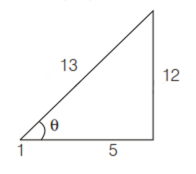
(B) Let $\theta = \sin ^{-1}\left(\frac{12}{13}\right)$. Then $\sin \theta = \frac{12}{13}$. Using the Pythagorean theorem,the base is $\sqrt{13^2 - 12^2} = \sqrt{169 - 144} = \sqrt{25} = 5$. Thus,$\tan \theta = \frac{12}{5}$,so $\theta = \tan ^{-1}\left(\frac{12}{5}\right)$.
Let $\phi = \cos ^{-1}\left(\frac{4}{5}\right)$. Then $\cos \phi = \frac{4}{5}$. The perpendicular is $\sqrt{5^2 - 4^2} = \sqrt{25 - 16} = \sqrt{9} = 3$. Thus,$\tan \phi = \frac{3}{4}$,so $\phi = \tan ^{-1}\left(\frac{3}{4}\right)$.
Substituting these into the expression:
$\tan ^{-1}\left(\frac{12}{5}\right) + \tan ^{-1}\left(\frac{3}{4}\right) + \tan ^{-1}\left(\frac{63}{16}\right)$
Using the formula $\tan ^{-1} A + \tan ^{-1} B = \pi + \tan ^{-1}\left(\frac{A+B}{1-AB}\right)$ for $AB > 1$:
$A = \frac{12}{5}, B = \frac{3}{4} \Rightarrow AB = \frac{36}{20} = 1.8 > 1$.
So,$\tan ^{-1}\left(\frac{12}{5}\right) + \tan ^{-1}\left(\frac{3}{4}\right) = \pi + \tan ^{-1}\left(\frac{\frac{12}{5} + \frac{3}{4}}{1 - \frac{12}{5} \times \frac{3}{4}}\right) = \pi + \tan ^{-1}\left(\frac{\frac{48+15}{20}}{1 - \frac{36}{20}}\right) = \pi + \tan ^{-1}\left(\frac{\frac{63}{20}}{-\frac{16}{20}}\right) = \pi + \tan ^{-1}\left(-\frac{63}{16}\right) = \pi - \tan ^{-1}\left(\frac{63}{16}\right)$.
Adding the final term:
$\pi - \tan ^{-1}\left(\frac{63}{16}\right) + \tan ^{-1}\left(\frac{63}{16}\right) = \pi$.
Let $\phi = \cos ^{-1}\left(\frac{4}{5}\right)$. Then $\cos \phi = \frac{4}{5}$. The perpendicular is $\sqrt{5^2 - 4^2} = \sqrt{25 - 16} = \sqrt{9} = 3$. Thus,$\tan \phi = \frac{3}{4}$,so $\phi = \tan ^{-1}\left(\frac{3}{4}\right)$.
Substituting these into the expression:
$\tan ^{-1}\left(\frac{12}{5}\right) + \tan ^{-1}\left(\frac{3}{4}\right) + \tan ^{-1}\left(\frac{63}{16}\right)$
Using the formula $\tan ^{-1} A + \tan ^{-1} B = \pi + \tan ^{-1}\left(\frac{A+B}{1-AB}\right)$ for $AB > 1$:
$A = \frac{12}{5}, B = \frac{3}{4} \Rightarrow AB = \frac{36}{20} = 1.8 > 1$.
So,$\tan ^{-1}\left(\frac{12}{5}\right) + \tan ^{-1}\left(\frac{3}{4}\right) = \pi + \tan ^{-1}\left(\frac{\frac{12}{5} + \frac{3}{4}}{1 - \frac{12}{5} \times \frac{3}{4}}\right) = \pi + \tan ^{-1}\left(\frac{\frac{48+15}{20}}{1 - \frac{36}{20}}\right) = \pi + \tan ^{-1}\left(\frac{\frac{63}{20}}{-\frac{16}{20}}\right) = \pi + \tan ^{-1}\left(-\frac{63}{16}\right) = \pi - \tan ^{-1}\left(\frac{63}{16}\right)$.
Adding the final term:
$\pi - \tan ^{-1}\left(\frac{63}{16}\right) + \tan ^{-1}\left(\frac{63}{16}\right) = \pi$.
0 likes
View Solution167
DifficultMCQ
$\tan \left[\frac{\pi}{4}+\frac{1}{2} \cos ^{-1}\left(\frac{a}{b}\right)\right]+\tan \left[\frac{\pi}{4}-\frac{1}{2} \cos ^{-1}\left(\frac{a}{b}\right)\right]$ is equal to
A
$\frac{2 a}{b}$
B
$\frac{2 b}{a}$
C
$\frac{a}{b}$
D
$\frac{b}{a}$
Solution
(B) Let $\theta = \frac{1}{2} \cos ^{-1}\left(\frac{a}{b}\right)$,then $\cos 2 \theta = \frac{a}{b}$.
The expression is $\tan \left(\frac{\pi}{4} + \theta\right) + \tan \left(\frac{\pi}{4} - \theta\right)$.
Using the identity $\tan(A+B) + \tan(A-B) = \frac{2 \tan A}{1 - \tan^2 A \tan^2 B}$ is not standard,so we expand:
$= \left( \frac{1 + \tan \theta}{1 - \tan \theta} \right) + \left( \frac{1 - \tan \theta}{1 + \tan \theta} \right)$
$= \frac{(1 + \tan \theta)^2 + (1 - \tan \theta)^2}{(1 - \tan \theta)(1 + \tan \theta)}$
$= \frac{1 + 2 \tan \theta + \tan^2 \theta + 1 - 2 \tan \theta + \tan^2 \theta}{1 - \tan^2 \theta}$
$= \frac{2(1 + \tan^2 \theta)}{1 - \tan^2 \theta} = \frac{2}{\cos 2 \theta}$.
Substituting $\cos 2 \theta = \frac{a}{b}$,we get $\frac{2}{a/b} = \frac{2b}{a}$.
The expression is $\tan \left(\frac{\pi}{4} + \theta\right) + \tan \left(\frac{\pi}{4} - \theta\right)$.
Using the identity $\tan(A+B) + \tan(A-B) = \frac{2 \tan A}{1 - \tan^2 A \tan^2 B}$ is not standard,so we expand:
$= \left( \frac{1 + \tan \theta}{1 - \tan \theta} \right) + \left( \frac{1 - \tan \theta}{1 + \tan \theta} \right)$
$= \frac{(1 + \tan \theta)^2 + (1 - \tan \theta)^2}{(1 - \tan \theta)(1 + \tan \theta)}$
$= \frac{1 + 2 \tan \theta + \tan^2 \theta + 1 - 2 \tan \theta + \tan^2 \theta}{1 - \tan^2 \theta}$
$= \frac{2(1 + \tan^2 \theta)}{1 - \tan^2 \theta} = \frac{2}{\cos 2 \theta}$.
Substituting $\cos 2 \theta = \frac{a}{b}$,we get $\frac{2}{a/b} = \frac{2b}{a}$.
0 likes
View Solution168
MediumMCQ
The number of solutions of $\sin ^{-1} x+\sin ^{-1}(1-x)=\cos ^{-1} x$ is
A
$0$
B
$1$
C
$2$
D
$4$
Solution
(C) Given equation: $\sin ^{-1} x + \sin ^{-1}(1-x) = \cos ^{-1} x$.
Taking $\sin$ on both sides:
$\sin(\sin ^{-1} x + \sin ^{-1}(1-x)) = \sin(\cos ^{-1} x)$.
Using $\sin(A+B) = \sin A \cos B + \cos A \sin B$:
$x \sqrt{1-(1-x)^2} + (1-x) \sqrt{1-x^2} = \sqrt{1-x^2}$.
$x \sqrt{1-(1-2x+x^2)} + (1-x) \sqrt{1-x^2} = \sqrt{1-x^2}$.
$x \sqrt{2x-x^2} + (1-x) \sqrt{1-x^2} = \sqrt{1-x^2}$.
$x \sqrt{x(2-x)} = \sqrt{1-x^2} - (1-x) \sqrt{1-x^2} = x \sqrt{1-x^2}$.
Squaring both sides: $x^2(2x-x^2) = x^2(1-x^2)$.
$2x^3 - x^4 = x^2 - x^4$.
$2x^3 - x^2 = 0 \Rightarrow x^2(2x-1) = 0$.
So,$x = 0$ or $x = 1/2$.
Checking $x=0$: $\sin^{-1}(0) + \sin^{-1}(1) = 0 + \pi/2 = \pi/2$. $\cos^{-1}(0) = \pi/2$. (Valid)
Checking $x=1/2$: $\sin^{-1}(1/2) + \sin^{-1}(1/2) = \pi/6 + \pi/6 = \pi/3$. $\cos^{-1}(1/2) = \pi/3$. (Valid)
Thus,there are $2$ solutions.
Taking $\sin$ on both sides:
$\sin(\sin ^{-1} x + \sin ^{-1}(1-x)) = \sin(\cos ^{-1} x)$.
Using $\sin(A+B) = \sin A \cos B + \cos A \sin B$:
$x \sqrt{1-(1-x)^2} + (1-x) \sqrt{1-x^2} = \sqrt{1-x^2}$.
$x \sqrt{1-(1-2x+x^2)} + (1-x) \sqrt{1-x^2} = \sqrt{1-x^2}$.
$x \sqrt{2x-x^2} + (1-x) \sqrt{1-x^2} = \sqrt{1-x^2}$.
$x \sqrt{x(2-x)} = \sqrt{1-x^2} - (1-x) \sqrt{1-x^2} = x \sqrt{1-x^2}$.
Squaring both sides: $x^2(2x-x^2) = x^2(1-x^2)$.
$2x^3 - x^4 = x^2 - x^4$.
$2x^3 - x^2 = 0 \Rightarrow x^2(2x-1) = 0$.
So,$x = 0$ or $x = 1/2$.
Checking $x=0$: $\sin^{-1}(0) + \sin^{-1}(1) = 0 + \pi/2 = \pi/2$. $\cos^{-1}(0) = \pi/2$. (Valid)
Checking $x=1/2$: $\sin^{-1}(1/2) + \sin^{-1}(1/2) = \pi/6 + \pi/6 = \pi/3$. $\cos^{-1}(1/2) = \pi/3$. (Valid)
Thus,there are $2$ solutions.
0 likes
View Solution169
MediumMCQ
If $0 \leq A \leq \frac{\pi}{4},$ then $\tan ^{-1}\left(\frac{1}{2} \tan 2 A\right)+\tan ^{-1}(\cot A)+\tan ^{-1}(\cot ^{3} A)$ is equal to
A
$\frac{\pi}{4}$
B
$\pi$
C
$0$
D
$\frac{\pi}{2}$
Solution
(C) Let $S = \tan ^{-1}\left(\frac{1}{2} \tan 2 A\right)+\tan ^{-1}(\cot A)+\tan ^{-1}(\cot ^{3} A)$.
Using the identity $\tan ^{-1} x + \tan ^{-1} y = \tan ^{-1}\left(\frac{x+y}{1-xy}\right)$,we have:
$\tan ^{-1}(\cot A) + \tan ^{-1}(\cot ^{3} A) = \tan ^{-1}\left(\frac{\cot A + \cot ^{3} A}{1 - \cot A \cdot \cot ^{3} A}\right) = \tan ^{-1}\left(\frac{\cot A(1 + \cot ^{2} A)}{1 - \cot ^{4} A}\right)$.
Since $1 - \cot ^{4} A = (1 - \cot ^{2} A)(1 + \cot ^{2} A)$,the expression simplifies to:
$\tan ^{-1}\left(\frac{\cot A}{1 - \cot ^{2} A}\right) = \tan ^{-1}\left(\frac{1/\tan A}{1 - 1/\tan ^{2} A}\right) = \tan ^{-1}\left(\frac{\tan A}{\tan ^{2} A - 1}\right) = -\tan ^{-1}\left(\frac{\tan A}{1 - \tan ^{2} A}\right)$.
Now,$\frac{1}{2} \tan 2 A = \frac{1}{2} \cdot \frac{2 \tan A}{1 - \tan ^{2} A} = \frac{\tan A}{1 - \tan ^{2} A}$.
Thus,$S = \tan ^{-1}\left(\frac{\tan A}{1 - \tan ^{2} A}\right) - \tan ^{-1}\left(\frac{\tan A}{1 - \tan ^{2} A}\right) = 0$.
Using the identity $\tan ^{-1} x + \tan ^{-1} y = \tan ^{-1}\left(\frac{x+y}{1-xy}\right)$,we have:
$\tan ^{-1}(\cot A) + \tan ^{-1}(\cot ^{3} A) = \tan ^{-1}\left(\frac{\cot A + \cot ^{3} A}{1 - \cot A \cdot \cot ^{3} A}\right) = \tan ^{-1}\left(\frac{\cot A(1 + \cot ^{2} A)}{1 - \cot ^{4} A}\right)$.
Since $1 - \cot ^{4} A = (1 - \cot ^{2} A)(1 + \cot ^{2} A)$,the expression simplifies to:
$\tan ^{-1}\left(\frac{\cot A}{1 - \cot ^{2} A}\right) = \tan ^{-1}\left(\frac{1/\tan A}{1 - 1/\tan ^{2} A}\right) = \tan ^{-1}\left(\frac{\tan A}{\tan ^{2} A - 1}\right) = -\tan ^{-1}\left(\frac{\tan A}{1 - \tan ^{2} A}\right)$.
Now,$\frac{1}{2} \tan 2 A = \frac{1}{2} \cdot \frac{2 \tan A}{1 - \tan ^{2} A} = \frac{\tan A}{1 - \tan ^{2} A}$.
Thus,$S = \tan ^{-1}\left(\frac{\tan A}{1 - \tan ^{2} A}\right) - \tan ^{-1}\left(\frac{\tan A}{1 - \tan ^{2} A}\right) = 0$.
0 likes
View Solution170
MediumMCQ
The possible values of $x$,which satisfy the trigonometric equation $\tan ^{-1}\left(\frac{x-1}{x-2}\right)+\tan ^{-1}\left(\frac{x+1}{x+2}\right)=\frac{\pi}{4}$ are
A
$\pm \frac{1}{\sqrt{2}}$
B
$\pm \sqrt{2}$
C
$\pm \frac{1}{2}$
D
$\pm 2$
Solution
(A) Given the equation: $\tan ^{-1}\left(\frac{x-1}{x-2}\right)+\tan ^{-1}\left(\frac{x+1}{x+2}\right)=\frac{\pi}{4}$
Using the formula $\tan ^{-1} A + \tan ^{-1} B = \tan ^{-1} \left( \frac{A+B}{1-AB} \right)$,we get:
$\tan ^{-1}\left[\frac{\frac{x-1}{x-2}+\frac{x+1}{x+2}}{1-\left(\frac{x-1}{x-2}\right) \left(\frac{x+1}{x+2}\right)}\right]=\frac{\pi}{4}$
Taking $\tan$ on both sides:
$\frac{\frac{x-1}{x-2}+\frac{x+1}{x+2}}{1-\frac{(x-1)(x+1)}{(x-2)(x+2)}} = \tan \frac{\pi}{4} = 1$
Simplifying the numerator and denominator:
$\frac{(x-1)(x+2)+(x+1)(x-2)}{(x-2)(x+2)-(x-1)(x+1)} = 1$
$\frac{(x^2+x-2)+(x^2-x-2)}{(x^2-4)-(x^2-1)} = 1$
$\frac{2x^2-4}{-3} = 1$
$2x^2-4 = -3$
$2x^2 = 1$
$x^2 = \frac{1}{2}$
$x = \pm \frac{1}{\sqrt{2}}$
Using the formula $\tan ^{-1} A + \tan ^{-1} B = \tan ^{-1} \left( \frac{A+B}{1-AB} \right)$,we get:
$\tan ^{-1}\left[\frac{\frac{x-1}{x-2}+\frac{x+1}{x+2}}{1-\left(\frac{x-1}{x-2}\right) \left(\frac{x+1}{x+2}\right)}\right]=\frac{\pi}{4}$
Taking $\tan$ on both sides:
$\frac{\frac{x-1}{x-2}+\frac{x+1}{x+2}}{1-\frac{(x-1)(x+1)}{(x-2)(x+2)}} = \tan \frac{\pi}{4} = 1$
Simplifying the numerator and denominator:
$\frac{(x-1)(x+2)+(x+1)(x-2)}{(x-2)(x+2)-(x-1)(x+1)} = 1$
$\frac{(x^2+x-2)+(x^2-x-2)}{(x^2-4)-(x^2-1)} = 1$
$\frac{2x^2-4}{-3} = 1$
$2x^2-4 = -3$
$2x^2 = 1$
$x^2 = \frac{1}{2}$
$x = \pm \frac{1}{\sqrt{2}}$
0 likes
View Solution171
DifficultMCQ
Considering the principal values of inverse trigonometric functions,the value of the expression $\tan\left(2 \sin^{-1}\left(\frac{2}{\sqrt{13}}\right)-2 \cos^{-1}\left(\frac{3}{\sqrt{10}}\right)\right)$ is equal to:
A
$-\frac{33}{56}$
B
$\frac{33}{56}$
C
$\frac{16}{63}$
D
$-\frac{16}{63}$
Solution
(B) Let $\theta = \sin^{-1}\left(\frac{2}{\sqrt{13}}\right)$ and $\phi = \cos^{-1}\left(\frac{3}{\sqrt{10}}\right)$.
Then $\sin \theta = \frac{2}{\sqrt{13}}$,which implies $\tan \theta = \frac{2}{3}$.
Then $\cos \phi = \frac{3}{\sqrt{10}}$,which implies $\tan \phi = \frac{1}{3}$.
We need to find $\tan(2\theta - 2\phi) = \frac{\tan 2\theta - \tan 2\phi}{1 + \tan 2\theta \tan 2\phi}$.
Using $\tan 2\alpha = \frac{2 \tan \alpha}{1 - \tan^2 \alpha}$:
$\tan 2\theta = \frac{2(2/3)}{1 - (2/3)^2} = \frac{4/3}{1 - 4/9} = \frac{4/3}{5/9} = \frac{4}{3} \times \frac{9}{5} = \frac{12}{5}$.
$\tan 2\phi = \frac{2(1/3)}{1 - (1/3)^2} = \frac{2/3}{1 - 1/9} = \frac{2/3}{8/9} = \frac{2}{3} \times \frac{9}{8} = \frac{3}{4}$.
Substituting these values:
$\tan(2\theta - 2\phi) = \frac{12/5 - 3/4}{1 + (12/5)(3/4)} = \frac{(48-15)/20}{1 + 36/20} = \frac{33/20}{56/20} = \frac{33}{56}$.
Then $\sin \theta = \frac{2}{\sqrt{13}}$,which implies $\tan \theta = \frac{2}{3}$.
Then $\cos \phi = \frac{3}{\sqrt{10}}$,which implies $\tan \phi = \frac{1}{3}$.
We need to find $\tan(2\theta - 2\phi) = \frac{\tan 2\theta - \tan 2\phi}{1 + \tan 2\theta \tan 2\phi}$.
Using $\tan 2\alpha = \frac{2 \tan \alpha}{1 - \tan^2 \alpha}$:
$\tan 2\theta = \frac{2(2/3)}{1 - (2/3)^2} = \frac{4/3}{1 - 4/9} = \frac{4/3}{5/9} = \frac{4}{3} \times \frac{9}{5} = \frac{12}{5}$.
$\tan 2\phi = \frac{2(1/3)}{1 - (1/3)^2} = \frac{2/3}{1 - 1/9} = \frac{2/3}{8/9} = \frac{2}{3} \times \frac{9}{8} = \frac{3}{4}$.
Substituting these values:
$\tan(2\theta - 2\phi) = \frac{12/5 - 3/4}{1 + (12/5)(3/4)} = \frac{(48-15)/20}{1 + 36/20} = \frac{33/20}{56/20} = \frac{33}{56}$.
0 likes
View Solution172
DifficultMCQ
If $k = \tan(\frac{\pi}{4} + \frac{1}{2}\cos^{-1}(\frac{2}{3})) + \tan(\frac{1}{2}\sin^{-1}(\frac{2}{3}))$,then the number of solutions of the equation $\sin^{-1}(kx-1) = \sin^{-1}x - \cos^{-1}x$ is . . . . . . .
A
$1$
B
$2$
C
$0$
D
$3$
Solution
(A) Let $\alpha = \frac{1}{2}\cos^{-1}(\frac{2}{3})$ and $\beta = \frac{1}{2}\sin^{-1}(\frac{2}{3})$.
Then $k = \tan(\frac{\pi}{4} + \alpha) + \tan(\beta)$.
Since $2\alpha = \cos^{-1}(\frac{2}{3})$,$\cos(2\alpha) = \frac{2}{3}$.
Since $2\beta = \sin^{-1}(\frac{2}{3})$,$\sin(2\beta) = \frac{2}{3}$.
Note that $\beta = \frac{\pi}{4} - \alpha$ is not necessarily true,but $\tan(\frac{\pi}{4} + \alpha) = \frac{1 + \tan \alpha}{1 - \tan \alpha}$.
Using $\tan \alpha = \sqrt{\frac{1-\cos 2\alpha}{1+\cos 2\alpha}} = \sqrt{\frac{1-2/3}{1+2/3}} = \sqrt{\frac{1/3}{5/3}} = \frac{1}{\sqrt{5}}$.
Using $\tan \beta = \sqrt{\frac{1-\cos 2\beta}{1+\cos 2\beta}} = \sqrt{\frac{1-\sqrt{1-4/9}}{1+\sqrt{1-4/9}}} = \sqrt{\frac{1-\sqrt{5}/3}{1+\sqrt{5}/3}} = \sqrt{\frac{3-\sqrt{5}}{3+\sqrt{5}}} = \frac{3-\sqrt{5}}{2}$.
Calculating $k$ leads to $k=3$.
The equation becomes $\sin^{-1}(3x-1) = \sin^{-1}x - (\frac{\pi}{2} - \sin^{-1}x) = 2\sin^{-1}x - \frac{\pi}{2}$.
Taking $\sin$ on both sides: $3x-1 = \sin(2\sin^{-1}x - \frac{\pi}{2}) = -\cos(2\sin^{-1}x) = -(1-2x^2) = 2x^2-1$.
$2x^2 - 3x = 0 \Rightarrow x(2x-3) = 0$.
So $x=0$ or $x=1.5$.
Checking $x=1.5$: $\sin^{-1}(3.5)$ is undefined.
Checking $x=0$: $\sin^{-1}(-1) = -\frac{\pi}{2}$ and $\sin^{-1}(0) - \cos^{-1}(0) = 0 - \frac{\pi}{2} = -\frac{\pi}{2}$.
Thus,$x=0$ is the only solution.
Then $k = \tan(\frac{\pi}{4} + \alpha) + \tan(\beta)$.
Since $2\alpha = \cos^{-1}(\frac{2}{3})$,$\cos(2\alpha) = \frac{2}{3}$.
Since $2\beta = \sin^{-1}(\frac{2}{3})$,$\sin(2\beta) = \frac{2}{3}$.
Note that $\beta = \frac{\pi}{4} - \alpha$ is not necessarily true,but $\tan(\frac{\pi}{4} + \alpha) = \frac{1 + \tan \alpha}{1 - \tan \alpha}$.
Using $\tan \alpha = \sqrt{\frac{1-\cos 2\alpha}{1+\cos 2\alpha}} = \sqrt{\frac{1-2/3}{1+2/3}} = \sqrt{\frac{1/3}{5/3}} = \frac{1}{\sqrt{5}}$.
Using $\tan \beta = \sqrt{\frac{1-\cos 2\beta}{1+\cos 2\beta}} = \sqrt{\frac{1-\sqrt{1-4/9}}{1+\sqrt{1-4/9}}} = \sqrt{\frac{1-\sqrt{5}/3}{1+\sqrt{5}/3}} = \sqrt{\frac{3-\sqrt{5}}{3+\sqrt{5}}} = \frac{3-\sqrt{5}}{2}$.
Calculating $k$ leads to $k=3$.
The equation becomes $\sin^{-1}(3x-1) = \sin^{-1}x - (\frac{\pi}{2} - \sin^{-1}x) = 2\sin^{-1}x - \frac{\pi}{2}$.
Taking $\sin$ on both sides: $3x-1 = \sin(2\sin^{-1}x - \frac{\pi}{2}) = -\cos(2\sin^{-1}x) = -(1-2x^2) = 2x^2-1$.
$2x^2 - 3x = 0 \Rightarrow x(2x-3) = 0$.
So $x=0$ or $x=1.5$.
Checking $x=1.5$: $\sin^{-1}(3.5)$ is undefined.
Checking $x=0$: $\sin^{-1}(-1) = -\frac{\pi}{2}$ and $\sin^{-1}(0) - \cos^{-1}(0) = 0 - \frac{\pi}{2} = -\frac{\pi}{2}$.
Thus,$x=0$ is the only solution.
0 likes
View Solution173
DifficultMCQ
The number of real solutions of the equation $\tan^{-1}\sqrt{x(x+1)} + \sin^{-1}\sqrt{x^2+x+1} = \pi/2$ is
A
$1$
B
$3$
C
$2$
D
$4$
Solution
(C) Let $u = \sqrt{x^2+x}$. The domain requires $x^2+x \ge 0$ and $0 \le x^2+x+1 \le 1$.
Since $x^2+x+1 \le 1 \Rightarrow x^2+x \le 0$.
Combining $x^2+x \ge 0$ and $x^2+x \le 0$,we must have $x^2+x = 0$.
If $x^2+x = 0$,then $u = 0$.
The equation becomes $\tan^{-1}(0) + \sin^{-1}(1) = 0 + \pi/2 = \pi/2$.
This satisfies the equation.
$x^2+x = 0 \Rightarrow x(x+1) = 0$,which gives $x = 0$ or $x = -1$.
Both values are valid.
Thus,there are $2$ real solutions.
Since $x^2+x+1 \le 1 \Rightarrow x^2+x \le 0$.
Combining $x^2+x \ge 0$ and $x^2+x \le 0$,we must have $x^2+x = 0$.
If $x^2+x = 0$,then $u = 0$.
The equation becomes $\tan^{-1}(0) + \sin^{-1}(1) = 0 + \pi/2 = \pi/2$.
This satisfies the equation.
$x^2+x = 0 \Rightarrow x(x+1) = 0$,which gives $x = 0$ or $x = -1$.
Both values are valid.
Thus,there are $2$ real solutions.
0 likes
View Solution174
DifficultMCQ
If $\sin(\tan^{-1}(x\sqrt{2})) = \cot(\sin^{-1}\sqrt{1-x^2})$ for $x \in (0, 1)$,then the value of $x$ is:
A
$1/2$
B
$1/3$
C
$2/3$
D
$5/8$
Solution
(A) Let $\tan^{-1}(x\sqrt{2}) = \theta$. Then $\tan \theta = x\sqrt{2}$.
Using the identity $\sin \theta = \frac{\tan \theta}{\sqrt{1+\tan^2 \theta}}$,we get $\sin \theta = \frac{x\sqrt{2}}{\sqrt{1+2x^2}}$.
Let $\sin^{-1}(\sqrt{1-x^2}) = \phi$. Then $\sin \phi = \sqrt{1-x^2}$.
Using the identity $\cot \phi = \frac{\cos \phi}{\sin \phi} = \frac{\sqrt{1-\sin^2 \phi}}{\sin \phi}$,we get $\cot \phi = \frac{\sqrt{1-(1-x^2)}}{\sqrt{1-x^2}} = \frac{x}{\sqrt{1-x^2}}$.
Equating the two sides: $\frac{x\sqrt{2}}{\sqrt{1+2x^2}} = \frac{x}{\sqrt{1-x^2}}$.
Since $x \in (0, 1)$,$x \neq 0$,we can divide by $x$: $\frac{\sqrt{2}}{\sqrt{1+2x^2}} = \frac{1}{\sqrt{1-x^2}}$.
Squaring both sides: $\frac{2}{1+2x^2} = \frac{1}{1-x^2}$.
$2(1-x^2) = 1+2x^2 \implies 2-2x^2 = 1+2x^2 \implies 4x^2 = 1 \implies x^2 = 1/4$.
Since $x \in (0, 1)$,$x = 1/2$.
Using the identity $\sin \theta = \frac{\tan \theta}{\sqrt{1+\tan^2 \theta}}$,we get $\sin \theta = \frac{x\sqrt{2}}{\sqrt{1+2x^2}}$.
Let $\sin^{-1}(\sqrt{1-x^2}) = \phi$. Then $\sin \phi = \sqrt{1-x^2}$.
Using the identity $\cot \phi = \frac{\cos \phi}{\sin \phi} = \frac{\sqrt{1-\sin^2 \phi}}{\sin \phi}$,we get $\cot \phi = \frac{\sqrt{1-(1-x^2)}}{\sqrt{1-x^2}} = \frac{x}{\sqrt{1-x^2}}$.
Equating the two sides: $\frac{x\sqrt{2}}{\sqrt{1+2x^2}} = \frac{x}{\sqrt{1-x^2}}$.
Since $x \in (0, 1)$,$x \neq 0$,we can divide by $x$: $\frac{\sqrt{2}}{\sqrt{1+2x^2}} = \frac{1}{\sqrt{1-x^2}}$.
Squaring both sides: $\frac{2}{1+2x^2} = \frac{1}{1-x^2}$.
$2(1-x^2) = 1+2x^2 \implies 2-2x^2 = 1+2x^2 \implies 4x^2 = 1 \implies x^2 = 1/4$.
Since $x \in (0, 1)$,$x = 1/2$.
0 likes
View Solution175
DifficultMCQ
Let $\alpha = 3 \sin^{-1}(\frac{6}{11})$ and $\beta = 3 \cos^{-1}(\frac{4}{9})$,where inverse trigonometric functions take only the principal values. Given below are two statements:
Statement $I$: $\cos(\alpha + \beta) > 0$.
Statement $II$: $\cos(\alpha) < 0$.
In the light of the above statements,choose the correct answer from the options given below:
Statement $I$: $\cos(\alpha + \beta) > 0$.
Statement $II$: $\cos(\alpha) < 0$.
In the light of the above statements,choose the correct answer from the options given below:
A
Both Statement $I$ and Statement $II$ are true
B
Both Statement $I$ and Statement $II$ are false
C
Statement $I$ is true but Statement $II$ is false
D
Statement $I$ is false but Statement $II$ is true
Solution
(A) Given $\alpha = 3 \sin^{-1}(\frac{6}{11})$. Since $\frac{6}{11} > \frac{1}{2}$,we have $\sin^{-1}(\frac{6}{11}) > \sin^{-1}(\frac{1}{2}) = 30^\circ$. Thus,$\alpha > 3 \times 30^\circ = 90^\circ$. Since $90^\circ < \alpha < 270^\circ$ (as $\sin^{-1}(\frac{6}{11}) < 90^\circ$),$\cos(\alpha) < 0$. So,Statement $II$ is true.
Given $\beta = 3 \cos^{-1}(\frac{4}{9})$. Since $\frac{4}{9} < \frac{1}{2}$,we have $\cos^{-1}(\frac{4}{9}) > \cos^{-1}(\frac{1}{2}) = 60^\circ$. Thus,$\beta > 3 \times 60^\circ = 180^\circ$.
Since $\alpha > 90^\circ$ and $\beta > 180^\circ$,$\alpha + \beta > 270^\circ$. In the fourth quadrant,the cosine function is positive. Therefore,$\cos(\alpha + \beta) > 0$. So,Statement $I$ is true.
Given $\beta = 3 \cos^{-1}(\frac{4}{9})$. Since $\frac{4}{9} < \frac{1}{2}$,we have $\cos^{-1}(\frac{4}{9}) > \cos^{-1}(\frac{1}{2}) = 60^\circ$. Thus,$\beta > 3 \times 60^\circ = 180^\circ$.
Since $\alpha > 90^\circ$ and $\beta > 180^\circ$,$\alpha + \beta > 270^\circ$. In the fourth quadrant,the cosine function is positive. Therefore,$\cos(\alpha + \beta) > 0$. So,Statement $I$ is true.
0 likes
View SolutionInverse Trigonometric Functions — Mix Examples-ITF · Frequently Asked Questions
1Are these Inverse Trigonometric Functions questions useful for JEE and NEET?
Yes. All questions in this section are mapped to JEE Main and NEET exam patterns. Previous year questions from JEE Main, NEET, GUJCET and state-level exams are included with full solutions.
2Can I switch to Hindi or Gujarati for these questions?
Yes. Use the language tabs in the hero section or the sidebar to view the same questions and solutions in English, Hindi or Gujarati.
3How do I generate a question paper from this subtopic?
Use the Vedclass Exam Paper Generator — select the chapter and subtopic, set difficulty, and generate Sets A, B, C, D automatically. First 3 chapters of every subject are free.
Vedclass Products
For Students
Vedclass Test Series
Mock tests in real JEE/NEET style with performance analysis. 5-day free trial.
Start Free TrialFor Teachers
Exam Paper Generator
Generate Set A/B/C/D papers from this chapter in 2 minutes. 3 chapters free.
Try FreeFor Institutes
Online Exam Module
Live online exams with unlimited students, 360° analytics & white-label branding.
See DemoFor Teachers & Institutes
Generate a Inverse Trigonometric Functions Exam Paper in 2 Minutes
Select subtopic & difficulty — Sets A, B, C, D auto-generated with No Repeat logic.
First 3 chapters of every subject are free — no payment required.