
A English
Differentiability Questions in English
Class 12 Mathematics · Continuity and Differentiation · Differentiability
201+
Questions
English
Language
100%
With Solutions
Showing 48 of 201 questions in English
151
MediumMCQ
If $f(x)=\begin{cases} \frac{2 x e^{\frac{1}{2 x}}-3 x e^{\frac{-1}{2 x}}}{e^{\frac{1}{2 x}}+4 e^{\frac{-1}{2 x}}} & \text{if } x \neq 0 \\ 0 & \text{if } x=0 \end{cases}$ is a real valued function,then:
A
$f^{\prime}(0^{+}) = -\frac{3}{4}$
B
$f^{\prime}(0^{-}) = 2$
C
$f$ is not differentiable at $x=0$
D
$f$ is differentiable at $x=0$
Solution
(C) Given the function $f(x) = \begin{cases} \frac{2 x e^{\frac{1}{2 x}}-3 x e^{\frac{-1}{2 x}}}{e^{\frac{1}{2 x}}+4 e^{-\frac{1}{2 x}}} & x \neq 0 \\ 0 & x=0 \end{cases}$.
First,calculate the Left Hand Derivative ($L$.$H$.$D$.) at $x=0$:
$f^{\prime}(0^{-}) = \lim_{h \rightarrow 0^{+}} \frac{f(0-h)-f(0)}{-h} = \lim_{h \rightarrow 0^{+}} \frac{f(-h)-0}{-h}$
$= \lim_{h \rightarrow 0^{+}} \frac{-2h e^{\frac{-1}{2h}} + 3h e^{\frac{1}{2h}}}{-h(e^{\frac{-1}{2h}} + 4e^{\frac{1}{2h}})} = \lim_{h \rightarrow 0^{+}} \frac{2e^{\frac{-1}{2h}} - 3e^{\frac{1}{2h}}}{e^{\frac{-1}{2h}} + 4e^{\frac{1}{2h}}}$
Divide numerator and denominator by $e^{\frac{1}{2h}}$:
$= \lim_{h \rightarrow 0^{+}} \frac{2e^{\frac{-1}{h}} - 3}{e^{\frac{-1}{h}} + 4} = \frac{0 - 3}{0 + 4} = -\frac{3}{4}$.
Next,calculate the Right Hand Derivative ($R$.$H$.$D$.) at $x=0$:
$f^{\prime}(0^{+}) = \lim_{h \rightarrow 0^{+}} \frac{f(0+h)-f(0)}{h} = \lim_{h \rightarrow 0^{+}} \frac{f(h)-0}{h}$
$= \lim_{h \rightarrow 0^{+}} \frac{2h e^{\frac{1}{2h}} - 3h e^{\frac{-1}{2h}}}{h(e^{\frac{1}{2h}} + 4e^{\frac{-1}{2h}})} = \lim_{h \rightarrow 0^{+}} \frac{2e^{\frac{1}{2h}} - 3e^{\frac{-1}{2h}}}{e^{\frac{1}{2h}} + 4e^{\frac{-1}{2h}}}$
Divide numerator and denominator by $e^{\frac{1}{2h}}$:
$= \lim_{h \rightarrow 0^{+}} \frac{2 - 3e^{\frac{-1}{h}}}{1 + 4e^{\frac{-1}{h}}} = \frac{2 - 0}{1 + 0} = 2$.
Since $f^{\prime}(0^{-}) \neq f^{\prime}(0^{+})$,the function $f(x)$ is not differentiable at $x=0$.
First,calculate the Left Hand Derivative ($L$.$H$.$D$.) at $x=0$:
$f^{\prime}(0^{-}) = \lim_{h \rightarrow 0^{+}} \frac{f(0-h)-f(0)}{-h} = \lim_{h \rightarrow 0^{+}} \frac{f(-h)-0}{-h}$
$= \lim_{h \rightarrow 0^{+}} \frac{-2h e^{\frac{-1}{2h}} + 3h e^{\frac{1}{2h}}}{-h(e^{\frac{-1}{2h}} + 4e^{\frac{1}{2h}})} = \lim_{h \rightarrow 0^{+}} \frac{2e^{\frac{-1}{2h}} - 3e^{\frac{1}{2h}}}{e^{\frac{-1}{2h}} + 4e^{\frac{1}{2h}}}$
Divide numerator and denominator by $e^{\frac{1}{2h}}$:
$= \lim_{h \rightarrow 0^{+}} \frac{2e^{\frac{-1}{h}} - 3}{e^{\frac{-1}{h}} + 4} = \frac{0 - 3}{0 + 4} = -\frac{3}{4}$.
Next,calculate the Right Hand Derivative ($R$.$H$.$D$.) at $x=0$:
$f^{\prime}(0^{+}) = \lim_{h \rightarrow 0^{+}} \frac{f(0+h)-f(0)}{h} = \lim_{h \rightarrow 0^{+}} \frac{f(h)-0}{h}$
$= \lim_{h \rightarrow 0^{+}} \frac{2h e^{\frac{1}{2h}} - 3h e^{\frac{-1}{2h}}}{h(e^{\frac{1}{2h}} + 4e^{\frac{-1}{2h}})} = \lim_{h \rightarrow 0^{+}} \frac{2e^{\frac{1}{2h}} - 3e^{\frac{-1}{2h}}}{e^{\frac{1}{2h}} + 4e^{\frac{-1}{2h}}}$
Divide numerator and denominator by $e^{\frac{1}{2h}}$:
$= \lim_{h \rightarrow 0^{+}} \frac{2 - 3e^{\frac{-1}{h}}}{1 + 4e^{\frac{-1}{h}}} = \frac{2 - 0}{1 + 0} = 2$.
Since $f^{\prime}(0^{-}) \neq f^{\prime}(0^{+})$,the function $f(x)$ is not differentiable at $x=0$.
0 likes
View Solution152
EasyMCQ
If $f(x) = \begin{cases} 2x+3, & x \leq 1 \\ ax^{2}+bx, & x > 1 \end{cases}$ is differentiable $\forall x \in R$,then $f(2) = $ . . . . . . .
A
$5$
B
$4$
C
-$4$
D
-$10$
Solution
(B) Given $f(x) = \begin{cases} 2x+3, & x \leq 1 \\ ax^{2}+bx, & x > 1 \end{cases}$.
Since $f(x)$ is differentiable for all $x \in R$,it must be continuous at $x = 1$.
$\lim_{x \to 1^{-}} f(x) = \lim_{x \to 1^{+}} f(x) = f(1) \Rightarrow 2(1) + 3 = a(1)^2 + b(1) \Rightarrow a + b = 5 \quad \dots(i)$
Also,$f'(x)$ must be continuous at $x = 1$.
$f'(x) = \begin{cases} 2, & x < 1 \\ 2ax + b, & x > 1 \end{cases}$
$\lim_{x \to 1^{-}} f'(x) = \lim_{x \to 1^{+}} f'(x) \Rightarrow 2 = 2a(1) + b \Rightarrow 2a + b = 2 \quad \dots(ii)$
Subtracting $(i)$ from $(ii)$: $(2a + b) - (a + b) = 2 - 5 \Rightarrow a = -3$.
Substituting $a = -3$ in $(i)$: $-3 + b = 5 \Rightarrow b = 8$.
Thus,for $x > 1$,$f(x) = -3x^2 + 8x$.
We need to find $f(2)$.
$f(2) = -3(2)^2 + 8(2) = -3(4) + 16 = -12 + 16 = 4$.
Since $f(x)$ is differentiable for all $x \in R$,it must be continuous at $x = 1$.
$\lim_{x \to 1^{-}} f(x) = \lim_{x \to 1^{+}} f(x) = f(1) \Rightarrow 2(1) + 3 = a(1)^2 + b(1) \Rightarrow a + b = 5 \quad \dots(i)$
Also,$f'(x)$ must be continuous at $x = 1$.
$f'(x) = \begin{cases} 2, & x < 1 \\ 2ax + b, & x > 1 \end{cases}$
$\lim_{x \to 1^{-}} f'(x) = \lim_{x \to 1^{+}} f'(x) \Rightarrow 2 = 2a(1) + b \Rightarrow 2a + b = 2 \quad \dots(ii)$
Subtracting $(i)$ from $(ii)$: $(2a + b) - (a + b) = 2 - 5 \Rightarrow a = -3$.
Substituting $a = -3$ in $(i)$: $-3 + b = 5 \Rightarrow b = 8$.
Thus,for $x > 1$,$f(x) = -3x^2 + 8x$.
We need to find $f(2)$.
$f(2) = -3(2)^2 + 8(2) = -3(4) + 16 = -12 + 16 = 4$.
0 likes
View Solution153
MediumMCQ
In the interval $[0, 3]$,the function $f(x) = |x - 1| + |x - 2|$ is
A
Discontinuous
B
Differentiable
C
Continuous but not differentiable at $x = 2$ only
D
Continuous but not differentiable at $x = 1$ and $x = 2$
Solution
(D) The function is defined as $f(x) = |x - 1| + |x - 2|$ for $x \in [0, 3]$.
By breaking the absolute values,we get:
$f(x) = \begin{cases} -(x-1) - (x-2) = -2x + 3, & 0 \leq x \leq 1 \\ (x-1) - (x-2) = 1, & 1 < x < 2 \\ (x-1) + (x-2) = 2x - 3, & 2 \leq x \leq 3 \end{cases}$
Since $f(x)$ is a sum of continuous functions,it is continuous everywhere in $[0, 3]$.
At $x = 1$,the left-hand derivative is $\frac{d}{dx}(-2x+3) = -2$ and the right-hand derivative is $\frac{d}{dx}(1) = 0$. Since $-2 \neq 0$,$f(x)$ is not differentiable at $x = 1$.
At $x = 2$,the left-hand derivative is $\frac{d}{dx}(1) = 0$ and the right-hand derivative is $\frac{d}{dx}(2x-3) = 2$. Since $0 \neq 2$,$f(x)$ is not differentiable at $x = 2$.
Thus,$f(x)$ is continuous but not differentiable at $x = 1$ and $x = 2$.
By breaking the absolute values,we get:
$f(x) = \begin{cases} -(x-1) - (x-2) = -2x + 3, & 0 \leq x \leq 1 \\ (x-1) - (x-2) = 1, & 1 < x < 2 \\ (x-1) + (x-2) = 2x - 3, & 2 \leq x \leq 3 \end{cases}$
Since $f(x)$ is a sum of continuous functions,it is continuous everywhere in $[0, 3]$.
At $x = 1$,the left-hand derivative is $\frac{d}{dx}(-2x+3) = -2$ and the right-hand derivative is $\frac{d}{dx}(1) = 0$. Since $-2 \neq 0$,$f(x)$ is not differentiable at $x = 1$.
At $x = 2$,the left-hand derivative is $\frac{d}{dx}(1) = 0$ and the right-hand derivative is $\frac{d}{dx}(2x-3) = 2$. Since $0 \neq 2$,$f(x)$ is not differentiable at $x = 2$.
Thus,$f(x)$ is continuous but not differentiable at $x = 1$ and $x = 2$.
0 likes
View Solution154
EasyMCQ
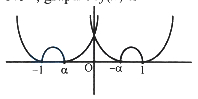
If $\alpha \in R - \{-1\}$ and $f(x) = |(|x| + \alpha)(|x| - 1)|$,then the number of points at which $f(x)$ is not differentiable is:
A
$3$,when $\alpha < 0$
B
$5$,when $\alpha > 0$
C
$4$,when $\alpha > 0$
D
$5$,when $\alpha < 0$
Solution
(D) Given $f(x) = |(|x| + \alpha)(|x| - 1)|$.
Let $g(x) = (|x| + \alpha)(|x| - 1)$.
The function $f(x) = |g(x)|$ is not differentiable at the points where $g(x) = 0$ (provided the roots are simple) and at $x = 0$ due to the $|x|$ term.
Case $1$: If $\alpha > 0$,then $|x| + \alpha = 0$ has no real solution. The roots of $g(x) = 0$ are $|x| = 1$,i.e.,$x = 1, -1$.
At $x = 1, -1$,the function $f(x)$ has sharp corners. Also,at $x = 0$,$f(x) = |\alpha(-1)| = |-\alpha| = \alpha$. Since $f'(0^+)$ and $f'(0^-)$ will differ due to the $|x|$ term,$f(x)$ is not differentiable at $x = 0$. Thus,for $\alpha > 0$,there are $3$ points of non-differentiability $(x = -1, 0, 1)$.
Case $2$: If $\alpha < 0$ and $\alpha \neq -1$,let $\alpha = -k$ where $k > 0$ and $k \neq 1$. Then $g(x) = (|x| - k)(|x| - 1)$.
The roots are $|x| = k$ and $|x| = 1$,which gives $x = \pm k$ and $x = \pm 1$.
These are $4$ distinct points where $f(x) = 0$. Additionally,$f(x)$ is not differentiable at $x = 0$ because of the $|x|$ term.
Thus,for $\alpha < 0$ (and $\alpha \neq -1$),there are $5$ points of non-differentiability $(x = -1, -k, 0, k, 1)$.
Comparing with the options,$D$ is correct.
Let $g(x) = (|x| + \alpha)(|x| - 1)$.
The function $f(x) = |g(x)|$ is not differentiable at the points where $g(x) = 0$ (provided the roots are simple) and at $x = 0$ due to the $|x|$ term.
Case $1$: If $\alpha > 0$,then $|x| + \alpha = 0$ has no real solution. The roots of $g(x) = 0$ are $|x| = 1$,i.e.,$x = 1, -1$.
At $x = 1, -1$,the function $f(x)$ has sharp corners. Also,at $x = 0$,$f(x) = |\alpha(-1)| = |-\alpha| = \alpha$. Since $f'(0^+)$ and $f'(0^-)$ will differ due to the $|x|$ term,$f(x)$ is not differentiable at $x = 0$. Thus,for $\alpha > 0$,there are $3$ points of non-differentiability $(x = -1, 0, 1)$.
Case $2$: If $\alpha < 0$ and $\alpha \neq -1$,let $\alpha = -k$ where $k > 0$ and $k \neq 1$. Then $g(x) = (|x| - k)(|x| - 1)$.
The roots are $|x| = k$ and $|x| = 1$,which gives $x = \pm k$ and $x = \pm 1$.
These are $4$ distinct points where $f(x) = 0$. Additionally,$f(x)$ is not differentiable at $x = 0$ because of the $|x|$ term.
Thus,for $\alpha < 0$ (and $\alpha \neq -1$),there are $5$ points of non-differentiability $(x = -1, -k, 0, k, 1)$.
Comparing with the options,$D$ is correct.
0 likes
View Solution155
MediumMCQ
If $f(x) = \begin{cases} \frac{1}{2}(b^2 - a^2), & 0 \leq x \leq a \\ \frac{1}{2}b^2 - \frac{x^2}{6} - \frac{a^3}{3x}, & a < x \leq b \\ \frac{1}{3}\left(\frac{b^3 - a^3}{x}\right), & x > b \end{cases}$,then which of the following is true?
A
$f''(a) = 2b$
B
$f''(a) = 1$
C
$f''(a) = b^2 - a^2$
D
$f'(x)$ is not differentiable at $x = a$
Solution
(D) To check the differentiability of $f(x)$ at $x = a$,we calculate the left-hand derivative ($L$.$H$.$D$.) and right-hand derivative ($R$.$H$.$D$.).
$L$.$H$.$D$. at $x = a$ is $\lim_{h \to 0} \frac{f(a-h) - f(a)}{-h} = \lim_{h \to 0} \frac{\frac{1}{2}(b^2 - a^2) - \frac{1}{2}(b^2 - a^2)}{-h} = 0$.
Now,$R$.$H$.$D$. at $x = a$ is $\lim_{h \to 0} \frac{f(a+h) - f(a)}{h} = \lim_{h \to 0} \frac{\frac{1}{2}b^2 - \frac{(a+h)^2}{6} - \frac{a^3}{3(a+h)} - \frac{1}{2}(b^2 - a^2)}{h}$.
Simplifying the expression: $\lim_{h \to 0} \frac{1}{h} \left[ \frac{1}{2}a^2 - \frac{(a+h)^3 + 2a^3}{6(a+h)} \right]$.
As $h \to 0$,the expression does not converge to a finite value,implying the derivative does not exist at $x = a$.
Since $f(x)$ is not differentiable at $x = a$,$f'(x)$ is also not differentiable at $x = a$.
$L$.$H$.$D$. at $x = a$ is $\lim_{h \to 0} \frac{f(a-h) - f(a)}{-h} = \lim_{h \to 0} \frac{\frac{1}{2}(b^2 - a^2) - \frac{1}{2}(b^2 - a^2)}{-h} = 0$.
Now,$R$.$H$.$D$. at $x = a$ is $\lim_{h \to 0} \frac{f(a+h) - f(a)}{h} = \lim_{h \to 0} \frac{\frac{1}{2}b^2 - \frac{(a+h)^2}{6} - \frac{a^3}{3(a+h)} - \frac{1}{2}(b^2 - a^2)}{h}$.
Simplifying the expression: $\lim_{h \to 0} \frac{1}{h} \left[ \frac{1}{2}a^2 - \frac{(a+h)^3 + 2a^3}{6(a+h)} \right]$.
As $h \to 0$,the expression does not converge to a finite value,implying the derivative does not exist at $x = a$.
Since $f(x)$ is not differentiable at $x = a$,$f'(x)$ is also not differentiable at $x = a$.
0 likes
View Solution156
EasyMCQ
Assertion $(A)$: If $f(x)$ is not continuous at $x=a$,then it is not differentiable at $x=a$.
Reason $(R)$: If $f(x)$ is differentiable at a point,then it is continuous at that point.
Reason $(R)$: If $f(x)$ is differentiable at a point,then it is continuous at that point.
A
$(A)$ and $(R)$ are both true,$(R)$ is the correct explanation of $(A)$
B
$(A)$ and $(R)$ are both true,$(R)$ is not the correct explanation of $(A)$
C
$(A)$ is true,$(R)$ is false
D
$(A)$ is false,$(R)$ is true
Solution
(A) fundamental theorem in calculus states that if a function $f(x)$ is differentiable at a point $x=a$,then it must be continuous at that point $x=a$.
The contrapositive of this statement is: if $f(x)$ is not continuous at $x=a$,then $f(x)$ is not differentiable at $x=a$.
Since the Reason $(R)$ provides the direct theorem that justifies the Assertion $(A)$,both are true and $(R)$ is the correct explanation of $(A)$.
The contrapositive of this statement is: if $f(x)$ is not continuous at $x=a$,then $f(x)$ is not differentiable at $x=a$.
Since the Reason $(R)$ provides the direct theorem that justifies the Assertion $(A)$,both are true and $(R)$ is the correct explanation of $(A)$.
0 likes
View Solution157
EasyMCQ
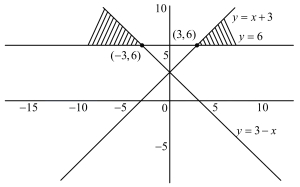
If $f(x) = \operatorname{Max} \{3 - x, 3 + x, 6\}$ is not differentiable at $x = a$ and $x = b$,then $|a| + |b| =$
A
$4$
B
$5$
C
$6$
D
$8$
Solution
(C) The function is defined as $f(x) = \operatorname{Max} \{3 - x, 3 + x, 6\}$.
To find the points of non-differentiability,we analyze the intersections of the functions $y_1 = 3 - x$,$y_2 = 3 + x$,and $y_3 = 6$.
$1$. Intersection of $y_1$ and $y_3$: $3 - x = 6 \implies x = -3$.
$2$. Intersection of $y_2$ and $y_3$: $3 + x = 6 \implies x = 3$.
$3$. Intersection of $y_1$ and $y_2$: $3 - x = 3 + x \implies 2x = 0 \implies x = 0$. At $x=0$,$y_1 = 3$ and $y_2 = 3$,but $y_3 = 6$,so $f(0) = 6$.
The function $f(x)$ is given by:
$f(x) = \begin{cases} 3 + x, & x < -3 \\ 6, & -3 \le x \le 3 \\ 3 - x, & x > 3 \end{cases}$ (Wait,checking the max: for $x < -3$,$3-x > 6$,so $f(x) = 3-x$. For $x > 3$,$3+x > 6$,so $f(x) = 3+x$.)
Correct definition: $f(x) = \begin{cases} 3 - x, & x < -3 \\ 6, & -3 \le x \le 3 \\ 3 + x, & x > 3 \end{cases}$.
The function has sharp corners (points of non-differentiability) at $x = -3$ and $x = 3$.
Thus,$a = -3$ and $b = 3$.
Therefore,$|a| + |b| = |-3| + |3| = 3 + 3 = 6$.
To find the points of non-differentiability,we analyze the intersections of the functions $y_1 = 3 - x$,$y_2 = 3 + x$,and $y_3 = 6$.
$1$. Intersection of $y_1$ and $y_3$: $3 - x = 6 \implies x = -3$.
$2$. Intersection of $y_2$ and $y_3$: $3 + x = 6 \implies x = 3$.
$3$. Intersection of $y_1$ and $y_2$: $3 - x = 3 + x \implies 2x = 0 \implies x = 0$. At $x=0$,$y_1 = 3$ and $y_2 = 3$,but $y_3 = 6$,so $f(0) = 6$.
The function $f(x)$ is given by:
$f(x) = \begin{cases} 3 + x, & x < -3 \\ 6, & -3 \le x \le 3 \\ 3 - x, & x > 3 \end{cases}$ (Wait,checking the max: for $x < -3$,$3-x > 6$,so $f(x) = 3-x$. For $x > 3$,$3+x > 6$,so $f(x) = 3+x$.)
Correct definition: $f(x) = \begin{cases} 3 - x, & x < -3 \\ 6, & -3 \le x \le 3 \\ 3 + x, & x > 3 \end{cases}$.
The function has sharp corners (points of non-differentiability) at $x = -3$ and $x = 3$.
Thus,$a = -3$ and $b = 3$.
Therefore,$|a| + |b| = |-3| + |3| = 3 + 3 = 6$.
0 likes
View Solution158
MediumMCQ
If $f(x) = \begin{cases} \frac{1}{|x|}, & |x| \geq 1 \\ ax^2 + b, & -1 < x < 1 \end{cases}$ is differentiable $\forall x \in \mathbb{R}$,then one of the values of $a$ and $b$ is-
A
$a = \frac{1}{2}, b = \frac{-3}{2}$
B
$a = \frac{-1}{2}, b = \frac{3}{2}$
C
$a = \frac{3}{2}, b = \frac{1}{2}$
D
None of these
Solution
(B) Given,$f(x) = \begin{cases} \frac{1}{|x|}, & |x| \geq 1 \\ ax^2 + b, & -1 < x < 1 \end{cases}$
Expanding the definition,we get:
$f(x) = \begin{cases} -\frac{1}{x}, & x \leq -1 \\ ax^2 + b, & -1 < x < 1 \\ \frac{1}{x}, & x \geq 1 \end{cases}$
For $f(x)$ to be differentiable $\forall x \in \mathbb{R}$,it must be continuous and differentiable at $x = 1$.
Continuity at $x = 1$: $\lim_{x \to 1^-} f(x) = \lim_{x \to 1^+} f(x) = f(1)$.
$\implies a(1)^2 + b = \frac{1}{1} \implies a + b = 1$ . . . $(1)$
Differentiability at $x = 1$: $f'(1^-) = f'(1^+)$.
For $x < 1$,$f'(x) = 2ax$. For $x > 1$,$f'(x) = -\frac{1}{x^2}$.
$\implies 2a(1) = -\frac{1}{(1)^2} \implies 2a = -1 \implies a = -\frac{1}{2}$.
Substituting $a = -\frac{1}{2}$ into equation $(1)$:
$-\frac{1}{2} + b = 1 \implies b = 1 + \frac{1}{2} = \frac{3}{2}$.
Thus,$a = -\frac{1}{2}$ and $b = \frac{3}{2}$.
Expanding the definition,we get:
$f(x) = \begin{cases} -\frac{1}{x}, & x \leq -1 \\ ax^2 + b, & -1 < x < 1 \\ \frac{1}{x}, & x \geq 1 \end{cases}$
For $f(x)$ to be differentiable $\forall x \in \mathbb{R}$,it must be continuous and differentiable at $x = 1$.
Continuity at $x = 1$: $\lim_{x \to 1^-} f(x) = \lim_{x \to 1^+} f(x) = f(1)$.
$\implies a(1)^2 + b = \frac{1}{1} \implies a + b = 1$ . . . $(1)$
Differentiability at $x = 1$: $f'(1^-) = f'(1^+)$.
For $x < 1$,$f'(x) = 2ax$. For $x > 1$,$f'(x) = -\frac{1}{x^2}$.
$\implies 2a(1) = -\frac{1}{(1)^2} \implies 2a = -1 \implies a = -\frac{1}{2}$.
Substituting $a = -\frac{1}{2}$ into equation $(1)$:
$-\frac{1}{2} + b = 1 \implies b = 1 + \frac{1}{2} = \frac{3}{2}$.
Thus,$a = -\frac{1}{2}$ and $b = \frac{3}{2}$.
0 likes
View Solution159
MediumMCQ
If $f(x) = \begin{cases} \frac{x^2 \ln \cos x}{\ln(1 + x^2)}, & x \neq 0 \\ 0, & x = 0 \end{cases}$,then $f(x)$ is
A
discontinuous at $0$
B
continuous but not differentiable at $0$
C
differentiable at $0$
D
not continuous and not differentiable at $0$
Solution
(C) To check for continuity and differentiability at $x = 0$,we first evaluate the limit $\lim_{x \to 0} f(x)$.
$\lim_{x \to 0} \frac{x^2 \ln \cos x}{\ln(1 + x^2)} = \lim_{x \to 0} \left( \frac{x^2}{\ln(1 + x^2)} \right) \times \ln \cos x$.
Since $\lim_{x \to 0} \frac{x^2}{\ln(1 + x^2)} = 1$ and $\lim_{x \to 0} \ln \cos x = \ln(1) = 0$,the limit is $1 \times 0 = 0$.
Since $\lim_{x \to 0} f(x) = f(0) = 0$,the function is continuous at $x = 0$.
Now,check for differentiability at $x = 0$:
$f'(0) = \lim_{h \to 0} \frac{f(h) - f(0)}{h} = \lim_{h \to 0} \frac{h^2 \ln \cos h}{h \ln(1 + h^2)} = \lim_{h \to 0} \frac{h \ln \cos h}{\ln(1 + h^2)}$.
Using the standard limits $\lim_{h \to 0} \frac{\ln(1 + h^2)}{h^2} = 1$ and $\lim_{h \to 0} \frac{\ln \cos h}{h^2} = -\frac{1}{2}$:
$f'(0) = \lim_{h \to 0} \left( \frac{h^2}{\ln(1 + h^2)} \right) \times \left( \frac{\ln \cos h}{h^2} \right) \times h = 1 \times (-\frac{1}{2}) \times 0 = 0$.
Since the limit exists and is finite,$f(x)$ is differentiable at $x = 0$.
$\lim_{x \to 0} \frac{x^2 \ln \cos x}{\ln(1 + x^2)} = \lim_{x \to 0} \left( \frac{x^2}{\ln(1 + x^2)} \right) \times \ln \cos x$.
Since $\lim_{x \to 0} \frac{x^2}{\ln(1 + x^2)} = 1$ and $\lim_{x \to 0} \ln \cos x = \ln(1) = 0$,the limit is $1 \times 0 = 0$.
Since $\lim_{x \to 0} f(x) = f(0) = 0$,the function is continuous at $x = 0$.
Now,check for differentiability at $x = 0$:
$f'(0) = \lim_{h \to 0} \frac{f(h) - f(0)}{h} = \lim_{h \to 0} \frac{h^2 \ln \cos h}{h \ln(1 + h^2)} = \lim_{h \to 0} \frac{h \ln \cos h}{\ln(1 + h^2)}$.
Using the standard limits $\lim_{h \to 0} \frac{\ln(1 + h^2)}{h^2} = 1$ and $\lim_{h \to 0} \frac{\ln \cos h}{h^2} = -\frac{1}{2}$:
$f'(0) = \lim_{h \to 0} \left( \frac{h^2}{\ln(1 + h^2)} \right) \times \left( \frac{\ln \cos h}{h^2} \right) \times h = 1 \times (-\frac{1}{2}) \times 0 = 0$.
Since the limit exists and is finite,$f(x)$ is differentiable at $x = 0$.
0 likes
View Solution160
EasyMCQ
Which of the following is differentiable at $x=0$?
A
$f(x)=\cos |x|+|x|$
B
$f(x)=\sin |x|+|x|$
C
$f(x)=\cos |x|-|x|$
D
$f(x)=\sin |x|-|x|$
Solution
(D) function $f(x)$ is differentiable at $x=0$ if $\lim_{h \to 0^+} \frac{f(h)-f(0)}{h} = \lim_{h \to 0^-} \frac{f(h)-f(0)}{h}$.
For $f(x) = \sin |x| - |x|$,we have $f(0) = \sin(0) - 0 = 0$.
Right Hand Derivative $(RHD)$ at $x=0$:
$\lim_{h \to 0^+} \frac{\sin |h| - |h| - 0}{h} = \lim_{h \to 0^+} \frac{\sin h - h}{h} = \lim_{h \to 0^+} (\frac{\sin h}{h} - 1) = 1 - 1 = 0$.
Left Hand Derivative $(LHD)$ at $x=0$:
$\lim_{h \to 0^-} \frac{\sin |-h| - |-h| - 0}{h} = \lim_{h \to 0^-} \frac{\sin(-h) - (-h)}{h} = \lim_{h \to 0^-} \frac{-\sin h + h}{h} = \lim_{h \to 0^-} (-\frac{\sin h}{h} + 1) = -1 + 1 = 0$.
Since $LHD = RHD = 0$,the function $f(x) = \sin |x| - |x|$ is differentiable at $x=0$.
For $f(x) = \sin |x| - |x|$,we have $f(0) = \sin(0) - 0 = 0$.
Right Hand Derivative $(RHD)$ at $x=0$:
$\lim_{h \to 0^+} \frac{\sin |h| - |h| - 0}{h} = \lim_{h \to 0^+} \frac{\sin h - h}{h} = \lim_{h \to 0^+} (\frac{\sin h}{h} - 1) = 1 - 1 = 0$.
Left Hand Derivative $(LHD)$ at $x=0$:
$\lim_{h \to 0^-} \frac{\sin |-h| - |-h| - 0}{h} = \lim_{h \to 0^-} \frac{\sin(-h) - (-h)}{h} = \lim_{h \to 0^-} \frac{-\sin h + h}{h} = \lim_{h \to 0^-} (-\frac{\sin h}{h} + 1) = -1 + 1 = 0$.
Since $LHD = RHD = 0$,the function $f(x) = \sin |x| - |x|$ is differentiable at $x=0$.
0 likes
View Solution161
EasyMCQ
$f(x) = \begin{cases} 4, & -\infty < x < -\sqrt{5} \\ x^2-1, & -\sqrt{5} \leq x \leq \sqrt{5} \\ 4, & \sqrt{5} < x < \infty \end{cases}$
If $k$ is the number of points where $f(x)$ is not differentiable,then $k-2=$
If $k$ is the number of points where $f(x)$ is not differentiable,then $k-2=$
A
$2$
B
$1$
C
$0$
D
$3$
Solution
(C) To check for differentiability,we examine the points of transition: $x = -\sqrt{5}$ and $x = \sqrt{5}$.
At $x = -\sqrt{5}$:
Left-hand limit $(LHL)$ = $4$.
Right-hand limit $(RHL)$ = $(-\sqrt{5})^2 - 1 = 5 - 1 = 4$.
Since $LHL = RHL = f(-\sqrt{5})$,the function is continuous at $x = -\sqrt{5}$.
Left-hand derivative $(LHD)$ = $\frac{d}{dx}(4) = 0$.
Right-hand derivative $(RHD)$ = $\frac{d}{dx}(x^2-1) = 2x = 2(-\sqrt{5}) = -2\sqrt{5}$.
Since $LHD \neq RHD$,$f(x)$ is not differentiable at $x = -\sqrt{5}$.
At $x = \sqrt{5}$:
$LHL$ = $(\sqrt{5})^2 - 1 = 4$.
$RHL$ = $4$.
Since $LHL = RHL = f(\sqrt{5})$,the function is continuous at $x = \sqrt{5}$.
$LHD$ = $2x = 2(\sqrt{5}) = 2\sqrt{5}$.
$RHD$ = $\frac{d}{dx}(4) = 0$.
Since $LHD \neq RHD$,$f(x)$ is not differentiable at $x = \sqrt{5}$.
Thus,there are $k = 2$ points where the function is not differentiable.
Therefore,$k - 2 = 2 - 2 = 0$.
At $x = -\sqrt{5}$:
Left-hand limit $(LHL)$ = $4$.
Right-hand limit $(RHL)$ = $(-\sqrt{5})^2 - 1 = 5 - 1 = 4$.
Since $LHL = RHL = f(-\sqrt{5})$,the function is continuous at $x = -\sqrt{5}$.
Left-hand derivative $(LHD)$ = $\frac{d}{dx}(4) = 0$.
Right-hand derivative $(RHD)$ = $\frac{d}{dx}(x^2-1) = 2x = 2(-\sqrt{5}) = -2\sqrt{5}$.
Since $LHD \neq RHD$,$f(x)$ is not differentiable at $x = -\sqrt{5}$.
At $x = \sqrt{5}$:
$LHL$ = $(\sqrt{5})^2 - 1 = 4$.
$RHL$ = $4$.
Since $LHL = RHL = f(\sqrt{5})$,the function is continuous at $x = \sqrt{5}$.
$LHD$ = $2x = 2(\sqrt{5}) = 2\sqrt{5}$.
$RHD$ = $\frac{d}{dx}(4) = 0$.
Since $LHD \neq RHD$,$f(x)$ is not differentiable at $x = \sqrt{5}$.
Thus,there are $k = 2$ points where the function is not differentiable.
Therefore,$k - 2 = 2 - 2 = 0$.
0 likes
View Solution162
EasyMCQ
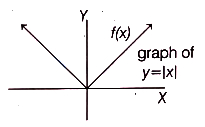
Assertion $(A)$: $f(x) = |x|$ is differentiable at $x = a \neq 0$ and continuous but not differentiable at $x = 0$.
Reason $(R)$: If a function is differentiable at a point,then it is continuous at the point. But the converse is not true.
Reason $(R)$: If a function is differentiable at a point,then it is continuous at the point. But the converse is not true.
A
$A$ is correct,$R$ is correct,$R$ is the correct explanation of $A$.
B
$A$ is correct,$R$ is correct,but $R$ is not the correct explanation of $A$.
C
$A$ is correct,$R$ is false.
D
$A$ is false,$R$ is correct.
Solution
(A) The function $f(x) = |x|$ is defined as:
$f(x) = \begin{cases} x, & x \geq 0 \\ -x, & x < 0 \end{cases}$
At $x = 0$,the left-hand derivative is $\lim_{h \to 0^-} \frac{f(0+h) - f(0)}{h} = \lim_{h \to 0^-} \frac{-h - 0}{h} = -1$.
The right-hand derivative is $\lim_{h \to 0^+} \frac{f(0+h) - f(0)}{h} = \lim_{h \to 0^+} \frac{h - 0}{h} = 1$.
Since the left-hand derivative $\neq$ right-hand derivative,$f(x)$ is not differentiable at $x = 0$.
However,$f(x)$ is continuous everywhere,including $x = 0$.
For any $x = a \neq 0$,the function is locally linear (either $x$ or $-x$),so it is differentiable.
Thus,Assertion $(A)$ is correct.
Reason $(R)$ states a fundamental theorem in calculus: differentiability implies continuity,but continuity does not imply differentiability. This theorem explains why $f(x) = |x|$ is continuous at $x = 0$ but not differentiable there.
Therefore,$R$ is the correct explanation of $A$.
$f(x) = \begin{cases} x, & x \geq 0 \\ -x, & x < 0 \end{cases}$
At $x = 0$,the left-hand derivative is $\lim_{h \to 0^-} \frac{f(0+h) - f(0)}{h} = \lim_{h \to 0^-} \frac{-h - 0}{h} = -1$.
The right-hand derivative is $\lim_{h \to 0^+} \frac{f(0+h) - f(0)}{h} = \lim_{h \to 0^+} \frac{h - 0}{h} = 1$.
Since the left-hand derivative $\neq$ right-hand derivative,$f(x)$ is not differentiable at $x = 0$.
However,$f(x)$ is continuous everywhere,including $x = 0$.
For any $x = a \neq 0$,the function is locally linear (either $x$ or $-x$),so it is differentiable.
Thus,Assertion $(A)$ is correct.
Reason $(R)$ states a fundamental theorem in calculus: differentiability implies continuity,but continuity does not imply differentiability. This theorem explains why $f(x) = |x|$ is continuous at $x = 0$ but not differentiable there.
Therefore,$R$ is the correct explanation of $A$.
0 likes
View Solution163
MediumMCQ
The set of all points where the function $f(x) = 2x|x|$ is differentiable is
A
$(-\infty, \infty)$
B
$(-\infty, 0) \cup (0, \infty)$
C
$(0, \infty)$
D
$[0, \infty)$
Solution
(A) The function is given by $f(x) = 2x|x|$.
We can rewrite this as a piecewise function:
$f(x) = \begin{cases} 2x^2, & x \geq 0 \\ -2x^2, & x < 0 \end{cases}$
Since $2x^2$ and $-2x^2$ are polynomials,$f(x)$ is differentiable for all $x \neq 0$. We only need to check the differentiability at $x = 0$.
Left Hand Derivative $(LHD)$ at $x = 0$:
$f'(0^-) = \lim_{h \rightarrow 0^-} \frac{f(0+h) - f(0)}{h} = \lim_{h \rightarrow 0^-} \frac{-2h^2 - 0}{h} = \lim_{h \rightarrow 0^-} (-2h) = 0$.
Right Hand Derivative $(RHD)$ at $x = 0$:
$f'(0^+) = \lim_{h \rightarrow 0^+} \frac{f(0+h) - f(0)}{h} = \lim_{h \rightarrow 0^+} \frac{2h^2 - 0}{h} = \lim_{h \rightarrow 0^+} (2h) = 0$.
Since $LHD = RHD = 0$,the function $f(x)$ is differentiable at $x = 0$.
Therefore,$f(x)$ is differentiable for all $x \in (-\infty, \infty)$.
We can rewrite this as a piecewise function:
$f(x) = \begin{cases} 2x^2, & x \geq 0 \\ -2x^2, & x < 0 \end{cases}$
Since $2x^2$ and $-2x^2$ are polynomials,$f(x)$ is differentiable for all $x \neq 0$. We only need to check the differentiability at $x = 0$.
Left Hand Derivative $(LHD)$ at $x = 0$:
$f'(0^-) = \lim_{h \rightarrow 0^-} \frac{f(0+h) - f(0)}{h} = \lim_{h \rightarrow 0^-} \frac{-2h^2 - 0}{h} = \lim_{h \rightarrow 0^-} (-2h) = 0$.
Right Hand Derivative $(RHD)$ at $x = 0$:
$f'(0^+) = \lim_{h \rightarrow 0^+} \frac{f(0+h) - f(0)}{h} = \lim_{h \rightarrow 0^+} \frac{2h^2 - 0}{h} = \lim_{h \rightarrow 0^+} (2h) = 0$.
Since $LHD = RHD = 0$,the function $f(x)$ is differentiable at $x = 0$.
Therefore,$f(x)$ is differentiable for all $x \in (-\infty, \infty)$.
0 likes
View Solution164
MediumMCQ
The function $y = \sin^{-1}(\cos x)$ is not differentiable at . . . . . .
A
$x = \pi$ only
B
$x = 2\pi$ only
C
$x = -2\pi$ only
D
All options are correct
Solution
(D) The function $y = \sin^{-1}(\cos x)$ is defined when $-1 \le \cos x \le 1$. However,the derivative of $\sin^{-1} u$ is $\frac{1}{\sqrt{1-u^2}}$,which is undefined when $u = \pm 1$.
Thus,the function $y = \sin^{-1}(\cos x)$ is not differentiable where $\cos x = 1$ or $\cos x = -1$.
For $\cos x = -1$,$x = (2n+1)\pi$ for any integer $n$. For $n=0$,$x = \pi$.
For $\cos x = 1$,$x = 2n\pi$ for any integer $n$. For $n=1$,$x = 2\pi$,and for $n=-1$,$x = -2\pi$.
Since the function is not differentiable at $x = \pi$,$x = 2\pi$,and $x = -2\pi$,all the given options are correct.
Thus,the function $y = \sin^{-1}(\cos x)$ is not differentiable where $\cos x = 1$ or $\cos x = -1$.
For $\cos x = -1$,$x = (2n+1)\pi$ for any integer $n$. For $n=0$,$x = \pi$.
For $\cos x = 1$,$x = 2n\pi$ for any integer $n$. For $n=1$,$x = 2\pi$,and for $n=-1$,$x = -2\pi$.
Since the function is not differentiable at $x = \pi$,$x = 2\pi$,and $x = -2\pi$,all the given options are correct.
0 likes
View Solution165
EasyMCQ
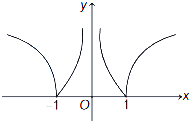
$f(x) = |\log_e |x||$ is differentiable at
A
$x = 0$ only
B
$x = 1$ only
C
$x = -1$ only
D
$R - \{0, \pm 1\}$
Solution
(D) The function is defined as $f(x) = |\log_e |x||$.
First,consider the domain of the function. The function is undefined at $x = 0$ because $\log_e 0$ is undefined.
Next,examine the points where the function might not be differentiable. The function $f(x)$ involves an absolute value of a logarithm,which creates sharp corners (cusps) where the argument of the absolute value is zero.
Setting $\log_e |x| = 0$,we get $|x| = 1$,which implies $x = 1$ or $x = -1$.
At $x = 1$ and $x = -1$,the graph has sharp turns,meaning the derivative does not exist at these points.
At $x = 0$,the function has a vertical asymptote,so it is not continuous,and therefore not differentiable.
Thus,the function $f(x)$ is differentiable for all real numbers except $x = 0, 1, -1$.
This is represented as $R - \{0, 1, -1\}$ or $R - \{0, \pm 1\}$.
Therefore,option $(d)$ is correct.
First,consider the domain of the function. The function is undefined at $x = 0$ because $\log_e 0$ is undefined.
Next,examine the points where the function might not be differentiable. The function $f(x)$ involves an absolute value of a logarithm,which creates sharp corners (cusps) where the argument of the absolute value is zero.
Setting $\log_e |x| = 0$,we get $|x| = 1$,which implies $x = 1$ or $x = -1$.
At $x = 1$ and $x = -1$,the graph has sharp turns,meaning the derivative does not exist at these points.
At $x = 0$,the function has a vertical asymptote,so it is not continuous,and therefore not differentiable.
Thus,the function $f(x)$ is differentiable for all real numbers except $x = 0, 1, -1$.
This is represented as $R - \{0, 1, -1\}$ or $R - \{0, \pm 1\}$.
Therefore,option $(d)$ is correct.
0 likes
View Solution166
MediumMCQ
Let $[x]$ denote the greatest integer less than or equal to $x$. Then the number of points where the function $y = [x] + |1 - x|$ for $-1 \leq x \leq 3$ is not differentiable,is
A
$1$
B
$2$
C
$3$
D
$4$
Solution
(D) The function is defined as $f(x) = [x] + |1 - x|$ on the interval $[-1, 3]$.
Points of discontinuity for the greatest integer function $[x]$ in the interval $[-1, 3]$ are $x = 0, 1, 2, 3$.
At $x = 1$,the function is $f(x) = [x] + |1 - x|$. Since $|1 - x|$ is continuous everywhere,the non-differentiability arises from the jump discontinuities of $[x]$ at $x = 0, 1, 2, 3$ and the corner point of $|1 - x|$ at $x = 1$.
Checking the points:
$1$. At $x = 0$: $[x]$ is discontinuous,so $f(x)$ is not differentiable.
$2$. At $x = 1$: $[x]$ is discontinuous and $|1 - x|$ has a corner,so $f(x)$ is not differentiable.
$3$. At $x = 2$: $[x]$ is discontinuous,so $f(x)$ is not differentiable.
$4$. At $x = 3$: $[x]$ is discontinuous,so $f(x)$ is not differentiable.
Thus,the function is not differentiable at $x = 0, 1, 2, 3$. There are $4$ such points.
Points of discontinuity for the greatest integer function $[x]$ in the interval $[-1, 3]$ are $x = 0, 1, 2, 3$.
At $x = 1$,the function is $f(x) = [x] + |1 - x|$. Since $|1 - x|$ is continuous everywhere,the non-differentiability arises from the jump discontinuities of $[x]$ at $x = 0, 1, 2, 3$ and the corner point of $|1 - x|$ at $x = 1$.
Checking the points:
$1$. At $x = 0$: $[x]$ is discontinuous,so $f(x)$ is not differentiable.
$2$. At $x = 1$: $[x]$ is discontinuous and $|1 - x|$ has a corner,so $f(x)$ is not differentiable.
$3$. At $x = 2$: $[x]$ is discontinuous,so $f(x)$ is not differentiable.
$4$. At $x = 3$: $[x]$ is discontinuous,so $f(x)$ is not differentiable.
Thus,the function is not differentiable at $x = 0, 1, 2, 3$. There are $4$ such points.
0 likes
View Solution167
EasyMCQ
The number of points in the interval $(0,2)$ at which $f(x)=|x-0.5|+|x-1|+\tan x$ is not differentiable is
A
$1$
B
$2$
C
$3$
D
$4$
Solution
(C) Given the function $f(x) = |x - 0.5| + |x - 1| + \tan x$.
We know that the modulus function $|x - a|$ is not differentiable at $x = a$.
Therefore,$|x - 0.5|$ is not differentiable at $x = 0.5$ and $|x - 1|$ is not differentiable at $x = 1$.
Both $x = 0.5$ and $x = 1$ lie within the interval $(0, 2)$.
Additionally,the function $\tan x$ is not defined (and hence not differentiable) at $x = \frac{\pi}{2}$.
Since $\pi \approx 3.14$,we have $\frac{\pi}{2} \approx 1.57$,which also lies within the interval $(0, 2)$.
Thus,the function $f(x)$ is not differentiable at $x = 0.5$,$x = 1$,and $x = \frac{\pi}{2}$.
There are $3$ such points in the interval $(0, 2)$.
Therefore,option $C$ is correct.
We know that the modulus function $|x - a|$ is not differentiable at $x = a$.
Therefore,$|x - 0.5|$ is not differentiable at $x = 0.5$ and $|x - 1|$ is not differentiable at $x = 1$.
Both $x = 0.5$ and $x = 1$ lie within the interval $(0, 2)$.
Additionally,the function $\tan x$ is not defined (and hence not differentiable) at $x = \frac{\pi}{2}$.
Since $\pi \approx 3.14$,we have $\frac{\pi}{2} \approx 1.57$,which also lies within the interval $(0, 2)$.
Thus,the function $f(x)$ is not differentiable at $x = 0.5$,$x = 1$,and $x = \frac{\pi}{2}$.
There are $3$ such points in the interval $(0, 2)$.
Therefore,option $C$ is correct.
0 likes
View Solution168
EasyMCQ
If $\alpha$ and $\beta$ are such that the function $f(x)$ defined by $f(x) = \begin{cases} \alpha x^2 - \beta, & |x| < 1 \\ \frac{-1}{|x|}, & |x| \ge 1 \end{cases}$ is differentiable everywhere,then the ordered pair $(\alpha, \beta) =$
A
$(-\frac{1}{2}, -\frac{3}{2})$
B
$(\frac{1}{2}, -\frac{3}{2})$
C
$(\frac{1}{2}, \frac{3}{2})$
D
$(-\frac{1}{2}, \frac{3}{2})$
Solution
(C) For $f(x)$ to be differentiable everywhere,it must be continuous and differentiable at $x = 1$ and $x = -1$. Since $f(x)$ is an even function,we check $x = 1$.
Continuity at $x = 1$: $\lim_{x \to 1^-} f(x) = \lim_{x \to 1^+} f(x) = f(1)$.
$\lim_{x \to 1^-} (\alpha x^2 - \beta) = \alpha - \beta$.
$\lim_{x \to 1^+} (-\frac{1}{x}) = -1$.
So,$\alpha - \beta = -1$ (Equation $1$).
Differentiability at $x = 1$: $f'(1^-) = f'(1^+)$.
$f'(x) = 2\alpha x$ for $|x| < 1$ and $f'(x) = \frac{1}{x^2}$ for $|x| > 1$.
$f'(1^-) = 2\alpha(1) = 2\alpha$.
$f'(1^+) = \frac{1}{(1)^2} = 1$.
Thus,$2\alpha = 1 \implies \alpha = \frac{1}{2}$.
Substituting $\alpha = \frac{1}{2}$ into Equation $1$: $\frac{1}{2} - \beta = -1 \implies \beta = \frac{3}{2}$.
Therefore,the ordered pair $(\alpha, \beta) = (\frac{1}{2}, \frac{3}{2})$.
Continuity at $x = 1$: $\lim_{x \to 1^-} f(x) = \lim_{x \to 1^+} f(x) = f(1)$.
$\lim_{x \to 1^-} (\alpha x^2 - \beta) = \alpha - \beta$.
$\lim_{x \to 1^+} (-\frac{1}{x}) = -1$.
So,$\alpha - \beta = -1$ (Equation $1$).
Differentiability at $x = 1$: $f'(1^-) = f'(1^+)$.
$f'(x) = 2\alpha x$ for $|x| < 1$ and $f'(x) = \frac{1}{x^2}$ for $|x| > 1$.
$f'(1^-) = 2\alpha(1) = 2\alpha$.
$f'(1^+) = \frac{1}{(1)^2} = 1$.
Thus,$2\alpha = 1 \implies \alpha = \frac{1}{2}$.
Substituting $\alpha = \frac{1}{2}$ into Equation $1$: $\frac{1}{2} - \beta = -1 \implies \beta = \frac{3}{2}$.
Therefore,the ordered pair $(\alpha, \beta) = (\frac{1}{2}, \frac{3}{2})$.
0 likes
View Solution169
MediumMCQ
Let $f$ be defined on $D = R - \{-1, 1\}$ by $f(x) = \frac{|x|}{1 - |x|}$,then
A
$f$ is differentiable on $D$
B
$f$ is differentiable on $D$ except at $x = 0$
C
$f$ is continuous but not differentiable on $D$
D
$f$ is differentiable but not continuous on $D$
Solution
(B) Given: $f(x) = \frac{|x|}{1 - |x|}$.
First,check continuity at $x = 0$:
$\text{LHL} = \lim_{x \to 0^-} \frac{-x}{1 - (-x)} = \lim_{x \to 0^-} \frac{-x}{1 + x} = 0$.
$\text{RHL} = \lim_{x \to 0^+} \frac{x}{1 - x} = 0$.
Since $f(0) = 0$,$f(x)$ is continuous at $x = 0$.
Now,check differentiability at $x = 0$:
For $x < 0$,$f(x) = \frac{-x}{1 + x}$,so $f'(x) = \frac{-(1+x) - (-x)(1)}{(1+x)^2} = \frac{-1}{(1+x)^2}$. Thus,$\text{LHD} = f'(0^-) = -1$.
For $x > 0$,$f(x) = \frac{x}{1 - x}$,so $f'(x) = \frac{(1-x) - x(-1)}{(1-x)^2} = \frac{1}{(1-x)^2}$. Thus,$\text{RHD} = f'(0^+) = 1$.
Since $\text{LHD} \neq \text{RHD}$,$f(x)$ is not differentiable at $x = 0$.
However,$f(x)$ is differentiable for all $x \in D \setminus \{0\}$.
Therefore,$f$ is differentiable on $D$ except at $x = 0$.
First,check continuity at $x = 0$:
$\text{LHL} = \lim_{x \to 0^-} \frac{-x}{1 - (-x)} = \lim_{x \to 0^-} \frac{-x}{1 + x} = 0$.
$\text{RHL} = \lim_{x \to 0^+} \frac{x}{1 - x} = 0$.
Since $f(0) = 0$,$f(x)$ is continuous at $x = 0$.
Now,check differentiability at $x = 0$:
For $x < 0$,$f(x) = \frac{-x}{1 + x}$,so $f'(x) = \frac{-(1+x) - (-x)(1)}{(1+x)^2} = \frac{-1}{(1+x)^2}$. Thus,$\text{LHD} = f'(0^-) = -1$.
For $x > 0$,$f(x) = \frac{x}{1 - x}$,so $f'(x) = \frac{(1-x) - x(-1)}{(1-x)^2} = \frac{1}{(1-x)^2}$. Thus,$\text{RHD} = f'(0^+) = 1$.
Since $\text{LHD} \neq \text{RHD}$,$f(x)$ is not differentiable at $x = 0$.
However,$f(x)$ is differentiable for all $x \in D \setminus \{0\}$.
Therefore,$f$ is differentiable on $D$ except at $x = 0$.
0 likes
View Solution170
MediumMCQ
The points at which the function $f(x) = |x - 0.5| + |x - 1| + \tan x$ does not have a derivative in the interval $(0, 2)$ are:
A
$0.5, 1, 2$
B
$0.5, \frac{\pi}{2}, 0$
C
$1, \frac{\pi}{2}, 2$
D
$0.5, 1, \frac{\pi}{2}$
Solution
(D) function $f(x)$ is not differentiable at points where the expression inside the absolute value is zero,or where the function itself is discontinuous.
$1$. The absolute value functions $|x - 0.5|$ and $|x - 1|$ are not differentiable at $x = 0.5$ and $x = 1$ respectively.
$2$. The function $\tan x$ is not defined (and thus not differentiable) at $x = \frac{\pi}{2} + n\pi$. Within the interval $(0, 2)$,$\frac{\pi}{2} \approx 1.57$,which lies in the interval.
$3$. Combining these,the function $f(x)$ is not differentiable at $x = 0.5$,$x = 1$,and $x = \frac{\pi}{2}$.
Thus,the correct option is $D$.
$1$. The absolute value functions $|x - 0.5|$ and $|x - 1|$ are not differentiable at $x = 0.5$ and $x = 1$ respectively.
$2$. The function $\tan x$ is not defined (and thus not differentiable) at $x = \frac{\pi}{2} + n\pi$. Within the interval $(0, 2)$,$\frac{\pi}{2} \approx 1.57$,which lies in the interval.
$3$. Combining these,the function $f(x)$ is not differentiable at $x = 0.5$,$x = 1$,and $x = \frac{\pi}{2}$.
Thus,the correct option is $D$.
0 likes
View Solution171
MediumMCQ
Define $f(x) = \begin{cases} x^2 + bx + c, & x < 1 \\ x, & x \geq 1 \end{cases}$. If $f(x)$ is differentiable at $x = 1$,then $(b - c)$ is equal to
A
$-2$
B
$0$
C
$1$
D
$2$
Solution
(A) Given the function,$f(x) = \begin{cases} x^2 + bx + c, & x < 1 \\ x, & x \geq 1 \end{cases}$.
For $f(x)$ to be differentiable at $x = 1$,it must be continuous at $x = 1$ and the left-hand derivative must equal the right-hand derivative.
First,for continuity at $x = 1$:
$\lim_{x \to 1^-} f(x) = f(1)$
$\lim_{x \to 1^-} (x^2 + bx + c) = 1$
$1 + b + c = 1 \Rightarrow b + c = 0$ (Equation $1$).
Next,for differentiability at $x = 1$,the derivatives must match:
$f'(x) = \begin{cases} 2x + b, & x < 1 \\ 1, & x > 1 \end{cases}$
$\lim_{x \to 1^-} f'(x) = \lim_{x \to 1^+} f'(x)$
$2(1) + b = 1 \Rightarrow 2 + b = 1 \Rightarrow b = -1$.
Substituting $b = -1$ into Equation $1$:
$-1 + c = 0 \Rightarrow c = 1$.
Therefore,$b - c = -1 - 1 = -2$.
For $f(x)$ to be differentiable at $x = 1$,it must be continuous at $x = 1$ and the left-hand derivative must equal the right-hand derivative.
First,for continuity at $x = 1$:
$\lim_{x \to 1^-} f(x) = f(1)$
$\lim_{x \to 1^-} (x^2 + bx + c) = 1$
$1 + b + c = 1 \Rightarrow b + c = 0$ (Equation $1$).
Next,for differentiability at $x = 1$,the derivatives must match:
$f'(x) = \begin{cases} 2x + b, & x < 1 \\ 1, & x > 1 \end{cases}$
$\lim_{x \to 1^-} f'(x) = \lim_{x \to 1^+} f'(x)$
$2(1) + b = 1 \Rightarrow 2 + b = 1 \Rightarrow b = -1$.
Substituting $b = -1$ into Equation $1$:
$-1 + c = 0 \Rightarrow c = 1$.
Therefore,$b - c = -1 - 1 = -2$.
0 likes
View Solution172
DifficultMCQ
If $f(x)=|x|+|sin x|$ for $x \in \left(-\frac{\pi}{2}, \frac{\pi}{2}\right)$,then its left hand derivative at $x=0$ is
A
$0$
B
$-1$
C
$-2$
D
$-3$
Solution
(C) Given $f(x) = |x| + |sin x|$.
For $x \in \left(-\frac{\pi}{2}, \frac{\pi}{2}\right)$,the left hand derivative $(LHD)$ at $x=0$ is defined as:
$LHD = \lim_{h \to 0^+} \frac{f(0-h) - f(0)}{-h}$
Since $f(0) = |0| + |sin 0| = 0$,we have:
$LHD = \lim_{h \to 0^+} \frac{|-h| + |sin(-h)| - 0}{-h}$
For small $h > 0$,$|-h| = h$ and $|sin(-h)| = |-sin h| = sin h$ (since $sin h > 0$ for $h \in (0, \pi/2)$).
$LHD = \lim_{h \to 0^+} \frac{h + sin h}{-h}$
$LHD = \lim_{h \to 0^+} -\left( \frac{h}{h} + \frac{sin h}{h} \right)$
$LHD = -(1 + 1) = -2$.
For $x \in \left(-\frac{\pi}{2}, \frac{\pi}{2}\right)$,the left hand derivative $(LHD)$ at $x=0$ is defined as:
$LHD = \lim_{h \to 0^+} \frac{f(0-h) - f(0)}{-h}$
Since $f(0) = |0| + |sin 0| = 0$,we have:
$LHD = \lim_{h \to 0^+} \frac{|-h| + |sin(-h)| - 0}{-h}$
For small $h > 0$,$|-h| = h$ and $|sin(-h)| = |-sin h| = sin h$ (since $sin h > 0$ for $h \in (0, \pi/2)$).
$LHD = \lim_{h \to 0^+} \frac{h + sin h}{-h}$
$LHD = \lim_{h \to 0^+} -\left( \frac{h}{h} + \frac{sin h}{h} \right)$
$LHD = -(1 + 1) = -2$.
0 likes
View Solution173
MediumMCQ
The domain of the derivative of the function $f(x) = \frac{x}{1+|x|}$ is
A
$[0, \infty)$
B
$(-\infty, 0)$
C
$(-\infty, \infty)$
D
$(0, \infty)$
Solution
(C) Given the function $f(x) = \frac{x}{1+|x|}$.
We can write this as a piecewise function:
If $x \ge 0$,then $|x| = x$,so $f(x) = \frac{x}{1+x}$.
If $x < 0$,then $|x| = -x$,so $f(x) = \frac{x}{1-x}$.
Now,we find the derivative $f'(x)$:
For $x > 0$,$f'(x) = \frac{(1+x)(1) - x(1)}{(1+x)^2} = \frac{1}{(1+x)^2}$.
For $x < 0$,$f'(x) = \frac{(1-x)(1) - x(-1)}{(1-x)^2} = \frac{1-x+x}{(1-x)^2} = \frac{1}{(1-x)^2}$.
At $x = 0$,we check the left-hand derivative and right-hand derivative:
$LHD = \lim_{h \to 0^-} \frac{f(0+h) - f(0)}{h} = \lim_{h \to 0^-} \frac{\frac{h}{1-h} - 0}{h} = \lim_{h \to 0^-} \frac{1}{1-h} = 1$.
$RHD = \lim_{h \to 0^+} \frac{f(0+h) - f(0)}{h} = \lim_{h \to 0^+} \frac{\frac{h}{1+h} - 0}{h} = \lim_{h \to 0^+} \frac{1}{1+h} = 1$.
Since $LHD = RHD = 1$,the function is differentiable at $x = 0$ and $f'(0) = 1$.
Thus,the derivative exists for all real numbers $x \in (-\infty, \infty)$.
We can write this as a piecewise function:
If $x \ge 0$,then $|x| = x$,so $f(x) = \frac{x}{1+x}$.
If $x < 0$,then $|x| = -x$,so $f(x) = \frac{x}{1-x}$.
Now,we find the derivative $f'(x)$:
For $x > 0$,$f'(x) = \frac{(1+x)(1) - x(1)}{(1+x)^2} = \frac{1}{(1+x)^2}$.
For $x < 0$,$f'(x) = \frac{(1-x)(1) - x(-1)}{(1-x)^2} = \frac{1-x+x}{(1-x)^2} = \frac{1}{(1-x)^2}$.
At $x = 0$,we check the left-hand derivative and right-hand derivative:
$LHD = \lim_{h \to 0^-} \frac{f(0+h) - f(0)}{h} = \lim_{h \to 0^-} \frac{\frac{h}{1-h} - 0}{h} = \lim_{h \to 0^-} \frac{1}{1-h} = 1$.
$RHD = \lim_{h \to 0^+} \frac{f(0+h) - f(0)}{h} = \lim_{h \to 0^+} \frac{\frac{h}{1+h} - 0}{h} = \lim_{h \to 0^+} \frac{1}{1+h} = 1$.
Since $LHD = RHD = 1$,the function is differentiable at $x = 0$ and $f'(0) = 1$.
Thus,the derivative exists for all real numbers $x \in (-\infty, \infty)$.
0 likes
View Solution174
DifficultMCQ
If $f(x) = \begin{cases} \frac{x-1}{2x^2-7x+5}, & \text{for } x \neq 1 \\ -\frac{1}{3}, & \text{for } x=1 \end{cases}$,then $f^{\prime}(1)$ is equal to:
A
$-\frac{1}{9}$
B
$-\frac{2}{9}$
C
$-\frac{1}{3}$
D
$\frac{1}{3}$
Solution
(B) Given $f(x) = \frac{x-1}{2x^2-7x+5}$ for $x \neq 1$.
Factoring the denominator: $2x^2-7x+5 = 2x^2-2x-5x+5 = 2x(x-1)-5(x-1) = (2x-5)(x-1)$.
Thus,for $x \neq 1$,$f(x) = \frac{x-1}{(2x-5)(x-1)} = \frac{1}{2x-5}$.
The function is $f(x) = \begin{cases} \frac{1}{2x-5}, & x \neq 1 \\ -\frac{1}{3}, & x=1 \end{cases}$.
By the definition of the derivative,$f^{\prime}(1) = \lim_{h \to 0} \frac{f(1+h)-f(1)}{h}$.
$f^{\prime}(1) = \lim_{h \to 0} \frac{\frac{1}{2(1+h)-5} - (-\frac{1}{3})}{h} = \lim_{h \to 0} \frac{\frac{1}{2h-3} + \frac{1}{3}}{h}$.
$f^{\prime}(1) = \lim_{h \to 0} \frac{3 + (2h-3)}{3h(2h-3)} = \lim_{h \to 0} \frac{2h}{3h(2h-3)}$.
$f^{\prime}(1) = \lim_{h \to 0} \frac{2}{3(2h-3)} = \frac{2}{3(-3)} = -\frac{2}{9}$.
Factoring the denominator: $2x^2-7x+5 = 2x^2-2x-5x+5 = 2x(x-1)-5(x-1) = (2x-5)(x-1)$.
Thus,for $x \neq 1$,$f(x) = \frac{x-1}{(2x-5)(x-1)} = \frac{1}{2x-5}$.
The function is $f(x) = \begin{cases} \frac{1}{2x-5}, & x \neq 1 \\ -\frac{1}{3}, & x=1 \end{cases}$.
By the definition of the derivative,$f^{\prime}(1) = \lim_{h \to 0} \frac{f(1+h)-f(1)}{h}$.
$f^{\prime}(1) = \lim_{h \to 0} \frac{\frac{1}{2(1+h)-5} - (-\frac{1}{3})}{h} = \lim_{h \to 0} \frac{\frac{1}{2h-3} + \frac{1}{3}}{h}$.
$f^{\prime}(1) = \lim_{h \to 0} \frac{3 + (2h-3)}{3h(2h-3)} = \lim_{h \to 0} \frac{2h}{3h(2h-3)}$.
$f^{\prime}(1) = \lim_{h \to 0} \frac{2}{3(2h-3)} = \frac{2}{3(-3)} = -\frac{2}{9}$.
0 likes
View Solution175
MediumMCQ
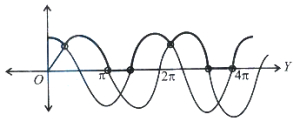
Let $f(x) = \operatorname{Max}\{\cos x, \sin x, 0\}$. If the number of points at which $f(x)$ is not differentiable in $(0, 2024 \pi)$ is $1012 k$,then $k =$
A
$3/2$
B
$6$
C
$3$
D
$2$
Solution
(C) Given $f(x) = \max\{\cos x, \sin x, 0\}$.
In the interval $[0, 2\pi]$,the function $f(x)$ is defined as:
$f(x) = \cos x$ for $x \in [0, \pi/4]$
$f(x) = \sin x$ for $x \in [\pi/4, 5\pi/4]$
$f(x) = 0$ for $x \in [5\pi/4, 2\pi]$
Checking for non-differentiability at the intersection points:
$1$. At $x = \pi/4$,$\cos(\pi/4) = \sin(\pi/4) = 1/\sqrt{2}$. The derivatives are $-\sin(\pi/4) = -1/\sqrt{2}$ and $\cos(\pi/4) = 1/\sqrt{2}$. Since they are not equal,$f(x)$ is not differentiable at $x = \pi/4$.
$2$. At $x = 5\pi/4$,$\sin(5\pi/4) = -1/\sqrt{2}$ and $0$. Since $\sin(5\pi/4) < 0$,the function is $0$. The transition from $\sin x$ to $0$ occurs at $x = \pi$ (where $\sin x = 0$). At $x = \pi$,$\sin(\pi) = 0$ and the derivative is $\cos(\pi) = -1$. The derivative of $0$ is $0$. Since $-1 \neq 0$,it is not differentiable at $x = \pi$.
$3$. At $x = 2\pi$,$\cos(2\pi) = 1$ and $0$. The transition from $0$ to $\cos x$ occurs at $x = 2\pi - \pi/2 = 3\pi/2$ is not correct,actually $\cos x = 0$ at $x = 3\pi/2$. The function $f(x)$ is $0$ on $[5\pi/4, 2\pi]$ and $\cos x$ starts being positive at $x = 3\pi/2$. At $x = 3\pi/2$,$\cos(3\pi/2) = 0$ and the derivative is $-\sin(3\pi/2) = 1$. Since $1 \neq 0$,it is not differentiable at $x = 3\pi/2$.
Thus,there are $3$ points of non-differentiability in every interval of length $2\pi$.
In $(0, 2024\pi)$,there are $1012$ such intervals.
Total points of non-differentiability $= 3 \times 1012 = 3036$.
Given $1012k = 3036$,we get $k = 3$.
In the interval $[0, 2\pi]$,the function $f(x)$ is defined as:
$f(x) = \cos x$ for $x \in [0, \pi/4]$
$f(x) = \sin x$ for $x \in [\pi/4, 5\pi/4]$
$f(x) = 0$ for $x \in [5\pi/4, 2\pi]$
Checking for non-differentiability at the intersection points:
$1$. At $x = \pi/4$,$\cos(\pi/4) = \sin(\pi/4) = 1/\sqrt{2}$. The derivatives are $-\sin(\pi/4) = -1/\sqrt{2}$ and $\cos(\pi/4) = 1/\sqrt{2}$. Since they are not equal,$f(x)$ is not differentiable at $x = \pi/4$.
$2$. At $x = 5\pi/4$,$\sin(5\pi/4) = -1/\sqrt{2}$ and $0$. Since $\sin(5\pi/4) < 0$,the function is $0$. The transition from $\sin x$ to $0$ occurs at $x = \pi$ (where $\sin x = 0$). At $x = \pi$,$\sin(\pi) = 0$ and the derivative is $\cos(\pi) = -1$. The derivative of $0$ is $0$. Since $-1 \neq 0$,it is not differentiable at $x = \pi$.
$3$. At $x = 2\pi$,$\cos(2\pi) = 1$ and $0$. The transition from $0$ to $\cos x$ occurs at $x = 2\pi - \pi/2 = 3\pi/2$ is not correct,actually $\cos x = 0$ at $x = 3\pi/2$. The function $f(x)$ is $0$ on $[5\pi/4, 2\pi]$ and $\cos x$ starts being positive at $x = 3\pi/2$. At $x = 3\pi/2$,$\cos(3\pi/2) = 0$ and the derivative is $-\sin(3\pi/2) = 1$. Since $1 \neq 0$,it is not differentiable at $x = 3\pi/2$.
Thus,there are $3$ points of non-differentiability in every interval of length $2\pi$.
In $(0, 2024\pi)$,there are $1012$ such intervals.
Total points of non-differentiability $= 3 \times 1012 = 3036$.
Given $1012k = 3036$,we get $k = 3$.
0 likes
View Solution176
MediumMCQ
If the function $g(x)=\begin{cases} K \sqrt{x+1} &, 0 \leq x \leq 3 \\ mx+2 &, 3 < x \leq 5 \end{cases}$ is differentiable,then $K+m=$
A
$4$
B
$2$
C
$6$
D
$0$
Solution
(B) For the function $g(x)$ to be differentiable at $x=3$,it must first be continuous at $x=3$.
Continuity at $x=3$: $\lim_{x \to 3^-} g(x) = \lim_{x \to 3^+} g(x) = g(3)$.
$K \sqrt{3+1} = 3m+2 \implies 2K = 3m+2$ (Equation $1$).
Differentiability at $x=3$: The left-hand derivative must equal the right-hand derivative.
$g'(x) = \begin{cases} \frac{K}{2\sqrt{x+1}} &, 0 < x < 3 \\ m &, 3 < x < 5 \end{cases}$.
At $x=3$,$\frac{K}{2\sqrt{3+1}} = m \implies \frac{K}{4} = m \implies K = 4m$ (Equation $2$).
Substitute $K=4m$ into Equation $1$: $2(4m) = 3m+2 \implies 8m = 3m+2 \implies 5m = 2 \implies m = \frac{2}{5}$.
Then $K = 4(\frac{2}{5}) = \frac{8}{5}$.
Therefore,$K+m = \frac{8}{5} + \frac{2}{5} = \frac{10}{5} = 2$.
Continuity at $x=3$: $\lim_{x \to 3^-} g(x) = \lim_{x \to 3^+} g(x) = g(3)$.
$K \sqrt{3+1} = 3m+2 \implies 2K = 3m+2$ (Equation $1$).
Differentiability at $x=3$: The left-hand derivative must equal the right-hand derivative.
$g'(x) = \begin{cases} \frac{K}{2\sqrt{x+1}} &, 0 < x < 3 \\ m &, 3 < x < 5 \end{cases}$.
At $x=3$,$\frac{K}{2\sqrt{3+1}} = m \implies \frac{K}{4} = m \implies K = 4m$ (Equation $2$).
Substitute $K=4m$ into Equation $1$: $2(4m) = 3m+2 \implies 8m = 3m+2 \implies 5m = 2 \implies m = \frac{2}{5}$.
Then $K = 4(\frac{2}{5}) = \frac{8}{5}$.
Therefore,$K+m = \frac{8}{5} + \frac{2}{5} = \frac{10}{5} = 2$.
0 likes
View Solution177
EasyMCQ
If the function $f: R \rightarrow R$,defined by $f(x) = \begin{cases} 5-3x, & \text{if } x \leq \frac{5}{3} \\ x^2-3x+20, & \text{if } x > \frac{5}{3} \end{cases}$,then $f$ is
A
continuous at $x = \frac{5}{3}$
B
differentiable at $x = \frac{5}{3}$
C
differentiable at $x = 2$
D
discontinuous at $x = -2$
Solution
(C) We check the continuity at $x = \frac{5}{3}$:
Left-hand limit: $\lim_{x \to \frac{5}{3}^-} f(x) = 5 - 3(\frac{5}{3}) = 5 - 5 = 0$.
Right-hand limit: $\lim_{x \to \frac{5}{3}^+} f(x) = (\frac{5}{3})^2 - 3(\frac{5}{3}) + 20 = \frac{25}{9} - 5 + 20 = \frac{25}{9} + 15 = \frac{25 + 135}{9} = \frac{160}{9}$.
Since $\lim_{x \to \frac{5}{3}^-} f(x) \neq \lim_{x \to \frac{5}{3}^+} f(x)$,the function is discontinuous at $x = \frac{5}{3}$.
Now check differentiability at $x = 2$. Since $2 > \frac{5}{3}$,the function is defined by $f(x) = x^2 - 3x + 20$ in the neighborhood of $x = 2$.
This is a polynomial function,which is differentiable everywhere in its domain. Thus,$f(x)$ is differentiable at $x = 2$.
Left-hand limit: $\lim_{x \to \frac{5}{3}^-} f(x) = 5 - 3(\frac{5}{3}) = 5 - 5 = 0$.
Right-hand limit: $\lim_{x \to \frac{5}{3}^+} f(x) = (\frac{5}{3})^2 - 3(\frac{5}{3}) + 20 = \frac{25}{9} - 5 + 20 = \frac{25}{9} + 15 = \frac{25 + 135}{9} = \frac{160}{9}$.
Since $\lim_{x \to \frac{5}{3}^-} f(x) \neq \lim_{x \to \frac{5}{3}^+} f(x)$,the function is discontinuous at $x = \frac{5}{3}$.
Now check differentiability at $x = 2$. Since $2 > \frac{5}{3}$,the function is defined by $f(x) = x^2 - 3x + 20$ in the neighborhood of $x = 2$.
This is a polynomial function,which is differentiable everywhere in its domain. Thus,$f(x)$ is differentiable at $x = 2$.
0 likes
View Solution178
MediumMCQ
If $f(x) = \begin{cases} \frac{x^2 \ln \cos x}{\ln (1+x^2)} & , x \neq 0 \\ 0 & , x=0 \end{cases}$,then $f(x)$ is
A
discontinuous at zero
B
continuous but not differentiable at zero
C
differentiable at zero
D
not continuous and not differentiable at zero
Solution
(C) First,we check for continuity at $x=0$: $\lim_{x \to 0} f(x) = \lim_{x \to 0} \frac{x^2 \ln \cos x}{\ln (1+x^2)}$.
Using standard limits $\lim_{u \to 0} \frac{\ln(1+u)}{u} = 1$,we have $\lim_{x \to 0} \frac{\ln(1+x^2)}{x^2} = 1$.
Thus,$\lim_{x \to 0} f(x) = \lim_{x \to 0} \left( \frac{x^2}{\ln(1+x^2)} \right) \cdot \ln \cos x = 1 \cdot \ln(1) = 0$.
Since $\lim_{x \to 0} f(x) = f(0) = 0$,the function is continuous at $x=0$.
Now,we check for differentiability at $x=0$ using the definition $f'(0) = \lim_{h \to 0} \frac{f(h) - f(0)}{h} = \lim_{h \to 0} \frac{h^2 \ln \cos h}{h \ln(1+h^2)} = \lim_{h \to 0} \frac{h \ln \cos h}{\ln(1+h^2)}$.
Dividing numerator and denominator by $h^2$: $\lim_{h \to 0} \frac{\frac{\ln \cos h}{h}}{\frac{\ln(1+h^2)}{h^2}} = \lim_{h \to 0} \frac{\frac{\ln \cos h}{h}}{1}$.
Using $L$'Hospital's rule on $\frac{\ln \cos h}{h}$: $\lim_{h \to 0} \frac{-\tan h}{1} = 0$.
Since the limit exists and is equal to $0$,$f(x)$ is differentiable at $x=0$.
Using standard limits $\lim_{u \to 0} \frac{\ln(1+u)}{u} = 1$,we have $\lim_{x \to 0} \frac{\ln(1+x^2)}{x^2} = 1$.
Thus,$\lim_{x \to 0} f(x) = \lim_{x \to 0} \left( \frac{x^2}{\ln(1+x^2)} \right) \cdot \ln \cos x = 1 \cdot \ln(1) = 0$.
Since $\lim_{x \to 0} f(x) = f(0) = 0$,the function is continuous at $x=0$.
Now,we check for differentiability at $x=0$ using the definition $f'(0) = \lim_{h \to 0} \frac{f(h) - f(0)}{h} = \lim_{h \to 0} \frac{h^2 \ln \cos h}{h \ln(1+h^2)} = \lim_{h \to 0} \frac{h \ln \cos h}{\ln(1+h^2)}$.
Dividing numerator and denominator by $h^2$: $\lim_{h \to 0} \frac{\frac{\ln \cos h}{h}}{\frac{\ln(1+h^2)}{h^2}} = \lim_{h \to 0} \frac{\frac{\ln \cos h}{h}}{1}$.
Using $L$'Hospital's rule on $\frac{\ln \cos h}{h}$: $\lim_{h \to 0} \frac{-\tan h}{1} = 0$.
Since the limit exists and is equal to $0$,$f(x)$ is differentiable at $x=0$.
0 likes
View Solution179
MediumMCQ
The values of $x$ at which the real-valued function $f(x) = 7|2x + 1| - 19|3x - 5|$ is not differentiable are:
A
$1, -1$
B
$\frac{1}{2}, -\frac{5}{3}$
C
$-\frac{1}{2}, \frac{5}{3}$
D
$0, 1$
Solution
(C) function $f(x) = |g(x)|$ is not differentiable at points where $g(x) = 0$,provided $g(x)$ is a linear or polynomial function.
Given $f(x) = 7|2x + 1| - 19|3x - 5|$.
The function involves absolute value terms $|2x + 1|$ and $|3x - 5|$.
The term $|2x + 1|$ is not differentiable at $2x + 1 = 0$,which gives $x = -\frac{1}{2}$.
The term $|3x - 5|$ is not differentiable at $3x - 5 = 0$,which gives $x = \frac{5}{3}$.
Since the function is a linear combination of these absolute value functions,it is not differentiable at the points where the expressions inside the absolute values are zero.
Therefore,the function $f(x)$ is not differentiable at $x = -\frac{1}{2}$ and $x = \frac{5}{3}$.
Given $f(x) = 7|2x + 1| - 19|3x - 5|$.
The function involves absolute value terms $|2x + 1|$ and $|3x - 5|$.
The term $|2x + 1|$ is not differentiable at $2x + 1 = 0$,which gives $x = -\frac{1}{2}$.
The term $|3x - 5|$ is not differentiable at $3x - 5 = 0$,which gives $x = \frac{5}{3}$.
Since the function is a linear combination of these absolute value functions,it is not differentiable at the points where the expressions inside the absolute values are zero.
Therefore,the function $f(x)$ is not differentiable at $x = -\frac{1}{2}$ and $x = \frac{5}{3}$.
0 likes
View Solution180
MediumMCQ
The set of all values of $x$ for which $f(x) = ||x| - 1|$ is differentiable is
A
$R - \{-1, 0, 1\}$
B
$R - \{-1, 1\}$
C
$R - \{0\}$
D
$R$
Solution
(A) The function is given by $f(x) = ||x| - 1|$.
We know that $|x|$ is not differentiable at $x = 0$.
Also,the function $g(x) = |x| - 1$ is not differentiable at $x = 0$.
The function $f(x) = |g(x)|$ is not differentiable where $g(x) = 0$ or where $g(x)$ is not differentiable.
Setting $g(x) = 0$,we get $|x| - 1 = 0$,which implies $|x| = 1$,so $x = 1$ or $x = -1$.
Additionally,$g(x)$ is not differentiable at $x = 0$.
Therefore,$f(x)$ is not differentiable at $x \in \{-1, 0, 1\}$.
Thus,the set of all values of $x$ for which $f(x)$ is differentiable is $R - \{-1, 0, 1\}$.
We know that $|x|$ is not differentiable at $x = 0$.
Also,the function $g(x) = |x| - 1$ is not differentiable at $x = 0$.
The function $f(x) = |g(x)|$ is not differentiable where $g(x) = 0$ or where $g(x)$ is not differentiable.
Setting $g(x) = 0$,we get $|x| - 1 = 0$,which implies $|x| = 1$,so $x = 1$ or $x = -1$.
Additionally,$g(x)$ is not differentiable at $x = 0$.
Therefore,$f(x)$ is not differentiable at $x \in \{-1, 0, 1\}$.
Thus,the set of all values of $x$ for which $f(x)$ is differentiable is $R - \{-1, 0, 1\}$.
0 likes
View Solution181
EasyMCQ
If the function $f(x) = \begin{cases} \frac{(e^{kx}-1) \sin kx}{4 \tan x}, & x \neq 0 \\ P, & x=0 \end{cases}$ is differentiable at $x=0$,then
A
$P=0$,$f^{\prime}(0)=\frac{k^2}{4}$
B
$P=0$,$f^{\prime}(0)=-\frac{1}{2}$
C
$P=k$,$f^{\prime}(0)=-\frac{k^2}{4}$
D
$P=k$,$f^{\prime}(0)=-\frac{1}{4}$
Solution
(A) Since $f(x)$ is differentiable at $x=0$,it must be continuous at $x=0$.
$\lim_{x \rightarrow 0} f(x) = f(0) = P$.
$\lim_{x \rightarrow 0} \frac{(e^{kx}-1) \sin kx}{4 \tan x} = \lim_{x \rightarrow 0} \frac{(e^{kx}-1)}{x} \cdot \frac{\sin kx}{x} \cdot \frac{x^2}{4 \tan x} = (k) \cdot (k) \cdot (0) = 0$.
Thus,$P = 0$.
Now,$f^{\prime}(0) = \lim_{x \rightarrow 0} \frac{f(x) - f(0)}{x} = \lim_{x \rightarrow 0} \frac{(e^{kx}-1) \sin kx}{4x \tan x}$.
$f^{\prime}(0) = \lim_{x \rightarrow 0} \left( \frac{e^{kx}-1}{x} \right) \left( \frac{\sin kx}{x} \right) \left( \frac{x}{\tan x} \right) \cdot \frac{1}{4} = (k) \cdot (k) \cdot (1) \cdot \frac{1}{4} = \frac{k^2}{4}$.
$\lim_{x \rightarrow 0} f(x) = f(0) = P$.
$\lim_{x \rightarrow 0} \frac{(e^{kx}-1) \sin kx}{4 \tan x} = \lim_{x \rightarrow 0} \frac{(e^{kx}-1)}{x} \cdot \frac{\sin kx}{x} \cdot \frac{x^2}{4 \tan x} = (k) \cdot (k) \cdot (0) = 0$.
Thus,$P = 0$.
Now,$f^{\prime}(0) = \lim_{x \rightarrow 0} \frac{f(x) - f(0)}{x} = \lim_{x \rightarrow 0} \frac{(e^{kx}-1) \sin kx}{4x \tan x}$.
$f^{\prime}(0) = \lim_{x \rightarrow 0} \left( \frac{e^{kx}-1}{x} \right) \left( \frac{\sin kx}{x} \right) \left( \frac{x}{\tan x} \right) \cdot \frac{1}{4} = (k) \cdot (k) \cdot (1) \cdot \frac{1}{4} = \frac{k^2}{4}$.
0 likes
View Solution182
EasyMCQ
Consider the following statements.
$(a)$ If a function is differentiable at a point $p$ then it is not continuous at $p$.
$(b)$ If a function is not continuous at $x = a$,then it is not differentiable at $x = a$.
$(c)$ If $f(x) = |x|$ then $f(x)$ is not differentiable but continuous on $R$.
$(d)$ If $f(x) = x - [x]$,then $f'(1) = 1$.
Which of the above statements are (is) correct?
$(a)$ If a function is differentiable at a point $p$ then it is not continuous at $p$.
$(b)$ If a function is not continuous at $x = a$,then it is not differentiable at $x = a$.
$(c)$ If $f(x) = |x|$ then $f(x)$ is not differentiable but continuous on $R$.
$(d)$ If $f(x) = x - [x]$,then $f'(1) = 1$.
Which of the above statements are (is) correct?
A
Only $(b)$
B
$(b)$ and $(c)$
C
Only $(c)$
D
$(c)$ and $(d)$
Solution
(B) Statement $(a)$ is incorrect because if a function is differentiable at a point,it must be continuous at that point.
Statement $(b)$ is correct because differentiability implies continuity; therefore,the contrapositive (not continuous implies not differentiable) is also true.
Statement $(c)$ is correct because $f(x) = |x|$ is continuous for all $x \in R$ but is not differentiable at $x = 0$.
Statement $(d)$ is incorrect because $f(x) = x - [x]$ is the fractional part function,which is discontinuous at all integers,including $x = 1$. Since it is discontinuous at $x = 1$,it is not differentiable at $x = 1$.
Thus,statements $(b)$ and $(c)$ are correct.
Statement $(b)$ is correct because differentiability implies continuity; therefore,the contrapositive (not continuous implies not differentiable) is also true.
Statement $(c)$ is correct because $f(x) = |x|$ is continuous for all $x \in R$ but is not differentiable at $x = 0$.
Statement $(d)$ is incorrect because $f(x) = x - [x]$ is the fractional part function,which is discontinuous at all integers,including $x = 1$. Since it is discontinuous at $x = 1$,it is not differentiable at $x = 1$.
Thus,statements $(b)$ and $(c)$ are correct.
0 likes
View Solution183
MediumMCQ
Let $g: [-2, 2] \rightarrow R$ and $f: [-2, 2] \rightarrow R$ be two functions defined as $g(x) = \begin{cases} -1, & \text{if } -2 \le x < 0 \\ x^2 - 1, & \text{if } 0 \le x \le 2 \end{cases}$ and $f(x) = |g(x)| + g(|x|) + 2$. In the interval $(-2, 2)$,$f$ is not differentiable at $x = $
A
$0$
B
$1$
C
$\frac{1}{2}$
D
$-1$
Solution
(B) First,we determine $|g(x)|$:
$|g(x)| = \begin{cases} |-1| = 1, & -2 \le x < 0 \\ |x^2 - 1|, & 0 \le x \le 2 \end{cases} = \begin{cases} 1, & -2 \le x < 0 \\ 1 - x^2, & 0 \le x < 1 \\ x^2 - 1, & 1 \le x \le 2 \end{cases}$
Next,we determine $g(|x|)$:
Since $|x| \ge 0$ for all $x \in [-2, 2]$,we use the second part of $g(x)$:
$g(|x|) = |x|^2 - 1 = x^2 - 1$ for all $x \in [-2, 2]$.
Now,calculate $f(x) = |g(x)| + g(|x|) + 2$:
For $-2 \le x < 0$: $f(x) = 1 + (x^2 - 1) + 2 = x^2 + 2$.
For $0 \le x < 1$: $f(x) = (1 - x^2) + (x^2 - 1) + 2 = 2$.
For $1 \le x \le 2$: $f(x) = (x^2 - 1) + (x^2 - 1) + 2 = 2x^2$.
Thus,$f(x) = \begin{cases} x^2 + 2, & -2 \le x < 0 \\ 2, & 0 \le x < 1 \\ 2x^2, & 1 \le x \le 2 \end{cases}$.
Checking differentiability at $x = 0$:
$LHD = \lim_{x \to 0^-} \frac{d}{dx}(x^2 + 2) = 2(0) = 0$.
$RHD = \lim_{x \to 0^+} \frac{d}{dx}(2) = 0$.
Since $LHD = RHD$,$f$ is differentiable at $x = 0$.
Checking differentiability at $x = 1$:
$LHD = \lim_{x \to 1^-} \frac{d}{dx}(2) = 0$.
$RHD = \lim_{x \to 1^+} \frac{d}{dx}(2x^2) = 4(1) = 4$.
Since $LHD \neq RHD$,$f$ is not differentiable at $x = 1$.
$|g(x)| = \begin{cases} |-1| = 1, & -2 \le x < 0 \\ |x^2 - 1|, & 0 \le x \le 2 \end{cases} = \begin{cases} 1, & -2 \le x < 0 \\ 1 - x^2, & 0 \le x < 1 \\ x^2 - 1, & 1 \le x \le 2 \end{cases}$
Next,we determine $g(|x|)$:
Since $|x| \ge 0$ for all $x \in [-2, 2]$,we use the second part of $g(x)$:
$g(|x|) = |x|^2 - 1 = x^2 - 1$ for all $x \in [-2, 2]$.
Now,calculate $f(x) = |g(x)| + g(|x|) + 2$:
For $-2 \le x < 0$: $f(x) = 1 + (x^2 - 1) + 2 = x^2 + 2$.
For $0 \le x < 1$: $f(x) = (1 - x^2) + (x^2 - 1) + 2 = 2$.
For $1 \le x \le 2$: $f(x) = (x^2 - 1) + (x^2 - 1) + 2 = 2x^2$.
Thus,$f(x) = \begin{cases} x^2 + 2, & -2 \le x < 0 \\ 2, & 0 \le x < 1 \\ 2x^2, & 1 \le x \le 2 \end{cases}$.
Checking differentiability at $x = 0$:
$LHD = \lim_{x \to 0^-} \frac{d}{dx}(x^2 + 2) = 2(0) = 0$.
$RHD = \lim_{x \to 0^+} \frac{d}{dx}(2) = 0$.
Since $LHD = RHD$,$f$ is differentiable at $x = 0$.
Checking differentiability at $x = 1$:
$LHD = \lim_{x \to 1^-} \frac{d}{dx}(2) = 0$.
$RHD = \lim_{x \to 1^+} \frac{d}{dx}(2x^2) = 4(1) = 4$.
Since $LHD \neq RHD$,$f$ is not differentiable at $x = 1$.
0 likes
View Solution184
EasyMCQ
If $f: R \rightarrow R$ is defined as $f(x)=|x+1|+|x-1|$,then $f(x)$ is
A
not differentiable at every real number
B
not differentiable at $-1$ and $1$ only
C
not differentiable at $-1, 0$ and $1$
D
differentiable on $R$
Solution
(B) Given the function $f(x) = |x+1| + |x-1|$.
We know that the function $g(x) = |x|$ is not differentiable at $x = 0$.
Similarly,$|x+1|$ is not differentiable at $x = -1$ and $|x-1|$ is not differentiable at $x = 1$.
The sum of two functions is not differentiable at the points where either of the functions is not differentiable.
Therefore,$f(x)$ is not differentiable at $x = -1$ and $x = 1$.
We know that the function $g(x) = |x|$ is not differentiable at $x = 0$.
Similarly,$|x+1|$ is not differentiable at $x = -1$ and $|x-1|$ is not differentiable at $x = 1$.
The sum of two functions is not differentiable at the points where either of the functions is not differentiable.
Therefore,$f(x)$ is not differentiable at $x = -1$ and $x = 1$.
0 likes
View Solution185
EasyMCQ
Suppose $f(x) = \begin{cases} [\cos \pi x], & x \leq 1 \\ 2\{x\} - 1, & x > 1 \end{cases}$,where $[\cdot]$ and $\{\cdot\}$ denote the greatest integer function and the fractional part of $x$ respectively,then at $x = 1$:
A
right derivative is $2$
B
left derivative is $2$
C
right derivative is $0$
D
left derivative is $-1$
Solution
(A) Given $f(x) = \begin{cases} [\cos \pi x], & x \leq 1 \\ 2\{x\} - 1, & x > 1 \end{cases}$.
For $x > 1$,we have $f(x) = 2(x - [x]) - 1$. Since for $x$ slightly greater than $1$,$[x] = 1$,we get $f(x) = 2(x - 1) - 1 = 2x - 3$.
The right-hand derivative at $x = 1$ is defined as $f'(1^+) = \lim_{h \to 0^+} \frac{f(1+h) - f(1)}{h}$.
First,$f(1) = [\cos \pi] = [-1] = -1$.
Then,$f'(1^+) = \lim_{h \to 0^+} \frac{2(1+h) - 3 - (-1)}{h} = \lim_{h \to 0^+} \frac{2 + 2h - 3 + 1}{h} = \lim_{h \to 0^+} \frac{2h}{h} = 2$.
Thus,the right derivative at $x = 1$ is $2$.
For $x > 1$,we have $f(x) = 2(x - [x]) - 1$. Since for $x$ slightly greater than $1$,$[x] = 1$,we get $f(x) = 2(x - 1) - 1 = 2x - 3$.
The right-hand derivative at $x = 1$ is defined as $f'(1^+) = \lim_{h \to 0^+} \frac{f(1+h) - f(1)}{h}$.
First,$f(1) = [\cos \pi] = [-1] = -1$.
Then,$f'(1^+) = \lim_{h \to 0^+} \frac{2(1+h) - 3 - (-1)}{h} = \lim_{h \to 0^+} \frac{2 + 2h - 3 + 1}{h} = \lim_{h \to 0^+} \frac{2h}{h} = 2$.
Thus,the right derivative at $x = 1$ is $2$.
0 likes
View Solution186
MediumMCQ
If $f(x)=\frac{2x}{4+3|x|}, x \in R$,then $f^{\prime}(0)=$
A
$0$
B
$\frac{1}{4}$
C
$\frac{1}{2}$
D
$\frac{3}{4}$
Solution
(C) We have,$f(x)=\frac{2x}{4+3|x|}, x \in R$.
This can be written as:
$f(x) = \begin{cases} \frac{2x}{4+3x}, & \text{if } x \geq 0 \\ \frac{2x}{4-3x}, & \text{if } x < 0 \end{cases}$
To find $f^{\prime}(0)$,we check the left-hand and right-hand derivatives at $x=0$.
For $x > 0$,$f^{\prime}(x) = \frac{d}{dx} \left( \frac{2x}{4+3x} \right) = \frac{(4+3x)(2) - 2x(3)}{(4+3x)^2} = \frac{8+6x-6x}{(4+3x)^2} = \frac{8}{(4+3x)^2}$.
Thus,$Rf^{\prime}(0) = \lim_{x \rightarrow 0^+} \frac{8}{(4+3x)^2} = \frac{8}{16} = \frac{1}{2}$.
For $x < 0$,$f^{\prime}(x) = \frac{d}{dx} \left( \frac{2x}{4-3x} \right) = \frac{(4-3x)(2) - 2x(-3)}{(4-3x)^2} = \frac{8-6x+6x}{(4-3x)^2} = \frac{8}{(4-3x)^2}$.
Thus,$Lf^{\prime}(0) = \lim_{x \rightarrow 0^-} \frac{8}{(4-3x)^2} = \frac{8}{16} = \frac{1}{2}$.
Since $Lf^{\prime}(0) = Rf^{\prime}(0) = \frac{1}{2}$,the derivative $f^{\prime}(0)$ exists and is equal to $\frac{1}{2}$.
This can be written as:
$f(x) = \begin{cases} \frac{2x}{4+3x}, & \text{if } x \geq 0 \\ \frac{2x}{4-3x}, & \text{if } x < 0 \end{cases}$
To find $f^{\prime}(0)$,we check the left-hand and right-hand derivatives at $x=0$.
For $x > 0$,$f^{\prime}(x) = \frac{d}{dx} \left( \frac{2x}{4+3x} \right) = \frac{(4+3x)(2) - 2x(3)}{(4+3x)^2} = \frac{8+6x-6x}{(4+3x)^2} = \frac{8}{(4+3x)^2}$.
Thus,$Rf^{\prime}(0) = \lim_{x \rightarrow 0^+} \frac{8}{(4+3x)^2} = \frac{8}{16} = \frac{1}{2}$.
For $x < 0$,$f^{\prime}(x) = \frac{d}{dx} \left( \frac{2x}{4-3x} \right) = \frac{(4-3x)(2) - 2x(-3)}{(4-3x)^2} = \frac{8-6x+6x}{(4-3x)^2} = \frac{8}{(4-3x)^2}$.
Thus,$Lf^{\prime}(0) = \lim_{x \rightarrow 0^-} \frac{8}{(4-3x)^2} = \frac{8}{16} = \frac{1}{2}$.
Since $Lf^{\prime}(0) = Rf^{\prime}(0) = \frac{1}{2}$,the derivative $f^{\prime}(0)$ exists and is equal to $\frac{1}{2}$.
0 likes
View Solution187
MediumMCQ
The function that is not differentiable at $x=1$ is
A
$f_1(x)=|x|, -\infty < x < \infty$
B
$f_2(x)=\begin{cases} 1+\sin(x-1), & x \leq 1 \\ x, & x > 1 \end{cases}$
C
$f_3(x)=\begin{cases} x^2+7x-7, & x \leq 1 \\ \frac{3x-1}{2}, & x > 1 \end{cases}$
D
$f_4(x)=\begin{cases} |x-1|+|x-2|, & x \leq 1 \\ 1+x-x^3, & x > 1 \end{cases}$
Solution
(C) function $f(x)$ is differentiable at $x=a$ if the left-hand derivative $LHD = \lim_{h \to 0^-} \frac{f(a+h)-f(a)}{h}$ and right-hand derivative $RHD = \lim_{h \to 0^+} \frac{f(a+h)-f(a)}{h}$ exist and are equal.
For $f_1(x)=|x|$,at $x=1$,$f_1(x)=x$. Thus $f_1'(1)=1$. It is differentiable.
For $f_2(x)$,at $x=1$,$LHD = \frac{d}{dx}(1+\sin(x-1))|_{x=1} = \cos(0) = 1$. $RHD = \frac{d}{dx}(x)|_{x=1} = 1$. Since $LHD=RHD$,it is differentiable.
For $f_3(x)$,at $x=1$,$LHD = \frac{d}{dx}(x^2+7x-7)|_{x=1} = 2(1)+7 = 9$. $RHD = \frac{d}{dx}(\frac{3x-1}{2})|_{x=1} = \frac{3}{2} = 1.5$. Since $LHD \neq RHD$,$f_3(x)$ is not differentiable at $x=1$.
For $f_4(x)$,at $x=1$,$f_4(x) = |x-1|+|x-2|$. For $x \leq 1$,$f_4(x) = -(x-1)-(x-2) = -2x+3$. $LHD = -2$. For $x > 1$,$f_4(x) = 1+x-x^3$. $RHD = \frac{d}{dx}(1+x-x^3)|_{x=1} = 1-3(1)^2 = -2$. Since $LHD=RHD$,it is differentiable.
For $f_1(x)=|x|$,at $x=1$,$f_1(x)=x$. Thus $f_1'(1)=1$. It is differentiable.
For $f_2(x)$,at $x=1$,$LHD = \frac{d}{dx}(1+\sin(x-1))|_{x=1} = \cos(0) = 1$. $RHD = \frac{d}{dx}(x)|_{x=1} = 1$. Since $LHD=RHD$,it is differentiable.
For $f_3(x)$,at $x=1$,$LHD = \frac{d}{dx}(x^2+7x-7)|_{x=1} = 2(1)+7 = 9$. $RHD = \frac{d}{dx}(\frac{3x-1}{2})|_{x=1} = \frac{3}{2} = 1.5$. Since $LHD \neq RHD$,$f_3(x)$ is not differentiable at $x=1$.
For $f_4(x)$,at $x=1$,$f_4(x) = |x-1|+|x-2|$. For $x \leq 1$,$f_4(x) = -(x-1)-(x-2) = -2x+3$. $LHD = -2$. For $x > 1$,$f_4(x) = 1+x-x^3$. $RHD = \frac{d}{dx}(1+x-x^3)|_{x=1} = 1-3(1)^2 = -2$. Since $LHD=RHD$,it is differentiable.
0 likes
View Solution188
MediumMCQ
If $f(x) = \begin{cases} x^2 \left| \cos \frac{\pi}{x} \right|, & x \neq 0 \\ 0, & x = 0 \end{cases}$,then at $x = 2$,$f(x)$ is
A
Differentiable
B
Continuous but not differentiable
C
Right differentiable only
D
Left differentiable only
Solution
(A) To check the differentiability of $f(x)$ at $x = 2$,we first note that for $x$ in a neighborhood of $2$,$\cos(\frac{\pi}{x})$ is positive because $\frac{\pi}{x}$ is near $\frac{\pi}{2}$. Specifically,for $x$ near $2$,$\frac{\pi}{x}$ is in the interval $(0, \pi)$,where $\cos(\frac{\pi}{x})$ is positive.
Thus,for $x$ in a small neighborhood of $2$,$f(x) = x^2 \cos(\frac{\pi}{x})$.
Now,we find the derivative $f'(x)$ using the product rule:
$f'(x) = \frac{d}{dx} [x^2 \cos(\frac{\pi}{x})] = 2x \cos(\frac{\pi}{x}) + x^2 [-\sin(\frac{\pi}{x})] \cdot (-\frac{\pi}{x^2}) = 2x \cos(\frac{\pi}{x}) + \pi \sin(\frac{\pi}{x})$.
Evaluating at $x = 2$:
$f'(2) = 2(2) \cos(\frac{\pi}{2}) + \pi \sin(\frac{\pi}{2}) = 4(0) + \pi(1) = \pi$.
Since the derivative exists at $x = 2$,the function is differentiable at $x = 2$.
Thus,for $x$ in a small neighborhood of $2$,$f(x) = x^2 \cos(\frac{\pi}{x})$.
Now,we find the derivative $f'(x)$ using the product rule:
$f'(x) = \frac{d}{dx} [x^2 \cos(\frac{\pi}{x})] = 2x \cos(\frac{\pi}{x}) + x^2 [-\sin(\frac{\pi}{x})] \cdot (-\frac{\pi}{x^2}) = 2x \cos(\frac{\pi}{x}) + \pi \sin(\frac{\pi}{x})$.
Evaluating at $x = 2$:
$f'(2) = 2(2) \cos(\frac{\pi}{2}) + \pi \sin(\frac{\pi}{2}) = 4(0) + \pi(1) = \pi$.
Since the derivative exists at $x = 2$,the function is differentiable at $x = 2$.
0 likes
View Solution189
MediumMCQ
Let $f(x)=|1-2 x|$,then
A
$f(x)$ is continuous but not differentiable at $x=\frac{1}{2}$
B
$f(x)$ is differentiable but not continuous at $x=\frac{1}{2}$
C
$f(x)$ is both continuous and differentiable at $x=\frac{1}{2}$
D
$f(x)$ is neither differentiable nor continuous at $x=\frac{1}{2}$
Solution
(A) The absolute value function can be rewritten as a piecewise function:
$f(x)= \begin{cases} 1-2x, & \text{if } x \leq \frac{1}{2} \\ 2x-1, & \text{if } x > \frac{1}{2} \end{cases}$
Check for continuity at $x=\frac{1}{2}$:
Left-hand limit: $\lim_{x \rightarrow \frac{1}{2}^-} f(x) = \lim_{x \rightarrow \frac{1}{2}} (1-2x) = 1-2(\frac{1}{2}) = 0$.
Right-hand limit: $\lim_{x \rightarrow \frac{1}{2}^+} f(x) = \lim_{x \rightarrow \frac{1}{2}} (2x-1) = 2(\frac{1}{2})-1 = 0$.
Function value: $f(\frac{1}{2}) = |1-2(\frac{1}{2})| = 0$.
Since the left-hand limit,right-hand limit,and function value are all equal,the function is continuous at $x=\frac{1}{2}$.
Check for differentiability at $x=\frac{1}{2}$:
Left-hand derivative: $f'(x) = \frac{d}{dx}(1-2x) = -2$ for $x < \frac{1}{2}$.
Right-hand derivative: $f'(x) = \frac{d}{dx}(2x-1) = 2$ for $x > \frac{1}{2}$.
Since the left-hand derivative $(-2)$ and right-hand derivative $(2)$ are not equal,the function is not differentiable at $x=\frac{1}{2}$.
$f(x)= \begin{cases} 1-2x, & \text{if } x \leq \frac{1}{2} \\ 2x-1, & \text{if } x > \frac{1}{2} \end{cases}$
Check for continuity at $x=\frac{1}{2}$:
Left-hand limit: $\lim_{x \rightarrow \frac{1}{2}^-} f(x) = \lim_{x \rightarrow \frac{1}{2}} (1-2x) = 1-2(\frac{1}{2}) = 0$.
Right-hand limit: $\lim_{x \rightarrow \frac{1}{2}^+} f(x) = \lim_{x \rightarrow \frac{1}{2}} (2x-1) = 2(\frac{1}{2})-1 = 0$.
Function value: $f(\frac{1}{2}) = |1-2(\frac{1}{2})| = 0$.
Since the left-hand limit,right-hand limit,and function value are all equal,the function is continuous at $x=\frac{1}{2}$.
Check for differentiability at $x=\frac{1}{2}$:
Left-hand derivative: $f'(x) = \frac{d}{dx}(1-2x) = -2$ for $x < \frac{1}{2}$.
Right-hand derivative: $f'(x) = \frac{d}{dx}(2x-1) = 2$ for $x > \frac{1}{2}$.
Since the left-hand derivative $(-2)$ and right-hand derivative $(2)$ are not equal,the function is not differentiable at $x=\frac{1}{2}$.
0 likes
View Solution190
MediumMCQ
Let $f(x)=a_0+a_1|x|+a_2|x|^2+a_3|x|^3$,where $a_0, a_1, a_2, a_3$ are real constants. Then $f(x)$ is differentiable at $x=0$ if and only if:
A
whatever be $a_0, a_1, a_2, a_3$
B
for no values of $a_0, a_1, a_2, a_3$
C
only if $a_1=0$
D
only if $a_1=0, a_3=0$
Solution
(C) Given $f(x) = a_0 + a_1|x| + a_2|x|^2 + a_3|x|^3$.
Since $|x|^2 = x^2$ and $|x|^3 = |x| \cdot x^2$,we can write $f(x) = a_0 + a_1|x| + a_2x^2 + a_3|x|x^2$.
For $f(x)$ to be differentiable at $x=0$,the left-hand derivative and right-hand derivative must be equal.
Right-hand derivative at $x=0$: $f'(0^+) = \lim_{h \to 0^+} \frac{f(h) - f(0)}{h} = \lim_{h \to 0^+} \frac{a_0 + a_1h + a_2h^2 + a_3h^3 - a_0}{h} = \lim_{h \to 0^+} (a_1 + a_2h + a_3h^2) = a_1$.
Left-hand derivative at $x=0$: $f'(0^-) = \lim_{h \to 0^-} \frac{f(h) - f(0)}{h} = \lim_{h \to 0^-} \frac{a_0 + a_1(-h) + a_2h^2 + a_3(-h^3) - a_0}{h} = \lim_{h \to 0^-} (-a_1 + a_2h - a_3h^2) = -a_1$.
For differentiability,$f'(0^+) = f'(0^-) \implies a_1 = -a_1 \implies 2a_1 = 0 \implies a_1 = 0$.
Thus,$f(x)$ is differentiable at $x=0$ only if $a_1=0$.
Since $|x|^2 = x^2$ and $|x|^3 = |x| \cdot x^2$,we can write $f(x) = a_0 + a_1|x| + a_2x^2 + a_3|x|x^2$.
For $f(x)$ to be differentiable at $x=0$,the left-hand derivative and right-hand derivative must be equal.
Right-hand derivative at $x=0$: $f'(0^+) = \lim_{h \to 0^+} \frac{f(h) - f(0)}{h} = \lim_{h \to 0^+} \frac{a_0 + a_1h + a_2h^2 + a_3h^3 - a_0}{h} = \lim_{h \to 0^+} (a_1 + a_2h + a_3h^2) = a_1$.
Left-hand derivative at $x=0$: $f'(0^-) = \lim_{h \to 0^-} \frac{f(h) - f(0)}{h} = \lim_{h \to 0^-} \frac{a_0 + a_1(-h) + a_2h^2 + a_3(-h^3) - a_0}{h} = \lim_{h \to 0^-} (-a_1 + a_2h - a_3h^2) = -a_1$.
For differentiability,$f'(0^+) = f'(0^-) \implies a_1 = -a_1 \implies 2a_1 = 0 \implies a_1 = 0$.
Thus,$f(x)$ is differentiable at $x=0$ only if $a_1=0$.
0 likes
View Solution191
MediumMCQ
If $f(x) = \begin{cases} x^2 + 3x + a, & x \leq 1 \\ bx + 2, & x > 1 \end{cases}$ is everywhere differentiable,then:
A
$a = 3, b = 5$
B
$a = 0, b = 5$
C
$a = 0, b = 3$
D
$a = b = 3$
Solution
(A) For $f(x)$ to be differentiable at $x = 1$,it must first be continuous at $x = 1$.
$\text{LHL} = \lim_{x \to 1^-} (x^2 + 3x + a) = 1 + 3 + a = 4 + a$.
$\text{RHL} = \lim_{x \to 1^+} (bx + 2) = b + 2$.
Since $\text{LHL} = \text{RHL}$,we have $4 + a = b + 2$,which implies $b - a = 2$ (Equation $1$).
For differentiability,$\text{LHD} = \text{RHD}$ at $x = 1$.
$\text{LHD} = \frac{d}{dx}(x^2 + 3x + a) = 2x + 3$. At $x = 1$,$\text{LHD} = 2(1) + 3 = 5$.
$\text{RHD} = \frac{d}{dx}(bx + 2) = b$.
Thus,$b = 5$.
Substituting $b = 5$ into Equation $1$: $5 - a = 2 \Rightarrow a = 3$.
$\text{LHL} = \lim_{x \to 1^-} (x^2 + 3x + a) = 1 + 3 + a = 4 + a$.
$\text{RHL} = \lim_{x \to 1^+} (bx + 2) = b + 2$.
Since $\text{LHL} = \text{RHL}$,we have $4 + a = b + 2$,which implies $b - a = 2$ (Equation $1$).
For differentiability,$\text{LHD} = \text{RHD}$ at $x = 1$.
$\text{LHD} = \frac{d}{dx}(x^2 + 3x + a) = 2x + 3$. At $x = 1$,$\text{LHD} = 2(1) + 3 = 5$.
$\text{RHD} = \frac{d}{dx}(bx + 2) = b$.
Thus,$b = 5$.
Substituting $b = 5$ into Equation $1$: $5 - a = 2 \Rightarrow a = 3$.
0 likes
View Solution192
MediumMCQ
Let $f(x) = |x - \alpha| + |x - \beta|$,where $\alpha$ and $\beta$ are the roots of the equation $x^2 - 3x + 2 = 0$. Then the number of points in $[\alpha, \beta]$ at which $f$ is not differentiable is
A
$2$
B
$0$
C
$1$
D
infinite
Solution
(B) The given equation is $x^2 - 3x + 2 = 0$.
Factoring the quadratic equation,we get $(x - 1)(x - 2) = 0$.
Thus,the roots are $\alpha = 1$ and $\beta = 2$.
So,$f(x) = |x - 1| + |x - 2|$.
For $x \in [1, 2]$,we have $x - 1 \ge 0$ and $x - 2 \le 0$.
Therefore,$f(x) = (x - 1) - (x - 2) = x - 1 - x + 2 = 1$.
Since $f(x) = 1$ is a constant function on the interval $[1, 2]$,it is differentiable at every point in the interval $[1, 2]$.
Thus,the number of points in $[1, 2]$ at which $f$ is not differentiable is $0$.
Factoring the quadratic equation,we get $(x - 1)(x - 2) = 0$.
Thus,the roots are $\alpha = 1$ and $\beta = 2$.
So,$f(x) = |x - 1| + |x - 2|$.
For $x \in [1, 2]$,we have $x - 1 \ge 0$ and $x - 2 \le 0$.
Therefore,$f(x) = (x - 1) - (x - 2) = x - 1 - x + 2 = 1$.
Since $f(x) = 1$ is a constant function on the interval $[1, 2]$,it is differentiable at every point in the interval $[1, 2]$.
Thus,the number of points in $[1, 2]$ at which $f$ is not differentiable is $0$.
0 likes
View Solution193
MediumMCQ
Suppose $f: R \rightarrow R$ is given by $f(x) = \begin{cases} 1, & \text{if } x=1 \\ e^{(x^{10}-1)} + (x-1)^2 \sin \frac{1}{x-1}, & \text{if } x \neq 1 \end{cases}$. Then:
A
$f^{\prime}(1)$ does not exist
B
$f^{\prime}(1)$ exists and is zero
C
$f^{\prime}(1)$ exists and is $9$
D
$f^{\prime}(1)$ exists and is $10$
Solution
(D) To check the differentiability of $f(x)$ at $x=1$,we calculate the derivative using the definition: $f^{\prime}(1) = \lim_{h \to 0} \frac{f(1+h) - f(1)}{h}$.
Given $f(1) = 1$ and for $h \neq 0$,$f(1+h) = e^{((1+h)^{10}-1)} + h^2 \sin(\frac{1}{h})$.
Substituting these into the limit definition:
$f^{\prime}(1) = \lim_{h \to 0} \frac{e^{((1+h)^{10}-1)} + h^2 \sin(\frac{1}{h}) - 1}{h}$.
Using the expansion $e^u = 1 + u + \frac{u^2}{2!} + \dots$,where $u = (1+h)^{10}-1 = 1 + 10h + \dots - 1 = 10h + O(h^2)$:
$f^{\prime}(1) = \lim_{h \to 0} \frac{1 + (10h + O(h^2)) + h^2 \sin(\frac{1}{h}) - 1}{h}$.
$f^{\prime}(1) = \lim_{h \to 0} \frac{10h + O(h^2) + h^2 \sin(\frac{1}{h})}{h}$.
$f^{\prime}(1) = \lim_{h \to 0} (10 + O(h) + h \sin(\frac{1}{h}))$.
Since $\lim_{h \to 0} h \sin(\frac{1}{h}) = 0$ by the Squeeze Theorem,we get $f^{\prime}(1) = 10 + 0 + 0 = 10$.
Given $f(1) = 1$ and for $h \neq 0$,$f(1+h) = e^{((1+h)^{10}-1)} + h^2 \sin(\frac{1}{h})$.
Substituting these into the limit definition:
$f^{\prime}(1) = \lim_{h \to 0} \frac{e^{((1+h)^{10}-1)} + h^2 \sin(\frac{1}{h}) - 1}{h}$.
Using the expansion $e^u = 1 + u + \frac{u^2}{2!} + \dots$,where $u = (1+h)^{10}-1 = 1 + 10h + \dots - 1 = 10h + O(h^2)$:
$f^{\prime}(1) = \lim_{h \to 0} \frac{1 + (10h + O(h^2)) + h^2 \sin(\frac{1}{h}) - 1}{h}$.
$f^{\prime}(1) = \lim_{h \to 0} \frac{10h + O(h^2) + h^2 \sin(\frac{1}{h})}{h}$.
$f^{\prime}(1) = \lim_{h \to 0} (10 + O(h) + h \sin(\frac{1}{h}))$.
Since $\lim_{h \to 0} h \sin(\frac{1}{h}) = 0$ by the Squeeze Theorem,we get $f^{\prime}(1) = 10 + 0 + 0 = 10$.
0 likes
View Solution194
MediumMCQ
The function $f(x) = a \sin |x| + b e^{|x|}$ is differentiable at $x = 0$ when
A
$a = 0, b = 0$
B
$a = 0, b \neq 0$
C
$a \neq 0, b = 0$
D
$a = 0, b = 0$ is not possible
Solution
(C) For $f(x) = a \sin |x| + b e^{|x|}$ to be differentiable at $x = 0$,the left-hand derivative $(LHD)$ and right-hand derivative $(RHD)$ must be equal.
$LHD = \lim_{h \to 0^-} \frac{f(0+h) - f(0)}{h} = \lim_{h \to 0} \frac{a \sin |-h| + b e^{|-h|} - (a \sin 0 + b e^0)}{h} = \lim_{h \to 0} \frac{a \sin(-h) + b e^{-h} - b}{h} = \lim_{h \to 0} \frac{-a \sin h + b(e^{-h} - 1)}{h} = -a - b$.
$RHD = \lim_{h \to 0^+} \frac{f(0+h) - f(0)}{h} = \lim_{h \to 0} \frac{a \sin h + b e^h - b}{h} = \lim_{h \to 0} \frac{a \sin h + b(e^h - 1)}{h} = a + b$.
For differentiability,$LHD = RHD \implies -a - b = a + b \implies 2a + 2b = 0 \implies a + b = 0$.
$LHD = \lim_{h \to 0^-} \frac{f(0+h) - f(0)}{h} = \lim_{h \to 0} \frac{a \sin |-h| + b e^{|-h|} - (a \sin 0 + b e^0)}{h} = \lim_{h \to 0} \frac{a \sin(-h) + b e^{-h} - b}{h} = \lim_{h \to 0} \frac{-a \sin h + b(e^{-h} - 1)}{h} = -a - b$.
$RHD = \lim_{h \to 0^+} \frac{f(0+h) - f(0)}{h} = \lim_{h \to 0} \frac{a \sin h + b e^h - b}{h} = \lim_{h \to 0} \frac{a \sin h + b(e^h - 1)}{h} = a + b$.
For differentiability,$LHD = RHD \implies -a - b = a + b \implies 2a + 2b = 0 \implies a + b = 0$.
0 likes
View Solution195
MediumMCQ
Suppose that $f(x)$ is a differentiable function such that $f^{\prime}(x)$ is continuous,$f^{\prime}(0)=1$ and $f^{\prime \prime}(0)$ does not exist. Let $g(x)=x f^{\prime}(x)$. Then,
A
$g^{\prime}(0)$ does not exist
B
$g^{\prime}(0)=0$
C
$g^{\prime}(0)=1$
D
$g^{\prime}(0)=2$
Solution
(C) We are given $g(x) = x f^{\prime}(x)$.
To find $g^{\prime}(0)$,we use the definition of the derivative:
$g^{\prime}(0) = \lim_{h \to 0} \frac{g(0+h) - g(0)}{h}$.
Since $g(0) = 0 \cdot f^{\prime}(0) = 0$,we have:
$g^{\prime}(0) = \lim_{h \to 0} \frac{h f^{\prime}(h) - 0}{h} = \lim_{h \to 0} f^{\prime}(h)$.
Since $f^{\prime}(x)$ is given to be continuous at $x=0$,we have $\lim_{h \to 0} f^{\prime}(h) = f^{\prime}(0)$.
Given $f^{\prime}(0) = 1$,it follows that $g^{\prime}(0) = 1$.
To find $g^{\prime}(0)$,we use the definition of the derivative:
$g^{\prime}(0) = \lim_{h \to 0} \frac{g(0+h) - g(0)}{h}$.
Since $g(0) = 0 \cdot f^{\prime}(0) = 0$,we have:
$g^{\prime}(0) = \lim_{h \to 0} \frac{h f^{\prime}(h) - 0}{h} = \lim_{h \to 0} f^{\prime}(h)$.
Since $f^{\prime}(x)$ is given to be continuous at $x=0$,we have $\lim_{h \to 0} f^{\prime}(h) = f^{\prime}(0)$.
Given $f^{\prime}(0) = 1$,it follows that $g^{\prime}(0) = 1$.
0 likes
View Solution196
MediumMCQ
The number of points at which the function $f(x) = \max \{a-x, a+x, b\}$ for $-\infty < x < \infty$ and $0 < a < b$ is not differentiable,is
A
$0$
B
$1$
C
$2$
D
$3$
Solution
(C) We are given the function $f(x) = \max \{a-x, a+x, b\}$.
To find the points of non-differentiability,we analyze the intersections of the functions $y_1 = a-x$,$y_2 = a+x$,and $y_3 = b$.
$1$. Intersection of $y_1$ and $y_3$: $a-x = b \implies x = a-b$.
$2$. Intersection of $y_2$ and $y_3$: $a+x = b \implies x = b-a$.
$3$. Intersection of $y_1$ and $y_2$: $a-x = a+x \implies 2x = 0 \implies x = 0$.
Since $0 < a < b$,we have $a-b < 0$ and $b-a > 0$.
At $x = a-b$,$f(x)$ transitions from $a-x$ to $b$,creating a sharp turn.
At $x = b-a$,$f(x)$ transitions from $b$ to $a+x$,creating a sharp turn.
At $x = 0$,the value of $f(0) = \max \{a, a, b\} = b$ (since $b > a$). The function is $b$ in the interval $[a-b, b-a]$,so it is differentiable at $x=0$.
Thus,there are exactly $2$ points of non-differentiability: $x = a-b$ and $x = b-a$.
To find the points of non-differentiability,we analyze the intersections of the functions $y_1 = a-x$,$y_2 = a+x$,and $y_3 = b$.
$1$. Intersection of $y_1$ and $y_3$: $a-x = b \implies x = a-b$.
$2$. Intersection of $y_2$ and $y_3$: $a+x = b \implies x = b-a$.
$3$. Intersection of $y_1$ and $y_2$: $a-x = a+x \implies 2x = 0 \implies x = 0$.
Since $0 < a < b$,we have $a-b < 0$ and $b-a > 0$.
At $x = a-b$,$f(x)$ transitions from $a-x$ to $b$,creating a sharp turn.
At $x = b-a$,$f(x)$ transitions from $b$ to $a+x$,creating a sharp turn.
At $x = 0$,the value of $f(0) = \max \{a, a, b\} = b$ (since $b > a$). The function is $b$ in the interval $[a-b, b-a]$,so it is differentiable at $x=0$.
Thus,there are exactly $2$ points of non-differentiability: $x = a-b$ and $x = b-a$.
0 likes
View Solution197
DifficultMCQ
Let $\alpha, \beta \in R$ be such that the function $f(x) = \begin{cases} 2 \alpha (x^2 - 2) + 2 \beta x, & x < 1 \\ (\alpha + 3) x + (\alpha - \beta), & x \ge 1 \end{cases}$ is differentiable at all $x \in R$. Then $34(\alpha + \beta)$ is equal to
A
$84$
B
$48$
C
$36$
D
$24$
Solution
(B) For $f(x)$ to be differentiable at $x = 1$,it must be continuous at $x = 1$ and $f'(1^-) = f'(1^+)$.
First,for continuity at $x = 1$,we have $f(1^-) = f(1^+)$.
$f(1^-) = \lim_{x \to 1^-} (2 \alpha (x^2 - 2) + 2 \beta x) = 2 \alpha (1 - 2) + 2 \beta (1) = -2 \alpha + 2 \beta$.
$f(1^+) = (\alpha + 3)(1) + (\alpha - \beta) = 2 \alpha - \beta + 3$.
Equating them: $-2 \alpha + 2 \beta = 2 \alpha - \beta + 3 \Rightarrow 4 \alpha - 3 \beta = -3$ $\quad (1)$.
Next,for differentiability,$f'(1^-) = f'(1^+)$.
$f'(x) = 4 \alpha x + 2 \beta$ for $x < 1$ and $f'(x) = \alpha + 3$ for $x > 1$.
$f'(1^-) = 4 \alpha + 2 \beta$.
$f'(1^+) = \alpha + 3$.
Equating them: $4 \alpha + 2 \beta = \alpha + 3 \Rightarrow 3 \alpha + 2 \beta = 3$ $\quad (2)$.
Solving equations $(1)$ and $(2)$:
From $(2)$,$2 \beta = 3 - 3 \alpha \Rightarrow \beta = \frac{3 - 3 \alpha}{2}$.
Substitute into $(1)$: $4 \alpha - 3(\frac{3 - 3 \alpha}{2}) = -3 \Rightarrow 8 \alpha - 9 + 9 \alpha = -6 \Rightarrow 17 \alpha = 3 \Rightarrow \alpha = \frac{3}{17}$.
Then $\beta = \frac{3 - 3(3/17)}{2} = \frac{3 - 9/17}{2} = \frac{42/17}{2} = \frac{21}{17}$.
Thus,$34(\alpha + \beta) = 34(\frac{3}{17} + \frac{21}{17}) = 34(\frac{24}{17}) = 2 \times 24 = 48$.
First,for continuity at $x = 1$,we have $f(1^-) = f(1^+)$.
$f(1^-) = \lim_{x \to 1^-} (2 \alpha (x^2 - 2) + 2 \beta x) = 2 \alpha (1 - 2) + 2 \beta (1) = -2 \alpha + 2 \beta$.
$f(1^+) = (\alpha + 3)(1) + (\alpha - \beta) = 2 \alpha - \beta + 3$.
Equating them: $-2 \alpha + 2 \beta = 2 \alpha - \beta + 3 \Rightarrow 4 \alpha - 3 \beta = -3$ $\quad (1)$.
Next,for differentiability,$f'(1^-) = f'(1^+)$.
$f'(x) = 4 \alpha x + 2 \beta$ for $x < 1$ and $f'(x) = \alpha + 3$ for $x > 1$.
$f'(1^-) = 4 \alpha + 2 \beta$.
$f'(1^+) = \alpha + 3$.
Equating them: $4 \alpha + 2 \beta = \alpha + 3 \Rightarrow 3 \alpha + 2 \beta = 3$ $\quad (2)$.
Solving equations $(1)$ and $(2)$:
From $(2)$,$2 \beta = 3 - 3 \alpha \Rightarrow \beta = \frac{3 - 3 \alpha}{2}$.
Substitute into $(1)$: $4 \alpha - 3(\frac{3 - 3 \alpha}{2}) = -3 \Rightarrow 8 \alpha - 9 + 9 \alpha = -6 \Rightarrow 17 \alpha = 3 \Rightarrow \alpha = \frac{3}{17}$.
Then $\beta = \frac{3 - 3(3/17)}{2} = \frac{3 - 9/17}{2} = \frac{42/17}{2} = \frac{21}{17}$.
Thus,$34(\alpha + \beta) = 34(\frac{3}{17} + \frac{21}{17}) = 34(\frac{24}{17}) = 2 \times 24 = 48$.
0 likes
View Solution198
DifficultMCQ
For the function $f(x) = e^{\sin |x|} - |x|$, $x \in R$, consider the following statements:
Statement $I$: $f$ is differentiable for all $x \in R$.
Statement $II$: $f$ is increasing in $(-\pi, -\frac{\pi}{2})$.
In the light of the above statements, choose the correct answer from the options given below:
Statement $I$: $f$ is differentiable for all $x \in R$.
Statement $II$: $f$ is increasing in $(-\pi, -\frac{\pi}{2})$.
In the light of the above statements, choose the correct answer from the options given below:
A
Both Statement $I$ and Statement $II$ are true
B
Both Statement $I$ and Statement $II$ are false
C
Statement $I$ is true but Statement $II$ is false
D
Statement $I$ is false but Statement $II$ is true
Solution
(D) The function is $f(x) = e^{\sin |x|} - |x|$.
First, check the differentiability at $x = 0$. The function $f(x)$ contains the term $|x|$, which is not differentiable at $x = 0$. Therefore, $f(x)$ is not differentiable at $x = 0$. Thus, Statement $I$ is false.
Next, consider Statement $II$ in the interval $(-\pi, -\frac{\pi}{2})$. For $x < 0$, we have $|x| = -x$. Thus, $f(x) = e^{\sin(-x)} - (-x) = e^{-\sin x} + x$.
The derivative is $f'(x) = e^{-\sin x}(-\cos x) + 1 = 1 - e^{-\sin x}\cos x$.
For $x \in (-\pi, -\frac{\pi}{2})$, we have $\sin x \in (-1, 0)$ and $\cos x \in (-1, 0)$.
Since $\sin x$ is negative, $-\sin x$ is positive, so $e^{-\sin x} > e^0 = 1$. Also, $\cos x$ is negative.
Thus, $-e^{-\sin x}\cos x$ is positive. Therefore, $f'(x) = 1 + (\text{positive value}) > 0$.
Since $f'(x) > 0$, the function $f(x)$ is strictly increasing in the interval $(-\pi, -\frac{\pi}{2})$. Thus, Statement $II$ is true.
First, check the differentiability at $x = 0$. The function $f(x)$ contains the term $|x|$, which is not differentiable at $x = 0$. Therefore, $f(x)$ is not differentiable at $x = 0$. Thus, Statement $I$ is false.
Next, consider Statement $II$ in the interval $(-\pi, -\frac{\pi}{2})$. For $x < 0$, we have $|x| = -x$. Thus, $f(x) = e^{\sin(-x)} - (-x) = e^{-\sin x} + x$.
The derivative is $f'(x) = e^{-\sin x}(-\cos x) + 1 = 1 - e^{-\sin x}\cos x$.
For $x \in (-\pi, -\frac{\pi}{2})$, we have $\sin x \in (-1, 0)$ and $\cos x \in (-1, 0)$.
Since $\sin x$ is negative, $-\sin x$ is positive, so $e^{-\sin x} > e^0 = 1$. Also, $\cos x$ is negative.
Thus, $-e^{-\sin x}\cos x$ is positive. Therefore, $f'(x) = 1 + (\text{positive value}) > 0$.
Since $f'(x) > 0$, the function $f(x)$ is strictly increasing in the interval $(-\pi, -\frac{\pi}{2})$. Thus, Statement $II$ is true.
0 likes
View SolutionContinuity and Differentiation — Differentiability · Frequently Asked Questions
1Are these Continuity and Differentiation questions useful for JEE and NEET?
Yes. All questions in this section are mapped to JEE Main and NEET exam patterns. Previous year questions from JEE Main, NEET, GUJCET and state-level exams are included with full solutions.
2Can I switch to Hindi or Gujarati for these questions?
Yes. Use the language tabs in the hero section or the sidebar to view the same questions and solutions in English, Hindi or Gujarati.
3How do I generate a question paper from this subtopic?
Use the Vedclass Exam Paper Generator — select the chapter and subtopic, set difficulty, and generate Sets A, B, C, D automatically. First 3 chapters of every subject are free.
Vedclass Products
For Students
Vedclass Test Series
Mock tests in real JEE/NEET style with performance analysis. 5-day free trial.
Start Free TrialFor Teachers
Exam Paper Generator
Generate Set A/B/C/D papers from this chapter in 2 minutes. 3 chapters free.
Try FreeFor Institutes
Online Exam Module
Live online exams with unlimited students, 360° analytics & white-label branding.
See DemoFor Teachers & Institutes
Generate a Continuity and Differentiation Exam Paper in 2 Minutes
Select subtopic & difficulty — Sets A, B, C, D auto-generated with No Repeat logic.
First 3 chapters of every subject are free — no payment required.