
A English
Area bounded by region of single curve Questions in English
Class 12 Mathematics · Application of Integration · Area bounded by region of single curve
374+
Questions
English
Language
100%
With Solutions
Showing 50 of 374 questions in English
101
DifficultMCQ
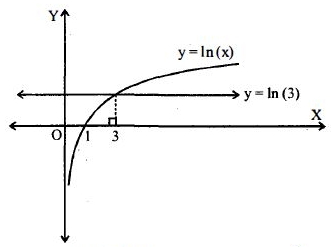
The area bounded by the curve $y = \ln(x)$ and the lines $y = 0$,$y = \ln(3)$,and $x = 0$ is equal to
A
$3$
B
$3\ln(3) - 2$
C
$3\ln(3) + 2$
D
$2$
Solution
(D) To find the area bounded by the curve $y = \ln(x)$ and the lines $y = 0$,$y = \ln(3)$,and $x = 0$,it is easier to integrate with respect to $y$.
Given $y = \ln(x)$,we have $x = e^y$.
The region is bounded by $y = 0$ (the $x$-axis) and $y = \ln(3)$,and the curve $x = e^y$ from $x = 0$ to $x = 3$.
The area $A$ is given by the integral of $x$ with respect to $y$ from $y = 0$ to $y = \ln(3)$:
$A = \int_{0}^{\ln(3)} e^y \, dy$
Evaluating the integral:
$A = [e^y]_{0}^{\ln(3)}$
$A = e^{\ln(3)} - e^0$
$A = 3 - 1$
$A = 2$
Thus,the area is $2$.
Given $y = \ln(x)$,we have $x = e^y$.
The region is bounded by $y = 0$ (the $x$-axis) and $y = \ln(3)$,and the curve $x = e^y$ from $x = 0$ to $x = 3$.
The area $A$ is given by the integral of $x$ with respect to $y$ from $y = 0$ to $y = \ln(3)$:
$A = \int_{0}^{\ln(3)} e^y \, dy$
Evaluating the integral:
$A = [e^y]_{0}^{\ln(3)}$
$A = e^{\ln(3)} - e^0$
$A = 3 - 1$
$A = 2$
Thus,the area is $2$.
0 likes
View Solution102
DifficultMCQ
The area of the region (in sq. units),in the first quadrant bounded by the parabola $y = 9x^2$ and the lines $x = 0, y = 1$ and $y = 4$,is
A
$7/9$
B
$14/3$
C
$7/3$
D
$14/9$
Solution
(D) The given parabola is $y = 9x^2$,which implies $x^2 = y/9$. Since we are in the first quadrant,$x = \sqrt{y}/3$.
The area $A$ bounded by the curve $x = f(y)$,the $y$-axis $(x = 0)$,and the lines $y = 1$ and $y = 4$ is given by the integral:
$A = \int_{1}^{4} x \, dy = \int_{1}^{4} \frac{\sqrt{y}}{3} \, dy$
$A = \frac{1}{3} \int_{1}^{4} y^{1/2} \, dy$
Using the power rule $\int y^n \, dy = \frac{y^{n+1}}{n+1}$,we get:
$A = \frac{1}{3} \left[ \frac{y^{3/2}}{3/2} \right]_{1}^{4} = \frac{1}{3} \times \frac{2}{3} \left[ y^{3/2} \right]_{1}^{4}$
$A = \frac{2}{9} \left( 4^{3/2} - 1^{3/2} \right)$
$A = \frac{2}{9} (8 - 1) = \frac{2}{9} \times 7 = \frac{14}{9} \text{ sq. units.}$
The area $A$ bounded by the curve $x = f(y)$,the $y$-axis $(x = 0)$,and the lines $y = 1$ and $y = 4$ is given by the integral:
$A = \int_{1}^{4} x \, dy = \int_{1}^{4} \frac{\sqrt{y}}{3} \, dy$
$A = \frac{1}{3} \int_{1}^{4} y^{1/2} \, dy$
Using the power rule $\int y^n \, dy = \frac{y^{n+1}}{n+1}$,we get:
$A = \frac{1}{3} \left[ \frac{y^{3/2}}{3/2} \right]_{1}^{4} = \frac{1}{3} \times \frac{2}{3} \left[ y^{3/2} \right]_{1}^{4}$
$A = \frac{2}{9} \left( 4^{3/2} - 1^{3/2} \right)$
$A = \frac{2}{9} (8 - 1) = \frac{2}{9} \times 7 = \frac{14}{9} \text{ sq. units.}$
0 likes
View Solution103
DifficultMCQ
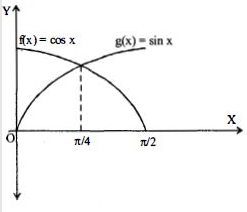
The area under the curve $y = |\cos x - \sin x|$,$0 \leq x \leq \frac{\pi}{2}$,and above the $x$-axis is
A
$2\sqrt{2}$
B
$2\sqrt{2} - 2$
C
$2\sqrt{2} + 2$
D
$0$
Solution
(B) The function is $y = |\cos x - \sin x|$.
In the interval $[0, \pi/4]$,$\cos x \geq \sin x$,so $y = \cos x - \sin x$.
In the interval $[\pi/4, \pi/2]$,$\sin x \geq \cos x$,so $y = \sin x - \cos x$.
The required area is given by:
$A = \int_{0}^{\pi/4} (\cos x - \sin x) \, dx + \int_{\pi/4}^{\pi/2} (\sin x - \cos x) \, dx$
$A = [\sin x + \cos x]_{0}^{\pi/4} + [-\cos x - \sin x]_{\pi/4}^{\pi/2}$
$A = ((\sin(\pi/4) + \cos(\pi/4)) - (\sin(0) + \cos(0))) + ((-\cos(\pi/2) - \sin(\pi/2)) - (-\cos(\pi/4) - \sin(\pi/4)))$
$A = ((\frac{1}{\sqrt{2}} + \frac{1}{\sqrt{2}}) - (0 + 1)) + ((0 - 1) - (-\frac{1}{\sqrt{2}} - \frac{1}{\sqrt{2}}))$
$A = (\sqrt{2} - 1) + (-1 + \sqrt{2})$
$A = 2\sqrt{2} - 2$ square units.
In the interval $[0, \pi/4]$,$\cos x \geq \sin x$,so $y = \cos x - \sin x$.
In the interval $[\pi/4, \pi/2]$,$\sin x \geq \cos x$,so $y = \sin x - \cos x$.
The required area is given by:
$A = \int_{0}^{\pi/4} (\cos x - \sin x) \, dx + \int_{\pi/4}^{\pi/2} (\sin x - \cos x) \, dx$
$A = [\sin x + \cos x]_{0}^{\pi/4} + [-\cos x - \sin x]_{\pi/4}^{\pi/2}$
$A = ((\sin(\pi/4) + \cos(\pi/4)) - (\sin(0) + \cos(0))) + ((-\cos(\pi/2) - \sin(\pi/2)) - (-\cos(\pi/4) - \sin(\pi/4)))$
$A = ((\frac{1}{\sqrt{2}} + \frac{1}{\sqrt{2}}) - (0 + 1)) + ((0 - 1) - (-\frac{1}{\sqrt{2}} - \frac{1}{\sqrt{2}}))$
$A = (\sqrt{2} - 1) + (-1 + \sqrt{2})$
$A = 2\sqrt{2} - 2$ square units.
0 likes
View Solution104
DifficultMCQ
If a straight line $y - x = 2$ divides the region $x^2 + y^2 \le 4$ into two parts,then the ratio of the area of the smaller part to the area of the greater part is
A
$3\pi - 8 : \pi + 8$
B
$\pi - 3 : 3\pi + 3$
C
$3\pi - 4 : \pi + 4$
D
$\pi - 2 : 3\pi + 2$
Solution
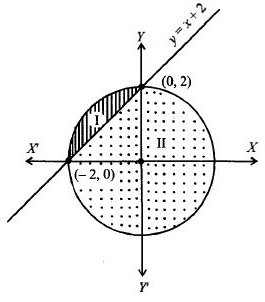
(D) The given region is a circle $x^2 + y^2 = 4$ with radius $r = 2$ and center at $(0, 0)$. The line $y = x + 2$ passes through $(-2, 0)$ and $(0, 2)$.
Let $I$ be the smaller portion and $II$ be the greater portion of the circle.
The area of the smaller portion $I$ is given by the integral:
Area of $I = \int_{-2}^{0} [\sqrt{4 - x^2} - (x + 2)] dx$
$= [\frac{x}{2} \sqrt{4 - x^2} + \frac{4}{2} \sin^{-1}(\frac{x}{2})]_{-2}^{0} - [\frac{x^2}{2} + 2x]_{-2}^{0}$
$= [0 + 2 \sin^{-1}(0)] - [(-1) \sqrt{0} + 2 \sin^{-1}(-1)] - [0 - (\frac{4}{2} - 4)]$
$= [0 - 2(-\frac{\pi}{2})] - [0 - (-2)]$
$= \pi - 2$
Now,the area of the greater portion $II$ is:
Area of $II = \text{Area of circle} - \text{Area of } I$
$= 4\pi - (\pi - 2) = 3\pi + 2$
Therefore,the required ratio is:
$\frac{\text{Area of } I}{\text{Area of } II} = \frac{\pi - 2}{3\pi + 2}$
Let $I$ be the smaller portion and $II$ be the greater portion of the circle.
The area of the smaller portion $I$ is given by the integral:
Area of $I = \int_{-2}^{0} [\sqrt{4 - x^2} - (x + 2)] dx$
$= [\frac{x}{2} \sqrt{4 - x^2} + \frac{4}{2} \sin^{-1}(\frac{x}{2})]_{-2}^{0} - [\frac{x^2}{2} + 2x]_{-2}^{0}$
$= [0 + 2 \sin^{-1}(0)] - [(-1) \sqrt{0} + 2 \sin^{-1}(-1)] - [0 - (\frac{4}{2} - 4)]$
$= [0 - 2(-\frac{\pi}{2})] - [0 - (-2)]$
$= \pi - 2$
Now,the area of the greater portion $II$ is:
Area of $II = \text{Area of circle} - \text{Area of } I$
$= 4\pi - (\pi - 2) = 3\pi + 2$
Therefore,the required ratio is:
$\frac{\text{Area of } I}{\text{Area of } II} = \frac{\pi - 2}{3\pi + 2}$
0 likes
View Solution105
DifficultMCQ
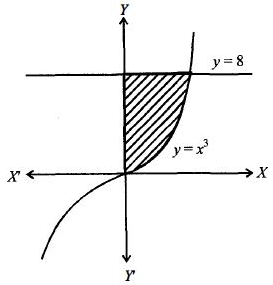
The area of the region bounded by the curve $y = x^3$,and the lines $y = 8$ and $x = 0$ is
A
$8$
B
$12$
C
$10$
D
$16$
Solution
(B) The region is bounded by the curve $y = x^3$,the line $y = 8$,and the $y$-axis $(x = 0)$.
To find the area with respect to the $y$-axis,we express $x$ in terms of $y$: $x = y^{1/3}$.
The limits for $y$ are from $0$ to $8$.
Required Area $= \int\limits_{0}^{8} x \, dy = \int\limits_{0}^{8} y^{1/3} \, dy$
$= \left[ \frac{y^{1/3 + 1}}{1/3 + 1} \right]_{0}^{8} = \left[ \frac{y^{4/3}}{4/3} \right]_{0}^{8} = \left[ \frac{3}{4} y^{4/3} \right]_{0}^{8}$
$= \frac{3}{4} (8^{4/3} - 0^{4/3}) = \frac{3}{4} ((2^3)^{4/3}) = \frac{3}{4} (2^4) = \frac{3}{4} \times 16 = 12 \text{ sq. units.}$
To find the area with respect to the $y$-axis,we express $x$ in terms of $y$: $x = y^{1/3}$.
The limits for $y$ are from $0$ to $8$.
Required Area $= \int\limits_{0}^{8} x \, dy = \int\limits_{0}^{8} y^{1/3} \, dy$
$= \left[ \frac{y^{1/3 + 1}}{1/3 + 1} \right]_{0}^{8} = \left[ \frac{y^{4/3}}{4/3} \right]_{0}^{8} = \left[ \frac{3}{4} y^{4/3} \right]_{0}^{8}$
$= \frac{3}{4} (8^{4/3} - 0^{4/3}) = \frac{3}{4} ((2^3)^{4/3}) = \frac{3}{4} (2^4) = \frac{3}{4} \times 16 = 12 \text{ sq. units.}$
0 likes
View Solution106
DifficultMCQ
The area of the region $A = \{ (x,y) : 0 \le y \le x|x| + 1, -1 \le x \le 1 \}$ in square units is:
A
$\frac{2}{3}$
B
$\frac{1}{3}$
C
$2$
D
$\frac{4}{3}$
Solution
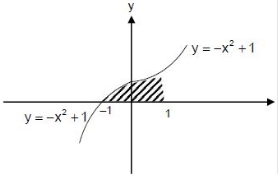
(C) The given region is bounded by $y = x|x| + 1$ and the $x$-axis for $-1 \le x \le 1$.
We can define $y$ as:
$y = \begin{cases} -x^2 + 1, & \text{if } -1 \le x < 0 \\ x^2 + 1, & \text{if } 0 \le x \le 1 \end{cases}$
The area is given by the integral:
$\text{Area} = \int_{-1}^{0} (-x^2 + 1) dx + \int_{0}^{1} (x^2 + 1) dx$
Evaluating the first integral:
$\int_{-1}^{0} (-x^2 + 1) dx = \left[ -\frac{x^3}{3} + x \right]_{-1}^{0} = 0 - (\frac{1}{3} - 1) = \frac{2}{3}$
Evaluating the second integral:
$\int_{0}^{1} (x^2 + 1) dx = \left[ \frac{x^3}{3} + x \right]_{0}^{1} = (\frac{1}{3} + 1) - 0 = \frac{4}{3}$
Total Area $= \frac{2}{3} + \frac{4}{3} = \frac{6}{3} = 2$ square units.
We can define $y$ as:
$y = \begin{cases} -x^2 + 1, & \text{if } -1 \le x < 0 \\ x^2 + 1, & \text{if } 0 \le x \le 1 \end{cases}$
The area is given by the integral:
$\text{Area} = \int_{-1}^{0} (-x^2 + 1) dx + \int_{0}^{1} (x^2 + 1) dx$
Evaluating the first integral:
$\int_{-1}^{0} (-x^2 + 1) dx = \left[ -\frac{x^3}{3} + x \right]_{-1}^{0} = 0 - (\frac{1}{3} - 1) = \frac{2}{3}$
Evaluating the second integral:
$\int_{0}^{1} (x^2 + 1) dx = \left[ \frac{x^3}{3} + x \right]_{0}^{1} = (\frac{1}{3} + 1) - 0 = \frac{4}{3}$
Total Area $= \frac{2}{3} + \frac{4}{3} = \frac{6}{3} = 2$ square units.
0 likes
View Solution107
DifficultMCQ
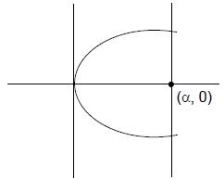
Let $S(\alpha) = \{(x,y) : y^2 \leq x, 0 \leq x \leq \alpha\}$ and $A(\alpha)$ be the area of the region $S(\alpha)$. If for a $\lambda, 0 < \lambda < 4, A(\lambda) : A(4) = 2 : 5$,then $\lambda$ equals:
A
$4\left(\frac{2}{5}\right)^{\frac{1}{3}}$
B
$2\left(\frac{2}{5}\right)^{\frac{1}{3}}$
C
$4\left(\frac{4}{25}\right)^{\frac{1}{3}}$
D
$2\left(\frac{4}{25}\right)^{\frac{1}{3}}$
Solution
(C) The region $S(\alpha)$ is bounded by the parabola $y^2 = x$ and the vertical line $x = \alpha$.
The area $A(\alpha)$ is given by:
$A(\alpha) = \int_{0}^{\alpha} 2\sqrt{x} \, dx = 2 \left[ \frac{x^{3/2}}{3/2} \right]_{0}^{\alpha} = \frac{4}{3} \alpha^{3/2}$.
Given the ratio $A(\lambda) : A(4) = 2 : 5$,we have:
$\frac{\frac{4}{3} \lambda^{3/2}}{\frac{4}{3} 4^{3/2}} = \frac{2}{5}$
$\frac{\lambda^{3/2}}{8} = \frac{2}{5}$
$\lambda^{3/2} = \frac{16}{5}$
$\lambda = \left( \frac{16}{5} \right)^{2/3} = \left( \frac{16^2}{5^2} \right)^{1/3} = \left( \frac{256}{25} \right)^{1/3} = 4 \left( \frac{4}{25} \right)^{1/3}$.
Thus,$\lambda = 4\left(\frac{4}{25}\right)^{1/3}$.
The area $A(\alpha)$ is given by:
$A(\alpha) = \int_{0}^{\alpha} 2\sqrt{x} \, dx = 2 \left[ \frac{x^{3/2}}{3/2} \right]_{0}^{\alpha} = \frac{4}{3} \alpha^{3/2}$.
Given the ratio $A(\lambda) : A(4) = 2 : 5$,we have:
$\frac{\frac{4}{3} \lambda^{3/2}}{\frac{4}{3} 4^{3/2}} = \frac{2}{5}$
$\frac{\lambda^{3/2}}{8} = \frac{2}{5}$
$\lambda^{3/2} = \frac{16}{5}$
$\lambda = \left( \frac{16}{5} \right)^{2/3} = \left( \frac{16^2}{5^2} \right)^{1/3} = \left( \frac{256}{25} \right)^{1/3} = 4 \left( \frac{4}{25} \right)^{1/3}$.
Thus,$\lambda = 4\left(\frac{4}{25}\right)^{1/3}$.
0 likes
View Solution108
DifficultMCQ
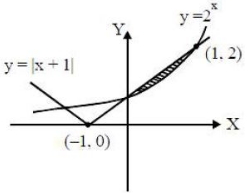
The area (in sq. units) of the region bounded by the curves $y = 2^x$ and $y = |x + 1|$ in the first quadrant is
A
$\frac{3}{2}$
B
$\log_e 2 + \frac{3}{2}$
C
$\frac{3}{2} - \frac{1}{\log_e 2}$
D
$\frac{1}{2}$
Solution
(C) The region is bounded by $y = 2^x$ and $y = x + 1$ (since $x \ge 0$ in the first quadrant,$|x + 1| = x + 1$) from $x = 0$ to $x = 1$.
The required area is given by the integral:
$A = \int_{0}^{1} ((x + 1) - 2^x) dx$
Evaluating the integral:
$A = \left[ \frac{x^2}{2} + x - \frac{2^x}{\ln 2} \right]_{0}^{1}$
Substituting the limits:
$A = \left( \frac{1^2}{2} + 1 - \frac{2^1}{\ln 2} \right) - \left( \frac{0^2}{2} + 0 - \frac{2^0}{\ln 2} \right)$
$A = \left( \frac{1}{2} + 1 - \frac{2}{\ln 2} \right) - \left( 0 + 0 - \frac{1}{\ln 2} \right)$
$A = \frac{3}{2} - \frac{2}{\ln 2} + \frac{1}{\ln 2}$
$A = \frac{3}{2} - \frac{1}{\ln 2}$
The required area is given by the integral:
$A = \int_{0}^{1} ((x + 1) - 2^x) dx$
Evaluating the integral:
$A = \left[ \frac{x^2}{2} + x - \frac{2^x}{\ln 2} \right]_{0}^{1}$
Substituting the limits:
$A = \left( \frac{1^2}{2} + 1 - \frac{2^1}{\ln 2} \right) - \left( \frac{0^2}{2} + 0 - \frac{2^0}{\ln 2} \right)$
$A = \left( \frac{1}{2} + 1 - \frac{2}{\ln 2} \right) - \left( 0 + 0 - \frac{1}{\ln 2} \right)$
$A = \frac{3}{2} - \frac{2}{\ln 2} + \frac{1}{\ln 2}$
$A = \frac{3}{2} - \frac{1}{\ln 2}$
0 likes
View Solution109
DifficultMCQ
Find the area enclosed by the circle $x^{2}+y^{2}=a^{2}$.
A
$\pi a^{2}$
B
$2\pi a^{2}$
C
$\frac{1}{2}\pi a^{2}$
D
$4\pi a^{2}$
Solution
(A) The given equation of the circle is $x^{2}+y^{2}=a^{2}$.
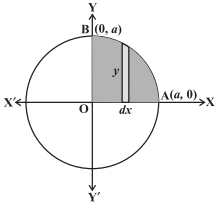
Since the circle is symmetrical about both the $x$-axis and the $y$-axis,the total area is $4$ times the area of the region $AOBA$ in the first quadrant.
Area $= 4 \int_{0}^{a} y \, dx$
Since $x^{2}+y^{2}=a^{2}$,we have $y = \sqrt{a^{2}-x^{2}}$ in the first quadrant.
Area $= 4 \int_{0}^{a} \sqrt{a^{2}-x^{2}} \, dx$
Using the standard integral formula $\int \sqrt{a^{2}-x^{2}} \, dx = \frac{x}{2} \sqrt{a^{2}-x^{2}} + \frac{a^{2}}{2} \sin^{-1} \left(\frac{x}{a}\right)$:
Area $= 4 \left[ \frac{x}{2} \sqrt{a^{2}-x^{2}} + \frac{a^{2}}{2} \sin^{-1} \left(\frac{x}{a}\right) \right]_{0}^{a}$
$= 4 \left[ \left( \frac{a}{2} \sqrt{a^{2}-a^{2}} + \frac{a^{2}}{2} \sin^{-1}(1) \right) - (0 + 0) \right]$
$= 4 \left[ 0 + \frac{a^{2}}{2} \left(\frac{\pi}{2}\right) \right]$
$= 4 \left( \frac{\pi a^{2}}{4} \right) = \pi a^{2}$
Thus,the area enclosed by the circle is $\pi a^{2}$ square units.
Since the circle is symmetrical about both the $x$-axis and the $y$-axis,the total area is $4$ times the area of the region $AOBA$ in the first quadrant.
Area $= 4 \int_{0}^{a} y \, dx$
Since $x^{2}+y^{2}=a^{2}$,we have $y = \sqrt{a^{2}-x^{2}}$ in the first quadrant.
Area $= 4 \int_{0}^{a} \sqrt{a^{2}-x^{2}} \, dx$
Using the standard integral formula $\int \sqrt{a^{2}-x^{2}} \, dx = \frac{x}{2} \sqrt{a^{2}-x^{2}} + \frac{a^{2}}{2} \sin^{-1} \left(\frac{x}{a}\right)$:
Area $= 4 \left[ \frac{x}{2} \sqrt{a^{2}-x^{2}} + \frac{a^{2}}{2} \sin^{-1} \left(\frac{x}{a}\right) \right]_{0}^{a}$
$= 4 \left[ \left( \frac{a}{2} \sqrt{a^{2}-a^{2}} + \frac{a^{2}}{2} \sin^{-1}(1) \right) - (0 + 0) \right]$
$= 4 \left[ 0 + \frac{a^{2}}{2} \left(\frac{\pi}{2}\right) \right]$
$= 4 \left( \frac{\pi a^{2}}{4} \right) = \pi a^{2}$
Thus,the area enclosed by the circle is $\pi a^{2}$ square units.
0 likes
View Solution110
DifficultMCQ
Find the area enclosed by the ellipse $\frac{x^{2}}{a^{2}}+\frac{y^{2}}{b^{2}}=1$.
A
$\pi a b$
B
$\frac{1}{2} \pi a b$
C
$\frac{1}{4} \pi a b$
D
$2 \pi a b$
Solution
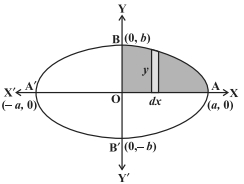
(A) From the figure,the area of the region $ABA'B'A$ bounded by the ellipse is given by:
Area $= 4 \times (\text{Area of the region } AOBA \text{ in the first quadrant bounded by the curve, } x\text{-axis and the ordinates } x = 0, x = a)$
(as the ellipse is symmetrical about both $x$-axis and $y$-axis)
Area $= 4 \int_{0}^{a} y \, dx$ (taking vertical strips)
Now,$\frac{x^{2}}{a^{2}}+\frac{y^{2}}{b^{2}}=1$ gives $y = \pm \frac{b}{a} \sqrt{a^{2}-x^{2}}$. Since the region $AOBA$ lies in the first quadrant,$y$ is taken as positive.
So,the required area is:
Area $= 4 \int_{0}^{a} \frac{b}{a} \sqrt{a^{2}-x^{2}} \, dx$
$= \frac{4b}{a} \left[ \frac{x}{2} \sqrt{a^{2}-x^{2}} + \frac{a^{2}}{2} \sin^{-1} \left( \frac{x}{a} \right) \right]_{0}^{a}$
$= \frac{4b}{a} \left[ \left( \frac{a}{2} \times 0 + \frac{a^{2}}{2} \sin^{-1}(1) \right) - (0 + 0) \right]$
$= \frac{4b}{a} \left( \frac{a^{2}}{2} \times \frac{\pi}{2} \right) = \pi ab$.
Area $= 4 \times (\text{Area of the region } AOBA \text{ in the first quadrant bounded by the curve, } x\text{-axis and the ordinates } x = 0, x = a)$
(as the ellipse is symmetrical about both $x$-axis and $y$-axis)
Area $= 4 \int_{0}^{a} y \, dx$ (taking vertical strips)
Now,$\frac{x^{2}}{a^{2}}+\frac{y^{2}}{b^{2}}=1$ gives $y = \pm \frac{b}{a} \sqrt{a^{2}-x^{2}}$. Since the region $AOBA$ lies in the first quadrant,$y$ is taken as positive.
So,the required area is:
Area $= 4 \int_{0}^{a} \frac{b}{a} \sqrt{a^{2}-x^{2}} \, dx$
$= \frac{4b}{a} \left[ \frac{x}{2} \sqrt{a^{2}-x^{2}} + \frac{a^{2}}{2} \sin^{-1} \left( \frac{x}{a} \right) \right]_{0}^{a}$
$= \frac{4b}{a} \left[ \left( \frac{a}{2} \times 0 + \frac{a^{2}}{2} \sin^{-1}(1) \right) - (0 + 0) \right]$
$= \frac{4b}{a} \left( \frac{a^{2}}{2} \times \frac{\pi}{2} \right) = \pi ab$.
0 likes
View Solution111
MediumMCQ
Find the area of the region bounded by the curve $y=x^{2}$ and the line $y=4$. (in $/3$)
A
$32$
B
$16$
C
$8$
D
$64$
Solution
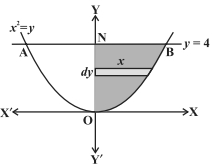
(A) The given curve is $y=x^{2}$,which is a parabola symmetric about the $y$-axis with its vertex at the origin $(0,0)$.
The region is bounded by the curve $y=x^{2}$ and the line $y=4$. The intersection points of the curve and the line are found by substituting $y=4$ into $y=x^{2}$,which gives $x^{2}=4$,so $x=\pm 2$.
Since the parabola is symmetric about the $y$-axis,the total area $A$ is twice the area of the region in the first quadrant bounded by the curve,the $y$-axis,and the line $y=4$.
Using horizontal strips of width $dy$ and length $x = \sqrt{y}$,the area is given by:
$A = 2 \int_{0}^{4} x \, dy = 2 \int_{0}^{4} \sqrt{y} \, dy$
Evaluating the integral:
$A = 2 \left[ \frac{y^{3/2}}{3/2} \right]_{0}^{4} = 2 \times \frac{2}{3} \left[ y^{3/2} \right]_{0}^{4}$
$A = \frac{4}{3} \left( 4^{3/2} - 0^{3/2} \right) = \frac{4}{3} \times 8 = \frac{32}{3}$
Thus,the area of the region is $\frac{32}{3}$ square units.
The region is bounded by the curve $y=x^{2}$ and the line $y=4$. The intersection points of the curve and the line are found by substituting $y=4$ into $y=x^{2}$,which gives $x^{2}=4$,so $x=\pm 2$.
Since the parabola is symmetric about the $y$-axis,the total area $A$ is twice the area of the region in the first quadrant bounded by the curve,the $y$-axis,and the line $y=4$.
Using horizontal strips of width $dy$ and length $x = \sqrt{y}$,the area is given by:
$A = 2 \int_{0}^{4} x \, dy = 2 \int_{0}^{4} \sqrt{y} \, dy$
Evaluating the integral:
$A = 2 \left[ \frac{y^{3/2}}{3/2} \right]_{0}^{4} = 2 \times \frac{2}{3} \left[ y^{3/2} \right]_{0}^{4}$
$A = \frac{4}{3} \left( 4^{3/2} - 0^{3/2} \right) = \frac{4}{3} \times 8 = \frac{32}{3}$
Thus,the area of the region is $\frac{32}{3}$ square units.
0 likes
View Solution112
DifficultMCQ
Find the area of the region in the first quadrant enclosed by the $x-$ axis,the line $y=x,$ and the circle $x^{2}+y^{2}=32$. (in $\pi$)
A
$4$
B
$8$
C
$2$
D
$16$
Solution
(A) The given equations are:
$y=x$ ........... $(1)$
$x^{2}+y^{2}=32$ ........... $(2)$
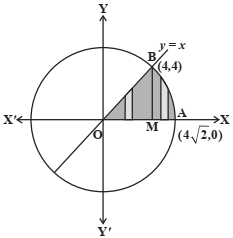
Solving $(1)$ and $(2)$,we substitute $y=x$ in $(2)$ to get $x^{2}+x^{2}=32$,which gives $2x^{2}=32$,so $x^{2}=16$. Since we are in the first quadrant,$x=4$. Thus,the line and the circle meet at $B(4, 4)$.
Draw perpendicular $BM$ to the $x-$ axis,where $M$ is $(4, 0)$.
The required area is the area of the region $OBMO$ $+$ area of the region $BMAB$.
Area of region $OBMO = \int_{0}^{4} y \, dx = \int_{0}^{4} x \, dx = \left[\frac{x^{2}}{2}\right]_{0}^{4} = \frac{16}{2} = 8$.
Area of region $BMAB = \int_{4}^{4\sqrt{2}} y \, dx = \int_{4}^{4\sqrt{2}} \sqrt{(4\sqrt{2})^{2}-x^{2}} \, dx$.
Using the formula $\int \sqrt{a^{2}-x^{2}} \, dx = \frac{x}{2}\sqrt{a^{2}-x^{2}} + \frac{a^{2}}{2}\sin^{-1}\left(\frac{x}{a}\right)$:
$= \left[\frac{x}{2}\sqrt{32-x^{2}} + \frac{32}{2}\sin^{-1}\left(\frac{x}{4\sqrt{2}}\right)\right]_{4}^{4\sqrt{2}}$
$= \left(0 + 16 \sin^{-1}(1)\right) - \left(\frac{4}{2}\sqrt{32-16} + 16 \sin^{-1}\left(\frac{4}{4\sqrt{2}}\right)\right)$
$= 16 \times \frac{\pi}{2} - \left(2 \times 4 + 16 \times \frac{\pi}{4}\right) = 8\pi - (8 + 4\pi) = 4\pi - 8$.
Total area $= 8 + (4\pi - 8) = 4\pi$.
$y=x$ ........... $(1)$
$x^{2}+y^{2}=32$ ........... $(2)$
Solving $(1)$ and $(2)$,we substitute $y=x$ in $(2)$ to get $x^{2}+x^{2}=32$,which gives $2x^{2}=32$,so $x^{2}=16$. Since we are in the first quadrant,$x=4$. Thus,the line and the circle meet at $B(4, 4)$.
Draw perpendicular $BM$ to the $x-$ axis,where $M$ is $(4, 0)$.
The required area is the area of the region $OBMO$ $+$ area of the region $BMAB$.
Area of region $OBMO = \int_{0}^{4} y \, dx = \int_{0}^{4} x \, dx = \left[\frac{x^{2}}{2}\right]_{0}^{4} = \frac{16}{2} = 8$.
Area of region $BMAB = \int_{4}^{4\sqrt{2}} y \, dx = \int_{4}^{4\sqrt{2}} \sqrt{(4\sqrt{2})^{2}-x^{2}} \, dx$.
Using the formula $\int \sqrt{a^{2}-x^{2}} \, dx = \frac{x}{2}\sqrt{a^{2}-x^{2}} + \frac{a^{2}}{2}\sin^{-1}\left(\frac{x}{a}\right)$:
$= \left[\frac{x}{2}\sqrt{32-x^{2}} + \frac{32}{2}\sin^{-1}\left(\frac{x}{4\sqrt{2}}\right)\right]_{4}^{4\sqrt{2}}$
$= \left(0 + 16 \sin^{-1}(1)\right) - \left(\frac{4}{2}\sqrt{32-16} + 16 \sin^{-1}\left(\frac{4}{4\sqrt{2}}\right)\right)$
$= 16 \times \frac{\pi}{2} - \left(2 \times 4 + 16 \times \frac{\pi}{4}\right) = 8\pi - (8 + 4\pi) = 4\pi - 8$.
Total area $= 8 + (4\pi - 8) = 4\pi$.
0 likes
View Solution113
MediumMCQ
Find the area bounded by the ellipse $\frac{x^{2}}{a^{2}}+\frac{y^{2}}{b^{2}}=1$ and the ordinates $x=0$ and $x=ae$,where $b^{2}=a^{2}(1-e^{2})$ and $e < 1$.
A
$\frac{ab}{2}[e\sqrt{1-e^{2}}+\sin^{-1}e]$
B
$ab[e\sqrt{1-e^{2}}+\sin^{-1}e]$
C
$2ab[e\sqrt{1-e^{2}}+\sin^{-1}e]$
D
$\frac{ab}{2}[e\sqrt{1-e^{2}}-\sin^{-1}e]$
Solution
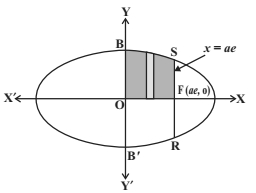
(B) The area of the region bounded by the ellipse and the ordinates $x=0$ and $x=ae$ is symmetric about the $x$-axis.
The area is given by $A = 2 \int_{0}^{ae} y \, dx$.
From the equation of the ellipse,$y = \frac{b}{a} \sqrt{a^{2}-x^{2}}$.
Substituting this into the integral,we get $A = 2 \frac{b}{a} \int_{0}^{ae} \sqrt{a^{2}-x^{2}} \, dx$.
Using the standard integral $\int \sqrt{a^{2}-x^{2}} \, dx = \frac{x}{2} \sqrt{a^{2}-x^{2}} + \frac{a^{2}}{2} \sin^{-1}(\frac{x}{a})$,we have:
$A = \frac{2b}{a} \left[ \frac{x}{2} \sqrt{a^{2}-x^{2}} + \frac{a^{2}}{2} \sin^{-1}(\frac{x}{a}) \right]_{0}^{ae}$
$A = \frac{2b}{a} \left[ \frac{ae}{2} \sqrt{a^{2}-a^{2}e^{2}} + \frac{a^{2}}{2} \sin^{-1}(\frac{ae}{a}) - (0 + 0) \right]$
$A = \frac{2b}{a} \left[ \frac{ae}{2} \cdot a\sqrt{1-e^{2}} + \frac{a^{2}}{2} \sin^{-1}(e) \right]$
$A = \frac{2b}{a} \cdot \frac{a^{2}}{2} \left[ e\sqrt{1-e^{2}} + \sin^{-1}(e) \right]$
$A = ab[e\sqrt{1-e^{2}} + \sin^{-1}(e)]$.
The area is given by $A = 2 \int_{0}^{ae} y \, dx$.
From the equation of the ellipse,$y = \frac{b}{a} \sqrt{a^{2}-x^{2}}$.
Substituting this into the integral,we get $A = 2 \frac{b}{a} \int_{0}^{ae} \sqrt{a^{2}-x^{2}} \, dx$.
Using the standard integral $\int \sqrt{a^{2}-x^{2}} \, dx = \frac{x}{2} \sqrt{a^{2}-x^{2}} + \frac{a^{2}}{2} \sin^{-1}(\frac{x}{a})$,we have:
$A = \frac{2b}{a} \left[ \frac{x}{2} \sqrt{a^{2}-x^{2}} + \frac{a^{2}}{2} \sin^{-1}(\frac{x}{a}) \right]_{0}^{ae}$
$A = \frac{2b}{a} \left[ \frac{ae}{2} \sqrt{a^{2}-a^{2}e^{2}} + \frac{a^{2}}{2} \sin^{-1}(\frac{ae}{a}) - (0 + 0) \right]$
$A = \frac{2b}{a} \left[ \frac{ae}{2} \cdot a\sqrt{1-e^{2}} + \frac{a^{2}}{2} \sin^{-1}(e) \right]$
$A = \frac{2b}{a} \cdot \frac{a^{2}}{2} \left[ e\sqrt{1-e^{2}} + \sin^{-1}(e) \right]$
$A = ab[e\sqrt{1-e^{2}} + \sin^{-1}(e)]$.
0 likes
View Solution114
MediumMCQ
Find the area of the region bounded by the curve $y^{2}=x$,the lines $x=1$,$x=4$,and the $x$-axis in the first quadrant.
A
$\frac{14}{3}$ square units
B
$\frac{16}{3}$ square units
C
$\frac{10}{3}$ square units
D
$\frac{7}{3}$ square units
Solution
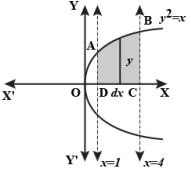
(A) The area of the region bounded by the curve $y^{2}=x$,the lines $x=1$ and $x=4$,and the $x$-axis in the first quadrant is given by the integral of $y$ with respect to $x$ from $x=1$ to $x=4$.
Since $y^{2}=x$ and we are in the first quadrant,$y = \sqrt{x}$.
Area $= \int_{1}^{4} y \, dx = \int_{1}^{4} \sqrt{x} \, dx$
$= \left[ \frac{x^{\frac{3}{2}}}{\frac{3}{2}} \right]_1^4$
$= \frac{2}{3} \left[ x^{\frac{3}{2}} \right]_1^4$
$= \frac{2}{3} \left( 4^{\frac{3}{2}} - 1^{\frac{3}{2}} \right)$
$= \frac{2}{3} (8 - 1)$
$= \frac{2}{3} \times 7 = \frac{14}{3}$ square units.
Since $y^{2}=x$ and we are in the first quadrant,$y = \sqrt{x}$.
Area $= \int_{1}^{4} y \, dx = \int_{1}^{4} \sqrt{x} \, dx$
$= \left[ \frac{x^{\frac{3}{2}}}{\frac{3}{2}} \right]_1^4$
$= \frac{2}{3} \left[ x^{\frac{3}{2}} \right]_1^4$
$= \frac{2}{3} \left( 4^{\frac{3}{2}} - 1^{\frac{3}{2}} \right)$
$= \frac{2}{3} (8 - 1)$
$= \frac{2}{3} \times 7 = \frac{14}{3}$ square units.
0 likes
View Solution115
MediumMCQ
Find the area of the region bounded by $y^{2}=9x$,$x=2$,$x=4$ and the $x$-axis in the first quadrant.
A
$16-4\sqrt{2}$
B
$16+4\sqrt{2}$
C
$8-2\sqrt{2}$
D
$8+2\sqrt{2}$
Solution
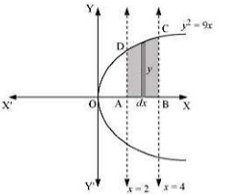
(A) The area of the region bounded by the curve $y^{2}=9x$,the lines $x=2$ and $x=4$,and the $x$-axis in the first quadrant is given by the integral:
Area $= \int_{2}^{4} y \, dx$
Since $y^{2}=9x$ and we are in the first quadrant,$y = \sqrt{9x} = 3\sqrt{x}$.
Area $= \int_{2}^{4} 3\sqrt{x} \, dx$
$= 3 \int_{2}^{4} x^{1/2} \, dx$
$= 3 \left[ \frac{x^{3/2}}{3/2} \right]_{2}^{4}$
$= 3 \times \frac{2}{3} \left[ x^{3/2} \right]_{2}^{4}$
$= 2 \left[ 4^{3/2} - 2^{3/2} \right]$
$= 2 \left[ 8 - 2\sqrt{2} \right]$
$= 16 - 4\sqrt{2} \text{ square units}$.
Area $= \int_{2}^{4} y \, dx$
Since $y^{2}=9x$ and we are in the first quadrant,$y = \sqrt{9x} = 3\sqrt{x}$.
Area $= \int_{2}^{4} 3\sqrt{x} \, dx$
$= 3 \int_{2}^{4} x^{1/2} \, dx$
$= 3 \left[ \frac{x^{3/2}}{3/2} \right]_{2}^{4}$
$= 3 \times \frac{2}{3} \left[ x^{3/2} \right]_{2}^{4}$
$= 2 \left[ 4^{3/2} - 2^{3/2} \right]$
$= 2 \left[ 8 - 2\sqrt{2} \right]$
$= 16 - 4\sqrt{2} \text{ square units}$.
0 likes
View Solution116
MediumMCQ
Find the area of the region bounded by $x^{2}=4y$,$y=2$,$y=4$ and the $y-$axis in the first quadrant.
A
$\left(\frac{32-8 \sqrt{2}}{3}\right)$
B
$\left(\frac{32-8 \sqrt{2}}{3}\right)$
C
$\left(\frac{32-8 \sqrt{2}}{3}\right)$
D
$\left(\frac{32-8 \sqrt{2}}{3}\right)$
Solution
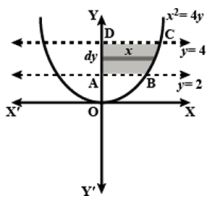
(A) The area of the region bounded by the curve $x^{2}=4y$,the lines $y=2$ and $y=4$,and the $y$-axis in the first quadrant is given by the integral of $x$ with respect to $y$ from $y=2$ to $y=4$.
Given $x^{2}=4y$,we have $x = \sqrt{4y} = 2\sqrt{y}$ (since it is in the first quadrant,$x > 0$).
Area $= \int_{2}^{4} x \, dy = \int_{2}^{4} 2\sqrt{y} \, dy$
$= 2 \int_{2}^{4} y^{1/2} \, dy$
$= 2 \left[ \frac{y^{3/2}}{3/2} \right]_{2}^{4} = 2 \times \frac{2}{3} \left[ y^{3/2} \right]_{2}^{4}$
$= \frac{4}{3} \left[ 4^{3/2} - 2^{3/2} \right]$
$= \frac{4}{3} \left[ 8 - 2\sqrt{2} \right]$
$= \left( \frac{32 - 8\sqrt{2}}{3} \right) \text{ square units}$
Given $x^{2}=4y$,we have $x = \sqrt{4y} = 2\sqrt{y}$ (since it is in the first quadrant,$x > 0$).
Area $= \int_{2}^{4} x \, dy = \int_{2}^{4} 2\sqrt{y} \, dy$
$= 2 \int_{2}^{4} y^{1/2} \, dy$
$= 2 \left[ \frac{y^{3/2}}{3/2} \right]_{2}^{4} = 2 \times \frac{2}{3} \left[ y^{3/2} \right]_{2}^{4}$
$= \frac{4}{3} \left[ 4^{3/2} - 2^{3/2} \right]$
$= \frac{4}{3} \left[ 8 - 2\sqrt{2} \right]$
$= \left( \frac{32 - 8\sqrt{2}}{3} \right) \text{ square units}$
0 likes
View Solution117
MediumMCQ
Find the area of the region bounded by the ellipse $\frac{x^{2}}{16}+\frac{y^{2}}{9}=1$. (in $\pi$)
A
$12$
B
$16$
C
$9$
D
$4$
Solution
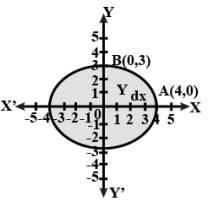
(A) The given equation of the ellipse is $\frac{x^{2}}{16}+\frac{y^{2}}{9}=1$.
Here,$a^2 = 16 \implies a = 4$ and $b^2 = 9 \implies b = 3$.
The ellipse is symmetrical about both the $x-$axis and $y-$axis.
Therefore,the total area bounded by the ellipse is $4 \times$ (Area of the region in the first quadrant).
Area in the first quadrant $= \int_{0}^{4} y \, dx$.
From the equation,$y = 3 \sqrt{1 - \frac{x^2}{16}} = \frac{3}{4} \sqrt{16 - x^2}$.
Area $= \int_{0}^{4} \frac{3}{4} \sqrt{16 - x^2} \, dx = \frac{3}{4} \left[ \frac{x}{2} \sqrt{16 - x^2} + \frac{16}{2} \sin^{-1} \left( \frac{x}{4} \right) \right]_{0}^{4}$.
$= \frac{3}{4} \left[ (0 + 8 \sin^{-1}(1)) - (0 + 8 \sin^{-1}(0)) \right] = \frac{3}{4} \left[ 8 \times \frac{\pi}{2} \right] = \frac{3}{4} [4 \pi] = 3 \pi$.
Total area $= 4 \times 3 \pi = 12 \pi$ square units.
Here,$a^2 = 16 \implies a = 4$ and $b^2 = 9 \implies b = 3$.
The ellipse is symmetrical about both the $x-$axis and $y-$axis.
Therefore,the total area bounded by the ellipse is $4 \times$ (Area of the region in the first quadrant).
Area in the first quadrant $= \int_{0}^{4} y \, dx$.
From the equation,$y = 3 \sqrt{1 - \frac{x^2}{16}} = \frac{3}{4} \sqrt{16 - x^2}$.
Area $= \int_{0}^{4} \frac{3}{4} \sqrt{16 - x^2} \, dx = \frac{3}{4} \left[ \frac{x}{2} \sqrt{16 - x^2} + \frac{16}{2} \sin^{-1} \left( \frac{x}{4} \right) \right]_{0}^{4}$.
$= \frac{3}{4} \left[ (0 + 8 \sin^{-1}(1)) - (0 + 8 \sin^{-1}(0)) \right] = \frac{3}{4} \left[ 8 \times \frac{\pi}{2} \right] = \frac{3}{4} [4 \pi] = 3 \pi$.
Total area $= 4 \times 3 \pi = 12 \pi$ square units.
0 likes
View Solution118
MediumMCQ
Find the area of the region bounded by the ellipse $\frac{x^{2}}{4}+\frac{y^{2}}{9}=1$. (in $\pi$)
A
$6$
B
$4$
C
$3$
D
$9$
Solution
(A) The given equation of the ellipse is $\frac{x^{2}}{4}+\frac{y^{2}}{9}=1$.
This can be written as $\frac{y^{2}}{9}=1-\frac{x^{2}}{4} \Rightarrow y^{2}=9\left(1-\frac{x^{2}}{4}\right) \Rightarrow y=3 \sqrt{1-\frac{x^{2}}{4}}$ (taking the positive value for the first quadrant).
Since the ellipse is symmetrical about both the $x$-axis and $y$-axis,the total area is $4$ times the area in the first quadrant.
Area $= 4 \int_{0}^{2} y \, dx = 4 \int_{0}^{2} 3 \sqrt{1-\frac{x^{2}}{4}} \, dx = 4 \times \frac{3}{2} \int_{0}^{2} \sqrt{4-x^{2}} \, dx = 6 \int_{0}^{2} \sqrt{2^{2}-x^{2}} \, dx$.
Using the formula $\int \sqrt{a^{2}-x^{2}} \, dx = \frac{x}{2} \sqrt{a^{2}-x^{2}} + \frac{a^{2}}{2} \sin^{-1} \left(\frac{x}{a}\right)$:
Area $= 6 \left[ \frac{x}{2} \sqrt{4-x^{2}} + \frac{4}{2} \sin^{-1} \left(\frac{x}{2}\right) \right]_{0}^{2}$
$= 6 \left[ (0 + 2 \sin^{-1}(1)) - (0 + 2 \sin^{-1}(0)) \right] = 6 \left[ 2 \times \frac{\pi}{2} \right] = 6 \pi$ square units.
This can be written as $\frac{y^{2}}{9}=1-\frac{x^{2}}{4} \Rightarrow y^{2}=9\left(1-\frac{x^{2}}{4}\right) \Rightarrow y=3 \sqrt{1-\frac{x^{2}}{4}}$ (taking the positive value for the first quadrant).
Since the ellipse is symmetrical about both the $x$-axis and $y$-axis,the total area is $4$ times the area in the first quadrant.
Area $= 4 \int_{0}^{2} y \, dx = 4 \int_{0}^{2} 3 \sqrt{1-\frac{x^{2}}{4}} \, dx = 4 \times \frac{3}{2} \int_{0}^{2} \sqrt{4-x^{2}} \, dx = 6 \int_{0}^{2} \sqrt{2^{2}-x^{2}} \, dx$.
Using the formula $\int \sqrt{a^{2}-x^{2}} \, dx = \frac{x}{2} \sqrt{a^{2}-x^{2}} + \frac{a^{2}}{2} \sin^{-1} \left(\frac{x}{a}\right)$:
Area $= 6 \left[ \frac{x}{2} \sqrt{4-x^{2}} + \frac{4}{2} \sin^{-1} \left(\frac{x}{2}\right) \right]_{0}^{2}$
$= 6 \left[ (0 + 2 \sin^{-1}(1)) - (0 + 2 \sin^{-1}(0)) \right] = 6 \left[ 2 \times \frac{\pi}{2} \right] = 6 \pi$ square units.
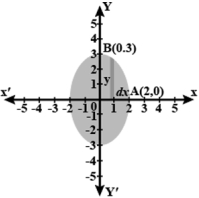
0 likes
View Solution119
DifficultMCQ
Find the area of the region in the first quadrant enclosed by the $x-$ axis,the line $x=\sqrt{3} y$ and the circle $x^{2}+y^{2}=4$.
A
$\frac{\pi}{3}$
B
$\frac{\pi}{6}$
C
$\frac{\pi}{2}$
D
$\frac{2\pi}{3}$
Solution
(A) The area of the region bounded by the circle $x^{2}+y^{2}=4$,the line $x=\sqrt{3} y$,and the $x-$ axis in the first quadrant is the area of the region $OAB$ as shown in the figure.
The point of intersection of the line $x=\sqrt{3} y$ and the circle $x^{2}+y^{2}=4$ in the first quadrant is found by substituting $x=\sqrt{3} y$ into the circle equation:
$(\sqrt{3} y)^{2} + y^{2} = 4 \implies 3y^{2} + y^{2} = 4 \implies 4y^{2} = 4 \implies y = 1$.
Thus,$x = \sqrt{3}(1) = \sqrt{3}$. The intersection point is $A(\sqrt{3}, 1)$.
Area $OAB = \text{Area}(\triangle OCA) + \text{Area}(\text{region } ACB)$.
Area of $\triangle OCA = \frac{1}{2} \times OC \times AC = \frac{1}{2} \times \sqrt{3} \times 1 = \frac{\sqrt{3}}{2}$.
Area of region $ACB = \int_{\sqrt{3}}^{2} y \, dx = \int_{\sqrt{3}}^{2} \sqrt{4-x^{2}} \, dx$.
Using the formula $\int \sqrt{a^{2}-x^{2}} \, dx = \frac{x}{2} \sqrt{a^{2}-x^{2}} + \frac{a^{2}}{2} \sin^{-1}(\frac{x}{a})$:
$= \left[ \frac{x}{2} \sqrt{4-x^{2}} + \frac{4}{2} \sin^{-1}(\frac{x}{2}) \right]_{\sqrt{3}}^{2}$
$= \left( \frac{2}{2} \sqrt{4-4} + 2 \sin^{-1}(1) \right) - \left( \frac{\sqrt{3}}{2} \sqrt{4-3} + 2 \sin^{-1}(\frac{\sqrt{3}}{2}) \right)$
$= (0 + 2 \times \frac{\pi}{2}) - (\frac{\sqrt{3}}{2} \times 1 + 2 \times \frac{\pi}{3})$
$= \pi - \frac{\sqrt{3}}{2} - \frac{2\pi}{3} = \frac{\pi}{3} - \frac{\sqrt{3}}{2}$.
Total Area $OAB = \frac{\sqrt{3}}{2} + (\frac{\pi}{3} - \frac{\sqrt{3}}{2}) = \frac{\pi}{3}$ square units.
The point of intersection of the line $x=\sqrt{3} y$ and the circle $x^{2}+y^{2}=4$ in the first quadrant is found by substituting $x=\sqrt{3} y$ into the circle equation:
$(\sqrt{3} y)^{2} + y^{2} = 4 \implies 3y^{2} + y^{2} = 4 \implies 4y^{2} = 4 \implies y = 1$.
Thus,$x = \sqrt{3}(1) = \sqrt{3}$. The intersection point is $A(\sqrt{3}, 1)$.
Area $OAB = \text{Area}(\triangle OCA) + \text{Area}(\text{region } ACB)$.
Area of $\triangle OCA = \frac{1}{2} \times OC \times AC = \frac{1}{2} \times \sqrt{3} \times 1 = \frac{\sqrt{3}}{2}$.
Area of region $ACB = \int_{\sqrt{3}}^{2} y \, dx = \int_{\sqrt{3}}^{2} \sqrt{4-x^{2}} \, dx$.
Using the formula $\int \sqrt{a^{2}-x^{2}} \, dx = \frac{x}{2} \sqrt{a^{2}-x^{2}} + \frac{a^{2}}{2} \sin^{-1}(\frac{x}{a})$:
$= \left[ \frac{x}{2} \sqrt{4-x^{2}} + \frac{4}{2} \sin^{-1}(\frac{x}{2}) \right]_{\sqrt{3}}^{2}$
$= \left( \frac{2}{2} \sqrt{4-4} + 2 \sin^{-1}(1) \right) - \left( \frac{\sqrt{3}}{2} \sqrt{4-3} + 2 \sin^{-1}(\frac{\sqrt{3}}{2}) \right)$
$= (0 + 2 \times \frac{\pi}{2}) - (\frac{\sqrt{3}}{2} \times 1 + 2 \times \frac{\pi}{3})$
$= \pi - \frac{\sqrt{3}}{2} - \frac{2\pi}{3} = \frac{\pi}{3} - \frac{\sqrt{3}}{2}$.
Total Area $OAB = \frac{\sqrt{3}}{2} + (\frac{\pi}{3} - \frac{\sqrt{3}}{2}) = \frac{\pi}{3}$ square units.
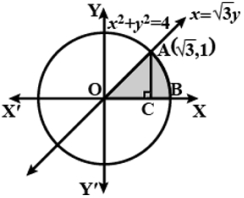
0 likes
View Solution120
DifficultMCQ
Find the area of the smaller part of the circle $x^{2}+y^{2}=a^{2}$ cut off by the line $x=\frac{a}{\sqrt{2}}$.
A
$\frac{a^{2}}{2}\left(\frac{\pi}{2}-1\right)$
B
$\frac{a^{2}}{4}\left(\frac{\pi}{2}-1\right)$
C
$\frac{a^{2}}{2}\left(\frac{\pi}{4}-1\right)$
D
$\frac{a^{2}}{4}\left(\frac{\pi}{4}-1\right)$
Solution
(A) The area of the smaller part of the circle $x^{2}+y^{2}=a^{2}$ cut off by the line $x=\frac{a}{\sqrt{2}}$ is the area of the region bounded by the circle and the line in the first and fourth quadrants.
Since the circle is symmetrical about the $x$-axis,the total area is twice the area of the region in the first quadrant.
Area $= 2 \int_{\frac{a}{\sqrt{2}}}^{a} y \, dx = 2 \int_{\frac{a}{\sqrt{2}}}^{a} \sqrt{a^{2}-x^{2}} \, dx$
Using the formula $\int \sqrt{a^{2}-x^{2}} \, dx = \frac{x}{2} \sqrt{a^{2}-x^{2}} + \frac{a^{2}}{2} \sin^{-1} \left(\frac{x}{a}\right)$:
Area $= 2 \left[ \frac{x}{2} \sqrt{a^{2}-x^{2}} + \frac{a^{2}}{2} \sin^{-1} \left(\frac{x}{a}\right) \right]_{\frac{a}{\sqrt{2}}}^{a}$
$= 2 \left[ \left( 0 + \frac{a^{2}}{2} \sin^{-1}(1) \right) - \left( \frac{a}{2\sqrt{2}} \sqrt{a^{2}-\frac{a^{2}}{2}} + \frac{a^{2}}{2} \sin^{-1} \left(\frac{1}{\sqrt{2}}\right) \right) \right]$
$= 2 \left[ \frac{a^{2}}{2} \left(\frac{\pi}{2}\right) - \left( \frac{a}{2\sqrt{2}} \cdot \frac{a}{\sqrt{2}} + \frac{a^{2}}{2} \left(\frac{\pi}{4}\right) \right) \right]$
$= 2 \left[ \frac{a^{2}\pi}{4} - \frac{a^{2}}{4} - \frac{a^{2}\pi}{8} \right] = 2 \left[ \frac{2a^{2}\pi - a^{2}\pi}{8} - \frac{a^{2}}{4} \right] = 2 \left[ \frac{a^{2}\pi}{8} - \frac{a^{2}}{4} \right] = \frac{a^{2}\pi}{4} - \frac{a^{2}}{2} = \frac{a^{2}}{2} \left( \frac{\pi}{2} - 1 \right)$.
Since the circle is symmetrical about the $x$-axis,the total area is twice the area of the region in the first quadrant.
Area $= 2 \int_{\frac{a}{\sqrt{2}}}^{a} y \, dx = 2 \int_{\frac{a}{\sqrt{2}}}^{a} \sqrt{a^{2}-x^{2}} \, dx$
Using the formula $\int \sqrt{a^{2}-x^{2}} \, dx = \frac{x}{2} \sqrt{a^{2}-x^{2}} + \frac{a^{2}}{2} \sin^{-1} \left(\frac{x}{a}\right)$:
Area $= 2 \left[ \frac{x}{2} \sqrt{a^{2}-x^{2}} + \frac{a^{2}}{2} \sin^{-1} \left(\frac{x}{a}\right) \right]_{\frac{a}{\sqrt{2}}}^{a}$
$= 2 \left[ \left( 0 + \frac{a^{2}}{2} \sin^{-1}(1) \right) - \left( \frac{a}{2\sqrt{2}} \sqrt{a^{2}-\frac{a^{2}}{2}} + \frac{a^{2}}{2} \sin^{-1} \left(\frac{1}{\sqrt{2}}\right) \right) \right]$
$= 2 \left[ \frac{a^{2}}{2} \left(\frac{\pi}{2}\right) - \left( \frac{a}{2\sqrt{2}} \cdot \frac{a}{\sqrt{2}} + \frac{a^{2}}{2} \left(\frac{\pi}{4}\right) \right) \right]$
$= 2 \left[ \frac{a^{2}\pi}{4} - \frac{a^{2}}{4} - \frac{a^{2}\pi}{8} \right] = 2 \left[ \frac{2a^{2}\pi - a^{2}\pi}{8} - \frac{a^{2}}{4} \right] = 2 \left[ \frac{a^{2}\pi}{8} - \frac{a^{2}}{4} \right] = \frac{a^{2}\pi}{4} - \frac{a^{2}}{2} = \frac{a^{2}}{2} \left( \frac{\pi}{2} - 1 \right)$.
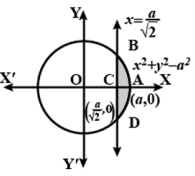
0 likes
View Solution121
DifficultMCQ
The area between $x=y^{2}$ and $x=4$ is divided into two equal parts by the line $x=a$. Find the value of $a$.
A
$4^{\frac{2}{3}}$
B
$2^{\frac{2}{3}}$
C
$4^{\frac{1}{3}}$
D
$2^{\frac{1}{3}}$
Solution
(A) The area bounded by the parabola $x=y^{2}$ and the line $x=4$ is symmetric about the $x$-axis.
The line $x=a$ divides this area into two equal parts.
Total area from $x=0$ to $x=4$ is $2 \int_{0}^{4} \sqrt{x} \, dx = 2 \left[ \frac{2}{3} x^{\frac{3}{2}} \right]_{0}^{4} = \frac{4}{3} (8) = \frac{32}{3}$.
The area from $x=0$ to $x=a$ is half of the total area:
$2 \int_{0}^{a} \sqrt{x} \, dx = \frac{1}{2} \times \frac{32}{3} = \frac{16}{3}$.
$2 \left[ \frac{2}{3} x^{\frac{3}{2}} \right]_{0}^{a} = \frac{16}{3}$.
$\frac{4}{3} a^{\frac{3}{2}} = \frac{16}{3}$.
$a^{\frac{3}{2}} = 4$.
$a = 4^{\frac{2}{3}}$.
The line $x=a$ divides this area into two equal parts.
Total area from $x=0$ to $x=4$ is $2 \int_{0}^{4} \sqrt{x} \, dx = 2 \left[ \frac{2}{3} x^{\frac{3}{2}} \right]_{0}^{4} = \frac{4}{3} (8) = \frac{32}{3}$.
The area from $x=0$ to $x=a$ is half of the total area:
$2 \int_{0}^{a} \sqrt{x} \, dx = \frac{1}{2} \times \frac{32}{3} = \frac{16}{3}$.
$2 \left[ \frac{2}{3} x^{\frac{3}{2}} \right]_{0}^{a} = \frac{16}{3}$.
$\frac{4}{3} a^{\frac{3}{2}} = \frac{16}{3}$.
$a^{\frac{3}{2}} = 4$.
$a = 4^{\frac{2}{3}}$.
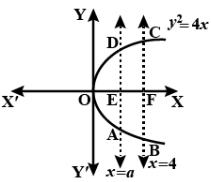
0 likes
View Solution122
DifficultMCQ
Find the area of the region bounded by the parabola $y=x^{2}$ and $y=|x|$.
A
$1/3$
B
$1/2$
C
$1/6$
D
$2/3$
Solution
(A) The area bounded by the parabola $y=x^{2}$ and the line $y=|x|$ is symmetric about the $y$-axis.
The points of intersection of $y=x^{2}$ and $y=|x|$ are found by setting $x^{2}=|x|$.
For $x \ge 0$,$x^{2}=x \implies x(x-1)=0$,so $x=0$ or $x=1$.
The intersection points are $(0,0)$ and $(1,1)$ in the first quadrant,and $(-1,1)$ in the second quadrant.
The required area is $2 \times \int_{0}^{1} (|x| - x^{2}) dx$.
Since $x \ge 0$ in the first quadrant,$|x|=x$.
Area $= 2 \int_{0}^{1} (x - x^{2}) dx$
$= 2 \left[ \frac{x^{2}}{2} - \frac{x^{3}}{3} \right]_{0}^{1}$
$= 2 \left( \frac{1}{2} - \frac{1}{3} \right)$
$= 2 \left( \frac{3-2}{6} \right) = 2 \left( \frac{1}{6} \right) = \frac{1}{3} \text{ sq. units.}$
The points of intersection of $y=x^{2}$ and $y=|x|$ are found by setting $x^{2}=|x|$.
For $x \ge 0$,$x^{2}=x \implies x(x-1)=0$,so $x=0$ or $x=1$.
The intersection points are $(0,0)$ and $(1,1)$ in the first quadrant,and $(-1,1)$ in the second quadrant.
The required area is $2 \times \int_{0}^{1} (|x| - x^{2}) dx$.
Since $x \ge 0$ in the first quadrant,$|x|=x$.
Area $= 2 \int_{0}^{1} (x - x^{2}) dx$
$= 2 \left[ \frac{x^{2}}{2} - \frac{x^{3}}{3} \right]_{0}^{1}$
$= 2 \left( \frac{1}{2} - \frac{1}{3} \right)$
$= 2 \left( \frac{3-2}{6} \right) = 2 \left( \frac{1}{6} \right) = \frac{1}{3} \text{ sq. units.}$
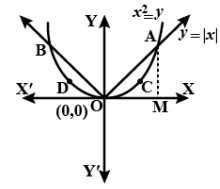
0 likes
View Solution123
MediumMCQ
Find the area of the region bounded by the curve $y^{2}=4x$ and the line $x=3$. (in $\sqrt{3}$)
A
$8$
B
$4$
C
$12$
D
$16$
Solution
(A) The region bounded by the parabola $y^{2}=4x$ and the line $x=3$ is the area $OAC$ (as shown in the figure).
The area is symmetrical about the $x$-axis.
Therefore,the required area $= 2 \times (\text{Area of } OAB)$.
Area $= 2 \int_{0}^{3} y \, dx$
Since $y^{2}=4x$,we have $y = 2\sqrt{x}$ (taking the positive value for the upper half).
Area $= 2 \int_{0}^{3} 2\sqrt{x} \, dx = 4 \int_{0}^{3} x^{1/2} \, dx$
$= 4 \left[ \frac{x^{3/2}}{3/2} \right]_{0}^{3} = 4 \times \frac{2}{3} \left[ x^{3/2} \right]_{0}^{3}$
$= \frac{8}{3} \left[ 3^{3/2} - 0^{3/2} \right] = \frac{8}{3} \times 3\sqrt{3} = 8\sqrt{3}$ square units.
The area is symmetrical about the $x$-axis.
Therefore,the required area $= 2 \times (\text{Area of } OAB)$.
Area $= 2 \int_{0}^{3} y \, dx$
Since $y^{2}=4x$,we have $y = 2\sqrt{x}$ (taking the positive value for the upper half).
Area $= 2 \int_{0}^{3} 2\sqrt{x} \, dx = 4 \int_{0}^{3} x^{1/2} \, dx$
$= 4 \left[ \frac{x^{3/2}}{3/2} \right]_{0}^{3} = 4 \times \frac{2}{3} \left[ x^{3/2} \right]_{0}^{3}$
$= \frac{8}{3} \left[ 3^{3/2} - 0^{3/2} \right] = \frac{8}{3} \times 3\sqrt{3} = 8\sqrt{3}$ square units.
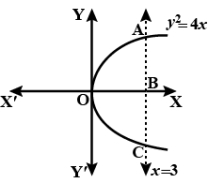
0 likes
View Solution124
MediumMCQ
The area lying in the first quadrant and bounded by the circle $x^{2}+y^{2}=4$ and the lines $x=0$ and $x=2$ is
A
$\pi$
B
$\frac{\pi}{2}$
C
$\frac{\pi}{3}$
D
$\frac{\pi}{4}$
Solution
(A) The given circle is $x^{2}+y^{2}=4$,which is a circle centered at the origin $(0,0)$ with radius $r=2$.
In the first quadrant,$y = \sqrt{4-x^{2}}$.
The area bounded by the circle,the $y$-axis $(x=0)$,and the line $x=2$ is the area of the quarter circle in the first quadrant.
Area $= \int_{0}^{2} y \, dx = \int_{0}^{2} \sqrt{4-x^{2}} \, dx$.
Using the formula $\int \sqrt{a^{2}-x^{2}} \, dx = \frac{x}{2} \sqrt{a^{2}-x^{2}} + \frac{a^{2}}{2} \sin^{-1} \left(\frac{x}{a}\right)$:
Area $= \left[ \frac{x}{2} \sqrt{4-x^{2}} + \frac{4}{2} \sin^{-1} \left(\frac{x}{2}\right) \right]_{0}^{2}$.
Substituting the limits:
$= \left( \frac{2}{2} \sqrt{4-4} + 2 \sin^{-1} \left(\frac{2}{2}\right) \right) - \left( 0 + 2 \sin^{-1}(0) \right)$.
$= (0 + 2 \sin^{-1}(1)) - (0) = 2 \times \frac{\pi}{2} = \pi$ square units.
Thus,the correct option is $A$.
In the first quadrant,$y = \sqrt{4-x^{2}}$.
The area bounded by the circle,the $y$-axis $(x=0)$,and the line $x=2$ is the area of the quarter circle in the first quadrant.
Area $= \int_{0}^{2} y \, dx = \int_{0}^{2} \sqrt{4-x^{2}} \, dx$.
Using the formula $\int \sqrt{a^{2}-x^{2}} \, dx = \frac{x}{2} \sqrt{a^{2}-x^{2}} + \frac{a^{2}}{2} \sin^{-1} \left(\frac{x}{a}\right)$:
Area $= \left[ \frac{x}{2} \sqrt{4-x^{2}} + \frac{4}{2} \sin^{-1} \left(\frac{x}{2}\right) \right]_{0}^{2}$.
Substituting the limits:
$= \left( \frac{2}{2} \sqrt{4-4} + 2 \sin^{-1} \left(\frac{2}{2}\right) \right) - \left( 0 + 2 \sin^{-1}(0) \right)$.
$= (0 + 2 \sin^{-1}(1)) - (0) = 2 \times \frac{\pi}{2} = \pi$ square units.
Thus,the correct option is $A$.
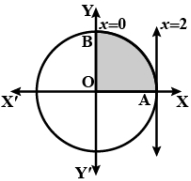
0 likes
View Solution125
EasyMCQ
Area of the region bounded by the curve $y^{2}=4x$,$y$-axis and the line $y=3$ is
A
$2$
B
$\frac{9}{4}$
C
$\frac{9}{3}$
D
$\frac{9}{2}$
Solution
(B) The area bounded by the curve $y^{2}=4x$,the $y$-axis,and the line $y=3$ is calculated by integrating $x$ with respect to $y$ from $y=0$ to $y=3$.
Given the curve $y^{2}=4x$,we can express $x$ as $x = \frac{y^{2}}{4}$.
The area $A$ is given by the integral:
$A = \int_{0}^{3} x \, dy$
Substituting $x = \frac{y^{2}}{4}$:
$A = \int_{0}^{3} \frac{y^{2}}{4} \, dy$
$A = \frac{1}{4} \left[ \frac{y^{3}}{3} \right]_{0}^{3}$
$A = \frac{1}{4} \left( \frac{3^{3}}{3} - \frac{0^{3}}{3} \right)$
$A = \frac{1}{4} \left( \frac{27}{3} \right)$
$A = \frac{1}{4} (9) = \frac{9}{4} \text{ sq. units}$.
Thus,the correct answer is $B$.
Given the curve $y^{2}=4x$,we can express $x$ as $x = \frac{y^{2}}{4}$.
The area $A$ is given by the integral:
$A = \int_{0}^{3} x \, dy$
Substituting $x = \frac{y^{2}}{4}$:
$A = \int_{0}^{3} \frac{y^{2}}{4} \, dy$
$A = \frac{1}{4} \left[ \frac{y^{3}}{3} \right]_{0}^{3}$
$A = \frac{1}{4} \left( \frac{3^{3}}{3} - \frac{0^{3}}{3} \right)$
$A = \frac{1}{4} \left( \frac{27}{3} \right)$
$A = \frac{1}{4} (9) = \frac{9}{4} \text{ sq. units}$.
Thus,the correct answer is $B$.
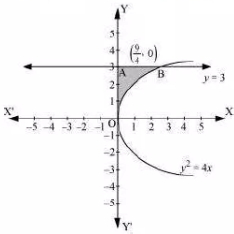
0 likes
View Solution126
DifficultMCQ
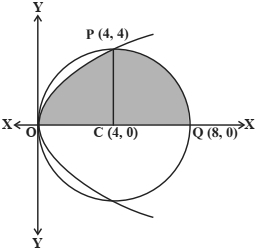
Find the area lying above the $x-$ axis and included between the circle $x^{2}+y^{2}=8x$ and inside the parabola $y^{2}=4x$.
A
$\frac{4}{3}(8+3\pi)$
B
$\frac{8}{3}(4+3\pi)$
C
$\frac{2}{3}(8+3\pi)$
D
$\frac{4}{3}(4+3\pi)$
Solution
(A) The given equation of the circle $x^{2}+y^{2}=8x$ can be expressed as $(x-4)^{2}+y^{2}=16$. Thus,the centre of the circle is $(4, 0)$ and the radius is $4$.
Its intersection with the parabola $y^{2}=4x$ gives:
$x^{2}+4x=8x$
$x^{2}-4x=0$
$x(x-4)=0$
$x=0, x=4$
Thus,the points of intersection of these two curves are $O(0, 0)$ and $P(4, 4)$ above the $x-$ axis.
The required area of the region $OPQCO$ included between these two curves above the $x-$ axis is:
Area $= \int_{0}^{4} \sqrt{4x} \, dx + \int_{4}^{8} \sqrt{16-(x-4)^{2}} \, dx$
$= 2 \int_{0}^{4} x^{1/2} \, dx + \int_{0}^{4} \sqrt{4^{2}-t^{2}} \, dt$ (where $t = x-4$)
$= 2 \times \frac{2}{3} [x^{3/2}]_{0}^{4} + [\frac{t}{2} \sqrt{16-t^{2}} + \frac{16}{2} \sin^{-1}(\frac{t}{4})]_{0}^{4}$
$= \frac{4}{3} (8) + [0 + 8 \sin^{-1}(1) - 0]$
$= \frac{32}{3} + 8(\frac{\pi}{2}) = \frac{32}{3} + 4\pi = \frac{4}{3}(8+3\pi)$
Its intersection with the parabola $y^{2}=4x$ gives:
$x^{2}+4x=8x$
$x^{2}-4x=0$
$x(x-4)=0$
$x=0, x=4$
Thus,the points of intersection of these two curves are $O(0, 0)$ and $P(4, 4)$ above the $x-$ axis.
The required area of the region $OPQCO$ included between these two curves above the $x-$ axis is:
Area $= \int_{0}^{4} \sqrt{4x} \, dx + \int_{4}^{8} \sqrt{16-(x-4)^{2}} \, dx$
$= 2 \int_{0}^{4} x^{1/2} \, dx + \int_{0}^{4} \sqrt{4^{2}-t^{2}} \, dt$ (where $t = x-4$)
$= 2 \times \frac{2}{3} [x^{3/2}]_{0}^{4} + [\frac{t}{2} \sqrt{16-t^{2}} + \frac{16}{2} \sin^{-1}(\frac{t}{4})]_{0}^{4}$
$= \frac{4}{3} (8) + [0 + 8 \sin^{-1}(1) - 0]$
$= \frac{32}{3} + 8(\frac{\pi}{2}) = \frac{32}{3} + 4\pi = \frac{4}{3}(8+3\pi)$
0 likes
View Solution127
DifficultMCQ
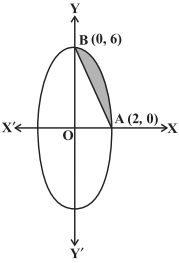
In the figure,$AOBA$ is the part of the ellipse $9x^{2} + y^{2} = 36$ in the first quadrant such that $OA = 2$ and $OB = 6$. Find the area between the arc $AB$ and the chord $AB$.
A
$3\pi - 6$
B
$3\pi + 6$
C
$6 - 3\pi$
D
$3\pi$
Solution
(A) The given equation of the ellipse is $9x^{2} + y^{2} = 36$,which can be written as $\frac{x^{2}}{4} + \frac{y^{2}}{36} = 1$ or $\frac{x^{2}}{2^{2}} + \frac{y^{2}}{6^{2}} = 1$.
From the equation,$y = \sqrt{36 - 9x^{2}} = 3\sqrt{4 - x^{2}}$.
The equation of the chord $AB$ passing through $A(2, 0)$ and $B(0, 6)$ is given by $\frac{x}{2} + \frac{y}{6} = 1$,which simplifies to $y = 6 - 3x$.
The area of the shaded region is the area under the ellipse minus the area under the line $AB$ from $x = 0$ to $x = 2$.
Area $= \int_{0}^{2} (y_{\text{ellipse}} - y_{\text{line}}) dx = \int_{0}^{2} (3\sqrt{4 - x^{2}} - (6 - 3x)) dx$.
$= 3 \int_{0}^{2} \sqrt{2^{2} - x^{2}} dx - \int_{0}^{2} (6 - 3x) dx$.
Using the formula $\int \sqrt{a^{2} - x^{2}} dx = \frac{x}{2}\sqrt{a^{2} - x^{2}} + \frac{a^{2}}{2}\sin^{-1}(\frac{x}{a})$:
$= 3 \left[ \frac{x}{2}\sqrt{4 - x^{2}} + \frac{4}{2}\sin^{-1}(\frac{x}{2}) \right]_{0}^{2} - \left[ 6x - \frac{3x^{2}}{2} \right]_{0}^{2}$.
$= 3 \left[ (0 + 2\sin^{-1}(1)) - (0 + 0) \right] - \left[ (12 - 6) - (0 - 0) \right]$.
$= 3 \left[ 2 \times \frac{\pi}{2} \right] - 6 = 3\pi - 6$ square units.
From the equation,$y = \sqrt{36 - 9x^{2}} = 3\sqrt{4 - x^{2}}$.
The equation of the chord $AB$ passing through $A(2, 0)$ and $B(0, 6)$ is given by $\frac{x}{2} + \frac{y}{6} = 1$,which simplifies to $y = 6 - 3x$.
The area of the shaded region is the area under the ellipse minus the area under the line $AB$ from $x = 0$ to $x = 2$.
Area $= \int_{0}^{2} (y_{\text{ellipse}} - y_{\text{line}}) dx = \int_{0}^{2} (3\sqrt{4 - x^{2}} - (6 - 3x)) dx$.
$= 3 \int_{0}^{2} \sqrt{2^{2} - x^{2}} dx - \int_{0}^{2} (6 - 3x) dx$.
Using the formula $\int \sqrt{a^{2} - x^{2}} dx = \frac{x}{2}\sqrt{a^{2} - x^{2}} + \frac{a^{2}}{2}\sin^{-1}(\frac{x}{a})$:
$= 3 \left[ \frac{x}{2}\sqrt{4 - x^{2}} + \frac{4}{2}\sin^{-1}(\frac{x}{2}) \right]_{0}^{2} - \left[ 6x - \frac{3x^{2}}{2} \right]_{0}^{2}$.
$= 3 \left[ (0 + 2\sin^{-1}(1)) - (0 + 0) \right] - \left[ (12 - 6) - (0 - 0) \right]$.
$= 3 \left[ 2 \times \frac{\pi}{2} \right] - 6 = 3\pi - 6$ square units.
0 likes
View Solution128
MediumMCQ
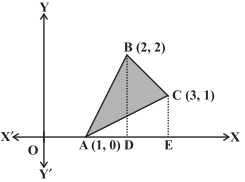
Using integration,find the area of the region bounded by the triangle whose vertices are $(1, 0)$,$(2, 2)$,and $(3, 1)$.
A
$1.5$
B
$2.0$
C
$2.5$
D
$3.0$
Solution
(A) Let $A(1,0)$,$B(2,2)$,and $C(3,1)$ be the vertices of a triangle $ABC$.
The equations of the sides are:
Side $AB$: $y - 0 = \frac{2-0}{2-1}(x - 1) \implies y = 2(x-1)$
Side $BC$: $y - 2 = \frac{1-2}{3-2}(x - 2) \implies y - 2 = -1(x-2) \implies y = 4-x$
Side $AC$: $y - 0 = \frac{1-0}{3-1}(x - 1) \implies y = \frac{1}{2}(x-1)$
The area of $\Delta ABC$ is given by:
Area $= \int_{1}^{2} (y_{AB} - y_{AC}) dx + \int_{2}^{3} (y_{BC} - y_{AC}) dx$
$= \int_{1}^{2} (2x - 2 - \frac{x-1}{2}) dx + \int_{2}^{3} (4 - x - \frac{x-1}{2}) dx$
$= \int_{1}^{2} (\frac{3x-3}{2}) dx + \int_{2}^{3} (\frac{9-3x}{2}) dx$
$= \frac{3}{2} [\frac{x^2}{2} - x]_{1}^{2} + \frac{3}{2} [3x - \frac{x^2}{2}]_{2}^{3}$
$= \frac{3}{2} [(2 - 2) - (\frac{1}{2} - 1)] + \frac{3}{2} [(9 - 4.5) - (6 - 2)]$
$= \frac{3}{2} [0.5] + \frac{3}{2} [4.5 - 4] = \frac{3}{2} (0.5) + \frac{3}{2} (0.5) = 0.75 + 0.75 = 1.5$ square units.
The equations of the sides are:
Side $AB$: $y - 0 = \frac{2-0}{2-1}(x - 1) \implies y = 2(x-1)$
Side $BC$: $y - 2 = \frac{1-2}{3-2}(x - 2) \implies y - 2 = -1(x-2) \implies y = 4-x$
Side $AC$: $y - 0 = \frac{1-0}{3-1}(x - 1) \implies y = \frac{1}{2}(x-1)$
The area of $\Delta ABC$ is given by:
Area $= \int_{1}^{2} (y_{AB} - y_{AC}) dx + \int_{2}^{3} (y_{BC} - y_{AC}) dx$
$= \int_{1}^{2} (2x - 2 - \frac{x-1}{2}) dx + \int_{2}^{3} (4 - x - \frac{x-1}{2}) dx$
$= \int_{1}^{2} (\frac{3x-3}{2}) dx + \int_{2}^{3} (\frac{9-3x}{2}) dx$
$= \frac{3}{2} [\frac{x^2}{2} - x]_{1}^{2} + \frac{3}{2} [3x - \frac{x^2}{2}]_{2}^{3}$
$= \frac{3}{2} [(2 - 2) - (\frac{1}{2} - 1)] + \frac{3}{2} [(9 - 4.5) - (6 - 2)]$
$= \frac{3}{2} [0.5] + \frac{3}{2} [4.5 - 4] = \frac{3}{2} (0.5) + \frac{3}{2} (0.5) = 0.75 + 0.75 = 1.5$ square units.
0 likes
View Solution129
DifficultMCQ
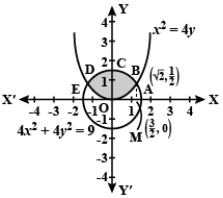
Find the area of the circle $4x^{2}+4y^{2}=9$ which is interior to the parabola $x^{2}=4y$.
A
$\left[\frac{\sqrt{2}}{6}+\frac{9}{4} \sin ^{-1} \frac{2 \sqrt{2}}{3}\right]$
B
$\left[\frac{\sqrt{2}}{3}+\frac{9}{2} \sin ^{-1} \frac{2 \sqrt{2}}{3}\right]$
C
$\left[\frac{\sqrt{2}}{6}+\frac{9}{8} \sin ^{-1} \frac{2 \sqrt{2}}{3}\right]$
D
$\left[\frac{\sqrt{2}}{12}+\frac{9}{4} \sin ^{-1} \frac{2 \sqrt{2}}{3}\right]$
Solution
(A) The required area is represented by the shaded region $OBCDO$.
Solving the equations $4x^{2}+4y^{2}=9$ and $x^{2}=4y$,we substitute $x^{2}=4y$ into the circle equation:
$4(4y)+4y^{2}=9 \implies 4y^{2}+16y-9=0$.
Using the quadratic formula,$y = \frac{-16 \pm \sqrt{256 - 4(4)(-9)}}{8} = \frac{-16 \pm \sqrt{400}}{8} = \frac{-16 \pm 20}{8}$.
Since $y \ge 0$ for the parabola,$y = \frac{4}{8} = \frac{1}{2}$.
Then $x^{2} = 4(\frac{1}{2}) = 2$,so $x = \pm \sqrt{2}$. The intersection points are $B(\sqrt{2}, \frac{1}{2})$ and $D(-\sqrt{2}, \frac{1}{2})$.
The area is symmetric about the $y$-axis,so Area $= 2 \times \int_{0}^{\sqrt{2}} (y_{circle} - y_{parabola}) dx$.
$y_{circle} = \sqrt{\frac{9-4x^{2}}{4}} = \frac{1}{2}\sqrt{9-4x^{2}}$ and $y_{parabola} = \frac{x^{2}}{4}$.
Area $= 2 \int_{0}^{\sqrt{2}} (\frac{1}{2}\sqrt{9-4x^{2}} - \frac{x^{2}}{4}) dx = \int_{0}^{\sqrt{2}} \sqrt{9-4x^{2}} dx - \frac{1}{2} \int_{0}^{\sqrt{2}} x^{2} dx$.
Using $\int \sqrt{a^{2}-u^{2}} du = \frac{u}{2}\sqrt{a^{2}-u^{2}} + \frac{a^{2}}{2}\sin^{-1}(\frac{u}{a})$,let $u=2x, du=2dx$:
$= \frac{1}{2} [\frac{2x}{2}\sqrt{9-4x^{2}} + \frac{9}{2}\sin^{-1}(\frac{2x}{3})]_{0}^{\sqrt{2}} - \frac{1}{2} [\frac{x^{3}}{3}]_{0}^{\sqrt{2}}$
$= [\frac{x}{2}\sqrt{9-4x^{2}} + \frac{9}{4}\sin^{-1}(\frac{2x}{3})]_{0}^{\sqrt{2}} - \frac{1}{6}(\sqrt{2})^{3}$
$= (\frac{\sqrt{2}}{2}\sqrt{9-8} + \frac{9}{4}\sin^{-1}(\frac{2\sqrt{2}}{3})) - \frac{2\sqrt{2}}{6}$
$= \frac{\sqrt{2}}{2} + \frac{9}{4}\sin^{-1}(\frac{2\sqrt{2}}{3}) - \frac{\sqrt{2}}{3} = \frac{\sqrt{2}}{6} + \frac{9}{4}\sin^{-1}(\frac{2\sqrt{2}}{3})$ sq. units.
Solving the equations $4x^{2}+4y^{2}=9$ and $x^{2}=4y$,we substitute $x^{2}=4y$ into the circle equation:
$4(4y)+4y^{2}=9 \implies 4y^{2}+16y-9=0$.
Using the quadratic formula,$y = \frac{-16 \pm \sqrt{256 - 4(4)(-9)}}{8} = \frac{-16 \pm \sqrt{400}}{8} = \frac{-16 \pm 20}{8}$.
Since $y \ge 0$ for the parabola,$y = \frac{4}{8} = \frac{1}{2}$.
Then $x^{2} = 4(\frac{1}{2}) = 2$,so $x = \pm \sqrt{2}$. The intersection points are $B(\sqrt{2}, \frac{1}{2})$ and $D(-\sqrt{2}, \frac{1}{2})$.
The area is symmetric about the $y$-axis,so Area $= 2 \times \int_{0}^{\sqrt{2}} (y_{circle} - y_{parabola}) dx$.
$y_{circle} = \sqrt{\frac{9-4x^{2}}{4}} = \frac{1}{2}\sqrt{9-4x^{2}}$ and $y_{parabola} = \frac{x^{2}}{4}$.
Area $= 2 \int_{0}^{\sqrt{2}} (\frac{1}{2}\sqrt{9-4x^{2}} - \frac{x^{2}}{4}) dx = \int_{0}^{\sqrt{2}} \sqrt{9-4x^{2}} dx - \frac{1}{2} \int_{0}^{\sqrt{2}} x^{2} dx$.
Using $\int \sqrt{a^{2}-u^{2}} du = \frac{u}{2}\sqrt{a^{2}-u^{2}} + \frac{a^{2}}{2}\sin^{-1}(\frac{u}{a})$,let $u=2x, du=2dx$:
$= \frac{1}{2} [\frac{2x}{2}\sqrt{9-4x^{2}} + \frac{9}{2}\sin^{-1}(\frac{2x}{3})]_{0}^{\sqrt{2}} - \frac{1}{2} [\frac{x^{3}}{3}]_{0}^{\sqrt{2}}$
$= [\frac{x}{2}\sqrt{9-4x^{2}} + \frac{9}{4}\sin^{-1}(\frac{2x}{3})]_{0}^{\sqrt{2}} - \frac{1}{6}(\sqrt{2})^{3}$
$= (\frac{\sqrt{2}}{2}\sqrt{9-8} + \frac{9}{4}\sin^{-1}(\frac{2\sqrt{2}}{3})) - \frac{2\sqrt{2}}{6}$
$= \frac{\sqrt{2}}{2} + \frac{9}{4}\sin^{-1}(\frac{2\sqrt{2}}{3}) - \frac{\sqrt{2}}{3} = \frac{\sqrt{2}}{6} + \frac{9}{4}\sin^{-1}(\frac{2\sqrt{2}}{3})$ sq. units.
0 likes
View Solution130
DifficultMCQ
Find the area bounded by the curves $(x-1)^{2}+y^{2}=1$ and $x^{2}+y^{2}=1$.
A
$\left(\frac{2 \pi}{3}-\frac{\sqrt{3}}{2}\right)$
B
$\left(\frac{2 \pi}{3}-\frac{\sqrt{3}}{2}\right)$
C
$\left(\frac{2 \pi}{3}-\frac{\sqrt{3}}{2}\right)$
D
$\left(\frac{2 \pi}{3}-\frac{\sqrt{3}}{2}\right)$
Solution
(A) The area bounded by the curves $(x-1)^{2}+y^{2}=1$ and $x^{2}+y^{2}=1$ is represented by the shaded region.
On solving the equations $(x-1)^{2}+y^{2}=1$ and $x^{2}+y^{2}=1$,we get:
$x^2 - 2x + 1 + y^2 = 1$
Since $x^2 + y^2 = 1$,we have $1 - 2x + 1 = 1$,which gives $2x = 1$,so $x = \frac{1}{2}$.
Substituting $x = \frac{1}{2}$ in $x^2 + y^2 = 1$,we get $y^2 = 1 - \frac{1}{4} = \frac{3}{4}$,so $y = \pm \frac{\sqrt{3}}{2}$.
The intersection points are $A\left(\frac{1}{2}, \frac{\sqrt{3}}{2}\right)$ and $B\left(\frac{1}{2}, -\frac{\sqrt{3}}{2}\right)$.
The required area is symmetric about the $x$-axis.
Area $= 2 \times \int_{0}^{1/2} \sqrt{1 - (x-1)^2} dx + 2 \times \int_{1/2}^{1} \sqrt{1 - x^2} dx$.
Using the formula $\int \sqrt{a^2 - x^2} dx = \frac{x}{2}\sqrt{a^2 - x^2} + \frac{a^2}{2}\sin^{-1}\left(\frac{x}{a}\right)$:
Area $= 2 \left[ \frac{x-1}{2}\sqrt{1-(x-1)^2} + \frac{1}{2}\sin^{-1}(x-1) \right]_0^{1/2} + 2 \left[ \frac{x}{2}\sqrt{1-x^2} + \frac{1}{2}\sin^{-1}(x) \right]_{1/2}^1$
$= 2 \left[ (-\frac{1}{4}\frac{\sqrt{3}}{2} + \frac{1}{2}\sin^{-1}(-1/2)) - (0 + \frac{1}{2}\sin^{-1}(-1)) \right] + 2 \left[ (0 + \frac{1}{2}\sin^{-1}(1)) - (\frac{1}{4}\frac{\sqrt{3}}{2} + \frac{1}{2}\sin^{-1}(1/2)) \right]$
$= 2 \left[ -\frac{\sqrt{3}}{8} - \frac{\pi}{12} + \frac{\pi}{4} \right] + 2 \left[ \frac{\pi}{4} - \frac{\sqrt{3}}{8} - \frac{\pi}{12} \right]$
$= 2 \left[ \frac{\pi}{6} - \frac{\sqrt{3}}{8} \right] + 2 \left[ \frac{\pi}{6} - \frac{\sqrt{3}}{8} \right] = 4 \left( \frac{\pi}{6} - \frac{\sqrt{3}}{8} \right) = \frac{2\pi}{3} - \frac{\sqrt{3}}{2}$ sq. units.
On solving the equations $(x-1)^{2}+y^{2}=1$ and $x^{2}+y^{2}=1$,we get:
$x^2 - 2x + 1 + y^2 = 1$
Since $x^2 + y^2 = 1$,we have $1 - 2x + 1 = 1$,which gives $2x = 1$,so $x = \frac{1}{2}$.
Substituting $x = \frac{1}{2}$ in $x^2 + y^2 = 1$,we get $y^2 = 1 - \frac{1}{4} = \frac{3}{4}$,so $y = \pm \frac{\sqrt{3}}{2}$.
The intersection points are $A\left(\frac{1}{2}, \frac{\sqrt{3}}{2}\right)$ and $B\left(\frac{1}{2}, -\frac{\sqrt{3}}{2}\right)$.
The required area is symmetric about the $x$-axis.
Area $= 2 \times \int_{0}^{1/2} \sqrt{1 - (x-1)^2} dx + 2 \times \int_{1/2}^{1} \sqrt{1 - x^2} dx$.
Using the formula $\int \sqrt{a^2 - x^2} dx = \frac{x}{2}\sqrt{a^2 - x^2} + \frac{a^2}{2}\sin^{-1}\left(\frac{x}{a}\right)$:
Area $= 2 \left[ \frac{x-1}{2}\sqrt{1-(x-1)^2} + \frac{1}{2}\sin^{-1}(x-1) \right]_0^{1/2} + 2 \left[ \frac{x}{2}\sqrt{1-x^2} + \frac{1}{2}\sin^{-1}(x) \right]_{1/2}^1$
$= 2 \left[ (-\frac{1}{4}\frac{\sqrt{3}}{2} + \frac{1}{2}\sin^{-1}(-1/2)) - (0 + \frac{1}{2}\sin^{-1}(-1)) \right] + 2 \left[ (0 + \frac{1}{2}\sin^{-1}(1)) - (\frac{1}{4}\frac{\sqrt{3}}{2} + \frac{1}{2}\sin^{-1}(1/2)) \right]$
$= 2 \left[ -\frac{\sqrt{3}}{8} - \frac{\pi}{12} + \frac{\pi}{4} \right] + 2 \left[ \frac{\pi}{4} - \frac{\sqrt{3}}{8} - \frac{\pi}{12} \right]$
$= 2 \left[ \frac{\pi}{6} - \frac{\sqrt{3}}{8} \right] + 2 \left[ \frac{\pi}{6} - \frac{\sqrt{3}}{8} \right] = 4 \left( \frac{\pi}{6} - \frac{\sqrt{3}}{8} \right) = \frac{2\pi}{3} - \frac{\sqrt{3}}{2}$ sq. units.
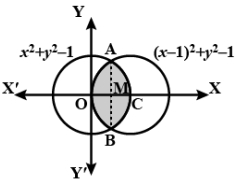
0 likes
View Solution131
MediumMCQ
Find the area of the region bounded by the curves $y=x^{2}+2, \,y=x,\, x=0$ and $x=3$.
A
$\frac{21}{2}$
B
$\frac{15}{2}$
C
$\frac{27}{2}$
D
$\frac{19}{2}$
Solution
(A) The area bounded by the curves $y=x^{2}+2, \,y=x, \,x=0,$ and $x=3$ is given by the integral of the difference between the upper curve and the lower curve within the given limits.
Area $= \int_{0}^{3} ((x^{2}+2) - x) \, dx$
$= \int_{0}^{3} (x^{2} - x + 2) \, dx$
$= \left[ \frac{x^{3}}{3} - \frac{x^{2}}{2} + 2x \right]_{0}^{3}$
$= \left( \frac{3^{3}}{3} - \frac{3^{2}}{2} + 2(3) \right) - (0)$
$= \left( \frac{27}{3} - \frac{9}{2} + 6 \right)$
$= 9 - 4.5 + 6$
$= 10.5 = \frac{21}{2} \text{ sq. units}$
Area $= \int_{0}^{3} ((x^{2}+2) - x) \, dx$
$= \int_{0}^{3} (x^{2} - x + 2) \, dx$
$= \left[ \frac{x^{3}}{3} - \frac{x^{2}}{2} + 2x \right]_{0}^{3}$
$= \left( \frac{3^{3}}{3} - \frac{3^{2}}{2} + 2(3) \right) - (0)$
$= \left( \frac{27}{3} - \frac{9}{2} + 6 \right)$
$= 9 - 4.5 + 6$
$= 10.5 = \frac{21}{2} \text{ sq. units}$
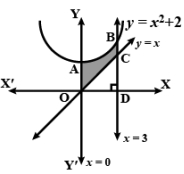
0 likes
View Solution132
MediumMCQ
Using integration,find the area of the region bounded by the triangle whose vertices are $(-1, 0)$,$(1, 3)$,and $(3, 2)$.
A
$4$ sq. units
B
$6$ sq. units
C
$8$ sq. units
D
$2$ sq. units
Solution
(A) $BL$ and $CM$ are drawn perpendicular to the $x$-axis.
It can be observed in the figure that,
Area $(\Delta ABC) = \text{Area}(ALBA) + \text{Area}(BLMCB) - \text{Area}(AMCA)$ ...... $(1)$
The equation of the line segment $AB$ passing through $(-1, 0)$ and $(1, 3)$ is:
$y - 0 = \frac{3 - 0}{1 - (-1)}(x - (-1)) \implies y = \frac{3}{2}(x + 1)$
$\text{Area}(ALBA) = \int_{-1}^{1} \frac{3}{2}(x + 1) dx = \frac{3}{2} \left[ \frac{x^2}{2} + x \right]_{-1}^{1} = \frac{3}{2} \left[ (\frac{1}{2} + 1) - (\frac{1}{2} - 1) \right] = \frac{3}{2} [2] = 3$ sq. units.
The equation of the line segment $BC$ passing through $(1, 3)$ and $(3, 2)$ is:
$y - 3 = \frac{2 - 3}{3 - 1}(x - 1) \implies y - 3 = -\frac{1}{2}(x - 1) \implies y = -\frac{1}{2}x + \frac{7}{2}$
$\text{Area}(BLMCB) = \int_{1}^{3} (-\frac{1}{2}x + \frac{7}{2}) dx = \left[ -\frac{x^2}{4} + \frac{7x}{2} \right]_{1}^{3} = (-\frac{9}{4} + \frac{21}{2}) - (-\frac{1}{4} + \frac{7}{2}) = (\frac{33}{4}) - (\frac{13}{4}) = \frac{20}{4} = 5$ sq. units.
The equation of the line segment $AC$ passing through $(-1, 0)$ and $(3, 2)$ is:
$y - 0 = \frac{2 - 0}{3 - (-1)}(x - (-1)) \implies y = \frac{2}{4}(x + 1) \implies y = \frac{1}{2}(x + 1)$
$\text{Area}(AMCA) = \int_{-1}^{3} \frac{1}{2}(x + 1) dx = \frac{1}{2} \left[ \frac{x^2}{2} + x \right]_{-1}^{3} = \frac{1}{2} \left[ (\frac{9}{2} + 3) - (\frac{1}{2} - 1) \right] = \frac{1}{2} [\frac{15}{2} + \frac{1}{2}] = \frac{1}{2} [8] = 4$ sq. units.
Therefore,from equation $(1)$,
$\text{Area}(\Delta ABC) = 3 + 5 - 4 = 4$ sq. units.
It can be observed in the figure that,
Area $(\Delta ABC) = \text{Area}(ALBA) + \text{Area}(BLMCB) - \text{Area}(AMCA)$ ...... $(1)$
The equation of the line segment $AB$ passing through $(-1, 0)$ and $(1, 3)$ is:
$y - 0 = \frac{3 - 0}{1 - (-1)}(x - (-1)) \implies y = \frac{3}{2}(x + 1)$
$\text{Area}(ALBA) = \int_{-1}^{1} \frac{3}{2}(x + 1) dx = \frac{3}{2} \left[ \frac{x^2}{2} + x \right]_{-1}^{1} = \frac{3}{2} \left[ (\frac{1}{2} + 1) - (\frac{1}{2} - 1) \right] = \frac{3}{2} [2] = 3$ sq. units.
The equation of the line segment $BC$ passing through $(1, 3)$ and $(3, 2)$ is:
$y - 3 = \frac{2 - 3}{3 - 1}(x - 1) \implies y - 3 = -\frac{1}{2}(x - 1) \implies y = -\frac{1}{2}x + \frac{7}{2}$
$\text{Area}(BLMCB) = \int_{1}^{3} (-\frac{1}{2}x + \frac{7}{2}) dx = \left[ -\frac{x^2}{4} + \frac{7x}{2} \right]_{1}^{3} = (-\frac{9}{4} + \frac{21}{2}) - (-\frac{1}{4} + \frac{7}{2}) = (\frac{33}{4}) - (\frac{13}{4}) = \frac{20}{4} = 5$ sq. units.
The equation of the line segment $AC$ passing through $(-1, 0)$ and $(3, 2)$ is:
$y - 0 = \frac{2 - 0}{3 - (-1)}(x - (-1)) \implies y = \frac{2}{4}(x + 1) \implies y = \frac{1}{2}(x + 1)$
$\text{Area}(AMCA) = \int_{-1}^{3} \frac{1}{2}(x + 1) dx = \frac{1}{2} \left[ \frac{x^2}{2} + x \right]_{-1}^{3} = \frac{1}{2} \left[ (\frac{9}{2} + 3) - (\frac{1}{2} - 1) \right] = \frac{1}{2} [\frac{15}{2} + \frac{1}{2}] = \frac{1}{2} [8] = 4$ sq. units.
Therefore,from equation $(1)$,
$\text{Area}(\Delta ABC) = 3 + 5 - 4 = 4$ sq. units.
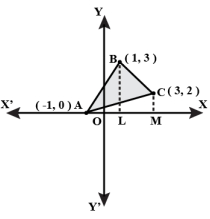
0 likes
View Solution133
MediumMCQ
Using integration,find the area of the triangular region whose sides have the equations $y=2x+1$,$y=3x+1$,and $x=4$.
A
$6 \text{ sq. units}$
B
$8 \text{ sq. units}$
C
$10 \text{ sq. units}$
D
$12 \text{ sq. units}$
Solution
(B) The equations of the sides of the triangle are $y=2x+1$,$y=3x+1$,and $x=4$.
On solving these equations,we obtain the vertices of the triangle as $A(0, 1)$,$B(4, 13)$,and $C(4, 9)$.
It can be observed that the area of the triangular region is the area between the two lines $y=3x+1$ and $y=2x+1$ from $x=0$ to $x=4$.
$\text{Area} = \int_{0}^{4} [(3x+1) - (2x+1)] \, dx$
$= \int_{0}^{4} (3x + 1 - 2x - 1) \, dx$
$= \int_{0}^{4} x \, dx$
$= \left[ \frac{x^2}{2} \right]_{0}^{4}$
$= \frac{16}{2} - 0$
$= 8 \text{ sq. units}$
On solving these equations,we obtain the vertices of the triangle as $A(0, 1)$,$B(4, 13)$,and $C(4, 9)$.
It can be observed that the area of the triangular region is the area between the two lines $y=3x+1$ and $y=2x+1$ from $x=0$ to $x=4$.
$\text{Area} = \int_{0}^{4} [(3x+1) - (2x+1)] \, dx$
$= \int_{0}^{4} (3x + 1 - 2x - 1) \, dx$
$= \int_{0}^{4} x \, dx$
$= \left[ \frac{x^2}{2} \right]_{0}^{4}$
$= \frac{16}{2} - 0$
$= 8 \text{ sq. units}$
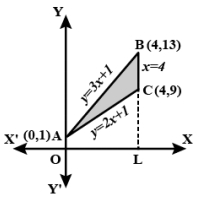
0 likes
View Solution134
MediumMCQ
The smaller area enclosed by the circle $x^{2}+y^{2}=4$ and the line $x+y=2$ is
A
$\pi-2$
B
$2\pi-1$
C
$2(\pi-2)$
D
$2(\pi+2)$
Solution
(A) The circle is $x^{2}+y^{2}=2^{2}$,which has a radius of $2$ and center at $(0,0)$. The line $x+y=2$ passes through $(2,0)$ and $(0,2)$.
The smaller area enclosed by the circle and the line is the area of the circular segment in the first quadrant.
Area $= \int_{0}^{2} (y_{\text{circle}} - y_{\text{line}}) dx$
$= \int_{0}^{2} (\sqrt{4-x^{2}} - (2-x)) dx$
$= \int_{0}^{2} \sqrt{4-x^{2}} dx - \int_{0}^{2} (2-x) dx$
Using the formula $\int \sqrt{a^{2}-x^{2}} dx = \frac{x}{2}\sqrt{a^{2}-x^{2}} + \frac{a^{2}}{2}\sin^{-1}(\frac{x}{a})$:
$= [\frac{x}{2}\sqrt{4-x^{2}} + \frac{4}{2}\sin^{-1}(\frac{x}{2})]_{0}^{2} - [2x - \frac{x^{2}}{2}]_{0}^{2}$
$= [0 + 2\sin^{-1}(1)] - [0 + 2\sin^{-1}(0)] - [(4 - 2) - (0 - 0)]$
$= 2(\frac{\pi}{2}) - 2 = \pi - 2$ sq. units.
Thus,the correct answer is $A$.
The smaller area enclosed by the circle and the line is the area of the circular segment in the first quadrant.
Area $= \int_{0}^{2} (y_{\text{circle}} - y_{\text{line}}) dx$
$= \int_{0}^{2} (\sqrt{4-x^{2}} - (2-x)) dx$
$= \int_{0}^{2} \sqrt{4-x^{2}} dx - \int_{0}^{2} (2-x) dx$
Using the formula $\int \sqrt{a^{2}-x^{2}} dx = \frac{x}{2}\sqrt{a^{2}-x^{2}} + \frac{a^{2}}{2}\sin^{-1}(\frac{x}{a})$:
$= [\frac{x}{2}\sqrt{4-x^{2}} + \frac{4}{2}\sin^{-1}(\frac{x}{2})]_{0}^{2} - [2x - \frac{x^{2}}{2}]_{0}^{2}$
$= [0 + 2\sin^{-1}(1)] - [0 + 2\sin^{-1}(0)] - [(4 - 2) - (0 - 0)]$
$= 2(\frac{\pi}{2}) - 2 = \pi - 2$ sq. units.
Thus,the correct answer is $A$.
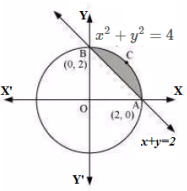
0 likes
View Solution135
MediumMCQ
The area lying between the curves $y^{2}=4x$ and $y=2x$ is
A
$\frac{2}{3}$
B
$\frac{1}{3}$
C
$\frac{1}{4}$
D
$\frac{3}{4}$
Solution
(B) To find the area between the curves $y^{2}=4x$ and $y=2x$,we first find their points of intersection.
Substituting $y=2x$ into $y^{2}=4x$,we get $(2x)^{2}=4x$,which simplifies to $4x^{2}-4x=0$,or $4x(x-1)=0$.
Thus,the points of intersection are $x=0$ and $x=1$.
For $x=0$,$y=0$,and for $x=1$,$y=2$. So the intersection points are $(0,0)$ and $(1,2)$.
The area $A$ is given by the integral of the upper curve minus the lower curve from $x=0$ to $x=1$.
$A = \int_{0}^{1} (\text{upper curve} - \text{lower curve}) dx$
$A = \int_{0}^{1} (\sqrt{4x} - 2x) dx$
$A = \int_{0}^{1} (2\sqrt{x} - 2x) dx$
$A = 2 \left[ \frac{x^{3/2}}{3/2} \right]_{0}^{1} - 2 \left[ \frac{x^{2}}{2} \right]_{0}^{1}$
$A = 2 \left( \frac{2}{3} \right) - 1 = \frac{4}{3} - 1 = \frac{1}{3}$ square units.
Thus,the correct answer is $B$.
Substituting $y=2x$ into $y^{2}=4x$,we get $(2x)^{2}=4x$,which simplifies to $4x^{2}-4x=0$,or $4x(x-1)=0$.
Thus,the points of intersection are $x=0$ and $x=1$.
For $x=0$,$y=0$,and for $x=1$,$y=2$. So the intersection points are $(0,0)$ and $(1,2)$.
The area $A$ is given by the integral of the upper curve minus the lower curve from $x=0$ to $x=1$.
$A = \int_{0}^{1} (\text{upper curve} - \text{lower curve}) dx$
$A = \int_{0}^{1} (\sqrt{4x} - 2x) dx$
$A = \int_{0}^{1} (2\sqrt{x} - 2x) dx$
$A = 2 \left[ \frac{x^{3/2}}{3/2} \right]_{0}^{1} - 2 \left[ \frac{x^{2}}{2} \right]_{0}^{1}$
$A = 2 \left( \frac{2}{3} \right) - 1 = \frac{4}{3} - 1 = \frac{1}{3}$ square units.
Thus,the correct answer is $B$.
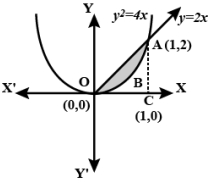
0 likes
View Solution136
DifficultMCQ
Find the area of the parabola $y^{2}=4ax$ bounded by its latus rectum.
A
$\frac{8}{3}a^{2}$
B
$\frac{4}{3}a^{2}$
C
$\frac{2}{3}a^{2}$
D
$\frac{1}{3}a^{2}$
Solution
(A) The vertex of the parabola $y^{2}=4ax$ is at the origin $(0,0)$.
The equation of the latus rectum $LSL^{\prime}$ is $x=a$.
The parabola is symmetrical about the $x$-axis.
The required area of the region $OLL^{\prime}O$ is given by:
Area $= 2 \times (\text{Area of the region } OLSO)$
Area $= 2 \int_{0}^{a} y \, dx = 2 \int_{0}^{a} \sqrt{4ax} \, dx$
Area $= 2 \times 2 \sqrt{a} \int_{0}^{a} \sqrt{x} \, dx$
Area $= 4 \sqrt{a} \left[ \frac{x^{3/2}}{3/2} \right]_{0}^{a}$
Area $= 4 \sqrt{a} \times \frac{2}{3} \left[ x^{3/2} \right]_{0}^{a}$
Area $= \frac{8}{3} \sqrt{a} \times a^{3/2} = \frac{8}{3} a^{2}$ square units.
The equation of the latus rectum $LSL^{\prime}$ is $x=a$.
The parabola is symmetrical about the $x$-axis.
The required area of the region $OLL^{\prime}O$ is given by:
Area $= 2 \times (\text{Area of the region } OLSO)$
Area $= 2 \int_{0}^{a} y \, dx = 2 \int_{0}^{a} \sqrt{4ax} \, dx$
Area $= 2 \times 2 \sqrt{a} \int_{0}^{a} \sqrt{x} \, dx$
Area $= 4 \sqrt{a} \left[ \frac{x^{3/2}}{3/2} \right]_{0}^{a}$
Area $= 4 \sqrt{a} \times \frac{2}{3} \left[ x^{3/2} \right]_{0}^{a}$
Area $= \frac{8}{3} \sqrt{a} \times a^{3/2} = \frac{8}{3} a^{2}$ square units.
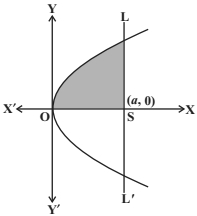
0 likes
View Solution137
MediumMCQ
Find the area of the region bounded by the line $y=3x+2$,the $x$-axis,and the ordinates $x=-1$ and $x=1$.
A
$13/3$
B
$13/6$
C
$25/6$
D
$1/6$
Solution
(A) As shown in the figure,the line $y=3x+2$ meets the $x$-axis at $x=-2/3$. The graph lies below the $x$-axis for $x \in (-1, -2/3)$ and above the $x$-axis for $x \in (-2/3, 1)$.
The required area is given by:
$\text{Area} = \left| \int_{-1}^{-2/3} (3x+2) dx \right| + \int_{-2/3}^{1} (3x+2) dx$
First,evaluate the integral $\int (3x+2) dx = \frac{3x^2}{2} + 2x$.
For the first part:
$\left| \left[ \frac{3x^2}{2} + 2x \right]_{-1}^{-2/3} \right| = \left| \left( \frac{3(-2/3)^2}{2} + 2(-2/3) \right) - \left( \frac{3(-1)^2}{2} + 2(-1) \right) \right|$
$= \left| \left( \frac{3(4/9)}{2} - 4/3 \right) - \left( 3/2 - 2 \right) \right| = \left| (2/3 - 4/3) - (-1/2) \right| = \left| -2/3 + 1/2 \right| = \left| -1/6 \right| = 1/6$.
For the second part:
$\left[ \frac{3x^2}{2} + 2x \right]_{-2/3}^{1} = \left( \frac{3(1)^2}{2} + 2(1) \right) - \left( \frac{3(-2/3)^2}{2} + 2(-2/3) \right)$
$= (3/2 + 2) - (-1/6) = 7/2 + 1/6 = 21/6 + 1/6 = 22/6 = 11/3$.
Total Area $= 1/6 + 11/3 = 1/6 + 22/6 = 23/6$. Wait,let's re-calculate: $1/6 + 22/6 = 23/6$. Let's re-check the integral: $\int_{-2/3}^{1} (3x+2) dx = [3/2 + 2] - [2/3 - 4/3] = 7/2 - (-2/3) = 7/2 + 2/3 = 21/6 + 4/6 = 25/6$.
Total Area $= 1/6 + 25/6 = 26/6 = 13/3$.
The required area is given by:
$\text{Area} = \left| \int_{-1}^{-2/3} (3x+2) dx \right| + \int_{-2/3}^{1} (3x+2) dx$
First,evaluate the integral $\int (3x+2) dx = \frac{3x^2}{2} + 2x$.
For the first part:
$\left| \left[ \frac{3x^2}{2} + 2x \right]_{-1}^{-2/3} \right| = \left| \left( \frac{3(-2/3)^2}{2} + 2(-2/3) \right) - \left( \frac{3(-1)^2}{2} + 2(-1) \right) \right|$
$= \left| \left( \frac{3(4/9)}{2} - 4/3 \right) - \left( 3/2 - 2 \right) \right| = \left| (2/3 - 4/3) - (-1/2) \right| = \left| -2/3 + 1/2 \right| = \left| -1/6 \right| = 1/6$.
For the second part:
$\left[ \frac{3x^2}{2} + 2x \right]_{-2/3}^{1} = \left( \frac{3(1)^2}{2} + 2(1) \right) - \left( \frac{3(-2/3)^2}{2} + 2(-2/3) \right)$
$= (3/2 + 2) - (-1/6) = 7/2 + 1/6 = 21/6 + 1/6 = 22/6 = 11/3$.
Total Area $= 1/6 + 11/3 = 1/6 + 22/6 = 23/6$. Wait,let's re-calculate: $1/6 + 22/6 = 23/6$. Let's re-check the integral: $\int_{-2/3}^{1} (3x+2) dx = [3/2 + 2] - [2/3 - 4/3] = 7/2 - (-2/3) = 7/2 + 2/3 = 21/6 + 4/6 = 25/6$.
Total Area $= 1/6 + 25/6 = 26/6 = 13/3$.
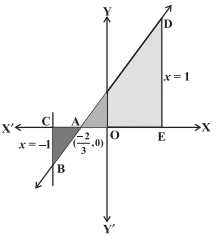
0 likes
View Solution138
MediumMCQ
Find the area bounded by the curve $y=\cos x$ between $x=0$ and $x=2 \pi$.
A
$4$
B
$3$
C
$2$
D
$1$
Solution
(A) The area bounded by the curve $y=\cos x$ between $x=0$ and $x=2 \pi$ is given by the integral of the absolute value of the function.
Required Area $= \int_{0}^{2 \pi} |\cos x| \, dx$
From the graph,the curve is above the $x$-axis from $x=0$ to $x=\frac{\pi}{2}$,below the $x$-axis from $x=\frac{\pi}{2}$ to $x=\frac{3 \pi}{2}$,and above the $x$-axis from $x=\frac{3 \pi}{2}$ to $x=2 \pi$.
Thus,the area is:
$= \int_{0}^{\frac{\pi}{2}} \cos x \, dx + \left| \int_{\frac{\pi}{2}}^{\frac{3 \pi}{2}} \cos x \, dx \right| + \int_{\frac{3 \pi}{2}}^{2 \pi} \cos x \, dx$
$= [\sin x]_{0}^{\frac{\pi}{2}} + \left| [\sin x]_{\frac{\pi}{2}}^{\frac{3 \pi}{2}} \right| + [\sin x]_{\frac{3 \pi}{2}}^{2 \pi}$
$= (\sin \frac{\pi}{2} - \sin 0) + |(\sin \frac{3 \pi}{2} - \sin \frac{\pi}{2})| + (\sin 2 \pi - \sin \frac{3 \pi}{2})$
$= (1 - 0) + |(-1 - 1)| + (0 - (-1))$
$= 1 + |-2| + 1 = 1 + 2 + 1 = 4$ square units.
Required Area $= \int_{0}^{2 \pi} |\cos x| \, dx$
From the graph,the curve is above the $x$-axis from $x=0$ to $x=\frac{\pi}{2}$,below the $x$-axis from $x=\frac{\pi}{2}$ to $x=\frac{3 \pi}{2}$,and above the $x$-axis from $x=\frac{3 \pi}{2}$ to $x=2 \pi$.
Thus,the area is:
$= \int_{0}^{\frac{\pi}{2}} \cos x \, dx + \left| \int_{\frac{\pi}{2}}^{\frac{3 \pi}{2}} \cos x \, dx \right| + \int_{\frac{3 \pi}{2}}^{2 \pi} \cos x \, dx$
$= [\sin x]_{0}^{\frac{\pi}{2}} + \left| [\sin x]_{\frac{\pi}{2}}^{\frac{3 \pi}{2}} \right| + [\sin x]_{\frac{3 \pi}{2}}^{2 \pi}$
$= (\sin \frac{\pi}{2} - \sin 0) + |(\sin \frac{3 \pi}{2} - \sin \frac{\pi}{2})| + (\sin 2 \pi - \sin \frac{3 \pi}{2})$
$= (1 - 0) + |(-1 - 1)| + (0 - (-1))$
$= 1 + |-2| + 1 = 1 + 2 + 1 = 4$ square units.
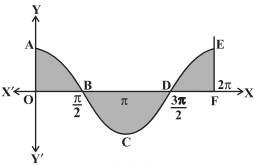
1 likes
View Solution139
Difficult
Prove that the curves $y^{2}=4x$ and $x^{2}=4y$ divide the area of the square bounded by $x=0, x=4, y=4$ and $y=0$ into three equal parts.
Solution
(N/A) The points of intersection of the parabolas $y^{2}=4x$ and $x^{2}=4y$ are found by substituting $y = \frac{x^{2}}{4}$ into $y^{2}=4x$,which gives $(\frac{x^{2}}{4})^{2} = 4x$,so $x^{4} = 64x$. This implies $x(x^{3}-64) = 0$,so $x=0$ or $x=4$. Thus,the intersection points are $(0,0)$ and $(4,4)$.
$1$. The area of the region bounded by the curves $y^{2}=4x$ and $x^{2}=4y$ is:
$\int_{0}^{4} (2\sqrt{x} - \frac{x^{2}}{4}) dx = [2 \times \frac{2}{3} x^{\frac{3}{2}} - \frac{x^{3}}{12}]_{0}^{4} = \frac{32}{3} - \frac{16}{3} = \frac{16}{3}$ square units.
$2$. The area of the region bounded by the curve $x^{2}=4y$,the $x$-axis,and the lines $x=0$ and $x=4$ is:
$\int_{0}^{4} \frac{x^{2}}{4} dx = \frac{1}{12} [x^{3}]_{0}^{4} = \frac{64}{12} = \frac{16}{3}$ square units.
$3$. The area of the region bounded by the curve $y^{2}=4x$,the $y$-axis,and the lines $y=0$ and $y=4$ is:
$\int_{0}^{4} \frac{y^{2}}{4} dy = \frac{1}{12} [y^{3}]_{0}^{4} = \frac{64}{12} = \frac{16}{3}$ square units.
Since the total area of the square is $4 \times 4 = 16$ square units and each of the three regions has an area of $\frac{16}{3}$ square units,the curves divide the square into three equal parts.
$1$. The area of the region bounded by the curves $y^{2}=4x$ and $x^{2}=4y$ is:
$\int_{0}^{4} (2\sqrt{x} - \frac{x^{2}}{4}) dx = [2 \times \frac{2}{3} x^{\frac{3}{2}} - \frac{x^{3}}{12}]_{0}^{4} = \frac{32}{3} - \frac{16}{3} = \frac{16}{3}$ square units.
$2$. The area of the region bounded by the curve $x^{2}=4y$,the $x$-axis,and the lines $x=0$ and $x=4$ is:
$\int_{0}^{4} \frac{x^{2}}{4} dx = \frac{1}{12} [x^{3}]_{0}^{4} = \frac{64}{12} = \frac{16}{3}$ square units.
$3$. The area of the region bounded by the curve $y^{2}=4x$,the $y$-axis,and the lines $y=0$ and $y=4$ is:
$\int_{0}^{4} \frac{y^{2}}{4} dy = \frac{1}{12} [y^{3}]_{0}^{4} = \frac{64}{12} = \frac{16}{3}$ square units.
Since the total area of the square is $4 \times 4 = 16$ square units and each of the three regions has an area of $\frac{16}{3}$ square units,the curves divide the square into three equal parts.
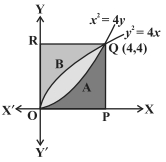
0 likes
View Solution140
DifficultMCQ
Find the area of the region $\{(x, y): 0 \leq y \leq x^{2}+1, 0 \leq y \leq x+1, 0 \leq x \leq 2\}$.
A
$\frac{23}{6}$
B
$\frac{13}{6}$
C
$\frac{19}{6}$
D
$\frac{25}{6}$
Solution
(A) The region is defined by the intersection of $y \leq x^2 + 1$,$y \leq x + 1$,and $0 \leq x \leq 2$.
First,find the intersection points of the curves $y = x^2 + 1$ and $y = x + 1$:
$x^2 + 1 = x + 1 \implies x^2 - x = 0 \implies x(x - 1) = 0$.
So,the curves intersect at $x = 0$ and $x = 1$.
For $0 \leq x \leq 1$,the region is bounded by $y \leq x + 1$ (since $x+1 \geq x^2+1$ in this interval).
For $1 \leq x \leq 2$,the region is bounded by $y \leq x^2 + 1$ (since $x^2+1 \geq x+1$ in this interval).
Wait,looking at the graph provided,the region is bounded by the lower of the two curves at any point $x$.
For $0 \leq x \leq 1$,the lower curve is $y = x^2 + 1$.
For $1 \leq x \leq 2$,the lower curve is $y = x + 1$.
Area $= \int_{0}^{1} (x^2 + 1) dx + \int_{1}^{2} (x + 1) dx$.
$= [\frac{x^3}{3} + x]_{0}^{1} + [\frac{x^2}{2} + x]_{1}^{2}$.
$= (\frac{1}{3} + 1) - 0 + ((\frac{4}{2} + 2) - (\frac{1}{2} + 1))$.
$= \frac{4}{3} + (4 - \frac{3}{2}) = \frac{4}{3} + \frac{5}{2} = \frac{8 + 15}{6} = \frac{23}{6}$.
First,find the intersection points of the curves $y = x^2 + 1$ and $y = x + 1$:
$x^2 + 1 = x + 1 \implies x^2 - x = 0 \implies x(x - 1) = 0$.
So,the curves intersect at $x = 0$ and $x = 1$.
For $0 \leq x \leq 1$,the region is bounded by $y \leq x + 1$ (since $x+1 \geq x^2+1$ in this interval).
For $1 \leq x \leq 2$,the region is bounded by $y \leq x^2 + 1$ (since $x^2+1 \geq x+1$ in this interval).
Wait,looking at the graph provided,the region is bounded by the lower of the two curves at any point $x$.
For $0 \leq x \leq 1$,the lower curve is $y = x^2 + 1$.
For $1 \leq x \leq 2$,the lower curve is $y = x + 1$.
Area $= \int_{0}^{1} (x^2 + 1) dx + \int_{1}^{2} (x + 1) dx$.
$= [\frac{x^3}{3} + x]_{0}^{1} + [\frac{x^2}{2} + x]_{1}^{2}$.
$= (\frac{1}{3} + 1) - 0 + ((\frac{4}{2} + 2) - (\frac{1}{2} + 1))$.
$= \frac{4}{3} + (4 - \frac{3}{2}) = \frac{4}{3} + \frac{5}{2} = \frac{8 + 15}{6} = \frac{23}{6}$.
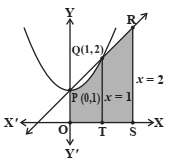
0 likes
View Solution141
MediumMCQ
Find the area under the given curve $y=x^{2}$ bounded by the lines $x=1$,$x=2$ and the $x$-axis.
A
$\frac{7}{3}$ sq. units
B
$\frac{8}{3}$ sq. units
C
$\frac{5}{3}$ sq. units
D
$\frac{4}{3}$ sq. units
Solution
(A) The required area is represented by the shaded region bounded by the curve $y=x^{2}$,the lines $x=1$,$x=2$,and the $x$-axis.
The area is given by the definite integral:
$\text{Area} = \int_{1}^{2} y \, dx$
Substituting $y = x^{2}$:
$\text{Area} = \int_{1}^{2} x^{2} \, dx$
Evaluating the integral:
$\text{Area} = \left[ \frac{x^{3}}{3} \right]_{1}^{2}$
Applying the limits:
$\text{Area} = \left( \frac{2^{3}}{3} \right) - \left( \frac{1^{3}}{3} \right)$
$\text{Area} = \frac{8}{3} - \frac{1}{3}$
$\text{Area} = \frac{7}{3} \text{ sq. units}$
The area is given by the definite integral:
$\text{Area} = \int_{1}^{2} y \, dx$
Substituting $y = x^{2}$:
$\text{Area} = \int_{1}^{2} x^{2} \, dx$
Evaluating the integral:
$\text{Area} = \left[ \frac{x^{3}}{3} \right]_{1}^{2}$
Applying the limits:
$\text{Area} = \left( \frac{2^{3}}{3} \right) - \left( \frac{1^{3}}{3} \right)$
$\text{Area} = \frac{8}{3} - \frac{1}{3}$
$\text{Area} = \frac{7}{3} \text{ sq. units}$
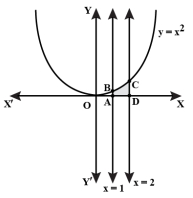
0 likes
View Solution142
MediumMCQ
Find the area under the curve $y=x^{4}$ bounded by the lines $x=1$,$x=5$ and the $x$-axis.
A
$624.8 \text{ sq. units}$
B
$625.8 \text{ sq. units}$
C
$626.8 \text{ sq. units}$
D
$623.8 \text{ sq. units}$
Solution
(A) The required area is given by the definite integral of the function $y=x^{4}$ from $x=1$ to $x=5$.
$\text{Area} = \int_{1}^{5} x^{4} \, dx$
$= \left[ \frac{x^{5}}{5} \right]_{1}^{5}$
$= \frac{(5)^{5}}{5} - \frac{(1)^{5}}{5}$
$= \frac{3125}{5} - \frac{1}{5}$
$= 625 - 0.2$
$= 624.8 \text{ sq. units}$
$\text{Area} = \int_{1}^{5} x^{4} \, dx$
$= \left[ \frac{x^{5}}{5} \right]_{1}^{5}$
$= \frac{(5)^{5}}{5} - \frac{(1)^{5}}{5}$
$= \frac{3125}{5} - \frac{1}{5}$
$= 625 - 0.2$
$= 624.8 \text{ sq. units}$
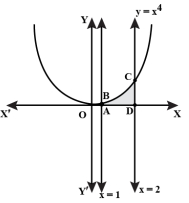
0 likes
View Solution143
MediumMCQ
Find the area of the region lying in the first quadrant and bounded by $y=4x^2$,$x=0$,$y=1$,and $y=4$.
A
$\frac{7}{3}$ sq. units
B
$\frac{8}{3}$ sq. units
C
$\frac{5}{3}$ sq. units
D
$\frac{4}{3}$ sq. units
Solution
(A) The area in the first quadrant bounded by $y=4x^2$,$x=0$,$y=1$,and $y=4$ is calculated by integrating with respect to $y$.
Given $y=4x^2$,we have $x^2 = \frac{y}{4}$,which implies $x = \frac{\sqrt{y}}{2}$ (since $x \ge 0$ in the first quadrant).
The area $A$ is given by the integral:
$A = \int_{1}^{4} x \, dy$
$A = \int_{1}^{4} \frac{\sqrt{y}}{2} \, dy$
$A = \frac{1}{2} \int_{1}^{4} y^{1/2} \, dy$
$A = \frac{1}{2} \left[ \frac{y^{3/2}}{3/2} \right]_{1}^{4}$
$A = \frac{1}{2} \cdot \frac{2}{3} \left[ y^{3/2} \right]_{1}^{4}$
$A = \frac{1}{3} [4^{3/2} - 1^{3/2}]$
$A = \frac{1}{3} [8 - 1]$
$A = \frac{7}{3} \text{ sq. units}$.
Given $y=4x^2$,we have $x^2 = \frac{y}{4}$,which implies $x = \frac{\sqrt{y}}{2}$ (since $x \ge 0$ in the first quadrant).
The area $A$ is given by the integral:
$A = \int_{1}^{4} x \, dy$
$A = \int_{1}^{4} \frac{\sqrt{y}}{2} \, dy$
$A = \frac{1}{2} \int_{1}^{4} y^{1/2} \, dy$
$A = \frac{1}{2} \left[ \frac{y^{3/2}}{3/2} \right]_{1}^{4}$
$A = \frac{1}{2} \cdot \frac{2}{3} \left[ y^{3/2} \right]_{1}^{4}$
$A = \frac{1}{3} [4^{3/2} - 1^{3/2}]$
$A = \frac{1}{3} [8 - 1]$
$A = \frac{7}{3} \text{ sq. units}$.
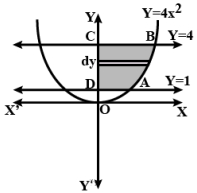
0 likes
View Solution144
DifficultMCQ
Sketch the graph of $y=|x+3|$ and evaluate $\int_{-6}^{0}|x+3| d x$.
A
$9$
B
$6$
C
$12$
D
$3$
Solution
(A) The given equation is $y=|x+3|$.
The corresponding values of $x$ and $y$ are given in the following table:
On plotting these points,we obtain the graph of $y=|x+3|$.
It is known that $(x+3) \leq 0$ for $-6 \leq x \leq -3$ and $(x+3) \geq 0$ for $-3 \leq x \leq 0$.
Therefore,$\int_{-6}^{0}|x+3| d x = \int_{-6}^{-3}-(x+3) d x + \int_{-3}^{0}(x+3) d x$.
$= -\left[\frac{x^2}{2} + 3x\right]_{-6}^{-3} + \left[\frac{x^2}{2} + 3x\right]_{-3}^{0}$.
$= -\left[\left(\frac{9}{2} - 9\right) - \left(\frac{36}{2} - 18\right)\right] + \left[(0) - \left(\frac{9}{2} - 9\right)\right]$.
$= -\left[-\frac{9}{2} - 0\right] + \left[0 - (-\frac{9}{2})\right]$.
$= \frac{9}{2} + \frac{9}{2} = 9$.
The corresponding values of $x$ and $y$ are given in the following table:
| $X$ | $-6$ | $-5$ | $-4$ | $-3$ | $-2$ | $-1$ | $0$ |
| $Y$ | $3$ | $2$ | $1$ | $0$ | $1$ | $2$ | $3$ |
On plotting these points,we obtain the graph of $y=|x+3|$.
It is known that $(x+3) \leq 0$ for $-6 \leq x \leq -3$ and $(x+3) \geq 0$ for $-3 \leq x \leq 0$.
Therefore,$\int_{-6}^{0}|x+3| d x = \int_{-6}^{-3}-(x+3) d x + \int_{-3}^{0}(x+3) d x$.
$= -\left[\frac{x^2}{2} + 3x\right]_{-6}^{-3} + \left[\frac{x^2}{2} + 3x\right]_{-3}^{0}$.
$= -\left[\left(\frac{9}{2} - 9\right) - \left(\frac{36}{2} - 18\right)\right] + \left[(0) - \left(\frac{9}{2} - 9\right)\right]$.
$= -\left[-\frac{9}{2} - 0\right] + \left[0 - (-\frac{9}{2})\right]$.
$= \frac{9}{2} + \frac{9}{2} = 9$.
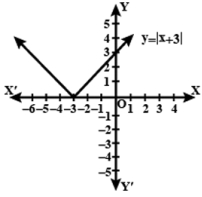
0 likes
View Solution145
DifficultMCQ
Find the area bounded by the curve $y=\sin x$ between $x=0$ and $x=2 \pi$.
A
$2 \text{ sq. units}$
B
$4 \text{ sq. units}$
C
$1 \text{ sq. units}$
D
$0 \text{ sq. units}$
Solution
(B) The graph of $y=\sin x$ is shown in the figure. The area bounded by the curve between $x=0$ and $x=2 \pi$ is given by the sum of the areas of the two loops.
$\text{Required Area} = \int_{0}^{\pi} \sin x \, dx + \left| \int_{\pi}^{2 \pi} \sin x \, dx \right|$
$= [-\cos x]_{0}^{\pi} + \left| [-\cos x]_{\pi}^{2 \pi} \right|$
$= (-\cos \pi - (-\cos 0)) + |(-\cos 2 \pi - (-\cos \pi))|$
$= (-(-1) + 1) + |(-1 - (1))|$
$= (1 + 1) + |-2|$
$= 2 + 2 = 4 \text{ sq. units}$.
$\text{Required Area} = \int_{0}^{\pi} \sin x \, dx + \left| \int_{\pi}^{2 \pi} \sin x \, dx \right|$
$= [-\cos x]_{0}^{\pi} + \left| [-\cos x]_{\pi}^{2 \pi} \right|$
$= (-\cos \pi - (-\cos 0)) + |(-\cos 2 \pi - (-\cos \pi))|$
$= (-(-1) + 1) + |(-1 - (1))|$
$= (1 + 1) + |-2|$
$= 2 + 2 = 4 \text{ sq. units}$.
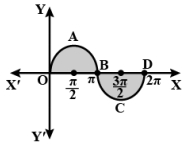
0 likes
View Solution146
DifficultMCQ
Find the area enclosed between the parabola $y^{2}=4ax$ and the line $y=mx$.
A
$\frac{8a^{2}}{3m^{3}}$
B
$\frac{4a^{2}}{3m^{3}}$
C
$\frac{2a^{2}}{3m^{3}}$
D
$\frac{a^{2}}{3m^{3}}$
Solution
(A) The area enclosed between the parabola $y^{2}=4ax$ and the line $y=mx$ is found by determining the points of intersection.
Substituting $y=mx$ into $y^{2}=4ax$,we get:
$(mx)^{2}=4ax \implies m^{2}x^{2}-4ax=0 \implies x(m^{2}x-4a)=0$.
Thus,the points of intersection are $x=0$ and $x=\frac{4a}{m^{2}}$.
The area $A$ is given by the integral of the difference between the upper curve (parabola) and the lower curve (line) from $x=0$ to $x=\frac{4a}{m^{2}}$:
$A = \int_{0}^{\frac{4a}{m^{2}}} (\sqrt{4ax} - mx) dx$
$A = 2\sqrt{a} \int_{0}^{\frac{4a}{m^{2}}} x^{1/2} dx - m \int_{0}^{\frac{4a}{m^{2}}} x dx$
$A = 2\sqrt{a} \left[ \frac{x^{3/2}}{3/2} \right]_{0}^{\frac{4a}{m^{2}}} - m \left[ \frac{x^{2}}{2} \right]_{0}^{\frac{4a}{m^{2}}}$
$A = \frac{4\sqrt{a}}{3} \left( \frac{4a}{m^{2}} \right)^{3/2} - \frac{m}{2} \left( \frac{4a}{m^{2}} \right)^{2}$
$A = \frac{4\sqrt{a}}{3} \cdot \frac{8a^{3/2}}{m^{3}} - \frac{m}{2} \cdot \frac{16a^{2}}{m^{4}}$
$A = \frac{32a^{2}}{3m^{3}} - \frac{8a^{2}}{m^{3}} = \frac{32a^{2} - 24a^{2}}{3m^{3}} = \frac{8a^{2}}{3m^{3}}$ sq. units.
Substituting $y=mx$ into $y^{2}=4ax$,we get:
$(mx)^{2}=4ax \implies m^{2}x^{2}-4ax=0 \implies x(m^{2}x-4a)=0$.
Thus,the points of intersection are $x=0$ and $x=\frac{4a}{m^{2}}$.
The area $A$ is given by the integral of the difference between the upper curve (parabola) and the lower curve (line) from $x=0$ to $x=\frac{4a}{m^{2}}$:
$A = \int_{0}^{\frac{4a}{m^{2}}} (\sqrt{4ax} - mx) dx$
$A = 2\sqrt{a} \int_{0}^{\frac{4a}{m^{2}}} x^{1/2} dx - m \int_{0}^{\frac{4a}{m^{2}}} x dx$
$A = 2\sqrt{a} \left[ \frac{x^{3/2}}{3/2} \right]_{0}^{\frac{4a}{m^{2}}} - m \left[ \frac{x^{2}}{2} \right]_{0}^{\frac{4a}{m^{2}}}$
$A = \frac{4\sqrt{a}}{3} \left( \frac{4a}{m^{2}} \right)^{3/2} - \frac{m}{2} \left( \frac{4a}{m^{2}} \right)^{2}$
$A = \frac{4\sqrt{a}}{3} \cdot \frac{8a^{3/2}}{m^{3}} - \frac{m}{2} \cdot \frac{16a^{2}}{m^{4}}$
$A = \frac{32a^{2}}{3m^{3}} - \frac{8a^{2}}{m^{3}} = \frac{32a^{2} - 24a^{2}}{3m^{3}} = \frac{8a^{2}}{3m^{3}}$ sq. units.
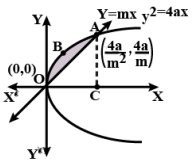
0 likes
View Solution147
DifficultMCQ
Find the area of the smaller region bounded by the ellipse $\frac{x^{2}}{9}+\frac{y^{2}}{4}=1$ and the line $\frac{x}{3}+\frac{y}{2}=1$.
A
$\frac{3}{2}(\pi-2)$ sq. units
B
$\frac{3}{4}(\pi-2)$ sq. units
C
$\frac{2}{3}(\pi-2)$ sq. units
D
$\frac{1}{2}(\pi-2)$ sq. units
Solution
(A) The area of the smaller region bounded by the ellipse $\frac{x^{2}}{9}+\frac{y^{2}}{4}=1$ and the line $\frac{x}{3}+\frac{y}{2}=1$ is the area of the region $ABC$ shown in the figure.
The points of intersection are $A(0, 2)$ and $B(3, 0)$.
Area of the region $ABC = \int_{0}^{3} (y_{\text{ellipse}} - y_{\text{line}}) dx$
From the ellipse equation,$y = 2\sqrt{1-\frac{x^{2}}{9}} = \frac{2}{3}\sqrt{9-x^{2}}$.
From the line equation,$y = 2(1-\frac{x}{3}) = 2 - \frac{2x}{3}$.
Area $= \int_{0}^{3} \left( \frac{2}{3}\sqrt{9-x^{2}} - (2 - \frac{2x}{3}) \right) dx$
$= \frac{2}{3} \int_{0}^{3} \sqrt{3^{2}-x^{2}} dx - \int_{0}^{3} (2 - \frac{2x}{3}) dx$
$= \frac{2}{3} \left[ \frac{x}{2}\sqrt{9-x^{2}} + \frac{9}{2}\sin^{-1}(\frac{x}{3}) \right]_{0}^{3} - \left[ 2x - \frac{x^{2}}{3} \right]_{0}^{3}$
$= \frac{2}{3} \left[ (0 + \frac{9}{2} \cdot \frac{\pi}{2}) - 0 \right] - \left[ (6 - 3) - 0 \right]$
$= \frac{2}{3} \cdot \frac{9\pi}{4} - 3 = \frac{3\pi}{2} - 3 = \frac{3}{2}(\pi-2)$ sq. units.
The points of intersection are $A(0, 2)$ and $B(3, 0)$.
Area of the region $ABC = \int_{0}^{3} (y_{\text{ellipse}} - y_{\text{line}}) dx$
From the ellipse equation,$y = 2\sqrt{1-\frac{x^{2}}{9}} = \frac{2}{3}\sqrt{9-x^{2}}$.
From the line equation,$y = 2(1-\frac{x}{3}) = 2 - \frac{2x}{3}$.
Area $= \int_{0}^{3} \left( \frac{2}{3}\sqrt{9-x^{2}} - (2 - \frac{2x}{3}) \right) dx$
$= \frac{2}{3} \int_{0}^{3} \sqrt{3^{2}-x^{2}} dx - \int_{0}^{3} (2 - \frac{2x}{3}) dx$
$= \frac{2}{3} \left[ \frac{x}{2}\sqrt{9-x^{2}} + \frac{9}{2}\sin^{-1}(\frac{x}{3}) \right]_{0}^{3} - \left[ 2x - \frac{x^{2}}{3} \right]_{0}^{3}$
$= \frac{2}{3} \left[ (0 + \frac{9}{2} \cdot \frac{\pi}{2}) - 0 \right] - \left[ (6 - 3) - 0 \right]$
$= \frac{2}{3} \cdot \frac{9\pi}{4} - 3 = \frac{3\pi}{2} - 3 = \frac{3}{2}(\pi-2)$ sq. units.
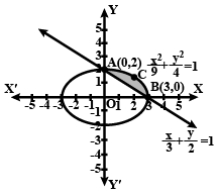
0 likes
View Solution148
DifficultMCQ
Find the area of the smaller region bounded by the ellipse $\frac{x^{2}}{a^{2}}+\frac{y^{2}}{b^{2}}=1$ and the line $\frac{x}{a}+\frac{y}{b}=1$.
A
$\frac{ab}{4}(\pi-2)$
B
$\frac{ab}{2}(\pi-2)$
C
$\frac{ab}{4}(\pi+2)$
D
$\frac{ab}{2}(\pi+2)$
Solution
(A) The area of the smaller region bounded by the ellipse,$\frac{x^{2}}{a^{2}}+\frac{y^{2}}{b^{2}}=1,$ and the line,$\frac{x}{a}+\frac{y}{b}=1,$ is represented by the shaded region $BCAB$ as:
Area $BCAB = \text{Area}(OBCAO) - \text{Area}(OBAO)$
$= \int_{0}^{a} b \sqrt{1-\frac{x^{2}}{a^{2}}} \, dx - \int_{0}^{a} b\left(1-\frac{x}{a}\right) \, dx$
$= \frac{b}{a} \int_{0}^{a} \sqrt{a^{2}-x^{2}} \, dx - \frac{b}{a} \int_{0}^{a}(a-x) \, dx$
$= \frac{b}{a} \left[ \left\{ \frac{x}{2} \sqrt{a^{2}-x^{2}} + \frac{a^{2}}{2} \sin^{-1} \frac{x}{a} \right\}_{0}^{a} - \left\{ ax - \frac{x^{2}}{2} \right\}_{0}^{a} \right]$
$= \frac{b}{a} \left[ \left\{ \frac{a^{2}}{2} \left(\frac{\pi}{2}\right) \right\} - \left\{ a^{2} - \frac{a^{2}}{2} \right\} \right]$
$= \frac{b}{a} \left[ \frac{a^{2}\pi}{4} - \frac{a^{2}}{2} \right]$
$= \frac{ba^{2}}{2a} \left[ \frac{\pi}{2} - 1 \right]$
$= \frac{ab}{2} \left[ \frac{\pi-2}{2} \right] = \frac{ab}{4}(\pi-2) \text{ sq. units.}$
Area $BCAB = \text{Area}(OBCAO) - \text{Area}(OBAO)$
$= \int_{0}^{a} b \sqrt{1-\frac{x^{2}}{a^{2}}} \, dx - \int_{0}^{a} b\left(1-\frac{x}{a}\right) \, dx$
$= \frac{b}{a} \int_{0}^{a} \sqrt{a^{2}-x^{2}} \, dx - \frac{b}{a} \int_{0}^{a}(a-x) \, dx$
$= \frac{b}{a} \left[ \left\{ \frac{x}{2} \sqrt{a^{2}-x^{2}} + \frac{a^{2}}{2} \sin^{-1} \frac{x}{a} \right\}_{0}^{a} - \left\{ ax - \frac{x^{2}}{2} \right\}_{0}^{a} \right]$
$= \frac{b}{a} \left[ \left\{ \frac{a^{2}}{2} \left(\frac{\pi}{2}\right) \right\} - \left\{ a^{2} - \frac{a^{2}}{2} \right\} \right]$
$= \frac{b}{a} \left[ \frac{a^{2}\pi}{4} - \frac{a^{2}}{2} \right]$
$= \frac{ba^{2}}{2a} \left[ \frac{\pi}{2} - 1 \right]$
$= \frac{ab}{2} \left[ \frac{\pi-2}{2} \right] = \frac{ab}{4}(\pi-2) \text{ sq. units.}$
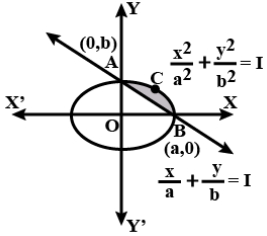
0 likes
View Solution149
DifficultMCQ
Find the area of the region enclosed by the parabola $x^{2}=y,$ the line $y=x+2$ and the $x-$ axis.
A
$5/6$
B
$7/6$
C
$9/6$
D
$11/6$
Solution
(A) The area of the region enclosed by the parabola $x^{2}=y,$ the line $y=x+2,$ and the $x-$ axis is the shaded region shown in the figure.
The line $y=x+2$ intersects the $x-$ axis at $x=-2$ (where $y=0$).
The parabola $x^{2}=y$ and the line $y=x+2$ intersect where $x^{2}=x+2.$
$x^{2}-x-2=0 \Rightarrow (x-2)(x+1)=0.$
Since the region is in the second quadrant,we take the intersection point $x=-1.$
The required area is the sum of the area under the line from $x=-2$ to $x=-1$ and the area under the parabola from $x=-1$ to $x=0$ (or simply the area under the line from $x=-2$ to $x=-1$ plus the area under the parabola from $x=-1$ to $x=0$ is not correct; looking at the figure,it is the area under the line from $x=-2$ to $x=-1$ plus the area under the parabola from $x=-1$ to $x=0$ is actually the area bounded by the line and the $x-$ axis from $x=-2$ to $x=-1$ plus the area bounded by the parabola and the $x-$ axis from $x=-1$ to $x=0$).
Area $= \int_{-2}^{-1} (x+2) dx + \int_{-1}^{0} x^{2} dx$
$= \left[ \frac{x^{2}}{2} + 2x \right]_{-2}^{-1} + \left[ \frac{x^{3}}{3} \right]_{-1}^{0}$
$= \left( (\frac{1}{2} - 2) - (\frac{4}{2} - 4) \right) + (0 - (-\frac{1}{3}))$
$= (-\frac{3}{2} - (-2)) + \frac{1}{3}$
$= \frac{1}{2} + \frac{1}{3} = \frac{5}{6} \text{ sq. units.}$
The line $y=x+2$ intersects the $x-$ axis at $x=-2$ (where $y=0$).
The parabola $x^{2}=y$ and the line $y=x+2$ intersect where $x^{2}=x+2.$
$x^{2}-x-2=0 \Rightarrow (x-2)(x+1)=0.$
Since the region is in the second quadrant,we take the intersection point $x=-1.$
The required area is the sum of the area under the line from $x=-2$ to $x=-1$ and the area under the parabola from $x=-1$ to $x=0$ (or simply the area under the line from $x=-2$ to $x=-1$ plus the area under the parabola from $x=-1$ to $x=0$ is not correct; looking at the figure,it is the area under the line from $x=-2$ to $x=-1$ plus the area under the parabola from $x=-1$ to $x=0$ is actually the area bounded by the line and the $x-$ axis from $x=-2$ to $x=-1$ plus the area bounded by the parabola and the $x-$ axis from $x=-1$ to $x=0$).
Area $= \int_{-2}^{-1} (x+2) dx + \int_{-1}^{0} x^{2} dx$
$= \left[ \frac{x^{2}}{2} + 2x \right]_{-2}^{-1} + \left[ \frac{x^{3}}{3} \right]_{-1}^{0}$
$= \left( (\frac{1}{2} - 2) - (\frac{4}{2} - 4) \right) + (0 - (-\frac{1}{3}))$
$= (-\frac{3}{2} - (-2)) + \frac{1}{3}$
$= \frac{1}{2} + \frac{1}{3} = \frac{5}{6} \text{ sq. units.}$
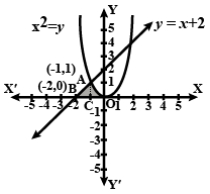
0 likes
View Solution150
DifficultMCQ
Using the method of integration,find the area bounded by the curve $|x|+|y|=1$.
A
$2 \text{ sq. units}$
B
$1 \text{ sq. unit}$
C
$4 \text{ sq. units}$
D
$0.5 \text{ sq. units}$
Solution
(A) The curve $|x|+|y|=1$ represents a square with vertices at $A(0,1)$,$B(1,0)$,$C(0,-1)$,and $D(-1,0)$.
The curve is symmetric about both the $x$-axis and the $y$-axis.
Therefore,the total area is $4$ times the area of the region in the first quadrant $(OBA)$.
In the first quadrant,$x \ge 0$ and $y \ge 0$,so the equation becomes $x+y=1$,or $y=1-x$.
$\text{Area} = 4 \int_{0}^{1} y \, dx = 4 \int_{0}^{1} (1-x) \, dx$
$= 4 \left[ x - \frac{x^2}{2} \right]_{0}^{1}$
$= 4 \left( (1 - \frac{1}{2}) - (0 - 0) \right)$
$= 4 \left( \frac{1}{2} \right) = 2 \text{ sq. units}$.
The curve is symmetric about both the $x$-axis and the $y$-axis.
Therefore,the total area is $4$ times the area of the region in the first quadrant $(OBA)$.
In the first quadrant,$x \ge 0$ and $y \ge 0$,so the equation becomes $x+y=1$,or $y=1-x$.
$\text{Area} = 4 \int_{0}^{1} y \, dx = 4 \int_{0}^{1} (1-x) \, dx$
$= 4 \left[ x - \frac{x^2}{2} \right]_{0}^{1}$
$= 4 \left( (1 - \frac{1}{2}) - (0 - 0) \right)$
$= 4 \left( \frac{1}{2} \right) = 2 \text{ sq. units}$.
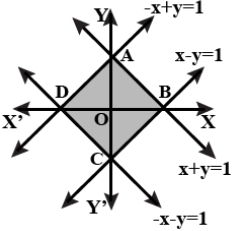
0 likes
View SolutionApplication of Integration — Area bounded by region of single curve · Frequently Asked Questions
1Are these Application of Integration questions useful for JEE and NEET?
Yes. All questions in this section are mapped to JEE Main and NEET exam patterns. Previous year questions from JEE Main, NEET, GUJCET and state-level exams are included with full solutions.
2Can I switch to Hindi or Gujarati for these questions?
Yes. Use the language tabs in the hero section or the sidebar to view the same questions and solutions in English, Hindi or Gujarati.
3How do I generate a question paper from this subtopic?
Use the Vedclass Exam Paper Generator — select the chapter and subtopic, set difficulty, and generate Sets A, B, C, D automatically. First 3 chapters of every subject are free.
Vedclass Products
For Students
Vedclass Test Series
Mock tests in real JEE/NEET style with performance analysis. 5-day free trial.
Start Free TrialFor Teachers
Exam Paper Generator
Generate Set A/B/C/D papers from this chapter in 2 minutes. 3 chapters free.
Try FreeFor Institutes
Online Exam Module
Live online exams with unlimited students, 360° analytics & white-label branding.
See DemoFor Teachers & Institutes
Generate a Application of Integration Exam Paper in 2 Minutes
Select subtopic & difficulty — Sets A, B, C, D auto-generated with No Repeat logic.
First 3 chapters of every subject are free — no payment required.