
A English
Catalyst and Catalysis Questions in English
Class 12 Chemistry · Surface Chemistry · Catalyst and Catalysis
242+
Questions
English
Language
100%
With Solutions
Showing 50 of 242 questions in English
151
Difficult
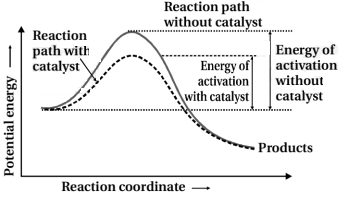
Explain: How does a catalyst increase the rate of a reaction?
Solution
(N/A) catalyst increases the rate of a reaction. The action of a catalyst can be explained by the intermediate complex theory.
According to this theory,a catalyst participates in a chemical reaction by forming temporary bonds with the reactants,resulting in an intermediate complex.
This intermediate complex has a transitory existence and decomposes to yield products and the catalyst.
It is believed that the catalyst provides an alternate pathway or reaction mechanism by reducing the activation energy between reactants and products,hence lowering the potential energy barrier as shown in the figure.
According to this theory,a catalyst participates in a chemical reaction by forming temporary bonds with the reactants,resulting in an intermediate complex.
This intermediate complex has a transitory existence and decomposes to yield products and the catalyst.
It is believed that the catalyst provides an alternate pathway or reaction mechanism by reducing the activation energy between reactants and products,hence lowering the potential energy barrier as shown in the figure.
0 likes
View Solution152
Medium
Write the characteristics of a catalyst.
Solution
(N/A) $1$. $A$ small amount of the catalyst is sufficient to bring about a large change in the rate of reaction.
$2$. $A$ catalyst cannot initiate a reaction; it can only accelerate the rate of an existing reaction.
$3$. According to the Arrhenius equation,$k = Ae^{-E_a/RT}$,a catalyst lowers the activation energy $(E_a)$,which increases the rate of reaction.
$4$. $A$ catalyst does not alter the Gibbs free energy change $(\Delta G)$ of a reaction.
$5$. $A$ catalyst does not change the enthalpy change $(\Delta H)$ of a reaction.
$6$. $A$ catalyst participates in the reaction mechanism but is regenerated without any permanent chemical change at the end of the reaction.
$7$. $A$ catalyst does not change the equilibrium constant $(K_{eq})$ of a reaction. It helps in attaining equilibrium faster by catalyzing both the forward and backward reactions to the same extent.
$8$. The potential energy of reactants and products remains unchanged by the presence of a catalyst.
$2$. $A$ catalyst cannot initiate a reaction; it can only accelerate the rate of an existing reaction.
$3$. According to the Arrhenius equation,$k = Ae^{-E_a/RT}$,a catalyst lowers the activation energy $(E_a)$,which increases the rate of reaction.
$4$. $A$ catalyst does not alter the Gibbs free energy change $(\Delta G)$ of a reaction.
$5$. $A$ catalyst does not change the enthalpy change $(\Delta H)$ of a reaction.
$6$. $A$ catalyst participates in the reaction mechanism but is regenerated without any permanent chemical change at the end of the reaction.
$7$. $A$ catalyst does not change the equilibrium constant $(K_{eq})$ of a reaction. It helps in attaining equilibrium faster by catalyzing both the forward and backward reactions to the same extent.
$8$. The potential energy of reactants and products remains unchanged by the presence of a catalyst.
0 likes
View Solution153
Medium
Define the following terms:
$(i)$ Inhibitors
$(ii)$ Catalyst
$(i)$ Inhibitors
$(ii)$ Catalyst
Solution
(N/A) $(i)$ Inhibitors: These are chemical substances that decrease the rate of a chemical reaction or prevent it from occurring by binding to the active site of an enzyme or reacting with the catalyst.
$(ii)$ Catalyst: $A$ catalyst is a substance that increases the rate of a chemical reaction without itself undergoing any permanent chemical change.
$(ii)$ Catalyst: $A$ catalyst is a substance that increases the rate of a chemical reaction without itself undergoing any permanent chemical change.
0 likes
View Solution154
AdvancedMCQ
Which is True $(T)$ and False $(F)$ of the following statements?
$1.$ Catalysts do not participate in the reaction.
$2.$ The catalyst increases the rate of reaction.
$3.$ Catalyst decreases the rate of reaction.
$4.$ Catalyst changes the pathway of reaction.
$1.$ Catalysts do not participate in the reaction.
$2.$ The catalyst increases the rate of reaction.
$3.$ Catalyst decreases the rate of reaction.
$4.$ Catalyst changes the pathway of reaction.
A
$1-T, 2-T, 3-F, 4-T$
B
$1-F, 2-T, 3-F, 4-T$
C
$1-T, 2-F, 3-T, 4-F$
D
$1-F, 2-F, 3-T, 4-T$
Solution
(B) $1.$ False: Catalysts participate in the reaction by forming intermediate complexes,though they are regenerated at the end.
$2.$ True: Catalysts increase the rate of reaction by providing an alternative pathway with lower activation energy.
$3.$ False: Catalysts generally increase the rate of reaction (positive catalysts).
$4.$ True: Catalysts change the reaction mechanism by providing an alternative pathway with a lower activation energy $(E_a)$.
$2.$ True: Catalysts increase the rate of reaction by providing an alternative pathway with lower activation energy.
$3.$ False: Catalysts generally increase the rate of reaction (positive catalysts).
$4.$ True: Catalysts change the reaction mechanism by providing an alternative pathway with a lower activation energy $(E_a)$.
0 likes
View Solution155
DifficultMCQ
Which is True $(T)$ and False $(F)$ of the following statements?
$1.$ Catalyst forms an activated complex with partial bonds.
$2.$ Catalyst alters the enthalpy change of the reaction.
$3.$ Catalyst remains the same at the initial and end of the reaction.
$1.$ Catalyst forms an activated complex with partial bonds.
$2.$ Catalyst alters the enthalpy change of the reaction.
$3.$ Catalyst remains the same at the initial and end of the reaction.
A
$T, T, T$
B
$T, F, T$
C
$F, T, F$
D
$F, F, T$
Solution
(B) $1.$ $A$ catalyst provides an alternative pathway for the reaction by forming an activated complex with lower activation energy,involving partial bonds. This statement is $True \ (T)$.
$2.$ $A$ catalyst does not change the enthalpy change $(\Delta H)$ of the reaction; it only affects the rate of reaction. This statement is $False \ (F)$.
$3.$ $A$ catalyst is not consumed in the reaction and remains chemically unchanged at the end of the reaction. This statement is $True \ (T)$.
Therefore,the sequence is $T, F, T$.
$2.$ $A$ catalyst does not change the enthalpy change $(\Delta H)$ of the reaction; it only affects the rate of reaction. This statement is $False \ (F)$.
$3.$ $A$ catalyst is not consumed in the reaction and remains chemically unchanged at the end of the reaction. This statement is $True \ (T)$.
Therefore,the sequence is $T, F, T$.
0 likes
View Solution156
DifficultMCQ
Which is True $(T)$ and False $(F)$ of the following statements?
$1.$ By catalyst,the forward reaction becomes fast and the reverse reaction becomes slow.
$2.$ $A$ catalyst decreases the potential energy of reactants and products.
$3.$ $A$ catalyst forms bonds in the reaction,so it is consumed.
$1.$ By catalyst,the forward reaction becomes fast and the reverse reaction becomes slow.
$2.$ $A$ catalyst decreases the potential energy of reactants and products.
$3.$ $A$ catalyst forms bonds in the reaction,so it is consumed.
A
$F, F, F$
B
$T, T, T$
C
$F, T, F$
D
$T, F, T$
Solution
(A) $1.$ $A$ catalyst increases the rate of both forward and backward reactions equally by providing an alternative pathway with lower activation energy. Thus,statement $1$ is $False$.
$2.$ $A$ catalyst does not change the potential energy of reactants or products; it only lowers the activation energy of the transition state. Thus,statement $2$ is $False$.
$3.$ $A$ catalyst is not consumed in a chemical reaction; it remains unchanged at the end of the reaction. Thus,statement $3$ is $False$.
Therefore,the correct sequence is $F, F, F$.
$2.$ $A$ catalyst does not change the potential energy of reactants or products; it only lowers the activation energy of the transition state. Thus,statement $2$ is $False$.
$3.$ $A$ catalyst is not consumed in a chemical reaction; it remains unchanged at the end of the reaction. Thus,statement $3$ is $False$.
Therefore,the correct sequence is $F, F, F$.
0 likes
View Solution157
Medium
Give information about catalysis and explain about promoters.
Solution
(N/A) Catalysis is the phenomenon where the rate of a chemical reaction is altered by the presence of a foreign substance that remains chemically and quantitatively unchanged after the reaction. Such substances are called catalysts.
For example,the decomposition of potassium chlorate $(2 KClO_{3} \rightarrow 2 KCl + 3 O_{2})$ occurs slowly at $653-873 \ K$,but in the presence of manganese dioxide $(MnO_{2})$,it occurs at a lower temperature range of $473-633 \ K$ with an accelerated rate.
Promoters are substances that enhance the activity of a catalyst,while poisons decrease the activity of a catalyst.
For example,in Haber's process for the manufacture of ammonia,molybdenum $(Mo)$ acts as a promoter for iron $(Fe)$,which is used as a catalyst:
$N_{2(g)} + 3 H_{2(g)} \xrightarrow{Fe(s), Mo(s)} 2 NH_{3(g)}$
For example,the decomposition of potassium chlorate $(2 KClO_{3} \rightarrow 2 KCl + 3 O_{2})$ occurs slowly at $653-873 \ K$,but in the presence of manganese dioxide $(MnO_{2})$,it occurs at a lower temperature range of $473-633 \ K$ with an accelerated rate.
Promoters are substances that enhance the activity of a catalyst,while poisons decrease the activity of a catalyst.
For example,in Haber's process for the manufacture of ammonia,molybdenum $(Mo)$ acts as a promoter for iron $(Fe)$,which is used as a catalyst:
$N_{2(g)} + 3 H_{2(g)} \xrightarrow{Fe(s), Mo(s)} 2 NH_{3(g)}$
0 likes
View Solution158
Difficult
Give information about Homogeneous catalysis and Heterogeneous catalysis.
Solution
(N/A) Homogeneous Catalysis: When the reactants,products,and the catalyst are in the same phase,the process is said to be homogeneous catalysis.
Examples of homogeneous catalysis:
$(i)$ Oxidation of sulphur dioxide into sulphur trioxide with dioxygen in the presence of oxides of nitrogen as the catalyst in the lead chamber process:
$2 SO_{2(g)} + O_{2(g)} \xrightarrow{NO_{(g)}} 2 SO_{3(g)}$
$(ii)$ Hydrolysis of methyl acetate is catalysed by $H^+$ ions furnished by hydrochloric acid:
$CH_3COOCH_{3(l)} + H_2O_{(l)} \xrightarrow{HCl_{(l)}} CH_3COOH_{(aq)} + CH_3OH_{(aq)}$
$(iii)$ Hydrolysis of sugar is catalysed by $H^+$ ions furnished by sulphuric acid:
$C_{12}H_{22}O_{11(aq)} + H_2O_{(l)} \xrightarrow{H_2SO_{4(l)}} C_6H_{12}O_{6(aq)} + C_6H_{12}O_{6(aq)}$
Heterogeneous Catalysis: When the reactants and the catalyst are in different phases,the process is said to be heterogeneous catalysis.
Examples of heterogeneous catalysis:
$(i)$ Oxidation of sulphur dioxide into sulphur trioxide in the presence of platinum $(Pt)$ as the catalyst in the contact process:
$2 SO_{2(g)} + O_{2(g)} \xrightarrow{Pt_{(s)}} 2 SO_{3(g)}$
$(ii)$ Haber's process for the synthesis of ammonia using iron $(Fe)$ as the catalyst:
$N_{2(g)} + 3H_{2(g)} \xrightarrow{Fe_{(s)}} 2NH_{3(g)}$
Examples of homogeneous catalysis:
$(i)$ Oxidation of sulphur dioxide into sulphur trioxide with dioxygen in the presence of oxides of nitrogen as the catalyst in the lead chamber process:
$2 SO_{2(g)} + O_{2(g)} \xrightarrow{NO_{(g)}} 2 SO_{3(g)}$
$(ii)$ Hydrolysis of methyl acetate is catalysed by $H^+$ ions furnished by hydrochloric acid:
$CH_3COOCH_{3(l)} + H_2O_{(l)} \xrightarrow{HCl_{(l)}} CH_3COOH_{(aq)} + CH_3OH_{(aq)}$
$(iii)$ Hydrolysis of sugar is catalysed by $H^+$ ions furnished by sulphuric acid:
$C_{12}H_{22}O_{11(aq)} + H_2O_{(l)} \xrightarrow{H_2SO_{4(l)}} C_6H_{12}O_{6(aq)} + C_6H_{12}O_{6(aq)}$
Heterogeneous Catalysis: When the reactants and the catalyst are in different phases,the process is said to be heterogeneous catalysis.
Examples of heterogeneous catalysis:
$(i)$ Oxidation of sulphur dioxide into sulphur trioxide in the presence of platinum $(Pt)$ as the catalyst in the contact process:
$2 SO_{2(g)} + O_{2(g)} \xrightarrow{Pt_{(s)}} 2 SO_{3(g)}$
$(ii)$ Haber's process for the synthesis of ammonia using iron $(Fe)$ as the catalyst:
$N_{2(g)} + 3H_{2(g)} \xrightarrow{Fe_{(s)}} 2NH_{3(g)}$
0 likes
View Solution159
Advanced
Explain the adsorption theory of heterogeneous catalysis.
Solution
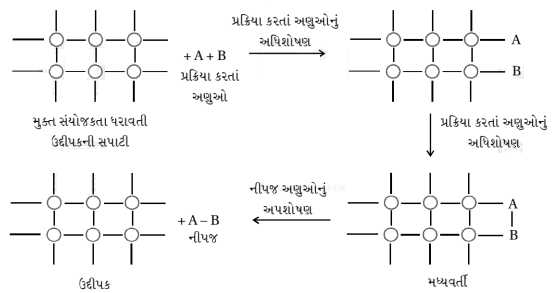
(N/A) This theory explains the mechanism of heterogeneous catalysis. The old theory,known as the adsorption theory of catalysis,stated that the reactants in a gaseous state or in solutions are adsorbed on the surface of the solid catalyst.
The increase in concentration of the reactants on the surface increases the rate of reaction. Adsorption being an exothermic process,the heat of adsorption is utilized in enhancing the rate of the reaction.
The modern adsorption theory is a combination of the intermediate compound formation theory and the old adsorption theory. The catalytic activity is localized on the surface of the catalyst. The mechanism involves five steps:
$(i)$ Diffusion of reactants to the surface of the catalyst.
$(ii)$ Adsorption of reactant molecules on the surface of the catalyst.
$(iii)$ Occurrence of a chemical reaction on the catalyst's surface through the formation of an intermediate.
$(iv)$ Desorption of reaction products from the catalyst surface,thereby making the surface available again for more reaction to occur.
$(v)$ Diffusion of reaction products away from the catalyst's surface.
The surface of the catalyst,unlike the inner part of the bulk,has free valencies which provide the seat for chemical forces of attraction. When a gas comes in contact with such a surface,its molecules are held there due to loose chemical combination. If different molecules are adsorbed side by side,they may react with each other,resulting in the formation of new molecules.
The increase in concentration of the reactants on the surface increases the rate of reaction. Adsorption being an exothermic process,the heat of adsorption is utilized in enhancing the rate of the reaction.
The modern adsorption theory is a combination of the intermediate compound formation theory and the old adsorption theory. The catalytic activity is localized on the surface of the catalyst. The mechanism involves five steps:
$(i)$ Diffusion of reactants to the surface of the catalyst.
$(ii)$ Adsorption of reactant molecules on the surface of the catalyst.
$(iii)$ Occurrence of a chemical reaction on the catalyst's surface through the formation of an intermediate.
$(iv)$ Desorption of reaction products from the catalyst surface,thereby making the surface available again for more reaction to occur.
$(v)$ Diffusion of reaction products away from the catalyst's surface.
The surface of the catalyst,unlike the inner part of the bulk,has free valencies which provide the seat for chemical forces of attraction. When a gas comes in contact with such a surface,its molecules are held there due to loose chemical combination. If different molecules are adsorbed side by side,they may react with each other,resulting in the formation of new molecules.
0 likes
View Solution160
Difficult
Give information about important features of solid catalysts.
Solution
The important features of solid catalysts are as follows:
$(a)$ Activity: The activity of a catalyst depends upon the strength of chemisorption to a large extent. The reactants must get adsorbed reasonably strongly onto the catalyst to become active. However,they must not get adsorbed so strongly that they are immobilised and other reactants are left with no space on the catalyst's surface for adsorption.
Example: $2H_{2(g)} + O_{2(g)} \xrightarrow{Pt} 2H_2O_{(l)}$
$(b)$ Selectivity: The selectivity of a catalyst is its ability to direct a reaction to yield a particular product selectively,when under the same reaction conditions many products are possible.
Selectivity of different catalysts for the same reactants is different. For example,starting with $H_2$ and $CO$ and using different catalysts,we get different products:
$(i)$ $CO_{(g)} + 3H_{2(g)} \xrightarrow{Ni} CH_{4(g)} + H_2O_{(g)}$
$(ii)$ $CO_{(g)} + 2H_{2(g)} \xrightarrow{Cu/ZnO-Cr_2O_3} CH_3OH_{(g)}$
$(iii)$ $CO_{(g)} + H_{2(g)} \xrightarrow{Cu} HCHO_{(g)}$
Thus,it can be inferred that the action of a catalyst is highly selective in nature. As a result,a substance which acts as a catalyst in one reaction may fail to catalyse another reaction.
$(a)$ Activity: The activity of a catalyst depends upon the strength of chemisorption to a large extent. The reactants must get adsorbed reasonably strongly onto the catalyst to become active. However,they must not get adsorbed so strongly that they are immobilised and other reactants are left with no space on the catalyst's surface for adsorption.
Example: $2H_{2(g)} + O_{2(g)} \xrightarrow{Pt} 2H_2O_{(l)}$
$(b)$ Selectivity: The selectivity of a catalyst is its ability to direct a reaction to yield a particular product selectively,when under the same reaction conditions many products are possible.
Selectivity of different catalysts for the same reactants is different. For example,starting with $H_2$ and $CO$ and using different catalysts,we get different products:
$(i)$ $CO_{(g)} + 3H_{2(g)} \xrightarrow{Ni} CH_{4(g)} + H_2O_{(g)}$
$(ii)$ $CO_{(g)} + 2H_{2(g)} \xrightarrow{Cu/ZnO-Cr_2O_3} CH_3OH_{(g)}$
$(iii)$ $CO_{(g)} + H_{2(g)} \xrightarrow{Cu} HCHO_{(g)}$
Thus,it can be inferred that the action of a catalyst is highly selective in nature. As a result,a substance which acts as a catalyst in one reaction may fail to catalyse another reaction.
1 likes
View Solution161
Medium
Explain the shape selective catalysis by zeolites.
Solution
(N/A) The catalytic reaction that depends upon the pore structure of the catalyst and the size of the reactant and product molecules is called shape-selective catalysis.
Zeolites are good shape-selective catalysts because of their honeycomb-like structures. They are microporous aluminosilicates with a three-dimensional network of silicates in which some silicon atoms are replaced by aluminium atoms,giving an $Al-O-Si$ framework.
The reactions taking place in zeolites depend upon the size and shape of reactant and product molecules as well as upon the pores and cavities of the zeolites. They are found in nature as well as synthesized for catalytic selectivity.
Zeolites are widely used as catalysts in petrochemical industries for the cracking of hydrocarbons and isomerisation. An important zeolite catalyst used in the petroleum industry is $ZSM-5$. It converts alcohols directly into gasoline (petrol) by dehydrating them to give a mixture of hydrocarbons.
Zeolites are good shape-selective catalysts because of their honeycomb-like structures. They are microporous aluminosilicates with a three-dimensional network of silicates in which some silicon atoms are replaced by aluminium atoms,giving an $Al-O-Si$ framework.
The reactions taking place in zeolites depend upon the size and shape of reactant and product molecules as well as upon the pores and cavities of the zeolites. They are found in nature as well as synthesized for catalytic selectivity.
Zeolites are widely used as catalysts in petrochemical industries for the cracking of hydrocarbons and isomerisation. An important zeolite catalyst used in the petroleum industry is $ZSM-5$. It converts alcohols directly into gasoline (petrol) by dehydrating them to give a mixture of hydrocarbons.
0 likes
View Solution162
Difficult
Explain the characteristics of enzyme catalysis.
Solution
(N/A) The characteristics of enzyme catalysis are as follows:
$(i)$ Highly efficient: One molecule of an enzyme may transform one million molecules of the reactant per minute.
$(ii)$ Highly specific nature: Each enzyme is specific for a given reaction; for example,the enzyme urease catalyses the hydrolysis of urea only.
$(iii)$ Highly active under optimum temperature: The rate of the enzyme reaction is maximum at a definite temperature called the optimum temperature,typically $298-310 \ K$.
$(iv)$ Highly active under optimum $pH$: The rate of an enzyme-catalysed reaction is maximum at a particular $pH$ value,generally between $pH$ $5-7$.
$(v)$ Increasing activity in presence of activators and co-enzymes: The enzymatic activity is increased in the presence of co-enzymes,which are small non-protein molecules (often vitamins) that enhance catalytic activity.
$(vi)$ Influence of inhibitors and poisons: Inhibitors or poisons interact with the active functional groups on the enzyme surface,reducing or destroying their catalytic activity.
$(i)$ Highly efficient: One molecule of an enzyme may transform one million molecules of the reactant per minute.
$(ii)$ Highly specific nature: Each enzyme is specific for a given reaction; for example,the enzyme urease catalyses the hydrolysis of urea only.
$(iii)$ Highly active under optimum temperature: The rate of the enzyme reaction is maximum at a definite temperature called the optimum temperature,typically $298-310 \ K$.
$(iv)$ Highly active under optimum $pH$: The rate of an enzyme-catalysed reaction is maximum at a particular $pH$ value,generally between $pH$ $5-7$.
$(v)$ Increasing activity in presence of activators and co-enzymes: The enzymatic activity is increased in the presence of co-enzymes,which are small non-protein molecules (often vitamins) that enhance catalytic activity.
$(vi)$ Influence of inhibitors and poisons: Inhibitors or poisons interact with the active functional groups on the enzyme surface,reducing or destroying their catalytic activity.
0 likes
View Solution163
Difficult
Give information about the utility of catalysts in industries.
Solution
(N/A)
| Process | Catalyst |
|---|---|
| $1$. Haber's process for the manufacture of ammonia: $N_{2(g)} + 3H_{2(g)} \rightleftharpoons 2NH_{3(g)}$ | $1$. Finely divided iron,molybdenum as promoter. Conditions: $200 \ bar$ pressure and $723-773 \ K$ temperature. Now-a-days,a mixture of iron oxide,potassium oxide and alumina is used. |
| $2$. Ostwald's process for the manufacture of nitric acid: $4NH_{3(g)} + 5O_{2(g)} \rightarrow 4NO_{(g)} + 6H_{2}O_{(g)}$; $2NO_{(g)} + O_{2(g)} \rightarrow 2NO_{2(g)}$; $4NO_{2(g)} + 2H_{2}O_{(l)} + O_{2(g)} \rightarrow 4HNO_{3(aq)}$ | $2$. Platinised asbestos,temperature $573 \ K$. |
| $3$. Contact process for the manufacture of sulphuric acid: $2SO_{2(g)} + O_{2(g)} \rightarrow 2SO_{3(g)}$; $SO_{3(g)} + H_{2}SO_{4(aq)} \rightarrow H_{2}S_{2}O_{7(l)}$ (oleum); $H_{2}S_{2}O_{7(l)} + H_{2}O_{(l)} \rightarrow 2H_{2}SO_{4(aq)}$ | $3$. Platinised asbestos or vanadium pentoxide $(V_{2}O_{5})$,temperature $673-723 \ K$. |
0 likes
View Solution164
EasyMCQ
What is the role of $MnO_2$ in the decomposition reaction $2KClO_3 \to 2KCl + 3O_2$?
A
It acts as a reactant.
B
It acts as a catalyst.
C
It acts as an inhibitor.
D
It acts as a product.
Solution
(B) In the decomposition of potassium chlorate $(KClO_3)$,manganese dioxide $(MnO_2)$ is added to increase the rate of reaction at a lower temperature.
Since $MnO_2$ remains chemically unchanged at the end of the reaction,it acts as a catalyst.
Since $MnO_2$ remains chemically unchanged at the end of the reaction,it acts as a catalyst.
0 likes
View Solution165
Easy
How many types of catalysis are there? Give the names.
Solution
(N/A) Catalysis is broadly classified into two main types based on the physical state of the reactants and the catalyst:
$1$. $Homogeneous \ catalysis$: In this type,the reactants and the catalyst are in the same phase (e.g.,all in liquid or all in gas phase).
$2$. $Heterogeneous \ catalysis$: In this type,the reactants and the catalyst are in different phases (e.g.,solid catalyst with gaseous or liquid reactants).
$1$. $Homogeneous \ catalysis$: In this type,the reactants and the catalyst are in the same phase (e.g.,all in liquid or all in gas phase).
$2$. $Heterogeneous \ catalysis$: In this type,the reactants and the catalyst are in different phases (e.g.,solid catalyst with gaseous or liquid reactants).
0 likes
View Solution166
EasyMCQ
Hydrogenation of vegetable oil in the presence of Raney Nickel is an example of what?
A
Homogeneous catalysis
B
Heterogeneous catalysis
C
Enzyme catalysis
D
Autocatalysis
Solution
(B) In the hydrogenation of vegetable oil,the reactant (vegetable oil) is in the liquid state,while the catalyst (Raney Nickel) is in the solid state. Since the catalyst and the reactants are in different phases,this is an example of $Heterogeneous \ catalysis$.
0 likes
View Solution167
EasyMCQ
Shape-selective catalyst zeolite has a structure like ..........
A
Honeycomb
B
Layered
C
Crystalline
D
Amorphous
Solution
(A) Zeolites are aluminosilicates with a three-dimensional network structure. They possess a $Honeycomb$-like structure,which allows them to act as shape-selective catalysts by trapping molecules of specific sizes within their pores.
0 likes
View Solution168
EasyMCQ
What is the role of desorption in the process of catalysis?
A
To increase the surface area of the catalyst.
B
To remove the product molecules from the catalyst surface to make space for new reactant molecules.
C
To decrease the activation energy of the reaction.
D
To form an intermediate complex with the reactants.
Solution
(B) In the process of catalysis,the role of desorption is to remove the product molecules from the surface of the catalyst. This process frees up the active sites on the catalyst surface,allowing new reactant molecules to adsorb and react,thereby maintaining the catalytic cycle.
0 likes
View Solution169
Medium
Why is desorption important for a substance to act as a good catalyst?
Solution
(N/A) During a catalytic reaction,reactant molecules are adsorbed on the surface of the catalyst to form products.
For the catalyst to remain effective and continue the reaction,the product molecules must be desorbed from the surface.
This desorption process creates vacant sites on the catalyst surface,allowing new reactant molecules to be adsorbed and undergo the reaction again.
For the catalyst to remain effective and continue the reaction,the product molecules must be desorbed from the surface.
This desorption process creates vacant sites on the catalyst surface,allowing new reactant molecules to be adsorbed and undergo the reaction again.
0 likes
View Solution170
MediumMCQ
What is the role of diffusion in heterogeneous catalysis?
A
It helps in the formation of the catalyst.
B
It facilitates the transport of reactants to the surface and products away from the surface.
C
It increases the temperature of the reaction.
D
It decreases the activation energy of the reaction.
Solution
(B) In heterogeneous catalysis,the reaction occurs on the surface of the solid catalyst.
First,the reactant molecules must diffuse from the bulk phase to the surface of the catalyst to undergo adsorption.
After the chemical reaction occurs on the surface,the product molecules must diffuse away from the catalyst surface back into the bulk phase to allow for further reaction cycles.
First,the reactant molecules must diffuse from the bulk phase to the surface of the catalyst to undergo adsorption.
After the chemical reaction occurs on the surface,the product molecules must diffuse away from the catalyst surface back into the bulk phase to allow for further reaction cycles.
0 likes
View Solution171
Medium
How does a solid catalyst enhance the rate of combination of gaseous molecules?
Solution
(N/A) In heterogeneous catalysis,the gaseous molecules get adsorbed on the surface of the solid catalyst.
This adsorption process lowers the activation energy of the reaction.
Furthermore,since adsorption is an exothermic process,the heat released during adsorption increases the local temperature on the catalyst surface,which further accelerates the reaction rate.
This adsorption process lowers the activation energy of the reaction.
Furthermore,since adsorption is an exothermic process,the heat released during adsorption increases the local temperature on the catalyst surface,which further accelerates the reaction rate.
0 likes
View Solution172
Difficult
What is the role of adsorption in heterogeneous catalysis?
Solution
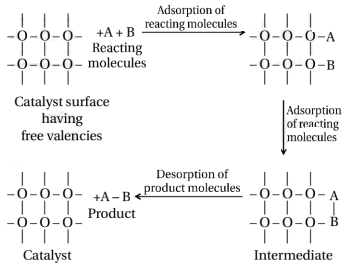
The mechanism of heterogeneous catalysis involves the following steps:
$1)$ Diffusion of the reactants to the surface of the catalyst.
$2)$ Adsorption of reactant molecules on the surface of the catalyst.
$3)$ Occurrence of the chemical reaction on the catalyst surface through the formation of an intermediate.
$4)$ Desorption of the reaction products from the catalyst surface,thereby making the surface available again for more reaction to occur.
$5)$ Diffusion of reaction products away from the catalyst's surface.
This is known as the Modern Adsorption Theory. This theory explains why the catalyst remains unchanged in mass and chemical composition at the end of the reaction and is effective even in small quantities. However,it failed to explain the action of catalytic promoters and inhibitors.
$1)$ Diffusion of the reactants to the surface of the catalyst.
$2)$ Adsorption of reactant molecules on the surface of the catalyst.
$3)$ Occurrence of the chemical reaction on the catalyst surface through the formation of an intermediate.
$4)$ Desorption of the reaction products from the catalyst surface,thereby making the surface available again for more reaction to occur.
$5)$ Diffusion of reaction products away from the catalyst's surface.
This is known as the Modern Adsorption Theory. This theory explains why the catalyst remains unchanged in mass and chemical composition at the end of the reaction and is effective even in small quantities. However,it failed to explain the action of catalytic promoters and inhibitors.
0 likes
View Solution173
Difficult
What do you understand by shape selective catalysis? Why are zeolites good shape selective catalysts?
Solution
(N/A) The catalytic reaction that depends upon the pore structure of the catalyst and the size of reactant and product molecules is called shape selective catalysis.
Zeolites are good shape selective catalysts because of their honeycomb-like structure.
Zeolites are microporous aluminosilicates with a three-dimensional network in which some silicon atoms are replaced by aluminium atoms,creating an $Al-O-Si$ framework. The reaction taking place in a zeolite depends upon the size and shape of the reactant and product molecules,as well as the pores and cavities of the zeolites.
Zeolites are widely used as catalysts in petrochemical industries for the cracking of hydrocarbons and isomerisation. For example,the zeolite $ZSM-5$ converts alcohols into gasoline by dehydrating them to produce a mixture of hydrocarbons.
Zeolites are good shape selective catalysts because of their honeycomb-like structure.
Zeolites are microporous aluminosilicates with a three-dimensional network in which some silicon atoms are replaced by aluminium atoms,creating an $Al-O-Si$ framework. The reaction taking place in a zeolite depends upon the size and shape of the reactant and product molecules,as well as the pores and cavities of the zeolites.
Zeolites are widely used as catalysts in petrochemical industries for the cracking of hydrocarbons and isomerisation. For example,the zeolite $ZSM-5$ converts alcohols into gasoline by dehydrating them to produce a mixture of hydrocarbons.
0 likes
View Solution174
Medium
Fill in the blanks:
$1.$ $TiCl_4$ with $Al(CH_3)_3$ is called ............ catalyst.
$2.$ In the Haber process,ammonia is produced from a mixture of ............ .
$1.$ $TiCl_4$ with $Al(CH_3)_3$ is called ............ catalyst.
$2.$ In the Haber process,ammonia is produced from a mixture of ............ .
Solution
(N/A) $1.$ The combination of $TiCl_4$ and $Al(CH_3)_3$ is known as the Ziegler-Natta catalyst.
$2.$ In the Haber process,ammonia is produced from a mixture of nitrogen $(N_2)$ and hydrogen $(H_2)$ gases.
$2.$ In the Haber process,ammonia is produced from a mixture of nitrogen $(N_2)$ and hydrogen $(H_2)$ gases.
0 likes
View Solution175
EasyMCQ
Which catalyst is used in the Haber process?
A
Finely divided iron
B
Vanadium pentoxide
C
Platinum
D
Nickel
Solution
(A) The Haber process is used for the industrial production of ammonia $(NH_3)$ from nitrogen $(N_2)$ and hydrogen $(H_2)$.
The reaction is: $N_2(g) + 3H_2(g) \rightleftharpoons 2NH_3(g)$.
In this process,finely divided iron is used as a catalyst,and molybdenum $(Mo)$ is often used as a promoter to increase the efficiency of the iron catalyst.
The reaction is: $N_2(g) + 3H_2(g) \rightleftharpoons 2NH_3(g)$.
In this process,finely divided iron is used as a catalyst,and molybdenum $(Mo)$ is often used as a promoter to increase the efficiency of the iron catalyst.
0 likes
View Solution176
Medium
Match the catalyst given in List-$I$ with the process in List-$II$.
| List-$I$ (Catalyst) | List-$II$ (Process) |
| $A$. $Ni$ in presence of $H_2$ | $1$. Ziegler-Natta catalyst |
| $B$. $Cu_2Cl_2$ | $2$. Contact process |
| $C$. $V_2O_5$ | $3$. Hydrogenation of vegetable oils |
| $D$. Finely divided iron | $4$. Sandmeyer reaction |
| $E$. $TiCl_4 + Al(CH_3)_3$ | $5$. Haber process |
| $6$. Decomposition of $KClO_3$ |
Solution
(A-3, B-4, C-2, D-5, E-1) $A-3, B-4, C-2, D-5, E-1$
$A$. $Ni$ in presence of $H_2$ is used for the hydrogenation of vegetable oils.
$B$. $Cu_2Cl_2$ is used in the Sandmeyer reaction.
$C$. $V_2O_5$ is used in the Contact process for the manufacture of sulfuric acid.
$D$. Finely divided iron is used as a catalyst in the Haber process for the synthesis of ammonia.
$E$. $TiCl_4 + Al(CH_3)_3$ is the Ziegler-Natta catalyst used for the polymerization of ethene.
$A$. $Ni$ in presence of $H_2$ is used for the hydrogenation of vegetable oils.
$B$. $Cu_2Cl_2$ is used in the Sandmeyer reaction.
$C$. $V_2O_5$ is used in the Contact process for the manufacture of sulfuric acid.
$D$. Finely divided iron is used as a catalyst in the Haber process for the synthesis of ammonia.
$E$. $TiCl_4 + Al(CH_3)_3$ is the Ziegler-Natta catalyst used for the polymerization of ethene.
0 likes
View Solution177
Medium
Explain the process in which a biocatalyst is used in the industrial preparation of a compound known to you.
Solution
(N/A) common example of a biocatalyst used in industry is the enzyme $Invertase$,which is used in the production of $Invert \ Sugar$ (a mixture of $Glucose$ and $Fructose$) from $Sucrose$ (cane sugar).
$1$. The process involves the hydrolysis of $Sucrose$ $(C_{12}H_{22}O_{11})$ in the presence of the enzyme $Invertase$,which is obtained from yeast $(Saccharomyces \ cerevisiae)$.
$2$. The chemical reaction is: $C_{12}H_{22}O_{11} + H_2O \xrightarrow{Invertase} C_6H_{12}O_6 (Glucose) + C_6H_{12}O_6 (Fructose)$.
$3$. This process is highly efficient and operates under mild conditions of temperature and $pH$,making it an environmentally friendly industrial method.
$1$. The process involves the hydrolysis of $Sucrose$ $(C_{12}H_{22}O_{11})$ in the presence of the enzyme $Invertase$,which is obtained from yeast $(Saccharomyces \ cerevisiae)$.
$2$. The chemical reaction is: $C_{12}H_{22}O_{11} + H_2O \xrightarrow{Invertase} C_6H_{12}O_6 (Glucose) + C_6H_{12}O_6 (Fructose)$.
$3$. This process is highly efficient and operates under mild conditions of temperature and $pH$,making it an environmentally friendly industrial method.
0 likes
View Solution178
EasyMCQ
Which catalyst is used in the reaction $2KClO_3 \to 2KCl + 3O_2$?
A
$MnO_2$
B
$V_2O_5$
C
$Fe$
D
$Ni$
Solution
(A) The decomposition of potassium chlorate $(KClO_3)$ to produce oxygen gas is catalyzed by manganese dioxide $(MnO_2)$.
The reaction is represented as: $2KClO_3(s) \xrightarrow{MnO_2} 2KCl(s) + 3O_2(g)$.
$MnO_2$ lowers the activation energy of the reaction,allowing it to proceed at a lower temperature.
The reaction is represented as: $2KClO_3(s) \xrightarrow{MnO_2} 2KCl(s) + 3O_2(g)$.
$MnO_2$ lowers the activation energy of the reaction,allowing it to proceed at a lower temperature.
0 likes
View Solution179
Easy
Describe how the enthalpy of reaction remains unchanged when a catalyst is used in the reaction.
Solution
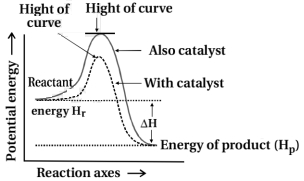
(N/A) When a reaction is carried out in the presence of a catalyst,the enthalpy of the reactant $H_{R}$ and the enthalpy of the product $H_{P}$ remain unchanged. The enthalpy of reaction,which is the change in enthalpy $\Delta_{r} H$,does not change.
$\Delta_{r} H = H_{P} - H_{R}$
$= \text{Enthalpy of product} - \text{Enthalpy of reactant}$
$= \text{Constant}$
Therefore,$\Delta H$ does not change in the presence of a catalyst.
In the presence of a catalyst,the height of the potential energy barrier decreases,but the energy levels of the reactants and products remain the same. Thus,$\Delta H$ remains constant.
$\Delta_{r} H = H_{P} - H_{R}$
$= \text{Enthalpy of product} - \text{Enthalpy of reactant}$
$= \text{Constant}$
Therefore,$\Delta H$ does not change in the presence of a catalyst.
In the presence of a catalyst,the height of the potential energy barrier decreases,but the energy levels of the reactants and products remain the same. Thus,$\Delta H$ remains constant.
0 likes
View Solution180
MediumMCQ
Which of the following parameters changes when a catalyst is added during a chemical reaction?
A
Equilibrium constant
B
Activation energy
C
Enthalpy change
D
Gibbs free energy
Solution
(B) catalyst provides an alternative reaction pathway with a lower activation energy $(E_a)$. It does not affect the equilibrium constant,enthalpy change,or Gibbs free energy of the reaction.
0 likes
View Solution181
MediumMCQ
Match List-$I$ with List-$II$.
Choose the most appropriate answer from the options given below:
| List-$I$ (Process) | List-$II$ (Catalyst) |
|---|---|
| $a$. Deacon's process | $i$. $ZSM-5$ |
| $b$. Contact process | $ii$. $CuCl_2$ |
| $c$. Cracking of hydrocarbons | $iii$. $Ni$ |
| $d$. Hydrogenation of vegetable oils | $iv$. $V_2O_5$ |
Choose the most appropriate answer from the options given below:
A
$a-ii, b-iv, c-i, d-iii$
B
$a-i, b-iii, c-ii, d-iv$
C
$a-iii, b-i, c-iv, d-ii$
D
$a-iv, b-ii, c-i, d-iii$
Solution
(A) The correct matches are as follows:
$a$. Deacon's process uses $CuCl_2$ as a catalyst.
$b$. Contact process for the manufacture of $H_2SO_4$ uses $V_2O_5$ as a catalyst.
$c$. Cracking of hydrocarbons uses $ZSM-5$ as a catalyst.
$d$. Hydrogenation of vegetable oils uses $Ni$ as a catalyst.
Thus,the correct sequence is $a-ii, b-iv, c-i, d-iii$.
$a$. Deacon's process uses $CuCl_2$ as a catalyst.
$b$. Contact process for the manufacture of $H_2SO_4$ uses $V_2O_5$ as a catalyst.
$c$. Cracking of hydrocarbons uses $ZSM-5$ as a catalyst.
$d$. Hydrogenation of vegetable oils uses $Ni$ as a catalyst.
Thus,the correct sequence is $a-ii, b-iv, c-i, d-iii$.
0 likes
View Solution182
MediumMCQ
Match List-$I$ with List-$II$.
Choose the correct answer from the options given below.
| List-$I$ | List-$II$ |
| $A. N_{2(g)} + 3H_{2(g)} \rightarrow 2NH_{3(g)}$ | $I. Fe_xO_y + K_2O + Al_2O_3$ |
| $B. CO_{(g)} + 3H_{2(g)} \rightarrow CH_{4(g)} + H_2O_{(g)}$ | $II. Ni$ |
| $C. CO_{(g)} + H_{2(g)} \rightarrow HCHO_{(g)}$ | $III. Cu$ |
| $D. CO_{(g)} + 2H_{2(g)} \rightarrow CH_3OH_{(g)}$ | $IV. Cu/ZnO - Cr_2O_3$ |
Choose the correct answer from the options given below.
A
$A-I, B-II, C-III, D-IV$
B
$A-I, B-II, C-IV, D-III$
C
$A-II, B-I, C-III, D-IV$
D
$A-II, B-I, C-IV, D-III$
Solution
(A) The reactions are matched with their respective catalysts as follows:
$A. N_{2(g)} + 3H_{2(g)} \rightarrow 2NH_{3(g)}$ (Haber process) uses $Fe_xO_y + K_2O + Al_2O_3$ as a catalyst $(I)$.
$B. CO_{(g)} + 3H_{2(g)} \rightarrow CH_{4(g)} + H_2O_{(g)}$ uses $Ni$ as a catalyst $(II)$.
$C. CO_{(g)} + H_{2(g)} \rightarrow HCHO_{(g)}$ uses $Cu$ as a catalyst $(III)$.
$D. CO_{(g)} + 2H_{2(g)} \rightarrow CH_3OH_{(g)}$ uses $Cu/ZnO - Cr_2O_3$ as a catalyst $(IV)$.
Therefore,the correct matching is $A-I, B-II, C-III, D-IV$.
$A. N_{2(g)} + 3H_{2(g)} \rightarrow 2NH_{3(g)}$ (Haber process) uses $Fe_xO_y + K_2O + Al_2O_3$ as a catalyst $(I)$.
$B. CO_{(g)} + 3H_{2(g)} \rightarrow CH_{4(g)} + H_2O_{(g)}$ uses $Ni$ as a catalyst $(II)$.
$C. CO_{(g)} + H_{2(g)} \rightarrow HCHO_{(g)}$ uses $Cu$ as a catalyst $(III)$.
$D. CO_{(g)} + 2H_{2(g)} \rightarrow CH_3OH_{(g)}$ uses $Cu/ZnO - Cr_2O_3$ as a catalyst $(IV)$.
Therefore,the correct matching is $A-I, B-II, C-III, D-IV$.
0 likes
View Solution183
DifficultMCQ
Match List-$I$ with List-$II$.
Choose the correct answer from the options given below.
| List-$I$ (Processes/Reactions) | List-$II$ (Catalyst) |
|---|---|
| $A. 2 SO_{2(g)} + O_{2(g)} \rightarrow 2 SO_{3(g)}$ | $I. V_{2}O_{5}$ |
| $B. 4 NH_{3(g)} + 5 O_{2(g)} \rightarrow 4 NO_{(g)} + 6 H_{2}O_{(g)}$ | $II. Pt_{(s)}-Rh_{(s)}$ |
| $C. N_{2(g)} + 3 H_{2(g)} \rightarrow 2 NH_{3(g)}$ | $III. Fe_{(s)}$ |
| $D. \text{Vegetable oil}(l) + H_{2} \rightarrow \text{Vegetable ghee}(s)$ | $IV. Ni_{(s)}$ |
Choose the correct answer from the options given below.
A
$A-I, B-II, C-III, D-IV$
B
$A-III, B-II, C-I, D-IV$
C
$A-IV, B-III, C-I, D-II$
D
$A-IV, B-II, C-III, D-I$
Solution
(A) $2 SO_{2(g)} + O_{2(g)} \xrightarrow{V_{2}O_{5}} 2 SO_{3(g)}$: Contact process uses $V_{2}O_{5}$ as a catalyst.
$4 NH_{3(g)} + 5 O_{2(g)} \xrightarrow{Pt_{(s)}-Rh_{(s)}} 4 NO_{(g)} + 6 H_{2}O_{(g)}$: Ostwald's process uses $Pt_{(s)}-Rh_{(s)}$ as a catalyst.
$N_{2(g)} + 3 H_{2(g)} \xrightarrow{Fe_{(s)}} 2 NH_{3(g)}$: Haber's process uses $Fe_{(s)}$ as a catalyst.
$\text{Vegetable oil}(l) + H_{2(g)} \xrightarrow{Ni_{(s)}} \text{Vegetable ghee}(s)$: Hydrogenation uses $Ni_{(s)}$ as a catalyst.
Therefore,the correct matching is $A-I, B-II, C-III, D-IV$.
$4 NH_{3(g)} + 5 O_{2(g)} \xrightarrow{Pt_{(s)}-Rh_{(s)}} 4 NO_{(g)} + 6 H_{2}O_{(g)}$: Ostwald's process uses $Pt_{(s)}-Rh_{(s)}$ as a catalyst.
$N_{2(g)} + 3 H_{2(g)} \xrightarrow{Fe_{(s)}} 2 NH_{3(g)}$: Haber's process uses $Fe_{(s)}$ as a catalyst.
$\text{Vegetable oil}(l) + H_{2(g)} \xrightarrow{Ni_{(s)}} \text{Vegetable ghee}(s)$: Hydrogenation uses $Ni_{(s)}$ as a catalyst.
Therefore,the correct matching is $A-I, B-II, C-III, D-IV$.
0 likes
View Solution184
MediumMCQ
Match List-$I$ with List-$II$.
Choose the correct answer from the options given below.
| List-$I$ | List-$II$ |
| $A$. $4NH_{3(g)} + 5O_{2(g)} \rightarrow 4NO_{(g)} + 6H_2O_{(g)}$ | $I$. $NO_{(g)}$ |
| $B$. $N_{2(g)} + 3H_{2(g)} \rightarrow 2NH_{3(g)}$ | $II$. $H_2SO_{4(l)}$ |
| $C$. $C_{12}H_{22}O_{11(aq)} + H_2O_{(l)} \rightarrow C_6H_{12}O_6 + C_6H_{12}O_6$ | $III$. $Pt_{(s)}$ |
| $D$. $2SO_{2(g)} + O_{2(g)} \rightarrow 2SO_{3(g)}$ | $IV$. $Fe_{(s)}$ |
Choose the correct answer from the options given below.
A
$A-III, B-IV, C-II, D-I$
B
$A-III, B-II, C-I, D-IV$
C
$A-III, B-IV, C-I, D-II$
D
$A-II, B-III, C-IV, D-I$
Solution
(A) . $4NH_{3(g)} + 5O_{2(g)} \xrightarrow{Pt_{(s)}} 4NO_{(g)} + 6H_2O_{(g)}$ (Ostwald process uses $Pt_{(s)}$ as a catalyst).
$B$. $N_{2(g)} + 3H_{2(g)} \xrightarrow{Fe_{(s)}} 2NH_{3(g)}$ (Haber process uses $Fe_{(s)}$ as a catalyst).
$C$. $C_{12}H_{22}O_{11(aq)} + H_2O_{(l)} \xrightarrow{H^+} C_6H_{12}O_6 + C_6H_{12}O_6$ (Inversion of cane sugar uses $H_2SO_{4(l)}$ as a catalyst).
$D$. $2SO_{2(g)} + O_{2(g)} \xrightarrow{NO_{(g)}} 2SO_{3(g)}$ (Lead chamber process uses $NO_{(g)}$ as a catalyst).
Therefore,the correct matching is $A-III, B-IV, C-II, D-I$.
$B$. $N_{2(g)} + 3H_{2(g)} \xrightarrow{Fe_{(s)}} 2NH_{3(g)}$ (Haber process uses $Fe_{(s)}$ as a catalyst).
$C$. $C_{12}H_{22}O_{11(aq)} + H_2O_{(l)} \xrightarrow{H^+} C_6H_{12}O_6 + C_6H_{12}O_6$ (Inversion of cane sugar uses $H_2SO_{4(l)}$ as a catalyst).
$D$. $2SO_{2(g)} + O_{2(g)} \xrightarrow{NO_{(g)}} 2SO_{3(g)}$ (Lead chamber process uses $NO_{(g)}$ as a catalyst).
Therefore,the correct matching is $A-III, B-IV, C-II, D-I$.
0 likes
View Solution185
MediumMCQ
The variation of the rate of an enzyme-catalyzed reaction with substrate concentration is correctly represented by which graph?
A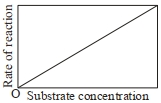
B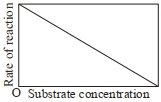
C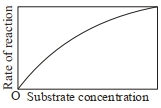
D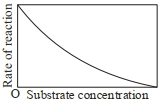
Solution
(C) The rate of an enzyme-catalyzed reaction follows the Michaelis-Menten kinetics.
At low substrate concentrations,the reaction is first-order with respect to the substrate,meaning the rate increases linearly with substrate concentration.
As the substrate concentration increases,the enzyme active sites become saturated,and the reaction rate approaches a maximum value $(V_{max})$,showing a hyperbolic curve.
Graph $c$ represents this hyperbolic relationship where the rate increases and eventually levels off as substrate concentration increases.
At low substrate concentrations,the reaction is first-order with respect to the substrate,meaning the rate increases linearly with substrate concentration.
As the substrate concentration increases,the enzyme active sites become saturated,and the reaction rate approaches a maximum value $(V_{max})$,showing a hyperbolic curve.
Graph $c$ represents this hyperbolic relationship where the rate increases and eventually levels off as substrate concentration increases.
0 likes
View Solution186
MediumMCQ
The number of correct statements about modern adsorption theory of heterogeneous catalysis from the following is ..........
$A.$ The catalyst is diffused over the surface of reactants.
$B.$ Reactants are adsorbed on the surface of the catalyst.
$C.$ Occurrence of chemical reaction on the catalyst's surface through formation of an intermediate.
$D.$ It is a combination of intermediate compound formation theory and the old adsorption theory.
$E.$ It explains the action of the catalyst as well as those of catalytic promoters and poisons.
$A.$ The catalyst is diffused over the surface of reactants.
$B.$ Reactants are adsorbed on the surface of the catalyst.
$C.$ Occurrence of chemical reaction on the catalyst's surface through formation of an intermediate.
$D.$ It is a combination of intermediate compound formation theory and the old adsorption theory.
$E.$ It explains the action of the catalyst as well as those of catalytic promoters and poisons.
A
$3$
B
$4$
C
$5$
D
$1$
Solution
(B) The modern adsorption theory of heterogeneous catalysis involves the following steps:
$1.$ Diffusion of reactants to the surface of the catalyst.
$2.$ Adsorption of reactant molecules on the surface of the catalyst.
$3.$ Occurrence of a chemical reaction on the catalyst's surface through the formation of an intermediate.
$4.$ Desorption of reaction products from the catalyst surface.
$5.$ Diffusion of reaction products away from the catalyst surface.
Evaluating the given statements:
$A.$ Incorrect: Reactants diffuse to the catalyst surface,not the other way around.
$B.$ Correct: Reactants are adsorbed on the catalyst surface.
$C.$ Correct: The reaction occurs via an intermediate on the surface.
$D.$ Correct: It combines the intermediate compound formation theory and the adsorption theory.
$E.$ Correct: It explains the action of catalysts,promoters,and poisons.
Thus,statements $B, C, D,$ and $E$ are correct. The total number of correct statements is $4$.
$1.$ Diffusion of reactants to the surface of the catalyst.
$2.$ Adsorption of reactant molecules on the surface of the catalyst.
$3.$ Occurrence of a chemical reaction on the catalyst's surface through the formation of an intermediate.
$4.$ Desorption of reaction products from the catalyst surface.
$5.$ Diffusion of reaction products away from the catalyst surface.
Evaluating the given statements:
$A.$ Incorrect: Reactants diffuse to the catalyst surface,not the other way around.
$B.$ Correct: Reactants are adsorbed on the catalyst surface.
$C.$ Correct: The reaction occurs via an intermediate on the surface.
$D.$ Correct: It combines the intermediate compound formation theory and the adsorption theory.
$E.$ Correct: It explains the action of catalysts,promoters,and poisons.
Thus,statements $B, C, D,$ and $E$ are correct. The total number of correct statements is $4$.
0 likes
View Solution187
DifficultMCQ
Which one is an example of heterogeneous catalysis?
A
Combination between dinitrogen and dihydrogen to form ammonia in the presence of finely divided iron
B
Oxidation of sulphur dioxide into sulphur trioxide in the presence of oxides of nitrogen
C
Hydrolysis of sugar catalysed by $H^{+}$ ions
D
Decomposition of ozone in presence of nitrogen monoxide
Solution
(A) The combination of $N_2$ and $H_2$ to form $NH_3$ in the presence of finely divided $Fe$ is an example of heterogeneous catalysis because the catalyst $(Fe_{(s)})$ is in a different physical state than the reactants ($N_2(g)$ and $H_2(g)$).
$N_{2(g)} + 3H_{2(g)} \xrightarrow{Fe_{(s)}} 2NH_{3(g)}$
All other options are examples of homogeneous catalysis where the catalyst and reactants are in the same phase:
$C_{12}H_{22}O_{11(aq)} + H_2O_{(l)} \xrightarrow{H^+_{(aq)}} \text{Glucose}_{(aq)} + \text{Fructose}_{(aq)}$
$2SO_{2(g)} + O_{2(g)} \xrightarrow{NO_{(g)}} 2SO_{3(g)}$
$N_{2(g)} + 3H_{2(g)} \xrightarrow{Fe_{(s)}} 2NH_{3(g)}$
All other options are examples of homogeneous catalysis where the catalyst and reactants are in the same phase:
$C_{12}H_{22}O_{11(aq)} + H_2O_{(l)} \xrightarrow{H^+_{(aq)}} \text{Glucose}_{(aq)} + \text{Fructose}_{(aq)}$
$2SO_{2(g)} + O_{2(g)} \xrightarrow{NO_{(g)}} 2SO_{3(g)}$
0 likes
View Solution188
DifficultMCQ
Identify the incorrect pair from the following:
A
Photography - $AgBr$
B
Polythene preparation - $TiCl_4, Al(CH_3)_3$
C
Haber process - Iron
D
Wacker process - $PtCl_2$
Solution
(D) In the Wacker process,the catalyst used is $PdCl_2$ (palladium$(II)$ chloride) along with a copper$(II)$ chloride co-catalyst.
Therefore,the pair $Wacker \ process - PtCl_2$ is incorrect.
Therefore,the pair $Wacker \ process - PtCl_2$ is incorrect.
0 likes
View Solution189
MediumMCQ
Iron $(III)$ catalyses the reaction between iodide and persulphate ions,in which
$A$. $Fe^{3+}$ oxidises the iodide ion
$B$. $Fe^{3+}$ oxidises the persulphate ion
$C$. $Fe^{2+}$ reduces the iodide ion
$D$. $Fe^{2+}$ reduces the persulphate ion
Choose the most appropriate answer from the options given below:
$A$. $Fe^{3+}$ oxidises the iodide ion
$B$. $Fe^{3+}$ oxidises the persulphate ion
$C$. $Fe^{2+}$ reduces the iodide ion
$D$. $Fe^{2+}$ reduces the persulphate ion
Choose the most appropriate answer from the options given below:
A
$B$ and $C$ only
B
$B$ only
C
$A$ only
D
$A$ and $D$ only
Solution
(D) The catalytic reaction proceeds in two steps:
$1$. $2 Fe^{3+} + 2 I^{-} \longrightarrow 2 Fe^{2+} + I_2$
$2$. $2 Fe^{2+} + S_2 O_8^{2-} \longrightarrow 2 Fe^{3+} + 2 SO_4^{2-}$
In the first step,$Fe^{3+}$ oxidises the iodide ion $(I^-)$ to iodine $(I_2)$ and is reduced to $Fe^{2+}$.
In the second step,$Fe^{2+}$ reduces the persulphate ion $(S_2 O_8^{2-})$ to sulphate $(SO_4^{2-})$ and is oxidised back to $Fe^{3+}$.
Thus,statements $A$ and $D$ are correct.
$1$. $2 Fe^{3+} + 2 I^{-} \longrightarrow 2 Fe^{2+} + I_2$
$2$. $2 Fe^{2+} + S_2 O_8^{2-} \longrightarrow 2 Fe^{3+} + 2 SO_4^{2-}$
In the first step,$Fe^{3+}$ oxidises the iodide ion $(I^-)$ to iodine $(I_2)$ and is reduced to $Fe^{2+}$.
In the second step,$Fe^{2+}$ reduces the persulphate ion $(S_2 O_8^{2-})$ to sulphate $(SO_4^{2-})$ and is oxidised back to $Fe^{3+}$.
Thus,statements $A$ and $D$ are correct.
0 likes
View Solution190
EasyMCQ
Which of the following nanoparticle catalysts is used in photocatalysis?
A
$TiO_2$
B
$Pd$
C
$Pt$
D
$Au$
Solution
(A) $TiO_2$ (Titanium dioxide) is a well-known semiconductor material that acts as an efficient photocatalyst under ultraviolet light irradiation.
It is widely used in environmental applications such as the degradation of organic pollutants and water splitting.
It is widely used in environmental applications such as the degradation of organic pollutants and water splitting.
0 likes
View Solution191
EasyMCQ
Which of the following catalysts is used in the decomposition of $KClO_3$?
A
Platinized asbestos
B
$Fe-Cr$ catalyst
C
$Ni$
D
$MnO_2$
Solution
(D) The decomposition of potassium chlorate $(KClO_3)$ is a standard laboratory method for the preparation of oxygen gas.
The reaction is represented as: $2KClO_3(s) \xrightarrow{MnO_2, \Delta} 2KCl(s) + 3O_2(g)$.
In this reaction,manganese dioxide $(MnO_2)$ acts as a catalyst to lower the activation energy,allowing the decomposition to occur at a lower temperature.
The reaction is represented as: $2KClO_3(s) \xrightarrow{MnO_2, \Delta} 2KCl(s) + 3O_2(g)$.
In this reaction,manganese dioxide $(MnO_2)$ acts as a catalyst to lower the activation energy,allowing the decomposition to occur at a lower temperature.
0 likes
View Solution192
EasyMCQ
Which catalyst is used for oxidation of $SO_2$ to $SO_3$ in the lead chamber process for the manufacture of sulphuric acid?
A
Nitric oxide
B
Nitrous oxide
C
Potassium iodide
D
Dilute $HCl$
Solution
(A) In the lead chamber process for the manufacture of sulphuric acid,$NO$ (Nitric oxide) acts as a catalyst for the oxidation of $SO_2$ to $SO_3$.
0 likes
View Solution193
EasyMCQ
Which of the following is used as a catalyst in the Fischer-Tropsch process for the synthesis of gasoline?
A
$Fe-Cr$
B
$Co-Th$
C
$Mo$
D
$Ni$
Solution
(B) The Fischer-Tropsch process is a collection of chemical reactions that converts a mixture of carbon monoxide and hydrogen into liquid hydrocarbons.
In this process,catalysts such as $Fe$ (iron) or $Co$ (cobalt) are typically used.
Specifically,for the synthesis of gasoline-range hydrocarbons,a cobalt-thorium $(Co-Th)$ catalyst is commonly employed to facilitate the hydrogenation of carbon monoxide.
In this process,catalysts such as $Fe$ (iron) or $Co$ (cobalt) are typically used.
Specifically,for the synthesis of gasoline-range hydrocarbons,a cobalt-thorium $(Co-Th)$ catalyst is commonly employed to facilitate the hydrogenation of carbon monoxide.
0 likes
View Solution194
EasyMCQ
Identify the role of glycerol in the following reaction: $2 H_2O_{2(\ell)} \xrightarrow{\text{glycerol}} 2 H_2O_{(\ell)} + O_{2(g)}$
A
Homogeneous catalyst
B
Inhibitor
C
Promoter
D
Heterogeneous catalyst
Solution
(B) The decomposition of hydrogen peroxide $(H_2O_2)$ is a spontaneous reaction. Glycerol acts as a negative catalyst or an inhibitor in this reaction. It slows down the rate of decomposition of $H_2O_2$ by forming a complex or by stabilizing the reactant,thereby preventing its rapid breakdown into water and oxygen.
0 likes
View Solution195
MediumMCQ
In the reaction,$H_2O_{2(aq)} \xrightarrow{I^{-}_{(aq)}} H_2O_{(l)} + \frac{1}{2} O_{2(g)}$,the iodide ion acts as:
A
Homogeneous catalyst
B
Acid catalyst
C
Heterogeneous catalyst
D
Enzyme catalyst
Solution
(A) In the reaction $H_2O_{2(aq)} \xrightarrow{I^{-}_{(aq)}} H_2O_{(l)} + \frac{1}{2} O_{2(g)}$,the reactant $H_2O_2$ is in the aqueous phase $(aq)$.
Since the catalyst $I^{-}$ is also in the aqueous phase $(aq)$,it is in the same phase as the reactant.
Therefore,the iodide ion acts as a homogeneous catalyst.
Since the catalyst $I^{-}$ is also in the aqueous phase $(aq)$,it is in the same phase as the reactant.
Therefore,the iodide ion acts as a homogeneous catalyst.
0 likes
View Solution196
EasyMCQ
Which of the following catalysts is used in the Haber's process for the manufacture of ammonia?
A
$MnO_2$
B
$Fe/Mo$
C
$Co-Th$
D
$Fe-Cr$
Solution
(B) The Haber's process involves the reaction of $N_2$ and $H_2$ to produce ammonia $(NH_3)$.
In this process,finely divided iron $(Fe)$ is used as the catalyst.
Molybdenum $(Mo)$ is used as a promoter to increase the efficiency of the iron catalyst.
Therefore,the combination used is $Fe/Mo$.
In this process,finely divided iron $(Fe)$ is used as the catalyst.
Molybdenum $(Mo)$ is used as a promoter to increase the efficiency of the iron catalyst.
Therefore,the combination used is $Fe/Mo$.
0 likes
View Solution197
EasyMCQ
In Haber's process of production of ammonia,$K_2O$ is used as
A
catalyst
B
inhibitor
C
promotor
D
adsorbate
Solution
(C) In the Haber process for the production of ammonia $(N_2 + 3H_2 \rightleftharpoons 2NH_3)$,iron $(Fe)$ is used as the catalyst.
$K_2O$ (potassium oxide) and $Al_2O_3$ (aluminum oxide) are added to the reaction mixture as promoters.
$A$ promoter is a substance that increases the efficiency or activity of a catalyst.
$K_2O$ (potassium oxide) and $Al_2O_3$ (aluminum oxide) are added to the reaction mixture as promoters.
$A$ promoter is a substance that increases the efficiency or activity of a catalyst.
0 likes
View Solution198
EasyMCQ
For the conversion of ozone to oxygen in the atmosphere,nitric oxide in the gaseous phase acts as:
A
enzyme catalyst
B
inhibitor
C
homogeneous catalyst
D
heterogeneous catalyst
Solution
(C) In the atmosphere,nitric oxide $(NO)$ catalyzes the decomposition of ozone $(O_3)$ into oxygen $(O_2)$.
Since both the reactant $(O_3)$ and the catalyst $(NO)$ are in the gaseous phase,this is an example of homogeneous catalysis.
The reaction is: $2 O_{3(g)} \xrightarrow{NO_{(g)}} 3 O_{2(g)}$.
Since both the reactant $(O_3)$ and the catalyst $(NO)$ are in the gaseous phase,this is an example of homogeneous catalysis.
The reaction is: $2 O_{3(g)} \xrightarrow{NO_{(g)}} 3 O_{2(g)}$.
0 likes
View Solution199
EasyMCQ
Which of the following metals is used as a catalyst in the manufacture of sulphuric acid by the contact process?
A
Iron
B
Platinum
C
Nickel
D
Cobalt
Solution
(B) In the contact process for the industrial production of sulphuric acid,$SO_2$ and $O_2$ react to form $SO_3$ in the presence of a catalyst.
Historically,platinised asbestos was used as the catalyst.
Currently,vanadium pentoxide $(V_2O_5)$ is more commonly used,but among the given options,$Platinum$ is the correct metal catalyst.
Historically,platinised asbestos was used as the catalyst.
Currently,vanadium pentoxide $(V_2O_5)$ is more commonly used,but among the given options,$Platinum$ is the correct metal catalyst.
0 likes
View Solution200
MediumMCQ
Which of the following is an example of heterogeneous catalysis?
A
Oxidation of $SO_{2(g)}$ in presence of $NO_{(g)}$.
B
Decomposition of aqueous $H_2O_2$ in presence of $I^-_{(aq)}$.
C
Hydrolysis of sugar in presence of aqueous $H_2SO_4$.
D
Hydrogenation of vegetable oil in presence of $Ni_{(s)}$.
Solution
(D) Heterogeneous catalysis is a process where the catalyst exists in a different physical phase than the reactants.
In the hydrogenation of vegetable oil,the reactant (vegetable oil) is in the liquid phase,while the catalyst $(Ni_{(s)})$ is in the solid phase.
Since the phases are different,this is an example of heterogeneous catalysis.
In options $A$,$B$,and $C$,the catalyst and the reactants are in the same phase (homogeneous catalysis).
In the hydrogenation of vegetable oil,the reactant (vegetable oil) is in the liquid phase,while the catalyst $(Ni_{(s)})$ is in the solid phase.
Since the phases are different,this is an example of heterogeneous catalysis.
In options $A$,$B$,and $C$,the catalyst and the reactants are in the same phase (homogeneous catalysis).
0 likes
View SolutionSurface Chemistry — Catalyst and Catalysis · Frequently Asked Questions
1Are these Surface Chemistry questions useful for JEE and NEET?
Yes. All questions in this section are mapped to JEE Main and NEET exam patterns. Previous year questions from JEE Main, NEET, GUJCET and state-level exams are included with full solutions.
2Can I switch to Hindi or Gujarati for these questions?
Yes. Use the language tabs in the hero section or the sidebar to view the same questions and solutions in English, Hindi or Gujarati.
3How do I generate a question paper from this subtopic?
Use the Vedclass Exam Paper Generator — select the chapter and subtopic, set difficulty, and generate Sets A, B, C, D automatically. First 3 chapters of every subject are free.
Vedclass Products
For Students
Vedclass Test Series
Mock tests in real JEE/NEET style with performance analysis. 5-day free trial.
Start Free TrialFor Teachers
Exam Paper Generator
Generate Set A/B/C/D papers from this chapter in 2 minutes. 3 chapters free.
Try FreeFor Institutes
Online Exam Module
Live online exams with unlimited students, 360° analytics & white-label branding.
See DemoFor Teachers & Institutes
Generate a Surface Chemistry Exam Paper in 2 Minutes
Select subtopic & difficulty — Sets A, B, C, D auto-generated with No Repeat logic.
First 3 chapters of every subject are free — no payment required.