
A English
Artificial transmutation Questions in English
Class 12 Chemistry · Nuclear Chemistry · Artificial transmutation
68+
Questions
English
Language
100%
With Solutions
Showing 16 of 68 questions in English
51
DifficultMCQ
The missing particle in the reaction,$_{92}^{235}U + _{0}^{1}n \to _{56}^{146}Ba + ... + 3_{0}^{1}n$ is
A
$_{32}^{87}Ge$
B
$_{35}^{89}Br$
C
$_{36}^{87}Kr$
D
$_{35}^{86}Br$
Solution
(C) In a nuclear fission reaction,both the mass number and the atomic number must be conserved on both sides of the equation.
Let the missing particle be $_{Z}^{A}X$.
The equation is: $_{92}^{235}U + _{0}^{1}n \to _{56}^{146}Ba + _{Z}^{A}X + 3_{0}^{1}n$.
Conservation of mass number: $235 + 1 = 146 + A + 3(1) \implies 236 = 149 + A \implies A = 87$.
Conservation of atomic number: $92 + 0 = 56 + Z + 3(0) \implies 92 = 56 + Z \implies Z = 36$.
The element with atomic number $36$ is Krypton $(Kr)$.
Thus,the missing particle is $_{36}^{87}Kr$.
Let the missing particle be $_{Z}^{A}X$.
The equation is: $_{92}^{235}U + _{0}^{1}n \to _{56}^{146}Ba + _{Z}^{A}X + 3_{0}^{1}n$.
Conservation of mass number: $235 + 1 = 146 + A + 3(1) \implies 236 = 149 + A \implies A = 87$.
Conservation of atomic number: $92 + 0 = 56 + Z + 3(0) \implies 92 = 56 + Z \implies Z = 36$.
The element with atomic number $36$ is Krypton $(Kr)$.
Thus,the missing particle is $_{36}^{87}Kr$.
0 likes
View Solution52
MediumMCQ
If $_{92}U^{235}$ nucleus absorbs a neutron and disintegrates into $_{54}Xe^{139}$,$_{38}Sr^{94}$ and $X$,then what will be the product $X$?
A
$\alpha$-particle
B
$\beta$-particle
C
$2$ neutrons
D
$3$ neutrons
Solution
(D) The nuclear reaction is given by: $_{92}U^{235} + _{0}n^{1} \to _{54}Xe^{139} + _{38}Sr^{94} + x(_{0}n^{1})$.
Applying the law of conservation of mass number: $235 + 1 = 139 + 94 + x$.
$236 = 233 + x$.
$x = 3$.
Therefore,the product $X$ is $3$ neutrons.
Applying the law of conservation of mass number: $235 + 1 = 139 + 94 + x$.
$236 = 233 + x$.
$x = 3$.
Therefore,the product $X$ is $3$ neutrons.
0 likes
View Solution53
MediumMCQ
When $_3Li^7$ are bombarded with protons,$\gamma$-rays are produced. The nuclide formed is
A
$_3Li^8$
B
$_4Be^8$
C
$_3B^9$
D
$_4Be^9$
Solution
(B) The nuclear reaction is given by:
$_3Li^7 + _1H^1 \to _4Be^8 + \gamma$
In this reaction,a lithium-$7$ nucleus captures a proton $(H^+)$ to form a beryllium-$8$ nucleus,accompanied by the emission of $\gamma$-rays.
$_3Li^7 + _1H^1 \to _4Be^8 + \gamma$
In this reaction,a lithium-$7$ nucleus captures a proton $(H^+)$ to form a beryllium-$8$ nucleus,accompanied by the emission of $\gamma$-rays.
0 likes
View Solution54
MediumMCQ
In the following nuclear reactions $_7N^{14} + _2He^4 \to _8O^{17} + X_1$ and $_{13}Al^{27} + _1D^2 \to _{14}Si^{28} + X_2$,$X_1$ and $X_2$ are respectively:
A
$_1H^1$ and $_0n^1$
B
$_0n^1$ and $_1H^1$
C
$_2He^4$ and $_0n^1$
D
$_0n^1$ and $_2He^4$
Solution
(A) For the first reaction: $_7N^{14} + _2He^4 \to _8O^{17} + X_1$.
Sum of atomic numbers: $7 + 2 = 8 + Z_1 \implies Z_1 = 1$.
Sum of mass numbers: $14 + 4 = 17 + A_1 \implies A_1 = 1$.
Thus,$X_1$ is $_1H^1$ (a proton).
For the second reaction: $_{13}Al^{27} + _1D^2 \to _{14}Si^{28} + X_2$.
Sum of atomic numbers: $13 + 1 = 14 + Z_2 \implies Z_2 = 0$.
Sum of mass numbers: $27 + 2 = 28 + A_2 \implies A_2 = 1$.
Thus,$X_2$ is $_0n^1$ (a neutron).
Therefore,$X_1$ and $X_2$ are $_1H^1$ and $_0n^1$ respectively.
Sum of atomic numbers: $7 + 2 = 8 + Z_1 \implies Z_1 = 1$.
Sum of mass numbers: $14 + 4 = 17 + A_1 \implies A_1 = 1$.
Thus,$X_1$ is $_1H^1$ (a proton).
For the second reaction: $_{13}Al^{27} + _1D^2 \to _{14}Si^{28} + X_2$.
Sum of atomic numbers: $13 + 1 = 14 + Z_2 \implies Z_2 = 0$.
Sum of mass numbers: $27 + 2 = 28 + A_2 \implies A_2 = 1$.
Thus,$X_2$ is $_0n^1$ (a neutron).
Therefore,$X_1$ and $X_2$ are $_1H^1$ and $_0n^1$ respectively.
0 likes
View Solution55
MediumMCQ
Which particle can be used to change $_{13}Al^{27}$ into $_{15}P^{30}$?
A
Neutron
B
$\alpha-$ particle
C
Proton
D
Deuteron
Solution
(B) The nuclear reaction is given by: $_{13}Al^{27} + _{2}He^{4} \to _{15}P^{30} + _{0}n^{1}$.
Here,the particle used to bombard the aluminum nucleus is the $\alpha-$ particle $(_{2}He^{4})$.
Here,the particle used to bombard the aluminum nucleus is the $\alpha-$ particle $(_{2}He^{4})$.
0 likes
View Solution56
MediumMCQ
In the transformation of ${}_{92}^{238}U$ to ${}_{92}^{234}U$,if one emission is an $\alpha$-particle,what should be the other emission$(s)$?
A
one $\beta^-$ and one $\gamma$
B
one $\beta^+$ and one $\beta^-$
C
two $\beta^-$
D
two $\beta^-$ and one $\beta^+$
Solution
(C) The nuclear transformation is ${}_{92}^{238}U \rightarrow {}_{92}^{234}U + \text{emissions}$.
First,the emission of one $\alpha$-particle $({}_{2}^{4}He)$ results in: ${}_{92}^{238}U \rightarrow {}_{90}^{234}Th + {}_{2}^{4}He$.
To reach the final product ${}_{92}^{234}U$,the ${}_{90}^{234}Th$ must undergo beta decay: ${}_{90}^{234}Th \rightarrow {}_{91}^{234}Pa + {}_{-1}^{0}e$ and ${}_{91}^{234}Pa \rightarrow {}_{92}^{234}U + {}_{-1}^{0}e$.
Thus,the total emissions are one $\alpha$-particle and two $\beta^-$-particles.
First,the emission of one $\alpha$-particle $({}_{2}^{4}He)$ results in: ${}_{92}^{238}U \rightarrow {}_{90}^{234}Th + {}_{2}^{4}He$.
To reach the final product ${}_{92}^{234}U$,the ${}_{90}^{234}Th$ must undergo beta decay: ${}_{90}^{234}Th \rightarrow {}_{91}^{234}Pa + {}_{-1}^{0}e$ and ${}_{91}^{234}Pa \rightarrow {}_{92}^{234}U + {}_{-1}^{0}e$.
Thus,the total emissions are one $\alpha$-particle and two $\beta^-$-particles.
0 likes
View Solution57
DifficultMCQ
The number of neutrons emitted when ${}_{92}^{235} U$ undergoes controlled nuclear fission to ${}_{54}^{142} Xe$ and ${}_{38}^{90} Sr$ is
A
$1$
B
$2$
C
$3$
D
$4$
Solution
(D) The nuclear fission reaction is represented as: ${}_{92}^{235} U + {}_{0}^{1} n \rightarrow {}_{54}^{142} Xe + {}_{38}^{90} Sr + x({}_{0}^{1} n)$.
By balancing the mass number: $235 + 1 = 142 + 90 + x$.
$236 = 232 + x$.
$x = 236 - 232 = 4$.
Therefore,the number of neutrons emitted is $4$.
By balancing the mass number: $235 + 1 = 142 + 90 + x$.
$236 = 232 + x$.
$x = 236 - 232 = 4$.
Therefore,the number of neutrons emitted is $4$.
0 likes
View Solution58
DifficultMCQ
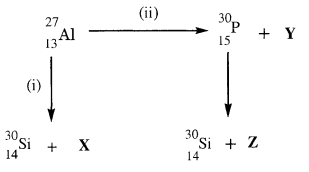
Bombardment of aluminum by $\alpha$-particle leads to its artificial disintegration in two ways,$(i)$ and $(ii)$ as shown. Products $X,$ $Y$ and $Z$ respectively are,
A
proton,neutron,positron
B
neutron,positron,proton
C
proton,positron,neutron
D
positron,proton,neutron
Solution
(A) The reaction for path $(i)$ is: ${ }_{13}^{27} Al +{ }_2^4 \alpha \rightarrow{ }_{14}^{30} Si +{ }_1^1 p (X)$.
Here,$X$ is a proton $({ }_1^1 p)$ because the mass number and atomic number are conserved ($27+4 = 30+1$ and $13+2 = 14+1$).
The reaction for path $(ii)$ is: ${ }_{13}^{27} Al +{ }_2^4 \alpha \rightarrow{ }_{15}^{30} P +{ }_0^1 n (Y)$.
Here,$Y$ is a neutron $({ }_0^1 n)$ because the mass number and atomic number are conserved ($27+4 = 30+1$ and $13+2 = 15+0$).
The subsequent decay of phosphorus is: ${ }_{15}^{30} P \rightarrow{ }_{14}^{30} Si +{ }_{+1}^{0} e (Z)$.
Here,$Z$ is a positron $({ }_{+1}^{0} e)$ because the atomic number decreases by $1$.
Therefore,$X$ is proton,$Y$ is neutron,and $Z$ is positron.
Thus,the correct option is $A$.
Here,$X$ is a proton $({ }_1^1 p)$ because the mass number and atomic number are conserved ($27+4 = 30+1$ and $13+2 = 14+1$).
The reaction for path $(ii)$ is: ${ }_{13}^{27} Al +{ }_2^4 \alpha \rightarrow{ }_{15}^{30} P +{ }_0^1 n (Y)$.
Here,$Y$ is a neutron $({ }_0^1 n)$ because the mass number and atomic number are conserved ($27+4 = 30+1$ and $13+2 = 15+0$).
The subsequent decay of phosphorus is: ${ }_{15}^{30} P \rightarrow{ }_{14}^{30} Si +{ }_{+1}^{0} e (Z)$.
Here,$Z$ is a positron $({ }_{+1}^{0} e)$ because the atomic number decreases by $1$.
Therefore,$X$ is proton,$Y$ is neutron,and $Z$ is positron.
Thus,the correct option is $A$.
0 likes
View Solution59
DifficultMCQ
In the nuclear transmutation $_4^9 Be + X \longrightarrow _4^8 Be + Y$,the pair $(X, Y)$ is (are):
A
$(A) (\gamma, n)$
B
$(B) (p, D)$
C
$(C) (n, D)$
D
$(D) (\gamma, p)$
Solution
(A) The given nuclear reaction is $_4^9 Be + X \longrightarrow _4^8 Be + Y$.
For the reaction to be balanced,the sum of atomic numbers and mass numbers must be conserved on both sides.
Case $1$: If $X = \gamma$ (photon,$0^0\gamma$),then $_4^9 Be + _0^0\gamma \longrightarrow _4^8 Be + _0^1 n$. Here $Y = n$ (neutron).
Case $2$: If $X = p$ (proton,$_1^1 p$),then $_4^9 Be + _1^1 p \longrightarrow _4^8 Be + _1^2 D$. Here $Y = D$ (deuteron).
Thus,both $(A)$ and $(B)$ are valid pairs for $(X, Y)$.
For the reaction to be balanced,the sum of atomic numbers and mass numbers must be conserved on both sides.
Case $1$: If $X = \gamma$ (photon,$0^0\gamma$),then $_4^9 Be + _0^0\gamma \longrightarrow _4^8 Be + _0^1 n$. Here $Y = n$ (neutron).
Case $2$: If $X = p$ (proton,$_1^1 p$),then $_4^9 Be + _1^1 p \longrightarrow _4^8 Be + _1^2 D$. Here $Y = D$ (deuteron).
Thus,both $(A)$ and $(B)$ are valid pairs for $(X, Y)$.
0 likes
View Solution60
DifficultMCQ
$A$ closed vessel with rigid walls contains $1 \ mol$ of ${ }_{92}^{238} U$ and $1 \ mol$ of air at $298 \ K$. Considering the complete decay of ${ }_{92}^{238} U$ to ${ }_{82}^{206} Pb$, the ratio of the final pressure to the initial pressure of the system at $298 \ K$ is:
A
$6$
B
$7$
C
$8$
D
$9$
Solution
(D) The nuclear decay reaction for ${ }_{92}^{238} U$ to ${ }_{82}^{206} Pb$ is given by: ${ }_{92}^{238} U \rightarrow { }_{82}^{206} Pb + 8 { }_{2}^{4} He + 6 { }_{-1}^{0} e$.
Initially, the system contains $1 \ mol$ of air (gaseous) and $1 \ mol$ of solid ${ }_{92}^{238} U$.
Since the vessel is rigid and the temperature is constant at $298 \ K$, the pressure is directly proportional to the number of moles of gas present $(P \propto n_{gas})$.
Initial moles of gas $(n_i)$ = $1 \ mol$ (air).
After complete decay, the solid ${ }_{92}^{238} U$ is converted into $1 \ mol$ of solid ${ }_{82}^{206} Pb$ and $8 \ mol$ of gaseous ${ }_{2}^{4} He$ ($\alpha$-particles).
The final moles of gas $(n_f)$ = $1 \ mol$ (air) + $8 \ mol$ (He) = $9 \ mol$.
The ratio of the final pressure to the initial pressure is given by $P_f / P_i = n_f / n_i = 9 / 1 = 9$.
Initially, the system contains $1 \ mol$ of air (gaseous) and $1 \ mol$ of solid ${ }_{92}^{238} U$.
Since the vessel is rigid and the temperature is constant at $298 \ K$, the pressure is directly proportional to the number of moles of gas present $(P \propto n_{gas})$.
Initial moles of gas $(n_i)$ = $1 \ mol$ (air).
After complete decay, the solid ${ }_{92}^{238} U$ is converted into $1 \ mol$ of solid ${ }_{82}^{206} Pb$ and $8 \ mol$ of gaseous ${ }_{2}^{4} He$ ($\alpha$-particles).
The final moles of gas $(n_f)$ = $1 \ mol$ (air) + $8 \ mol$ (He) = $9 \ mol$.
The ratio of the final pressure to the initial pressure is given by $P_f / P_i = n_f / n_i = 9 / 1 = 9$.
0 likes
View Solution61
DifficultMCQ
An element ${ }_{x} A^{y}$ emits $5$ $\alpha$ and $4$ $\beta$ particles to give ${ }_{82} B^{207}$. The number of protons and neutrons in $A$ are respectively
A
$88, 227$
B
$88, 139$
C
$82, 227$
D
$84, 139$
Solution
(B) The nuclear reaction is given by: ${ }_{x} A^{y} \longrightarrow { }_{82} B^{207} + 5 { }_{2} \alpha^{4} + 4 { }_{-1} \beta^{0}$
By balancing the atomic number $(x)$: $x = 82 + (5 \times 2) + (4 \times -1) = 82 + 10 - 4 = 88$
By balancing the mass number $(y)$: $y = 207 + (5 \times 4) + (4 \times 0) = 207 + 20 = 227$
Thus,the element $A$ is ${ }_{88} A^{227}$.
Number of protons = $88$
Number of neutrons = $227 - 88 = 139$
By balancing the atomic number $(x)$: $x = 82 + (5 \times 2) + (4 \times -1) = 82 + 10 - 4 = 88$
By balancing the mass number $(y)$: $y = 207 + (5 \times 4) + (4 \times 0) = 207 + 20 = 227$
Thus,the element $A$ is ${ }_{88} A^{227}$.
Number of protons = $88$
Number of neutrons = $227 - 88 = 139$
0 likes
View Solution62
MediumMCQ
$_6C^{12}$ and $_1T^3$ are formed in nature due to the nuclear reaction of a neutron with:
A
$_7N^{14}$
B
$_6C^{13}$
C
$_2He^4$
D
$_3Li^6$
Solution
(A) The balanced nuclear reaction is:
$_7N^{14} + _0n^1 \longrightarrow _6C^{12} + _1T^3$
Here,$_1T^3$ (Tritium) is a radioactive isotope of hydrogen,which is produced in the upper atmosphere by the interaction of cosmic ray neutrons with nitrogen-$14$ nuclei.
$_7N^{14} + _0n^1 \longrightarrow _6C^{12} + _1T^3$
Here,$_1T^3$ (Tritium) is a radioactive isotope of hydrogen,which is produced in the upper atmosphere by the interaction of cosmic ray neutrons with nitrogen-$14$ nuclei.
0 likes
View Solution63
MediumMCQ
What is $X$ in the following reaction?
${}_{12}Mg^{26} + {}_{1}H^{2} \longrightarrow {}_{12}Mg^{27} + X$
${}_{12}Mg^{26} + {}_{1}H^{2} \longrightarrow {}_{12}Mg^{27} + X$
A
$\gamma$-ray
B
${}_{0}n^{1}$
C
${}_{1}H^{1}$
D
${}_{1}D^{2}$
Solution
(C) In a nuclear reaction,the sum of atomic numbers and the sum of mass numbers must be conserved on both sides.
For atomic numbers: $12 + 1 = 12 + Z$,which gives $Z = 1$.
For mass numbers: $26 + 2 = 27 + A$,which gives $A = 1$.
Since the atomic number is $1$ and the mass number is $1$,the particle $X$ is a proton,represented as ${}_{1}H^{1}$.
For atomic numbers: $12 + 1 = 12 + Z$,which gives $Z = 1$.
For mass numbers: $26 + 2 = 27 + A$,which gives $A = 1$.
Since the atomic number is $1$ and the mass number is $1$,the particle $X$ is a proton,represented as ${}_{1}H^{1}$.
0 likes
View Solution64
EasyMCQ
$_{98}Cf^{246}$ was formed along with a neutron when an unknown radioactive substance was bombarded with $_{6}C^{12}$. The unknown substance was:
A
$_{91}Pa^{234}$
B
$_{90}Th^{234}$
C
$_{92}U^{235}$
D
$_{92}U^{238}$
Solution
(C) Let the unknown substance be $_{Z}X^{A}$.
The nuclear reaction is: $_{Z}X^{A} + _{6}C^{12} \rightarrow _{98}Cf^{246} + _{0}n^{1}$.
According to the law of conservation of mass number: $A + 12 = 246 + 1$,which gives $A = 235$.
According to the law of conservation of atomic number: $Z + 6 = 98$,which gives $Z = 92$.
The element with atomic number $92$ is Uranium $(U)$.
Therefore,the unknown substance is $_{92}U^{235}$.
The nuclear reaction is: $_{Z}X^{A} + _{6}C^{12} \rightarrow _{98}Cf^{246} + _{0}n^{1}$.
According to the law of conservation of mass number: $A + 12 = 246 + 1$,which gives $A = 235$.
According to the law of conservation of atomic number: $Z + 6 = 98$,which gives $Z = 92$.
The element with atomic number $92$ is Uranium $(U)$.
Therefore,the unknown substance is $_{92}U^{235}$.
0 likes
View Solution65
EasyMCQ
$_{5}B^{10} + _{2}He^{4} \rightarrow X + _{0}n^{1}$
In the above nuclear reaction '$X$' will be
In the above nuclear reaction '$X$' will be
A
$_{7}N^{14}$
B
$_{7}N^{13}$
C
$_{6}C^{12}$
D
$_{7}N^{15}$
Solution
(B) The given nuclear reaction is: $_{5}B^{10} + _{2}He^{4} \rightarrow _{b}^{a}X + _{0}n^{1}$
By balancing the atomic numbers (sum of protons):
$5 + 2 = b + 0$
$b = 7$
By balancing the mass numbers (sum of protons and neutrons):
$10 + 4 = a + 1$
$14 = a + 1$
$a = 13$
Therefore,the product $X$ is $_{7}N^{13}$.
By balancing the atomic numbers (sum of protons):
$5 + 2 = b + 0$
$b = 7$
By balancing the mass numbers (sum of protons and neutrons):
$10 + 4 = a + 1$
$14 = a + 1$
$a = 13$
Therefore,the product $X$ is $_{7}N^{13}$.
0 likes
View Solution66
MediumMCQ
For the reaction $^{14}N + \alpha \longrightarrow {}^{17}O + p$,$1.16 \ MeV$ (Mass equivalent $= 0.00124 \ amu$) of energy is absorbed. Mass on the reactant side is $18.00567 \ amu$ and proton mass $= 1.00782 \ amu$. The atomic mass of ${}^{17}O$ will be (in $amu$)
A
$17.0044$
B
$16.9991$
C
$17.0114$
D
$16.9966$
Solution
(B) The reaction is $^{14}N + {}_{2}^{4}He \rightarrow {}^{17}O + {}_{1}^{1}H$.
Since energy is absorbed,the mass of the products is greater than the mass of the reactants.
Mass defect $(\Delta m) = 0.00124 \ amu$.
$(m_{{}^{17}O} + m_{p}) - (m_{reactants}) = \Delta m$.
$m_{{}^{17}O} + 1.00782 \ amu - 18.00567 \ amu = 0.00124 \ amu$.
$m_{{}^{17}O} = 18.00567 + 0.00124 - 1.00782 = 16.99909 \ amu$.
Rounding to four decimal places,we get $16.9991 \ amu$.
Since energy is absorbed,the mass of the products is greater than the mass of the reactants.
Mass defect $(\Delta m) = 0.00124 \ amu$.
$(m_{{}^{17}O} + m_{p}) - (m_{reactants}) = \Delta m$.
$m_{{}^{17}O} + 1.00782 \ amu - 18.00567 \ amu = 0.00124 \ amu$.
$m_{{}^{17}O} = 18.00567 + 0.00124 - 1.00782 = 16.99909 \ amu$.
Rounding to four decimal places,we get $16.9991 \ amu$.
0 likes
View SolutionNuclear Chemistry — Artificial transmutation · Frequently Asked Questions
1Are these Nuclear Chemistry questions useful for JEE and NEET?
Yes. All questions in this section are mapped to JEE Main and NEET exam patterns. Previous year questions from JEE Main, NEET, GUJCET and state-level exams are included with full solutions.
2Can I switch to Hindi or Gujarati for these questions?
Yes. Use the language tabs in the hero section or the sidebar to view the same questions and solutions in English, Hindi or Gujarati.
3How do I generate a question paper from this subtopic?
Use the Vedclass Exam Paper Generator — select the chapter and subtopic, set difficulty, and generate Sets A, B, C, D automatically. First 3 chapters of every subject are free.
Vedclass Products
For Students
Vedclass Test Series
Mock tests in real JEE/NEET style with performance analysis. 5-day free trial.
Start Free TrialFor Teachers
Exam Paper Generator
Generate Set A/B/C/D papers from this chapter in 2 minutes. 3 chapters free.
Try FreeFor Institutes
Online Exam Module
Live online exams with unlimited students, 360° analytics & white-label branding.
See DemoFor Teachers & Institutes
Generate a Nuclear Chemistry Exam Paper in 2 Minutes
Select subtopic & difficulty — Sets A, B, C, D auto-generated with No Repeat logic.
First 3 chapters of every subject are free — no payment required.