
A English
Roasting and Calcination Questions in English
Class 12 Chemistry · General Principles and Processes of Isolation of Elements · Roasting and Calcination
89+
Questions
English
Language
100%
With Solutions
Showing 38 of 89 questions in English
51
MediumMCQ
The pair that does $Not$ require calcination is
A
$ZnO$ and $MgO$
B
$ZnO$ and $Fe_2O_3 \cdot xH_2O$
C
$ZnCO_3$ and $CaO$
D
$Fe_2O_3$ and $CaCO_3 \cdot MgCO_3$
Solution
(A) Calcination is a process of heating an ore in a limited supply of air to convert carbonates or hydrated oxides into their respective metal oxides.
$ZnO$ and $MgO$ are already present in their oxide forms,hence they do not require calcination.
$ZnO$ and $MgO$ are already present in their oxide forms,hence they do not require calcination.
0 likes
View Solution52
MediumMCQ
$A$ sulphide ore is first converted into its oxide before reduction. This is done because
A
a sulphide ore cannot be reduced to metal at all
B
no reducing agent is found suitable for reducing a sulphide ore
C
the enthalpy of formation of $CO_2$ is more than that of $CS_2$
D
a metal oxide is generally less stable than the metal sulphide
Solution
(C) The reduction of metal sulphides to metals is thermodynamically unfavorable compared to the reduction of metal oxides.
Metal oxides are generally easier to reduce using common reducing agents like $C$ or $CO$ because the formation of $CO_2$ is highly exothermic.
In contrast,the reduction of metal sulphides is difficult and often requires more energy.
Therefore,sulphide ores are first converted into metal oxides through a process called roasting,which makes the subsequent reduction to metal much more efficient.
Metal oxides are generally easier to reduce using common reducing agents like $C$ or $CO$ because the formation of $CO_2$ is highly exothermic.
In contrast,the reduction of metal sulphides is difficult and often requires more energy.
Therefore,sulphide ores are first converted into metal oxides through a process called roasting,which makes the subsequent reduction to metal much more efficient.
0 likes
View Solution53
MediumMCQ
Choose the correct code regarding the Roasting process.
$I$. It is the process of heating ore in air to obtain the oxide.
$II$. It is an exothermic process.
$III$. It is used for hydrated oxide and oxysalt ore.
$IV$. It is used after the concentration of ore.
$I$. It is the process of heating ore in air to obtain the oxide.
$II$. It is an exothermic process.
$III$. It is used for hydrated oxide and oxysalt ore.
$IV$. It is used after the concentration of ore.
A
$I, II$ and $III$
B
$I, II$ and $IV$
C
$I, III$ and $IV$
D
$I, II, III$ and $IV$
Solution
(B) Roasting is a metallurgical process in which an ore is heated in a regular supply of air at a temperature below the melting point of the metal.
$I$. Roasting is used to convert sulfide ores into oxides. This statement is correct.
$II$. Roasting is generally an exothermic process because the oxidation of sulfide ores releases a significant amount of heat. This statement is correct.
$III$. Heating hydrated oxides and oxysalt ores to remove moisture and volatile impurities is known as Calcination,not Roasting. This statement is incorrect.
$IV$. Roasting is performed after the concentration of the ore to convert the concentrated ore into a form suitable for reduction. This statement is correct.
Therefore,statements $I, II,$ and $IV$ are correct.
$I$. Roasting is used to convert sulfide ores into oxides. This statement is correct.
$II$. Roasting is generally an exothermic process because the oxidation of sulfide ores releases a significant amount of heat. This statement is correct.
$III$. Heating hydrated oxides and oxysalt ores to remove moisture and volatile impurities is known as Calcination,not Roasting. This statement is incorrect.
$IV$. Roasting is performed after the concentration of the ore to convert the concentrated ore into a form suitable for reduction. This statement is correct.
Therefore,statements $I, II,$ and $IV$ are correct.
0 likes
View Solution54
EasyMCQ
Which reaction is not possible for calcination?
A
$PbSO_4 \to PbO$
B
$PbCO_3 \to PbO$
C
$PbS \to PbSO_4$
D
$Fe_2O_3 \cdot 3H_2O \to Fe_2O_3$
Solution
(C) Calcination is a process of heating an ore in a limited supply of air or in the absence of air to remove volatile impurities or water of hydration,or to decompose carbonates into oxides.
$PbCO_3 \to PbO + CO_2$ is a calcination reaction.
$Fe_2O_3 \cdot 3H_2O \to Fe_2O_3 + 3H_2O$ is a calcination reaction (removal of water).
$PbS \to PbSO_4$ is an oxidation reaction (roasting),not calcination,as it involves the addition of oxygen to a sulfide ore.
$PbSO_4$ is already an oxidized form and does not undergo calcination under standard conditions.
Therefore,the reaction $PbS \to PbSO_4$ is a roasting process,not calcination.
$PbCO_3 \to PbO + CO_2$ is a calcination reaction.
$Fe_2O_3 \cdot 3H_2O \to Fe_2O_3 + 3H_2O$ is a calcination reaction (removal of water).
$PbS \to PbSO_4$ is an oxidation reaction (roasting),not calcination,as it involves the addition of oxygen to a sulfide ore.
$PbSO_4$ is already an oxidized form and does not undergo calcination under standard conditions.
Therefore,the reaction $PbS \to PbSO_4$ is a roasting process,not calcination.
0 likes
View Solution55
EasyMCQ
Which of the following changes is not observed when an ore is heated for calcination?
A
$PbSO_4 \rightarrow PbO$
B
$PbCO_3 \rightarrow PbO$
C
$PbS \rightarrow PbSO_4$
D
$Fe_2O_3 \cdot 3H_2O \rightarrow Fe_2O_3$
Solution
(C) Calcination is the process of heating an ore strongly in the absence of air to remove volatile impurities or moisture and to convert carbonates or hydroxides into oxides.
$PbCO_3 \rightarrow PbO + CO_2$ (Calcination)
$Fe_2O_3 \cdot 3H_2O \rightarrow Fe_2O_3 + 3H_2O$ (Calcination)
$PbS + 1.5O_2 \rightarrow PbO + SO_2$ (Roasting)
$PbS + 2O_2 \rightarrow PbSO_4$ (Roasting)
$PbSO_4$ is typically formed during the roasting of sulfide ores,not calcination.
Therefore,the change $PbS \rightarrow PbSO_4$ is not observed during calcination.
$PbCO_3 \rightarrow PbO + CO_2$ (Calcination)
$Fe_2O_3 \cdot 3H_2O \rightarrow Fe_2O_3 + 3H_2O$ (Calcination)
$PbS + 1.5O_2 \rightarrow PbO + SO_2$ (Roasting)
$PbS + 2O_2 \rightarrow PbSO_4$ (Roasting)
$PbSO_4$ is typically formed during the roasting of sulfide ores,not calcination.
Therefore,the change $PbS \rightarrow PbSO_4$ is not observed during calcination.
0 likes
View Solution56
EasyMCQ
Which of the following statements is not correct regarding calcination?
A
Impurities are removed in the form of elemental vapours
B
Carbonate ores convert into their oxides
C
Temperature of the process is maintained below the melting point of the mixture
D
Lower oxidation state oxides are oxidised further
Solution
(A) Calcination is a process of heating an ore in a limited supply of air or in the absence of air to a temperature below its melting point.
$1$. Carbonate ores decompose to form oxides (e.g.,$ZnCO_3 \rightarrow ZnO + CO_2$).
$2$. Moisture and volatile impurities are removed.
$3$. The process is kept below the melting point to prevent fusion.
$4$. Option $A$ is incorrect because the removal of impurities as elemental vapours is characteristic of roasting or specific distillation processes,not calcination.
$5$. Option $D$ is incorrect because calcination does not involve oxidation; in fact,it is often used for ores that are already in the desired oxidation state or to remove volatile components.
$1$. Carbonate ores decompose to form oxides (e.g.,$ZnCO_3 \rightarrow ZnO + CO_2$).
$2$. Moisture and volatile impurities are removed.
$3$. The process is kept below the melting point to prevent fusion.
$4$. Option $A$ is incorrect because the removal of impurities as elemental vapours is characteristic of roasting or specific distillation processes,not calcination.
$5$. Option $D$ is incorrect because calcination does not involve oxidation; in fact,it is often used for ores that are already in the desired oxidation state or to remove volatile components.
0 likes
View Solution57
MediumMCQ
The process of converting hydrated alumina into anhydrous alumina is known as .......
A
Roasting
B
Smelting
C
Concentration
D
Calcination
Solution
(D) The conversion of hydrated alumina $(Al_2O_3 \cdot 2H_2O)$ into anhydrous alumina $(Al_2O_3)$ is achieved by heating the ore in the absence of air or in a limited supply of air. This process is known as $Calcination$. The chemical reaction is: $Al_2O_3 \cdot 2H_2O(s) \xrightarrow{\Delta} Al_2O_3(s) + 2H_2O(g)$.
0 likes
View Solution58
EasyMCQ
What is the function of calcination in metallurgy?
A
To remove moisture
B
To decompose carbonates
C
To remove organic matter
D
All of the above
Solution
(D) Calcination is a process of heating an ore strongly in a limited supply of air or in the absence of air.
Its main functions are:
$1$. To remove moisture from the ore.
$2$. To remove volatile impurities and organic matter.
$3$. To decompose carbonates into oxides (e.g.,$CaCO_3 \rightarrow CaO + CO_2$).
Therefore,all the given options are correct.
Its main functions are:
$1$. To remove moisture from the ore.
$2$. To remove volatile impurities and organic matter.
$3$. To decompose carbonates into oxides (e.g.,$CaCO_3 \rightarrow CaO + CO_2$).
Therefore,all the given options are correct.
0 likes
View Solution59
MediumMCQ
Which of the following is an example of the calcination process?
A
$2Ag + 2HCl + [O] \to 2AgCl + H_2O$
B
$2Zn + O_2 \to 2ZnO$
C
$2ZnS + 3O_2 \to 2ZnO + 2SO_2$
D
$MgCO_3 \to MgO + CO_2$
Solution
(D) Calcination is the process of heating an ore strongly in the absence of air or in a limited supply of air to remove volatile impurities and moisture.
It is typically used for carbonate or hydroxide ores.
In the reaction $MgCO_3 \to MgO + CO_2$,magnesium carbonate is heated to produce magnesium oxide and carbon dioxide,which is a classic example of calcination.
Option $A$ represents a leaching process,while options $B$ and $C$ represent roasting processes.
It is typically used for carbonate or hydroxide ores.
In the reaction $MgCO_3 \to MgO + CO_2$,magnesium carbonate is heated to produce magnesium oxide and carbon dioxide,which is a classic example of calcination.
Option $A$ represents a leaching process,while options $B$ and $C$ represent roasting processes.
0 likes
View Solution60
EasyMCQ
What is the process of heating pyrites to remove sulfur called?
A
Smelting
B
Calcination
C
Liquation
D
Roasting
Solution
(D) The process of heating a sulfide ore in the presence of excess air to remove sulfur as sulfur dioxide $(SO_2)$ is known as roasting.
For example,$2FeS_2 + \frac{11}{2}O_2 \rightarrow Fe_2O_3 + 4SO_2$.
For example,$2FeS_2 + \frac{11}{2}O_2 \rightarrow Fe_2O_3 + 4SO_2$.
0 likes
View Solution61
EasyMCQ
What is the process of heating an ore in the absence of air at a temperature below its melting point called?
A
Leaching
B
Roasting
C
Smelting
D
Calcination
Solution
(D) The process of heating an ore in the absence of air at a temperature below its melting point is known as $Calcination$.
$Calcination$ is typically used for carbonate and hydroxide ores to remove volatile impurities and moisture,and to convert the ore into its oxide form.
$Calcination$ is typically used for carbonate and hydroxide ores to remove volatile impurities and moisture,and to convert the ore into its oxide form.
0 likes
View Solution62
EasyMCQ
During which of the following processes is an ore converted into its oxide?
A
Roasting
B
Calcination
C
Reduction
D
Both $A$ and $B$
Solution
(D) Both $Roasting$ and $Calcination$ are metallurgical processes used to convert ores into their respective metal oxides.
$Roasting$ involves heating the ore in the presence of excess air (usually for sulfide ores).
$Calcination$ involves heating the ore in the absence or limited supply of air (usually for carbonate or hydrated ores).
Therefore,both processes result in the formation of metal oxides.
$Roasting$ involves heating the ore in the presence of excess air (usually for sulfide ores).
$Calcination$ involves heating the ore in the absence or limited supply of air (usually for carbonate or hydrated ores).
Therefore,both processes result in the formation of metal oxides.
0 likes
View Solution63
EasyMCQ
In metallurgy,calcination is used for .........
A
removing water and sulphides
B
removing water and $CO_2$
C
removing $H_2S$ and $CO_2$
D
removing water and $H_2S$
Solution
(B) Calcination is a process of heating an ore strongly in a limited supply of air or in the absence of air.
It is primarily used to remove volatile impurities like water (moisture) and carbon dioxide $(CO_2)$ from carbonate ores.
For example,$ZnCO_3 \xrightarrow{\Delta} ZnO + CO_2 \uparrow$.
It is primarily used to remove volatile impurities like water (moisture) and carbon dioxide $(CO_2)$ from carbonate ores.
For example,$ZnCO_3 \xrightarrow{\Delta} ZnO + CO_2 \uparrow$.
0 likes
View Solution64
MediumMCQ
The mixture obtained from the roasting of copper pyrites is ......... .
A
$Cu_2S + FeO + O_2$
B
$Cu_2O + FeS + SO_2$
C
$Cu_2S + FeS + SO_2$
D
$Cu_2S + FeS + O_2$
Solution
(C) Copper pyrites is $CuFeS_2$. During the roasting process,$CuFeS_2$ is heated in the presence of air (oxygen).
The chemical reaction is: $2CuFeS_2 + O_2 \rightarrow Cu_2S + 2FeS + SO_2$.
Thus,the mixture obtained after roasting consists of $Cu_2S$,$FeS$,and $SO_2$ gas is evolved.
The chemical reaction is: $2CuFeS_2 + O_2 \rightarrow Cu_2S + 2FeS + SO_2$.
Thus,the mixture obtained after roasting consists of $Cu_2S$,$FeS$,and $SO_2$ gas is evolved.
0 likes
View Solution65
MediumMCQ
$2CuFeS_2 + O_2 \rightarrow Cu_2S + 2FeS + SO_2$
Which process of metallurgy of copper is represented by the above equation?
Which process of metallurgy of copper is represented by the above equation?
A
Concentration
B
Roasting
C
Reduction
D
Purification
Solution
(B) Roasting is the process in which the ore is strongly heated in the presence of excess air.
In the extraction of copper,after crushing and concentration of the ore,it is heated in a reverberatory furnace.
Copper pyrites $(CuFeS_2)$ is partially oxidized,and a part of the sulfur in the ore is removed as sulfur dioxide $(SO_2)$.
The given equation $2CuFeS_2 + O_2 \rightarrow Cu_2S + 2FeS + SO_2$ represents the partial roasting of copper pyrites.
In the extraction of copper,after crushing and concentration of the ore,it is heated in a reverberatory furnace.
Copper pyrites $(CuFeS_2)$ is partially oxidized,and a part of the sulfur in the ore is removed as sulfur dioxide $(SO_2)$.
The given equation $2CuFeS_2 + O_2 \rightarrow Cu_2S + 2FeS + SO_2$ represents the partial roasting of copper pyrites.
0 likes
View Solution66
Difficult
Write the chemical reactions taking place in the extraction of zinc from zinc blende.
Solution
(N/A) The extraction of zinc from zinc blende $(ZnS)$ involves the following steps:
$(i)$ Concentration of ore: The ore is concentrated by the froth floatation process.
$(ii)$ Roasting: The concentrated ore is heated in a regular supply of air to convert it into zinc oxide.
$2 ZnS + 3 O_{2} \longrightarrow 2 ZnO + 2 SO_{2}$
$(iii)$ Reduction: Zinc oxide is reduced to zinc metal by heating it with coke.
$ZnO + C \xrightarrow{673 \ K} Zn + CO$
$(iv)$ Electrolytic Refining: The impure zinc is refined by electrolysis using an acidified solution of zinc sulphate $(ZnSO_{4})$ as the electrolyte,with impure zinc as the anode and pure zinc as the cathode.
Anode: $Zn \longrightarrow Zn^{2+} + 2e^{-}$
Cathode: $Zn^{2+} + 2e^{-} \longrightarrow Zn$
$(i)$ Concentration of ore: The ore is concentrated by the froth floatation process.
$(ii)$ Roasting: The concentrated ore is heated in a regular supply of air to convert it into zinc oxide.
$2 ZnS + 3 O_{2} \longrightarrow 2 ZnO + 2 SO_{2}$
$(iii)$ Reduction: Zinc oxide is reduced to zinc metal by heating it with coke.
$ZnO + C \xrightarrow{673 \ K} Zn + CO$
$(iv)$ Electrolytic Refining: The impure zinc is refined by electrolysis using an acidified solution of zinc sulphate $(ZnSO_{4})$ as the electrolyte,with impure zinc as the anode and pure zinc as the cathode.
Anode: $Zn \longrightarrow Zn^{2+} + 2e^{-}$
Cathode: $Zn^{2+} + 2e^{-} \longrightarrow Zn$
1 likes
View Solution67
Medium
Giving examples,differentiate between 'roasting' and 'calcination'.
Solution
(N/A) Roasting is the process of converting sulphide ores to oxides by heating the ores in a regular supply of air at a temperature below the melting point of the metal. For example,sulphide ores of $Zn$,$Pb$,and $Cu$ are converted to their respective oxides by this process.
$2ZnS + 3O_2 \xrightarrow{\Delta} 2ZnO + 2SO_2$
$2PbS + 3O_2 \xrightarrow{\Delta} 2PbO + 2SO_2$
$2Cu_2S + 3O_2 \xrightarrow{\Delta} 2Cu_2O + 2SO_2$
On the other hand,calcination is the process of converting hydroxide and carbonate ores to oxides by heating the ores either in the absence or in a limited supply of air at a temperature below the melting point of the metal. This process causes the escaping of volatile matter leaving behind the metal oxide. For example,hydroxide of $Fe$,carbonates of $Zn$,$Ca$,and $Mg$ are converted to their respective oxides by this process.
$Fe_2O_3 \cdot 3H_2O \xrightarrow{\Delta} Fe_2O_3 + 3H_2O$
$ZnCO_3(s) \xrightarrow{\Delta} ZnO(s) + CO_2(g)$
$CaMg(CO_3)_2 \xrightarrow{\Delta} CaO(s) + MgO(s) + 2CO_2(g)$
$2ZnS + 3O_2 \xrightarrow{\Delta} 2ZnO + 2SO_2$
$2PbS + 3O_2 \xrightarrow{\Delta} 2PbO + 2SO_2$
$2Cu_2S + 3O_2 \xrightarrow{\Delta} 2Cu_2O + 2SO_2$
On the other hand,calcination is the process of converting hydroxide and carbonate ores to oxides by heating the ores either in the absence or in a limited supply of air at a temperature below the melting point of the metal. This process causes the escaping of volatile matter leaving behind the metal oxide. For example,hydroxide of $Fe$,carbonates of $Zn$,$Ca$,and $Mg$ are converted to their respective oxides by this process.
$Fe_2O_3 \cdot 3H_2O \xrightarrow{\Delta} Fe_2O_3 + 3H_2O$
$ZnCO_3(s) \xrightarrow{\Delta} ZnO(s) + CO_2(g)$
$CaMg(CO_3)_2 \xrightarrow{\Delta} CaO(s) + MgO(s) + 2CO_2(g)$
0 likes
View Solution68
Medium
In what form should the concentrated ore be converted? Why?
Solution
(N/A) The concentrated ore should be converted into a form that is suitable for reduction. Generally,sulfide ores are converted into oxides before reduction because it is easier to reduce metal oxides than other compounds like sulfides or carbonates.
0 likes
View Solution69
Medium
Explain Calcination and Roasting in detail.
Solution
(N/A) There are two methods to convert concentrated ore into oxide: $(A)$ Calcination and $(B)$ Roasting.
$(A)$ Calcination: Calcination involves heating the ore in the absence of air or in a limited supply of air. This process removes volatile impurities and leaves behind the metal oxide.
$Fe_{2}O_{3} \cdot xH_{2}O_{(s)} \stackrel{\Delta}{\longrightarrow} Fe_{2}O_{3(s)} + xH_{2}O_{(g)}$
$ZnCO_{3(s)} \stackrel{\Delta}{\longrightarrow} ZnO_{(s)} + CO_{2(g)}$
$CaCO_{3} \cdot MgCO_{3(s)} \stackrel{\Delta}{\longrightarrow} CaO_{(s)} + MgO_{(s)} + 2CO_{2(g)}$
$(B)$ Roasting: In roasting,the ore is heated in a regular supply of air at a temperature below the melting point of the metal.
Some processes involving sulfide ores are:
$2ZnS + 3O_{2} \rightarrow 2ZnO + 2SO_{2}$
$2PbS + 3O_{2} \rightarrow 2PbO + 2SO_{2}$
$2Cu_{2}S + 3O_{2} \rightarrow 2Cu_{2}O + 2SO_{2}$
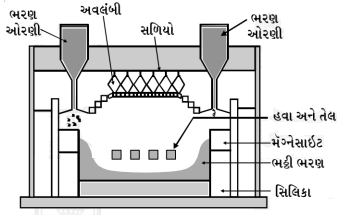
Copper sulfide ore is heated in a reverberatory furnace. If the ore contains iron,it is mixed with silica before heating. Iron oxide is removed as iron silicate 'slag' and copper is obtained in the form of 'copper matte' which contains $Cu_{2}S$ and $FeS$.
$FeO + SiO_{2} \rightarrow FeSiO_{3}$
The $SO_{2}$ gas produced is used in the production of $H_{2}SO_{4}$.
$(A)$ Calcination: Calcination involves heating the ore in the absence of air or in a limited supply of air. This process removes volatile impurities and leaves behind the metal oxide.
$Fe_{2}O_{3} \cdot xH_{2}O_{(s)} \stackrel{\Delta}{\longrightarrow} Fe_{2}O_{3(s)} + xH_{2}O_{(g)}$
$ZnCO_{3(s)} \stackrel{\Delta}{\longrightarrow} ZnO_{(s)} + CO_{2(g)}$
$CaCO_{3} \cdot MgCO_{3(s)} \stackrel{\Delta}{\longrightarrow} CaO_{(s)} + MgO_{(s)} + 2CO_{2(g)}$
$(B)$ Roasting: In roasting,the ore is heated in a regular supply of air at a temperature below the melting point of the metal.
Some processes involving sulfide ores are:
$2ZnS + 3O_{2} \rightarrow 2ZnO + 2SO_{2}$
$2PbS + 3O_{2} \rightarrow 2PbO + 2SO_{2}$
$2Cu_{2}S + 3O_{2} \rightarrow 2Cu_{2}O + 2SO_{2}$
Copper sulfide ore is heated in a reverberatory furnace. If the ore contains iron,it is mixed with silica before heating. Iron oxide is removed as iron silicate 'slag' and copper is obtained in the form of 'copper matte' which contains $Cu_{2}S$ and $FeS$.
$FeO + SiO_{2} \rightarrow FeSiO_{3}$
The $SO_{2}$ gas produced is used in the production of $H_{2}SO_{4}$.
0 likes
View Solution70
Medium
What are the methods to convert concentrated ore into oxide? Explain them in detail.
Solution
(N/A) There are two main methods to convert concentrated ore into oxide: $(A)$ Calcination and $(B)$ Roasting.
$(A)$ Calcination: Calcination involves heating the ore in the absence or limited supply of air. This process removes volatile impurities and leaves behind the metal oxide.
$Fe_2O_3 \cdot xH_2O(s) \xrightarrow{\Delta} Fe_2O_3(s) + xH_2O(g)$
$ZnCO_3(s) \xrightarrow{\Delta} ZnO(s) + CO_2(g)$
$CaCO_3 \cdot MgCO_3(s) \xrightarrow{\Delta} CaO(s) + MgO(s) + 2CO_2(g)$
$(B)$ Roasting: In roasting,the ore is heated in a regular supply of air at a temperature below the melting point of the metal.
Some processes involving sulfide ores are:
$2ZnS + 3O_2 \rightarrow 2ZnO + 2SO_2$
$2PbS + 3O_2 \rightarrow 2PbO + 2SO_2$
$2Cu_2S + 3O_2 \rightarrow 2Cu_2O + 2SO_2$
Copper sulfide ore is heated in a reverberatory furnace. If the ore contains iron,it is mixed with silica before heating. Iron oxide is removed as iron silicate slag $(FeSiO_3)$,and copper is obtained in the form of 'copper matte',which contains $Cu_2S$ and $FeS$.
$FeO + SiO_2 \rightarrow FeSiO_3$
The $SO_2$ gas produced is used in the production of $H_2SO_4$.
$(A)$ Calcination: Calcination involves heating the ore in the absence or limited supply of air. This process removes volatile impurities and leaves behind the metal oxide.
$Fe_2O_3 \cdot xH_2O(s) \xrightarrow{\Delta} Fe_2O_3(s) + xH_2O(g)$
$ZnCO_3(s) \xrightarrow{\Delta} ZnO(s) + CO_2(g)$
$CaCO_3 \cdot MgCO_3(s) \xrightarrow{\Delta} CaO(s) + MgO(s) + 2CO_2(g)$
$(B)$ Roasting: In roasting,the ore is heated in a regular supply of air at a temperature below the melting point of the metal.
Some processes involving sulfide ores are:
$2ZnS + 3O_2 \rightarrow 2ZnO + 2SO_2$
$2PbS + 3O_2 \rightarrow 2PbO + 2SO_2$
$2Cu_2S + 3O_2 \rightarrow 2Cu_2O + 2SO_2$
Copper sulfide ore is heated in a reverberatory furnace. If the ore contains iron,it is mixed with silica before heating. Iron oxide is removed as iron silicate slag $(FeSiO_3)$,and copper is obtained in the form of 'copper matte',which contains $Cu_2S$ and $FeS$.
$FeO + SiO_2 \rightarrow FeSiO_3$
The $SO_2$ gas produced is used in the production of $H_2SO_4$.
0 likes
View Solution71
Easy
Explain the isolation of metals from concentrated ore.
Solution
(N/A) The process of isolation of metals from concentrated ore involves two main steps:
$(i)$ Conversion to oxide
$(ii)$ Reduction of the oxide to metal
Step $1$: Conversion to oxide:
$(i)$ Calcination: Calcination involves heating the ore in the absence or limited supply of air. It removes volatile matter and moisture,leaving behind the metal oxide:
$Fe_{2}O_{3} \cdot xH_{2}O_{(s)} \stackrel{\Delta}{\longrightarrow} Fe_{2}O_{3_{(s)}} + xH_{2}O_{(g)}$
$ZnCO_{3_{(s)}} \stackrel{\Delta}{\longrightarrow} ZnO_{(s)} + CO_{2_{(g)}}$
$CaCO_{3} \cdot MgCO_{3_{(s)}} \stackrel{\Delta}{\longrightarrow} CaO_{(s)} + MgO_{(s)} + 2CO_{2_{(g)}}$
$(ii)$ Roasting: In roasting,the ore is heated in a regular supply of air in a furnace at a temperature below the melting point of the metal. This is commonly used for sulphide ores:
$2ZnS_{(s)} + 3O_{2_{(g)}} \rightarrow 2ZnO_{(s)} + 2SO_{2_{(g)}}$
$2PbS_{(s)} + 3O_{2_{(g)}} \rightarrow 2PbO_{(s)} + 2SO_{2_{(g)}}$
$2Cu_{2}S_{(s)} + 3O_{2_{(g)}} \rightarrow 2Cu_{2}O_{(s)} + 2SO_{2_{(g)}}$
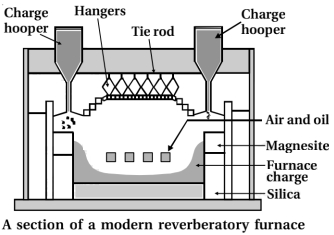
The sulphide ores of copper are heated in a reverberatory furnace. If the ore contains iron,it is mixed with silica before heating. Iron oxide is removed as iron silicate slag $(FeSiO_{3})$,and copper is produced in the form of copper matte,which contains $Cu_{2}S$ and $FeS$.
$(i)$ Conversion to oxide
$(ii)$ Reduction of the oxide to metal
Step $1$: Conversion to oxide:
$(i)$ Calcination: Calcination involves heating the ore in the absence or limited supply of air. It removes volatile matter and moisture,leaving behind the metal oxide:
$Fe_{2}O_{3} \cdot xH_{2}O_{(s)} \stackrel{\Delta}{\longrightarrow} Fe_{2}O_{3_{(s)}} + xH_{2}O_{(g)}$
$ZnCO_{3_{(s)}} \stackrel{\Delta}{\longrightarrow} ZnO_{(s)} + CO_{2_{(g)}}$
$CaCO_{3} \cdot MgCO_{3_{(s)}} \stackrel{\Delta}{\longrightarrow} CaO_{(s)} + MgO_{(s)} + 2CO_{2_{(g)}}$
$(ii)$ Roasting: In roasting,the ore is heated in a regular supply of air in a furnace at a temperature below the melting point of the metal. This is commonly used for sulphide ores:
$2ZnS_{(s)} + 3O_{2_{(g)}} \rightarrow 2ZnO_{(s)} + 2SO_{2_{(g)}}$
$2PbS_{(s)} + 3O_{2_{(g)}} \rightarrow 2PbO_{(s)} + 2SO_{2_{(g)}}$
$2Cu_{2}S_{(s)} + 3O_{2_{(g)}} \rightarrow 2Cu_{2}O_{(s)} + 2SO_{2_{(g)}}$
The sulphide ores of copper are heated in a reverberatory furnace. If the ore contains iron,it is mixed with silica before heating. Iron oxide is removed as iron silicate slag $(FeSiO_{3})$,and copper is produced in the form of copper matte,which contains $Cu_{2}S$ and $FeS$.
0 likes
View Solution72
Medium
Why are sulphide ores converted to oxide before reduction?
Solution
(N/A) It is thermodynamically easier to reduce metal oxides than metal sulphides. The reduction of metal sulphides is difficult because the metal-sulphur bond is more stable and the process is less spontaneous compared to the reduction of metal oxides. Therefore,sulphide ores are first converted into oxide ores by roasting,which are then easily reduced to the metal.
0 likes
View Solution73
MediumMCQ
The processes of calcination and roasting in metallurgical industries,respectively,can lead to :-
A
Global warming and acid rain
B
Photochemical smog and ozone layer depletion
C
Global warming and photochemical smog
D
Photochemical smog and global warming
Solution
(A) Calcination involves heating carbonate ores,which releases $CO_{2}$ gas,a primary greenhouse gas contributing to global warming.
Roasting involves heating sulfide ores,which releases $SO_{2}$ gas,a primary pollutant responsible for acid rain.
Therefore,calcination and roasting lead to global warming and acid rain,respectively.
Roasting involves heating sulfide ores,which releases $SO_{2}$ gas,a primary pollutant responsible for acid rain.
Therefore,calcination and roasting lead to global warming and acid rain,respectively.
0 likes
View Solution74
MediumMCQ
The process that involves the removal of sulphur from the ores is
A
Smelting
B
Roasting
C
Leaching
D
Refining
Solution
(B) In the roasting process,metal sulphide $(MS)$ ores are converted into metal oxides,and sulphur is removed in the form of $SO_{2}$ gas.
$2 MS + 3 O_{2} \xrightarrow{\Delta} 2 MO + 2 SO_{2} \uparrow$
$2 MS + 3 O_{2} \xrightarrow{\Delta} 2 MO + 2 SO_{2} \uparrow$
0 likes
View Solution75
DifficultMCQ
Consider two chemical reactions $(A)$ and $(B)$ that take place during metallurgical processes:
$(A)$ $ZnCO_{3(s)} \longrightarrow ZnO_{(s)} + CO_{2(g)}$
$(B)$ $2ZnS_{(s)} + 3O_{2(g)} \longrightarrow 2ZnO_{(s)} + 2SO_{2(g)}$
The correct names for these processes are:
$(A)$ $ZnCO_{3(s)} \longrightarrow ZnO_{(s)} + CO_{2(g)}$
$(B)$ $2ZnS_{(s)} + 3O_{2(g)} \longrightarrow 2ZnO_{(s)} + 2SO_{2(g)}$
The correct names for these processes are:
A
$(A)$ is calcination and $(B)$ is roasting
B
$(A)$ is roasting and $(B)$ is calcination
C
Both $(A)$ and $(B)$ produce the same product,so both are calcination
D
Both $(A)$ and $(B)$ produce the same product,so both are roasting
Solution
(A) $ZnCO_{3(s)} \xrightarrow{\Delta} ZnO_{(s)} + CO_{2(g)}$
Heating in the absence of air or limited supply of air is known as calcination.
$(B)$ $2ZnS_{(s)} + 3O_{2(g)} \longrightarrow 2ZnO_{(s)} + 2SO_{2(g)}$
Heating in the presence of excess air is known as roasting.
Therefore,$(A)$ is calcination and $(B)$ is roasting.
Heating in the absence of air or limited supply of air is known as calcination.
$(B)$ $2ZnS_{(s)} + 3O_{2(g)} \longrightarrow 2ZnO_{(s)} + 2SO_{2(g)}$
Heating in the presence of excess air is known as roasting.
Therefore,$(A)$ is calcination and $(B)$ is roasting.
0 likes
View Solution76
MediumMCQ
The major products of the following reaction,$2ZnS_{(s)} + 3O_{2(g)} \xrightarrow{\text{Heat}} \dots$ are
A
$ZnO$ and $SO_2$
B
$ZnSO_4$ and $SO_3$
C
$ZnSO_4$ and $SO_2$
D
$Zn$ and $SO_2$
Solution
(A) The correct option is $A$.
The reaction is $2ZnS_{(s)} + 3O_{2(g)} \xrightarrow{\Delta} 2ZnO_{(s)} + 2SO_{2(g)}$.
This process is known as roasting,where the sulphide ore is heated in a regular supply of air to convert it into its oxide form at a temperature below the melting point of the metal.
The reaction is $2ZnS_{(s)} + 3O_{2(g)} \xrightarrow{\Delta} 2ZnO_{(s)} + 2SO_{2(g)}$.
This process is known as roasting,where the sulphide ore is heated in a regular supply of air to convert it into its oxide form at a temperature below the melting point of the metal.
0 likes
View Solution77
MediumMCQ
Given below are two statements:
Statement-$I$ : In the metallurgy process,sulphide ore is converted to oxide before reduction.
Statement-$II$ : Oxide ores in general are easier to reduce.
In the light of the above statements,choose the most appropriate answer from the options given below :
Statement-$I$ : In the metallurgy process,sulphide ore is converted to oxide before reduction.
Statement-$II$ : Oxide ores in general are easier to reduce.
In the light of the above statements,choose the most appropriate answer from the options given below :
A
Both Statement $I$ and Statement $II$ are correct.
B
Statement $I$ is correct but Statement $II$ is incorrect.
C
Both Statement $I$ and Statement $II$ are incorrect.
D
Statement $I$ is incorrect but Statement $II$ is correct.
Solution
(A) In metallurgy,sulphide ores are first converted into oxides by roasting because it is thermodynamically easier to reduce metal oxides than metal sulphides.
$2 ZnS + 3 O_2 \rightarrow 2 ZnO + 2 SO_2$
Metal oxides are easier to reduce using carbon because the formation of $CO_2$ is more favorable and $CO_2$ is a stable gas,whereas the reduction of sulphides with carbon is difficult and often leads to the formation of $CS_2$,which is less stable and harder to remove.
Therefore,both Statement-$I$ and Statement-$II$ are correct.
$2 ZnS + 3 O_2 \rightarrow 2 ZnO + 2 SO_2$
Metal oxides are easier to reduce using carbon because the formation of $CO_2$ is more favorable and $CO_2$ is a stable gas,whereas the reduction of sulphides with carbon is difficult and often leads to the formation of $CS_2$,which is less stable and harder to remove.
Therefore,both Statement-$I$ and Statement-$II$ are correct.
0 likes
View Solution78
MediumMCQ
Which one of the following is not an example of calcination?
A
$Fe_2O_3 \cdot xH_2O \xrightarrow{\Delta} Fe_2O_3 + xH_2O$
B
$CaCO_3 \xrightarrow{\Delta} CaO + CO_2$
C
$CaCO_3 \cdot MgCO_3 \xrightarrow{\Delta} CaO + MgO + 2CO_2$
D
$2PbS + 3O_2 \xrightarrow{\Delta} 2PbO + 2SO_2$
Solution
(D) Calcination is the process of heating an ore in the absence or limited supply of air to remove moisture and volatile impurities.
Option $A$ is the dehydration of limonite (calcination).
Option $B$ is the calcination of limestone.
Option $C$ is the calcination of dolomite.
Option $D$ $(2PbS + 3O_2 \xrightarrow{\Delta} 2PbO + 2SO_2)$ involves the reaction of sulfide ore with oxygen,which is the definition of roasting.
Option $A$ is the dehydration of limonite (calcination).
Option $B$ is the calcination of limestone.
Option $C$ is the calcination of dolomite.
Option $D$ $(2PbS + 3O_2 \xrightarrow{\Delta} 2PbO + 2SO_2)$ involves the reaction of sulfide ore with oxygen,which is the definition of roasting.
0 likes
View Solution79
AdvancedMCQ
Extraction of zinc from zinc blende $(ZnS)$ is achieved by:
A
electrolytic reduction
B
roasting followed by reduction with carbon
C
roasting followed by reduction with another metal
D
roasting followed by self-reduction
Solution
(B) The extraction of zinc from zinc blende $(ZnS)$ involves the following steps:
$1$. Roasting: Zinc blende is heated in the presence of excess air to convert it into zinc oxide $(ZnS + 3O_2 \rightarrow 2ZnO + 2SO_2)$.
$2$. Reduction: The zinc oxide $(ZnO)$ obtained is then reduced to metallic zinc using carbon (coke) as a reducing agent $(ZnO + C \rightarrow Zn + CO)$.
Therefore,option $B$ is correct.
$1$. Roasting: Zinc blende is heated in the presence of excess air to convert it into zinc oxide $(ZnS + 3O_2 \rightarrow 2ZnO + 2SO_2)$.
$2$. Reduction: The zinc oxide $(ZnO)$ obtained is then reduced to metallic zinc using carbon (coke) as a reducing agent $(ZnO + C \rightarrow Zn + CO)$.
Therefore,option $B$ is correct.
0 likes
View Solution80
EasyMCQ
Sulphide ore on roasting gives a gas $X$. $X$ reacts with $Cl_{2}$ in the presence of activated charcoal to give $Y$. $Y$ is
A
$SO_{2}Cl_{2}$
B
$S_{2}Cl_{2}$
C
$SCl_{6}$
D
$SOCl_{2}$
Solution
(A) When sulphide ore is roasted,it is heated in the presence of excess air to form the gas $SO_{2}$.
$S + O_{2} \longrightarrow SO_{2} (X)$
For example: $2ZnS + 3O_{2} \longrightarrow 2ZnO + 2SO_{2}$
Thereafter,$X$ $(SO_{2})$ reacts with $Cl_{2}$ in the presence of activated charcoal to give $Y$ $(SO_{2}Cl_{2})$:
$SO_{2} + Cl_{2} \xrightarrow{\text{activated charcoal}} SO_{2}Cl_{2} (Y)$
Thus,$Y$ is $SO_{2}Cl_{2}$.
$S + O_{2} \longrightarrow SO_{2} (X)$
For example: $2ZnS + 3O_{2} \longrightarrow 2ZnO + 2SO_{2}$
Thereafter,$X$ $(SO_{2})$ reacts with $Cl_{2}$ in the presence of activated charcoal to give $Y$ $(SO_{2}Cl_{2})$:
$SO_{2} + Cl_{2} \xrightarrow{\text{activated charcoal}} SO_{2}Cl_{2} (Y)$
Thus,$Y$ is $SO_{2}Cl_{2}$.
0 likes
View Solution81
EasyMCQ
Select the correct statement:
A
Roasting involves heating the ore in the absence of air.
B
Calcination involves heating the ore above its melting point.
C
Smelting involves heating the ore with a suitable reducing agent and flux below its melting point.
D
Calcination of calcium carbonate is endothermic.
Solution
(D) The correct statement is given in option $(D)$.
- Roasting involves heating the ore in a regular supply of air.
- Calcination involves heating the ore below its melting point.
- Smelting is the process by which a metal is obtained at temperatures above its melting point.
- Calcination of calcium carbonate $(CaCO_3 \rightarrow CaO + CO_2)$ is an endothermic process as it requires heat to proceed.
- Roasting involves heating the ore in a regular supply of air.
- Calcination involves heating the ore below its melting point.
- Smelting is the process by which a metal is obtained at temperatures above its melting point.
- Calcination of calcium carbonate $(CaCO_3 \rightarrow CaO + CO_2)$ is an endothermic process as it requires heat to proceed.
0 likes
View Solution82
EasyMCQ
When limestone is heated,$CO_{2}$ is given off. The metallurgical operation is
A
smelting
B
reduction
C
calcination
D
roasting
Solution
(C) Calcination is the process of converting an ore into its oxide by heating it strongly below its melting point in the absence or limited supply of air. Carbonate ores are converted into their respective oxides by the loss of carbon dioxide.
$CaCO_{3} \stackrel{\Delta}{\longrightarrow} CaO + CO_{2} \uparrow$
$CaCO_{3} \stackrel{\Delta}{\longrightarrow} CaO + CO_{2} \uparrow$
0 likes
View Solution83
MediumMCQ
Which one of the following statements is false?
A
During roasting,moisture is removed from the ore
B
The ore is freed from almost all non-metallic impurities
C
Calcination of ore is carried out in the absence of any blast of air
D
The concentrated zinc blende is subjected to calcination during its extraction by pyrometallurgy
Solution
(D) Roasting is the process of heating an ore in a regular supply of air in a furnace at a temperature below the melting point of the metal. $ZnS$ (zinc blende) is a sulfide ore,and sulfide ores are always subjected to roasting,not calcination,to convert them into their respective oxides. Therefore,the statement that zinc blende is subjected to calcination is false.
0 likes
View Solution84
EasyMCQ
Which of the following reactions is an example of roasting?
A
$ZnCO_3 \longrightarrow ZnO + CO_2$
B
$2 PbS + 3 O_2 \longrightarrow 2 PbO + 2 SO_2$
C
$Fe_2O_3 + 3 C \longrightarrow 2 Fe + 3 CO$
D
$FeO + SiO_2 \longrightarrow FeSiO_3$
Solution
(B) Roasting is a metallurgical process in which a sulfide ore is heated in a regular supply of air or oxygen to convert it into its oxide form.
In the reaction $2 PbS + 3 O_2 \longrightarrow 2 PbO + 2 SO_2$,lead sulfide $(PbS)$ is heated in the presence of oxygen to form lead oxide $(PbO)$ and sulfur dioxide $(SO_2)$.
Therefore,this reaction is an example of roasting.
Option $A$ represents calcination,option $C$ represents reduction using carbon,and option $D$ represents slag formation.
In the reaction $2 PbS + 3 O_2 \longrightarrow 2 PbO + 2 SO_2$,lead sulfide $(PbS)$ is heated in the presence of oxygen to form lead oxide $(PbO)$ and sulfur dioxide $(SO_2)$.
Therefore,this reaction is an example of roasting.
Option $A$ represents calcination,option $C$ represents reduction using carbon,and option $D$ represents slag formation.
0 likes
View Solution85
EasyMCQ
The flux used in the preparation of wrought iron from cast iron in a reverberatory furnace is
A
$SiO_2$
B
$CaCO_3$
C
$C$
D
$NaCN$
Solution
(B) In the process of manufacturing wrought iron from cast iron,a reverberatory furnace is lined with limestone $(CaCO_3)$.
$CaCO_3$ acts as a flux to remove impurities like silicon,which is oxidized to $SiO_2$.
$CaO + SiO_2 \longrightarrow CaSiO_3$ (slag).
Thus,$CaCO_3$ is the flux used.
$CaCO_3$ acts as a flux to remove impurities like silicon,which is oxidized to $SiO_2$.
$CaO + SiO_2 \longrightarrow CaSiO_3$ (slag).
Thus,$CaCO_3$ is the flux used.
0 likes
View Solution86
EasyMCQ
Why is iron pyrite not the ideal choice of ore for the extraction of iron?
A
It produces polluting gases
B
Thermodynamically not feasible
C
Highly stable
D
Difficult in roasting process
Solution
(A) Iron pyrite,i.e.,$FeS_2$,is also known as Fool's Gold.
It is not an ideal choice of ore for the extraction of iron because it produces polluting sulfur-containing gases,such as $SO_2$ and $SO_3$,during the roasting process.
Although it is thermodynamically feasible and stable,the environmental impact of these gases makes it undesirable.
Hence,option $(A)$ is the correct answer.
It is not an ideal choice of ore for the extraction of iron because it produces polluting sulfur-containing gases,such as $SO_2$ and $SO_3$,during the roasting process.
Although it is thermodynamically feasible and stable,the environmental impact of these gases makes it undesirable.
Hence,option $(A)$ is the correct answer.
0 likes
View Solution87
MediumMCQ
The chemical reaction that involves the roasting process is:
A
$Fe_2O_3 + 3CO \longrightarrow 2Fe + 3CO_2$
B
$2Al + Fe_2O_3 \longrightarrow 2Fe + Al_2O_3$
C
$2ZnS + 3O_2 \longrightarrow 2ZnO + 2SO_2$
D
$FeO + SiO_2 \longrightarrow FeSiO_3$
Solution
(C) Roasting is a metallurgical process in which sulphide ores are heated in the presence of excess air to convert them into their corresponding metal oxides.
In the given options,the reaction $2ZnS + 3O_2 \longrightarrow 2ZnO + 2SO_2$ represents the roasting of zinc sulphide $(ZnS)$ ore to form zinc oxide $(ZnO)$.
In the given options,the reaction $2ZnS + 3O_2 \longrightarrow 2ZnO + 2SO_2$ represents the roasting of zinc sulphide $(ZnS)$ ore to form zinc oxide $(ZnO)$.
0 likes
View Solution88
EasyMCQ
Among the following,the calcination process is
A
$2 Cu_2S + 3 O_2 \xrightarrow{\Delta} 2 Cu_2O + 2 SO_2 \uparrow$
B
$Al_2O_{3(s)} + 2 NaOH_{(aq)} + 3 H_2O_{(l)} \longrightarrow 2 Na[Al(OH)_4]_{(aq)}$
C
$2 CuFeS_2 + O_2 \longrightarrow Cu_2S + 2 FeS + SO_2 \uparrow$
D
$Fe_2O_3 \cdot x H_2O \xrightarrow{\Delta} Fe_2O_{3(s)} + x H_2O_{(g)}$
Solution
(D) Calcination is a process of heating an ore in a limited supply of air or in the absence of air to remove volatile impurities and moisture.
It is typically used for carbonate or hydrated oxide ores.
The reaction $Fe_2O_3 \cdot x H_2O \xrightarrow{\Delta} Fe_2O_{3(s)} + x H_2O_{(g)}$ represents the removal of water of hydration from limonite,which is a characteristic calcination process.
It is typically used for carbonate or hydrated oxide ores.
The reaction $Fe_2O_3 \cdot x H_2O \xrightarrow{\Delta} Fe_2O_{3(s)} + x H_2O_{(g)}$ represents the removal of water of hydration from limonite,which is a characteristic calcination process.
0 likes
View SolutionGeneral Principles and Processes of Isolation of Elements — Roasting and Calcination · Frequently Asked Questions
1Are these General Principles and Processes of Isolation of Elements questions useful for JEE and NEET?
Yes. All questions in this section are mapped to JEE Main and NEET exam patterns. Previous year questions from JEE Main, NEET, GUJCET and state-level exams are included with full solutions.
2Can I switch to Hindi or Gujarati for these questions?
Yes. Use the language tabs in the hero section or the sidebar to view the same questions and solutions in English, Hindi or Gujarati.
3How do I generate a question paper from this subtopic?
Use the Vedclass Exam Paper Generator — select the chapter and subtopic, set difficulty, and generate Sets A, B, C, D automatically. First 3 chapters of every subject are free.
Vedclass Products
For Students
Vedclass Test Series
Mock tests in real JEE/NEET style with performance analysis. 5-day free trial.
Start Free TrialFor Teachers
Exam Paper Generator
Generate Set A/B/C/D papers from this chapter in 2 minutes. 3 chapters free.
Try FreeFor Institutes
Online Exam Module
Live online exams with unlimited students, 360° analytics & white-label branding.
See DemoFor Teachers & Institutes
Generate a General Principles and Processes of Isolation of Elements Exam Paper in 2 Minutes
Select subtopic & difficulty — Sets A, B, C, D auto-generated with No Repeat logic.
First 3 chapters of every subject are free — no payment required.