
A English
Organometallic compounds Questions in English
Class 12 Chemistry · Coordination Compounds · Organometallic compounds
141+
Questions
English
Language
100%
With Solutions
Showing 40 of 141 questions in English
101
DifficultMCQ
Assertion : $C-O$ bond in metal carbonyls is long.
Reason : There is delocalisation of electrons from filled $d$ orbitals into the empty $\pi^*$ orbitals on the $CO$ ligands.
Reason : There is delocalisation of electrons from filled $d$ orbitals into the empty $\pi^*$ orbitals on the $CO$ ligands.
A
If both Assertion and Reason are correct and the Reason is a correct explanation of the Assertion.
B
If both Assertion and Reason are correct but Reason is not a correct explanation of the Assertion.
C
If the Assertion is correct but Reason is incorrect.
D
If both the Assertion and Reason are incorrect.
Solution
(A) In metal carbonyls,a $\pi$-bond arises from the overlap of filled $d$-orbitals on the metal with empty $\pi^*$-antibonding orbitals of the $CO$ ligand.
This back-bonding increases the electron density in the antibonding orbital of $CO$,which weakens the $C-O$ bond compared to free $CO$.
As a result,the $C-O$ bond order decreases and the bond length increases.
Therefore,both the Assertion and Reason are correct,and the Reason is the correct explanation of the Assertion.
This back-bonding increases the electron density in the antibonding orbital of $CO$,which weakens the $C-O$ bond compared to free $CO$.
As a result,the $C-O$ bond order decreases and the bond length increases.
Therefore,both the Assertion and Reason are correct,and the Reason is the correct explanation of the Assertion.
0 likes
View Solution102
MediumMCQ
Which statement is true for ferrocene?
A
All $Fe-C$ bonds are of equal length
B
It has a sandwich-type structure
C
It was the first discovered organometallic compound
D
All of these
Solution
(D) Ferrocene,$Fe(\eta^5-C_5H_5)_2$,is a classic example of an organometallic compound.
It possesses a sandwich-type structure where the $Fe$ atom is located between two parallel cyclopentadienyl rings.
Due to the delocalization of $\pi$-electrons in the cyclopentadienyl rings,all $Fe-C$ bond lengths are equal.
It is widely recognized as one of the earliest discovered sandwich compounds,significantly influencing organometallic chemistry.
Therefore,all the given statements are true.
It possesses a sandwich-type structure where the $Fe$ atom is located between two parallel cyclopentadienyl rings.
Due to the delocalization of $\pi$-electrons in the cyclopentadienyl rings,all $Fe-C$ bond lengths are equal.
It is widely recognized as one of the earliest discovered sandwich compounds,significantly influencing organometallic chemistry.
Therefore,all the given statements are true.
0 likes
View Solution103
DifficultMCQ
What is incorrect about homoleptic metal carbonyls?
A
$M-C$,$\sigma$-bond is formed by donation of lone pair of electrons from $CO$.
B
$M-C$,$\pi$-bond is formed by back donation of electron from filled $d$-orbital of metal to vacant $\pi^*$-orbital of carbon.
C
$M-CO$ bonding produces a synergic effect.
D
Metal carbonyls contain only $\sigma$-bonds.
Solution
(D) The statement in option $D$ is incorrect.
In metal carbonyls,the metal-carbon bond possesses both $\sigma$ and $\pi$ character.
Option $A$ is correct: The $\sigma$-bond is formed by the donation of a lone pair of electrons from the carbonyl carbon to the vacant orbital of the metal.
Option $B$ is correct: The $\pi$-bond is formed by the back-donation of electrons from a filled $d$-orbital of the metal into the vacant antibonding $\pi^*$-orbital of the carbon monoxide ligand.
Option $C$ is correct: This back-donation creates a synergic effect that strengthens the $M-C$ bond while weakening the $C-O$ bond.
In metal carbonyls,the metal-carbon bond possesses both $\sigma$ and $\pi$ character.
Option $A$ is correct: The $\sigma$-bond is formed by the donation of a lone pair of electrons from the carbonyl carbon to the vacant orbital of the metal.
Option $B$ is correct: The $\pi$-bond is formed by the back-donation of electrons from a filled $d$-orbital of the metal into the vacant antibonding $\pi^*$-orbital of the carbon monoxide ligand.
Option $C$ is correct: This back-donation creates a synergic effect that strengthens the $M-C$ bond while weakening the $C-O$ bond.
0 likes
View Solution104
DifficultMCQ
In $Fe_2(CO)_9$,the two iron atoms are
A
linked only directly
B
linked directly along with $3\,CO$ molecules as bridging ligands
C
linked only through $3\,CO$ molecules as bridging ligands
D
joined through one $CO$ group as bridging ligands
Solution
(B) The structure of $Fe_2(CO)_9$ consists of two $Fe(CO)_3$ units joined by three bridging $CO$ ligands.
Additionally,there is a direct $Fe-Fe$ bond between the two iron atoms.
Therefore,the two iron atoms are linked directly along with $3\,CO$ molecules as bridging ligands.
Additionally,there is a direct $Fe-Fe$ bond between the two iron atoms.
Therefore,the two iron atoms are linked directly along with $3\,CO$ molecules as bridging ligands.
0 likes
View Solution105
MediumMCQ
Iron carbonyl,$Fe(CO)_5$ is
A
tetranuclear
B
mononuclear
C
trinuclear
D
dinuclear
Solution
(B) The chemical formula of iron carbonyl is $Fe(CO)_5$.
In this complex,there is only one central metal atom $(Fe)$ present.
$A$ complex containing only one central metal atom is classified as mononuclear.
Therefore,$Fe(CO)_5$ is mononuclear.
In this complex,there is only one central metal atom $(Fe)$ present.
$A$ complex containing only one central metal atom is classified as mononuclear.
Therefore,$Fe(CO)_5$ is mononuclear.
0 likes
View Solution106
Medium
Discuss the nature of bonding in metal carbonyls.
Solution
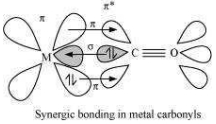
(N/A) The metal-carbon bonds in metal carbonyls have both $\sigma$ and $\pi$ characters.
$A$ $\sigma$ bond is formed when the carbonyl carbon donates a lone pair of electrons to the vacant orbital of the metal.
$A$ $\pi$ bond is formed by the donation of a pair of electrons from the filled metal $d$ orbital into the vacant anti-bonding $\pi^{*}$ orbital of the $CO$ ligand (also known as back bonding).
The $\sigma$ bond strengthens the $\pi$ bond and vice-versa. Thus,a synergic effect is created due to this metal-ligand bonding,which strengthens the bond between $CO$ and the metal.
$A$ $\sigma$ bond is formed when the carbonyl carbon donates a lone pair of electrons to the vacant orbital of the metal.
$A$ $\pi$ bond is formed by the donation of a pair of electrons from the filled metal $d$ orbital into the vacant anti-bonding $\pi^{*}$ orbital of the $CO$ ligand (also known as back bonding).
The $\sigma$ bond strengthens the $\pi$ bond and vice-versa. Thus,a synergic effect is created due to this metal-ligand bonding,which strengthens the bond between $CO$ and the metal.
0 likes
View Solution107
EasyMCQ
In $Fe(CO)_5$,which type of bond does the $CO$ ligand form with $Fe$?
A
Only $\sigma$-bond
B
Only $\pi$-bond
C
Both $\sigma$ and $\pi$-bonds
D
Ionic bond
Solution
(C) In metal carbonyls like $Fe(CO)_5$,the $CO$ ligand acts as a $\sigma$-donor and a $\pi$-acceptor.
$1$. The lone pair on the $C$ atom of $CO$ is donated into the empty $d$-orbital of $Fe$ to form a $\sigma$-bond.
$2$. Simultaneously,the filled $d$-orbital of $Fe$ donates electron density into the empty antibonding $\pi^*$-orbital of $CO$,forming a $\pi$-backbond.
This synergistic bonding stabilizes the metal-carbon bond.
$1$. The lone pair on the $C$ atom of $CO$ is donated into the empty $d$-orbital of $Fe$ to form a $\sigma$-bond.
$2$. Simultaneously,the filled $d$-orbital of $Fe$ donates electron density into the empty antibonding $\pi^*$-orbital of $CO$,forming a $\pi$-backbond.
This synergistic bonding stabilizes the metal-carbon bond.
0 likes
View Solution108
Difficult
Explain the bonding in metal carbonyls.
Solution
(N/A) Homoleptic carbonyls are those compounds in which only carbonyl ligands are present.
These compounds are formed by most of the transition metals. These carbonyls have simple,well-defined structures. $[Ni(CO)_4]$,$[Fe(CO)_5]$,and $[Cr(CO)_6]$ have tetrahedral,trigonal bipyramidal,and octahedral structures,respectively.
Decacarbonyldimanganese $(0)$ is formed by the $Mn-Mn$ bond between two square pyramidal $[Mn(CO)_5]$ units. In octacarbonyldicobalt $(0)$,there is a $Co-Co$ bond bridged by two $CO$ groups.
In metal carbonyls,the metal-carbon bond possesses both $\sigma$ and $\pi$ character. The $M-C$ $\sigma$ bond is formed by the donation of lone pairs of electrons from the carbonyl carbon into the vacant orbitals of the metal.
The $M-C$ $\pi$ bond is formed by the donation of electrons from the filled $d$-orbitals of the metal into the vacant $\pi^*$ antibonding orbitals of $CO$. The metal-to-ligand bonding creates a synergic effect,which strengthens the bond between the metal and $CO$.
These compounds are formed by most of the transition metals. These carbonyls have simple,well-defined structures. $[Ni(CO)_4]$,$[Fe(CO)_5]$,and $[Cr(CO)_6]$ have tetrahedral,trigonal bipyramidal,and octahedral structures,respectively.
Decacarbonyldimanganese $(0)$ is formed by the $Mn-Mn$ bond between two square pyramidal $[Mn(CO)_5]$ units. In octacarbonyldicobalt $(0)$,there is a $Co-Co$ bond bridged by two $CO$ groups.
In metal carbonyls,the metal-carbon bond possesses both $\sigma$ and $\pi$ character. The $M-C$ $\sigma$ bond is formed by the donation of lone pairs of electrons from the carbonyl carbon into the vacant orbitals of the metal.
The $M-C$ $\pi$ bond is formed by the donation of electrons from the filled $d$-orbitals of the metal into the vacant $\pi^*$ antibonding orbitals of $CO$. The metal-to-ligand bonding creates a synergic effect,which strengthens the bond between the metal and $CO$.
0 likes
View Solution109
Difficult
Explain homoleptic carbonyl compounds.
Solution
(N/A) Homoleptic carbonyls are those metal carbonyls in which only carbonyl $(CO)$ ligands are attached to the metal atom.
These compounds are formed by most transition metals. These carbonyls have simple,well-defined structures. $[Ni(CO)_4]$,$[Fe(CO)_5]$,and $[Cr(CO)_6]$ have tetrahedral,trigonal bipyramidal,and octahedral geometries,respectively.
Decacarbonyldimanganese $(0)$,$[Mn_2(CO)_{10}]$,is formed by the linkage of two square pyramidal $[Mn(CO)_5]$ units through a $Mn-Mn$ bond. Octacarbonyldicobalt $(0)$,$[Co_2(CO)_8]$,has a $Co-Co$ bond bridged by two $CO$ groups.
In metal carbonyls,the metal-carbon bond possesses both $\sigma$ and $\pi$ character. The $M-C$ $\sigma$ bond is formed by the donation of lone pairs of electrons from the carbonyl carbon into the vacant orbital of the metal.
The $M-C$ $\pi$ bond is formed by the donation of a pair of electrons from a filled $d$-orbital of the metal into the vacant antibonding $\pi^*$ orbital of $CO$. The metal-to-ligand bonding creates a synergic effect,which strengthens the bond between the metal and $CO$.
These compounds are formed by most transition metals. These carbonyls have simple,well-defined structures. $[Ni(CO)_4]$,$[Fe(CO)_5]$,and $[Cr(CO)_6]$ have tetrahedral,trigonal bipyramidal,and octahedral geometries,respectively.
Decacarbonyldimanganese $(0)$,$[Mn_2(CO)_{10}]$,is formed by the linkage of two square pyramidal $[Mn(CO)_5]$ units through a $Mn-Mn$ bond. Octacarbonyldicobalt $(0)$,$[Co_2(CO)_8]$,has a $Co-Co$ bond bridged by two $CO$ groups.
In metal carbonyls,the metal-carbon bond possesses both $\sigma$ and $\pi$ character. The $M-C$ $\sigma$ bond is formed by the donation of lone pairs of electrons from the carbonyl carbon into the vacant orbital of the metal.
The $M-C$ $\pi$ bond is formed by the donation of a pair of electrons from a filled $d$-orbital of the metal into the vacant antibonding $\pi^*$ orbital of $CO$. The metal-to-ligand bonding creates a synergic effect,which strengthens the bond between the metal and $CO$.
0 likes
View Solution110
DifficultMCQ
Give an example of synergistic bonding interaction in a carbonyl complex.
A
$[Ni(CO)_4]$
B
$[Fe(CO)_5]$
C
$[Cr(CO)_6]$
D
All of the above
Solution
(D) In metal carbonyls,the metal-carbon bond possesses both $\sigma$ and $\pi$ character.
$1$. The $\sigma$ bond is formed by the donation of an electron pair from the carbonyl carbon into a vacant orbital of the metal.
$2$. The $\pi$ bond is formed by the donation of a pair of electrons from a filled $d$-orbital of the metal into the vacant antibonding $\pi^*$ orbital of the carbon monoxide.
$3$. This creates a synergistic effect which strengthens the metal-carbon bond.
$4$. All the given complexes,$[Ni(CO)_4]$,$[Fe(CO)_5]$,and $[Cr(CO)_6]$,exhibit this synergistic bonding interaction.
$1$. The $\sigma$ bond is formed by the donation of an electron pair from the carbonyl carbon into a vacant orbital of the metal.
$2$. The $\pi$ bond is formed by the donation of a pair of electrons from a filled $d$-orbital of the metal into the vacant antibonding $\pi^*$ orbital of the carbon monoxide.
$3$. This creates a synergistic effect which strengthens the metal-carbon bond.
$4$. All the given complexes,$[Ni(CO)_4]$,$[Fe(CO)_5]$,and $[Cr(CO)_6]$,exhibit this synergistic bonding interaction.
0 likes
View Solution111
Medium
Explain synergic bonding.
Solution
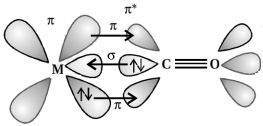
(N/A) The metal-carbon bond in metal carbonyls possesses both $\sigma$ and $\pi$ character.
The $M-C$ $\sigma$-bond is formed by the donation of a lone pair of electrons on the carbonyl carbon into a vacant orbital of the metal.
The $M-C$ $\pi$-bond is formed by the donation of a pair of electrons from a filled $d$-orbital of the metal into the vacant antibonding $\pi^{*}$ orbital of carbon monoxide $(CO)$.
The metal-to-ligand bonding creates a synergic effect which strengthens the bond between $CO$ and the metal.
The $M-C$ $\sigma$-bond is formed by the donation of a lone pair of electrons on the carbonyl carbon into a vacant orbital of the metal.
The $M-C$ $\pi$-bond is formed by the donation of a pair of electrons from a filled $d$-orbital of the metal into the vacant antibonding $\pi^{*}$ orbital of carbon monoxide $(CO)$.
The metal-to-ligand bonding creates a synergic effect which strengthens the bond between $CO$ and the metal.
0 likes
View Solution112
Medium
Explain the bonding in metal carbonyls.
Solution
(N/A) The $M-C$ bond in metal carbonyls possesses both $\sigma$ and $\pi$ character.
$1$. The $M-C$ $\sigma$-bond is formed by the donation of a lone pair of electrons from the carbonyl carbon into a vacant orbital of the metal.
$2$. The $M-C$ $\pi$-bond is formed by the donation of a pair of electrons from a filled $d$-orbital of the metal into the vacant antibonding $\pi^*$ orbital of carbon monoxide. This is also known as back-bonding.
$1$. The $M-C$ $\sigma$-bond is formed by the donation of a lone pair of electrons from the carbonyl carbon into a vacant orbital of the metal.
$2$. The $M-C$ $\pi$-bond is formed by the donation of a pair of electrons from a filled $d$-orbital of the metal into the vacant antibonding $\pi^*$ orbital of carbon monoxide. This is also known as back-bonding.
0 likes
View Solution113
Medium
What are metal carbonyls? Give examples.
Solution
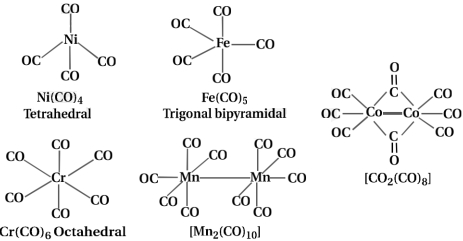
(N/A) Metal carbonyls are coordination complexes of transition metals with carbon monoxide $(CO)$ as the ligand.
Examples include: $[Ni(CO)_{4}]$,$[Fe(CO)_{5}]$,$[Mn_{2}(CO)_{10}]$,and $[Cr(CO)_{6}]$.
These are homoleptic compounds,meaning they contain only carbonyl groups as ligands and possess simple,well-defined structures:
$1$. $[Ni(CO)_{4}]$ is tetrahedral.
$2$. $[Fe(CO)_{5}]$ is trigonal bipyramidal.
$3$. $[Cr(CO)_{6}]$ is octahedral.
$4$. Decacarbonyldimanganese $(0)$ $[Mn_{2}(CO)_{10}]$ consists of two square pyramidal $[Mn(CO)_{5}]$ units joined by a $Mn-Mn$ bond.
$5$. Octacarbonyldicobalt $(0)$ $[Co_{2}(CO)_{8}]$ features a $Co-Co$ bond bridged by two $CO$ groups.
Examples include: $[Ni(CO)_{4}]$,$[Fe(CO)_{5}]$,$[Mn_{2}(CO)_{10}]$,and $[Cr(CO)_{6}]$.
These are homoleptic compounds,meaning they contain only carbonyl groups as ligands and possess simple,well-defined structures:
$1$. $[Ni(CO)_{4}]$ is tetrahedral.
$2$. $[Fe(CO)_{5}]$ is trigonal bipyramidal.
$3$. $[Cr(CO)_{6}]$ is octahedral.
$4$. Decacarbonyldimanganese $(0)$ $[Mn_{2}(CO)_{10}]$ consists of two square pyramidal $[Mn(CO)_{5}]$ units joined by a $Mn-Mn$ bond.
$5$. Octacarbonyldicobalt $(0)$ $[Co_{2}(CO)_{8}]$ features a $Co-Co$ bond bridged by two $CO$ groups.
0 likes
View Solution114
Difficult
Explain the Grignard reaction in detail.
Solution
(N/A) Organometallic compounds: Compounds in which a carbon atom is bonded to a metal atom are called 'organometallic' compounds. Most organic chlorides,bromides,and iodides react with certain active metals to form these compounds.
$(b)$ Grignard reagent: Organic halide compounds react with magnesium metal in dry ether to form alkyl magnesium halides $(RMgX)$,which are known as Grignard reagents.
$R - X + Mg \xrightarrow{\text{dry ether}} R^{-\delta} - Mg^{+\delta} - X^{-\delta}$
$CH_3CH_2Br + Mg \xrightarrow{\text{dry ether}} CH_3CH_2MgBr$
Victor Grignard discovered $RMgX$ in $1900$. It belongs to the class of organometallic compounds.
$(c)$ Reactivity and reactions: In Grignard reagents,the carbon-magnesium bond is not purely covalent but polar $(R^{-\delta} - Mg^{+\delta} - X^{-\delta})$ because magnesium is an electropositive metal. The carbon atom pulls electrons from magnesium,making the carbon partially negative. This makes the carbon highly reactive.
Grignard reagents react with any source of protons to form hydrocarbons:
$RMgX + H^+ \xrightarrow{OH^-} RH + Mg(OH)X$
They react with water,alcohols $(R'OH)$,and amines $(R'NH_2, R'_2NH)$,which act as proton donors.
$RMgX + H_2O \rightarrow RH + Mg(OH)X$
Example: $CH_3Br + Mg$ $\rightarrow CH_3MgBr$ $\xrightarrow{H_2O} CH_4 + Mg(OH)Br$
$(b)$ Grignard reagent: Organic halide compounds react with magnesium metal in dry ether to form alkyl magnesium halides $(RMgX)$,which are known as Grignard reagents.
$R - X + Mg \xrightarrow{\text{dry ether}} R^{-\delta} - Mg^{+\delta} - X^{-\delta}$
$CH_3CH_2Br + Mg \xrightarrow{\text{dry ether}} CH_3CH_2MgBr$
Victor Grignard discovered $RMgX$ in $1900$. It belongs to the class of organometallic compounds.
$(c)$ Reactivity and reactions: In Grignard reagents,the carbon-magnesium bond is not purely covalent but polar $(R^{-\delta} - Mg^{+\delta} - X^{-\delta})$ because magnesium is an electropositive metal. The carbon atom pulls electrons from magnesium,making the carbon partially negative. This makes the carbon highly reactive.
Grignard reagents react with any source of protons to form hydrocarbons:
$RMgX + H^+ \xrightarrow{OH^-} RH + Mg(OH)X$
They react with water,alcohols $(R'OH)$,and amines $(R'NH_2, R'_2NH)$,which act as proton donors.
$RMgX + H_2O \rightarrow RH + Mg(OH)X$
Example: $CH_3Br + Mg$ $\rightarrow CH_3MgBr$ $\xrightarrow{H_2O} CH_4 + Mg(OH)Br$
0 likes
View Solution115
Medium
What are organometallic compounds? Explain in detail.
Solution
(N/A) Organometallic compounds: Compounds in which a carbon atom is directly bonded to a metal atom are called 'organometallic' compounds.
$(b)$ Grignard Reagent: Alkyl magnesium halides $(RMgX)$ are formed by the reaction of organic halides with magnesium metal in dry ether. This was discovered by Victor Grignard in $1900$.
$R-X + Mg \xrightarrow{\text{dry ether}} R^{-\delta}-Mg^{+\delta}-X^{-\delta}$
$CH_3CH_2Br + Mg \xrightarrow{\text{dry ether}} CH_3CH_2MgBr$
$(c)$ Reactivity of Grignard Reagent: The $C-Mg$ bond is highly polar due to the electropositive nature of magnesium. The carbon atom carries a partial negative charge $(R^{-\delta})$,making it highly reactive.
It reacts with any source of protons to form hydrocarbons:
$RMgX + H_2O \rightarrow RH + Mg(OH)X$
Grignard reagents react with water,alcohols $(R'OH)$,and amines to yield hydrocarbons,acting as strong nucleophiles.
$(b)$ Grignard Reagent: Alkyl magnesium halides $(RMgX)$ are formed by the reaction of organic halides with magnesium metal in dry ether. This was discovered by Victor Grignard in $1900$.
$R-X + Mg \xrightarrow{\text{dry ether}} R^{-\delta}-Mg^{+\delta}-X^{-\delta}$
$CH_3CH_2Br + Mg \xrightarrow{\text{dry ether}} CH_3CH_2MgBr$
$(c)$ Reactivity of Grignard Reagent: The $C-Mg$ bond is highly polar due to the electropositive nature of magnesium. The carbon atom carries a partial negative charge $(R^{-\delta})$,making it highly reactive.
It reacts with any source of protons to form hydrocarbons:
$RMgX + H_2O \rightarrow RH + Mg(OH)X$
Grignard reagents react with water,alcohols $(R'OH)$,and amines to yield hydrocarbons,acting as strong nucleophiles.
0 likes
View Solution116
MediumMCQ
In $Fe(CO)_5$,the $Fe-C$ bond possesses
A
ionic characters
B
$\sigma$-character only
C
$\pi$-character
D
Both $\sigma$ and $\pi$ characters
Solution
(D) In $Fe(CO)_5$,the $Fe-C$ bond is formed by the donation of a lone pair of electrons from the $C$ atom of $CO$ to the empty $d$-orbital of $Fe$,which creates a $\sigma$-bond.
Additionally,there is back-donation of electrons from the filled $d$-orbitals of $Fe$ into the empty antibonding $\pi^*$-orbitals of $CO$,which creates a $\pi$-bond.
Therefore,the $Fe-C$ bond possesses both $\sigma$ and $\pi$ characters.
Additionally,there is back-donation of electrons from the filled $d$-orbitals of $Fe$ into the empty antibonding $\pi^*$-orbitals of $CO$,which creates a $\pi$-bond.
Therefore,the $Fe-C$ bond possesses both $\sigma$ and $\pi$ characters.
0 likes
View Solution117
DifficultMCQ
In $Fe(CO)_5$ and $Cr(CO)_6$,how many $CO$ ligands can be replaced by $NO$ to maintain the $18$ electron rule?
A
$3, 6$
B
$2, 4$
C
$3, 4$
D
$2, 6$
Solution
(A) The $CO$ ligand acts as a $2$-electron donor,while the $NO$ ligand acts as a $3$-electron donor.
For $Fe(CO)_5$: Total valence electrons = $8 + (5 \times 2) = 18$. To replace $CO$ with $NO$ while maintaining $18$ electrons,we replace $3$ $CO$ ($6$ $e^-$) with $2$ $NO$ ($6$ $e^-$),resulting in $Fe(CO)_2(NO)_2$.
For $Cr(CO)_6$: Total valence electrons = $6 + (6 \times 2) = 18$. To replace $CO$ with $NO$ while maintaining $18$ electrons,we replace $6$ $CO$ ($12$ $e^-$) with $4$ $NO$ ($12$ $e^-$),resulting in $Cr(NO)_4$.
Thus,the number of $CO$ ligands replaced are $3$ and $6$ respectively.
For $Fe(CO)_5$: Total valence electrons = $8 + (5 \times 2) = 18$. To replace $CO$ with $NO$ while maintaining $18$ electrons,we replace $3$ $CO$ ($6$ $e^-$) with $2$ $NO$ ($6$ $e^-$),resulting in $Fe(CO)_2(NO)_2$.
For $Cr(CO)_6$: Total valence electrons = $6 + (6 \times 2) = 18$. To replace $CO$ with $NO$ while maintaining $18$ electrons,we replace $6$ $CO$ ($12$ $e^-$) with $4$ $NO$ ($12$ $e^-$),resulting in $Cr(NO)_4$.
Thus,the number of $CO$ ligands replaced are $3$ and $6$ respectively.
0 likes
View Solution118
EasyMCQ
The number of bridging $CO$ ligands in $[Mn_{2}(CO)_{10}]$ is $....$ .
A
$4$
B
$2$
C
$1$
D
$0$
Solution
(D) The structure of $[Mn_{2}(CO)_{10}]$ consists of two $Mn(CO)_{5}$ units joined by a $Mn-Mn$ metal-metal bond.
Each $Mn$ atom is bonded to five terminal $CO$ ligands.
There are no $CO$ ligands bridging the two $Mn$ atoms.
Therefore,the number of bridging $CO$ ligands is $0$.
Each $Mn$ atom is bonded to five terminal $CO$ ligands.
There are no $CO$ ligands bridging the two $Mn$ atoms.
Therefore,the number of bridging $CO$ ligands is $0$.
0 likes
View Solution119
MediumMCQ
State the $IUPAC$ name of the following complex: $Fe(C_5H_5)_2$.
A
Ferrocene
B
Bis(cyclopentadienyl)iron$(II)$
C
Dicyclopentadienyliron
D
Iron$(II)$ cyclopentadienide
Solution
(B) The complex $Fe(C_5H_5)_2$ is an organometallic compound known as ferrocene.
According to $IUPAC$ nomenclature for coordination compounds,the ligand $C_5H_5^-$ is named 'cyclopentadienyl'.
Since there are two such ligands,the prefix 'bis' is used.
The oxidation state of iron $(Fe)$ is calculated as: $x + 2(-1) = 0$,which gives $x = +2$.
Therefore,the $IUPAC$ name is Bis(cyclopentadienyl)iron$(II)$.
According to $IUPAC$ nomenclature for coordination compounds,the ligand $C_5H_5^-$ is named 'cyclopentadienyl'.
Since there are two such ligands,the prefix 'bis' is used.
The oxidation state of iron $(Fe)$ is calculated as: $x + 2(-1) = 0$,which gives $x = +2$.
Therefore,the $IUPAC$ name is Bis(cyclopentadienyl)iron$(II)$.
0 likes
View Solution120
MediumMCQ
In the cobalt-carbonyl complex: $[Co_{2}(CO)_{8}]$,the number of $Co-Co$ bonds is "$X$" and the number of terminal $CO$ ligands is "$Y$". Find the value of $X + Y$.
A
$5$
B
$7$
C
$8$
D
$4$
Solution
(B) The structure of the cobalt-carbonyl complex $[Co_{2}(CO)_{8}]$ consists of two $Co$ atoms bonded to each other.
$1$. Number of $Co-Co$ bonds $(X)$: There is $1$ direct metal-metal bond between the two cobalt atoms. So,$X = 1$.
$2$. Number of terminal $CO$ ligands $(Y)$: In the solid-state structure of $[Co_{2}(CO)_{8}]$,there are $6$ terminal $CO$ ligands (each $Co$ atom is bonded to $3$ terminal $CO$ groups) and $2$ bridging $CO$ ligands. So,$Y = 6$.
$3$. Calculation: $X + Y = 1 + 6 = 7$.
$1$. Number of $Co-Co$ bonds $(X)$: There is $1$ direct metal-metal bond between the two cobalt atoms. So,$X = 1$.
$2$. Number of terminal $CO$ ligands $(Y)$: In the solid-state structure of $[Co_{2}(CO)_{8}]$,there are $6$ terminal $CO$ ligands (each $Co$ atom is bonded to $3$ terminal $CO$ groups) and $2$ bridging $CO$ ligands. So,$Y = 6$.
$3$. Calculation: $X + Y = 1 + 6 = 7$.
0 likes
View Solution121
MediumMCQ
Number of complexes which will exhibit synergic bonding amongst $[Cr(CO)_6]$,$[Mn(CO)_5]$ and $[Mn_2(CO)_{10}]$ is ..... .
A
$4$
B
$9$
C
$1$
D
$3$
Solution
(D) Synergic bonding is a characteristic feature of metal carbonyl complexes where the metal-carbon bond has both $\sigma$-donor and $\pi$-acceptor character.
All three complexes,$[Cr(CO)_6]$,$[Mn(CO)_5]$,and $[Mn_2(CO)_{10}]$,contain metal-carbonyl bonds.
Therefore,all $3$ complexes exhibit synergic bonding.
The correct answer is $3$.
All three complexes,$[Cr(CO)_6]$,$[Mn(CO)_5]$,and $[Mn_2(CO)_{10}]$,contain metal-carbonyl bonds.
Therefore,all $3$ complexes exhibit synergic bonding.
The correct answer is $3$.
0 likes
View Solution122
DifficultMCQ
The correct pair of orbitals involved in $\pi$-bonding between metal and $CO$ in metal carbonyl complexes is
A
metal $d_{xy}$ and carbonyl $\pi^{*}$
B
metal $d_{xy}$ and carbonyl $\pi$
C
metal $d_{x^{2}-y^{2}}$ and carbonyl $\pi^{*}$
D
metal $d_{x^{2}-y^{2}}$ and carbonyl $\pi$
Solution
(A) In metal carbonyl complexes,the $M-C$ $\sigma$-bond is formed by the donation of a lone pair of electrons from the carbonyl carbon into a vacant orbital of the metal.
The $M-C$ $\pi$-bond (back-bonding) is formed by the donation of a pair of electrons from a filled $d$-orbital of the metal (such as $d_{xy}$,$d_{yz}$,or $d_{zx}$) into the vacant antibonding $\pi^{*}$-orbital of carbon monoxide.
Therefore,the correct pair of orbitals involved in $\pi$-bonding is a metal $d$-orbital (like $d_{xy}$) and the carbonyl $\pi^{*}$-orbital.
The $M-C$ $\pi$-bond (back-bonding) is formed by the donation of a pair of electrons from a filled $d$-orbital of the metal (such as $d_{xy}$,$d_{yz}$,or $d_{zx}$) into the vacant antibonding $\pi^{*}$-orbital of carbon monoxide.
Therefore,the correct pair of orbitals involved in $\pi$-bonding is a metal $d$-orbital (like $d_{xy}$) and the carbonyl $\pi^{*}$-orbital.
0 likes
View Solution123
MediumMCQ
The oxidation state of cobalt in the following molecule is
A
$3$
B
$1$
C
$2$
D
$0$
Solution
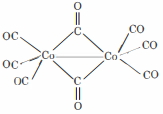
(D) The given molecule is $Co_2(CO)_8$.
In this complex,the ligand $CO$ (carbonyl) is a neutral ligand,meaning its charge is $0$.
Since the overall charge of the molecule $Co_2(CO)_8$ is $0$,we can calculate the oxidation state of $Co$ as follows:
Let the oxidation state of $Co$ be $x$.
$2x + 8(0) = 0$
$2x = 0$
$x = 0$
Therefore,the oxidation state of cobalt in the molecule is $0$.
In this complex,the ligand $CO$ (carbonyl) is a neutral ligand,meaning its charge is $0$.
Since the overall charge of the molecule $Co_2(CO)_8$ is $0$,we can calculate the oxidation state of $Co$ as follows:
Let the oxidation state of $Co$ be $x$.
$2x + 8(0) = 0$
$2x = 0$
$x = 0$
Therefore,the oxidation state of cobalt in the molecule is $0$.
0 likes
View Solution124
MediumMCQ
The sum of bridging carbonyls in $W(CO)_6$ and $Mn_2(CO)_{10}$ is $............$.
A
$0$
B
$1$
C
$2$
D
$4$
Solution
(A) In $W(CO)_6$,the structure is octahedral with all $6$ carbonyl groups being terminal. Thus,the number of bridging carbonyls is $0$.
In $Mn_2(CO)_{10}$,the structure consists of two $Mn(CO)_5$ units linked by a $Mn-Mn$ bond. All $10$ carbonyl groups are terminal. Thus,the number of bridging carbonyls is $0$.
The sum of bridging carbonyls in $W(CO)_6$ and $Mn_2(CO)_{10}$ is $0 + 0 = 0$.
In $Mn_2(CO)_{10}$,the structure consists of two $Mn(CO)_5$ units linked by a $Mn-Mn$ bond. All $10$ carbonyl groups are terminal. Thus,the number of bridging carbonyls is $0$.
The sum of bridging carbonyls in $W(CO)_6$ and $Mn_2(CO)_{10}$ is $0 + 0 = 0$.
0 likes
View Solution125
MediumMCQ
Given below are two statements: one is labelled as Assertion $(A)$ and the other is labelled as Reason $(R)$.
Assertion $(A)$: The metal-carbon bond in metal carbonyls possesses both $\sigma$ and $\pi$ character.
Reason $(R)$: The ligand-to-metal bond is a $\sigma$ bond and metal-to-ligand bond is a $\pi$ bond.
In the light of the above statements,choose the most appropriate answer from the options given below :
Assertion $(A)$: The metal-carbon bond in metal carbonyls possesses both $\sigma$ and $\pi$ character.
Reason $(R)$: The ligand-to-metal bond is a $\sigma$ bond and metal-to-ligand bond is a $\pi$ bond.
In the light of the above statements,choose the most appropriate answer from the options given below :
A
Both $(A)$ and $(R)$ are correct and $(R)$ is the correct explanation of $(A)$
B
Both $(A)$ and $(R)$ are correct but $(R)$ is not the correct explanation of $(A)$
C
$(A)$ is correct but $(R)$ is not correct.
D
$(A)$ is not correct but $(R)$ is correct.
Solution
(A) In metal carbonyls,the metal-carbon bond is formed by a synergic bonding mechanism.
$1$. The ligand $(CO)$ donates a lone pair of electrons from its carbon atom into an empty orbital of the metal,forming a $\sigma$ bond.
$2$. The metal then donates a pair of electrons from its filled $d$-orbital into the empty antibonding $\pi^*$ orbital of the $CO$ ligand,forming a $\pi$ bond.
$3$. This back-donation strengthens the metal-carbon bond and weakens the carbon-oxygen bond.
$4$. Thus,both Assertion $(A)$ and Reason $(R)$ are correct,and $(R)$ correctly explains $(A)$.
$1$. The ligand $(CO)$ donates a lone pair of electrons from its carbon atom into an empty orbital of the metal,forming a $\sigma$ bond.
$2$. The metal then donates a pair of electrons from its filled $d$-orbital into the empty antibonding $\pi^*$ orbital of the $CO$ ligand,forming a $\pi$ bond.
$3$. This back-donation strengthens the metal-carbon bond and weakens the carbon-oxygen bond.
$4$. Thus,both Assertion $(A)$ and Reason $(R)$ are correct,and $(R)$ correctly explains $(A)$.
0 likes
View Solution126
DifficultMCQ
Match List-$I$ with List-$II$:
Choose the correct answer from the options given below:
| $LIST-I$ (Substances) | $LIST-II$ (Element Present) |
| $A$. Ziegler catalyst | $I$. Rhodium |
| $B$. Blood pigment | $II$. Cobalt |
| $C$. Wilkinson catalyst | $III$. Iron |
| $D$. Vitamin $B_{12}$ | $IV$. Titanium |
Choose the correct answer from the options given below:
A
$A-II, B-IV, C-I, D-III$
B
$A-II, B-III, C-IV, D-I$
C
$A-III, B-II, C-IV, D-I$
D
$A-IV, B-III, C-I, D-II$
Solution
(D) . Ziegler catalyst is $TiCl_4 + (C_2H_5)_3Al$,which contains Titanium $(IV)$.
$B$. Blood pigment (Hemoglobin) contains Iron $(III)$.
$C$. Wilkinson catalyst is $[RhCl(PPh_3)_3]$,which contains Rhodium $(I)$.
$D$. Vitamin $B_{12}$ (Cyanocobalamin) contains Cobalt $(II)$.
Therefore,the correct matching is $A-IV, B-III, C-I, D-II$.
$B$. Blood pigment (Hemoglobin) contains Iron $(III)$.
$C$. Wilkinson catalyst is $[RhCl(PPh_3)_3]$,which contains Rhodium $(I)$.
$D$. Vitamin $B_{12}$ (Cyanocobalamin) contains Cobalt $(II)$.
Therefore,the correct matching is $A-IV, B-III, C-I, D-II$.
0 likes
View Solution127
DifficultMCQ
In which one of the following metal carbonyls,$CO$ forms a bridge between metal atoms?
A
$[Co_2(CO)_8]$
B
$[Mn_2(CO)_{10}]$
C
$[Os_3(CO)_{12}]$
D
$[Ru_3(CO)_{12}]$
Solution
(A) In the structure of $[Co_2(CO)_8]$,there are two bridging $CO$ ligands between the two cobalt atoms,along with a $Co-Co$ bond.
In $[Mn_2(CO)_{10}]$,$[Os_3(CO)_{12}]$,and $[Ru_3(CO)_{12}]$,all $CO$ ligands are terminal,and there are no bridging $CO$ groups.
Therefore,the correct option is $A$.
In $[Mn_2(CO)_{10}]$,$[Os_3(CO)_{12}]$,and $[Ru_3(CO)_{12}]$,all $CO$ ligands are terminal,and there are no bridging $CO$ groups.
Therefore,the correct option is $A$.
0 likes
View Solution128
AdvancedMCQ
If the bond length of $CO$ bond in carbon monoxide is $1.128 \ \mathring{A}$,then what is the value of $CO$ bond length in $Fe(CO)_5$?
A
$1.15 \ \mathring{A}$
B
$1.128 \ \mathring{A}$
C
$1.72 \ \mathring{A}$
D
$1.118 \ \mathring{A}$
Solution
(A) In metal carbonyls like $Fe(CO)_5$,a synergic bond is formed between the metal and the $CO$ ligand.
This involves the donation of electron density from the $CO$ $5\sigma$ orbital to the metal $d$-orbital and the back-donation of electron density from the metal $d$-orbital to the $CO$ $\pi^*$ antibonding orbital.
This back-donation increases the electron density in the antibonding orbital of $CO$,which decreases the $C-O$ bond order.
$A$ decrease in bond order leads to an increase in bond length.
Therefore,the $CO$ bond length in $Fe(CO)_5$ is greater than the $CO$ bond length in free carbon monoxide $(1.128 \ \mathring{A})$.
Among the given options,$1.15 \ \mathring{A}$ is the only value greater than $1.128 \ \mathring{A}$.
This involves the donation of electron density from the $CO$ $5\sigma$ orbital to the metal $d$-orbital and the back-donation of electron density from the metal $d$-orbital to the $CO$ $\pi^*$ antibonding orbital.
This back-donation increases the electron density in the antibonding orbital of $CO$,which decreases the $C-O$ bond order.
$A$ decrease in bond order leads to an increase in bond length.
Therefore,the $CO$ bond length in $Fe(CO)_5$ is greater than the $CO$ bond length in free carbon monoxide $(1.128 \ \mathring{A})$.
Among the given options,$1.15 \ \mathring{A}$ is the only value greater than $1.128 \ \mathring{A}$.
0 likes
View Solution129
AdvancedMCQ
Among the following metal carbonyls,the $C-O$ bond order is lowest in
A
$\left[Mn(CO)_6\right]^{+}$
B
$\left[Fe(CO)_5\right]$
C
$\left[Cr(CO)_6\right]$
D
$\left[V(CO)_6\right]^{-}$
Solution
(D) The $C-O$ bond order in metal carbonyls decreases as the extent of back-bonding from the metal $d$-orbitals to the $\pi^*$ antibonding orbitals of $CO$ increases.
Back-bonding increases as the electron density on the metal center increases (i.e.,as the negative charge on the complex increases or the oxidation state of the metal decreases).
Let us analyze the electron density on the metal center for each complex:
$(A)$ $\left[Mn(CO)_6\right]^{+}$: $Mn$ is in $+1$ oxidation state. Total valence electrons $= 7 - 1 + 12 = 18$.
$(B)$ $\left[Fe(CO)_5\right]$: $Fe$ is in $0$ oxidation state. Total valence electrons $= 8 + 10 = 18$.
$(C)$ $\left[Cr(CO)_6\right]$: $Cr$ is in $0$ oxidation state. Total valence electrons $= 6 + 12 = 18$.
$(D)$ $\left[V(CO)_6\right]^{-}$: $V$ is in $-1$ oxidation state. Total valence electrons $= 5 + 1 + 12 = 18$.
The metal center with the lowest oxidation state (highest negative charge) has the highest electron density available for back-bonding.
Comparing the oxidation states: $Mn(+1) > Cr(0) = Fe(0) > V(-1)$.
Since $\left[V(CO)_6\right]^{-}$ has the lowest oxidation state $(-1)$,it has the highest electron density and thus the strongest back-bonding to $CO$,resulting in the lowest $C-O$ bond order.
Back-bonding increases as the electron density on the metal center increases (i.e.,as the negative charge on the complex increases or the oxidation state of the metal decreases).
Let us analyze the electron density on the metal center for each complex:
$(A)$ $\left[Mn(CO)_6\right]^{+}$: $Mn$ is in $+1$ oxidation state. Total valence electrons $= 7 - 1 + 12 = 18$.
$(B)$ $\left[Fe(CO)_5\right]$: $Fe$ is in $0$ oxidation state. Total valence electrons $= 8 + 10 = 18$.
$(C)$ $\left[Cr(CO)_6\right]$: $Cr$ is in $0$ oxidation state. Total valence electrons $= 6 + 12 = 18$.
$(D)$ $\left[V(CO)_6\right]^{-}$: $V$ is in $-1$ oxidation state. Total valence electrons $= 5 + 1 + 12 = 18$.
The metal center with the lowest oxidation state (highest negative charge) has the highest electron density available for back-bonding.
Comparing the oxidation states: $Mn(+1) > Cr(0) = Fe(0) > V(-1)$.
Since $\left[V(CO)_6\right]^{-}$ has the lowest oxidation state $(-1)$,it has the highest electron density and thus the strongest back-bonding to $CO$,resulting in the lowest $C-O$ bond order.
0 likes
View Solution130
MediumMCQ
The correct statement$(s)$ regarding the binary transition metal carbonyl compounds is (are) (Atomic numbers: $Fe = 26, Ni = 28$)
$A$. Total number of valence shell electrons at metal centre in $Fe(CO)_5$ or $Ni(CO)_4$ is $16$
$B$. These are predominantly low spin in nature
$C$. Metal-carbon bond strengthens when the oxidation state of the metal is lowered
$D$. The carbonyl $C-O$ bond weakens when the oxidation state of the metal is increased
$A$. Total number of valence shell electrons at metal centre in $Fe(CO)_5$ or $Ni(CO)_4$ is $16$
$B$. These are predominantly low spin in nature
$C$. Metal-carbon bond strengthens when the oxidation state of the metal is lowered
$D$. The carbonyl $C-O$ bond weakens when the oxidation state of the metal is increased
A
$A, B$
B
$A, C$
C
$B, C$
D
$B, D$
Solution
(C) $1$. The total number of valence shell electrons at the metal centre in $Fe(CO)_5$ $(8 + 5 \times 2 = 18)$ and $Ni(CO)_4$ $(10 + 4 \times 2 = 18)$ is $18$,not $16$. Thus,statement $A$ is incorrect.
$2$. Metal carbonyls are predominantly low spin complexes because $CO$ is a strong field ligand. Thus,statement $B$ is correct.
$3$. The metal-carbon bond strengthens as the oxidation state of the metal decreases because a lower oxidation state increases the electron density on the metal,which enhances back-bonding to the $CO$ ligand. Thus,statement $C$ is correct.
$4$. The $C-O$ bond weakens when the oxidation state of the metal is lowered (due to increased back-bonding),not when it is increased. Thus,statement $D$ is incorrect.
$2$. Metal carbonyls are predominantly low spin complexes because $CO$ is a strong field ligand. Thus,statement $B$ is correct.
$3$. The metal-carbon bond strengthens as the oxidation state of the metal decreases because a lower oxidation state increases the electron density on the metal,which enhances back-bonding to the $CO$ ligand. Thus,statement $C$ is correct.
$4$. The $C-O$ bond weakens when the oxidation state of the metal is lowered (due to increased back-bonding),not when it is increased. Thus,statement $D$ is incorrect.
0 likes
View Solution131
MediumMCQ
The $C-O$ bond distance in $[V(CO)_6]$ and $[V(CO)_6]^-$ are:
A
$[V(CO)_6] < [V(CO)_6]^-$
B
$[V(CO)_6] = [V(CO)_6]^-$
C
$[V(CO)_6] > [V(CO)_6]^-$
D
$[V(CO)_6] = 2[V(CO)_6]^-$
Solution
(A) In metal carbonyls,the metal-carbon bond involves both $\sigma$-donation from $CO$ to the metal and $\pi$-back-bonding from the metal to the $CO$ $\pi^*$ antibonding orbital.
As the negative charge on the complex increases,the electron density on the metal increases.
This leads to greater $\pi$-back-bonding from the metal to the $CO$ ligand.
Increased $\pi$-back-bonding populates the antibonding $\pi^*$ orbital of $CO$,which weakens the $C-O$ bond and increases its bond length.
Since $[V(CO)_6]^-$ has a higher negative charge than $[V(CO)_6]$,it exhibits more $\pi$-back-bonding.
Therefore,the $C-O$ bond length in $[V(CO)_6]^-$ is greater than in $[V(CO)_6]$,which means $[V(CO)_6] < [V(CO)_6]^-$.
As the negative charge on the complex increases,the electron density on the metal increases.
This leads to greater $\pi$-back-bonding from the metal to the $CO$ ligand.
Increased $\pi$-back-bonding populates the antibonding $\pi^*$ orbital of $CO$,which weakens the $C-O$ bond and increases its bond length.
Since $[V(CO)_6]^-$ has a higher negative charge than $[V(CO)_6]$,it exhibits more $\pi$-back-bonding.
Therefore,the $C-O$ bond length in $[V(CO)_6]^-$ is greater than in $[V(CO)_6]$,which means $[V(CO)_6] < [V(CO)_6]^-$.
0 likes
View Solution132
EasyMCQ
The molecular formula of Wilkinson catalyst,used in the hydrogenation of alkenes is -
A
$Co_2(CO)_8$
B
$(Ph_3P)_3RhCl$
C
$[Pt(NH_3)_2Cl_2]$
D
$K[Ag(CN)_2]$
Solution
(B) The Wilkinson catalyst is a coordination complex of rhodium with the formula $(Ph_3P)_3RhCl$.
It is widely used as a homogeneous catalyst for the hydrogenation of alkenes.
It is widely used as a homogeneous catalyst for the hydrogenation of alkenes.
0 likes
View Solution133
EasyMCQ
Which is the correct formula of the Wilkinson catalyst?
A
$[RhCl(PPh_3)_3]$
B
$[RhCl(PMe_3)_3]$
C
$[RhCl(PPh_3)_3]$
D
$[RhCl(AsMe_3)_3]$
Solution
(A) The Wilkinson catalyst is a well-known organometallic complex used in the hydrogenation of alkenes.
Its chemical formula is $[RhCl(PPh_3)_3]$,where $Rh$ is Rhodium,$Cl$ is Chlorine,and $PPh_3$ is Triphenylphosphine.
Therefore,the correct option is $A$ or $C$ (as both are identical in the provided options).
Its chemical formula is $[RhCl(PPh_3)_3]$,where $Rh$ is Rhodium,$Cl$ is Chlorine,and $PPh_3$ is Triphenylphosphine.
Therefore,the correct option is $A$ or $C$ (as both are identical in the provided options).
0 likes
View Solution134
EasyMCQ
Which of the following is an organometallic compound?
A
$CH_3COONa$
B
$CH_3CH_2MgBr$
C
$(CH_3COO)_2Ca$
D
$CH_3ONa$
Solution
(B) $CH_3CH_2MgBr$ is an organometallic compound because it contains a direct carbon-metal bond between the carbon atom of the ethyl group and the magnesium atom.
Organometallic compounds are defined as compounds containing at least one direct bond between a carbon atom and a metal atom.
In $CH_3COONa$,$(CH_3COO)_2Ca$,and $CH_3ONa$,the metal atoms are bonded to oxygen atoms,not directly to carbon atoms.
Organometallic compounds are defined as compounds containing at least one direct bond between a carbon atom and a metal atom.
In $CH_3COONa$,$(CH_3COO)_2Ca$,and $CH_3ONa$,the metal atoms are bonded to oxygen atoms,not directly to carbon atoms.
0 likes
View Solution135
MediumMCQ
The organometallic compound $(CH_3)_3 CMgBr$ on reaction with $D_2 O$ produces . . . . . . .
A
$(CH_3)_3 COD$
B
$(CD_3)_3 CD$
C
$(CD_3)_3 COD$
D
$(CH_3)_3 CD$
Solution
(D) The Grignard reagent $(CH_3)_3 CMgBr$ contains a highly nucleophilic carbon atom bonded to magnesium,which carries a partial negative charge $(- \delta)$.
When it reacts with $D_2 O$ (deuterium oxide),the nucleophilic carbon attacks the electrophilic deuterium atom $(D^+)$ of $D_2 O$.
This results in the formation of the alkane derivative $(CH_3)_3 CD$ and the byproduct $Mg(OD)Br$.
The reaction is: $(CH_3)_3 CMgBr + D_2 O \rightarrow (CH_3)_3 CD + Mg(OD)Br$.
When it reacts with $D_2 O$ (deuterium oxide),the nucleophilic carbon attacks the electrophilic deuterium atom $(D^+)$ of $D_2 O$.
This results in the formation of the alkane derivative $(CH_3)_3 CD$ and the byproduct $Mg(OD)Br$.
The reaction is: $(CH_3)_3 CMgBr + D_2 O \rightarrow (CH_3)_3 CD + Mg(OD)Br$.
0 likes
View Solution136
DifficultMCQ
Among the given complexes that possess $CO$ ligand bridges are:
$\underset{I}{[Co_2(CO)_8]} \quad \underset{II}{[Fe_3(CO)_{12}]} \quad \underset{III}{[Mn_2(CO)_{10}]} \quad \underset{IV}{[Fe_2(CO)_9]}$
$\underset{I}{[Co_2(CO)_8]} \quad \underset{II}{[Fe_3(CO)_{12}]} \quad \underset{III}{[Mn_2(CO)_{10}]} \quad \underset{IV}{[Fe_2(CO)_9]}$
A
$I, II \& III$
B
$II, III \& IV$
C
$I, II \& IV$
D
$I, III \& IV$
Solution
(C) The structures of the given metal carbonyls are as follows:
$I. [Co_2(CO)_8]$: It exists in a bridged form in the solid state,containing two $CO$ bridges.
$II. [Fe_3(CO)_{12}]$: It contains two $CO$ bridges in its structure.
$III. [Mn_2(CO)_{10}]$: It has a direct $Mn-Mn$ bond and no $CO$ bridges.
$IV. [Fe_2(CO)_9]$: It contains three $CO$ bridges.
Thus,the complexes with $CO$ bridges are $I, II,$ and $IV$.
$I. [Co_2(CO)_8]$: It exists in a bridged form in the solid state,containing two $CO$ bridges.
$II. [Fe_3(CO)_{12}]$: It contains two $CO$ bridges in its structure.
$III. [Mn_2(CO)_{10}]$: It has a direct $Mn-Mn$ bond and no $CO$ bridges.
$IV. [Fe_2(CO)_9]$: It contains three $CO$ bridges.
Thus,the complexes with $CO$ bridges are $I, II,$ and $IV$.
0 likes
View Solution137
DifficultMCQ
The number of bridged $CO$ ligands present in $Fe_2(CO)_9$ and $Co_2(CO)_8$,respectively are
A
$2, 1$
B
$2, 2$
C
$2, 3$
D
$3, 2$
Solution
(D) In $Fe_2(CO)_9$,there are $3$ bridging $CO$ ligands and $6$ terminal $CO$ ligands.
In $Co_2(CO)_8$,there are $2$ bridging $CO$ ligands and $6$ terminal $CO$ ligands.
Therefore,the number of bridged $CO$ ligands in $Fe_2(CO)_9$ and $Co_2(CO)_8$ are $3$ and $2$,respectively.
In $Co_2(CO)_8$,there are $2$ bridging $CO$ ligands and $6$ terminal $CO$ ligands.
Therefore,the number of bridged $CO$ ligands in $Fe_2(CO)_9$ and $Co_2(CO)_8$ are $3$ and $2$,respectively.
0 likes
View Solution138
MediumMCQ
The Wilkinson catalyst is
A
$[(PPh_3)_2 RhCl_2]$
B
$[(PPh_3)_3 RhCl]$
C
$[(PPh_3)(RhCl_3)]$
D
$[(PPh_3)_4 RhCl]$
Solution
(B) The Wilkinson's catalyst is a well-known organometallic coordination complex of rhodium.
Its chemical formula is $[RhCl(PPh_3)_3]$,where $PPh_3$ represents triphenylphosphine.
It is widely used as a catalyst for the hydrogenation of alkenes.
Therefore,the correct option is $B$.
Its chemical formula is $[RhCl(PPh_3)_3]$,where $PPh_3$ represents triphenylphosphine.
It is widely used as a catalyst for the hydrogenation of alkenes.
Therefore,the correct option is $B$.
0 likes
View Solution139
MediumMCQ
What is the oxidation state of $Ti$ in the Ziegler-Natta catalyst?
A
$+3$
B
$+5$
C
$+4$
D
$+2$
Solution
(C) The Ziegler-Natta catalyst is typically a mixture of titanium tetrachloride $(TiCl_4)$ and triethylaluminum $(Al(C_2H_5)_3)$.
In $TiCl_4$,the oxidation state of Titanium $(Ti)$ is calculated as follows:
Let the oxidation state of $Ti$ be $x$.
The oxidation state of Chlorine $(Cl)$ is $-1$.
$x + 4(-1) = 0$
$x - 4 = 0$
$x = +4$.
Therefore,the oxidation state of $Ti$ in the Ziegler-Natta catalyst is $+4$.
In $TiCl_4$,the oxidation state of Titanium $(Ti)$ is calculated as follows:
Let the oxidation state of $Ti$ be $x$.
The oxidation state of Chlorine $(Cl)$ is $-1$.
$x + 4(-1) = 0$
$x - 4 = 0$
$x = +4$.
Therefore,the oxidation state of $Ti$ in the Ziegler-Natta catalyst is $+4$.
0 likes
View Solution140
MediumMCQ
The correct statements about metal carbonyls are:
$A$. The metal-carbon bonds in metal carbonyls possess both $\sigma$ and $\pi$-character.
$B$. Due to synergic bonding interactions between metal and $CO$ ligand,the metal-carbon bond becomes weak.
$C$. The metal-carbon $\sigma$ bond is formed by the donation of a lone pair of electrons on the carbonyl carbon into a vacant orbital of metal.
$D$. The metal-carbon $\pi$ bond is formed by the donation of electrons from a filled $d$-orbital of metal into a vacant $\pi^*$ orbital of $CO$.
Choose the correct answer from the options given below:
$A$. The metal-carbon bonds in metal carbonyls possess both $\sigma$ and $\pi$-character.
$B$. Due to synergic bonding interactions between metal and $CO$ ligand,the metal-carbon bond becomes weak.
$C$. The metal-carbon $\sigma$ bond is formed by the donation of a lone pair of electrons on the carbonyl carbon into a vacant orbital of metal.
$D$. The metal-carbon $\pi$ bond is formed by the donation of electrons from a filled $d$-orbital of metal into a vacant $\pi^*$ orbital of $CO$.
Choose the correct answer from the options given below:
A
$A$ and $B$ Only
B
$A, C$ and $D$ Only
C
$B$ and $C$ Only
D
$A$ and $D$ Only
Solution
(B) In metal carbonyls,the metal-carbon $(M-C)$ bond exhibits both $\sigma$ and $\pi$ character.
Statement $A$ is correct because the bond involves both $\sigma$-donation and $\pi$-back-donation.
Statement $C$ is correct: the $\sigma$ bond is formed by the donation of a lone pair of electrons from the carbonyl carbon to a vacant orbital of the metal.
Statement $D$ is correct: the $\pi$ bond is formed by the back-donation of electrons from a filled $d$-orbital of the metal into the vacant antibonding $\pi^*$ orbital of the $CO$ ligand.
Statement $B$ is incorrect because the synergic bonding interaction actually strengthens the $M-C$ bond and weakens the $C-O$ bond.
Therefore,statements $A, C,$ and $D$ are correct.
Statement $A$ is correct because the bond involves both $\sigma$-donation and $\pi$-back-donation.
Statement $C$ is correct: the $\sigma$ bond is formed by the donation of a lone pair of electrons from the carbonyl carbon to a vacant orbital of the metal.
Statement $D$ is correct: the $\pi$ bond is formed by the back-donation of electrons from a filled $d$-orbital of the metal into the vacant antibonding $\pi^*$ orbital of the $CO$ ligand.
Statement $B$ is incorrect because the synergic bonding interaction actually strengthens the $M-C$ bond and weakens the $C-O$ bond.
Therefore,statements $A, C,$ and $D$ are correct.
0 likes
View SolutionCoordination Compounds — Organometallic compounds · Frequently Asked Questions
1Are these Coordination Compounds questions useful for JEE and NEET?
Yes. All questions in this section are mapped to JEE Main and NEET exam patterns. Previous year questions from JEE Main, NEET, GUJCET and state-level exams are included with full solutions.
2Can I switch to Hindi or Gujarati for these questions?
Yes. Use the language tabs in the hero section or the sidebar to view the same questions and solutions in English, Hindi or Gujarati.
3How do I generate a question paper from this subtopic?
Use the Vedclass Exam Paper Generator — select the chapter and subtopic, set difficulty, and generate Sets A, B, C, D automatically. First 3 chapters of every subject are free.
Vedclass Products
For Students
Vedclass Test Series
Mock tests in real JEE/NEET style with performance analysis. 5-day free trial.
Start Free TrialFor Teachers
Exam Paper Generator
Generate Set A/B/C/D papers from this chapter in 2 minutes. 3 chapters free.
Try FreeFor Institutes
Online Exam Module
Live online exams with unlimited students, 360° analytics & white-label branding.
See DemoFor Teachers & Institutes
Generate a Coordination Compounds Exam Paper in 2 Minutes
Select subtopic & difficulty — Sets A, B, C, D auto-generated with No Repeat logic.
First 3 chapters of every subject are free — no payment required.