
A English
SEXUAL REPRODUCTION Questions in English
Class 12 Biology · Reproduction in Organisms · SEXUAL REPRODUCTION
83+
Questions
English
Language
100%
With Solutions
Showing 33 of 83 questions in English
51
MediumMCQ
What is the major disadvantage of external fertilization?
A
Increased survival rate of offspring.
B
Low survival rate of offspring.
C
Insufficient nutrition for all offspring.
D
Offspring destroy each other.
Solution
(B) External fertilization occurs outside the body of the organism,typically in an aquatic medium.
Because the offspring are exposed to predators and environmental hazards,the survival rate of the offspring is significantly low compared to internal fertilization.
Therefore,organisms usually produce a large number of offspring to ensure that at least some survive to adulthood.
Because the offspring are exposed to predators and environmental hazards,the survival rate of the offspring is significantly low compared to internal fertilization.
Therefore,organisms usually produce a large number of offspring to ensure that at least some survive to adulthood.
0 likes
View Solution52
EasyMCQ
In which organisms does the zygote develop a thick wall that is resistant to desiccation and damage?
A
Humans and amphibians
B
Fishes and amphibians
C
Algae and fungi
D
Fungi and cartilaginous fishes
Solution
(C) In organisms belonging to the groups $Algae$ and $Fungi$, the zygote develops a thick, resistant wall.
This thick wall protects the zygote from desiccation (drying out) and mechanical damage.
This adaptation allows the zygote to undergo a period of rest before germination, which is crucial for survival in unfavorable environmental conditions.
This thick wall protects the zygote from desiccation (drying out) and mechanical damage.
This adaptation allows the zygote to undergo a period of rest before germination, which is crucial for survival in unfavorable environmental conditions.
0 likes
View Solution53
EasyMCQ
Identify the correct sequence of events in sexual reproduction.
A
Gamete transfer $\rightarrow$ Gametogenesis $\rightarrow$ Embryogenesis $\rightarrow$ Fertilization $\rightarrow$ Zygote
B
Gamete transfer $\rightarrow$ Fertilization $\rightarrow$ Zygote $\rightarrow$ Embryogenesis $\rightarrow$ Gametogenesis
C
Gametogenesis $\rightarrow$ Gamete transfer $\rightarrow$ Fertilization $\rightarrow$ Zygote $\rightarrow$ Embryogenesis
D
Gamete transfer $\rightarrow$ Gametogenesis $\rightarrow$ Embryogenesis $\rightarrow$ Zygote $\rightarrow$ Fertilization
Solution
(C) Sexual reproduction involves a series of sequential events:
$1$. Gametogenesis: The process of formation of male and female gametes.
$2$. Gamete transfer: The process of bringing male and female gametes together.
$3$. Fertilization: The fusion of male and female gametes to form a diploid zygote.
$4$. Zygote: The single-celled structure formed after fertilization.
$5$. Embryogenesis: The process of development of the embryo from the zygote.
Therefore,the correct sequence is Gametogenesis $\rightarrow$ Gamete transfer $\rightarrow$ Fertilization $\rightarrow$ Zygote $\rightarrow$ Embryogenesis.
$1$. Gametogenesis: The process of formation of male and female gametes.
$2$. Gamete transfer: The process of bringing male and female gametes together.
$3$. Fertilization: The fusion of male and female gametes to form a diploid zygote.
$4$. Zygote: The single-celled structure formed after fertilization.
$5$. Embryogenesis: The process of development of the embryo from the zygote.
Therefore,the correct sequence is Gametogenesis $\rightarrow$ Gamete transfer $\rightarrow$ Fertilization $\rightarrow$ Zygote $\rightarrow$ Embryogenesis.
0 likes
View Solution54
MediumMCQ
............ is responsible for variation.
A
Asexual reproduction
B
Apomixis
C
Sexual reproduction
D
Vegetative propagation
Solution
(C) Sexual reproduction involves the fusion of gametes from two different parents,which leads to genetic recombination and crossing over during meiosis. These processes result in offspring that are genetically different from their parents and from each other,thus causing variation. In contrast,asexual reproduction,apomixis,and vegetative propagation produce clones that are genetically identical to the parent.
0 likes
View Solution55
MediumMCQ
Which organisms exhibit reproduction only once in their lifetime?
A
Bamboo and Salmon fish
B
Sea anemone and Hermit crab
C
Petromyzon and Platypus
D
All of the above
Solution
(A) Some organisms breed only once in their lifetime,a phenomenon known as semelparity.
Examples include bamboo,which flowers and fruits only once in its life cycle,and Pacific salmon fish,which migrate to freshwater to spawn and die shortly after.
Therefore,the correct answer is $A$.
Examples include bamboo,which flowers and fruits only once in its life cycle,and Pacific salmon fish,which migrate to freshwater to spawn and die shortly after.
Therefore,the correct answer is $A$.
0 likes
View Solution56
MediumMCQ
In multicellular organisms, which of the following refers to the production of progeny possessing features more or less similar to those of parents?
A
Growth
B
Reproduction
C
Metabolism
D
Consciousness
Solution
$(B)$ Reproduction is the biological process by which an organism produces offspring that are biologically similar to the parent organism.
It ensures the continuity of the species, generation after generation.
Genetic variations are created and inherited during reproduction, but the fundamental characteristics remain similar.
"Like begets like" is the phrase used to explain the similarity between parents and offspring.
It ensures the continuity of the species, generation after generation.
Genetic variations are created and inherited during reproduction, but the fundamental characteristics remain similar.
"Like begets like" is the phrase used to explain the similarity between parents and offspring.
0 likes
View Solution57
EasyMCQ
Internal fertilization is the process in which syngamy:
A
Occurs outside the body
B
Occurs inside the body
C
Is followed by meiosis
D
None of these
Solution
(B) In internal fertilization,syngamy (fusion of male and female gametes) takes place inside the body of the female organism. This process provides direct protection from the external environment to the developing progeny.
0 likes
View Solution58
EasyMCQ
Seasonal breeders are organisms that reproduce during:
A
Favourable season only
B
Unfavourable season only
C
Maturation period
D
Juvenile period
Solution
(A) Seasonal breeders are organisms that reproduce only during a favourable season of the year. Their reproductive cycles are regulated by environmental factors such as light,temperature,and food availability. Their reproductive organs become functional only during specific seasonal changes,ensuring that offspring are born when conditions are optimal for survival. Examples include many mammals like dogs,cats,and deer.
0 likes
View Solution59
EasyMCQ
Seasonal breeders are organisms which reproduce during:
A
Favourable season only
B
Unfavourable season only
C
Maturation period
D
Juvenile period
Solution
(A) Seasonal breeders are organisms that reproduce only during a specific favourable season of the year.
Their reproductive organs become active and functional due to environmental cues such as photoperiod,temperature,and food availability.
Consequently,they have a specific time period for reproduction.
$e.g.$,dogs,cats,and deer.
Their reproductive organs become active and functional due to environmental cues such as photoperiod,temperature,and food availability.
Consequently,they have a specific time period for reproduction.
$e.g.$,dogs,cats,and deer.
0 likes
View Solution60
EasyMCQ
Reproduction takes place in which stage of the life span?
A
Juvenile stage
B
Maturation or Reproductive stage
C
Pre-Reproductive stage
D
Ageing phase
Solution
(B) The correct answer is $B$. The life span of an organism is the period from birth to natural death.
It is generally divided into four stages:
$(i)$ Juvenile stage: The period from birth until the organism develops the capacity to reproduce.
$(ii)$ Maturation or Reproductive stage: The stage where the organism attains sexual maturity and reproduction begins.
$(iii)$ Ageing or Senescence: The phase characterized by the decline in metabolic activities and physiological functions.
$(iv)$ Death: The end of the life span.
Therefore,reproduction occurs during the Maturation or Reproductive stage.
It is generally divided into four stages:
$(i)$ Juvenile stage: The period from birth until the organism develops the capacity to reproduce.
$(ii)$ Maturation or Reproductive stage: The stage where the organism attains sexual maturity and reproduction begins.
$(iii)$ Ageing or Senescence: The phase characterized by the decline in metabolic activities and physiological functions.
$(iv)$ Death: The end of the life span.
Therefore,reproduction occurs during the Maturation or Reproductive stage.
0 likes
View Solution61
EasyMCQ
Bamboo plants flower only once in their lifetime, generally after $50-100$ years, produce a large number of fruits, and then die. Similarly, $Strobilanthus$ $kunthiana$ (Neelakuranji) flowers once in how many years (in $years$)?
A
$15$
B
$12$
C
$20$
D
$48$
Solution
(B) $Strobilanthus$ $kunthiana$, commonly known as Neelakuranji, is a plant species found in the hilly regions of Kerala, Karnataka, and Tamil Nadu.
It exhibits a unique flowering pattern where it blooms only once every $12$ years.
This phenomenon is a classic example of semelparity in plants, similar to the bamboo plant, where the organism invests heavily in reproduction once and then dies or completes its life cycle.
It exhibits a unique flowering pattern where it blooms only once every $12$ years.
This phenomenon is a classic example of semelparity in plants, similar to the bamboo plant, where the organism invests heavily in reproduction once and then dies or completes its life cycle.
0 likes
View Solution62
EasyMCQ
The majority of sexually reproducing organisms form:
A
Isogametes
B
Homogametes
C
Heterogametes
D
More than one option is correct
Solution
(C) In the majority of sexually reproducing organisms,the gametes produced are morphologically distinct types,known as heterogametes. In these organisms,the male gamete is usually smaller and motile,while the female gamete is larger and stationary. This type of sexual reproduction is referred to as oogamous reproduction.
0 likes
View Solution63
MediumMCQ
Which of the following features is universal in all sexually reproducing organisms?
A
Embryo formation
B
Gametic meiosis
C
Zygote formation
D
Pollen grain transfer
Solution
(C) In all sexually reproducing organisms, the fusion of male and female gametes (syngamy) results in the formation of a diploid cell called a $Zygote$.
$1.$ $Embryo$ $formation$ is not universal, as some organisms (like fungi and algae) develop the $Zygote$ directly into spores.
$2.$ $Gametic$ $meiosis$ is not universal; many organisms undergo meiosis after $Zygote$ formation ($Zygotic$ $meiosis$).
$3.$ $Pollen$ $grain$ $transfer$ is specific to seed plants.
$4.$ Therefore, the formation of a $Zygote$ is the only event common to all sexually reproducing organisms.
$1.$ $Embryo$ $formation$ is not universal, as some organisms (like fungi and algae) develop the $Zygote$ directly into spores.
$2.$ $Gametic$ $meiosis$ is not universal; many organisms undergo meiosis after $Zygote$ formation ($Zygotic$ $meiosis$).
$3.$ $Pollen$ $grain$ $transfer$ is specific to seed plants.
$4.$ Therefore, the formation of a $Zygote$ is the only event common to all sexually reproducing organisms.
0 likes
View Solution64
Medium
Define/Explain: Hermaphrodite.
Solution
(N/A) $\rightarrow$ When the sexes are not separate,i.e.,when both male and female sex organs are present in the same individual,the animal is termed as hermaphrodite or bisexual.
0 likes
View Solution65
Easy
Define/Explain: External fertilisation.
Solution
(N/A) $\rightarrow$ In animals such as many invertebrates,some marine fishes,and most amphibians,both eggs and sperm are shed into the surrounding water medium. The fusion of gametes (fertilisation) and subsequent development occur outside the body of the organism. This process is known as external fertilisation.
0 likes
View Solution66
MediumMCQ
Higher organisms have resorted to sexual reproduction in spite of their complexity. Why?
A
It is a faster process than asexual reproduction.
B
It ensures the production of a large number of offspring.
C
It promotes genetic variation and adaptation,which enhances survival.
D
It does not require the involvement of two parents.
Solution
(C) Higher organisms have resorted to sexual reproduction in spite of its complexity because it involves the fusion of gametes from two different parents,which leads to genetic recombination.
This process induces genetic variability among the offspring.
Genetic variation provides the necessary raw material for evolution and helps organisms adapt to changing environmental conditions,making them better equipped for the struggle of existence.
This process induces genetic variability among the offspring.
Genetic variation provides the necessary raw material for evolution and helps organisms adapt to changing environmental conditions,making them better equipped for the struggle of existence.
0 likes
View Solution67
EasyMCQ
What are pre-fertilization events?
A
Events occurring after the formation of the zygote.
B
Events occurring before the fusion of gametes.
C
Events occurring during the development of the embryo.
D
Events occurring during the formation of the fruit.
Solution
(B) Pre-fertilization events are the biological processes that occur before the fusion of male and female gametes.
These events primarily involve two major processes:
$1$. Gametogenesis: The process of formation of male and female gametes.
$2$. Gamete transfer: The process of bringing the male and female gametes together to facilitate fertilization.
These events primarily involve two major processes:
$1$. Gametogenesis: The process of formation of male and female gametes.
$2$. Gamete transfer: The process of bringing the male and female gametes together to facilitate fertilization.
0 likes
View Solution68
Medium
Write a short note on sexuality in organisms.
Solution
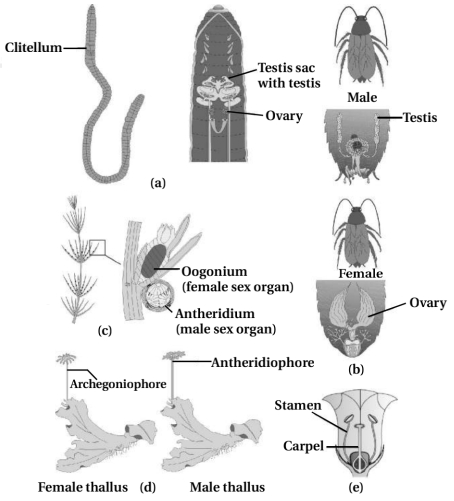
(N/A) Sexuality in organisms refers to the presence of reproductive structures. Organisms can be classified based on the distribution of these structures:
$1$. Bisexual (Hermaphrodite): Organisms that possess both male and female reproductive organs in the same individual. Examples include earthworms,sponges,tapeworms,and many flowering plants.
$2$. Unisexual (Dioecious): Organisms where male and female reproductive organs are present in separate individuals. Examples include humans,cockroaches,and many higher animals.
- In fungi and plants,the term 'homothallic' or 'monoecious' is used to denote the bisexual condition,where both male and female gametes are produced by the same plant.
- The term 'heterothallic' or 'dioecious' is used to describe the unisexual condition,where male and female gametes are produced by different plants.
$1$. Bisexual (Hermaphrodite): Organisms that possess both male and female reproductive organs in the same individual. Examples include earthworms,sponges,tapeworms,and many flowering plants.
$2$. Unisexual (Dioecious): Organisms where male and female reproductive organs are present in separate individuals. Examples include humans,cockroaches,and many higher animals.
- In fungi and plants,the term 'homothallic' or 'monoecious' is used to denote the bisexual condition,where both male and female gametes are produced by the same plant.
- The term 'heterothallic' or 'dioecious' is used to describe the unisexual condition,where male and female gametes are produced by different plants.
0 likes
View Solution69
Medium
Explain the process of gamete transfer.
Solution
(N/A) After the formation of male and female gametes,they must be brought together to facilitate the process of fertilization.
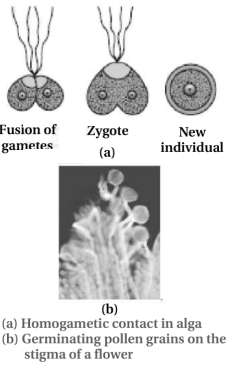
In the majority of organisms,the male gamete is motile and the female gamete is non-motile. The male gamete requires a medium to travel.
In algae,bryophytes,and pteridophytes,the male gamete travels through a water medium.
$A$ large number of male gametes,however,fail to reach the female gamete.
To compensate for this loss of male gametes during their travel,the number of male gametes produced is several thousand times higher than the number of female gametes produced.
In angiosperms,pollen grains are the carriers of male gametes,and the ovule contains the egg cell.
- Pollen grains are produced in anthers and transferred to the stigma through a process called pollination.
- This process involves external agents like water,air,insects,birds,etc.
Pollen grains germinate on the stigma,and the pollen tube carrying the male gametes reaches the ovule and discharges two male gametes near the egg cell.
In bisexual animals,since male and female gametes are formed in different individuals (or even in the same individual),the organism must evolve a special mechanism for gamete transfer,which is a prerequisite for fertilization.
In the majority of organisms,the male gamete is motile and the female gamete is non-motile. The male gamete requires a medium to travel.
In algae,bryophytes,and pteridophytes,the male gamete travels through a water medium.
$A$ large number of male gametes,however,fail to reach the female gamete.
To compensate for this loss of male gametes during their travel,the number of male gametes produced is several thousand times higher than the number of female gametes produced.
In angiosperms,pollen grains are the carriers of male gametes,and the ovule contains the egg cell.
- Pollen grains are produced in anthers and transferred to the stigma through a process called pollination.
- This process involves external agents like water,air,insects,birds,etc.
Pollen grains germinate on the stigma,and the pollen tube carrying the male gametes reaches the ovule and discharges two male gametes near the egg cell.
In bisexual animals,since male and female gametes are formed in different individuals (or even in the same individual),the organism must evolve a special mechanism for gamete transfer,which is a prerequisite for fertilization.
0 likes
View Solution70
Medium
Describe the process of fertilization.
Solution
(N/A) Fertilization is the process of fusion of two similar or dissimilar gametes,known as syngamy,which results in the formation of a diploid zygote.
There are two main types of fertilization:
$1$. External fertilization: In this type,syngamy occurs outside the body of the organism. Examples include most aquatic organisms like algae,fish,and amphibians.
The major disadvantage of external fertilization is that although they produce a large number of offspring,the offspring are highly vulnerable to predators.
$2$. Internal fertilization: Syngamy occurs inside the body of the organism. Examples include fungi,birds,and mammals.
In this process,male gametes are released close to the female gametes,where they fuse to form a zygote.
There are two main types of fertilization:
$1$. External fertilization: In this type,syngamy occurs outside the body of the organism. Examples include most aquatic organisms like algae,fish,and amphibians.
The major disadvantage of external fertilization is that although they produce a large number of offspring,the offspring are highly vulnerable to predators.
$2$. Internal fertilization: Syngamy occurs inside the body of the organism. Examples include fungi,birds,and mammals.
In this process,male gametes are released close to the female gametes,where they fuse to form a zygote.
0 likes
View Solution71
Medium
Explain the terms oviparous and viviparous.
Solution
(N/A) Oviparous animals: These are animals that lay hard,calcareous-shelled eggs in a safe environment. After a period of incubation,the young ones hatch out. Examples include reptiles and birds.
Viviparous animals: These animals exhibit internal fertilization and development. The young ones develop inside the body of the female. After the completion of the gestation period,the female gives birth to the young ones. Examples include most mammals.
Viviparous animals: These animals exhibit internal fertilization and development. The young ones develop inside the body of the female. After the completion of the gestation period,the female gives birth to the young ones. Examples include most mammals.
0 likes
View Solution72
Medium
Differentiate between external fertilization and internal fertilization.
Solution
(N/A)
| External Fertilization | Internal Fertilization |
|---|---|
| $(1)$ Syngamy occurs in an external medium (e.g.,water). | $(1)$ Syngamy takes place inside the body of the organism. |
| $(2)$ $A$ large number of offspring are produced. | $(2)$ The number of offspring produced is limited. |
| $(3)$ The chances of survival of the young ones are lower due to predators and environmental factors. | $(3)$ The chances of survival of the young ones are higher as they are protected inside the mother's body. |
| $(4)$ It requires an external medium like water for the male gametes to reach the female egg. | $(4)$ Male gametes are motile and reach the female egg within the reproductive tract. |
0 likes
View Solution73
Medium
Give a scientific reason: Haploid parents produce haploid gametes.
Solution
(N/A) In haploid organisms,the plant body is $n$. Since the organism is already haploid,it cannot undergo meiosis to produce gametes because meiosis reduces the chromosome number by half. Therefore,haploid organisms produce gametes through mitosis,which is an equational division. This ensures that the gametes maintain the same haploid $(n)$ chromosome number as the parent.
0 likes
View Solution74
EasyMCQ
This type of reproduction is divided into three stages: pre-fertilization,fertilization,and post-fertilization.
A
Asexual reproduction
B
Sexual reproduction
C
Vegetative reproduction
D
Both $A$ and $C$
Solution
(B) Sexual reproduction is characterized by the fusion of male and female gametes. This complex process is systematically divided into three distinct phases:
$1$. Pre-fertilization events: Includes gametogenesis (formation of gametes) and gamete transfer.
$2$. Fertilization: The process of syngamy or fusion of male and female gametes to form a diploid zygote.
$3$. Post-fertilization events: Includes the development of the zygote into an embryo (embryogenesis) and subsequent morphological changes.
Therefore,the correct option is $B$.
$1$. Pre-fertilization events: Includes gametogenesis (formation of gametes) and gamete transfer.
$2$. Fertilization: The process of syngamy or fusion of male and female gametes to form a diploid zygote.
$3$. Post-fertilization events: Includes the development of the zygote into an embryo (embryogenesis) and subsequent morphological changes.
Therefore,the correct option is $B$.
0 likes
View Solution75
EasyMCQ
Which biological process involves the production of offspring that are similar to the parents?
A
Evolution
B
Differentiation
C
Reproduction
D
Excretion
Solution
(C) Reproduction is a fundamental biological process by which living organisms produce new individual organisms (offspring) similar to themselves.
It ensures the continuity of species from generation to generation.
Evolution refers to the change in the heritable characteristics of biological populations over successive generations.
Differentiation is the process by which a less specialized cell becomes a more specialized cell type.
Excretion is the process of eliminating metabolic waste products from the body.
It ensures the continuity of species from generation to generation.
Evolution refers to the change in the heritable characteristics of biological populations over successive generations.
Differentiation is the process by which a less specialized cell becomes a more specialized cell type.
Excretion is the process of eliminating metabolic waste products from the body.
0 likes
View Solution76
MediumMCQ
Select the incorrect option regarding sexual reproduction.
A
One or two individuals of opposite sexes produce male and female gametes.
B
These gametes fuse to form a zygote,which develops into a new organism.
C
This process is a short,simple,and rapid process.
D
The offspring produced as a result of sexual reproduction are not identical to the parents or to each other.
Solution
(C) Sexual reproduction is a complex,elaborate,and slow process compared to asexual reproduction.
It involves the formation of male and female gametes by one or two individuals of opposite sexes.
These gametes fuse to form a zygote,which develops into a new organism.
Due to the fusion of male and female gametes and the process of meiosis,the offspring produced are genetically different from the parents and from each other,leading to variation.
Therefore,the statement that it is a 'short,simple,and rapid process' is incorrect.
It involves the formation of male and female gametes by one or two individuals of opposite sexes.
These gametes fuse to form a zygote,which develops into a new organism.
Due to the fusion of male and female gametes and the process of meiosis,the offspring produced are genetically different from the parents and from each other,leading to variation.
Therefore,the statement that it is a 'short,simple,and rapid process' is incorrect.
0 likes
View Solution77
EasyMCQ
What is the juvenile phase in plants known as?
A
Vegetative phase
B
Reproductive phase
C
Senescent phase
D
All of the above
Solution
(A) In the life cycle of plants,the period of growth from germination to the onset of flowering is known as the vegetative phase. This phase is equivalent to the juvenile phase in animals,where the organism undergoes growth and development before reaching sexual maturity.
0 likes
View Solution78
EasyMCQ
Identify the phases of sexual reproduction.
A
Pre-fertilization phase
B
Fertilization phase
C
Post-fertilization phase
D
All of the above
Solution
(D) Sexual reproduction is characterized by the fusion of male and female gametes,the formation of zygote,and embryogenesis. These events are grouped into three distinct stages:
$1$. Pre-fertilization phase: Includes gametogenesis (formation of gametes) and gamete transfer.
$2$. Fertilization phase: Involves the fusion of male and female gametes (syngamy) to form a diploid zygote.
$3$. Post-fertilization phase: Includes the development of the zygote into an embryo (embryogenesis).
Therefore,all the listed phases are part of sexual reproduction.
$1$. Pre-fertilization phase: Includes gametogenesis (formation of gametes) and gamete transfer.
$2$. Fertilization phase: Involves the fusion of male and female gametes (syngamy) to form a diploid zygote.
$3$. Post-fertilization phase: Includes the development of the zygote into an embryo (embryogenesis).
Therefore,all the listed phases are part of sexual reproduction.
0 likes
View Solution79
EasyMCQ
In most organisms,the male gamete is ........ and the female gamete is ........ .
A
motile,stationary
B
stationary,motile
C
motile,motile
D
stationary,stationary
Solution
(A) In most sexually reproducing organisms,the male gametes are produced in large numbers and are typically motile,which allows them to travel to the female gamete. The female gamete is generally larger,stationary (non-motile),and contains food reserves to support the developing embryo. Therefore,the correct answer is $A$.
0 likes
View Solution80
MediumMCQ
In organisms exhibiting this type of fertilization,the probability of being destroyed by predators is significantly increased.
A
Internal fertilization
B
External fertilization
C
Both
D
None of these
Solution
(B) External fertilization occurs outside the body of the organism,usually in an aquatic medium.
Because the gametes and the developing embryos are released into the open environment,they are highly vulnerable to predators and environmental hazards.
This results in a significant increase in the probability of being destroyed by predators compared to internal fertilization,where the embryo is protected within the female body.
Because the gametes and the developing embryos are released into the open environment,they are highly vulnerable to predators and environmental hazards.
This results in a significant increase in the probability of being destroyed by predators compared to internal fertilization,where the embryo is protected within the female body.
0 likes
View Solution81
MediumMCQ
The processes of zygote formation and embryogenesis are included in which of the following events?
A
Pre-fertilization
B
Fertilization
C
Post-fertilization
D
All of the above
Solution
(C) In sexual reproduction,the events are categorized into three stages:
$1$. Pre-fertilization: Includes gametogenesis and gamete transfer.
$2$. Fertilization: The fusion of male and female gametes to form a diploid zygote.
$3$. Post-fertilization: Includes the development of the zygote into an embryo (embryogenesis) and further development.
Therefore,zygote formation and embryogenesis are key events of post-fertilization.
$1$. Pre-fertilization: Includes gametogenesis and gamete transfer.
$2$. Fertilization: The fusion of male and female gametes to form a diploid zygote.
$3$. Post-fertilization: Includes the development of the zygote into an embryo (embryogenesis) and further development.
Therefore,zygote formation and embryogenesis are key events of post-fertilization.
0 likes
View Solution82
MediumMCQ
The vital link that ensures continuity of species between organisms of one generation and the next is:
A
Gametes
B
Spores
C
Zygote
D
All of the above
Solution
(C) The $Zygote$ is considered the vital link that ensures the continuity of species between organisms of one generation and the next.
During sexual reproduction, the fusion of male and female gametes results in the formation of a diploid $Zygote$.
This $Zygote$ contains the genetic material from both parents, which is then passed on to the offspring, thereby maintaining the continuity of the species across generations.
During sexual reproduction, the fusion of male and female gametes results in the formation of a diploid $Zygote$.
This $Zygote$ contains the genetic material from both parents, which is then passed on to the offspring, thereby maintaining the continuity of the species across generations.
0 likes
View Solution83
EasyMCQ
When male and female gametes are morphologically distinct,the condition is known as
A
Homogametes
B
Heterogametes
C
Hermaphrodites
D
Sexual Dimorphism
Solution
(B) The correct answer is $B$.
When male and female gametes are morphologically distinct,they are called $Heterogametes$ (or $Anisogametes$).
$Hetero-$ means different and $gametes$ refers to the reproductive cells.
In this condition,the male gamete is usually smaller and motile (sperm/antherozoid),while the female gamete is larger and non-motile (egg/ovum).
When male and female gametes are morphologically distinct,they are called $Heterogametes$ (or $Anisogametes$).
$Hetero-$ means different and $gametes$ refers to the reproductive cells.
In this condition,the male gamete is usually smaller and motile (sperm/antherozoid),while the female gamete is larger and non-motile (egg/ovum).
0 likes
View SolutionReproduction in Organisms — SEXUAL REPRODUCTION · Frequently Asked Questions
1Are these Reproduction in Organisms questions useful for JEE and NEET?
Yes. All questions in this section are mapped to JEE Main and NEET exam patterns. Previous year questions from JEE Main, NEET, GUJCET and state-level exams are included with full solutions.
2Can I switch to Hindi or Gujarati for these questions?
Yes. Use the language tabs in the hero section or the sidebar to view the same questions and solutions in English, Hindi or Gujarati.
3How do I generate a question paper from this subtopic?
Use the Vedclass Exam Paper Generator — select the chapter and subtopic, set difficulty, and generate Sets A, B, C, D automatically. First 3 chapters of every subject are free.
Vedclass Products
For Students
Vedclass Test Series
Mock tests in real JEE/NEET style with performance analysis. 5-day free trial.
Start Free TrialFor Teachers
Exam Paper Generator
Generate Set A/B/C/D papers from this chapter in 2 minutes. 3 chapters free.
Try FreeFor Institutes
Online Exam Module
Live online exams with unlimited students, 360° analytics & white-label branding.
See DemoFor Teachers & Institutes
Generate a Reproduction in Organisms Exam Paper in 2 Minutes
Select subtopic & difficulty — Sets A, B, C, D auto-generated with No Repeat logic.
First 3 chapters of every subject are free — no payment required.