
A English
SEXUAL REPRODUCTION Questions in English
Class 12 Biology · Reproduction in Organisms · SEXUAL REPRODUCTION
83+
Questions
English
Language
100%
With Solutions
Showing 50 of 83 questions in English
1
MediumMCQ
In physiological anisogamy,
A
Gametes are morphologically similar but physiologically dissimilar
B
Gametes are morphologically dissimilar but physiologically similar
C
Gametes are morphologically and physiologically similar
D
None of the above
Solution
(A) In physiological anisogamy,the fusing gametes are similar in morphology (shape and size) but different in their physiological behavior or mating types,often denoted as $(+)$ and $(-)$ strains.
This phenomenon is observed in certain algae,such as $Chlamydomonas$ $monoica$.
This phenomenon is observed in certain algae,such as $Chlamydomonas$ $monoica$.
0 likes
View Solution2
EasyMCQ
Fusion of mature individuals which directly act as gametes,is called
A
Isogamy
B
Anisogamy
C
Hologamy
D
Autogamy
Solution
(C) The fusion of two mature individuals that act directly as gametes is known as $Hologamy$.
In certain species of $Chlamydomonas$,the entire vegetative cell functions as a gamete,and the fusion of two such whole cells is termed $Hologamy$.
In certain species of $Chlamydomonas$,the entire vegetative cell functions as a gamete,and the fusion of two such whole cells is termed $Hologamy$.
0 likes
View Solution3
MediumMCQ
Which of the following is a correct statement?
A
Gametes are diploid.
B
Spores are invariably haploid.
C
Spores and gametes are invariably haploid.
D
Gametes are invariably haploid.
Solution
(B) In biological organisms,gametes are specialized cells produced for sexual reproduction. In many organisms,they are haploid $(n)$,but in some organisms (like certain algae or fungi),gametes can be produced by mitosis from haploid individuals,or in some cases,they may be diploid. However,spores are reproductive cells that are produced by meiosis in the sporophyte generation and are invariably haploid $(n)$. Therefore,the statement that spores are invariably haploid is the most accurate biological generalization among the options provided.
0 likes
View Solution4
MediumMCQ
The primary biological importance of sex in organisms is that it
A
Is essential for organismic reproduction
B
Is essential for cellular reproduction
C
Causes new mutations to occur in offspring
D
Promotes genetic variability in offspring
Solution
(D) Sexual reproduction involves the process of meiosis and fertilization,which leads to the recombination of genetic material from two parents. This process generates new combinations of genes in the offspring,thereby promoting genetic variability. Genetic variation is crucial for evolution and the adaptation of a species to changing environmental conditions.
0 likes
View Solution5
MediumMCQ
Animals with an oestrous cycle possess .....
A
One ovulation per month
B
One ovum
C
$A$ breeding season once a year
D
Menstrual flow once a month
Solution
(C) The oestrous cycle is a reproductive cycle observed in non-primate mammals such as cows,sheep,rats,deer,dogs,and tigers.
These animals exhibit cyclic changes in the activities of ovaries and accessory ducts as well as hormones during the reproductive phase.
Unlike the menstrual cycle,which involves the shedding of the uterine lining (menstruation),the oestrous cycle is characterized by a specific breeding season during which the female is receptive to mating.
Therefore,animals with an oestrous cycle typically have a restricted breeding season once or twice a year.
These animals exhibit cyclic changes in the activities of ovaries and accessory ducts as well as hormones during the reproductive phase.
Unlike the menstrual cycle,which involves the shedding of the uterine lining (menstruation),the oestrous cycle is characterized by a specific breeding season during which the female is receptive to mating.
Therefore,animals with an oestrous cycle typically have a restricted breeding season once or twice a year.
0 likes
View Solution6
MediumMCQ
What is associated with internal fertilization in animals?
A
Presence of copulatory organs
B
Certainty of fertilization
C
Adaptation to terrestrial life
D
Prevention of wastage
Solution
(A-D) Internal fertilization is a process where the fusion of male and female gametes occurs inside the female body.
$1$. It is a key adaptation for terrestrial animals to prevent the desiccation of gametes.
$2$. It ensures a higher probability of fertilization compared to external fertilization.
$3$. It reduces the wastage of gametes.
$4$. It often involves the presence of specialized copulatory organs for the transfer of sperm.
Since all the given options are associated with internal fertilization,the most comprehensive answer in the context of biological evolution and reproductive strategy is that it encompasses all these factors. However,if a single choice is required,it is often noted that internal fertilization is primarily an adaptation to terrestrial life to protect gametes from the external environment.
$1$. It is a key adaptation for terrestrial animals to prevent the desiccation of gametes.
$2$. It ensures a higher probability of fertilization compared to external fertilization.
$3$. It reduces the wastage of gametes.
$4$. It often involves the presence of specialized copulatory organs for the transfer of sperm.
Since all the given options are associated with internal fertilization,the most comprehensive answer in the context of biological evolution and reproductive strategy is that it encompasses all these factors. However,if a single choice is required,it is often noted that internal fertilization is primarily an adaptation to terrestrial life to protect gametes from the external environment.
0 likes
View Solution7
EasyMCQ
Through which process do new organisms replace the organisms that have died?
A
Ability to inherit
B
Consciousness
C
Adaptation
D
Reproduction
Solution
(D) Reproduction is the biological process by which new individual organisms,or 'offspring',are produced from their 'parents'.
It ensures the continuity of species from generation to generation.
Even though individual organisms die,the process of reproduction allows the population to persist by replacing the deceased individuals with new ones.
It ensures the continuity of species from generation to generation.
Even though individual organisms die,the process of reproduction allows the population to persist by replacing the deceased individuals with new ones.
0 likes
View Solution8
EasyMCQ
Which process ensures the continuity of life from generation to generation?
A
Ability to preserve heritage
B
Reproduction
C
Death
D
Variation
Solution
(B) Reproduction is a fundamental biological process by which living organisms produce new individuals of their own kind.
It ensures the continuity of species from one generation to the next.
While other processes like metabolism or growth are essential for an individual's survival,reproduction is essential for the survival of the species as a whole.
It ensures the continuity of species from one generation to the next.
While other processes like metabolism or growth are essential for an individual's survival,reproduction is essential for the survival of the species as a whole.
0 likes
View Solution9
MediumMCQ
Through which process is the continuity of life maintained from generation to generation?
A
Adaptation
B
Reproduction
C
Growth
D
Death
Solution
(B) Reproduction is a fundamental biological process by which living organisms produce new individuals of their own kind. It ensures the continuity of species from one generation to the next,preventing the extinction of life on Earth. While growth,adaptation,and death are characteristics of living organisms,they do not directly facilitate the transmission of genetic information to offspring to maintain life's continuity.
0 likes
View Solution10
EasyMCQ
The term 'vital force' (vis vitalis) is associated with which biological process?
A
Growth
B
Adaptation
C
Reproduction
D
Death
Solution
(C) The concept of 'vital force' (vis vitalis) was historically proposed to explain the phenomenon of life. In the context of biological processes, it is most closely associated with the ability of living organisms to produce offspring, which is $Reproduction$. This theory suggested that living things possess a unique force that distinguishes them from non-living matter, enabling them to replicate and sustain life.
0 likes
View Solution11
EasyMCQ
What is the process called when a living organism produces a new organism similar to itself at maturity?
A
Regeneration
B
Adaptation
C
Reproduction
D
Differentiation
Solution
(C) Reproduction is a fundamental biological process by which living organisms produce new individual organisms (offspring) similar to themselves. It is a characteristic feature of all living organisms,ensuring the continuity of species.
0 likes
View Solution12
EasyMCQ
What is reproduction?
A
Various biochemical processes occurring in living cells.
B
Increase in mass and number.
C
Morphogenesis and differentiation.
D
The production of new organisms similar to themselves by mature individuals.
Solution
(D) Reproduction is a fundamental characteristic of living organisms. It is defined as the biological process by which mature individuals produce new offspring that are similar to themselves. This ensures the continuity of the species from generation to generation.
0 likes
View Solution13
EasyMCQ
Which of the following is responsible for the maintenance of life continuity and species balance?
A
Death
B
Reproduction
C
Adaptation
D
Both death and reproduction
Solution
(B) Reproduction is the biological process by which new individual organisms (offspring) are produced from their parents. It is essential for the continuity of life on Earth and ensures the survival of a species by replacing individuals that die,thereby maintaining the population balance.
0 likes
View Solution14
MediumMCQ
Syngamy can occur outside the body of the organism in
A
mosses
B
algae
C
ferns
D
fungi
Solution
(B) $Syngamy$ is the complete and permanent fusion of male and female gametes to form the zygote.
When fertilization occurs outside the body of the organism,this type of gametic fusion is called external fertilization or external $syngamy$.
In the majority of $algae$,external fertilization occurs in the surrounding water medium.
When fertilization occurs outside the body of the organism,this type of gametic fusion is called external fertilization or external $syngamy$.
In the majority of $algae$,external fertilization occurs in the surrounding water medium.
0 likes
View Solution15
MediumMCQ
Which one of the following generates new genetic combinations leading to variation?
A
Vegetative reproduction
B
Parthenogenesis
C
Sexual reproduction
D
Nucellar polyembryony
Solution
(C) : Sexual reproduction involves the formation and fusion of male and female gametes.
Gamete formation is accomplished through meiotic cell division,which involves crossing over between non-sister chromatids of homologous chromosomes,leading to new genetic recombination in gametes.
Random fusion of these male and female gametes leads to genetic variability in the offspring,which,although resembling their parents,also exhibit new traits of their own.
Gamete formation is accomplished through meiotic cell division,which involves crossing over between non-sister chromatids of homologous chromosomes,leading to new genetic recombination in gametes.
Random fusion of these male and female gametes leads to genetic variability in the offspring,which,although resembling their parents,also exhibit new traits of their own.
0 likes
View Solution16
MediumMCQ
The product of sexual reproduction generally generates:
A
new genetic combinations leading to variation
B
large biomass
C
longer viability of seeds
D
prolonged dormancy
Solution
(A) : Sexual reproduction always involves meiosis (zygotic in case of haploid individuals and gametic in case of diploid individuals).
Meiosis results in crossing over between chromosomes during prophase $I$,which generates new recombinations.
Besides,sexual reproduction generally involves the combination of genes from two different organisms.
Thus,sexual reproduction generates new genetic combinations leading to variations.
Meiosis results in crossing over between chromosomes during prophase $I$,which generates new recombinations.
Besides,sexual reproduction generally involves the combination of genes from two different organisms.
Thus,sexual reproduction generates new genetic combinations leading to variations.
0 likes
View Solution17
MediumMCQ
What is the major disadvantage of external fertilization?
A
External environment is suitable for fertilization
B
Surrounding medium (water) enhances the chance of syngamy
C
Offspring are extremely vulnerable to predators
D
All of the above
Solution
(C) External fertilization is a process where the fusion of male and female gametes occurs outside the body of the organism,typically in an aquatic medium.
While this method allows for the production of a large number of offspring,it has significant disadvantages.
The primary disadvantage is that the offspring are not protected by the parent's body during their early development.
Consequently,they are extremely vulnerable to predators,which significantly reduces their chances of survival to adulthood.
While this method allows for the production of a large number of offspring,it has significant disadvantages.
The primary disadvantage is that the offspring are not protected by the parent's body during their early development.
Consequently,they are extremely vulnerable to predators,which significantly reduces their chances of survival to adulthood.
0 likes
View Solution18
MediumMCQ
Identify $X, Y$ and $Z$ and select the correct option.
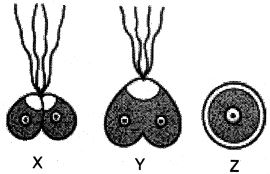
A
$X-$ Fusion of gametes,$Y-$ Zygote,$Z-$ New individual
B
$X-$ Zygote,$Y-$ New individual,$Z-$ Fusion of gametes
C
$X-$ New individual,$Y-$ Spore formation,$Z-$ Zygote
D
$X-$ Zygote,$Y-$ Fusion of gametes,$Z-$ Spore formation
Solution
(A) The provided image illustrates the process of sexual reproduction in organisms,specifically showing the stages of fertilization and development.
$X$ represents the fusion of gametes (syngamy),where two haploid gametes come together.
$Y$ represents the formation of the diploid zygote,which is the result of the fusion of gametes.
$Z$ represents the development of the zygote into a new individual (or embryo/oospore depending on the organism).
Therefore,the correct sequence is $X-$ Fusion of gametes,$Y-$ Zygote,$Z-$ New individual.
$X$ represents the fusion of gametes (syngamy),where two haploid gametes come together.
$Y$ represents the formation of the diploid zygote,which is the result of the fusion of gametes.
$Z$ represents the development of the zygote into a new individual (or embryo/oospore depending on the organism).
Therefore,the correct sequence is $X-$ Fusion of gametes,$Y-$ Zygote,$Z-$ New individual.
0 likes
View Solution19
EasyMCQ
Anisogamous means both gametes are
A
Similar in size and non-motile
B
Dissimilar in size
C
Similar in size and motile
D
Dissimilar in size and non-motile only
Solution
(B) In sexual reproduction,when the two fusing gametes are morphologically distinct or dissimilar in size,the condition is known as anisogamy.
$1$. Isogamy: Gametes are similar in size (e.g.,Cladophora).
$2$. Anisogamy: Gametes are dissimilar in size (e.g.,some species of Eudorina).
$3$. Oogamy: $A$ large,non-motile female gamete fuses with a smaller,motile male gamete (e.g.,Volvox,Fucus).
Therefore,the term anisogamous refers to gametes that are dissimilar in size.
$1$. Isogamy: Gametes are similar in size (e.g.,Cladophora).
$2$. Anisogamy: Gametes are dissimilar in size (e.g.,some species of Eudorina).
$3$. Oogamy: $A$ large,non-motile female gamete fuses with a smaller,motile male gamete (e.g.,Volvox,Fucus).
Therefore,the term anisogamous refers to gametes that are dissimilar in size.
0 likes
View Solution20
MediumMCQ
Select the wrong statement:
A
Anisogametes differ in structure,function,or behaviour.
B
In oogamy,the female gamete is smaller and motile,while the male gamete is larger and non-motile.
C
$Chlamydomonas$ exhibits both isogamy and anisogamy,and $Fucus$ shows oogamy.
D
Isogametes are similar in structure,function,and behaviour.
Solution
(B) In oogamous reproduction,the female gamete is typically large and non-motile (e.g.,egg or ovum),while the male gamete is smaller and motile (e.g.,sperm). The statement in option $B$ incorrectly reverses these characteristics,stating that the female gamete is smaller and motile while the male is larger and non-motile. Therefore,statement $B$ is incorrect.
0 likes
View Solution21
MediumMCQ
Sexual reproduction involving the fusion of two cells in $Chlamydomonas$ is known as:
A
Isogamy
B
Homogamy
C
Somatogamy
D
Hologamy
Solution
(D) In $Chlamydomonas$,sexual reproduction can occur through the fusion of two vegetative cells that act as gametes. When the entire organism functions as a gamete and fuses with another,the process is called $Hologamy$. $Isogamy$ refers to the fusion of morphologically similar gametes,while $Somatogamy$ involves the fusion of somatic cells in fungi. Therefore,the correct term for the fusion of two cells in $Chlamydomonas$ is $Hologamy$.
0 likes
View Solution22
MediumMCQ
Find the incorrect statement.
A
Isogametes are similar in structure,function,and behavior.
B
Anisogametes show differences in structure,function,or behavior.
C
In Oomycetes,the female gamete is small and motile,while the male gamete is large and non-motile.
D
Chlamydomonas shows both isogamy and anisogamy,while Fucus shows oogamy.
Solution
(C) In Oomycetes (a group of water molds),the sexual reproduction is oogamous. In oogamy,the female gamete (egg) is large and non-motile,while the male gamete (antherozoid) is small and motile. The statement provided in option $C$ incorrectly reverses these characteristics,making it the incorrect statement.
0 likes
View Solution23
MediumMCQ
Which of the following produces new combinations leading to variation?
A
Vegetative propagation
B
Apomixis
C
Sexual reproduction
D
Nuclear polyembryony
Solution
(C) Sexual reproduction involves the process of meiosis and fertilization. During meiosis,specifically in prophase-$I$,crossing over occurs between homologous chromosomes,which results in the exchange of genetic material. This process,combined with the random fusion of gametes during fertilization,leads to new genetic combinations in the offspring. These new combinations are the primary source of genetic variation in a population. In contrast,vegetative propagation,apomixis,and nuclear polyembryony are forms of asexual reproduction that produce clones,which are genetically identical to the parent.
0 likes
View Solution24
Easy
Define:
$(a)$ Juvenile phase,
$(b)$ Reproductive phase,
$(c)$ Senescent phase.
$(a)$ Juvenile phase,
$(b)$ Reproductive phase,
$(c)$ Senescent phase.
Solution
(N/A) Juvenile phase:
It is the period of growth in an individual organism after its birth and before it reaches reproductive maturity.
$(b)$ Reproductive phase:
It is the period when an individual organism is capable of sexual reproduction.
$(c)$ Senescent phase:
It is the final stage of the life cycle,characterized by the onset of aging and the loss of reproductive ability.
It is the period of growth in an individual organism after its birth and before it reaches reproductive maturity.
$(b)$ Reproductive phase:
It is the period when an individual organism is capable of sexual reproduction.
$(c)$ Senescent phase:
It is the final stage of the life cycle,characterized by the onset of aging and the loss of reproductive ability.
0 likes
View Solution25
Medium
Higher organisms have resorted to sexual reproduction in spite of its complexity. Why?
Solution
(N/A) Although sexual reproduction involves more time and energy,higher organisms have resorted to sexual reproduction in spite of its complexity.
This is because this mode of reproduction helps introduce new variations in progenies through the combination of the $DNA$ from two (usually) different individuals.
These variations allow the individual to cope with various environmental conditions and thus,make the organism better suited for the environment.
Variations also lead to the evolution of better organisms and therefore,provide better chances of survival.
On the other hand,asexual reproduction does not provide genetic differences in the individuals produced.
This is because this mode of reproduction helps introduce new variations in progenies through the combination of the $DNA$ from two (usually) different individuals.
These variations allow the individual to cope with various environmental conditions and thus,make the organism better suited for the environment.
Variations also lead to the evolution of better organisms and therefore,provide better chances of survival.
On the other hand,asexual reproduction does not provide genetic differences in the individuals produced.
0 likes
View Solution26
Medium
Define external fertilization. Mention its disadvantages.
Solution
(N/A) External fertilization is the process in which the fusion of the male and the female gamete takes place outside the female body in an external medium,generally water.
Examples of organisms that exhibit external fertilization include fish,frogs,and starfish.
Disadvantages of external fertilization:
$1$. In external fertilization,eggs have less chance of being fertilized,which can lead to the wastage of a large number of eggs produced during the process.
$2$. There is an absence of proper parental care for the offspring,which results in a low survival rate for the progeny.
Examples of organisms that exhibit external fertilization include fish,frogs,and starfish.
Disadvantages of external fertilization:
$1$. In external fertilization,eggs have less chance of being fertilized,which can lead to the wastage of a large number of eggs produced during the process.
$2$. There is an absence of proper parental care for the offspring,which results in a low survival rate for the progeny.
0 likes
View Solution27
Medium
Differentiate between gametogenesis and embryogenesis.
Solution
(N/A)
| Gametogenesis | Embryogenesis |
|---|---|
| It is the process of the formation of haploid male and female gametes from diploid meiocytes through the process of meiosis. | It is the process of the development of the embryo from the repeated mitotic divisions of the diploid zygote. |
0 likes
View Solution28
Medium
Describe the reproductive phase in higher plants in relation to flowering,including examples.
Solution
(N/A) In higher plants,the reproductive phase begins with the onset of flowering,which marks the end of the juvenile or vegetative phase.
Examples: Plants like marigold,wheat,rice,coconut,and mango take different amounts of time to flower. Many plants exhibit flowering more than once in their lifetime.
Some plants,such as mango,apple,and jackfruit,flower only during specific seasons. Some plants show continuous flowering throughout the year,while others exhibit seasonal flowering.
In annual and biennial plants,the vegetative,reproductive,and senescent phases are clearly defined. However,in perennial plants,these phases are very difficult to define clearly.
Some plants show unique flowering patterns. For example,bamboo species flower only once in their lifetime,generally after $50-100$ years,produce a large number of fruits,and then die.
Another example is 'Strobilanthus kunthiana' (Neelakurinji),which flowers once every $12$ years. It flowered in September-October $2006$ in the hilly regions of Kerala,Karnataka,and Tamil Nadu,creating a blue stretch that attracted many tourists.
In animals,the juvenile phase is followed by morphological and physiological changes prior to active reproductive behavior. The duration of the reproductive phase varies among different organisms.
Examples: Plants like marigold,wheat,rice,coconut,and mango take different amounts of time to flower. Many plants exhibit flowering more than once in their lifetime.
Some plants,such as mango,apple,and jackfruit,flower only during specific seasons. Some plants show continuous flowering throughout the year,while others exhibit seasonal flowering.
In annual and biennial plants,the vegetative,reproductive,and senescent phases are clearly defined. However,in perennial plants,these phases are very difficult to define clearly.
Some plants show unique flowering patterns. For example,bamboo species flower only once in their lifetime,generally after $50-100$ years,produce a large number of fruits,and then die.
Another example is 'Strobilanthus kunthiana' (Neelakurinji),which flowers once every $12$ years. It flowered in September-October $2006$ in the hilly regions of Kerala,Karnataka,and Tamil Nadu,creating a blue stretch that attracted many tourists.
In animals,the juvenile phase is followed by morphological and physiological changes prior to active reproductive behavior. The duration of the reproductive phase varies among different organisms.
0 likes
View Solution29
Medium
Provide information about the reproductive phase in various animals with examples.
Solution
(N/A) In natural habitats,birds lay eggs seasonally. However,birds in captivity (like in poultry farms) can be made to lay eggs throughout the year. In this case,laying eggs is not related to reproduction but is for commercial exploitation for human welfare.
Female placental mammals exhibit cyclic changes in the activities of ovaries and accessory ducts as well as hormones during the reproductive phase. In non-primate mammals like cows,sheep,rats,deer,dogs,and tigers,such cyclic changes during reproduction are called the $Oestrus$ cycle.
In primates like monkeys,apes,and humans,it is called the $Menstrual$ cycle.
Many mammals,especially those living in natural,wild conditions,exhibit such cycles only during favourable seasons in their reproductive phase and are therefore called $Seasonal$ $breeders$.
Many other mammals are reproductively active throughout their reproductive phase and are hence called $Continuous$ $breeders$.
Female placental mammals exhibit cyclic changes in the activities of ovaries and accessory ducts as well as hormones during the reproductive phase. In non-primate mammals like cows,sheep,rats,deer,dogs,and tigers,such cyclic changes during reproduction are called the $Oestrus$ cycle.
In primates like monkeys,apes,and humans,it is called the $Menstrual$ cycle.
Many mammals,especially those living in natural,wild conditions,exhibit such cycles only during favourable seasons in their reproductive phase and are therefore called $Seasonal$ $breeders$.
Many other mammals are reproductively active throughout their reproductive phase and are hence called $Continuous$ $breeders$.
0 likes
View Solution30
Medium
Describe the events (stages) that occur in sexual reproduction.
Solution
(N/A) After reaching maturity,all organisms that reproduce sexually exhibit various events and processes that show structural similarity,even though the structures associated with sexual reproduction differ significantly.
The events of sexual reproduction are complex and follow a regular sequence. The fusion of male and female gametes (fertilization),the formation of a zygote,and embryogenesis are characteristic features of sexual reproduction.
For convenience,these events are divided into three stages: Pre-fertilization events,Fertilization,and Post-fertilization events.
The events of sexual reproduction are complex and follow a regular sequence. The fusion of male and female gametes (fertilization),the formation of a zygote,and embryogenesis are characteristic features of sexual reproduction.
For convenience,these events are divided into three stages: Pre-fertilization events,Fertilization,and Post-fertilization events.
0 likes
View Solution31
Medium
List the types of pre-fertilization events and provide information about gametogenesis.
Solution
(N/A) Pre-fertilization events are the processes that occur before the fusion of gametes. These include two main events:
$1$. Gametogenesis: The process of formation of male and female gametes.
$2$. Gamete transfer: The process of bringing the male and female gametes together for fertilization.
Gametogenesis involves the formation of haploid cells $(n)$ from diploid parent cells $(2n)$ through meiosis. In many organisms,the two gametes produced are morphologically distinct types (heterogametes). The male gamete is called antherozoid or sperm,and the female gamete is called egg or ovum. In some algae,the two gametes are so similar in appearance that it is not possible to categorize them into male and female types; these are called homogametes (isogametes).
$1$. Gametogenesis: The process of formation of male and female gametes.
$2$. Gamete transfer: The process of bringing the male and female gametes together for fertilization.
Gametogenesis involves the formation of haploid cells $(n)$ from diploid parent cells $(2n)$ through meiosis. In many organisms,the two gametes produced are morphologically distinct types (heterogametes). The male gamete is called antherozoid or sperm,and the female gamete is called egg or ovum. In some algae,the two gametes are so similar in appearance that it is not possible to categorize them into male and female types; these are called homogametes (isogametes).
0 likes
View Solution32
Medium
Write a short note on sexuality in organisms.
Solution
(N/A) Sexuality in organisms refers to the nature of reproductive structures present in an individual.
$1$. Bisexual organisms: These organisms possess both male and female reproductive structures in the same individual. In plants,this condition is often referred to as $monoecious$ or $homothallic$.
$2$. Unisexual organisms: These organisms possess either male or female reproductive structures,but not both. In plants,this condition is referred to as $dioecious$ or $heterothallic$.
$3$. In animals,individuals are often referred to as $bisexual$ (hermaphrodites) if they possess both sets of reproductive organs,or $unisexual$ if they possess only one type.
$1$. Bisexual organisms: These organisms possess both male and female reproductive structures in the same individual. In plants,this condition is often referred to as $monoecious$ or $homothallic$.
$2$. Unisexual organisms: These organisms possess either male or female reproductive structures,but not both. In plants,this condition is referred to as $dioecious$ or $heterothallic$.
$3$. In animals,individuals are often referred to as $bisexual$ (hermaphrodites) if they possess both sets of reproductive organs,or $unisexual$ if they possess only one type.
0 likes
View Solution33
Medium
Explain the types of cell division during gamete formation.
Solution
(N/A) In all heterogametic species, there are two types of gametes: male and female. Gametes are haploid $(n)$, but the parent plant body from which they arise can be either haploid $(n)$ or diploid $(2n)$.
$A$ haploid parent produces gametes by mitosis.
Many organisms belonging to Monera, Fungi, Algae, and Bryophytes have a haploid plant body. However, in Pteridophytes, Gymnosperms, Angiosperms, and many animals including humans, the parent body is diploid $(2n)$.
Therefore, to produce haploid gametes from a diploid body, a reductional division called meiosis occurs.
In diploid organisms, specialized cells called meiocytes undergo meiosis.
At the end of meiosis, one set of chromosomes $(n)$ enters each gamete.
$A$ haploid parent produces gametes by mitosis.
Many organisms belonging to Monera, Fungi, Algae, and Bryophytes have a haploid plant body. However, in Pteridophytes, Gymnosperms, Angiosperms, and many animals including humans, the parent body is diploid $(2n)$.
Therefore, to produce haploid gametes from a diploid body, a reductional division called meiosis occurs.
In diploid organisms, specialized cells called meiocytes undergo meiosis.
At the end of meiosis, one set of chromosomes $(n)$ enters each gamete.
| Name of Organism | Chromosome number in meiocyte $(2n)$ | Chromosome number in gamete $(n)$ |
| Housefly | $12$ | $6$ |
| Rat | $42$ | $21$ |
| Dog | $78$ | $39$ |
| Cat | $38$ | $19$ |
| Fruit fly | $8$ | $4$ |
| Ophioglossum (fern) | $1260$ | $630$ |
| Apple | $34$ | $17$ |
| Rice | $24$ | $12$ |
| Maize | $20$ | $10$ |
| Potato | $48$ | $24$ |
| Butterfly | $380$ | $190$ |
| Onion | $16$ | $8$ |
| Human | $46$ | $23$ |
0 likes
View Solution34
MediumMCQ
Describe the process of fertilization. What are the types of fertilization?
A
External fertilization
B
Internal fertilization
C
Both $A$ and $B$
D
None of the above
Solution
(C) The most vital event of sexual reproduction is the fusion of gametes. This process is called syngamy and it results in the formation of a diploid $zygote$. The term $fertilization$ is also used for this process.
There are two main types of fertilization:
$1$. $External$ $fertilization$: In a majority of algae,fishes,and amphibians,syngamy occurs in the external medium (water),i.e.,outside the body of the organism. This is called external fertilization.
$2$. $Internal$ $fertilization$: In higher animals such as reptiles,birds,mammals,and in a majority of plants (bryophytes,pteridophytes,gymnosperms,and angiosperms),syngamy occurs inside the body of the organism. This process is called internal fertilization.
There are two main types of fertilization:
$1$. $External$ $fertilization$: In a majority of algae,fishes,and amphibians,syngamy occurs in the external medium (water),i.e.,outside the body of the organism. This is called external fertilization.
$2$. $Internal$ $fertilization$: In higher animals such as reptiles,birds,mammals,and in a majority of plants (bryophytes,pteridophytes,gymnosperms,and angiosperms),syngamy occurs inside the body of the organism. This process is called internal fertilization.
0 likes
View Solution35
Medium
Explain the site of syngamy and its types in different organisms.
Solution
(N/A) Syngamy (fertilisation) occurs either outside or inside the body of the organism. Based on this,it is classified as external or internal fertilisation.
External Fertilisation: In most aquatic organisms,such as a majority of algae and fishes as well as amphibians,syngamy occurs in the external medium (water). This is called external fertilisation. Organisms exhibiting external fertilisation show great synchrony between the sexes and release a large number of gametes into the surrounding medium (water) to enhance the chances of syngamy.
In bony fishes and frogs,a large number of offspring are produced. $A$ major disadvantage is that the offspring are extremely vulnerable to predators,threatening their survival up to adulthood.
Internal Fertilisation: In many terrestrial organisms,such as fungi,higher animals (reptiles,birds,mammals),and a majority of plants (bryophytes,pteridophytes,gymnosperms,and angiosperms),syngamy occurs inside the body of the organism. This is called internal fertilisation.
In these organisms,the egg is formed inside the female body where it fuses with the male gamete.
In organisms exhibiting internal fertilisation,the male gamete is motile and reaches the egg for fusion.
Although a large number of male gametes are produced,the number of eggs produced is significantly lower.
In seed plants,non-motile male gametes are carried to the female gamete via pollen tubes.
External Fertilisation: In most aquatic organisms,such as a majority of algae and fishes as well as amphibians,syngamy occurs in the external medium (water). This is called external fertilisation. Organisms exhibiting external fertilisation show great synchrony between the sexes and release a large number of gametes into the surrounding medium (water) to enhance the chances of syngamy.
In bony fishes and frogs,a large number of offspring are produced. $A$ major disadvantage is that the offspring are extremely vulnerable to predators,threatening their survival up to adulthood.
Internal Fertilisation: In many terrestrial organisms,such as fungi,higher animals (reptiles,birds,mammals),and a majority of plants (bryophytes,pteridophytes,gymnosperms,and angiosperms),syngamy occurs inside the body of the organism. This is called internal fertilisation.
In these organisms,the egg is formed inside the female body where it fuses with the male gamete.
In organisms exhibiting internal fertilisation,the male gamete is motile and reaches the egg for fusion.
Although a large number of male gametes are produced,the number of eggs produced is significantly lower.
In seed plants,non-motile male gametes are carried to the female gamete via pollen tubes.
0 likes
View Solution36
Medium
Give a scientific reason: Reproduction ensures the continuity of generations and helps in creating genetic variation.
Solution
(N/A) Reproduction is a fundamental biological process that ensures the survival of a species by producing offspring.
$1$. Continuity of Generations: Through reproduction,organisms pass on their genetic material to the next generation,ensuring that the lineage continues and the species does not go extinct.
$2$. Genetic Variation: In asexual reproduction,offspring are clones of the parent. However,in sexual reproduction,the fusion of two distinct gametes (male and female) leads to the formation of a zygote with a unique combination of genetic material. This process,combined with crossing over during meiosis,introduces genetic variations that are crucial for evolution and adaptation to changing environments.
$1$. Continuity of Generations: Through reproduction,organisms pass on their genetic material to the next generation,ensuring that the lineage continues and the species does not go extinct.
$2$. Genetic Variation: In asexual reproduction,offspring are clones of the parent. However,in sexual reproduction,the fusion of two distinct gametes (male and female) leads to the formation of a zygote with a unique combination of genetic material. This process,combined with crossing over during meiosis,introduces genetic variations that are crucial for evolution and adaptation to changing environments.
0 likes
View Solution37
Easy
Define the following terms:
$(a)$ Isogametes
$(b)$ Anisogametes
$(a)$ Isogametes
$(b)$ Anisogametes
Solution
(N/A) Isogametes: These are gametes that are morphologically and physiologically similar,making it impossible to distinguish between male and female gametes. This condition is commonly observed in some algae like $Cladophora$.
$(b)$ Anisogametes: These are gametes that are morphologically and/or physiologically distinct. They differ in size,structure,or behavior,and are categorized into male and female gametes based on these differences.
$(b)$ Anisogametes: These are gametes that are morphologically and/or physiologically distinct. They differ in size,structure,or behavior,and are categorized into male and female gametes based on these differences.
0 likes
View Solution38
Medium
What is the importance of sexual reproduction?
Solution
(N/A) Sexual reproduction is significant for the following reasons:
$1$. Genetic Variation: It involves the fusion of male and female gametes,which leads to the recombination of genetic material. This results in offspring that are genetically distinct from their parents and each other.
$2$. Evolution: The continuous generation of variations provides the raw material for natural selection,which is essential for the process of evolution and adaptation to changing environments.
$3$. Survival: Genetic diversity increases the chances of survival of a species in a changing or harsh environment,as some individuals may possess traits that allow them to withstand adverse conditions.
$1$. Genetic Variation: It involves the fusion of male and female gametes,which leads to the recombination of genetic material. This results in offspring that are genetically distinct from their parents and each other.
$2$. Evolution: The continuous generation of variations provides the raw material for natural selection,which is essential for the process of evolution and adaptation to changing environments.
$3$. Survival: Genetic diversity increases the chances of survival of a species in a changing or harsh environment,as some individuals may possess traits that allow them to withstand adverse conditions.
0 likes
View Solution39
Easy
Differentiate between: Oviparous and viviparous characteristics.
Solution
(N/A)
| Oviparous characteristic | Viviparous characteristic |
|---|---|
| $(1)$ They lay eggs,and the young ones hatch from them after some time. | $(1)$ These animals give birth to young ones directly. |
| $(2)$ Examples: Reptiles,birds,and some mammals (monotremes). | $(2)$ Examples: Scoliodon and most mammals. |
0 likes
View Solution40
MediumMCQ
Why do organisms that exhibit external fertilization produce gametes in large numbers?
A
To ensure the survival of the offspring.
B
To compensate for the high risk of gamete loss and to increase the probability of syngamy.
C
To allow for genetic variation.
D
To attract mates from a distance.
Solution
(B) Organisms exhibiting external fertilization release a large number of gametes into the surrounding medium (water) to enhance the chances of syngamy.
Since the gametes are released into an open environment,they are highly susceptible to predation,environmental hazards,and physical dispersal,which significantly reduces the probability of successful fusion between male and female gametes.
Therefore,producing a vast number of gametes is an evolutionary strategy to ensure that at least some gametes successfully meet and fuse,thereby increasing the chances of fertilization and survival of the species.
Examples include bony fishes and frogs.
Since the gametes are released into an open environment,they are highly susceptible to predation,environmental hazards,and physical dispersal,which significantly reduces the probability of successful fusion between male and female gametes.
Therefore,producing a vast number of gametes is an evolutionary strategy to ensure that at least some gametes successfully meet and fuse,thereby increasing the chances of fertilization and survival of the species.
Examples include bony fishes and frogs.
0 likes
View Solution41
Medium
Justify why the survival rate of offsprings in sexual reproduction is often considered higher in terms of adaptability?
Solution
(N/A) Sexual reproduction involves the fusion of male and female gametes,which results in genetic recombination and variations.
These variations allow individuals to adapt better to changing environmental conditions,thereby increasing their chances of survival.
Unlike asexual reproduction,which produces clones,sexual reproduction introduces genetic diversity into the population.
This diversity ensures that at least some individuals may possess traits that allow them to survive if the environment undergoes drastic changes.
These variations allow individuals to adapt better to changing environmental conditions,thereby increasing their chances of survival.
Unlike asexual reproduction,which produces clones,sexual reproduction introduces genetic diversity into the population.
This diversity ensures that at least some individuals may possess traits that allow them to survive if the environment undergoes drastic changes.
0 likes
View Solution42
Easy
Explain the phase in the life of the organism before it can reproduce sexually.
Solution
(N/A) $\Rightarrow \quad$ Juvenile phase: Before reaching sexual maturity,all organisms must undergo a period of physical growth.
This phase is known as the juvenile phase.
In plants,this phase is referred to as the vegetative phase.
In humans,the juvenile phase typically lasts up to $12$ to $13$ years of age.
This phase is known as the juvenile phase.
In plants,this phase is referred to as the vegetative phase.
In humans,the juvenile phase typically lasts up to $12$ to $13$ years of age.
0 likes
View Solution43
Medium
Explain the phase in the life of the organism when it can reproduce sexually.
Solution
(N/A) Reproductive phase: When the reproductive system is mature enough to produce male and female gametes,the organism is ready to mate and reproduce.
This phase is called the reproductive phase.
Some major hormonal changes are exhibited during this phase.
In humans,the reproductive phase starts at about $12$ to $13$ years and lasts up to the age of $55$ to $60$ years.
This phase is called the reproductive phase.
Some major hormonal changes are exhibited during this phase.
In humans,the reproductive phase starts at about $12$ to $13$ years and lasts up to the age of $55$ to $60$ years.
0 likes
View Solution44
EasyMCQ
What is required for sexual reproduction?
A
Fusion of male and female gametes
B
Production of offspring without gamete formation
C
Formation of only female gametes
D
Formation of offspring from a single gamete
Solution
(A) Sexual reproduction involves the formation and fusion of male and female gametes. This process typically involves meiosis to produce haploid gametes,followed by fertilization (syngamy) to form a diploid zygote,which eventually develops into a new organism. This mechanism ensures genetic variation in the offspring.
0 likes
View Solution45
EasyMCQ
Select the relevant option regarding sexual reproduction.
A
Runner
B
Tuber
C
Rhizome
D
Zygote
Solution
(D) Sexual reproduction involves the fusion of male and female gametes to form a diploid structure called a $Zygote$.
$Runner$,$Tuber$,and $Rhizome$ are all methods of vegetative propagation,which is a type of asexual reproduction.
Therefore,$Zygote$ is the only term associated with sexual reproduction.
$Runner$,$Tuber$,and $Rhizome$ are all methods of vegetative propagation,which is a type of asexual reproduction.
Therefore,$Zygote$ is the only term associated with sexual reproduction.
0 likes
View Solution46
EasyMCQ
Select the correct option regarding sexual reproduction.
A
Fusion of two male gametes
B
Fusion of two female gametes
C
Fusion of male and female gametes
D
No fusion of gametes
Solution
(C) Sexual reproduction is a biological process that involves the formation and fusion of gametes.
In most organisms,this process involves the fusion of a male gamete (sperm/pollen) and a female gamete (egg/ovum) to form a diploid zygote.
This fusion process is known as fertilization or syngamy.
Therefore,the correct option is the fusion of male and female gametes.
In most organisms,this process involves the fusion of a male gamete (sperm/pollen) and a female gamete (egg/ovum) to form a diploid zygote.
This fusion process is known as fertilization or syngamy.
Therefore,the correct option is the fusion of male and female gametes.
0 likes
View Solution47
EasyMCQ
What is responsible for the transition between the juvenile,reproductive,and senescent phases?
A
Hormones
B
Digestion
C
Nutrients
D
Habitat
Solution
(A) The life cycle of an organism consists of three main phases: the juvenile phase (growth phase),the reproductive phase,and the senescent phase (aging phase).
These transitions are primarily regulated by the interaction between hormones and certain environmental factors.
Hormones play a critical role in triggering the onset of puberty (reproductive phase) and the subsequent decline in physiological functions during senescence.
These transitions are primarily regulated by the interaction between hormones and certain environmental factors.
Hormones play a critical role in triggering the onset of puberty (reproductive phase) and the subsequent decline in physiological functions during senescence.
0 likes
View Solution48
EasyMCQ
Into how many stages are the events in sexual reproduction divided?
A
One
B
Two
C
Three
D
Four
Solution
(C) The events in sexual reproduction are elaborate,complex,and slow processes. These events are grouped into three distinct stages:
$1$. Pre-fertilization events: These include gametogenesis (formation of gametes) and gamete transfer.
$2$. Fertilization (Syngamy): This involves the fusion of male and female gametes to form a diploid zygote.
$3$. Post-fertilization events: These include the formation of the zygote and embryogenesis (development of the embryo).
$1$. Pre-fertilization events: These include gametogenesis (formation of gametes) and gamete transfer.
$2$. Fertilization (Syngamy): This involves the fusion of male and female gametes to form a diploid zygote.
$3$. Post-fertilization events: These include the formation of the zygote and embryogenesis (development of the embryo).
0 likes
View Solution49
EasyMCQ
In most organisms,which of the following is motile?
A
Gamete mother cell
B
Male gamete
C
Female gamete
D
Somatic cell
Solution
(B) In the majority of sexually reproducing organisms,the male gamete is small and motile,while the female gamete is large and non-motile (stationary).
This specialization allows the male gamete to actively move towards the female gamete to facilitate fertilization.
Therefore,the correct answer is the male gamete.
This specialization allows the male gamete to actively move towards the female gamete to facilitate fertilization.
Therefore,the correct answer is the male gamete.
0 likes
View Solution50
MediumMCQ
In which organisms is synchronization between the release of male and female gametes essential?
A
Organisms exhibiting external fertilization
B
Organisms exhibiting asexual reproduction
C
Organisms exhibiting apomixis
D
Sterile organisms
Solution
(A) In organisms that exhibit external fertilization (such as many aquatic organisms like bony fish and amphibians),the male and female gametes are released into the surrounding medium (water).
Since the gametes are released outside the body,there is a high risk of them being washed away or eaten by predators.
To ensure successful fertilization,it is essential that the release of male and female gametes is synchronized so that they can meet in the water column.
Since the gametes are released outside the body,there is a high risk of them being washed away or eaten by predators.
To ensure successful fertilization,it is essential that the release of male and female gametes is synchronized so that they can meet in the water column.
0 likes
View SolutionReproduction in Organisms — SEXUAL REPRODUCTION · Frequently Asked Questions
1Are these Reproduction in Organisms questions useful for JEE and NEET?
Yes. All questions in this section are mapped to JEE Main and NEET exam patterns. Previous year questions from JEE Main, NEET, GUJCET and state-level exams are included with full solutions.
2Can I switch to Hindi or Gujarati for these questions?
Yes. Use the language tabs in the hero section or the sidebar to view the same questions and solutions in English, Hindi or Gujarati.
3How do I generate a question paper from this subtopic?
Use the Vedclass Exam Paper Generator — select the chapter and subtopic, set difficulty, and generate Sets A, B, C, D automatically. First 3 chapters of every subject are free.
Vedclass Products
For Students
Vedclass Test Series
Mock tests in real JEE/NEET style with performance analysis. 5-day free trial.
Start Free TrialFor Teachers
Exam Paper Generator
Generate Set A/B/C/D papers from this chapter in 2 minutes. 3 chapters free.
Try FreeFor Institutes
Online Exam Module
Live online exams with unlimited students, 360° analytics & white-label branding.
See DemoFor Teachers & Institutes
Generate a Reproduction in Organisms Exam Paper in 2 Minutes
Select subtopic & difficulty — Sets A, B, C, D auto-generated with No Repeat logic.
First 3 chapters of every subject are free — no payment required.