
A English
General Introduction Questions in English
Class 12 Biology · Microbes in Human Welfare · General Introduction
120+
Questions
English
Language
100%
With Solutions
Showing 50 of 120 questions in English
51
MediumMCQ
Which of the following is not a yeast?
A
Monascus purpureus
B
Saccharomyces cerevisiae
C
Trichoderma polysporum
D
Penicillium notatum
Solution
(C) $Saccharomyces cerevisiae$ is a well-known yeast used in the baking and brewing industries.
$Monascus purpureus$ is a yeast used for the production of commercially available blood-cholesterol lowering statins.
$Trichoderma polysporum$ is a fungus (not a yeast) used to produce cyclosporin $A$.
$Penicillium notatum$ is a mold (fungus) used to produce penicillin.
However,in the context of typical microbiology questions regarding industrial microbes,$Trichoderma polysporum$ and $Penicillium notatum$ are filamentous fungi. Since the question asks which is not a yeast,and both $C$ and $D$ are fungi,$Trichoderma polysporum$ is the most commonly cited non-yeast fungus in this specific chapter context for industrial production.
$Monascus purpureus$ is a yeast used for the production of commercially available blood-cholesterol lowering statins.
$Trichoderma polysporum$ is a fungus (not a yeast) used to produce cyclosporin $A$.
$Penicillium notatum$ is a mold (fungus) used to produce penicillin.
However,in the context of typical microbiology questions regarding industrial microbes,$Trichoderma polysporum$ and $Penicillium notatum$ are filamentous fungi. Since the question asks which is not a yeast,and both $C$ and $D$ are fungi,$Trichoderma polysporum$ is the most commonly cited non-yeast fungus in this specific chapter context for industrial production.
0 likes
View Solution52
EasyMCQ
Who was the first discoverer of penicillin?
A
Louis Pasteur
B
Walther Fleming
C
Alexander Fleming
D
Alexander Pasteur
Solution
(C) Penicillin was discovered by Alexander Fleming in $1928$. He observed that the mold $Penicillium$ $notatum$ inhibited the growth of $Staphylococcus$ bacteria in a culture plate. This discovery marked the beginning of the antibiotic era.
0 likes
View Solution53
EasyMCQ
Who was the first discoverer of the antibiotic penicillin?
A
Louis Pasteur
B
Alexander Fleming
C
Ernst Chain
D
Howard Florey
Solution
(B) Alexander Fleming discovered the first antibiotic,penicillin,in $1928$ while working on the bacterium $Staphylococcus$ $aureus$. He observed that a mold called $Penicillium$ $notatum$ inhibited the growth of the bacteria. Later,Ernst Chain and Howard Florey were awarded the Nobel Prize along with Fleming for their work in establishing penicillin's potential as an effective antibiotic.
0 likes
View Solution54
MediumMCQ
What do photosynthetic microorganisms produce?
A
$N_2$
B
$H_2$
C
$CH_4$
D
Carbon
Solution
(B) Photosynthetic microorganisms,such as certain species of cyanobacteria and green algae,utilize light energy to perform photosynthesis.
During this process,they often produce oxygen $(O_2)$ as a byproduct.
However,in the context of specific metabolic pathways,some photosynthetic bacteria can produce hydrogen gas $(H_2)$ as a byproduct of their nitrogen-fixing or photosynthetic activity under specific environmental conditions.
Among the given options,$H_2$ is a known byproduct of certain photosynthetic microbial processes.
During this process,they often produce oxygen $(O_2)$ as a byproduct.
However,in the context of specific metabolic pathways,some photosynthetic bacteria can produce hydrogen gas $(H_2)$ as a byproduct of their nitrogen-fixing or photosynthetic activity under specific environmental conditions.
Among the given options,$H_2$ is a known byproduct of certain photosynthetic microbial processes.
0 likes
View Solution55
EasyMCQ
Who was the first discoverer of antibiotics?
A
Beadle and Tatum
B
Howard Florey
C
Ernst Chain
D
Alexander Fleming
Solution
(D) The first antibiotic, $Penicillin$, was discovered by $Alexander \text{ } Fleming$ in $1928$ while working on $Staphylococcus$ bacteria. He observed that a mold called $Penicillium \text{ } notatum$ inhibited the growth of the bacteria. Later, $Howard \text{ } Florey$ and $Ernst \text{ } Chain$ were instrumental in establishing its full potential as an effective antibiotic.
0 likes
View Solution56
MediumMCQ
Which scientists were awarded the Nobel Prize in $1945$ for establishing the efficacy of penicillin?
A
Alexander Fleming
B
Ernst Chain
C
Howard Florey
D
All of the above
Solution
(D) Alexander Fleming discovered penicillin,but its full potential as an effective antibiotic was established by Ernst Chain and Howard Florey. For this significant contribution to medicine,all three scientists—Alexander Fleming,Ernst Chain,and Howard Florey—were jointly awarded the Nobel Prize in $1945$.
0 likes
View Solution57
MediumMCQ
Assertion $(S)$: Alexander Fleming was the discoverer of antibiotics.
Reason $(R)$: Penicillin was obtained from $Penicillium \text{ } notatum$.
Reason $(R)$: Penicillin was obtained from $Penicillium \text{ } notatum$.
A
$S$ and $R$ are both true, and $R$ is the correct explanation of $S$.
B
$S$ and $R$ are both true, but $R$ is not the correct explanation of $S$.
C
$S$ is true and $R$ is false.
D
$S$ is false and $R$ is true.
Solution
(A) Alexander Fleming discovered the first antibiotic, Penicillin, while working on Staphylococci bacteria.
He observed that a mold called $Penicillium \text{ } notatum$ was growing in one of his unwashed culture plates around which Staphylococci could not grow.
Thus, $S$ is true because he discovered the first antibiotic.
$R$ is also true because Penicillin was indeed derived from the mold $Penicillium \text{ } notatum$.
Since the discovery of the antibiotic was directly linked to the observation of this specific mold, $R$ provides the correct explanation for $S$.
He observed that a mold called $Penicillium \text{ } notatum$ was growing in one of his unwashed culture plates around which Staphylococci could not grow.
Thus, $S$ is true because he discovered the first antibiotic.
$R$ is also true because Penicillin was indeed derived from the mold $Penicillium \text{ } notatum$.
Since the discovery of the antibiotic was directly linked to the observation of this specific mold, $R$ provides the correct explanation for $S$.
0 likes
View Solution58
MediumMCQ
$S$ (Assertion): Alexander Fleming established the full potential of penicillin as an effective antibiotic.
$R$ (Reason): Alexander Fleming discovered penicillin.
$R$ (Reason): Alexander Fleming discovered penicillin.
A
$S$ and $R$ are true,and $R$ is the correct explanation of $S$.
B
$S$ and $R$ are true,but $R$ is not the correct explanation of $S$.
C
$S$ is true,but $R$ is false.
D
$S$ is false,but $R$ is true.
Solution
(D) Alexander Fleming discovered penicillin in $1928$ as a chance observation while working on Staphylococci. However,he did not establish its full potential as an effective antibiotic. The full potential of penicillin as an effective antibiotic was established much later by Howard Florey and Ernst Chain. Therefore,the assertion $(S)$ is false,and the reason $(R)$ is true.
0 likes
View Solution59
EasyMCQ
Which of the following is an antibiotic?
A
Tropamycin
B
Anacin
C
Glycine
D
Carbamycin
Solution
(D) Antibiotics are chemical substances produced by some microbes that can kill or retard the growth of other disease-causing microbes.
Among the given options,$Carbamycin$ is an antibiotic.
$Tropamycin$ is not a standard antibiotic name.
$Anacin$ is a brand name for a pain reliever (analgesic) containing aspirin and caffeine.
$Glycine$ is a non-essential amino acid.
Among the given options,$Carbamycin$ is an antibiotic.
$Tropamycin$ is not a standard antibiotic name.
$Anacin$ is a brand name for a pain reliever (analgesic) containing aspirin and caffeine.
$Glycine$ is a non-essential amino acid.
0 likes
View Solution60
EasyMCQ
Which bacteria are present in the digestive tract of cattle?
A
Cellulase
B
Rhizobium
C
Methanogens
D
Azotobacter
Solution
(C) Methanogens are a group of anaerobic bacteria that produce methane $(CH_4)$ as a metabolic byproduct in hypoxic conditions.
These bacteria are commonly found in the rumen (a part of the stomach) of cattle.
In the rumen,these bacteria help in the breakdown of cellulose,which is a major component of the food consumed by cattle.
Therefore,methanogens are present in the digestive tract of cattle.
These bacteria are commonly found in the rumen (a part of the stomach) of cattle.
In the rumen,these bacteria help in the breakdown of cellulose,which is a major component of the food consumed by cattle.
Therefore,methanogens are present in the digestive tract of cattle.
0 likes
View Solution61
EasyMCQ
Which of the following are included in microorganisms?
A
Bacteria
B
Viruses
C
Protozoa
D
$A$,$B$,and $C$ all
Solution
(D) Microorganisms are diverse organisms that are too small to be seen with the naked eye.
They include a wide variety of biological entities such as:
$1$. Bacteria: Prokaryotic organisms.
$2$. Viruses: Sub-microscopic infectious agents.
$3$. Protozoa: Single-celled eukaryotic organisms.
$4$. Fungi (like yeast) and certain algae are also considered microorganisms.
Since bacteria,viruses,and protozoa are all categorized as microorganisms,the correct answer is $D$.
They include a wide variety of biological entities such as:
$1$. Bacteria: Prokaryotic organisms.
$2$. Viruses: Sub-microscopic infectious agents.
$3$. Protozoa: Single-celled eukaryotic organisms.
$4$. Fungi (like yeast) and certain algae are also considered microorganisms.
Since bacteria,viruses,and protozoa are all categorized as microorganisms,the correct answer is $D$.
0 likes
View Solution62
MediumMCQ
Which of the following organisms are considered microbes?
A
Amoeba only
B
Paramecium only
C
Plasmodium only
D
All of the above ($A, B$ and $C$)
Solution
(D) Microbes or microorganisms are diverse organisms that are too small to be seen with the naked eye.
They include bacteria,fungi,protozoa,and some microscopic algae and viruses.
$Amoeba$,$Paramecium$,and $Plasmodium$ are all examples of protozoa,which are microscopic organisms.
Therefore,all the given options are correct.
They include bacteria,fungi,protozoa,and some microscopic algae and viruses.
$Amoeba$,$Paramecium$,and $Plasmodium$ are all examples of protozoa,which are microscopic organisms.
Therefore,all the given options are correct.
0 likes
View Solution63
EasyMCQ
Which statement is correct regarding microbes and humanity?
A
All microbes are useful to humanity.
B
All microbes are pathogenic to humanity.
C
Except for some,most microbes are useful to humanity.
D
All $(A)$,$(B)$,and $(C)$.
Solution
(C) Microbes are diverse organisms that play a significant role in human welfare.
While some microbes are pathogenic and cause diseases in humans,animals,and plants,the vast majority of them are beneficial.
They are used in the production of household products (like curd,cheese),industrial products (like beverages,antibiotics),sewage treatment,and as biofertilizers.
Therefore,it is incorrect to say all are useful or all are pathogenic; rather,most are useful to humanity despite the existence of harmful ones.
While some microbes are pathogenic and cause diseases in humans,animals,and plants,the vast majority of them are beneficial.
They are used in the production of household products (like curd,cheese),industrial products (like beverages,antibiotics),sewage treatment,and as biofertilizers.
Therefore,it is incorrect to say all are useful or all are pathogenic; rather,most are useful to humanity despite the existence of harmful ones.
0 likes
View Solution64
EasyMCQ
Which organisms have been used for human welfare for centuries?
A
Microbes
B
Macro-organisms
C
Extinct organisms
D
Vestigial organisms
Solution
(A) Microbes are a major component of biological systems on Earth. For centuries,humans have been using microbes or products derived from them for various purposes such as the production of curd,bread,cheese,and alcoholic beverages. Therefore,microbes have been used for human welfare for centuries.
0 likes
View Solution65
MediumMCQ
Which products synthesized by microorganisms are useful to mankind?
A
Vaccines
B
Steroids
C
Organic compounds
D
All of the above $(A), (B)$ and $(C)$
Solution
(D) Microorganisms are used in the production of various products that are beneficial to humans.
$1$. Vaccines: Many vaccines are produced using attenuated or killed microorganisms or their components.
$2$. Steroids: Certain microorganisms,such as specific fungi and bacteria,are used in the biotransformation of steroids.
$3$. Organic compounds: Microorganisms are extensively used to produce organic acids (e.g.,citric acid,acetic acid),enzymes,and alcohols.
Therefore,all the mentioned products are synthesized by microorganisms and are useful to mankind.
$1$. Vaccines: Many vaccines are produced using attenuated or killed microorganisms or their components.
$2$. Steroids: Certain microorganisms,such as specific fungi and bacteria,are used in the biotransformation of steroids.
$3$. Organic compounds: Microorganisms are extensively used to produce organic acids (e.g.,citric acid,acetic acid),enzymes,and alcohols.
Therefore,all the mentioned products are synthesized by microorganisms and are useful to mankind.
0 likes
View Solution66
EasyMCQ
Which of the following is an antibiotic?
A
Tetracycline
B
Tetramydin
C
Tetracarboxyl
D
Carbomide
Solution
(A) Antibiotics are chemical substances produced by some microbes and can kill or retard the growth of other disease-causing microbes. Tetracycline is a well-known broad-spectrum antibiotic used to treat various bacterial infections. The other options provided are not recognized antibiotics.
0 likes
View Solution67
MediumMCQ
$A$: Microbes have been used for the welfare of humanity.
$R$: The fields of biotechnology and genetic engineering have developed.
$R$: The fields of biotechnology and genetic engineering have developed.
A
$A$ and $R$ are both true. $R$ is the correct explanation of $A$.
B
$A$ and $R$ are both true. $R$ is not the correct explanation of $A$.
C
$A$ and $R$ are both false.
D
$A$ is false and $R$ is true.
Solution
(B) is true because microbes have been used for centuries in various processes like fermentation,production of antibiotics,and waste treatment for human welfare.
$R$ is true because the study of microbes and their metabolic pathways has significantly contributed to the advancement of biotechnology and genetic engineering.
However,the development of biotechnology and genetic engineering is a broader scientific advancement that utilizes various biological systems,not just microbes,and is not the direct cause or explanation for the historical use of microbes for human welfare. Therefore,$R$ is not the correct explanation of $A$.
$R$ is true because the study of microbes and their metabolic pathways has significantly contributed to the advancement of biotechnology and genetic engineering.
However,the development of biotechnology and genetic engineering is a broader scientific advancement that utilizes various biological systems,not just microbes,and is not the direct cause or explanation for the historical use of microbes for human welfare. Therefore,$R$ is not the correct explanation of $A$.
0 likes
View Solution68
EasyMCQ
What did Fa-Hien and Wanse discuss?
A
Use of eggs as food
B
Use of honey as medicine
C
Use of milk as food
D
Modern methods like pasteurization
Solution
(B) Fa-Hien and Wanse were ancient travelers and scholars who documented various aspects of the cultures they visited. In the context of historical records regarding food and medicine,they discussed the use of honey as a medicinal substance. Honey has been used for centuries across various civilizations for its therapeutic properties,including wound healing and as a remedy for various ailments.
0 likes
View Solution69
MediumMCQ
Consider the following statements $(A-D)$ about organic farming.
$(A)$ Utilizes genetically modified crops like Bt cotton
$(B)$ Uses only naturally produced inputs like compost
$(C)$ Does not use pesticides and urea
$(D)$ Produces vegetables rich in vitamins and minerals
Which of the above statements are correct?
$(A)$ Utilizes genetically modified crops like Bt cotton
$(B)$ Uses only naturally produced inputs like compost
$(C)$ Does not use pesticides and urea
$(D)$ Produces vegetables rich in vitamins and minerals
Which of the above statements are correct?
A
$B, C$ and $D$
B
$C$ and $D$ only
C
$B$ and $C$ only
D
$A$ and $B$ only
Solution
(C) Organic farming is a system of agriculture that relies on techniques such as crop rotation,green manure,compost,and biological pest control to maintain soil productivity and manage pests.
Statement $(A)$ is incorrect because organic farming strictly excludes the use of genetically modified organisms (GMOs) such as $Bt$ cotton.
Statement $(B)$ is correct because it emphasizes the use of naturally produced inputs like compost and manure.
Statement $(C)$ is correct because organic farming avoids synthetic chemical fertilizers (like urea) and synthetic pesticides.
Statement $(D)$ is incorrect in the context of defining organic farming principles,as the primary focus is on sustainable practices rather than specifically increasing vitamin/mineral content compared to conventional farming.
Therefore,statements $(B)$ and $(C)$ are correct.
Statement $(A)$ is incorrect because organic farming strictly excludes the use of genetically modified organisms (GMOs) such as $Bt$ cotton.
Statement $(B)$ is correct because it emphasizes the use of naturally produced inputs like compost and manure.
Statement $(C)$ is correct because organic farming avoids synthetic chemical fertilizers (like urea) and synthetic pesticides.
Statement $(D)$ is incorrect in the context of defining organic farming principles,as the primary focus is on sustainable practices rather than specifically increasing vitamin/mineral content compared to conventional farming.
Therefore,statements $(B)$ and $(C)$ are correct.
0 likes
View Solution70
EasyMCQ
Probiotics are
A
cancer inducing microbes
B
new kind of food allergens
C
live microbial food supplement
D
safe antibiotics
Solution
(C) : Probiotics are dietary supplements containing potentially beneficial bacteria or yeast,with lactic acid bacteria $(LAB)$ as the most common microbes used. $LAB$ have been used in the food industry for many years,because they are able to convert sugars (including lactose) and other carbohydrates into lactic acid. They not only provide the characteristic sour taste of fermented dairy foods such as yogurt,but also act as a preservative by lowering the $pH$ and creating fewer opportunities for spoilage organisms to grow.
0 likes
View Solution71
MediumMCQ
$A$ genetically engineered microorganism used successfully in bioremediation of oil spills is a species of
A
Trichoderma
B
Xanthomonas
C
Bacillus
D
Pseudomonas
Solution
(D) : Bioremediation is the process of using living microorganisms to clean up a contaminated site.
Microorganisms perform this by removing toxins from materials.
They decompose these compounds by using enzymes,which are specific proteins that control reactions in living cells.
Organisms that produce enzymes capable of degrading petroleum are useful in cleaning up oil spills.
Some common examples that break down oil are genetically engineered species of $Pseudomonas$ and $Azotobacter$.
Bioremediation accounts for $5$ to $10$ percent of all pollution treatment and has been used successfully in cleaning up leaking underground gasoline storage tanks.
Bioremediation has many applications,from the ordinary garden compost to the removal of selenium and other toxic metals from waste.
The best agents for bioremediation are those that can break down contaminants without becoming contaminated or harmful themselves.
Microorganisms perform this by removing toxins from materials.
They decompose these compounds by using enzymes,which are specific proteins that control reactions in living cells.
Organisms that produce enzymes capable of degrading petroleum are useful in cleaning up oil spills.
Some common examples that break down oil are genetically engineered species of $Pseudomonas$ and $Azotobacter$.
Bioremediation accounts for $5$ to $10$ percent of all pollution treatment and has been used successfully in cleaning up leaking underground gasoline storage tanks.
Bioremediation has many applications,from the ordinary garden compost to the removal of selenium and other toxic metals from waste.
The best agents for bioremediation are those that can break down contaminants without becoming contaminated or harmful themselves.
0 likes
View Solution72
EasyMCQ
Microbes like ............ can be grown easily on material like waste water from potato processing plants (containing starch).
A
Spirulina
B
Moss
C
Fern
D
Methylophilus methylotrophus
Solution
(A) The correct answer is $A$.
$Spirulina$ is a cyanobacterium that can be grown easily on materials like wastewater from potato processing plants (containing starch),straw,molasses,animal manure,and even sewage to produce large quantities of biomass,which can serve as food rich in protein,minerals,fats,carbohydrates,and vitamins. This is a common method used for the production of Single Cell Protein $(SCP)$.
$Spirulina$ is a cyanobacterium that can be grown easily on materials like wastewater from potato processing plants (containing starch),straw,molasses,animal manure,and even sewage to produce large quantities of biomass,which can serve as food rich in protein,minerals,fats,carbohydrates,and vitamins. This is a common method used for the production of Single Cell Protein $(SCP)$.
0 likes
View Solution73
MediumMCQ
From the given below,which one increases vitamin $B_{12}$ in our stomach and also plays a very beneficial role in checking disease-causing microbes?
A
Antibiotic
B
Lactic acid bacteria
C
Saccharomyces cerevisiae
D
Aspergillus niger
Solution
(B) Lactic acid bacteria $(LAB)$,such as $Lactobacillus$,grow in milk and convert it into curd.
During this process,they produce acids that coagulate and partially digest the milk proteins.
$LAB$ also plays a very beneficial role in checking disease-causing microbes in our stomach.
Furthermore,$LAB$ is known to increase the content of vitamin $B_{12}$ in curd,which is nutritionally superior to milk.
During this process,they produce acids that coagulate and partially digest the milk proteins.
$LAB$ also plays a very beneficial role in checking disease-causing microbes in our stomach.
Furthermore,$LAB$ is known to increase the content of vitamin $B_{12}$ in curd,which is nutritionally superior to milk.
0 likes
View Solution74
MediumMCQ
Identify the bacterium from the given options.
A
Trichoderma polysporum
B
Monascus purpureus
C
Streptococcus
D
Penicillium notatum
Solution
(C) The correct answer is $C$.
$1$. $Streptococcus$ is a genus of Gram-positive bacteria.
$2$. $Trichoderma$ $polysporum$ is a fungus used to produce cyclosporin $A$.
$3$. $Monascus$ $purpureus$ is a yeast (fungus) used to produce statins.
$4$. $Penicillium$ $notatum$ is a fungus used to produce penicillin.
$1$. $Streptococcus$ is a genus of Gram-positive bacteria.
$2$. $Trichoderma$ $polysporum$ is a fungus used to produce cyclosporin $A$.
$3$. $Monascus$ $purpureus$ is a yeast (fungus) used to produce statins.
$4$. $Penicillium$ $notatum$ is a fungus used to produce penicillin.
0 likes
View Solution75
MediumMCQ
Penicillium notatum stops the growth of
A
Aspergillus niger
B
Trichoderma polysporum
C
Monascus purpureus
D
Staphylococci
Solution
(D) Alexander Fleming discovered the first antibiotic, penicillin, from the fungus $Penicillium \text{ } notatum$.
This antibiotic was found to be effective in inhibiting the growth of certain bacteria, specifically $Staphylococci$ (a type of bacteria).
Therefore, $Penicillium \text{ } notatum$ stops the growth of $Staphylococci$.
This antibiotic was found to be effective in inhibiting the growth of certain bacteria, specifically $Staphylococci$ (a type of bacteria).
Therefore, $Penicillium \text{ } notatum$ stops the growth of $Staphylococci$.
0 likes
View Solution76
EasyMCQ
In cattle,these are helpful in the digestion of cellulose.
A
Methanogens
B
Streptococcus
C
Trichoderma
D
Monascus
Solution
(A) Methanogens are a group of anaerobic bacteria that produce methane $(CH_4)$ as a metabolic byproduct in hypoxic conditions.
These bacteria are commonly found in the rumen (a part of the stomach) of cattle.
In the rumen,these bacteria help in the breakdown of cellulose,which is a major component of the food (grass/fodder) consumed by cattle.
Therefore,methanogens play a crucial role in the digestion of cellulose in cattle.
These bacteria are commonly found in the rumen (a part of the stomach) of cattle.
In the rumen,these bacteria help in the breakdown of cellulose,which is a major component of the food (grass/fodder) consumed by cattle.
Therefore,methanogens play a crucial role in the digestion of cellulose in cattle.
0 likes
View Solution77
MediumMCQ
Which was discovered by Alexander Fleming?
A
Staphylococcus
B
Penicillium
C
Lactobacillus
D
Acetic acid
Solution
(B) Alexander Fleming discovered the first antibiotic,penicillin,in $1928$.
He observed that the mold $Penicillium$ $notatum$ inhibited the growth of the bacterium $Staphylococcus$ in a culture plate.
Therefore,the correct answer is $Penicillium$.
He observed that the mold $Penicillium$ $notatum$ inhibited the growth of the bacterium $Staphylococcus$ in a culture plate.
Therefore,the correct answer is $Penicillium$.
0 likes
View Solution78
EasyMCQ
Who coined the term 'antibiotic'?
A
Selman Waksman
B
Alexander Fleming
C
Edward Jenner
D
Louis Pasteur
Solution
(A) The term 'antibiotic' was coined by the American microbiologist $Selman \ Waksman$ in $1942$.
He defined an antibiotic as a chemical substance produced by microorganisms that has the capacity,in dilute solutions,to inhibit the growth of or even destroy other microorganisms.
While $Alexander \ Fleming$ discovered the first antibiotic,$Penicillin$,it was $Selman \ Waksman$ who introduced the term to describe such substances.
He defined an antibiotic as a chemical substance produced by microorganisms that has the capacity,in dilute solutions,to inhibit the growth of or even destroy other microorganisms.
While $Alexander \ Fleming$ discovered the first antibiotic,$Penicillin$,it was $Selman \ Waksman$ who introduced the term to describe such substances.
0 likes
View Solution79
EasyMCQ
Which of the following pairs is not correctly matched?
A
Streptomyces - Antibiotic
B
Serratia - Drug addict
C
Spirulina - Single-cell protein
D
Rhizobium - Biofertilizer
Solution
(B) $1$. $Streptomyces$ is a genus of bacteria known for producing various antibiotics.
$2$. $Spirulina$ is a cyanobacterium used as a source of single-cell protein $(SCP)$.
$3$. $Rhizobium$ is a symbiotic bacterium that fixes atmospheric nitrogen, acting as a biofertilizer.
$4$. $Serratia$ is a genus of Gram-negative bacteria; it is not related to 'drug addicts'. The term 'drug addict' is unrelated to this biological classification. Therefore, the pair $Serratia - \text{Drug addict}$ is incorrectly matched.
$2$. $Spirulina$ is a cyanobacterium used as a source of single-cell protein $(SCP)$.
$3$. $Rhizobium$ is a symbiotic bacterium that fixes atmospheric nitrogen, acting as a biofertilizer.
$4$. $Serratia$ is a genus of Gram-negative bacteria; it is not related to 'drug addicts'. The term 'drug addict' is unrelated to this biological classification. Therefore, the pair $Serratia - \text{Drug addict}$ is incorrectly matched.
0 likes
View Solution80
MediumMCQ
Which of the following statements is $NOT$ true regarding antibiotics?
A
The term 'antibiotic' was coined by Selman Waksman in $1942$.
B
The first antibiotic was discovered by Alexander Fleming.
C
Every antibiotic is effective against a specific type of germ.
D
Some individuals are allergic to certain specific antibiotics.
Solution
(NONE) The term 'antibiotic' was coined by Selman Waksman in $1942$. This statement is true.
Alexander Fleming discovered the first antibiotic, Penicillin, from the fungus Penicillium notatum. This statement is true.
Antibiotics are chemical substances produced by some microbes which can kill or retard the growth of other (disease-causing) microbes. They are not necessarily effective against every type of germ; they are often specific to certain groups of bacteria. However, the statement 'Every antibiotic is effective against a specific type of germ' is generally considered a correct description of their selective toxicity.
Actually, all the provided statements are scientifically accurate based on standard biological literature. If this is a multiple-choice question where one must be 'not true', there might be a context-specific error. However, based on $NCERT$, all these facts are correct.
Alexander Fleming discovered the first antibiotic, Penicillin, from the fungus Penicillium notatum. This statement is true.
Antibiotics are chemical substances produced by some microbes which can kill or retard the growth of other (disease-causing) microbes. They are not necessarily effective against every type of germ; they are often specific to certain groups of bacteria. However, the statement 'Every antibiotic is effective against a specific type of germ' is generally considered a correct description of their selective toxicity.
Actually, all the provided statements are scientifically accurate based on standard biological literature. If this is a multiple-choice question where one must be 'not true', there might be a context-specific error. However, based on $NCERT$, all these facts are correct.
0 likes
View Solution81
EasyMCQ
Which of the following organisms is used as an indicator of water quality?
A
Beggiatoa
B
Chlorella
C
Azospirillum
D
Escherichia
Solution
(D) The presence of $Escherichia$ $coli$ $(E. coli)$ in water is widely used as an indicator of fecal contamination. $E. coli$ is a bacterium commonly found in the lower intestine of warm-blooded organisms. Its presence in water samples indicates that the water has been contaminated with fecal matter,which may contain other pathogenic microorganisms. Therefore,it serves as a reliable indicator of water quality regarding biological safety.
0 likes
View Solution82
MediumMCQ
Chloramphenicol and erythromycin (broad-spectrum antibiotics) are produced by
A
Streptomyces
B
Nitrobacter
C
Rhizobium
D
Penicillium
Solution
(A) Antibiotics are chemical substances produced by some microbes and can kill or retard the growth of other disease-causing microbes.
Chloramphenicol and erythromycin are well-known broad-spectrum antibiotics.
These antibiotics are primarily produced by bacteria belonging to the genus $Streptomyces$.
$Streptomyces$ species are filamentous bacteria known for their ability to produce a wide variety of secondary metabolites,including many clinically important antibiotics.
Chloramphenicol and erythromycin are well-known broad-spectrum antibiotics.
These antibiotics are primarily produced by bacteria belonging to the genus $Streptomyces$.
$Streptomyces$ species are filamentous bacteria known for their ability to produce a wide variety of secondary metabolites,including many clinically important antibiotics.
0 likes
View Solution83
EasyMCQ
In which way have microbes played a major role in controlling diseases caused by harmful bacteria?
A
By producing vaccines that provide immunity.
B
By producing antibiotics that kill or inhibit the growth of harmful bacteria.
C
By acting as predators that consume harmful bacteria.
D
By decomposing the toxins produced by harmful bacteria.
Solution
(B) Several micro-organisms are used for preparing medicines. Antibiotics are chemical substances produced by certain micro-organisms that can kill or retard the growth of other disease-causing micro-organisms.
These medicines are commonly obtained from bacteria and fungi.
Streptomycin,tetracycline,and penicillin are common examples of antibiotics.
For instance,Penicillium notatum produces penicillin,which inhibits the growth of staphylococci bacteria.
Antibiotics function by destroying bacteria,often by weakening their cell walls,which leads to cell lysis (the breaking down of the cell membrane) and the eventual death of the pathogen.
These medicines are commonly obtained from bacteria and fungi.
Streptomycin,tetracycline,and penicillin are common examples of antibiotics.
For instance,Penicillium notatum produces penicillin,which inhibits the growth of staphylococci bacteria.
Antibiotics function by destroying bacteria,often by weakening their cell walls,which leads to cell lysis (the breaking down of the cell membrane) and the eventual death of the pathogen.
0 likes
View Solution84
Medium
Provide general information about microbes.
Solution
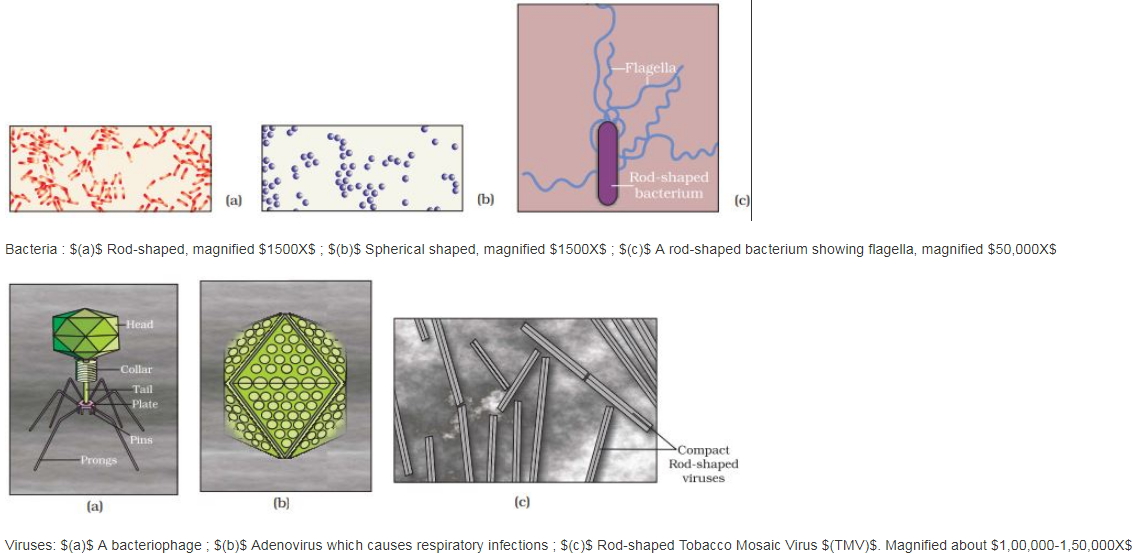
(N/A) Besides macroscopic plants and animals,microbes are the major components of biological systems on this earth.
Microbes are present everywhere in soil,water,air,inside our bodies,and in the bodies of other animals and plants.
Microbes are present even at sites where no other life form could possibly exist - sites such as deep inside geysers where the temperature may be as high as $100^{\circ} C$,deep in the soil under layers of snow several meters thick,and in highly acidic environments.
Microbes are present everywhere in soil,water,air,inside our bodies,and in the bodies of other animals and plants.
Microbes are present even at sites where no other life form could possibly exist - sites such as deep inside geysers where the temperature may be as high as $100^{\circ} C$,deep in the soil under layers of snow several meters thick,and in highly acidic environments.
0 likes
View Solution85
Easy
Give scientific reasons: In the rumen of cattle,components having high cellulose content get digested easily.
Solution
(N/A) The rumen of cattle contains a symbiotic population of bacteria known as methanogens (e.g.,Methanobacterium). These bacteria possess the enzymatic machinery required to break down complex cellulose into simpler compounds. As cattle consume plant-based diets rich in cellulose,these methanogens facilitate the digestion process,which is essential for the animal's nutrition and energy production.
0 likes
View Solution86
Medium
Medicines are either man-made (i.e.,synthetic) or obtained from living organisms like plants,bacteria,animals,etc.,and hence,the latter are called natural products. Sometimes,natural products are chemically altered by man to reduce toxicity or side effects. Write against each of the following whether they were initially obtained as a natural product or as a synthetic chemical: $(a)$ Penicillin $(b)$ Sulphonamide $(c)$ Vitamin-$C$ $(d)$ Growth hormone.
Solution
(A) Penicillin: Obtained from fungi ($Penicillium$ species),hence it is a natural product.
$(b)$ Sulphonamide: It is a synthetic chemical antimicrobial agent.
$(c)$ Vitamin-$C$: It is a natural product obtained from various fruits and vegetables (e.g.,citrus fruits).
$(d)$ Growth hormone: It is a natural product produced by the pituitary gland in the body.
$(b)$ Sulphonamide: It is a synthetic chemical antimicrobial agent.
$(c)$ Vitamin-$C$: It is a natural product obtained from various fruits and vegetables (e.g.,citrus fruits).
$(d)$ Growth hormone: It is a natural product produced by the pituitary gland in the body.
0 likes
View Solution87
Medium
How was penicillin discovered?
Solution
(N/A) Penicillin was an accidental discovery.
Sir Alexander Fleming observed that in unwashed culture plates of $Staphylococcus$,a mould $Penicillium$ was growing.
This mould inhibited the growth of $Staphylococcus$.
Later,the antibiotic Penicillin was isolated from this fungus.
Sir Alexander Fleming observed that in unwashed culture plates of $Staphylococcus$,a mould $Penicillium$ was growing.
This mould inhibited the growth of $Staphylococcus$.
Later,the antibiotic Penicillin was isolated from this fungus.
0 likes
View Solution88
Easy
Give the scientific names of any two microorganisms inhabiting the human intestine.
Solution
(N/A) The human intestine,particularly the large intestine,serves as a habitat for a diverse community of microorganisms known as the gut microbiota.
Two common examples of microorganisms found in the human intestine are:
$(1)$ $Escherichia \ coli$ (commonly known as $E. \ coli$): This is a Gram-negative,facultative anaerobic bacterium that is a normal inhabitant of the human gastrointestinal tract.
$(2)$ $Enterococcus \ faecalis$: This is a Gram-positive,commensal bacterium that typically resides in the human intestine.
Two common examples of microorganisms found in the human intestine are:
$(1)$ $Escherichia \ coli$ (commonly known as $E. \ coli$): This is a Gram-negative,facultative anaerobic bacterium that is a normal inhabitant of the human gastrointestinal tract.
$(2)$ $Enterococcus \ faecalis$: This is a Gram-positive,commensal bacterium that typically resides in the human intestine.
0 likes
View Solution89
MediumMCQ
Which organisms can survive at temperatures exceeding $100^{\circ}C$?
A
Plants
B
Microbes
C
Animals
D
Lichens
Solution
(B) Certain microorganisms,specifically thermophilic archaea,are capable of surviving and thriving in extreme environments such as hydrothermal vents and hot springs where temperatures exceed $100^{\circ}C$. These organisms possess specialized enzymes and membrane structures that remain stable at such high temperatures. Plants,animals,and lichens generally cannot survive at these extreme temperatures.
0 likes
View Solution90
MediumMCQ
Select the appropriate option for $Saccharomyces \ cerevisiae$.
A
Algae
B
Yeast
C
Bacteria
D
Virus
Solution
(B) $Saccharomyces \ cerevisiae$ is commonly known as Brewer's yeast or Baker's yeast.
It is a unicellular fungus belonging to the group Ascomycetes.
It is widely used in the fermentation process for the production of ethanol and in the baking industry for bread making.
It is a unicellular fungus belonging to the group Ascomycetes.
It is widely used in the fermentation process for the production of ethanol and in the baking industry for bread making.
0 likes
View Solution91
MediumMCQ
Which bacteria was being cultured by the discoverer of the first antibiotic at the time of its discovery?
A
Staphylococci
B
Penicillium
C
Lactobacillus
D
Staphylococcus
Solution
(D) The first antibiotic,$Penicillin$,was discovered by $Alexander \ Fleming$ in $1928$.
While working on $Staphylococcus$ bacteria,he observed that a mold called $Penicillium \ notatum$ was growing in one of his unwashed culture plates.
He noticed that the presence of this mold inhibited the growth of the $Staphylococcus$ bacteria around it.
Therefore,the bacteria being cultured at the time of discovery was $Staphylococcus$.
While working on $Staphylococcus$ bacteria,he observed that a mold called $Penicillium \ notatum$ was growing in one of his unwashed culture plates.
He noticed that the presence of this mold inhibited the growth of the $Staphylococcus$ bacteria around it.
Therefore,the bacteria being cultured at the time of discovery was $Staphylococcus$.
0 likes
View Solution92
MediumMCQ
Which scientist first discovered antibiotics?
A
Ernst Chain
B
Alexander Fleming
C
Burkholder
D
Waksman
Solution
(B) The first antibiotic, $Penicillin$, was discovered by $Alexander Fleming$ in $1928$ while working on $Staphylococcus$ bacteria. He observed that the mold $Penicillium notatum$ inhibited the growth of the bacteria. Later, $Ernst Chain$ and $Howard Florey$ made significant contributions to its purification and mass production, for which all three were awarded the Nobel Prize in $1945$.
0 likes
View Solution93
EasyMCQ
Which organism produced the first discovered antibiotic?
A
Propionibacterium shermanii
B
Penicillium notatum
C
Streptococcus
D
Staphylococci
Solution
(B) The first antibiotic discovered was Penicillin. It was discovered by Alexander Fleming in $1928$ from the mold fungus $Penicillium$ $notatum$. This discovery marked the beginning of the antibiotic era in medicine.
0 likes
View Solution94
MediumMCQ
What is the role of bacteria present in the rumen of cattle?
A
Digestion of fats
B
Digestion of cellulose
C
Digestion of proteins
D
Digestion of glucose
Solution
(B) The rumen of cattle contains a large population of symbiotic bacteria known as methanogens (e.g.,$Methanobacterium$).
These bacteria play a crucial role in the digestion of cellulose,which is a major component of the plant material consumed by cattle.
Cellulose is a complex polysaccharide that most animals cannot digest on their own.
These bacteria break down cellulose into simpler compounds,which the cattle can then absorb and utilize for energy.
These bacteria play a crucial role in the digestion of cellulose,which is a major component of the plant material consumed by cattle.
Cellulose is a complex polysaccharide that most animals cannot digest on their own.
These bacteria break down cellulose into simpler compounds,which the cattle can then absorb and utilize for energy.
0 likes
View Solution95
MediumMCQ
Which of the following statements is incorrect?
A
Alexander Fleming discovered the first antibiotic.
B
Antibiotics inhibit the growth of certain microorganisms.
C
The organism that produces an antibiotic dies due to the production of that same antibiotic.
D
Fleming was awarded the Nobel Prize.
Solution
(C) The correct answer is $C$.
Antibiotics are chemical substances produced by some microbes which can kill or retard the growth of other (disease-causing) microbes.
Alexander Fleming discovered the first antibiotic,$Penicillin$,from the mould $Penicillium$ $notatum$.
He was awarded the Nobel Prize in $1945$ for this discovery.
Statement $C$ is incorrect because the organism producing the antibiotic does not die from its own product; it has mechanisms to remain unaffected by the antibiotic it synthesizes.
Antibiotics are chemical substances produced by some microbes which can kill or retard the growth of other (disease-causing) microbes.
Alexander Fleming discovered the first antibiotic,$Penicillin$,from the mould $Penicillium$ $notatum$.
He was awarded the Nobel Prize in $1945$ for this discovery.
Statement $C$ is incorrect because the organism producing the antibiotic does not die from its own product; it has mechanisms to remain unaffected by the antibiotic it synthesizes.
0 likes
View Solution96
MediumMCQ
Identify the odd one out.
A
Staphylococcus
B
Streptococci
C
Acetobacter aceti
D
Saccharomyces cerevisiae
Solution
(D) The options $A$, $B$, and $C$ represent bacterial species. Specifically, $Staphylococcus$ and $Streptococci$ are bacteria, and $Acetobacter$ $aceti$ is an acetic acid bacterium. In contrast, $Saccharomyces$ $cerevisiae$ is a yeast, which is a unicellular fungus. Therefore, $Saccharomyces$ $cerevisiae$ is the odd one out.
0 likes
View Solution97
MediumMCQ
Penicillin was discovered while observing the inhibition of growth of which organism?
A
Staphylococci
B
Penicillium notatum
C
Virus
D
Aspergillus niger
Solution
(A) Alexander Fleming, while working on the bacterium $Staphylococci$, observed that in one of his unwashed culture plates, a mould named $Penicillium$ $notatum$ was growing.
He noticed that the presence of this mould inhibited the growth of the $Staphylococci$ bacteria around it.
This led to the discovery of the first antibiotic, Penicillin.
He noticed that the presence of this mould inhibited the growth of the $Staphylococci$ bacteria around it.
This led to the discovery of the first antibiotic, Penicillin.
0 likes
View Solution98
MediumMCQ
What does $Rauwolfia$ $vomitoria$ produce?
A
Reserpine
B
Respirin
C
Renin
D
Rabeprazole
Solution
(A) The plant $Rauwolfia$ $vomitoria$ is a medicinal plant found in the Himalayan ranges. It produces an active chemical substance known as $Reserpine$. This alkaloid is widely used for the treatment of high blood pressure (hypertension) and certain mental disorders.
0 likes
View Solution99
EasyMCQ
The term $LABS$ abbreviates as:
A
Laboratory
B
Lauryl acidic benzene sulphate
C
Linear alkyl benzene sulphonate
D
None of the above
Solution
(C) $LABS$ stands for Linear alkyl benzene sulphonate.
It is a class of anionic surfactants widely used in the production of synthetic detergents and cleaning agents.
These compounds are preferred in industry due to their biodegradability compared to branched-chain alkyl benzene sulfonates.
It is a class of anionic surfactants widely used in the production of synthetic detergents and cleaning agents.
These compounds are preferred in industry due to their biodegradability compared to branched-chain alkyl benzene sulfonates.
0 likes
View Solution100
MediumMCQ
Microbes like $Spirulina$ can be grown on materials like:
$I$. Waste water from potato processing plants
$II$. Straw
$III$. Animal manure and sewage
$IV$. Molasses
Choose the correct option.
$I$. Waste water from potato processing plants
$II$. Straw
$III$. Animal manure and sewage
$IV$. Molasses
Choose the correct option.
A
$I$ and $II$
B
$I$,$II$ and $III$
C
$II$,$III$ and $IV$
D
$I$,$II$,$III$ and $IV$
Solution
(D) Microbes like $Spirulina$ can be grown on a variety of waste materials because they are highly efficient at converting organic waste into biomass.
$1$. Waste water from potato processing plants is rich in starch and other nutrients that support microbial growth.
$2$. Straw provides a carbon source for microbial fermentation.
$3$. Animal manure and sewage are rich in nitrogen and other minerals,making them excellent substrates for large-scale cultivation.
$4$. Molasses is a byproduct of the sugar industry and is a very common carbon source used for growing microbes.
Since all the listed materials $(I, II, III, IV)$ can be used as substrates for the growth of microbes like $Spirulina$,the correct option is $D$.
$1$. Waste water from potato processing plants is rich in starch and other nutrients that support microbial growth.
$2$. Straw provides a carbon source for microbial fermentation.
$3$. Animal manure and sewage are rich in nitrogen and other minerals,making them excellent substrates for large-scale cultivation.
$4$. Molasses is a byproduct of the sugar industry and is a very common carbon source used for growing microbes.
Since all the listed materials $(I, II, III, IV)$ can be used as substrates for the growth of microbes like $Spirulina$,the correct option is $D$.
0 likes
View SolutionMicrobes in Human Welfare — General Introduction · Frequently Asked Questions
1Are these Microbes in Human Welfare questions useful for JEE and NEET?
Yes. All questions in this section are mapped to JEE Main and NEET exam patterns. Previous year questions from JEE Main, NEET, GUJCET and state-level exams are included with full solutions.
2Can I switch to Hindi or Gujarati for these questions?
Yes. Use the language tabs in the hero section or the sidebar to view the same questions and solutions in English, Hindi or Gujarati.
3How do I generate a question paper from this subtopic?
Use the Vedclass Exam Paper Generator — select the chapter and subtopic, set difficulty, and generate Sets A, B, C, D automatically. First 3 chapters of every subject are free.
Vedclass Products
For Students
Vedclass Test Series
Mock tests in real JEE/NEET style with performance analysis. 5-day free trial.
Start Free TrialFor Teachers
Exam Paper Generator
Generate Set A/B/C/D papers from this chapter in 2 minutes. 3 chapters free.
Try FreeFor Institutes
Online Exam Module
Live online exams with unlimited students, 360° analytics & white-label branding.
See DemoFor Teachers & Institutes
Generate a Microbes in Human Welfare Exam Paper in 2 Minutes
Select subtopic & difficulty — Sets A, B, C, D auto-generated with No Repeat logic.
First 3 chapters of every subject are free — no payment required.