
A English
Immunity Questions in English
Class 12 Biology · Human Health and Disease · Immunity
636+
Questions
English
Language
100%
With Solutions
Showing 50 of 636 questions in English
101
EasyMCQ
Which barrier of innate immunity is represented by saliva in the mouth and tears in the eyes?
A
Cellular barrier
B
Physiological barrier
C
Physical barrier
D
Cytokine barrier
Solution
(B) Innate immunity consists of four types of barriers:
$1$. Physical barriers: Skin and mucus coating of the respiratory,gastrointestinal,and urogenital tracts.
$2$. Physiological barriers: Acid in the stomach,saliva in the mouth,and tears from the eyes prevent microbial growth.
$3$. Cellular barriers: Polymorphonuclear leukocytes ($PMNL$-neutrophils),monocytes,and natural killer cells.
$4$. Cytokine barriers: Virus-infected cells secrete proteins called interferons which protect non-infected cells from further viral infection.
Therefore,saliva and tears are examples of physiological barriers.
$1$. Physical barriers: Skin and mucus coating of the respiratory,gastrointestinal,and urogenital tracts.
$2$. Physiological barriers: Acid in the stomach,saliva in the mouth,and tears from the eyes prevent microbial growth.
$3$. Cellular barriers: Polymorphonuclear leukocytes ($PMNL$-neutrophils),monocytes,and natural killer cells.
$4$. Cytokine barriers: Virus-infected cells secrete proteins called interferons which protect non-infected cells from further viral infection.
Therefore,saliva and tears are examples of physiological barriers.
0 likes
View Solution102
MediumMCQ
When an insect bites,the affected area swells. Which chemicals are likely introduced into the body?
A
Histamine and Dopamine
B
Histamine and Kinins
C
Interferons and Opsonins
D
Interferons and Histones
Solution
(B) When an insect bites,it injects foreign substances into the body.
These substances trigger an inflammatory response,which is a part of the innate immune system.
The primary chemicals released or introduced that cause swelling (edema),redness,and pain at the site of the bite are Histamine and Kinins (such as bradykinin).
Histamine increases the permeability of blood vessels,leading to fluid accumulation (swelling),while Kinins are potent mediators of inflammation and pain.
These substances trigger an inflammatory response,which is a part of the innate immune system.
The primary chemicals released or introduced that cause swelling (edema),redness,and pain at the site of the bite are Histamine and Kinins (such as bradykinin).
Histamine increases the permeability of blood vessels,leading to fluid accumulation (swelling),while Kinins are potent mediators of inflammation and pain.
0 likes
View Solution103
MediumMCQ
Which of the following is true for $T-$lymphocytes in mammals?
A
They consist of three main types: $T-$cells,helper $T-$cells,and suppressor $T-$cells.
B
They are produced in the lymphoid tissue.
C
They clean up injured cells and cellular debris.
D
They are produced in the thyroid gland.
Solution
(A) $1$. $T-$lymphocytes are a type of white blood cell that plays a central role in cell-mediated immunity.
$2$. They are produced in the bone marrow but mature in the thymus gland.
$3$. The main types of $T-$lymphocytes include helper $T-$cells,cytotoxic $T-$cells,and suppressor $T-$cells.
$4$. Option $A$ correctly identifies the functional classification of $T-$lymphocytes involved in the immune response.
$5$. Option $B$ is incorrect because they originate in bone marrow,not lymphoid tissue. Option $C$ describes the function of macrophages. Option $D$ is incorrect because they mature in the thymus,not the thyroid.
$2$. They are produced in the bone marrow but mature in the thymus gland.
$3$. The main types of $T-$lymphocytes include helper $T-$cells,cytotoxic $T-$cells,and suppressor $T-$cells.
$4$. Option $A$ correctly identifies the functional classification of $T-$lymphocytes involved in the immune response.
$5$. Option $B$ is incorrect because they originate in bone marrow,not lymphoid tissue. Option $C$ describes the function of macrophages. Option $D$ is incorrect because they mature in the thymus,not the thyroid.
0 likes
View Solution104
EasyMCQ
Many vertebrates produce virus-resistant substances that inhibit viral replication. What are these substances known as?
A
Virions
B
Interferons
C
Antivirams
D
Antigens
Solution
(B) Interferons $(IFNs)$ are a group of signaling proteins made and released by host cells in response to the presence of several viruses.
These proteins act as a part of the innate immune system.
When a cell is infected by a virus,it secretes interferons,which signal neighboring cells to heighten their anti-viral defenses.
This process effectively inhibits viral replication in the surrounding cells,thereby protecting the host from further infection.
These proteins act as a part of the innate immune system.
When a cell is infected by a virus,it secretes interferons,which signal neighboring cells to heighten their anti-viral defenses.
This process effectively inhibits viral replication in the surrounding cells,thereby protecting the host from further infection.
0 likes
View Solution105
MediumMCQ
Which of the following are associated with the defense of the body?
A
Neutrophils
B
Lymphocytes
C
Macrophages
D
All of the above
Solution
(D) The body's defense mechanism,known as the immune system,involves various types of white blood cells $(WBCs)$.
$1$. Neutrophils are phagocytic cells that act as the first line of defense by engulfing pathogens.
$2$. Lymphocytes are specialized cells ($B$-cells and $T$-cells) responsible for the specific immune response,including antibody production and cell-mediated immunity.
$3$. Macrophages are large phagocytic cells that ingest cellular debris,foreign substances,and pathogens.
Since all these cells play a crucial role in protecting the body against infections,the correct answer is $D$.
$1$. Neutrophils are phagocytic cells that act as the first line of defense by engulfing pathogens.
$2$. Lymphocytes are specialized cells ($B$-cells and $T$-cells) responsible for the specific immune response,including antibody production and cell-mediated immunity.
$3$. Macrophages are large phagocytic cells that ingest cellular debris,foreign substances,and pathogens.
Since all these cells play a crucial role in protecting the body against infections,the correct answer is $D$.
0 likes
View Solution106
EasyMCQ
What is an antibody?
A
Albumin
B
Gamma-globulin
C
Sucrose
D
Vitamin $C$
Solution
(B) Antibodies are specialized proteins produced by the immune system in response to antigens. These proteins belong to a class of plasma proteins known as immunoglobulins. Specifically,antibodies are classified as gamma-globulins because they migrate to the gamma region during electrophoresis of serum proteins. Therefore,the correct answer is gamma-globulin.
0 likes
View Solution107
MediumMCQ
Plasma cells are .....
A
Modified $B$-lymphocytes of blood
B
Antigen-producing cells
C
Cells producing heparin,histamine,and serotonin
D
Cells producing matrix and fibers
Solution
(A) Plasma cells are specialized cells derived from $B$-lymphocytes.
When $B$-lymphocytes are activated by an antigen,they differentiate into plasma cells.
These plasma cells are responsible for the synthesis and secretion of antibodies (immunoglobulins) into the blood and lymph.
Therefore,they are modified $B$-lymphocytes.
When $B$-lymphocytes are activated by an antigen,they differentiate into plasma cells.
These plasma cells are responsible for the synthesis and secretion of antibodies (immunoglobulins) into the blood and lymph.
Therefore,they are modified $B$-lymphocytes.
0 likes
View Solution108
EasyMCQ
In $T$-lymphocytes,what does the letter '$T$' stand for?
A
Thymus
B
Thyroid
C
Thalamus
D
Tonsil
Solution
(A) $T$-lymphocytes are a type of white blood cell that plays a central role in the immune response.
They are called '$T$' lymphocytes because they mature in the $Thymus$ gland.
After being produced in the bone marrow,the precursor cells migrate to the thymus,where they undergo differentiation and maturation.
They are called '$T$' lymphocytes because they mature in the $Thymus$ gland.
After being produced in the bone marrow,the precursor cells migrate to the thymus,where they undergo differentiation and maturation.
0 likes
View Solution109
MediumMCQ
$T$-lymphocytes differentiate in which of the following organs?
A
Bone marrow
B
Liver
C
Thymus gland
D
Kidney
Solution
(C) $T$-lymphocytes are produced in the bone marrow but migrate to the thymus gland for maturation and differentiation. The thymus gland acts as the primary lymphoid organ where $T$-lymphocytes undergo differentiation to become immunocompetent cells. Therefore,the correct answer is the thymus gland.
0 likes
View Solution110
MediumMCQ
$T$-cells mature in the . . . . . . .
A
Peyer's patches
B
Lymph node
C
Thymus
D
Bursa of Fabricius
Solution
(C) $T$-lymphocytes (or $T$-cells) originate in the bone marrow but migrate to the thymus for maturation and differentiation. The thymus is a primary lymphoid organ where $T$-cells acquire immunocompetence. Therefore,the correct answer is $C$ (Thymus).
0 likes
View Solution111
MediumMCQ
$A$ mammal born without a thymus gland is unable to produce which of the following?
A
$B$-lymphocytes
B
$T$-lymphocytes
C
Plasma cells
D
Basophils
Solution
(B) The thymus gland is a primary lymphoid organ that serves as the site for the maturation and differentiation of $T$-lymphocytes.
In the absence of a thymus gland,the precursor cells (prothymocytes) that migrate from the bone marrow cannot undergo the necessary maturation process to become functional $T$-lymphocytes.
$B$-lymphocytes mature in the bone marrow,and plasma cells are derived from $B$-lymphocytes; therefore,these would still be produced.
Basophils are a type of granulocyte produced in the bone marrow.
Thus,a mammal born without a thymus gland is unable to produce $T$-lymphocytes.
In the absence of a thymus gland,the precursor cells (prothymocytes) that migrate from the bone marrow cannot undergo the necessary maturation process to become functional $T$-lymphocytes.
$B$-lymphocytes mature in the bone marrow,and plasma cells are derived from $B$-lymphocytes; therefore,these would still be produced.
Basophils are a type of granulocyte produced in the bone marrow.
Thus,a mammal born without a thymus gland is unable to produce $T$-lymphocytes.
0 likes
View Solution112
MediumMCQ
Antibodies produced by $B$-lymphocytes are responsible for:
A
Cell-mediated immunity.
B
Humoral immunity.
C
Active acquired immunity.
D
Permanent immunity.
Solution
(B) The immune system is divided into two main types: $1.$ Cell-mediated immunity $(CMI)$ and $2.$ Humoral immunity (Antibody-mediated immunity).
$B$-lymphocytes produce proteins called antibodies in response to pathogens into the blood to fight them.
Since these antibodies are present in the blood (humor),this response is known as Humoral immune response.
$T$-lymphocytes are responsible for Cell-mediated immunity.
$B$-lymphocytes produce proteins called antibodies in response to pathogens into the blood to fight them.
Since these antibodies are present in the blood (humor),this response is known as Humoral immune response.
$T$-lymphocytes are responsible for Cell-mediated immunity.
0 likes
View Solution113
EasyMCQ
What type of barrier is the mucus coating?
A
Cellular
B
Physiological
C
Physical
D
Cytokine
Solution
(C) The mucus coating of the epithelium lining the respiratory,gastrointestinal,and urogenital tracts is a type of $Physical$ barrier. It helps in trapping microbes entering our body and prevents them from causing infection.
0 likes
View Solution114
EasyMCQ
When is the immune response most intense?
A
When our body comes into contact with a pathogen for the first time.
B
When our body comes into contact with the same pathogen for the second time.
C
When our body does not come into contact with any pathogen.
D
When innate immunity is acquired.
Solution
(B) The immune response is most intense during the secondary immune response. When the body encounters a pathogen for the first time,it generates a primary immune response,which is of low intensity. However,when the same pathogen enters the body for the second time,the memory cells ($B$-cells and $T$-cells) recognize it immediately and mount a highly intensified secondary or anamnestic response. This is the principle behind vaccination.
0 likes
View Solution115
EasyMCQ
Innate immunity is defined as.........
A
Immunity developed in the body after birth to fight diseases
B
Immunity inherited by an animal at the time of birth
C
Immunity to recognize various pathogens at the time of birth
D
The ability of antibodies to develop in the body at the time of birth
Solution
(B) Innate immunity is a type of non-specific defense mechanism that is present at the time of birth.
It is inherited from parents and provides protection against various pathogens throughout life.
It does not require prior exposure to a pathogen to function.
Therefore,it is defined as the immunity inherited by an animal at the time of birth.
It is inherited from parents and provides protection against various pathogens throughout life.
It does not require prior exposure to a pathogen to function.
Therefore,it is defined as the immunity inherited by an animal at the time of birth.
0 likes
View Solution116
MediumMCQ
Which of the following is responsible for the rejection of organ transplants?
A
Physiological barriers
B
Cell-mediated immunity
C
Humoral immunity
D
Antibody activity
Solution
(B) The body is able to differentiate between 'self' and 'non-self' cells.
Organ transplants are often rejected by the recipient's immune system because the body recognizes the transplanted organ as 'non-self' or foreign tissue.
This rejection is primarily mediated by $T$-lymphocytes,which are the key components of cell-mediated immunity $(CMI)$.
Therefore,cell-mediated immunity is responsible for the graft rejection.
Organ transplants are often rejected by the recipient's immune system because the body recognizes the transplanted organ as 'non-self' or foreign tissue.
This rejection is primarily mediated by $T$-lymphocytes,which are the key components of cell-mediated immunity $(CMI)$.
Therefore,cell-mediated immunity is responsible for the graft rejection.
0 likes
View Solution117
EasyMCQ
What is the immune response mediated by antibodies known as?
A
$PMNL$
B
$HIR$
C
$CMI$
D
$H2L2$
Solution
(B) The immune response mediated by antibodies is known as Humoral Immune Response $(HIR)$ or Antibody-Mediated Immunity $(AMI)$.
$B$-lymphocytes produce antibodies in response to pathogens into the blood to fight with them.
$CMI$ (Cell-Mediated Immunity) is mediated by $T$-lymphocytes.
$PMNL$ stands for Polymorphonuclear Leukocytes,which are a type of white blood cell.
$H2L2$ represents the structure of an antibody molecule consisting of two heavy and two light chains.
$B$-lymphocytes produce antibodies in response to pathogens into the blood to fight with them.
$CMI$ (Cell-Mediated Immunity) is mediated by $T$-lymphocytes.
$PMNL$ stands for Polymorphonuclear Leukocytes,which are a type of white blood cell.
$H2L2$ represents the structure of an antibody molecule consisting of two heavy and two light chains.
0 likes
View Solution118
MediumMCQ
Which cells are responsible for acquired immunity?
A
Macrophages
B
Leukocytes
C
Lymphocytes
D
Natural killer cells
Solution
(C) Acquired immunity,also known as adaptive or specific immunity,is primarily mediated by lymphocytes.
There are two main types of lymphocytes: $B$-lymphocytes and $T$-lymphocytes.
$B$-lymphocytes produce antibodies in response to pathogens,while $T$-lymphocytes help $B$-cells produce antibodies and also directly attack infected cells.
Therefore,lymphocytes are the key cells responsible for the specificity and memory associated with acquired immunity.
There are two main types of lymphocytes: $B$-lymphocytes and $T$-lymphocytes.
$B$-lymphocytes produce antibodies in response to pathogens,while $T$-lymphocytes help $B$-cells produce antibodies and also directly attack infected cells.
Therefore,lymphocytes are the key cells responsible for the specificity and memory associated with acquired immunity.
0 likes
View Solution119
MediumMCQ
Assertion $A$: Cell-mediated immunity is responsible for the rejection of organ transplants. Reason $R$: The body's immune system has the ability to differentiate between self and non-self. Which option is correct for Assertion $A$ and Reason $R$?
A
$A$ and $R$ are both true and $R$ is the correct explanation of $A$.
B
$A$ and $R$ are both true but $R$ is not the correct explanation of $A$.
C
$A$ is true and $R$ is false.
D
$A$ is false and $R$ is true.
Solution
(A) Cell-mediated immunity $(CMI)$ is mediated by $T$-lymphocytes.
When an organ is transplanted,the recipient's immune system recognizes the foreign antigens on the donor's tissue as 'non-self'.
This triggers a cell-mediated immune response,leading to the rejection of the graft or transplant.
Therefore,the body's ability to differentiate between 'self' and 'non-self' is the fundamental reason why the immune system rejects foreign tissues.
Thus,both $A$ and $R$ are true,and $R$ is the correct explanation of $A$.
When an organ is transplanted,the recipient's immune system recognizes the foreign antigens on the donor's tissue as 'non-self'.
This triggers a cell-mediated immune response,leading to the rejection of the graft or transplant.
Therefore,the body's ability to differentiate between 'self' and 'non-self' is the fundamental reason why the immune system rejects foreign tissues.
Thus,both $A$ and $R$ are true,and $R$ is the correct explanation of $A$.
0 likes
View Solution120
MediumMCQ
How many types of barriers are included in innate immunity?
A
Three
B
Five
C
Two
D
Four
Solution
(D) Innate immunity is non-specific type of defense that is present at the time of birth. It consists of four types of barriers:
$1$. Physical barriers: e.g.,skin,mucus coating of the epithelium lining the respiratory,gastrointestinal,and urogenital tracts.
$2$. Physiological barriers: e.g.,acid in the stomach,saliva in the mouth,and tears from eyes.
$3$. Cellular barriers: e.g.,polymorpho-nuclear leukocytes ($PMNL$-neutrophils),monocytes,and natural killer cells in the blood,as well as macrophages in tissues.
$4$. Cytokine barriers: e.g.,virus-infected cells secrete proteins called interferons which protect non-infected cells from further viral infection.
$1$. Physical barriers: e.g.,skin,mucus coating of the epithelium lining the respiratory,gastrointestinal,and urogenital tracts.
$2$. Physiological barriers: e.g.,acid in the stomach,saliva in the mouth,and tears from eyes.
$3$. Cellular barriers: e.g.,polymorpho-nuclear leukocytes ($PMNL$-neutrophils),monocytes,and natural killer cells in the blood,as well as macrophages in tissues.
$4$. Cytokine barriers: e.g.,virus-infected cells secrete proteins called interferons which protect non-infected cells from further viral infection.
0 likes
View Solution121
MediumMCQ
Which of the following barriers is $NOT$ included in innate immunity?
A
Physical
B
Chemical
C
Physiological
D
Cellular
Solution
(B) Innate immunity is non-specific type of defense that is present at the time of birth. It consists of four types of barriers:
$1$. Physical barriers: e.g.,skin,mucus coating of the epithelium lining the respiratory,gastrointestinal,and urogenital tracts.
$2$. Physiological barriers: e.g.,acid in the stomach,saliva in the mouth,and tears from eyes.
$3$. Cellular barriers: e.g.,polymorpho-nuclear leukocytes ($PMNL$-neutrophils),monocytes,and natural killer cells in the blood.
$4$. Cytokine barriers: e.g.,virus-infected cells secrete proteins called interferons which protect non-infected cells from further viral infection.
Since all options (Physical,Chemical,Physiological,Cellular) are technically part of the innate immunity classification (where Chemical is often grouped under Physiological or Physical),the question implies a standard classification. However,based on $NCERT$,the four barriers are Physical,Physiological,Cellular,and Cytokine. 'Chemical' is not listed as a primary category in $NCERT$,making it the correct choice for '$NOT$ included'.
$1$. Physical barriers: e.g.,skin,mucus coating of the epithelium lining the respiratory,gastrointestinal,and urogenital tracts.
$2$. Physiological barriers: e.g.,acid in the stomach,saliva in the mouth,and tears from eyes.
$3$. Cellular barriers: e.g.,polymorpho-nuclear leukocytes ($PMNL$-neutrophils),monocytes,and natural killer cells in the blood.
$4$. Cytokine barriers: e.g.,virus-infected cells secrete proteins called interferons which protect non-infected cells from further viral infection.
Since all options (Physical,Chemical,Physiological,Cellular) are technically part of the innate immunity classification (where Chemical is often grouped under Physiological or Physical),the question implies a standard classification. However,based on $NCERT$,the four barriers are Physical,Physiological,Cellular,and Cytokine. 'Chemical' is not listed as a primary category in $NCERT$,making it the correct choice for '$NOT$ included'.
0 likes
View Solution122
MediumMCQ
Which cells secrete interferons?
A
Bacteria-infected cells
B
Virus-infected cells
C
Protozoa-infected cells
D
Helminth-infected organs
Solution
(B) Interferons are a type of cytokine barrier in innate immunity. When a cell is infected by a virus,it secretes proteins called interferons. These proteins protect the non-infected neighboring cells from further viral infection. Therefore,virus-infected cells are responsible for the secretion of interferons.
0 likes
View Solution123
EasyMCQ
How many antigens can each antibody molecule bind to at most?
A
$1$
B
$2$
C
$3$
D
$4$
Solution
(B) An antibody molecule has a $Y$-shaped structure consisting of four polypeptide chains: two heavy chains and two light chains.
Each antibody molecule contains two antigen-binding sites located at the tips of the $Y$-shaped structure,known as the variable regions.
Because there are two specific binding sites,each antibody molecule can bind to a maximum of two antigen molecules simultaneously.
Therefore,the correct answer is $2$.
Each antibody molecule contains two antigen-binding sites located at the tips of the $Y$-shaped structure,known as the variable regions.
Because there are two specific binding sites,each antibody molecule can bind to a maximum of two antigen molecules simultaneously.
Therefore,the correct answer is $2$.
0 likes
View Solution124
MediumMCQ
Which of the following cells are not considered phagocytic cells?
A
$NK$ cells
B
Macrophages
C
Monocytes
D
Lymphocytes
Solution
(A) Phagocytic cells are cells that protect the body by ingesting harmful foreign particles,bacteria,and dead or dying cells.
$1$. Macrophages and Monocytes are well-known phagocytic cells of the innate immune system.
$2$. $NK$ (Natural Killer) cells are a type of cytotoxic lymphocyte that destroy infected host cells but are not primarily phagocytic.
$3$. Lymphocytes (specifically $T$ and $B$ cells) are involved in adaptive immunity and are not phagocytic.
However,among the given options,$NK$ cells and Lymphocytes are not phagocytic. In the context of standard biology questions,$NK$ cells are often distinguished from phagocytes,and Lymphocytes are the broader category. Given the options,$NK$ cells are specifically cytotoxic,not phagocytic.
$1$. Macrophages and Monocytes are well-known phagocytic cells of the innate immune system.
$2$. $NK$ (Natural Killer) cells are a type of cytotoxic lymphocyte that destroy infected host cells but are not primarily phagocytic.
$3$. Lymphocytes (specifically $T$ and $B$ cells) are involved in adaptive immunity and are not phagocytic.
However,among the given options,$NK$ cells and Lymphocytes are not phagocytic. In the context of standard biology questions,$NK$ cells are often distinguished from phagocytes,and Lymphocytes are the broader category. Given the options,$NK$ cells are specifically cytotoxic,not phagocytic.
0 likes
View Solution125
EasyMCQ
What are $IgA$ and $IgE$?
A
Types of $T$-cells
B
Types of $B$-cells
C
Types of antibodies
D
Types of antigens
Solution
(C) Antibodies,also known as immunoglobulins $(Ig)$,are glycoprotein molecules produced by plasma cells (differentiated $B$-lymphocytes).
There are five main classes of antibodies in humans: $IgA, IgD, IgE, IgG,$ and $IgM$.
$IgA$ is found in secretions like saliva,tears,and colostrum,while $IgE$ is involved in allergic reactions.
Therefore,$IgA$ and $IgE$ are types of antibodies.
There are five main classes of antibodies in humans: $IgA, IgD, IgE, IgG,$ and $IgM$.
$IgA$ is found in secretions like saliva,tears,and colostrum,while $IgE$ is involved in allergic reactions.
Therefore,$IgA$ and $IgE$ are types of antibodies.
0 likes
View Solution126
EasyMCQ
Assertion $A$: Innate immunity consists of various barriers. Reason $R$: Exposure to a pathogen is required for the stimulation of innate immunity. Which option is correct for Assertion $A$ and Reason $R$?
A
$A$ and $R$ are both true and $R$ is the correct explanation of $A$.
B
$A$ and $R$ are both true but $R$ is not the correct explanation of $A$.
C
$A$ is true and $R$ is false.
D
$A$ is false and $R$ is true.
Solution
(C) Innate immunity is non-specific type of defense that is present at the time of birth. It provides protection by different types of barriers which prevent the entry of foreign agents into our body. These include physical,physiological,cellular,and cytokine barriers. Thus,Assertion $A$ is true.
Innate immunity does not require prior exposure to a pathogen to be stimulated; it is always ready to act. Acquired immunity,on the other hand,is pathogen-specific and requires exposure to a pathogen for its activation. Therefore,the statement that exposure to a pathogen is required for the stimulation of innate immunity is incorrect. Thus,Reason $R$ is false.
Innate immunity does not require prior exposure to a pathogen to be stimulated; it is always ready to act. Acquired immunity,on the other hand,is pathogen-specific and requires exposure to a pathogen for its activation. Therefore,the statement that exposure to a pathogen is required for the stimulation of innate immunity is incorrect. Thus,Reason $R$ is false.
0 likes
View Solution127
MediumMCQ
Assertion $A$: Acquired immunity is pathogen-specific. Reason $R$: Acquired immunity is characterized by memory. Which option is correct for Assertion $A$ and Reason $R$?
A
$A$ and $R$ are both true but $R$ is not the correct explanation of $A$.
B
$A$ and $R$ are both true and $R$ is the correct explanation of $A$.
C
$A$ is true and $R$ is false.
D
$A$ is false and $R$ is true.
Solution
(B) Acquired immunity is pathogen-specific,meaning it produces a specific response against a particular pathogen. This is because the immune system can distinguish between self and non-self and recognizes specific antigens.
Acquired immunity is also characterized by memory. When the body encounters a pathogen for the first time,it produces a primary response. Upon subsequent encounters with the same pathogen,the immune system produces a highly intensified secondary or anamnestic response due to the memory of the first encounter.
Therefore,both statements are true,and the memory characteristic is the fundamental reason why acquired immunity is pathogen-specific and effective.
Acquired immunity is also characterized by memory. When the body encounters a pathogen for the first time,it produces a primary response. Upon subsequent encounters with the same pathogen,the immune system produces a highly intensified secondary or anamnestic response due to the memory of the first encounter.
Therefore,both statements are true,and the memory characteristic is the fundamental reason why acquired immunity is pathogen-specific and effective.
0 likes
View Solution128
EasyMCQ
What does $CMI$ stand for?
A
$Cytoplasm\, Mediated\, Immunity$
B
$Cell\, Molecular\, Immunity$
C
$Cell\, Moderate\, Response$
D
$Cell\, Mediated\, Immunity$
Solution
(D) $CMI$ stands for $Cell\, Mediated\, Immunity$.
It is a type of immune response that does not involve antibodies but rather involves the activation of phagocytes,antigen-specific cytotoxic $T$-lymphocytes,and the release of various cytokines in response to an antigen.
It is primarily responsible for the rejection of transplanted organs and defense against intracellular pathogens like viruses and certain bacteria.
It is a type of immune response that does not involve antibodies but rather involves the activation of phagocytes,antigen-specific cytotoxic $T$-lymphocytes,and the release of various cytokines in response to an antigen.
It is primarily responsible for the rejection of transplanted organs and defense against intracellular pathogens like viruses and certain bacteria.
0 likes
View Solution129
EasyMCQ
How many peptide chains are present in the structure of an antibody?
A
Three
B
Two
C
Four
D
Five
Solution
(C) An antibody molecule is represented as $H_2L_2$.
It consists of four polypeptide chains: two identical light chains $(L)$ and two identical heavy chains $(H)$.
These chains are held together by disulfide bonds to form a $Y$-shaped structure.
It consists of four polypeptide chains: two identical light chains $(L)$ and two identical heavy chains $(H)$.
These chains are held together by disulfide bonds to form a $Y$-shaped structure.
0 likes
View Solution130
MediumMCQ
Memory cells are responsible for:
A
Producing interferons.
B
Passive acquired immunity.
C
Protection against antigens entering the body.
D
Generating a secondary immune response upon subsequent exposure to the same pathogen.
Solution
(D) Memory cells are a type of lymphocyte formed during the primary immune response. When the body encounters a pathogen for the first time,it generates a primary response. During this process,some lymphocytes are stored as memory cells. Upon subsequent exposure to the same pathogen,these memory cells generate a secondary immune response very rapidly and with high intensity,which is also known as the 'anamnestic response'.
0 likes
View Solution131
EasyMCQ
What does $PMNL$ stand for?
A
Polymorphonuclear leukocytes
B
Polymorphonucleotide leukocytes
C
Polymolar nuclear leukocytes
D
Polymediated nuclear leukocytes
Solution
(A) $PMNL$ stands for Polymorphonuclear leukocytes. These are a type of white blood cell (leukocyte) characterized by a multi-lobed nucleus. They are a key component of the innate immune system,specifically acting as phagocytes that engulf and destroy pathogens.
0 likes
View Solution132
MediumMCQ
Which of the following is $NOT$ included in physiological barriers?
A
Mucus coating of the gastrointestinal tract
B
Saliva in the mouth
C
Tears from the eyes
D
Acid secretion in the stomach
Solution
(A) Physiological barriers are part of the innate immunity that prevent microbial growth through chemical or physical conditions.
$1$. Acid in the stomach $(HCl)$,saliva in the mouth,and tears from the eyes are all examples of physiological barriers.
$2$. The mucus coating of the gastrointestinal,urogenital,and respiratory tracts acts as a physical barrier that traps microorganisms entering our body.
$3$. Therefore,the mucus coating is classified as a physical barrier,not a physiological barrier.
$1$. Acid in the stomach $(HCl)$,saliva in the mouth,and tears from the eyes are all examples of physiological barriers.
$2$. The mucus coating of the gastrointestinal,urogenital,and respiratory tracts acts as a physical barrier that traps microorganisms entering our body.
$3$. Therefore,the mucus coating is classified as a physical barrier,not a physiological barrier.
0 likes
View Solution133
EasyMCQ
In acquired immunity,the secondary immune response is highly intense because...
A
The secondary immune response is exhibited at adulthood.
B
The intensity of pathogens is lower during the secondary immune response.
C
The body retains a memory of the first encounter with the pathogen.
D
All components of the immune system respond simultaneously.
Solution
(C) The secondary immune response,also known as the anamnestic response,occurs upon subsequent exposure to the same pathogen.
This response is characterized by a rapid and highly intense production of antibodies.
This happens because the body retains a 'memory' of the first encounter with the pathogen through specialized memory $B$ and $T$ cells.
These memory cells recognize the pathogen immediately upon re-exposure,leading to a swift and robust immune reaction.
This response is characterized by a rapid and highly intense production of antibodies.
This happens because the body retains a 'memory' of the first encounter with the pathogen through specialized memory $B$ and $T$ cells.
These memory cells recognize the pathogen immediately upon re-exposure,leading to a swift and robust immune reaction.
0 likes
View Solution134
EasyMCQ
Which cells are responsible for the production of immunoglobulins?
A
Monocytes
B
$T$-cells
C
Neutrophils
D
$B$-cells
Solution
(D) Immunoglobulins,also known as antibodies,are produced by plasma cells.
Plasma cells are differentiated forms of $B$-lymphocytes (or $B$-cells) that have been activated by an antigen.
When $B$-cells encounter an antigen,they proliferate and differentiate into plasma cells,which then secrete large quantities of antibodies (immunoglobulins) into the blood and lymph to fight the infection.
Plasma cells are differentiated forms of $B$-lymphocytes (or $B$-cells) that have been activated by an antigen.
When $B$-cells encounter an antigen,they proliferate and differentiate into plasma cells,which then secrete large quantities of antibodies (immunoglobulins) into the blood and lymph to fight the infection.
0 likes
View Solution135
EasyMCQ
Which of the following is a characteristic feature of acquired immunity?
A
Cellular barrier
B
Cytokine barrier
C
Memory
D
Mucus membrane
Solution
(C) Acquired immunity is pathogen-specific. It is characterized by the ability to distinguish between self and non-self and possesses the property of 'memory'. When the body encounters a pathogen for the first time,it produces a primary response of low intensity. Subsequent encounters with the same pathogen elicit a highly intensified secondary or anamnestic response due to the memory of the first encounter.
0 likes
View Solution136
MediumMCQ
Assertion $(A)$: The human body is exposed to a large number of infectious agents daily,yet only a few result in disease. Reason $(R)$: The human body possesses an immune system. Which option is correct for Assertion $(A)$ and Reason $(R)$?
A
$A$ and $R$ are both true and $R$ is the correct explanation of $A$.
B
$A$ and $R$ are both true but $R$ is not the correct explanation of $A$.
C
$A$ is true and $R$ is false.
D
$A$ is false and $R$ is true.
Solution
(A) Assertion $(A)$ is true because our body is constantly surrounded by various pathogens (bacteria,viruses,fungi,etc.),but we do not fall ill every day.
Reason $(R)$ is true because the human body has a specialized defense mechanism known as the immune system.
The immune system recognizes,responds to,and eliminates these foreign pathogens,thereby preventing disease.
Therefore,the presence of the immune system is the direct reason why we do not get sick despite constant exposure to pathogens.
Thus,$R$ is the correct explanation of $A$.
Reason $(R)$ is true because the human body has a specialized defense mechanism known as the immune system.
The immune system recognizes,responds to,and eliminates these foreign pathogens,thereby preventing disease.
Therefore,the presence of the immune system is the direct reason why we do not get sick despite constant exposure to pathogens.
Thus,$R$ is the correct explanation of $A$.
0 likes
View Solution137
MediumMCQ
Match the following columns:
| Column-$I$ | Column-$II$ |
| $1.$ Saliva and tears | $a.$ Cytokine barrier |
| $2.$ Mucus coating | $b.$ Cellular barrier |
| $3.$ $PMNL$ | $c.$ Physiological barrier |
| $4.$ Interferons | $d.$ Physical barrier |
A
$1-c, 2-d, 3-b, 4-a$
B
$1-d, 2-c, 3-b, 4-a$
C
$1-c, 2-d, 3-a, 4-b$
D
$1-b, 2-c, 3-d, 4-a$
Solution
(A) The innate immunity consists of four types of barriers:
$1$. Physical barriers: Skin and mucus coating of the respiratory, gastrointestinal, and urogenital tracts prevent the entry of microorganisms $(2-d)$.
$2$. Physiological barriers: Acid in the stomach, saliva in the mouth, and tears from eyes prevent microbial growth $(1-c)$.
$3$. Cellular barriers: Certain types of leukocytes like $PMNL$-neutrophils and monocytes, and macrophages in tissues, phagocytose and destroy microbes $(3-b)$.
$4$. Cytokine barriers: Virus-infected cells secrete proteins called interferons which protect non-infected cells from further viral infection $(4-a)$.
Thus, the correct match is $1-c, 2-d, 3-b, 4-a$.
$1$. Physical barriers: Skin and mucus coating of the respiratory, gastrointestinal, and urogenital tracts prevent the entry of microorganisms $(2-d)$.
$2$. Physiological barriers: Acid in the stomach, saliva in the mouth, and tears from eyes prevent microbial growth $(1-c)$.
$3$. Cellular barriers: Certain types of leukocytes like $PMNL$-neutrophils and monocytes, and macrophages in tissues, phagocytose and destroy microbes $(3-b)$.
$4$. Cytokine barriers: Virus-infected cells secrete proteins called interferons which protect non-infected cells from further viral infection $(4-a)$.
Thus, the correct match is $1-c, 2-d, 3-b, 4-a$.
0 likes
View Solution138
MediumMCQ
What type of cells are the $B$-cells and $T$-cells of the immune system?
A
Neutrophils
B
Natural Killer cells
C
Lymphocytes
D
Monocytes
Solution
(C) The immune system consists of specialized white blood cells known as lymphocytes.
$B$-cells and $T$-cells are the two primary types of lymphocytes.
$B$-cells are responsible for humoral immunity by producing antibodies,while $T$-cells are responsible for cell-mediated immunity.
Therefore,both $B$-cells and $T$-cells are classified as lymphocytes.
$B$-cells and $T$-cells are the two primary types of lymphocytes.
$B$-cells are responsible for humoral immunity by producing antibodies,while $T$-cells are responsible for cell-mediated immunity.
Therefore,both $B$-cells and $T$-cells are classified as lymphocytes.
0 likes
View Solution139
EasyMCQ
The mucus coating of the lining of the urogenital tract helps in trapping microorganisms entering our body. Which type of barrier is this?
A
Cytokine
B
Physical
C
Physiological
D
Cellular
Solution
(B) The human body has innate immunity which provides different types of barriers to prevent the entry of foreign agents.
$1$. Physical barriers: These include the skin and the mucus coating of the epithelium lining the respiratory,gastrointestinal,and urogenital tracts. These barriers trap microorganisms and prevent them from entering the body.
$2$. Physiological barriers: These include acid in the stomach,saliva in the mouth,and tears from eyes,which prevent microbial growth.
$3$. Cellular barriers: These include leukocytes like polymorphonuclear leukocytes ($PMNL$-neutrophils) and monocytes,and natural killer cells in the blood,as well as macrophages in tissues.
$4$. Cytokine barriers: These include virus-infected cells which secrete proteins called interferons that protect non-infected cells from further viral infection.
Therefore,the mucus coating of the urogenital tract is a physical barrier.
$1$. Physical barriers: These include the skin and the mucus coating of the epithelium lining the respiratory,gastrointestinal,and urogenital tracts. These barriers trap microorganisms and prevent them from entering the body.
$2$. Physiological barriers: These include acid in the stomach,saliva in the mouth,and tears from eyes,which prevent microbial growth.
$3$. Cellular barriers: These include leukocytes like polymorphonuclear leukocytes ($PMNL$-neutrophils) and monocytes,and natural killer cells in the blood,as well as macrophages in tissues.
$4$. Cytokine barriers: These include virus-infected cells which secrete proteins called interferons that protect non-infected cells from further viral infection.
Therefore,the mucus coating of the urogenital tract is a physical barrier.
0 likes
View Solution140
EasyMCQ
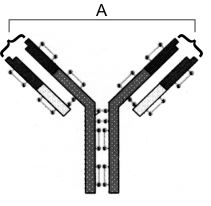
In the given figure,what does the part labeled '$A$' represent?
A
Light chain
B
Heavy chain
C
Antigen binding site
D
Antigen
Solution
(C) The provided figure represents the structure of an antibody molecule (immunoglobulin).
An antibody molecule is composed of four polypeptide chains: two small chains called light chains and two longer chains called heavy chains,represented as $H_2L_2$.
The region labeled '$A$' at the tips of the '$Y$'-shaped structure represents the variable region where the antigen binds.
Therefore,'$A$' represents the antigen binding site.
An antibody molecule is composed of four polypeptide chains: two small chains called light chains and two longer chains called heavy chains,represented as $H_2L_2$.
The region labeled '$A$' at the tips of the '$Y$'-shaped structure represents the variable region where the antigen binds.
Therefore,'$A$' represents the antigen binding site.
0 likes
View Solution141
EasyMCQ
What is primary immune response?
A
Immunity developed in the body during the lifetime of an animal after birth to fight diseases.
B
Immunity inherited by an animal at the time of birth.
C
Immunity observed upon the first encounter with a pathogen.
D
Immunity generated when a pathogen is encountered for the second time.
Solution
(C) The immune response of the body to a pathogen is classified into two types based on the encounter:
$1$. Primary Immune Response: This occurs when the body encounters a pathogen for the first time. It is characterized by a low intensity of response.
$2$. Secondary Immune Response: This occurs upon subsequent encounters with the same pathogen. It is highly intensified due to the memory of the immune system.
Therefore,the primary immune response is the response observed upon the first encounter with a pathogen.
$1$. Primary Immune Response: This occurs when the body encounters a pathogen for the first time. It is characterized by a low intensity of response.
$2$. Secondary Immune Response: This occurs upon subsequent encounters with the same pathogen. It is highly intensified due to the memory of the immune system.
Therefore,the primary immune response is the response observed upon the first encounter with a pathogen.
0 likes
View Solution142
MediumMCQ
Before and after organ transplantation,it is necessary to perform:
A
Tissue matching
B
Blood group matching
C
Both tissue and blood group matching
D
Tissue compatibility antigen matching
Solution
(C) Organ transplantation is a critical medical procedure where a damaged organ is replaced by a healthy one from a donor.
To prevent the recipient's immune system from rejecting the transplanted organ (graft rejection),two primary factors must be matched:
$1$. $ABO$ blood group matching to prevent immediate transfusion reactions.
$2$. Tissue matching (Human Leukocyte Antigen or $HLA$ matching) to ensure the recipient's immune system recognizes the donor organ as 'self' rather than 'foreign'.
Therefore,both tissue and blood group matching are essential for the success of the transplant.
To prevent the recipient's immune system from rejecting the transplanted organ (graft rejection),two primary factors must be matched:
$1$. $ABO$ blood group matching to prevent immediate transfusion reactions.
$2$. Tissue matching (Human Leukocyte Antigen or $HLA$ matching) to ensure the recipient's immune system recognizes the donor organ as 'self' rather than 'foreign'.
Therefore,both tissue and blood group matching are essential for the success of the transplant.
0 likes
View Solution143
MediumMCQ
Which cells help $B$-cells in the production of antibodies?
A
$NK$-cells
B
$T$-helper cells
C
Lymphocytes
D
Macrophages
Solution
(B) The immune system involves a complex interaction between different types of cells.
$B$-cells are responsible for producing antibodies,but they require activation signals to do so effectively.
$T$-helper cells (a type of $T$-cell) recognize antigens presented by antigen-presenting cells and release cytokines.
These cytokines stimulate $B$-cells to proliferate and differentiate into plasma cells,which then secrete antibodies.
Therefore,$T$-helper cells are essential for the antibody-mediated immune response.
$B$-cells are responsible for producing antibodies,but they require activation signals to do so effectively.
$T$-helper cells (a type of $T$-cell) recognize antigens presented by antigen-presenting cells and release cytokines.
These cytokines stimulate $B$-cells to proliferate and differentiate into plasma cells,which then secrete antibodies.
Therefore,$T$-helper cells are essential for the antibody-mediated immune response.
0 likes
View Solution144
MediumMCQ
Interferons are proteins that:
A
Protect non-infected cells from viral infection.
B
Destroy the virus directly.
C
Inhibit the growth of the virus.
D
Destroy virus-infected cells.
Solution
(A) Interferons $(IFNs)$ are a type of cytokine barrier in innate immunity. When a cell is infected by a virus,it secretes proteins called interferons. These interferons do not kill the virus directly,nor do they kill the infected cell. Instead,they act on nearby non-infected cells and make them resistant to further viral infection by inducing the production of antiviral proteins. Therefore,the correct statement is that they protect non-infected cells from viral infection.
0 likes
View Solution145
EasyMCQ
Which protein is secreted by animal cells in response to viral infection?
A
Histone
B
Antibody
C
Interferon
D
Antigen
Solution
(C) When animal cells are infected by viruses,they secrete specific proteins known as $Interferons$ $(IFNs)$.
These proteins act as a part of the innate immune system.
$Interferons$ do not directly kill the virus but protect non-infected cells from further viral infection by inducing an antiviral state in them.
Therefore,the correct option is $C$.
These proteins act as a part of the innate immune system.
$Interferons$ do not directly kill the virus but protect non-infected cells from further viral infection by inducing an antiviral state in them.
Therefore,the correct option is $C$.
0 likes
View Solution146
EasyMCQ
Which of the following is $NOT$ included in innate immunity?
A
Primary barriers
B
Physical barriers
C
Physiological barriers
D
Cellular barriers
Solution
(A) Innate immunity is a non-specific type of defense that is present at the time of birth. It consists of four types of barriers:
$1$. Physical barriers: Skin and mucus coating of the epithelium lining the respiratory,gastrointestinal,and urogenital tracts.
$2$. Physiological barriers: Acid in the stomach,saliva in the mouth,and tears from eyes.
$3$. Cellular barriers: Polymorpho-nuclear leukocytes ($PMNL$-neutrophils),monocytes,and natural killer cells.
$4$. Cytokine barriers: Virus-infected cells secrete proteins called interferons which protect non-infected cells from further viral infection.
'Primary barriers' is not a recognized category of innate immunity in the $NCERT$ textbook.
$1$. Physical barriers: Skin and mucus coating of the epithelium lining the respiratory,gastrointestinal,and urogenital tracts.
$2$. Physiological barriers: Acid in the stomach,saliva in the mouth,and tears from eyes.
$3$. Cellular barriers: Polymorpho-nuclear leukocytes ($PMNL$-neutrophils),monocytes,and natural killer cells.
$4$. Cytokine barriers: Virus-infected cells secrete proteins called interferons which protect non-infected cells from further viral infection.
'Primary barriers' is not a recognized category of innate immunity in the $NCERT$ textbook.
0 likes
View Solution147
MediumMCQ
Which of the following statements is incorrect regarding antibodies?
A
They are an army of proteins produced by $B$-lymphocytes.
B
$T$-cells help $B$-cells in the production of antibodies.
C
They are immunoglobulins.
D
They provide cell-mediated immunity.
Solution
(D) Antibodies are proteins produced by $B$-lymphocytes in response to pathogens,which is known as humoral immune response.
$T$-cells assist $B$-cells in this production process.
Antibodies are indeed immunoglobulins $(Ig)$.
However,cell-mediated immunity is provided by $T$-lymphocytes,not by antibodies.
Therefore,the statement that antibodies provide cell-mediated immunity is incorrect.
$T$-cells assist $B$-cells in this production process.
Antibodies are indeed immunoglobulins $(Ig)$.
However,cell-mediated immunity is provided by $T$-lymphocytes,not by antibodies.
Therefore,the statement that antibodies provide cell-mediated immunity is incorrect.
0 likes
View Solution148
EasyMCQ
Interferons are a type of .........
A
Antigen
B
Lipid
C
Protein
D
Antibody
Solution
(C) Interferons $(IFNs)$ are a group of signaling proteins made and released by host cells in response to the presence of several pathogens,such as viruses,bacteria,parasites,or tumor cells. They are a type of cytokine,which are small proteins that are crucial in controlling the growth of cells and in the immune response. Therefore,interferons are classified as proteins.
0 likes
View Solution149
MediumMCQ
Which of the following statements is incorrect?
A
An antibody molecule consists of four nucleotide chains.
B
An antibody molecule consists of two light chains and two heavy chains.
C
$B$-cells are responsible for humoral immune response.
D
$T$-cells are responsible for cell-mediated immune response.
Solution
(A) An antibody molecule is a protein,not a nucleic acid. It is composed of four polypeptide chains (two light chains and two heavy chains),not nucleotide chains. Therefore,the statement that an antibody molecule consists of four nucleotide chains is incorrect. $B$-cells produce antibodies to provide humoral immunity,while $T$-cells provide cell-mediated immunity.
0 likes
View Solution150
EasyMCQ
Which of the following components possesses antibacterial properties?
A
Gastric acid
B
Saliva in the mouth
C
Tears from the eyes
D
All of the above
Solution
(D) The human body possesses innate immunity,which includes physical and physiological barriers that prevent the entry of pathogens.
$1$. Gastric acid $(HCl)$ in the stomach kills many microorganisms that enter with food.
$2$. Saliva in the mouth contains enzymes like lysozyme that inhibit bacterial growth.
$3$. Tears from the eyes also contain lysozyme,which provides antibacterial protection to the eyes.
Since all these components possess antibacterial properties,the correct answer is $D$.
$1$. Gastric acid $(HCl)$ in the stomach kills many microorganisms that enter with food.
$2$. Saliva in the mouth contains enzymes like lysozyme that inhibit bacterial growth.
$3$. Tears from the eyes also contain lysozyme,which provides antibacterial protection to the eyes.
Since all these components possess antibacterial properties,the correct answer is $D$.
0 likes
View SolutionHuman Health and Disease — Immunity · Frequently Asked Questions
1Are these Human Health and Disease questions useful for JEE and NEET?
Yes. All questions in this section are mapped to JEE Main and NEET exam patterns. Previous year questions from JEE Main, NEET, GUJCET and state-level exams are included with full solutions.
2Can I switch to Hindi or Gujarati for these questions?
Yes. Use the language tabs in the hero section or the sidebar to view the same questions and solutions in English, Hindi or Gujarati.
3How do I generate a question paper from this subtopic?
Use the Vedclass Exam Paper Generator — select the chapter and subtopic, set difficulty, and generate Sets A, B, C, D automatically. First 3 chapters of every subject are free.
Vedclass Products
For Students
Vedclass Test Series
Mock tests in real JEE/NEET style with performance analysis. 5-day free trial.
Start Free TrialFor Teachers
Exam Paper Generator
Generate Set A/B/C/D papers from this chapter in 2 minutes. 3 chapters free.
Try FreeFor Institutes
Online Exam Module
Live online exams with unlimited students, 360° analytics & white-label branding.
See DemoFor Teachers & Institutes
Generate a Human Health and Disease Exam Paper in 2 Minutes
Select subtopic & difficulty — Sets A, B, C, D auto-generated with No Repeat logic.
First 3 chapters of every subject are free — no payment required.