
A English
Origin of Life Questions in English
Class 12 Biology · Evolution · Origin of Life
348+
Questions
English
Language
100%
With Solutions
Showing 50 of 348 questions in English
251
MediumMCQ
The Big-Bang theory attempts to explain the origin of:
A
Earth
B
Solar system
C
Universe
D
Continents
Solution
(C) The correct answer is the origin of the $Universe$.
There are several theories regarding the origin of the $Universe$, but the most widely accepted one is the $Big-Bang$ theory.
$Big-Bang$ Theory: This theory was proposed by $Abbe$ $Lemaitre$ in $1931$. According to the $Big-Bang$ theory, about $15$ billion years ago, all cosmic matter was in a highly condensed form. $A$ massive explosion occurred, which broke the condensed matter and scattered its fragments into space at an enormous velocity. This event produced a $Big-Bang$ sound, and thus the theory came to be known as the $Big-Bang$ theory.
There are several theories regarding the origin of the $Universe$, but the most widely accepted one is the $Big-Bang$ theory.
$Big-Bang$ Theory: This theory was proposed by $Abbe$ $Lemaitre$ in $1931$. According to the $Big-Bang$ theory, about $15$ billion years ago, all cosmic matter was in a highly condensed form. $A$ massive explosion occurred, which broke the condensed matter and scattered its fragments into space at an enormous velocity. This event produced a $Big-Bang$ sound, and thus the theory came to be known as the $Big-Bang$ theory.
0 likes
View Solution252
MediumMCQ
Which theory argues that life on Earth came from outer space?
A
Theory of panspermia
B
Cosmozoic theory
C
Spore theory
D
All of these
Solution
(D) The theory of panspermia,also known as the cosmozoic theory,was proposed by Richter $(1865)$.
According to this theory,life reached Earth in the form of spores,germs,or other simple particles from unknown parts of the universe along with cosmic dust.
These particles subsequently evolved into various forms of life on Earth.
Since panspermia,cosmozoic theory,and spore theory all refer to the same concept of extraterrestrial origin of life,the correct answer is 'All of these'.
According to this theory,life reached Earth in the form of spores,germs,or other simple particles from unknown parts of the universe along with cosmic dust.
These particles subsequently evolved into various forms of life on Earth.
Since panspermia,cosmozoic theory,and spore theory all refer to the same concept of extraterrestrial origin of life,the correct answer is 'All of these'.
0 likes
View Solution253
EasyMCQ
The swan-necked flask experiment proved:
A
Biogenesis
B
Abiogenesis
C
Gene therapy
D
Both $(a)$ and $(b)$
Solution
(A) Louis Pasteur performed the swan-necked flask experiment to demonstrate the theory of biogenesis.
This experiment proved that all living organisms originate from pre-existing living organisms (germs/spores).
By showing that no life appeared in the sterilized broth unless exposed to air containing microorganisms,he completely disproved the concept of spontaneous generation (abiogenesis).
This experiment proved that all living organisms originate from pre-existing living organisms (germs/spores).
By showing that no life appeared in the sterilized broth unless exposed to air containing microorganisms,he completely disproved the concept of spontaneous generation (abiogenesis).
0 likes
View Solution254
EasyMCQ
Miller and Urey performed an experiment to prove the origin of life. They took gases $NH_{3}$ and $H_{2}$ along with:
A
$N_{2}$ and $H_{2}O$
B
$H_{2}O$ and $CH_{4}$
C
$CH_{4}$ and $N_{2}$
D
$CO_{2}$ and $NH_{3}$
Solution
(B) In $1953$,Stanley Miller and Harold Urey conducted an experiment to test the Oparin-Haldane hypothesis regarding the origin of life.
They created a closed system simulating the conditions of the primitive Earth.
The mixture of gases used in the spark-discharge apparatus consisted of methane $(CH_{4})$,ammonia $(NH_{3})$,hydrogen $(H_{2})$,and water vapor $(H_{2}O)$.
Therefore,along with $NH_{3}$ and $H_{2}$,they used $CH_{4}$ and $H_{2}O$.
They created a closed system simulating the conditions of the primitive Earth.
The mixture of gases used in the spark-discharge apparatus consisted of methane $(CH_{4})$,ammonia $(NH_{3})$,hydrogen $(H_{2})$,and water vapor $(H_{2}O)$.
Therefore,along with $NH_{3}$ and $H_{2}$,they used $CH_{4}$ and $H_{2}O$.
0 likes
View Solution255
MediumMCQ
The Urey-Miller experiment mixture contained the following,except:
A
Methane
B
$CO_{2}$
C
Hydrogen
D
Water vapour
Solution
(B) In $1953$,Stanley Miller and Harold Urey synthesized amino acids by passing an electric discharge through a mixture of methane $(CH_{4})$,ammonia $(NH_{3})$,hydrogen $(H_{2})$,and water vapour $(H_{2}O)$.
Carbon dioxide $(CO_{2})$ was not present in the Urey-Miller experiment mixture.
Carbon dioxide $(CO_{2})$ was not present in the Urey-Miller experiment mixture.
0 likes
View Solution256
MediumMCQ
The first life on the earth was developed through
A
Chemical evolution
B
Panspermia
C
Biogenesis
D
Abiogenesis
Solution
(D) The chemical theory of the origin of life is the most widely accepted theory.
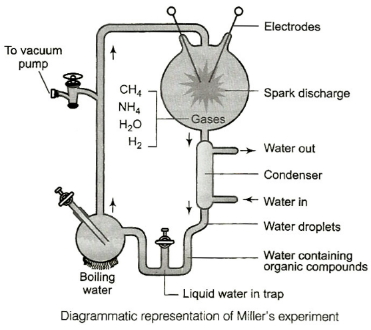
In $1953$,Stanley Miller,who was then a graduate student of Harold Urey $(1893-1981)$ at the University of Chicago,clearly demonstrated that ultraviolet radiation or electric discharges can produce complex organic compounds from a mixture of $CH_{4}$,$NH_{3}$,$H_{2}O$,and $H_{2}$. The ratio of methane,ammonia,and hydrogen in Miller's experiment was $2:1:2$.
Experimental Evidences of Chemical Evolution:
Stanley Miller and Harold Urey performed an experiment in $1953$ to test the chemical theory of evolution.
They created an electric discharge in a closed flask containing $CH_{4}$,$H_{2}$,$NH_{3}$,and water vapor at $800^{\circ}C$. They observed the formation of amino acids. In similar experiments,others observed the formation of sugars,nitrogen bases,pigments,and fats.
The first non-cellular forms of life could have originated $3$ billion years ago. The first cellular form of life possibly did not originate until about $2$ billion years ago because the conditions were non-biogenic at that time. This version of abiogenesis,i.e.,the first form of life arose slowly through evolutionary forces from non-living molecules,was accepted by the majority.
In $1953$,Stanley Miller,who was then a graduate student of Harold Urey $(1893-1981)$ at the University of Chicago,clearly demonstrated that ultraviolet radiation or electric discharges can produce complex organic compounds from a mixture of $CH_{4}$,$NH_{3}$,$H_{2}O$,and $H_{2}$. The ratio of methane,ammonia,and hydrogen in Miller's experiment was $2:1:2$.
Experimental Evidences of Chemical Evolution:
Stanley Miller and Harold Urey performed an experiment in $1953$ to test the chemical theory of evolution.
They created an electric discharge in a closed flask containing $CH_{4}$,$H_{2}$,$NH_{3}$,and water vapor at $800^{\circ}C$. They observed the formation of amino acids. In similar experiments,others observed the formation of sugars,nitrogen bases,pigments,and fats.
The first non-cellular forms of life could have originated $3$ billion years ago. The first cellular form of life possibly did not originate until about $2$ billion years ago because the conditions were non-biogenic at that time. This version of abiogenesis,i.e.,the first form of life arose slowly through evolutionary forces from non-living molecules,was accepted by the majority.
0 likes
View Solution257
EasyMCQ
Which of the following was formed in $S. Miller$'s experiment?
A
Amino acids
B
Nucleic acids
C
$UV$ radiations
D
Microspheres
Solution
(A) In $1953$,$Stanley \ Miller$ synthesized organic compounds under conditions resembling the primitive atmosphere of the earth. $A$ mixture of water vapour,methane,hydrogen,and ammonia was circulated through a closed apparatus by steam from boiling water and subjected to an electric spark discharge $(7000 \ V)$ between tungsten electrodes. This apparatus was permitted to run for a week. The result was the formation of several amino acids.
0 likes
View Solution258
MediumMCQ
Name the first organisms that invaded land.
A
Plants
B
Consumers
C
Animals
D
Carnivores
Solution
(A) Plants were the first organisms to invade land. They were present on land long before animals arrived,providing the necessary oxygen and food sources for subsequent life forms.
0 likes
View Solution259
MediumMCQ
Oparin and Haldane's theory is also called
A
Chemical theory of origin of life
B
Modern theory of origin of life
C
Naturalistic theory
D
All of the above
Solution
(D) The correct answer is $D$. All of the above.
Oparin and Haldane's theory,which explains the origin of life on Earth,is known by several names:
$1$. $\text{Chemical theory of origin of life}$: It suggests that life originated from non-living organic molecules through a series of chemical reactions.
$2$. $\text{Modern theory of origin of life}$: It is considered the most widely accepted modern scientific explanation for the origin of life.
$3$. $\text{Naturalistic theory}$: It explains the origin of life through natural processes rather than supernatural intervention.
Therefore,all the given options are correct.
Oparin and Haldane's theory,which explains the origin of life on Earth,is known by several names:
$1$. $\text{Chemical theory of origin of life}$: It suggests that life originated from non-living organic molecules through a series of chemical reactions.
$2$. $\text{Modern theory of origin of life}$: It is considered the most widely accepted modern scientific explanation for the origin of life.
$3$. $\text{Naturalistic theory}$: It explains the origin of life through natural processes rather than supernatural intervention.
Therefore,all the given options are correct.
0 likes
View Solution260
EasyMCQ
In which era did Protozoa,sponges,and algae originate?
A
Cenozoic era
B
Azoic era
C
Proterozoic era
D
Mesozoic era
Solution
(C) The $Proterozoic$ era is characterized by the appearance of the first eukaryotic organisms.
During this era,simple multicellular life forms such as $Protozoa$,sponges,and various forms of algae began to evolve and diversify in the oceans.
This era followed the $Archean$ eon and preceded the $Phanerozoic$ eon,marking a significant step in the history of life on Earth.
During this era,simple multicellular life forms such as $Protozoa$,sponges,and various forms of algae began to evolve and diversify in the oceans.
This era followed the $Archean$ eon and preceded the $Phanerozoic$ eon,marking a significant step in the history of life on Earth.
0 likes
View Solution261
MediumMCQ
Select the wrong pair.
A
$Oparin - Probiont$
B
$Spallanzani - \text{Approve abiogenesis}$
C
$Haldane - \text{Hot dilute soup}$
D
$Fox - \text{Coacervates}$
Solution
(B) $Spallanzani$ disapproved the theory of abiogenesis (spontaneous generation).
$Spallanzani$'s Experiment: He experimented that animal and vegetable broths boiled for several hours and soon after sealed, were never infested with microorganisms.
From this experiment, he concluded that high temperature had killed all living organisms in the broths and without them, life did not appear.
When the broths were left exposed to air, they were soon invaded by microorganisms.
Therefore, the pair $Spallanzani - \text{Approve abiogenesis}$ is incorrect.
$Spallanzani$'s Experiment: He experimented that animal and vegetable broths boiled for several hours and soon after sealed, were never infested with microorganisms.
From this experiment, he concluded that high temperature had killed all living organisms in the broths and without them, life did not appear.
When the broths were left exposed to air, they were soon invaded by microorganisms.
Therefore, the pair $Spallanzani - \text{Approve abiogenesis}$ is incorrect.
0 likes
View Solution262
EasyMCQ
The ratio of methane,ammonia,and hydrogen in Stanley Miller's experiment was
A
$3: 1: 2$
B
$2: 1: 2$
C
$1: 2: 1$
D
$5: 4: 1$
Solution
(B) Stanley Miller and Harold Urey synthesized amino acids by passing an electric discharge through a mixture of ammonia $(NH_3)$,hydrogen $(H_2)$,water vapor $(H_2O)$,and methane $(CH_4)$.
The ratio of methane $(CH_4)$,ammonia $(NH_3)$,and hydrogen $(H_2)$ used in the large flask was $2: 1: 2$.
The ratio of methane $(CH_4)$,ammonia $(NH_3)$,and hydrogen $(H_2)$ used in the large flask was $2: 1: 2$.
0 likes
View Solution263
MediumMCQ
Life cannot originate from inorganic materials now because of
A
Low atmospheric temperature
B
High degree of pollution
C
High atmospheric oxygen
D
Absence of raw materials
Solution
(C) Life cannot originate from inorganic materials now because of high atmospheric oxygen. Oxygen is potentially very dangerous to living things,because it reacts with organic molecules,destroying these molecules and releasing their stored energy.
0 likes
View Solution264
MediumMCQ
Which of the following experiments suggested that the simplest living organisms could not have originated spontaneously from non-living matter?
A
Microbes did not appear in stored meat
B
Larvae could appear in decaying organic matter
C
Microbes appeared from unsterilized organic matter
D
Meat was not spoiled,when heated and kept sealed in a vessel
Solution
(D) The experiment where meat was not spoiled when heated and kept sealed in a vessel suggested that the simplest living organisms could not have originated spontaneously from non-living matter.
This experiment,often associated with the work of $Lazzaro$ $Spallanzani$,demonstrated that microorganisms are present in the air and that they are the source of contamination in organic matter.
By boiling the broth or meat and sealing the container,the entry of microbes from the air was prevented,thus proving that life does not arise spontaneously from non-living matter (abiogenesis).
This experiment,often associated with the work of $Lazzaro$ $Spallanzani$,demonstrated that microorganisms are present in the air and that they are the source of contamination in organic matter.
By boiling the broth or meat and sealing the container,the entry of microbes from the air was prevented,thus proving that life does not arise spontaneously from non-living matter (abiogenesis).
0 likes
View Solution265
MediumMCQ
Which of the following statements stands in favour of abiogenesis?
$I.$ Spontaneous generation
$II.$ Origin of viruses and microbes
$III.$ Origin of life from living organism
$IV.$ Origin of life from non-living organism
The correct combination is
$I.$ Spontaneous generation
$II.$ Origin of viruses and microbes
$III.$ Origin of life from living organism
$IV.$ Origin of life from non-living organism
The correct combination is
A
$I$ and $II$
B
$II$ and $III$
C
$III$ and $IV$
D
$I$ and $IV$
Solution
(D) Abiogenesis refers to the natural process by which life has arisen from non-living matter,such as simple organic compounds.
$I.$ Spontaneous generation is the hypothetical process by which living organisms develop from non-living matter.
$IV.$ Origin of life from non-living organism is the fundamental definition of abiogenesis.
Therefore,statements $I$ and $IV$ support the concept of abiogenesis.
$I.$ Spontaneous generation is the hypothetical process by which living organisms develop from non-living matter.
$IV.$ Origin of life from non-living organism is the fundamental definition of abiogenesis.
Therefore,statements $I$ and $IV$ support the concept of abiogenesis.
0 likes
View Solution266
MediumMCQ
Select the wrong statements.
$I.$ Swan-neck flask experiment was performed by Louis Pasteur.
$II.$ Louis Pasteur is famous for the germ theory of disease.
$III.$ Louis Pasteur disapproved the spontaneous generation theory forever.
$IV.$ Cosmozoic theory of origin of life was proposed by Richter.
$V.$ Theory of catastrophism was given by Georges Cuvier.
Choose the correct option.
$I.$ Swan-neck flask experiment was performed by Louis Pasteur.
$II.$ Louis Pasteur is famous for the germ theory of disease.
$III.$ Louis Pasteur disapproved the spontaneous generation theory forever.
$IV.$ Cosmozoic theory of origin of life was proposed by Richter.
$V.$ Theory of catastrophism was given by Georges Cuvier.
Choose the correct option.
A
$I, II$ and $IV$
B
$I, III$ and $IV$
C
$III, IV$ and $V$
D
None of these
Solution
(D) Let us analyze the given statements:
$I.$ The swan-neck flask experiment was indeed performed by Louis Pasteur to disprove spontaneous generation. This statement is correct.
$II.$ Louis Pasteur is widely recognized for his contributions to the germ theory of disease. This statement is correct.
$III.$ Louis Pasteur successfully demonstrated that life comes from pre-existing life,thereby permanently disproving the theory of spontaneous generation. This statement is correct.
$IV.$ The Cosmozoic theory (or Panspermia theory) suggests that life reached Earth from other planets in the form of spores or germs. This theory was proposed by Richter in $1865$. This statement is correct.
$V.$ The theory of catastrophism,which suggests that Earth's geological features were formed by sudden,short-lived,violent events,was proposed by Georges Cuvier. This statement is correct.
Since all the statements provided ($I, II, III, IV,$ and $V$) are scientifically accurate,there are no wrong statements among them.
$I.$ The swan-neck flask experiment was indeed performed by Louis Pasteur to disprove spontaneous generation. This statement is correct.
$II.$ Louis Pasteur is widely recognized for his contributions to the germ theory of disease. This statement is correct.
$III.$ Louis Pasteur successfully demonstrated that life comes from pre-existing life,thereby permanently disproving the theory of spontaneous generation. This statement is correct.
$IV.$ The Cosmozoic theory (or Panspermia theory) suggests that life reached Earth from other planets in the form of spores or germs. This theory was proposed by Richter in $1865$. This statement is correct.
$V.$ The theory of catastrophism,which suggests that Earth's geological features were formed by sudden,short-lived,violent events,was proposed by Georges Cuvier. This statement is correct.
Since all the statements provided ($I, II, III, IV,$ and $V$) are scientifically accurate,there are no wrong statements among them.
0 likes
View Solution267
MediumMCQ
Given below are some major events in the early history of life:
$I.$ First heterotrophic prokaryotes
$II.$ First eukaryotes
$III.$ First autotrophic prokaryotes
$IV.$ First animals
Choose the correct sequence of these evolutionary events.
$I.$ First heterotrophic prokaryotes
$II.$ First eukaryotes
$III.$ First autotrophic prokaryotes
$IV.$ First animals
Choose the correct sequence of these evolutionary events.
A
$IV, III, II, I$
B
$I, III, II, IV$
C
$I, II, III, IV$
D
$IV, I, II, III$
Solution
(B) The evolutionary sequence of life on Earth is as follows:
$1$. First heterotrophic prokaryotes $(I)$: These were the earliest life forms that utilized existing organic molecules for energy.
$2$. First autotrophic prokaryotes $(III)$: As organic resources became scarce,organisms evolved the ability to synthesize their own food (e.g.,chemosynthesis and later photosynthesis).
$3$. First eukaryotes $(II)$: These evolved from prokaryotes through endosymbiosis,characterized by a membrane-bound nucleus and organelles.
$4$. First animals $(IV)$: Multicellular eukaryotic organisms appeared much later in the evolutionary timeline.
Therefore,the correct chronological order is $I, III, II, IV$.
$1$. First heterotrophic prokaryotes $(I)$: These were the earliest life forms that utilized existing organic molecules for energy.
$2$. First autotrophic prokaryotes $(III)$: As organic resources became scarce,organisms evolved the ability to synthesize their own food (e.g.,chemosynthesis and later photosynthesis).
$3$. First eukaryotes $(II)$: These evolved from prokaryotes through endosymbiosis,characterized by a membrane-bound nucleus and organelles.
$4$. First animals $(IV)$: Multicellular eukaryotic organisms appeared much later in the evolutionary timeline.
Therefore,the correct chronological order is $I, III, II, IV$.
0 likes
View Solution268
MediumMCQ
The origin of the Earth dates back to
A
$10,000-15,000$ million years ago
B
$4000-4600$ million years ago
C
$500-1000$ million years ago
D
$2000-3000$ million years ago
Solution
(B) The origin of the universe occurred approximately $20$ billion years ago.
The origin of the Earth is estimated to have occurred approximately $4.5$ billion years ago,which is equivalent to $4500$ million years.
Therefore,the range $4000-4600$ million years ago is the correct scientific estimate.
The origin of the Earth is estimated to have occurred approximately $4.5$ billion years ago,which is equivalent to $4500$ million years.
Therefore,the range $4000-4600$ million years ago is the correct scientific estimate.
0 likes
View Solution269
EasyMCQ
Who finally refuted the theory of spontaneous generation and experimentally disproved it?
A
Thomas Malthus
B
Alfred Wallace
C
Louis Pasteur
D
Charles Darwin
Solution
(C) Louis Pasteur finally refuted the theory of spontaneous generation. He performed the famous 'Swan-neck flask experiment'. In this experiment,he showed that in pre-sterilized flasks,life did not come from killed yeast,while in another flask open to air,new living organisms arose from 'life' existing in the air. This experiment conclusively disproved the concept of spontaneous generation.
0 likes
View Solution270
MediumMCQ
An experiment to prove that organic compounds were the basis of life was performed by
A
Van Helmont
B
Oparin
C
$S.$ Miller
D
Fox
Solution
(C) Based on the hypothesis proposed by Oparin and Haldane,Stanley Miller provided experimental evidence for chemical evolution.
In $1953$,he created a laboratory setup simulating the conditions of the primitive atmosphere,such as high temperature,volcanic storms,and a reducing atmosphere consisting of $CH_4$,$NH_3$,$H_2$,and water vapor.
He observed the formation of amino acids,which are the building blocks of organic compounds,thereby supporting the theory of chemical evolution.
In $1953$,he created a laboratory setup simulating the conditions of the primitive atmosphere,such as high temperature,volcanic storms,and a reducing atmosphere consisting of $CH_4$,$NH_3$,$H_2$,and water vapor.
He observed the formation of amino acids,which are the building blocks of organic compounds,thereby supporting the theory of chemical evolution.
0 likes
View Solution271
EasyMCQ
Which of the following theories is related to the transfer of life from one planet to another?
A
Theory of special creation
B
Theory of biogenesis
C
Theory of spontaneous generation
D
Cosmozoic theory
Solution
(D) The $Cosmozoic$ $theory$,also known as the $Panspermia$ $theory$,suggests that life did not originate on Earth but was brought here from other parts of the universe.
According to this theory,life exists throughout the universe and is transferred from one planet to another in the form of resistant seeds,spores,or other biological units.
According to this theory,life exists throughout the universe and is transferred from one planet to another in the form of resistant seeds,spores,or other biological units.
0 likes
View Solution272
MediumMCQ
Stanley Miller had put the Oparin-Haldane theory to test in $1953$ by creating in the laboratory the probable conditions on the primitive earth. In the experiment,simple amino acids were synthesized from which of the following mixtures,as observed after eighteen days?
A
$H_{2}, O_{2}, N_{2}$ and $H_{2}O$
B
$CH_{4}, CN, H_{2}$ and $O_{2}$
C
$H_{2}, NH_{3}, CH_{4}$ and water vapour
D
$NH_{3}, CH_{4}$ and $O_{2}$
Solution
(C) Stanley Miller conducted a famous experiment in $1953$ to test the Oparin-Haldane hypothesis regarding the origin of life.
He created a closed system in the laboratory that simulated the conditions of the primitive Earth.
He used a mixture of gases consisting of $CH_{4}$ (methane),$NH_{3}$ (ammonia),$H_{2}$ (hydrogen),and water vapour $(H_{2}O)$ in a ratio of $2:1:2$.
These gases were subjected to electric discharges using electrodes to simulate lightning.
After $18$ days,he observed the formation of simple amino acids like glycine,alanine,and aspartic acid,which provided experimental evidence for the chemical evolution of life.
He created a closed system in the laboratory that simulated the conditions of the primitive Earth.
He used a mixture of gases consisting of $CH_{4}$ (methane),$NH_{3}$ (ammonia),$H_{2}$ (hydrogen),and water vapour $(H_{2}O)$ in a ratio of $2:1:2$.
These gases were subjected to electric discharges using electrodes to simulate lightning.
After $18$ days,he observed the formation of simple amino acids like glycine,alanine,and aspartic acid,which provided experimental evidence for the chemical evolution of life.
0 likes
View Solution273
EasyMCQ
The proponent of the theory of spontaneous generation was
A
Louis Pasteur
B
Van Helmont
C
Spallanzani
D
Francisco Redi
Solution
(B) The theory of spontaneous generation,also known as abiogenesis,suggested that living organisms could arise from non-living matter.
$Van \ Helmont$ was a notable proponent of this theory,famously suggesting that mice could arise from wheat and a dirty shirt.
In contrast,$Louis \ Pasteur$,$Spallanzani$,and $Francisco \ Redi$ conducted experiments that ultimately disproved the theory of spontaneous generation,demonstrating that life arises only from pre-existing life.
$Van \ Helmont$ was a notable proponent of this theory,famously suggesting that mice could arise from wheat and a dirty shirt.
In contrast,$Louis \ Pasteur$,$Spallanzani$,and $Francisco \ Redi$ conducted experiments that ultimately disproved the theory of spontaneous generation,demonstrating that life arises only from pre-existing life.
0 likes
View Solution274
EasyMCQ
Which English scientist worked on the origin of life and later settled in India?
A
$A. I. Oparin$
B
$J. B. S. Haldane$
C
Louis Pasteur
D
Van Helmont
Solution
(B) $J. B. S. Haldane$ was a British-born scientist who made significant contributions to the study of the origin of life.
He proposed the chemical evolution theory,suggesting that life originated from non-living organic molecules.
He moved to India in $1957$,became an Indian citizen,and spent the later part of his life working at the Indian Statistical Institute in Kolkata.
He proposed the chemical evolution theory,suggesting that life originated from non-living organic molecules.
He moved to India in $1957$,became an Indian citizen,and spent the later part of his life working at the Indian Statistical Institute in Kolkata.
0 likes
View Solution275
EasyMCQ
According to the cosmozoic theory,life arrived on Earth from other planets in space in the form of:
A
Spores
B
Seeds
C
Gametes
D
All of these
Solution
(D) The cosmozoic theory,also known as the theory of 'Panspermia',suggests that life did not originate on Earth but was brought here from outer space. According to this theory,life existed in the form of resistant units such as spores,seeds,or other simple reproductive structures that could survive the harsh conditions of space travel. Therefore,all of the listed options are considered potential vehicles for the transfer of life according to this theory.
0 likes
View Solution276
MediumMCQ
The theory that living organisms on the earth came from outer space is based on the study of
A
Igneous rocks
B
Sedimentary rocks
C
Meteorites
D
Moon soil
Solution
(C) The theory of Panspermia suggests that life exists throughout the Universe and is distributed by space dust,meteoroids,asteroids,comets,or planetoids.
This theory is supported by the study of meteorites,which are fragments of rock or metal from outer space that fall to the Earth's surface.
Scientists have analyzed the chemical composition of meteorites and found organic compounds,which provides evidence for the possibility of extraterrestrial life origins.
This theory is supported by the study of meteorites,which are fragments of rock or metal from outer space that fall to the Earth's surface.
Scientists have analyzed the chemical composition of meteorites and found organic compounds,which provides evidence for the possibility of extraterrestrial life origins.
0 likes
View Solution277
EasyMCQ
The Russian scientist who proposed the theory of the origin of life was
A
Oparin
B
Haldane
C
Miller
D
None of these
Solution
(A) Alexander Oparin was a Russian biochemist who proposed the theory of the chemical origin of life in $1924$.
$J$.$B$.$S$. Haldane was a British scientist who independently proposed a similar theory.
Therefore,Oparin is the correct answer as he was the Russian scientist.
$J$.$B$.$S$. Haldane was a British scientist who independently proposed a similar theory.
Therefore,Oparin is the correct answer as he was the Russian scientist.
0 likes
View Solution278
EasyMCQ
$A.I.$ Oparin wrote
A
Origin of Species
B
Origin of Life
C
Philosophie Zoologique
D
The Planet
Solution
(B) $A.I.$ Oparin is a famous scientist known for his theory on the chemical evolution of life. He authored the book titled "The Origin of Life" in $1924$.
Matching the other options:
$1$. "Origin of Species" was written by Charles Darwin.
$2$. "Philosophie Zoologique" was written by Jean-Baptiste Lamarck.
$3$. "The Planets" (or related works on planetary science) is often associated with $H.C.$ Urey.
Matching the other options:
$1$. "Origin of Species" was written by Charles Darwin.
$2$. "Philosophie Zoologique" was written by Jean-Baptiste Lamarck.
$3$. "The Planets" (or related works on planetary science) is often associated with $H.C.$ Urey.
0 likes
View Solution279
EasyMCQ
$H.C. Urey$ wrote the following book:
A
The Planets
B
Origin of Life
C
The Origin of Species
D
None of these
Solution
(A) The book titled "The Planets" was written by $H.C. Urey$.
"Origin of Species" was written by $Charles \, Darwin$.
"The Origin of Life" was written by $A.I. Oparin$.
Therefore, the correct option is $A$.
"Origin of Species" was written by $Charles \, Darwin$.
"The Origin of Life" was written by $A.I. Oparin$.
Therefore, the correct option is $A$.
0 likes
View Solution280
MediumMCQ
What did $S.L.$ Miller observe in his experimental set-up?
A
Formation of sugars and nitrogenous bases
B
Formation of amino acids
C
Formation of pigments
D
Formation of fats
Solution
(B) $S.L.$ Miller conducted an experiment in $1953$ to test the Oparin-Haldane hypothesis. He created a closed system with a mixture of $CH_4$,$NH_3$,$H_2$,and water vapor at $800^{\circ}C$ using electric discharges. After a week,he observed the formation of simple organic compounds,specifically amino acids such as alanine,glycine,and aspartic acid.
0 likes
View Solution281
EasyMCQ
$S.L.$ Miller conducted an experiment in $1953$ to support the:
A
Theory of spontaneous generation
B
Biogenesis
C
Chemical evolution of life
D
Natural selection
Solution
(C) The chemical evolution theory,proposed by Oparin and Haldane,suggests that the first forms of life originated from pre-existing non-living organic molecules.
In $1953$,$S.L.$ Miller conducted an experiment to test this hypothesis by creating a laboratory environment that simulated the conditions of the primitive Earth (high temperature,volcanic storms,and a reducing atmosphere containing $CH_4$,$NH_3$,$H_2$,and $H_2O$).
He observed the synthesis of amino acids in his apparatus,which provided experimental evidence for the chemical evolution of life.
In $1953$,$S.L.$ Miller conducted an experiment to test this hypothesis by creating a laboratory environment that simulated the conditions of the primitive Earth (high temperature,volcanic storms,and a reducing atmosphere containing $CH_4$,$NH_3$,$H_2$,and $H_2O$).
He observed the synthesis of amino acids in his apparatus,which provided experimental evidence for the chemical evolution of life.
0 likes
View Solution282
EasyMCQ
The scientist associated with the theory of biogenesis and experiments with swan-necked flasks is
A
Van Helmont
B
Louis Pasteur
C
Miller
D
Haeckel
Solution
(B) Louis Pasteur is the scientist who performed the famous swan-necked flask experiment.
This experiment provided conclusive evidence to disprove the theory of spontaneous generation (abiogenesis).
He demonstrated that life arises only from pre-existing life (biogenesis),as microorganisms could not grow in the sterile broth of the swan-necked flask because they were trapped in the neck.
This experiment provided conclusive evidence to disprove the theory of spontaneous generation (abiogenesis).
He demonstrated that life arises only from pre-existing life (biogenesis),as microorganisms could not grow in the sterile broth of the swan-necked flask because they were trapped in the neck.
0 likes
View Solution283
MediumMCQ
All of the following conditions were present on early earth,except:
A
High temperature
B
Volcanic storms
C
Oxidising atmosphere
D
Reducing atmosphere
Solution
(C) The early atmosphere of the Earth was a reducing atmosphere,characterized by the presence of hydrogen,methane,ammonia,and water vapor,but lacking free oxygen. Therefore,an oxidising atmosphere was not present on early Earth.
0 likes
View Solution284
MediumMCQ
Which of the following broke down water into hydrogen and oxygen on the early Earth?
A
Visible light
B
Infrared radiations
C
Sunlight
D
$UV$ radiations
Solution
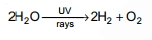
(D) On the early Earth,high-energy $UV$ radiations from the sun caused the photolysis of water vapor $(2H_{2}O \xrightarrow{UV} 2H_{2} + O_{2})$.
Since hydrogen is a light gas,it escaped into space.
The released oxygen combined with ammonia $(NH_{3})$ and methane $(CH_{4})$ to form water $(H_{2}O)$,carbon dioxide $(CO_{2})$,and other compounds.
Since hydrogen is a light gas,it escaped into space.
The released oxygen combined with ammonia $(NH_{3})$ and methane $(CH_{4})$ to form water $(H_{2}O)$,carbon dioxide $(CO_{2})$,and other compounds.
0 likes
View Solution285
MediumMCQ
Which of the following appeared on the Earth with the arrival of plants and was absent in the past?
A
Carbon dioxide
B
Methane
C
Ammonia
D
Oxygen
Solution
(D) The early atmosphere of the Earth was reducing in nature,meaning it lacked free oxygen. Oxygen was released into the atmosphere as a byproduct of photosynthesis by early photosynthetic organisms like cyanobacteria and later by plants. Therefore,free oxygen appeared on Earth only after the evolution of photosynthetic life forms.
0 likes
View Solution286
EasyMCQ
The theory of abiogenesis or spontaneous generation was finally disapproved by
A
Louis Pasteur
B
$A.I.$ Oparin
C
$A.R.$ Wallace
D
Sydney Fox
Solution
(A) The theory of abiogenesis,which suggested that life could originate from non-living matter spontaneously,was finally disproved by Louis Pasteur.
He conducted the famous 'Swan-Neck Flask' experiment,which demonstrated that microorganisms only arise from pre-existing microorganisms in the air,thereby supporting the theory of biogenesis.
He conducted the famous 'Swan-Neck Flask' experiment,which demonstrated that microorganisms only arise from pre-existing microorganisms in the air,thereby supporting the theory of biogenesis.
0 likes
View Solution287
EasyMCQ
Simple one-celled cyanobacteria-like organisms appeared on Earth:
A
$5600 \text{ million}$ years ago
B
$5000 \text{ million}$ years ago
C
$4600 \text{ million}$ years ago
D
$3.3 \text{ to } 3.5 \text{ billion}$ years ago
Solution
(D) The origin of the Earth occurred approximately $4.5 \text{ billion}$ years ago.
Cyanobacteria-like organisms are considered to be among the earliest forms of life,appearing on Earth about $3.3 \text{ to } 3.5 \text{ billion}$ years ago.
Cyanobacteria-like organisms are considered to be among the earliest forms of life,appearing on Earth about $3.3 \text{ to } 3.5 \text{ billion}$ years ago.
0 likes
View Solution288
EasyMCQ
Eukaryotes developed around
A
$1,600 \; \text{million}$ years ago
B
$459 \; \text{million}$ years ago
C
$3,800 \; \text{million}$ years ago
D
$4,200 \; \text{million}$ years ago
Solution
(A) Eukaryotes are complex cells that evolved from prokaryotic ancestors through the process of endosymbiosis.
According to evolutionary biology and the fossil record, the first free-living eukaryotic organisms originated in the oceans approximately $1.5 \; \text{billion}$ years ago, which is equivalent to $1,500 \; \text{million}$ years ago.
Among the given options, $1,600 \; \text{million}$ years ago is the closest approximation to this timeline.
According to evolutionary biology and the fossil record, the first free-living eukaryotic organisms originated in the oceans approximately $1.5 \; \text{billion}$ years ago, which is equivalent to $1,500 \; \text{million}$ years ago.
Among the given options, $1,600 \; \text{million}$ years ago is the closest approximation to this timeline.
0 likes
View Solution289
MediumMCQ
The atmosphere became oxidising with the appearance of
A
Autotrophic bacteria
B
Autotrophic cyanobacteria
C
Land plants
D
Algae
Solution
(B) Autotrophic cyanobacteria were the first organisms to perform oxygenic photosynthesis.
They used $H_{2}O$ as a hydrogen donor to obtain hydrogen for carbon fixation,which resulted in the release of oxygen as a byproduct.
This process led to the accumulation of free oxygen in the atmosphere,causing it to become oxidising.
They used $H_{2}O$ as a hydrogen donor to obtain hydrogen for carbon fixation,which resulted in the release of oxygen as a byproduct.
This process led to the accumulation of free oxygen in the atmosphere,causing it to become oxidising.
0 likes
View Solution290
EasyMCQ
Which one of the following gases was not present in free form at the time life originated on Earth?
A
Ammonia
B
Oxygen
C
Hydrogen
D
Methane
Solution
(B) The atmosphere of primitive Earth was a reducing environment. It contained gases like $CH_4$,$NH_3$,$H_2$,and water vapor,but it lacked free molecular oxygen $(O_2)$. Oxygen was released later into the atmosphere through the process of photosynthesis by cyanobacteria.
0 likes
View Solution291
EasyMCQ
The theory of spontaneous generation states that:
A
Life originated from decaying and rotting matter like straw,mud,etc.
B
Life came to the Earth from outer space.
C
Life comes from pre-existing life only.
D
Life started with the replication of self-replicating metabolic capsules.
Solution
(A) The theory of spontaneous generation,also known as abiogenesis,proposed that life could arise spontaneously from non-living,decaying,and rotting matter such as straw,mud,or sweat. This theory was later disproven by experiments conducted by scientists like Francesco Redi,Lazzaro Spallanzani,and finally Louis Pasteur,who demonstrated that life comes only from pre-existing life (biogenesis).
0 likes
View Solution292
MediumMCQ
Louis Pasteur,by careful experimentation,demonstrated that:
A
Phenomenon of chemical evolution
B
There is spontaneous generation of life
C
Life comes from pre-existing life
D
Abiogenic origin of life
Solution
(C) Louis Pasteur performed the famous $Swan-Neck$ flask experiment.
In this experiment,he showed that in pre-sterilized flasks,life did not come from killed yeast if the flask was sealed,but when exposed to air,new living organisms arose from pre-existing life forms present in the air.
This experiment effectively disproved the theory of spontaneous generation and provided evidence for $BIOGENESIS$,which states that life comes from pre-existing life.
In this experiment,he showed that in pre-sterilized flasks,life did not come from killed yeast if the flask was sealed,but when exposed to air,new living organisms arose from pre-existing life forms present in the air.
This experiment effectively disproved the theory of spontaneous generation and provided evidence for $BIOGENESIS$,which states that life comes from pre-existing life.
0 likes
View Solution293
MediumMCQ
The first non-cellular form of life could have originated about $.....$ years ago.
A
$3 \; \text{million}$
B
$2 \; \text{million}$
C
$3 \; \text{billion}$
D
$2 \; \text{billion}$
Solution
(C) According to the theory of chemical evolution, the first non-cellular forms of life originated approximately $3 \; \text{billion}$ years ago.
These were likely giant molecules such as $RNA$, $DNA$, and polysaccharides that were capable of self-replication or complex chemical interactions.
These were likely giant molecules such as $RNA$, $DNA$, and polysaccharides that were capable of self-replication or complex chemical interactions.
0 likes
View Solution294
MediumMCQ
Which ones are the most essential for the origin of life?
A
Enzymes
B
Proteins
C
Carbohydrates
D
Nucleic acid
Solution
(D) Nucleic acids are considered the most essential for the origin of life because they serve as the genetic material (the blueprint of an organism's genetic make-up). They possess the unique ability to store,replicate,and transmit genetic information,which is fundamental for self-replication and evolution.
0 likes
View Solution295
MediumMCQ
The presence of $NaCl$ in body fluids indicates that life originated in:
A
Primitive ocean
B
Rainwater lakes
C
Salt solution
D
All of these
Solution
(A) The presence of $NaCl$ (sodium chloride) in the body fluids of organisms is considered evidence that life originated in the primitive ocean. The concentration of salts in our internal body fluids is similar to the salinity of the ancient oceans where the first life forms evolved.
0 likes
View Solution296
EasyMCQ
Origin of life from nonliving matter is known as
A
Coacervates
B
Abiogenesis
C
Biogenesis
D
None of these
Solution
(B) The theory of spontaneous generation,also known as $Abiogenesis$,proposes that living organisms can originate from non-living matter.
This concept suggests that life arises naturally from inanimate substances under certain conditions.
This concept suggests that life arises naturally from inanimate substances under certain conditions.
0 likes
View Solution297
MediumMCQ
During the origin and evolution of life,key biological compounds were progressively synthesized in the ocean with the help of energy obtainable from:
A
Lightning
B
Ultraviolet light
C
Lightning as well as ultraviolet light
D
Combustion of certain compounds
Solution
(C) According to the Oparin-Haldane hypothesis,the early atmosphere was reducing and contained simple molecules like $CH_{4}$,$NH_{3}$,$H_{2}O$,and $H_{2}$.
Energy sources such as lightning and ultraviolet $(UV)$ radiation provided the necessary activation energy for these simple molecules to react and form complex organic compounds like amino acids and nucleotides in the primitive ocean.
$UV$ rays also played a role in the photolysis of water,breaking $H_{2}O$ into $H_{2}$ and $O_{2}$.
Energy sources such as lightning and ultraviolet $(UV)$ radiation provided the necessary activation energy for these simple molecules to react and form complex organic compounds like amino acids and nucleotides in the primitive ocean.
$UV$ rays also played a role in the photolysis of water,breaking $H_{2}O$ into $H_{2}$ and $O_{2}$.
0 likes
View Solution298
EasyMCQ
The theory of panspermia was proposed to explain the
A
Origin of universe
B
Origin of life
C
Origin of earth
D
Evolution of life
Solution
(B) The theory of panspermia,also known as the theory of cosmic origin,suggests that life did not originate on Earth but was brought to Earth from outer space in the form of resistant spores,seeds,or microorganisms.
It proposes that life exists throughout the Universe and is distributed by meteoroids,asteroids,comets,or planetoids.
Therefore,it is a hypothesis proposed to explain the origin of life on Earth.
It proposes that life exists throughout the Universe and is distributed by meteoroids,asteroids,comets,or planetoids.
Therefore,it is a hypothesis proposed to explain the origin of life on Earth.
0 likes
View Solution299
EasyMCQ
The first organisms that appeared on Earth were
A
Chemoheterotrophs
B
Chemoautotrophs
C
Photoautotrophs
D
Decomposers
Solution
(A) The first organisms on Earth are believed to have been chemoheterotrophs.
These primitive life forms obtained their energy and carbon from the organic molecules present in the 'primordial soup' of the early oceans.
They did not possess the machinery for photosynthesis or chemosynthesis,making them dependent on pre-existing organic compounds.
These primitive life forms obtained their energy and carbon from the organic molecules present in the 'primordial soup' of the early oceans.
They did not possess the machinery for photosynthesis or chemosynthesis,making them dependent on pre-existing organic compounds.
0 likes
View Solution300
MediumMCQ
The most important condition for the origin of life is the presence of
A
Water
B
Oxygen
C
Nitrogen
D
Carbon
Solution
(A) Life originated in the primitive oceans,which provided the necessary aqueous environment for the synthesis of complex organic molecules. Water acts as a universal solvent and is essential for all biochemical reactions,making it the most critical condition for the origin of life.
0 likes
View SolutionEvolution — Origin of Life · Frequently Asked Questions
1Are these Evolution questions useful for JEE and NEET?
Yes. All questions in this section are mapped to JEE Main and NEET exam patterns. Previous year questions from JEE Main, NEET, GUJCET and state-level exams are included with full solutions.
2Can I switch to Hindi or Gujarati for these questions?
Yes. Use the language tabs in the hero section or the sidebar to view the same questions and solutions in English, Hindi or Gujarati.
3How do I generate a question paper from this subtopic?
Use the Vedclass Exam Paper Generator — select the chapter and subtopic, set difficulty, and generate Sets A, B, C, D automatically. First 3 chapters of every subject are free.
Vedclass Products
For Students
Vedclass Test Series
Mock tests in real JEE/NEET style with performance analysis. 5-day free trial.
Start Free TrialFor Teachers
Exam Paper Generator
Generate Set A/B/C/D papers from this chapter in 2 minutes. 3 chapters free.
Try FreeFor Institutes
Online Exam Module
Live online exams with unlimited students, 360° analytics & white-label branding.
See DemoFor Teachers & Institutes
Generate a Evolution Exam Paper in 2 Minutes
Select subtopic & difficulty — Sets A, B, C, D auto-generated with No Repeat logic.
First 3 chapters of every subject are free — no payment required.