
A English
A Brief Account of Evolution Questions in English
Class 12 Biology · Evolution · A Brief Account of Evolution
130+
Questions
English
Language
100%
With Solutions
Showing 30 of 130 questions in English
101
MediumMCQ
The Cretaceous period of the Mesozoic era is characterized by which of the following?
A
Gymnosperms are dominant plants and first birds appear
B
Dinosaurs become extinct and angiosperms appear
C
Flowering plants disappear
D
Radiation of reptiles and origin of mammal-like reptiles
Solution
(B) The Cretaceous period is characterized by the extinction of dinosaurs and the appearance of angiosperms (flowering plants).
Option $A$ is incorrect because the first birds appeared in the Jurassic period.
Option $C$ is incorrect because flowering plants appeared and diversified during the Cretaceous period.
Option $D$ is incorrect because the radiation of reptiles occurred earlier in the Mesozoic era.
Option $A$ is incorrect because the first birds appeared in the Jurassic period.
Option $C$ is incorrect because flowering plants appeared and diversified during the Cretaceous period.
Option $D$ is incorrect because the radiation of reptiles occurred earlier in the Mesozoic era.
0 likes
View Solution102
MediumMCQ
The flowering plants originated in which of the following periods?
A
Cretaceous
B
Tertiary period
C
Triassic
D
Carboniferous
Solution
(A) The origin of flowering plants (angiosperms) occurred during the $Cretaceous$ period of the Mesozoic era.
During this time,they began to diversify and eventually became the dominant land plants.
During this time,they began to diversify and eventually became the dominant land plants.
0 likes
View Solution103
EasyMCQ
Dinosaurs were abundant in
A
Jurassic period
B
Devonian period
C
Permian period
D
Pleistocene period
Solution
(A) During the $Jurassic$ period,gymnosperms and dinosaurs were dominant. The first birds also appeared during this period.
0 likes
View Solution104
EasyMCQ
The epoch of human civilization is
A
Pliocene
B
Holocene
C
Pleistocene
D
Palaeocene
Solution
(B) The $Holocene$ epoch is the current geological epoch,which began approximately $11,700$ years before present.
Human civilization,including the development of agriculture and recorded history,occurred entirely within the $Holocene$ epoch.
While early human ancestors appeared in the $Pleistocene$ epoch,the rise of modern human civilization is specifically associated with the stable climate conditions of the $Holocene$.
Human civilization,including the development of agriculture and recorded history,occurred entirely within the $Holocene$ epoch.
While early human ancestors appeared in the $Pleistocene$ epoch,the rise of modern human civilization is specifically associated with the stable climate conditions of the $Holocene$.
0 likes
View Solution105
MediumMCQ
The last major evolutionary advancement among the vascular plants was the emergence of flowering plants (angiosperms) about
A
$350$ million years ago
B
$140$ million years ago
C
$1600$ million years ago
D
$220$ million years ago
Solution
(B) The emergence of flowering plants (angiosperms) occurred during the Cretaceous period of the Mesozoic era.
This evolutionary event took place approximately $140$ million years ago.
Angiosperms represent the most advanced group of vascular plants,characterized by the development of flowers and seeds enclosed within fruits.
This evolutionary event took place approximately $140$ million years ago.
Angiosperms represent the most advanced group of vascular plants,characterized by the development of flowers and seeds enclosed within fruits.
0 likes
View Solution106
MediumMCQ
The rate of appearance of new life forms is linked to their
A
Acquired traits
B
Nonheritable characters
C
Life span
D
Cranial capacities
Solution
(C) The rate of evolution or the appearance of new life forms is directly linked to the life span or the generation time of an organism. Organisms with shorter life spans undergo more frequent reproductive cycles,allowing for faster accumulation of genetic variations and,consequently,a higher rate of evolutionary change.
0 likes
View Solution107
MediumMCQ
Which of the following is correctly matched with respect to the era and its period?
A
$A$. Paleozoic - Cretaceous
B
$B$. Mesozoic - Devonian
C
$C$. Cenozoic - Permian
D
$D$. Paleozoic - Carboniferous
Solution
(D) The geological time scale classifies Earth's history into Eras and Periods.
$1$. Paleozoic Era includes the following periods: Permian,Carboniferous,Devonian,Silurian,Ordovician,and Cambrian.
$2$. Mesozoic Era includes the following periods: Cretaceous,Jurassic,and Triassic.
$3$. Cenozoic Era includes the following periods: Quaternary and Tertiary.
Comparing the given options:
- Paleozoic - Cretaceous is incorrect (Cretaceous belongs to Mesozoic).
- Mesozoic - Devonian is incorrect (Devonian belongs to Paleozoic).
- Cenozoic - Permian is incorrect (Permian belongs to Paleozoic).
- Paleozoic - Carboniferous is correct as Carboniferous is a period within the Paleozoic Era.
$1$. Paleozoic Era includes the following periods: Permian,Carboniferous,Devonian,Silurian,Ordovician,and Cambrian.
$2$. Mesozoic Era includes the following periods: Cretaceous,Jurassic,and Triassic.
$3$. Cenozoic Era includes the following periods: Quaternary and Tertiary.
Comparing the given options:
- Paleozoic - Cretaceous is incorrect (Cretaceous belongs to Mesozoic).
- Mesozoic - Devonian is incorrect (Devonian belongs to Paleozoic).
- Cenozoic - Permian is incorrect (Permian belongs to Paleozoic).
- Paleozoic - Carboniferous is correct as Carboniferous is a period within the Paleozoic Era.
0 likes
View Solution108
MediumMCQ
The fish-like giant reptile which existed $200$ million years ago (mya) was:
A
Pteranodon
B
Ichthyosaur
C
Triceratops
D
Tyrannosaurus
Solution
(B) Approximately $200$ million years ago,some land reptiles returned to the water and evolved into fish-like reptiles. The $Ichthyosaur$ is the most prominent example of these giant,fish-like marine reptiles that lived during that period.
0 likes
View Solution109
EasyMCQ
Which of the following was a land dinosaur?
A
Triceratops
B
Pteranodon
C
Archaeopteryx
D
Ichthyosaur
Solution
(A) $Triceratops$ was a land dinosaur.
$Ichthyosaur$ was a fish-like giant marine reptile.
$Pteranodon$ was an extinct flying reptile (pterosaur).
$Archaeopteryx$ is considered a transitional fossil between non-avian feathered dinosaurs and modern birds.
$Ichthyosaur$ was a fish-like giant marine reptile.
$Pteranodon$ was an extinct flying reptile (pterosaur).
$Archaeopteryx$ is considered a transitional fossil between non-avian feathered dinosaurs and modern birds.
0 likes
View Solution110
MediumMCQ
The wrongly matched pair with respect to the organisms and their probable time of evolution is:
A
Jawless fish - around $350$ mya
B
Lobefins - around $350$ mya
C
Fish-like giant reptiles - around $320$ mya
D
Sea weeds - around $320$ mya
Solution
(C) According to the evolutionary timeline provided in the $NCERT$ textbook:
$1$. Jawless fish evolved around $350$ mya.
$2$. Lobefins evolved around $350$ mya.
$3$. Fish-like giant reptiles (Ichthyosaurs) evolved around $200$ mya,not $320$ mya.
$4$. Sea weeds existed around $320$ mya.
Therefore,the pair 'Fish-like giant reptiles - around $320$ mya' is incorrectly matched.
$1$. Jawless fish evolved around $350$ mya.
$2$. Lobefins evolved around $350$ mya.
$3$. Fish-like giant reptiles (Ichthyosaurs) evolved around $200$ mya,not $320$ mya.
$4$. Sea weeds existed around $320$ mya.
Therefore,the pair 'Fish-like giant reptiles - around $320$ mya' is incorrectly matched.
0 likes
View Solution111
MediumMCQ
The origin of seeds in land plants was achieved about $345 \; \text{million}$ years ago, in lineages recognized as ancestral to all more advanced vascular plants in:
A
Rhynia
B
Tracheophyte ancestor
C
Seed ferns
D
Conifers
Solution
(C) The origin of seeds occurred during the Carboniferous period, approximately $345 \; \text{million}$ years ago. The earliest seed-bearing plants are known as seed ferns (Pteridosperms), which are considered the ancestors of more advanced vascular plants.
0 likes
View Solution112
MediumMCQ
The origin of mammal-like reptiles occurred in which period?
A
Triassic period
B
Permian period
C
Jurassic period
D
Tertiary period
Solution
(B) According to the geological time scale and evolutionary history,the mammal-like reptiles,known as Synapsids,originated during the $Permian$ period. These organisms represent a transitional group that eventually gave rise to true mammals.
0 likes
View Solution113
MediumMCQ
As the horse evolved,there was a progressive reduction in the number of toes. Which of the following is the correct sequence in the evolution of the horse?
A
Orohippus,Hyracotherium,Mesohippus,Callipus,Merychippus,Pliohippus,Equus
B
Hyracotherium,Orohippus,Mesohippus,Merychippus,Pliohippus,Equus
C
Orohippus,Callipus,Hyracotherium,Mesohippus,Merychippus,Pliohippus,Equus
D
Hyracotherium,Mesohippus,Orohippus,Callipus,Merychippus,Pliohippus and Equus
Solution
(B) The evolution of the horse is a classic example of gradual morphological change over geological time.
The correct chronological sequence is: $Hyracotherium$ (Eohippus) $\rightarrow$ $Orohippus$ $\rightarrow$ $Mesohippus$ $\rightarrow$ $Merychippus$ $\rightarrow$ $Pliohippus$ $\rightarrow$ $Equus$.
Key evolutionary trends include:
$1$. General increase in body size.
$2$. Progressive reduction in the number of toes (from polydactyl to monodactyl).
$3$. Lengthening of the limbs and the remaining central toe.
$4$. Enlargement of the brain.
$5$. Increase in the complexity of molar teeth for grazing.
The correct chronological sequence is: $Hyracotherium$ (Eohippus) $\rightarrow$ $Orohippus$ $\rightarrow$ $Mesohippus$ $\rightarrow$ $Merychippus$ $\rightarrow$ $Pliohippus$ $\rightarrow$ $Equus$.
Key evolutionary trends include:
$1$. General increase in body size.
$2$. Progressive reduction in the number of toes (from polydactyl to monodactyl).
$3$. Lengthening of the limbs and the remaining central toe.
$4$. Enlargement of the brain.
$5$. Increase in the complexity of molar teeth for grazing.
0 likes
View Solution114
MediumMCQ
$A$: $Tyrannosaurus$ $rex$ had fearsome dagger-like teeth.
$R$: $Tyrannosaurus$ was the largest dinosaur depending upon herbs and shrubs.
$R$: $Tyrannosaurus$ was the largest dinosaur depending upon herbs and shrubs.
A
Assertion and Reason both are correct and Reason is the correct explanation of Assertion.
B
Assertion and Reason both are correct but Reason is not the correct explanation of Assertion.
C
Assertion is correct,but Reason is incorrect.
D
Both Assertion and Reason are incorrect.
Solution
(C) $Tyrannosaurus$ $rex$ was a massive carnivorous dinosaur,not a herbivore. It possessed large,sharp,dagger-like teeth used for hunting and tearing flesh. Therefore,the Assertion is correct,but the Reason is incorrect because it describes the dinosaur as herbivorous.
0 likes
View Solution115
EasyMCQ
Match the following columns:
| Column-$I$ (Organism) | Column-$II$ (Origin) |
| $P$. Invertebrates | $I$. $500$ million years ago |
| $Q$. Jawless fish | $II$. $350$ million years ago |
| $R$. Sea weeds and few plants | $III$. $320$ million years ago |
A
$P-I, Q-II, R-III$
B
$P-I, Q-III, R-II$
C
$P-III, Q-II, R-I$
D
$P-II, Q-III, R-I$
Solution
(A) According to the evolutionary timeline:
$1$. Invertebrates originated approximately $500$ million years ago $(P-I)$.
$2$. Jawless fish originated approximately $350$ million years ago $(Q-II)$.
$3$. Sea weeds and a few plants originated approximately $320$ million years ago $(R-III)$.
Therefore, the correct matching is $P-I, Q-II, R-III$.
$1$. Invertebrates originated approximately $500$ million years ago $(P-I)$.
$2$. Jawless fish originated approximately $350$ million years ago $(Q-II)$.
$3$. Sea weeds and a few plants originated approximately $320$ million years ago $(R-III)$.
Therefore, the correct matching is $P-I, Q-II, R-III$.
0 likes
View Solution116
MediumMCQ
Identify the given figure and select the correct option.
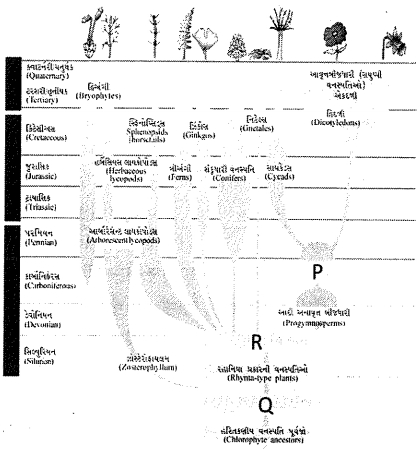
A
$P$ - Seed ferns
$Q$ - Psilophyton
$R$ - Tracheophyte ancestors
$Q$ - Psilophyton
$R$ - Tracheophyte ancestors
B
$P$ - Seed ferns
$Q$ - Tracheophyte ancestors
$R$ - Psilophyton
$Q$ - Tracheophyte ancestors
$R$ - Psilophyton
C
$P$ - Psilophyton
$Q$ - Tracheophyte ancestors
$R$ - Seed ferns
$Q$ - Tracheophyte ancestors
$R$ - Seed ferns
D
$P$ - Tracheophyte ancestors
$Q$ - Psilophyton
$R$ - Seed ferns
$Q$ - Psilophyton
$R$ - Seed ferns
Solution
(A) Based on the evolutionary tree of plants provided in the $NCERT$ textbook (Chapter: Evolution,Section: $A$ Brief Account of Evolution):
$1$. The label $P$ corresponds to 'Seed ferns' (Pteridosperms),which are an extinct group of seed-bearing plants.
$2$. The label $Q$ corresponds to 'Psilophyton',which are considered early vascular plants.
$3$. The label $R$ corresponds to 'Tracheophyte ancestors' (vascular plant ancestors),which evolved from the Rhynia-type plants.
Therefore,the correct sequence is $P$ - Seed ferns,$Q$ - Psilophyton,$R$ - Tracheophyte ancestors.
$1$. The label $P$ corresponds to 'Seed ferns' (Pteridosperms),which are an extinct group of seed-bearing plants.
$2$. The label $Q$ corresponds to 'Psilophyton',which are considered early vascular plants.
$3$. The label $R$ corresponds to 'Tracheophyte ancestors' (vascular plant ancestors),which evolved from the Rhynia-type plants.
Therefore,the correct sequence is $P$ - Seed ferns,$Q$ - Psilophyton,$R$ - Tracheophyte ancestors.
0 likes
View Solution117
EasyMCQ
Identify the correct chronological order of the geological eras from the earliest to the most recent.
A
$Paleozoic \rightarrow Mesozoic \rightarrow Cenozoic$
B
$Cenozoic \rightarrow Mesozoic \rightarrow Paleozoic$
C
$Mesozoic \rightarrow Paleozoic \rightarrow Cenozoic$
D
$Mesozoic \rightarrow Cenozoic \rightarrow Paleozoic$
Solution
(A) The geological time scale is divided into eras based on major evolutionary events and fossil records.
$1$. The $Paleozoic$ era is the oldest among the three,characterized by the diversification of marine life and the colonization of land by plants and animals.
$2$. The $Mesozoic$ era followed the $Paleozoic$ and is often called the 'Age of Reptiles' or 'Age of Dinosaurs'.
$3$. The $Cenozoic$ era is the most recent era,often called the 'Age of Mammals',which continues to the present day.
Therefore,the correct chronological sequence is $Paleozoic \rightarrow Mesozoic \rightarrow Cenozoic$.
$1$. The $Paleozoic$ era is the oldest among the three,characterized by the diversification of marine life and the colonization of land by plants and animals.
$2$. The $Mesozoic$ era followed the $Paleozoic$ and is often called the 'Age of Reptiles' or 'Age of Dinosaurs'.
$3$. The $Cenozoic$ era is the most recent era,often called the 'Age of Mammals',which continues to the present day.
Therefore,the correct chronological sequence is $Paleozoic \rightarrow Mesozoic \rightarrow Cenozoic$.
0 likes
View Solution118
MediumMCQ
Fish with stout and strong fins could move on land and go back to water. This occurred about ....... million years ago.
A
$500$
B
$350$
C
$320$
D
$300$
Solution
(B) According to the evolutionary history of life on Earth,the first amphibians evolved from lobe-finned fish.
These fish had stout and strong fins,which allowed them to move on land and return to water.
This significant evolutionary event occurred approximately $350$ million years ago.
Therefore,the correct option is $B$.
These fish had stout and strong fins,which allowed them to move on land and return to water.
This significant evolutionary event occurred approximately $350$ million years ago.
Therefore,the correct option is $B$.
0 likes
View Solution119
MediumMCQ
The first amphibians that could live on both land and water evolved from:
A
Frogs
B
Salamanders
C
Reptiles
D
Lobefins
Solution
(D) According to the evolutionary history of vertebrates,lobefins (lobe-finned fishes) are considered the ancestors of the first amphibians.
These fish,such as Coelacanths,had fins with fleshy bases that allowed them to move on land for short periods.
Over time,these structures evolved into limbs,enabling the transition from an aquatic to a semi-terrestrial lifestyle,leading to the emergence of the first amphibians.
These fish,such as Coelacanths,had fins with fleshy bases that allowed them to move on land for short periods.
Over time,these structures evolved into limbs,enabling the transition from an aquatic to a semi-terrestrial lifestyle,leading to the emergence of the first amphibians.
0 likes
View Solution120
MediumMCQ
The following chart represents the evolutionary history of vertebrates through geological periods. What are the organisms $P$ and $Q$?
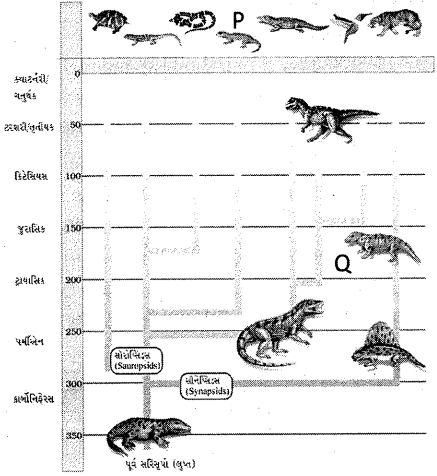
A
Tuatara,Therapsids
B
Tuatara,Thecodonts
C
Mammals,Pelycosaurs
D
Mammals,Dinosaurs
Solution
(A) Based on the standard evolutionary chart of vertebrates provided in the $NCERT$ textbook:
$1$. The organism labeled $P$ represents the Tuatara,which is a living fossil belonging to the lineage of reptiles.
$2$. The organism labeled $Q$ represents the Therapsids,which are the ancestors of mammals that evolved from synapsids during the Triassic period.
Therefore,$P$ is Tuatara and $Q$ is Therapsids.
$1$. The organism labeled $P$ represents the Tuatara,which is a living fossil belonging to the lineage of reptiles.
$2$. The organism labeled $Q$ represents the Therapsids,which are the ancestors of mammals that evolved from synapsids during the Triassic period.
Therefore,$P$ is Tuatara and $Q$ is Therapsids.
0 likes
View Solution121
MediumMCQ
Which land reptiles were present $200$ million years ago?
A
Turtles
B
Tortoises
C
Dinosaurs
D
Snakes
Solution
(C) According to the evolutionary history of life on Earth,the period around $200$ million years ago is associated with the dominance of giant reptiles known as dinosaurs.
These land reptiles thrived during the Mesozoic Era.
Therefore,the correct answer is $C$ (Dinosaurs).
These land reptiles thrived during the Mesozoic Era.
Therefore,the correct answer is $C$ (Dinosaurs).
0 likes
View Solution122
EasyMCQ
Dinosaurs suddenly disappeared from the Earth $...........$ million years ago.
A
$200$
B
$20$
C
$65$
D
$100$
Solution
(C) Dinosaurs were the dominant terrestrial vertebrates for over $160$ million years. They suddenly became extinct approximately $65$ million years ago,marking the end of the Cretaceous period. This event is widely attributed to a massive asteroid impact and subsequent climate change.
0 likes
View Solution123
MediumMCQ
Which of the following is considered the ancestor of the pteridophytes?
A
Sphenopsids
B
Gnetales
C
Psilophyton
D
Zosterophyllum
Solution
(C) According to the evolutionary history of plants,$Psilophyton$ is considered the common ancestor of the pteridophytes.
$Psilophyton$ belongs to the group $Psilophytopsida$,which are the earliest known vascular plants.
These plants evolved from bryophytes and eventually gave rise to various groups of pteridophytes,including ferns and horsetails.
$Psilophyton$ belongs to the group $Psilophytopsida$,which are the earliest known vascular plants.
These plants evolved from bryophytes and eventually gave rise to various groups of pteridophytes,including ferns and horsetails.
0 likes
View Solution124
MediumMCQ
Match List $I$ with List $II$:
Choose the correct answer from the options given below:
| List $I$ | List $II$ |
| $A$. Mesozoic Era | $I$. Lower invertebrates |
| $B$. Proterozoic Era | $II$. Fish and Amphibia |
| $C$. Cenozoic Era | $III$. Birds and Reptiles |
| $D$. Paleozoic Era | $IV$. Mammals |
Choose the correct answer from the options given below:
A
$A-III, B-I, C-II, D-IV$
B
$A-I, B-II, C-IV, D-III$
C
$A-III, B-I, C-IV, D-II$
D
$A-II, B-I, C-III, D-IV$
Solution
(C) The correct answer is option $C$.
$A$. Mesozoic Era is known as the age of reptiles and birds, corresponding to $III$.
$B$. Proterozoic Era is associated with the early life forms, including lower invertebrates, corresponding to $I$.
$C$. Cenozoic Era is known as the age of mammals, corresponding to $IV$.
$D$. Paleozoic Era is characterized by the dominance of fish and the emergence of amphibians, corresponding to $II$.
Therefore, the correct matching is $A-III, B-I, C-IV, D-II$.
$A$. Mesozoic Era is known as the age of reptiles and birds, corresponding to $III$.
$B$. Proterozoic Era is associated with the early life forms, including lower invertebrates, corresponding to $I$.
$C$. Cenozoic Era is known as the age of mammals, corresponding to $IV$.
$D$. Paleozoic Era is characterized by the dominance of fish and the emergence of amphibians, corresponding to $II$.
Therefore, the correct matching is $A-III, B-I, C-IV, D-II$.
0 likes
View Solution125
EasyMCQ
The biggest dinosaur had about $20$ feet height and huge, fearsome dagger-like teeth. The name of it is
A
Ichthyosaurus
B
Triceratops
C
Tyrannosaurus
D
Stegosaurus
Solution
(C) The $Tyrannosaurus rex$ was one of the largest known carnivorous dinosaurs. It reached a height of about $20$ feet and possessed massive, dagger-like teeth designed for tearing flesh. It lived during the Cretaceous period and is iconic for its size and predatory nature.
0 likes
View Solution126
EasyMCQ
Match the following geological eras in Column $A$ with their respective time periods in Column $B$ and key evolutionary events in Column $C$. Which of the following is the correct match?
| Column $A$ | Column $B$ and $C$ |
|---|---|
| $i$. Cenozoic | $2-65 \ \text{mya}$,Origin of vertebrates |
| $ii$. Palaeozoic | $500-165 \ \text{mya}$,Rise of egg-laying mammals |
| $iii$. Mesozoic | $135-225 \ \text{mya}$,Reptiles dominant |
| $iv$. Proterozoic | $350-500 \ \text{mya}$,Trilobites dominant |
A
$i$
B
$ii$
C
$iii$
D
$iv$
Solution
(C) To determine the correct match, we analyze the geological time scale and evolutionary history:
$1$. $i$. Cenozoic $(2-65 \ \text{mya})$: This era is known for the rise of mammals and modern life, not the origin of vertebrates.
$2$. $ii$. Palaeozoic $(500-165 \ \text{mya})$: This era includes the Cambrian to Permian periods, characterized by the dominance of invertebrates and the origin of early vertebrates.
$3$. $iii$. Mesozoic $(135-225 \ \text{mya})$: This is the 'Age of Reptiles'. During the Triassic, Jurassic, and Cretaceous periods, reptiles were the dominant land animals.
$4$. $iv$. Proterozoic $(350-500 \ \text{mya})$: This era precedes the Palaeozoic and is characterized by early life forms, not trilobites (which are Palaeozoic).
Comparing the options, the match $iii$. Mesozoic $(135-225 \ \text{mya}$, Reptiles dominant) is the most accurate representation of geological history provided in the table.
$1$. $i$. Cenozoic $(2-65 \ \text{mya})$: This era is known for the rise of mammals and modern life, not the origin of vertebrates.
$2$. $ii$. Palaeozoic $(500-165 \ \text{mya})$: This era includes the Cambrian to Permian periods, characterized by the dominance of invertebrates and the origin of early vertebrates.
$3$. $iii$. Mesozoic $(135-225 \ \text{mya})$: This is the 'Age of Reptiles'. During the Triassic, Jurassic, and Cretaceous periods, reptiles were the dominant land animals.
$4$. $iv$. Proterozoic $(350-500 \ \text{mya})$: This era precedes the Palaeozoic and is characterized by early life forms, not trilobites (which are Palaeozoic).
Comparing the options, the match $iii$. Mesozoic $(135-225 \ \text{mya}$, Reptiles dominant) is the most accurate representation of geological history provided in the table.
0 likes
View Solution127
EasyMCQ
The reptiles,like dinosaurs,were dominant in the . . . . . . period.
A
Cretaceous
B
Jurassic
C
Tertiary
D
Triassic
Solution
(B) The Mesozoic Era is often called the 'Age of Reptiles'.
Within this era,the Jurassic period is particularly famous for the dominance of dinosaurs.
During the Jurassic period,giant reptiles (dinosaurs) were the most successful and dominant land animals on Earth.
Within this era,the Jurassic period is particularly famous for the dominance of dinosaurs.
During the Jurassic period,giant reptiles (dinosaurs) were the most successful and dominant land animals on Earth.
0 likes
View Solution128
EasyMCQ
Which type of animals first evolved from lobefins?
A
Aves
B
Reptiles
C
Amphibians
D
Mammals
Solution
(C) Lobefins were fish with stout and strong fins that could move on land and go back to water.
In $1938$,a fish caught in South Africa happened to be a Coelacanth,which was thought to be extinct.
These animals,called lobefins,evolved into the first amphibians that lived on both land and water.
Therefore,the correct answer is $C$ (Amphibians).
In $1938$,a fish caught in South Africa happened to be a Coelacanth,which was thought to be extinct.
These animals,called lobefins,evolved into the first amphibians that lived on both land and water.
Therefore,the correct answer is $C$ (Amphibians).
0 likes
View Solution129
EasyMCQ
Identify the plants that are dominant during the Jurassic period.
A
Angiosperms and Bryophytes
B
Sphenopsida and Ginkgo's
C
Ferns,Conifers and Cycads
D
Monocotyledons and Arborescent lycopods
Solution
(C) The correct answer is $C$.
During the Jurassic period,the Earth's flora was dominated by gymnosperms,specifically conifers,cycads,and ferns.
These groups were highly successful and widespread,forming the primary vegetation before the later rise of angiosperms.
During the Jurassic period,the Earth's flora was dominated by gymnosperms,specifically conifers,cycads,and ferns.
These groups were highly successful and widespread,forming the primary vegetation before the later rise of angiosperms.
0 likes
View Solution130
MediumMCQ
Match List-$I$ with List-$II$ with respect to the chronology of the evolution of life forms:
Choose the correct answer from the options given below:
| List-$I$ | List-$II$ |
|---|---|
| $A$. About $65 \text{ mya}$ | $I$. Jawless fish probably evolved |
| $B$. About $500 \text{ mya}$ | $II$. The dinosaurs suddenly disappeared from the earth |
| $C$. About $350 \text{ mya}$ | $III$. Seaweeds and few plants probably existed |
| $D$. About $320 \text{ mya}$ | $IV$. Invertebrates were formed and became active |
A
$A-III, B-IV, C-I, D-II$
B
$A-II, B-IV, C-III, D-I$
C
$A-II, B-I, C-III, D-IV$
D
$A-I, B-II, C-III, D-IV$
Solution
(C) The chronological order of the evolution of life forms is as follows:
$A$. About $65 \text{ mya}$: The dinosaurs suddenly disappeared from the earth $(II)$.
$B$. About $500 \text{ mya}$: Jawless fish probably evolved $(I)$.
$C$. About $350 \text{ mya}$: Seaweeds and few plants probably existed $(III)$.
$D$. About $320 \text{ mya}$: Invertebrates were formed and became active $(IV)$.
Therefore,the correct match is $A-II, B-I, C-III, D-IV$.
$A$. About $65 \text{ mya}$: The dinosaurs suddenly disappeared from the earth $(II)$.
$B$. About $500 \text{ mya}$: Jawless fish probably evolved $(I)$.
$C$. About $350 \text{ mya}$: Seaweeds and few plants probably existed $(III)$.
$D$. About $320 \text{ mya}$: Invertebrates were formed and became active $(IV)$.
Therefore,the correct match is $A-II, B-I, C-III, D-IV$.
0 likes
View SolutionEvolution — A Brief Account of Evolution · Frequently Asked Questions
1Are these Evolution questions useful for JEE and NEET?
Yes. All questions in this section are mapped to JEE Main and NEET exam patterns. Previous year questions from JEE Main, NEET, GUJCET and state-level exams are included with full solutions.
2Can I switch to Hindi or Gujarati for these questions?
Yes. Use the language tabs in the hero section or the sidebar to view the same questions and solutions in English, Hindi or Gujarati.
3How do I generate a question paper from this subtopic?
Use the Vedclass Exam Paper Generator — select the chapter and subtopic, set difficulty, and generate Sets A, B, C, D automatically. First 3 chapters of every subject are free.
Vedclass Products
For Students
Vedclass Test Series
Mock tests in real JEE/NEET style with performance analysis. 5-day free trial.
Start Free TrialFor Teachers
Exam Paper Generator
Generate Set A/B/C/D papers from this chapter in 2 minutes. 3 chapters free.
Try FreeFor Institutes
Online Exam Module
Live online exams with unlimited students, 360° analytics & white-label branding.
See DemoFor Teachers & Institutes
Generate a Evolution Exam Paper in 2 Minutes
Select subtopic & difficulty — Sets A, B, C, D auto-generated with No Repeat logic.
First 3 chapters of every subject are free — no payment required.