
A English
Pollution Questions in English
Class 12 Biology · Environmental Issues · Pollution
550+
Questions
English
Language
100%
With Solutions
Showing 50 of 550 questions in English
501
Medium
Define/Explain: Non-point sources of pollution.
Solution
(N/A) Non-point sources of pollution are those that do not originate from a single,identifiable location. Instead,they discharge their effluents over a large,diffuse area. Examples include city storm water runoff,agricultural runoff containing fertilizers and pesticides,and sediment from construction sites.
0 likes
View Solution502
Medium
Define/Explain: Smog.
Solution
(N/A) Smog is a type of intense air pollution that reduces visibility.
It is a combination of smoke and fog.
It is formed by the interaction of smoke,dust particles,water vapour,and various gases such as $SO_2$,$NO_2$,and $H_2S$ in the atmosphere.
There are two main types: Classical smog (reducing) and Photochemical smog (oxidizing).
It is a combination of smoke and fog.
It is formed by the interaction of smoke,dust particles,water vapour,and various gases such as $SO_2$,$NO_2$,and $H_2S$ in the atmosphere.
There are two main types: Classical smog (reducing) and Photochemical smog (oxidizing).
0 likes
View Solution503
EasyMCQ
What is the full form of $CNG$?
A
Compressed Natural Gas
B
Carbon Natural Gas
C
Compressed Nitrogen Gas
D
Central Natural Gas
Solution
(A) The full form of $CNG$ is $Compressed \ Natural \ Gas$. It is a cleaner fuel compared to petrol and diesel,as it burns more efficiently and produces fewer pollutants.
0 likes
View Solution504
EasyMCQ
What significant event occurred on $1$ April $2010$ in the context of environmental regulations in India?
A
Implementation of Euro-$II$ norms
B
Implementation of Euro-$III$ norms
C
Implementation of Euro-$IV$ norms
D
Implementation of Bharat Stage-$VI$ norms
Solution
(C) On $1$ April $2010$,the Euro-$IV$ emission norms were implemented in $11$ major cities of India to control vehicular air pollution. These norms were part of the government's strategy to reduce the levels of pollutants like carbon monoxide,nitrogen oxides,and particulate matter in the atmosphere.
0 likes
View Solution505
MediumMCQ
Given below are two statements:
Statement $I:$ In a scrubber,the exhaust from the thermal plant is passed through a spray of water or lime to remove gases like $SO_2$.
Statement $II:$ Particulate matter $(PM\,2.5)$ cannot be removed by a scrubber but can be removed by an electrostatic precipitator.
In the light of the above statements,choose the most appropriate answer from the options given below:
Statement $I:$ In a scrubber,the exhaust from the thermal plant is passed through a spray of water or lime to remove gases like $SO_2$.
Statement $II:$ Particulate matter $(PM\,2.5)$ cannot be removed by a scrubber but can be removed by an electrostatic precipitator.
In the light of the above statements,choose the most appropriate answer from the options given below:
A
Both Statement $I$ and Statement $II$ are incorrect.
B
Statement $I$ is correct but Statement $II$ is incorrect.
C
Statement $I$ is incorrect but Statement $II$ is correct.
D
Both Statement $I$ and Statement $II$ are correct.
Solution
(C) Statement $I$ is incorrect because a scrubber is used to remove gases like $SO_2$ from industrial exhaust by passing it through a spray of water or lime. The process of passing exhaust through electric wires to charge dust particles is the working principle of an electrostatic precipitator,not a scrubber.
Statement $II$ is correct because scrubbers are primarily designed to remove gaseous pollutants. Particulate matter,especially fine particles like $PM\,2.5$,are too small to be efficiently removed by scrubbers and are best removed by electrostatic precipitators,which use high-voltage electrodes to charge and collect these particles.
Statement $II$ is correct because scrubbers are primarily designed to remove gaseous pollutants. Particulate matter,especially fine particles like $PM\,2.5$,are too small to be efficiently removed by scrubbers and are best removed by electrostatic precipitators,which use high-voltage electrodes to charge and collect these particles.
0 likes
View Solution506
EasyMCQ
Which of the following is a source of nitrogen oxides $(NO_x)$?
A
Industrial combustion,vehicle exhaust
B
Forest fires
C
Power generation plants
D
All of the above
Solution
(D) Nitrogen oxides $(NO_x)$ are primarily produced by the combustion of fossil fuels at high temperatures.
Major sources include:
$1$. Industrial combustion processes.
$2$. Exhaust emissions from motor vehicles.
$3$. Forest fires,which release nitrogen stored in biomass.
$4$. Power generation plants that burn coal,oil,or natural gas.
Therefore,all the listed options are significant sources of nitrogen oxides.
Major sources include:
$1$. Industrial combustion processes.
$2$. Exhaust emissions from motor vehicles.
$3$. Forest fires,which release nitrogen stored in biomass.
$4$. Power generation plants that burn coal,oil,or natural gas.
Therefore,all the listed options are significant sources of nitrogen oxides.
0 likes
View Solution507
MediumMCQ
Arrange the following in ascending order based on their $BOD$ value:
$I -$ Sewage water,$II -$ Distilled water,$III -$ Tap water
$I -$ Sewage water,$II -$ Distilled water,$III -$ Tap water
A
$II < III < I$
B
$II > III > I$
C
$III > I > II$
D
$II > I > III$
Solution
(A) $BOD$ (Biochemical Oxygen Demand) refers to the amount of oxygen that would be consumed if all the organic matter in one liter of water were oxidized by bacteria.
$1$. Sewage water contains a high amount of organic matter,leading to a very high $BOD$.
$2$. Tap water contains some organic matter but significantly less than sewage,resulting in a low $BOD$.
$3$. Distilled water is purified and contains almost no organic matter,resulting in a $BOD$ value near zero.
Therefore,the ascending order of $BOD$ is: $II$ (Distilled water) $< III$ (Tap water) $< I$ (Sewage water).
$1$. Sewage water contains a high amount of organic matter,leading to a very high $BOD$.
$2$. Tap water contains some organic matter but significantly less than sewage,resulting in a low $BOD$.
$3$. Distilled water is purified and contains almost no organic matter,resulting in a $BOD$ value near zero.
Therefore,the ascending order of $BOD$ is: $II$ (Distilled water) $< III$ (Tap water) $< I$ (Sewage water).
0 likes
View Solution508
MediumMCQ
As the pollution of organic matter in water increases,what happens to the $BOD$ value?
A
The $BOD$ value increases.
B
The $BOD$ value decreases.
C
The $BOD$ value remains constant.
D
None of the above.
Solution
(A) Biochemical Oxygen Demand $(BOD)$ refers to the amount of oxygen that would be consumed if all the organic matter in one liter of water were oxidized by bacteria.
When the amount of organic matter in water increases,the number of microorganisms (bacteria) that decompose this organic matter also increases.
These microorganisms consume more dissolved oxygen from the water to break down the organic waste.
Therefore,a higher concentration of organic pollutants leads to a higher $BOD$ value,indicating greater water pollution.
When the amount of organic matter in water increases,the number of microorganisms (bacteria) that decompose this organic matter also increases.
These microorganisms consume more dissolved oxygen from the water to break down the organic waste.
Therefore,a higher concentration of organic pollutants leads to a higher $BOD$ value,indicating greater water pollution.
0 likes
View Solution509
EasyMCQ
Pollution brings about undesirable changes in the $..........$ characteristics of air,land,or water.
A
Physical
B
Chemical
C
Biological
D
All of the above
Solution
(D) Pollution is defined as any undesirable change in the physical,chemical,or biological characteristics of air,land,water,or soil.
These changes are harmful to human beings,other living organisms,industrial processes,living conditions,and cultural assets.
Therefore,pollution affects all three aspects: physical,chemical,and biological properties of the environment.
These changes are harmful to human beings,other living organisms,industrial processes,living conditions,and cultural assets.
Therefore,pollution affects all three aspects: physical,chemical,and biological properties of the environment.
0 likes
View Solution510
EasyMCQ
Components that bring about undesirable changes in air,water,and land are called:
A
Allergens
B
Carcinogens
C
Pollutants
D
Mutagens
Solution
(C) Pollutants are substances or energy forms that,when introduced into the environment (air,water,or land),cause undesirable changes in the physical,chemical,or biological characteristics of the environment. These changes can be harmful to human health,other living organisms,and the ecosystem as a whole. Therefore,the correct answer is $C$ (Pollutants).
0 likes
View Solution511
EasyMCQ
$...............$ is any undesirable change in the physical,chemical,or biological characteristics of air,land,water,or soil.
A
Biomagnification
B
Pollution
C
Eutrophication
D
Population explosion
Solution
(B) Pollution is defined as any undesirable change in the physical,chemical,or biological characteristics of air,land,water,or soil that can harmfully affect human life,industrial progress,living conditions,and cultural assets. Agents that bring about such an undesirable change are called pollutants.
0 likes
View Solution512
EasyMCQ
Thermal power plants,smelters,metal refineries,and other industries release $................$ pollutants.
A
Particulate pollutants
B
Gaseous pollutants
C
Toxic gases
D
All of the above
Solution
(D) Thermal power plants,smelters,and metal refineries are major sources of industrial air pollution.
These industries release both particulate matter (such as dust,fly ash,and soot) and various gaseous pollutants (such as $SO_2$,$NO_x$,and $CO$) into the atmosphere.
Many of these gaseous pollutants are also toxic in nature.
Therefore,these industries are responsible for releasing particulate pollutants,gaseous pollutants,and toxic gases into the environment.
Thus,the correct option is $D$.
These industries release both particulate matter (such as dust,fly ash,and soot) and various gaseous pollutants (such as $SO_2$,$NO_x$,and $CO$) into the atmosphere.
Many of these gaseous pollutants are also toxic in nature.
Therefore,these industries are responsible for releasing particulate pollutants,gaseous pollutants,and toxic gases into the environment.
Thus,the correct option is $D$.
0 likes
View Solution513
EasyMCQ
An electrostatic precipitator is used in thermal power plants to remove $...........$ from the exhaust gases.
A
$99 \% SO_2$
B
$99.9 \% SO_2$
C
$99.9 \%$ particulate matter
D
$99 \%$ particulate matter
Solution
(D) An electrostatic precipitator $(ESP)$ is a highly efficient device used in thermal power plants to control air pollution.
It works on the principle of corona discharge,where electrodes generate a corona that releases electrons.
These electrons attach to dust particles,giving them a negative charge.
The charged dust particles are then attracted to collecting plates that are grounded or positively charged.
This process is capable of removing over $99 \%$ of the particulate matter present in the exhaust gases of thermal power plants.
It works on the principle of corona discharge,where electrodes generate a corona that releases electrons.
These electrons attach to dust particles,giving them a negative charge.
The charged dust particles are then attracted to collecting plates that are grounded or positively charged.
This process is capable of removing over $99 \%$ of the particulate matter present in the exhaust gases of thermal power plants.
0 likes
View Solution514
MediumMCQ
Select the correct statement regarding the electrode wires in an electrostatic precipitator.
A
They generate a corona that releases electrons.
B
Electrons attach to dust particles.
C
They give a negative charge to dust particles.
D
All of the above.
Solution
(D) In an electrostatic precipitator,the electrode wires are maintained at several thousand volts,which produces a corona that releases electrons. These free electrons attach to the dust particles present in the air,thereby giving them a negative charge. Therefore,all the given statements are correct.
0 likes
View Solution515
EasyMCQ
According to the Central Pollution Control Board $(CPCB)$,particulate matter of what size is responsible for causing the greatest harm to human health?
A
$2.5$ micrometers
B
$2.5$ micrometers or less
C
$25$ micrometers
D
$25$ micrometers or more
Solution
(B) According to the Central Pollution Control Board $(CPCB)$,particulate matter of size $2.5$ micrometers or less in diameter (commonly referred to as $PM_{2.5}$) is responsible for causing the greatest harm to human health. These fine particles can be inhaled deep into the lungs and can cause breathing and respiratory symptoms,irritation,inflammations,and damage to the lungs and premature deaths.
0 likes
View Solution516
EasyMCQ
Catalytic converters,which have expensive metals as catalysts,are fitted into automobiles for reducing emission of poisonous gases. Which of the following is $NOT$ used in them?
A
Selenium
B
Platinum
C
Palladium
D
Rhodium
Solution
(A) Catalytic converters are used in automobiles to reduce the emission of poisonous gases like carbon monoxide and nitrogen oxides.
These converters contain expensive metals acting as catalysts,specifically $Platinum$,$Palladium$,and $Rhodium$.
As the exhaust passes through the catalytic converter,unburnt hydrocarbons are converted into carbon dioxide and water,carbon monoxide is converted into carbon dioxide,and nitric oxide is converted into nitrogen gas.
$Selenium$ is not used as a catalyst in these converters.
Therefore,the correct option is $A$.
These converters contain expensive metals acting as catalysts,specifically $Platinum$,$Palladium$,and $Rhodium$.
As the exhaust passes through the catalytic converter,unburnt hydrocarbons are converted into carbon dioxide and water,carbon monoxide is converted into carbon dioxide,and nitric oxide is converted into nitrogen gas.
$Selenium$ is not used as a catalyst in these converters.
Therefore,the correct option is $A$.
0 likes
View Solution517
MediumMCQ
Choose the correct option for catalytic converters.
A
Convert unburnt hydrocarbons into carbon dioxide and water.
B
Convert carbon monoxide into carbon dioxide.
C
Convert nitric oxide into nitrogen gas.
D
All of the above.
Solution
(D) Catalytic converters are fitted into automobiles for reducing emission of poisonous gases.
They have expensive metals like platinum-palladium and rhodium as catalysts.
As the exhaust passes through the catalytic converter,the following changes occur:
$1$. Unburnt hydrocarbons are converted into $CO_2$ and $H_2O$.
$2$. Carbon monoxide $(CO)$ is converted into carbon dioxide $(CO_2)$.
$3$. Nitric oxide $(NO)$ is converted into nitrogen gas $(N_2)$.
Therefore,all the given statements are correct.
They have expensive metals like platinum-palladium and rhodium as catalysts.
As the exhaust passes through the catalytic converter,the following changes occur:
$1$. Unburnt hydrocarbons are converted into $CO_2$ and $H_2O$.
$2$. Carbon monoxide $(CO)$ is converted into carbon dioxide $(CO_2)$.
$3$. Nitric oxide $(NO)$ is converted into nitrogen gas $(N_2)$.
Therefore,all the given statements are correct.
0 likes
View Solution518
EasyMCQ
$.........$ is an undesirable,high-intensity sound.
A
Music
B
Song
C
Noise
D
Explosion
Solution
(C) Noise is defined as an undesirable,high-intensity sound that causes discomfort or irritation to the ears. In the context of environmental pollution,noise is considered a pollutant that can lead to various health issues,including hearing loss,stress,and sleep disturbance.
0 likes
View Solution519
EasyMCQ
Exposure to a noise level of $............$ or more for a short period can damage the eardrums,leading to permanent hearing impairment. (in $,dB$)
A
$80$
B
$100$
C
$120$
D
$150$
Solution
(D) According to the $NCERT$ textbook on Environmental Issues,noise is an undesired high level of sound.
Exposure to a noise level of $150\,dB$ or more generated by take-off of a jet plane or rocket can damage eardrums or can permanently impair human hearing ability.
Exposure to a noise level of $150\,dB$ or more generated by take-off of a jet plane or rocket can damage eardrums or can permanently impair human hearing ability.
0 likes
View Solution520
MediumMCQ
Which of the following is $NOT$ an effect of noise pollution on humans?
A
Anxiety and insomnia
B
Decrease in heart rate
C
Changes in breathing patterns
D
Psychological and physiological disorders
Solution
(B) Noise pollution is an undesirable high level of sound. It has several adverse effects on human health.
$1$. It can cause psychological and physiological disorders,such as anxiety,stress,and insomnia.
$2$. It leads to changes in breathing patterns.
$3$. It causes an increase in heart rate,not a decrease.
Therefore,the statement 'Decrease in heart rate' is incorrect regarding the effects of noise pollution.
$1$. It can cause psychological and physiological disorders,such as anxiety,stress,and insomnia.
$2$. It leads to changes in breathing patterns.
$3$. It causes an increase in heart rate,not a decrease.
Therefore,the statement 'Decrease in heart rate' is incorrect regarding the effects of noise pollution.
0 likes
View Solution521
MediumMCQ
Which measures can be taken to control noise pollution?
$I-$ Use of sound-absorbent materials or mufflers in industries.
$II-$ Creating horn-free zones around hospitals and schools.
$III-$ Setting permissible sound levels for firecrackers and loud speakers.
$IV-$ Restricting the use of loudspeakers after a certain time.
$I-$ Use of sound-absorbent materials or mufflers in industries.
$II-$ Creating horn-free zones around hospitals and schools.
$III-$ Setting permissible sound levels for firecrackers and loud speakers.
$IV-$ Restricting the use of loudspeakers after a certain time.
A
$I, II, III, IV$
B
$I, II, IV$
C
$II, III, IV$
D
$I, II, III$
Solution
(A) Noise pollution is an undesirable high level of sound that causes discomfort and health issues. To control it,the following measures are effective:
$I-$ Industries should use sound-absorbent materials or mufflers to reduce noise emission.
$II-$ Creating horn-free zones around sensitive areas like hospitals and schools reduces unnecessary noise.
$III-$ Setting permissible sound levels for firecrackers and loudspeakers helps regulate noise intensity.
$IV-$ Restricting the use of loudspeakers after a certain time (e.g.,at night) prevents disturbance to the public.
Therefore,all the given statements $(I, II, III, IV)$ are correct measures to control noise pollution.
$I-$ Industries should use sound-absorbent materials or mufflers to reduce noise emission.
$II-$ Creating horn-free zones around sensitive areas like hospitals and schools reduces unnecessary noise.
$III-$ Setting permissible sound levels for firecrackers and loudspeakers helps regulate noise intensity.
$IV-$ Restricting the use of loudspeakers after a certain time (e.g.,at night) prevents disturbance to the public.
Therefore,all the given statements $(I, II, III, IV)$ are correct measures to control noise pollution.
0 likes
View Solution522
MediumMCQ
Which steps were taken in Delhi to reduce pollution from vehicles?
$I-$ Phasing out of old vehicles
$II -$ Use of leaded petrol
$III -$ Use of low-sulphur petrol and diesel
$IV -$ Use of catalytic converters in vehicles
$V -$ Application of stringent pollution level norms for vehicles
$I-$ Phasing out of old vehicles
$II -$ Use of leaded petrol
$III -$ Use of low-sulphur petrol and diesel
$IV -$ Use of catalytic converters in vehicles
$V -$ Application of stringent pollution level norms for vehicles
A
$I, II, III, IV, V$
B
$I, III, IV, V$
C
$II, III, IV, V$
D
$III, IV, V$
Solution
(B) To control vehicular air pollution in Delhi,several measures were implemented:
$1$. Phasing out of old vehicles $(I)$ helps reduce emissions from outdated engines.
$2$. Use of low-sulphur petrol and diesel $(III)$ reduces the emission of sulphur dioxide.
$3$. Use of catalytic converters $(IV)$ in vehicles helps convert toxic gases like carbon monoxide and nitrogen oxides into less harmful substances.
$4$. Application of stringent pollution level norms $(V)$ (e.g.,Bharat Stage norms) ensures that vehicles meet specific emission standards.
$5$. The use of leaded petrol $(II)$ is incorrect because leaded petrol is a major source of air pollution and was banned to reduce toxicity. Therefore,the correct steps are $I, III, IV,$ and $V$.
$1$. Phasing out of old vehicles $(I)$ helps reduce emissions from outdated engines.
$2$. Use of low-sulphur petrol and diesel $(III)$ reduces the emission of sulphur dioxide.
$3$. Use of catalytic converters $(IV)$ in vehicles helps convert toxic gases like carbon monoxide and nitrogen oxides into less harmful substances.
$4$. Application of stringent pollution level norms $(V)$ (e.g.,Bharat Stage norms) ensures that vehicles meet specific emission standards.
$5$. The use of leaded petrol $(II)$ is incorrect because leaded petrol is a major source of air pollution and was banned to reduce toxicity. Therefore,the correct steps are $I, III, IV,$ and $V$.
0 likes
View Solution523
MediumMCQ
According to the Euro-$II$ norms,which of the following is correct?
A
Sulfur should be controlled at $150 \, ppm$ in diesel.
B
Sulfur should be controlled at $350 \, ppm$ in petrol.
C
Aromatic hydrocarbons should be contained at $42 \%$ of the concerned fuel.
D
All of the above.
Solution
(D) According to the Euro-$II$ norms:
$1$. Sulfur is to be controlled at $350 \, ppm$ in diesel and $150 \, ppm$ in petrol.
$2$. The level of aromatic hydrocarbons is to be contained at $42 \%$ of the concerned fuel.
Since the options provided in the question are slightly mixed regarding the specific values for diesel and petrol,but collectively represent the regulatory requirements defined under Euro-$II$ standards,option $D$ is the most appropriate choice as it encompasses the regulatory framework.
$1$. Sulfur is to be controlled at $350 \, ppm$ in diesel and $150 \, ppm$ in petrol.
$2$. The level of aromatic hydrocarbons is to be contained at $42 \%$ of the concerned fuel.
Since the options provided in the question are slightly mixed regarding the specific values for diesel and petrol,but collectively represent the regulatory requirements defined under Euro-$II$ standards,option $D$ is the most appropriate choice as it encompasses the regulatory framework.
0 likes
View Solution524
EasyMCQ
According to the $..........$ norms,the implementation of $.......$ vehicles was enforced across the country from $1^{st}$ April $2017$.
A
Bharat Stage $IV$,four-wheelers
B
Bharat Stage $IV$,three-wheelers
C
Bharat Stage $IV$,two-wheelers
D
All of the above
Solution
(D) The Government of India implemented the $Bharat$ $Stage$ $IV$ $(BS-IV)$ emission norms for all categories of vehicles,including two-wheelers,three-wheelers,and four-wheelers,across the entire country effective from $1^{st}$ April $2017$. These norms were introduced to control air pollution caused by vehicular emissions.
0 likes
View Solution525
MediumMCQ
The figure below shows the effect of sewage discharge on some important characteristics of a river. What are $P$ and $Q$?
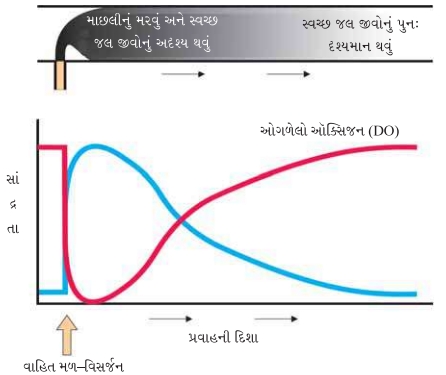
A
Dissolved Oxygen,$BOD$
B
$BOD$,Dissolved Oxygen
C
Insoluble Oxygen,$BOD$
D
$BOD$,Insoluble Oxygen
Solution
(B) When sewage is discharged into a river,the organic matter content increases,which leads to an increase in the Biological Oxygen Demand $(BOD)$ as microorganisms consume oxygen to decompose the organic matter.
As $BOD$ increases,the Dissolved Oxygen $(DO)$ levels in the water decrease significantly,causing the death of fish and other aquatic organisms.
In the provided graph,the curve that starts high and drops sharply at the point of sewage discharge represents Dissolved Oxygen $(DO)$,while the curve that starts low and rises sharply represents $BOD$.
Therefore,$P$ corresponds to $BOD$ and $Q$ corresponds to Dissolved Oxygen.
As $BOD$ increases,the Dissolved Oxygen $(DO)$ levels in the water decrease significantly,causing the death of fish and other aquatic organisms.
In the provided graph,the curve that starts high and drops sharply at the point of sewage discharge represents Dissolved Oxygen $(DO)$,while the curve that starts low and rises sharply represents $BOD$.
Therefore,$P$ corresponds to $BOD$ and $Q$ corresponds to Dissolved Oxygen.
0 likes
View Solution526
EasyMCQ
What is the $BOD$ level of potable water?
A
Low
B
High
C
Moderate
D
Can be anything
Solution
(A) Biochemical Oxygen Demand $(BOD)$ is a measure of the amount of dissolved oxygen required by aerobic microorganisms to decompose the organic matter present in a given volume of water.
Potable water (drinking water) should have very low levels of organic pollutants.
Therefore,the $BOD$ value of potable water must be low,typically less than $1 \ mg/L$.
Potable water (drinking water) should have very low levels of organic pollutants.
Therefore,the $BOD$ value of potable water must be low,typically less than $1 \ mg/L$.
0 likes
View Solution527
MediumMCQ
Select the correct option regarding algal bloom.
$I-$ Excessive growth of planktonic algae occurs due to the presence of high amounts of nutrients in water bodies.
$II-$ Algal bloom imparts a distinct color to the water bodies.
$III-$ Algal bloom causes deterioration of water quality and fish mortality.
$IV-$ All bloom-forming algae are highly toxic to humans and animals.
$I-$ Excessive growth of planktonic algae occurs due to the presence of high amounts of nutrients in water bodies.
$II-$ Algal bloom imparts a distinct color to the water bodies.
$III-$ Algal bloom causes deterioration of water quality and fish mortality.
$IV-$ All bloom-forming algae are highly toxic to humans and animals.
A
$I, II, III, IV$
B
$II, III$
C
$II, III, IV$
D
$II, IV$
Solution
(B) Algal bloom is the excessive growth of planktonic (free-floating) algae in water bodies caused by the presence of high amounts of nutrients,especially nitrogen and phosphorus,which leads to eutrophication.
Statement $I$ is incorrect because it mentions 'planktonic fungi' instead of 'planktonic algae'.
Statement $II$ is correct as algal blooms impart a distinct color to the water bodies.
Statement $III$ is correct because the excessive growth of algae leads to the depletion of dissolved oxygen,causing the death of fish and other aquatic organisms.
Statement $IV$ is incorrect because not all bloom-forming algae are toxic to humans and animals; only certain species produce toxins.
Therefore,statements $II$ and $III$ are correct.
Statement $I$ is incorrect because it mentions 'planktonic fungi' instead of 'planktonic algae'.
Statement $II$ is correct as algal blooms impart a distinct color to the water bodies.
Statement $III$ is correct because the excessive growth of algae leads to the depletion of dissolved oxygen,causing the death of fish and other aquatic organisms.
Statement $IV$ is incorrect because not all bloom-forming algae are toxic to humans and animals; only certain species produce toxins.
Therefore,statements $II$ and $III$ are correct.
0 likes
View Solution528
EasyMCQ
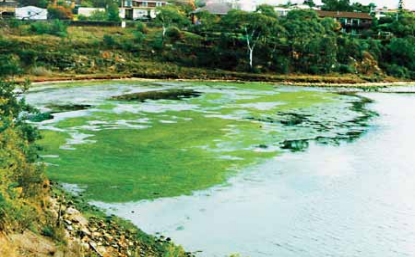
What does the given image represent?
A
Algal bloom
B
Biomagnification
C
Secondary treatment of water
D
Primary treatment of water
Solution
(A) The image shows a dense growth of algae covering the surface of a water body,which is a classic example of an algal bloom.
Algal blooms occur due to the excessive growth of planktonic (free-floating) algae,often caused by the enrichment of water bodies with nutrients like nitrogen and phosphorus (eutrophication).
This phenomenon leads to the deterioration of water quality and can cause fish mortality and depletion of dissolved oxygen.
Algal blooms occur due to the excessive growth of planktonic (free-floating) algae,often caused by the enrichment of water bodies with nutrients like nitrogen and phosphorus (eutrophication).
This phenomenon leads to the deterioration of water quality and can cause fish mortality and depletion of dissolved oxygen.
0 likes
View Solution529
EasyMCQ
What is the density of heavy metals?
A
$> 5\,g/mm^3$
B
$< 5\,g/mm^3$
C
$> 5\,g/cm^3$
D
$< 5\,g/cm^3$
Solution
(C) Heavy metals are defined as metallic chemical elements that have a relatively high density and are toxic or poisonous at low concentrations.
By scientific convention,heavy metals are generally defined as metals with a density greater than $5\,g/cm^3$.
Examples include mercury,lead,cadmium,and arsenic,which are significant environmental pollutants.
By scientific convention,heavy metals are generally defined as metals with a density greater than $5\,g/cm^3$.
Examples include mercury,lead,cadmium,and arsenic,which are significant environmental pollutants.
0 likes
View Solution530
MediumMCQ
Some toxic substances present in industrial waste water can undergo $.........$ in the aquatic food chain.
A
Biomagnification
B
Eutrophication
C
Accelerated eutrophication
D
Algal bloom
Solution
(A) Biomagnification refers to the increase in concentration of toxic substances at successive trophic levels in a food chain.
This occurs because a toxic substance accumulated by an organism cannot be metabolized or excreted,and is thus passed on to the next higher trophic level.
In aquatic ecosystems,this is commonly observed with substances like mercury and $DDT$,which accumulate in the tissues of organisms and reach high concentrations in top predators.
This occurs because a toxic substance accumulated by an organism cannot be metabolized or excreted,and is thus passed on to the next higher trophic level.
In aquatic ecosystems,this is commonly observed with substances like mercury and $DDT$,which accumulate in the tissues of organisms and reach high concentrations in top predators.
0 likes
View Solution531
MediumMCQ
The population of birds and reptiles is declining due to $.......$.
A
Biological pesticides
B
Bio-fertilizers
C
Both $A$ and $B$
D
$DDT$
Solution
(D) The decline in the population of birds and reptiles is primarily caused by the accumulation of $DDT$ (Dichlorodiphenyltrichloroethane) in the environment. $DDT$ is a persistent organic pollutant that undergoes biomagnification,meaning its concentration increases as it moves up the food chain. High levels of $DDT$ in birds interfere with calcium metabolism,leading to the thinning of eggshells,which causes them to break prematurely during incubation,resulting in a decline in their population.
0 likes
View Solution532
MediumMCQ
High $BOD$ indicates $........$.
A
Low microbial activity
B
Low sewage content
C
Low water pollution
D
Very high water pollution
Solution
(D) $BOD$ stands for Biochemical Oxygen Demand.
It is a measure of the amount of dissolved oxygen required by aerobic microorganisms to decompose the organic matter present in a given volume of water.
When water is highly polluted with organic waste,microorganisms consume more oxygen to break down this waste.
Therefore,a high $BOD$ value indicates that the water contains a large amount of organic pollutants,signifying very high water pollution.
It is a measure of the amount of dissolved oxygen required by aerobic microorganisms to decompose the organic matter present in a given volume of water.
When water is highly polluted with organic waste,microorganisms consume more oxygen to break down this waste.
Therefore,a high $BOD$ value indicates that the water contains a large amount of organic pollutants,signifying very high water pollution.
0 likes
View Solution533
MediumMCQ
What are the effects of high concentrations of $DDT$ on birds?
A
It disturbs calcium metabolism in birds.
B
It causes thinning of eggshells.
C
It leads to premature breaking of eggshells.
D
All of the above.
Solution
(D) High concentrations of $DDT$ (Dichlorodiphenyltrichloroethane) in birds interfere with calcium metabolism.
This disruption leads to the thinning of eggshells.
As a result,the eggshells become fragile and break prematurely before the embryo can fully develop,which significantly reduces the bird population.
This disruption leads to the thinning of eggshells.
As a result,the eggshells become fragile and break prematurely before the embryo can fully develop,which significantly reduces the bird population.
0 likes
View Solution534
MediumMCQ
Select the incorrect option regarding biological magnification (biomagnification).
A
Increase in the concentration of toxic substances at successive trophic levels.
B
Toxic substances accumulate in organisms because they cannot be metabolized or excreted.
C
Toxic substances cannot be transferred to higher trophic levels.
D
$DDT$ and mercury are well-known examples of biomagnification.
Solution
(C) Biological magnification (biomagnification) refers to the increase in concentration of non-biodegradable toxic substances at successive trophic levels.
This occurs because a toxic substance accumulated by an organism cannot be metabolized or excreted,and is thus passed on to the next higher trophic level.
Therefore,the concentration of the toxicant increases as we move up the food chain.
Option $C$ is incorrect because toxic substances are indeed transferred to higher trophic levels,which is the core mechanism of biomagnification.
This occurs because a toxic substance accumulated by an organism cannot be metabolized or excreted,and is thus passed on to the next higher trophic level.
Therefore,the concentration of the toxicant increases as we move up the food chain.
Option $C$ is incorrect because toxic substances are indeed transferred to higher trophic levels,which is the core mechanism of biomagnification.
0 likes
View Solution535
EasyMCQ
The natural aging of a lake by nutrient enrichment of its water is known as $..........$
A
Eutrophication
B
Biomagnification
C
Bioremediation
D
Bioaccumulation
Solution
(A) The natural aging of a lake by nutrient enrichment of its water is known as $Eutrophication$.
As a lake ages,it becomes warmer and shallower,and nutrient-rich sediments accumulate at the bottom.
This process encourages the growth of aquatic organisms like algae,which further increases the nutrient content,eventually leading to the filling of the lake basin with organic matter.
As a lake ages,it becomes warmer and shallower,and nutrient-rich sediments accumulate at the bottom.
This process encourages the growth of aquatic organisms like algae,which further increases the nutrient content,eventually leading to the filling of the lake basin with organic matter.
0 likes
View Solution536
MediumMCQ
Why does fish mortality occur due to eutrophication?
A
Unavailability of food
B
Unavailability of light
C
Unavailability of oxygen
D
Unavailability of essential minerals
Solution
(C) Eutrophication is the process of nutrient enrichment in water bodies,which leads to excessive growth of algae (algal bloom).
As these algae die,their decomposition by microorganisms consumes a large amount of dissolved oxygen in the water.
This leads to a significant decrease in the level of dissolved oxygen (Biological Oxygen Demand increases),causing the death of aquatic organisms like fish due to hypoxia (lack of oxygen).
As these algae die,their decomposition by microorganisms consumes a large amount of dissolved oxygen in the water.
This leads to a significant decrease in the level of dissolved oxygen (Biological Oxygen Demand increases),causing the death of aquatic organisms like fish due to hypoxia (lack of oxygen).
0 likes
View Solution537
MediumMCQ
Which of the following statements are correct regarding Eutrophication?
$I-$ Streams entering into a lake introduce nutrients like nitrogen and phosphorus,which encourage the growth of aquatic organisms.
$II-$ As the lake's fertility increases,plant and animal life flourish.
$III-$ Organic remains begin to deposit at the bottom of the lake.
$IV-$ Organic waste materials continue to accumulate in the lake.
$V -$ The lake becomes shallower and warmer.
$VI -$ Cold-water organisms are replaced by warm-water organisms.
$VII -$ Marsh plants take root in the shallows and begin to fill in the original lake basin.
$I-$ Streams entering into a lake introduce nutrients like nitrogen and phosphorus,which encourage the growth of aquatic organisms.
$II-$ As the lake's fertility increases,plant and animal life flourish.
$III-$ Organic remains begin to deposit at the bottom of the lake.
$IV-$ Organic waste materials continue to accumulate in the lake.
$V -$ The lake becomes shallower and warmer.
$VI -$ Cold-water organisms are replaced by warm-water organisms.
$VII -$ Marsh plants take root in the shallows and begin to fill in the original lake basin.
A
$I, II, III, IV, V, VI, VII$
B
$I, II, III, IV, V$
C
$I, II, III, IV, VII$
D
$III, VI, VII$
Solution
(A) Eutrophication is the natural aging of a lake by nutrient enrichment of its water.
$I-$ Streams entering the lake bring nutrients like nitrogen and phosphorus,which stimulate the growth of algae and other aquatic organisms.
$II-$ Increased nutrients lead to increased fertility,causing plant and animal life to flourish.
$III-$ As these organisms die,their organic remains deposit at the bottom of the lake.
$IV-$ Over time,organic waste materials accumulate at the bottom.
$V -$ As the lake fills with silt and organic debris,it becomes shallower and warmer.
$VI -$ Warm-water organisms thrive in the warmer,shallower water,replacing cold-water organisms.
$VII -$ Marsh plants take root in the shallows and begin to fill in the original lake basin,eventually converting the lake into land.
Therefore,all statements $I$ to $VII$ correctly describe the process of eutrophication.
$I-$ Streams entering the lake bring nutrients like nitrogen and phosphorus,which stimulate the growth of algae and other aquatic organisms.
$II-$ Increased nutrients lead to increased fertility,causing plant and animal life to flourish.
$III-$ As these organisms die,their organic remains deposit at the bottom of the lake.
$IV-$ Over time,organic waste materials accumulate at the bottom.
$V -$ As the lake fills with silt and organic debris,it becomes shallower and warmer.
$VI -$ Warm-water organisms thrive in the warmer,shallower water,replacing cold-water organisms.
$VII -$ Marsh plants take root in the shallows and begin to fill in the original lake basin,eventually converting the lake into land.
Therefore,all statements $I$ to $VII$ correctly describe the process of eutrophication.
0 likes
View Solution538
EasyMCQ
Ahmed Khan's company developed a fine powder of recycled modified plastic called $..........$.
A
Landfills
B
Polyblend
C
Electronic waste
D
Bitumen
Solution
(B) Ahmed Khan,a plastic sack manufacturer in Bangalore,developed a fine powder of recycled modified plastic called $Polyblend$.
This $Polyblend$ is mixed with bitumen to lay roads.
This mixture enhances the water-repellent properties of bitumen and helps in road life extension,as well as solving the problem of plastic waste disposal.
This $Polyblend$ is mixed with bitumen to lay roads.
This mixture enhances the water-repellent properties of bitumen and helps in road life extension,as well as solving the problem of plastic waste disposal.
0 likes
View Solution539
MediumMCQ
In agriculture,improper drainage of water leads to:
$I-$ The soil becomes waterlogged.
$II -$ The soil surface draws up salts from the water.
$III -$ Salts are deposited as a thin crust on the land surface.
$IV -$ Salts start accumulating around the roots of the plants.
$V -$ The increasing concentration of salts becomes favorable for crop growth.
$VI -$ It is highly beneficial for agriculture.
Which of the above statements are correct?
$I-$ The soil becomes waterlogged.
$II -$ The soil surface draws up salts from the water.
$III -$ Salts are deposited as a thin crust on the land surface.
$IV -$ Salts start accumulating around the roots of the plants.
$V -$ The increasing concentration of salts becomes favorable for crop growth.
$VI -$ It is highly beneficial for agriculture.
Which of the above statements are correct?
A
$I, II, III, IV, V, VI$
B
$I, III, IV, V$
C
$I, II, IV, V$
D
$I, II, III, IV$
Solution
(D) Improper drainage of water in agricultural fields leads to waterlogging $(I)$.
Waterlogging causes the water table to rise,which brings dissolved salts to the surface of the soil $(II)$.
As the water evaporates,these salts are left behind,forming a thin crust on the land surface $(III)$.
This accumulation of salts around the roots of plants $(IV)$ increases the salinity of the soil,which is harmful to crop growth,not favorable.
Therefore,statements $I, II, III,$ and $IV$ are correct,while $V$ and $VI$ are incorrect.
Waterlogging causes the water table to rise,which brings dissolved salts to the surface of the soil $(II)$.
As the water evaporates,these salts are left behind,forming a thin crust on the land surface $(III)$.
This accumulation of salts around the roots of plants $(IV)$ increases the salinity of the soil,which is harmful to crop growth,not favorable.
Therefore,statements $I, II, III,$ and $IV$ are correct,while $V$ and $VI$ are incorrect.
0 likes
View Solution540
EasyMCQ
Which of the following led to problems like waterlogging and soil salinity?
A
Overgrazing
B
Green Revolution
C
Urbanization
D
All of the above
Solution
(B) Waterlogging and soil salinity are major environmental problems associated with intensive agricultural practices.
During the Green Revolution,the use of excessive irrigation without proper drainage systems led to waterlogging in the soil.
Waterlogging draws salt to the surface of the soil,which is deposited as a thin crust on the land surface or starts collecting at the roots of the plants,leading to soil salinity.
Thus,the Green Revolution is the primary cause among the given options for these specific issues.
During the Green Revolution,the use of excessive irrigation without proper drainage systems led to waterlogging in the soil.
Waterlogging draws salt to the surface of the soil,which is deposited as a thin crust on the land surface or starts collecting at the roots of the plants,leading to soil salinity.
Thus,the Green Revolution is the primary cause among the given options for these specific issues.
0 likes
View Solution541
MediumMCQ
Why is $CNG$ considered a better fuel than diesel?
$(a)$ It cannot be adulterated.
$(b)$ It takes less time to fill the fuel tank.
$(c)$ It burns more efficiently.
$(d)$ It is cheaper.
$(e)$ It is less inflammable.
Choose the most appropriate answer from the options given below:
$(a)$ It cannot be adulterated.
$(b)$ It takes less time to fill the fuel tank.
$(c)$ It burns more efficiently.
$(d)$ It is cheaper.
$(e)$ It is less inflammable.
Choose the most appropriate answer from the options given below:
A
$(a), (b), (c), (e)$ only
B
$(a), (c), (d)$ only
C
$(a), (b), (d), (e)$ only
D
$(c), (d), (e)$ only
Solution
(B) $CNG$ (Compressed Natural Gas) is considered a better fuel than diesel for several reasons:
$1$. It cannot be adulterated like petrol or diesel,ensuring purity.
$2$. It burns more efficiently,leaving very little unburnt residue.
$3$. It is cheaper than diesel.
Therefore,statements $(a)$,$(c)$,and $(d)$ are correct.
Statement $(b)$ is incorrect because filling $CNG$ often takes more time due to pressure requirements.
Statement $(e)$ is incorrect because $CNG$ is highly inflammable,though it is safer due to its lighter-than-air nature which allows it to disperse quickly in case of a leak.
$1$. It cannot be adulterated like petrol or diesel,ensuring purity.
$2$. It burns more efficiently,leaving very little unburnt residue.
$3$. It is cheaper than diesel.
Therefore,statements $(a)$,$(c)$,and $(d)$ are correct.
Statement $(b)$ is incorrect because filling $CNG$ often takes more time due to pressure requirements.
Statement $(e)$ is incorrect because $CNG$ is highly inflammable,though it is safer due to its lighter-than-air nature which allows it to disperse quickly in case of a leak.
0 likes
View Solution542
MediumMCQ
Given below are two statements:
Statement $I$: Electrostatic precipitator is most widely used in thermal power plants.
Statement $II$: Electrostatic precipitator in thermal power plants removes ionising radiations.
In the light of the above statements,choose the most appropriate answer from the options given below:
Statement $I$: Electrostatic precipitator is most widely used in thermal power plants.
Statement $II$: Electrostatic precipitator in thermal power plants removes ionising radiations.
In the light of the above statements,choose the most appropriate answer from the options given below:
A
Statement $I$ is incorrect but Statement $II$ is correct.
B
Both Statement $I$ and Statement $II$ are correct.
C
Both Statement $I$ and Statement $II$ are incorrect.
D
Statement $I$ is correct but Statement $II$ is incorrect.
Solution
(D) Statement $I$ is correct because an electrostatic precipitator is the most widely used device to remove particulate matter from the exhaust of thermal power plants.
Statement $II$ is incorrect because electrostatic precipitators are designed to remove particulate matter (dust,smoke,etc.),not ionising radiations. Ionising radiations are typically managed through shielding and containment,not by electrostatic precipitation.
Statement $II$ is incorrect because electrostatic precipitators are designed to remove particulate matter (dust,smoke,etc.),not ionising radiations. Ionising radiations are typically managed through shielding and containment,not by electrostatic precipitation.
0 likes
View Solution543
EasyMCQ
Identify the $INCORRECT$ statement about Biological Oxygen Demand $(BOD)$.
A
It is the amount of dissolved oxygen required by microorganisms for decomposing organic matter.
B
It is expressed in milligram of oxygen per litre of water.
C
More the level of microbial pollution,higher the $BOD$.
D
Higher the $BOD$,higher the level of oxygen in the water.
Solution
(D) Biochemical Oxygen Demand $(BOD)$ is the amount of dissolved oxygen required by microorganisms for decomposing the organic matter present in water.
It is expressed in milligram of oxygen per litre $(mg/L)$ of water.
High $BOD$ indicates an intense level of microbial pollution,as microorganisms consume more oxygen to break down organic waste.
Therefore,a higher $BOD$ value implies lower levels of dissolved oxygen in the water,making statement $D$ incorrect.
It is expressed in milligram of oxygen per litre $(mg/L)$ of water.
High $BOD$ indicates an intense level of microbial pollution,as microorganisms consume more oxygen to break down organic waste.
Therefore,a higher $BOD$ value implies lower levels of dissolved oxygen in the water,making statement $D$ incorrect.
0 likes
View Solution544
EasyMCQ
What is the significance of using unleaded petrol in motor vehicles with catalytic converter?
A
Lead in petrol activates catalyst in catalytic converter.
B
Lead in petrol inactivates the catalyst in catalytic converter.
C
Unleaded petrol is cheaper than lead-containing petrol.
D
Unleaded petrol is more combustible than leaded petrol.
Solution
(B) Catalytic converters are used in motor vehicles to reduce the emission of poisonous gases like carbon monoxide $(CO)$ and nitrogen oxides $(NO_x)$.
These converters contain expensive metals like platinum,palladium,and rhodium as catalysts.
Lead present in petrol acts as a poison to these catalysts,which inactivates or damages them,thereby preventing them from converting toxic gases into less harmful substances.
Therefore,it is essential to use unleaded petrol in vehicles equipped with catalytic converters to ensure the catalyst remains active and functional.
These converters contain expensive metals like platinum,palladium,and rhodium as catalysts.
Lead present in petrol acts as a poison to these catalysts,which inactivates or damages them,thereby preventing them from converting toxic gases into less harmful substances.
Therefore,it is essential to use unleaded petrol in vehicles equipped with catalytic converters to ensure the catalyst remains active and functional.
0 likes
View Solution545
EasyMCQ
Exposure to extremely high sound level, . . . . . . ,generated during a take off of a jet plane or rocket,may damage ear drums and cause permanent hearing loss.
A
$150$ decibels or more
B
$30$ to $50$ decibels
C
$50$ to $70$ decibels
D
$70$ to $90$ decibels
Solution
(A) The sound level generated during the take-off of a jet plane or rocket is extremely high,typically reaching $150 \ dB$ or more.
Exposure to such high-intensity sound levels can cause physical damage to the ear drums and lead to permanent hearing loss.
According to environmental standards,sound levels above $80 \ dB$ are considered harmful to human hearing over prolonged periods,and levels at $150 \ dB$ are immediately damaging.
Exposure to such high-intensity sound levels can cause physical damage to the ear drums and lead to permanent hearing loss.
According to environmental standards,sound levels above $80 \ dB$ are considered harmful to human hearing over prolonged periods,and levels at $150 \ dB$ are immediately damaging.
0 likes
View Solution546
EasyMCQ
All of the following are the ill effects of particulate pollutants on human health $EXCEPT$ . . . . . .
A
irritation and inflammation of lungs
B
breathing and respiratory disorder
C
pneumonia
D
damage to the lung
Solution
(C) Particulate pollutants,especially those with a diameter of $2.5 \ \mu m$ or less $(PM_{2.5})$,are responsible for causing serious health hazards.
These particles can be inhaled deep into the lungs and cause irritation,inflammation,and damage to the lungs.
They are also known to cause breathing and respiratory symptoms,irritation,and premature deaths.
Pneumonia is an infection caused by bacteria,viruses,or fungi,not directly by the inhalation of particulate pollutants.
Therefore,pneumonia is the correct answer as it is not a direct ill effect of particulate pollutants.
These particles can be inhaled deep into the lungs and cause irritation,inflammation,and damage to the lungs.
They are also known to cause breathing and respiratory symptoms,irritation,and premature deaths.
Pneumonia is an infection caused by bacteria,viruses,or fungi,not directly by the inhalation of particulate pollutants.
Therefore,pneumonia is the correct answer as it is not a direct ill effect of particulate pollutants.
0 likes
View Solution547
EasyMCQ
The deposition of pesticides in fatty tissue of the organisms is called . . . . . .
A
biomagnification
B
bioaccumulation
C
bioconcentration
D
biodegradation
Solution
(B) Bioaccumulation refers to the process by which chemicals,such as pesticides,accumulate in the fatty tissues of an organism over time.
This occurs when the rate of intake of a substance exceeds the rate at which the organism can eliminate it.
Biomagnification,on the other hand,refers to the increase in concentration of a substance as it moves up the food chain.
Therefore,the deposition of pesticides in the fatty tissues of an individual organism is known as bioaccumulation.
This occurs when the rate of intake of a substance exceeds the rate at which the organism can eliminate it.
Biomagnification,on the other hand,refers to the increase in concentration of a substance as it moves up the food chain.
Therefore,the deposition of pesticides in the fatty tissues of an individual organism is known as bioaccumulation.
0 likes
View Solution548
EasyMCQ
Which one of the following represents natural pollutants?
A
dusts,pollen and carbon monoxide
B
pollen,dusts from desert and hydrocarbons from vegetation
C
smog,fog and dust
D
pollen fibres and sulphur dioxide
Solution
(B) Natural pollutants are substances released into the environment by natural processes rather than human activities.
$1$. Pollen grains are natural allergens released by plants.
$2$. Dusts from deserts (wind-blown dust) are natural particulate matter.
$3$. Hydrocarbons released from vegetation (e.g.,terpenes) are natural volatile organic compounds.
Carbon monoxide,smog,and sulphur dioxide are primarily associated with anthropogenic (human-made) activities like industrial emissions and vehicular exhaust.
Therefore,option $B$ correctly lists natural pollutants.
$1$. Pollen grains are natural allergens released by plants.
$2$. Dusts from deserts (wind-blown dust) are natural particulate matter.
$3$. Hydrocarbons released from vegetation (e.g.,terpenes) are natural volatile organic compounds.
Carbon monoxide,smog,and sulphur dioxide are primarily associated with anthropogenic (human-made) activities like industrial emissions and vehicular exhaust.
Therefore,option $B$ correctly lists natural pollutants.
0 likes
View Solution549
EasyMCQ
Which of the following is an odd pollutant?
A
$SO_2$
B
$CO_2$
C
$CO$
D
Acid rain
Solution
(D) The correct answer is $D$ (Acid rain).
$SO_2$,$CO_2$,and $CO$ are all primary air pollutants or gases that contribute to pollution.
Acid rain is not a pollutant itself; rather,it is a secondary effect or a phenomenon caused by the reaction of pollutants like $SO_2$ and $NO_x$ with water vapor in the atmosphere.
Therefore,Acid rain is the odd one out as it is an environmental impact,not a direct pollutant.
$SO_2$,$CO_2$,and $CO$ are all primary air pollutants or gases that contribute to pollution.
Acid rain is not a pollutant itself; rather,it is a secondary effect or a phenomenon caused by the reaction of pollutants like $SO_2$ and $NO_x$ with water vapor in the atmosphere.
Therefore,Acid rain is the odd one out as it is an environmental impact,not a direct pollutant.
0 likes
View Solution550
EasyMCQ
As the organic matter increases in a water body,the $BOD$
A
increases
B
decreases
C
remains unchanged
D
not a parameter
Solution
(A) $BOD$ stands for Biochemical Oxygen Demand.
It is the amount of oxygen required by aerobic microorganisms to decompose the organic matter present in $1 \text{ litre}$ of water.
As the amount of organic matter in a water body increases,the microorganisms require more oxygen to decompose it.
Therefore,the $BOD$ increases,which serves as an indicator of water pollution.
It is the amount of oxygen required by aerobic microorganisms to decompose the organic matter present in $1 \text{ litre}$ of water.
As the amount of organic matter in a water body increases,the microorganisms require more oxygen to decompose it.
Therefore,the $BOD$ increases,which serves as an indicator of water pollution.
0 likes
View SolutionEnvironmental Issues — Pollution · Frequently Asked Questions
1Are these Environmental Issues questions useful for JEE and NEET?
Yes. All questions in this section are mapped to JEE Main and NEET exam patterns. Previous year questions from JEE Main, NEET, GUJCET and state-level exams are included with full solutions.
2Can I switch to Hindi or Gujarati for these questions?
Yes. Use the language tabs in the hero section or the sidebar to view the same questions and solutions in English, Hindi or Gujarati.
3How do I generate a question paper from this subtopic?
Use the Vedclass Exam Paper Generator — select the chapter and subtopic, set difficulty, and generate Sets A, B, C, D automatically. First 3 chapters of every subject are free.
Vedclass Products
For Students
Vedclass Test Series
Mock tests in real JEE/NEET style with performance analysis. 5-day free trial.
Start Free TrialFor Teachers
Exam Paper Generator
Generate Set A/B/C/D papers from this chapter in 2 minutes. 3 chapters free.
Try FreeFor Institutes
Online Exam Module
Live online exams with unlimited students, 360° analytics & white-label branding.
See DemoFor Teachers & Institutes
Generate a Environmental Issues Exam Paper in 2 Minutes
Select subtopic & difficulty — Sets A, B, C, D auto-generated with No Repeat logic.
First 3 chapters of every subject are free — no payment required.