
A English
Trigonometrical ratios of sum and difference of two and three angles Questions in English
Class 11 Mathematics · Trigonometrical Ratios, Functions and Identities · Trigonometrical ratios of sum and difference of two and three angles
170+
Questions
English
Language
100%
With Solutions
Showing 17 of 170 questions in English
151
MediumMCQ
$\frac{\sinh(x+y) + \sinh(x-y)}{\cosh(x+y) - \cosh(x-y)} = $
A
$\tanh y$
B
$\coth y$
C
$\tanh x \coth y$
D
$\tanh y \coth x$
Solution
(B) We use the sum and difference formulas for hyperbolic functions:
$\sinh(x+y) = \sinh x \cosh y + \cosh x \sinh y$
$\sinh(x-y) = \sinh x \cosh y - \cosh x \sinh y$
$\cosh(x+y) = \cosh x \cosh y + \sinh x \sinh y$
$\cosh(x-y) = \cosh x \cosh y - \sinh x \sinh y$
Substituting these into the numerator:
$\sinh(x+y) + \sinh(x-y) = (\sinh x \cosh y + \cosh x \sinh y) + (\sinh x \cosh y - \cosh x \sinh y) = 2 \sinh x \cosh y$
Substituting these into the denominator:
$\cosh(x+y) - \cosh(x-y) = (\cosh x \cosh y + \sinh x \sinh y) - (\cosh x \cosh y - \sinh x \sinh y) = 2 \sinh x \sinh y$
Now,divide the numerator by the denominator:
$\frac{2 \sinh x \cosh y}{2 \sinh x \sinh y} = \frac{\cosh y}{\sinh y} = \coth y$
Therefore,the correct option is $B$.
$\sinh(x+y) = \sinh x \cosh y + \cosh x \sinh y$
$\sinh(x-y) = \sinh x \cosh y - \cosh x \sinh y$
$\cosh(x+y) = \cosh x \cosh y + \sinh x \sinh y$
$\cosh(x-y) = \cosh x \cosh y - \sinh x \sinh y$
Substituting these into the numerator:
$\sinh(x+y) + \sinh(x-y) = (\sinh x \cosh y + \cosh x \sinh y) + (\sinh x \cosh y - \cosh x \sinh y) = 2 \sinh x \cosh y$
Substituting these into the denominator:
$\cosh(x+y) - \cosh(x-y) = (\cosh x \cosh y + \sinh x \sinh y) - (\cosh x \cosh y - \sinh x \sinh y) = 2 \sinh x \sinh y$
Now,divide the numerator by the denominator:
$\frac{2 \sinh x \cosh y}{2 \sinh x \sinh y} = \frac{\cosh y}{\sinh y} = \coth y$
Therefore,the correct option is $B$.
0 likes
View Solution152
MediumMCQ
If $\sin (A+B) \sin (A-B)+\cos (A+B) \cos (A-B)=\frac{1}{2}$ and $0 < B < \frac{\pi}{2}$,then $B=$
A
$\frac{\pi}{6}$
B
$\frac{\pi}{4}$
C
$\frac{\pi}{3}$
D
$\frac{5 \pi}{12}$
Solution
(A) Given the equation: $\sin (A+B) \sin (A-B)+\cos (A+B) \cos (A-B)=\frac{1}{2}$
Using the trigonometric identity $\cos (x-y) = \cos x \cos y + \sin x \sin y$,where $x = A+B$ and $y = A-B$:
$\cos ((A+B) - (A-B)) = \frac{1}{2}$
$\cos (A+B-A+B) = \frac{1}{2}$
$\cos (2B) = \frac{1}{2}$
Since $\cos \frac{\pi}{3} = \frac{1}{2}$,we have $2B = \frac{\pi}{3}$
Therefore,$B = \frac{\pi}{6}$
Thus,option $A$ is correct.
Using the trigonometric identity $\cos (x-y) = \cos x \cos y + \sin x \sin y$,where $x = A+B$ and $y = A-B$:
$\cos ((A+B) - (A-B)) = \frac{1}{2}$
$\cos (A+B-A+B) = \frac{1}{2}$
$\cos (2B) = \frac{1}{2}$
Since $\cos \frac{\pi}{3} = \frac{1}{2}$,we have $2B = \frac{\pi}{3}$
Therefore,$B = \frac{\pi}{6}$
Thus,option $A$ is correct.
0 likes
View Solution153
DifficultMCQ
If $m \cos (\alpha+\beta)-n \cos (\alpha-\beta)=m \cos (\alpha-\beta)+n \cos (\alpha+\beta)$,then $\tan \alpha \tan \beta=$
A
$m+n$
B
$m-n$
C
$-\frac{n}{m}$
D
$\frac{m}{n}$
Solution
(C) Given: $m \cos (\alpha+\beta)-n \cos (\alpha-\beta)=m \cos (\alpha-\beta)+n \cos (\alpha+\beta)$
Rearranging the terms,we get:
$m [\cos (\alpha+\beta) - \cos (\alpha-\beta)] = n [\cos (\alpha+\beta) + \cos (\alpha-\beta)]$
Using the identities $\cos (A+B) - \cos (A-B) = -2 \sin A \sin B$ and $\cos (A+B) + \cos (A-B) = 2 \cos A \cos B$:
$m [-2 \sin \alpha \sin \beta] = n [2 \cos \alpha \cos \beta]$
$-2m \sin \alpha \sin \beta = 2n \cos \alpha \cos \beta$
Dividing both sides by $2m \cos \alpha \cos \beta$ (assuming $\cos \alpha \cos \beta \neq 0$):
$\frac{\sin \alpha \sin \beta}{\cos \alpha \cos \beta} = -\frac{n}{m}$
$\tan \alpha \tan \beta = -\frac{n}{m}$
Rearranging the terms,we get:
$m [\cos (\alpha+\beta) - \cos (\alpha-\beta)] = n [\cos (\alpha+\beta) + \cos (\alpha-\beta)]$
Using the identities $\cos (A+B) - \cos (A-B) = -2 \sin A \sin B$ and $\cos (A+B) + \cos (A-B) = 2 \cos A \cos B$:
$m [-2 \sin \alpha \sin \beta] = n [2 \cos \alpha \cos \beta]$
$-2m \sin \alpha \sin \beta = 2n \cos \alpha \cos \beta$
Dividing both sides by $2m \cos \alpha \cos \beta$ (assuming $\cos \alpha \cos \beta \neq 0$):
$\frac{\sin \alpha \sin \beta}{\cos \alpha \cos \beta} = -\frac{n}{m}$
$\tan \alpha \tan \beta = -\frac{n}{m}$
0 likes
View Solution154
MediumMCQ
If $A$ and $B$ $(A > B)$ are acute angles,$\sin (A-B)=\frac{16}{65}$ and $\sin B=\frac{5}{13}$,then $\tan A+\cot A=$
A
$\frac{714025}{342732}$
B
$\frac{714025}{342733}$
C
$\frac{714025}{342722}$
D
$\frac{714015}{342732}$
Solution
(A) Given: $\sin B = \frac{5}{13}$. Since $B$ is an acute angle,$\cos B = \sqrt{1 - (\frac{5}{13})^2} = \frac{12}{13}$. Thus,$\tan B = \frac{5}{12}$.
Given: $\sin (A-B) = \frac{16}{65}$. Since $A$ and $B$ are acute,$\cos (A-B) = \sqrt{1 - (\frac{16}{65})^2} = \sqrt{\frac{4225-256}{4225}} = \sqrt{\frac{3969}{4225}} = \frac{63}{65}$.
Thus,$\tan (A-B) = \frac{16}{63}$.
Using the formula $\tan (A-B) = \frac{\tan A - \tan B}{1 + \tan A \tan B}$,we have:
$\frac{\tan A - \frac{5}{12}}{1 + \tan A \cdot \frac{5}{12}} = \frac{16}{63}$
$\frac{12 \tan A - 5}{12 + 5 \tan A} = \frac{16}{63}$
$63(12 \tan A - 5) = 16(12 + 5 \tan A)$
$756 \tan A - 315 = 192 + 80 \tan A$
$676 \tan A = 507$
$\tan A = \frac{507}{676} = \frac{3}{4}$.
Then $\cot A = \frac{1}{\tan A} = \frac{4}{3}$.
Finally,$\tan A + \cot A = \frac{3}{4} + \frac{4}{3} = \frac{9+16}{12} = \frac{25}{12}$.
Wait,re-evaluating the calculation: $\tan A = \frac{507}{676} = 0.75 = \frac{3}{4}$. The provided option $\frac{714025}{342732}$ is $\frac{507^2 + 676^2}{507 \times 676} = \frac{257049 + 456976}{342732} = \frac{714025}{342732}$. This matches option $A$.
Given: $\sin (A-B) = \frac{16}{65}$. Since $A$ and $B$ are acute,$\cos (A-B) = \sqrt{1 - (\frac{16}{65})^2} = \sqrt{\frac{4225-256}{4225}} = \sqrt{\frac{3969}{4225}} = \frac{63}{65}$.
Thus,$\tan (A-B) = \frac{16}{63}$.
Using the formula $\tan (A-B) = \frac{\tan A - \tan B}{1 + \tan A \tan B}$,we have:
$\frac{\tan A - \frac{5}{12}}{1 + \tan A \cdot \frac{5}{12}} = \frac{16}{63}$
$\frac{12 \tan A - 5}{12 + 5 \tan A} = \frac{16}{63}$
$63(12 \tan A - 5) = 16(12 + 5 \tan A)$
$756 \tan A - 315 = 192 + 80 \tan A$
$676 \tan A = 507$
$\tan A = \frac{507}{676} = \frac{3}{4}$.
Then $\cot A = \frac{1}{\tan A} = \frac{4}{3}$.
Finally,$\tan A + \cot A = \frac{3}{4} + \frac{4}{3} = \frac{9+16}{12} = \frac{25}{12}$.
Wait,re-evaluating the calculation: $\tan A = \frac{507}{676} = 0.75 = \frac{3}{4}$. The provided option $\frac{714025}{342732}$ is $\frac{507^2 + 676^2}{507 \times 676} = \frac{257049 + 456976}{342732} = \frac{714025}{342732}$. This matches option $A$.
0 likes
View Solution155
MediumMCQ
$\frac{\tan 80^{\circ}-\tan 10^{\circ}}{\tan 70^{\circ}}$ is equal to
A
$0$
B
$1$
C
$2$
D
$3$
Solution
(C) We know that $\tan(A-B) = \frac{\tan A - \tan B}{1 + \tan A \tan B}$.
Therefore,$\tan A - \tan B = \tan(A-B)(1 + \tan A \tan B)$.
Substituting $A = 80^{\circ}$ and $B = 10^{\circ}$:
$\tan 80^{\circ} - \tan 10^{\circ} = \tan(80^{\circ}-10^{\circ})(1 + \tan 80^{\circ} \tan 10^{\circ}) = \tan 70^{\circ}(1 + \tan 80^{\circ} \tan 10^{\circ})$.
Now,$\frac{\tan 80^{\circ}-\tan 10^{\circ}}{\tan 70^{\circ}} = \frac{\tan 70^{\circ}(1 + \tan 80^{\circ} \tan 10^{\circ})}{\tan 70^{\circ}} = 1 + \tan 80^{\circ} \tan 10^{\circ}$.
Since $\tan 80^{\circ} = \cot 10^{\circ}$,we have $1 + \cot 10^{\circ} \tan 10^{\circ} = 1 + 1 = 2$.
Therefore,$\tan A - \tan B = \tan(A-B)(1 + \tan A \tan B)$.
Substituting $A = 80^{\circ}$ and $B = 10^{\circ}$:
$\tan 80^{\circ} - \tan 10^{\circ} = \tan(80^{\circ}-10^{\circ})(1 + \tan 80^{\circ} \tan 10^{\circ}) = \tan 70^{\circ}(1 + \tan 80^{\circ} \tan 10^{\circ})$.
Now,$\frac{\tan 80^{\circ}-\tan 10^{\circ}}{\tan 70^{\circ}} = \frac{\tan 70^{\circ}(1 + \tan 80^{\circ} \tan 10^{\circ})}{\tan 70^{\circ}} = 1 + \tan 80^{\circ} \tan 10^{\circ}$.
Since $\tan 80^{\circ} = \cot 10^{\circ}$,we have $1 + \cot 10^{\circ} \tan 10^{\circ} = 1 + 1 = 2$.
0 likes
View Solution156
DifficultMCQ
If $0 < A < B < \frac{\pi}{4}$,$\cos (A+B) = \frac{11}{61}$ and $\sin (A-B) = \frac{24}{25}$,then $\sin 2A + \sin 2B = $
A
$\frac{684}{1525}$
B
$\frac{156}{1525}$
C
$\frac{168}{305}$
D
$\frac{137}{305}$
Solution
(C) Given $0 < A < B < \frac{\pi}{4}$,$\cos (A+B) = \frac{11}{61}$ and $\sin (A-B) = \frac{24}{25}$.
Since $0 < A+B < \frac{\pi}{2}$,$\sin (A+B) = \sqrt{1 - (\frac{11}{61})^2} = \sqrt{\frac{3721-121}{3721}} = \frac{60}{61}$.
Since $0 < A-B < 0$ is not possible,we note that $A < B$ implies $A-B < 0$. However,the problem states $\sin(A-B) = \frac{24}{25}$,which implies $A-B$ must be in the first or second quadrant. Given the constraints,we treat the values as magnitudes for the identity.
Using $\cos (A-B) = \sqrt{1 - (\frac{24}{25})^2} = \frac{7}{25}$.
We know $\sin 2A = \sin ((A+B) + (A-B)) = \sin (A+B) \cos (A-B) + \cos (A+B) \sin (A-B) = (\frac{60}{61} \times \frac{7}{25}) + (\frac{11}{61} \times \frac{24}{25}) = \frac{420 + 264}{1525} = \frac{684}{1525}$.
We know $\sin 2B = \sin ((A+B) - (A-B)) = \sin (A+B) \cos (A-B) - \cos (A+B) \sin (A-B) = (\frac{60}{61} \times \frac{7}{25}) - (\frac{11}{61} \times \frac{24}{25}) = \frac{420 - 264}{1525} = \frac{156}{1525}$.
Therefore,$\sin 2A + \sin 2B = \frac{684}{1525} + \frac{156}{1525} = \frac{840}{1525} = \frac{168}{305}$.
Since $0 < A+B < \frac{\pi}{2}$,$\sin (A+B) = \sqrt{1 - (\frac{11}{61})^2} = \sqrt{\frac{3721-121}{3721}} = \frac{60}{61}$.
Since $0 < A-B < 0$ is not possible,we note that $A < B$ implies $A-B < 0$. However,the problem states $\sin(A-B) = \frac{24}{25}$,which implies $A-B$ must be in the first or second quadrant. Given the constraints,we treat the values as magnitudes for the identity.
Using $\cos (A-B) = \sqrt{1 - (\frac{24}{25})^2} = \frac{7}{25}$.
We know $\sin 2A = \sin ((A+B) + (A-B)) = \sin (A+B) \cos (A-B) + \cos (A+B) \sin (A-B) = (\frac{60}{61} \times \frac{7}{25}) + (\frac{11}{61} \times \frac{24}{25}) = \frac{420 + 264}{1525} = \frac{684}{1525}$.
We know $\sin 2B = \sin ((A+B) - (A-B)) = \sin (A+B) \cos (A-B) - \cos (A+B) \sin (A-B) = (\frac{60}{61} \times \frac{7}{25}) - (\frac{11}{61} \times \frac{24}{25}) = \frac{420 - 264}{1525} = \frac{156}{1525}$.
Therefore,$\sin 2A + \sin 2B = \frac{684}{1525} + \frac{156}{1525} = \frac{840}{1525} = \frac{168}{305}$.
0 likes
View Solution157
MediumMCQ
If $A=35^{\circ}, B=15^{\circ}$ and $C=40^{\circ}$,then $\tan A \cdot \tan B+\tan B \cdot \tan C+\tan C \cdot \tan A$ is equal to
A
$0$
B
$1$
C
$2$
D
$3$
Solution
(B) Given that,$A=35^{\circ}, B=15^{\circ}$ and $C=40^{\circ}$.
Since $A+B+C = 35^{\circ} + 15^{\circ} + 40^{\circ} = 90^{\circ}$,we have $\tan(A+B+C) = \tan(90^{\circ})$,which is undefined.
The formula for $\tan(A+B+C)$ is given by:
$\tan(A+B+C) = \frac{\tan A + \tan B + \tan C - \tan A \tan B \tan C}{1 - (\tan A \tan B + \tan B \tan C + \tan C \tan A)}$
For this to be undefined,the denominator must be zero:
$1 - (\tan A \tan B + \tan B \tan C + \tan C \tan A) = 0$
Therefore,$\tan A \tan B + \tan B \tan C + \tan C \tan A = 1$.
Since $A+B+C = 35^{\circ} + 15^{\circ} + 40^{\circ} = 90^{\circ}$,we have $\tan(A+B+C) = \tan(90^{\circ})$,which is undefined.
The formula for $\tan(A+B+C)$ is given by:
$\tan(A+B+C) = \frac{\tan A + \tan B + \tan C - \tan A \tan B \tan C}{1 - (\tan A \tan B + \tan B \tan C + \tan C \tan A)}$
For this to be undefined,the denominator must be zero:
$1 - (\tan A \tan B + \tan B \tan C + \tan C \tan A) = 0$
Therefore,$\tan A \tan B + \tan B \tan C + \tan C \tan A = 1$.
0 likes
View Solution158
MediumMCQ
If $\sin A = -\frac{24}{25}$,$\cos B = \frac{15}{17}$,$A$ does not belong to the $4^{\text{th}}$ quadrant,and $B$ does not belong to the $1^{\text{st}}$ quadrant,then $(A+B)$ lies in which quadrant?
A
$1^{\text{st}}$ quadrant
B
$2^{\text{nd}}$ quadrant
C
$3^{\text{rd}}$ quadrant
D
$4^{\text{th}}$ quadrant
Solution
(C) Given $\sin A = -\frac{24}{25}$. Since $A$ is not in the $4^{\text{th}}$ quadrant and $\sin A < 0$,$A$ must be in the $3^{\text{rd}}$ quadrant. Thus,$\cos A = -\sqrt{1 - \sin^2 A} = -\sqrt{1 - (-\frac{24}{25})^2} = -\sqrt{1 - \frac{576}{625}} = -\sqrt{\frac{49}{625}} = -\frac{7}{25}$.
Given $\cos B = \frac{15}{17}$. Since $B$ is not in the $1^{\text{st}}$ quadrant and $\cos B > 0$,$B$ must be in the $4^{\text{th}}$ quadrant. Thus,$\sin B = -\sqrt{1 - \cos^2 B} = -\sqrt{1 - (\frac{15}{17})^2} = -\sqrt{1 - \frac{225}{289}} = -\sqrt{\frac{64}{289}} = -\frac{8}{17}$.
Now,$\sin(A+B) = \sin A \cos B + \cos A \sin B = (-\frac{24}{25})(\frac{15}{17}) + (-\frac{7}{25})(-\frac{8}{17}) = -\frac{360}{425} + \frac{56}{425} = -\frac{304}{425} < 0$.
$\cos(A+B) = \cos A \cos B - \sin A \sin B = (-\frac{7}{25})(\frac{15}{17}) - (-\frac{24}{25})(-\frac{8}{17}) = -\frac{105}{425} - \frac{192}{425} = -\frac{297}{425} < 0$.
Since both $\sin(A+B) < 0$ and $\cos(A+B) < 0$,$(A+B)$ lies in the $3^{\text{rd}}$ quadrant.
Given $\cos B = \frac{15}{17}$. Since $B$ is not in the $1^{\text{st}}$ quadrant and $\cos B > 0$,$B$ must be in the $4^{\text{th}}$ quadrant. Thus,$\sin B = -\sqrt{1 - \cos^2 B} = -\sqrt{1 - (\frac{15}{17})^2} = -\sqrt{1 - \frac{225}{289}} = -\sqrt{\frac{64}{289}} = -\frac{8}{17}$.
Now,$\sin(A+B) = \sin A \cos B + \cos A \sin B = (-\frac{24}{25})(\frac{15}{17}) + (-\frac{7}{25})(-\frac{8}{17}) = -\frac{360}{425} + \frac{56}{425} = -\frac{304}{425} < 0$.
$\cos(A+B) = \cos A \cos B - \sin A \sin B = (-\frac{7}{25})(\frac{15}{17}) - (-\frac{24}{25})(-\frac{8}{17}) = -\frac{105}{425} - \frac{192}{425} = -\frac{297}{425} < 0$.
Since both $\sin(A+B) < 0$ and $\cos(A+B) < 0$,$(A+B)$ lies in the $3^{\text{rd}}$ quadrant.
0 likes
View Solution159
MediumMCQ
$2 \cosh (x+y) \sinh (x-y) + \sinh 2y =$
A
$\sinh 2x$
B
$\frac{\sinh 2x + \sinh 2y}{2}$
C
$\frac{\sinh 2x - \sinh 2y}{2}$
D
$\cosh 2x$
Solution
(A) We use the identity $2 \cosh A \sinh B = \sinh(A+B) + \sinh(A-B)$.
Let $A = x+y$ and $B = x-y$.
Then $A+B = (x+y) + (x-y) = 2x$ and $A-B = (x+y) - (x-y) = 2y$.
Substituting these into the expression:
$2 \cosh (x+y) \sinh (x-y) = \sinh(2x) + \sinh(2y)$.
Now,add $\sinh 2y$ to the expression:
$\sinh 2x + \sinh 2y + \sinh 2y = \sinh 2x + 2 \sinh 2y$.
Wait,re-evaluating the expression $2 \cosh A \sinh B = \sinh(A+B) - \sinh(A-B)$ is incorrect. The correct identity is $2 \cosh A \sinh B = \sinh(A+B) - \sinh(A-B)$.
Let us re-calculate:
$2 \cosh (x+y) \sinh (x-y) = \sinh((x+y) + (x-y)) - \sinh((x+y) - (x-y)) = \sinh 2x - \sinh 2y$.
Adding $\sinh 2y$ to this result:
$(\sinh 2x - \sinh 2y) + \sinh 2y = \sinh 2x$.
Let $A = x+y$ and $B = x-y$.
Then $A+B = (x+y) + (x-y) = 2x$ and $A-B = (x+y) - (x-y) = 2y$.
Substituting these into the expression:
$2 \cosh (x+y) \sinh (x-y) = \sinh(2x) + \sinh(2y)$.
Now,add $\sinh 2y$ to the expression:
$\sinh 2x + \sinh 2y + \sinh 2y = \sinh 2x + 2 \sinh 2y$.
Wait,re-evaluating the expression $2 \cosh A \sinh B = \sinh(A+B) - \sinh(A-B)$ is incorrect. The correct identity is $2 \cosh A \sinh B = \sinh(A+B) - \sinh(A-B)$.
Let us re-calculate:
$2 \cosh (x+y) \sinh (x-y) = \sinh((x+y) + (x-y)) - \sinh((x+y) - (x-y)) = \sinh 2x - \sinh 2y$.
Adding $\sinh 2y$ to this result:
$(\sinh 2x - \sinh 2y) + \sinh 2y = \sinh 2x$.
0 likes
View Solution160
MediumMCQ
$\cos ^2\left(\frac{\pi}{6}+\theta\right)-\sin ^2\left(\frac{\pi}{6}-\theta\right)$ is equal to
A
$\frac{1}{2} \cos 2 \theta$
B
$0$
C
$-\frac{1}{2} \cos 2 \theta$
D
$\frac{1}{2}$
Solution
(A) We use the trigonometric identity $\cos^2 A - \sin^2 B = \cos(A+B) \cos(A-B)$.
Let $A = \frac{\pi}{6} + \theta$ and $B = \frac{\pi}{6} - \theta$.
Then $A+B = \left(\frac{\pi}{6} + \theta\right) + \left(\frac{\pi}{6} - \theta\right) = \frac{2\pi}{6} = \frac{\pi}{3}$.
And $A-B = \left(\frac{\pi}{6} + \theta\right) - \left(\frac{\pi}{6} - \theta\right) = 2\theta$.
Substituting these into the identity:
$\cos^2\left(\frac{\pi}{6}+\theta\right)-\sin^2\left(\frac{\pi}{6}-\theta\right) = \cos\left(\frac{\pi}{3}\right) \cos(2\theta)$.
Since $\cos\left(\frac{\pi}{3}\right) = \frac{1}{2}$,the expression equals $\frac{1}{2} \cos 2\theta$.
Let $A = \frac{\pi}{6} + \theta$ and $B = \frac{\pi}{6} - \theta$.
Then $A+B = \left(\frac{\pi}{6} + \theta\right) + \left(\frac{\pi}{6} - \theta\right) = \frac{2\pi}{6} = \frac{\pi}{3}$.
And $A-B = \left(\frac{\pi}{6} + \theta\right) - \left(\frac{\pi}{6} - \theta\right) = 2\theta$.
Substituting these into the identity:
$\cos^2\left(\frac{\pi}{6}+\theta\right)-\sin^2\left(\frac{\pi}{6}-\theta\right) = \cos\left(\frac{\pi}{3}\right) \cos(2\theta)$.
Since $\cos\left(\frac{\pi}{3}\right) = \frac{1}{2}$,the expression equals $\frac{1}{2} \cos 2\theta$.
0 likes
View Solution161
MediumMCQ
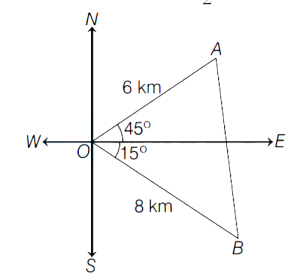
Two ships leave a port from a point at the same time. One goes with a velocity of $3 \text{ km/h}$ along North-East making an angle of $45^{\circ}$ with the East direction and the other travels with a velocity of $4 \text{ km/h}$ along South-East making an angle of $15^{\circ}$ with the East direction. Then,the distance between the ships at the end of two hours is
A
$2 \sqrt{13}$
B
$\sqrt{13}$
C
$5$
D
$10$
Solution
(A) Let the starting point be $O$. After $2 \text{ hours}$,the distance travelled by the first ship is $OA = 3 \text{ km/h} \times 2 \text{ h} = 6 \text{ km}$.
The distance travelled by the second ship is $OB = 4 \text{ km/h} \times 2 \text{ h} = 8 \text{ km}$.
The angle between the two paths is $\angle AOB = 45^{\circ} + 15^{\circ} = 60^{\circ}$.
Using the Law of Cosines in $\triangle AOB$:
$AB^2 = OA^2 + OB^2 - 2(OA)(OB) \cos(60^{\circ})$
$AB^2 = 6^2 + 8^2 - 2(6)(8) \times \frac{1}{2}$
$AB^2 = 36 + 64 - 48$
$AB^2 = 100 - 48 = 52$
$AB = \sqrt{52} = \sqrt{4 \times 13} = 2 \sqrt{13} \text{ km}$.
The distance travelled by the second ship is $OB = 4 \text{ km/h} \times 2 \text{ h} = 8 \text{ km}$.
The angle between the two paths is $\angle AOB = 45^{\circ} + 15^{\circ} = 60^{\circ}$.
Using the Law of Cosines in $\triangle AOB$:
$AB^2 = OA^2 + OB^2 - 2(OA)(OB) \cos(60^{\circ})$
$AB^2 = 6^2 + 8^2 - 2(6)(8) \times \frac{1}{2}$
$AB^2 = 36 + 64 - 48$
$AB^2 = 100 - 48 = 52$
$AB = \sqrt{52} = \sqrt{4 \times 13} = 2 \sqrt{13} \text{ km}$.
0 likes
View Solution162
EasyMCQ
The value of $\cos ^{2} 75^{\circ}+\cos ^{2} 45^{\circ}+\cos ^{2} 15^{\circ}-\cos ^{2} 30^{\circ}-\cos ^{2} 60^{\circ}$ is
A
$0$
B
$1$
C
$\frac{1}{2}$
D
$\frac{1}{4}$
Solution
(C) We know that $\cos 75^{\circ} = \cos(45^{\circ}+30^{\circ}) = \cos 45^{\circ} \cos 30^{\circ} - \sin 45^{\circ} \sin 30^{\circ} = \frac{1}{\sqrt{2}} \cdot \frac{\sqrt{3}}{2} - \frac{1}{\sqrt{2}} \cdot \frac{1}{2} = \frac{\sqrt{3}-1}{2\sqrt{2}}$.
Similarly,$\cos 15^{\circ} = \cos(45^{\circ}-30^{\circ}) = \frac{\sqrt{3}+1}{2\sqrt{2}}$.
Now,$\cos^2 75^{\circ} + \cos^2 15^{\circ} = \left(\frac{\sqrt{3}-1}{2\sqrt{2}}\right)^2 + \left(\frac{\sqrt{3}+1}{2\sqrt{2}}\right)^2 = \frac{3+1-2\sqrt{3}}{8} + \frac{3+1+2\sqrt{3}}{8} = \frac{8}{8} = 1$.
Also,$\cos^2 45^{\circ} = \left(\frac{1}{\sqrt{2}}\right)^2 = \frac{1}{2}$.
And $\cos^2 30^{\circ} + \cos^2 60^{\circ} = \left(\frac{\sqrt{3}}{2}\right)^2 + \left(\frac{1}{2}\right)^2 = \frac{3}{4} + \frac{1}{4} = 1$.
Substituting these values into the expression: $1 + \frac{1}{2} - 1 = \frac{1}{2}$.
Similarly,$\cos 15^{\circ} = \cos(45^{\circ}-30^{\circ}) = \frac{\sqrt{3}+1}{2\sqrt{2}}$.
Now,$\cos^2 75^{\circ} + \cos^2 15^{\circ} = \left(\frac{\sqrt{3}-1}{2\sqrt{2}}\right)^2 + \left(\frac{\sqrt{3}+1}{2\sqrt{2}}\right)^2 = \frac{3+1-2\sqrt{3}}{8} + \frac{3+1+2\sqrt{3}}{8} = \frac{8}{8} = 1$.
Also,$\cos^2 45^{\circ} = \left(\frac{1}{\sqrt{2}}\right)^2 = \frac{1}{2}$.
And $\cos^2 30^{\circ} + \cos^2 60^{\circ} = \left(\frac{\sqrt{3}}{2}\right)^2 + \left(\frac{1}{2}\right)^2 = \frac{3}{4} + \frac{1}{4} = 1$.
Substituting these values into the expression: $1 + \frac{1}{2} - 1 = \frac{1}{2}$.
0 likes
View Solution163
MediumMCQ
If $\cos (\theta+\phi)=\frac{3}{5}$ and $\sin (\theta-\phi)=\frac{5}{13}$,where $0 < \theta, \phi < \frac{\pi}{4}$,then $\cot (2 \theta)$ has the value:
A
$\frac{16}{63}$
B
$\frac{63}{16}$
C
$\frac{3}{13}$
D
$\frac{13}{3}$
Solution
(A) Given $\cos (\theta+\phi) = \frac{3}{5}$,since $0 < \theta, \phi < \frac{\pi}{4}$,we have $\tan (\theta+\phi) = \frac{4}{3}$.
Given $\sin (\theta-\phi) = \frac{5}{13}$,we have $\tan (\theta-\phi) = \frac{5}{12}$.
We know that $2\theta = (\theta+\phi) + (\theta-\phi)$.
Therefore,$\tan (2\theta) = \tan ((\theta+\phi) + (\theta-\phi)) = \frac{\tan (\theta+\phi) + \tan (\theta-\phi)}{1 - \tan (\theta+\phi) \tan (\theta-\phi)}$.
Substituting the values: $\tan (2\theta) = \frac{\frac{4}{3} + \frac{5}{12}}{1 - (\frac{4}{3} \times \frac{5}{12})} = \frac{\frac{16+5}{12}}{1 - \frac{20}{36}} = \frac{\frac{21}{12}}{\frac{16}{36}} = \frac{21}{12} \times \frac{36}{16} = \frac{21 \times 3}{16} = \frac{63}{16}$.
Thus,$\cot (2\theta) = \frac{1}{\tan (2\theta)} = \frac{16}{63}$.
Given $\sin (\theta-\phi) = \frac{5}{13}$,we have $\tan (\theta-\phi) = \frac{5}{12}$.
We know that $2\theta = (\theta+\phi) + (\theta-\phi)$.
Therefore,$\tan (2\theta) = \tan ((\theta+\phi) + (\theta-\phi)) = \frac{\tan (\theta+\phi) + \tan (\theta-\phi)}{1 - \tan (\theta+\phi) \tan (\theta-\phi)}$.
Substituting the values: $\tan (2\theta) = \frac{\frac{4}{3} + \frac{5}{12}}{1 - (\frac{4}{3} \times \frac{5}{12})} = \frac{\frac{16+5}{12}}{1 - \frac{20}{36}} = \frac{\frac{21}{12}}{\frac{16}{36}} = \frac{21}{12} \times \frac{36}{16} = \frac{21 \times 3}{16} = \frac{63}{16}$.
Thus,$\cot (2\theta) = \frac{1}{\tan (2\theta)} = \frac{16}{63}$.
0 likes
View Solution164
MediumMCQ
Let $\tan \alpha = \frac{a}{a+1}$ and $\tan \beta = \frac{1}{2a+1}$,then $\alpha + \beta$ is
A
$\frac{\pi}{4}$
B
$\frac{\pi}{3}$
C
$\frac{\pi}{2}$
D
$\pi$
Solution
(A) We use the formula $\tan(\alpha + \beta) = \frac{\tan \alpha + \tan \beta}{1 - \tan \alpha \tan \beta}$.
Substituting the given values:
$\tan(\alpha + \beta) = \frac{\frac{a}{a+1} + \frac{1}{2a+1}}{1 - \left(\frac{a}{a+1}\right) \left(\frac{1}{2a+1}\right)}$
$= \frac{\frac{a(2a+1) + 1(a+1)}{(a+1)(2a+1)}}{\frac{(a+1)(2a+1) - a}{(a+1)(2a+1)}}$
$= \frac{2a^2 + a + a + 1}{2a^2 + a + 2a + 1 - a}$
$= \frac{2a^2 + 2a + 1}{2a^2 + 2a + 1} = 1$
Since $\tan(\alpha + \beta) = 1$,we have $\alpha + \beta = \frac{\pi}{4}$.
Substituting the given values:
$\tan(\alpha + \beta) = \frac{\frac{a}{a+1} + \frac{1}{2a+1}}{1 - \left(\frac{a}{a+1}\right) \left(\frac{1}{2a+1}\right)}$
$= \frac{\frac{a(2a+1) + 1(a+1)}{(a+1)(2a+1)}}{\frac{(a+1)(2a+1) - a}{(a+1)(2a+1)}}$
$= \frac{2a^2 + a + a + 1}{2a^2 + a + 2a + 1 - a}$
$= \frac{2a^2 + 2a + 1}{2a^2 + 2a + 1} = 1$
Since $\tan(\alpha + \beta) = 1$,we have $\alpha + \beta = \frac{\pi}{4}$.
0 likes
View Solution165
EasyMCQ
If $\theta+\phi=\frac{\pi}{4}$,then $(1+\tan \theta)(1+\tan \phi)$ is equal to
A
$1$
B
$2$
C
$5/2$
D
$1/3$
Solution
(B) Given that $\theta + \phi = \frac{\pi}{4}$.
Taking $\tan$ on both sides,we get $\tan(\theta + \phi) = \tan(\frac{\pi}{4}) = 1$.
Using the formula $\tan(\theta + \phi) = \frac{\tan \theta + \tan \phi}{1 - \tan \theta \tan \phi} = 1$.
This implies $\tan \theta + \tan \phi = 1 - \tan \theta \tan \phi$,or $\tan \theta + \tan \phi + \tan \theta \tan \phi = 1$.
Now,consider the expression $(1 + \tan \theta)(1 + \tan \phi) = 1 + \tan \phi + \tan \theta + \tan \theta \tan \phi$.
Substituting the value from the previous step: $1 + (\tan \theta + \tan \phi + \tan \theta \tan \phi) = 1 + 1 = 2$.
Taking $\tan$ on both sides,we get $\tan(\theta + \phi) = \tan(\frac{\pi}{4}) = 1$.
Using the formula $\tan(\theta + \phi) = \frac{\tan \theta + \tan \phi}{1 - \tan \theta \tan \phi} = 1$.
This implies $\tan \theta + \tan \phi = 1 - \tan \theta \tan \phi$,or $\tan \theta + \tan \phi + \tan \theta \tan \phi = 1$.
Now,consider the expression $(1 + \tan \theta)(1 + \tan \phi) = 1 + \tan \phi + \tan \theta + \tan \theta \tan \phi$.
Substituting the value from the previous step: $1 + (\tan \theta + \tan \phi + \tan \theta \tan \phi) = 1 + 1 = 2$.
0 likes
View Solution166
MediumMCQ
The value of $\cos 15^{\circ} - \sin 15^{\circ}$ is
A
$0$
B
$\frac{1}{\sqrt{2}}$
C
$-\frac{1}{\sqrt{2}}$
D
$\frac{1}{2\sqrt{2}}$
Solution
(B) We know that $\cos 15^{\circ} = \cos(45^{\circ} - 30^{\circ}) = \cos 45^{\circ} \cos 30^{\circ} + \sin 45^{\circ} \sin 30^{\circ} = \frac{1}{\sqrt{2}} \cdot \frac{\sqrt{3}}{2} + \frac{1}{\sqrt{2}} \cdot \frac{1}{2} = \frac{\sqrt{3} + 1}{2\sqrt{2}}$.
Also,$\sin 15^{\circ} = \sin(45^{\circ} - 30^{\circ}) = \sin 45^{\circ} \cos 30^{\circ} - \cos 45^{\circ} \sin 30^{\circ} = \frac{1}{\sqrt{2}} \cdot \frac{\sqrt{3}}{2} - \frac{1}{\sqrt{2}} \cdot \frac{1}{2} = \frac{\sqrt{3} - 1}{2\sqrt{2}}$.
Subtracting the two values:
$\cos 15^{\circ} - \sin 15^{\circ} = \frac{\sqrt{3} + 1}{2\sqrt{2}} - \frac{\sqrt{3} - 1}{2\sqrt{2}} = \frac{\sqrt{3} + 1 - \sqrt{3} + 1}{2\sqrt{2}} = \frac{2}{2\sqrt{2}} = \frac{1}{\sqrt{2}}$.
Also,$\sin 15^{\circ} = \sin(45^{\circ} - 30^{\circ}) = \sin 45^{\circ} \cos 30^{\circ} - \cos 45^{\circ} \sin 30^{\circ} = \frac{1}{\sqrt{2}} \cdot \frac{\sqrt{3}}{2} - \frac{1}{\sqrt{2}} \cdot \frac{1}{2} = \frac{\sqrt{3} - 1}{2\sqrt{2}}$.
Subtracting the two values:
$\cos 15^{\circ} - \sin 15^{\circ} = \frac{\sqrt{3} + 1}{2\sqrt{2}} - \frac{\sqrt{3} - 1}{2\sqrt{2}} = \frac{\sqrt{3} + 1 - \sqrt{3} + 1}{2\sqrt{2}} = \frac{2}{2\sqrt{2}} = \frac{1}{\sqrt{2}}$.
0 likes
View Solution167
DifficultMCQ
Let $\cos(\alpha+\beta)=-\frac{1}{10}$ and $\sin(\alpha-\beta)=\frac{3}{8}$ where $0 < \alpha < \frac{\pi}{3}$ and $0 < \beta < \frac{\pi}{4}$. If $\tan 2\alpha=\frac{3(1-r\sqrt{5})}{\sqrt{11}(s+\sqrt{5})}$,where $r, s \in N$,then $r+s$ is equal to . . . . . .
A
$10$
B
$15$
C
$20$
D
$25$
Solution
(C) Given $\cos(\alpha+\beta) = -\frac{1}{10}$. Since $0 < \alpha < \frac{\pi}{3}$ and $0 < \beta < \frac{\pi}{4}$,we have $0 < \alpha+\beta < \frac{7\pi}{12}$. Since $\cos(\alpha+\beta) < 0$,we must have $\frac{\pi}{2} < \alpha+\beta < \frac{7\pi}{12}$.
Thus,$\sin(\alpha+\beta) = \sqrt{1 - (-\frac{1}{10})^2} = \sqrt{\frac{99}{100}} = \frac{3\sqrt{11}}{10}$.
So,$\tan(\alpha+\beta) = \frac{3\sqrt{11}/10}{-1/10} = -3\sqrt{11}$.
Given $\sin(\alpha-\beta) = \frac{3}{8}$. Since $0 < \alpha < \frac{\pi}{3}$ and $0 < \beta < \frac{\pi}{4}$,we have $-\frac{\pi}{4} < \alpha-\beta < \frac{\pi}{3}$. Since $\sin(\alpha-\beta) > 0$,we have $0 < \alpha-\beta < \frac{\pi}{3}$.
Thus,$\cos(\alpha-\beta) = \sqrt{1 - (\frac{3}{8})^2} = \sqrt{\frac{55}{64}} = \frac{\sqrt{55}}{8}$.
So,$\tan(\alpha-\beta) = \frac{3/8}{\sqrt{55}/8} = \frac{3}{\sqrt{55}}$.
Now,$\tan 2\alpha = \tan((\alpha+\beta)+(\alpha-\beta)) = \frac{\tan(\alpha+\beta) + \tan(\alpha-\beta)}{1 - \tan(\alpha+\beta)\tan(\alpha-\beta)}$.
Substituting the values,$\tan 2\alpha = \frac{-3\sqrt{11} + \frac{3}{\sqrt{55}}}{1 - (-3\sqrt{11})(\frac{3}{\sqrt{55}})} = \frac{\frac{-3\sqrt{11}\sqrt{55} + 3}{\sqrt{55}}}{1 + \frac{9\sqrt{11}}{\sqrt{55}}} = \frac{-3(11\sqrt{5}) + 3}{\sqrt{55} + 9\sqrt{11}} = \frac{3(1 - 11\sqrt{5})}{\sqrt{11}(\sqrt{5} + 9)}$.
Comparing with $\frac{3(1-r\sqrt{5})}{\sqrt{11}(s+\sqrt{5})}$,we get $r=11$ and $s=9$.
Therefore,$r+s = 11+9 = 20$.
Thus,$\sin(\alpha+\beta) = \sqrt{1 - (-\frac{1}{10})^2} = \sqrt{\frac{99}{100}} = \frac{3\sqrt{11}}{10}$.
So,$\tan(\alpha+\beta) = \frac{3\sqrt{11}/10}{-1/10} = -3\sqrt{11}$.
Given $\sin(\alpha-\beta) = \frac{3}{8}$. Since $0 < \alpha < \frac{\pi}{3}$ and $0 < \beta < \frac{\pi}{4}$,we have $-\frac{\pi}{4} < \alpha-\beta < \frac{\pi}{3}$. Since $\sin(\alpha-\beta) > 0$,we have $0 < \alpha-\beta < \frac{\pi}{3}$.
Thus,$\cos(\alpha-\beta) = \sqrt{1 - (\frac{3}{8})^2} = \sqrt{\frac{55}{64}} = \frac{\sqrt{55}}{8}$.
So,$\tan(\alpha-\beta) = \frac{3/8}{\sqrt{55}/8} = \frac{3}{\sqrt{55}}$.
Now,$\tan 2\alpha = \tan((\alpha+\beta)+(\alpha-\beta)) = \frac{\tan(\alpha+\beta) + \tan(\alpha-\beta)}{1 - \tan(\alpha+\beta)\tan(\alpha-\beta)}$.
Substituting the values,$\tan 2\alpha = \frac{-3\sqrt{11} + \frac{3}{\sqrt{55}}}{1 - (-3\sqrt{11})(\frac{3}{\sqrt{55}})} = \frac{\frac{-3\sqrt{11}\sqrt{55} + 3}{\sqrt{55}}}{1 + \frac{9\sqrt{11}}{\sqrt{55}}} = \frac{-3(11\sqrt{5}) + 3}{\sqrt{55} + 9\sqrt{11}} = \frac{3(1 - 11\sqrt{5})}{\sqrt{11}(\sqrt{5} + 9)}$.
Comparing with $\frac{3(1-r\sqrt{5})}{\sqrt{11}(s+\sqrt{5})}$,we get $r=11$ and $s=9$.
Therefore,$r+s = 11+9 = 20$.
0 likes
View SolutionTrigonometrical Ratios, Functions and Identities — Trigonometrical ratios of sum and difference of two and three angles · Frequently Asked Questions
1Are these Trigonometrical Ratios, Functions and Identities questions useful for JEE and NEET?
Yes. All questions in this section are mapped to JEE Main and NEET exam patterns. Previous year questions from JEE Main, NEET, GUJCET and state-level exams are included with full solutions.
2Can I switch to Hindi or Gujarati for these questions?
Yes. Use the language tabs in the hero section or the sidebar to view the same questions and solutions in English, Hindi or Gujarati.
3How do I generate a question paper from this subtopic?
Use the Vedclass Exam Paper Generator — select the chapter and subtopic, set difficulty, and generate Sets A, B, C, D automatically. First 3 chapters of every subject are free.
Vedclass Products
For Students
Vedclass Test Series
Mock tests in real JEE/NEET style with performance analysis. 5-day free trial.
Start Free TrialFor Teachers
Exam Paper Generator
Generate Set A/B/C/D papers from this chapter in 2 minutes. 3 chapters free.
Try FreeFor Institutes
Online Exam Module
Live online exams with unlimited students, 360° analytics & white-label branding.
See DemoFor Teachers & Institutes
Generate a Trigonometrical Ratios, Functions and Identities Exam Paper in 2 Minutes
Select subtopic & difficulty — Sets A, B, C, D auto-generated with No Repeat logic.
First 3 chapters of every subject are free — no payment required.