
A English
Geometry of complex numbers Questions in English
Class 11 Mathematics · 4-1.Complex numbers · Geometry of complex numbers
467+
Questions
English
Language
100%
With Solutions
Showing 48 of 467 questions in English
251
DifficultMCQ
Let $w = \frac{\sqrt{3} + i}{2}$ and $P = \{w^n : n = 1, 2, 3, \ldots\}$. Further, $H_1 = \{z \in C : \operatorname{Re}(z) > \frac{1}{2}\}$ and $H_2 = \{z \in C : \operatorname{Re}(z) < -\frac{1}{2}\}$, where $C$ is the set of all complex numbers. If $z_1 \in P \cap H_1$, $z_2 \in P \cap H_2$, and $O$ represents the origin, then $\angle z_1 O z_2$ can be:
A
$(A) \frac{\pi}{2}$
B
$(B) \frac{\pi}{6}$
C
$(C) \frac{2\pi}{3}$
D
$(D) \frac{5\pi}{6}$
Solution
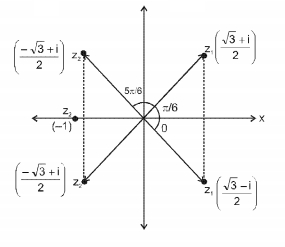
(C) Given $w = \frac{\sqrt{3} + i}{2} = \cos\left(\frac{\pi}{6}\right) + i \sin\left(\frac{\pi}{6}\right) = e^{i\pi/6}$.
Thus, $P = \{e^{in\pi/6} : n = 1, 2, 3, \ldots\}$.
$H_1 = \{z : \operatorname{Re}(z) > 1/2\}$. For $z = e^{in\pi/6} = \cos(n\pi/6) + i \sin(n\pi/6)$, $\operatorname{Re}(z) = \cos(n\pi/6) > 1/2$ implies $n\pi/6 \in (0, \pi/3) \cup (5\pi/3, 2\pi)$. For $n \in Z^+$, this gives $n = 1$ $(z_1 = e^{i\pi/6} = \frac{\sqrt{3}+i}{2})$ and $n = 11$ $(z_1 = e^{i11\pi/6} = \frac{\sqrt{3}-i}{2})$.
$H_2 = \{z : \operatorname{Re}(z) < -1/2\}$. $\operatorname{Re}(z) = \cos(n\pi/6) < -1/2$ implies $n\pi/6 \in (2\pi/3, 4\pi/3)$. For $n \in Z^+$, this gives $n = 5$ $(z_2 = e^{i5\pi/6} = \frac{-\sqrt{3}+i}{2})$ and $n = 7$ $(z_2 = e^{i7\pi/6} = \frac{-\sqrt{3}-i}{2})$.
The possible angles $\angle z_1 O z_2$ are the differences in arguments: $|\arg(z_1) - \arg(z_2)|$.
Possible arguments for $z_1$ are $\pm \pi/6$. Possible arguments for $z_2$ are $\pm 5\pi/6$.
The differences are $|5\pi/6 - \pi/6| = 4\pi/6 = 2\pi/3$, $|-5\pi/6 - \pi/6| = |-\pi| = \pi$, $|5\pi/6 - (-\pi/6)| = \pi$, and $|-5\pi/6 - (-\pi/6)| = |-4\pi/6| = 2\pi/3$.
Thus, the possible values are $2\pi/3$ and $\pi$. Comparing with the options, $2\pi/3$ is present.
Thus, $P = \{e^{in\pi/6} : n = 1, 2, 3, \ldots\}$.
$H_1 = \{z : \operatorname{Re}(z) > 1/2\}$. For $z = e^{in\pi/6} = \cos(n\pi/6) + i \sin(n\pi/6)$, $\operatorname{Re}(z) = \cos(n\pi/6) > 1/2$ implies $n\pi/6 \in (0, \pi/3) \cup (5\pi/3, 2\pi)$. For $n \in Z^+$, this gives $n = 1$ $(z_1 = e^{i\pi/6} = \frac{\sqrt{3}+i}{2})$ and $n = 11$ $(z_1 = e^{i11\pi/6} = \frac{\sqrt{3}-i}{2})$.
$H_2 = \{z : \operatorname{Re}(z) < -1/2\}$. $\operatorname{Re}(z) = \cos(n\pi/6) < -1/2$ implies $n\pi/6 \in (2\pi/3, 4\pi/3)$. For $n \in Z^+$, this gives $n = 5$ $(z_2 = e^{i5\pi/6} = \frac{-\sqrt{3}+i}{2})$ and $n = 7$ $(z_2 = e^{i7\pi/6} = \frac{-\sqrt{3}-i}{2})$.
The possible angles $\angle z_1 O z_2$ are the differences in arguments: $|\arg(z_1) - \arg(z_2)|$.
Possible arguments for $z_1$ are $\pm \pi/6$. Possible arguments for $z_2$ are $\pm 5\pi/6$.
The differences are $|5\pi/6 - \pi/6| = 4\pi/6 = 2\pi/3$, $|-5\pi/6 - \pi/6| = |-\pi| = \pi$, $|5\pi/6 - (-\pi/6)| = \pi$, and $|-5\pi/6 - (-\pi/6)| = |-4\pi/6| = 2\pi/3$.
Thus, the possible values are $2\pi/3$ and $\pi$. Comparing with the options, $2\pi/3$ is present.
0 likes
View Solution252
Difficult
Let $S=S_1 \cap S_2 \cap S_3$,where $S_1=\{z \in \mathbb{C}:|z|<4\}$,$S_2=\{z \in \mathbb{C}: \operatorname{Im}[\frac{z-1+\sqrt{3} i}{1-\sqrt{3} i}]>0\}$,and $S_3=\{z \in \mathbb{C}: \operatorname{Re} z>0\}$.
$1.$ Area of $S=$
$(A) \frac{10 \pi}{3} \quad (B) \frac{20 \pi}{3} \quad (C) \frac{16 \pi}{3} \quad (D) \frac{32 \pi}{3}$
$2.$ $\min _{z \in S}|1-3 i-z|=$
$(A) \frac{2-\sqrt{3}}{2} \quad (B) \frac{2+\sqrt{3}}{2} \quad (C) \frac{3-\sqrt{3}}{2} \quad (D) \frac{3+\sqrt{3}}{2}$
$1.$ Area of $S=$
$(A) \frac{10 \pi}{3} \quad (B) \frac{20 \pi}{3} \quad (C) \frac{16 \pi}{3} \quad (D) \frac{32 \pi}{3}$
$2.$ $\min _{z \in S}|1-3 i-z|=$
$(A) \frac{2-\sqrt{3}}{2} \quad (B) \frac{2+\sqrt{3}}{2} \quad (C) \frac{3-\sqrt{3}}{2} \quad (D) \frac{3+\sqrt{3}}{2}$
Solution
(B,C) $1.$ $S_1$ represents the interior of a circle with radius $r=4$ centered at the origin.
$S_2: \operatorname{Im}[\frac{(x-1)+i(y+\sqrt{3})}{1-\sqrt{3} i} \cdot \frac{1+\sqrt{3} i}{1+\sqrt{3} i}] > 0 \implies \operatorname{Im}[\frac{(x-1+i(y+\sqrt{3}))(1+\sqrt{3} i)}{4}] > 0$
$\implies (x-1)\sqrt{3} + (y+\sqrt{3}) > 0 \implies \sqrt{3}x + y > 0$.
$S_3: x > 0$.
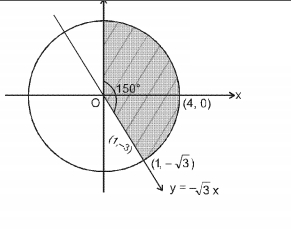
The region $S$ is the intersection of the disk $x^2+y^2 < 16$,the half-plane $y > -\sqrt{3}x$,and the half-plane $x > 0$. This forms a circular sector with angle $\theta = 150^\circ = \frac{5\pi}{6}$ radians.
Area $= \frac{1}{2} r^2 \theta = \frac{1}{2} \times 16 \times \frac{5\pi}{6} = \frac{20\pi}{3}$.
$2.$ We need the minimum distance from the point $P(1, -3)$ to the region $S$. The boundary of $S$ includes the line $y = -\sqrt{3}x$ for $x > 0$.
The distance from $(1, -3)$ to the line $\sqrt{3}x + y = 0$ is $d = \frac{|\sqrt{3}(1) + (-3)|}{\sqrt{(\sqrt{3})^2 + 1^2}} = \frac{|\sqrt{3}-3|}{2} = \frac{3-\sqrt{3}}{2}$.
$S_2: \operatorname{Im}[\frac{(x-1)+i(y+\sqrt{3})}{1-\sqrt{3} i} \cdot \frac{1+\sqrt{3} i}{1+\sqrt{3} i}] > 0 \implies \operatorname{Im}[\frac{(x-1+i(y+\sqrt{3}))(1+\sqrt{3} i)}{4}] > 0$
$\implies (x-1)\sqrt{3} + (y+\sqrt{3}) > 0 \implies \sqrt{3}x + y > 0$.
$S_3: x > 0$.
The region $S$ is the intersection of the disk $x^2+y^2 < 16$,the half-plane $y > -\sqrt{3}x$,and the half-plane $x > 0$. This forms a circular sector with angle $\theta = 150^\circ = \frac{5\pi}{6}$ radians.
Area $= \frac{1}{2} r^2 \theta = \frac{1}{2} \times 16 \times \frac{5\pi}{6} = \frac{20\pi}{3}$.
$2.$ We need the minimum distance from the point $P(1, -3)$ to the region $S$. The boundary of $S$ includes the line $y = -\sqrt{3}x$ for $x > 0$.
The distance from $(1, -3)$ to the line $\sqrt{3}x + y = 0$ is $d = \frac{|\sqrt{3}(1) + (-3)|}{\sqrt{(\sqrt{3})^2 + 1^2}} = \frac{|\sqrt{3}-3|}{2} = \frac{3-\sqrt{3}}{2}$.
0 likes
View Solution253
DifficultMCQ
For any integer $k$,let $\alpha_k = \cos \left(\frac{k \pi}{7}\right) + i \sin \left(\frac{k \pi}{7}\right)$,where $i = \sqrt{-1}$. The value of the expression $\frac{\sum_{k=1}^{12} |\alpha_{k+1} - \alpha_k|}{\sum_{k=1}^3 |\alpha_{4k-1} - \alpha_{4k-2}|}$ is
A
$1$
B
$2$
C
$3$
D
$4$
Solution
(D) Given $\alpha_k = e^{i \frac{k \pi}{7}}$.
Then $|\alpha_{k+1} - \alpha_k| = |e^{i \frac{(k+1) \pi}{7}} - e^{i \frac{k \pi}{7}}| = |e^{i \frac{k \pi}{7}}| |e^{i \frac{\pi}{7}} - 1| = |e^{i \frac{\pi}{7}} - 1|$.
The numerator is $\sum_{k=1}^{12} |e^{i \frac{\pi}{7}} - 1| = 12 |e^{i \frac{\pi}{7}} - 1|$.
The denominator is $\sum_{k=1}^3 |e^{i \frac{(4k-1) \pi}{7}} - e^{i \frac{(4k-2) \pi}{7}}| = \sum_{k=1}^3 |e^{i \frac{(4k-2) \pi}{7}}| |e^{i \frac{\pi}{7}} - 1| = 3 |e^{i \frac{\pi}{7}} - 1|$.
Thus,the ratio is $\frac{12 |e^{i \frac{\pi}{7}} - 1|}{3 |e^{i \frac{\pi}{7}} - 1|} = \frac{12}{3} = 4$.
Then $|\alpha_{k+1} - \alpha_k| = |e^{i \frac{(k+1) \pi}{7}} - e^{i \frac{k \pi}{7}}| = |e^{i \frac{k \pi}{7}}| |e^{i \frac{\pi}{7}} - 1| = |e^{i \frac{\pi}{7}} - 1|$.
The numerator is $\sum_{k=1}^{12} |e^{i \frac{\pi}{7}} - 1| = 12 |e^{i \frac{\pi}{7}} - 1|$.
The denominator is $\sum_{k=1}^3 |e^{i \frac{(4k-1) \pi}{7}} - e^{i \frac{(4k-2) \pi}{7}}| = \sum_{k=1}^3 |e^{i \frac{(4k-2) \pi}{7}}| |e^{i \frac{\pi}{7}} - 1| = 3 |e^{i \frac{\pi}{7}} - 1|$.
Thus,the ratio is $\frac{12 |e^{i \frac{\pi}{7}} - 1|}{3 |e^{i \frac{\pi}{7}} - 1|} = \frac{12}{3} = 4$.
0 likes
View Solution254
DifficultMCQ
Let the curve $z(1+i)+\bar{z}(1-i)=4, z \in \mathbb{C}$,divide the region $|z-3| \leq 1$ into two parts of areas $\alpha$ and $\beta$. Then $|\alpha-\beta|$ equals :
A
$1+\frac{\pi}{2}$
B
$1+\frac{\pi}{3}$
C
$1+\frac{\pi}{4}$
D
$1+\frac{\pi}{6}$
Solution
(A) Let $z=x+iy$. Substituting this into the equation of the curve:
$(x+iy)(1+i)+(x-iy)(1-i)=4$
$x+ix+iy-y+x-ix-iy-y=4$
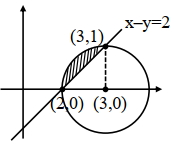
$2x-2y=4 \implies x-y=2$.
The region $|z-3| \leq 1$ represents a circle with center $(3,0)$ and radius $r=1$,given by $(x-3)^2+y^2 \leq 1$.
The line $x-y=2$ intersects the circle at points where $(x-3)^2+(x-2)^2=1$,which simplifies to $x^2-6x+9+x^2-4x+4=1$,or $2x^2-10x+12=0$,so $x^2-5x+6=0$. The intersection points are $(2,0)$ and $(3,1)$.
The distance from the center $(3,0)$ to the line $x-y-2=0$ is $d = \frac{|3-0-2|}{\sqrt{1^2+(-1)^2}} = \frac{1}{\sqrt{2}}$.
The area of the circular segment cut by the chord is $A_{segment} = r^2 \cos^{-1}(\frac{d}{r}) - d\sqrt{r^2-d^2} = 1^2 \cos^{-1}(\frac{1}{\sqrt{2}}) - \frac{1}{\sqrt{2}}\sqrt{1-\frac{1}{2}} = \frac{\pi}{4} - \frac{1}{2}$.
Let $\alpha = \frac{\pi}{4} - \frac{1}{2}$ be the smaller area. The total area of the circle is $\pi r^2 = \pi$. The larger area is $\beta = \pi - (\frac{\pi}{4} - \frac{1}{2}) = \frac{3\pi}{4} + \frac{1}{2}$.
Then $|\alpha-\beta| = |(\frac{\pi}{4} - \frac{1}{2}) - (\frac{3\pi}{4} + \frac{1}{2})| = |-\frac{2\pi}{4} - 1| = \frac{\pi}{2} + 1$.
$(x+iy)(1+i)+(x-iy)(1-i)=4$
$x+ix+iy-y+x-ix-iy-y=4$
$2x-2y=4 \implies x-y=2$.
The region $|z-3| \leq 1$ represents a circle with center $(3,0)$ and radius $r=1$,given by $(x-3)^2+y^2 \leq 1$.
The line $x-y=2$ intersects the circle at points where $(x-3)^2+(x-2)^2=1$,which simplifies to $x^2-6x+9+x^2-4x+4=1$,or $2x^2-10x+12=0$,so $x^2-5x+6=0$. The intersection points are $(2,0)$ and $(3,1)$.
The distance from the center $(3,0)$ to the line $x-y-2=0$ is $d = \frac{|3-0-2|}{\sqrt{1^2+(-1)^2}} = \frac{1}{\sqrt{2}}$.
The area of the circular segment cut by the chord is $A_{segment} = r^2 \cos^{-1}(\frac{d}{r}) - d\sqrt{r^2-d^2} = 1^2 \cos^{-1}(\frac{1}{\sqrt{2}}) - \frac{1}{\sqrt{2}}\sqrt{1-\frac{1}{2}} = \frac{\pi}{4} - \frac{1}{2}$.
Let $\alpha = \frac{\pi}{4} - \frac{1}{2}$ be the smaller area. The total area of the circle is $\pi r^2 = \pi$. The larger area is $\beta = \pi - (\frac{\pi}{4} - \frac{1}{2}) = \frac{3\pi}{4} + \frac{1}{2}$.
Then $|\alpha-\beta| = |(\frac{\pi}{4} - \frac{1}{2}) - (\frac{3\pi}{4} + \frac{1}{2})| = |-\frac{2\pi}{4} - 1| = \frac{\pi}{2} + 1$.
0 likes
View Solution255
DifficultMCQ
Let $\left|\frac{\bar{z}-i}{2 \bar{z}+i}\right|=\frac{1}{3}$,where $z \in \mathbb{C}$,be the equation of a circle with center at $C$. If the area of the triangle,whose vertices are at the points $(0,0)$,$C$,and $(\alpha, 0)$,is $11$ square units,then $\alpha^2$ equals
A
$100$
B
$50$
C
$\frac{121}{25}$
D
$\frac{81}{25}$
Solution
(A) Given $\left|\frac{\bar{z}-i}{2 \bar{z}+i}\right|=\frac{1}{3}$.
Dividing numerator and denominator by $2$ inside the modulus: $\left|\frac{\bar{z}-i}{2(\bar{z}+i/2)}\right|=\frac{1}{3}$ $\Rightarrow \left|\frac{\bar{z}-i}{\bar{z}+i/2}\right|=\frac{2}{3}$.
Let $z = x+iy$,then $\bar{z} = x-iy$. Substituting this:
$3|x-iy-i| = 2|x-iy+i/2|$
$9(x^2 + (-y-1)^2) = 4(x^2 + (-y+1/2)^2)$
$9(x^2 + y^2 + 2y + 1) = 4(x^2 + y^2 - y + 1/4)$
$9x^2 + 9y^2 + 18y + 9 = 4x^2 + 4y^2 - 4y + 1$
$5x^2 + 5y^2 + 22y + 8 = 0$
$x^2 + y^2 + \frac{22}{5}y + \frac{8}{5} = 0$.
The center $C$ is $(0, -11/5)$.
The area of the triangle with vertices $(0,0)$,$(0, -11/5)$,and $(\alpha, 0)$ is given by $\frac{1}{2} |x_1(y_2-y_3) + x_2(y_3-y_1) + x_3(y_1-y_2)| = 11$.
$\frac{1}{2} |0(-11/5 - 0) + 0(0 - 0) + \alpha(0 - (-11/5))| = 11$.
$\frac{1}{2} |\alpha \cdot \frac{11}{5}| = 11$.
$|\alpha| = 10$.
Therefore,$\alpha^2 = 100$.
Dividing numerator and denominator by $2$ inside the modulus: $\left|\frac{\bar{z}-i}{2(\bar{z}+i/2)}\right|=\frac{1}{3}$ $\Rightarrow \left|\frac{\bar{z}-i}{\bar{z}+i/2}\right|=\frac{2}{3}$.
Let $z = x+iy$,then $\bar{z} = x-iy$. Substituting this:
$3|x-iy-i| = 2|x-iy+i/2|$
$9(x^2 + (-y-1)^2) = 4(x^2 + (-y+1/2)^2)$
$9(x^2 + y^2 + 2y + 1) = 4(x^2 + y^2 - y + 1/4)$
$9x^2 + 9y^2 + 18y + 9 = 4x^2 + 4y^2 - 4y + 1$
$5x^2 + 5y^2 + 22y + 8 = 0$
$x^2 + y^2 + \frac{22}{5}y + \frac{8}{5} = 0$.
The center $C$ is $(0, -11/5)$.
The area of the triangle with vertices $(0,0)$,$(0, -11/5)$,and $(\alpha, 0)$ is given by $\frac{1}{2} |x_1(y_2-y_3) + x_2(y_3-y_1) + x_3(y_1-y_2)| = 11$.
$\frac{1}{2} |0(-11/5 - 0) + 0(0 - 0) + \alpha(0 - (-11/5))| = 11$.
$\frac{1}{2} |\alpha \cdot \frac{11}{5}| = 11$.
$|\alpha| = 10$.
Therefore,$\alpha^2 = 100$.
0 likes
View Solution256
MediumMCQ
The number of complex numbers $z$ satisfying $|z|=1$ and $\left|\frac{z}{\bar{z}}+\frac{\bar{z}}{z}\right|=1$ is:
A
$6$
B
$4$
C
$10$
D
$8$
Solution
(D) Given $|z|=1$,we can write $z = e^{i\theta}$ where $\theta \in [0, 2\pi)$.
Then $\bar{z} = e^{-i\theta}$.
Thus,$\frac{z}{\bar{z}} = \frac{e^{i\theta}}{e^{-i\theta}} = e^{i2\theta}$ and $\frac{\bar{z}}{z} = e^{-i2\theta}$.
The given equation is $\left|e^{i2\theta} + e^{-i2\theta}\right| = 1$.
Using Euler's formula,$e^{i2\theta} + e^{-i2\theta} = 2\cos(2\theta)$.
So,$|2\cos(2\theta)| = 1$,which implies $|\cos(2\theta)| = \frac{1}{2}$.
This means $\cos(2\theta) = \pm \frac{1}{2}$.
For $\theta \in [0, 2\pi)$,$2\theta \in [0, 4\pi)$.
If $\cos(2\theta) = \frac{1}{2}$,then $2\theta = \frac{\pi}{3}, \frac{5\pi}{3}, \frac{7\pi}{3}, \frac{11\pi}{3}$.
If $\cos(2\theta) = -\frac{1}{2}$,then $2\theta = \frac{2\pi}{3}, \frac{4\pi}{3}, \frac{8\pi}{3}, \frac{10\pi}{3}$.
There are $8$ distinct values for $\theta$,hence there are $8$ such complex numbers $z$.
Then $\bar{z} = e^{-i\theta}$.
Thus,$\frac{z}{\bar{z}} = \frac{e^{i\theta}}{e^{-i\theta}} = e^{i2\theta}$ and $\frac{\bar{z}}{z} = e^{-i2\theta}$.
The given equation is $\left|e^{i2\theta} + e^{-i2\theta}\right| = 1$.
Using Euler's formula,$e^{i2\theta} + e^{-i2\theta} = 2\cos(2\theta)$.
So,$|2\cos(2\theta)| = 1$,which implies $|\cos(2\theta)| = \frac{1}{2}$.
This means $\cos(2\theta) = \pm \frac{1}{2}$.
For $\theta \in [0, 2\pi)$,$2\theta \in [0, 4\pi)$.
If $\cos(2\theta) = \frac{1}{2}$,then $2\theta = \frac{\pi}{3}, \frac{5\pi}{3}, \frac{7\pi}{3}, \frac{11\pi}{3}$.
If $\cos(2\theta) = -\frac{1}{2}$,then $2\theta = \frac{2\pi}{3}, \frac{4\pi}{3}, \frac{8\pi}{3}, \frac{10\pi}{3}$.
There are $8$ distinct values for $\theta$,hence there are $8$ such complex numbers $z$.
0 likes
View Solution257
DifficultMCQ
Let $O$ be the origin,the point $A$ be $z_1 = \sqrt{3} + 2\sqrt{2}i$,and the point $B(z_2)$ be such that $\sqrt{3}|z_2| = |z_1|$ and $\arg(z_2) = \arg(z_1) + \frac{\pi}{6}$. Then:
A
area of triangle $ABO$ is $\frac{11}{\sqrt{3}}$
B
$ABO$ is a scalene triangle
C
area of triangle $ABO$ is $\frac{11}{4}$
D
$ABO$ is an obtuse angled isosceles triangle
Solution
(D) Given $z_1 = \sqrt{3} + 2\sqrt{2}i$. The modulus is $|z_1| = \sqrt{(\sqrt{3})^2 + (2\sqrt{2})^2} = \sqrt{3 + 8} = \sqrt{11}$.
Given $\sqrt{3}|z_2| = |z_1|$,so $|z_2| = \frac{|z_1|}{\sqrt{3}} = \sqrt{\frac{11}{3}}$.
Given $\arg(z_2) - \arg(z_1) = \frac{\pi}{6}$,the angle $\angle AOB = \frac{\pi}{6}$.
The area of $\triangle ABO = \frac{1}{2} |z_1| |z_2| \sin(\angle AOB) = \frac{1}{2} \cdot \sqrt{11} \cdot \sqrt{\frac{11}{3}} \cdot \sin(\frac{\pi}{6}) = \frac{1}{2} \cdot \frac{11}{\sqrt{3}} \cdot \frac{1}{2} = \frac{11}{4\sqrt{3}}$.
Using the Law of Cosines in $\triangle ABO$,$AB^2 = |z_1|^2 + |z_2|^2 - 2|z_1||z_2| \cos(\frac{\pi}{6}) = 11 + \frac{11}{3} - 2 \cdot \sqrt{11} \cdot \sqrt{\frac{11}{3}} \cdot \frac{\sqrt{3}}{2} = \frac{44}{3} - 11 = \frac{11}{3}$.
Since $|z_2|^2 = \frac{11}{3}$ and $AB^2 = \frac{11}{3}$,we have $|z_2| = AB$. Thus,$\triangle ABO$ is an isosceles triangle with $\angle OAB = \angle AOB = \frac{\pi}{6}$.
The third angle $\angle ABO = \pi - (\frac{\pi}{6} + \frac{\pi}{6}) = \frac{2\pi}{3}$.
Since $\angle ABO = \frac{2\pi}{3} > \frac{\pi}{2}$,the triangle is obtuse angled isosceles.
Given $\sqrt{3}|z_2| = |z_1|$,so $|z_2| = \frac{|z_1|}{\sqrt{3}} = \sqrt{\frac{11}{3}}$.
Given $\arg(z_2) - \arg(z_1) = \frac{\pi}{6}$,the angle $\angle AOB = \frac{\pi}{6}$.
The area of $\triangle ABO = \frac{1}{2} |z_1| |z_2| \sin(\angle AOB) = \frac{1}{2} \cdot \sqrt{11} \cdot \sqrt{\frac{11}{3}} \cdot \sin(\frac{\pi}{6}) = \frac{1}{2} \cdot \frac{11}{\sqrt{3}} \cdot \frac{1}{2} = \frac{11}{4\sqrt{3}}$.
Using the Law of Cosines in $\triangle ABO$,$AB^2 = |z_1|^2 + |z_2|^2 - 2|z_1||z_2| \cos(\frac{\pi}{6}) = 11 + \frac{11}{3} - 2 \cdot \sqrt{11} \cdot \sqrt{\frac{11}{3}} \cdot \frac{\sqrt{3}}{2} = \frac{44}{3} - 11 = \frac{11}{3}$.
Since $|z_2|^2 = \frac{11}{3}$ and $AB^2 = \frac{11}{3}$,we have $|z_2| = AB$. Thus,$\triangle ABO$ is an isosceles triangle with $\angle OAB = \angle AOB = \frac{\pi}{6}$.
The third angle $\angle ABO = \pi - (\frac{\pi}{6} + \frac{\pi}{6}) = \frac{2\pi}{3}$.
Since $\angle ABO = \frac{2\pi}{3} > \frac{\pi}{2}$,the triangle is obtuse angled isosceles.
0 likes
View Solution258
MediumMCQ
Let $|z_1 - 8 - 2i| \leq 1$ and $|z_2 - 2 + 6i| \leq 2$,where $z_1, z_2 \in \mathbb{C}$. Then the minimum value of $|z_1 - z_2|$ is:
A
$3$
B
$7$
C
$13$
D
$10$
Solution
(B) The given inequalities represent two disks in the complex plane:
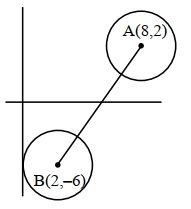
$|z_1 - (8 + 2i)| \leq 1$ is a disk centered at $A(8, 2)$ with radius $r_1 = 1$.
$|z_2 - (2 - 6i)| \leq 2$ is a disk centered at $B(2, -6)$ with radius $r_2 = 2$.
The distance between the centers $A(8, 2)$ and $B(2, -6)$ is given by the distance formula:
$d = \sqrt{(8 - 2)^2 + (2 - (-6))^2} = \sqrt{6^2 + 8^2} = \sqrt{36 + 64} = \sqrt{100} = 10$.
The minimum distance between two points $z_1$ and $z_2$ in these disks is given by $d - r_1 - r_2$.
$|z_1 - z_2|_{\text{min}} = 10 - 1 - 2 = 7$.
$|z_1 - (8 + 2i)| \leq 1$ is a disk centered at $A(8, 2)$ with radius $r_1 = 1$.
$|z_2 - (2 - 6i)| \leq 2$ is a disk centered at $B(2, -6)$ with radius $r_2 = 2$.
The distance between the centers $A(8, 2)$ and $B(2, -6)$ is given by the distance formula:
$d = \sqrt{(8 - 2)^2 + (2 - (-6))^2} = \sqrt{6^2 + 8^2} = \sqrt{36 + 64} = \sqrt{100} = 10$.
The minimum distance between two points $z_1$ and $z_2$ in these disks is given by $d - r_1 - r_2$.
$|z_1 - z_2|_{\text{min}} = 10 - 1 - 2 = 7$.
0 likes
View Solution259
DifficultMCQ
If $z_1, z_2, z_3 \in \mathbb{C}$ are the vertices of an equilateral triangle,whose centroid is $z_0$,then $\sum_{k=1}^3 (z_k - z_0)^2$ is equal to
A
$0$
B
$1$
C
$2$
D
$3$
Solution
(A) For an equilateral triangle with vertices $z_1, z_2, z_3$ and centroid $z_0$,we have the property $z_1^2 + z_2^2 + z_3^2 = z_1 z_2 + z_2 z_3 + z_3 z_1$.
Also,the centroid is given by $z_0 = \frac{z_1 + z_2 + z_3}{3}$,which implies $z_1 + z_2 + z_3 = 3z_0$.
We want to evaluate $\sum_{k=1}^3 (z_k - z_0)^2 = (z_1 - z_0)^2 + (z_2 - z_0)^2 + (z_3 - z_0)^2$.
Expanding this,we get $(z_1^2 + z_2^2 + z_3^2) - 2z_0(z_1 + z_2 + z_3) + 3z_0^2$.
Substituting $z_1 + z_2 + z_3 = 3z_0$,the expression becomes $(z_1^2 + z_2^2 + z_3^2) - 2z_0(3z_0) + 3z_0^2 = (z_1^2 + z_2^2 + z_3^2) - 3z_0^2$.
Since $z_1^2 + z_2^2 + z_3^2 = z_1 z_2 + z_2 z_3 + z_3 z_1$,and using the identity $(z_1 + z_2 + z_3)^2 = z_1^2 + z_2^2 + z_3^2 + 2(z_1 z_2 + z_2 z_3 + z_3 z_1)$,we have $(3z_0)^2 = 3(z_1^2 + z_2^2 + z_3^2)$,so $z_1^2 + z_2^2 + z_3^2 = 3z_0^2$.
Thus,the expression is $3z_0^2 - 3z_0^2 = 0$.
Also,the centroid is given by $z_0 = \frac{z_1 + z_2 + z_3}{3}$,which implies $z_1 + z_2 + z_3 = 3z_0$.
We want to evaluate $\sum_{k=1}^3 (z_k - z_0)^2 = (z_1 - z_0)^2 + (z_2 - z_0)^2 + (z_3 - z_0)^2$.
Expanding this,we get $(z_1^2 + z_2^2 + z_3^2) - 2z_0(z_1 + z_2 + z_3) + 3z_0^2$.
Substituting $z_1 + z_2 + z_3 = 3z_0$,the expression becomes $(z_1^2 + z_2^2 + z_3^2) - 2z_0(3z_0) + 3z_0^2 = (z_1^2 + z_2^2 + z_3^2) - 3z_0^2$.
Since $z_1^2 + z_2^2 + z_3^2 = z_1 z_2 + z_2 z_3 + z_3 z_1$,and using the identity $(z_1 + z_2 + z_3)^2 = z_1^2 + z_2^2 + z_3^2 + 2(z_1 z_2 + z_2 z_3 + z_3 z_1)$,we have $(3z_0)^2 = 3(z_1^2 + z_2^2 + z_3^2)$,so $z_1^2 + z_2^2 + z_3^2 = 3z_0^2$.
Thus,the expression is $3z_0^2 - 3z_0^2 = 0$.
0 likes
View Solution260
DifficultMCQ
Let $A = \{z \in \mathbb{C} : |z - 2 - i| = 3\}$, $B = \{z \in \mathbb{C} : \operatorname{Re}(z - iz) = 2\}$ and $S = A \cap B$. Then $\sum_{z \in S} |z|^2$ is equal to . . . . . . .
A
$20$
B
$21$
C
$22$
D
$23$
Solution
(C) Let $z = x + iy$.
For set $A$, $|(x - 2) + i(y - 1)| = 3$, which implies $(x - 2)^2 + (y - 1)^2 = 9$.
For set $B$, $\operatorname{Re}((x + iy) - i(x + iy)) = \operatorname{Re}((x + y) + i(y - x)) = x + y = 2$.
Substituting $y = 2 - x$ into the equation for $A$:
$(x - 2)^2 + (2 - x - 1)^2 = 9$
$(x - 2)^2 + (1 - x)^2 = 9$
$x^2 - 4x + 4 + 1 - 2x + x^2 = 9$
$2x^2 - 6x - 4 = 0 \implies x^2 - 3x - 2 = 0$.
The roots are $x = \frac{3 \pm \sqrt{17}}{2}$.
Since $y = 2 - x$, the points are $z_1 = x_1 + iy_1$ and $z_2 = x_2 + iy_2$.
$|z|^2 = x^2 + y^2 = x^2 + (2 - x)^2 = 2x^2 - 4x + 4$.
Using $x^2 = 3x + 2$, we get $|z|^2 = 2(3x + 2) - 4x + 4 = 2x + 8$.
Sum $= (2x_1 + 8) + (2x_2 + 8) = 2(x_1 + x_2) + 16$.
Since $x_1 + x_2 = 3$, Sum $= 2(3) + 16 = 22$.
For set $A$, $|(x - 2) + i(y - 1)| = 3$, which implies $(x - 2)^2 + (y - 1)^2 = 9$.
For set $B$, $\operatorname{Re}((x + iy) - i(x + iy)) = \operatorname{Re}((x + y) + i(y - x)) = x + y = 2$.
Substituting $y = 2 - x$ into the equation for $A$:
$(x - 2)^2 + (2 - x - 1)^2 = 9$
$(x - 2)^2 + (1 - x)^2 = 9$
$x^2 - 4x + 4 + 1 - 2x + x^2 = 9$
$2x^2 - 6x - 4 = 0 \implies x^2 - 3x - 2 = 0$.
The roots are $x = \frac{3 \pm \sqrt{17}}{2}$.
Since $y = 2 - x$, the points are $z_1 = x_1 + iy_1$ and $z_2 = x_2 + iy_2$.
$|z|^2 = x^2 + y^2 = x^2 + (2 - x)^2 = 2x^2 - 4x + 4$.
Using $x^2 = 3x + 2$, we get $|z|^2 = 2(3x + 2) - 4x + 4 = 2x + 8$.
Sum $= (2x_1 + 8) + (2x_2 + 8) = 2(x_1 + x_2) + 16$.
Since $x_1 + x_2 = 3$, Sum $= 2(3) + 16 = 22$.
0 likes
View Solution261
AdvancedMCQ
If the locus of $z \in \mathbb{C}$, such that $\operatorname{Re}\left(\frac{z-1}{2 z+i}\right)+\operatorname{Re}\left(\frac{\bar{z}-1}{2 \bar{z}-i}\right)=2$, is a circle of radius $r$ and center $(a, b)$, then $\frac{15 a b}{r^2}$ is equal to :
A
$24$
B
$12$
C
$18$
D
$16$
Solution
(C) Given $\operatorname{Re}\left(\frac{z-1}{2z+i}\right) + \operatorname{Re}\left(\frac{\bar{z}-1}{2\bar{z}-i}\right)=2$
Since $\operatorname{Re}(w)=\operatorname{Re}(\bar{w})$, we have
$\operatorname{Re}\left(\frac{\bar{z}-1}{2\bar{z}-i}\right)=\operatorname{Re}\left(\overline{\left(\frac{\bar{z}-1}{2\bar{z}-i}\right)}\right)=\operatorname{Re}\left(\frac{z-1}{2z+i}\right)$
Thus, $2\operatorname{Re}\left(\frac{z-1}{2z+i}\right)=2 \Rightarrow \operatorname{Re}\left(\frac{z-1}{2z+i}\right)=1$
Let $z=x+iy$. Then
$\frac{z-1}{2z+i}=\frac{(x-1)+iy}{2x+i(2y+1)}=\frac{((x-1)+iy)(2x-i(2y+1))}{4x^2+(2y+1)^2}$
Real part: $\frac{2x(x-1)+y(2y+1)}{4x^2+(2y+1)^2}=1$
$2x^2-2x+2y^2+y=4x^2+4y^2+4y+1$
$2x^2+2y^2+2x+3y+1=0$
$x^2+y^2+x+\frac{3}{2}y+\frac{1}{2}=0$
Comparing with $x^2+y^2-2ax-2by+c=0$, center is
$(a,b)=\left(-\frac{1}{2},-\frac{3}{4}\right)$
$r^2=a^2+b^2-c=\frac{1}{4}+\frac{9}{16}-\frac{1}{2}=\frac{5}{16}$
Now, $\frac{15ab}{r^2}=15\cdot\left(-\frac{1}{2}\right)\cdot\left(-\frac{3}{4}\right)\cdot\frac{16}{5}=18$
Since $\operatorname{Re}(w)=\operatorname{Re}(\bar{w})$, we have
$\operatorname{Re}\left(\frac{\bar{z}-1}{2\bar{z}-i}\right)=\operatorname{Re}\left(\overline{\left(\frac{\bar{z}-1}{2\bar{z}-i}\right)}\right)=\operatorname{Re}\left(\frac{z-1}{2z+i}\right)$
Thus, $2\operatorname{Re}\left(\frac{z-1}{2z+i}\right)=2 \Rightarrow \operatorname{Re}\left(\frac{z-1}{2z+i}\right)=1$
Let $z=x+iy$. Then
$\frac{z-1}{2z+i}=\frac{(x-1)+iy}{2x+i(2y+1)}=\frac{((x-1)+iy)(2x-i(2y+1))}{4x^2+(2y+1)^2}$
Real part: $\frac{2x(x-1)+y(2y+1)}{4x^2+(2y+1)^2}=1$
$2x^2-2x+2y^2+y=4x^2+4y^2+4y+1$
$2x^2+2y^2+2x+3y+1=0$
$x^2+y^2+x+\frac{3}{2}y+\frac{1}{2}=0$
Comparing with $x^2+y^2-2ax-2by+c=0$, center is
$(a,b)=\left(-\frac{1}{2},-\frac{3}{4}\right)$
$r^2=a^2+b^2-c=\frac{1}{4}+\frac{9}{16}-\frac{1}{2}=\frac{5}{16}$
Now, $\frac{15ab}{r^2}=15\cdot\left(-\frac{1}{2}\right)\cdot\left(-\frac{3}{4}\right)\cdot\frac{16}{5}=18$
0 likes
View Solution262
AdvancedMCQ
Let $R$ denote the set of all real numbers. Let $z_1 = 1 + 2i$ and $z_2 = 3i$ be two complex numbers,where $i = \sqrt{-1}$. Let $S = \{(x, y) \in R \times R : |x + iy - z_1| = 2|x + iy - z_2|\}$. Then which of the following statements is (are) True?
$(A) S$ is a circle with centre $\left(-\frac{1}{3}, \frac{10}{3}\right)$
$(B) S$ is a circle with centre $\left(\frac{1}{3}, \frac{8}{3}\right)$
$(C) S$ is a circle with radius $\frac{\sqrt{2}}{3}$
$(D) S$ is a circle with radius $\frac{2\sqrt{2}}{3}$
$(A) S$ is a circle with centre $\left(-\frac{1}{3}, \frac{10}{3}\right)$
$(B) S$ is a circle with centre $\left(\frac{1}{3}, \frac{8}{3}\right)$
$(C) S$ is a circle with radius $\frac{\sqrt{2}}{3}$
$(D) S$ is a circle with radius $\frac{2\sqrt{2}}{3}$
A
$B, D$
B
$A, D$
C
$C, D$
D
$B, C$
Solution
(B) Given $|x + iy - (1 + 2i)| = 2|x + iy - 3i|$.
Squaring both sides,we get $(x - 1)^2 + (y - 2)^2 = 4(x^2 + (y - 3)^2)$.
Expanding the terms: $x^2 - 2x + 1 + y^2 - 4y + 4 = 4(x^2 + y^2 - 6y + 9)$.
$x^2 + y^2 - 2x - 4y + 5 = 4x^2 + 4y^2 - 24y + 36$.
Rearranging terms: $3x^2 + 3y^2 + 2x - 20y + 31 = 0$.
Dividing by $3$: $x^2 + y^2 + \frac{2}{3}x - \frac{20}{3}y + \frac{31}{3} = 0$.
The centre is $\left(-\frac{1}{3}, \frac{10}{3}\right)$.
The radius is $\sqrt{\left(-\frac{1}{3}\right)^2 + \left(\frac{10}{3}\right)^2 - \frac{31}{3}} = \sqrt{\frac{1}{9} + \frac{100}{9} - \frac{93}{9}} = \sqrt{\frac{8}{9}} = \frac{2\sqrt{2}}{3}$.
Thus,statements $A$ and $D$ are true.
Squaring both sides,we get $(x - 1)^2 + (y - 2)^2 = 4(x^2 + (y - 3)^2)$.
Expanding the terms: $x^2 - 2x + 1 + y^2 - 4y + 4 = 4(x^2 + y^2 - 6y + 9)$.
$x^2 + y^2 - 2x - 4y + 5 = 4x^2 + 4y^2 - 24y + 36$.
Rearranging terms: $3x^2 + 3y^2 + 2x - 20y + 31 = 0$.
Dividing by $3$: $x^2 + y^2 + \frac{2}{3}x - \frac{20}{3}y + \frac{31}{3} = 0$.
The centre is $\left(-\frac{1}{3}, \frac{10}{3}\right)$.
The radius is $\sqrt{\left(-\frac{1}{3}\right)^2 + \left(\frac{10}{3}\right)^2 - \frac{31}{3}} = \sqrt{\frac{1}{9} + \frac{100}{9} - \frac{93}{9}} = \sqrt{\frac{8}{9}} = \frac{2\sqrt{2}}{3}$.
Thus,statements $A$ and $D$ are true.
0 likes
View Solution263
MediumMCQ
If $|z|=1$ and $w=\frac{z-1}{z+1}$ (where $z \neq -1$),then $\operatorname{Re}(w)$ is
A
$0$
B
$-\frac{1}{|z+1|^2}$
C
$\left|\frac{z}{z+1}\right| \cdot \frac{1}{|z+1|^2}$
D
$\frac{\sqrt{2}}{|z+1|^2}$
Solution
(A) Given $w = \frac{z-1}{z+1}$.
Since $|z|=1$,we can write $z = x+iy$ where $x^2+y^2=1$.
Then $w = \frac{(x-1)+iy}{(x+1)+iy}$.
To find the real part,multiply the numerator and denominator by the conjugate of the denominator: $(x+1)-iy$.
$w = \frac{((x-1)+iy)((x+1)-iy)}{(x+1)^2+y^2} = \frac{(x^2-1) + y^2 + i(y(x+1) - y(x-1))}{(x+1)^2+y^2}$.
$w = \frac{(x^2+y^2-1) + 2iy}{(x+1)^2+y^2}$.
Since $|z|=1$,we have $x^2+y^2=1$,so $x^2+y^2-1=0$.
Therefore,$\operatorname{Re}(w) = \frac{0}{(x+1)^2+y^2} = 0$.
Since $|z|=1$,we can write $z = x+iy$ where $x^2+y^2=1$.
Then $w = \frac{(x-1)+iy}{(x+1)+iy}$.
To find the real part,multiply the numerator and denominator by the conjugate of the denominator: $(x+1)-iy$.
$w = \frac{((x-1)+iy)((x+1)-iy)}{(x+1)^2+y^2} = \frac{(x^2-1) + y^2 + i(y(x+1) - y(x-1))}{(x+1)^2+y^2}$.
$w = \frac{(x^2+y^2-1) + 2iy}{(x+1)^2+y^2}$.
Since $|z|=1$,we have $x^2+y^2=1$,so $x^2+y^2-1=0$.
Therefore,$\operatorname{Re}(w) = \frac{0}{(x+1)^2+y^2} = 0$.
0 likes
View Solution264
EasyMCQ
The polar coordinates of the point,whose Cartesian coordinates are $(-2 \sqrt{3}, 2)$,are
A
$(4, \frac{11 \pi}{12})$
B
$(4, \frac{5 \pi}{6})$
C
$(4, \frac{3 \pi}{4})$
D
$(4, \frac{2 \pi}{3})$
Solution
(B) Given Cartesian coordinates are $(x, y) = (-2 \sqrt{3}, 2)$.
First,calculate the modulus $r$:
$r = \sqrt{x^2 + y^2} = \sqrt{(-2 \sqrt{3})^2 + (2)^2} = \sqrt{12 + 4} = \sqrt{16} = 4$.
Since the point lies in the second quadrant $(x < 0, y > 0)$,the argument $\theta$ is given by:
$\theta = \pi - \tan^{-1} \left| \frac{y}{x} \right| = \pi - \tan^{-1} \left| \frac{2}{-2 \sqrt{3}} \right| = \pi - \tan^{-1} \left( \frac{1}{\sqrt{3}} \right) = \pi - \frac{\pi}{6} = \frac{5 \pi}{6}$.
Thus,the polar coordinates are $(r, \theta) = (4, \frac{5 \pi}{6})$.
First,calculate the modulus $r$:
$r = \sqrt{x^2 + y^2} = \sqrt{(-2 \sqrt{3})^2 + (2)^2} = \sqrt{12 + 4} = \sqrt{16} = 4$.
Since the point lies in the second quadrant $(x < 0, y > 0)$,the argument $\theta$ is given by:
$\theta = \pi - \tan^{-1} \left| \frac{y}{x} \right| = \pi - \tan^{-1} \left| \frac{2}{-2 \sqrt{3}} \right| = \pi - \tan^{-1} \left( \frac{1}{\sqrt{3}} \right) = \pi - \frac{\pi}{6} = \frac{5 \pi}{6}$.
Thus,the polar coordinates are $(r, \theta) = (4, \frac{5 \pi}{6})$.
0 likes
View Solution265
MediumMCQ
The area of the triangle whose vertices are $i, \omega$ and $\omega^2$ is (Where $\omega$ is a complex cube root of unity other than $1$,$i$ is an imaginary number) . . . . . . sq.units
A
$\frac{3 \sqrt{3}}{4}$
B
$\frac{\sqrt{3}}{2}$
C
$\frac{3 \sqrt{3}}{2}$
D
$\frac{\sqrt{3}}{4}$
Solution
(D) The vertices of the triangle are $z_1 = i$,$z_2 = \omega$,and $z_3 = \omega^2$.
We know that $\omega = -\frac{1}{2} + i\frac{\sqrt{3}}{2}$ and $\omega^2 = -\frac{1}{2} - i\frac{\sqrt{3}}{2}$.
The area of a triangle with vertices $z_1, z_2, z_3$ in the Argand plane is given by $\frac{1}{2} |\text{Im}(\bar{z_1}z_2 + \bar{z_2}z_3 + \bar{z_3}z_1)|$.
Substituting the values:
$z_1 = 0 + i$,$z_2 = -\frac{1}{2} + i\frac{\sqrt{3}}{2}$,$z_3 = -\frac{1}{2} - i\frac{\sqrt{3}}{2}$.
$\bar{z_1}z_2 = (-i)(-\frac{1}{2} + i\frac{\sqrt{3}}{2}) = \frac{\sqrt{3}}{2} + i\frac{1}{2}$.
$\bar{z_2}z_3 = (-\frac{1}{2} - i\frac{\sqrt{3}}{2})(-\frac{1}{2} - i\frac{\sqrt{3}}{2}) = \frac{1}{4} - \frac{3}{4} + i\frac{\sqrt{3}}{2} = -\frac{1}{2} + i\frac{\sqrt{3}}{2}$.
$\bar{z_3}z_1 = (-\frac{1}{2} + i\frac{\sqrt{3}}{2})(i) = -\frac{\sqrt{3}}{2} - i\frac{1}{2}$.
Sum $= (\frac{\sqrt{3}}{2} - \frac{1}{2} - \frac{\sqrt{3}}{2}) + i(\frac{1}{2} + \frac{\sqrt{3}}{2} - \frac{1}{2}) = -\frac{1}{2} + i\frac{\sqrt{3}}{2}$.
The imaginary part is $\frac{\sqrt{3}}{2}$.
Area $= \frac{1}{2} |\frac{\sqrt{3}}{2}| = \frac{\sqrt{3}}{4}$ sq.units.
We know that $\omega = -\frac{1}{2} + i\frac{\sqrt{3}}{2}$ and $\omega^2 = -\frac{1}{2} - i\frac{\sqrt{3}}{2}$.
The area of a triangle with vertices $z_1, z_2, z_3$ in the Argand plane is given by $\frac{1}{2} |\text{Im}(\bar{z_1}z_2 + \bar{z_2}z_3 + \bar{z_3}z_1)|$.
Substituting the values:
$z_1 = 0 + i$,$z_2 = -\frac{1}{2} + i\frac{\sqrt{3}}{2}$,$z_3 = -\frac{1}{2} - i\frac{\sqrt{3}}{2}$.
$\bar{z_1}z_2 = (-i)(-\frac{1}{2} + i\frac{\sqrt{3}}{2}) = \frac{\sqrt{3}}{2} + i\frac{1}{2}$.
$\bar{z_2}z_3 = (-\frac{1}{2} - i\frac{\sqrt{3}}{2})(-\frac{1}{2} - i\frac{\sqrt{3}}{2}) = \frac{1}{4} - \frac{3}{4} + i\frac{\sqrt{3}}{2} = -\frac{1}{2} + i\frac{\sqrt{3}}{2}$.
$\bar{z_3}z_1 = (-\frac{1}{2} + i\frac{\sqrt{3}}{2})(i) = -\frac{\sqrt{3}}{2} - i\frac{1}{2}$.
Sum $= (\frac{\sqrt{3}}{2} - \frac{1}{2} - \frac{\sqrt{3}}{2}) + i(\frac{1}{2} + \frac{\sqrt{3}}{2} - \frac{1}{2}) = -\frac{1}{2} + i\frac{\sqrt{3}}{2}$.
The imaginary part is $\frac{\sqrt{3}}{2}$.
Area $= \frac{1}{2} |\frac{\sqrt{3}}{2}| = \frac{\sqrt{3}}{4}$ sq.units.
0 likes
View Solution266
EasyMCQ
The equation $|z+1-i|=|z-1+i|$ represents a (where $z$ is a complex number)
A
Straight line passing through the origin and the first and third quadrant.
B
Straight line passing through the origin and the second and fourth quadrant.
C
Straight line passing through the point $(1, -1)$ and having slope $-1$.
D
Straight line passing through the point $(2, 1)$ and having slope $\frac{1}{2}$.
Solution
(A) Let $z = x + iy$.
Substituting this into the equation: $|(x+1) + i(y-1)| = |(x-1) + i(y+1)|$.
Squaring both sides: $(x+1)^2 + (y-1)^2 = (x-1)^2 + (y+1)^2$.
Expanding the terms: $x^2 + 2x + 1 + y^2 - 2y + 1 = x^2 - 2x + 1 + y^2 + 2y + 1$.
Simplifying: $2x - 2y = -2x + 2y$.
$4x = 4y$,which implies $y = x$.
The equation $y = x$ represents a straight line passing through the origin and the first and third quadrants.
Substituting this into the equation: $|(x+1) + i(y-1)| = |(x-1) + i(y+1)|$.
Squaring both sides: $(x+1)^2 + (y-1)^2 = (x-1)^2 + (y+1)^2$.
Expanding the terms: $x^2 + 2x + 1 + y^2 - 2y + 1 = x^2 - 2x + 1 + y^2 + 2y + 1$.
Simplifying: $2x - 2y = -2x + 2y$.
$4x = 4y$,which implies $y = x$.
The equation $y = x$ represents a straight line passing through the origin and the first and third quadrants.
0 likes
View Solution267
MediumMCQ
The locus of the points represented by $|z+3|-|z-3|=6$,where $z$ is a complex number,is ....
A
Circle with radius $1$ unit
B
Straight line with slope $1$
C
Parabola with focus $(1,0)$
D
$A$ ray on the $x$-axis
Solution
(D) Given the equation $|z+3|-|z-3|=6$.
Let $z = x + iy$. The points $z_1 = -3$ and $z_2 = 3$ are the foci of the hyperbola.
The distance between the foci is $2c = |3 - (-3)| = 6$.
The definition of a hyperbola is $| |z - z_1| - |z - z_2| | = 2a$.
Here,$2a = 6$,so $a = 3$.
Since $2a = 2c$,the hyperbola degenerates into the line segment connecting the foci.
Specifically,for $|z+3|-|z-3|=6$,the condition $|z+3| = |z-3| + 6$ implies that $z$ must lie on the $x$-axis to the right of $3$ (i.e.,$x \ge 3$).
However,looking at the options provided,the most appropriate description for the locus defined by $|z+3|-|z-3|=6$ is a ray on the $x$-axis starting from $3$ to $\infty$.
Let $z = x + iy$. The points $z_1 = -3$ and $z_2 = 3$ are the foci of the hyperbola.
The distance between the foci is $2c = |3 - (-3)| = 6$.
The definition of a hyperbola is $| |z - z_1| - |z - z_2| | = 2a$.
Here,$2a = 6$,so $a = 3$.
Since $2a = 2c$,the hyperbola degenerates into the line segment connecting the foci.
Specifically,for $|z+3|-|z-3|=6$,the condition $|z+3| = |z-3| + 6$ implies that $z$ must lie on the $x$-axis to the right of $3$ (i.e.,$x \ge 3$).
However,looking at the options provided,the most appropriate description for the locus defined by $|z+3|-|z-3|=6$ is a ray on the $x$-axis starting from $3$ to $\infty$.
0 likes
View Solution268
MediumMCQ
If $z = x + iy$ is a complex number,then the equation $\left|\frac{z+i}{z-i}\right| = \sqrt{3}$ represents the
A
circle with centre $(0, 2)$ and radius $\sqrt{3}$
B
circle with centre $(0, -2)$ and radius $\sqrt{3}$
C
circle with centre $(0, 0)$ and radius $\sqrt{3}$
D
circle with centre $(2, 0)$ and radius $\sqrt{3}$
Solution
(A) Given $\left|\frac{z+i}{z-i}\right| = \sqrt{3}$.
Squaring both sides,we get $\frac{|z+i|^2}{|z-i|^2} = 3$.
Substituting $z = x + iy$,we have $|x + i(y+1)|^2 = 3|x + i(y-1)|^2$.
This simplifies to $x^2 + (y+1)^2 = 3(x^2 + (y-1)^2)$.
$x^2 + y^2 + 2y + 1 = 3(x^2 + y^2 - 2y + 1)$.
$x^2 + y^2 + 2y + 1 = 3x^2 + 3y^2 - 6y + 3$.
$2x^2 + 2y^2 - 8y + 2 = 0$.
Dividing by $2$,we get $x^2 + y^2 - 4y + 1 = 0$.
Completing the square for $y$: $x^2 + (y-2)^2 - 4 + 1 = 0$.
$x^2 + (y-2)^2 = 3$.
This is a circle with centre $(0, 2)$ and radius $\sqrt{3}$.
Squaring both sides,we get $\frac{|z+i|^2}{|z-i|^2} = 3$.
Substituting $z = x + iy$,we have $|x + i(y+1)|^2 = 3|x + i(y-1)|^2$.
This simplifies to $x^2 + (y+1)^2 = 3(x^2 + (y-1)^2)$.
$x^2 + y^2 + 2y + 1 = 3(x^2 + y^2 - 2y + 1)$.
$x^2 + y^2 + 2y + 1 = 3x^2 + 3y^2 - 6y + 3$.
$2x^2 + 2y^2 - 8y + 2 = 0$.
Dividing by $2$,we get $x^2 + y^2 - 4y + 1 = 0$.
Completing the square for $y$: $x^2 + (y-2)^2 - 4 + 1 = 0$.
$x^2 + (y-2)^2 = 3$.
This is a circle with centre $(0, 2)$ and radius $\sqrt{3}$.
0 likes
View Solution269
EasyMCQ
If $P(x, y)$ denotes $z = x + iy$ where $x, y \in \mathbb{R}$ and $i = \sqrt{-1}$ in the Argand plane,and $\left|\frac{z-1}{z+2i}\right| = 1$,then the locus of $P$ is
A
parabola
B
hyperbola
C
circle
D
straight line
Solution
(D) Given $\left|\frac{z-1}{z+2i}\right| = 1$.
This implies $|z-1| = |z+2i|$.
Substituting $z = x + iy$:
$|x + iy - 1| = |x + iy + 2i|$
$|(x-1) + iy| = |x + i(y+2)|$
Squaring both sides:
$(x-1)^2 + y^2 = x^2 + (y+2)^2$
$x^2 - 2x + 1 + y^2 = x^2 + y^2 + 4y + 4$
$-2x + 1 = 4y + 4$
$2x + 4y + 3 = 0$.
This is the equation of a straight line.
This implies $|z-1| = |z+2i|$.
Substituting $z = x + iy$:
$|x + iy - 1| = |x + iy + 2i|$
$|(x-1) + iy| = |x + i(y+2)|$
Squaring both sides:
$(x-1)^2 + y^2 = x^2 + (y+2)^2$
$x^2 - 2x + 1 + y^2 = x^2 + y^2 + 4y + 4$
$-2x + 1 = 4y + 4$
$2x + 4y + 3 = 0$.
This is the equation of a straight line.
0 likes
View Solution270
MediumMCQ
If $z=x+iy$ satisfies the condition $|z+1|=1$,then $z$ lies on the
A
parabola with vertex $(0,0)$
B
circle with centre $(-1,0)$ and radius $1$
C
circle with centre $(1,0)$ and radius $1$
D
$Y$-axis
Solution
(B) Given $z=x+iy$ and $|z+1|=1$.
Substituting $z=x+iy$ into the equation:
$|(x+1)+iy|=1$.
Squaring both sides,we get:
$(x+1)^2+y^2=1^2$.
This is the standard equation of a circle $(x-h)^2+(y-k)^2=r^2$,where the centre is $(h,k)=(-1,0)$ and the radius is $r=1$.
Substituting $z=x+iy$ into the equation:
$|(x+1)+iy|=1$.
Squaring both sides,we get:
$(x+1)^2+y^2=1^2$.
This is the standard equation of a circle $(x-h)^2+(y-k)^2=r^2$,where the centre is $(h,k)=(-1,0)$ and the radius is $r=1$.
0 likes
View Solution271
MediumMCQ
If $\frac{z-1}{2z+1}$ is a purely imaginary number,then the locus of $z$ represents a circle. Find its radius.
A
$\frac{9}{16}$ units
B
$\frac{3}{4}$ units
C
$\frac{1}{4}$ units
D
$\frac{1}{2}$ units
Solution
(B) Let $w = \frac{z-1}{2z+1}$. Since $w$ is purely imaginary,$w + \overline{w} = 0$.
Substituting $w$,we get $\frac{z-1}{2z+1} + \frac{\overline{z}-1}{2\overline{z}+1} = 0$.
$(z-1)(2\overline{z}+1) + (\overline{z}-1)(2z+1) = 0$.
$2z\overline{z} + z - 2\overline{z} - 1 + 2z\overline{z} + \overline{z} - 2z - 1 = 0$.
$4z\overline{z} - z - \overline{z} - 2 = 0$.
Dividing by $4$,we get $z\overline{z} - \frac{1}{4}z - \frac{1}{4}\overline{z} - \frac{1}{2} = 0$.
This is the equation of a circle in the form $z\overline{z} - \overline{\alpha}z - \alpha\overline{z} + k = 0$,where the center is $\alpha = \frac{1}{8}$ and the radius $r = \sqrt{|\alpha|^2 - k}$.
Here,$\alpha = \frac{1}{8}$ and $k = -\frac{1}{2}$.
$r = \sqrt{(\frac{1}{8})^2 - (-\frac{1}{2})} = \sqrt{\frac{1}{64} + \frac{1}{2}} = \sqrt{\frac{1+32}{64}} = \sqrt{\frac{33}{64}} = \frac{\sqrt{33}}{8}$.
Wait,re-evaluating the standard form: $z\overline{z} - \frac{1}{4}z - \frac{1}{4}\overline{z} = \frac{1}{2}$.
$(z - \frac{1}{4})(\overline{z} - \frac{1}{4}) = \frac{1}{2} + \frac{1}{16} = \frac{9}{16}$.
$|z - \frac{1}{4}|^2 = (\frac{3}{4})^2$.
Thus,the radius is $\frac{3}{4}$ units.
Substituting $w$,we get $\frac{z-1}{2z+1} + \frac{\overline{z}-1}{2\overline{z}+1} = 0$.
$(z-1)(2\overline{z}+1) + (\overline{z}-1)(2z+1) = 0$.
$2z\overline{z} + z - 2\overline{z} - 1 + 2z\overline{z} + \overline{z} - 2z - 1 = 0$.
$4z\overline{z} - z - \overline{z} - 2 = 0$.
Dividing by $4$,we get $z\overline{z} - \frac{1}{4}z - \frac{1}{4}\overline{z} - \frac{1}{2} = 0$.
This is the equation of a circle in the form $z\overline{z} - \overline{\alpha}z - \alpha\overline{z} + k = 0$,where the center is $\alpha = \frac{1}{8}$ and the radius $r = \sqrt{|\alpha|^2 - k}$.
Here,$\alpha = \frac{1}{8}$ and $k = -\frac{1}{2}$.
$r = \sqrt{(\frac{1}{8})^2 - (-\frac{1}{2})} = \sqrt{\frac{1}{64} + \frac{1}{2}} = \sqrt{\frac{1+32}{64}} = \sqrt{\frac{33}{64}} = \frac{\sqrt{33}}{8}$.
Wait,re-evaluating the standard form: $z\overline{z} - \frac{1}{4}z - \frac{1}{4}\overline{z} = \frac{1}{2}$.
$(z - \frac{1}{4})(\overline{z} - \frac{1}{4}) = \frac{1}{2} + \frac{1}{16} = \frac{9}{16}$.
$|z - \frac{1}{4}|^2 = (\frac{3}{4})^2$.
Thus,the radius is $\frac{3}{4}$ units.
0 likes
View Solution272
MediumMCQ
$A$ particle $P$ starts from the point $Z_0 = 1 + 2i$ where $i = \sqrt{-1}$. It moves first horizontally away from the origin by $5$ units and then vertically upwards parallel to the positive $y$-axis by $3$ units to reach a point $Z_1$. From $Z_1$,the particle moves $\sqrt{2}$ units in the direction of vector $\hat{i} + \hat{j}$ and then it moves through an angle $\frac{\pi}{2}$ in the anticlockwise direction on a circle with the centre at the origin to reach point $Z_2$. Then $Z_2 =$
A
$6 + 7i$
B
$-7 + 6i$
C
$-6 + 7i$
D
$7 - 6i$
Solution
(C) The initial position is $Z_0 = 1 + 2i$.
Moving $5$ units horizontally away from the origin means adding $5$ to the real part: $Z_{temp} = (1 + 5) + 2i = 6 + 2i$.
Moving $3$ units vertically upwards means adding $3$ to the imaginary part: $Z_1 = 6 + (2 + 3)i = 6 + 5i$.
From $Z_1$,the particle moves $\sqrt{2}$ units in the direction of $\hat{i} + \hat{j}$. The unit vector in this direction is $\frac{1}{\sqrt{2}}(\hat{i} + \hat{j}) = \frac{1}{\sqrt{2}} + \frac{1}{\sqrt{2}}i$. Thus,the displacement is $\sqrt{2} \times (\frac{1}{\sqrt{2}} + \frac{1}{\sqrt{2}}i) = 1 + i$.
The new position is $Z_{1.5} = (6 + 5i) + (1 + i) = 7 + 6i$.
Finally,moving through an angle $\frac{\pi}{2}$ anticlockwise on a circle centered at the origin is equivalent to multiplying by $e^{i\pi/2} = i$.
$Z_2 = (7 + 6i) \times i = 7i + 6i^2 = 7i - 6 = -6 + 7i$.
Moving $5$ units horizontally away from the origin means adding $5$ to the real part: $Z_{temp} = (1 + 5) + 2i = 6 + 2i$.
Moving $3$ units vertically upwards means adding $3$ to the imaginary part: $Z_1 = 6 + (2 + 3)i = 6 + 5i$.
From $Z_1$,the particle moves $\sqrt{2}$ units in the direction of $\hat{i} + \hat{j}$. The unit vector in this direction is $\frac{1}{\sqrt{2}}(\hat{i} + \hat{j}) = \frac{1}{\sqrt{2}} + \frac{1}{\sqrt{2}}i$. Thus,the displacement is $\sqrt{2} \times (\frac{1}{\sqrt{2}} + \frac{1}{\sqrt{2}}i) = 1 + i$.
The new position is $Z_{1.5} = (6 + 5i) + (1 + i) = 7 + 6i$.
Finally,moving through an angle $\frac{\pi}{2}$ anticlockwise on a circle centered at the origin is equivalent to multiplying by $e^{i\pi/2} = i$.
$Z_2 = (7 + 6i) \times i = 7i + 6i^2 = 7i - 6 = -6 + 7i$.
0 likes
View Solution273
DifficultMCQ
If $\left|\frac{z}{1+i}\right|=2$,where $z=x+iy$ and $i=\sqrt{-1}$ represents a circle,then the centre $C$ and radius $r$ of the circle are:
A
$C \equiv(3,0), r=4$
B
$C \equiv(6,0), r=2$
C
$C \equiv(0,3), r=8$
D
$C \equiv(0,0), r=2\sqrt{2}$
Solution
(D) Given $\left|\frac{z}{1+i}\right|=2$.
Since $|1+i| = \sqrt{1^2+1^2} = \sqrt{2}$,we have $|z| = 2|1+i| = 2\sqrt{2}$.
Substituting $z=x+iy$,we get $|x+iy| = 2\sqrt{2}$.
Squaring both sides,we get $x^2+y^2 = (2\sqrt{2})^2 = 8$.
This represents a circle $x^2+y^2 = 8$ with centre $C \equiv (0,0)$ and radius $r = \sqrt{8} = 2\sqrt{2}$.
Since $|1+i| = \sqrt{1^2+1^2} = \sqrt{2}$,we have $|z| = 2|1+i| = 2\sqrt{2}$.
Substituting $z=x+iy$,we get $|x+iy| = 2\sqrt{2}$.
Squaring both sides,we get $x^2+y^2 = (2\sqrt{2})^2 = 8$.
This represents a circle $x^2+y^2 = 8$ with centre $C \equiv (0,0)$ and radius $r = \sqrt{8} = 2\sqrt{2}$.
0 likes
View Solution274
MediumMCQ
If the complex number $z=x+iy$,where $i=\sqrt{-1}$,satisfies the condition $|z+1|=1$,then $z$ lies on
A
$X$-axis.
B
circle with centre $(1,0)$ and radius $1$ unit.
C
circle with centre $(-1,0)$ and radius $1$ unit.
D
$Y$-axis.
Solution
(C) Given the condition $|z+1|=1$.
Substitute $z=x+iy$ into the equation:
$|x+iy+1|=1$
$|(x+1)+iy|=1$
Using the definition of the modulus of a complex number $|a+ib|=\sqrt{a^2+b^2}$,we get:
$\sqrt{(x+1)^2+y^2}=1$
Squaring both sides:
$(x+1)^2+y^2=1^2$
$(x+1)^2+y^2=1$
This is the standard equation of a circle $(x-h)^2+(y-k)^2=r^2$,where the centre is $(h,k)$ and the radius is $r$.
Comparing the equations,the centre is $(-1,0)$ and the radius is $1$ unit.
Substitute $z=x+iy$ into the equation:
$|x+iy+1|=1$
$|(x+1)+iy|=1$
Using the definition of the modulus of a complex number $|a+ib|=\sqrt{a^2+b^2}$,we get:
$\sqrt{(x+1)^2+y^2}=1$
Squaring both sides:
$(x+1)^2+y^2=1^2$
$(x+1)^2+y^2=1$
This is the standard equation of a circle $(x-h)^2+(y-k)^2=r^2$,where the centre is $(h,k)$ and the radius is $r$.
Comparing the equations,the centre is $(-1,0)$ and the radius is $1$ unit.
0 likes
View Solution275
MediumMCQ
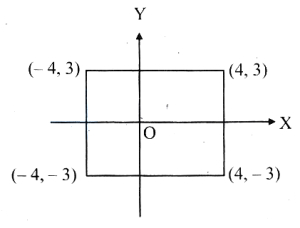
Let $z=x+iy$ be a complex number,where $x$ and $y$ are integers and $i=\sqrt{-1}$. Then the area of the rectangle whose vertices are the roots of the equation $z\bar{z}^3+\bar{z}z^3=350$ is
A
$48$
B
$32$
C
$40$
D
$80$
Solution
(A) Given,$z\bar{z}^3+\bar{z}z^3=350$
$\Rightarrow z\bar{z}(\bar{z}^2+z^2)=350$
$\Rightarrow |z|^2(x-iy)^2+(x+iy)^2=350$
$\Rightarrow (x^2+y^2)(x^2-y^2-2ixy+x^2-y^2+2ixy)=350$
$\Rightarrow (x^2+y^2)(2x^2-2y^2)=350$
$\Rightarrow 2(x^2+y^2)(x^2-y^2)=350$
$\Rightarrow x^4-y^4=175$
Since $x$ and $y$ are integers,we test values: $x^4-y^4=(x^2-y^2)(x^2+y^2)=175$.
For $x=4, y=3$: $4^4-3^4=256-81=175$.
Thus,the vertices are $(4,3), (-4,3), (-4,-3), (4,-3)$.
The length of the rectangle is $|4-(-4)|=8$ and the breadth is $|3-(-3)|=6$.
Area $= 8 \times 6 = 48 \text{ sq. units}$.
$\Rightarrow z\bar{z}(\bar{z}^2+z^2)=350$
$\Rightarrow |z|^2(x-iy)^2+(x+iy)^2=350$
$\Rightarrow (x^2+y^2)(x^2-y^2-2ixy+x^2-y^2+2ixy)=350$
$\Rightarrow (x^2+y^2)(2x^2-2y^2)=350$
$\Rightarrow 2(x^2+y^2)(x^2-y^2)=350$
$\Rightarrow x^4-y^4=175$
Since $x$ and $y$ are integers,we test values: $x^4-y^4=(x^2-y^2)(x^2+y^2)=175$.
For $x=4, y=3$: $4^4-3^4=256-81=175$.
Thus,the vertices are $(4,3), (-4,3), (-4,-3), (4,-3)$.
The length of the rectangle is $|4-(-4)|=8$ and the breadth is $|3-(-3)|=6$.
Area $= 8 \times 6 = 48 \text{ sq. units}$.
0 likes
View Solution276
DifficultMCQ
If $w = \frac{z}{z - \frac{1}{3}i}$ and $|w| = 1$,where $i = \sqrt{-1}$,then $z$ lies on
A
a circle.
B
a line.
C
a parabola.
D
an ellipse.
Solution
(B) Given $w = \frac{z}{z - \frac{1}{3}i}$.
Multiplying numerator and denominator by $3$,we get $w = \frac{3z}{3z - i}$.
Since $|w| = 1$,we have $|\frac{3z}{3z - i}| = 1$,which implies $3|z| = |3z - i|$.
Let $z = x + iy$. Then $3|x + iy| = |3x + i(3y - 1)|$.
Squaring both sides,we get $9(x^2 + y^2) = (3x)^2 + (3y - 1)^2$.
$9x^2 + 9y^2 = 9x^2 + 9y^2 - 6y + 1$.
$6y - 1 = 0$,which is the equation of a straight line.
Multiplying numerator and denominator by $3$,we get $w = \frac{3z}{3z - i}$.
Since $|w| = 1$,we have $|\frac{3z}{3z - i}| = 1$,which implies $3|z| = |3z - i|$.
Let $z = x + iy$. Then $3|x + iy| = |3x + i(3y - 1)|$.
Squaring both sides,we get $9(x^2 + y^2) = (3x)^2 + (3y - 1)^2$.
$9x^2 + 9y^2 = 9x^2 + 9y^2 - 6y + 1$.
$6y - 1 = 0$,which is the equation of a straight line.
0 likes
View Solution277
MediumMCQ
If $|z-2+i| \leq 2$,then the difference between the greatest and least value of $|z|$ is $(i=\sqrt{-1})$.
A
$2 \sqrt{5}+4$
B
$2 \sqrt{5}$
C
$4$
D
$8$
Solution
(C) Given the inequality $|z-(2-i)| \leq 2$,this represents a disk in the complex plane centered at $2-i$ with radius $r=2$.
Let $z_0 = 2-i$. The distance of the center from the origin is $|z_0| = |2-i| = \sqrt{2^2+(-1)^2} = \sqrt{5}$.
The maximum value of $|z|$ is $|z_0| + r = \sqrt{5} + 2$.
The minimum value of $|z|$ is $|z_0| - r = \sqrt{5} - 2$.
The difference between the greatest and least value is $(\sqrt{5} + 2) - (\sqrt{5} - 2) = 4$.
Let $z_0 = 2-i$. The distance of the center from the origin is $|z_0| = |2-i| = \sqrt{2^2+(-1)^2} = \sqrt{5}$.
The maximum value of $|z|$ is $|z_0| + r = \sqrt{5} + 2$.
The minimum value of $|z|$ is $|z_0| - r = \sqrt{5} - 2$.
The difference between the greatest and least value is $(\sqrt{5} + 2) - (\sqrt{5} - 2) = 4$.
0 likes
View Solution278
MediumMCQ
If the amplitude of $(z-2-3i)$ is $\frac{3\pi}{4}$,then the locus of $z$ is (where $z=x+iy$):
A
$x+y=1$
B
$x+y=5$
C
$x-y=-5$
D
$x-y=1$
Solution
(B) Given the amplitude of $(z-2-3i)$ is $\frac{3\pi}{4}$ and $z=x+iy$.
Substituting $z$,we get $(x-2) + i(y-3)$.
Since $\text{arg}((x-2) + i(y-3)) = \frac{3\pi}{4}$,we have $\tan^{-1}\left(\frac{y-3}{x-2}\right) = \frac{3\pi}{4}$.
Taking tangent on both sides,$\frac{y-3}{x-2} = \tan\left(\frac{3\pi}{4}\right) = -1$.
This implies $y-3 = -(x-2)$,which simplifies to $y-3 = -x+2$.
Therefore,$x+y=5$.
Substituting $z$,we get $(x-2) + i(y-3)$.
Since $\text{arg}((x-2) + i(y-3)) = \frac{3\pi}{4}$,we have $\tan^{-1}\left(\frac{y-3}{x-2}\right) = \frac{3\pi}{4}$.
Taking tangent on both sides,$\frac{y-3}{x-2} = \tan\left(\frac{3\pi}{4}\right) = -1$.
This implies $y-3 = -(x-2)$,which simplifies to $y-3 = -x+2$.
Therefore,$x+y=5$.
0 likes
View Solution279
EasyMCQ
In Argand's plane,the point corresponding to $\frac{(1-i \sqrt{3})(1+i)}{(\sqrt{3}+i)}$ lies in
A
quadrant $I$
B
quadrant $II$
C
quadrant $III$
D
quadrant $IV$
Solution
(D) Let $z = \frac{(1-i \sqrt{3})(1+i)}{(\sqrt{3}+i)}$.
Multiply the numerator and denominator by the conjugate of the denominator $(\sqrt{3}-i)$:
$z = \frac{(1-i \sqrt{3})(1+i)(\sqrt{3}-i)}{(\sqrt{3}+i)(\sqrt{3}-i)}$
$z = \frac{(1+i-i\sqrt{3}+\sqrt{3})(\sqrt{3}-i)}{3+1}$
$z = \frac{(1+\sqrt{3}) + i(1-\sqrt{3})}{4} \cdot (\sqrt{3}-i)$
$z = \frac{1}{4} [\sqrt{3}(1+\sqrt{3}) - i(1+\sqrt{3}) + i\sqrt{3}(1-\sqrt{3}) - i^2(1-\sqrt{3})]$
$z = \frac{1}{4} [\sqrt{3} + 3 - i - i\sqrt{3} + i\sqrt{3} - 3i + 1 - \sqrt{3}]$
$z = \frac{1}{4} [4 - 4i] = 1 - i$
The point $(1, -1)$ corresponds to $1-i$ in the Argand plane.
Since the $x$-coordinate is positive and the $y$-coordinate is negative,the point lies in the $IV^{th}$ quadrant.
Multiply the numerator and denominator by the conjugate of the denominator $(\sqrt{3}-i)$:
$z = \frac{(1-i \sqrt{3})(1+i)(\sqrt{3}-i)}{(\sqrt{3}+i)(\sqrt{3}-i)}$
$z = \frac{(1+i-i\sqrt{3}+\sqrt{3})(\sqrt{3}-i)}{3+1}$
$z = \frac{(1+\sqrt{3}) + i(1-\sqrt{3})}{4} \cdot (\sqrt{3}-i)$
$z = \frac{1}{4} [\sqrt{3}(1+\sqrt{3}) - i(1+\sqrt{3}) + i\sqrt{3}(1-\sqrt{3}) - i^2(1-\sqrt{3})]$
$z = \frac{1}{4} [\sqrt{3} + 3 - i - i\sqrt{3} + i\sqrt{3} - 3i + 1 - \sqrt{3}]$
$z = \frac{1}{4} [4 - 4i] = 1 - i$
The point $(1, -1)$ corresponds to $1-i$ in the Argand plane.
Since the $x$-coordinate is positive and the $y$-coordinate is negative,the point lies in the $IV^{th}$ quadrant.
0 likes
View Solution280
EasyMCQ
The number of solutions of the equation $z^{2}+\overline{z}=0$,where $z \in \mathbb{C}$,is
A
$1$
B
$4$
C
$5$
D
$6$
Solution
(B) Let $z = x + iy$.
Then $z^{2} = x^{2} - y^{2} + 2ixy$.
Given $z^{2} + \overline{z} = 0$,we have $(x^{2} - y^{2} + 2ixy) + (x - iy) = 0$.
Grouping real and imaginary parts: $(x^{2} + x - y^{2}) + i(2xy - y) = 0$.
Equating real and imaginary parts to zero:
$x^{2} + x - y^{2} = 0$ $(i)$
$y(2x - 1) = 0$ (ii)
From (ii),either $y = 0$ or $x = 1/2$.
Case $1$: If $y = 0$,then $x^{2} + x = 0 \Rightarrow x(x + 1) = 0$,so $x = 0$ or $x = -1$. This gives solutions $z = 0$ and $z = -1$.
Case $2$: If $x = 1/2$,then $(1/2)^{2} + 1/2 - y^{2} = 0$ $\Rightarrow 1/4 + 1/2 = y^{2}$ $\Rightarrow y^{2} = 3/4$ $\Rightarrow y = \pm \sqrt{3}/2$. This gives solutions $z = 1/2 + i\sqrt{3}/2$ and $z = 1/2 - i\sqrt{3}/2$.
Thus,there are $4$ solutions in total.
Then $z^{2} = x^{2} - y^{2} + 2ixy$.
Given $z^{2} + \overline{z} = 0$,we have $(x^{2} - y^{2} + 2ixy) + (x - iy) = 0$.
Grouping real and imaginary parts: $(x^{2} + x - y^{2}) + i(2xy - y) = 0$.
Equating real and imaginary parts to zero:
$x^{2} + x - y^{2} = 0$ $(i)$
$y(2x - 1) = 0$ (ii)
From (ii),either $y = 0$ or $x = 1/2$.
Case $1$: If $y = 0$,then $x^{2} + x = 0 \Rightarrow x(x + 1) = 0$,so $x = 0$ or $x = -1$. This gives solutions $z = 0$ and $z = -1$.
Case $2$: If $x = 1/2$,then $(1/2)^{2} + 1/2 - y^{2} = 0$ $\Rightarrow 1/4 + 1/2 = y^{2}$ $\Rightarrow y^{2} = 3/4$ $\Rightarrow y = \pm \sqrt{3}/2$. This gives solutions $z = 1/2 + i\sqrt{3}/2$ and $z = 1/2 - i\sqrt{3}/2$.
Thus,there are $4$ solutions in total.
0 likes
View Solution281
EasyMCQ
If $P(x, y)$ denotes $z = x + iy$ in the Argand plane and $\left|\frac{z-1}{z+2i}\right| = 1$,then the locus of $P$ is a/an
A
hyperbola
B
ellipse
C
circle
D
straight line
Solution
(D) Given,$z = x + iy$ and $\left|\frac{z-1}{z+2i}\right| = 1$.
Taking the modulus on both sides,we have $|z-1| = |z+2i|$.
Substituting $z = x + iy$,we get $|(x-1) + iy| = |x + i(y+2)|$.
Squaring both sides,we get $(x-1)^2 + y^2 = x^2 + (y+2)^2$.
Expanding the squares,$x^2 - 2x + 1 + y^2 = x^2 + y^2 + 4y + 4$.
Simplifying the equation,$-2x + 1 = 4y + 4$,which leads to $2x + 4y + 3 = 0$.
This is the equation of a straight line.
Taking the modulus on both sides,we have $|z-1| = |z+2i|$.
Substituting $z = x + iy$,we get $|(x-1) + iy| = |x + i(y+2)|$.
Squaring both sides,we get $(x-1)^2 + y^2 = x^2 + (y+2)^2$.
Expanding the squares,$x^2 - 2x + 1 + y^2 = x^2 + y^2 + 4y + 4$.
Simplifying the equation,$-2x + 1 = 4y + 4$,which leads to $2x + 4y + 3 = 0$.
This is the equation of a straight line.
0 likes
View Solution282
DifficultMCQ
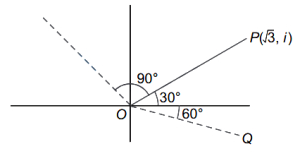
If $P$ is the point in the Argand diagram corresponding to the complex number $\sqrt{3}+i$ and if $OPQ$ is an isosceles right-angled triangle,right-angled at $O$,then $Q$ represents the complex number
A
$-1+i\sqrt{3}$ or $1-i\sqrt{3}$
B
$1 \pm i\sqrt{3}$
C
$\sqrt{3}-i$ or $1-i\sqrt{3}$
D
$-1 \pm i\sqrt{3}$
Solution
(A) Let $z = \sqrt{3}+i$. The modulus is $|z| = \sqrt{(\sqrt{3})^2 + 1^2} = 2$ and the argument is $\arg(z) = \tan^{-1}(\frac{1}{\sqrt{3}}) = 30^{\circ}$.
Since $OPQ$ is an isosceles right-angled triangle with $\angle POQ = 90^{\circ}$ and $OP = OQ$,the point $Q$ can be obtained by rotating $P$ by $90^{\circ}$ in either the clockwise or counter-clockwise direction.
If we rotate by $+90^{\circ}$,the argument of $Q$ is $30^{\circ} + 90^{\circ} = 120^{\circ}$. The complex number is $2(\cos 120^{\circ} + i\sin 120^{\circ}) = 2(-\frac{1}{2} + i\frac{\sqrt{3}}{2}) = -1 + i\sqrt{3}$.
If we rotate by $-90^{\circ}$,the argument of $Q$ is $30^{\circ} - 90^{\circ} = -60^{\circ}$. The complex number is $2(\cos(-60^{\circ}) + i\sin(-60^{\circ})) = 2(\frac{1}{2} - i\frac{\sqrt{3}}{2}) = 1 - i\sqrt{3}$.
Thus,$Q$ represents $-1+i\sqrt{3}$ or $1-i\sqrt{3}$.
Since $OPQ$ is an isosceles right-angled triangle with $\angle POQ = 90^{\circ}$ and $OP = OQ$,the point $Q$ can be obtained by rotating $P$ by $90^{\circ}$ in either the clockwise or counter-clockwise direction.
If we rotate by $+90^{\circ}$,the argument of $Q$ is $30^{\circ} + 90^{\circ} = 120^{\circ}$. The complex number is $2(\cos 120^{\circ} + i\sin 120^{\circ}) = 2(-\frac{1}{2} + i\frac{\sqrt{3}}{2}) = -1 + i\sqrt{3}$.
If we rotate by $-90^{\circ}$,the argument of $Q$ is $30^{\circ} - 90^{\circ} = -60^{\circ}$. The complex number is $2(\cos(-60^{\circ}) + i\sin(-60^{\circ})) = 2(\frac{1}{2} - i\frac{\sqrt{3}}{2}) = 1 - i\sqrt{3}$.
Thus,$Q$ represents $-1+i\sqrt{3}$ or $1-i\sqrt{3}$.
0 likes
View Solution283
EasyMCQ
If $z=x+iy$,then the equation $|z+1|=|z-1|$ represents
A
a circle
B
a parabola
C
$X$-axis
D
$Y$-axis
Solution
(D) Given,$z=x+iy$.
The equation is $|z+1|=|z-1|$.
Squaring both sides,we get $|z+1|^2 = |z-1|^2$.
Substituting $z=x+iy$,we have $|(x+1)+iy|^2 = |(x-1)+iy|^2$.
This implies $(x+1)^2 + y^2 = (x-1)^2 + y^2$.
Simplifying,$(x+1)^2 - (x-1)^2 = 0$.
Using the identity $a^2 - b^2 = (a-b)(a+b)$,we get $(x+1-x+1)(x+1+x-1) = 0$.
$(2)(2x) = 0$,which gives $4x = 0$,so $x = 0$.
The equation $x=0$ represents the $Y$-axis in the complex plane.
The equation is $|z+1|=|z-1|$.
Squaring both sides,we get $|z+1|^2 = |z-1|^2$.
Substituting $z=x+iy$,we have $|(x+1)+iy|^2 = |(x-1)+iy|^2$.
This implies $(x+1)^2 + y^2 = (x-1)^2 + y^2$.
Simplifying,$(x+1)^2 - (x-1)^2 = 0$.
Using the identity $a^2 - b^2 = (a-b)(a+b)$,we get $(x+1-x+1)(x+1+x-1) = 0$.
$(2)(2x) = 0$,which gives $4x = 0$,so $x = 0$.
The equation $x=0$ represents the $Y$-axis in the complex plane.
0 likes
View Solution284
MediumMCQ
If $\cos \alpha + 2 \cos \beta + 3 \cos \gamma = 0$,$\sin \alpha + 2 \sin \beta + 3 \sin \gamma = 0$ and $\alpha + \beta + \gamma = \pi$,then $\sin 3 \alpha + 8 \sin 3 \beta + 27 \sin 3 \gamma$ is equal to
A
$-18$
B
$0$
C
$3$
D
$9$
Solution
(B) Let $z_1 = e^{i\alpha} = \cos \alpha + i \sin \alpha$,$z_2 = e^{i\beta} = \cos \beta + i \sin \beta$,and $z_3 = e^{i\gamma} = \cos \gamma + i \sin \gamma$.
Given that $z_1 + 2z_2 + 3z_3 = (\cos \alpha + 2 \cos \beta + 3 \cos \gamma) + i(\sin \alpha + 2 \sin \beta + 3 \sin \gamma) = 0 + i(0) = 0$.
Let $x = z_1$,$y = 2z_2$,and $z = 3z_3$. Then $x + y + z = 0$.
Using the identity if $x + y + z = 0$,then $x^3 + y^3 + z^3 = 3xyz$.
Thus,$z_1^3 + (2z_2)^3 + (3z_3)^3 = 3(z_1)(2z_2)(3z_3) = 18z_1 z_2 z_3$.
Substituting the exponential forms: $e^{i3\alpha} + 8e^{i3\beta} + 27e^{i3\gamma} = 18e^{i(\alpha + \beta + \gamma)}$.
Since $\alpha + \beta + \gamma = \pi$,we have $e^{i3\alpha} + 8e^{i3\beta} + 27e^{i3\gamma} = 18e^{i\pi} = 18(\cos \pi + i \sin \pi) = -18 + 0i$.
Equating the imaginary parts,we get $\sin 3 \alpha + 8 \sin 3 \beta + 27 \sin 3 \gamma = 0$.
Given that $z_1 + 2z_2 + 3z_3 = (\cos \alpha + 2 \cos \beta + 3 \cos \gamma) + i(\sin \alpha + 2 \sin \beta + 3 \sin \gamma) = 0 + i(0) = 0$.
Let $x = z_1$,$y = 2z_2$,and $z = 3z_3$. Then $x + y + z = 0$.
Using the identity if $x + y + z = 0$,then $x^3 + y^3 + z^3 = 3xyz$.
Thus,$z_1^3 + (2z_2)^3 + (3z_3)^3 = 3(z_1)(2z_2)(3z_3) = 18z_1 z_2 z_3$.
Substituting the exponential forms: $e^{i3\alpha} + 8e^{i3\beta} + 27e^{i3\gamma} = 18e^{i(\alpha + \beta + \gamma)}$.
Since $\alpha + \beta + \gamma = \pi$,we have $e^{i3\alpha} + 8e^{i3\beta} + 27e^{i3\gamma} = 18e^{i\pi} = 18(\cos \pi + i \sin \pi) = -18 + 0i$.
Equating the imaginary parts,we get $\sin 3 \alpha + 8 \sin 3 \beta + 27 \sin 3 \gamma = 0$.
0 likes
View Solution285
MediumMCQ
If $P(x)=0$ is a polynomial equation of least degree with integer coefficients and $\sqrt{2}+\sqrt{3} i$ is one of its roots,then that equation is
A
$x^6-2 x^4+2 x^2-25=0$
B
$x^5+3 x^4+2 x^2+24=0$
C
$x^4+2 x^2+25=0$
D
$x^4-2 x^2+25=0$
Solution
(C) Let $\alpha = \sqrt{2}+\sqrt{3} i$. Since the coefficients are integers,the conjugate $\bar{\alpha} = \sqrt{2}-\sqrt{3} i$ must also be a root. Furthermore,since $\sqrt{2}$ is irrational,$-\sqrt{2}+\sqrt{3} i$ and $-\sqrt{2}-\sqrt{3} i$ must also be roots to ensure integer coefficients.
The polynomial is given by:
$(x-(\sqrt{2}+\sqrt{3} i))(x-(\sqrt{2}-\sqrt{3} i))(x-(-\sqrt{2}+\sqrt{3} i))(x-(-\sqrt{2}-\sqrt{3} i)) = 0$
Grouping the terms:
$((x-\sqrt{2})-\sqrt{3} i)((x-\sqrt{2})+\sqrt{3} i) \times ((x+\sqrt{2})-\sqrt{3} i)((x+\sqrt{2})+\sqrt{3} i) = 0$
$((x-\sqrt{2})^2 + 3)((x+\sqrt{2})^2 + 3) = 0$
$(x^2 - 2\sqrt{2}x + 2 + 3)(x^2 + 2\sqrt{2}x + 2 + 3) = 0$
$(x^2 + 5 - 2\sqrt{2}x)(x^2 + 5 + 2\sqrt{2}x) = 0$
$(x^2+5)^2 - (2\sqrt{2}x)^2 = 0$
$x^4 + 10x^2 + 25 - 8x^2 = 0$
$x^4 + 2x^2 + 25 = 0$
The polynomial is given by:
$(x-(\sqrt{2}+\sqrt{3} i))(x-(\sqrt{2}-\sqrt{3} i))(x-(-\sqrt{2}+\sqrt{3} i))(x-(-\sqrt{2}-\sqrt{3} i)) = 0$
Grouping the terms:
$((x-\sqrt{2})-\sqrt{3} i)((x-\sqrt{2})+\sqrt{3} i) \times ((x+\sqrt{2})-\sqrt{3} i)((x+\sqrt{2})+\sqrt{3} i) = 0$
$((x-\sqrt{2})^2 + 3)((x+\sqrt{2})^2 + 3) = 0$
$(x^2 - 2\sqrt{2}x + 2 + 3)(x^2 + 2\sqrt{2}x + 2 + 3) = 0$
$(x^2 + 5 - 2\sqrt{2}x)(x^2 + 5 + 2\sqrt{2}x) = 0$
$(x^2+5)^2 - (2\sqrt{2}x)^2 = 0$
$x^4 + 10x^2 + 25 - 8x^2 = 0$
$x^4 + 2x^2 + 25 = 0$
0 likes
View Solution286
MediumMCQ
If the amplitude of $(Z-2)$ is $\frac{\pi}{2}$,then the locus of $Z$ is:
A
$x=2, y>0$
B
$x=2, y < 0$
C
$x>2, y=0$
D
$x < 2, y=0$
Solution
(A) Let $Z = x + iy$.
Then $Z - 2 = (x - 2) + iy$.
The amplitude (argument) of a complex number $w = a + ib$ is $\theta = \tan^{-1}(\frac{b}{a})$.
Given $\arg(Z - 2) = \frac{\pi}{2}$,this implies that the real part must be $0$ and the imaginary part must be positive.
Therefore,$x - 2 = 0 \Rightarrow x = 2$ and $y > 0$.
Thus,the locus of $Z$ is the vertical line $x = 2$ where $y > 0$.
Then $Z - 2 = (x - 2) + iy$.
The amplitude (argument) of a complex number $w = a + ib$ is $\theta = \tan^{-1}(\frac{b}{a})$.
Given $\arg(Z - 2) = \frac{\pi}{2}$,this implies that the real part must be $0$ and the imaginary part must be positive.
Therefore,$x - 2 = 0 \Rightarrow x = 2$ and $y > 0$.
Thus,the locus of $Z$ is the vertical line $x = 2$ where $y > 0$.
0 likes
View Solution287
EasyMCQ
Let the locus of a point $z$ in the Argand plane satisfying the condition $\operatorname{Re}(z^2)=4$ be $C_1$ and the locus of $z$ satisfying the condition $\operatorname{Im}(z^2)=4$ be $C_2$. Then the number of common points of the two curves $C_1$ and $C_2$ are
A
$0$
B
$3$
C
$1$
D
$2$
Solution
(D) Let $z=x+iy$, then $z^2=(x+iy)^2 = x^2-y^2+i(2xy)$.
For $C_1$, $\operatorname{Re}(z^2)=x^2-y^2=4$ $(i)$.
For $C_2$, $\operatorname{Im}(z^2)=2xy=4 \Rightarrow xy=2$ $(ii)$.
From $(ii)$, $y=\frac{2}{x}$. Substituting into $(i)$:
$x^2 - (\frac{2}{x})^2 = 4 \Rightarrow x^2 - \frac{4}{x^2} = 4$.
Let $t=x^2$ (where $t > 0$): $t - \frac{4}{t} = 4 \Rightarrow t^2 - 4t - 4 = 0$.
Using the quadratic formula, $t = \frac{4 \pm \sqrt{16 - 4(1)(-4)}}{2} = \frac{4 \pm \sqrt{32}}{2} = 2 \pm 2\sqrt{2}$.
Since $t=x^2 > 0$, we must have $t = 2+2\sqrt{2}$.
Thus, $x^2 = 2+2\sqrt{2}$, which gives two real values for $x$ $(x = \pm \sqrt{2+2\sqrt{2}})$.
For each $x$, $y = \frac{2}{x}$ gives a unique real value for $y$.
Therefore, there are $2$ common points.
For $C_1$, $\operatorname{Re}(z^2)=x^2-y^2=4$ $(i)$.
For $C_2$, $\operatorname{Im}(z^2)=2xy=4 \Rightarrow xy=2$ $(ii)$.
From $(ii)$, $y=\frac{2}{x}$. Substituting into $(i)$:
$x^2 - (\frac{2}{x})^2 = 4 \Rightarrow x^2 - \frac{4}{x^2} = 4$.
Let $t=x^2$ (where $t > 0$): $t - \frac{4}{t} = 4 \Rightarrow t^2 - 4t - 4 = 0$.
Using the quadratic formula, $t = \frac{4 \pm \sqrt{16 - 4(1)(-4)}}{2} = \frac{4 \pm \sqrt{32}}{2} = 2 \pm 2\sqrt{2}$.
Since $t=x^2 > 0$, we must have $t = 2+2\sqrt{2}$.
Thus, $x^2 = 2+2\sqrt{2}$, which gives two real values for $x$ $(x = \pm \sqrt{2+2\sqrt{2}})$.
For each $x$, $y = \frac{2}{x}$ gives a unique real value for $y$.
Therefore, there are $2$ common points.
0 likes
View Solution288
EasyMCQ
Let the complex numbers $\alpha$ and $\left(\frac{1}{\bar{\alpha}}\right)$ lie on circles $\left(x-x_0\right)^2+\left(y-y_0\right)^2=r^2$ and $\left(x-x_0\right)^2+\left(y-y_0\right)^2=4 r^2$ respectively. If $z_0=x_0+i y_0$ satisfies the equation $2|z_0|^2=r^2+2$,then $|\alpha|=$
A
$\frac{1}{\sqrt{2}}$
B
$\frac{1}{2}$
C
$\frac{1}{\sqrt{7}}$
D
$\frac{1}{3}$
Solution
(C) As point $\alpha$ lies on the circle $\left(x-x_0\right)^2+\left(y-y_0\right)^2=r^2$,we have $|\alpha-z_0|^2=r^2$,where $z_0=x_0+iy_0$.
Expanding this,we get $|\alpha|^2+|z_0|^2-(\alpha\bar{z}_0+\bar{\alpha}z_0)=r^2 \quad \ldots (i)$
Since $\frac{1}{\bar{\alpha}}$ lies on the circle $\left(x-x_0\right)^2+\left(y-y_0\right)^2=4r^2$,we have $|\frac{1}{\bar{\alpha}}-z_0|^2=4r^2$.
Expanding this,we get $\frac{1}{|\alpha|^2}+|z_0|^2-(\frac{\alpha\bar{z}_0}{|\alpha|^2}+\frac{\bar{\alpha}z_0}{|\alpha|^2})=4r^2$.
Multiplying by $|\alpha|^2$,we get $1+|z_0|^2|\alpha|^2-(\alpha\bar{z}_0+\bar{\alpha}z_0)=4r^2|\alpha|^2 \quad \ldots (ii)$
Subtracting $(i)$ from $(ii)$,we get $(|\alpha|^2-1)|z_0|^2 - (|\alpha|^2-1) = r^2(4|\alpha|^2-1)$.
$(|\alpha|^2-1)(|z_0|^2-1) = r^2(4|\alpha|^2-1)$.
Given $2|z_0|^2=r^2+2$,we have $|z_0|^2-1 = \frac{r^2}{2}$.
Substituting this,$(|\alpha|^2-1)\frac{r^2}{2} = r^2(4|\alpha|^2-1)$.
Dividing by $r^2$ (assuming $r \neq 0$),we get $\frac{|\alpha|^2-1}{2} = 4|\alpha|^2-1$.
$|\alpha|^2-1 = 8|\alpha|^2-2$.
$7|\alpha|^2=1 \Rightarrow |\alpha|=\frac{1}{\sqrt{7}}$.
Expanding this,we get $|\alpha|^2+|z_0|^2-(\alpha\bar{z}_0+\bar{\alpha}z_0)=r^2 \quad \ldots (i)$
Since $\frac{1}{\bar{\alpha}}$ lies on the circle $\left(x-x_0\right)^2+\left(y-y_0\right)^2=4r^2$,we have $|\frac{1}{\bar{\alpha}}-z_0|^2=4r^2$.
Expanding this,we get $\frac{1}{|\alpha|^2}+|z_0|^2-(\frac{\alpha\bar{z}_0}{|\alpha|^2}+\frac{\bar{\alpha}z_0}{|\alpha|^2})=4r^2$.
Multiplying by $|\alpha|^2$,we get $1+|z_0|^2|\alpha|^2-(\alpha\bar{z}_0+\bar{\alpha}z_0)=4r^2|\alpha|^2 \quad \ldots (ii)$
Subtracting $(i)$ from $(ii)$,we get $(|\alpha|^2-1)|z_0|^2 - (|\alpha|^2-1) = r^2(4|\alpha|^2-1)$.
$(|\alpha|^2-1)(|z_0|^2-1) = r^2(4|\alpha|^2-1)$.
Given $2|z_0|^2=r^2+2$,we have $|z_0|^2-1 = \frac{r^2}{2}$.
Substituting this,$(|\alpha|^2-1)\frac{r^2}{2} = r^2(4|\alpha|^2-1)$.
Dividing by $r^2$ (assuming $r \neq 0$),we get $\frac{|\alpha|^2-1}{2} = 4|\alpha|^2-1$.
$|\alpha|^2-1 = 8|\alpha|^2-2$.
$7|\alpha|^2=1 \Rightarrow |\alpha|=\frac{1}{\sqrt{7}}$.
0 likes
View Solution289
MediumMCQ
Let $z=x+yi$,where $x, y$ are integers and $i=\sqrt{-1}$. The area of the rectangle whose vertices are the roots of the equation $\bar{z}z^3+z(\bar{z})^3=700$ is
A
$32$
B
$40$
C
$48$
D
$80$
Solution
(C) Given the equation $\bar{z}z^3+z(\bar{z})^3=700$.
Since $z=x+iy$,we have $\bar{z}=x-iy$ and $z\bar{z}=x^2+y^2$.
The equation can be written as $\bar{z}z(z^2+(\bar{z})^2)=700$.
Substituting $z=x+iy$ and $\bar{z}=x-iy$,we get $(x^2+y^2)((x+iy)^2+(x-iy)^2)=700$.
$(x^2+y^2)(x^2-y^2+2ixy+x^2-y^2-2ixy)=700$.
$(x^2+y^2)(2(x^2-y^2))=700$.
$(x^2+y^2)(x^2-y^2)=350$.
Since $x, y$ are integers,we look for factors of $350$.
We have $x^2+y^2=25$ and $x^2-y^2=14$ (not integer solutions) or $x^2+y^2=50$ and $x^2-y^2=7$ (not integer solutions).
Wait,let us re-evaluate: $x^2+y^2=25$ and $x^2-y^2=7$ gives $2x^2=32$ $\Rightarrow x^2=16$ $\Rightarrow x=\pm 4$ and $2y^2=18$ $\Rightarrow y^2=9$ $\Rightarrow y=\pm 3$.
The vertices are $(\pm 4, \pm 3)$.
The rectangle has length $2|x| = 8$ and width $2|y| = 6$.
Area $= 8 \times 6 = 48$.
Thus,option $C$ is correct.
Since $z=x+iy$,we have $\bar{z}=x-iy$ and $z\bar{z}=x^2+y^2$.
The equation can be written as $\bar{z}z(z^2+(\bar{z})^2)=700$.
Substituting $z=x+iy$ and $\bar{z}=x-iy$,we get $(x^2+y^2)((x+iy)^2+(x-iy)^2)=700$.
$(x^2+y^2)(x^2-y^2+2ixy+x^2-y^2-2ixy)=700$.
$(x^2+y^2)(2(x^2-y^2))=700$.
$(x^2+y^2)(x^2-y^2)=350$.
Since $x, y$ are integers,we look for factors of $350$.
We have $x^2+y^2=25$ and $x^2-y^2=14$ (not integer solutions) or $x^2+y^2=50$ and $x^2-y^2=7$ (not integer solutions).
Wait,let us re-evaluate: $x^2+y^2=25$ and $x^2-y^2=7$ gives $2x^2=32$ $\Rightarrow x^2=16$ $\Rightarrow x=\pm 4$ and $2y^2=18$ $\Rightarrow y^2=9$ $\Rightarrow y=\pm 3$.
The vertices are $(\pm 4, \pm 3)$.
The rectangle has length $2|x| = 8$ and width $2|y| = 6$.
Area $= 8 \times 6 = 48$.
Thus,option $C$ is correct.
0 likes
View Solution290
EasyMCQ
If $a$ and $b$ are the least and the greatest values respectively of $|z_1+z_2|$,where $z_1=12+5i$ and $|z_2|=9$,then $a^2+b^2=$
A
$468$
B
$500$
C
$250$
D
$450$
Solution
(B) Given $z_1 = 12 + 5i$ and $|z_2| = 9$.
First,calculate the modulus of $z_1$:
$|z_1| = \sqrt{12^2 + 5^2} = \sqrt{144 + 25} = \sqrt{169} = 13$.
By the triangle inequality,the range of $|z_1 + z_2|$ is given by $||z_1| - |z_2|| \leq |z_1 + z_2| \leq |z_1| + |z_2|$.
The greatest value $b = |z_1| + |z_2| = 13 + 9 = 22$.
The least value $a = ||z_1| - |z_2|| = |13 - 9| = 4$.
Therefore,$a^2 + b^2 = 4^2 + 22^2 = 16 + 484 = 500$.
First,calculate the modulus of $z_1$:
$|z_1| = \sqrt{12^2 + 5^2} = \sqrt{144 + 25} = \sqrt{169} = 13$.
By the triangle inequality,the range of $|z_1 + z_2|$ is given by $||z_1| - |z_2|| \leq |z_1 + z_2| \leq |z_1| + |z_2|$.
The greatest value $b = |z_1| + |z_2| = 13 + 9 = 22$.
The least value $a = ||z_1| - |z_2|| = |13 - 9| = 4$.
Therefore,$a^2 + b^2 = 4^2 + 22^2 = 16 + 484 = 500$.
0 likes
View Solution291
EasyMCQ
Let $z=x+iy$ and a point $P$ represent $z$ in the Argand plane. If the real part of $\frac{z-1}{z+i}$ is $1$,then a point that lies on the locus of $P$ is
A
$(2016, 2017)$
B
$(-2016, 2017)$
C
$(-2016, -2017)$
D
$(2016, -2017)$
Solution
(D) We have,$\frac{z-1}{z+i} = \frac{x+iy-1}{x+i(y+1)}$.
Multiplying the numerator and denominator by the conjugate of the denominator,$x-i(y+1)$,we get:
$\frac{(x-1)+iy}{x+i(y+1)} \times \frac{x-i(y+1)}{x-i(y+1)} = \frac{x(x-1) - i(x-1)(y+1) + ixy + y(y+1)}{x^2+(y+1)^2}$.
The real part is $\frac{x(x-1)+y(y+1)}{x^2+(y+1)^2}$.
Given that the real part is $1$,we have:
$\frac{x^2-x+y^2+y}{x^2+(y+1)^2} = 1$.
$x^2-x+y^2+y = x^2+y^2+2y+1$.
$-x+y = 2y+1$.
$x+y+1 = 0$.
Checking the options,for $(2016, -2017)$,we have $2016 + (-2017) + 1 = 2016 - 2017 + 1 = 0$.
Thus,the point $(2016, -2017)$ lies on the locus.
Multiplying the numerator and denominator by the conjugate of the denominator,$x-i(y+1)$,we get:
$\frac{(x-1)+iy}{x+i(y+1)} \times \frac{x-i(y+1)}{x-i(y+1)} = \frac{x(x-1) - i(x-1)(y+1) + ixy + y(y+1)}{x^2+(y+1)^2}$.
The real part is $\frac{x(x-1)+y(y+1)}{x^2+(y+1)^2}$.
Given that the real part is $1$,we have:
$\frac{x^2-x+y^2+y}{x^2+(y+1)^2} = 1$.
$x^2-x+y^2+y = x^2+y^2+2y+1$.
$-x+y = 2y+1$.
$x+y+1 = 0$.
Checking the options,for $(2016, -2017)$,we have $2016 + (-2017) + 1 = 2016 - 2017 + 1 = 0$.
Thus,the point $(2016, -2017)$ lies on the locus.
0 likes
View Solution292
EasyMCQ
If $z = x + iy$ and $z^2 = (i \bar{z})^2$,then
A
$y = \pm \frac{x}{\sqrt{3}}$
B
$y = \pm x$
C
$y = \pm \frac{x}{2}$
D
$x = 0, y = \pm 1$
Solution
(B) Given $z = x + iy$,then $\bar{z} = x - iy$.
Given the equation $z^2 = (i \bar{z})^2$.
Expanding both sides: $z^2 = i^2 (\bar{z})^2$.
Since $i^2 = -1$,we have $z^2 = -(\bar{z})^2$,which implies $z^2 + (\bar{z})^2 = 0$.
Substitute $z = x + iy$ and $\bar{z} = x - iy$:
$(x + iy)^2 + (x - iy)^2 = 0$.
$(x^2 - y^2 + 2ixy) + (x^2 - y^2 - 2ixy) = 0$.
$2(x^2 - y^2) = 0$.
$x^2 - y^2 = 0$.
$x^2 = y^2$,which means $y = \pm x$.
Given the equation $z^2 = (i \bar{z})^2$.
Expanding both sides: $z^2 = i^2 (\bar{z})^2$.
Since $i^2 = -1$,we have $z^2 = -(\bar{z})^2$,which implies $z^2 + (\bar{z})^2 = 0$.
Substitute $z = x + iy$ and $\bar{z} = x - iy$:
$(x + iy)^2 + (x - iy)^2 = 0$.
$(x^2 - y^2 + 2ixy) + (x^2 - y^2 - 2ixy) = 0$.
$2(x^2 - y^2) = 0$.
$x^2 - y^2 = 0$.
$x^2 = y^2$,which means $y = \pm x$.
0 likes
View Solution293
DifficultMCQ
Let $A$ and $B$ represent $z_1$ and $z_2$ in the Argand plane and $z_1, z_2$ be the roots of the equation $Z^2+pZ+q=0$,where $p, q$ are complex numbers. If $O$ is the origin,$OA=OB$ and $\angle AOB=\alpha$,then $p^2=$
A
$2q \cos \left(\frac{\alpha}{2}\right)$
B
$4q \cos \left(\frac{\alpha}{2}\right)$
C
$4q \cos^2 \left(\frac{\alpha}{2}\right)$
D
$4q^2 \cos^2 \left(\frac{\alpha}{2}\right)$
Solution
(C) Given that $z_1$ and $z_2$ are roots of $Z^2+pZ+q=0$,we have $z_1+z_2 = -p$ and $z_1z_2 = q$.
Since $OA=OB$,we have $|z_1| = |z_2|$.
Let $z_1 = re^{i\theta_1}$ and $z_2 = re^{i\theta_2}$.
Given $\angle AOB = \alpha$,we have $|\theta_1 - \theta_2| = \alpha$.
Then $z_1/z_2 = e^{i(\theta_1-\theta_2)} = e^{\pm i\alpha}$.
From $z_1+z_2 = -p$,we have $p^2 = (z_1+z_2)^2 = z_1^2 + z_2^2 + 2z_1z_2$.
Also $p^2 - 4q = (z_1+z_2)^2 - 4z_1z_2 = (z_1-z_2)^2$.
Thus $p^2 = 4q + (z_1-z_2)^2 = 4q + z_2^2(z_1/z_2 - 1)^2$.
Using $z_1/z_2 = e^{i\alpha}$,we get $p^2 = 4q + z_2^2(e^{i\alpha}-1)^2 = 4q + z_2^2 e^{i\alpha}(e^{i\alpha/2} - e^{-i\alpha/2})^2$.
Since $z_1z_2 = q$,$z_2^2 e^{i\alpha} = z_2^2 (z_1/z_2) = z_1z_2 = q$.
So $p^2 = 4q + q(2i \sin(\alpha/2))^2 = 4q - 4q \sin^2(\alpha/2) = 4q(1-\sin^2(\alpha/2)) = 4q \cos^2(\alpha/2)$.
Since $OA=OB$,we have $|z_1| = |z_2|$.
Let $z_1 = re^{i\theta_1}$ and $z_2 = re^{i\theta_2}$.
Given $\angle AOB = \alpha$,we have $|\theta_1 - \theta_2| = \alpha$.
Then $z_1/z_2 = e^{i(\theta_1-\theta_2)} = e^{\pm i\alpha}$.
From $z_1+z_2 = -p$,we have $p^2 = (z_1+z_2)^2 = z_1^2 + z_2^2 + 2z_1z_2$.
Also $p^2 - 4q = (z_1+z_2)^2 - 4z_1z_2 = (z_1-z_2)^2$.
Thus $p^2 = 4q + (z_1-z_2)^2 = 4q + z_2^2(z_1/z_2 - 1)^2$.
Using $z_1/z_2 = e^{i\alpha}$,we get $p^2 = 4q + z_2^2(e^{i\alpha}-1)^2 = 4q + z_2^2 e^{i\alpha}(e^{i\alpha/2} - e^{-i\alpha/2})^2$.
Since $z_1z_2 = q$,$z_2^2 e^{i\alpha} = z_2^2 (z_1/z_2) = z_1z_2 = q$.
So $p^2 = 4q + q(2i \sin(\alpha/2))^2 = 4q - 4q \sin^2(\alpha/2) = 4q(1-\sin^2(\alpha/2)) = 4q \cos^2(\alpha/2)$.
0 likes
View Solution294
DifficultMCQ
If $a$ and $c$ are complex numbers and $b$ is a real number in the Argand plane,then the perpendicular distance from $c$ to the line $a \bar{z} + \bar{a} z + b = 0$ is
A
$\frac{|a \bar{c} + \bar{a} c + b|}{2|a|}$
B
$\frac{|\bar{a} \bar{c} + a c + b|}{2|a|}$
C
$\frac{|a \bar{c} + \bar{a} c + b|}{|a|}$
D
$\frac{|\bar{a} + b + \bar{c}|}{2|a|}$
Solution
(A) The equation of the line in the Argand plane is given by $a \bar{z} + \bar{a} z + b = 0$.
Let $z = x + iy$ and $a = \alpha + i\beta$.
The equation can be rewritten as $a \bar{z} + \overline{a \bar{z}} + b = 0$,which is $2 \text{Re}(a \bar{z}) + b = 0$.
This represents a line in the complex plane.
The perpendicular distance $d$ from a point $z_0$ to the line $a \bar{z} + \bar{a} z + b = 0$ is given by the formula $d = \frac{|a \bar{z_0} + \bar{a} z_0 + b|}{2|a|}$.
Substituting $z_0 = c$,we get the distance $d = \frac{|a \bar{c} + \bar{a} c + b|}{2|a|}$.
Let $z = x + iy$ and $a = \alpha + i\beta$.
The equation can be rewritten as $a \bar{z} + \overline{a \bar{z}} + b = 0$,which is $2 \text{Re}(a \bar{z}) + b = 0$.
This represents a line in the complex plane.
The perpendicular distance $d$ from a point $z_0$ to the line $a \bar{z} + \bar{a} z + b = 0$ is given by the formula $d = \frac{|a \bar{z_0} + \bar{a} z_0 + b|}{2|a|}$.
Substituting $z_0 = c$,we get the distance $d = \frac{|a \bar{c} + \bar{a} c + b|}{2|a|}$.
0 likes
View Solution295
DifficultMCQ
If $z, iz$ and $z+iz$ are the vertices of a triangle and if $|z|=4$,then the area (in sq. units) of that triangle is:
A
$4$
B
$8$
C
$16$
D
$32$
Solution
(B) Let $z = x + iy$. Then $|z| = \sqrt{x^2 + y^2} = 4$,so $x^2 + y^2 = 16$.
The vertices of the triangle are $A = z$,$B = iz$,and $C = z + iz$.
Note that $C - A = iz$ and $C - B = z$.
The vectors representing the sides $AC$ and $BC$ are $iz$ and $z$ respectively.
The area of the triangle formed by complex numbers $z_1, z_2, z_3$ is given by $\frac{1}{2} |\text{Im}(\bar{z_1}z_2 + \bar{z_2}z_3 + \bar{z_3}z_1)|$.
Alternatively,since the triangle is formed by $z, iz$,and $z+iz$,it is a right-angled triangle with vertices at the origin $O(0,0)$,$A(z)$,and $B(iz)$ if we consider the triangle $OAB$ where $O, z, z+iz$ form a triangle with base $|z|$ and height $|iz|$.
Actually,the vertices are $z, iz, z+iz$. This is a right-angled triangle because the vector $z$ and $iz$ are perpendicular.
The lengths of the two legs are $|z|$ and $|iz|$.
Since $|iz| = |i||z| = |z| = 4$,the area is $\frac{1}{2} \times |z| \times |iz| = \frac{1}{2} \times 4 \times 4 = 8$ sq. units.
The vertices of the triangle are $A = z$,$B = iz$,and $C = z + iz$.
Note that $C - A = iz$ and $C - B = z$.
The vectors representing the sides $AC$ and $BC$ are $iz$ and $z$ respectively.
The area of the triangle formed by complex numbers $z_1, z_2, z_3$ is given by $\frac{1}{2} |\text{Im}(\bar{z_1}z_2 + \bar{z_2}z_3 + \bar{z_3}z_1)|$.
Alternatively,since the triangle is formed by $z, iz$,and $z+iz$,it is a right-angled triangle with vertices at the origin $O(0,0)$,$A(z)$,and $B(iz)$ if we consider the triangle $OAB$ where $O, z, z+iz$ form a triangle with base $|z|$ and height $|iz|$.
Actually,the vertices are $z, iz, z+iz$. This is a right-angled triangle because the vector $z$ and $iz$ are perpendicular.
The lengths of the two legs are $|z|$ and $|iz|$.
Since $|iz| = |i||z| = |z| = 4$,the area is $\frac{1}{2} \times |z| \times |iz| = \frac{1}{2} \times 4 \times 4 = 8$ sq. units.
0 likes
View Solution296
DifficultMCQ
If a complex number $z$ satisfies $|z^2-1|=|z|^2+1$,then $z$ lies on
A
the real axis
B
the imaginary axis
C
$y=x$
D
a circle
Solution
(B) Given,$|z^2-1|=|z|^2+1$. \\ Let $z=x+iy$. \\ Then,$|(x+iy)^2-1| = |x+iy|^2+1$. \\ $|x^2-y^2+2ixy-1| = x^2+y^2+1$. \\ $|(x^2-y^2-1)+i(2xy)| = x^2+y^2+1$. \\ Squaring both sides,we get: \\ $(x^2-y^2-1)^2 + (2xy)^2 = (x^2+y^2+1)^2$. \\ $(x^2-y^2)^2 + 1 - 2(x^2-y^2) + 4x^2y^2 = (x^2+y^2)^2 + 1 + 2(x^2+y^2)$. \\ $x^4+y^4-2x^2y^2 + 1 - 2x^2+2y^2 + 4x^2y^2 = x^4+y^4+2x^2y^2 + 1 + 2x^2+2y^2$. \\ $x^4+y^4+2x^2y^2 + 1 - 2x^2+2y^2 = x^4+y^4+2x^2y^2 + 1 + 2x^2+2y^2$. \\ Simplifying the equation: \\ $-2x^2 = 2x^2$. \\ $4x^2 = 0 \implies x=0$. \\ Since $x=0$,the real part of $z$ is $0$,which means $z$ lies on the imaginary axis.
0 likes
View Solution297
MediumMCQ
For any two non-zero complex numbers $z_1$ and $z_2$, if $|z_1+z_2|^2=|z_1|^2+|z_2|^2$, then
A
$\operatorname{Re}\left(\frac{z_1}{z_2}\right)=0$
B
$\operatorname{Im}\left(\frac{z_1}{z_2}\right)=0$
C
$\operatorname{Re}\left(z_1 z_2\right)=0$
D
$\operatorname{Im}\left(z_1 z_2\right)=0$
Solution
(A) We are given $|z_1+z_2|^2 = |z_1|^2 + |z_2|^2$.
Using the property $|z|^2 = z \bar{z}$, we can write:
$(z_1+z_2)(\bar{z_1}+\bar{z_2}) = z_1 \bar{z_1} + z_2 \bar{z_2}$.
Expanding the left side:
$z_1 \bar{z_1} + z_1 \bar{z_2} + z_2 \bar{z_1} + z_2 \bar{z_2} = z_1 \bar{z_1} + z_2 \bar{z_2}$.
Subtracting $|z_1|^2$ and $|z_2|^2$ from both sides, we get:
$z_1 \bar{z_2} + z_2 \bar{z_1} = 0$.
This can be written as $z_1 \bar{z_2} + \overline{z_1 \bar{z_2}} = 0$.
Since $z + \bar{z} = 2 \operatorname{Re}(z)$, we have $2 \operatorname{Re}(z_1 \bar{z_2}) = 0$, which implies $\operatorname{Re}(z_1 \bar{z_2}) = 0$.
Dividing by $|z_2|^2$, we get $\operatorname{Re}\left(\frac{z_1 \bar{z_2}}{z_2 \bar{z_2}}\right) = 0$, which simplifies to $\operatorname{Re}\left(\frac{z_1}{z_2}\right) = 0$.
Using the property $|z|^2 = z \bar{z}$, we can write:
$(z_1+z_2)(\bar{z_1}+\bar{z_2}) = z_1 \bar{z_1} + z_2 \bar{z_2}$.
Expanding the left side:
$z_1 \bar{z_1} + z_1 \bar{z_2} + z_2 \bar{z_1} + z_2 \bar{z_2} = z_1 \bar{z_1} + z_2 \bar{z_2}$.
Subtracting $|z_1|^2$ and $|z_2|^2$ from both sides, we get:
$z_1 \bar{z_2} + z_2 \bar{z_1} = 0$.
This can be written as $z_1 \bar{z_2} + \overline{z_1 \bar{z_2}} = 0$.
Since $z + \bar{z} = 2 \operatorname{Re}(z)$, we have $2 \operatorname{Re}(z_1 \bar{z_2}) = 0$, which implies $\operatorname{Re}(z_1 \bar{z_2}) = 0$.
Dividing by $|z_2|^2$, we get $\operatorname{Re}\left(\frac{z_1 \bar{z_2}}{z_2 \bar{z_2}}\right) = 0$, which simplifies to $\operatorname{Re}\left(\frac{z_1}{z_2}\right) = 0$.
0 likes
View Solution298
MediumMCQ
If $z$ and $\omega$ are two non-zero complex numbers such that $|z \omega|=1$ and $\operatorname{Arg}(z) - \operatorname{Arg}(\omega) = \frac{\pi}{2}$,then $\bar{z} \omega =$
A
$i$
B
$-1$
C
$1$
D
$-i$
Solution
(D) Given that $|z \omega| = 1$,we have $|z| |\omega| = 1$.
Also,$\operatorname{Arg}(z) - \operatorname{Arg}(\omega) = \frac{\pi}{2}$,which implies $\operatorname{Arg}(\frac{z}{\omega}) = \frac{\pi}{2}$.
Let $z = r_1 e^{i \theta_1}$ and $\omega = r_2 e^{i \theta_2}$.
Then $|z| = r_1$ and $|\omega| = r_2$,so $r_1 r_2 = 1$.
$\operatorname{Arg}(z) = \theta_1$ and $\operatorname{Arg}(\omega) = \theta_2$,so $\theta_1 - \theta_2 = \frac{\pi}{2}$.
We need to find $\bar{z} \omega$.
$\bar{z} = r_1 e^{-i \theta_1}$.
$\bar{z} \omega = (r_1 e^{-i \theta_1}) (r_2 e^{i \theta_2}) = (r_1 r_2) e^{i(\theta_2 - \theta_1)}$.
Since $r_1 r_2 = 1$ and $\theta_2 - \theta_1 = -\frac{\pi}{2}$,we have:
$\bar{z} \omega = 1 \cdot e^{-i \frac{\pi}{2}} = \cos(-\frac{\pi}{2}) + i \sin(-\frac{\pi}{2}) = 0 - i = -i$.
Also,$\operatorname{Arg}(z) - \operatorname{Arg}(\omega) = \frac{\pi}{2}$,which implies $\operatorname{Arg}(\frac{z}{\omega}) = \frac{\pi}{2}$.
Let $z = r_1 e^{i \theta_1}$ and $\omega = r_2 e^{i \theta_2}$.
Then $|z| = r_1$ and $|\omega| = r_2$,so $r_1 r_2 = 1$.
$\operatorname{Arg}(z) = \theta_1$ and $\operatorname{Arg}(\omega) = \theta_2$,so $\theta_1 - \theta_2 = \frac{\pi}{2}$.
We need to find $\bar{z} \omega$.
$\bar{z} = r_1 e^{-i \theta_1}$.
$\bar{z} \omega = (r_1 e^{-i \theta_1}) (r_2 e^{i \theta_2}) = (r_1 r_2) e^{i(\theta_2 - \theta_1)}$.
Since $r_1 r_2 = 1$ and $\theta_2 - \theta_1 = -\frac{\pi}{2}$,we have:
$\bar{z} \omega = 1 \cdot e^{-i \frac{\pi}{2}} = \cos(-\frac{\pi}{2}) + i \sin(-\frac{\pi}{2}) = 0 - i = -i$.
0 likes
View Solution4-1.Complex numbers — Geometry of complex numbers · Frequently Asked Questions
1Are these 4-1.Complex numbers questions useful for JEE and NEET?
Yes. All questions in this section are mapped to JEE Main and NEET exam patterns. Previous year questions from JEE Main, NEET, GUJCET and state-level exams are included with full solutions.
2Can I switch to Hindi or Gujarati for these questions?
Yes. Use the language tabs in the hero section or the sidebar to view the same questions and solutions in English, Hindi or Gujarati.
3How do I generate a question paper from this subtopic?
Use the Vedclass Exam Paper Generator — select the chapter and subtopic, set difficulty, and generate Sets A, B, C, D automatically. First 3 chapters of every subject are free.
Vedclass Products
For Students
Vedclass Test Series
Mock tests in real JEE/NEET style with performance analysis. 5-day free trial.
Start Free TrialFor Teachers
Exam Paper Generator
Generate Set A/B/C/D papers from this chapter in 2 minutes. 3 chapters free.
Try FreeFor Institutes
Online Exam Module
Live online exams with unlimited students, 360° analytics & white-label branding.
See DemoFor Teachers & Institutes
Generate a 4-1.Complex numbers Exam Paper in 2 Minutes
Select subtopic & difficulty — Sets A, B, C, D auto-generated with No Repeat logic.
First 3 chapters of every subject are free — no payment required.