
A English
Hyperbola Questions in English
Class 11 Mathematics · 10-2. Parabola, Ellipse, Hyperbola · Hyperbola
593+
Questions
English
Language
100%
With Solutions
Showing 50 of 593 questions in English
201
AdvancedMCQ
The length of the latus rectum of the hyperbola $\frac{x^2}{\cos^2 \alpha} - \frac{y^2}{\sin^2 \alpha} = 4$ is (where $\alpha \neq \frac{n\pi}{2}, n \in I$).
A
$2\left| \frac{1 - \cos 2\alpha}{\cos \alpha} \right|$
B
$\left| \frac{1 + \cos 2\alpha}{\sin \alpha} \right|$
C
$2\left| \frac{1 + \cos 2\alpha}{\sin \alpha} \right|$
D
$\left| \frac{1 - \cos 2\alpha}{\cos \alpha} \right|$
Solution
(A) The given equation of the hyperbola is $\frac{x^2}{\cos^2 \alpha} - \frac{y^2}{\sin^2 \alpha} = 4$.
Dividing by $4$,we get $\frac{x^2}{4\cos^2 \alpha} - \frac{y^2}{4\sin^2 \alpha} = 1$.
Comparing this with the standard form $\frac{x^2}{a^2} - \frac{y^2}{b^2} = 1$,we have $a^2 = 4\cos^2 \alpha$ and $b^2 = 4\sin^2 \alpha$.
Thus,$a = 2|\cos \alpha|$ and $b = 2|\sin \alpha|$.
The length of the latus rectum is given by $LR = \frac{2b^2}{a}$.
Substituting the values,$LR = \frac{2(4\sin^2 \alpha)}{2|\cos \alpha|} = \frac{4\sin^2 \alpha}{|\cos \alpha|}$.
Using the identity $2\sin^2 \alpha = 1 - \cos 2\alpha$,we get $LR = \frac{2(1 - \cos 2\alpha)}{|\cos \alpha|} = 2\left| \frac{1 - \cos 2\alpha}{\cos \alpha} \right|$.
Dividing by $4$,we get $\frac{x^2}{4\cos^2 \alpha} - \frac{y^2}{4\sin^2 \alpha} = 1$.
Comparing this with the standard form $\frac{x^2}{a^2} - \frac{y^2}{b^2} = 1$,we have $a^2 = 4\cos^2 \alpha$ and $b^2 = 4\sin^2 \alpha$.
Thus,$a = 2|\cos \alpha|$ and $b = 2|\sin \alpha|$.
The length of the latus rectum is given by $LR = \frac{2b^2}{a}$.
Substituting the values,$LR = \frac{2(4\sin^2 \alpha)}{2|\cos \alpha|} = \frac{4\sin^2 \alpha}{|\cos \alpha|}$.
Using the identity $2\sin^2 \alpha = 1 - \cos 2\alpha$,we get $LR = \frac{2(1 - \cos 2\alpha)}{|\cos \alpha|} = 2\left| \frac{1 - \cos 2\alpha}{\cos \alpha} \right|$.
0 likes
View Solution202
AdvancedMCQ
The equations of the tangents to the hyperbola $4x^2 - y^2 = 12$ are $y = 4x + c_1$ and $y = 4x + c_2$. Then $|c_1 - c_2|$ is equal to -
A
$1$
B
$4$
C
$6$
D
$12$
Solution
(D) The given hyperbola is $4x^2 - y^2 = 12$,which can be written as $\frac{x^2}{3} - \frac{y^2}{12} = 1$.
Here,$a^2 = 3$ and $b^2 = 12$.
The equation of a tangent with slope $m$ to the hyperbola $\frac{x^2}{a^2} - \frac{y^2}{b^2} = 1$ is given by $y = mx \pm \sqrt{a^2m^2 - b^2}$.
Given the slope $m = 4$,we substitute the values:
$c = \pm \sqrt{3(4)^2 - 12} = \pm \sqrt{3(16) - 12} = \pm \sqrt{48 - 12} = \pm \sqrt{36} = \pm 6$.
Thus,the equations are $y = 4x + 6$ and $y = 4x - 6$,so $c_1 = 6$ and $c_2 = -6$.
Therefore,$|c_1 - c_2| = |6 - (-6)| = |12| = 12$.
Here,$a^2 = 3$ and $b^2 = 12$.
The equation of a tangent with slope $m$ to the hyperbola $\frac{x^2}{a^2} - \frac{y^2}{b^2} = 1$ is given by $y = mx \pm \sqrt{a^2m^2 - b^2}$.
Given the slope $m = 4$,we substitute the values:
$c = \pm \sqrt{3(4)^2 - 12} = \pm \sqrt{3(16) - 12} = \pm \sqrt{48 - 12} = \pm \sqrt{36} = \pm 6$.
Thus,the equations are $y = 4x + 6$ and $y = 4x - 6$,so $c_1 = 6$ and $c_2 = -6$.
Therefore,$|c_1 - c_2| = |6 - (-6)| = |12| = 12$.
0 likes
View Solution203
AdvancedMCQ
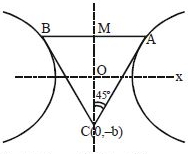
Let tangents drawn from point $C(0,-b)$ to the hyperbola $\frac{x^2}{a^2} - \frac{y^2}{b^2} = 1$ touch the hyperbola at points $A$ and $B$. If $\Delta ABC$ is a right-angled triangle,then $\frac{a^2}{b^2}$ is equal to -
A
$1$
B
$\frac{1}{2}$
C
$2$
D
$\frac{3}{2}$
Solution
(C) The equation of the tangent to the hyperbola $\frac{x^2}{a^2} - \frac{y^2}{b^2} = 1$ at point $(x_1, y_1)$ is $\frac{xx_1}{a^2} - \frac{yy_1}{b^2} = 1$.
Since the tangent passes through $C(0, -b)$,we have $\frac{0 \cdot x_1}{a^2} - \frac{(-b)y_1}{b^2} = 1$,which simplifies to $\frac{y_1}{b} = 1$,so $y_1 = b$.
Substituting $y_1 = b$ into the hyperbola equation: $\frac{x_1^2}{a^2} - \frac{b^2}{b^2} = 1$ $\Rightarrow \frac{x_1^2}{a^2} = 2$ $\Rightarrow x_1 = \pm a\sqrt{2}$.
Thus,the points of contact are $A(a\sqrt{2}, b)$ and $B(-a\sqrt{2}, b)$.
The triangle $\Delta ABC$ has vertices $C(0, -b)$,$A(a\sqrt{2}, b)$,and $B(-a\sqrt{2}, b)$.
The length of the base $AB$ is $2a\sqrt{2}$. The height of the triangle from $C$ to $AB$ is $h = b - (-b) = 2b$.
For $\Delta ABC$ to be a right-angled triangle,the angle at $C$ must be $90^{\circ}$ (since $AB$ is horizontal and $C$ lies on the $y$-axis,the triangle is isosceles with $CA=CB$).
If $\angle ACB = 90^{\circ}$,then the slope of $CA$ is $m_1 = \frac{b - (-b)}{a\sqrt{2} - 0} = \frac{2b}{a\sqrt{2}} = \frac{b\sqrt{2}}{a}$.
The slope of $CB$ is $m_2 = \frac{b - (-b)}{-a\sqrt{2} - 0} = -\frac{b\sqrt{2}}{a}$.
Since $m_1 \cdot m_2 = -1$,we have $-(\frac{b\sqrt{2}}{a})^2 = -1$ $\Rightarrow \frac{2b^2}{a^2} = 1$ $\Rightarrow \frac{a^2}{b^2} = 2$.
Since the tangent passes through $C(0, -b)$,we have $\frac{0 \cdot x_1}{a^2} - \frac{(-b)y_1}{b^2} = 1$,which simplifies to $\frac{y_1}{b} = 1$,so $y_1 = b$.
Substituting $y_1 = b$ into the hyperbola equation: $\frac{x_1^2}{a^2} - \frac{b^2}{b^2} = 1$ $\Rightarrow \frac{x_1^2}{a^2} = 2$ $\Rightarrow x_1 = \pm a\sqrt{2}$.
Thus,the points of contact are $A(a\sqrt{2}, b)$ and $B(-a\sqrt{2}, b)$.
The triangle $\Delta ABC$ has vertices $C(0, -b)$,$A(a\sqrt{2}, b)$,and $B(-a\sqrt{2}, b)$.
The length of the base $AB$ is $2a\sqrt{2}$. The height of the triangle from $C$ to $AB$ is $h = b - (-b) = 2b$.
For $\Delta ABC$ to be a right-angled triangle,the angle at $C$ must be $90^{\circ}$ (since $AB$ is horizontal and $C$ lies on the $y$-axis,the triangle is isosceles with $CA=CB$).
If $\angle ACB = 90^{\circ}$,then the slope of $CA$ is $m_1 = \frac{b - (-b)}{a\sqrt{2} - 0} = \frac{2b}{a\sqrt{2}} = \frac{b\sqrt{2}}{a}$.
The slope of $CB$ is $m_2 = \frac{b - (-b)}{-a\sqrt{2} - 0} = -\frac{b\sqrt{2}}{a}$.
Since $m_1 \cdot m_2 = -1$,we have $-(\frac{b\sqrt{2}}{a})^2 = -1$ $\Rightarrow \frac{2b^2}{a^2} = 1$ $\Rightarrow \frac{a^2}{b^2} = 2$.
0 likes
View Solution204
AdvancedMCQ
If $(a - 2)x^2 + ay^2 = 4$ represents a rectangular hyperbola,then $a$ equals:
A
$0$
B
$2$
C
$1$
D
$3$
Solution
(C) The given equation is $(a - 2)x^2 + ay^2 = 4$.
Dividing by $4$,we get $\frac{x^2}{\frac{4}{a-2}} + \frac{y^2}{\frac{4}{a}} = 1$.
For a hyperbola,the coefficients of $x^2$ and $y^2$ must have opposite signs. Let the equation be in the form $\frac{x^2}{A^2} - \frac{y^2}{B^2} = 1$ or $\frac{y^2}{A^2} - \frac{x^2}{B^2} = 1$.
For a rectangular hyperbola,the magnitudes of the semi-axes must be equal,i.e.,$A^2 = B^2$.
Here,the equation is $\frac{x^2}{\frac{4}{a-2}} - \frac{y^2}{-\frac{4}{a}} = 1$.
Equating the denominators: $\frac{4}{a-2} = -\frac{4}{a}$.
$a = -(a - 2)$.
$a = -a + 2$.
$2a = 2$.
$a = 1$.
Dividing by $4$,we get $\frac{x^2}{\frac{4}{a-2}} + \frac{y^2}{\frac{4}{a}} = 1$.
For a hyperbola,the coefficients of $x^2$ and $y^2$ must have opposite signs. Let the equation be in the form $\frac{x^2}{A^2} - \frac{y^2}{B^2} = 1$ or $\frac{y^2}{A^2} - \frac{x^2}{B^2} = 1$.
For a rectangular hyperbola,the magnitudes of the semi-axes must be equal,i.e.,$A^2 = B^2$.
Here,the equation is $\frac{x^2}{\frac{4}{a-2}} - \frac{y^2}{-\frac{4}{a}} = 1$.
Equating the denominators: $\frac{4}{a-2} = -\frac{4}{a}$.
$a = -(a - 2)$.
$a = -a + 2$.
$2a = 2$.
$a = 1$.
0 likes
View Solution205
AdvancedMCQ
Area of the triangle formed by the lines $x - y = 0$,$x + y = 0$ and any tangent to the hyperbola $x^2 - y^2 = a^2$ is:
A
$|a|$
B
$\frac{1}{2} |a|$
C
$a^2$
D
$\frac{1}{2} a^2$
Solution
(C) Any tangent to the hyperbola $x^2 - y^2 = a^2$ at point $P(a \sec \theta, a \tan \theta)$ is given by the equation:
$x \sec \theta - y \tan \theta = a$ --- $(1)$
The other two lines are:
$x - y = 0$ --- $(2)$
$x + y = 0$ --- $(3)$
Solving $(1)$ and $(2)$ simultaneously:
$x(\sec \theta - \tan \theta) = a \implies x = a(\sec \theta + \tan \theta), y = a(\sec \theta + \tan \theta)$
Solving $(1)$ and $(3)$ simultaneously:
$x(\sec \theta + \tan \theta) = a \implies x = a(\sec \theta - \tan \theta), y = -a(\sec \theta - \tan \theta)$
The intersection of $(2)$ and $(3)$ is the origin $(0, 0)$.
The area of the triangle with vertices $(0, 0)$,$(x_1, y_1)$,and $(x_2, y_2)$ is $\frac{1}{2} |x_1 y_2 - x_2 y_1|$.
Area $= \frac{1}{2} |a(\sec \theta + \tan \theta)(-a(\sec \theta - \tan \theta)) - (a(\sec \theta - \tan \theta))(a(\sec \theta + \tan \theta))|$
Area $= \frac{1}{2} |-a^2(\sec^2 \theta - \tan^2 \theta) - a^2(\sec^2 \theta - \tan^2 \theta)|$
Since $\sec^2 \theta - \tan^2 \theta = 1$,we get:
Area $= \frac{1}{2} |-a^2 - a^2| = \frac{1}{2} |-2a^2| = a^2$.
$x \sec \theta - y \tan \theta = a$ --- $(1)$
The other two lines are:
$x - y = 0$ --- $(2)$
$x + y = 0$ --- $(3)$
Solving $(1)$ and $(2)$ simultaneously:
$x(\sec \theta - \tan \theta) = a \implies x = a(\sec \theta + \tan \theta), y = a(\sec \theta + \tan \theta)$
Solving $(1)$ and $(3)$ simultaneously:
$x(\sec \theta + \tan \theta) = a \implies x = a(\sec \theta - \tan \theta), y = -a(\sec \theta - \tan \theta)$
The intersection of $(2)$ and $(3)$ is the origin $(0, 0)$.
The area of the triangle with vertices $(0, 0)$,$(x_1, y_1)$,and $(x_2, y_2)$ is $\frac{1}{2} |x_1 y_2 - x_2 y_1|$.
Area $= \frac{1}{2} |a(\sec \theta + \tan \theta)(-a(\sec \theta - \tan \theta)) - (a(\sec \theta - \tan \theta))(a(\sec \theta + \tan \theta))|$
Area $= \frac{1}{2} |-a^2(\sec^2 \theta - \tan^2 \theta) - a^2(\sec^2 \theta - \tan^2 \theta)|$
Since $\sec^2 \theta - \tan^2 \theta = 1$,we get:
Area $= \frac{1}{2} |-a^2 - a^2| = \frac{1}{2} |-2a^2| = a^2$.
0 likes
View Solution206
AdvancedMCQ
The length of the latus rectum of the hyperbola $25x^2 - 16y^2 = 400$ is -
A
$\frac{25}{2}$
B
$\frac{16}{5}$
C
$\frac{15}{4}$
D
$\frac{4}{5}$
Solution
(A) The given equation of the hyperbola is $25x^2 - 16y^2 = 400$.
Dividing both sides by $400$,we get:
$\frac{25x^2}{400} - \frac{16y^2}{400} = 1$
$\frac{x^2}{16} - \frac{y^2}{25} = 1$
Comparing this with the standard equation $\frac{x^2}{a^2} - \frac{y^2}{b^2} = 1$,we have $a^2 = 16$ and $b^2 = 25$.
Thus,$a = 4$ and $b = 5$.
The length of the latus rectum is given by the formula $\frac{2b^2}{a}$.
Length $= \frac{2 \times 25}{4} = \frac{50}{4} = \frac{25}{2}$.
Dividing both sides by $400$,we get:
$\frac{25x^2}{400} - \frac{16y^2}{400} = 1$
$\frac{x^2}{16} - \frac{y^2}{25} = 1$
Comparing this with the standard equation $\frac{x^2}{a^2} - \frac{y^2}{b^2} = 1$,we have $a^2 = 16$ and $b^2 = 25$.
Thus,$a = 4$ and $b = 5$.
The length of the latus rectum is given by the formula $\frac{2b^2}{a}$.
Length $= \frac{2 \times 25}{4} = \frac{50}{4} = \frac{25}{2}$.
0 likes
View Solution207
AdvancedMCQ
The equation of the hyperbola whose foci are $(-2, 0)$ and $(2, 0)$ and eccentricity is $2$ is given by :-
A
$-3x^2 + y^2 = 3$
B
$x^2 - 3y^2 = 3$
C
$3x^2 - y^2 = 3$
D
$-x^2 + 3y^2 = 3$
Solution
(C) The foci are at $(\pm ae, 0) = (\pm 2, 0)$,so $ae = 2$.
Given eccentricity $e = 2$,we have $a(2) = 2$,which implies $a = 1$.
For a hyperbola,$b^2 = a^2(e^2 - 1)$.
Substituting the values,$b^2 = 1^2(2^2 - 1) = 4 - 1 = 3$.
The standard equation of the hyperbola is $\frac{x^2}{a^2} - \frac{y^2}{b^2} = 1$.
Substituting $a^2 = 1$ and $b^2 = 3$,we get $\frac{x^2}{1} - \frac{y^2}{3} = 1$.
Multiplying by $3$,we get $3x^2 - y^2 = 3$.
Given eccentricity $e = 2$,we have $a(2) = 2$,which implies $a = 1$.
For a hyperbola,$b^2 = a^2(e^2 - 1)$.
Substituting the values,$b^2 = 1^2(2^2 - 1) = 4 - 1 = 3$.
The standard equation of the hyperbola is $\frac{x^2}{a^2} - \frac{y^2}{b^2} = 1$.
Substituting $a^2 = 1$ and $b^2 = 3$,we get $\frac{x^2}{1} - \frac{y^2}{3} = 1$.
Multiplying by $3$,we get $3x^2 - y^2 = 3$.
0 likes
View Solution208
AdvancedMCQ
$A$ rectangular hyperbola of latus rectum $2$ units passes through $(0, 0)$ and has $(1, 0)$ as its one focus. The other focus lies on the curve -
A
$4x^2 + y^2 = 1$
B
$x^2 + y^2 = 9$
C
$x^2 - y^2 = 1$
D
$4x^2 - y^2 = 1$
Solution
(B) For a rectangular hyperbola,the eccentricity $e = \sqrt{2}$.
The length of the latus rectum is $\frac{2b^2}{a} = 2$,which implies $b^2 = a$.
For a rectangular hyperbola,$a^2 = b^2$,so $a^2 = a$,which gives $a = 1$ (since $a > 0$).
Thus,$a = 1$ and $b = 1$.
The distance between the foci is $2ae = 2(1)(\sqrt{2}) = 2\sqrt{2}$.
Let the other focus be $(h, k)$. The given focus is $S_1 = (1, 0)$ and the point on the hyperbola is $P = (0, 0)$.
By the definition of a hyperbola,$|PS_1 - PS_2| = 2a$.
$|\sqrt{(0-1)^2 + (0-0)^2} - \sqrt{(0-h)^2 + (0-k)^2}| = 2(1)$.
$|1 - \sqrt{h^2 + k^2}| = 2$.
This implies $\sqrt{h^2 + k^2} = 3$ or $\sqrt{h^2 + k^2} = -1$ (impossible).
Therefore,$h^2 + k^2 = 9$,which represents the curve $x^2 + y^2 = 9$.
The length of the latus rectum is $\frac{2b^2}{a} = 2$,which implies $b^2 = a$.
For a rectangular hyperbola,$a^2 = b^2$,so $a^2 = a$,which gives $a = 1$ (since $a > 0$).
Thus,$a = 1$ and $b = 1$.
The distance between the foci is $2ae = 2(1)(\sqrt{2}) = 2\sqrt{2}$.
Let the other focus be $(h, k)$. The given focus is $S_1 = (1, 0)$ and the point on the hyperbola is $P = (0, 0)$.
By the definition of a hyperbola,$|PS_1 - PS_2| = 2a$.
$|\sqrt{(0-1)^2 + (0-0)^2} - \sqrt{(0-h)^2 + (0-k)^2}| = 2(1)$.
$|1 - \sqrt{h^2 + k^2}| = 2$.
This implies $\sqrt{h^2 + k^2} = 3$ or $\sqrt{h^2 + k^2} = -1$ (impossible).
Therefore,$h^2 + k^2 = 9$,which represents the curve $x^2 + y^2 = 9$.
0 likes
View Solution209
AdvancedMCQ
The product of the lengths of the perpendiculars drawn from the foci to any tangent to the hyperbola $x^{2} - \frac{y^{2}}{4} = 1$ is:
A
$2$
B
$4$
C
$1$
D
$\frac{1}{2}$
Solution
(B) For a hyperbola of the form $\frac{x^{2}}{a^{2}} - \frac{y^{2}}{b^{2}} = 1$,the product of the lengths of the perpendiculars drawn from the foci to any tangent is equal to $b^{2}$.
Given the equation $x^{2} - \frac{y^{2}}{4} = 1$,we have $a^{2} = 1$ and $b^{2} = 4$.
Therefore,the product of the lengths of the perpendiculars is $b^{2} = 4$.
Given the equation $x^{2} - \frac{y^{2}}{4} = 1$,we have $a^{2} = 1$ and $b^{2} = 4$.
Therefore,the product of the lengths of the perpendiculars is $b^{2} = 4$.
0 likes
View Solution210
AdvancedMCQ
If $\frac{(3x - 4y - z)^2}{100} - \frac{(4x + 3y - 1)^2}{225} = 1$,then the length of the latus rectum of the hyperbola is:
A
$4.5$
B
$\frac{40}{3}$
C
$9$
D
$\frac{8}{3}$
Solution
(C) The given equation is $\frac{(3x - 4y - z)^2}{100} - \frac{(4x + 3y - 1)^2}{225} = 1$.
Assuming the constant $z$ in the first term is a typo for $1$,the equation becomes $\frac{(3x - 4y - 1)^2}{100} - \frac{(4x + 3y - 1)^2}{225} = 1$.
Dividing the numerators by the square of the distance between the lines (which is $5^2 = 25$),we rewrite the equation as:
$\frac{(\frac{3x - 4y - 1}{5})^2}{4} - \frac{(\frac{4x + 3y - 1}{5})^2}{9} = 1$.
This is in the standard form $\frac{X^2}{a^2} - \frac{Y^2}{b^2} = 1$,where $a^2 = 4$ and $b^2 = 9$.
Thus,$a = 2$ and $b = 3$.
The length of the latus rectum is given by $\frac{2b^2}{a} = \frac{2 \times 9}{2} = 9$.
Assuming the constant $z$ in the first term is a typo for $1$,the equation becomes $\frac{(3x - 4y - 1)^2}{100} - \frac{(4x + 3y - 1)^2}{225} = 1$.
Dividing the numerators by the square of the distance between the lines (which is $5^2 = 25$),we rewrite the equation as:
$\frac{(\frac{3x - 4y - 1}{5})^2}{4} - \frac{(\frac{4x + 3y - 1}{5})^2}{9} = 1$.
This is in the standard form $\frac{X^2}{a^2} - \frac{Y^2}{b^2} = 1$,where $a^2 = 4$ and $b^2 = 9$.
Thus,$a = 2$ and $b = 3$.
The length of the latus rectum is given by $\frac{2b^2}{a} = \frac{2 \times 9}{2} = 9$.
0 likes
View Solution211
AdvancedMCQ
If the line $ax + by = 1$ is normal to the hyperbola $\frac{x^2}{p^2} - \frac{y^2}{q^2} = 1$,then $\frac{p^2}{a^2} - \frac{q^2}{b^2}$ is equal to (where $a, b, p, q \in R^+$):
A
$0$
B
$1$
C
$(a^2 + b^2)^2$
D
$(p^2 + q^2)^2$
Solution
(D) The equation of the normal to the hyperbola $\frac{x^2}{p^2} - \frac{y^2}{q^2} = 1$ at the point $(p \sec \theta, q \tan \theta)$ is given by $\frac{px}{\sec \theta} + \frac{qy}{\tan \theta} = p^2 + q^2$,which simplifies to $px \cos \theta + qy \cot \theta = p^2 + q^2$.
Comparing this with the given normal equation $ax + by = 1$,we can rewrite the given equation as $(p^2 + q^2)ax + (p^2 + q^2)by = p^2 + q^2$.
Equating the coefficients,we get $p \cos \theta = a(p^2 + q^2)$ and $q \cot \theta = b(p^2 + q^2)$.
Thus,$\cos \theta = \frac{a(p^2 + q^2)}{p}$ and $\cot \theta = \frac{b(p^2 + q^2)}{q}$.
Using the identity $\csc^2 \theta - \cot^2 \theta = 1$,we have $\frac{1}{\cos^2 \theta} - \cot^2 \theta = 1$ is incorrect; rather,we use $\sec^2 \theta - \tan^2 \theta = 1$.
From the expressions,$\sec \theta = \frac{p}{a(p^2 + q^2)}$ and $\tan \theta = \frac{q}{b(p^2 + q^2)}$.
Substituting into $\sec^2 \theta - \tan^2 \theta = 1$,we get $\frac{p^2}{a^2(p^2 + q^2)^2} - \frac{q^2}{b^2(p^2 + q^2)^2} = 1$.
Therefore,$\frac{p^2}{a^2} - \frac{q^2}{b^2} = (p^2 + q^2)^2$.
Comparing this with the given normal equation $ax + by = 1$,we can rewrite the given equation as $(p^2 + q^2)ax + (p^2 + q^2)by = p^2 + q^2$.
Equating the coefficients,we get $p \cos \theta = a(p^2 + q^2)$ and $q \cot \theta = b(p^2 + q^2)$.
Thus,$\cos \theta = \frac{a(p^2 + q^2)}{p}$ and $\cot \theta = \frac{b(p^2 + q^2)}{q}$.
Using the identity $\csc^2 \theta - \cot^2 \theta = 1$,we have $\frac{1}{\cos^2 \theta} - \cot^2 \theta = 1$ is incorrect; rather,we use $\sec^2 \theta - \tan^2 \theta = 1$.
From the expressions,$\sec \theta = \frac{p}{a(p^2 + q^2)}$ and $\tan \theta = \frac{q}{b(p^2 + q^2)}$.
Substituting into $\sec^2 \theta - \tan^2 \theta = 1$,we get $\frac{p^2}{a^2(p^2 + q^2)^2} - \frac{q^2}{b^2(p^2 + q^2)^2} = 1$.
Therefore,$\frac{p^2}{a^2} - \frac{q^2}{b^2} = (p^2 + q^2)^2$.
0 likes
View Solution212
MediumMCQ
The eccentricity of the conjugate hyperbola of $16x^2 - 9y^2 - 32x - 36y - 164 = 0$ is:
A
$\frac{5}{3}$
B
$\frac{5}{4}$
C
$\frac{12}{5}$
D
$\frac{13}{12}$
Solution
(B) Given equation: $16x^2 - 9y^2 - 32x - 36y - 164 = 0$
Rearranging terms: $16(x^2 - 2x) - 9(y^2 + 4y) = 164$
Completing the square: $16(x^2 - 2x + 1) - 9(y^2 + 4y + 4) = 164 + 16 - 36$
$16(x - 1)^2 - 9(y + 2)^2 = 144$
Dividing by $144$: $\frac{(x - 1)^2}{9} - \frac{(y + 2)^2}{16} = 1$
Here,$a^2 = 9$ and $b^2 = 16$. The eccentricity $e$ of the hyperbola is $\sqrt{1 + \frac{b^2}{a^2}} = \sqrt{1 + \frac{16}{9}} = \sqrt{\frac{25}{9}} = \frac{5}{3}$.
The conjugate hyperbola is $\frac{(y + 2)^2}{16} - \frac{(x - 1)^2}{9} = 1$.
For the conjugate hyperbola,the roles of $a$ and $b$ are swapped,so its eccentricity $e'$ is $\sqrt{1 + \frac{a^2}{b^2}} = \sqrt{1 + \frac{9}{16}} = \sqrt{\frac{25}{16}} = \frac{5}{4}$.
Rearranging terms: $16(x^2 - 2x) - 9(y^2 + 4y) = 164$
Completing the square: $16(x^2 - 2x + 1) - 9(y^2 + 4y + 4) = 164 + 16 - 36$
$16(x - 1)^2 - 9(y + 2)^2 = 144$
Dividing by $144$: $\frac{(x - 1)^2}{9} - \frac{(y + 2)^2}{16} = 1$
Here,$a^2 = 9$ and $b^2 = 16$. The eccentricity $e$ of the hyperbola is $\sqrt{1 + \frac{b^2}{a^2}} = \sqrt{1 + \frac{16}{9}} = \sqrt{\frac{25}{9}} = \frac{5}{3}$.
The conjugate hyperbola is $\frac{(y + 2)^2}{16} - \frac{(x - 1)^2}{9} = 1$.
For the conjugate hyperbola,the roles of $a$ and $b$ are swapped,so its eccentricity $e'$ is $\sqrt{1 + \frac{a^2}{b^2}} = \sqrt{1 + \frac{9}{16}} = \sqrt{\frac{25}{16}} = \frac{5}{4}$.
0 likes
View Solution213
AdvancedMCQ
The locus of the foot of the perpendicular drawn from any focus to a variable tangent of the hyperbola $4x^2 - 9y^2 - 8x - 18y = 41$ is:
A
$x^2 + y^2 - 2x + 2y = 3$
B
$x^2 + y^2 - 2x + 2y = 7$
C
$x^2 + y^2 - 2x + 2y = 1$
D
$x^2 + y^2 - 2x + 2y = 5$
Solution
(B) The given equation of the hyperbola is $4x^2 - 9y^2 - 8x - 18y = 41$.
Completing the square,we get $4(x^2 - 2x + 1) - 9(y^2 + 2y + 1) = 41 + 4 - 9$.
$4(x - 1)^2 - 9(y + 1)^2 = 36$.
Dividing by $36$,we get $\frac{(x - 1)^2}{9} - \frac{(y + 1)^2}{4} = 1$.
This is a hyperbola with center $(1, -1)$ and $a^2 = 9$.
The locus of the foot of the perpendicular from a focus to any tangent of a hyperbola is its auxiliary circle.
The auxiliary circle of the hyperbola $\frac{(x - h)^2}{a^2} - \frac{(y - k)^2}{b^2} = 1$ is $(x - h)^2 + (y - k)^2 = a^2$.
Substituting $h = 1, k = -1, a^2 = 9$,we get $(x - 1)^2 + (y + 1)^2 = 9$.
Expanding this,$x^2 - 2x + 1 + y^2 + 2y + 1 = 9$,which simplifies to $x^2 + y^2 - 2x + 2y = 7$.
Completing the square,we get $4(x^2 - 2x + 1) - 9(y^2 + 2y + 1) = 41 + 4 - 9$.
$4(x - 1)^2 - 9(y + 1)^2 = 36$.
Dividing by $36$,we get $\frac{(x - 1)^2}{9} - \frac{(y + 1)^2}{4} = 1$.
This is a hyperbola with center $(1, -1)$ and $a^2 = 9$.
The locus of the foot of the perpendicular from a focus to any tangent of a hyperbola is its auxiliary circle.
The auxiliary circle of the hyperbola $\frac{(x - h)^2}{a^2} - \frac{(y - k)^2}{b^2} = 1$ is $(x - h)^2 + (y - k)^2 = a^2$.
Substituting $h = 1, k = -1, a^2 = 9$,we get $(x - 1)^2 + (y + 1)^2 = 9$.
Expanding this,$x^2 - 2x + 1 + y^2 + 2y + 1 = 9$,which simplifies to $x^2 + y^2 - 2x + 2y = 7$.
0 likes
View Solution214
AdvancedMCQ
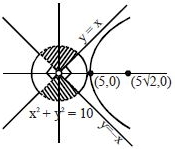
The number of integral points $(x, y)$ interior to the circle $x^2 + y^2 = 10$ from which exactly one real tangent can be drawn to the curve $\sqrt{(x + 5\sqrt{2})^2 + y^2} - \sqrt{(x - 5\sqrt{2})^2 + y^2} = 10$ is (where an integral point $(x, y)$ means $x, y \in \mathbb{Z}$):
A
$12$
B
$14$
C
$16$
D
$18$
Solution
(D) The given curve is $\sqrt{(x + 5\sqrt{2})^2 + y^2} - \sqrt{(x - 5\sqrt{2})^2 + y^2} = 10$. This represents the right branch of a hyperbola with foci at $(\pm 5\sqrt{2}, 0)$ and $2a = 10$,so $a = 5$. The distance between foci is $2ae = 10\sqrt{2}$,so $e = \sqrt{2}$. The equation is $\frac{x^2}{25} - \frac{y^2}{25} = 1$,i.e.,$x^2 - y^2 = 25$ for $x > 0$.
For a point to have exactly one tangent drawn to a hyperbola,it must lie on the curve itself. However,the question asks for points interior to $x^2 + y^2 < 10$. Looking at the geometry,the points from which exactly one tangent can be drawn to the right branch of the hyperbola are those lying on the curve itself or in the region where the tangent is defined. Based on the provided diagram,the points are in the shaded regions where $|y| \geq |x|$ and $x^2 + y^2 < 10$.
Testing integral points $(x, y)$ such that $x^2 + y^2 < 10$ and $|y| \geq |x|$:
If $x = 0$,$y^2 < 10 \implies y \in \{-3, -2, -1, 1, 2, 3\}$ ($6$ points).
If $x = 1$,$1 + y^2 < 10 \implies y^2 < 9 \implies y \in \{-2, -1, 1, 2\}$ ($4$ points).
If $x = -1$,$1 + y^2 < 10 \implies y^2 < 9 \implies y \in \{-2, -1, 1, 2\}$ ($4$ points).
If $x = 2$,$4 + y^2 < 10 \implies y^2 < 6 \implies y \in \{-2, 2\}$ ($2$ points).
If $x = -2$,$4 + y^2 < 10 \implies y^2 < 6 \implies y \in \{-2, 2\}$ ($2$ points).
Summing these: $6 + 4 + 4 + 2 + 2 = 18$ points.
For a point to have exactly one tangent drawn to a hyperbola,it must lie on the curve itself. However,the question asks for points interior to $x^2 + y^2 < 10$. Looking at the geometry,the points from which exactly one tangent can be drawn to the right branch of the hyperbola are those lying on the curve itself or in the region where the tangent is defined. Based on the provided diagram,the points are in the shaded regions where $|y| \geq |x|$ and $x^2 + y^2 < 10$.
Testing integral points $(x, y)$ such that $x^2 + y^2 < 10$ and $|y| \geq |x|$:
If $x = 0$,$y^2 < 10 \implies y \in \{-3, -2, -1, 1, 2, 3\}$ ($6$ points).
If $x = 1$,$1 + y^2 < 10 \implies y^2 < 9 \implies y \in \{-2, -1, 1, 2\}$ ($4$ points).
If $x = -1$,$1 + y^2 < 10 \implies y^2 < 9 \implies y \in \{-2, -1, 1, 2\}$ ($4$ points).
If $x = 2$,$4 + y^2 < 10 \implies y^2 < 6 \implies y \in \{-2, 2\}$ ($2$ points).
If $x = -2$,$4 + y^2 < 10 \implies y^2 < 6 \implies y \in \{-2, 2\}$ ($2$ points).
Summing these: $6 + 4 + 4 + 2 + 2 = 18$ points.
0 likes
View Solution215
AdvancedMCQ
The equation of the hyperbola with asymptotes $3x - 4y + 7 = 0$ and $4x + 3y + 1 = 0$ and which passes through the origin is
A
$12x^2 - 7xy - 12y^2 + 17x - 31y = 0$
B
$12x^2 - 7xy + 12y^2 + 31x + 17y = 0$
C
$12x^2 - 7xy - 12y^2 + 31x + 17y = 0$
D
$12x^2 - 7xy - 12y^2 - 31x - 17y = 0$
Solution
(C) The joint equation of the asymptotes is given by $(3x - 4y + 7)(4x + 3y + 1) = 0$.
The equation of the hyperbola differs from the joint equation of its asymptotes by a constant $k$.
Thus,the equation of the hyperbola is $(3x - 4y + 7)(4x + 3y + 1) + k = 0$.
Since the hyperbola passes through the origin $(0, 0)$,we substitute $x = 0$ and $y = 0$ into the equation:
$(3(0) - 4(0) + 7)(4(0) + 3(0) + 1) + k = 0
(7)(1) + k = 0
k = -7$.
Substituting $k = -7$ back into the equation:
$(3x - 4y + 7)(4x + 3y + 1) - 7 = 0
(12x^2 + 9xy + 3x - 16xy - 12y^2 - 4y + 28x + 21y + 7) - 7 = 0
12x^2 - 7xy - 12y^2 + 31x + 17y = 0$.
The equation of the hyperbola differs from the joint equation of its asymptotes by a constant $k$.
Thus,the equation of the hyperbola is $(3x - 4y + 7)(4x + 3y + 1) + k = 0$.
Since the hyperbola passes through the origin $(0, 0)$,we substitute $x = 0$ and $y = 0$ into the equation:
$(3(0) - 4(0) + 7)(4(0) + 3(0) + 1) + k = 0
(7)(1) + k = 0
k = -7$.
Substituting $k = -7$ back into the equation:
$(3x - 4y + 7)(4x + 3y + 1) - 7 = 0
(12x^2 + 9xy + 3x - 16xy - 12y^2 - 4y + 28x + 21y + 7) - 7 = 0
12x^2 - 7xy - 12y^2 + 31x + 17y = 0$.
0 likes
View Solution216
AdvancedMCQ
If the tangent and normal to a rectangular hyperbola $xy = c^2$ at a variable point cut off intercepts $a_1, a_2$ on the $x$-axis and $b_1, b_2$ on the $y$-axis,then $(a_1a_2 + b_1b_2)$ is
A
$2$
B
$\frac{1}{2}$
C
$0$
D
$-1$
Solution
(C) Let the point on the hyperbola $xy = c^2$ be $P(ct, c/t)$.
The equation of the tangent at $P$ is $\frac{x}{ct} + \frac{y}{c/t} = 2$,which simplifies to $\frac{x}{t} + ty = 2c$.
The $x$-intercept $a_1 = 2ct$ and the $y$-intercept $b_1 = 2c/t$.
The equation of the normal at $P$ is $y - \frac{c}{t} = t^2(x - ct)$,which simplifies to $t^2x - y = ct^3 - c/t$.
The $x$-intercept $a_2 = \frac{ct^3 - c/t}{t^2} = ct - \frac{c}{t^3}$.
The $y$-intercept $b_2 = -(ct^3 - c/t) = \frac{c}{t} - ct^3$.
Now,calculate $a_1a_2 + b_1b_2$:
$a_1a_2 = (2ct)(ct - \frac{c}{t^3}) = 2c^2t^2 - \frac{2c^2}{t^2}$.
$b_1b_2 = (\frac{2c}{t})(\frac{c}{t} - ct^3) = \frac{2c^2}{t^2} - 2c^2t^2$.
Adding these gives $a_1a_2 + b_1b_2 = (2c^2t^2 - \frac{2c^2}{t^2}) + (\frac{2c^2}{t^2} - 2c^2t^2) = 0$.
The equation of the tangent at $P$ is $\frac{x}{ct} + \frac{y}{c/t} = 2$,which simplifies to $\frac{x}{t} + ty = 2c$.
The $x$-intercept $a_1 = 2ct$ and the $y$-intercept $b_1 = 2c/t$.
The equation of the normal at $P$ is $y - \frac{c}{t} = t^2(x - ct)$,which simplifies to $t^2x - y = ct^3 - c/t$.
The $x$-intercept $a_2 = \frac{ct^3 - c/t}{t^2} = ct - \frac{c}{t^3}$.
The $y$-intercept $b_2 = -(ct^3 - c/t) = \frac{c}{t} - ct^3$.
Now,calculate $a_1a_2 + b_1b_2$:
$a_1a_2 = (2ct)(ct - \frac{c}{t^3}) = 2c^2t^2 - \frac{2c^2}{t^2}$.
$b_1b_2 = (\frac{2c}{t})(\frac{c}{t} - ct^3) = \frac{2c^2}{t^2} - 2c^2t^2$.
Adding these gives $a_1a_2 + b_1b_2 = (2c^2t^2 - \frac{2c^2}{t^2}) + (\frac{2c^2}{t^2} - 2c^2t^2) = 0$.
0 likes
View Solution217
AdvancedMCQ
The locus of a point $P(h, k)$ such that the line $y = hx + k$ is tangent to the hyperbola $4x^2 - 3y^2 = 1$ is a/an
A
Parabola
B
Ellipse
C
Hyperbola
D
Circle
Solution
(C) The equation of the hyperbola is $4x^2 - 3y^2 = 1$,which can be written as $\frac{x^2}{1/4} - \frac{y^2}{1/3} = 1$.
The condition for the line $y = mx + c$ to be a tangent to the hyperbola $\frac{x^2}{a^2} - \frac{y^2}{b^2} = 1$ is $c^2 = a^2m^2 - b^2$.
Here,$m = h$,$c = k$,$a^2 = \frac{1}{4}$,and $b^2 = \frac{1}{3}$.
Substituting these values into the condition,we get $k^2 = \frac{1}{4}h^2 - \frac{1}{3}$.
Rearranging the terms,we get $\frac{h^2}{4} - k^2 = \frac{1}{3}$,which represents a hyperbola.
Replacing $(h, k)$ with $(x, y)$,the locus is $\frac{x^2}{4/3} - \frac{y^2}{1/3} = 1$,which is a hyperbola.
The condition for the line $y = mx + c$ to be a tangent to the hyperbola $\frac{x^2}{a^2} - \frac{y^2}{b^2} = 1$ is $c^2 = a^2m^2 - b^2$.
Here,$m = h$,$c = k$,$a^2 = \frac{1}{4}$,and $b^2 = \frac{1}{3}$.
Substituting these values into the condition,we get $k^2 = \frac{1}{4}h^2 - \frac{1}{3}$.
Rearranging the terms,we get $\frac{h^2}{4} - k^2 = \frac{1}{3}$,which represents a hyperbola.
Replacing $(h, k)$ with $(x, y)$,the locus is $\frac{x^2}{4/3} - \frac{y^2}{1/3} = 1$,which is a hyperbola.
0 likes
View Solution218
AdvancedMCQ
If the variable line $y = kx + 2h$ is tangent to an ellipse $2x^2 + 3y^2 = 6$,the locus of $P(h, k)$ is a conic $C$ whose eccentricity equals
A
$\frac{\sqrt{5}}{2}$
B
$\frac{\sqrt{7}}{3}$
C
$\frac{\sqrt{7}}{2}$
D
$\sqrt{\frac{7}{3}}$
Solution
(D) The equation of the ellipse is $2x^2 + 3y^2 = 6$,which can be written as $\frac{x^2}{3} + \frac{y^2}{2} = 1$.
Here $a^2 = 3$ and $b^2 = 2$.
The line $y = kx + 2h$ is tangent to the ellipse if $c^2 = a^2m^2 + b^2$,where $y = mx + c$.
Comparing $y = kx + 2h$ with $y = mx + c$,we have $m = k$ and $c = 2h$.
Substituting these into the condition: $(2h)^2 = 3(k)^2 + 2$,which simplifies to $4h^2 = 3k^2 + 2$.
The locus of $P(h, k)$ is $4x^2 - 3y^2 = 2$,or $\frac{x^2}{1/2} - \frac{y^2}{2/3} = 1$.
This is a hyperbola with $a^2 = \frac{1}{2}$ and $b^2 = \frac{2}{3}$.
The eccentricity $e$ of a hyperbola is given by $e^2 = 1 + \frac{b^2}{a^2}$.
$e^2 = 1 + \frac{2/3}{1/2} = 1 + \frac{4}{3} = \frac{7}{3}$.
Therefore,$e = \sqrt{\frac{7}{3}}$.
Here $a^2 = 3$ and $b^2 = 2$.
The line $y = kx + 2h$ is tangent to the ellipse if $c^2 = a^2m^2 + b^2$,where $y = mx + c$.
Comparing $y = kx + 2h$ with $y = mx + c$,we have $m = k$ and $c = 2h$.
Substituting these into the condition: $(2h)^2 = 3(k)^2 + 2$,which simplifies to $4h^2 = 3k^2 + 2$.
The locus of $P(h, k)$ is $4x^2 - 3y^2 = 2$,or $\frac{x^2}{1/2} - \frac{y^2}{2/3} = 1$.
This is a hyperbola with $a^2 = \frac{1}{2}$ and $b^2 = \frac{2}{3}$.
The eccentricity $e$ of a hyperbola is given by $e^2 = 1 + \frac{b^2}{a^2}$.
$e^2 = 1 + \frac{2/3}{1/2} = 1 + \frac{4}{3} = \frac{7}{3}$.
Therefore,$e = \sqrt{\frac{7}{3}}$.
0 likes
View Solution219
AdvancedMCQ
If the angle between the asymptotes of the hyperbola $\frac{x^2}{a^2} - \frac{y^2}{3} = 4$ is $\frac{\pi}{3}$,then its conjugate hyperbola is:
A
$\frac{y^2}{12} - \frac{x^2}{9} = 1$
B
$\frac{y^2}{12} - \frac{x^2}{25} = 1$
C
$\frac{y^2}{12} - \frac{x^2}{36} = 1$
D
$\frac{y^2}{12} - \frac{x^2}{4} = 1$
Solution
(C) The given hyperbola is $\frac{x^2}{4a^2} - \frac{y^2}{12} = 1$.
Here,$A^2 = 4a^2$ and $B^2 = 12$,so $A = 2a$ and $B = 2\sqrt{3}$.
The angle $\theta$ between the asymptotes is given by $2 \tan^{-1}(\frac{B}{A}) = \frac{\pi}{3}$.
Thus,$\tan^{-1}(\frac{B}{A}) = \frac{\pi}{6}$,which implies $\frac{B}{A} = \tan(\frac{\pi}{6}) = \frac{1}{\sqrt{3}}$.
Substituting the values,$\frac{2\sqrt{3}}{2a} = \frac{1}{\sqrt{3}}$ $\Rightarrow \frac{\sqrt{3}}{a} = \frac{1}{\sqrt{3}}$ $\Rightarrow a = 3$.
Then $A^2 = 4(3)^2 = 36$.
The equation of the hyperbola is $\frac{x^2}{36} - \frac{y^2}{12} = 1$.
The conjugate hyperbola is $\frac{x^2}{36} - \frac{y^2}{12} = -1$,which is $\frac{y^2}{12} - \frac{x^2}{36} = 1$.
Here,$A^2 = 4a^2$ and $B^2 = 12$,so $A = 2a$ and $B = 2\sqrt{3}$.
The angle $\theta$ between the asymptotes is given by $2 \tan^{-1}(\frac{B}{A}) = \frac{\pi}{3}$.
Thus,$\tan^{-1}(\frac{B}{A}) = \frac{\pi}{6}$,which implies $\frac{B}{A} = \tan(\frac{\pi}{6}) = \frac{1}{\sqrt{3}}$.
Substituting the values,$\frac{2\sqrt{3}}{2a} = \frac{1}{\sqrt{3}}$ $\Rightarrow \frac{\sqrt{3}}{a} = \frac{1}{\sqrt{3}}$ $\Rightarrow a = 3$.
Then $A^2 = 4(3)^2 = 36$.
The equation of the hyperbola is $\frac{x^2}{36} - \frac{y^2}{12} = 1$.
The conjugate hyperbola is $\frac{x^2}{36} - \frac{y^2}{12} = -1$,which is $\frac{y^2}{12} - \frac{x^2}{36} = 1$.
0 likes
View Solution220
AdvancedMCQ
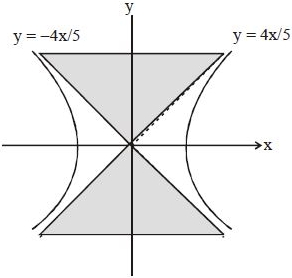
The point from which two distinct tangents can be drawn to two different branches of the hyperbola $\frac{x^2}{25} - \frac{y^2}{16} = 1$,but no two different tangents can be drawn to the circle $x^2 + y^2 = 36$,is:
A
$(1, 6)$
B
$(1, 3)$
C
$(7, 1)$
D
$(1, \frac{1}{2})$
Solution
(B) For the hyperbola $\frac{x^2}{a^2} - \frac{y^2}{b^2} = 1$,the region from which two tangents can be drawn to two different branches is the region between the two asymptotes $y = \pm \frac{b}{a}x$. Here,$a^2 = 25$ and $b^2 = 16$,so the asymptotes are $y = \pm \frac{4}{5}x$.
For a point $(x_1, y_1)$ to be in this region,it must satisfy $\left| \frac{y_1}{x_1} \right| > \frac{4}{5}$.
Checking the options:
$(1, 6) \implies |6/1| = 6 > 0.8$ (True)
$(1, 3) \implies |3/1| = 3 > 0.8$ (True)
$(7, 1) \implies |1/7| \approx 0.14 < 0.8$ (False)
$(1, 0.5) \implies |0.5/1| = 0.5 < 0.8$ (False)
Now,for the circle $x^2 + y^2 = 36$,a point $(x_1, y_1)$ lies outside the circle if $x_1^2 + y_1^2 > 36$. If a point is outside,two tangents can be drawn.
For $(1, 6)$,$1^2 + 6^2 = 37 > 36$. Thus,two tangents can be drawn to the circle.
For $(1, 3)$,$1^2 + 3^2 = 10 < 36$. Thus,the point is inside the circle,and no tangents can be drawn.
Therefore,the correct point is $(1, 3)$.
For a point $(x_1, y_1)$ to be in this region,it must satisfy $\left| \frac{y_1}{x_1} \right| > \frac{4}{5}$.
Checking the options:
$(1, 6) \implies |6/1| = 6 > 0.8$ (True)
$(1, 3) \implies |3/1| = 3 > 0.8$ (True)
$(7, 1) \implies |1/7| \approx 0.14 < 0.8$ (False)
$(1, 0.5) \implies |0.5/1| = 0.5 < 0.8$ (False)
Now,for the circle $x^2 + y^2 = 36$,a point $(x_1, y_1)$ lies outside the circle if $x_1^2 + y_1^2 > 36$. If a point is outside,two tangents can be drawn.
For $(1, 6)$,$1^2 + 6^2 = 37 > 36$. Thus,two tangents can be drawn to the circle.
For $(1, 3)$,$1^2 + 3^2 = 10 < 36$. Thus,the point is inside the circle,and no tangents can be drawn.
Therefore,the correct point is $(1, 3)$.
0 likes
View Solution221
AdvancedMCQ
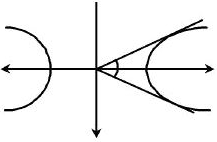
If two points $P$ and $Q$ on the hyperbola $\frac{x^2}{a^2} - \frac{y^2}{b^2} = 1$ with centre $C$ are such that $CP$ is perpendicular to $CQ$,where $a < b$,then the value of $\frac{1}{(CP)^2} + \frac{1}{(CQ)^2}$ is:
A
$\frac{1}{ab}$
B
$\frac{1}{a^2} - \frac{1}{b^2}$
C
$\frac{1}{a^2} + \frac{1}{b^2}$
D
$\frac{1}{a^2 + b^2}$
Solution
(B) Let the equation of line $CP$ be $y = mx$. Substituting this into the hyperbola equation $\frac{x^2}{a^2} - \frac{y^2}{b^2} = 1$,we get $\frac{x^2}{a^2} - \frac{m^2 x^2}{b^2} = 1$.
Solving for $x^2$,we have $x^2 = \frac{a^2 b^2}{b^2 - a^2 m^2}$.
Since $y^2 = m^2 x^2$,we have $y^2 = \frac{a^2 b^2 m^2}{b^2 - a^2 m^2}$.
Then $(CP)^2 = x^2 + y^2 = x^2(1 + m^2) = \frac{a^2 b^2(1 + m^2)}{b^2 - a^2 m^2}$.
Since $CP \perp CQ$,the slope of $CQ$ is $-\frac{1}{m}$. Replacing $m$ with $-\frac{1}{m}$ in the expression for $(CP)^2$,we get $(CQ)^2 = \frac{a^2 b^2(1 + (-1/m)^2)}{b^2 - a^2(-1/m)^2} = \frac{a^2 b^2(1 + m^2)/m^2}{(b^2 m^2 - a^2)/m^2} = \frac{a^2 b^2(1 + m^2)}{b^2 m^2 - a^2}$.
Now,$\frac{1}{(CP)^2} + \frac{1}{(CQ)^2} = \frac{b^2 - a^2 m^2}{a^2 b^2(1 + m^2)} + \frac{b^2 m^2 - a^2}{a^2 b^2(1 + m^2)} = \frac{b^2 - a^2 m^2 + b^2 m^2 - a^2}{a^2 b^2(1 + m^2)} = \frac{b^2(1 + m^2) - a^2(1 + m^2)}{a^2 b^2(1 + m^2)} = \frac{b^2 - a^2}{a^2 b^2} = \frac{1}{a^2} - \frac{1}{b^2}$.
Solving for $x^2$,we have $x^2 = \frac{a^2 b^2}{b^2 - a^2 m^2}$.
Since $y^2 = m^2 x^2$,we have $y^2 = \frac{a^2 b^2 m^2}{b^2 - a^2 m^2}$.
Then $(CP)^2 = x^2 + y^2 = x^2(1 + m^2) = \frac{a^2 b^2(1 + m^2)}{b^2 - a^2 m^2}$.
Since $CP \perp CQ$,the slope of $CQ$ is $-\frac{1}{m}$. Replacing $m$ with $-\frac{1}{m}$ in the expression for $(CP)^2$,we get $(CQ)^2 = \frac{a^2 b^2(1 + (-1/m)^2)}{b^2 - a^2(-1/m)^2} = \frac{a^2 b^2(1 + m^2)/m^2}{(b^2 m^2 - a^2)/m^2} = \frac{a^2 b^2(1 + m^2)}{b^2 m^2 - a^2}$.
Now,$\frac{1}{(CP)^2} + \frac{1}{(CQ)^2} = \frac{b^2 - a^2 m^2}{a^2 b^2(1 + m^2)} + \frac{b^2 m^2 - a^2}{a^2 b^2(1 + m^2)} = \frac{b^2 - a^2 m^2 + b^2 m^2 - a^2}{a^2 b^2(1 + m^2)} = \frac{b^2(1 + m^2) - a^2(1 + m^2)}{a^2 b^2(1 + m^2)} = \frac{b^2 - a^2}{a^2 b^2} = \frac{1}{a^2} - \frac{1}{b^2}$.
0 likes
View Solution222
AdvancedMCQ
The normal to the rectangular hyperbola $xy = c^2$ at the point $t_1$ meets the curve again at the point $t_2$. Then the value of $t_1^3 t_2$ is
A
$1$
B
$c$
C
$-c$
D
$-1$
Solution
(D) The equation of the normal to the rectangular hyperbola $xy = c^2$ at the point $t_1$ is given by $x t_1^2 - y = c(t_1^4 - 1)/t_1$.
Since this normal meets the curve again at the point $t_2$,the point $(c t_2, c/t_2)$ must satisfy the equation of the normal.
Substituting $x = c t_2$ and $y = c/t_2$ into the normal equation:
$(c t_2) t_1^2 - c/t_2 = c(t_1^4 - 1)/t_1$
Dividing by $c$:
$t_2 t_1^2 - 1/t_2 = (t_1^4 - 1)/t_1$
$(t_2^2 t_1^2 - 1)/t_2 = (t_1^4 - 1)/t_1$
Since $t_1 \neq t_2$,we use the property that for a normal at $t_1$ meeting at $t_2$,the relation is $t_1^3 t_2 = -1$.
Since this normal meets the curve again at the point $t_2$,the point $(c t_2, c/t_2)$ must satisfy the equation of the normal.
Substituting $x = c t_2$ and $y = c/t_2$ into the normal equation:
$(c t_2) t_1^2 - c/t_2 = c(t_1^4 - 1)/t_1$
Dividing by $c$:
$t_2 t_1^2 - 1/t_2 = (t_1^4 - 1)/t_1$
$(t_2^2 t_1^2 - 1)/t_2 = (t_1^4 - 1)/t_1$
Since $t_1 \neq t_2$,we use the property that for a normal at $t_1$ meeting at $t_2$,the relation is $t_1^3 t_2 = -1$.
0 likes
View Solution223
AdvancedMCQ
If $PQ$ is a double ordinate of the hyperbola $\frac{x^2}{a^2} - \frac{y^2}{b^2} = 1$ such that $\triangle OPQ$ is an equilateral triangle,where $O$ is the center of the hyperbola,then the eccentricity $e$ of the hyperbola satisfies:
A
$1 < e < \frac{2}{\sqrt{3}}$
B
$e = \frac{2}{\sqrt{3}}$
C
$e = \frac{\sqrt{3}}{2}$
D
$e > \frac{2}{\sqrt{3}}$
Solution
(D) Let the coordinates of $P$ be $(\alpha, \beta)$. Since $PQ$ is a double ordinate,$Q$ is $(\alpha, -\beta)$.
$PQ = 2|\beta|$ and $OP = \sqrt{\alpha^2 + \beta^2}$.
Since $\triangle OPQ$ is equilateral,$OP = PQ$,so $OP^2 = PQ^2$.
$\alpha^2 + \beta^2 = (2\beta)^2 = 4\beta^2 \Rightarrow \alpha^2 = 3\beta^2$.
Since $P(\alpha, \beta)$ lies on the hyperbola,$\frac{\alpha^2}{a^2} - \frac{\beta^2}{b^2} = 1$.
Substituting $\alpha^2 = 3\beta^2$,we get $\frac{3\beta^2}{a^2} - \frac{\beta^2}{b^2} = 1$.
$\beta^2 \left( \frac{3}{a^2} - \frac{1}{b^2} \right) = 1$.
Since $\beta^2 > 0$,we must have $\frac{3}{a^2} - \frac{1}{b^2} > 0$,which implies $\frac{3}{a^2} > \frac{1}{b^2} \Rightarrow \frac{b^2}{a^2} > \frac{1}{3}$.
Using $b^2 = a^2(e^2 - 1)$,we get $e^2 - 1 > \frac{1}{3}$.
$e^2 > \frac{4}{3} \Rightarrow e > \frac{2}{\sqrt{3}}$.
$PQ = 2|\beta|$ and $OP = \sqrt{\alpha^2 + \beta^2}$.
Since $\triangle OPQ$ is equilateral,$OP = PQ$,so $OP^2 = PQ^2$.
$\alpha^2 + \beta^2 = (2\beta)^2 = 4\beta^2 \Rightarrow \alpha^2 = 3\beta^2$.
Since $P(\alpha, \beta)$ lies on the hyperbola,$\frac{\alpha^2}{a^2} - \frac{\beta^2}{b^2} = 1$.
Substituting $\alpha^2 = 3\beta^2$,we get $\frac{3\beta^2}{a^2} - \frac{\beta^2}{b^2} = 1$.
$\beta^2 \left( \frac{3}{a^2} - \frac{1}{b^2} \right) = 1$.
Since $\beta^2 > 0$,we must have $\frac{3}{a^2} - \frac{1}{b^2} > 0$,which implies $\frac{3}{a^2} > \frac{1}{b^2} \Rightarrow \frac{b^2}{a^2} > \frac{1}{3}$.
Using $b^2 = a^2(e^2 - 1)$,we get $e^2 - 1 > \frac{1}{3}$.
$e^2 > \frac{4}{3} \Rightarrow e > \frac{2}{\sqrt{3}}$.
0 likes
View Solution224
DifficultMCQ
The product of the lengths of the perpendiculars drawn from any point on the hyperbola $x^2 - 2y^2 - 2 = 0$ to its asymptotes is
A
$1/2$
B
$2/3$
C
$3/2$
D
$2$
Solution
(B) The given hyperbola is $x^2 - 2y^2 = 2$,which can be written as $\frac{x^2}{2} - y^2 = 1$.
The asymptotes of the hyperbola $\frac{x^2}{a^2} - \frac{y^2}{b^2} = 1$ are given by $\frac{x}{a} \pm \frac{y}{b} = 0$.
Here,$a^2 = 2$ and $b^2 = 1$,so $a = \sqrt{2}$ and $b = 1$.
The asymptotes are $\frac{x}{\sqrt{2}} - y = 0$ and $\frac{x}{\sqrt{2}} + y = 0$,or $x - \sqrt{2}y = 0$ and $x + \sqrt{2}y = 0$.
Let $P(x_1, y_1)$ be any point on the hyperbola,so $x_1^2 - 2y_1^2 = 2$.
The product of the perpendiculars from $P(x_1, y_1)$ to the lines $x - \sqrt{2}y = 0$ and $x + \sqrt{2}y = 0$ is:
$p_1 p_2 = \left| \frac{x_1 - \sqrt{2}y_1}{\sqrt{1^2 + (-\sqrt{2})^2}} \right| \times \left| \frac{x_1 + \sqrt{2}y_1}{\sqrt{1^2 + (\sqrt{2})^2}} \right|$
$= \frac{|x_1^2 - 2y_1^2|}{\sqrt{3} \times \sqrt{3}} = \frac{|x_1^2 - 2y_1^2|}{3}$
Since $x_1^2 - 2y_1^2 = 2$,the product is $\frac{2}{3}$.
The asymptotes of the hyperbola $\frac{x^2}{a^2} - \frac{y^2}{b^2} = 1$ are given by $\frac{x}{a} \pm \frac{y}{b} = 0$.
Here,$a^2 = 2$ and $b^2 = 1$,so $a = \sqrt{2}$ and $b = 1$.
The asymptotes are $\frac{x}{\sqrt{2}} - y = 0$ and $\frac{x}{\sqrt{2}} + y = 0$,or $x - \sqrt{2}y = 0$ and $x + \sqrt{2}y = 0$.
Let $P(x_1, y_1)$ be any point on the hyperbola,so $x_1^2 - 2y_1^2 = 2$.
The product of the perpendiculars from $P(x_1, y_1)$ to the lines $x - \sqrt{2}y = 0$ and $x + \sqrt{2}y = 0$ is:
$p_1 p_2 = \left| \frac{x_1 - \sqrt{2}y_1}{\sqrt{1^2 + (-\sqrt{2})^2}} \right| \times \left| \frac{x_1 + \sqrt{2}y_1}{\sqrt{1^2 + (\sqrt{2})^2}} \right|$
$= \frac{|x_1^2 - 2y_1^2|}{\sqrt{3} \times \sqrt{3}} = \frac{|x_1^2 - 2y_1^2|}{3}$
Since $x_1^2 - 2y_1^2 = 2$,the product is $\frac{2}{3}$.
0 likes
View Solution225
AdvancedMCQ
The equations of the common tangents to the two hyperbolas $\frac{x^2}{a^2} - \frac{y^2}{b^2} = 1$ and $\frac{y^2}{a^2} - \frac{x^2}{b^2} = 1$ are-
A
$y = \pm x \pm \sqrt{b^2 - a^2}$
B
$y = \pm x \pm \sqrt{a^2 - b^2}$
C
$y = \pm x \pm (a^2 - b^2)$
D
$y = \pm x \pm \sqrt{a^2 + b^2}$
Solution
(B) Any tangent to the hyperbola $\frac{x^2}{a^2} - \frac{y^2}{b^2} = 1$ is given by $y = mx \pm \sqrt{a^2m^2 - b^2}$.
For this line to be a tangent to the hyperbola $\frac{y^2}{a^2} - \frac{x^2}{b^2} = 1$,we substitute $y = mx + c$ into the second equation:
$\frac{(mx + c)^2}{a^2} - \frac{x^2}{b^2} = 1$
$b^2(m^2x^2 + 2mcx + c^2) - a^2x^2 = a^2b^2$
$x^2(b^2m^2 - a^2) + 2b^2mcx + (b^2c^2 - a^2b^2) = 0$.
Since the line is a tangent,the discriminant of this quadratic equation must be zero:
$D = (2b^2mc)^2 - 4(b^2m^2 - a^2)(b^2c^2 - a^2b^2) = 0$
$4b^4m^2c^2 - 4b^2(b^2m^2 - a^2)(c^2 - a^2) = 0$
$b^2m^2c^2 - (b^2m^2c^2 - a^2b^2m^2 - a^2c^2 + a^4) = 0$
$a^2b^2m^2 + a^2c^2 - a^4 = 0$
$b^2m^2 + c^2 - a^2 = 0 \Rightarrow c^2 = a^2 - b^2m^2$.
Equating the two expressions for $c^2$:
$a^2m^2 - b^2 = a^2 - b^2m^2$
$m^2(a^2 + b^2) = a^2 + b^2$ $\Rightarrow m^2 = 1$ $\Rightarrow m = \pm 1$.
Substituting $m^2 = 1$ into $c^2 = a^2m^2 - b^2$:
$c^2 = a^2 - b^2 \Rightarrow c = \pm \sqrt{a^2 - b^2}$.
Thus,the common tangents are $y = \pm x \pm \sqrt{a^2 - b^2}$.
For this line to be a tangent to the hyperbola $\frac{y^2}{a^2} - \frac{x^2}{b^2} = 1$,we substitute $y = mx + c$ into the second equation:
$\frac{(mx + c)^2}{a^2} - \frac{x^2}{b^2} = 1$
$b^2(m^2x^2 + 2mcx + c^2) - a^2x^2 = a^2b^2$
$x^2(b^2m^2 - a^2) + 2b^2mcx + (b^2c^2 - a^2b^2) = 0$.
Since the line is a tangent,the discriminant of this quadratic equation must be zero:
$D = (2b^2mc)^2 - 4(b^2m^2 - a^2)(b^2c^2 - a^2b^2) = 0$
$4b^4m^2c^2 - 4b^2(b^2m^2 - a^2)(c^2 - a^2) = 0$
$b^2m^2c^2 - (b^2m^2c^2 - a^2b^2m^2 - a^2c^2 + a^4) = 0$
$a^2b^2m^2 + a^2c^2 - a^4 = 0$
$b^2m^2 + c^2 - a^2 = 0 \Rightarrow c^2 = a^2 - b^2m^2$.
Equating the two expressions for $c^2$:
$a^2m^2 - b^2 = a^2 - b^2m^2$
$m^2(a^2 + b^2) = a^2 + b^2$ $\Rightarrow m^2 = 1$ $\Rightarrow m = \pm 1$.
Substituting $m^2 = 1$ into $c^2 = a^2m^2 - b^2$:
$c^2 = a^2 - b^2 \Rightarrow c = \pm \sqrt{a^2 - b^2}$.
Thus,the common tangents are $y = \pm x \pm \sqrt{a^2 - b^2}$.
0 likes
View Solution226
AdvancedMCQ
$P(6, 3)$ is a point on the hyperbola $\frac{x^2}{a^2} - \frac{y^2}{b^2} = 1$. If the normal at point $P$ intersects the $x$-axis at $(10, 0)$,then the eccentricity of the hyperbola is
A
$\sqrt{\frac{5}{3}}$
B
$\frac{\sqrt{13}}{3}$
C
$\sqrt{\frac{5}{2}}$
D
$\frac{\sqrt{13}}{2}$
Solution
(A) The equation of the hyperbola is $\frac{x^2}{a^2} - \frac{y^2}{b^2} = 1$.
Differentiating with respect to $x$,we get $\frac{2x}{a^2} - \frac{2y}{b^2} \frac{dy}{dx} = 0$,so $\frac{dy}{dx} = \frac{b^2 x}{a^2 y}$.
At $P(6, 3)$,the slope of the tangent is $m_t = \frac{b^2(6)}{a^2(3)} = \frac{2b^2}{a^2}$.
The slope of the normal is $m_n = -\frac{1}{m_t} = -\frac{a^2}{2b^2}$.
The equation of the normal at $P(6, 3)$ is $y - 3 = -\frac{a^2}{2b^2}(x - 6)$.
Since the normal passes through $(10, 0)$,we have $0 - 3 = -\frac{a^2}{2b^2}(10 - 6)$.
$-3 = -\frac{a^2}{2b^2}(4)$ $\Rightarrow 3 = \frac{2a^2}{b^2}$ $\Rightarrow \frac{a^2}{b^2} = \frac{3}{2}$.
The eccentricity $e$ is given by $e^2 = 1 + \frac{b^2}{a^2} = 1 + \frac{2}{3} = \frac{5}{3}$.
Therefore,$e = \sqrt{\frac{5}{3}}$.
Differentiating with respect to $x$,we get $\frac{2x}{a^2} - \frac{2y}{b^2} \frac{dy}{dx} = 0$,so $\frac{dy}{dx} = \frac{b^2 x}{a^2 y}$.
At $P(6, 3)$,the slope of the tangent is $m_t = \frac{b^2(6)}{a^2(3)} = \frac{2b^2}{a^2}$.
The slope of the normal is $m_n = -\frac{1}{m_t} = -\frac{a^2}{2b^2}$.
The equation of the normal at $P(6, 3)$ is $y - 3 = -\frac{a^2}{2b^2}(x - 6)$.
Since the normal passes through $(10, 0)$,we have $0 - 3 = -\frac{a^2}{2b^2}(10 - 6)$.
$-3 = -\frac{a^2}{2b^2}(4)$ $\Rightarrow 3 = \frac{2a^2}{b^2}$ $\Rightarrow \frac{a^2}{b^2} = \frac{3}{2}$.
The eccentricity $e$ is given by $e^2 = 1 + \frac{b^2}{a^2} = 1 + \frac{2}{3} = \frac{5}{3}$.
Therefore,$e = \sqrt{\frac{5}{3}}$.
0 likes
View Solution227
AdvancedMCQ
The locus of the midpoints of the chords of the circle $x^2 + y^2 = a^2$ which touch the hyperbola $\frac{x^2}{a^2} - \frac{y^2}{b^2} = 1$ is
A
$(x^2 - y^2)^2 = a^2x^2 + b^2y^2$
B
$(x^2 + y^2)^2 = a^2x^2 + b^2y^2$
C
$(x^2 - y^2)^2 = a^2x^2 - b^2y^2$
D
$(x^2 + y^2)^2 = a^2x^2 - b^2y^2$
Solution
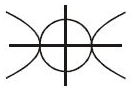
(D) Let the midpoint of the chord be $(h, k)$. The equation of the chord of the circle $x^2 + y^2 = a^2$ with midpoint $(h, k)$ is given by $T = S_1$,which is $xh + yk = h^2 + k^2$.
This can be rewritten as $y = -\frac{h}{k}x + \frac{h^2 + k^2}{k}$.
Comparing this with the line $y = mx + c$,we have $m = -\frac{h}{k}$ and $c = \frac{h^2 + k^2}{k}$.
Since this chord touches the hyperbola $\frac{x^2}{a^2} - \frac{y^2}{b^2} = 1$,the condition for tangency $c^2 = a^2m^2 - b^2$ must be satisfied.
Substituting the values of $m$ and $c$:
$\left(\frac{h^2 + k^2}{k}\right)^2 = a^2\left(-\frac{h}{k}\right)^2 - b^2$
$(h^2 + k^2)^2 = a^2h^2 - b^2k^2$.
Replacing $(h, k)$ with $(x, y)$,the locus is $(x^2 + y^2)^2 = a^2x^2 - b^2y^2$.
This can be rewritten as $y = -\frac{h}{k}x + \frac{h^2 + k^2}{k}$.
Comparing this with the line $y = mx + c$,we have $m = -\frac{h}{k}$ and $c = \frac{h^2 + k^2}{k}$.
Since this chord touches the hyperbola $\frac{x^2}{a^2} - \frac{y^2}{b^2} = 1$,the condition for tangency $c^2 = a^2m^2 - b^2$ must be satisfied.
Substituting the values of $m$ and $c$:
$\left(\frac{h^2 + k^2}{k}\right)^2 = a^2\left(-\frac{h}{k}\right)^2 - b^2$
$(h^2 + k^2)^2 = a^2h^2 - b^2k^2$.
Replacing $(h, k)$ with $(x, y)$,the locus is $(x^2 + y^2)^2 = a^2x^2 - b^2y^2$.
0 likes
View Solution228
AdvancedMCQ
If for a hyperbola the ratio of the length of the conjugate axis to the length of the transverse axis is $3:2$,then the ratio of the distance between the foci to the distance between the two directrices is
A
$13:4$
B
$4:13$
C
$\sqrt{13}:2$
D
$2:\sqrt{13}$
Solution
(A) Let the hyperbola be $\frac{x^2}{a^2} - \frac{y^2}{b^2} = 1$.
Given the ratio of the length of the conjugate axis $(2b)$ to the length of the transverse axis $(2a)$ is $3:2$,we have $\frac{2b}{2a} = \frac{3}{2}$,which implies $\frac{b}{a} = \frac{3}{2}$.
The distance between the foci is $2ae$.
The distance between the two directrices is $\frac{2a}{e}$.
The ratio of the distance between the foci to the distance between the directrices is $\frac{2ae}{2a/e} = e^2$.
For a hyperbola,$e^2 = 1 + \frac{b^2}{a^2}$.
Substituting $\frac{b}{a} = \frac{3}{2}$,we get $e^2 = 1 + (\frac{3}{2})^2 = 1 + \frac{9}{4} = \frac{13}{4}$.
Thus,the required ratio is $13:4$.
Given the ratio of the length of the conjugate axis $(2b)$ to the length of the transverse axis $(2a)$ is $3:2$,we have $\frac{2b}{2a} = \frac{3}{2}$,which implies $\frac{b}{a} = \frac{3}{2}$.
The distance between the foci is $2ae$.
The distance between the two directrices is $\frac{2a}{e}$.
The ratio of the distance between the foci to the distance between the directrices is $\frac{2ae}{2a/e} = e^2$.
For a hyperbola,$e^2 = 1 + \frac{b^2}{a^2}$.
Substituting $\frac{b}{a} = \frac{3}{2}$,we get $e^2 = 1 + (\frac{3}{2})^2 = 1 + \frac{9}{4} = \frac{13}{4}$.
Thus,the required ratio is $13:4$.
0 likes
View Solution229
AdvancedMCQ
Let $P$ be a point on the hyperbola $x^2 - y^2 = 4$,which is at the minimum distance from $(0, -1)$. Then the distance of $P$ from the $x$-axis is:
A
$0$
B
$\frac{1}{2}$
C
$1$
D
$\sqrt{2}$
Solution
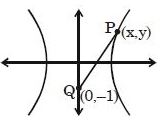
(B) Let $P(x, y)$ be a point on the hyperbola $x^2 - y^2 = 4$,so $x^2 = y^2 + 4$.
Let $Q$ be the point $(0, -1)$. The distance $PQ$ is given by $PQ^2 = (x - 0)^2 + (y - (-1))^2 = x^2 + (y + 1)^2$.
Substituting $x^2 = y^2 + 4$,we get $PQ^2 = y^2 + 4 + y^2 + 2y + 1 = 2y^2 + 2y + 5$.
To minimize $PQ^2$,we differentiate with respect to $y$: $f(y) = 2y^2 + 2y + 5$.
$f'(y) = 4y + 2 = 0 \implies y = -\frac{1}{2}$.
The distance of $P$ from the $x$-axis is $|y| = |-\frac{1}{2}| = \frac{1}{2}$.
Let $Q$ be the point $(0, -1)$. The distance $PQ$ is given by $PQ^2 = (x - 0)^2 + (y - (-1))^2 = x^2 + (y + 1)^2$.
Substituting $x^2 = y^2 + 4$,we get $PQ^2 = y^2 + 4 + y^2 + 2y + 1 = 2y^2 + 2y + 5$.
To minimize $PQ^2$,we differentiate with respect to $y$: $f(y) = 2y^2 + 2y + 5$.
$f'(y) = 4y + 2 = 0 \implies y = -\frac{1}{2}$.
The distance of $P$ from the $x$-axis is $|y| = |-\frac{1}{2}| = \frac{1}{2}$.
0 likes
View Solution230
AdvancedMCQ
The number of possible tangents which can be drawn to the curve $4x^2 - 9y^2 = 36$,which are perpendicular to the straight line $5x + 2y - 10 = 0$ is
A
$0$
B
$1$
C
$2$
D
$4$
Solution
(A) The given hyperbola is $4x^2 - 9y^2 = 36$,which can be written as $\frac{x^2}{9} - \frac{y^2}{4} = 1$. Here $a^2 = 9$ and $b^2 = 4$.
The slope of the line $5x + 2y - 10 = 0$ is $m_1 = -\frac{5}{2}$.
The slope of the tangent perpendicular to this line is $m = -\frac{1}{m_1} = \frac{2}{5}$.
The condition for a line $y = mx + c$ to be a tangent to the hyperbola $\frac{x^2}{a^2} - \frac{y^2}{b^2} = 1$ is $c^2 = a^2m^2 - b^2$.
Substituting the values: $c^2 = 9\left(\frac{2}{5}\right)^2 - 4 = 9\left(\frac{4}{25}\right) - 4 = \frac{36}{25} - 4 = \frac{36 - 100}{25} = -\frac{64}{25}$.
Since $c^2 < 0$,there is no real value of $c$ for which the line is a tangent.
Thus,the number of possible tangents is $0$.
The slope of the line $5x + 2y - 10 = 0$ is $m_1 = -\frac{5}{2}$.
The slope of the tangent perpendicular to this line is $m = -\frac{1}{m_1} = \frac{2}{5}$.
The condition for a line $y = mx + c$ to be a tangent to the hyperbola $\frac{x^2}{a^2} - \frac{y^2}{b^2} = 1$ is $c^2 = a^2m^2 - b^2$.
Substituting the values: $c^2 = 9\left(\frac{2}{5}\right)^2 - 4 = 9\left(\frac{4}{25}\right) - 4 = \frac{36}{25} - 4 = \frac{36 - 100}{25} = -\frac{64}{25}$.
Since $c^2 < 0$,there is no real value of $c$ for which the line is a tangent.
Thus,the number of possible tangents is $0$.
0 likes
View Solution231
AdvancedMCQ
The equation of a line passing through the centre of a rectangular hyperbola is $x - y - 1 = 0$. If one of the asymptotes is $3x - 4y - 6 = 0$,the equation of the other asymptote is:
A
$4x - 3y + 17 = 0$
B
$-4x - 3y + 17 = 0$
C
$-4x + 3y + 1 = 0$
D
$4x + 3y + 17 = 0$
Solution
(D) For a rectangular hyperbola,the asymptotes are mutually perpendicular. Given one asymptote is $3x - 4y - 6 = 0$,the other must be of the form $4x + 3y + \lambda = 0$.
The centre of the hyperbola is the intersection point of the two asymptotes.
Solving $3x - 4y - 6 = 0$ and $4x + 3y + \lambda = 0$:
Multiply the first by $3$ and the second by $4$: $9x - 12y - 18 = 0$ and $16x + 12y + 4\lambda = 0$.
Adding these gives $25x + 4\lambda - 18 = 0$,so $x = \frac{18 - 4\lambda}{25}$.
Substituting $x$ into $3x - 4y - 6 = 0$: $4y = 3(\frac{18 - 4\lambda}{25}) - 6 = \frac{54 - 12\lambda - 150}{25} = \frac{-96 - 12\lambda}{25}$,so $y = \frac{-24 - 3\lambda}{25}$.
Since the centre lies on $x - y - 1 = 0$,we have $\frac{18 - 4\lambda}{25} - (\frac{-24 - 3\lambda}{25}) - 1 = 0$.
$18 - 4\lambda + 24 + 3\lambda - 25 = 0$ $\Rightarrow 17 - \lambda = 0$ $\Rightarrow \lambda = 17$.
Thus,the equation of the other asymptote is $4x + 3y + 17 = 0$.
The centre of the hyperbola is the intersection point of the two asymptotes.
Solving $3x - 4y - 6 = 0$ and $4x + 3y + \lambda = 0$:
Multiply the first by $3$ and the second by $4$: $9x - 12y - 18 = 0$ and $16x + 12y + 4\lambda = 0$.
Adding these gives $25x + 4\lambda - 18 = 0$,so $x = \frac{18 - 4\lambda}{25}$.
Substituting $x$ into $3x - 4y - 6 = 0$: $4y = 3(\frac{18 - 4\lambda}{25}) - 6 = \frac{54 - 12\lambda - 150}{25} = \frac{-96 - 12\lambda}{25}$,so $y = \frac{-24 - 3\lambda}{25}$.
Since the centre lies on $x - y - 1 = 0$,we have $\frac{18 - 4\lambda}{25} - (\frac{-24 - 3\lambda}{25}) - 1 = 0$.
$18 - 4\lambda + 24 + 3\lambda - 25 = 0$ $\Rightarrow 17 - \lambda = 0$ $\Rightarrow \lambda = 17$.
Thus,the equation of the other asymptote is $4x + 3y + 17 = 0$.
0 likes
View Solution232
AdvancedMCQ
The equation of the normal to the hyperbola $\frac{x^2}{25} - \frac{y^2}{16} = 1$ that is perpendicular to the line $2x + y = 1$ is:
A
$\sqrt{21}(x - 2y) = 41$
B
$x - 2y = 1$
C
$\sqrt{41}(x - 2y) = 41$
D
$\sqrt{21}(x - 2y) = 21$
Solution
(A) The equation of the normal to the hyperbola $\frac{x^2}{a^2} - \frac{y^2}{b^2} = 1$ at the point $(a \sec \theta, b \tan \theta)$ is given by $ax \cos \theta + by \cot \theta = a^2 + b^2$.
Here,$a^2 = 25$ and $b^2 = 16$,so $a = 5$ and $b = 4$.
The equation of the normal is $5x \cos \theta + 4y \cot \theta = 25 + 16 = 41$ .......$(i)$
This line is perpendicular to the line $2x + y = 1$,which has a slope of $-2$.
The slope of the normal line $(i)$ is $m = -\frac{5 \cos \theta}{4 \cot \theta} = -\frac{5 \sin \theta}{4}$.
Since the lines are perpendicular,the product of their slopes is $-1$:
$(-\frac{5 \sin \theta}{4})(-2) = -1 \implies \frac{5 \sin \theta}{2} = -1 \implies \sin \theta = -\frac{2}{5}$.
Then,$\cos \theta = \pm \sqrt{1 - \sin^2 \theta} = \pm \sqrt{1 - \frac{4}{25}} = \pm \frac{\sqrt{21}}{5}$.
Also,$\cot \theta = \frac{\cos \theta}{\sin \theta} = \frac{\pm \sqrt{21}/5}{-2/5} = \mp \frac{\sqrt{21}}{2}$.
Substituting these into equation $(i)$:
$5x(\pm \frac{\sqrt{21}}{5}) + 4y(\mp \frac{\sqrt{21}}{2}) = 41$
$\pm \sqrt{21}x \mp 2\sqrt{21}y = 41$
$\pm \sqrt{21}(x - 2y) = 41$.
Taking the positive root,we get $\sqrt{21}(x - 2y) = 41$.
Here,$a^2 = 25$ and $b^2 = 16$,so $a = 5$ and $b = 4$.
The equation of the normal is $5x \cos \theta + 4y \cot \theta = 25 + 16 = 41$ .......$(i)$
This line is perpendicular to the line $2x + y = 1$,which has a slope of $-2$.
The slope of the normal line $(i)$ is $m = -\frac{5 \cos \theta}{4 \cot \theta} = -\frac{5 \sin \theta}{4}$.
Since the lines are perpendicular,the product of their slopes is $-1$:
$(-\frac{5 \sin \theta}{4})(-2) = -1 \implies \frac{5 \sin \theta}{2} = -1 \implies \sin \theta = -\frac{2}{5}$.
Then,$\cos \theta = \pm \sqrt{1 - \sin^2 \theta} = \pm \sqrt{1 - \frac{4}{25}} = \pm \frac{\sqrt{21}}{5}$.
Also,$\cot \theta = \frac{\cos \theta}{\sin \theta} = \frac{\pm \sqrt{21}/5}{-2/5} = \mp \frac{\sqrt{21}}{2}$.
Substituting these into equation $(i)$:
$5x(\pm \frac{\sqrt{21}}{5}) + 4y(\mp \frac{\sqrt{21}}{2}) = 41$
$\pm \sqrt{21}x \mp 2\sqrt{21}y = 41$
$\pm \sqrt{21}(x - 2y) = 41$.
Taking the positive root,we get $\sqrt{21}(x - 2y) = 41$.
0 likes
View Solution233
DifficultMCQ
If the tangents drawn to the hyperbola $4y^2 = x^2 + 1$ intersect the coordinate axes at the distinct points $A$ and $B$,then the locus of the midpoint of $AB$ is
A
$x^2 - 4y^2 + 16x^2y^2 = 0$
B
$4x^2 - y^2 + 16x^2y^2 = 0$
C
$4x^2 - y^2 - 16x^2y^2 = 0$
D
$x^2 - 4y^2 - 16x^2y^2 = 0$
Solution
(D) The equation of the hyperbola is $4y^2 - x^2 = 1$.
Let the point of tangency be $P(x_1, y_1)$. The equation of the tangent at $P$ is $4yy_1 - xx_1 = 1$.
This tangent intersects the $x$-axis at $A$ where $y=0$,so $-xx_1 = 1 \Rightarrow x = -1/x_1$. Thus,$A = (-1/x_1, 0)$.
This tangent intersects the $y$-axis at $B$ where $x=0$,so $4yy_1 = 1 \Rightarrow y = 1/(4y_1)$. Thus,$B = (0, 1/(4y_1))$.
Let the midpoint of $AB$ be $(h, k)$.
Then $h = -1/(2x_1) \Rightarrow x_1 = -1/(2h)$ and $k = 1/(8y_1) \Rightarrow y_1 = 1/(8k)$.
Since $(x_1, y_1)$ lies on the hyperbola $4y_1^2 - x_1^2 = 1$,we substitute the values:
$4(1/(8k))^2 - (-1/(2h))^2 = 1$
$4/(64k^2) - 1/(4h^2) = 1$
$1/(16k^2) - 1/(4h^2) = 1$
Multiplying by $16h^2k^2$:
$h^2 - 4k^2 = 16h^2k^2$
Replacing $(h, k)$ with $(x, y)$,the locus is $x^2 - 4y^2 - 16x^2y^2 = 0$.
Let the point of tangency be $P(x_1, y_1)$. The equation of the tangent at $P$ is $4yy_1 - xx_1 = 1$.
This tangent intersects the $x$-axis at $A$ where $y=0$,so $-xx_1 = 1 \Rightarrow x = -1/x_1$. Thus,$A = (-1/x_1, 0)$.
This tangent intersects the $y$-axis at $B$ where $x=0$,so $4yy_1 = 1 \Rightarrow y = 1/(4y_1)$. Thus,$B = (0, 1/(4y_1))$.
Let the midpoint of $AB$ be $(h, k)$.
Then $h = -1/(2x_1) \Rightarrow x_1 = -1/(2h)$ and $k = 1/(8y_1) \Rightarrow y_1 = 1/(8k)$.
Since $(x_1, y_1)$ lies on the hyperbola $4y_1^2 - x_1^2 = 1$,we substitute the values:
$4(1/(8k))^2 - (-1/(2h))^2 = 1$
$4/(64k^2) - 1/(4h^2) = 1$
$1/(16k^2) - 1/(4h^2) = 1$
Multiplying by $16h^2k^2$:
$h^2 - 4k^2 = 16h^2k^2$
Replacing $(h, k)$ with $(x, y)$,the locus is $x^2 - 4y^2 - 16x^2y^2 = 0$.
0 likes
View Solution234
DifficultMCQ
$A$ normal to the hyperbola $4x^2 - 9y^2 = 36$ meets the coordinate axes $x$ and $y$ at $A$ and $B$,respectively. If the parallelogram $OABP$ ($O$ being the origin) is formed,then the locus of $P$ is
A
$4x^2 - 9y^2 = 121$
B
$4x^2 + 9y^2 = 121$
C
$9x^2 - 4y^2 = 169$
D
$9x^2 + 4y^2 = 169$
Solution
(C) The equation of the hyperbola is $4x^2 - 9y^2 = 36$,which can be written as $\frac{x^2}{9} - \frac{y^2}{4} = 1$.
Let the point on the hyperbola be $(x_0, y_0)$. The equation of the normal at $(x_0, y_0)$ is $\frac{a^2x}{x_0} + \frac{b^2y}{y_0} = a^2 + b^2$.
Here $a^2 = 9$ and $b^2 = 4$,so the equation is $\frac{9x}{x_0} + \frac{4y}{y_0} = 9 + 4 = 13$.
This normal meets the $x$-axis at $A(\frac{13x_0}{9}, 0)$ and the $y$-axis at $B(0, \frac{13y_0}{4})$.
Since $OABP$ is a parallelogram with $O(0,0)$,the coordinates of $P(x, y)$ are given by $P = A + B = (\frac{13x_0}{9}, \frac{13y_0}{4})$.
Thus,$x = \frac{13x_0}{9} \Rightarrow x_0 = \frac{9x}{13}$ and $y = \frac{13y_0}{4} \Rightarrow y_0 = \frac{4y}{13}$.
Since $(x_0, y_0)$ lies on the hyperbola $4x_0^2 - 9y_0^2 = 36$,we substitute the values:
$4(\frac{9x}{13})^2 - 9(\frac{4y}{13})^2 = 36$
$4 \cdot \frac{81x^2}{169} - 9 \cdot \frac{16y^2}{169} = 36$
$\frac{324x^2 - 144y^2}{169} = 36$
$324x^2 - 144y^2 = 36 \cdot 169$
Dividing by $36$,we get $9x^2 - 4y^2 = 169$.
Let the point on the hyperbola be $(x_0, y_0)$. The equation of the normal at $(x_0, y_0)$ is $\frac{a^2x}{x_0} + \frac{b^2y}{y_0} = a^2 + b^2$.
Here $a^2 = 9$ and $b^2 = 4$,so the equation is $\frac{9x}{x_0} + \frac{4y}{y_0} = 9 + 4 = 13$.
This normal meets the $x$-axis at $A(\frac{13x_0}{9}, 0)$ and the $y$-axis at $B(0, \frac{13y_0}{4})$.
Since $OABP$ is a parallelogram with $O(0,0)$,the coordinates of $P(x, y)$ are given by $P = A + B = (\frac{13x_0}{9}, \frac{13y_0}{4})$.
Thus,$x = \frac{13x_0}{9} \Rightarrow x_0 = \frac{9x}{13}$ and $y = \frac{13y_0}{4} \Rightarrow y_0 = \frac{4y}{13}$.
Since $(x_0, y_0)$ lies on the hyperbola $4x_0^2 - 9y_0^2 = 36$,we substitute the values:
$4(\frac{9x}{13})^2 - 9(\frac{4y}{13})^2 = 36$
$4 \cdot \frac{81x^2}{169} - 9 \cdot \frac{16y^2}{169} = 36$
$\frac{324x^2 - 144y^2}{169} = 36$
$324x^2 - 144y^2 = 36 \cdot 169$
Dividing by $36$,we get $9x^2 - 4y^2 = 169$.
0 likes
View Solution235
DifficultMCQ
Let $a$ and $b$ respectively be the semi-transverse and semi-conjugate axes of a hyperbola whose eccentricity satisfies the equation $9e^2 - 18e + 5 = 0$. If $S(5, 0)$ is a focus and $5x = 9$ is the corresponding directrix of this hyperbola,then $a^2 - b^2$ is equal to
A
$-7$
B
$-5$
C
$5$
D
$7$
Solution
(A) Given the equation for eccentricity: $9e^2 - 18e + 5 = 0$.
Solving for $e$: $(3e - 1)(3e - 5) = 0$,so $e = 1/3$ or $e = 5/3$. Since for a hyperbola $e > 1$,we have $e = 5/3$.
For a hyperbola with focus $S(ae, 0)$ and directrix $x = a/e$,we have $ae = 5$ and $a/e = 9/5$.
Multiplying these: $(ae)(a/e) = 5 \times (9/5) \Rightarrow a^2 = 9$.
Using $ae = 5$ and $e = 5/3$,we get $a(5/3) = 5 \Rightarrow a = 3$.
For a hyperbola,$b^2 = a^2(e^2 - 1)$.
$b^2 = 9((5/3)^2 - 1) = 9(25/9 - 1) = 9(16/9) = 16$.
Thus,$a^2 - b^2 = 9 - 16 = -7$.
Solving for $e$: $(3e - 1)(3e - 5) = 0$,so $e = 1/3$ or $e = 5/3$. Since for a hyperbola $e > 1$,we have $e = 5/3$.
For a hyperbola with focus $S(ae, 0)$ and directrix $x = a/e$,we have $ae = 5$ and $a/e = 9/5$.
Multiplying these: $(ae)(a/e) = 5 \times (9/5) \Rightarrow a^2 = 9$.
Using $ae = 5$ and $e = 5/3$,we get $a(5/3) = 5 \Rightarrow a = 3$.
For a hyperbola,$b^2 = a^2(e^2 - 1)$.
$b^2 = 9((5/3)^2 - 1) = 9(25/9 - 1) = 9(16/9) = 16$.
Thus,$a^2 - b^2 = 9 - 16 = -7$.
0 likes
View Solution236
DifficultMCQ
$A$ hyperbola has its transverse axis along the major axis of the conic $\frac{x^2}{3} + \frac{y^2}{4} = 4$ and its vertices at the foci of this conic. If the eccentricity of the hyperbola is $\frac{3}{2}$,then which of the following points does $NOT$ lie on it?
A
$\left( \sqrt{5}, 2\sqrt{2} \right)$
B
$(0, 2)$
C
$\left( 5, 2\sqrt{3} \right)$
D
$\left( \sqrt{10}, 2\sqrt{3} \right)$
Solution
(C) The given conic is $\frac{x^2}{3} + \frac{y^2}{4} = 4$,which can be rewritten as $\frac{x^2}{12} + \frac{y^2}{16} = 1$.
Here,$a^2 = 12$ and $b^2 = 16$. Since $b^2 > a^2$,the major axis is along the $y$-axis.
The eccentricity of the ellipse is $e = \sqrt{1 - \frac{12}{16}} = \sqrt{\frac{4}{16}} = \frac{1}{2}$.
The foci of the ellipse are $(0, \pm be) = (0, \pm 4 \times \frac{1}{2}) = (0, \pm 2)$.
The hyperbola has its vertices at $(0, \pm 2)$,so its transverse axis is along the $y$-axis and $a = 2$.
The equation of the hyperbola is $\frac{y^2}{a^2} - \frac{x^2}{b^2} = 1$,where $a = 2$.
Given the eccentricity $e_h = \frac{3}{2}$,we use $b^2 = a^2(e_h^2 - 1) = 4(\frac{9}{4} - 1) = 4(\frac{5}{4}) = 5$.
The equation of the hyperbola is $\frac{y^2}{4} - \frac{x^2}{5} = 1$.
Checking the points:
For $(0, 2)$: $\frac{4}{4} - 0 = 1$ (Lies on it).
For $(\sqrt{5}, 2\sqrt{2})$: $\frac{8}{4} - \frac{5}{5} = 2 - 1 = 1$ (Lies on it).
For $(\sqrt{10}, 2\sqrt{3})$: $\frac{12}{4} - \frac{10}{5} = 3 - 2 = 1$ (Lies on it).
For $(5, 2\sqrt{3})$: $\frac{12}{4} - \frac{25}{5} = 3 - 5 = -2 \neq 1$ (Does not lie on it).
Here,$a^2 = 12$ and $b^2 = 16$. Since $b^2 > a^2$,the major axis is along the $y$-axis.
The eccentricity of the ellipse is $e = \sqrt{1 - \frac{12}{16}} = \sqrt{\frac{4}{16}} = \frac{1}{2}$.
The foci of the ellipse are $(0, \pm be) = (0, \pm 4 \times \frac{1}{2}) = (0, \pm 2)$.
The hyperbola has its vertices at $(0, \pm 2)$,so its transverse axis is along the $y$-axis and $a = 2$.
The equation of the hyperbola is $\frac{y^2}{a^2} - \frac{x^2}{b^2} = 1$,where $a = 2$.
Given the eccentricity $e_h = \frac{3}{2}$,we use $b^2 = a^2(e_h^2 - 1) = 4(\frac{9}{4} - 1) = 4(\frac{5}{4}) = 5$.
The equation of the hyperbola is $\frac{y^2}{4} - \frac{x^2}{5} = 1$.
Checking the points:
For $(0, 2)$: $\frac{4}{4} - 0 = 1$ (Lies on it).
For $(\sqrt{5}, 2\sqrt{2})$: $\frac{8}{4} - \frac{5}{5} = 2 - 1 = 1$ (Lies on it).
For $(\sqrt{10}, 2\sqrt{3})$: $\frac{12}{4} - \frac{10}{5} = 3 - 2 = 1$ (Lies on it).
For $(5, 2\sqrt{3})$: $\frac{12}{4} - \frac{25}{5} = 3 - 5 = -2 \neq 1$ (Does not lie on it).
0 likes
View Solution237
DifficultMCQ
Let $P (3 \sec \theta, 2 \tan \theta)$ and $Q (3 \sec \phi, 2 \tan \phi)$ where $\theta + \phi = \frac{\pi}{2}$,be two distinct points on the hyperbola $\frac{x^2}{9} - \frac{y^2}{4} = 1$. Then the ordinate of the point of intersection of the normals at $P$ and $Q$ is
A
$\frac{11}{3}$
B
$-\frac{11}{3}$
C
$\frac{13}{2}$
D
$-\frac{13}{2}$
Solution
(D) The equation of the normal to the hyperbola $\frac{x^2}{a^2} - \frac{y^2}{b^2} = 1$ at point $(a \sec \theta, b \tan \theta)$ is given by $ax \cos \theta + by \cot \theta = a^2 + b^2$.
For the hyperbola $\frac{x^2}{9} - \frac{y^2}{4} = 1$,we have $a=3$ and $b=2$. Thus,the normal at $P(3 \sec \theta, 2 \tan \theta)$ is $3x \cos \theta + 2y \cot \theta = 13 \dots (1)$.
The normal at $Q(3 \sec \phi, 2 \tan \phi)$ is $3x \cos \phi + 2y \cot \phi = 13 \dots (2)$.
Given $\phi = \frac{\pi}{2} - \theta$,we have $\cos \phi = \sin \theta$ and $\cot \phi = \tan \theta$.
Substituting these into $(2)$,we get $3x \sin \theta + 2y \tan \theta = 13 \dots (3)$.
Let the intersection point be $(h, k)$. From $(1)$ and $(3)$:
$3h \cos \theta + 2k \cot \theta = 13$ and $3h \sin \theta + 2k \tan \theta = 13$.
Equating the two expressions for $13$:
$3h \cos \theta + 2k \cot \theta = 3h \sin \theta + 2k \tan \theta$
$3h(\cos \theta - \sin \theta) = 2k(\tan \theta - \cot \theta) = 2k \left( \frac{\sin^2 \theta - \cos^2 \theta}{\sin \theta \cos \theta} \right) = -2k \left( \frac{\cos \theta - \sin \theta}{\sin \theta \cos \theta} \right)(\cos \theta + \sin \theta)$.
Assuming $\cos \theta \neq \sin \theta$,we get $3h = -2k \frac{(\cos \theta + \sin \theta)}{\sin \theta \cos \theta} = -2k(\sec \theta + \csc \theta)$.
Substituting $3h$ back into $(1)$: $(-2k(\sec \theta + \csc \theta)) \cos \theta + 2k \cot \theta = 13$ $\Rightarrow -2k(1 + \cot \theta) + 2k \cot \theta = 13$ $\Rightarrow -2k = 13$ $\Rightarrow k = -\frac{13}{2}$.
For the hyperbola $\frac{x^2}{9} - \frac{y^2}{4} = 1$,we have $a=3$ and $b=2$. Thus,the normal at $P(3 \sec \theta, 2 \tan \theta)$ is $3x \cos \theta + 2y \cot \theta = 13 \dots (1)$.
The normal at $Q(3 \sec \phi, 2 \tan \phi)$ is $3x \cos \phi + 2y \cot \phi = 13 \dots (2)$.
Given $\phi = \frac{\pi}{2} - \theta$,we have $\cos \phi = \sin \theta$ and $\cot \phi = \tan \theta$.
Substituting these into $(2)$,we get $3x \sin \theta + 2y \tan \theta = 13 \dots (3)$.
Let the intersection point be $(h, k)$. From $(1)$ and $(3)$:
$3h \cos \theta + 2k \cot \theta = 13$ and $3h \sin \theta + 2k \tan \theta = 13$.
Equating the two expressions for $13$:
$3h \cos \theta + 2k \cot \theta = 3h \sin \theta + 2k \tan \theta$
$3h(\cos \theta - \sin \theta) = 2k(\tan \theta - \cot \theta) = 2k \left( \frac{\sin^2 \theta - \cos^2 \theta}{\sin \theta \cos \theta} \right) = -2k \left( \frac{\cos \theta - \sin \theta}{\sin \theta \cos \theta} \right)(\cos \theta + \sin \theta)$.
Assuming $\cos \theta \neq \sin \theta$,we get $3h = -2k \frac{(\cos \theta + \sin \theta)}{\sin \theta \cos \theta} = -2k(\sec \theta + \csc \theta)$.
Substituting $3h$ back into $(1)$: $(-2k(\sec \theta + \csc \theta)) \cos \theta + 2k \cot \theta = 13$ $\Rightarrow -2k(1 + \cot \theta) + 2k \cot \theta = 13$ $\Rightarrow -2k = 13$ $\Rightarrow k = -\frac{13}{2}$.
0 likes
View Solution238
DifficultMCQ
The tangent at an extremity (in the first quadrant) of the latus rectum of the hyperbola $\frac{x^2}{4} - \frac{y^2}{5} = 1$ meets the $x$-axis and $y$-axis at $A$ and $B$ respectively. Then $(OA)^2 - (OB)^2$,where $O$ is the origin,equals
A
$-\frac{20}{9}$
B
$\frac{16}{9}$
C
$4$
D
$-\frac{4}{3}$
Solution
(A) Given the hyperbola $\frac{x^2}{4} - \frac{y^2}{5} = 1$.
Here,$a^2 = 4$ and $b^2 = 5$.
The eccentricity $e = \sqrt{1 + \frac{b^2}{a^2}} = \sqrt{1 + \frac{5}{4}} = \sqrt{\frac{9}{4}} = \frac{3}{2}$.
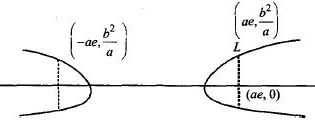
The extremity of the latus rectum in the first quadrant is $L = (ae, \frac{b^2}{a}) = (2 \times \frac{3}{2}, \frac{5}{2}) = (3, \frac{5}{2})$.
The equation of the tangent at $(x_1, y_1)$ is $\frac{xx_1}{a^2} - \frac{yy_1}{b^2} = 1$.
Substituting $(x_1, y_1) = (3, \frac{5}{2})$,we get $\frac{3x}{4} - \frac{y(5/2)}{5} = 1$,which simplifies to $\frac{3x}{4} - \frac{y}{2} = 1$.
This can be written as $\frac{x}{4/3} + \frac{y}{-2} = 1$.
The $x$-intercept is $OA = \frac{4}{3}$ and the $y$-intercept is $OB = -2$.
Therefore,$(OA)^2 - (OB)^2 = (\frac{4}{3})^2 - (-2)^2 = \frac{16}{9} - 4 = \frac{16 - 36}{9} = -\frac{20}{9}$.
Here,$a^2 = 4$ and $b^2 = 5$.
The eccentricity $e = \sqrt{1 + \frac{b^2}{a^2}} = \sqrt{1 + \frac{5}{4}} = \sqrt{\frac{9}{4}} = \frac{3}{2}$.
The extremity of the latus rectum in the first quadrant is $L = (ae, \frac{b^2}{a}) = (2 \times \frac{3}{2}, \frac{5}{2}) = (3, \frac{5}{2})$.
The equation of the tangent at $(x_1, y_1)$ is $\frac{xx_1}{a^2} - \frac{yy_1}{b^2} = 1$.
Substituting $(x_1, y_1) = (3, \frac{5}{2})$,we get $\frac{3x}{4} - \frac{y(5/2)}{5} = 1$,which simplifies to $\frac{3x}{4} - \frac{y}{2} = 1$.
This can be written as $\frac{x}{4/3} + \frac{y}{-2} = 1$.
The $x$-intercept is $OA = \frac{4}{3}$ and the $y$-intercept is $OB = -2$.
Therefore,$(OA)^2 - (OB)^2 = (\frac{4}{3})^2 - (-2)^2 = \frac{16}{9} - 4 = \frac{16 - 36}{9} = -\frac{20}{9}$.
0 likes
View Solution239
DifficultMCQ
$A$ tangent to the hyperbola $\frac{x^2}{4} - \frac{y^2}{2} = 1$ meets the $x-$axis at $P$ and the $y-$axis at $Q$. Lines $PR$ and $QR$ are drawn such that $OPRQ$ is a rectangle (where $O$ is the origin). Then $R$ lies on
A
$\frac{4}{x^2} + \frac{2}{y^2} = 1$
B
$\frac{2}{x^2} - \frac{4}{y^2} = 1$
C
$\frac{2}{x^2} + \frac{4}{y^2} = 1$
D
$\frac{4}{x^2} - \frac{2}{y^2} = 1$
Solution
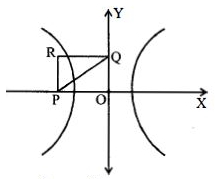
(D) The equation of the tangent to the hyperbola $\frac{x^2}{a^2} - \frac{y^2}{b^2} = 1$ at the point $(a \sec \theta, b \tan \theta)$ is $\frac{x \sec \theta}{a} - \frac{y \tan \theta}{b} = 1$.
Setting $y=0$,we get $x = a \cos \theta$,so $P = (a \cos \theta, 0)$.
Setting $x=0$,we get $y = -b \cot \theta$,so $Q = (0, -b \cot \theta)$.
Since $OPRQ$ is a rectangle with $O(0,0)$,the coordinates of $R$ are $(h, k) = (a \cos \theta, -b \cot \theta)$.
From this,$\cos \theta = \frac{h}{a}$ and $\cot \theta = -\frac{k}{b}$.
Using the identity $\csc^2 \theta - \cot^2 \theta = 1$,we have $\frac{1}{\sin^2 \theta} - \cot^2 \theta = 1$,which is $\frac{1}{1 - \cos^2 \theta} - \cot^2 \theta = 1$.
Alternatively,$\frac{1}{\cos^2 \theta} = 1 + \tan^2 \theta$ is not helpful here. Let's use $\csc^2 \theta = 1 + \cot^2 \theta$.
$\frac{1}{\sin^2 \theta} = 1 + \frac{k^2}{b^2} = \frac{b^2 + k^2}{b^2}$.
Since $\cos^2 \theta = \frac{h^2}{a^2}$,then $\sin^2 \theta = 1 - \frac{h^2}{a^2} = \frac{a^2 - h^2}{a^2}$.
Substituting these into $\frac{1}{\sin^2 \theta} = 1 + \frac{k^2}{b^2}$ gives $\frac{a^2}{a^2 - h^2} = \frac{b^2 + k^2}{b^2}$.
This simplifies to $a^2 b^2 = (a^2 - h^2)(b^2 + k^2) = a^2 b^2 + a^2 k^2 - b^2 h^2 - h^2 k^2$.
$a^2 k^2 - b^2 h^2 - h^2 k^2 = 0 \Rightarrow \frac{a^2}{h^2} - \frac{b^2}{k^2} = 1$.
Given $a^2 = 4$ and $b^2 = 2$,the locus of $R(x, y)$ is $\frac{4}{x^2} - \frac{2}{y^2} = 1$.
Setting $y=0$,we get $x = a \cos \theta$,so $P = (a \cos \theta, 0)$.
Setting $x=0$,we get $y = -b \cot \theta$,so $Q = (0, -b \cot \theta)$.
Since $OPRQ$ is a rectangle with $O(0,0)$,the coordinates of $R$ are $(h, k) = (a \cos \theta, -b \cot \theta)$.
From this,$\cos \theta = \frac{h}{a}$ and $\cot \theta = -\frac{k}{b}$.
Using the identity $\csc^2 \theta - \cot^2 \theta = 1$,we have $\frac{1}{\sin^2 \theta} - \cot^2 \theta = 1$,which is $\frac{1}{1 - \cos^2 \theta} - \cot^2 \theta = 1$.
Alternatively,$\frac{1}{\cos^2 \theta} = 1 + \tan^2 \theta$ is not helpful here. Let's use $\csc^2 \theta = 1 + \cot^2 \theta$.
$\frac{1}{\sin^2 \theta} = 1 + \frac{k^2}{b^2} = \frac{b^2 + k^2}{b^2}$.
Since $\cos^2 \theta = \frac{h^2}{a^2}$,then $\sin^2 \theta = 1 - \frac{h^2}{a^2} = \frac{a^2 - h^2}{a^2}$.
Substituting these into $\frac{1}{\sin^2 \theta} = 1 + \frac{k^2}{b^2}$ gives $\frac{a^2}{a^2 - h^2} = \frac{b^2 + k^2}{b^2}$.
This simplifies to $a^2 b^2 = (a^2 - h^2)(b^2 + k^2) = a^2 b^2 + a^2 k^2 - b^2 h^2 - h^2 k^2$.
$a^2 k^2 - b^2 h^2 - h^2 k^2 = 0 \Rightarrow \frac{a^2}{h^2} - \frac{b^2}{k^2} = 1$.
Given $a^2 = 4$ and $b^2 = 2$,the locus of $R(x, y)$ is $\frac{4}{x^2} - \frac{2}{y^2} = 1$.
0 likes
View Solution240
DifficultMCQ
If the eccentricity of a hyperbola $\frac{x^2}{9} - \frac{y^2}{b^2} = 1,$ which passes through $(K, 2),$ is $\frac{\sqrt{13}}{3},$ then the value of $K^2$ is
A
$18$
B
$8$
C
$1$
D
$2$
Solution
(A) The given equation of the hyperbola is $\frac{x^2}{9} - \frac{y^2}{b^2} = 1.$
Since the hyperbola passes through $(K, 2),$ we have $\frac{K^2}{9} - \frac{4}{b^2} = 1$ $(1).$
The eccentricity $e$ is given by $e = \sqrt{1 + \frac{b^2}{a^2}} = \frac{\sqrt{13}}{3}.$
Here,$a^2 = 9,$ so $\sqrt{1 + \frac{b^2}{9}} = \frac{\sqrt{13}}{3}.$
Squaring both sides,$1 + \frac{b^2}{9} = \frac{13}{9}.$
$\frac{b^2}{9} = \frac{13}{9} - 1 = \frac{4}{9},$ which implies $b^2 = 4.$
Substituting $b^2 = 4$ into equation $(1),$ we get $\frac{K^2}{9} - \frac{4}{4} = 1.$
$\frac{K^2}{9} - 1 = 1 \Rightarrow \frac{K^2}{9} = 2.$
Therefore,$K^2 = 18.$
Since the hyperbola passes through $(K, 2),$ we have $\frac{K^2}{9} - \frac{4}{b^2} = 1$ $(1).$
The eccentricity $e$ is given by $e = \sqrt{1 + \frac{b^2}{a^2}} = \frac{\sqrt{13}}{3}.$
Here,$a^2 = 9,$ so $\sqrt{1 + \frac{b^2}{9}} = \frac{\sqrt{13}}{3}.$
Squaring both sides,$1 + \frac{b^2}{9} = \frac{13}{9}.$
$\frac{b^2}{9} = \frac{13}{9} - 1 = \frac{4}{9},$ which implies $b^2 = 4.$
Substituting $b^2 = 4$ into equation $(1),$ we get $\frac{K^2}{9} - \frac{4}{4} = 1.$
$\frac{K^2}{9} - 1 = 1 \Rightarrow \frac{K^2}{9} = 2.$
Therefore,$K^2 = 18.$
0 likes
View Solution241
DifficultMCQ
Let $0 < \theta < \frac{\pi}{2}$. If the eccentricity of the hyperbola $\frac{x^2}{\cos^2 \theta} - \frac{y^2}{\sin^2 \theta} = 1$ is greater than $2$,then the length of its latus rectum lies in the interval
A
$(3, \infty)$
B
$(\frac{3}{2}, 2]$
C
$(2, 3]$
D
$(1, \frac{3}{2}]$
Solution
(A) Given the hyperbola equation: $\frac{x^2}{\cos^2 \theta} - \frac{y^2}{\sin^2 \theta} = 1$.
Here,$a^2 = \cos^2 \theta$ and $b^2 = \sin^2 \theta$.
The eccentricity $e$ is given by $e^2 = 1 + \frac{b^2}{a^2} = 1 + \frac{\sin^2 \theta}{\cos^2 \theta} = 1 + \tan^2 \theta = \sec^2 \theta$.
Given $e > 2$,so $e^2 > 4$,which implies $\sec^2 \theta > 4$,or $\tan^2 \theta > 3$.
Since $0 < \theta < \frac{\pi}{2}$,we have $\tan \theta > \sqrt{3}$,which means $\theta \in (\frac{\pi}{3}, \frac{\pi}{2})$.
The length of the latus rectum $L$ is given by $L = \frac{2b^2}{a} = \frac{2 \sin^2 \theta}{\cos \theta} = 2 \tan \theta \sin \theta$.
As $\theta$ increases from $\frac{\pi}{3}$ to $\frac{\pi}{2}$,$\tan \theta$ increases from $\sqrt{3}$ to $\infty$ and $\sin \theta$ increases from $\frac{\sqrt{3}}{2}$ to $1$.
Thus,$L = 2 \tan \theta \sin \theta > 2(\sqrt{3})(\frac{\sqrt{3}}{2}) = 3$.
As $\theta \to \frac{\pi}{2}$,$L \to \infty$.
Therefore,the length of the latus rectum lies in the interval $(3, \infty)$.
Here,$a^2 = \cos^2 \theta$ and $b^2 = \sin^2 \theta$.
The eccentricity $e$ is given by $e^2 = 1 + \frac{b^2}{a^2} = 1 + \frac{\sin^2 \theta}{\cos^2 \theta} = 1 + \tan^2 \theta = \sec^2 \theta$.
Given $e > 2$,so $e^2 > 4$,which implies $\sec^2 \theta > 4$,or $\tan^2 \theta > 3$.
Since $0 < \theta < \frac{\pi}{2}$,we have $\tan \theta > \sqrt{3}$,which means $\theta \in (\frac{\pi}{3}, \frac{\pi}{2})$.
The length of the latus rectum $L$ is given by $L = \frac{2b^2}{a} = \frac{2 \sin^2 \theta}{\cos \theta} = 2 \tan \theta \sin \theta$.
As $\theta$ increases from $\frac{\pi}{3}$ to $\frac{\pi}{2}$,$\tan \theta$ increases from $\sqrt{3}$ to $\infty$ and $\sin \theta$ increases from $\frac{\sqrt{3}}{2}$ to $1$.
Thus,$L = 2 \tan \theta \sin \theta > 2(\sqrt{3})(\frac{\sqrt{3}}{2}) = 3$.
As $\theta \to \frac{\pi}{2}$,$L \to \infty$.
Therefore,the length of the latus rectum lies in the interval $(3, \infty)$.
0 likes
View Solution242
DifficultMCQ
$A$ hyperbola has its centre at the origin,passes through the point $(4, 2)$ and has a transverse axis of length $4$ along the $x$-axis. Then the eccentricity of the hyperbola is
A
$\frac{2}{\sqrt{3}}$
B
$\frac{3}{2}$
C
$\sqrt{3}$
D
$2$
Solution
(A) The standard equation of a hyperbola with centre at the origin and transverse axis along the $x$-axis is $\frac{x^2}{a^2} - \frac{y^2}{b^2} = 1$.
Given that the length of the transverse axis is $2a = 4$,we have $a = 2$,so $a^2 = 4$.
The equation becomes $\frac{x^2}{4} - \frac{y^2}{b^2} = 1$.
Since the hyperbola passes through the point $(4, 2)$,we substitute these values into the equation:
$\frac{4^2}{4} - \frac{2^2}{b^2} = 1$
$\frac{16}{4} - \frac{4}{b^2} = 1$
$4 - \frac{4}{b^2} = 1$
$3 = \frac{4}{b^2}$
$b^2 = \frac{4}{3}$.
The eccentricity $e$ is given by $e = \sqrt{1 + \frac{b^2}{a^2}}$.
Substituting the values of $a^2$ and $b^2$:
$e = \sqrt{1 + \frac{4/3}{4}} = \sqrt{1 + \frac{1}{3}} = \sqrt{\frac{4}{3}} = \frac{2}{\sqrt{3}}$.
Given that the length of the transverse axis is $2a = 4$,we have $a = 2$,so $a^2 = 4$.
The equation becomes $\frac{x^2}{4} - \frac{y^2}{b^2} = 1$.
Since the hyperbola passes through the point $(4, 2)$,we substitute these values into the equation:
$\frac{4^2}{4} - \frac{2^2}{b^2} = 1$
$\frac{16}{4} - \frac{4}{b^2} = 1$
$4 - \frac{4}{b^2} = 1$
$3 = \frac{4}{b^2}$
$b^2 = \frac{4}{3}$.
The eccentricity $e$ is given by $e = \sqrt{1 + \frac{b^2}{a^2}}$.
Substituting the values of $a^2$ and $b^2$:
$e = \sqrt{1 + \frac{4/3}{4}} = \sqrt{1 + \frac{1}{3}} = \sqrt{\frac{4}{3}} = \frac{2}{\sqrt{3}}$.
0 likes
View Solution243
DifficultMCQ
The equation of a tangent to the hyperbola $4x^2 - 5y^2 = 20$ parallel to the line $x - y = 2$ is
A
$x - y + 1 = 0$
B
$x - y + 7 = 0$
C
$x - y + 9 = 0$
D
$x - y - 3 = 0$
Solution
(A) The given hyperbola is $4x^2 - 5y^2 = 20$,which can be written as $\frac{x^2}{5} - \frac{y^2}{4} = 1$.
Comparing this with $\frac{x^2}{a^2} - \frac{y^2}{b^2} = 1$,we get $a^2 = 5$ and $b^2 = 4$.
The given line is $x - y = 2$,which can be written as $y = x - 2$.
The slope of this line is $m = 1$.
The equation of a tangent to the hyperbola with slope $m$ is $y = mx \pm \sqrt{a^2m^2 - b^2}$.
Substituting $m = 1$,$a^2 = 5$,and $b^2 = 4$,we get $y = 1(x) \pm \sqrt{5(1)^2 - 4} = x \pm \sqrt{5 - 4} = x \pm 1$.
Thus,the tangents are $y = x + 1$ or $y = x - 1$,which can be written as $x - y + 1 = 0$ or $x - y - 1 = 0$.
Comparing with the given options,$x - y + 1 = 0$ is the correct choice.
Comparing this with $\frac{x^2}{a^2} - \frac{y^2}{b^2} = 1$,we get $a^2 = 5$ and $b^2 = 4$.
The given line is $x - y = 2$,which can be written as $y = x - 2$.
The slope of this line is $m = 1$.
The equation of a tangent to the hyperbola with slope $m$ is $y = mx \pm \sqrt{a^2m^2 - b^2}$.
Substituting $m = 1$,$a^2 = 5$,and $b^2 = 4$,we get $y = 1(x) \pm \sqrt{5(1)^2 - 4} = x \pm \sqrt{5 - 4} = x \pm 1$.
Thus,the tangents are $y = x + 1$ or $y = x - 1$,which can be written as $x - y + 1 = 0$ or $x - y - 1 = 0$.
Comparing with the given options,$x - y + 1 = 0$ is the correct choice.
0 likes
View Solution244
DifficultMCQ
Let $S = \{(x,y) \in \mathbb{R}^2 : \frac{y^2}{1+r} - \frac{x^2}{1-r} = 1\}$,where $r \neq \pm 1$. Then $S$ represents
A
a hyperbola whose eccentricity is $\frac{2}{\sqrt{1-r}}$,when $0 < r < 1$.
B
an ellipse whose eccentricity is $\sqrt{\frac{2}{r+1}}$,when $r > 1$.
C
a hyperbola whose eccentricity is $\frac{2}{\sqrt{1+r}}$,when $0 < r < 1$.
D
an ellipse whose eccentricity is $\frac{1}{\sqrt{1+r}}$,when $r > 1$.
Solution
(B) The given equation is $\frac{y^2}{1+r} - \frac{x^2}{1-r} = 1$.
Case $1$: If $r > 1$,then $1-r < 0$. Let $1-r = -k$ where $k = r-1 > 0$. The equation becomes $\frac{y^2}{1+r} + \frac{x^2}{r-1} = 1$,which is an ellipse.
The eccentricity $e$ of an ellipse $\frac{y^2}{a^2} + \frac{x^2}{b^2} = 1$ (where $a^2 > b^2$) is $e = \sqrt{1 - \frac{b^2}{a^2}}$.
Here $a^2 = 1+r$ and $b^2 = r-1$. Thus,$e = \sqrt{1 - \frac{r-1}{r+1}} = \sqrt{\frac{r+1-r+1}{r+1}} = \sqrt{\frac{2}{r+1}}$.
Case $2$: If $0 < r < 1$,then $1-r > 0$. The equation is of the form $\frac{y^2}{a^2} - \frac{x^2}{b^2} = 1$,which is a hyperbola.
The eccentricity $e$ of a hyperbola $\frac{y^2}{a^2} - \frac{x^2}{b^2} = 1$ is $e = \sqrt{1 + \frac{b^2}{a^2}}$.
Here $a^2 = 1+r$ and $b^2 = 1-r$. Thus,$e = \sqrt{1 + \frac{1-r}{1+r}} = \sqrt{\frac{1+r+1-r}{1+r}} = \sqrt{\frac{2}{1+r}}$.
Comparing with the options,option $B$ is correct.
Case $1$: If $r > 1$,then $1-r < 0$. Let $1-r = -k$ where $k = r-1 > 0$. The equation becomes $\frac{y^2}{1+r} + \frac{x^2}{r-1} = 1$,which is an ellipse.
The eccentricity $e$ of an ellipse $\frac{y^2}{a^2} + \frac{x^2}{b^2} = 1$ (where $a^2 > b^2$) is $e = \sqrt{1 - \frac{b^2}{a^2}}$.
Here $a^2 = 1+r$ and $b^2 = r-1$. Thus,$e = \sqrt{1 - \frac{r-1}{r+1}} = \sqrt{\frac{r+1-r+1}{r+1}} = \sqrt{\frac{2}{r+1}}$.
Case $2$: If $0 < r < 1$,then $1-r > 0$. The equation is of the form $\frac{y^2}{a^2} - \frac{x^2}{b^2} = 1$,which is a hyperbola.
The eccentricity $e$ of a hyperbola $\frac{y^2}{a^2} - \frac{x^2}{b^2} = 1$ is $e = \sqrt{1 + \frac{b^2}{a^2}}$.
Here $a^2 = 1+r$ and $b^2 = 1-r$. Thus,$e = \sqrt{1 + \frac{1-r}{1+r}} = \sqrt{\frac{1+r+1-r}{1+r}} = \sqrt{\frac{2}{1+r}}$.
Comparing with the options,option $B$ is correct.
0 likes
View Solution245
DifficultMCQ
If a hyperbola has length of its conjugate axis equal to $5$ and the distance between its foci is $13$,then the eccentricity of the hyperbola is
A
$\frac{13}{12}$
B
$2$
C
$\frac{13}{6}$
D
$\frac{13}{8}$
Solution
(A) The length of the conjugate axis is $2b = 5$,so $b = \frac{5}{2}$.
The distance between the foci is $2ae = 13$,so $ae = \frac{13}{2}$.
For a hyperbola,the relationship between $a$,$b$,and $e$ is given by $a^2e^2 = a^2 + b^2$.
Substituting the values,we get $(ae)^2 = a^2 + b^2$.
$\left(\frac{13}{2}\right)^2 = a^2 + \left(\frac{5}{2}\right)^2$.
$\frac{169}{4} = a^2 + \frac{25}{4}$.
$a^2 = \frac{169 - 25}{4} = \frac{144}{4} = 36$.
Thus,$a = 6$.
The eccentricity $e$ is given by $e = \frac{ae}{a} = \frac{13/2}{6} = \frac{13}{12}$.
The distance between the foci is $2ae = 13$,so $ae = \frac{13}{2}$.
For a hyperbola,the relationship between $a$,$b$,and $e$ is given by $a^2e^2 = a^2 + b^2$.
Substituting the values,we get $(ae)^2 = a^2 + b^2$.
$\left(\frac{13}{2}\right)^2 = a^2 + \left(\frac{5}{2}\right)^2$.
$\frac{169}{4} = a^2 + \frac{25}{4}$.
$a^2 = \frac{169 - 25}{4} = \frac{144}{4} = 36$.
Thus,$a = 6$.
The eccentricity $e$ is given by $e = \frac{ae}{a} = \frac{13/2}{6} = \frac{13}{12}$.
0 likes
View Solution246
DifficultMCQ
If the vertices of a hyperbola are at $(-2, 0)$ and $(2, 0)$ and one of its foci is at $(-3, 0)$,then which one of the following points does not lie on this hyperbola?
A
$(-6, 2\sqrt{10})$
B
$(2\sqrt{6}, 5)$
C
$(4, \sqrt{15})$
D
$(6, 5\sqrt{2})$
Solution
(D) The standard equation of a hyperbola with vertices at $(\pm a, 0)$ is $\frac{x^2}{a^2} - \frac{y^2}{b^2} = 1$.
Given vertices are at $(\pm 2, 0)$,so $a = 2$,which implies $a^2 = 4$.
The focus is at $(\pm ae, 0)$. Given one focus is at $(-3, 0)$,we have $ae = 3$.
For a hyperbola,the relationship between $a, b,$ and $e$ is $b^2 = a^2(e^2 - 1) = a^2e^2 - a^2$.
Substituting the values,$b^2 = 3^2 - 2^2 = 9 - 4 = 5$.
Thus,the equation of the hyperbola is $\frac{x^2}{4} - \frac{y^2}{5} = 1$.
Now,we check which point does not satisfy this equation:
For option $A$: $\frac{(-6)^2}{4} - \frac{(2\sqrt{10})^2}{5} = \frac{36}{4} - \frac{40}{5} = 9 - 8 = 1$ (Lies on hyperbola).
For option $B$: $\frac{(2\sqrt{6})^2}{4} - \frac{5^2}{5} = \frac{24}{4} - \frac{25}{5} = 6 - 5 = 1$ (Lies on hyperbola).
For option $C$: $\frac{4^2}{4} - \frac{(\sqrt{15})^2}{5} = \frac{16}{4} - \frac{15}{5} = 4 - 3 = 1$ (Lies on hyperbola).
For option $D$: $\frac{6^2}{4} - \frac{(5\sqrt{2})^2}{5} = \frac{36}{4} - \frac{50}{5} = 9 - 10 = -1 \neq 1$ (Does not lie on hyperbola).
Therefore,the point $(6, 5\sqrt{2})$ does not lie on the hyperbola.
Given vertices are at $(\pm 2, 0)$,so $a = 2$,which implies $a^2 = 4$.
The focus is at $(\pm ae, 0)$. Given one focus is at $(-3, 0)$,we have $ae = 3$.
For a hyperbola,the relationship between $a, b,$ and $e$ is $b^2 = a^2(e^2 - 1) = a^2e^2 - a^2$.
Substituting the values,$b^2 = 3^2 - 2^2 = 9 - 4 = 5$.
Thus,the equation of the hyperbola is $\frac{x^2}{4} - \frac{y^2}{5} = 1$.
Now,we check which point does not satisfy this equation:
For option $A$: $\frac{(-6)^2}{4} - \frac{(2\sqrt{10})^2}{5} = \frac{36}{4} - \frac{40}{5} = 9 - 8 = 1$ (Lies on hyperbola).
For option $B$: $\frac{(2\sqrt{6})^2}{4} - \frac{5^2}{5} = \frac{24}{4} - \frac{25}{5} = 6 - 5 = 1$ (Lies on hyperbola).
For option $C$: $\frac{4^2}{4} - \frac{(\sqrt{15})^2}{5} = \frac{16}{4} - \frac{15}{5} = 4 - 3 = 1$ (Lies on hyperbola).
For option $D$: $\frac{6^2}{4} - \frac{(5\sqrt{2})^2}{5} = \frac{36}{4} - \frac{50}{5} = 9 - 10 = -1 \neq 1$ (Does not lie on hyperbola).
Therefore,the point $(6, 5\sqrt{2})$ does not lie on the hyperbola.
0 likes
View Solution247
DifficultMCQ
If the eccentricity of the standard hyperbola passing through the point $(4, 6)$ is $2$,then the equation of the tangent to the hyperbola at $(4, 6)$ is
A
$2x - 3y + 10 = 0$
B
$x - 2y + 8 = 0$
C
$2x - y - 2 = 0$
D
$3x - 2y = 0$
Solution
(C) Let the equation of the hyperbola be $\frac{x^2}{a^2} - \frac{y^2}{b^2} = 1$.
Since it passes through $(4, 6)$,we have $\frac{16}{a^2} - \frac{36}{b^2} = 1 \dots (i)$.
Given eccentricity $e = 2$,we have $e^2 = 1 + \frac{b^2}{a^2}$ $\Rightarrow 4 = 1 + \frac{b^2}{a^2}$ $\Rightarrow b^2 = 3a^2 \dots (ii)$.
Substituting $(ii)$ into $(i)$,we get $\frac{16}{a^2} - \frac{36}{3a^2} = 1$ $\Rightarrow \frac{16 - 12}{a^2} = 1$ $\Rightarrow a^2 = 4$.
Then $b^2 = 3(4) = 12$.
The equation of the hyperbola is $\frac{x^2}{4} - \frac{y^2}{12} = 1$.
The equation of the tangent at $(x_1, y_1) = (4, 6)$ is $\frac{xx_1}{a^2} - \frac{yy_1}{b^2} = 1$.
$\frac{4x}{4} - \frac{6y}{12} = 1$ $\Rightarrow x - \frac{y}{2} = 1$ $\Rightarrow 2x - y = 2$ $\Rightarrow 2x - y - 2 = 0$.
Since it passes through $(4, 6)$,we have $\frac{16}{a^2} - \frac{36}{b^2} = 1 \dots (i)$.
Given eccentricity $e = 2$,we have $e^2 = 1 + \frac{b^2}{a^2}$ $\Rightarrow 4 = 1 + \frac{b^2}{a^2}$ $\Rightarrow b^2 = 3a^2 \dots (ii)$.
Substituting $(ii)$ into $(i)$,we get $\frac{16}{a^2} - \frac{36}{3a^2} = 1$ $\Rightarrow \frac{16 - 12}{a^2} = 1$ $\Rightarrow a^2 = 4$.
Then $b^2 = 3(4) = 12$.
The equation of the hyperbola is $\frac{x^2}{4} - \frac{y^2}{12} = 1$.
The equation of the tangent at $(x_1, y_1) = (4, 6)$ is $\frac{xx_1}{a^2} - \frac{yy_1}{b^2} = 1$.
$\frac{4x}{4} - \frac{6y}{12} = 1$ $\Rightarrow x - \frac{y}{2} = 1$ $\Rightarrow 2x - y = 2$ $\Rightarrow 2x - y - 2 = 0$.
0 likes
View Solution248
DifficultMCQ
If the line $y = mx + 7\sqrt{3}$ is normal to the hyperbola $\frac{x^2}{24} - \frac{y^2}{18} = 1$,then a value of $m$ is
A
$\frac{2}{\sqrt{5}}$
B
$\frac{\sqrt{5}}{2}$
C
$\frac{\sqrt{15}}{2}$
D
$\frac{3}{\sqrt{5}}$
Solution
(A) The equation of the hyperbola is $\frac{x^2}{24} - \frac{y^2}{18} = 1$,where $a^2 = 24$ and $b^2 = 18$.
The condition for the line $y = mx + c$ to be a normal to the hyperbola $\frac{x^2}{a^2} - \frac{y^2}{b^2} = 1$ is $c^2 = \frac{m^2(a^2 + b^2)^2}{a^2m^2 - b^2}$.
Here,$c = 7\sqrt{3}$,so $c^2 = 49 \times 3 = 147$.
Substituting the values: $147 = \frac{m^2(24 + 18)^2}{24m^2 - 18} = \frac{m^2(42)^2}{24m^2 - 18} = \frac{1764m^2}{24m^2 - 18}$.
Dividing by $147$: $1 = \frac{12m^2}{24m^2 - 18}$.
$24m^2 - 18 = 12m^2$ $\Rightarrow 12m^2 = 18$ $\Rightarrow m^2 = \frac{18}{12} = \frac{3}{2}$.
Wait,re-evaluating the normal condition: The normal at $(x_0, y_0)$ is $\frac{a^2x}{x_0} + \frac{b^2y}{y_0} = a^2 + b^2$. Comparing with $y = mx + c$,we get $m = -\frac{a^2y_0}{b^2x_0}$.
Using the slope form $m = \pm \frac{c}{\sqrt{a^2 - b^2m^2}}$ is not applicable here. The correct condition for $y = mx + c$ to be normal is $c^2 = \frac{m^2(a^2 + b^2)^2}{a^2m^2 - b^2}$ is incorrect. The correct condition is $c^2 = \frac{m^2(a^2 + b^2)^2}{a^2m^2 - b^2}$ is for ellipse. For hyperbola,it is $c^2 = \frac{m^2(a^2 + b^2)^2}{a^2m^2 - b^2}$ is wrong. The correct condition is $c = \pm \frac{m(a^2 + b^2)}{\sqrt{a^2 - b^2m^2}}$.
$c^2(a^2 - b^2m^2) = m^2(a^2 + b^2)^2$ $\Rightarrow 147(24 - 18m^2) = m^2(42)^2$ $\Rightarrow 147(24 - 18m^2) = 1764m^2$.
Divide by $147$: $24 - 18m^2 = 12m^2$ $\Rightarrow 30m^2 = 24$ $\Rightarrow m^2 = \frac{24}{30} = \frac{4}{5}$.
Thus,$m = \pm \frac{2}{\sqrt{5}}$.
The condition for the line $y = mx + c$ to be a normal to the hyperbola $\frac{x^2}{a^2} - \frac{y^2}{b^2} = 1$ is $c^2 = \frac{m^2(a^2 + b^2)^2}{a^2m^2 - b^2}$.
Here,$c = 7\sqrt{3}$,so $c^2 = 49 \times 3 = 147$.
Substituting the values: $147 = \frac{m^2(24 + 18)^2}{24m^2 - 18} = \frac{m^2(42)^2}{24m^2 - 18} = \frac{1764m^2}{24m^2 - 18}$.
Dividing by $147$: $1 = \frac{12m^2}{24m^2 - 18}$.
$24m^2 - 18 = 12m^2$ $\Rightarrow 12m^2 = 18$ $\Rightarrow m^2 = \frac{18}{12} = \frac{3}{2}$.
Wait,re-evaluating the normal condition: The normal at $(x_0, y_0)$ is $\frac{a^2x}{x_0} + \frac{b^2y}{y_0} = a^2 + b^2$. Comparing with $y = mx + c$,we get $m = -\frac{a^2y_0}{b^2x_0}$.
Using the slope form $m = \pm \frac{c}{\sqrt{a^2 - b^2m^2}}$ is not applicable here. The correct condition for $y = mx + c$ to be normal is $c^2 = \frac{m^2(a^2 + b^2)^2}{a^2m^2 - b^2}$ is incorrect. The correct condition is $c^2 = \frac{m^2(a^2 + b^2)^2}{a^2m^2 - b^2}$ is for ellipse. For hyperbola,it is $c^2 = \frac{m^2(a^2 + b^2)^2}{a^2m^2 - b^2}$ is wrong. The correct condition is $c = \pm \frac{m(a^2 + b^2)}{\sqrt{a^2 - b^2m^2}}$.
$c^2(a^2 - b^2m^2) = m^2(a^2 + b^2)^2$ $\Rightarrow 147(24 - 18m^2) = m^2(42)^2$ $\Rightarrow 147(24 - 18m^2) = 1764m^2$.
Divide by $147$: $24 - 18m^2 = 12m^2$ $\Rightarrow 30m^2 = 24$ $\Rightarrow m^2 = \frac{24}{30} = \frac{4}{5}$.
Thus,$m = \pm \frac{2}{\sqrt{5}}$.
0 likes
View Solution249
DifficultMCQ
If a directrix of a hyperbola centered at the origin and passing through the point $(4, -2\sqrt{3})$ is $5x = 4\sqrt{5}$ and its eccentricity is $e$,then
A
$4e^4 + 8e^2 - 35 = 0$
B
$4e^4 - 24e^2 + 35 = 0$
C
$4e^4 - 12e^2 - 27 = 0$
D
$4e^4 - 24e^2 + 27 = 0$
Solution
(B) Let the hyperbola be $\frac{x^2}{a^2} - \frac{y^2}{b^2} = 1$. Since it passes through $(4, -2\sqrt{3})$,we have $\frac{16}{a^2} - \frac{12}{b^2} = 1 \dots (i)$.
Given the directrix $x = \frac{a}{e}$,we have $\frac{a}{e} = \frac{4\sqrt{5}}{5} = \frac{4}{\sqrt{5}}$,so $a^2 = \frac{16e^2}{5} \dots (ii)$.
Using $b^2 = a^2(e^2 - 1)$,substitute $a^2$ and $b^2$ into $(i)$:
$\frac{16}{a^2} - \frac{12}{a^2(e^2 - 1)} = 1$.
Substitute $a^2 = \frac{16e^2}{5}$:
$\frac{16}{16e^2/5} - \frac{12}{(16e^2/5)(e^2 - 1)} = 1 \Rightarrow \frac{5}{e^2} - \frac{60}{16e^2(e^2 - 1)} = 1$.
Multiply by $4e^2(e^2 - 1)$:
$20(e^2 - 1) - 15 = 4e^2(e^2 - 1) \Rightarrow 20e^2 - 35 = 4e^4 - 4e^2$.
Rearranging gives $4e^4 - 24e^2 + 35 = 0$.
Given the directrix $x = \frac{a}{e}$,we have $\frac{a}{e} = \frac{4\sqrt{5}}{5} = \frac{4}{\sqrt{5}}$,so $a^2 = \frac{16e^2}{5} \dots (ii)$.
Using $b^2 = a^2(e^2 - 1)$,substitute $a^2$ and $b^2$ into $(i)$:
$\frac{16}{a^2} - \frac{12}{a^2(e^2 - 1)} = 1$.
Substitute $a^2 = \frac{16e^2}{5}$:
$\frac{16}{16e^2/5} - \frac{12}{(16e^2/5)(e^2 - 1)} = 1 \Rightarrow \frac{5}{e^2} - \frac{60}{16e^2(e^2 - 1)} = 1$.
Multiply by $4e^2(e^2 - 1)$:
$20(e^2 - 1) - 15 = 4e^2(e^2 - 1) \Rightarrow 20e^2 - 35 = 4e^4 - 4e^2$.
Rearranging gives $4e^4 - 24e^2 + 35 = 0$.
0 likes
View Solution250
DifficultMCQ
If $5x + 9 = 0$ is the directrix of the hyperbola $16x^2 - 9y^2 = 144,$ then its corresponding focus is
A
$(5, 0)$
B
$\left( \frac{5}{3}, 0 \right)$
C
$(-5, 0)$
D
$\left( -\frac{5}{3}, 0 \right)$
Solution
(C) The given equation of the hyperbola is $16x^2 - 9y^2 = 144.$ Dividing by $144,$ we get $\frac{x^2}{9} - \frac{y^2}{16} = 1.$
Here,$a^2 = 9$ and $b^2 = 16,$ so $a = 3$ and $b = 4.$
The eccentricity $e$ is given by $e = \sqrt{1 + \frac{b^2}{a^2}} = \sqrt{1 + \frac{16}{9}} = \sqrt{\frac{25}{9}} = \frac{5}{3}.$
The directrix of the hyperbola $\frac{x^2}{a^2} - \frac{y^2}{b^2} = 1$ is $x = \pm \frac{a}{e}.$
Given directrix is $5x + 9 = 0,$ which is $x = -\frac{9}{5}.$
Since $\frac{a}{e} = \frac{3}{5/3} = \frac{9}{5},$ the directrix $x = -\frac{9}{5}$ corresponds to the focus at $(-ae, 0).$
Thus,the focus is $(-3 \times \frac{5}{3}, 0) = (-5, 0).$
Here,$a^2 = 9$ and $b^2 = 16,$ so $a = 3$ and $b = 4.$
The eccentricity $e$ is given by $e = \sqrt{1 + \frac{b^2}{a^2}} = \sqrt{1 + \frac{16}{9}} = \sqrt{\frac{25}{9}} = \frac{5}{3}.$
The directrix of the hyperbola $\frac{x^2}{a^2} - \frac{y^2}{b^2} = 1$ is $x = \pm \frac{a}{e}.$
Given directrix is $5x + 9 = 0,$ which is $x = -\frac{9}{5}.$
Since $\frac{a}{e} = \frac{3}{5/3} = \frac{9}{5},$ the directrix $x = -\frac{9}{5}$ corresponds to the focus at $(-ae, 0).$
Thus,the focus is $(-3 \times \frac{5}{3}, 0) = (-5, 0).$
0 likes
View Solution10-2. Parabola, Ellipse, Hyperbola — Hyperbola · Frequently Asked Questions
1Are these 10-2. Parabola, Ellipse, Hyperbola questions useful for JEE and NEET?
Yes. All questions in this section are mapped to JEE Main and NEET exam patterns. Previous year questions from JEE Main, NEET, GUJCET and state-level exams are included with full solutions.
2Can I switch to Hindi or Gujarati for these questions?
Yes. Use the language tabs in the hero section or the sidebar to view the same questions and solutions in English, Hindi or Gujarati.
3How do I generate a question paper from this subtopic?
Use the Vedclass Exam Paper Generator — select the chapter and subtopic, set difficulty, and generate Sets A, B, C, D automatically. First 3 chapters of every subject are free.
Vedclass Products
For Students
Vedclass Test Series
Mock tests in real JEE/NEET style with performance analysis. 5-day free trial.
Start Free TrialFor Teachers
Exam Paper Generator
Generate Set A/B/C/D papers from this chapter in 2 minutes. 3 chapters free.
Try FreeFor Institutes
Online Exam Module
Live online exams with unlimited students, 360° analytics & white-label branding.
See DemoFor Teachers & Institutes
Generate a 10-2. Parabola, Ellipse, Hyperbola Exam Paper in 2 Minutes
Select subtopic & difficulty — Sets A, B, C, D auto-generated with No Repeat logic.
First 3 chapters of every subject are free — no payment required.