
A English
Hyperbola Questions in English
Class 11 Mathematics · 10-2. Parabola, Ellipse, Hyperbola · Hyperbola
593+
Questions
English
Language
100%
With Solutions
Showing 39 of 593 questions in English
501
MediumMCQ
If the eccentricity of a hyperbola is $\sqrt{3}$,then the eccentricity of its conjugate hyperbola is:
A
$\sqrt{2}$
B
$\sqrt{3}$
C
$\sqrt{\frac{3}{2}}$
D
$2 \sqrt{3}$
Solution
(C) Let $e$ and $e^{\prime}$ be the eccentricities of a hyperbola and its conjugate hyperbola respectively.
We know the relation between them is given by $\frac{1}{e^2} + \frac{1}{(e^{\prime})^2} = 1$.
Given $e = \sqrt{3}$,so $e^2 = 3$.
Substituting the value,we get $\frac{1}{3} + \frac{1}{(e^{\prime})^2} = 1$.
$\frac{1}{(e^{\prime})^2} = 1 - \frac{1}{3} = \frac{2}{3}$.
Therefore,$(e^{\prime})^2 = \frac{3}{2}$,which implies $e^{\prime} = \sqrt{\frac{3}{2}}$.
We know the relation between them is given by $\frac{1}{e^2} + \frac{1}{(e^{\prime})^2} = 1$.
Given $e = \sqrt{3}$,so $e^2 = 3$.
Substituting the value,we get $\frac{1}{3} + \frac{1}{(e^{\prime})^2} = 1$.
$\frac{1}{(e^{\prime})^2} = 1 - \frac{1}{3} = \frac{2}{3}$.
Therefore,$(e^{\prime})^2 = \frac{3}{2}$,which implies $e^{\prime} = \sqrt{\frac{3}{2}}$.
0 likes
View Solution502
MediumMCQ
Assertion: The distance between the points $P(\frac{\pi}{4})$ and $P(\frac{\pi}{3})$ on the hyperbola $9x^2 - 16y^2 = 9$ is $\frac{1}{4} \sqrt{66 - 32\sqrt{2} - 18\sqrt{3}}$.
Reason: $x = a \cosh t, y = b \sinh t$ are the parametric equations of the hyperbola $\frac{x^2}{a^2} - \frac{y^2}{b^2} = 1$.
Reason: $x = a \cosh t, y = b \sinh t$ are the parametric equations of the hyperbola $\frac{x^2}{a^2} - \frac{y^2}{b^2} = 1$.
A
$(A)$ is true,$(R)$ is true and $(R)$ is the correct explanation for $(A)$
B
$(A)$ is true,$(R)$ is true but $(R)$ is not the correct explanation for $(A)$
C
$(A)$ is true but $(R)$ is false
D
$(A)$ is false but $(R)$ is true
Solution
(C) The given equation $9x^2 - 16y^2 = 9$ can be written as $\frac{x^2}{1^2} - \frac{y^2}{(3/4)^2} = 1$. Here $a=1, b=3/4$.
The parametric points on a hyperbola are $(a \sec \theta, b \tan \theta)$.
For $\theta = \frac{\pi}{4}$,$P_1 = (1 \cdot \sqrt{2}, \frac{3}{4} \cdot 1) = (\sqrt{2}, \frac{3}{4})$.
For $\theta = \frac{\pi}{3}$,$P_2 = (1 \cdot 2, \frac{3}{4} \cdot \sqrt{3}) = (2, \frac{3\sqrt{3}}{4})$.
The distance $D = \sqrt{(2 - \sqrt{2})^2 + (\frac{3\sqrt{3}}{4} - \frac{3}{4})^2} = \sqrt{(4 + 2 - 4\sqrt{2}) + \frac{9}{16}(3 + 1 - 2\sqrt{3})} = \sqrt{6 - 4\sqrt{2} + \frac{9}{4} - \frac{9\sqrt{3}}{8}} = \sqrt{\frac{48 - 32\sqrt{2} + 18 - 9\sqrt{3}}{8}} = \sqrt{\frac{66 - 32\sqrt{2} - 9\sqrt{3}}{8}} = \frac{1}{2\sqrt{2}} \sqrt{66 - 32\sqrt{2} - 9\sqrt{3}}$.
The Assertion is true.
The Reason states $x = a \cosh t, y = b \sinh t$ are parametric equations for $\frac{x^2}{a^2} - \frac{y^2}{b^2} = 1$,which is incorrect; the correct parametric equations are $x = a \sec \theta, y = b \tan \theta$.
Thus,$(A)$ is true but $(R)$ is false.
The parametric points on a hyperbola are $(a \sec \theta, b \tan \theta)$.
For $\theta = \frac{\pi}{4}$,$P_1 = (1 \cdot \sqrt{2}, \frac{3}{4} \cdot 1) = (\sqrt{2}, \frac{3}{4})$.
For $\theta = \frac{\pi}{3}$,$P_2 = (1 \cdot 2, \frac{3}{4} \cdot \sqrt{3}) = (2, \frac{3\sqrt{3}}{4})$.
The distance $D = \sqrt{(2 - \sqrt{2})^2 + (\frac{3\sqrt{3}}{4} - \frac{3}{4})^2} = \sqrt{(4 + 2 - 4\sqrt{2}) + \frac{9}{16}(3 + 1 - 2\sqrt{3})} = \sqrt{6 - 4\sqrt{2} + \frac{9}{4} - \frac{9\sqrt{3}}{8}} = \sqrt{\frac{48 - 32\sqrt{2} + 18 - 9\sqrt{3}}{8}} = \sqrt{\frac{66 - 32\sqrt{2} - 9\sqrt{3}}{8}} = \frac{1}{2\sqrt{2}} \sqrt{66 - 32\sqrt{2} - 9\sqrt{3}}$.
The Assertion is true.
The Reason states $x = a \cosh t, y = b \sinh t$ are parametric equations for $\frac{x^2}{a^2} - \frac{y^2}{b^2} = 1$,which is incorrect; the correct parametric equations are $x = a \sec \theta, y = b \tan \theta$.
Thus,$(A)$ is true but $(R)$ is false.
0 likes
View Solution503
EasyMCQ
If the latus rectum of a hyperbola subtends an angle of $120^{\circ}$ at its centre,then its eccentricity is
A
$\sqrt{3}$
B
$\sqrt{2}$
C
$\frac{\sqrt{3}+1}{2}$
D
$\sqrt{3}+1$
Solution
(D) Let the hyperbola be $\frac{x^2}{a^2} - \frac{y^2}{b^2} = 1$. The centre is $(0, 0)$.
The endpoints of the latus rectum are $(ae, \frac{b^2}{a})$ and $(ae, -\frac{b^2}{a})$.
The angle subtended by the latus rectum at the centre is $120^{\circ}$.
Thus,the angle made by the line joining the centre to one endpoint $(ae, \frac{b^2}{a})$ with the $x$-axis is $60^{\circ}$.
Therefore,$\tan(60^{\circ}) = \frac{b^2/a}{ae} = \frac{b^2}{a^2e}$.
Since $\sqrt{3} = \frac{b^2}{a^2e}$ and $b^2 = a^2(e^2 - 1)$,we have $\sqrt{3} = \frac{a^2(e^2 - 1)}{a^2e} = \frac{e^2 - 1}{e}$.
This gives $e^2 - \sqrt{3}e - 1 = 0$.
Using the quadratic formula,$e = \frac{\sqrt{3} \pm \sqrt{3 - 4(1)(-1)}}{2} = \frac{\sqrt{3} \pm \sqrt{7}}{2}$.
Since $e > 1$,we take $e = \frac{\sqrt{3} + \sqrt{7}}{2}$.
The endpoints of the latus rectum are $(ae, \frac{b^2}{a})$ and $(ae, -\frac{b^2}{a})$.
The angle subtended by the latus rectum at the centre is $120^{\circ}$.
Thus,the angle made by the line joining the centre to one endpoint $(ae, \frac{b^2}{a})$ with the $x$-axis is $60^{\circ}$.
Therefore,$\tan(60^{\circ}) = \frac{b^2/a}{ae} = \frac{b^2}{a^2e}$.
Since $\sqrt{3} = \frac{b^2}{a^2e}$ and $b^2 = a^2(e^2 - 1)$,we have $\sqrt{3} = \frac{a^2(e^2 - 1)}{a^2e} = \frac{e^2 - 1}{e}$.
This gives $e^2 - \sqrt{3}e - 1 = 0$.
Using the quadratic formula,$e = \frac{\sqrt{3} \pm \sqrt{3 - 4(1)(-1)}}{2} = \frac{\sqrt{3} \pm \sqrt{7}}{2}$.
Since $e > 1$,we take $e = \frac{\sqrt{3} + \sqrt{7}}{2}$.
0 likes
View Solution504
MediumMCQ
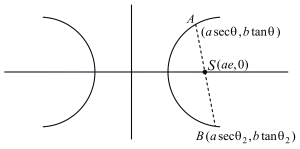
Let $A(\theta_1)$ and $B(\theta_2)$ be two points on the hyperbola $\frac{x^2}{a^2}-\frac{y^2}{b^2}=1$ and $S$ be the focus of the hyperbola. If $A, S, B$ are collinear and $a \cos \left(\frac{\theta_1+\theta_2}{2}\right)=k \cos \left(\frac{\theta_1-\theta_2}{2}\right)$ then $k=$
A
$a^2+b^2$
B
$\sqrt{a^2+b^2}$
C
$a^2-b^2$
D
$a+b$
Solution
(B) The equation of the chord joining points $A(\theta_1)$ and $B(\theta_2)$ on the hyperbola $\frac{x^2}{a^2}-\frac{y^2}{b^2}=1$ is given by:
$\frac{x}{a} \cos \left(\frac{\theta_1-\theta_2}{2}\right)-\frac{y}{b} \sin \left(\frac{\theta_1+\theta_2}{2}\right)=\cos \left(\frac{\theta_1+\theta_2}{2}\right)$
Since the chord passes through the focus $S(ae, 0)$,we substitute $x=ae$ and $y=0$ into the equation:
$\frac{ae}{a} \cos \left(\frac{\theta_1-\theta_2}{2}\right) = \cos \left(\frac{\theta_1+\theta_2}{2}\right)$
$e \cos \left(\frac{\theta_1-\theta_2}{2}\right) = \cos \left(\frac{\theta_1+\theta_2}{2}\right)$
Using the relation $e = \frac{\sqrt{a^2+b^2}}{a}$,we get:
$\frac{\sqrt{a^2+b^2}}{a} \cos \left(\frac{\theta_1-\theta_2}{2}\right) = \cos \left(\frac{\theta_1+\theta_2}{2}\right)$
$\sqrt{a^2+b^2} \cos \left(\frac{\theta_1-\theta_2}{2}\right) = a \cos \left(\frac{\theta_1+\theta_2}{2}\right)$
Comparing this with the given equation $a \cos \left(\frac{\theta_1+\theta_2}{2}\right) = k \cos \left(\frac{\theta_1-\theta_2}{2}\right)$,we find:
$k = \sqrt{a^2+b^2}$
$\frac{x}{a} \cos \left(\frac{\theta_1-\theta_2}{2}\right)-\frac{y}{b} \sin \left(\frac{\theta_1+\theta_2}{2}\right)=\cos \left(\frac{\theta_1+\theta_2}{2}\right)$
Since the chord passes through the focus $S(ae, 0)$,we substitute $x=ae$ and $y=0$ into the equation:
$\frac{ae}{a} \cos \left(\frac{\theta_1-\theta_2}{2}\right) = \cos \left(\frac{\theta_1+\theta_2}{2}\right)$
$e \cos \left(\frac{\theta_1-\theta_2}{2}\right) = \cos \left(\frac{\theta_1+\theta_2}{2}\right)$
Using the relation $e = \frac{\sqrt{a^2+b^2}}{a}$,we get:
$\frac{\sqrt{a^2+b^2}}{a} \cos \left(\frac{\theta_1-\theta_2}{2}\right) = \cos \left(\frac{\theta_1+\theta_2}{2}\right)$
$\sqrt{a^2+b^2} \cos \left(\frac{\theta_1-\theta_2}{2}\right) = a \cos \left(\frac{\theta_1+\theta_2}{2}\right)$
Comparing this with the given equation $a \cos \left(\frac{\theta_1+\theta_2}{2}\right) = k \cos \left(\frac{\theta_1-\theta_2}{2}\right)$,we find:
$k = \sqrt{a^2+b^2}$
0 likes
View Solution505
MediumMCQ
The lines of the form $x \cos \phi + y \sin \phi = P$ are chords of the hyperbola $4x^2 - y^2 = 4a^2$ which subtend a right angle at the centre of the hyperbola. If these chords touch a circle with centre at $(0,0)$,then the radius of that circle is
A
$\frac{2a}{\sqrt{3}}$
B
$\frac{a}{\sqrt{3}}$
C
$\sqrt{2}a$
D
$\frac{a}{\sqrt{2}}$
Solution
(A) The equation of the hyperbola is $4x^2 - y^2 = 4a^2$,which can be written as $\frac{x^2}{a^2} - \frac{y^2}{4a^2} = 1$.
Since the chord $x \cos \phi + y \sin \phi = P$ subtends a right angle at the origin $(0,0)$,we homogenize the equation of the hyperbola using the line equation: $\frac{x^2}{a^2} - \frac{y^2}{4a^2} = \left(\frac{x \cos \phi + y \sin \phi}{P}\right)^2$.
Expanding this,we get $x^2 \left(\frac{1}{a^2} - \frac{\cos^2 \phi}{P^2}\right) - y^2 \left(\frac{1}{4a^2} + \frac{\sin^2 \phi}{P^2}\right) - \frac{2xy \cos \phi \sin \phi}{P^2} = 0$.
For the chord to subtend a right angle at the origin,the sum of the coefficients of $x^2$ and $y^2$ must be zero:
$\left(\frac{1}{a^2} - \frac{\cos^2 \phi}{P^2}\right) - \left(\frac{1}{4a^2} + \frac{\sin^2 \phi}{P^2}\right) = 0$.
$\frac{1}{a^2} - \frac{1}{4a^2} - \frac{1}{P^2} (\cos^2 \phi + \sin^2 \phi) = 0$.
$\frac{3}{4a^2} - \frac{1}{P^2} = 0$ $\Rightarrow P^2 = \frac{4a^2}{3}$ $\Rightarrow P = \frac{2a}{\sqrt{3}}$.
Since $P$ is the perpendicular distance from the origin to the chord,it represents the radius of the circle touched by these chords. Thus,the radius is $\frac{2a}{\sqrt{3}}$.
Since the chord $x \cos \phi + y \sin \phi = P$ subtends a right angle at the origin $(0,0)$,we homogenize the equation of the hyperbola using the line equation: $\frac{x^2}{a^2} - \frac{y^2}{4a^2} = \left(\frac{x \cos \phi + y \sin \phi}{P}\right)^2$.
Expanding this,we get $x^2 \left(\frac{1}{a^2} - \frac{\cos^2 \phi}{P^2}\right) - y^2 \left(\frac{1}{4a^2} + \frac{\sin^2 \phi}{P^2}\right) - \frac{2xy \cos \phi \sin \phi}{P^2} = 0$.
For the chord to subtend a right angle at the origin,the sum of the coefficients of $x^2$ and $y^2$ must be zero:
$\left(\frac{1}{a^2} - \frac{\cos^2 \phi}{P^2}\right) - \left(\frac{1}{4a^2} + \frac{\sin^2 \phi}{P^2}\right) = 0$.
$\frac{1}{a^2} - \frac{1}{4a^2} - \frac{1}{P^2} (\cos^2 \phi + \sin^2 \phi) = 0$.
$\frac{3}{4a^2} - \frac{1}{P^2} = 0$ $\Rightarrow P^2 = \frac{4a^2}{3}$ $\Rightarrow P = \frac{2a}{\sqrt{3}}$.
Since $P$ is the perpendicular distance from the origin to the chord,it represents the radius of the circle touched by these chords. Thus,the radius is $\frac{2a}{\sqrt{3}}$.
0 likes
View Solution506
DifficultMCQ
The midpoint of the chord $4x - 3y = 5$ of the hyperbola $2x^2 - 3y^2 = 12$ is
A
$\left(0, -\frac{5}{3}\right)$
B
$(2, 1)$
C
$\left(\frac{5}{4}, 0\right)$
D
$\left(\frac{11}{4}, 2\right)$
Solution
(B) The equation of the chord of the hyperbola $S: 2x^2 - 3y^2 - 12 = 0$ with midpoint $M(h, k)$ is given by $T = S_1$,where $T = 2xh - 3yk - 12$ and $S_1 = 2h^2 - 3k^2 - 12$.
Thus,the equation of the chord is $2xh - 3yk = 2h^2 - 3k^2$.
Comparing this with the given chord equation $4x - 3y = 5$,we get:
$\frac{2h}{4} = \frac{-3k}{-3} = \frac{2h^2 - 3k^2}{5}$.
From $\frac{2h}{4} = k$,we have $k = \frac{h}{2}$.
Substituting $k = \frac{h}{2}$ into $\frac{2h}{4} = \frac{2h^2 - 3(h/2)^2}{5}$:
$\frac{h}{2} = \frac{2h^2 - \frac{3h^2}{4}}{5} = \frac{5h^2}{20} = \frac{h^2}{4}$.
So,$\frac{h}{2} = \frac{h^2}{4}$ $\Rightarrow 2h = h^2$ $\Rightarrow h(h - 2) = 0$.
Since the chord exists,$h \neq 0$ (as $h=0$ gives $k=0$,which does not satisfy the chord equation $4(0)-3(0)=5$).
Thus,$h = 2$.
Then $k = \frac{2}{2} = 1$.
The midpoint is $(2, 1)$.
Thus,the equation of the chord is $2xh - 3yk = 2h^2 - 3k^2$.
Comparing this with the given chord equation $4x - 3y = 5$,we get:
$\frac{2h}{4} = \frac{-3k}{-3} = \frac{2h^2 - 3k^2}{5}$.
From $\frac{2h}{4} = k$,we have $k = \frac{h}{2}$.
Substituting $k = \frac{h}{2}$ into $\frac{2h}{4} = \frac{2h^2 - 3(h/2)^2}{5}$:
$\frac{h}{2} = \frac{2h^2 - \frac{3h^2}{4}}{5} = \frac{5h^2}{20} = \frac{h^2}{4}$.
So,$\frac{h}{2} = \frac{h^2}{4}$ $\Rightarrow 2h = h^2$ $\Rightarrow h(h - 2) = 0$.
Since the chord exists,$h \neq 0$ (as $h=0$ gives $k=0$,which does not satisfy the chord equation $4(0)-3(0)=5$).
Thus,$h = 2$.
Then $k = \frac{2}{2} = 1$.
The midpoint is $(2, 1)$.
0 likes
View Solution507
MediumMCQ
If the tangent drawn at the point $P(3 \sqrt{2}, 4)$ on the hyperbola $\frac{x^2}{9}-\frac{y^2}{16}=1$ meets its directrix at $Q(\alpha, \beta)$ in the fourth quadrant,then $\beta=$
A
$\frac{5 \sqrt{2}-9}{4}$
B
$-\frac{9}{5}$
C
$\frac{12 \sqrt{2}-20}{5}$
D
$-\frac{5}{4}$
Solution
(C) The equation of the hyperbola is $\frac{x^2}{9} - \frac{y^2}{16} = 1$. Here $a^2 = 9$ and $b^2 = 16$,so $a = 3$ and $b = 4$.
The equation of the tangent at $P(x_1, y_1) = (3 \sqrt{2}, 4)$ is given by $\frac{x x_1}{a^2} - \frac{y y_1}{b^2} = 1$.
Substituting the values,we get $\frac{x(3 \sqrt{2})}{9} - \frac{y(4)}{16} = 1$,which simplifies to $\frac{x \sqrt{2}}{3} - \frac{y}{4} = 1$.
The eccentricity $e$ is given by $e = \sqrt{1 + \frac{b^2}{a^2}} = \sqrt{1 + \frac{16}{9}} = \sqrt{\frac{25}{9}} = \frac{5}{3}$.
The directrix of the hyperbola is $x = \frac{a}{e} = \frac{3}{5/3} = \frac{9}{5}$.
Since the point $Q(\alpha, \beta)$ lies on the directrix,$\alpha = \frac{9}{5}$.
Substituting $x = \frac{9}{5}$ into the tangent equation: $\frac{(9/5) \sqrt{2}}{3} - \frac{y}{4} = 1$.
$\frac{3 \sqrt{2}}{5} - \frac{y}{4} = 1 \implies \frac{y}{4} = \frac{3 \sqrt{2}}{5} - 1 = \frac{3 \sqrt{2} - 5}{5}$.
Thus,$y = \beta = \frac{12 \sqrt{2} - 20}{5}$.
Since $Q$ is in the fourth quadrant,we check the sign. $\sqrt{2} \approx 1.414$,so $12(1.414) \approx 16.968$. $16.968 - 20 < 0$,which is consistent with the fourth quadrant.
The equation of the tangent at $P(x_1, y_1) = (3 \sqrt{2}, 4)$ is given by $\frac{x x_1}{a^2} - \frac{y y_1}{b^2} = 1$.
Substituting the values,we get $\frac{x(3 \sqrt{2})}{9} - \frac{y(4)}{16} = 1$,which simplifies to $\frac{x \sqrt{2}}{3} - \frac{y}{4} = 1$.
The eccentricity $e$ is given by $e = \sqrt{1 + \frac{b^2}{a^2}} = \sqrt{1 + \frac{16}{9}} = \sqrt{\frac{25}{9}} = \frac{5}{3}$.
The directrix of the hyperbola is $x = \frac{a}{e} = \frac{3}{5/3} = \frac{9}{5}$.
Since the point $Q(\alpha, \beta)$ lies on the directrix,$\alpha = \frac{9}{5}$.
Substituting $x = \frac{9}{5}$ into the tangent equation: $\frac{(9/5) \sqrt{2}}{3} - \frac{y}{4} = 1$.
$\frac{3 \sqrt{2}}{5} - \frac{y}{4} = 1 \implies \frac{y}{4} = \frac{3 \sqrt{2}}{5} - 1 = \frac{3 \sqrt{2} - 5}{5}$.
Thus,$y = \beta = \frac{12 \sqrt{2} - 20}{5}$.
Since $Q$ is in the fourth quadrant,we check the sign. $\sqrt{2} \approx 1.414$,so $12(1.414) \approx 16.968$. $16.968 - 20 < 0$,which is consistent with the fourth quadrant.
0 likes
View Solution508
DifficultMCQ
$P(\theta)$ is a point on the hyperbola $\frac{x^2}{a^2} - \frac{y^2}{9} = 1$,$S$ is its focus lying on the positive $X$-axis and $Q = (0, 1)$. If $S Q = \sqrt{26}$ and $S P = 6$,then $\theta =$
A
$\frac{\pi}{6}$
B
$\frac{\pi}{4}$
C
$\frac{\pi}{3}$
D
$\cos^{-1} \left( \frac{2}{3} \right)$
Solution
(C) The focus $S$ is $(ae, 0)$. Given $Q = (0, 1)$,$S Q^2 = (ae)^2 + 1^2 = 26$,so $a^2 e^2 = 25$,which means $ae = 5$.
For the hyperbola $\frac{x^2}{a^2} - \frac{y^2}{9} = 1$,we have $b^2 = 9$,so $e^2 = 1 + \frac{9}{a^2}$.
Substituting $e^2 = \frac{25}{a^2}$,we get $\frac{25}{a^2} = 1 + \frac{9}{a^2}$,which implies $\frac{16}{a^2} = 1$,so $a = 4$.
Then $e = \frac{5}{4}$. The point $P$ is $(4 \sec \theta, 3 \tan \theta)$.
The distance $SP = 6$. Using the focal distance formula $SP = |ae \sec \theta - a|$ is not directly applicable as $S$ is $(ae, 0)$,so $SP^2 = (4 \sec \theta - 5)^2 + (3 \tan \theta - 0)^2 = 36$.
$16 \sec^2 \theta - 40 \sec \theta + 25 + 9 \tan^2 \theta = 36$.
Using $\tan^2 \theta = \sec^2 \theta - 1$,we get $16 \sec^2 \theta - 40 \sec \theta + 25 + 9 \sec^2 \theta - 9 = 36$.
$25 \sec^2 \theta - 40 \sec \theta - 20 = 0$,which simplifies to $5 \sec^2 \theta - 8 \sec \theta - 4 = 0$.
$(5 \sec \theta + 2)(\sec \theta - 2) = 0$.
Since $|\sec \theta| \geq 1$,we have $\sec \theta = 2$,which gives $\theta = \frac{\pi}{3}$.
For the hyperbola $\frac{x^2}{a^2} - \frac{y^2}{9} = 1$,we have $b^2 = 9$,so $e^2 = 1 + \frac{9}{a^2}$.
Substituting $e^2 = \frac{25}{a^2}$,we get $\frac{25}{a^2} = 1 + \frac{9}{a^2}$,which implies $\frac{16}{a^2} = 1$,so $a = 4$.
Then $e = \frac{5}{4}$. The point $P$ is $(4 \sec \theta, 3 \tan \theta)$.
The distance $SP = 6$. Using the focal distance formula $SP = |ae \sec \theta - a|$ is not directly applicable as $S$ is $(ae, 0)$,so $SP^2 = (4 \sec \theta - 5)^2 + (3 \tan \theta - 0)^2 = 36$.
$16 \sec^2 \theta - 40 \sec \theta + 25 + 9 \tan^2 \theta = 36$.
Using $\tan^2 \theta = \sec^2 \theta - 1$,we get $16 \sec^2 \theta - 40 \sec \theta + 25 + 9 \sec^2 \theta - 9 = 36$.
$25 \sec^2 \theta - 40 \sec \theta - 20 = 0$,which simplifies to $5 \sec^2 \theta - 8 \sec \theta - 4 = 0$.
$(5 \sec \theta + 2)(\sec \theta - 2) = 0$.
Since $|\sec \theta| \geq 1$,we have $\sec \theta = 2$,which gives $\theta = \frac{\pi}{3}$.
0 likes
View Solution509
EasyMCQ
If the line $2x + \sqrt{6}y = 2$ touches the hyperbola $x^2 - 2y^2 = 4$,then the coordinates of the point of contact are
A
$\left(\frac{1}{2}, \frac{1}{\sqrt{6}}\right)$
B
$(4, -\sqrt{6})$
C
$(4, \sqrt{6})$
D
$(-2, \sqrt{6})$
Solution
(B) The given line is $2x + \sqrt{6}y = 2$,which can be written as $2x + \sqrt{6}y - 2 = 0$.
The equation of the hyperbola is $x^2 - 2y^2 = 4$.
Let the point of contact be $(x_1, y_1)$.
The equation of the tangent to the hyperbola $x^2 - 2y^2 = 4$ at $(x_1, y_1)$ is given by $xx_1 - 2yy_1 = 4$,or $xx_1 - 2yy_1 - 4 = 0$.
Since this line is the same as the given line $2x + \sqrt{6}y - 2 = 0$,the coefficients must be proportional:
$\frac{x_1}{2} = \frac{-2y_1}{\sqrt{6}} = \frac{-4}{-2}$
$\frac{x_1}{2} = 2 \Rightarrow x_1 = 4$
$\frac{-2y_1}{\sqrt{6}} = 2$ $\Rightarrow -2y_1 = 2\sqrt{6}$ $\Rightarrow y_1 = -\sqrt{6}$
Thus,the point of contact is $(4, -\sqrt{6})$.
The equation of the hyperbola is $x^2 - 2y^2 = 4$.
Let the point of contact be $(x_1, y_1)$.
The equation of the tangent to the hyperbola $x^2 - 2y^2 = 4$ at $(x_1, y_1)$ is given by $xx_1 - 2yy_1 = 4$,or $xx_1 - 2yy_1 - 4 = 0$.
Since this line is the same as the given line $2x + \sqrt{6}y - 2 = 0$,the coefficients must be proportional:
$\frac{x_1}{2} = \frac{-2y_1}{\sqrt{6}} = \frac{-4}{-2}$
$\frac{x_1}{2} = 2 \Rightarrow x_1 = 4$
$\frac{-2y_1}{\sqrt{6}} = 2$ $\Rightarrow -2y_1 = 2\sqrt{6}$ $\Rightarrow y_1 = -\sqrt{6}$
Thus,the point of contact is $(4, -\sqrt{6})$.
0 likes
View Solution510
MediumMCQ
If the line $x+y+k=0$ is a normal to the hyperbola $\frac{x^2}{9}-\frac{y^2}{4}=1$,then $k=$
A
$\pm \frac{\sqrt{5}}{13}$
B
$\pm \frac{13}{\sqrt{5}}$
C
$\pm \frac{13}{5}$
D
$\pm \frac{5}{13}$
Solution
(B) The equation of the normal to the hyperbola $\frac{x^2}{a^2} - \frac{y^2}{b^2} = 1$ at point $(x_1, y_1)$ is given by $\frac{a^2 x}{x_1} + \frac{b^2 y}{y_1} = a^2 + b^2$.
For the hyperbola $\frac{x^2}{9} - \frac{y^2}{4} = 1$,we have $a^2 = 9$ and $b^2 = 4$.
The equation of the normal becomes $\frac{9x}{x_1} + \frac{4y}{y_1} = 9 + 4 = 13$.
Comparing this with the given line $x + y = -k$,we have the ratios:
$\frac{9/x_1}{1} = \frac{4/y_1}{1} = \frac{13}{-k}$.
This gives $x_1 = -\frac{9k}{13}$ and $y_1 = -\frac{4k}{13}$.
Since $(x_1, y_1)$ lies on the hyperbola,we substitute these values:
$\frac{(-9k/13)^2}{9} - \frac{(-4k/13)^2}{4} = 1$.
$\frac{81k^2}{169 \times 9} - \frac{16k^2}{169 \times 4} = 1$.
$\frac{9k^2}{169} - \frac{4k^2}{169} = 1$.
$\frac{5k^2}{169} = 1$.
$k^2 = \frac{169}{5}$.
$k = \pm \frac{13}{\sqrt{5}}$.
For the hyperbola $\frac{x^2}{9} - \frac{y^2}{4} = 1$,we have $a^2 = 9$ and $b^2 = 4$.
The equation of the normal becomes $\frac{9x}{x_1} + \frac{4y}{y_1} = 9 + 4 = 13$.
Comparing this with the given line $x + y = -k$,we have the ratios:
$\frac{9/x_1}{1} = \frac{4/y_1}{1} = \frac{13}{-k}$.
This gives $x_1 = -\frac{9k}{13}$ and $y_1 = -\frac{4k}{13}$.
Since $(x_1, y_1)$ lies on the hyperbola,we substitute these values:
$\frac{(-9k/13)^2}{9} - \frac{(-4k/13)^2}{4} = 1$.
$\frac{81k^2}{169 \times 9} - \frac{16k^2}{169 \times 4} = 1$.
$\frac{9k^2}{169} - \frac{4k^2}{169} = 1$.
$\frac{5k^2}{169} = 1$.
$k^2 = \frac{169}{5}$.
$k = \pm \frac{13}{\sqrt{5}}$.
0 likes
View Solution511
MediumMCQ
Let $P, Q, R, S$ be the points of intersection of the circle $x^2+y^2=4$ and the hyperbola $xy=\sqrt{3}$. If $P=(\alpha, \beta)$ and $\alpha>\beta>0$,then the equation of the tangent drawn at $P$ to the hyperbola is
A
$x+y=2$
B
$x+\sqrt{3}y=2\sqrt{3}$
C
$\sqrt{3}x+y=2\sqrt{3}$
D
$x-y=0$
Solution
(B) Given the equations:
$x^2+y^2=4$
$xy=\sqrt{3}$
Substitute $y=\frac{\sqrt{3}}{x}$ into the circle equation:
$x^2 + \frac{3}{x^2} = 4$
$x^4 - 4x^2 + 3 = 0$
$(x^2-3)(x^2-1) = 0$
So,$x^2=3$ or $x^2=1$.
Since $\alpha > \beta > 0$,we have $x^2=3$ and $y^2=1$.
Thus,$\alpha = \sqrt{3}$ and $\beta = 1$.
Point $P = (\sqrt{3}, 1)$.
The equation of the tangent to the hyperbola $xy=c^2$ at $(x_1, y_1)$ is $xy_1 + yx_1 = 2c^2$.
Here $c^2 = \sqrt{3}$,$x_1 = \sqrt{3}$,$y_1 = 1$.
So,$x(1) + y(\sqrt{3}) = 2\sqrt{3}$.
$x + \sqrt{3}y = 2\sqrt{3}$.
$x^2+y^2=4$
$xy=\sqrt{3}$
Substitute $y=\frac{\sqrt{3}}{x}$ into the circle equation:
$x^2 + \frac{3}{x^2} = 4$
$x^4 - 4x^2 + 3 = 0$
$(x^2-3)(x^2-1) = 0$
So,$x^2=3$ or $x^2=1$.
Since $\alpha > \beta > 0$,we have $x^2=3$ and $y^2=1$.
Thus,$\alpha = \sqrt{3}$ and $\beta = 1$.
Point $P = (\sqrt{3}, 1)$.
The equation of the tangent to the hyperbola $xy=c^2$ at $(x_1, y_1)$ is $xy_1 + yx_1 = 2c^2$.
Here $c^2 = \sqrt{3}$,$x_1 = \sqrt{3}$,$y_1 = 1$.
So,$x(1) + y(\sqrt{3}) = 2\sqrt{3}$.
$x + \sqrt{3}y = 2\sqrt{3}$.
0 likes
View Solution512
MediumMCQ
The point of intersection of two tangents drawn to the hyperbola $\frac{x^2}{a^2} - \frac{y^2}{4} = 1$ lies on the circle $x^2 + y^2 = 5$. If these tangents are perpendicular to each other,then $a =$
A
$25$
B
$5$
C
$9$
D
$3$
Solution
(D) The locus of the point of intersection of two perpendicular tangents to a hyperbola $\frac{x^2}{a^2} - \frac{y^2}{b^2} = 1$ is its director circle,given by the equation $x^2 + y^2 = a^2 - b^2$.
Given the hyperbola $\frac{x^2}{a^2} - \frac{y^2}{4} = 1$,we have $b^2 = 4$.
The director circle is $x^2 + y^2 = a^2 - 4$.
Comparing this with the given circle $x^2 + y^2 = 5$,we get $a^2 - 4 = 5$.
$a^2 = 9 \Rightarrow a = 3$ (since $a > 0$ for a hyperbola).
Given the hyperbola $\frac{x^2}{a^2} - \frac{y^2}{4} = 1$,we have $b^2 = 4$.
The director circle is $x^2 + y^2 = a^2 - 4$.
Comparing this with the given circle $x^2 + y^2 = 5$,we get $a^2 - 4 = 5$.
$a^2 = 9 \Rightarrow a = 3$ (since $a > 0$ for a hyperbola).
0 likes
View Solution513
MediumMCQ
The slope of the tangent drawn from the point $(1,1)$ to the hyperbola $2x^2-y^2=4$ is
A
$2$
B
$\frac{-2 \pm \sqrt{6}}{2}$
C
$-1 \pm \sqrt{6}$
D
$\frac{-2 \pm \sqrt{3}}{2}$
Solution
(C) The equation of the hyperbola is $2x^2-y^2=4$,which can be written as $\frac{x^2}{2}-\frac{y^2}{4}=1$.
Here,$a^2=2$ and $b^2=4$.
The equation of a tangent with slope $m$ to the hyperbola is $y=mx \pm \sqrt{a^2m^2-b^2}$,which becomes $y=mx \pm \sqrt{2m^2-4}$.
Since the tangent passes through the point $(1,1)$,we substitute $x=1$ and $y=1$:
$1 = m(1) \pm \sqrt{2m^2-4}$
$1-m = \pm \sqrt{2m^2-4}$
Squaring both sides,we get:
$(1-m)^2 = 2m^2-4$
$1+m^2-2m = 2m^2-4$
$m^2+2m-5 = 0$
Using the quadratic formula $m = \frac{-b \pm \sqrt{b^2-4ac}}{2a}$:
$m = \frac{-2 \pm \sqrt{2^2-4(1)(-5)}}{2(1)} = \frac{-2 \pm \sqrt{4+20}}{2} = \frac{-2 \pm \sqrt{24}}{2} = \frac{-2 \pm 2\sqrt{6}}{2} = -1 \pm \sqrt{6}$.
Here,$a^2=2$ and $b^2=4$.
The equation of a tangent with slope $m$ to the hyperbola is $y=mx \pm \sqrt{a^2m^2-b^2}$,which becomes $y=mx \pm \sqrt{2m^2-4}$.
Since the tangent passes through the point $(1,1)$,we substitute $x=1$ and $y=1$:
$1 = m(1) \pm \sqrt{2m^2-4}$
$1-m = \pm \sqrt{2m^2-4}$
Squaring both sides,we get:
$(1-m)^2 = 2m^2-4$
$1+m^2-2m = 2m^2-4$
$m^2+2m-5 = 0$
Using the quadratic formula $m = \frac{-b \pm \sqrt{b^2-4ac}}{2a}$:
$m = \frac{-2 \pm \sqrt{2^2-4(1)(-5)}}{2(1)} = \frac{-2 \pm \sqrt{4+20}}{2} = \frac{-2 \pm \sqrt{24}}{2} = \frac{-2 \pm 2\sqrt{6}}{2} = -1 \pm \sqrt{6}$.
0 likes
View Solution514
MediumMCQ
If the tangent drawn at a point $P(t)$ on the hyperbola $x^2-y^2=c^2$ cuts the $X$-axis at $T$ and the normal drawn at the same point $P$ cuts the $Y$-axis at $N$,then the equation of the locus of the midpoint of $TN$ is
A
$\frac{c^2}{4x^2}-\frac{y^2}{c^2}=1$
B
$\frac{x^2}{c^2}-\frac{y^2}{4c^2}=1$
C
$\frac{x^2}{4c^2}+\frac{y^2}{c^2}=1$
D
$x^2+y^2=4c^2$
Solution
(A) Let the point $P$ on the hyperbola $x^2-y^2=c^2$ be $(c \sec \theta, c \tan \theta)$.
Equation of tangent at $P$ is $x \sec \theta - y \tan \theta = c$.
$X$-intercept $T$ is $(c \cos \theta, 0)$.
Equation of normal at $P$ is $x \cos \theta + y \cot \theta = 2c \sec \theta$.
$Y$-intercept $N$ is $(0, 2c \csc \theta)$.
Let the midpoint of $TN$ be $(h, k) = (\frac{c}{2 \cos \theta}, c \csc \theta)$.
Then $\cos \theta = \frac{c}{2h}$ and $\sin \theta = \frac{c}{k}$.
Using $\cos^2 \theta - \sin^2 \theta = 1$ is not applicable here,but we use $\sec^2 \theta - \tan^2 \theta = 1$ or simply $\frac{1}{\cos^2 \theta} - \frac{1}{\sin^2 \theta} = \frac{1}{\cos^2 \theta} - \frac{1}{\sin^2 \theta}$.
Actually,$\frac{1}{\cos^2 \theta} - \frac{1}{\sin^2 \theta} = \frac{4h^2}{c^2} - \frac{k^2}{c^2} = 1$ is incorrect.
Correct approach: $\cos \theta = \frac{c}{2h}$ and $\sin \theta = \frac{c}{k}$.
Since $\cos^2 \theta + \sin^2 \theta = 1$ is not the identity,we use $\frac{1}{\cos^2 \theta} - \frac{1}{\sin^2 \theta} = \sec^2 \theta - \csc^2 \theta$.
Wait,the locus is $\frac{c^2}{4x^2} - \frac{y^2}{c^2} = 1$.
Equation of tangent at $P$ is $x \sec \theta - y \tan \theta = c$.
$X$-intercept $T$ is $(c \cos \theta, 0)$.
Equation of normal at $P$ is $x \cos \theta + y \cot \theta = 2c \sec \theta$.
$Y$-intercept $N$ is $(0, 2c \csc \theta)$.
Let the midpoint of $TN$ be $(h, k) = (\frac{c}{2 \cos \theta}, c \csc \theta)$.
Then $\cos \theta = \frac{c}{2h}$ and $\sin \theta = \frac{c}{k}$.
Using $\cos^2 \theta - \sin^2 \theta = 1$ is not applicable here,but we use $\sec^2 \theta - \tan^2 \theta = 1$ or simply $\frac{1}{\cos^2 \theta} - \frac{1}{\sin^2 \theta} = \frac{1}{\cos^2 \theta} - \frac{1}{\sin^2 \theta}$.
Actually,$\frac{1}{\cos^2 \theta} - \frac{1}{\sin^2 \theta} = \frac{4h^2}{c^2} - \frac{k^2}{c^2} = 1$ is incorrect.
Correct approach: $\cos \theta = \frac{c}{2h}$ and $\sin \theta = \frac{c}{k}$.
Since $\cos^2 \theta + \sin^2 \theta = 1$ is not the identity,we use $\frac{1}{\cos^2 \theta} - \frac{1}{\sin^2 \theta} = \sec^2 \theta - \csc^2 \theta$.
Wait,the locus is $\frac{c^2}{4x^2} - \frac{y^2}{c^2} = 1$.
0 likes
View Solution515
MediumMCQ
If $y=mx+4$ ($n>0$ is a typo,likely $m>0$ or irrelevant) is a tangent to the hyperbola $\frac{x^2}{25}-\frac{y^2}{9}=1$,then the point of contact of this tangent is
A
$\left(-\frac{25}{4}, -\frac{9}{4}\right)$
B
$\left(\frac{25}{4}, \frac{9}{4}\right)$
C
$(1, 5)$
D
$\left(-\frac{1}{2}, \frac{7}{2}\right)$
Solution
(B) The equation of the tangent to the hyperbola $\frac{x^2}{a^2} - \frac{y^2}{b^2} = 1$ is $y = mx \pm \sqrt{a^2m^2 - b^2}$.
Given the tangent $y = mx + 4$,we have $c = 4$.
Comparing $c^2 = a^2m^2 - b^2$,we get $16 = 25m^2 - 9$.
$25m^2 = 25 \Rightarrow m^2 = 1$. Since $m$ is usually positive for such forms,$m = 1$.
The point of contact for a tangent $y = mx + c$ to the hyperbola $\frac{x^2}{a^2} - \frac{y^2}{b^2} = 1$ is given by $\left(\frac{a^2m}{c}, \frac{b^2}{c}\right)$.
Substituting $a^2 = 25, b^2 = 9, m = 1, c = 4$:
Point of contact = $\left(\frac{25 \times 1}{4}, \frac{9}{4}\right) = \left(\frac{25}{4}, \frac{9}{4}\right)$.
Given the tangent $y = mx + 4$,we have $c = 4$.
Comparing $c^2 = a^2m^2 - b^2$,we get $16 = 25m^2 - 9$.
$25m^2 = 25 \Rightarrow m^2 = 1$. Since $m$ is usually positive for such forms,$m = 1$.
The point of contact for a tangent $y = mx + c$ to the hyperbola $\frac{x^2}{a^2} - \frac{y^2}{b^2} = 1$ is given by $\left(\frac{a^2m}{c}, \frac{b^2}{c}\right)$.
Substituting $a^2 = 25, b^2 = 9, m = 1, c = 4$:
Point of contact = $\left(\frac{25 \times 1}{4}, \frac{9}{4}\right) = \left(\frac{25}{4}, \frac{9}{4}\right)$.
0 likes
View Solution516
MediumMCQ
Let $P(\frac{\pi}{4}), Q(\frac{5 \pi}{4}), R(\frac{3 \pi}{4}), T(\frac{7 \pi}{4})$ be the points on the hyperbola $x^2-4y^2-4=0$ in the parametric form. Then the area of the quadrilateral $PQRT$ is (in square units) (in $\sqrt{2}$)
A
$4$
B
$16$
C
$32$
D
$8$
Solution
(D) The equation of the hyperbola is $x^2 - 4y^2 = 4$, which can be written as $\frac{x^2}{4} - \frac{y^2}{1} = 1$.
Here, $a = 2$ and $b = 1$.
The parametric coordinates are given by $(a \sec \theta, b \tan \theta) = (2 \sec \theta, \tan \theta)$.
Calculating the points:
$P(\frac{\pi}{4}) = (2 \sec \frac{\pi}{4}, \tan \frac{\pi}{4}) = (2 \sqrt{2}, 1)$
$Q(\frac{5 \pi}{4}) = (2 \sec \frac{5 \pi}{4}, \tan \frac{5 \pi}{4}) = (-2 \sqrt{2}, 1)$
$R(\frac{3 \pi}{4}) = (2 \sec \frac{3 \pi}{4}, \tan \frac{3 \pi}{4}) = (-2 \sqrt{2}, -1)$
$T(\frac{7 \pi}{4}) = (2 \sec \frac{7 \pi}{4}, \tan \frac{7 \pi}{4}) = (2 \sqrt{2}, -1)$
These points form a rectangle with vertices $(2 \sqrt{2}, 1), (-2 \sqrt{2}, 1), (-2 \sqrt{2}, -1),$ and $(2 \sqrt{2}, -1)$.
The length of the sides are:
Width $= |2 \sqrt{2} - (-2 \sqrt{2})| = 4 \sqrt{2}$
Height $= |1 - (-1)| = 2$
Area $= \text{width} \times \text{height} = 4 \sqrt{2} \times 2 = 8 \sqrt{2}$ square units.
Thus, option $D$ is correct.
Here, $a = 2$ and $b = 1$.
The parametric coordinates are given by $(a \sec \theta, b \tan \theta) = (2 \sec \theta, \tan \theta)$.
Calculating the points:
$P(\frac{\pi}{4}) = (2 \sec \frac{\pi}{4}, \tan \frac{\pi}{4}) = (2 \sqrt{2}, 1)$
$Q(\frac{5 \pi}{4}) = (2 \sec \frac{5 \pi}{4}, \tan \frac{5 \pi}{4}) = (-2 \sqrt{2}, 1)$
$R(\frac{3 \pi}{4}) = (2 \sec \frac{3 \pi}{4}, \tan \frac{3 \pi}{4}) = (-2 \sqrt{2}, -1)$
$T(\frac{7 \pi}{4}) = (2 \sec \frac{7 \pi}{4}, \tan \frac{7 \pi}{4}) = (2 \sqrt{2}, -1)$
These points form a rectangle with vertices $(2 \sqrt{2}, 1), (-2 \sqrt{2}, 1), (-2 \sqrt{2}, -1),$ and $(2 \sqrt{2}, -1)$.
The length of the sides are:
Width $= |2 \sqrt{2} - (-2 \sqrt{2})| = 4 \sqrt{2}$
Height $= |1 - (-1)| = 2$
Area $= \text{width} \times \text{height} = 4 \sqrt{2} \times 2 = 8 \sqrt{2}$ square units.
Thus, option $D$ is correct.
0 likes
View Solution517
MediumMCQ
If the product of the slopes of the tangents drawn from an external point $P(h, k)$ to the hyperbola $\frac{x^2}{a^2}-\frac{y^2}{b^2}=1$ is a constant $k^2$,then the locus of $P$ is
A
$y^2+b^2=k^2\left(x^2-a^2\right)$
B
$y^2-b^2=k^2\left(x^2-a^2\right)$
C
$x^2+b^2=k^2\left(y^2-a^2\right)$
D
$x^2-b^2=k^2\left(y^2-a^2\right)$
Solution
(A) Let the point $P$ be $(h, k)$. The equation of a line passing through $(h, k)$ with slope $m$ is $y - k = m(x - h)$,or $y = mx + (k - mh)$.
For this line to be a tangent to the hyperbola $\frac{x^2}{a^2} - \frac{y^2}{b^2} = 1$,the condition of tangency is $c^2 = a^2m^2 - b^2$,where $c = k - mh$.
Substituting $c$,we get $(k - mh)^2 = a^2m^2 - b^2$.
Expanding this,$k^2 - 2mhk + m^2h^2 = a^2m^2 - b^2$.
Rearranging as a quadratic in $m$: $m^2(h^2 - a^2) - 2mhk + (k^2 + b^2) = 0$.
Let the slopes of the two tangents be $m_1$ and $m_2$. The product of the roots is $m_1m_2 = \frac{k^2 + b^2}{h^2 - a^2}$.
Given that the product of the slopes is $k^2$,we have $\frac{k^2 + b^2}{h^2 - a^2} = k^2$.
Replacing $(h, k)$ with $(x, y)$,the locus of $P$ is $\frac{y^2 + b^2}{x^2 - a^2} = k^2$,which simplifies to $y^2 + b^2 = k^2(x^2 - a^2)$.
For this line to be a tangent to the hyperbola $\frac{x^2}{a^2} - \frac{y^2}{b^2} = 1$,the condition of tangency is $c^2 = a^2m^2 - b^2$,where $c = k - mh$.
Substituting $c$,we get $(k - mh)^2 = a^2m^2 - b^2$.
Expanding this,$k^2 - 2mhk + m^2h^2 = a^2m^2 - b^2$.
Rearranging as a quadratic in $m$: $m^2(h^2 - a^2) - 2mhk + (k^2 + b^2) = 0$.
Let the slopes of the two tangents be $m_1$ and $m_2$. The product of the roots is $m_1m_2 = \frac{k^2 + b^2}{h^2 - a^2}$.
Given that the product of the slopes is $k^2$,we have $\frac{k^2 + b^2}{h^2 - a^2} = k^2$.
Replacing $(h, k)$ with $(x, y)$,the locus of $P$ is $\frac{y^2 + b^2}{x^2 - a^2} = k^2$,which simplifies to $y^2 + b^2 = k^2(x^2 - a^2)$.
0 likes
View Solution518
MediumMCQ
The distance between the tangents drawn to the hyperbola $3x^2 - y^2 = 3$,which are parallel to the line $y = 2x + 4$,is:
A
$\frac{4}{\sqrt{5}}$
B
$\frac{2}{\sqrt{5}}$
C
$\frac{2}{3}$
D
$1$
Solution
(B) The given equation of the hyperbola is $3x^2 - y^2 = 3$,which can be written as $\frac{x^2}{1} - \frac{y^2}{3} = 1$.
Here,$a^2 = 1$ and $b^2 = 3$.
The equation of a tangent with slope $m$ to the hyperbola $\frac{x^2}{a^2} - \frac{y^2}{b^2} = 1$ is $y = mx \pm \sqrt{a^2m^2 - b^2}$.
Given the line is $y = 2x + 4$,the slope $m = 2$.
Substituting $m = 2, a^2 = 1, b^2 = 3$ into the tangent equation:
$y = 2x \pm \sqrt{1(2)^2 - 3} = 2x \pm \sqrt{4 - 3} = 2x \pm 1$.
The two parallel tangents are $2x - y + 1 = 0$ and $2x - y - 1 = 0$.
The distance between two parallel lines $Ax + By + C_1 = 0$ and $Ax + By + C_2 = 0$ is given by $d = \frac{|C_1 - C_2|}{\sqrt{A^2 + B^2}}$.
$d = \frac{|1 - (-1)|}{\sqrt{2^2 + (-1)^2}} = \frac{2}{\sqrt{4 + 1}} = \frac{2}{\sqrt{5}}$.
Here,$a^2 = 1$ and $b^2 = 3$.
The equation of a tangent with slope $m$ to the hyperbola $\frac{x^2}{a^2} - \frac{y^2}{b^2} = 1$ is $y = mx \pm \sqrt{a^2m^2 - b^2}$.
Given the line is $y = 2x + 4$,the slope $m = 2$.
Substituting $m = 2, a^2 = 1, b^2 = 3$ into the tangent equation:
$y = 2x \pm \sqrt{1(2)^2 - 3} = 2x \pm \sqrt{4 - 3} = 2x \pm 1$.
The two parallel tangents are $2x - y + 1 = 0$ and $2x - y - 1 = 0$.
The distance between two parallel lines $Ax + By + C_1 = 0$ and $Ax + By + C_2 = 0$ is given by $d = \frac{|C_1 - C_2|}{\sqrt{A^2 + B^2}}$.
$d = \frac{|1 - (-1)|}{\sqrt{2^2 + (-1)^2}} = \frac{2}{\sqrt{4 + 1}} = \frac{2}{\sqrt{5}}$.
0 likes
View Solution519
DifficultMCQ
Equation of one of the tangents passing through $(2,8)$ to the hyperbola $5 x^2-y^2=5$ is
A
$3 x-y+2=0$
B
$3 x+y-14=0$
C
$x+y+3=0$
D
$x-y+6=0$
Solution
(A) The given hyperbola is $5 x^2-y^2=5$,which can be rewritten as $\frac{x^2}{1}-\frac{y^2}{5}=1$.
Here,$a^2=1$ and $b^2=5$.
The equation of a tangent with slope $m$ is $y=m x \pm \sqrt{a^2 m^2-b^2}$,which becomes $y=m x \pm \sqrt{m^2-5}$.
Since the tangent passes through $(2,8)$,we have $8=2 m \pm \sqrt{m^2-5}$,or $(8-2 m)^2 = m^2-5$.
Expanding this,$64+4 m^2-32 m = m^2-5$,which simplifies to $3 m^2-32 m+69=0$.
Factoring the quadratic equation,$(3 m-23)(m-3)=0$,so $m=3$ or $m=\frac{23}{3}$.
For $m=3$,the tangent equation is $y=3 x \pm \sqrt{3^2-5} \Rightarrow y=3 x \pm 2$.
Thus,$3 x-y+2=0$ or $3 x-y-2=0$ are the tangents.
Here,$a^2=1$ and $b^2=5$.
The equation of a tangent with slope $m$ is $y=m x \pm \sqrt{a^2 m^2-b^2}$,which becomes $y=m x \pm \sqrt{m^2-5}$.
Since the tangent passes through $(2,8)$,we have $8=2 m \pm \sqrt{m^2-5}$,or $(8-2 m)^2 = m^2-5$.
Expanding this,$64+4 m^2-32 m = m^2-5$,which simplifies to $3 m^2-32 m+69=0$.
Factoring the quadratic equation,$(3 m-23)(m-3)=0$,so $m=3$ or $m=\frac{23}{3}$.
For $m=3$,the tangent equation is $y=3 x \pm \sqrt{3^2-5} \Rightarrow y=3 x \pm 2$.
Thus,$3 x-y+2=0$ or $3 x-y-2=0$ are the tangents.
0 likes
View Solution520
DifficultMCQ
$P(a \sec \theta, b \tan \theta)$ and $Q(a \sec \phi, b \tan \phi)$ are two points on the hyperbola $\frac{x^2}{a^2}-\frac{y^2}{b^2}=1$ where $\phi+\theta=\frac{\pi}{2}$. If $(h, k)$ is the point of intersection of the normals drawn at $P$ and $Q$,then $k=$
A
$\frac{a^2-b^2}{b}$
B
$\frac{a^2+b^2}{b}$
C
$-\left(\frac{a^2-b^2}{b}\right)$
D
$-\left(\frac{a^2+b^2}{b}\right)$
Solution
(D) The equation of the normal at point $\theta$ to the hyperbola $\frac{x^2}{a^2}-\frac{y^2}{b^2}=1$ is given by $ax \cos \theta + by \cot \theta = a^2+b^2$.
For point $P(\theta)$,the normal is $ax \cos \theta + by \cot \theta = a^2+b^2$ (Equation $1$).
For point $Q(\phi)$,the normal is $ax \cos \phi + by \cot \phi = a^2+b^2$.
Since $\phi = \frac{\pi}{2} - \theta$,we have $\cos \phi = \sin \theta$ and $\cot \phi = \tan \theta$.
Thus,the normal at $Q$ is $ax \sin \theta + by \tan \theta = a^2+b^2$ (Equation $2$).
Solving for the intersection $(h, k)$ by eliminating $x$ or $y$:
From Equation $1$,$ax \cos \theta = a^2+b^2 - by \cot \theta$.
From Equation $2$,$ax \sin \theta = a^2+b^2 - by \tan \theta$.
Using Cramer's rule or substitution,we find the $y$-coordinate $k$:
$k = \frac{(a^2+b^2)a(\cos \theta - \sin \theta)}{ab(\sin \theta - \cos \theta)} = \frac{-(a^2+b^2)}{b}$.
Therefore,$k = -\left(\frac{a^2+b^2}{b}\right)$.
For point $P(\theta)$,the normal is $ax \cos \theta + by \cot \theta = a^2+b^2$ (Equation $1$).
For point $Q(\phi)$,the normal is $ax \cos \phi + by \cot \phi = a^2+b^2$.
Since $\phi = \frac{\pi}{2} - \theta$,we have $\cos \phi = \sin \theta$ and $\cot \phi = \tan \theta$.
Thus,the normal at $Q$ is $ax \sin \theta + by \tan \theta = a^2+b^2$ (Equation $2$).
Solving for the intersection $(h, k)$ by eliminating $x$ or $y$:
From Equation $1$,$ax \cos \theta = a^2+b^2 - by \cot \theta$.
From Equation $2$,$ax \sin \theta = a^2+b^2 - by \tan \theta$.
Using Cramer's rule or substitution,we find the $y$-coordinate $k$:
$k = \frac{(a^2+b^2)a(\cos \theta - \sin \theta)}{ab(\sin \theta - \cos \theta)} = \frac{-(a^2+b^2)}{b}$.
Therefore,$k = -\left(\frac{a^2+b^2}{b}\right)$.
0 likes
View Solution521
EasyMCQ
If the equation $x+y+n=0$ represents a normal to the hyperbola $\frac{x^2}{6}-\frac{y^2}{2}=1$,then $n=$
A
$\pm \sqrt{3}$
B
$\pm 4$
C
$\pm \sqrt{2}$
D
$\pm 2$
Solution
(B) The given equation of the line is $x+y+n=0$,which can be written as $y=-x-n$.
Comparing this with $y=mx+c$,we get $m=-1$ and $c=-n$.
The condition for the line $y=mx+c$ to be a normal to the hyperbola $\frac{x^2}{a^2}-\frac{y^2}{b^2}=1$ is $c^2 = \frac{(a^2+b^2)^2 m^2}{a^2-b^2 m^2}$.
Here,$a^2=6$ and $b^2=2$.
Substituting the values,we get $(-n)^2 = \frac{(6+2)^2 (-1)^2}{6-2(-1)^2}$.
$n^2 = \frac{8^2 \times 1}{6-2} = \frac{64}{4} = 16$.
Therefore,$n = \pm 4$.
Comparing this with $y=mx+c$,we get $m=-1$ and $c=-n$.
The condition for the line $y=mx+c$ to be a normal to the hyperbola $\frac{x^2}{a^2}-\frac{y^2}{b^2}=1$ is $c^2 = \frac{(a^2+b^2)^2 m^2}{a^2-b^2 m^2}$.
Here,$a^2=6$ and $b^2=2$.
Substituting the values,we get $(-n)^2 = \frac{(6+2)^2 (-1)^2}{6-2(-1)^2}$.
$n^2 = \frac{8^2 \times 1}{6-2} = \frac{64}{4} = 16$.
Therefore,$n = \pm 4$.
0 likes
View Solution522
DifficultMCQ
Let $P(a \sec \theta, b \tan \theta)$ and $Q(a \sec \phi, b \tan \phi)$ be two points such that $\theta+\phi=\frac{\pi}{2}$ on the hyperbola $\frac{x^2}{a^2}-\frac{y^2}{b^2}=1$. If $(h, k)$ is the point of intersection of the normals at $P$ and $Q$,then $k=$
A
$\frac{a^2+b^2}{a}$
B
$-\left(\frac{a^2+b^2}{a}\right)$
C
$\frac{a^2+b^2}{b}$
D
$-\left(\frac{a^2+b^2}{b}\right)$
Solution
(D) The equation of the hyperbola is $\frac{x^2}{a^2}-\frac{y^2}{b^2}=1$.
The equation of the normal at a point $P(a \sec \theta, b \tan \theta)$ is $\frac{ax}{\sec \theta} + \frac{by}{\tan \theta} = a^2+b^2$,which simplifies to $ax \cos \theta + by \cot \theta = a^2+b^2$.
Similarly,the equation of the normal at $Q(a \sec \phi, b \tan \phi)$ is $ax \cos \phi + by \cot \phi = a^2+b^2$.
Given $\theta + \phi = \frac{\pi}{2}$,we have $\phi = \frac{\pi}{2} - \theta$. Thus,$\cos \phi = \sin \theta$ and $\cot \phi = \tan \theta$.
The two equations are:
$(1) \quad ax \cos \theta + by \cot \theta = a^2+b^2$
$(2) \quad ax \sin \theta + by \tan \theta = a^2+b^2$
To find $k$ (the $y$-coordinate),we eliminate $x$ by multiplying $(1)$ by $\sin \theta$ and $(2)$ by $\cos \theta$:
$ax \cos \theta \sin \theta + by \cot \theta \sin \theta = (a^2+b^2) \sin \theta$
$ax \sin \theta \cos \theta + by \tan \theta \cos \theta = (a^2+b^2) \cos \theta$
Subtracting the two equations:
$by(\cot \theta \sin \theta - \tan \theta \cos \theta) = (a^2+b^2)(\sin \theta - \cos \theta)$
$by(\cos \theta - \sin \theta) = (a^2+b^2)(\sin \theta - \cos \theta)$
$by = -(a^2+b^2)$
$y = -\frac{a^2+b^2}{b}$
Therefore,$k = -\frac{a^2+b^2}{b}$.
The equation of the normal at a point $P(a \sec \theta, b \tan \theta)$ is $\frac{ax}{\sec \theta} + \frac{by}{\tan \theta} = a^2+b^2$,which simplifies to $ax \cos \theta + by \cot \theta = a^2+b^2$.
Similarly,the equation of the normal at $Q(a \sec \phi, b \tan \phi)$ is $ax \cos \phi + by \cot \phi = a^2+b^2$.
Given $\theta + \phi = \frac{\pi}{2}$,we have $\phi = \frac{\pi}{2} - \theta$. Thus,$\cos \phi = \sin \theta$ and $\cot \phi = \tan \theta$.
The two equations are:
$(1) \quad ax \cos \theta + by \cot \theta = a^2+b^2$
$(2) \quad ax \sin \theta + by \tan \theta = a^2+b^2$
To find $k$ (the $y$-coordinate),we eliminate $x$ by multiplying $(1)$ by $\sin \theta$ and $(2)$ by $\cos \theta$:
$ax \cos \theta \sin \theta + by \cot \theta \sin \theta = (a^2+b^2) \sin \theta$
$ax \sin \theta \cos \theta + by \tan \theta \cos \theta = (a^2+b^2) \cos \theta$
Subtracting the two equations:
$by(\cot \theta \sin \theta - \tan \theta \cos \theta) = (a^2+b^2)(\sin \theta - \cos \theta)$
$by(\cos \theta - \sin \theta) = (a^2+b^2)(\sin \theta - \cos \theta)$
$by = -(a^2+b^2)$
$y = -\frac{a^2+b^2}{b}$
Therefore,$k = -\frac{a^2+b^2}{b}$.
0 likes
View Solution523
DifficultMCQ
Let $A(2 \sec \theta, 3 \tan \theta)$ and $B(2 \sec \phi, 3 \tan \phi)$ where $\theta+\phi=\frac{\pi}{2}$,be two points on the hyperbola $\frac{x^2}{4}-\frac{y^2}{9}=1$. If $(\alpha, \beta)$ is the point of intersection of normals to the hyperbola at $A$ and $B$,then $\beta$ is equal to
A
$-\frac{13}{3}$
B
$\frac{13}{3}$
C
$\frac{3}{13}$
D
$-\frac{3}{13}$
Solution
(A) The equation of the normal to the hyperbola $\frac{x^2}{a^2} - \frac{y^2}{b^2} = 1$ at point $(a \sec \theta, b \tan \theta)$ is $ax \cos \theta + by \cot \theta = a^2 + b^2$.
For the given hyperbola $\frac{x^2}{4} - \frac{y^2}{9} = 1$,we have $a^2 = 4$ and $b^2 = 9$.
The normal at $A(2 \sec \theta, 3 \tan \theta)$ is $2x \cos \theta + 3y \cot \theta = 4 + 9 = 13$ $(i)$.
The normal at $B(2 \sec \phi, 3 \tan \phi)$ is $2x \cos \phi + 3y \cot \phi = 4 + 9 = 13$ (ii).
Since $\theta + \phi = \frac{\pi}{2}$,we have $\phi = \frac{\pi}{2} - \theta$. Thus,$\cos \phi = \sin \theta$ and $\cot \phi = \tan \theta$.
Substituting these into (ii): $2x \sin \theta + 3y \tan \theta = 13$ (iii).
To find the intersection $(\alpha, \beta)$,we solve the system of equations:
$2x \cos \theta + 3y \cot \theta = 13$
$2x \sin \theta + 3y \tan \theta = 13$
Subtracting the equations or using Cramer's rule,we find the $y$-coordinate $\beta$.
From $2x \cos \theta + 3y \frac{\cos \theta}{\sin \theta} = 13$,we get $2x \cos \theta \sin \theta + 3y \cos \theta = 13 \sin \theta$.
From $2x \sin \theta + 3y \frac{\sin \theta}{\cos \theta} = 13$,we get $2x \sin \theta \cos \theta + 3y \sin \theta = 13 \cos \theta$.
Subtracting the two resulting equations: $3y(\cos \theta - \sin \theta) = 13(\sin \theta - \cos \theta)$.
Since $\sin \theta \neq \cos \theta$ (for distinct points),we divide by $(\cos \theta - \sin \theta)$ to get $3y = -13$.
Therefore,$\beta = -\frac{13}{3}$.
For the given hyperbola $\frac{x^2}{4} - \frac{y^2}{9} = 1$,we have $a^2 = 4$ and $b^2 = 9$.
The normal at $A(2 \sec \theta, 3 \tan \theta)$ is $2x \cos \theta + 3y \cot \theta = 4 + 9 = 13$ $(i)$.
The normal at $B(2 \sec \phi, 3 \tan \phi)$ is $2x \cos \phi + 3y \cot \phi = 4 + 9 = 13$ (ii).
Since $\theta + \phi = \frac{\pi}{2}$,we have $\phi = \frac{\pi}{2} - \theta$. Thus,$\cos \phi = \sin \theta$ and $\cot \phi = \tan \theta$.
Substituting these into (ii): $2x \sin \theta + 3y \tan \theta = 13$ (iii).
To find the intersection $(\alpha, \beta)$,we solve the system of equations:
$2x \cos \theta + 3y \cot \theta = 13$
$2x \sin \theta + 3y \tan \theta = 13$
Subtracting the equations or using Cramer's rule,we find the $y$-coordinate $\beta$.
From $2x \cos \theta + 3y \frac{\cos \theta}{\sin \theta} = 13$,we get $2x \cos \theta \sin \theta + 3y \cos \theta = 13 \sin \theta$.
From $2x \sin \theta + 3y \frac{\sin \theta}{\cos \theta} = 13$,we get $2x \sin \theta \cos \theta + 3y \sin \theta = 13 \cos \theta$.
Subtracting the two resulting equations: $3y(\cos \theta - \sin \theta) = 13(\sin \theta - \cos \theta)$.
Since $\sin \theta \neq \cos \theta$ (for distinct points),we divide by $(\cos \theta - \sin \theta)$ to get $3y = -13$.
Therefore,$\beta = -\frac{13}{3}$.
0 likes
View Solution524
DifficultMCQ
If the line $lx + my = 1$ is a normal to the hyperbola $\frac{x^2}{a^2} - \frac{y^2}{b^2} = 1$,then $\frac{a^2}{l^2} - \frac{b^2}{m^2}$ is equal to
A
$a^2 - b^2$
B
$a^2 + b^2$
C
$(a^2 + b^2)^2$
D
$(a^2 - b^2)^2$
Solution
(C) The equation of the line is $lx + my - 1 = 0$,so $n = -1$.
For a hyperbola $\frac{x^2}{a^2} - \frac{y^2}{b^2} = 1$,the condition for the line $lx + my + n = 0$ to be a normal is $\frac{a^2}{l^2} - \frac{b^2}{m^2} = \frac{(a^2 + b^2)^2}{n^2}$.
Substituting $n = -1$ into the condition,we get:
$\frac{a^2}{l^2} - \frac{b^2}{m^2} = \frac{(a^2 + b^2)^2}{(-1)^2} = (a^2 + b^2)^2$.
For a hyperbola $\frac{x^2}{a^2} - \frac{y^2}{b^2} = 1$,the condition for the line $lx + my + n = 0$ to be a normal is $\frac{a^2}{l^2} - \frac{b^2}{m^2} = \frac{(a^2 + b^2)^2}{n^2}$.
Substituting $n = -1$ into the condition,we get:
$\frac{a^2}{l^2} - \frac{b^2}{m^2} = \frac{(a^2 + b^2)^2}{(-1)^2} = (a^2 + b^2)^2$.
0 likes
View Solution525
EasyMCQ
$A$ rectangular hyperbola passing through $(3,2)$ has its asymptotes parallel to the coordinate axes. If $(1,1)$ is the point of intersection of the two perpendicular tangents of that hyperbola,then its equation is
A
$xy = x + \frac{1}{y}$
B
$x(y + 1 + \frac{1}{x}) = 1$
C
$x(1 - y) = y - 1$
D
$xy = x + y + 1$
Solution
(D) The asymptotes of a rectangular hyperbola are parallel to the coordinate axes,so its equation is of the form $(x - h)(y - k) = c$.
Since the point of intersection of the two perpendicular tangents is the center of the hyperbola,we have $(h, k) = (1, 1)$.
Thus,the equation is $(x - 1)(y - 1) = c$.
Since the hyperbola passes through $(3, 2)$,we substitute these coordinates: $(3 - 1)(2 - 1) = c$ $\Rightarrow 2 \times 1 = c$ $\Rightarrow c = 2$.
Substituting $c = 2$ into the equation,we get $(x - 1)(y - 1) = 2$.
Expanding this,we get $xy - x - y + 1 = 2$,which simplifies to $xy = x + y + 1$.
Since the point of intersection of the two perpendicular tangents is the center of the hyperbola,we have $(h, k) = (1, 1)$.
Thus,the equation is $(x - 1)(y - 1) = c$.
Since the hyperbola passes through $(3, 2)$,we substitute these coordinates: $(3 - 1)(2 - 1) = c$ $\Rightarrow 2 \times 1 = c$ $\Rightarrow c = 2$.
Substituting $c = 2$ into the equation,we get $(x - 1)(y - 1) = 2$.
Expanding this,we get $xy - x - y + 1 = 2$,which simplifies to $xy = x + y + 1$.
0 likes
View Solution526
MediumMCQ
The distance between the tangents to the hyperbola $\frac{x^2}{20} - \frac{3y^2}{4} = 1$ which are parallel to the line $x + 3y = 7$ is
A
$4\sqrt{5}$
B
$\frac{4}{\sqrt{5}}$
C
$\frac{2}{\sqrt{5}}$
D
$2\sqrt{5}$
Solution
(B) The equation of the hyperbola is $\frac{x^2}{20} - \frac{y^2}{4/3} = 1$. Here $a^2 = 20$ and $b^2 = \frac{4}{3}$.
Given the line $x + 3y = 7$,the slope $m = -\frac{1}{3}$.
The equation of the tangent to the hyperbola in slope form is $y = mx \pm \sqrt{a^2m^2 - b^2}$.
Substituting the values: $y = -\frac{1}{3}x \pm \sqrt{20(-\frac{1}{3})^2 - \frac{4}{3}} = -\frac{1}{3}x \pm \sqrt{\frac{20}{9} - \frac{12}{9}} = -\frac{1}{3}x \pm \sqrt{\frac{8}{9}} = -\frac{1}{3}x \pm \frac{2\sqrt{2}}{3}$.
This gives the two parallel tangents: $x + 3y - 2\sqrt{2} = 0$ and $x + 3y + 2\sqrt{2} = 0$.
The distance between two parallel lines $Ax + By + C_1 = 0$ and $Ax + By + C_2 = 0$ is given by $d = \frac{|C_1 - C_2|}{\sqrt{A^2 + B^2}}$.
$d = \frac{|2\sqrt{2} - (-2\sqrt{2})|}{\sqrt{1^2 + 3^2}} = \frac{4\sqrt{2}}{\sqrt{10}} = \frac{4\sqrt{2}}{\sqrt{2}\sqrt{5}} = \frac{4}{\sqrt{5}}$.
Given the line $x + 3y = 7$,the slope $m = -\frac{1}{3}$.
The equation of the tangent to the hyperbola in slope form is $y = mx \pm \sqrt{a^2m^2 - b^2}$.
Substituting the values: $y = -\frac{1}{3}x \pm \sqrt{20(-\frac{1}{3})^2 - \frac{4}{3}} = -\frac{1}{3}x \pm \sqrt{\frac{20}{9} - \frac{12}{9}} = -\frac{1}{3}x \pm \sqrt{\frac{8}{9}} = -\frac{1}{3}x \pm \frac{2\sqrt{2}}{3}$.
This gives the two parallel tangents: $x + 3y - 2\sqrt{2} = 0$ and $x + 3y + 2\sqrt{2} = 0$.
The distance between two parallel lines $Ax + By + C_1 = 0$ and $Ax + By + C_2 = 0$ is given by $d = \frac{|C_1 - C_2|}{\sqrt{A^2 + B^2}}$.
$d = \frac{|2\sqrt{2} - (-2\sqrt{2})|}{\sqrt{1^2 + 3^2}} = \frac{4\sqrt{2}}{\sqrt{10}} = \frac{4\sqrt{2}}{\sqrt{2}\sqrt{5}} = \frac{4}{\sqrt{5}}$.
0 likes
View Solution527
MediumMCQ
If $x=9$ is a chord of contact of the hyperbola $x^2-y^2=9$,then the equation of the tangent at one of the points of contact is
A
$x+\sqrt{3} y+2=0$
B
$3 x+2 \sqrt{2} y-3=0$
C
$3 x-\sqrt{2} y+6=0$
D
$x-\sqrt{3} y+2=0$
Solution
(B) Given the hyperbola $x^2-y^2=9$ and the chord of contact $x=9$.
Substituting $x=9$ into the hyperbola equation:
$81-y^2=9$ $\Rightarrow y^2=72$ $\Rightarrow y = \pm 6\sqrt{2}$.
Thus,the points of contact are $P_1(9, 6\sqrt{2})$ and $P_2(9, -6\sqrt{2})$.
Differentiating $x^2-y^2=9$ with respect to $x$:
$2x - 2y \frac{dy}{dx} = 0 \Rightarrow \frac{dy}{dx} = \frac{x}{y}$.
At $P_1(9, 6\sqrt{2})$,the slope $m_1 = \frac{9}{6\sqrt{2}} = \frac{3}{2\sqrt{2}}$.
The equation of the tangent at $P_1$ is $y - 6\sqrt{2} = \frac{3}{2\sqrt{2}}(x-9)$,which simplifies to $2\sqrt{2}y - 24 = 3x - 27$,or $3x - 2\sqrt{2}y - 3 = 0$.
At $P_2(9, -6\sqrt{2})$,the slope $m_2 = \frac{9}{-6\sqrt{2}} = -\frac{3}{2\sqrt{2}}$.
The equation of the tangent at $P_2$ is $y + 6\sqrt{2} = -\frac{3}{2\sqrt{2}}(x-9)$,which simplifies to $2\sqrt{2}y + 24 = -3x + 27$,or $3x + 2\sqrt{2}y - 3 = 0$.
Comparing with the options,$3x + 2\sqrt{2}y - 3 = 0$ is option $B$.
Substituting $x=9$ into the hyperbola equation:
$81-y^2=9$ $\Rightarrow y^2=72$ $\Rightarrow y = \pm 6\sqrt{2}$.
Thus,the points of contact are $P_1(9, 6\sqrt{2})$ and $P_2(9, -6\sqrt{2})$.
Differentiating $x^2-y^2=9$ with respect to $x$:
$2x - 2y \frac{dy}{dx} = 0 \Rightarrow \frac{dy}{dx} = \frac{x}{y}$.
At $P_1(9, 6\sqrt{2})$,the slope $m_1 = \frac{9}{6\sqrt{2}} = \frac{3}{2\sqrt{2}}$.
The equation of the tangent at $P_1$ is $y - 6\sqrt{2} = \frac{3}{2\sqrt{2}}(x-9)$,which simplifies to $2\sqrt{2}y - 24 = 3x - 27$,or $3x - 2\sqrt{2}y - 3 = 0$.
At $P_2(9, -6\sqrt{2})$,the slope $m_2 = \frac{9}{-6\sqrt{2}} = -\frac{3}{2\sqrt{2}}$.
The equation of the tangent at $P_2$ is $y + 6\sqrt{2} = -\frac{3}{2\sqrt{2}}(x-9)$,which simplifies to $2\sqrt{2}y + 24 = -3x + 27$,or $3x + 2\sqrt{2}y - 3 = 0$.
Comparing with the options,$3x + 2\sqrt{2}y - 3 = 0$ is option $B$.
0 likes
View Solution528
EasyMCQ
If the circle $x^2+y^2=a^2$ intersects the hyperbola $xy=c^2$ in four points $(x_i, y_i)$,for $i=1, 2, 3, 4$,then $y_1+y_2+y_3+y_4$ equals
A
$0$
B
$c$
C
$a$
D
$c^4$
Solution
(A) Given equations are $x^2+y^2=a^2$ and $xy=c^2$.
From the second equation,$x = \frac{c^2}{y}$.
Substituting $x$ in the first equation:
$\left(\frac{c^2}{y}\right)^2 + y^2 = a^2$
$\frac{c^4}{y^2} + y^2 = a^2$
$c^4 + y^4 = a^2 y^2$
$y^4 - a^2 y^2 + c^4 = 0$
This is a biquadratic equation in $y$. Let the roots be $y_1, y_2, y_3, y_4$.
The equation is of the form $Ay^4 + By^3 + Cy^2 + Dy + E = 0$,where $B=0$.
By Vieta's formulas,the sum of the roots is $-\frac{B}{A} = -\frac{0}{1} = 0$.
Therefore,$y_1+y_2+y_3+y_4 = 0$.
From the second equation,$x = \frac{c^2}{y}$.
Substituting $x$ in the first equation:
$\left(\frac{c^2}{y}\right)^2 + y^2 = a^2$
$\frac{c^4}{y^2} + y^2 = a^2$
$c^4 + y^4 = a^2 y^2$
$y^4 - a^2 y^2 + c^4 = 0$
This is a biquadratic equation in $y$. Let the roots be $y_1, y_2, y_3, y_4$.
The equation is of the form $Ay^4 + By^3 + Cy^2 + Dy + E = 0$,where $B=0$.
By Vieta's formulas,the sum of the roots is $-\frac{B}{A} = -\frac{0}{1} = 0$.
Therefore,$y_1+y_2+y_3+y_4 = 0$.
0 likes
View Solution529
MediumMCQ
If the product of the perpendicular distances from any point on the hyperbola $\frac{x^2}{a^2} - \frac{y^2}{b^2} = 1$ to its asymptotes is $\frac{36}{13}$ and its eccentricity is $\frac{\sqrt{13}}{3}$,then $a - b =$
A
$4$
B
$3$
C
$2$
D
$1$
Solution
(D) The asymptotes of the hyperbola $\frac{x^2}{a^2} - \frac{y^2}{b^2} = 1$ are given by $\frac{x}{a} - \frac{y}{b} = 0$ and $\frac{x}{a} + \frac{y}{b} = 0$.
The product of the perpendicular distances from any point $(x_1, y_1)$ on the hyperbola to these asymptotes is given by the formula $\frac{a^2 b^2}{a^2 + b^2}$.
Given that this product is $\frac{36}{13}$,we have $\frac{a^2 b^2}{a^2 + b^2} = \frac{36}{13}$.
The eccentricity $e$ is given by $e^2 = 1 + \frac{b^2}{a^2} = \frac{a^2 + b^2}{a^2}$.
Given $e = \frac{\sqrt{13}}{3}$,so $e^2 = \frac{13}{9}$.
Thus,$\frac{a^2 + b^2}{a^2} = \frac{13}{9}$,which implies $9(a^2 + b^2) = 13a^2$,or $9b^2 = 4a^2$.
From this,$b^2 = \frac{4}{9}a^2$,so $b = \frac{2}{3}a$.
Substituting $b^2 = \frac{4}{9}a^2$ into the product equation: $\frac{a^2 (\frac{4}{9}a^2)}{a^2 + \frac{4}{9}a^2} = \frac{36}{13}$.
$\frac{\frac{4}{9}a^4}{\frac{13}{9}a^2} = \frac{36}{13} \implies \frac{4}{13}a^2 = \frac{36}{13} \implies a^2 = 9 \implies a = 3$.
Then $b = \frac{2}{3}(3) = 2$.
Therefore,$a - b = 3 - 2 = 1$.
The product of the perpendicular distances from any point $(x_1, y_1)$ on the hyperbola to these asymptotes is given by the formula $\frac{a^2 b^2}{a^2 + b^2}$.
Given that this product is $\frac{36}{13}$,we have $\frac{a^2 b^2}{a^2 + b^2} = \frac{36}{13}$.
The eccentricity $e$ is given by $e^2 = 1 + \frac{b^2}{a^2} = \frac{a^2 + b^2}{a^2}$.
Given $e = \frac{\sqrt{13}}{3}$,so $e^2 = \frac{13}{9}$.
Thus,$\frac{a^2 + b^2}{a^2} = \frac{13}{9}$,which implies $9(a^2 + b^2) = 13a^2$,or $9b^2 = 4a^2$.
From this,$b^2 = \frac{4}{9}a^2$,so $b = \frac{2}{3}a$.
Substituting $b^2 = \frac{4}{9}a^2$ into the product equation: $\frac{a^2 (\frac{4}{9}a^2)}{a^2 + \frac{4}{9}a^2} = \frac{36}{13}$.
$\frac{\frac{4}{9}a^4}{\frac{13}{9}a^2} = \frac{36}{13} \implies \frac{4}{13}a^2 = \frac{36}{13} \implies a^2 = 9 \implies a = 3$.
Then $b = \frac{2}{3}(3) = 2$.
Therefore,$a - b = 3 - 2 = 1$.
0 likes
View Solution530
MediumMCQ
$(p, q)$ is the point of intersection of a latus rectum and an asymptote of the hyperbola $9x^2 - 16y^2 = 144$. If $p > 0$ and $q > 0$,then $q =$
A
$\frac{9}{4}$
B
$\frac{7}{4}$
C
$\frac{15}{4}$
D
$\frac{13}{4}$
Solution
(C) The given equation of the hyperbola is $9x^2 - 16y^2 = 144$.
Dividing by $144$,we get $\frac{x^2}{16} - \frac{y^2}{9} = 1$.
Here,$a^2 = 16$ and $b^2 = 9$,so $a = 4$ and $b = 3$.
The eccentricity $e = \sqrt{1 + \frac{b^2}{a^2}} = \sqrt{1 + \frac{9}{16}} = \sqrt{\frac{25}{16}} = \frac{5}{4}$.
The equation of the latus rectum is $x = ae = 4 \times \frac{5}{4} = 5$.
The equation of the asymptote is $\frac{x^2}{16} - \frac{y^2}{9} = 0$,which simplifies to $y = \pm \frac{b}{a}x = \pm \frac{3}{4}x$.
For the first quadrant,we take $y = \frac{3}{4}x$.
Substituting $x = 5$ into the asymptote equation,we get $q = \frac{3}{4}(5) = \frac{15}{4}$.
Thus,$q = \frac{15}{4}$.
Dividing by $144$,we get $\frac{x^2}{16} - \frac{y^2}{9} = 1$.
Here,$a^2 = 16$ and $b^2 = 9$,so $a = 4$ and $b = 3$.
The eccentricity $e = \sqrt{1 + \frac{b^2}{a^2}} = \sqrt{1 + \frac{9}{16}} = \sqrt{\frac{25}{16}} = \frac{5}{4}$.
The equation of the latus rectum is $x = ae = 4 \times \frac{5}{4} = 5$.
The equation of the asymptote is $\frac{x^2}{16} - \frac{y^2}{9} = 0$,which simplifies to $y = \pm \frac{b}{a}x = \pm \frac{3}{4}x$.
For the first quadrant,we take $y = \frac{3}{4}x$.
Substituting $x = 5$ into the asymptote equation,we get $q = \frac{3}{4}(5) = \frac{15}{4}$.
Thus,$q = \frac{15}{4}$.
0 likes
View Solution531
MediumMCQ
If the equation of a hyperbola is $9x^2 - 16y^2 + 72x - 32y - 16 = 0$,then the equation of its conjugate hyperbola is
A
$9x^2 - 16y^2 + 72x - 32y + 272 = 0$
B
$9x^2 - 16y^2 + 72x - 32y + 288 = 0$
C
$9x^2 - 16y^2 + 72x - 32y - 38 = 0$
D
$9x^2 - 16y^2 + 72x - 32y + 16 = 0$
Solution
(A) Given hyperbola $H: 9x^2 - 16y^2 + 72x - 32y - 16 = 0$.
Rewrite the equation by completing the squares:
$9(x^2 + 8x) - 16(y^2 + 2y) = 16$
$9(x+4)^2 - 144 - 16(y+1)^2 + 16 = 16$
$9(x+4)^2 - 16(y+1)^2 = 144$
Dividing by $144$,we get $\frac{(x+4)^2}{16} - \frac{(y+1)^2}{9} = 1$.
The equation of the conjugate hyperbola is $\frac{(x+4)^2}{16} - \frac{(y+1)^2}{9} = -1$.
Multiplying by $144$: $9(x+4)^2 - 16(y+1)^2 = -144$.
$9(x^2 + 8x + 16) - 16(y^2 + 2y + 1) = -144$
$9x^2 + 72x + 144 - 16y^2 - 32y - 16 = -144$
$9x^2 - 16y^2 + 72x - 32y + 128 = -144$
$9x^2 - 16y^2 + 72x - 32y + 272 = 0$.
Rewrite the equation by completing the squares:
$9(x^2 + 8x) - 16(y^2 + 2y) = 16$
$9(x+4)^2 - 144 - 16(y+1)^2 + 16 = 16$
$9(x+4)^2 - 16(y+1)^2 = 144$
Dividing by $144$,we get $\frac{(x+4)^2}{16} - \frac{(y+1)^2}{9} = 1$.
The equation of the conjugate hyperbola is $\frac{(x+4)^2}{16} - \frac{(y+1)^2}{9} = -1$.
Multiplying by $144$: $9(x+4)^2 - 16(y+1)^2 = -144$.
$9(x^2 + 8x + 16) - 16(y^2 + 2y + 1) = -144$
$9x^2 + 72x + 144 - 16y^2 - 32y - 16 = -144$
$9x^2 - 16y^2 + 72x - 32y + 128 = -144$
$9x^2 - 16y^2 + 72x - 32y + 272 = 0$.
0 likes
View Solution532
MediumMCQ
If the angle between the asymptotes of a hyperbola is $30^{\circ}$,then its eccentricity is
A
$\sqrt{5}-\sqrt{2}$
B
$\sqrt{6}-\sqrt{3}$
C
$\sqrt{5}-\sqrt{3}$
D
$\sqrt{6}-\sqrt{2}$
Solution
(D) The angle between the asymptotes of a hyperbola is given by $2 \sec^{-1}(e)$.
Given that the angle is $30^{\circ}$,we have:
$2 \sec^{-1}(e) = 30^{\circ}$
$\sec^{-1}(e) = 15^{\circ}$
$e = \sec(15^{\circ})$
Since $\cos(15^{\circ}) = \cos(45^{\circ}-30^{\circ}) = \cos(45^{\circ}) \cos(30^{\circ}) + \sin(45^{\circ}) \sin(30^{\circ}) = \frac{1}{\sqrt{2}} \cdot \frac{\sqrt{3}}{2} + \frac{1}{\sqrt{2}} \cdot \frac{1}{2} = \frac{\sqrt{3}+1}{2\sqrt{2}}$.
Therefore,$e = \frac{2\sqrt{2}}{\sqrt{3}+1} = \frac{2\sqrt{2}(\sqrt{3}-1)}{3-1} = \sqrt{6}-\sqrt{2}$.
Given that the angle is $30^{\circ}$,we have:
$2 \sec^{-1}(e) = 30^{\circ}$
$\sec^{-1}(e) = 15^{\circ}$
$e = \sec(15^{\circ})$
Since $\cos(15^{\circ}) = \cos(45^{\circ}-30^{\circ}) = \cos(45^{\circ}) \cos(30^{\circ}) + \sin(45^{\circ}) \sin(30^{\circ}) = \frac{1}{\sqrt{2}} \cdot \frac{\sqrt{3}}{2} + \frac{1}{\sqrt{2}} \cdot \frac{1}{2} = \frac{\sqrt{3}+1}{2\sqrt{2}}$.
Therefore,$e = \frac{2\sqrt{2}}{\sqrt{3}+1} = \frac{2\sqrt{2}(\sqrt{3}-1)}{3-1} = \sqrt{6}-\sqrt{2}$.
0 likes
View Solution533
MediumMCQ
The product of the lengths of the perpendiculars from any point on the hyperbola $x^2 - y^2 = 8$ to its asymptotes is
A
$2$
B
$3$
C
$4$
D
$8$
Solution
(C) Let $(h, k)$ be any point on the hyperbola $x^2 - y^2 = 8$.
Thus,$h^2 - k^2 = 8$.
The equations of the asymptotes of the hyperbola $x^2 - y^2 = 8$ are $x + y = 0$ and $x - y = 0$.
The perpendicular distance $d_1$ from $(h, k)$ to the line $x + y = 0$ is $d_1 = \frac{|h + k|}{\sqrt{1^2 + 1^2}} = \frac{|h + k|}{\sqrt{2}}$.
The perpendicular distance $d_2$ from $(h, k)$ to the line $x - y = 0$ is $d_2 = \frac{|h - k|}{\sqrt{1^2 + (-1)^2}} = \frac{|h - k|}{\sqrt{2}}$.
The product of the lengths of the perpendiculars is $d_1 d_2 = \frac{|h + k|}{\sqrt{2}} \times \frac{|h - k|}{\sqrt{2}} = \frac{|h^2 - k^2|}{2}$.
Substituting $h^2 - k^2 = 8$,we get $d_1 d_2 = \frac{8}{2} = 4$.
Thus,$h^2 - k^2 = 8$.
The equations of the asymptotes of the hyperbola $x^2 - y^2 = 8$ are $x + y = 0$ and $x - y = 0$.
The perpendicular distance $d_1$ from $(h, k)$ to the line $x + y = 0$ is $d_1 = \frac{|h + k|}{\sqrt{1^2 + 1^2}} = \frac{|h + k|}{\sqrt{2}}$.
The perpendicular distance $d_2$ from $(h, k)$ to the line $x - y = 0$ is $d_2 = \frac{|h - k|}{\sqrt{1^2 + (-1)^2}} = \frac{|h - k|}{\sqrt{2}}$.
The product of the lengths of the perpendiculars is $d_1 d_2 = \frac{|h + k|}{\sqrt{2}} \times \frac{|h - k|}{\sqrt{2}} = \frac{|h^2 - k^2|}{2}$.
Substituting $h^2 - k^2 = 8$,we get $d_1 d_2 = \frac{8}{2} = 4$.
0 likes
View Solution534
MediumMCQ
If $L_1=0$ and $L_2=0$ are the asymptotes of the hyperbola $9x^2-4y^2+36x+8y-4=0$,then the product of the perpendicular distances from the point $(1,1)$ to the lines $L_1=0$ and $L_2=0$ is
A
$\frac{32}{13}$
B
$\frac{64}{13}$
C
$\frac{81}{13}$
D
$\frac{162}{13}$
Solution
(C) The equation of the given hyperbola is $9x^2-4y^2+36x+8y-4=0$.
Rewriting the equation by completing the square:
$9(x^2+4x+4) - 4(y^2-2y+1) = 4 + 36 - 4 = 36$.
$9(x+2)^2 - 4(y-1)^2 = 36$.
The combined equation of the asymptotes is obtained by setting the constant term to zero:
$9(x+2)^2 - 4(y-1)^2 = 0$.
This implies $3(x+2) = \pm 2(y-1)$.
Thus,the two asymptotes are $L_1: 3x - 2y + 8 = 0$ and $L_2: 3x + 2y + 4 = 0$.
The perpendicular distance from $(1,1)$ to $L_1$ is $d_1 = \frac{|3(1) - 2(1) + 8|}{\sqrt{3^2 + (-2)^2}} = \frac{9}{\sqrt{13}}$.
The perpendicular distance from $(1,1)$ to $L_2$ is $d_2 = \frac{|3(1) + 2(1) + 4|}{\sqrt{3^2 + 2^2}} = \frac{9}{\sqrt{13}}$.
The product of the distances is $d_1 \times d_2 = \frac{9}{\sqrt{13}} \times \frac{9}{\sqrt{13}} = \frac{81}{13}$.
Rewriting the equation by completing the square:
$9(x^2+4x+4) - 4(y^2-2y+1) = 4 + 36 - 4 = 36$.
$9(x+2)^2 - 4(y-1)^2 = 36$.
The combined equation of the asymptotes is obtained by setting the constant term to zero:
$9(x+2)^2 - 4(y-1)^2 = 0$.
This implies $3(x+2) = \pm 2(y-1)$.
Thus,the two asymptotes are $L_1: 3x - 2y + 8 = 0$ and $L_2: 3x + 2y + 4 = 0$.
The perpendicular distance from $(1,1)$ to $L_1$ is $d_1 = \frac{|3(1) - 2(1) + 8|}{\sqrt{3^2 + (-2)^2}} = \frac{9}{\sqrt{13}}$.
The perpendicular distance from $(1,1)$ to $L_2$ is $d_2 = \frac{|3(1) + 2(1) + 4|}{\sqrt{3^2 + 2^2}} = \frac{9}{\sqrt{13}}$.
The product of the distances is $d_1 \times d_2 = \frac{9}{\sqrt{13}} \times \frac{9}{\sqrt{13}} = \frac{81}{13}$.
0 likes
View Solution535
MediumMCQ
The product of the lengths of the perpendiculars from any point on the hyperbola $x^2-y^2=16$ to its asymptotes is
A
$2$
B
$4$
C
$8$
D
$16$
Solution
(C) The product of the lengths of the perpendiculars from any point on the hyperbola $\frac{x^2}{a^2}-\frac{y^2}{b^2}=1$ to its asymptotes is given by the formula $\frac{a^2 b^2}{a^2+b^2}$.
Given the equation of the hyperbola is $x^2-y^2=16$,which can be written as $\frac{x^2}{4^2}-\frac{y^2}{4^2}=1$.
Here,$a^2=16$ and $b^2=16$.
Substituting these values into the formula:
$\text{Product} = \frac{16 \times 16}{16+16} = \frac{256}{32} = 8$.
Given the equation of the hyperbola is $x^2-y^2=16$,which can be written as $\frac{x^2}{4^2}-\frac{y^2}{4^2}=1$.
Here,$a^2=16$ and $b^2=16$.
Substituting these values into the formula:
$\text{Product} = \frac{16 \times 16}{16+16} = \frac{256}{32} = 8$.
0 likes
View Solution536
DifficultMCQ
The area (in sq units) of the triangle formed by the tangent at $(\sqrt{3}, 0)$ to the hyperbola $x^2-3y^2=3$ with the pair of asymptotes of the hyperbola is
A
$\sqrt{2}$
B
$\sqrt{3}$
C
$\frac{1}{\sqrt{3}}$
D
$2 \sqrt{3}$
Solution
(B) The given equation of the hyperbola is $x^2 - 3y^2 = 3$,which can be written as $\frac{x^2}{3} - y^2 = 1$.
The equation of the tangent at point $(\sqrt{3}, 0)$ is given by $x x_1 - 3 y y_1 = 3$.
Substituting $(\sqrt{3}, 0)$,we get $x(\sqrt{3}) - 3y(0) = 3$,which simplifies to $x = \sqrt{3}$.
The asymptotes of the hyperbola $\frac{x^2}{3} - y^2 = 1$ are given by $\frac{x^2}{3} - y^2 = 0$,which implies $x^2 = 3y^2$,or $x = \pm \sqrt{3}y$.
Thus,the asymptotes are $x - \sqrt{3}y = 0$ and $x + \sqrt{3}y = 0$.
The vertices of the triangle are the intersection points of the tangent $x = \sqrt{3}$ with the asymptotes and the intersection of the two asymptotes:
$1$. Intersection of $x = \sqrt{3}$ and $x - \sqrt{3}y = 0$: $\sqrt{3} - \sqrt{3}y = 0 \Rightarrow y = 1$. Point is $(\sqrt{3}, 1)$.
$2$. Intersection of $x = \sqrt{3}$ and $x + \sqrt{3}y = 0$: $\sqrt{3} + \sqrt{3}y = 0 \Rightarrow y = -1$. Point is $(\sqrt{3}, -1)$.
$3$. Intersection of $x - \sqrt{3}y = 0$ and $x + \sqrt{3}y = 0$: Point is $(0, 0)$.
The area of the triangle with vertices $(0, 0)$,$(\sqrt{3}, 1)$,and $(\sqrt{3}, -1)$ is given by $\frac{1}{2} |x_1(y_2 - y_3) + x_2(y_3 - y_1) + x_3(y_1 - y_2)|$.
Area $= \frac{1}{2} |0(1 - (-1)) + \sqrt{3}(-1 - 0) + \sqrt{3}(0 - 1)| = \frac{1}{2} |0 - \sqrt{3} - \sqrt{3}| = \frac{1}{2} |-2\sqrt{3}| = \sqrt{3}$ sq units.
The equation of the tangent at point $(\sqrt{3}, 0)$ is given by $x x_1 - 3 y y_1 = 3$.
Substituting $(\sqrt{3}, 0)$,we get $x(\sqrt{3}) - 3y(0) = 3$,which simplifies to $x = \sqrt{3}$.
The asymptotes of the hyperbola $\frac{x^2}{3} - y^2 = 1$ are given by $\frac{x^2}{3} - y^2 = 0$,which implies $x^2 = 3y^2$,or $x = \pm \sqrt{3}y$.
Thus,the asymptotes are $x - \sqrt{3}y = 0$ and $x + \sqrt{3}y = 0$.
The vertices of the triangle are the intersection points of the tangent $x = \sqrt{3}$ with the asymptotes and the intersection of the two asymptotes:
$1$. Intersection of $x = \sqrt{3}$ and $x - \sqrt{3}y = 0$: $\sqrt{3} - \sqrt{3}y = 0 \Rightarrow y = 1$. Point is $(\sqrt{3}, 1)$.
$2$. Intersection of $x = \sqrt{3}$ and $x + \sqrt{3}y = 0$: $\sqrt{3} + \sqrt{3}y = 0 \Rightarrow y = -1$. Point is $(\sqrt{3}, -1)$.
$3$. Intersection of $x - \sqrt{3}y = 0$ and $x + \sqrt{3}y = 0$: Point is $(0, 0)$.
The area of the triangle with vertices $(0, 0)$,$(\sqrt{3}, 1)$,and $(\sqrt{3}, -1)$ is given by $\frac{1}{2} |x_1(y_2 - y_3) + x_2(y_3 - y_1) + x_3(y_1 - y_2)|$.
Area $= \frac{1}{2} |0(1 - (-1)) + \sqrt{3}(-1 - 0) + \sqrt{3}(0 - 1)| = \frac{1}{2} |0 - \sqrt{3} - \sqrt{3}| = \frac{1}{2} |-2\sqrt{3}| = \sqrt{3}$ sq units.
0 likes
View Solution537
MediumMCQ
The angle between the asymptotes of the hyperbola $x^2-3y^2=3$ is
A
$\frac{\pi}{6}$
B
$\frac{\pi}{4}$
C
$\frac{\pi}{3}$
D
$\frac{\pi}{2}$
Solution
(C) The given equation of the hyperbola is $x^2-3y^2=3$. Dividing by $3$,we get $\frac{x^2}{3}-\frac{y^2}{1}=1$.
Here,$a^2=3$ and $b^2=1$,so $a=\sqrt{3}$ and $b=1$.
The equations of the asymptotes are $y = \pm \frac{b}{a}x$,which gives $y = \frac{1}{\sqrt{3}}x$ and $y = -\frac{1}{\sqrt{3}}x$.
Let the slopes be $m_1 = \frac{1}{\sqrt{3}}$ and $m_2 = -\frac{1}{\sqrt{3}}$.
The angle $\theta$ between the asymptotes is given by $\tan \theta = \left| \frac{m_1 - m_2}{1 + m_1 m_2} \right|$.
Substituting the values,$\tan \theta = \left| \frac{\frac{1}{\sqrt{3}} - (-\frac{1}{\sqrt{3}})}{1 + (\frac{1}{\sqrt{3}})(-\frac{1}{\sqrt{3}})} \right| = \left| \frac{\frac{2}{\sqrt{3}}}{1 - \frac{1}{3}} \right| = \left| \frac{\frac{2}{\sqrt{3}}}{\frac{2}{3}} \right| = \sqrt{3}$.
Since $\tan \theta = \sqrt{3}$,we have $\theta = \frac{\pi}{3}$.
Here,$a^2=3$ and $b^2=1$,so $a=\sqrt{3}$ and $b=1$.
The equations of the asymptotes are $y = \pm \frac{b}{a}x$,which gives $y = \frac{1}{\sqrt{3}}x$ and $y = -\frac{1}{\sqrt{3}}x$.
Let the slopes be $m_1 = \frac{1}{\sqrt{3}}$ and $m_2 = -\frac{1}{\sqrt{3}}$.
The angle $\theta$ between the asymptotes is given by $\tan \theta = \left| \frac{m_1 - m_2}{1 + m_1 m_2} \right|$.
Substituting the values,$\tan \theta = \left| \frac{\frac{1}{\sqrt{3}} - (-\frac{1}{\sqrt{3}})}{1 + (\frac{1}{\sqrt{3}})(-\frac{1}{\sqrt{3}})} \right| = \left| \frac{\frac{2}{\sqrt{3}}}{1 - \frac{1}{3}} \right| = \left| \frac{\frac{2}{\sqrt{3}}}{\frac{2}{3}} \right| = \sqrt{3}$.
Since $\tan \theta = \sqrt{3}$,we have $\theta = \frac{\pi}{3}$.
0 likes
View Solution538
DifficultMCQ
The product of the perpendicular distances from any point on the hyperbola $\frac{x^2}{a^2}-\frac{y^2}{b^2}=1$ to its asymptotes is
A
$\frac{a^2 b^2}{a^2-b^2}$
B
$\frac{a^2 b^2}{a^2+b^2}$
C
$\frac{a^2+b^2}{a^2 b^2}$
D
$\frac{a^2-b^2}{a^2 b^2}$
Solution
(B) Let $(a \sec \theta, b \tan \theta)$ be any point on the hyperbola $\frac{x^2}{a^2}-\frac{y^2}{b^2}=1$.
The equations of the asymptotes of the given hyperbola are $\frac{x}{a} + \frac{y}{b} = 0$ and $\frac{x}{a} - \frac{y}{b} = 0$.
Let $P_1$ be the length of the perpendicular from $(a \sec \theta, b \tan \theta)$ to $\frac{x}{a} + \frac{y}{b} = 0$.
$P_1 = \frac{|\sec \theta + \tan \theta|}{\sqrt{\frac{1}{a^2} + \frac{1}{b^2}}}$.
Let $P_2$ be the length of the perpendicular from $(a \sec \theta, b \tan \theta)$ to $\frac{x}{a} - \frac{y}{b} = 0$.
$P_2 = \frac{|\sec \theta - \tan \theta|}{\sqrt{\frac{1}{a^2} + \frac{1}{b^2}}}$.
The product $P_1 P_2 = \frac{|\sec^2 \theta - \tan^2 \theta|}{\frac{1}{a^2} + \frac{1}{b^2}} = \frac{1}{\frac{a^2 + b^2}{a^2 b^2}} = \frac{a^2 b^2}{a^2 + b^2}$.
The equations of the asymptotes of the given hyperbola are $\frac{x}{a} + \frac{y}{b} = 0$ and $\frac{x}{a} - \frac{y}{b} = 0$.
Let $P_1$ be the length of the perpendicular from $(a \sec \theta, b \tan \theta)$ to $\frac{x}{a} + \frac{y}{b} = 0$.
$P_1 = \frac{|\sec \theta + \tan \theta|}{\sqrt{\frac{1}{a^2} + \frac{1}{b^2}}}$.
Let $P_2$ be the length of the perpendicular from $(a \sec \theta, b \tan \theta)$ to $\frac{x}{a} - \frac{y}{b} = 0$.
$P_2 = \frac{|\sec \theta - \tan \theta|}{\sqrt{\frac{1}{a^2} + \frac{1}{b^2}}}$.
The product $P_1 P_2 = \frac{|\sec^2 \theta - \tan^2 \theta|}{\frac{1}{a^2} + \frac{1}{b^2}} = \frac{1}{\frac{a^2 + b^2}{a^2 b^2}} = \frac{a^2 b^2}{a^2 + b^2}$.
0 likes
View Solution539
DifficultMCQ
The equation of the hyperbola which passes through the point $(2,3)$ and has the asymptotes $4x+3y-7=0$ and $x-2y-1=0$ is
A
$4x^2+5xy-6y^2-11x+11y+50=0$
B
$4x^2+5xy-6y^2-11x+11y-43=0$
C
$4x^2-5xy-6y^2-11x+11y+57=0$
D
$x^2-5xy-y^2-11x+11y-43=0$
Solution
(C) The equation of a hyperbola with given asymptotes $L_1=0$ and $L_2=0$ is of the form $L_1 \times L_2 + k = 0$.
Given asymptotes are $(4x+3y-7)=0$ and $(x-2y-1)=0$.
So,the equation of the hyperbola is $(4x+3y-7)(x-2y-1)+k=0$ ...$(i)$
Since the hyperbola passes through the point $(2,3)$,we substitute $x=2$ and $y=3$ into Eq. $(i)$:
$(4(2)+3(3)-7)(2-2(3)-1)+k=0$
$(8+9-7)(2-6-1)+k=0$
$(10)(-5)+k=0$
$-50+k=0 \Rightarrow k=50$
Substituting $k=50$ back into Eq. $(i)$:
$(4x+3y-7)(x-2y-1)+50=0$
$4x^2-8xy-4x+3xy-6y^2-3y-7x+14y+7+50=0$
$4x^2-5xy-6y^2-11x+11y+57=0$
Given asymptotes are $(4x+3y-7)=0$ and $(x-2y-1)=0$.
So,the equation of the hyperbola is $(4x+3y-7)(x-2y-1)+k=0$ ...$(i)$
Since the hyperbola passes through the point $(2,3)$,we substitute $x=2$ and $y=3$ into Eq. $(i)$:
$(4(2)+3(3)-7)(2-2(3)-1)+k=0$
$(8+9-7)(2-6-1)+k=0$
$(10)(-5)+k=0$
$-50+k=0 \Rightarrow k=50$
Substituting $k=50$ back into Eq. $(i)$:
$(4x+3y-7)(x-2y-1)+50=0$
$4x^2-8xy-4x+3xy-6y^2-3y-7x+14y+7+50=0$
$4x^2-5xy-6y^2-11x+11y+57=0$
0 likes
View Solution10-2. Parabola, Ellipse, Hyperbola — Hyperbola · Frequently Asked Questions
1Are these 10-2. Parabola, Ellipse, Hyperbola questions useful for JEE and NEET?
Yes. All questions in this section are mapped to JEE Main and NEET exam patterns. Previous year questions from JEE Main, NEET, GUJCET and state-level exams are included with full solutions.
2Can I switch to Hindi or Gujarati for these questions?
Yes. Use the language tabs in the hero section or the sidebar to view the same questions and solutions in English, Hindi or Gujarati.
3How do I generate a question paper from this subtopic?
Use the Vedclass Exam Paper Generator — select the chapter and subtopic, set difficulty, and generate Sets A, B, C, D automatically. First 3 chapters of every subject are free.
Vedclass Products
For Students
Vedclass Test Series
Mock tests in real JEE/NEET style with performance analysis. 5-day free trial.
Start Free TrialFor Teachers
Exam Paper Generator
Generate Set A/B/C/D papers from this chapter in 2 minutes. 3 chapters free.
Try FreeFor Institutes
Online Exam Module
Live online exams with unlimited students, 360° analytics & white-label branding.
See DemoFor Teachers & Institutes
Generate a 10-2. Parabola, Ellipse, Hyperbola Exam Paper in 2 Minutes
Select subtopic & difficulty — Sets A, B, C, D auto-generated with No Repeat logic.
First 3 chapters of every subject are free — no payment required.