
A English
Hyperbola Questions in English
Class 11 Mathematics · 10-2. Parabola, Ellipse, Hyperbola · Hyperbola
593+
Questions
English
Language
100%
With Solutions
Showing 47 of 593 questions in English
451
MediumMCQ
If $\theta$ is the acute angle between the asymptotes of a hyperbola $7x^2 - 9y^2 = 63$,then $\cos \theta =$
A
$\frac{1}{4}$
B
$\frac{3}{4}$
C
$\frac{1}{8}$
D
$\frac{4}{3}$
Solution
(C) The given equation of the hyperbola is $7x^2 - 9y^2 = 63$.
Dividing by $63$,we get $\frac{x^2}{9} - \frac{y^2}{7} = 1$.
Here,$a^2 = 9$ and $b^2 = 7$,so $a = 3$ and $b = \sqrt{7}$.
The equations of the asymptotes are $y = \pm \frac{b}{a}x$,which are $y = \frac{\sqrt{7}}{3}x$ and $y = -\frac{\sqrt{7}}{3}x$.
The slopes are $m_1 = \frac{\sqrt{7}}{3}$ and $m_2 = -\frac{\sqrt{7}}{3}$.
The angle $\theta$ between the asymptotes is given by $\tan \theta = |\frac{m_1 - m_2}{1 + m_1 m_2}|$.
Since the asymptotes are symmetric about the axes,the angle $2\alpha$ between them satisfies $\tan \alpha = \frac{b}{a} = \frac{\sqrt{7}}{3}$.
Then $\cos 2\alpha = \frac{1 - \tan^2 \alpha}{1 + \tan^2 \alpha} = \frac{1 - 7/9}{1 + 7/9} = \frac{2/9}{16/9} = \frac{2}{16} = \frac{1}{8}$.
Thus,$\cos \theta = \frac{1}{8}$.
Dividing by $63$,we get $\frac{x^2}{9} - \frac{y^2}{7} = 1$.
Here,$a^2 = 9$ and $b^2 = 7$,so $a = 3$ and $b = \sqrt{7}$.
The equations of the asymptotes are $y = \pm \frac{b}{a}x$,which are $y = \frac{\sqrt{7}}{3}x$ and $y = -\frac{\sqrt{7}}{3}x$.
The slopes are $m_1 = \frac{\sqrt{7}}{3}$ and $m_2 = -\frac{\sqrt{7}}{3}$.
The angle $\theta$ between the asymptotes is given by $\tan \theta = |\frac{m_1 - m_2}{1 + m_1 m_2}|$.
Since the asymptotes are symmetric about the axes,the angle $2\alpha$ between them satisfies $\tan \alpha = \frac{b}{a} = \frac{\sqrt{7}}{3}$.
Then $\cos 2\alpha = \frac{1 - \tan^2 \alpha}{1 + \tan^2 \alpha} = \frac{1 - 7/9}{1 + 7/9} = \frac{2/9}{16/9} = \frac{2}{16} = \frac{1}{8}$.
Thus,$\cos \theta = \frac{1}{8}$.
0 likes
View Solution452
MediumMCQ
If a hyperbola has asymptotes $3x - 4y - 1 = 0$ and $4x - 3y - 6 = 0$,then the transverse and conjugate axes of that hyperbola are
A
$x + y - 5 = 0, x - y - 1 = 0$
B
$4x - 3y = 0, 3x + 4y = 0$
C
$3x - 4y = 0, 4x + 3y = 0$
D
$x + y - 1 = 0, x - y + 1 = 0$
Solution
(A) The equation of a hyperbola with asymptotes $L_1 = 0$ and $L_2 = 0$ is given by $L_1 L_2 = k$,where $k$ is a constant.
Given asymptotes are $L_1: 3x - 4y - 1 = 0$ and $L_2: 4x - 3y - 6 = 0$.
The axes of the hyperbola are the angle bisectors of the asymptotes.
The equations of the angle bisectors are given by $\frac{3x - 4y - 1}{\sqrt{3^2 + (-4)^2}} = \pm \frac{4x - 3y - 6}{\sqrt{4^2 + (-3)^2}}$.
Since the denominators are equal,we have $3x - 4y - 1 = \pm (4x - 3y - 6)$.
Case $1$: $3x - 4y - 1 = 4x - 3y - 6 \implies x + y - 5 = 0$.
Case $2$: $3x - 4y - 1 = -(4x - 3y - 6) \implies 3x - 4y - 1 = -4x + 3y + 6 \implies 7x - 7y - 7 = 0 \implies x - y - 1 = 0$.
Thus,the axes are $x + y - 5 = 0$ and $x - y - 1 = 0$.
Given asymptotes are $L_1: 3x - 4y - 1 = 0$ and $L_2: 4x - 3y - 6 = 0$.
The axes of the hyperbola are the angle bisectors of the asymptotes.
The equations of the angle bisectors are given by $\frac{3x - 4y - 1}{\sqrt{3^2 + (-4)^2}} = \pm \frac{4x - 3y - 6}{\sqrt{4^2 + (-3)^2}}$.
Since the denominators are equal,we have $3x - 4y - 1 = \pm (4x - 3y - 6)$.
Case $1$: $3x - 4y - 1 = 4x - 3y - 6 \implies x + y - 5 = 0$.
Case $2$: $3x - 4y - 1 = -(4x - 3y - 6) \implies 3x - 4y - 1 = -4x + 3y + 6 \implies 7x - 7y - 7 = 0 \implies x - y - 1 = 0$.
Thus,the axes are $x + y - 5 = 0$ and $x - y - 1 = 0$.
0 likes
View Solution453
MediumMCQ
If the angle between the asymptotes of a hyperbola $\frac{x^2}{a^2}-\frac{y^2}{b^2}=1$ is $2 \tan^{-1}\left(\frac{b}{a}\right) = 2 \tan^{-1}\left(\frac{2}{3}\right)$ and $a^2-b^2=45$,then $ab=$
A
$20$
B
$24$
C
$45$
D
$54$
Solution
(D) The asymptotes of the hyperbola $\frac{x^2}{a^2}-\frac{y^2}{b^2}=1$ are $y = \pm \frac{b}{a}x$.
Let $2\theta$ be the angle between the asymptotes. Then $\tan \theta = \frac{b}{a}$.
Given that the angle between the asymptotes is $2 \tan^{-1}\left(\frac{2}{3}\right)$,we have $\tan \theta = \frac{2}{3}$,so $\frac{b}{a} = \frac{2}{3}$,which implies $b = \frac{2}{3}a$.
Substitute $b^2 = \frac{4}{9}a^2$ into the given equation $a^2 - b^2 = 45$:
$a^2 - \frac{4}{9}a^2 = 45$
$\frac{5}{9}a^2 = 45$
$a^2 = 45 \times \frac{9}{5} = 81$,so $a = 9$.
Then $b^2 = \frac{4}{9}(81) = 36$,so $b = 6$.
Therefore,$ab = 9 \times 6 = 54$.
Let $2\theta$ be the angle between the asymptotes. Then $\tan \theta = \frac{b}{a}$.
Given that the angle between the asymptotes is $2 \tan^{-1}\left(\frac{2}{3}\right)$,we have $\tan \theta = \frac{2}{3}$,so $\frac{b}{a} = \frac{2}{3}$,which implies $b = \frac{2}{3}a$.
Substitute $b^2 = \frac{4}{9}a^2$ into the given equation $a^2 - b^2 = 45$:
$a^2 - \frac{4}{9}a^2 = 45$
$\frac{5}{9}a^2 = 45$
$a^2 = 45 \times \frac{9}{5} = 81$,so $a = 9$.
Then $b^2 = \frac{4}{9}(81) = 36$,so $b = 6$.
Therefore,$ab = 9 \times 6 = 54$.
0 likes
View Solution454
MediumMCQ
If the angle between the asymptotes of the hyperbola $x^2-k y^2=3$ is $\frac{\pi}{3}$ and $e$ is its eccentricity,then the pole of the line $x+y-1=0$ with respect to this hyperbola is
A
$\left(k, \frac{\sqrt{3} e}{2}\right)$
B
$\left(-k, \frac{\sqrt{3} e}{2}\right)$
C
$\left(-k,-\frac{\sqrt{3} e}{2}\right)$
D
$\left(k,-\frac{\sqrt{3} e}{2}\right)$
Solution
(D) The equation of the hyperbola is $x^2-k y^2=3$,which can be written as $\frac{x^2}{3}-\frac{y^2}{3/k}=1$.
Here $a^2=3$ and $b^2=\frac{3}{k}$.
The angle between the asymptotes is $2\tan^{-1}\left(\frac{b}{a}\right) = \frac{\pi}{3}$,so $\tan^{-1}\left(\frac{b}{a}\right) = \frac{\pi}{6}$.
Thus,$\frac{b}{a} = \tan\left(\frac{\pi}{6}\right) = \frac{1}{\sqrt{3}}$.
Squaring gives $\frac{b^2}{a^2} = \frac{1}{3}$ $\Rightarrow \frac{3/k}{3} = \frac{1}{3}$ $\Rightarrow \frac{1}{k} = \frac{1}{3}$ $\Rightarrow k=3$.
The hyperbola is $\frac{x^2}{3}-y^2=1$.
Eccentricity $e = \sqrt{1+\frac{b^2}{a^2}} = \sqrt{1+\frac{1}{3}} = \sqrt{\frac{4}{3}} = \frac{2}{\sqrt{3}}$.
The pole of the line $lx+my+n=0$ with respect to $\frac{x^2}{a^2}-\frac{y^2}{b^2}=1$ is $\left(-\frac{a^2l}{n}, \frac{b^2m}{n}\right)$.
For $x+y-1=0$,$l=1, m=1, n=-1$.
Pole is $\left(-\frac{3(1)}{-1}, \frac{1(1)}{-1}\right) = (3, -1)$.
Since $k=3$ and $e=\frac{2}{\sqrt{3}}$,we have $-1 = -\frac{\sqrt{3}}{2} \times \frac{2}{\sqrt{3}} = -\frac{\sqrt{3}e}{2}$.
Thus,the pole is $\left(k, -\frac{\sqrt{3}e}{2}\right)$.
Here $a^2=3$ and $b^2=\frac{3}{k}$.
The angle between the asymptotes is $2\tan^{-1}\left(\frac{b}{a}\right) = \frac{\pi}{3}$,so $\tan^{-1}\left(\frac{b}{a}\right) = \frac{\pi}{6}$.
Thus,$\frac{b}{a} = \tan\left(\frac{\pi}{6}\right) = \frac{1}{\sqrt{3}}$.
Squaring gives $\frac{b^2}{a^2} = \frac{1}{3}$ $\Rightarrow \frac{3/k}{3} = \frac{1}{3}$ $\Rightarrow \frac{1}{k} = \frac{1}{3}$ $\Rightarrow k=3$.
The hyperbola is $\frac{x^2}{3}-y^2=1$.
Eccentricity $e = \sqrt{1+\frac{b^2}{a^2}} = \sqrt{1+\frac{1}{3}} = \sqrt{\frac{4}{3}} = \frac{2}{\sqrt{3}}$.
The pole of the line $lx+my+n=0$ with respect to $\frac{x^2}{a^2}-\frac{y^2}{b^2}=1$ is $\left(-\frac{a^2l}{n}, \frac{b^2m}{n}\right)$.
For $x+y-1=0$,$l=1, m=1, n=-1$.
Pole is $\left(-\frac{3(1)}{-1}, \frac{1(1)}{-1}\right) = (3, -1)$.
Since $k=3$ and $e=\frac{2}{\sqrt{3}}$,we have $-1 = -\frac{\sqrt{3}}{2} \times \frac{2}{\sqrt{3}} = -\frac{\sqrt{3}e}{2}$.
Thus,the pole is $\left(k, -\frac{\sqrt{3}e}{2}\right)$.
0 likes
View Solution455
EasyMCQ
If $l_1$ and $l_2$ are the lengths of the perpendiculars drawn from a point on the hyperbola $5x^2 - 4y^2 - 20 = 0$ to its asymptotes,then $\frac{l_1^2 l_2^2}{100} = $
A
$\frac{20}{9}$
B
$\frac{16}{81}$
C
$\frac{4}{81}$
D
$\frac{2}{9}$
Solution
(C) The given hyperbola is $5x^2 - 4y^2 = 20$,which can be written as $\frac{x^2}{4} - \frac{y^2}{5} = 1$.
Its asymptotes are given by $\frac{x^2}{4} - \frac{y^2}{5} = 0$,which implies $\sqrt{5}x - 2y = 0$ and $\sqrt{5}x + 2y = 0$.
Let $(x_0, y_0)$ be a point on the hyperbola,so $5x_0^2 - 4y_0^2 = 20$.
The lengths of the perpendiculars from $(x_0, y_0)$ to the asymptotes are $l_1 = \frac{|\sqrt{5}x_0 - 2y_0|}{\sqrt{(\sqrt{5})^2 + (-2)^2}} = \frac{|\sqrt{5}x_0 - 2y_0|}{3}$ and $l_2 = \frac{|\sqrt{5}x_0 + 2y_0|}{\sqrt{(\sqrt{5})^2 + 2^2}} = \frac{|\sqrt{5}x_0 + 2y_0|}{3}$.
Thus,$l_1 l_2 = \frac{|5x_0^2 - 4y_0^2|}{9} = \frac{20}{9}$.
Therefore,$\frac{l_1^2 l_2^2}{100} = \frac{(20/9)^2}{100} = \frac{400/81}{100} = \frac{4}{81}$.
Its asymptotes are given by $\frac{x^2}{4} - \frac{y^2}{5} = 0$,which implies $\sqrt{5}x - 2y = 0$ and $\sqrt{5}x + 2y = 0$.
Let $(x_0, y_0)$ be a point on the hyperbola,so $5x_0^2 - 4y_0^2 = 20$.
The lengths of the perpendiculars from $(x_0, y_0)$ to the asymptotes are $l_1 = \frac{|\sqrt{5}x_0 - 2y_0|}{\sqrt{(\sqrt{5})^2 + (-2)^2}} = \frac{|\sqrt{5}x_0 - 2y_0|}{3}$ and $l_2 = \frac{|\sqrt{5}x_0 + 2y_0|}{\sqrt{(\sqrt{5})^2 + 2^2}} = \frac{|\sqrt{5}x_0 + 2y_0|}{3}$.
Thus,$l_1 l_2 = \frac{|5x_0^2 - 4y_0^2|}{9} = \frac{20}{9}$.
Therefore,$\frac{l_1^2 l_2^2}{100} = \frac{(20/9)^2}{100} = \frac{400/81}{100} = \frac{4}{81}$.
0 likes
View Solution456
EasyMCQ
The equation of the pair of asymptotes of the hyperbola $4x^2 - 9y^2 - 24x - 36y - 36 = 0$ is
A
$2x^2 - xy - 3y^2 - 14x - 9y - 12 = 0$
B
$2x^2 - xy - 3y^2 - 2x + 3y = 0$
C
$2x^2 - 5xy + 3y^2 - 22x - 27y + 60 = 0$
D
$4x^2 - 9y^2 - 24x - 36y = 0$
Solution
(D) The given equation of the hyperbola is $4x^2 - 9y^2 - 24x - 36y - 36 = 0$.
Rearranging the terms,we get $4(x^2 - 6x) - 9(y^2 + 4y) = 36$.
Completing the square,$4(x^2 - 6x + 9) - 9(y^2 + 4y + 4) = 36 + 36 - 36$.
This simplifies to $4(x - 3)^2 - 9(y + 2)^2 = 36$.
Dividing by $36$,we get $\frac{(x - 3)^2}{9} - \frac{(y + 2)^2}{4} = 1$.
The equation of the pair of asymptotes is obtained by setting the constant term to zero: $\frac{(x - 3)^2}{9} - \frac{(y + 2)^2}{4} = 0$.
Multiplying by $36$,we get $4(x - 3)^2 - 9(y + 2)^2 = 0$.
Expanding this,$4(x^2 - 6x + 9) - 9(y^2 + 4y + 4) = 0$.
$4x^2 - 24x + 36 - 9y^2 - 36y - 36 = 0$.
Thus,the equation is $4x^2 - 9y^2 - 24x - 36y = 0$.
Rearranging the terms,we get $4(x^2 - 6x) - 9(y^2 + 4y) = 36$.
Completing the square,$4(x^2 - 6x + 9) - 9(y^2 + 4y + 4) = 36 + 36 - 36$.
This simplifies to $4(x - 3)^2 - 9(y + 2)^2 = 36$.
Dividing by $36$,we get $\frac{(x - 3)^2}{9} - \frac{(y + 2)^2}{4} = 1$.
The equation of the pair of asymptotes is obtained by setting the constant term to zero: $\frac{(x - 3)^2}{9} - \frac{(y + 2)^2}{4} = 0$.
Multiplying by $36$,we get $4(x - 3)^2 - 9(y + 2)^2 = 0$.
Expanding this,$4(x^2 - 6x + 9) - 9(y^2 + 4y + 4) = 0$.
$4x^2 - 24x + 36 - 9y^2 - 36y - 36 = 0$.
Thus,the equation is $4x^2 - 9y^2 - 24x - 36y = 0$.
0 likes
View Solution457
EasyMCQ
If the eccentricity of the hyperbola $\frac{x^2}{a^2}-\frac{y^2}{b^2}=1$ is $\sec \alpha$,then the area of the triangle formed by the asymptotes of the hyperbola with any of its tangent is
A
$a^2 b^2 \sec^2 \alpha$
B
$ab$
C
$a^2 \tan^2 \alpha$
D
$(a^2+b^2) \tan^2 \alpha$
Solution
(B) The equation of the hyperbola is $\frac{x^2}{a^2}-\frac{y^2}{b^2}=1$.
It is a standard property that the area of the triangle formed by the asymptotes of a hyperbola with any tangent is constant and equal to $ab$.
Given the eccentricity $e = \sec \alpha$,we have $e^2 = 1 + \frac{b^2}{a^2} = \sec^2 \alpha$.
Since $1 + \tan^2 \alpha = \sec^2 \alpha$,we get $\frac{b^2}{a^2} = \tan^2 \alpha$,which implies $b = a \tan \alpha$.
Substituting this into the area formula,the area is $a(a \tan \alpha) = a^2 \tan \alpha$.
However,the standard result for the area is $ab$.
Given $b = a \tan \alpha$,the area is $a^2 \tan \alpha$.
Comparing with the options,if we evaluate $ab$,we get $a(a \tan \alpha) = a^2 \tan \alpha$.
Since the question asks for the area in terms of the given parameters,and $ab$ is the constant area,the correct value is $ab$.
It is a standard property that the area of the triangle formed by the asymptotes of a hyperbola with any tangent is constant and equal to $ab$.
Given the eccentricity $e = \sec \alpha$,we have $e^2 = 1 + \frac{b^2}{a^2} = \sec^2 \alpha$.
Since $1 + \tan^2 \alpha = \sec^2 \alpha$,we get $\frac{b^2}{a^2} = \tan^2 \alpha$,which implies $b = a \tan \alpha$.
Substituting this into the area formula,the area is $a(a \tan \alpha) = a^2 \tan \alpha$.
However,the standard result for the area is $ab$.
Given $b = a \tan \alpha$,the area is $a^2 \tan \alpha$.
Comparing with the options,if we evaluate $ab$,we get $a(a \tan \alpha) = a^2 \tan \alpha$.
Since the question asks for the area in terms of the given parameters,and $ab$ is the constant area,the correct value is $ab$.
0 likes
View Solution458
MediumMCQ
If $\theta$ is the angle between the asymptotes of the hyperbola $\frac{x^2}{a^2}-\frac{(y-2)^2}{4}=1$ and $\cos \theta=\frac{5}{13}$,then $a^2=$
A
$\frac{16}{3}$ or $18$
B
$\frac{16}{9}$ or $9$
C
$\frac{16}{7}$ or $6$
D
$\frac{16}{5}$ or $11$
Solution
(B) The equation of the hyperbola is $\frac{x^2}{a^2}-\frac{(y-2)^2}{4}=1$.
Given $\cos \theta = \frac{5}{13}$,we have $\tan \theta = \frac{12}{5}$ (assuming $\theta$ is acute).
The asymptotes of the hyperbola $\frac{x^2}{a^2}-\frac{(y-k)^2}{b^2}=1$ are $y-k = \pm \frac{b}{a}x$.
The slopes are $m_1 = \frac{b}{a}$ and $m_2 = -\frac{b}{a}$.
The angle $\theta$ between the asymptotes is given by $\tan \theta = \left| \frac{m_1 - m_2}{1 + m_1 m_2} \right| = \left| \frac{2b/a}{1 - b^2/a^2} \right| = \left| \frac{2ab}{a^2 - b^2} \right|$.
Here $b^2 = 4$,so $b = 2$. Thus,$\tan \theta = \left| \frac{4a}{a^2 - 4} \right|$.
Equating the two expressions for $\tan \theta$: $\frac{12}{5} = \frac{4a}{a^2 - 4}$ or $\frac{12}{5} = -\frac{4a}{a^2 - 4}$.
Case $1$: $3(a^2 - 4) = 5a$ $\Rightarrow 3a^2 - 5a - 12 = 0$ $\Rightarrow (3a + 4)(a - 3) = 0$.
Since $a^2 > 0$,$a = 3 \Rightarrow a^2 = 9$.
Case $2$: $3(a^2 - 4) = -5a$ $\Rightarrow 3a^2 + 5a - 12 = 0$ $\Rightarrow (3a - 4)(a + 3) = 0$.
Since $a^2 > 0$,$a = 4/3 \Rightarrow a^2 = 16/9$.
Thus,$a^2 = \frac{16}{9}$ or $9$.
Given $\cos \theta = \frac{5}{13}$,we have $\tan \theta = \frac{12}{5}$ (assuming $\theta$ is acute).
The asymptotes of the hyperbola $\frac{x^2}{a^2}-\frac{(y-k)^2}{b^2}=1$ are $y-k = \pm \frac{b}{a}x$.
The slopes are $m_1 = \frac{b}{a}$ and $m_2 = -\frac{b}{a}$.
The angle $\theta$ between the asymptotes is given by $\tan \theta = \left| \frac{m_1 - m_2}{1 + m_1 m_2} \right| = \left| \frac{2b/a}{1 - b^2/a^2} \right| = \left| \frac{2ab}{a^2 - b^2} \right|$.
Here $b^2 = 4$,so $b = 2$. Thus,$\tan \theta = \left| \frac{4a}{a^2 - 4} \right|$.
Equating the two expressions for $\tan \theta$: $\frac{12}{5} = \frac{4a}{a^2 - 4}$ or $\frac{12}{5} = -\frac{4a}{a^2 - 4}$.
Case $1$: $3(a^2 - 4) = 5a$ $\Rightarrow 3a^2 - 5a - 12 = 0$ $\Rightarrow (3a + 4)(a - 3) = 0$.
Since $a^2 > 0$,$a = 3 \Rightarrow a^2 = 9$.
Case $2$: $3(a^2 - 4) = -5a$ $\Rightarrow 3a^2 + 5a - 12 = 0$ $\Rightarrow (3a - 4)(a + 3) = 0$.
Since $a^2 > 0$,$a = 4/3 \Rightarrow a^2 = 16/9$.
Thus,$a^2 = \frac{16}{9}$ or $9$.
0 likes
View Solution459
MediumMCQ
Let the transverse axis of a hyperbola $H$ be parallel to the $X$-axis and $x^2+y^2-2x-4y+3=0$ be the equation of the auxiliary circle of $H$. If the asymptotes of $H$ are at right angles,then the equation of the hyperbola is
A
$3x^2-2y^2-6x+8y-11=0$
B
$x^2-y^2+2x+4y-5=0$
C
$3x^2-2y^2+6x+8y-11=0$
D
$x^2-y^2-2x+4y-5=0$
Solution
(D) The equation of the auxiliary circle is $x^2+y^2-2x-4y+3=0$.
Rewriting it as $(x-1)^2+(y-2)^2 = 1+4-3 = 2$.
The centre of the hyperbola is the same as the centre of the auxiliary circle,which is $(1, 2)$.
The radius of the auxiliary circle is $a = \sqrt{2}$.
Since the asymptotes are at right angles,the hyperbola is a rectangular hyperbola,so $e = \sqrt{2}$.
For a rectangular hyperbola,$a = b$,so $b = \sqrt{2}$.
The equation of the hyperbola with transverse axis parallel to the $X$-axis is $\frac{(x-h)^2}{a^2} - \frac{(y-k)^2}{b^2} = 1$.
Substituting the values: $\frac{(x-1)^2}{2} - \frac{(y-2)^2}{2} = 1$.
$(x-1)^2 - (y-2)^2 = 2$.
$x^2-2x+1 - (y^2-4y+4) = 2$.
$x^2-y^2-2x+4y-3-2 = 0$.
$x^2-y^2-2x+4y-5 = 0$.
Rewriting it as $(x-1)^2+(y-2)^2 = 1+4-3 = 2$.
The centre of the hyperbola is the same as the centre of the auxiliary circle,which is $(1, 2)$.
The radius of the auxiliary circle is $a = \sqrt{2}$.
Since the asymptotes are at right angles,the hyperbola is a rectangular hyperbola,so $e = \sqrt{2}$.
For a rectangular hyperbola,$a = b$,so $b = \sqrt{2}$.
The equation of the hyperbola with transverse axis parallel to the $X$-axis is $\frac{(x-h)^2}{a^2} - \frac{(y-k)^2}{b^2} = 1$.
Substituting the values: $\frac{(x-1)^2}{2} - \frac{(y-2)^2}{2} = 1$.
$(x-1)^2 - (y-2)^2 = 2$.
$x^2-2x+1 - (y^2-4y+4) = 2$.
$x^2-y^2-2x+4y-3-2 = 0$.
$x^2-y^2-2x+4y-5 = 0$.
0 likes
View Solution460
EasyMCQ
The equation of the pair of asymptotes of the hyperbola $x^2-2 y^2-8 x+8 y+4=0$ is
A
$x^2-2 y^2-8 x+8 y-8=0$
B
$2 x^2-4 y^2-16 x+16 y-7=0$
C
$x^2-2 y^2-8 x+8 y+8=0$
D
$2 x^2-4 y^2-16 x+16 y+9=0$
Solution
(C) The given equation of the hyperbola is $x^2-2 y^2-8 x+8 y+4=0$.
Completing the square,we get:
$(x^2-8 x+16) - 2(y^2-4 y+4) + 4 - 16 + 8 = 0$
$(x-4)^2 - 2(y-2)^2 = 4$.
The equation of the pair of asymptotes is obtained by setting the constant term to zero relative to the center:
$(x-4)^2 - 2(y-2)^2 = 0$.
Expanding this,we get:
$(x^2-8 x+16) - 2(y^2-4 y+4) = 0$
$x^2-8 x+16 - 2 y^2+8 y-8 = 0$
$x^2-2 y^2-8 x+8 y+8 = 0$.
Completing the square,we get:
$(x^2-8 x+16) - 2(y^2-4 y+4) + 4 - 16 + 8 = 0$
$(x-4)^2 - 2(y-2)^2 = 4$.
The equation of the pair of asymptotes is obtained by setting the constant term to zero relative to the center:
$(x-4)^2 - 2(y-2)^2 = 0$.
Expanding this,we get:
$(x^2-8 x+16) - 2(y^2-4 y+4) = 0$
$x^2-8 x+16 - 2 y^2+8 y-8 = 0$
$x^2-2 y^2-8 x+8 y+8 = 0$.
0 likes
View Solution461
EasyMCQ
The equation of the pair of asymptotes of the hyperbola $\frac{(x-3)^2}{3}-\frac{(y-2)^2}{2}=1$ is
A
$2 x^2-3 y^2-12 x+12 y-6=0$
B
$2 x^2-3 y^2-12 x+12 y+8=0$
C
$2 x^2-3 y^2-12 x+12 y-8=0$
D
$2 x^2-3 y^2-12 x+12 y+6=0$
Solution
(D) The equation of the hyperbola is $\frac{(x-3)^2}{3}-\frac{(y-2)^2}{2}=1$.
Expanding this,we get $2(x^2-6x+9) - 3(y^2-4y+4) = 6$,which simplifies to $2x^2 - 3y^2 - 12x + 12y + 18 - 12 = 6$,or $2x^2 - 3y^2 - 12x + 12y = 0$.
The equation of the pair of asymptotes differs from the hyperbola equation only by a constant term.
Let the equation of the pair of asymptotes be $2x^2 - 3y^2 - 12x + 12y + \lambda = 0$.
For this to represent a pair of straight lines,the determinant $\Delta$ must be zero.
Comparing with the general equation $ax^2 + 2hxy + by^2 + 2gx + 2fy + c = 0$,we have $a=2, b=-3, h=0, g=-6, f=6, c=\lambda$.
The condition $\Delta = abc + 2fgh - af^2 - bg^2 - ch^2 = 0$ gives $2(-3)(\lambda) + 2(6)(-6)(0) - 2(6)^2 - (-3)(-6)^2 - \lambda(0)^2 = 0$.
This simplifies to $-6\lambda - 72 + 108 = 0$,which gives $-6\lambda + 36 = 0$,so $\lambda = 6$.
Thus,the equation of the pair of asymptotes is $2x^2 - 3y^2 - 12x + 12y + 6 = 0$.
Expanding this,we get $2(x^2-6x+9) - 3(y^2-4y+4) = 6$,which simplifies to $2x^2 - 3y^2 - 12x + 12y + 18 - 12 = 6$,or $2x^2 - 3y^2 - 12x + 12y = 0$.
The equation of the pair of asymptotes differs from the hyperbola equation only by a constant term.
Let the equation of the pair of asymptotes be $2x^2 - 3y^2 - 12x + 12y + \lambda = 0$.
For this to represent a pair of straight lines,the determinant $\Delta$ must be zero.
Comparing with the general equation $ax^2 + 2hxy + by^2 + 2gx + 2fy + c = 0$,we have $a=2, b=-3, h=0, g=-6, f=6, c=\lambda$.
The condition $\Delta = abc + 2fgh - af^2 - bg^2 - ch^2 = 0$ gives $2(-3)(\lambda) + 2(6)(-6)(0) - 2(6)^2 - (-3)(-6)^2 - \lambda(0)^2 = 0$.
This simplifies to $-6\lambda - 72 + 108 = 0$,which gives $-6\lambda + 36 = 0$,so $\lambda = 6$.
Thus,the equation of the pair of asymptotes is $2x^2 - 3y^2 - 12x + 12y + 6 = 0$.
0 likes
View Solution462
MediumMCQ
Let $x+y+1=0$ and $x-y+4=0$ be the asymptotes of a hyperbola $H$. If $(1,1)$ is a point on $H$,then the length of the latus rectum of $H$ is
A
$4 \sqrt{3}$
B
$\sqrt{3}$
C
$4 \sqrt{2}$
D
$\sqrt{5}$
Solution
(A) The asymptotes of a hyperbola are given by the equations $x+y+1=0$ and $x-y+4=0$.
Solving these equations simultaneously gives the center of the hyperbola: $x+y=-1$ and $x-y=-4$. Adding them gives $2x = -5$,so $x = -2.5$. Subtracting gives $2y = 3$,so $y = 1.5$. Thus,the center is $(-2.5, 1.5)$.
The equation of the hyperbola is $(x+2.5+y-1.5)(x+2.5-(y-1.5)) = \lambda$,which simplifies to $(x+y+1)(x-y+4) = k$.
Since the point $(1,1)$ lies on the hyperbola,we substitute $x=1$ and $y=1$: $(1+1+1)(1-1+4) = k \Rightarrow 3 \times 4 = 12$. So $k=12$.
The equation is $(x+2.5)^2 - (y-1.5)^2 = 12$.
Comparing this to $\frac{(x-h)^2}{a^2} - \frac{(y-k)^2}{b^2} = 1$,we have $a^2 = 12$ and $b^2 = 12$,so $a = \sqrt{12} = 2\sqrt{3}$ and $b = 2\sqrt{3}$.
The length of the latus rectum is $\frac{2b^2}{a} = \frac{2 \times 12}{2\sqrt{3}} = \frac{12}{\sqrt{3}} = 4\sqrt{3}$.
Solving these equations simultaneously gives the center of the hyperbola: $x+y=-1$ and $x-y=-4$. Adding them gives $2x = -5$,so $x = -2.5$. Subtracting gives $2y = 3$,so $y = 1.5$. Thus,the center is $(-2.5, 1.5)$.
The equation of the hyperbola is $(x+2.5+y-1.5)(x+2.5-(y-1.5)) = \lambda$,which simplifies to $(x+y+1)(x-y+4) = k$.
Since the point $(1,1)$ lies on the hyperbola,we substitute $x=1$ and $y=1$: $(1+1+1)(1-1+4) = k \Rightarrow 3 \times 4 = 12$. So $k=12$.
The equation is $(x+2.5)^2 - (y-1.5)^2 = 12$.
Comparing this to $\frac{(x-h)^2}{a^2} - \frac{(y-k)^2}{b^2} = 1$,we have $a^2 = 12$ and $b^2 = 12$,so $a = \sqrt{12} = 2\sqrt{3}$ and $b = 2\sqrt{3}$.
The length of the latus rectum is $\frac{2b^2}{a} = \frac{2 \times 12}{2\sqrt{3}} = \frac{12}{\sqrt{3}} = 4\sqrt{3}$.
0 likes
View Solution463
MediumMCQ
If the product of the perpendicular distances from any point on the hyperbola $\frac{x^2}{a^2}-\frac{y^2}{b^2}=1$ to its asymptotes is $6$ and the eccentricity of the hyperbola is $\sqrt{3}$,then the length of the conjugate axis of the hyperbola is
A
$3$
B
$6$
C
$8$
D
$12$
Solution
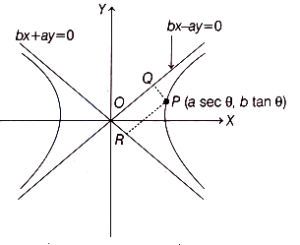
(D) The equations of the asymptotes of the hyperbola $\frac{x^2}{a^2}-\frac{y^2}{b^2}=1$ are $bx - ay = 0$ and $bx + ay = 0$.
Let $P(a \sec \theta, b \tan \theta)$ be any point on the hyperbola.
The perpendicular distance from $P$ to the asymptote $bx - ay = 0$ is $PQ = \frac{|b(a \sec \theta) - a(b \tan \theta)|}{\sqrt{b^2 + a^2}} = \frac{ab(\sec \theta - \tan \theta)}{\sqrt{a^2 + b^2}}$.
The perpendicular distance from $P$ to the asymptote $bx + ay = 0$ is $PR = \frac{|b(a \sec \theta) + a(b \tan \theta)|}{\sqrt{b^2 + a^2}} = \frac{ab(\sec \theta + \tan \theta)}{\sqrt{a^2 + b^2}}$.
The product of these distances is given as $6$:
$\frac{a^2 b^2(\sec^2 \theta - \tan^2 \theta)}{a^2 + b^2} = 6$
Since $\sec^2 \theta - \tan^2 \theta = 1$,we have $\frac{a^2 b^2}{a^2 + b^2} = 6$.
Given $e = \sqrt{3}$,we know $b^2 = a^2(e^2 - 1) = a^2(3 - 1) = 2a^2$.
Substituting $b^2 = 2a^2$ into the equation:
$\frac{a^2(2a^2)}{a^2 + 2a^2} = 6$ $\Rightarrow \frac{2a^4}{3a^2} = 6$ $\Rightarrow \frac{2}{3}a^2 = 6$ $\Rightarrow a^2 = 9$.
Then $b^2 = 2(9) = 18$,so $b = \sqrt{18} = 3\sqrt{2}$.
The length of the conjugate axis is $2b = 2(3\sqrt{2}) = 6\sqrt{2}$.
Let $P(a \sec \theta, b \tan \theta)$ be any point on the hyperbola.
The perpendicular distance from $P$ to the asymptote $bx - ay = 0$ is $PQ = \frac{|b(a \sec \theta) - a(b \tan \theta)|}{\sqrt{b^2 + a^2}} = \frac{ab(\sec \theta - \tan \theta)}{\sqrt{a^2 + b^2}}$.
The perpendicular distance from $P$ to the asymptote $bx + ay = 0$ is $PR = \frac{|b(a \sec \theta) + a(b \tan \theta)|}{\sqrt{b^2 + a^2}} = \frac{ab(\sec \theta + \tan \theta)}{\sqrt{a^2 + b^2}}$.
The product of these distances is given as $6$:
$\frac{a^2 b^2(\sec^2 \theta - \tan^2 \theta)}{a^2 + b^2} = 6$
Since $\sec^2 \theta - \tan^2 \theta = 1$,we have $\frac{a^2 b^2}{a^2 + b^2} = 6$.
Given $e = \sqrt{3}$,we know $b^2 = a^2(e^2 - 1) = a^2(3 - 1) = 2a^2$.
Substituting $b^2 = 2a^2$ into the equation:
$\frac{a^2(2a^2)}{a^2 + 2a^2} = 6$ $\Rightarrow \frac{2a^4}{3a^2} = 6$ $\Rightarrow \frac{2}{3}a^2 = 6$ $\Rightarrow a^2 = 9$.
Then $b^2 = 2(9) = 18$,so $b = \sqrt{18} = 3\sqrt{2}$.
The length of the conjugate axis is $2b = 2(3\sqrt{2}) = 6\sqrt{2}$.
0 likes
View Solution464
DifficultMCQ
The asymptotes of the hyperbola $\frac{x^2}{a^2}-\frac{y^2}{b^2}=1$,with any tangent to the hyperbola form a triangle whose area is $a^2 \tan (\alpha)$. Then its eccentricity equals
A
$\sec (\alpha)$
B
$\operatorname{cosec}(\alpha)$
C
$\sec ^2(\alpha)$
D
$\operatorname{cosec}^2(\alpha)$
Solution
(A) The equation of the hyperbola is $\frac{x^2}{a^2}-\frac{y^2}{b^2}=1$.
The asymptotes of the hyperbola are given by $\frac{x}{a} \pm \frac{y}{b} = 0$.
It is a standard property that the area of the triangle formed by any tangent to the hyperbola and its asymptotes is constant and equal to $ab$.
Given that the area is $a^2 \tan(\alpha)$,we have $ab = a^2 \tan(\alpha)$,which implies $b = a \tan(\alpha)$.
The eccentricity $e$ of the hyperbola is given by $e = \sqrt{1 + \frac{b^2}{a^2}}$.
Substituting $b = a \tan(\alpha)$,we get $e = \sqrt{1 + \frac{a^2 \tan^2(\alpha)}{a^2}} = \sqrt{1 + \tan^2(\alpha)} = \sqrt{\sec^2(\alpha)} = \sec(\alpha)$.
The asymptotes of the hyperbola are given by $\frac{x}{a} \pm \frac{y}{b} = 0$.
It is a standard property that the area of the triangle formed by any tangent to the hyperbola and its asymptotes is constant and equal to $ab$.
Given that the area is $a^2 \tan(\alpha)$,we have $ab = a^2 \tan(\alpha)$,which implies $b = a \tan(\alpha)$.
The eccentricity $e$ of the hyperbola is given by $e = \sqrt{1 + \frac{b^2}{a^2}}$.
Substituting $b = a \tan(\alpha)$,we get $e = \sqrt{1 + \frac{a^2 \tan^2(\alpha)}{a^2}} = \sqrt{1 + \tan^2(\alpha)} = \sqrt{\sec^2(\alpha)} = \sec(\alpha)$.
0 likes
View Solution465
MediumMCQ
The equation of the asymptotes of the hyperbola $2 x^2+5 x y+2 y^2-11 x-7 y-4=0$ is
A
$2 x^2+5 x y+2 y^2-11 x-7 y-9=0$
B
$2 x^2+5 x y+2 y^2-11 x-7 y+5=0$
C
$2 x^2+5 x y+2 y^2-11 x-7 y+4=0$
D
$2 x^2+5 x y+2 y^2-11 x-7 y+9=0$
Solution
(B) The equation of the asymptotes of the hyperbola $2 x^2+5 x y+2 y^2-11 x-7 y-4=0$ is of the form $2 x^2+5 x y+2 y^2-11 x-7 y+\lambda=0$.
Since this represents a pair of straight lines,the determinant of the general second-degree equation must be zero:
$abc + 2fgh - af^2 - bg^2 - ch^2 = 0$.
Here,$a=2, b=2, c=\lambda, h=\frac{5}{2}, g=-\frac{11}{2}, f=-\frac{7}{2}$.
Substituting these values:
$2(2)(\lambda) + 2(-\frac{7}{2})(-\frac{11}{2})(\frac{5}{2}) - 2(-\frac{7}{2})^2 - 2(-\frac{11}{2})^2 - \lambda(\frac{5}{2})^2 = 0$.
$4\lambda + \frac{385}{4} - \frac{49}{2} - \frac{121}{2} - \frac{25\lambda}{4} = 0$.
Multiplying by $4$:
$16\lambda + 385 - 98 - 242 - 25\lambda = 0$.
$-9\lambda + 45 = 0 \Rightarrow \lambda = 5$.
Thus,the equation is $2 x^2+5 x y+2 y^2-11 x-7 y+5=0$.
Since this represents a pair of straight lines,the determinant of the general second-degree equation must be zero:
$abc + 2fgh - af^2 - bg^2 - ch^2 = 0$.
Here,$a=2, b=2, c=\lambda, h=\frac{5}{2}, g=-\frac{11}{2}, f=-\frac{7}{2}$.
Substituting these values:
$2(2)(\lambda) + 2(-\frac{7}{2})(-\frac{11}{2})(\frac{5}{2}) - 2(-\frac{7}{2})^2 - 2(-\frac{11}{2})^2 - \lambda(\frac{5}{2})^2 = 0$.
$4\lambda + \frac{385}{4} - \frac{49}{2} - \frac{121}{2} - \frac{25\lambda}{4} = 0$.
Multiplying by $4$:
$16\lambda + 385 - 98 - 242 - 25\lambda = 0$.
$-9\lambda + 45 = 0 \Rightarrow \lambda = 5$.
Thus,the equation is $2 x^2+5 x y+2 y^2-11 x-7 y+5=0$.
0 likes
View Solution466
MediumMCQ
The equation of the hyperbola whose asymptotes are the lines $3x+4y-2=0$ and $2x+y+1=0$ and which passes through the point $(1,1)$ is
A
$6x^2+11xy+4y^2-30x+2y+7=0$
B
$6x^2+11xy+4y^2-x+2y-22=0$
C
$6x^2+11xy+4y^2-x+2y+22=0$
D
$6x^2+11xy+4y^2-3x-7y-11=0$
Solution
(B) The equation of the pair of asymptotes is given by the product of the lines: $(3x+4y-2)(2x+y+1)=0$.
Since the equation of the hyperbola differs from the equation of its asymptotes only by a constant $\lambda$,we can write: $(3x+4y-2)(2x+y+1)=\lambda$.
Given that the hyperbola passes through the point $(1,1)$,we substitute $x=1$ and $y=1$ into the equation: $(3(1)+4(1)-2)(2(1)+1+1)=\lambda$.
$(5)(4)=\lambda$,which gives $\lambda=20$.
Substituting $\lambda=20$ back into the equation: $(3x+4y-2)(2x+y+1)=20$.
Expanding the left side: $6x^2+3xy+3x+8xy+4y^2+4y-4x-2y-2=20$.
Simplifying: $6x^2+11xy+4y^2-x+2y-2=20$.
Thus,the equation is $6x^2+11xy+4y^2-x+2y-22=0$.
Since the equation of the hyperbola differs from the equation of its asymptotes only by a constant $\lambda$,we can write: $(3x+4y-2)(2x+y+1)=\lambda$.
Given that the hyperbola passes through the point $(1,1)$,we substitute $x=1$ and $y=1$ into the equation: $(3(1)+4(1)-2)(2(1)+1+1)=\lambda$.
$(5)(4)=\lambda$,which gives $\lambda=20$.
Substituting $\lambda=20$ back into the equation: $(3x+4y-2)(2x+y+1)=20$.
Expanding the left side: $6x^2+3xy+3x+8xy+4y^2+4y-4x-2y-2=20$.
Simplifying: $6x^2+11xy+4y^2-x+2y-2=20$.
Thus,the equation is $6x^2+11xy+4y^2-x+2y-22=0$.
0 likes
View Solution467
MediumMCQ
If the product of the lengths of the perpendiculars from any point on the hyperbola $16x^2 - 25y^2 = 400$ to its asymptotes is $p$ and the angle between the two asymptotes is $\theta$,then $p \tan \frac{\theta}{2} =$
A
$\frac{400}{41}$
B
$\frac{320}{41}$
C
$\frac{4}{5}$
D
$\frac{25}{16}$
Solution
(B) The given hyperbola is $16x^2 - 25y^2 = 400$,which can be written as $\frac{x^2}{25} - \frac{y^2}{16} = 1$.
Here,$a^2 = 25$ and $b^2 = 16$,so $a = 5$ and $b = 4$.
The equations of the asymptotes are $y = \pm \frac{b}{a}x$,i.e.,$4x - 5y = 0$ and $4x + 5y = 0$.
Let $P(x_1, y_1)$ be any point on the hyperbola,so $16x_1^2 - 25y_1^2 = 400$.
The lengths of the perpendiculars from $P$ to the asymptotes are $d_1 = \frac{|4x_1 - 5y_1|}{\sqrt{4^2 + 5^2}} = \frac{|4x_1 - 5y_1|}{\sqrt{41}}$ and $d_2 = \frac{|4x_1 + 5y_1|}{\sqrt{4^2 + 5^2}} = \frac{|4x_1 + 5y_1|}{\sqrt{41}}$.
The product $p = d_1 d_2 = \frac{|16x_1^2 - 25y_1^2|}{41} = \frac{400}{41}$.
The angle $\theta$ between the asymptotes is given by $\tan \frac{\theta}{2} = \frac{b}{a} = \frac{4}{5}$.
Therefore,$p \tan \frac{\theta}{2} = \frac{400}{41} \times \frac{4}{5} = \frac{80 \times 4}{41} = \frac{320}{41}$.
Here,$a^2 = 25$ and $b^2 = 16$,so $a = 5$ and $b = 4$.
The equations of the asymptotes are $y = \pm \frac{b}{a}x$,i.e.,$4x - 5y = 0$ and $4x + 5y = 0$.
Let $P(x_1, y_1)$ be any point on the hyperbola,so $16x_1^2 - 25y_1^2 = 400$.
The lengths of the perpendiculars from $P$ to the asymptotes are $d_1 = \frac{|4x_1 - 5y_1|}{\sqrt{4^2 + 5^2}} = \frac{|4x_1 - 5y_1|}{\sqrt{41}}$ and $d_2 = \frac{|4x_1 + 5y_1|}{\sqrt{4^2 + 5^2}} = \frac{|4x_1 + 5y_1|}{\sqrt{41}}$.
The product $p = d_1 d_2 = \frac{|16x_1^2 - 25y_1^2|}{41} = \frac{400}{41}$.
The angle $\theta$ between the asymptotes is given by $\tan \frac{\theta}{2} = \frac{b}{a} = \frac{4}{5}$.
Therefore,$p \tan \frac{\theta}{2} = \frac{400}{41} \times \frac{4}{5} = \frac{80 \times 4}{41} = \frac{320}{41}$.
0 likes
View Solution468
EasyMCQ
If the equation of one asymptote of the hyperbola $14 x^2+38 x y+20 y^2+x-7 y-91=0$ is $7 x+5 y-3=0$,then the other asymptote is
A
$2 x-4 y+1=0$
B
$2 x+4 y+1=0$
C
$2 x-4 y-1=0$
D
$2 x+4 y-1=0$
Solution
(B) The equation of the hyperbola is $14 x^2+38 x y+20 y^2+x-7 y-91=0$.
Asymptotes of a hyperbola differ from the hyperbola equation by a constant.
Let the asymptotes be $(7 x+5 y+c_1)(2 x+4 y+c_2) = 14 x^2+38 x y+20 y^2+x-7 y+k = 0$.
Expanding the product: $14 x^2+28 x y+7 x c_2+10 x y+20 y^2+5 y c_2+2 x c_1+4 y c_1+c_1 c_2 = 14 x^2+38 x y+20 y^2+x(7 c_2+2 c_1)+y(5 c_2+4 c_1)+c_1 c_2$.
Comparing the coefficients with the given hyperbola equation:
$7 c_2+2 c_1 = 1$
$5 c_2+4 c_1 = -7$
Given one asymptote is $7 x+5 y-3=0$,so $c_1 = -3$.
Substituting $c_1 = -3$ in the first equation: $7 c_2 + 2(-3) = 1$ $\Rightarrow 7 c_2 - 6 = 1$ $\Rightarrow 7 c_2 = 7$ $\Rightarrow c_2 = 1$.
Thus,the other asymptote is $2 x+4 y+1=0$.
Asymptotes of a hyperbola differ from the hyperbola equation by a constant.
Let the asymptotes be $(7 x+5 y+c_1)(2 x+4 y+c_2) = 14 x^2+38 x y+20 y^2+x-7 y+k = 0$.
Expanding the product: $14 x^2+28 x y+7 x c_2+10 x y+20 y^2+5 y c_2+2 x c_1+4 y c_1+c_1 c_2 = 14 x^2+38 x y+20 y^2+x(7 c_2+2 c_1)+y(5 c_2+4 c_1)+c_1 c_2$.
Comparing the coefficients with the given hyperbola equation:
$7 c_2+2 c_1 = 1$
$5 c_2+4 c_1 = -7$
Given one asymptote is $7 x+5 y-3=0$,so $c_1 = -3$.
Substituting $c_1 = -3$ in the first equation: $7 c_2 + 2(-3) = 1$ $\Rightarrow 7 c_2 - 6 = 1$ $\Rightarrow 7 c_2 = 7$ $\Rightarrow c_2 = 1$.
Thus,the other asymptote is $2 x+4 y+1=0$.
0 likes
View Solution469
DifficultMCQ
The product of the perpendicular distances drawn from any point on the hyperbola $\frac{x^2}{9} - \frac{y^2}{4} = 1$ to its asymptotes is
A
$\frac{13}{36}$
B
$\frac{13}{5}$
C
$\frac{36}{13}$
D
$\frac{36}{5}$
Solution
(C) For a hyperbola $\frac{x^2}{a^2} - \frac{y^2}{b^2} = 1$,the asymptotes are given by $\frac{x}{a} - \frac{y}{b} = 0$ and $\frac{x}{a} + \frac{y}{b} = 0$.
Here,$a^2 = 9$ and $b^2 = 4$,so $a = 3$ and $b = 2$.
The asymptotes are $\frac{x}{3} - \frac{y}{2} = 0$ or $2x - 3y = 0$ and $2x + 3y = 0$.
Let $P(x_0, y_0)$ be any point on the hyperbola,so $\frac{x_0^2}{9} - \frac{y_0^2}{4} = 1$.
The perpendicular distance $d_1$ from $P$ to $2x - 3y = 0$ is $d_1 = \frac{|2x_0 - 3y_0|}{\sqrt{2^2 + (-3)^2}} = \frac{|2x_0 - 3y_0|}{\sqrt{13}}$.
The perpendicular distance $d_2$ from $P$ to $2x + 3y = 0$ is $d_2 = \frac{|2x_0 + 3y_0|}{\sqrt{2^2 + 3^2}} = \frac{|2x_0 + 3y_0|}{\sqrt{13}}$.
The product $d_1 d_2 = \frac{|(2x_0 - 3y_0)(2x_0 + 3y_0)|}{13} = \frac{|4x_0^2 - 9y_0^2|}{13}$.
Since $\frac{x_0^2}{9} - \frac{y_0^2}{4} = 1$,we have $4x_0^2 - 9y_0^2 = 36$.
Thus,$d_1 d_2 = \frac{36}{13}$.
Here,$a^2 = 9$ and $b^2 = 4$,so $a = 3$ and $b = 2$.
The asymptotes are $\frac{x}{3} - \frac{y}{2} = 0$ or $2x - 3y = 0$ and $2x + 3y = 0$.
Let $P(x_0, y_0)$ be any point on the hyperbola,so $\frac{x_0^2}{9} - \frac{y_0^2}{4} = 1$.
The perpendicular distance $d_1$ from $P$ to $2x - 3y = 0$ is $d_1 = \frac{|2x_0 - 3y_0|}{\sqrt{2^2 + (-3)^2}} = \frac{|2x_0 - 3y_0|}{\sqrt{13}}$.
The perpendicular distance $d_2$ from $P$ to $2x + 3y = 0$ is $d_2 = \frac{|2x_0 + 3y_0|}{\sqrt{2^2 + 3^2}} = \frac{|2x_0 + 3y_0|}{\sqrt{13}}$.
The product $d_1 d_2 = \frac{|(2x_0 - 3y_0)(2x_0 + 3y_0)|}{13} = \frac{|4x_0^2 - 9y_0^2|}{13}$.
Since $\frac{x_0^2}{9} - \frac{y_0^2}{4} = 1$,we have $4x_0^2 - 9y_0^2 = 36$.
Thus,$d_1 d_2 = \frac{36}{13}$.
0 likes
View Solution470
DifficultMCQ
The equations of the asymptotes of a hyperbola are $x+y+3=0$ and $2x-y+1=0$. If $(1,-2)$ is a point on this hyperbola,find the equation of its conjugate hyperbola.
A
$2x^2+xy-y^2+7x-2y-1=0$
B
$2x^2+xy-y^2+7x-2y+13=0$
C
$2x^2+xy+y^2-7x-2y-1=0$
D
$2x^2+xy+y^2-7x-2y+13=0$
Solution
(B) The equation of the hyperbola is given by $(x+y+3)(2x-y+1) + \lambda = 0$.
Since the point $(1,-2)$ lies on the hyperbola,we substitute $x=1$ and $y=-2$:
$(1-2+3)(2(1)-(-2)+1) + \lambda = 0$
$(2)(5) + \lambda = 0 \implies \lambda = -10$.
Thus,the equation of the hyperbola is $(x+y+3)(2x-y+1) - 10 = 0$.
Expanding this: $2x^2 - xy + x + 2xy - y^2 + y + 6x - 3y + 3 - 10 = 0$,which simplifies to $2x^2 + xy - y^2 + 7x - 2y - 7 = 0$.
The equation of the conjugate hyperbola is $(x+y+3)(2x-y+1) + \lambda' = 0$.
Since the conjugate hyperbola passes through the point symmetric to $(1,-2)$ with respect to the center of the hyperbola,or by using the property that the constant term changes such that the sum of the constants of the hyperbola and its conjugate is $2 \times (\text{constant of the product of asymptotes})$,we find the constant term.
Alternatively,the equation of the conjugate hyperbola is $(x+y+3)(2x-y+1) + 10 = 0$.
Expanding this: $2x^2 + xy - y^2 + 7x - 2y + 3 + 10 = 0$,which simplifies to $2x^2 + xy - y^2 + 7x - 2y + 13 = 0$.
Since the point $(1,-2)$ lies on the hyperbola,we substitute $x=1$ and $y=-2$:
$(1-2+3)(2(1)-(-2)+1) + \lambda = 0$
$(2)(5) + \lambda = 0 \implies \lambda = -10$.
Thus,the equation of the hyperbola is $(x+y+3)(2x-y+1) - 10 = 0$.
Expanding this: $2x^2 - xy + x + 2xy - y^2 + y + 6x - 3y + 3 - 10 = 0$,which simplifies to $2x^2 + xy - y^2 + 7x - 2y - 7 = 0$.
The equation of the conjugate hyperbola is $(x+y+3)(2x-y+1) + \lambda' = 0$.
Since the conjugate hyperbola passes through the point symmetric to $(1,-2)$ with respect to the center of the hyperbola,or by using the property that the constant term changes such that the sum of the constants of the hyperbola and its conjugate is $2 \times (\text{constant of the product of asymptotes})$,we find the constant term.
Alternatively,the equation of the conjugate hyperbola is $(x+y+3)(2x-y+1) + 10 = 0$.
Expanding this: $2x^2 + xy - y^2 + 7x - 2y + 3 + 10 = 0$,which simplifies to $2x^2 + xy - y^2 + 7x - 2y + 13 = 0$.
0 likes
View Solution471
DifficultMCQ
Tangent at any point $\theta$ on the curve $x=35 \sec \theta, y=35 \tan \theta$ is
A
$y \sin \theta=x+35 \cos \theta$
B
$y \sin \theta=x-35 \cos \theta$
C
$y \cos \theta=x-35 \sin \theta$
D
$y \cos \theta=x+35 \sin \theta$
Solution
(B) Given,$x=35 \sec \theta$ and $y=35 \tan \theta$.
Point $P = (35 \sec \theta, 35 \tan \theta)$.
Differentiating $x$ and $y$ with respect to $\theta$:
$\frac{dx}{d\theta} = 35 \sec \theta \tan \theta$
$\frac{dy}{d\theta} = 35 \sec^2 \theta$
Slope of the tangent $m = \frac{dy}{dx} = \frac{dy/d\theta}{dx/d\theta} = \frac{35 \sec^2 \theta}{35 \sec \theta \tan \theta} = \frac{\sec \theta}{\tan \theta} = \frac{1}{\sin \theta}$.
Equation of the tangent at $P$ is $y - y_1 = m(x - x_1)$:
$y - 35 \tan \theta = \frac{1}{\sin \theta} (x - 35 \sec \theta)$
$y \sin \theta - 35 \tan \theta \sin \theta = x - 35 \sec \theta$
$y \sin \theta - 35 \frac{\sin^2 \theta}{\cos \theta} = x - \frac{35}{\cos \theta}$
$y \sin \theta = x + 35 \frac{\sin^2 \theta}{\cos \theta} - \frac{35}{\cos \theta}$
$y \sin \theta = x + \frac{35(\sin^2 \theta - 1)}{\cos \theta}$
$y \sin \theta = x + \frac{35(-\cos^2 \theta)}{\cos \theta}$
$y \sin \theta = x - 35 \cos \theta$.
Thus,the correct option is $B$.
Point $P = (35 \sec \theta, 35 \tan \theta)$.
Differentiating $x$ and $y$ with respect to $\theta$:
$\frac{dx}{d\theta} = 35 \sec \theta \tan \theta$
$\frac{dy}{d\theta} = 35 \sec^2 \theta$
Slope of the tangent $m = \frac{dy}{dx} = \frac{dy/d\theta}{dx/d\theta} = \frac{35 \sec^2 \theta}{35 \sec \theta \tan \theta} = \frac{\sec \theta}{\tan \theta} = \frac{1}{\sin \theta}$.
Equation of the tangent at $P$ is $y - y_1 = m(x - x_1)$:
$y - 35 \tan \theta = \frac{1}{\sin \theta} (x - 35 \sec \theta)$
$y \sin \theta - 35 \tan \theta \sin \theta = x - 35 \sec \theta$
$y \sin \theta - 35 \frac{\sin^2 \theta}{\cos \theta} = x - \frac{35}{\cos \theta}$
$y \sin \theta = x + 35 \frac{\sin^2 \theta}{\cos \theta} - \frac{35}{\cos \theta}$
$y \sin \theta = x + \frac{35(\sin^2 \theta - 1)}{\cos \theta}$
$y \sin \theta = x + \frac{35(-\cos^2 \theta)}{\cos \theta}$
$y \sin \theta = x - 35 \cos \theta$.
Thus,the correct option is $B$.
0 likes
View Solution472
MediumMCQ
If the perimeter of a triangle is $20$ and two of its vertices are $(-5, 0)$ and $(6, 0)$,then the locus of the third vertex is:
A
$40 x^2 - 81 y^2 - 40 x - 800 = 0$
B
$40 x^2 + 9 y^2 - 25 x + 800 = 0$
C
$40 x^2 - 9 y^2 = 800$
D
$5 x^2 - 3 y^2 + 3 x - 4 y + 25 = 0$
Solution
(A) Let the third vertex be $P(x, y)$. The other two vertices are $A(-5, 0)$ and $B(6, 0)$.
The perimeter is the sum of the lengths of the sides: $PA + PB + AB = 20$.
The distance $AB = \sqrt{(6 - (-5))^2 + (0 - 0)^2} = \sqrt{11^2} = 11$.
So,$PA + PB = 20 - 11 = 9$.
Substituting the coordinates,$\sqrt{(x + 5)^2 + y^2} + \sqrt{(x - 6)^2 + y^2} = 9$.
Rearranging: $\sqrt{(x + 5)^2 + y^2} = 9 - \sqrt{(x - 6)^2 + y^2}$.
Squaring both sides: $(x + 5)^2 + y^2 = 81 + (x - 6)^2 + y^2 - 18\sqrt{(x - 6)^2 + y^2}$.
$x^2 + 10x + 25 + y^2 = 81 + x^2 - 12x + 36 + y^2 - 18\sqrt{(x - 6)^2 + y^2}$.
$22x - 92 = -18\sqrt{(x - 6)^2 + y^2}$.
Dividing by $-2$: $46 - 11x = 9\sqrt{(x - 6)^2 + y^2}$.
Squaring again: $(46 - 11x)^2 = 81((x - 6)^2 + y^2)$.
$2116 - 1012x + 121x^2 = 81(x^2 - 12x + 36 + y^2)$.
$2116 - 1012x + 121x^2 = 81x^2 - 972x + 2916 + 81y^2$.
$40x^2 - 81y^2 - 40x - 800 = 0$.
The perimeter is the sum of the lengths of the sides: $PA + PB + AB = 20$.
The distance $AB = \sqrt{(6 - (-5))^2 + (0 - 0)^2} = \sqrt{11^2} = 11$.
So,$PA + PB = 20 - 11 = 9$.
Substituting the coordinates,$\sqrt{(x + 5)^2 + y^2} + \sqrt{(x - 6)^2 + y^2} = 9$.
Rearranging: $\sqrt{(x + 5)^2 + y^2} = 9 - \sqrt{(x - 6)^2 + y^2}$.
Squaring both sides: $(x + 5)^2 + y^2 = 81 + (x - 6)^2 + y^2 - 18\sqrt{(x - 6)^2 + y^2}$.
$x^2 + 10x + 25 + y^2 = 81 + x^2 - 12x + 36 + y^2 - 18\sqrt{(x - 6)^2 + y^2}$.
$22x - 92 = -18\sqrt{(x - 6)^2 + y^2}$.
Dividing by $-2$: $46 - 11x = 9\sqrt{(x - 6)^2 + y^2}$.
Squaring again: $(46 - 11x)^2 = 81((x - 6)^2 + y^2)$.
$2116 - 1012x + 121x^2 = 81(x^2 - 12x + 36 + y^2)$.
$2116 - 1012x + 121x^2 = 81x^2 - 972x + 2916 + 81y^2$.
$40x^2 - 81y^2 - 40x - 800 = 0$.
0 likes
View Solution473
DifficultMCQ
The equation $\frac{1}{r} = \frac{1}{8} + \frac{3}{8} \cos \theta$ represents:
A
a parabola
B
an ellipse
C
a hyperbola
D
a rectangular hyperbola
Solution
(C) The given equation is $\frac{1}{r} = \frac{1}{8} + \frac{3}{8} \cos \theta$.
Multiplying by $8r$,we get:
$8 = r + 3r \cos \theta$
Since $x = r \cos \theta$,we have $r = 8 - 3x$.
Squaring both sides:
$r^2 = (8 - 3x)^2$
$x^2 + y^2 = 64 + 9x^2 - 48x$
$8x^2 - y^2 - 48x + 64 = 0$.
Comparing this with the general equation of a conic section $Ax^2 + Bxy + Cy^2 + Dx + Ey + F = 0$,here $A = 8$ and $C = -1$.
Since $A$ and $C$ have opposite signs $(AC < 0)$,the equation represents a hyperbola.
Multiplying by $8r$,we get:
$8 = r + 3r \cos \theta$
Since $x = r \cos \theta$,we have $r = 8 - 3x$.
Squaring both sides:
$r^2 = (8 - 3x)^2$
$x^2 + y^2 = 64 + 9x^2 - 48x$
$8x^2 - y^2 - 48x + 64 = 0$.
Comparing this with the general equation of a conic section $Ax^2 + Bxy + Cy^2 + Dx + Ey + F = 0$,here $A = 8$ and $C = -1$.
Since $A$ and $C$ have opposite signs $(AC < 0)$,the equation represents a hyperbola.
0 likes
View Solution474
DifficultMCQ
If $l$ is the maximum value of $-3x^2+4x+1$ and $m$ is the minimum value of $3x^2+4x+1$,then the equation of the hyperbola having foci at $(l, 0)$ and $(7m, 0)$ and eccentricity $e=2$ is
A
$36x^2-12y^2=49$
B
$2x^2-5y^2=1$
C
$49x^2-36y^2=12$
D
$36x^2-12y^2=1$
Solution
(A) For $f(x) = -3x^2+4x+1$,the maximum value $l$ occurs at $x = -b/(2a) = -4/(2 \times -3) = 2/3$.
$l = f(2/3) = -3(4/9) + 4(2/3) + 1 = -4/3 + 8/3 + 1 = 7/3$.
For $g(x) = 3x^2+4x+1$,the minimum value $m$ occurs at $x = -4/(2 \times 3) = -2/3$.
$m = g(-2/3) = 3(4/9) + 4(-2/3) + 1 = 4/3 - 8/3 + 1 = -1/3$.
The foci are $(l, 0) = (7/3, 0)$ and $(7m, 0) = (7 \times -1/3, 0) = (-7/3, 0)$.
The center of the hyperbola is $(0, 0)$. The distance between foci is $2ae = 7/3 - (-7/3) = 14/3$.
Given $e = 2$,we have $2a(2) = 14/3 \implies 4a = 14/3 \implies a = 7/6$.
Also,$b^2 = a^2(e^2-1) = (49/36)(4-1) = (49/36)(3) = 49/12$.
The equation of the hyperbola is $x^2/a^2 - y^2/b^2 = 1$.
$x^2/(49/36) - y^2/(49/12) = 1 \implies 36x^2/49 - 12y^2/49 = 1 \implies 36x^2 - 12y^2 = 49$.
$l = f(2/3) = -3(4/9) + 4(2/3) + 1 = -4/3 + 8/3 + 1 = 7/3$.
For $g(x) = 3x^2+4x+1$,the minimum value $m$ occurs at $x = -4/(2 \times 3) = -2/3$.
$m = g(-2/3) = 3(4/9) + 4(-2/3) + 1 = 4/3 - 8/3 + 1 = -1/3$.
The foci are $(l, 0) = (7/3, 0)$ and $(7m, 0) = (7 \times -1/3, 0) = (-7/3, 0)$.
The center of the hyperbola is $(0, 0)$. The distance between foci is $2ae = 7/3 - (-7/3) = 14/3$.
Given $e = 2$,we have $2a(2) = 14/3 \implies 4a = 14/3 \implies a = 7/6$.
Also,$b^2 = a^2(e^2-1) = (49/36)(4-1) = (49/36)(3) = 49/12$.
The equation of the hyperbola is $x^2/a^2 - y^2/b^2 = 1$.
$x^2/(49/36) - y^2/(49/12) = 1 \implies 36x^2/49 - 12y^2/49 = 1 \implies 36x^2 - 12y^2 = 49$.
0 likes
View Solution475
MediumMCQ
Let $x$ be the eccentricity of a hyperbola whose transverse axis is twice its conjugate axis. Let $y$ be the eccentricity of another hyperbola for which the distance between the foci is $3$ times the distance between its directrices. Then $y^2-x^2=$
A
$\frac{23}{16}$
B
$\frac{7}{4}$
C
$\frac{4}{7}$
D
$\frac{16}{23}$
Solution
(B) For the first hyperbola,the transverse axis is $2a$ and the conjugate axis is $2b$. Given $2a = 2(2b)$,so $a = 2b$. The eccentricity $x$ is given by $x^2 = 1 + \frac{b^2}{a^2} = 1 + \frac{b^2}{(2b)^2} = 1 + \frac{1}{4} = \frac{5}{4}$.
For the second hyperbola,the distance between the foci is $2ae$ and the distance between the directrices is $\frac{2a}{e}$. Given $2ae = 3 \times \frac{2a}{e}$,which simplifies to $e^2 = 3$. Thus,$y^2 = 3$.
Therefore,$y^2 - x^2 = 3 - \frac{5}{4} = \frac{12-5}{4} = \frac{7}{4}$.
For the second hyperbola,the distance between the foci is $2ae$ and the distance between the directrices is $\frac{2a}{e}$. Given $2ae = 3 \times \frac{2a}{e}$,which simplifies to $e^2 = 3$. Thus,$y^2 = 3$.
Therefore,$y^2 - x^2 = 3 - \frac{5}{4} = \frac{12-5}{4} = \frac{7}{4}$.
0 likes
View Solution476
MediumMCQ
If the latus rectum through one of the foci of a hyperbola $\frac{x^2}{9}-\frac{y^2}{b^2}=1$ subtends a right angle at the farther vertex of the hyperbola,then $b^2=$
A
$4$
B
$16$
C
$25$
D
$27$
Solution
(D) For the hyperbola $\frac{x^2}{a^2} - \frac{y^2}{b^2} = 1$,we have $a^2 = 9$,so $a = 3$. The foci are $(\pm ae, 0)$ and vertices are $(\pm a, 0)$.
Let the focus be $S(ae, 0)$ and the farther vertex be $A'(-a, 0)$.
The latus rectum is the line $x = ae$. The endpoints of the latus rectum are $L(ae, \frac{b^2}{a})$ and $L'(ae, -\frac{b^2}{a})$.
The vector $\vec{A'L} = (ae - (-a), \frac{b^2}{a} - 0) = (a(e+1), \frac{b^2}{a})$.
The vector $\vec{A'L'} = (ae - (-a), -\frac{b^2}{a} - 0) = (a(e+1), -\frac{b^2}{a})$.
Since the angle $\angle L A' L'$ is $90^\circ$,the dot product $\vec{A'L} \cdot \vec{A'L'} = 0$.
$a^2(e+1)^2 - \frac{b^4}{a^2} = 0 \implies a^4(e+1)^2 = b^4$.
Since $b^2 = a^2(e^2-1) = a^2(e-1)(e+1)$,we have $b^4 = a^4(e-1)^2(e+1)^2$.
Equating the two expressions for $b^4$: $a^4(e+1)^2 = a^4(e-1)^2(e+1)^2$.
Dividing by $a^4(e+1)^2$,we get $1 = (e-1)^2$,so $e-1 = 1$,which means $e = 2$.
Then $b^2 = a^2(e^2-1) = 9(2^2-1) = 9(3) = 27$.
Let the focus be $S(ae, 0)$ and the farther vertex be $A'(-a, 0)$.
The latus rectum is the line $x = ae$. The endpoints of the latus rectum are $L(ae, \frac{b^2}{a})$ and $L'(ae, -\frac{b^2}{a})$.
The vector $\vec{A'L} = (ae - (-a), \frac{b^2}{a} - 0) = (a(e+1), \frac{b^2}{a})$.
The vector $\vec{A'L'} = (ae - (-a), -\frac{b^2}{a} - 0) = (a(e+1), -\frac{b^2}{a})$.
Since the angle $\angle L A' L'$ is $90^\circ$,the dot product $\vec{A'L} \cdot \vec{A'L'} = 0$.
$a^2(e+1)^2 - \frac{b^4}{a^2} = 0 \implies a^4(e+1)^2 = b^4$.
Since $b^2 = a^2(e^2-1) = a^2(e-1)(e+1)$,we have $b^4 = a^4(e-1)^2(e+1)^2$.
Equating the two expressions for $b^4$: $a^4(e+1)^2 = a^4(e-1)^2(e+1)^2$.
Dividing by $a^4(e+1)^2$,we get $1 = (e-1)^2$,so $e-1 = 1$,which means $e = 2$.
Then $b^2 = a^2(e^2-1) = 9(2^2-1) = 9(3) = 27$.
0 likes
View Solution477
EasyMCQ
If $\frac{x^2}{k-\frac{5}{2}}+\frac{y^2}{\frac{7}{3}-k}= 1$ ($k$ is a real number) represents a hyperbola,then the set of all values of $k$ is
A
$\left(\frac{5}{2}, \infty\right)$
B
$\left(\frac{7}{3}, \frac{5}{2}\right)$
C
$\left(-\infty, \frac{7}{3}\right) \cup \left(\frac{5}{2}, \infty\right)$
D
$R - \left[\frac{7}{3}, \frac{5}{2}\right]$
Solution
(C) The given equation is $\frac{x^2}{k-\frac{5}{2}} + \frac{y^2}{\frac{7}{3}-k} = 1$.
For this to represent a hyperbola,the denominators must have opposite signs,i.e.,their product must be negative:
$(k - \frac{5}{2})(\frac{7}{3} - k) < 0$.
Multiplying by $-1$,we get $(k - \frac{5}{2})(k - \frac{7}{3}) > 0$.
Since $\frac{7}{3} \approx 2.33$ and $\frac{5}{2} = 2.5$,we have $\frac{7}{3} < \frac{5}{2}$.
The inequality $(k - \frac{7}{3})(k - \frac{5}{2}) > 0$ holds when $k < \frac{7}{3}$ or $k > \frac{5}{2}$.
Thus,the set of all values of $k$ is $\left(-\infty, \frac{7}{3}\right) \cup \left(\frac{5}{2}, \infty\right)$.
For this to represent a hyperbola,the denominators must have opposite signs,i.e.,their product must be negative:
$(k - \frac{5}{2})(\frac{7}{3} - k) < 0$.
Multiplying by $-1$,we get $(k - \frac{5}{2})(k - \frac{7}{3}) > 0$.
Since $\frac{7}{3} \approx 2.33$ and $\frac{5}{2} = 2.5$,we have $\frac{7}{3} < \frac{5}{2}$.
The inequality $(k - \frac{7}{3})(k - \frac{5}{2}) > 0$ holds when $k < \frac{7}{3}$ or $k > \frac{5}{2}$.
Thus,the set of all values of $k$ is $\left(-\infty, \frac{7}{3}\right) \cup \left(\frac{5}{2}, \infty\right)$.
0 likes
View Solution478
EasyMCQ
If $P(\theta) = (x_1, \frac{3 \sqrt{5}}{2})$,$0 < \theta < \frac{\pi}{2}$ is a point on the hyperbola $\frac{x^2}{25} - \frac{y^2}{9} = 1$,where $\theta$ is the parameter in its parametric form,then $2 x_1 + 9 \sin^2 \theta = $
A
$8$
B
$10$
C
$20$
D
$34$
Solution
(C) The given hyperbola is $\frac{x^2}{25} - \frac{y^2}{9} = 1$.
Any point on this hyperbola is given by $(5 \sec \theta, 3 \tan \theta)$.
Given $P(\theta) = (x_1, \frac{3 \sqrt{5}}{2})$,we equate the $y$-coordinates: $3 \tan \theta = \frac{3 \sqrt{5}}{2} \implies \tan \theta = \frac{\sqrt{5}}{2}$.
Since $1 + \tan^2 \theta = \sec^2 \theta$,we have $\sec^2 \theta = 1 + \frac{5}{4} = \frac{9}{4}$,so $\sec \theta = \frac{3}{2}$ (as $0 < \theta < \frac{\pi}{2}$).
Thus,$x_1 = 5 \sec \theta = 5 \times \frac{3}{2} = \frac{15}{2}$.
Also,$\sin^2 \theta = 1 - \cos^2 \theta = 1 - \frac{1}{\sec^2 \theta} = 1 - \frac{4}{9} = \frac{5}{9}$.
Finally,$2 x_1 + 9 \sin^2 \theta = 2(\frac{15}{2}) + 9(\frac{5}{9}) = 15 + 5 = 20$.
Any point on this hyperbola is given by $(5 \sec \theta, 3 \tan \theta)$.
Given $P(\theta) = (x_1, \frac{3 \sqrt{5}}{2})$,we equate the $y$-coordinates: $3 \tan \theta = \frac{3 \sqrt{5}}{2} \implies \tan \theta = \frac{\sqrt{5}}{2}$.
Since $1 + \tan^2 \theta = \sec^2 \theta$,we have $\sec^2 \theta = 1 + \frac{5}{4} = \frac{9}{4}$,so $\sec \theta = \frac{3}{2}$ (as $0 < \theta < \frac{\pi}{2}$).
Thus,$x_1 = 5 \sec \theta = 5 \times \frac{3}{2} = \frac{15}{2}$.
Also,$\sin^2 \theta = 1 - \cos^2 \theta = 1 - \frac{1}{\sec^2 \theta} = 1 - \frac{4}{9} = \frac{5}{9}$.
Finally,$2 x_1 + 9 \sin^2 \theta = 2(\frac{15}{2}) + 9(\frac{5}{9}) = 15 + 5 = 20$.
0 likes
View Solution479
EasyMCQ
Let $S$ be the focus of the hyperbola $\frac{x^2}{16}-\frac{y^2}{9}=1$ lying on the positive $X$-axis and $P(5, y_1)$ be a point on the hyperbola. Then $SP =$
A
$\frac{1}{4}$
B
$\frac{3}{4}$
C
$\frac{9}{4}$
D
$\frac{5}{4}$
Solution
(C) Given the hyperbola equation $\frac{x^2}{16}-\frac{y^2}{9}=1$,we have $a^2=16$ and $b^2=9$.
Since point $P(5, y_1)$ lies on the hyperbola,we substitute $x=5$:
$\frac{25}{16}-\frac{y_1^2}{9}=1$
$\Rightarrow \frac{y_1^2}{9}=\frac{25}{16}-1 = \frac{9}{16}$
$\Rightarrow y_1^2 = \frac{81}{16}$ $\Rightarrow y_1 = \pm \frac{9}{4}$.
Thus,$P = (5, \pm \frac{9}{4})$.
The eccentricity $e$ is given by $e = \sqrt{1+\frac{b^2}{a^2}} = \sqrt{1+\frac{9}{16}} = \frac{5}{4}$.
The focus $S$ on the positive $X$-axis is $(ae, 0) = (4 \times \frac{5}{4}, 0) = (5, 0)$.
Now,the distance $SP$ is:
$SP = \sqrt{(5-5)^2 + (0 - (\pm \frac{9}{4}))^2} = \sqrt{0 + \frac{81}{16}} = \frac{9}{4}$.
Since point $P(5, y_1)$ lies on the hyperbola,we substitute $x=5$:
$\frac{25}{16}-\frac{y_1^2}{9}=1$
$\Rightarrow \frac{y_1^2}{9}=\frac{25}{16}-1 = \frac{9}{16}$
$\Rightarrow y_1^2 = \frac{81}{16}$ $\Rightarrow y_1 = \pm \frac{9}{4}$.
Thus,$P = (5, \pm \frac{9}{4})$.
The eccentricity $e$ is given by $e = \sqrt{1+\frac{b^2}{a^2}} = \sqrt{1+\frac{9}{16}} = \frac{5}{4}$.
The focus $S$ on the positive $X$-axis is $(ae, 0) = (4 \times \frac{5}{4}, 0) = (5, 0)$.
Now,the distance $SP$ is:
$SP = \sqrt{(5-5)^2 + (0 - (\pm \frac{9}{4}))^2} = \sqrt{0 + \frac{81}{16}} = \frac{9}{4}$.
0 likes
View Solution480
DifficultMCQ
If $e_1$ is the eccentricity of the hyperbola $x = \sec \theta, y = \sqrt{2} \tan \theta$ and $e_2$ is the eccentricity of the hyperbola $x = \sqrt{2} \sec \theta, y = \tan \theta$,then $\frac{e_2^2}{e_1^2} = $
A
$1$
B
$2$
C
$\frac{1}{2}$
D
$\frac{1}{4}$
Solution
(C) The given equations are in parametric form $x = a \sec \theta, y = b \tan \theta$,which represents the hyperbola $\frac{x^2}{a^2} - \frac{y^2}{b^2} = 1$.
The eccentricity $e$ is given by $e^2 = 1 + \frac{b^2}{a^2} = \frac{a^2 + b^2}{a^2}$.
For the first hyperbola,$a = 1$ and $b = \sqrt{2}$,so $e_1^2 = 1 + \frac{(\sqrt{2})^2}{1^2} = 1 + 2 = 3$.
For the second hyperbola,$a = \sqrt{2}$ and $b = 1$,so $e_2^2 = 1 + \frac{1^2}{(\sqrt{2})^2} = 1 + \frac{1}{2} = \frac{3}{2}$.
Therefore,$\frac{e_2^2}{e_1^2} = \frac{3/2}{3} = \frac{1}{2}$.
The eccentricity $e$ is given by $e^2 = 1 + \frac{b^2}{a^2} = \frac{a^2 + b^2}{a^2}$.
For the first hyperbola,$a = 1$ and $b = \sqrt{2}$,so $e_1^2 = 1 + \frac{(\sqrt{2})^2}{1^2} = 1 + 2 = 3$.
For the second hyperbola,$a = \sqrt{2}$ and $b = 1$,so $e_2^2 = 1 + \frac{1^2}{(\sqrt{2})^2} = 1 + \frac{1}{2} = \frac{3}{2}$.
Therefore,$\frac{e_2^2}{e_1^2} = \frac{3/2}{3} = \frac{1}{2}$.
0 likes
View Solution481
MediumMCQ
$A$ hyperbola having its centre at the origin passes through the point $(5, 2)$ and has a transverse axis of length $8$ along the $X$-axis. What is the eccentricity of its conjugate hyperbola?
A
$\frac{\sqrt{13}}{3}$
B
$\sqrt{\frac{13}{3}}$
C
$\frac{\sqrt{13}}{2}$
D
$\sqrt{\frac{13}{2}}$
Solution
(C) The equation of the hyperbola with centre at the origin and transverse axis along the $X$-axis is $\frac{x^2}{a^2} - \frac{y^2}{b^2} = 1$.
Given the length of the transverse axis $2a = 8$,we have $a = 4$,so $a^2 = 16$.
The hyperbola passes through $(5, 2)$,so $\frac{25}{16} - \frac{4}{b^2} = 1$.
$\frac{4}{b^2} = \frac{25}{16} - 1 = \frac{9}{16}$,which gives $b^2 = \frac{64}{9}$.
The conjugate hyperbola is $\frac{y^2}{b^2} - \frac{x^2}{a^2} = 1$.
The eccentricity $e'$ of the conjugate hyperbola is given by $e' = \sqrt{1 + \frac{a^2}{b^2}}$.
$e' = \sqrt{1 + \frac{16}{64/9}} = \sqrt{1 + \frac{16 \times 9}{64}} = \sqrt{1 + \frac{9}{4}} = \sqrt{\frac{13}{4}} = \frac{\sqrt{13}}{2}$.
Given the length of the transverse axis $2a = 8$,we have $a = 4$,so $a^2 = 16$.
The hyperbola passes through $(5, 2)$,so $\frac{25}{16} - \frac{4}{b^2} = 1$.
$\frac{4}{b^2} = \frac{25}{16} - 1 = \frac{9}{16}$,which gives $b^2 = \frac{64}{9}$.
The conjugate hyperbola is $\frac{y^2}{b^2} - \frac{x^2}{a^2} = 1$.
The eccentricity $e'$ of the conjugate hyperbola is given by $e' = \sqrt{1 + \frac{a^2}{b^2}}$.
$e' = \sqrt{1 + \frac{16}{64/9}} = \sqrt{1 + \frac{16 \times 9}{64}} = \sqrt{1 + \frac{9}{4}} = \sqrt{\frac{13}{4}} = \frac{\sqrt{13}}{2}$.
0 likes
View Solution482
MediumMCQ
Let $e_1$ be the eccentricity of a hyperbola for which the distance between its foci is $2$ times the distance between its directrices,and $e_2$ be the eccentricity of another hyperbola for which the length of its transverse axis is twice the length of its conjugate axis. Then $e_1 e_2 =$
A
$1$
B
$\frac{\sqrt{10}}{2}$
C
$\sqrt{5}$
D
$\frac{\sqrt{5}}{2}$
Solution
(B) For the first hyperbola,the distance between foci is $2ae_1$ and the distance between directrices is $\frac{2a}{e_1}$.
Given $2ae_1 = 2 \times \frac{2a}{e_1}$,which simplifies to $e_1^2 = 2$. Since $e_1 > 1$,we have $e_1 = \sqrt{2}$.
For the second hyperbola,the length of the transverse axis is $2a_2$ and the length of the conjugate axis is $2b_2$.
Given $2a_2 = 2(2b_2)$,so $a_2 = 2b_2$ or $b_2 = \frac{a_2}{2}$.
The eccentricity $e_2$ is given by $e_2 = \sqrt{1 + \frac{b_2^2}{a_2^2}} = \sqrt{1 + \frac{(a_2/2)^2}{a_2^2}} = \sqrt{1 + \frac{1}{4}} = \sqrt{\frac{5}{4}} = \frac{\sqrt{5}}{2}$.
Therefore,$e_1 e_2 = \sqrt{2} \times \frac{\sqrt{5}}{2} = \frac{\sqrt{10}}{2}$.
Thus,option $B$ is correct.
Given $2ae_1 = 2 \times \frac{2a}{e_1}$,which simplifies to $e_1^2 = 2$. Since $e_1 > 1$,we have $e_1 = \sqrt{2}$.
For the second hyperbola,the length of the transverse axis is $2a_2$ and the length of the conjugate axis is $2b_2$.
Given $2a_2 = 2(2b_2)$,so $a_2 = 2b_2$ or $b_2 = \frac{a_2}{2}$.
The eccentricity $e_2$ is given by $e_2 = \sqrt{1 + \frac{b_2^2}{a_2^2}} = \sqrt{1 + \frac{(a_2/2)^2}{a_2^2}} = \sqrt{1 + \frac{1}{4}} = \sqrt{\frac{5}{4}} = \frac{\sqrt{5}}{2}$.
Therefore,$e_1 e_2 = \sqrt{2} \times \frac{\sqrt{5}}{2} = \frac{\sqrt{10}}{2}$.
Thus,option $B$ is correct.
0 likes
View Solution483
MediumMCQ
If $P(\frac{\pi}{6})$ is a point on the hyperbola $\frac{x^2}{a^2}-\frac{y^2}{b^2}=1$,$S$ and $S^{\prime}$ are its foci,and $SP + S^{\prime}P - 2|SP - S^{\prime}P| = 0$,then the eccentricity $e$ is:
A
$\sqrt{2}$
B
$2$
C
$\sqrt{3}$
D
$3$
Solution
(C) For a point $P$ on the hyperbola $\frac{x^2}{a^2} - \frac{y^2}{b^2} = 1$,the focal distances are $SP = |ex - a|$ and $S^{\prime}P = |ex + a|$.
Given the condition $SP + S^{\prime}P - 2|SP - S^{\prime}P| = 0$,we know that $|SP - S^{\prime}P| = 2a$.
Substituting this into the equation: $SP + S^{\prime}P = 2(2a) = 4a$.
For a hyperbola,the sum of focal distances is $SP + S^{\prime}P = 2ex$ (assuming $x > 0$).
Thus,$2ex = 4a$,which implies $ex = 2a$,or $x = \frac{2a}{e}$.
The point $P$ is given as $P(\frac{\pi}{6})$,which in parametric form is $(a \sec \theta, b \tan \theta)$.
Here,$x = a \sec(\frac{\pi}{6}) = a \cdot \frac{2}{\sqrt{3}}$.
Equating the two expressions for $x$: $\frac{2a}{e} = \frac{2a}{\sqrt{3}}$.
Therefore,$e = \sqrt{3}$.
Given the condition $SP + S^{\prime}P - 2|SP - S^{\prime}P| = 0$,we know that $|SP - S^{\prime}P| = 2a$.
Substituting this into the equation: $SP + S^{\prime}P = 2(2a) = 4a$.
For a hyperbola,the sum of focal distances is $SP + S^{\prime}P = 2ex$ (assuming $x > 0$).
Thus,$2ex = 4a$,which implies $ex = 2a$,or $x = \frac{2a}{e}$.
The point $P$ is given as $P(\frac{\pi}{6})$,which in parametric form is $(a \sec \theta, b \tan \theta)$.
Here,$x = a \sec(\frac{\pi}{6}) = a \cdot \frac{2}{\sqrt{3}}$.
Equating the two expressions for $x$: $\frac{2a}{e} = \frac{2a}{\sqrt{3}}$.
Therefore,$e = \sqrt{3}$.
0 likes
View Solution484
MediumMCQ
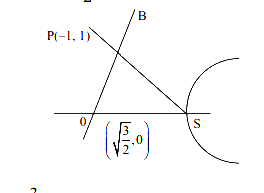
Let $S$ be the focus of the hyperbola $x^2 - 2y^2 = 1$ lying on the positive $X$-axis. Let $P(-1, 1)$ be a given point. Then the area of the triangle formed by the line $PS$ with the coordinate axes is (in sq. units)
A
$\frac{\sqrt{2}}{2(\sqrt{2}+3)}$
B
$\frac{\sqrt{6}}{2(2+\sqrt{6})}$
C
$\frac{3}{2(2+\sqrt{6})}$
D
$\frac{\sqrt{3}}{2(\sqrt{2}+\sqrt{3})}$
Solution
(C) The equation of the hyperbola is $x^2 - 2y^2 = 1$. Comparing with $\frac{x^2}{a^2} - \frac{y^2}{b^2} = 1$,we get $a^2 = 1$ and $b^2 = \frac{1}{2}$.
The eccentricity $e = \sqrt{1 + \frac{b^2}{a^2}} = \sqrt{1 + \frac{1/2}{1}} = \sqrt{\frac{3}{2}}$.
The focus $S$ is $(ae, 0) = (\sqrt{\frac{3}{2}}, 0)$.
The line passing through $P(-1, 1)$ and $S(\sqrt{\frac{3}{2}}, 0)$ has slope $m = \frac{0 - 1}{\sqrt{\frac{3}{2}} - (-1)} = \frac{-1}{\sqrt{\frac{3}{2}} + 1} = \frac{-\sqrt{2}}{\sqrt{3} + \sqrt{2}}$.
The equation of line $PS$ is $y - 0 = m(x - \sqrt{\frac{3}{2}})$,which is $y = \frac{-\sqrt{2}}{\sqrt{3} + \sqrt{2}}(x - \sqrt{\frac{3}{2}})$.
To find the $Y$-intercept $(B)$,set $x = 0$: $y = \frac{-\sqrt{2}}{\sqrt{3} + \sqrt{2}}(-\sqrt{\frac{3}{2}}) = \frac{\sqrt{3}}{\sqrt{3} + \sqrt{2}}$.
The area of the triangle formed by the line with coordinate axes is $\frac{1}{2} \times |OS| \times |OB| = \frac{1}{2} \times \sqrt{\frac{3}{2}} \times \frac{\sqrt{3}}{\sqrt{3} + \sqrt{2}} = \frac{1}{2} \times \frac{3}{\sqrt{2}(\sqrt{3} + \sqrt{2})} = \frac{3}{2(\sqrt{6} + 2)}$.
Thus,the correct option is $C$.
The eccentricity $e = \sqrt{1 + \frac{b^2}{a^2}} = \sqrt{1 + \frac{1/2}{1}} = \sqrt{\frac{3}{2}}$.
The focus $S$ is $(ae, 0) = (\sqrt{\frac{3}{2}}, 0)$.
The line passing through $P(-1, 1)$ and $S(\sqrt{\frac{3}{2}}, 0)$ has slope $m = \frac{0 - 1}{\sqrt{\frac{3}{2}} - (-1)} = \frac{-1}{\sqrt{\frac{3}{2}} + 1} = \frac{-\sqrt{2}}{\sqrt{3} + \sqrt{2}}$.
The equation of line $PS$ is $y - 0 = m(x - \sqrt{\frac{3}{2}})$,which is $y = \frac{-\sqrt{2}}{\sqrt{3} + \sqrt{2}}(x - \sqrt{\frac{3}{2}})$.
To find the $Y$-intercept $(B)$,set $x = 0$: $y = \frac{-\sqrt{2}}{\sqrt{3} + \sqrt{2}}(-\sqrt{\frac{3}{2}}) = \frac{\sqrt{3}}{\sqrt{3} + \sqrt{2}}$.
The area of the triangle formed by the line with coordinate axes is $\frac{1}{2} \times |OS| \times |OB| = \frac{1}{2} \times \sqrt{\frac{3}{2}} \times \frac{\sqrt{3}}{\sqrt{3} + \sqrt{2}} = \frac{1}{2} \times \frac{3}{\sqrt{2}(\sqrt{3} + \sqrt{2})} = \frac{3}{2(\sqrt{6} + 2)}$.
Thus,the correct option is $C$.
0 likes
View Solution485
EasyMCQ
If $(\alpha, -1)$ is an interior point of the curve $4x^2 - 3y^2 = 1$,then $\alpha$ lies in:
A
$(-\infty, -1) \cup (1, \infty)$
B
$(-1, 1)$
C
$(-\infty, \infty)$
D
$[0, \infty)$
Solution
(B) The equation of the hyperbola is $S = 4x^2 - 3y^2 - 1 = 0$.
For a point $(\alpha, \beta)$ to be in the interior of the hyperbola,the condition is $S_1 < 0$ if the point is between the branches,but for the standard hyperbola $\frac{x^2}{a^2} - \frac{y^2}{b^2} = 1$,the interior region containing the foci is defined by $S_1 < 0$.
However,checking the standard definition for $4x^2 - 3y^2 - 1 = 0$ at $(0,0)$,we get $S_1 = -1 < 0$,which is the interior region.
Substituting $(\alpha, -1)$ into $S < 0$:
$4\alpha^2 - 3(-1)^2 - 1 < 0$
$4\alpha^2 - 3 - 1 < 0$
$4\alpha^2 - 4 < 0$
$\alpha^2 < 1$
$-1 < \alpha < 1$
Thus,$\alpha \in (-1, 1)$.
For a point $(\alpha, \beta)$ to be in the interior of the hyperbola,the condition is $S_1 < 0$ if the point is between the branches,but for the standard hyperbola $\frac{x^2}{a^2} - \frac{y^2}{b^2} = 1$,the interior region containing the foci is defined by $S_1 < 0$.
However,checking the standard definition for $4x^2 - 3y^2 - 1 = 0$ at $(0,0)$,we get $S_1 = -1 < 0$,which is the interior region.
Substituting $(\alpha, -1)$ into $S < 0$:
$4\alpha^2 - 3(-1)^2 - 1 < 0$
$4\alpha^2 - 3 - 1 < 0$
$4\alpha^2 - 4 < 0$
$\alpha^2 < 1$
$-1 < \alpha < 1$
Thus,$\alpha \in (-1, 1)$.
0 likes
View Solution486
EasyMCQ
If $\frac{x^2}{\alpha+3}+\frac{y^2}{2-\alpha}=1$ represents a hyperbola,then $\alpha$ lies in
A
$(-3, 2)$
B
$(-3, \infty)$
C
$(-\infty, -2)$
D
$(-\infty, -3) \cup (2, \infty)$
Solution
(D) For the equation $\frac{x^2}{\alpha+3} + \frac{y^2}{2-\alpha} = 1$ to represent a hyperbola,the coefficients of $x^2$ and $y^2$ must have opposite signs.
This implies that their product must be negative:
$(\alpha+3)(2-\alpha) < 0$
Multiplying both sides by $-1$ reverses the inequality sign:
$(\alpha+3)(\alpha-2) > 0$
Solving this inequality,we find the roots are $\alpha = -3$ and $\alpha = 2$.
The expression is positive outside the interval between the roots.
Therefore,$\alpha \in (-\infty, -3) \cup (2, \infty)$.
This implies that their product must be negative:
$(\alpha+3)(2-\alpha) < 0$
Multiplying both sides by $-1$ reverses the inequality sign:
$(\alpha+3)(\alpha-2) > 0$
Solving this inequality,we find the roots are $\alpha = -3$ and $\alpha = 2$.
The expression is positive outside the interval between the roots.
Therefore,$\alpha \in (-\infty, -3) \cup (2, \infty)$.
0 likes
View Solution487
MediumMCQ
If the latus rectum of a hyperbola $\frac{x^2}{a^2}-\frac{y^2}{b^2}=1$ subtends an angle of $60^{\circ}$ at the other focus,then the eccentricity of the hyperbola is
A
$2$
B
$\frac{\sqrt{3}+1}{2}$
C
$2 \sqrt{3}$
D
$\sqrt{3}$
Solution
(D) The foci of the hyperbola are $S(ae, 0)$ and $S'(-ae, 0)$.
The endpoints of the latus rectum passing through $S$ are $A(ae, \frac{b^2}{a})$ and $B(ae, -\frac{b^2}{a})$.
The angle subtended by $AB$ at $S'$ is $60^{\circ}$.
Since the triangle $\triangle AS'B$ is isosceles,the line $S'S$ bisects the angle $\angle AS'B$,so $\angle AS'S = 30^{\circ}$.
The slope of $S'A$ is $\tan(30^{\circ}) = \frac{1}{\sqrt{3}}$.
Thus,$\frac{b^2/a}{ae - (-ae)} = \frac{b^2}{2a^2e} = \frac{1}{\sqrt{3}}$.
This gives $\frac{b^2}{a^2} = \frac{2e}{\sqrt{3}}$.
Using the relation $b^2 = a^2(e^2 - 1)$,we have $\frac{b^2}{a^2} = e^2 - 1$.
Equating the two expressions: $e^2 - 1 = \frac{2e}{\sqrt{3}}$,which simplifies to $\sqrt{3}e^2 - 2e - \sqrt{3} = 0$.
Solving the quadratic equation: $(\sqrt{3}e + 1)(e - \sqrt{3}) = 0$.
Since the eccentricity $e > 1$,we get $e = \sqrt{3}$.
The endpoints of the latus rectum passing through $S$ are $A(ae, \frac{b^2}{a})$ and $B(ae, -\frac{b^2}{a})$.
The angle subtended by $AB$ at $S'$ is $60^{\circ}$.
Since the triangle $\triangle AS'B$ is isosceles,the line $S'S$ bisects the angle $\angle AS'B$,so $\angle AS'S = 30^{\circ}$.
The slope of $S'A$ is $\tan(30^{\circ}) = \frac{1}{\sqrt{3}}$.
Thus,$\frac{b^2/a}{ae - (-ae)} = \frac{b^2}{2a^2e} = \frac{1}{\sqrt{3}}$.
This gives $\frac{b^2}{a^2} = \frac{2e}{\sqrt{3}}$.
Using the relation $b^2 = a^2(e^2 - 1)$,we have $\frac{b^2}{a^2} = e^2 - 1$.
Equating the two expressions: $e^2 - 1 = \frac{2e}{\sqrt{3}}$,which simplifies to $\sqrt{3}e^2 - 2e - \sqrt{3} = 0$.
Solving the quadratic equation: $(\sqrt{3}e + 1)(e - \sqrt{3}) = 0$.
Since the eccentricity $e > 1$,we get $e = \sqrt{3}$.
0 likes
View Solution488
EasyMCQ
The foci of the hyperbola $5x^2 - 6y^2 - 10x - 24y - 34 = 0$ are
A
$\left(-2 \pm \frac{\sqrt{33}}{2}, 2\right)$
B
$\left(2 \pm \frac{\sqrt{33}}{\sqrt{2}}, -2\right)$
C
$\left(2 \pm \frac{\sqrt{11}}{\sqrt{2}}, 2\right)$
D
$\left(1 \pm \sqrt{\frac{11}{2}}, -2\right)$
Solution
(D) Given equation: $5x^2 - 6y^2 - 10x - 24y - 34 = 0$
Rearranging terms: $5(x^2 - 2x) - 6(y^2 + 4y) = 34$
Completing the square: $5(x^2 - 2x + 1) - 6(y^2 + 4y + 4) = 34 + 5 - 24$
$5(x - 1)^2 - 6(y + 2)^2 = 15$
Dividing by $15$: $\frac{(x - 1)^2}{3} - \frac{(y + 2)^2}{2.5} = 1$
Here,$a^2 = 3$ and $b^2 = 2.5 = \frac{5}{2}$.
Eccentricity $e = \sqrt{1 + \frac{b^2}{a^2}} = \sqrt{1 + \frac{5/2}{3}} = \sqrt{1 + \frac{5}{6}} = \sqrt{\frac{11}{6}}$.
Foci are given by $(h \pm ae, k)$,where $(h, k) = (1, -2)$.
$ae = \sqrt{3} \times \sqrt{\frac{11}{6}} = \sqrt{\frac{33}{6}} = \sqrt{\frac{11}{2}}$.
Thus,the foci are $\left(1 \pm \sqrt{\frac{11}{2}}, -2\right)$.
Rearranging terms: $5(x^2 - 2x) - 6(y^2 + 4y) = 34$
Completing the square: $5(x^2 - 2x + 1) - 6(y^2 + 4y + 4) = 34 + 5 - 24$
$5(x - 1)^2 - 6(y + 2)^2 = 15$
Dividing by $15$: $\frac{(x - 1)^2}{3} - \frac{(y + 2)^2}{2.5} = 1$
Here,$a^2 = 3$ and $b^2 = 2.5 = \frac{5}{2}$.
Eccentricity $e = \sqrt{1 + \frac{b^2}{a^2}} = \sqrt{1 + \frac{5/2}{3}} = \sqrt{1 + \frac{5}{6}} = \sqrt{\frac{11}{6}}$.
Foci are given by $(h \pm ae, k)$,where $(h, k) = (1, -2)$.
$ae = \sqrt{3} \times \sqrt{\frac{11}{6}} = \sqrt{\frac{33}{6}} = \sqrt{\frac{11}{2}}$.
Thus,the foci are $\left(1 \pm \sqrt{\frac{11}{2}}, -2\right)$.
0 likes
View Solution489
EasyMCQ
If the hyperbola $\frac{x^2}{a^2} - \frac{y^2}{b^2} = 1$ has eccentricity $e = \frac{5}{4}$ and the length of the latus rectum equal to $9$,then $ab$ is equal to
A
$12 \sqrt{2}$
B
$18 \sqrt{3}$
C
$48$
D
$20$
Solution
(C) The eccentricity $e$ of the hyperbola is given by $e = \sqrt{1 + \frac{b^2}{a^2}}$.
Given $e = \frac{5}{4}$,we have $1 + \frac{b^2}{a^2} = \left(\frac{5}{4}\right)^2 = \frac{25}{16}$.
Thus,$\frac{b^2}{a^2} = \frac{25}{16} - 1 = \frac{9}{16}$,which implies $b^2 = \frac{9}{16} a^2$.
The length of the latus rectum is $\frac{2b^2}{a} = 9$.
Substituting $b^2 = \frac{9}{16} a^2$ into the latus rectum equation:
$\frac{2}{a} \left(\frac{9}{16} a^2\right) = 9$
$\frac{9}{8} a = 9 \Rightarrow a = 8$.
Now,$b^2 = \frac{9}{16} (8)^2 = \frac{9}{16} \times 64 = 36$,so $b = 6$.
Therefore,$ab = 8 \times 6 = 48$.
Given $e = \frac{5}{4}$,we have $1 + \frac{b^2}{a^2} = \left(\frac{5}{4}\right)^2 = \frac{25}{16}$.
Thus,$\frac{b^2}{a^2} = \frac{25}{16} - 1 = \frac{9}{16}$,which implies $b^2 = \frac{9}{16} a^2$.
The length of the latus rectum is $\frac{2b^2}{a} = 9$.
Substituting $b^2 = \frac{9}{16} a^2$ into the latus rectum equation:
$\frac{2}{a} \left(\frac{9}{16} a^2\right) = 9$
$\frac{9}{8} a = 9 \Rightarrow a = 8$.
Now,$b^2 = \frac{9}{16} (8)^2 = \frac{9}{16} \times 64 = 36$,so $b = 6$.
Therefore,$ab = 8 \times 6 = 48$.
0 likes
View Solution490
EasyMCQ
The equation of the hyperbola,whose eccentricity is $\sqrt{2}$ and whose foci are $16$ units apart,is
A
$9 x^2-4 y^2=36$
B
$2 x^2-3 y^2=7$
C
$x^2-y^2=16$
D
$x^2-y^2=32$
Solution
(D) Let the equation of the hyperbola be $\frac{x^2}{a^2} - \frac{y^2}{b^2} = 1$.
Given that the eccentricity $e = \sqrt{2}$ and the distance between the foci is $2ae = 16$.
Substituting $e = \sqrt{2}$ into the equation $2ae = 16$,we get $2a(\sqrt{2}) = 16$.
Thus,$a = \frac{16}{2\sqrt{2}} = 4\sqrt{2}$,so $a^2 = (4\sqrt{2})^2 = 32$.
For a hyperbola,$b^2 = a^2(e^2 - 1)$.
Substituting the values,$b^2 = 32((\sqrt{2})^2 - 1) = 32(2 - 1) = 32$.
Therefore,the equation of the hyperbola is $\frac{x^2}{32} - \frac{y^2}{32} = 1$,which simplifies to $x^2 - y^2 = 32$.
Given that the eccentricity $e = \sqrt{2}$ and the distance between the foci is $2ae = 16$.
Substituting $e = \sqrt{2}$ into the equation $2ae = 16$,we get $2a(\sqrt{2}) = 16$.
Thus,$a = \frac{16}{2\sqrt{2}} = 4\sqrt{2}$,so $a^2 = (4\sqrt{2})^2 = 32$.
For a hyperbola,$b^2 = a^2(e^2 - 1)$.
Substituting the values,$b^2 = 32((\sqrt{2})^2 - 1) = 32(2 - 1) = 32$.
Therefore,the equation of the hyperbola is $\frac{x^2}{32} - \frac{y^2}{32} = 1$,which simplifies to $x^2 - y^2 = 32$.
0 likes
View Solution491
EasyMCQ
If $(8,2)$ is a point on the hyperbola whose length of the transverse axis is $12$ and conjugate axis is $x=0$,then the eccentricity of that hyperbola is
A
$\frac{2 \sqrt{2}}{7}$
B
$\frac{8}{5}$
C
$\frac{2 \sqrt{2}}{\sqrt{7}}$
D
$\frac{\sqrt{8}}{5}$
Solution
(C) Let the equation of the hyperbola be $\frac{x^2}{a^2} - \frac{y^2}{b^2} = 1$.
Given that the length of the transverse axis is $2a = 12$,so $a = 6$.
Since the point $(8, 2)$ lies on the hyperbola,it must satisfy the equation:
$\frac{8^2}{a^2} - \frac{2^2}{b^2} = 1$
Substituting $a = 6$:
$\frac{64}{36} - \frac{4}{b^2} = 1$
$\frac{16}{9} - 1 = \frac{4}{b^2}$
$\frac{7}{9} = \frac{4}{b^2} \implies b^2 = \frac{36}{7}$.
The eccentricity $e$ is given by $e = \sqrt{1 + \frac{b^2}{a^2}}$.
$e = \sqrt{1 + \frac{36/7}{36}} = \sqrt{1 + \frac{1}{7}} = \sqrt{\frac{8}{7}} = \frac{2 \sqrt{2}}{\sqrt{7}}$.
Given that the length of the transverse axis is $2a = 12$,so $a = 6$.
Since the point $(8, 2)$ lies on the hyperbola,it must satisfy the equation:
$\frac{8^2}{a^2} - \frac{2^2}{b^2} = 1$
Substituting $a = 6$:
$\frac{64}{36} - \frac{4}{b^2} = 1$
$\frac{16}{9} - 1 = \frac{4}{b^2}$
$\frac{7}{9} = \frac{4}{b^2} \implies b^2 = \frac{36}{7}$.
The eccentricity $e$ is given by $e = \sqrt{1 + \frac{b^2}{a^2}}$.
$e = \sqrt{1 + \frac{36/7}{36}} = \sqrt{1 + \frac{1}{7}} = \sqrt{\frac{8}{7}} = \frac{2 \sqrt{2}}{\sqrt{7}}$.
0 likes
View Solution492
MediumMCQ
For the hyperbola $x^2-y^2-4x+2y+c=0$,if the focus is $S(2+2\sqrt{2}, k)$ and the directrix that is adjacent to $S$ is $x=2+\sqrt{2}$,then $c=$
A
$0$
B
-$1$
C
$1$
D
$2$
Solution
(B) The given equation of the hyperbola is $x^2-y^2-4x+2y+c=0$.
Completing the square,we get $(x-2)^2 - (y-1)^2 = 3-c$.
Let $a^2 = 3-c$. The equation becomes $\frac{(x-2)^2}{a^2} - \frac{(y-1)^2}{a^2} = 1$.
For this rectangular hyperbola,the eccentricity $e = \sqrt{2}$.
The focus is given by $x = 2 \pm ae = 2 \pm \sqrt{a^2} \cdot \sqrt{2} = 2 \pm \sqrt{2a^2}$.
Given the focus $S(2+2\sqrt{2}, k)$,we have $\sqrt{2a^2} = 2\sqrt{2} \implies 2a^2 = 8 \implies a^2 = 4$.
Since $a^2 = 3-c$,we have $4 = 3-c$,which gives $c = -1$.
The directrix is $x = 2 \pm \frac{a}{e} = 2 \pm \frac{2}{\sqrt{2}} = 2 \pm \sqrt{2}$.
The directrix adjacent to the focus $x = 2+2\sqrt{2}$ is $x = 2+\sqrt{2}$,which matches the given condition.
Thus,$c = -1$.
Completing the square,we get $(x-2)^2 - (y-1)^2 = 3-c$.
Let $a^2 = 3-c$. The equation becomes $\frac{(x-2)^2}{a^2} - \frac{(y-1)^2}{a^2} = 1$.
For this rectangular hyperbola,the eccentricity $e = \sqrt{2}$.
The focus is given by $x = 2 \pm ae = 2 \pm \sqrt{a^2} \cdot \sqrt{2} = 2 \pm \sqrt{2a^2}$.
Given the focus $S(2+2\sqrt{2}, k)$,we have $\sqrt{2a^2} = 2\sqrt{2} \implies 2a^2 = 8 \implies a^2 = 4$.
Since $a^2 = 3-c$,we have $4 = 3-c$,which gives $c = -1$.
The directrix is $x = 2 \pm \frac{a}{e} = 2 \pm \frac{2}{\sqrt{2}} = 2 \pm \sqrt{2}$.
The directrix adjacent to the focus $x = 2+2\sqrt{2}$ is $x = 2+\sqrt{2}$,which matches the given condition.
Thus,$c = -1$.
0 likes
View Solution493
MediumMCQ
If $e_1$ is the eccentricity of the ellipse $\frac{x^2}{16}+\frac{y^2}{25}=1$ and $e_2$ is the eccentricity of a hyperbola passing through the foci of the given ellipse and $e_1 e_2=1$,then the equation of such a hyperbola among the following is
A
$\frac{x^2}{9}-\frac{y^2}{16}=1$
B
$\frac{y^2}{9}-\frac{x^2}{16}=1$
C
$\frac{x^2}{9}-\frac{y^2}{25}=1$
D
$\frac{x^2}{25}-\frac{y^2}{9}=1$
Solution
(B) For the ellipse $\frac{x^2}{16}+\frac{y^2}{25}=1$,we have $a^2=16$ and $b^2=25$. Since $b^2 > a^2$,the eccentricity $e_1$ is given by $e_1 = \sqrt{1 - \frac{a^2}{b^2}} = \sqrt{1 - \frac{16}{25}} = \sqrt{\frac{9}{25}} = \frac{3}{5}$.
Given $e_1 e_2 = 1$,we have $\frac{3}{5} e_2 = 1$,which implies $e_2 = \frac{5}{3}$.
The foci of the ellipse are $(0, \pm be_1) = (0, \pm 5 \times \frac{3}{5}) = (0, \pm 3)$.
The hyperbola passes through $(0, \pm 3)$,so its transverse axis is along the $y$-axis. The equation is of the form $\frac{y^2}{b^2} - \frac{x^2}{a^2} = 1$.
Since it passes through $(0, 3)$,we have $b^2 = 3^2 = 9$.
For a hyperbola,$e_2^2 = 1 + \frac{a^2}{b^2}$. Substituting $e_2 = \frac{5}{3}$ and $b^2 = 9$:
$(\frac{5}{3})^2 = 1 + \frac{a^2}{9}$ $\Rightarrow \frac{25}{9} = 1 + \frac{a^2}{9}$ $\Rightarrow \frac{16}{9} = \frac{a^2}{9}$ $\Rightarrow a^2 = 16$.
Thus,the equation of the hyperbola is $\frac{y^2}{9} - \frac{x^2}{16} = 1$.
Given $e_1 e_2 = 1$,we have $\frac{3}{5} e_2 = 1$,which implies $e_2 = \frac{5}{3}$.
The foci of the ellipse are $(0, \pm be_1) = (0, \pm 5 \times \frac{3}{5}) = (0, \pm 3)$.
The hyperbola passes through $(0, \pm 3)$,so its transverse axis is along the $y$-axis. The equation is of the form $\frac{y^2}{b^2} - \frac{x^2}{a^2} = 1$.
Since it passes through $(0, 3)$,we have $b^2 = 3^2 = 9$.
For a hyperbola,$e_2^2 = 1 + \frac{a^2}{b^2}$. Substituting $e_2 = \frac{5}{3}$ and $b^2 = 9$:
$(\frac{5}{3})^2 = 1 + \frac{a^2}{9}$ $\Rightarrow \frac{25}{9} = 1 + \frac{a^2}{9}$ $\Rightarrow \frac{16}{9} = \frac{a^2}{9}$ $\Rightarrow a^2 = 16$.
Thus,the equation of the hyperbola is $\frac{y^2}{9} - \frac{x^2}{16} = 1$.
0 likes
View Solution494
MediumMCQ
The line $2x + y = 1$ is a tangent to the hyperbola $\frac{x^2}{a^2} - \frac{y^2}{b^2} = 1$ $(a > b)$. If this line passes through the point of intersection of a directrix and the positive $X$-axis,then the eccentricity of that hyperbola is
A
$\sqrt{2}$
B
$2$
C
$\sqrt{3}$
D
$3$
Solution
(B) The line $2x + y = 1$ is a tangent to the hyperbola $\frac{x^2}{a^2} - \frac{y^2}{b^2} = 1$.
The equation of the directrix is $x = \frac{a}{e}$.
The line passes through the point $(\frac{a}{e}, 0)$,so $2(\frac{a}{e}) + 0 = 1$,which gives $2a = e$.
The condition for the line $y = mx + c$ to be a tangent to the hyperbola is $c^2 = a^2m^2 - b^2$.
Here,$y = -2x + 1$,so $m = -2$ and $c = 1$.
Thus,$1^2 = a^2(-2)^2 - b^2$,which simplifies to $4a^2 - b^2 = 1$.
We know that for a hyperbola,$b^2 = a^2(e^2 - 1)$.
Substituting $b^2$ into the tangent condition: $4a^2 - a^2(e^2 - 1) = 1$.
Since $e = 2a$,we have $a = \frac{e}{2}$,so $a^2 = \frac{e^2}{4}$.
Substituting $a^2$: $4(\frac{e^2}{4}) - \frac{e^2}{4}(e^2 - 1) = 1$.
$e^2 - \frac{e^4}{4} + \frac{e^2}{4} = 1$.
Multiply by $4$: $4e^2 - e^4 + e^2 = 4$.
$e^4 - 5e^2 + 4 = 0$.
$(e^2 - 4)(e^2 - 1) = 0$.
Since $e > 1$ for a hyperbola,$e^2 = 4$,so $e = 2$.
The equation of the directrix is $x = \frac{a}{e}$.
The line passes through the point $(\frac{a}{e}, 0)$,so $2(\frac{a}{e}) + 0 = 1$,which gives $2a = e$.
The condition for the line $y = mx + c$ to be a tangent to the hyperbola is $c^2 = a^2m^2 - b^2$.
Here,$y = -2x + 1$,so $m = -2$ and $c = 1$.
Thus,$1^2 = a^2(-2)^2 - b^2$,which simplifies to $4a^2 - b^2 = 1$.
We know that for a hyperbola,$b^2 = a^2(e^2 - 1)$.
Substituting $b^2$ into the tangent condition: $4a^2 - a^2(e^2 - 1) = 1$.
Since $e = 2a$,we have $a = \frac{e}{2}$,so $a^2 = \frac{e^2}{4}$.
Substituting $a^2$: $4(\frac{e^2}{4}) - \frac{e^2}{4}(e^2 - 1) = 1$.
$e^2 - \frac{e^4}{4} + \frac{e^2}{4} = 1$.
Multiply by $4$: $4e^2 - e^4 + e^2 = 4$.
$e^4 - 5e^2 + 4 = 0$.
$(e^2 - 4)(e^2 - 1) = 0$.
Since $e > 1$ for a hyperbola,$e^2 = 4$,so $e = 2$.
0 likes
View Solution495
MediumMCQ
If the eccentricity $e$ of a conic satisfies the equation $2e^3 + 10e - 13 = 0$,then that conic is
A
a circle
B
a parabola
C
an ellipse
D
a hyperbola
Solution
(D) Let $f(e) = 2e^3 + 10e - 13$.
Since $f(1) = 2(1)^3 + 10(1) - 13 = 2 + 10 - 13 = -1 < 0$ and $f(2) = 2(8) + 10(2) - 13 = 16 + 20 - 13 = 23 > 0$.
By the Intermediate Value Theorem,there exists a root $e$ in the interval $(1, 2)$.
Since the eccentricity $e$ of a conic section satisfies $e > 1$,the conic is a hyperbola.
Since $f(1) = 2(1)^3 + 10(1) - 13 = 2 + 10 - 13 = -1 < 0$ and $f(2) = 2(8) + 10(2) - 13 = 16 + 20 - 13 = 23 > 0$.
By the Intermediate Value Theorem,there exists a root $e$ in the interval $(1, 2)$.
Since the eccentricity $e$ of a conic section satisfies $e > 1$,the conic is a hyperbola.
0 likes
View Solution496
DifficultMCQ
$A$ hyperbola passes through a focus of the ellipse $\frac{x^2}{169}+\frac{y^2}{25}=1$. Its transverse and conjugate axes coincide respectively with the major and minor axes of the ellipse. The product of their eccentricities is $1$. Then,the equation of the hyperbola is
A
$\frac{x^2}{144}-\frac{y^2}{9}=1$
B
$\frac{x^2}{169}-\frac{y^2}{25}=1$
C
$\frac{x^2}{144}-\frac{y^2}{25}=1$
D
$\frac{x^2}{25}-\frac{y^2}{9}=1$
Solution
(C) Let the equation of the hyperbola be $\frac{x^2}{a^2} - \frac{y^2}{b^2} = 1$.
The given equation of the ellipse is $\frac{x^2}{13^2} + \frac{y^2}{5^2} = 1$.
For the ellipse,$a_e = 13$ and $b_e = 5$.
The eccentricity of the ellipse $e$ is given by $e = \sqrt{1 - \frac{b_e^2}{a_e^2}} = \sqrt{1 - \frac{25}{169}} = \sqrt{\frac{144}{169}} = \frac{12}{13}$.
The foci of the ellipse are $(\pm a_e e, 0) = (\pm 13 \times \frac{12}{13}, 0) = (\pm 12, 0)$.
Since the hyperbola passes through $(\pm 12, 0)$,we have $\frac{12^2}{a^2} - \frac{0}{b^2} = 1$,which gives $a^2 = 144$.
The eccentricity of the hyperbola $e'$ is given by $e' = \sqrt{1 + \frac{b^2}{a^2}} = \sqrt{1 + \frac{b^2}{144}}$.
Given that the product of eccentricities is $1$,we have $e \times e' = 1$.
$\frac{12}{13} \times \sqrt{1 + \frac{b^2}{144}} = 1$.
$\sqrt{1 + \frac{b^2}{144}} = \frac{13}{12}$.
Squaring both sides,$1 + \frac{b^2}{144} = \frac{169}{144}$.
$\frac{b^2}{144} = \frac{169}{144} - 1 = \frac{25}{144}$.
Thus,$b^2 = 25$.
The equation of the hyperbola is $\frac{x^2}{144} - \frac{y^2}{25} = 1$.
The given equation of the ellipse is $\frac{x^2}{13^2} + \frac{y^2}{5^2} = 1$.
For the ellipse,$a_e = 13$ and $b_e = 5$.
The eccentricity of the ellipse $e$ is given by $e = \sqrt{1 - \frac{b_e^2}{a_e^2}} = \sqrt{1 - \frac{25}{169}} = \sqrt{\frac{144}{169}} = \frac{12}{13}$.
The foci of the ellipse are $(\pm a_e e, 0) = (\pm 13 \times \frac{12}{13}, 0) = (\pm 12, 0)$.
Since the hyperbola passes through $(\pm 12, 0)$,we have $\frac{12^2}{a^2} - \frac{0}{b^2} = 1$,which gives $a^2 = 144$.
The eccentricity of the hyperbola $e'$ is given by $e' = \sqrt{1 + \frac{b^2}{a^2}} = \sqrt{1 + \frac{b^2}{144}}$.
Given that the product of eccentricities is $1$,we have $e \times e' = 1$.
$\frac{12}{13} \times \sqrt{1 + \frac{b^2}{144}} = 1$.
$\sqrt{1 + \frac{b^2}{144}} = \frac{13}{12}$.
Squaring both sides,$1 + \frac{b^2}{144} = \frac{169}{144}$.
$\frac{b^2}{144} = \frac{169}{144} - 1 = \frac{25}{144}$.
Thus,$b^2 = 25$.
The equation of the hyperbola is $\frac{x^2}{144} - \frac{y^2}{25} = 1$.
0 likes
View Solution497
DifficultMCQ
The distance between the foci of the hyperbola $x^2 - 3y^2 - 4x - 6y - 11 = 0$ is
A
$4$
B
$6$
C
$8$
D
$10$
Solution
(C) Given the equation of the hyperbola is $x^2 - 3y^2 - 4x - 6y - 11 = 0$.
Rearranging the terms: $(x^2 - 4x) - 3(y^2 + 2y) = 11$.
Completing the square: $(x^2 - 4x + 4) - 3(y^2 + 2y + 1) = 11 + 4 - 3$.
$(x - 2)^2 - 3(y + 1)^2 = 12$.
Dividing by $12$: $\frac{(x - 2)^2}{12} - \frac{(y + 1)^2}{4} = 1$.
Here,$a^2 = 12$ and $b^2 = 4$.
The eccentricity $e = \sqrt{1 + \frac{b^2}{a^2}} = \sqrt{1 + \frac{4}{12}} = \sqrt{1 + \frac{1}{3}} = \sqrt{\frac{4}{3}} = \frac{2}{\sqrt{3}}$.
The distance between the foci is $2ae = 2 \times \sqrt{12} \times \frac{2}{\sqrt{3}} = 2 \times 2\sqrt{3} \times \frac{2}{\sqrt{3}} = 8$.
Rearranging the terms: $(x^2 - 4x) - 3(y^2 + 2y) = 11$.
Completing the square: $(x^2 - 4x + 4) - 3(y^2 + 2y + 1) = 11 + 4 - 3$.
$(x - 2)^2 - 3(y + 1)^2 = 12$.
Dividing by $12$: $\frac{(x - 2)^2}{12} - \frac{(y + 1)^2}{4} = 1$.
Here,$a^2 = 12$ and $b^2 = 4$.
The eccentricity $e = \sqrt{1 + \frac{b^2}{a^2}} = \sqrt{1 + \frac{4}{12}} = \sqrt{1 + \frac{1}{3}} = \sqrt{\frac{4}{3}} = \frac{2}{\sqrt{3}}$.
The distance between the foci is $2ae = 2 \times \sqrt{12} \times \frac{2}{\sqrt{3}} = 2 \times 2\sqrt{3} \times \frac{2}{\sqrt{3}} = 8$.
0 likes
View Solution10-2. Parabola, Ellipse, Hyperbola — Hyperbola · Frequently Asked Questions
1Are these 10-2. Parabola, Ellipse, Hyperbola questions useful for JEE and NEET?
Yes. All questions in this section are mapped to JEE Main and NEET exam patterns. Previous year questions from JEE Main, NEET, GUJCET and state-level exams are included with full solutions.
2Can I switch to Hindi or Gujarati for these questions?
Yes. Use the language tabs in the hero section or the sidebar to view the same questions and solutions in English, Hindi or Gujarati.
3How do I generate a question paper from this subtopic?
Use the Vedclass Exam Paper Generator — select the chapter and subtopic, set difficulty, and generate Sets A, B, C, D automatically. First 3 chapters of every subject are free.
Vedclass Products
For Students
Vedclass Test Series
Mock tests in real JEE/NEET style with performance analysis. 5-day free trial.
Start Free TrialFor Teachers
Exam Paper Generator
Generate Set A/B/C/D papers from this chapter in 2 minutes. 3 chapters free.
Try FreeFor Institutes
Online Exam Module
Live online exams with unlimited students, 360° analytics & white-label branding.
See DemoFor Teachers & Institutes
Generate a 10-2. Parabola, Ellipse, Hyperbola Exam Paper in 2 Minutes
Select subtopic & difficulty — Sets A, B, C, D auto-generated with No Repeat logic.
First 3 chapters of every subject are free — no payment required.