
A English
Ellipse Questions in English
Class 11 Mathematics · 10-2. Parabola, Ellipse, Hyperbola · Ellipse
754+
Questions
English
Language
100%
With Solutions
Showing 47 of 754 questions in English
701
MediumMCQ
The mid-point of a chord of the ellipse $x^2+4y^2-2x+20y=0$ is $(2,-4)$. The equation of the chord is
A
$x-6y=26$
B
$x+6y=26$
C
$6x-y=26$
D
$6x+y=26$
Solution
(A) The equation of a chord of a conic $S=0$ with mid-point $(x_1, y_1)$ is given by $T=S_1$.
Given equation of ellipse: $S = x^2+4y^2-2x+20y = 0$.
Mid-point $(x_1, y_1) = (2, -4)$.
$T = x(x_1) + 4y(y_1) - (x+x_1) + 10(y+y_1) = 0$.
Substituting $(x_1, y_1) = (2, -4)$:
$T = 2x + 4y(-4) - (x+2) + 10(y-4) = 2x - 16y - x - 2 + 10y - 40 = x - 6y - 42$.
$S_1 = (2)^2 + 4(-4)^2 - 2(2) + 20(-4) = 4 + 64 - 4 - 80 = -16$.
Equating $T = S_1$:
$x - 6y - 42 = -16$.
$x - 6y = 42 - 16$.
$x - 6y = 26$.
Given equation of ellipse: $S = x^2+4y^2-2x+20y = 0$.
Mid-point $(x_1, y_1) = (2, -4)$.
$T = x(x_1) + 4y(y_1) - (x+x_1) + 10(y+y_1) = 0$.
Substituting $(x_1, y_1) = (2, -4)$:
$T = 2x + 4y(-4) - (x+2) + 10(y-4) = 2x - 16y - x - 2 + 10y - 40 = x - 6y - 42$.
$S_1 = (2)^2 + 4(-4)^2 - 2(2) + 20(-4) = 4 + 64 - 4 - 80 = -16$.
Equating $T = S_1$:
$x - 6y - 42 = -16$.
$x - 6y = 42 - 16$.
$x - 6y = 26$.
0 likes
View Solution702
DifficultMCQ
Let $P$ be a point on the ellipse $\frac{x^2}{9}+\frac{y^2}{4}=1$ and let the perpendicular drawn through $P$ to the major axis meet its auxiliary circle at $Q$. If the normals drawn at $P$ and $Q$ to the ellipse and the auxiliary circle respectively meet in $R$,then the equation of the locus of $R$ is
A
$x^2+y^2=5$
B
$x^2+y^2=13$
C
$x^2+y^2=25$
D
$x^2+y^2=1$
Solution
(C) Let the point $P$ on the ellipse $\frac{x^2}{a^2} + \frac{y^2}{b^2} = 1$ be $(a \cos \theta, b \sin \theta)$. Here $a^2=9$ and $b^2=4$,so $a=3, b=2$. Thus $P = (3 \cos \theta, 2 \sin \theta)$.
The auxiliary circle is $x^2 + y^2 = a^2 = 9$. The point $Q$ on the auxiliary circle corresponding to $P$ is $(3 \cos \theta, 3 \sin \theta)$.
The normal to the ellipse at $P(3 \cos \theta, 2 \sin \theta)$ is $\frac{ax}{\cos \theta} - \frac{by}{\sin \theta} = a^2 - b^2$,which is $\frac{3x}{\cos \theta} - \frac{2y}{\sin \theta} = 9 - 4 = 5$.
The normal to the circle at $Q(3 \cos \theta, 3 \sin \theta)$ passes through the center $(0,0)$ and $Q$,so its equation is $y = x \tan \theta$,or $x \sin \theta - y \cos \theta = 0$.
Let $R = (h, k)$. Since $R$ lies on both normals,we have $\frac{3h}{\cos \theta} - \frac{2k}{\sin \theta} = 5$ and $h \sin \theta = k \cos \theta$.
From $h \sin \theta = k \cos \theta$,we get $\sin \theta = \frac{k \cos \theta}{h}$. Substituting into the first equation: $\frac{3h}{\cos \theta} - \frac{2kh}{k \cos \theta} = 5 \implies \frac{3h-2h}{\cos \theta} = 5 \implies \cos \theta = \frac{h}{5}$.
Then $\sin \theta = \frac{k}{h} \cdot \frac{h}{5} = \frac{k}{5}$.
Using $\sin^2 \theta + \cos^2 \theta = 1$,we get $(\frac{k}{5})^2 + (\frac{h}{5})^2 = 1$,which simplifies to $h^2 + k^2 = 25$.
Thus,the locus of $R$ is $x^2 + y^2 = 25$.
The auxiliary circle is $x^2 + y^2 = a^2 = 9$. The point $Q$ on the auxiliary circle corresponding to $P$ is $(3 \cos \theta, 3 \sin \theta)$.
The normal to the ellipse at $P(3 \cos \theta, 2 \sin \theta)$ is $\frac{ax}{\cos \theta} - \frac{by}{\sin \theta} = a^2 - b^2$,which is $\frac{3x}{\cos \theta} - \frac{2y}{\sin \theta} = 9 - 4 = 5$.
The normal to the circle at $Q(3 \cos \theta, 3 \sin \theta)$ passes through the center $(0,0)$ and $Q$,so its equation is $y = x \tan \theta$,or $x \sin \theta - y \cos \theta = 0$.
Let $R = (h, k)$. Since $R$ lies on both normals,we have $\frac{3h}{\cos \theta} - \frac{2k}{\sin \theta} = 5$ and $h \sin \theta = k \cos \theta$.
From $h \sin \theta = k \cos \theta$,we get $\sin \theta = \frac{k \cos \theta}{h}$. Substituting into the first equation: $\frac{3h}{\cos \theta} - \frac{2kh}{k \cos \theta} = 5 \implies \frac{3h-2h}{\cos \theta} = 5 \implies \cos \theta = \frac{h}{5}$.
Then $\sin \theta = \frac{k}{h} \cdot \frac{h}{5} = \frac{k}{5}$.
Using $\sin^2 \theta + \cos^2 \theta = 1$,we get $(\frac{k}{5})^2 + (\frac{h}{5})^2 = 1$,which simplifies to $h^2 + k^2 = 25$.
Thus,the locus of $R$ is $x^2 + y^2 = 25$.
0 likes
View Solution703
DifficultMCQ
If $P(\theta)$ and $Q\left(\frac{\pi}{2}+\theta\right)$ are two points on the ellipse $\frac{x^2}{a^2}+\frac{y^2}{b^2}=1$ and the locus of the midpoint of $PQ$ is $\frac{x^2}{\alpha^2}+\frac{y^2}{\beta^2}=1$,then $\frac{a+b}{\alpha+\beta}=$
A
$\frac{1}{\sqrt{2}}$
B
$\sqrt{3}$
C
$\frac{1}{\sqrt{3}}$
D
$\sqrt{2}$
Solution
(D) The coordinates of points $P$ and $Q$ on the ellipse $\frac{x^2}{a^2}+\frac{y^2}{b^2}=1$ are $P = (a \cos \theta, b \sin \theta)$ and $Q = (a \cos(\frac{\pi}{2}+\theta), b \sin(\frac{\pi}{2}+\theta)) = (-a \sin \theta, b \cos \theta)$.
Let the midpoint of $PQ$ be $(x, y)$. Then,
$x = \frac{a(\cos \theta - \sin \theta)}{2} \Rightarrow \frac{2x}{a} = \cos \theta - \sin \theta$
$y = \frac{b(\sin \theta + \cos \theta)}{2} \Rightarrow \frac{2y}{b} = \sin \theta + \cos \theta$
Squaring and adding these equations:
$(\frac{2x}{a})^2 + (\frac{2y}{b})^2 = (\cos \theta - \sin \theta)^2 + (\sin \theta + \cos \theta)^2$
$\frac{4x^2}{a^2} + \frac{4y^2}{b^2} = (\cos^2 \theta + \sin^2 \theta - 2 \sin \theta \cos \theta) + (\sin^2 \theta + \cos^2 \theta + 2 \sin \theta \cos \theta) = 2$
$\frac{x^2}{a^2/2} + \frac{y^2}{b^2/2} = 1$
Comparing this with $\frac{x^2}{\alpha^2} + \frac{y^2}{\beta^2} = 1$,we get $\alpha = \frac{a}{\sqrt{2}}$ and $\beta = \frac{b}{\sqrt{2}}$.
Therefore,$\frac{a+b}{\alpha+\beta} = \frac{a+b}{\frac{a}{\sqrt{2}} + \frac{b}{\sqrt{2}}} = \frac{a+b}{\frac{1}{\sqrt{2}}(a+b)} = \sqrt{2}$.
Let the midpoint of $PQ$ be $(x, y)$. Then,
$x = \frac{a(\cos \theta - \sin \theta)}{2} \Rightarrow \frac{2x}{a} = \cos \theta - \sin \theta$
$y = \frac{b(\sin \theta + \cos \theta)}{2} \Rightarrow \frac{2y}{b} = \sin \theta + \cos \theta$
Squaring and adding these equations:
$(\frac{2x}{a})^2 + (\frac{2y}{b})^2 = (\cos \theta - \sin \theta)^2 + (\sin \theta + \cos \theta)^2$
$\frac{4x^2}{a^2} + \frac{4y^2}{b^2} = (\cos^2 \theta + \sin^2 \theta - 2 \sin \theta \cos \theta) + (\sin^2 \theta + \cos^2 \theta + 2 \sin \theta \cos \theta) = 2$
$\frac{x^2}{a^2/2} + \frac{y^2}{b^2/2} = 1$
Comparing this with $\frac{x^2}{\alpha^2} + \frac{y^2}{\beta^2} = 1$,we get $\alpha = \frac{a}{\sqrt{2}}$ and $\beta = \frac{b}{\sqrt{2}}$.
Therefore,$\frac{a+b}{\alpha+\beta} = \frac{a+b}{\frac{a}{\sqrt{2}} + \frac{b}{\sqrt{2}}} = \frac{a+b}{\frac{1}{\sqrt{2}}(a+b)} = \sqrt{2}$.
0 likes
View Solution704
MediumMCQ
$P$ is a point on the conic $a^2 x^2+b^2 y^2=a^2(a^2+b^2-y^2)$ and $S$ is a focus of that conic. $M$ is the foot of the perpendicular from $P$ onto a directrix of that conic nearer to $S$. If $PM = K SP$,then $K=$
A
$\frac{b}{\sqrt{a^2+b^2}}$
B
$\frac{\sqrt{a^2+b^2}}{b}$
C
$\frac{a}{\sqrt{a^2+b^2}}$
D
$\frac{\sqrt{a^2+b^2}}{a}$
Solution
(B) Given the equation of the conic:
$a^2 x^2 + b^2 y^2 = a^2(a^2 + b^2 - y^2)$
$\Rightarrow a^2 x^2 + b^2 y^2 + a^2 y^2 = a^2(a^2 + b^2)$
$\Rightarrow a^2 x^2 + y^2(a^2 + b^2) = a^2(a^2 + b^2)$
Dividing by $a^2(a^2 + b^2)$:
$\frac{x^2}{a^2 + b^2} + \frac{y^2}{a^2} = 1$
This is an ellipse with $A^2 = a^2 + b^2$ and $B^2 = a^2$. Since $A^2 > B^2$,the eccentricity $e$ is given by:
$e = \sqrt{1 - \frac{B^2}{A^2}} = \sqrt{1 - \frac{a^2}{a^2 + b^2}} = \sqrt{\frac{b^2}{a^2 + b^2}} = \frac{b}{\sqrt{a^2 + b^2}}$
By the definition of a conic section,the distance from a point $P$ to the focus $S$ is $SP = e \cdot PM$,where $PM$ is the perpendicular distance to the directrix.
Thus,$PM = \frac{1}{e} SP$.
Comparing this with $PM = K SP$,we get $K = \frac{1}{e}$.
$K = \frac{\sqrt{a^2 + b^2}}{b}$.
$a^2 x^2 + b^2 y^2 = a^2(a^2 + b^2 - y^2)$
$\Rightarrow a^2 x^2 + b^2 y^2 + a^2 y^2 = a^2(a^2 + b^2)$
$\Rightarrow a^2 x^2 + y^2(a^2 + b^2) = a^2(a^2 + b^2)$
Dividing by $a^2(a^2 + b^2)$:
$\frac{x^2}{a^2 + b^2} + \frac{y^2}{a^2} = 1$
This is an ellipse with $A^2 = a^2 + b^2$ and $B^2 = a^2$. Since $A^2 > B^2$,the eccentricity $e$ is given by:
$e = \sqrt{1 - \frac{B^2}{A^2}} = \sqrt{1 - \frac{a^2}{a^2 + b^2}} = \sqrt{\frac{b^2}{a^2 + b^2}} = \frac{b}{\sqrt{a^2 + b^2}}$
By the definition of a conic section,the distance from a point $P$ to the focus $S$ is $SP = e \cdot PM$,where $PM$ is the perpendicular distance to the directrix.
Thus,$PM = \frac{1}{e} SP$.
Comparing this with $PM = K SP$,we get $K = \frac{1}{e}$.
$K = \frac{\sqrt{a^2 + b^2}}{b}$.
0 likes
View Solution705
DifficultMCQ
The locus of the midpoints of the portion of the tangents of the ellipse $\frac{x^2}{2}+\frac{y^2}{1}=1$ intercepted between the coordinate axes is
A
$\frac{1}{4x^2}+\frac{1}{2y^2}=1$
B
$2x^2+y^2=1$
C
$\frac{1}{2x^2}+\frac{1}{4y^2}=1$
D
$x^2+2y^2=4$
Solution
(C) Given the ellipse $\frac{x^2}{2}+\frac{y^2}{1}=1$,where $a^2=2$ and $b^2=1$.
The equation of the tangent at any point $(\sqrt{2}\cos \theta, \sin \theta)$ is given by $\frac{x \cos \theta}{\sqrt{2}} + y \sin \theta = 1$.
The tangent intersects the $x$-axis at point $A$ where $y=0$,so $A = (\frac{\sqrt{2}}{\cos \theta}, 0)$.
The tangent intersects the $y$-axis at point $B$ where $x=0$,so $B = (0, \frac{1}{\sin \theta})$.
Let $(h, k)$ be the midpoint of the segment $AB$. Then $h = \frac{\sqrt{2}}{2 \cos \theta}$ and $k = \frac{1}{2 \sin \theta}$.
From these,we have $\cos \theta = \frac{\sqrt{2}}{2h} = \frac{1}{\sqrt{2}h}$ and $\sin \theta = \frac{1}{2k}$.
Using the identity $\sin^2 \theta + \cos^2 \theta = 1$,we get $(\frac{1}{2k})^2 + (\frac{1}{\sqrt{2}h})^2 = 1$.
This simplifies to $\frac{1}{4k^2} + \frac{1}{2h^2} = 1$.
Replacing $(h, k)$ with $(x, y)$,the locus is $\frac{1}{2x^2} + \frac{1}{4y^2} = 1$.
The equation of the tangent at any point $(\sqrt{2}\cos \theta, \sin \theta)$ is given by $\frac{x \cos \theta}{\sqrt{2}} + y \sin \theta = 1$.
The tangent intersects the $x$-axis at point $A$ where $y=0$,so $A = (\frac{\sqrt{2}}{\cos \theta}, 0)$.
The tangent intersects the $y$-axis at point $B$ where $x=0$,so $B = (0, \frac{1}{\sin \theta})$.
Let $(h, k)$ be the midpoint of the segment $AB$. Then $h = \frac{\sqrt{2}}{2 \cos \theta}$ and $k = \frac{1}{2 \sin \theta}$.
From these,we have $\cos \theta = \frac{\sqrt{2}}{2h} = \frac{1}{\sqrt{2}h}$ and $\sin \theta = \frac{1}{2k}$.
Using the identity $\sin^2 \theta + \cos^2 \theta = 1$,we get $(\frac{1}{2k})^2 + (\frac{1}{\sqrt{2}h})^2 = 1$.
This simplifies to $\frac{1}{4k^2} + \frac{1}{2h^2} = 1$.
Replacing $(h, k)$ with $(x, y)$,the locus is $\frac{1}{2x^2} + \frac{1}{4y^2} = 1$.
0 likes
View Solution706
EasyMCQ
$A$ variable tangent to the ellipse $\frac{x^2}{a^2}+\frac{y^2}{b^2}=1$ makes intercepts on both the axes. The locus of the midpoint of the portion of the tangent between the coordinate axes is
A
$\frac{x^2}{b^2}+\frac{y^2}{a^2}=1$
B
$\frac{a^2}{x^2}+\frac{b^2}{y^2}=1$
C
$b^2 x^2+a^2 y^2=4$
D
$\frac{a^2}{x^2}+\frac{b^2}{y^2}=4$
Solution
(D) The equation of the ellipse is $\frac{x^2}{a^2}+\frac{y^2}{b^2}=1$.
The equation of the tangent at point $(a \cos \theta, b \sin \theta)$ is $\frac{x \cos \theta}{a}+\frac{y \sin \theta}{b}=1$.
The tangent meets the $x$-axis at $A\left(\frac{a}{\cos \theta}, 0\right)$ and the $y$-axis at $B\left(0, \frac{b}{\sin \theta}\right)$.
Let $(x, y)$ be the midpoint of $AB$. Then:
$x = \frac{a}{2 \cos \theta} \Rightarrow \cos \theta = \frac{a}{2x}$
$y = \frac{b}{2 \sin \theta} \Rightarrow \sin \theta = \frac{b}{2y}$
Using the identity $\sin^2 \theta + \cos^2 \theta = 1$,we get:
$\left(\frac{b}{2y}\right)^2 + \left(\frac{a}{2x}\right)^2 = 1$
$\frac{b^2}{4y^2} + \frac{a^2}{4x^2} = 1$
$\frac{a^2}{x^2} + \frac{b^2}{y^2} = 4$.
Thus,the locus of the midpoint is $\frac{a^2}{x^2} + \frac{b^2}{y^2} = 4$.
The equation of the tangent at point $(a \cos \theta, b \sin \theta)$ is $\frac{x \cos \theta}{a}+\frac{y \sin \theta}{b}=1$.
The tangent meets the $x$-axis at $A\left(\frac{a}{\cos \theta}, 0\right)$ and the $y$-axis at $B\left(0, \frac{b}{\sin \theta}\right)$.
Let $(x, y)$ be the midpoint of $AB$. Then:
$x = \frac{a}{2 \cos \theta} \Rightarrow \cos \theta = \frac{a}{2x}$
$y = \frac{b}{2 \sin \theta} \Rightarrow \sin \theta = \frac{b}{2y}$
Using the identity $\sin^2 \theta + \cos^2 \theta = 1$,we get:
$\left(\frac{b}{2y}\right)^2 + \left(\frac{a}{2x}\right)^2 = 1$
$\frac{b^2}{4y^2} + \frac{a^2}{4x^2} = 1$
$\frac{a^2}{x^2} + \frac{b^2}{y^2} = 4$.
Thus,the locus of the midpoint is $\frac{a^2}{x^2} + \frac{b^2}{y^2} = 4$.
0 likes
View Solution707
DifficultMCQ
$L_1^{\prime}$ is the end of a latus rectum of the ellipse $3x^2 + 4y^2 = 12$ which is lying in the third quadrant. If the normal drawn at $L_1^{\prime}$ to this ellipse intersects the ellipse again at the point $P(a, b)$,then $a =$
A
$\frac{63}{38}$
B
$\frac{11}{19}$
C
$-\frac{11}{19}$
D
$-\frac{63}{38}$
Solution
(B) The given equation of the ellipse is $3x^2 + 4y^2 = 12$,which can be written as $\frac{x^2}{4} + \frac{y^2}{3} = 1$.
Here,$a^2 = 4$ and $b^2 = 3$,so $a = 2$ and $b = \sqrt{3}$.
The eccentricity $e = \sqrt{1 - \frac{b^2}{a^2}} = \sqrt{1 - \frac{3}{4}} = \frac{1}{2}$.
The coordinates of the end of the latus rectum in the third quadrant are $(-ae, -\frac{b^2}{a}) = (-2 \times \frac{1}{2}, -\frac{3}{2}) = (-1, -\frac{3}{2})$.
The equation of the normal to the ellipse $\frac{x^2}{a^2} + \frac{y^2}{b^2} = 1$ at $(x_1, y_1)$ is $\frac{a^2x}{x_1} - \frac{b^2y}{y_1} = a^2 - b^2$.
Substituting $(x_1, y_1) = (-1, -\frac{3}{2})$,$a^2 = 4$,and $b^2 = 3$:
$\frac{4x}{-1} - \frac{3y}{-3/2} = 4 - 3$ $\Rightarrow -4x + 2y = 1$ $\Rightarrow y = 2x + \frac{1}{2}$.
Substituting $y = 2x + \frac{1}{2}$ into the ellipse equation $3x^2 + 4y^2 = 12$:
$3x^2 + 4(2x + \frac{1}{2})^2 = 12$ $\Rightarrow 3x^2 + 4(4x^2 + 2x + \frac{1}{4}) = 12$ $\Rightarrow 3x^2 + 16x^2 + 8x + 1 = 12$.
$19x^2 + 8x - 11 = 0$.
Factoring the quadratic: $(x + 1)(19x - 11) = 0$.
The roots are $x = -1$ (the point $L_1^{\prime}$) and $x = \frac{11}{19}$ (the point $P$).
Thus,$a = \frac{11}{19}$.
Here,$a^2 = 4$ and $b^2 = 3$,so $a = 2$ and $b = \sqrt{3}$.
The eccentricity $e = \sqrt{1 - \frac{b^2}{a^2}} = \sqrt{1 - \frac{3}{4}} = \frac{1}{2}$.
The coordinates of the end of the latus rectum in the third quadrant are $(-ae, -\frac{b^2}{a}) = (-2 \times \frac{1}{2}, -\frac{3}{2}) = (-1, -\frac{3}{2})$.
The equation of the normal to the ellipse $\frac{x^2}{a^2} + \frac{y^2}{b^2} = 1$ at $(x_1, y_1)$ is $\frac{a^2x}{x_1} - \frac{b^2y}{y_1} = a^2 - b^2$.
Substituting $(x_1, y_1) = (-1, -\frac{3}{2})$,$a^2 = 4$,and $b^2 = 3$:
$\frac{4x}{-1} - \frac{3y}{-3/2} = 4 - 3$ $\Rightarrow -4x + 2y = 1$ $\Rightarrow y = 2x + \frac{1}{2}$.
Substituting $y = 2x + \frac{1}{2}$ into the ellipse equation $3x^2 + 4y^2 = 12$:
$3x^2 + 4(2x + \frac{1}{2})^2 = 12$ $\Rightarrow 3x^2 + 4(4x^2 + 2x + \frac{1}{4}) = 12$ $\Rightarrow 3x^2 + 16x^2 + 8x + 1 = 12$.
$19x^2 + 8x - 11 = 0$.
Factoring the quadratic: $(x + 1)(19x - 11) = 0$.
The roots are $x = -1$ (the point $L_1^{\prime}$) and $x = \frac{11}{19}$ (the point $P$).
Thus,$a = \frac{11}{19}$.
0 likes
View Solution708
MediumMCQ
The length of the chord of the ellipse $\frac{x^2}{4} + y^2 = 1$ formed on the line $y = x + 1$ is
A
$\frac{2}{5} \sqrt{2}$
B
$\frac{4}{5} \sqrt{2}$
C
$\frac{6}{5} \sqrt{2}$
D
$\frac{8}{5} \sqrt{2}$
Solution
(D) Given the ellipse equation $\frac{x^2}{4} + y^2 = 1$ and the line $y = x + 1$.
Substitute $y = x + 1$ into the ellipse equation:
$\frac{x^2}{4} + (x + 1)^2 = 1$
$\frac{x^2}{4} + x^2 + 2x + 1 = 1$
$\frac{5x^2}{4} + 2x = 0$
$x(\frac{5x}{4} + 2) = 0$
So,$x_1 = 0$ and $x_2 = -\frac{8}{5}$.
Corresponding $y$ values are $y_1 = 0 + 1 = 1$ and $y_2 = -\frac{8}{5} + 1 = -\frac{3}{5}$.
The points of intersection are $P(0, 1)$ and $Q(-\frac{8}{5}, -\frac{3}{5})$.
The length of the chord $PQ$ is $\sqrt{(x_2 - x_1)^2 + (y_2 - y_1)^2}$.
Length $= \sqrt{(-\frac{8}{5} - 0)^2 + (-\frac{3}{5} - 1)^2}$
$= \sqrt{(-\frac{8}{5})^2 + (-\frac{8}{5})^2} = \sqrt{\frac{64}{25} + \frac{64}{25}} = \sqrt{\frac{128}{25}} = \frac{8\sqrt{2}}{5}$.
Substitute $y = x + 1$ into the ellipse equation:
$\frac{x^2}{4} + (x + 1)^2 = 1$
$\frac{x^2}{4} + x^2 + 2x + 1 = 1$
$\frac{5x^2}{4} + 2x = 0$
$x(\frac{5x}{4} + 2) = 0$
So,$x_1 = 0$ and $x_2 = -\frac{8}{5}$.
Corresponding $y$ values are $y_1 = 0 + 1 = 1$ and $y_2 = -\frac{8}{5} + 1 = -\frac{3}{5}$.
The points of intersection are $P(0, 1)$ and $Q(-\frac{8}{5}, -\frac{3}{5})$.
The length of the chord $PQ$ is $\sqrt{(x_2 - x_1)^2 + (y_2 - y_1)^2}$.
Length $= \sqrt{(-\frac{8}{5} - 0)^2 + (-\frac{3}{5} - 1)^2}$
$= \sqrt{(-\frac{8}{5})^2 + (-\frac{8}{5})^2} = \sqrt{\frac{64}{25} + \frac{64}{25}} = \sqrt{\frac{128}{25}} = \frac{8\sqrt{2}}{5}$.
0 likes
View Solution709
MediumMCQ
If $S$ is the focus of the ellipse $\frac{x^2}{9}+\frac{y^2}{4}=1$ lying on the positive $X$-axis and $P(\theta)$ is a point on the ellipse such that $SP=1$,then $\cos \theta=$
A
$\frac{1}{\sqrt{5}}$
B
$\frac{2}{\sqrt{5}}$
C
$\frac{1}{2}$
D
$\frac{1}{3}$
Solution
(B) For the ellipse $\frac{x^2}{9}+\frac{y^2}{4}=1$,we have $a^2=9$ and $b^2=4$.
Thus,$a=3$ and $b=2$.
The eccentricity $e$ is given by $e = \sqrt{1 - \frac{b^2}{a^2}} = \sqrt{1 - \frac{4}{9}} = \sqrt{\frac{5}{9}} = \frac{\sqrt{5}}{3}$.
The focus $S$ on the positive $X$-axis is $(ae, 0) = (3 \times \frac{\sqrt{5}}{3}, 0) = (\sqrt{5}, 0)$.
$A$ point $P$ on the ellipse is $(3 \cos \theta, 2 \sin \theta)$.
The distance $SP$ is given by the focal distance formula $SP = a - ex$ for a focus on the positive $X$-axis,where $x = 3 \cos \theta$.
So,$SP = 3 - (\frac{\sqrt{5}}{3})(3 \cos \theta) = 3 - \sqrt{5} \cos \theta$.
Given $SP = 1$,we have $1 = 3 - \sqrt{5} \cos \theta$.
$\sqrt{5} \cos \theta = 2$.
$\cos \theta = \frac{2}{\sqrt{5}}$.
Thus,$a=3$ and $b=2$.
The eccentricity $e$ is given by $e = \sqrt{1 - \frac{b^2}{a^2}} = \sqrt{1 - \frac{4}{9}} = \sqrt{\frac{5}{9}} = \frac{\sqrt{5}}{3}$.
The focus $S$ on the positive $X$-axis is $(ae, 0) = (3 \times \frac{\sqrt{5}}{3}, 0) = (\sqrt{5}, 0)$.
$A$ point $P$ on the ellipse is $(3 \cos \theta, 2 \sin \theta)$.
The distance $SP$ is given by the focal distance formula $SP = a - ex$ for a focus on the positive $X$-axis,where $x = 3 \cos \theta$.
So,$SP = 3 - (\frac{\sqrt{5}}{3})(3 \cos \theta) = 3 - \sqrt{5} \cos \theta$.
Given $SP = 1$,we have $1 = 3 - \sqrt{5} \cos \theta$.
$\sqrt{5} \cos \theta = 2$.
$\cos \theta = \frac{2}{\sqrt{5}}$.
0 likes
View Solution710
EasyMCQ
The equation of the normal to the curve $4x^2 + 9y^2 = 36$ at the point where the parametric angle is $\theta = \frac{7\pi}{4}$ is
A
$2x - 3y - 6\sqrt{2} = 0$
B
$2x + 3y = 0$
C
$3\sqrt{2}x + 2\sqrt{2}y - 5 = 0$
D
$3\sqrt{2}x - 2\sqrt{2}y - 13 = 0$
Solution
(C) The given curve is $4x^2 + 9y^2 = 36$. Dividing by $36$,we get $\frac{x^2}{9} + \frac{y^2}{4} = 1$.
This is an ellipse of the form $\frac{x^2}{a^2} + \frac{y^2}{b^2} = 1$ where $a^2 = 9$ $(a = 3)$ and $b^2 = 4$ $(b = 2)$.
The parametric coordinates of any point on the ellipse are $(a \cos \theta, b \sin \theta) = (3 \cos \theta, 2 \sin \theta)$.
The equation of the normal to the ellipse $\frac{x^2}{a^2} + \frac{y^2}{b^2} = 1$ at the point $\theta$ is given by $ax \sec \theta - by \operatorname{cosec} \theta = a^2 - b^2$.
Substituting $a = 3$,$b = 2$,and $\theta = \frac{7\pi}{4}$:
$3x \sec(\frac{7\pi}{4}) - 2y \operatorname{cosec}(\frac{7\pi}{4}) = 9 - 4$
Since $\sec(\frac{7\pi}{4}) = \sec(2\pi - \frac{\pi}{4}) = \sec(\frac{\pi}{4}) = \sqrt{2}$ and $\operatorname{cosec}(\frac{7\pi}{4}) = \operatorname{cosec}(2\pi - \frac{\pi}{4}) = -\operatorname{cosec}(\frac{\pi}{4}) = -\sqrt{2}$:
$3x(\sqrt{2}) - 2y(-\sqrt{2}) = 5$
$3\sqrt{2}x + 2\sqrt{2}y = 5$
Thus,the equation of the normal is $3\sqrt{2}x + 2\sqrt{2}y - 5 = 0$.
This is an ellipse of the form $\frac{x^2}{a^2} + \frac{y^2}{b^2} = 1$ where $a^2 = 9$ $(a = 3)$ and $b^2 = 4$ $(b = 2)$.
The parametric coordinates of any point on the ellipse are $(a \cos \theta, b \sin \theta) = (3 \cos \theta, 2 \sin \theta)$.
The equation of the normal to the ellipse $\frac{x^2}{a^2} + \frac{y^2}{b^2} = 1$ at the point $\theta$ is given by $ax \sec \theta - by \operatorname{cosec} \theta = a^2 - b^2$.
Substituting $a = 3$,$b = 2$,and $\theta = \frac{7\pi}{4}$:
$3x \sec(\frac{7\pi}{4}) - 2y \operatorname{cosec}(\frac{7\pi}{4}) = 9 - 4$
Since $\sec(\frac{7\pi}{4}) = \sec(2\pi - \frac{\pi}{4}) = \sec(\frac{\pi}{4}) = \sqrt{2}$ and $\operatorname{cosec}(\frac{7\pi}{4}) = \operatorname{cosec}(2\pi - \frac{\pi}{4}) = -\operatorname{cosec}(\frac{\pi}{4}) = -\sqrt{2}$:
$3x(\sqrt{2}) - 2y(-\sqrt{2}) = 5$
$3\sqrt{2}x + 2\sqrt{2}y = 5$
Thus,the equation of the normal is $3\sqrt{2}x + 2\sqrt{2}y - 5 = 0$.
0 likes
View Solution711
MediumMCQ
If the curves $\frac{x^2}{a^2}+\frac{y^2}{b^2}=1$ and $\frac{x^2}{25}+\frac{y^2}{16}=1$ cut each other orthogonally,then $a^2-b^2$ equals to
A
$9$
B
$400$
C
$75$
D
$41$
Solution
(A) We know that two conics $\frac{x^2}{a_1^2}+\frac{y^2}{b_1^2}=1$ and $\frac{x^2}{a_2^2}+\frac{y^2}{b_2^2}=1$ intersect orthogonally if and only if $a_1^2-b_1^2 = a_2^2-b_2^2$,which can be rearranged as $a_1^2-a_2^2 = b_1^2-b_2^2$.
Given the curves are $\frac{x^2}{a^2}+\frac{y^2}{b^2}=1$ and $\frac{x^2}{25}+\frac{y^2}{16}=1$.
Applying the condition for orthogonal intersection:
$a^2-25 = b^2-16$
Rearranging the terms to find $a^2-b^2$:
$a^2-b^2 = 25-16$
$a^2-b^2 = 9$
Thus,the value is $9$.
Given the curves are $\frac{x^2}{a^2}+\frac{y^2}{b^2}=1$ and $\frac{x^2}{25}+\frac{y^2}{16}=1$.
Applying the condition for orthogonal intersection:
$a^2-25 = b^2-16$
Rearranging the terms to find $a^2-b^2$:
$a^2-b^2 = 25-16$
$a^2-b^2 = 9$
Thus,the value is $9$.
0 likes
View Solution712
EasyMCQ
If the lines joining the foci of the ellipse $\frac{x^2}{a^2} + \frac{y^2}{b^2} = 1$ (where $a > b$) to an extremity of its minor axis are inclined at an angle of $60^{\circ}$ to each other,then the eccentricity of the ellipse is:
A
$\frac{\sqrt{3}}{2}$
B
$\frac{1}{2}$
C
$\frac{\sqrt{7}}{3}$
D
$\frac{1}{\sqrt{3}}$
Solution
(B) Let the foci be $F_1 = (ae, 0)$ and $F_2 = (-ae, 0)$,and the extremity of the minor axis be $B = (0, b)$.
The lines $BF_1$ and $BF_2$ are inclined at an angle of $60^{\circ}$ to each other,so the angle each makes with the $y$-axis is $30^{\circ}$.
Thus,the slope of $BF_1$ is $\tan(90^{\circ} - 30^{\circ}) = \tan 60^{\circ} = \sqrt{3}$.
The slope of $BF_1$ is also given by $\frac{b - 0}{0 - ae} = -\frac{b}{ae}$.
Since the angle is $60^{\circ}$ between the lines,the angle between $BF_1$ and the $y$-axis is $30^{\circ}$,so $\frac{ae}{b} = \tan 30^{\circ} = \frac{1}{\sqrt{3}}$.
Therefore,$\frac{b}{ae} = \sqrt{3}$,which implies $b = ae\sqrt{3}$.
Using the relation $e^2 = 1 - \frac{b^2}{a^2}$,we substitute $b^2 = 3a^2e^2$:
$e^2 = 1 - \frac{3a^2e^2}{a^2} = 1 - 3e^2$.
$4e^2 = 1 \Rightarrow e^2 = \frac{1}{4}$.
Since $e > 0$,we have $e = \frac{1}{2}$.
The lines $BF_1$ and $BF_2$ are inclined at an angle of $60^{\circ}$ to each other,so the angle each makes with the $y$-axis is $30^{\circ}$.
Thus,the slope of $BF_1$ is $\tan(90^{\circ} - 30^{\circ}) = \tan 60^{\circ} = \sqrt{3}$.
The slope of $BF_1$ is also given by $\frac{b - 0}{0 - ae} = -\frac{b}{ae}$.
Since the angle is $60^{\circ}$ between the lines,the angle between $BF_1$ and the $y$-axis is $30^{\circ}$,so $\frac{ae}{b} = \tan 30^{\circ} = \frac{1}{\sqrt{3}}$.
Therefore,$\frac{b}{ae} = \sqrt{3}$,which implies $b = ae\sqrt{3}$.
Using the relation $e^2 = 1 - \frac{b^2}{a^2}$,we substitute $b^2 = 3a^2e^2$:
$e^2 = 1 - \frac{3a^2e^2}{a^2} = 1 - 3e^2$.
$4e^2 = 1 \Rightarrow e^2 = \frac{1}{4}$.
Since $e > 0$,we have $e = \frac{1}{2}$.
0 likes
View Solution713
MediumMCQ
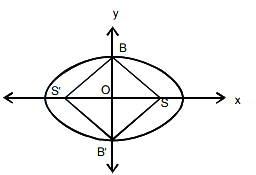
If $B$ and $B^{\prime}$ are the ends of the minor axis and $S$ and $S^{\prime}$ are the foci of the ellipse $\frac{x^{2}}{25}+\frac{y^{2}}{9}=1$,then the area of the rhombus $SBS^{\prime}B^{\prime}$ will be
A
$12 \text{ sq. unit}$
B
$48 \text{ sq. unit}$
C
$24 \text{ sq. unit}$
D
$36 \text{ sq. unit}$
Solution
(C) The given equation of the ellipse is $\frac{x^{2}}{25}+\frac{y^{2}}{9}=1$.
Comparing this with $\frac{x^{2}}{a^{2}}+\frac{y^{2}}{b^{2}}=1$,we get $a^{2}=25$ and $b^{2}=9$,so $a=5$ and $b=3$.
The ends of the minor axis are $B(0, 3)$ and $B^{\prime}(0, -3)$.
The eccentricity $e$ is given by $e = \sqrt{1 - \frac{b^{2}}{a^{2}}} = \sqrt{1 - \frac{9}{25}} = \sqrt{\frac{16}{25}} = \frac{4}{5}$.
The foci $S$ and $S^{\prime}$ are $(\pm ae, 0) = (\pm 5 \times \frac{4}{5}, 0) = (\pm 4, 0)$.
Thus,$S(4, 0)$ and $S^{\prime}(-4, 0)$.
The rhombus $SBS^{\prime}B^{\prime}$ has diagonals $SS^{\prime}$ and $BB^{\prime}$.
The length of diagonal $SS^{\prime} = 4 - (-4) = 8$.
The length of diagonal $BB^{\prime} = 3 - (-3) = 6$.
The area of a rhombus is $\frac{1}{2} \times \text{product of diagonals} = \frac{1}{2} \times 8 \times 6 = 24 \text{ sq. unit}$.
Comparing this with $\frac{x^{2}}{a^{2}}+\frac{y^{2}}{b^{2}}=1$,we get $a^{2}=25$ and $b^{2}=9$,so $a=5$ and $b=3$.
The ends of the minor axis are $B(0, 3)$ and $B^{\prime}(0, -3)$.
The eccentricity $e$ is given by $e = \sqrt{1 - \frac{b^{2}}{a^{2}}} = \sqrt{1 - \frac{9}{25}} = \sqrt{\frac{16}{25}} = \frac{4}{5}$.
The foci $S$ and $S^{\prime}$ are $(\pm ae, 0) = (\pm 5 \times \frac{4}{5}, 0) = (\pm 4, 0)$.
Thus,$S(4, 0)$ and $S^{\prime}(-4, 0)$.
The rhombus $SBS^{\prime}B^{\prime}$ has diagonals $SS^{\prime}$ and $BB^{\prime}$.
The length of diagonal $SS^{\prime} = 4 - (-4) = 8$.
The length of diagonal $BB^{\prime} = 3 - (-3) = 6$.
The area of a rhombus is $\frac{1}{2} \times \text{product of diagonals} = \frac{1}{2} \times 8 \times 6 = 24 \text{ sq. unit}$.
0 likes
View Solution714
EasyMCQ
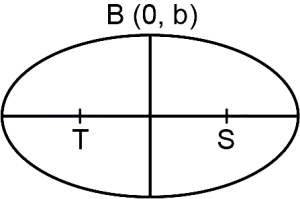
$S$ and $T$ are the foci of an ellipse and $B$ is the end point of the minor axis. If $\triangle STB$ is an equilateral triangle,the eccentricity of the ellipse is
A
$\frac{1}{4}$
B
$\frac{1}{3}$
C
$\frac{1}{2}$
D
$\frac{2}{3}$
Solution
(C) Let the equation of the ellipse be $\frac{x^{2}}{a^{2}}+\frac{y^{2}}{b^{2}}=1$.
Foci are $S(ae, 0)$ and $T(-ae, 0)$.
$B(0, b)$ is the end point of the minor axis.
Since $\triangle STB$ is an equilateral triangle,the distance $SB = ST = TB$.
$ST = ae - (-ae) = 2ae$.
$SB = \sqrt{(ae-0)^{2} + (0-b)^{2}} = \sqrt{a^{2}e^{2} + b^{2}}$.
Since $SB = ST$,we have $SB^{2} = ST^{2}$.
$a^{2}e^{2} + b^{2} = (2ae)^{2} = 4a^{2}e^{2}$.
$b^{2} = 3a^{2}e^{2}$.
Using the relation $b^{2} = a^{2}(1-e^{2})$,we get:
$a^{2}(1-e^{2}) = 3a^{2}e^{2}$.
$1 - e^{2} = 3e^{2}$.
$4e^{2} = 1$.
$e^{2} = \frac{1}{4}$.
$e = \frac{1}{2}$ (since eccentricity $e > 0$).
Foci are $S(ae, 0)$ and $T(-ae, 0)$.
$B(0, b)$ is the end point of the minor axis.
Since $\triangle STB$ is an equilateral triangle,the distance $SB = ST = TB$.
$ST = ae - (-ae) = 2ae$.
$SB = \sqrt{(ae-0)^{2} + (0-b)^{2}} = \sqrt{a^{2}e^{2} + b^{2}}$.
Since $SB = ST$,we have $SB^{2} = ST^{2}$.
$a^{2}e^{2} + b^{2} = (2ae)^{2} = 4a^{2}e^{2}$.
$b^{2} = 3a^{2}e^{2}$.
Using the relation $b^{2} = a^{2}(1-e^{2})$,we get:
$a^{2}(1-e^{2}) = 3a^{2}e^{2}$.
$1 - e^{2} = 3e^{2}$.
$4e^{2} = 1$.
$e^{2} = \frac{1}{4}$.
$e = \frac{1}{2}$ (since eccentricity $e > 0$).
0 likes
View Solution715
EasyMCQ
$P$ is the extremity of the latus rectum of the ellipse $3x^{2} + 4y^{2} = 48$ in the first quadrant. The eccentric angle of $P$ is
A
$\frac{\pi}{8}$
B
$\frac{3\pi}{4}$
C
$\frac{\pi}{3}$
D
$\frac{2\pi}{3}$
Solution
(C) The given equation of the ellipse is $3x^{2} + 4y^{2} = 48$.
Dividing by $48$,we get $\frac{x^{2}}{16} + \frac{y^{2}}{12} = 1$.
Here,$a^{2} = 16$ and $b^{2} = 12$,so $a = 4$ and $b = 2\sqrt{3}$.
The eccentricity $e$ is given by $e = \sqrt{1 - \frac{b^{2}}{a^{2}}} = \sqrt{1 - \frac{12}{16}} = \sqrt{\frac{4}{16}} = \frac{1}{2}$.
The coordinates of the extremity of the latus rectum $P$ in the first quadrant are $(ae, \frac{b^{2}}{a}) = (4 \times \frac{1}{2}, \frac{12}{4}) = (2, 3)$.
Let the eccentric angle of $P$ be $\theta$. Then $P = (a \cos \theta, b \sin \theta) = (4 \cos \theta, 2\sqrt{3} \sin \theta)$.
Equating the coordinates: $4 \cos \theta = 2 \Rightarrow \cos \theta = \frac{1}{2}$ and $2\sqrt{3} \sin \theta = 3 \Rightarrow \sin \theta = \frac{3}{2\sqrt{3}} = \frac{\sqrt{3}}{2}$.
Since $\cos \theta = \frac{1}{2}$ and $\sin \theta = \frac{\sqrt{3}}{2}$,we have $\theta = \frac{\pi}{3}$.
Dividing by $48$,we get $\frac{x^{2}}{16} + \frac{y^{2}}{12} = 1$.
Here,$a^{2} = 16$ and $b^{2} = 12$,so $a = 4$ and $b = 2\sqrt{3}$.
The eccentricity $e$ is given by $e = \sqrt{1 - \frac{b^{2}}{a^{2}}} = \sqrt{1 - \frac{12}{16}} = \sqrt{\frac{4}{16}} = \frac{1}{2}$.
The coordinates of the extremity of the latus rectum $P$ in the first quadrant are $(ae, \frac{b^{2}}{a}) = (4 \times \frac{1}{2}, \frac{12}{4}) = (2, 3)$.
Let the eccentric angle of $P$ be $\theta$. Then $P = (a \cos \theta, b \sin \theta) = (4 \cos \theta, 2\sqrt{3} \sin \theta)$.
Equating the coordinates: $4 \cos \theta = 2 \Rightarrow \cos \theta = \frac{1}{2}$ and $2\sqrt{3} \sin \theta = 3 \Rightarrow \sin \theta = \frac{3}{2\sqrt{3}} = \frac{\sqrt{3}}{2}$.
Since $\cos \theta = \frac{1}{2}$ and $\sin \theta = \frac{\sqrt{3}}{2}$,we have $\theta = \frac{\pi}{3}$.
0 likes
View Solution716
MediumMCQ
Let the equation of an ellipse be $\frac{x^{2}}{144}+\frac{y^{2}}{25}=1$. Then,the radius of the circle with center $(0, \sqrt{2})$ and passing through the foci of the ellipse is
A
$9$
B
$7$
C
$11$
D
$5$
Solution
(C) The given equation of the ellipse is $\frac{x^{2}}{144}+\frac{y^{2}}{25}=1$.
Here,$a^{2}=144$ and $b^{2}=25$.
The eccentricity $e$ is given by $e=\sqrt{1-\frac{b^{2}}{a^{2}}}=\sqrt{1-\frac{25}{144}}=\sqrt{\frac{119}{144}}=\frac{\sqrt{119}}{12}$.
The foci of the ellipse are $(\pm ae, 0) = (\pm 12 \times \frac{\sqrt{119}}{12}, 0) = (\pm \sqrt{119}, 0)$.
The circle has its center at $(0, \sqrt{2})$ and passes through the foci $(\pm \sqrt{119}, 0)$.
The radius $r$ of the circle is the distance between the center $(0, \sqrt{2})$ and one of the foci $(\sqrt{119}, 0)$.
$r = \sqrt{(\sqrt{119}-0)^{2} + (0-\sqrt{2})^{2}}$
$r = \sqrt{119 + 2} = \sqrt{121} = 11$.
Here,$a^{2}=144$ and $b^{2}=25$.
The eccentricity $e$ is given by $e=\sqrt{1-\frac{b^{2}}{a^{2}}}=\sqrt{1-\frac{25}{144}}=\sqrt{\frac{119}{144}}=\frac{\sqrt{119}}{12}$.
The foci of the ellipse are $(\pm ae, 0) = (\pm 12 \times \frac{\sqrt{119}}{12}, 0) = (\pm \sqrt{119}, 0)$.
The circle has its center at $(0, \sqrt{2})$ and passes through the foci $(\pm \sqrt{119}, 0)$.
The radius $r$ of the circle is the distance between the center $(0, \sqrt{2})$ and one of the foci $(\sqrt{119}, 0)$.
$r = \sqrt{(\sqrt{119}-0)^{2} + (0-\sqrt{2})^{2}}$
$r = \sqrt{119 + 2} = \sqrt{121} = 11$.
0 likes
View Solution717
EasyMCQ
If the distance between the foci of an ellipse is equal to the length of the latus rectum,then its eccentricity is
A
$\frac{1}{4}(\sqrt{5}-1)$
B
$\frac{1}{2}(\sqrt{5}+1)$
C
$\frac{1}{2}(\sqrt{5}-1)$
D
$\frac{1}{4}(\sqrt{5}+1)$
Solution
(C) Given that the distance between the foci of an ellipse is equal to the length of the latus rectum.
The distance between the foci is $2ae$ and the length of the latus rectum is $\frac{2b^2}{a}$.
Therefore,$2ae = \frac{2b^2}{a} \implies ae = \frac{b^2}{a} \implies b^2 = a^2e$.
We know that for an ellipse,$b^2 = a^2(1 - e^2)$.
Substituting $b^2 = a^2e$ into the equation,we get $a^2e = a^2(1 - e^2)$.
Dividing by $a^2$ (since $a \neq 0$),we get $e = 1 - e^2$.
Rearranging gives the quadratic equation $e^2 + e - 1 = 0$.
Using the quadratic formula $e = \frac{-b \pm \sqrt{b^2 - 4ac}}{2a}$,we get $e = \frac{-1 \pm \sqrt{1^2 - 4(1)(-1)}}{2(1)} = \frac{-1 \pm \sqrt{5}}{2}$.
Since eccentricity $e$ must be positive $(0 < e < 1)$,we take the positive root: $e = \frac{\sqrt{5} - 1}{2}$.
The distance between the foci is $2ae$ and the length of the latus rectum is $\frac{2b^2}{a}$.
Therefore,$2ae = \frac{2b^2}{a} \implies ae = \frac{b^2}{a} \implies b^2 = a^2e$.
We know that for an ellipse,$b^2 = a^2(1 - e^2)$.
Substituting $b^2 = a^2e$ into the equation,we get $a^2e = a^2(1 - e^2)$.
Dividing by $a^2$ (since $a \neq 0$),we get $e = 1 - e^2$.
Rearranging gives the quadratic equation $e^2 + e - 1 = 0$.
Using the quadratic formula $e = \frac{-b \pm \sqrt{b^2 - 4ac}}{2a}$,we get $e = \frac{-1 \pm \sqrt{1^2 - 4(1)(-1)}}{2(1)} = \frac{-1 \pm \sqrt{5}}{2}$.
Since eccentricity $e$ must be positive $(0 < e < 1)$,we take the positive root: $e = \frac{\sqrt{5} - 1}{2}$.
0 likes
View Solution718
EasyMCQ
The eccentric angle in the first quadrant of a point on the ellipse $\frac{x^{2}}{10}+\frac{y^{2}}{8}=1$ at a distance $3$ units from the centre of the ellipse is
A
$\frac{\pi}{6}$
B
$\frac{\pi}{4}$
C
$\frac{\pi}{3}$
D
$\frac{\pi}{2}$
Solution
(B) Let $P(\sqrt{10} \cos \theta, \sqrt{8} \sin \theta)$ be the point on the ellipse $\frac{x^{2}}{10}+\frac{y^{2}}{8}=1$.
Given that the distance of $P$ from the centre $(0,0)$ is $3$ units.
So,$OP^2 = 3^2 = 9$.
$10 \cos^2 \theta + 8 \sin^2 \theta = 9$.
Using the identity $\sin^2 \theta + \cos^2 \theta = 1$,we can write $9 = 9(\sin^2 \theta + \cos^2 \theta)$.
$10 \cos^2 \theta + 8 \sin^2 \theta = 9 \sin^2 \theta + 9 \cos^2 \theta$.
Rearranging the terms,we get $\cos^2 \theta = \sin^2 \theta$.
$\tan^2 \theta = 1$.
Since the point is in the first quadrant,$\theta = \frac{\pi}{4}$.
Given that the distance of $P$ from the centre $(0,0)$ is $3$ units.
So,$OP^2 = 3^2 = 9$.
$10 \cos^2 \theta + 8 \sin^2 \theta = 9$.
Using the identity $\sin^2 \theta + \cos^2 \theta = 1$,we can write $9 = 9(\sin^2 \theta + \cos^2 \theta)$.
$10 \cos^2 \theta + 8 \sin^2 \theta = 9 \sin^2 \theta + 9 \cos^2 \theta$.
Rearranging the terms,we get $\cos^2 \theta = \sin^2 \theta$.
$\tan^2 \theta = 1$.
Since the point is in the first quadrant,$\theta = \frac{\pi}{4}$.
0 likes
View Solution719
EasyMCQ
The length of the latus rectum of the ellipse $16x^2 + 25y^2 = 400$ is
A
$5/16$ unit
B
$32/5$ unit
C
$16/5$ unit
D
$5/32$ unit
Solution
(B) Given the equation of the ellipse: $16x^2 + 25y^2 = 400$.
Divide both sides by $400$ to get the standard form: $\frac{16x^2}{400} + \frac{25y^2}{400} = 1$,which simplifies to $\frac{x^2}{25} + \frac{y^2}{16} = 1$.
Comparing this with the standard form $\frac{x^2}{a^2} + \frac{y^2}{b^2} = 1$,we have $a^2 = 25$ and $b^2 = 16$.
Thus,$a = 5$ and $b = 4$.
The length of the latus rectum of an ellipse is given by the formula $\frac{2b^2}{a}$.
Substituting the values: $\text{Length} = \frac{2 \times 16}{5} = \frac{32}{5}$ units.
Divide both sides by $400$ to get the standard form: $\frac{16x^2}{400} + \frac{25y^2}{400} = 1$,which simplifies to $\frac{x^2}{25} + \frac{y^2}{16} = 1$.
Comparing this with the standard form $\frac{x^2}{a^2} + \frac{y^2}{b^2} = 1$,we have $a^2 = 25$ and $b^2 = 16$.
Thus,$a = 5$ and $b = 4$.
The length of the latus rectum of an ellipse is given by the formula $\frac{2b^2}{a}$.
Substituting the values: $\text{Length} = \frac{2 \times 16}{5} = \frac{32}{5}$ units.
0 likes
View Solution720
MediumMCQ
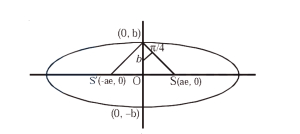
The angle between the lines joining the foci of an ellipse to one particular extremity of the minor axis is $90^{\circ}$. The eccentricity of the ellipse is
A
$\frac{1}{8}$
B
$\frac{1}{\sqrt{3}}$
C
$\sqrt{\frac{2}{3}}$
D
$\frac{1}{\sqrt{2}}$
Solution
(D) Let the ellipse be $\frac{x^2}{a^2} + \frac{y^2}{b^2} = 1$. The foci are $S(ae, 0)$ and $S'(-ae, 0)$,and the extremity of the minor axis is $B(0, b)$.
Given that the angle $\angle SBS' = 90^{\circ}$.
Since the triangle $\triangle SBS'$ is isosceles with $SB = S'B$,the altitude from $B$ to $SS'$ bisects the angle $\angle SBS'$.
Thus,$\angle OBS = 45^{\circ}$.
In the right-angled triangle $\triangle OBS$,we have $\tan(45^{\circ}) = \frac{OB}{OS} = \frac{b}{ae}$.
Since $\tan(45^{\circ}) = 1$,we get $1 = \frac{b}{ae}$,which implies $b = ae$.
Using the relation $b^2 = a^2(1 - e^2)$,we substitute $b^2 = a^2e^2$:
$a^2e^2 = a^2(1 - e^2)$
$e^2 = 1 - e^2$
$2e^2 = 1$
$e^2 = \frac{1}{2}$
$e = \frac{1}{\sqrt{2}}$.
Given that the angle $\angle SBS' = 90^{\circ}$.
Since the triangle $\triangle SBS'$ is isosceles with $SB = S'B$,the altitude from $B$ to $SS'$ bisects the angle $\angle SBS'$.
Thus,$\angle OBS = 45^{\circ}$.
In the right-angled triangle $\triangle OBS$,we have $\tan(45^{\circ}) = \frac{OB}{OS} = \frac{b}{ae}$.
Since $\tan(45^{\circ}) = 1$,we get $1 = \frac{b}{ae}$,which implies $b = ae$.
Using the relation $b^2 = a^2(1 - e^2)$,we substitute $b^2 = a^2e^2$:
$a^2e^2 = a^2(1 - e^2)$
$e^2 = 1 - e^2$
$2e^2 = 1$
$e^2 = \frac{1}{2}$
$e = \frac{1}{\sqrt{2}}$.
0 likes
View Solution721
MediumMCQ
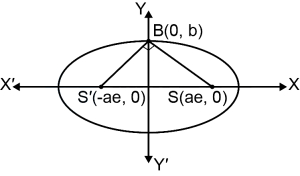
$B$ is an extremity of the minor axis of an ellipse whose foci are $S$ and $S^{\prime}$. If $\angle SBS^{\prime}$ is a right angle,then the eccentricity of the ellipse is
A
$\frac{1}{2}$
B
$\frac{1}{\sqrt{2}}$
C
$\frac{2}{3}$
D
$\frac{1}{3}$
Solution
(B) Let the equation of the ellipse be $\frac{x^2}{a^2} + \frac{y^2}{b^2} = 1$,where $a > b$.
The coordinates of the foci are $S(ae, 0)$ and $S^{\prime}(-ae, 0)$.
The extremity of the minor axis is $B(0, b)$.
The slope of $SB$ is $m_1 = \frac{b - 0}{0 - ae} = -\frac{b}{ae}$.
The slope of $S^{\prime}B$ is $m_2 = \frac{b - 0}{0 - (-ae)} = \frac{b}{ae}$.
Since $\angle SBS^{\prime} = 90^{\circ}$,the product of the slopes is $-1$,so $m_1 \times m_2 = -1$.
$(-\frac{b}{ae}) \times (\frac{b}{ae}) = -1$.
$\frac{b^2}{a^2 e^2} = 1 \Rightarrow b^2 = a^2 e^2$.
Using the relation $b^2 = a^2(1 - e^2)$,we get $a^2(1 - e^2) = a^2 e^2$.
$1 - e^2 = e^2$ $\Rightarrow 2e^2 = 1$ $\Rightarrow e^2 = \frac{1}{2}$.
Since eccentricity $e > 0$,we have $e = \frac{1}{\sqrt{2}}$.
The coordinates of the foci are $S(ae, 0)$ and $S^{\prime}(-ae, 0)$.
The extremity of the minor axis is $B(0, b)$.
The slope of $SB$ is $m_1 = \frac{b - 0}{0 - ae} = -\frac{b}{ae}$.
The slope of $S^{\prime}B$ is $m_2 = \frac{b - 0}{0 - (-ae)} = \frac{b}{ae}$.
Since $\angle SBS^{\prime} = 90^{\circ}$,the product of the slopes is $-1$,so $m_1 \times m_2 = -1$.
$(-\frac{b}{ae}) \times (\frac{b}{ae}) = -1$.
$\frac{b^2}{a^2 e^2} = 1 \Rightarrow b^2 = a^2 e^2$.
Using the relation $b^2 = a^2(1 - e^2)$,we get $a^2(1 - e^2) = a^2 e^2$.
$1 - e^2 = e^2$ $\Rightarrow 2e^2 = 1$ $\Rightarrow e^2 = \frac{1}{2}$.
Since eccentricity $e > 0$,we have $e = \frac{1}{\sqrt{2}}$.
0 likes
View Solution722
EasyMCQ
The coordinate of a point on the auxiliary circle of the ellipse $x^{2}+2y^{2}=4$ corresponding to the point on the ellipse whose eccentric angle is $60^{\circ}$ will be
A
$(\sqrt{3}, 1)$
B
$(1, \sqrt{3})$
C
$(1, 1)$
D
$(1, 2)$
Solution
(B) The given equation of the ellipse is $x^{2}+2y^{2}=4$.
Dividing by $4$,we get $\frac{x^{2}}{4}+\frac{y^{2}}{2}=1$.
Comparing this with the standard form $\frac{x^{2}}{a^{2}}+\frac{y^{2}}{b^{2}}=1$,we have $a^{2}=4$,so $a=2$.
The auxiliary circle of an ellipse $\frac{x^{2}}{a^{2}}+\frac{y^{2}}{b^{2}}=1$ is given by $x^{2}+y^{2}=a^{2}$.
Here,the equation of the auxiliary circle is $x^{2}+y^{2}=4$.
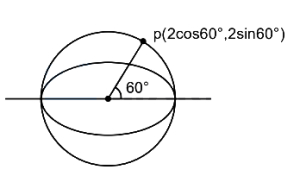
The coordinates of a point on the auxiliary circle corresponding to an eccentric angle $\theta$ are given by $(a \cos \theta, a \sin \theta)$.
Given $\theta = 60^{\circ}$ and $a=2$,the coordinates are $(2 \cos 60^{\circ}, 2 \sin 60^{\circ})$.
Substituting the values,we get $(2 \times \frac{1}{2}, 2 \times \frac{\sqrt{3}}{2}) = (1, \sqrt{3})$.
Thus,the correct option is $B$.
Dividing by $4$,we get $\frac{x^{2}}{4}+\frac{y^{2}}{2}=1$.
Comparing this with the standard form $\frac{x^{2}}{a^{2}}+\frac{y^{2}}{b^{2}}=1$,we have $a^{2}=4$,so $a=2$.
The auxiliary circle of an ellipse $\frac{x^{2}}{a^{2}}+\frac{y^{2}}{b^{2}}=1$ is given by $x^{2}+y^{2}=a^{2}$.
Here,the equation of the auxiliary circle is $x^{2}+y^{2}=4$.
The coordinates of a point on the auxiliary circle corresponding to an eccentric angle $\theta$ are given by $(a \cos \theta, a \sin \theta)$.
Given $\theta = 60^{\circ}$ and $a=2$,the coordinates are $(2 \cos 60^{\circ}, 2 \sin 60^{\circ})$.
Substituting the values,we get $(2 \times \frac{1}{2}, 2 \times \frac{\sqrt{3}}{2}) = (1, \sqrt{3})$.
Thus,the correct option is $B$.
0 likes
View Solution723
EasyMCQ
The equation of the auxiliary circle of the ellipse $16 x^{2}+25 y^{2}+32 x-100 y=284$ is
A
$x^{2}+y^{2}+2 x-4 y-20=0$
B
$x^{2}+y^{2}+2 x-4 y=0$
C
$(x+1)^{2}+(y-2)^{2}=400$
D
$(x+1)^{2}+(y-2)^{2}=225$
Solution
(A) The given equation of the ellipse is $16 x^{2}+25 y^{2}+32 x-100 y=284$.
Rearranging the terms,we get $16(x^{2}+2 x)+25(y^{2}-4 y)=284$.
Completing the square,$16(x^{2}+2 x+1)+25(y^{2}-4 y+4)=284+16+100$.
$16(x+1)^{2}+25(y-2)^{2}=400$.
Dividing by $400$,we get $\frac{(x+1)^{2}}{25}+\frac{(y-2)^{2}}{16}=1$.
Here,$a^{2}=25$. The auxiliary circle of an ellipse $\frac{(x-h)^{2}}{a^{2}}+\frac{(y-k)^{2}}{b^{2}}=1$ is $(x-h)^{2}+(y-k)^{2}=a^{2}$.
Thus,the equation of the auxiliary circle is $(x+1)^{2}+(y-2)^{2}=25$.
Expanding this,$x^{2}+2 x+1+y^{2}-4 y+4=25$.
Therefore,$x^{2}+y^{2}+2 x-4 y-20=0$.
Rearranging the terms,we get $16(x^{2}+2 x)+25(y^{2}-4 y)=284$.
Completing the square,$16(x^{2}+2 x+1)+25(y^{2}-4 y+4)=284+16+100$.
$16(x+1)^{2}+25(y-2)^{2}=400$.
Dividing by $400$,we get $\frac{(x+1)^{2}}{25}+\frac{(y-2)^{2}}{16}=1$.
Here,$a^{2}=25$. The auxiliary circle of an ellipse $\frac{(x-h)^{2}}{a^{2}}+\frac{(y-k)^{2}}{b^{2}}=1$ is $(x-h)^{2}+(y-k)^{2}=a^{2}$.
Thus,the equation of the auxiliary circle is $(x+1)^{2}+(y-2)^{2}=25$.
Expanding this,$x^{2}+2 x+1+y^{2}-4 y+4=25$.
Therefore,$x^{2}+y^{2}+2 x-4 y-20=0$.
0 likes
View Solution724
MediumMCQ
$AB$ is a variable chord of the ellipse $\frac{x^2}{a^2} + \frac{y^2}{b^2} = 1$. If $AB$ subtends a right angle at the origin $O$,then $\frac{1}{OA^2} + \frac{1}{OB^2}$ equals to
A
$\frac{1}{a^2} + \frac{1}{b^2}$
B
$\frac{1}{a^2} - \frac{1}{b^2}$
C
$a^2 + b^2$
D
$a^2 - b^2$
Solution
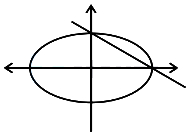
(A) Let the equation of the chord $AB$ be $lx + my = 1$.
Homogenizing the equation of the ellipse $\frac{x^2}{a^2} + \frac{y^2}{b^2} = 1$ with the help of the chord equation $lx + my = 1$,we get:
$\frac{x^2}{a^2} + \frac{y^2}{b^2} = (lx + my)^2$
$\frac{x^2}{a^2} + \frac{y^2}{b^2} = l^2x^2 + m^2y^2 + 2lmxy$
$x^2(\frac{1}{a^2} - l^2) + y^2(\frac{1}{b^2} - m^2) - 2lmxy = 0$
Since $AB$ subtends a right angle at the origin,the sum of the coefficients of $x^2$ and $y^2$ must be zero.
$(\frac{1}{a^2} - l^2) + (\frac{1}{b^2} - m^2) = 0$
$l^2 + m^2 = \frac{1}{a^2} + \frac{1}{b^2}$
Now,the distance of the chord $lx + my = 1$ from the origin is $p = \frac{1}{\sqrt{l^2 + m^2}}$.
If $A$ and $B$ are points on the ellipse,the coordinates can be represented such that $OA^2$ and $OB^2$ relate to the chord properties. For a chord subtending a right angle at the origin,the expression $\frac{1}{OA^2} + \frac{1}{OB^2}$ is constant and equal to $\frac{1}{a^2} + \frac{1}{b^2}$.
Homogenizing the equation of the ellipse $\frac{x^2}{a^2} + \frac{y^2}{b^2} = 1$ with the help of the chord equation $lx + my = 1$,we get:
$\frac{x^2}{a^2} + \frac{y^2}{b^2} = (lx + my)^2$
$\frac{x^2}{a^2} + \frac{y^2}{b^2} = l^2x^2 + m^2y^2 + 2lmxy$
$x^2(\frac{1}{a^2} - l^2) + y^2(\frac{1}{b^2} - m^2) - 2lmxy = 0$
Since $AB$ subtends a right angle at the origin,the sum of the coefficients of $x^2$ and $y^2$ must be zero.
$(\frac{1}{a^2} - l^2) + (\frac{1}{b^2} - m^2) = 0$
$l^2 + m^2 = \frac{1}{a^2} + \frac{1}{b^2}$
Now,the distance of the chord $lx + my = 1$ from the origin is $p = \frac{1}{\sqrt{l^2 + m^2}}$.
If $A$ and $B$ are points on the ellipse,the coordinates can be represented such that $OA^2$ and $OB^2$ relate to the chord properties. For a chord subtending a right angle at the origin,the expression $\frac{1}{OA^2} + \frac{1}{OB^2}$ is constant and equal to $\frac{1}{a^2} + \frac{1}{b^2}$.
0 likes
View Solution725
MediumMCQ
The line $y = 2t^2$ intersects the ellipse $\frac{x^2}{9} + \frac{y^2}{4} = 1$ in real points if
A
$|t| \leq 1$
B
$|t| < 1$
C
$|t| > 1$
D
$|t| \geq 1$
Solution
(A) Given the equation of the ellipse: $\frac{x^2}{9} + \frac{y^2}{4} = 1$ and the line $y = 2t^2$.
Substitute $y = 2t^2$ into the ellipse equation:
$\frac{x^2}{9} + \frac{(2t^2)^2}{4} = 1$
$\frac{x^2}{9} + \frac{4t^4}{4} = 1$
$\frac{x^2}{9} + t^4 = 1$
$x^2 = 9(1 - t^4)$
For the intersection points to be real,$x^2$ must be greater than or equal to $0$:
$9(1 - t^4) \geq 0$
$1 - t^4 \geq 0$
$t^4 \leq 1$
$(t^2 - 1)(t^2 + 1) \leq 0$
Since $t^2 + 1 > 0$ for all real $t$,we must have $t^2 - 1 \leq 0$.
$t^2 \leq 1$
$|t| \leq 1$
Substitute $y = 2t^2$ into the ellipse equation:
$\frac{x^2}{9} + \frac{(2t^2)^2}{4} = 1$
$\frac{x^2}{9} + \frac{4t^4}{4} = 1$
$\frac{x^2}{9} + t^4 = 1$
$x^2 = 9(1 - t^4)$
For the intersection points to be real,$x^2$ must be greater than or equal to $0$:
$9(1 - t^4) \geq 0$
$1 - t^4 \geq 0$
$t^4 \leq 1$
$(t^2 - 1)(t^2 + 1) \leq 0$
Since $t^2 + 1 > 0$ for all real $t$,we must have $t^2 - 1 \leq 0$.
$t^2 \leq 1$
$|t| \leq 1$
0 likes
View Solution726
MediumMCQ
The tangent at point $(a \cos \theta, b \sin \theta)$,where $0 < \theta < \frac{\pi}{2}$,to the ellipse $\frac{x^2}{a^2} + \frac{y^2}{b^2} = 1$ meets the $x$-axis at $T$ and the $y$-axis at $T_1$. Then the value of $\min_{0 < \theta < \frac{\pi}{2}} (OT)(OT_1)$ is
A
$ab$
B
$2ab$
C
$0$
D
$1$
Solution
(B) The equation of the tangent to the ellipse $\frac{x^2}{a^2} + \frac{y^2}{b^2} = 1$ at the point $(a \cos \theta, b \sin \theta)$ is given by $\frac{x \cos \theta}{a} + \frac{y \sin \theta}{b} = 1$.
To find the $x$-intercept $T$,set $y = 0$: $\frac{x \cos \theta}{a} = 1 \implies x = \frac{a}{\cos \theta}$. Thus,$OT = \frac{a}{\cos \theta}$.
To find the $y$-intercept $T_1$,set $x = 0$: $\frac{y \sin \theta}{b} = 1 \implies y = \frac{b}{\sin \theta}$. Thus,$OT_1 = \frac{b}{\sin \theta}$.
The product $(OT)(OT_1) = \frac{a}{\cos \theta} \cdot \frac{b}{\sin \theta} = \frac{ab}{\sin \theta \cos \theta} = \frac{2ab}{\sin 2\theta}$.
Since $0 < \theta < \frac{\pi}{2}$,the maximum value of $\sin 2\theta$ is $1$ (at $\theta = \frac{\pi}{4}$),which makes the expression $\frac{2ab}{\sin 2\theta}$ reach its minimum value.
Therefore,the minimum value is $2ab$.
To find the $x$-intercept $T$,set $y = 0$: $\frac{x \cos \theta}{a} = 1 \implies x = \frac{a}{\cos \theta}$. Thus,$OT = \frac{a}{\cos \theta}$.
To find the $y$-intercept $T_1$,set $x = 0$: $\frac{y \sin \theta}{b} = 1 \implies y = \frac{b}{\sin \theta}$. Thus,$OT_1 = \frac{b}{\sin \theta}$.
The product $(OT)(OT_1) = \frac{a}{\cos \theta} \cdot \frac{b}{\sin \theta} = \frac{ab}{\sin \theta \cos \theta} = \frac{2ab}{\sin 2\theta}$.
Since $0 < \theta < \frac{\pi}{2}$,the maximum value of $\sin 2\theta$ is $1$ (at $\theta = \frac{\pi}{4}$),which makes the expression $\frac{2ab}{\sin 2\theta}$ reach its minimum value.
Therefore,the minimum value is $2ab$.
0 likes
View Solution727
MediumMCQ
Consider the curve $\frac{x^{2}}{a^{2}}+\frac{y^{2}}{b^{2}}=1$. The portion of the tangent at any point of the curve intercepted between the point of contact and the directrix subtends at the corresponding focus an angle of
A
$\frac{\pi}{4}$
B
$\frac{\pi}{3}$
C
$\frac{\pi}{2}$
D
$\frac{\pi}{6}$
Solution
(C) Let the ellipse be $\frac{x^{2}}{a^{2}}+\frac{y^{2}}{b^{2}}=1$ with $a > b$.
Let $P(a \cos \theta, b \sin \theta)$ be a point on the ellipse.
The equation of the tangent at $P$ is $\frac{x \cos \theta}{a} + \frac{y \sin \theta}{b} = 1$.
The directrix is $x = \frac{a}{e}$.
Substituting $x = \frac{a}{e}$ into the tangent equation:
$\frac{(\frac{a}{e}) \cos \theta}{a} + \frac{y \sin \theta}{b} = 1 \implies \frac{\cos \theta}{e} + \frac{y \sin \theta}{b} = 1$.
$y = \frac{b(1 - \frac{\cos \theta}{e})}{\sin \theta} = \frac{b(e - \cos \theta)}{e \sin \theta}$.
Let $S(ae, 0)$ be the focus. The slope of $SP$ is $m_1 = \frac{b \sin \theta}{a \cos \theta - ae} = \frac{b \sin \theta}{a(\cos \theta - e)}$.
The slope of the line segment from the focus to the intersection point $Q(\frac{a}{e}, \frac{b(e - \cos \theta)}{e \sin \theta})$ is $m_2 = \frac{\frac{b(e - \cos \theta)}{e \sin \theta} - 0}{\frac{a}{e} - ae} = \frac{b(e - \cos \theta)}{e \sin \theta} \times \frac{e}{a(1 - e^{2})} = \frac{b(e - \cos \theta)}{a \sin \theta (1 - e^{2})}$.
Since $b^{2} = a^{2}(1 - e^{2})$,we have $1 - e^{2} = \frac{b^{2}}{a^{2}}$.
$m_2 = \frac{b(e - \cos \theta)}{a \sin \theta (\frac{b^{2}}{a^{2}})} = \frac{a(e - \cos \theta)}{b \sin \theta}$.
Note that $m_1 \times m_2 = \frac{b \sin \theta}{a(\cos \theta - e)} \times \frac{a(e - \cos \theta)}{b \sin \theta} = -1$.
Therefore,the angle subtended is $\frac{\pi}{2}$.
Let $P(a \cos \theta, b \sin \theta)$ be a point on the ellipse.
The equation of the tangent at $P$ is $\frac{x \cos \theta}{a} + \frac{y \sin \theta}{b} = 1$.
The directrix is $x = \frac{a}{e}$.
Substituting $x = \frac{a}{e}$ into the tangent equation:
$\frac{(\frac{a}{e}) \cos \theta}{a} + \frac{y \sin \theta}{b} = 1 \implies \frac{\cos \theta}{e} + \frac{y \sin \theta}{b} = 1$.
$y = \frac{b(1 - \frac{\cos \theta}{e})}{\sin \theta} = \frac{b(e - \cos \theta)}{e \sin \theta}$.
Let $S(ae, 0)$ be the focus. The slope of $SP$ is $m_1 = \frac{b \sin \theta}{a \cos \theta - ae} = \frac{b \sin \theta}{a(\cos \theta - e)}$.
The slope of the line segment from the focus to the intersection point $Q(\frac{a}{e}, \frac{b(e - \cos \theta)}{e \sin \theta})$ is $m_2 = \frac{\frac{b(e - \cos \theta)}{e \sin \theta} - 0}{\frac{a}{e} - ae} = \frac{b(e - \cos \theta)}{e \sin \theta} \times \frac{e}{a(1 - e^{2})} = \frac{b(e - \cos \theta)}{a \sin \theta (1 - e^{2})}$.
Since $b^{2} = a^{2}(1 - e^{2})$,we have $1 - e^{2} = \frac{b^{2}}{a^{2}}$.
$m_2 = \frac{b(e - \cos \theta)}{a \sin \theta (\frac{b^{2}}{a^{2}})} = \frac{a(e - \cos \theta)}{b \sin \theta}$.
Note that $m_1 \times m_2 = \frac{b \sin \theta}{a(\cos \theta - e)} \times \frac{a(e - \cos \theta)}{b \sin \theta} = -1$.
Therefore,the angle subtended is $\frac{\pi}{2}$.
0 likes
View Solution728
MediumMCQ
On the ellipse $4x^{2} + 9y^{2} = 1$,the points at which the tangents are parallel to the line $8x = 9y$ are:
A
$\left(\frac{2}{5}, \frac{1}{5}\right)$
B
$\left(-\frac{2}{5}, \frac{1}{5}\right)$
C
$\left(-\frac{2}{5}, -\frac{1}{5}\right)$
D
$\left(\frac{2}{5}, -\frac{1}{5}\right)$
Solution
(B, D) The given equation of the ellipse is $4x^{2} + 9y^{2} = 1$.
Differentiating with respect to $x$,we get $8x + 18yy' = 0$,which implies $y' = -\frac{8x}{18y} = -\frac{4x}{9y}$.
The slope of the line $8x = 9y$ is $y = \frac{8}{9}x$,so the slope $m = \frac{8}{9}$.
Since the tangents are parallel to the line,their slopes must be equal: $-\frac{4x}{9y} = \frac{8}{9}$.
This simplifies to $-4x = 8y$,or $x = -2y$.
Substituting $x = -2y$ into the ellipse equation: $4(-2y)^{2} + 9y^{2} = 1$.
$4(4y^{2}) + 9y^{2} = 1$ $\Rightarrow 16y^{2} + 9y^{2} = 1$ $\Rightarrow 25y^{2} = 1$.
Thus,$y^{2} = \frac{1}{25}$,which gives $y = \pm \frac{1}{5}$.
If $y = \frac{1}{5}$,then $x = -2(\frac{1}{5}) = -\frac{2}{5}$.
If $y = -\frac{1}{5}$,then $x = -2(-\frac{1}{5}) = \frac{2}{5}$.
The required points are $\left(-\frac{2}{5}, \frac{1}{5}\right)$ and $\left(\frac{2}{5}, -\frac{1}{5}\right)$.
Differentiating with respect to $x$,we get $8x + 18yy' = 0$,which implies $y' = -\frac{8x}{18y} = -\frac{4x}{9y}$.
The slope of the line $8x = 9y$ is $y = \frac{8}{9}x$,so the slope $m = \frac{8}{9}$.
Since the tangents are parallel to the line,their slopes must be equal: $-\frac{4x}{9y} = \frac{8}{9}$.
This simplifies to $-4x = 8y$,or $x = -2y$.
Substituting $x = -2y$ into the ellipse equation: $4(-2y)^{2} + 9y^{2} = 1$.
$4(4y^{2}) + 9y^{2} = 1$ $\Rightarrow 16y^{2} + 9y^{2} = 1$ $\Rightarrow 25y^{2} = 1$.
Thus,$y^{2} = \frac{1}{25}$,which gives $y = \pm \frac{1}{5}$.
If $y = \frac{1}{5}$,then $x = -2(\frac{1}{5}) = -\frac{2}{5}$.
If $y = -\frac{1}{5}$,then $x = -2(-\frac{1}{5}) = \frac{2}{5}$.
The required points are $\left(-\frac{2}{5}, \frac{1}{5}\right)$ and $\left(\frac{2}{5}, -\frac{1}{5}\right)$.
0 likes
View Solution729
EasyMCQ
The total number of tangents through the point $(3,5)$ that can be drawn to the ellipses $3x^2 + 5y^2 = 32$ and $25x^2 + 9y^2 = 450$ is
A
$0$
B
$2$
C
$3$
D
$4$
Solution
(C) For the ellipse $E_1: 3x^2 + 5y^2 = 32$,check the position of the point $(3,5)$ by substituting it into the equation: $3(3)^2 + 5(5)^2 = 3(9) + 5(25) = 27 + 125 = 152$. Since $152 > 32$,the point $(3,5)$ lies outside the ellipse $E_1$. Thus,$2$ tangents can be drawn to $E_1$.
For the ellipse $E_2: 25x^2 + 9y^2 = 450$,check the position of the point $(3,5)$: $25(3)^2 + 9(5)^2 = 25(9) + 9(25) = 225 + 225 = 450$. Since the result equals $450$,the point $(3,5)$ lies on the ellipse $E_2$. Thus,only $1$ tangent can be drawn to $E_2$.
The total number of tangents is $2 + 1 = 3$.
For the ellipse $E_2: 25x^2 + 9y^2 = 450$,check the position of the point $(3,5)$: $25(3)^2 + 9(5)^2 = 25(9) + 9(25) = 225 + 225 = 450$. Since the result equals $450$,the point $(3,5)$ lies on the ellipse $E_2$. Thus,only $1$ tangent can be drawn to $E_2$.
The total number of tangents is $2 + 1 = 3$.
0 likes
View Solution730
MediumMCQ
The line $y=x+\lambda$ is tangent to the ellipse $2x^{2}+3y^{2}=1$. Then,$\lambda$ is
A
$-2$
B
$1$
C
$\sqrt{\frac{5}{6}}$
D
$\sqrt{\frac{2}{3}}$
Solution
(C) The equation of the line is $y=x+\lambda$.
On comparing it with $y=mx+c$,we get $m=1$ and $c=\lambda$.
The equation of the ellipse is $2x^{2}+3y^{2}=1$,which can be written as $\frac{x^{2}}{1/2} + \frac{y^{2}}{1/3} = 1$.
On comparing it with $\frac{x^{2}}{a^{2}} + \frac{y^{2}}{b^{2}} = 1$,we get $a^{2}=\frac{1}{2}$ and $b^{2}=\frac{1}{3}$.
If the line touches the ellipse,the condition for tangency is $c^{2}=a^{2}m^{2}+b^{2}$.
Substituting the values,we get $\lambda^{2} = \frac{1}{2}(1)^{2} + \frac{1}{3} = \frac{1}{2} + \frac{1}{3} = \frac{5}{6}$.
Therefore,$\lambda = \pm \sqrt{\frac{5}{6}}$.
Given the options,the correct value is $\lambda = \sqrt{\frac{5}{6}}$.
On comparing it with $y=mx+c$,we get $m=1$ and $c=\lambda$.
The equation of the ellipse is $2x^{2}+3y^{2}=1$,which can be written as $\frac{x^{2}}{1/2} + \frac{y^{2}}{1/3} = 1$.
On comparing it with $\frac{x^{2}}{a^{2}} + \frac{y^{2}}{b^{2}} = 1$,we get $a^{2}=\frac{1}{2}$ and $b^{2}=\frac{1}{3}$.
If the line touches the ellipse,the condition for tangency is $c^{2}=a^{2}m^{2}+b^{2}$.
Substituting the values,we get $\lambda^{2} = \frac{1}{2}(1)^{2} + \frac{1}{3} = \frac{1}{2} + \frac{1}{3} = \frac{5}{6}$.
Therefore,$\lambda = \pm \sqrt{\frac{5}{6}}$.
Given the options,the correct value is $\lambda = \sqrt{\frac{5}{6}}$.
0 likes
View Solution731
MediumMCQ
Tangents are drawn to the ellipse $\frac{x^{2}}{9}+\frac{y^{2}}{5}=1$ at the ends of both latus recta. The area of the quadrilateral so formed is
A
$27 \text{ sq units}$
B
$\frac{13}{2} \text{ sq units}$
C
$\frac{15}{4} \text{ sq units}$
D
$45 \text{ sq units}$
Solution
(A) Given the ellipse $\frac{x^{2}}{9}+\frac{y^{2}}{5}=1$,we have $a^{2}=9$ and $b^{2}=5$,so $a=3$ and $b=\sqrt{5}$.
The eccentricity $e$ is given by $e = \sqrt{1-\frac{b^{2}}{a^{2}}} = \sqrt{1-\frac{5}{9}} = \sqrt{\frac{4}{9}} = \frac{2}{3}$.
The foci are at $(\pm ae, 0) = (\pm 3 \times \frac{2}{3}, 0) = (\pm 2, 0)$.
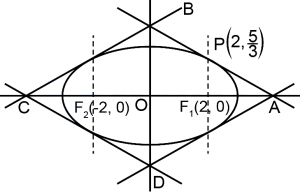
The ends of the latus recta are at $(\pm 2, \pm \frac{b^{2}}{a}) = (\pm 2, \pm \frac{5}{3})$.
Consider the point $P(2, \frac{5}{3})$ in the first quadrant. The equation of the tangent at $P$ is $\frac{x(2)}{9} + \frac{y(5/3)}{5} = 1$,which simplifies to $\frac{2x}{9} + \frac{y}{3} = 1$,or $2x + 3y = 9$.
This line intersects the $x$-axis at $A(\frac{9}{2}, 0)$ and the $y$-axis at $B(0, 3)$.
The quadrilateral formed by the four tangents is symmetric about both axes. The area of the quadrilateral is $4 \times \text{Area}(\Delta OAB) = 4 \times (\frac{1}{2} \times OA \times OB) = 4 \times \frac{1}{2} \times \frac{9}{2} \times 3 = 27 \text{ sq units}$.
The eccentricity $e$ is given by $e = \sqrt{1-\frac{b^{2}}{a^{2}}} = \sqrt{1-\frac{5}{9}} = \sqrt{\frac{4}{9}} = \frac{2}{3}$.
The foci are at $(\pm ae, 0) = (\pm 3 \times \frac{2}{3}, 0) = (\pm 2, 0)$.
The ends of the latus recta are at $(\pm 2, \pm \frac{b^{2}}{a}) = (\pm 2, \pm \frac{5}{3})$.
Consider the point $P(2, \frac{5}{3})$ in the first quadrant. The equation of the tangent at $P$ is $\frac{x(2)}{9} + \frac{y(5/3)}{5} = 1$,which simplifies to $\frac{2x}{9} + \frac{y}{3} = 1$,or $2x + 3y = 9$.
This line intersects the $x$-axis at $A(\frac{9}{2}, 0)$ and the $y$-axis at $B(0, 3)$.
The quadrilateral formed by the four tangents is symmetric about both axes. The area of the quadrilateral is $4 \times \text{Area}(\Delta OAB) = 4 \times (\frac{1}{2} \times OA \times OB) = 4 \times \frac{1}{2} \times \frac{9}{2} \times 3 = 27 \text{ sq units}$.
0 likes
View Solution732
MediumMCQ
$A$ line of fixed length $a + b$,where $a \neq b$,moves such that its ends are always on two fixed perpendicular straight lines. The locus of a point which divides the line into two parts of lengths $a$ and $b$ is
A
a parabola
B
a circle
C
an ellipse
D
a hyperbola
Solution
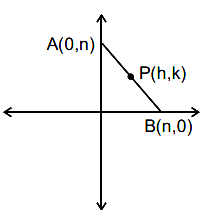
(C) Let the two perpendicular lines be the coordinate axes. Let the ends of the line segment be $A(0, m)$ and $B(n, 0)$.
The length of the line segment is $AB = \sqrt{m^2 + n^2} = a + b$,so $m^2 + n^2 = (a + b)^2$.
Let $P(h, k)$ be a point on the line segment $AB$ that divides it into parts of lengths $a$ and $b$. By the section formula,$P$ divides $AB$ in the ratio $b : a$ (since $AP = a$ and $PB = b$).
Thus,$h = \frac{b(0) + a(n)}{a + b} = \frac{an}{a + b} \Rightarrow n = \frac{(a + b)h}{a}$.
And $k = \frac{b(m) + a(0)}{a + b} = \frac{bm}{a + b} \Rightarrow m = \frac{(a + b)k}{b}$.
Substituting these into $m^2 + n^2 = (a + b)^2$,we get:
$\left(\frac{(a + b)k}{b}\right)^2 + \left(\frac{(a + b)h}{a}\right)^2 = (a + b)^2$.
Dividing by $(a + b)^2$,we obtain $\frac{k^2}{b^2} + \frac{h^2}{a^2} = 1$.
Replacing $(h, k)$ with $(x, y)$,the locus is $\frac{x^2}{a^2} + \frac{y^2}{b^2} = 1$,which is an ellipse.
The length of the line segment is $AB = \sqrt{m^2 + n^2} = a + b$,so $m^2 + n^2 = (a + b)^2$.
Let $P(h, k)$ be a point on the line segment $AB$ that divides it into parts of lengths $a$ and $b$. By the section formula,$P$ divides $AB$ in the ratio $b : a$ (since $AP = a$ and $PB = b$).
Thus,$h = \frac{b(0) + a(n)}{a + b} = \frac{an}{a + b} \Rightarrow n = \frac{(a + b)h}{a}$.
And $k = \frac{b(m) + a(0)}{a + b} = \frac{bm}{a + b} \Rightarrow m = \frac{(a + b)k}{b}$.
Substituting these into $m^2 + n^2 = (a + b)^2$,we get:
$\left(\frac{(a + b)k}{b}\right)^2 + \left(\frac{(a + b)h}{a}\right)^2 = (a + b)^2$.
Dividing by $(a + b)^2$,we obtain $\frac{k^2}{b^2} + \frac{h^2}{a^2} = 1$.
Replacing $(h, k)$ with $(x, y)$,the locus is $\frac{x^2}{a^2} + \frac{y^2}{b^2} = 1$,which is an ellipse.
0 likes
View Solution733
MediumMCQ
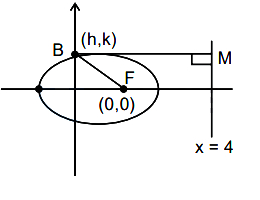
With the origin as a focus and $x = 4$ as the corresponding directrix,a family of ellipses is drawn. Then the locus of an end of the minor axis is
A
a circle
B
a parabola
C
a straight line
D
a hyperbola
Solution
(B) Let the focus be $F(0, 0)$ and the directrix be $x = 4$. Let the end of the minor axis be $B(h, k)$.
By the definition of an ellipse,the distance from the focus to the point $B$ is $e$ times the distance from $B$ to the directrix.
$BF = e \cdot BM$
$BF = \sqrt{h^2 + k^2}$ and $BM = |4 - h|$.
So,$\sqrt{h^2 + k^2} = e(4 - h)$.
Also,for an ellipse,the distance from the center to the focus is $ae$ and the distance from the center to the directrix is $a/e$. Since the focus is at $(0,0)$ and the directrix is $x=4$,the distance between them is $a/e - ae = 4$.
For the end of the minor axis,the distance from the center to the focus is $ae$,so $h = -ae$ and $k = b$.
From $a/e - ae = 4$,we have $a(1 - e^2) = 4e$,which implies $b^2/a = 4e$,so $b^2 = 4ae$.
Substituting $h = -ae$ and $k = b$,we get $k^2 = 4(-h) = -4h$.
Replacing $(h, k)$ with $(x, y)$,the locus is $y^2 = -4x$,which is a parabola.
By the definition of an ellipse,the distance from the focus to the point $B$ is $e$ times the distance from $B$ to the directrix.
$BF = e \cdot BM$
$BF = \sqrt{h^2 + k^2}$ and $BM = |4 - h|$.
So,$\sqrt{h^2 + k^2} = e(4 - h)$.
Also,for an ellipse,the distance from the center to the focus is $ae$ and the distance from the center to the directrix is $a/e$. Since the focus is at $(0,0)$ and the directrix is $x=4$,the distance between them is $a/e - ae = 4$.
For the end of the minor axis,the distance from the center to the focus is $ae$,so $h = -ae$ and $k = b$.
From $a/e - ae = 4$,we have $a(1 - e^2) = 4e$,which implies $b^2/a = 4e$,so $b^2 = 4ae$.
Substituting $h = -ae$ and $k = b$,we get $k^2 = 4(-h) = -4h$.
Replacing $(h, k)$ with $(x, y)$,the locus is $y^2 = -4x$,which is a parabola.
0 likes
View Solution734
EasyMCQ
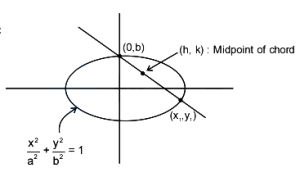
Chords of an ellipse $\frac{x^2}{a^2} + \frac{y^2}{b^2} = 1$ are drawn through the positive end of the minor axis $(0, b)$. The locus of their midpoints lies on:
A
a circle
B
a parabola
C
an ellipse
D
a hyperbola
Solution
(C) Let the ellipse be $\frac{x^2}{a^2} + \frac{y^2}{b^2} = 1$. The positive end of the minor axis is $P(0, b)$.
Let $(h, k)$ be the midpoint of a chord passing through $(0, b)$ and some point $(x_1, y_1)$ on the ellipse.
Then,$h = \frac{x_1 + 0}{2} \Rightarrow x_1 = 2h$ and $k = \frac{y_1 + b}{2} \Rightarrow y_1 = 2k - b$.
Since $(x_1, y_1)$ lies on the ellipse,we have $\frac{x_1^2}{a^2} + \frac{y_1^2}{b^2} = 1$.
Substituting the values of $x_1$ and $y_1$,we get $\frac{(2h)^2}{a^2} + \frac{(2k - b)^2}{b^2} = 1$.
This simplifies to $\frac{4h^2}{a^2} + \frac{4(k - b/2)^2}{b^2} = 1$,which can be rewritten as $\frac{h^2}{(a/2)^2} + \frac{(k - b/2)^2}{(b/2)^2} = 1$.
Replacing $(h, k)$ with $(x, y)$,the locus is $\frac{x^2}{(a/2)^2} + \frac{(y - b/2)^2}{(b/2)^2} = 1$,which represents an ellipse.
Let $(h, k)$ be the midpoint of a chord passing through $(0, b)$ and some point $(x_1, y_1)$ on the ellipse.
Then,$h = \frac{x_1 + 0}{2} \Rightarrow x_1 = 2h$ and $k = \frac{y_1 + b}{2} \Rightarrow y_1 = 2k - b$.
Since $(x_1, y_1)$ lies on the ellipse,we have $\frac{x_1^2}{a^2} + \frac{y_1^2}{b^2} = 1$.
Substituting the values of $x_1$ and $y_1$,we get $\frac{(2h)^2}{a^2} + \frac{(2k - b)^2}{b^2} = 1$.
This simplifies to $\frac{4h^2}{a^2} + \frac{4(k - b/2)^2}{b^2} = 1$,which can be rewritten as $\frac{h^2}{(a/2)^2} + \frac{(k - b/2)^2}{(b/2)^2} = 1$.
Replacing $(h, k)$ with $(x, y)$,the locus is $\frac{x^2}{(a/2)^2} + \frac{(y - b/2)^2}{(b/2)^2} = 1$,which represents an ellipse.
0 likes
View Solution735
MediumMCQ
Consider a tangent to the ellipse $\frac{x^{2}}{2}+\frac{y^{2}}{1}=1$ at any point. The locus of the midpoint of the portion intercepted between the axes is
A
$\frac{x^{2}}{2}+\frac{y^{2}}{4}=1$
B
$\frac{x^{2}}{4}+\frac{y^{2}}{2}=1$
C
$\frac{1}{3 x^{2}}+\frac{1}{4 y^{2}}=1$
D
$\frac{1}{2 x^{2}}+\frac{1}{4 y^{2}}=1$
Solution
(D) Let the point on the ellipse be $P(x_0, y_0)$. The equation of the tangent at $P$ is $\frac{x x_0}{2} + y y_0 = 1$.
The intercepts of this tangent on the $x$-axis and $y$-axis are found by setting $y=0$ and $x=0$ respectively.
For $y=0$,$x = \frac{2}{x_0}$. For $x=0$,$y = \frac{1}{y_0}$.
Let the midpoint of the intercepted portion be $(h, k)$. Then $h = \frac{1}{x_0}$ and $k = \frac{1}{2 y_0}$.
This gives $x_0 = \frac{1}{h}$ and $y_0 = \frac{1}{2 k}$.
Since $(x_0, y_0)$ lies on the ellipse $\frac{x_0^2}{2} + y_0^2 = 1$,we substitute the values:
$\frac{(1/h)^2}{2} + (1/2k)^2 = 1$
$\frac{1}{2h^2} + \frac{1}{4k^2} = 1$.
Replacing $(h, k)$ with $(x, y)$,the locus is $\frac{1}{2x^2} + \frac{1}{4y^2} = 1$.
The intercepts of this tangent on the $x$-axis and $y$-axis are found by setting $y=0$ and $x=0$ respectively.
For $y=0$,$x = \frac{2}{x_0}$. For $x=0$,$y = \frac{1}{y_0}$.
Let the midpoint of the intercepted portion be $(h, k)$. Then $h = \frac{1}{x_0}$ and $k = \frac{1}{2 y_0}$.
This gives $x_0 = \frac{1}{h}$ and $y_0 = \frac{1}{2 k}$.
Since $(x_0, y_0)$ lies on the ellipse $\frac{x_0^2}{2} + y_0^2 = 1$,we substitute the values:
$\frac{(1/h)^2}{2} + (1/2k)^2 = 1$
$\frac{1}{2h^2} + \frac{1}{4k^2} = 1$.
Replacing $(h, k)$ with $(x, y)$,the locus is $\frac{1}{2x^2} + \frac{1}{4y^2} = 1$.
0 likes
View Solution736
DifficultMCQ
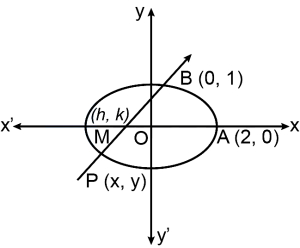
The locus of the mid-points of the chords of an ellipse $x^{2}+4y^{2}=4$ that are drawn from the positive end of the minor axis is
A
a circle with centre $\left(\frac{1}{2}, 0\right)$ and radius $1$
B
a parabola with focus $\left(\frac{1}{2}, 0\right)$ and directrix $x=-1$
C
an ellipse with centre $\left(0, \frac{1}{2}\right),$ major axis $1$ and minor axis $\frac{1}{2}$
D
a hyperbola with centre $\left(0, \frac{1}{2}\right),$ transverse axis $1$ and conjugate axis $\frac{1}{2}$
Solution
(C) Given the equation of the ellipse is $x^{2}+4y^{2}=4$.
Dividing by $4$,we get $\frac{x^{2}}{4}+\frac{y^{2}}{1}=1$.
The positive end of the minor axis is $B(0, 1)$.
Let the mid-point of the chord $BP$ be $M(h, k)$,where $P(x, y)$ is a point on the ellipse.
Then,$(h, k) = \left(\frac{0+x}{2}, \frac{1+y}{2}\right)$.
This implies $h = \frac{x}{2} \Rightarrow x = 2h$ and $k = \frac{1+y}{2} \Rightarrow y = 2k-1$.
Since $P(x, y)$ lies on the ellipse $x^{2}+4y^{2}=4$,substituting the values of $x$ and $y$ gives:
$(2h)^{2} + 4(2k-1)^{2} = 4$
$4h^{2} + 4(4k^{2} - 4k + 1) = 4$
$4h^{2} + 16k^{2} - 16k + 4 = 4$
$4h^{2} + 16k^{2} - 16k = 0$
Dividing by $4$,we get $h^{2} + 4k^{2} - 4k = 0$.
Replacing $(h, k)$ with $(x, y)$,the locus is $x^{2} + 4(y^{2} - y) = 0$.
Completing the square: $x^{2} + 4(y^{2} - y + \frac{1}{4}) = 4(\frac{1}{4}) = 1$.
$x^{2} + 4(y - \frac{1}{2})^{2} = 1$.
Dividing by $1$,we get $\frac{x^{2}}{1} + \frac{(y - 1/2)^{2}}{1/4} = 1$.
This is an ellipse with centre $(0, 1/2)$,semi-major axis $a=1$,and semi-minor axis $b=1/2$.
Dividing by $4$,we get $\frac{x^{2}}{4}+\frac{y^{2}}{1}=1$.
The positive end of the minor axis is $B(0, 1)$.
Let the mid-point of the chord $BP$ be $M(h, k)$,where $P(x, y)$ is a point on the ellipse.
Then,$(h, k) = \left(\frac{0+x}{2}, \frac{1+y}{2}\right)$.
This implies $h = \frac{x}{2} \Rightarrow x = 2h$ and $k = \frac{1+y}{2} \Rightarrow y = 2k-1$.
Since $P(x, y)$ lies on the ellipse $x^{2}+4y^{2}=4$,substituting the values of $x$ and $y$ gives:
$(2h)^{2} + 4(2k-1)^{2} = 4$
$4h^{2} + 4(4k^{2} - 4k + 1) = 4$
$4h^{2} + 16k^{2} - 16k + 4 = 4$
$4h^{2} + 16k^{2} - 16k = 0$
Dividing by $4$,we get $h^{2} + 4k^{2} - 4k = 0$.
Replacing $(h, k)$ with $(x, y)$,the locus is $x^{2} + 4(y^{2} - y) = 0$.
Completing the square: $x^{2} + 4(y^{2} - y + \frac{1}{4}) = 4(\frac{1}{4}) = 1$.
$x^{2} + 4(y - \frac{1}{2})^{2} = 1$.
Dividing by $1$,we get $\frac{x^{2}}{1} + \frac{(y - 1/2)^{2}}{1/4} = 1$.
This is an ellipse with centre $(0, 1/2)$,semi-major axis $a=1$,and semi-minor axis $b=1/2$.
0 likes
View Solution737
MediumMCQ
Let the foci of the ellipse $\frac{x^{2}}{9}+y^{2}=1$ subtend a right angle at a point $P$. Then,the locus of $P$ is
A
$x^{2}+y^{2}=1$
B
$x^{2}+y^{2}=2$
C
$x^{2}+y^{2}=4$
D
$x^{2}+y^{2}=8$
Solution
(D) Given the ellipse equation is $\frac{x^{2}}{9}+\frac{y^{2}}{1}=1$.
Comparing with $\frac{x^{2}}{a^{2}}+\frac{y^{2}}{b^{2}}=1$,we have $a^{2}=9$ and $b^{2}=1$.
The eccentricity $e$ is given by $e=\sqrt{1-\frac{b^{2}}{a^{2}}}=\sqrt{1-\frac{1}{9}}=\sqrt{\frac{8}{9}}=\frac{2\sqrt{2}}{3}$.
The foci are $(\pm ae, 0) = (\pm 3 \times \frac{2\sqrt{2}}{3}, 0) = (\pm 2\sqrt{2}, 0)$.
Let $P(h, k)$ be a point such that the foci $F_{1}(2\sqrt{2}, 0)$ and $F_{2}(-2\sqrt{2}, 0)$ subtend a right angle at $P$.
Thus,the product of the slopes of $PF_{1}$ and $PF_{2}$ is $-1$.
$\frac{k-0}{h-2\sqrt{2}} \times \frac{k-0}{h+2\sqrt{2}} = -1$.
$\frac{k^{2}}{h^{2}-(2\sqrt{2})^{2}} = -1$.
$k^{2} = -(h^{2}-8)$.
$h^{2}+k^{2} = 8$.
Replacing $(h, k)$ with $(x, y)$,the locus is $x^{2}+y^{2}=8$.
Comparing with $\frac{x^{2}}{a^{2}}+\frac{y^{2}}{b^{2}}=1$,we have $a^{2}=9$ and $b^{2}=1$.
The eccentricity $e$ is given by $e=\sqrt{1-\frac{b^{2}}{a^{2}}}=\sqrt{1-\frac{1}{9}}=\sqrt{\frac{8}{9}}=\frac{2\sqrt{2}}{3}$.
The foci are $(\pm ae, 0) = (\pm 3 \times \frac{2\sqrt{2}}{3}, 0) = (\pm 2\sqrt{2}, 0)$.
Let $P(h, k)$ be a point such that the foci $F_{1}(2\sqrt{2}, 0)$ and $F_{2}(-2\sqrt{2}, 0)$ subtend a right angle at $P$.
Thus,the product of the slopes of $PF_{1}$ and $PF_{2}$ is $-1$.
$\frac{k-0}{h-2\sqrt{2}} \times \frac{k-0}{h+2\sqrt{2}} = -1$.
$\frac{k^{2}}{h^{2}-(2\sqrt{2})^{2}} = -1$.
$k^{2} = -(h^{2}-8)$.
$h^{2}+k^{2} = 8$.
Replacing $(h, k)$ with $(x, y)$,the locus is $x^{2}+y^{2}=8$.
0 likes
View Solution738
DifficultMCQ
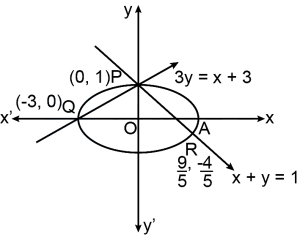
Lines $x+y=1$ and $3y=x+3$ intersect the ellipse $x^{2}+9y^{2}=9$ at the points $P, Q$ and $R$. The area of the $\triangle PQR$ is
A
$\frac{36}{5}$
B
$\frac{18}{5}$
C
$\frac{9}{5}$
D
$\frac{1}{5}$
Solution
(B) The equation of the ellipse is $x^{2}+9y^{2}=9$,which can be written as $\frac{x^{2}}{9}+\frac{y^{2}}{1}=1$.
First,find the intersection points:
$1$. Intersection of $x+y=1$ and $3y=x+3$:
Substitute $x=1-y$ into $3y=x+3$: $3y=(1-y)+3$ $\Rightarrow 4y=4$ $\Rightarrow y=1$. Then $x=0$. So,point $P$ is $(0, 1)$.
$2$. Intersection of $x+y=1$ and $x^{2}+9y^{2}=9$:
Substitute $x=1-y$ into the ellipse equation: $(1-y)^{2}+9y^{2}=9$ $\Rightarrow 1-2y+y^{2}+9y^{2}=9$ $\Rightarrow 10y^{2}-2y-8=0$ $\Rightarrow 5y^{2}-y-4=0$ $\Rightarrow (5y+4)(y-1)=0$. Thus $y=1$ (gives $P(0,1)$) or $y=-4/5$. If $y=-4/5$,$x=1-(-4/5)=9/5$. So,point $R$ is $(9/5, -4/5)$.
$3$. Intersection of $3y=x+3$ and $x^{2}+9y^{2}=9$:
Substitute $y=(x+3)/3$ into the ellipse equation: $x^{2}+9((x+3)/3)^{2}=9$ $\Rightarrow x^{2}+(x+3)^{2}=9$ $\Rightarrow x^{2}+x^{2}+6x+9=9$ $\Rightarrow 2x^{2}+6x=0$ $\Rightarrow 2x(x+3)=0$. Thus $x=0$ (gives $P(0,1)$) or $x=-3$. If $x=-3$,$y=(-3+3)/3=0$. So,point $Q$ is $(-3, 0)$.
The vertices of $\triangle PQR$ are $P(0, 1)$,$Q(-3, 0)$,and $R(9/5, -4/5)$.
The area of $\triangle PQR = \frac{1}{2} |x_1(y_2-y_3) + x_2(y_3-y_1) + x_3(y_1-y_2)|$
$= \frac{1}{2} |0(0 - (-4/5)) + (-3)(-4/5 - 1) + (9/5)(1 - 0)|$
$= \frac{1}{2} |0 + (-3)(-9/5) + 9/5|$
$= \frac{1}{2} |27/5 + 9/5| = \frac{1}{2} |36/5| = \frac{18}{5}$.
First,find the intersection points:
$1$. Intersection of $x+y=1$ and $3y=x+3$:
Substitute $x=1-y$ into $3y=x+3$: $3y=(1-y)+3$ $\Rightarrow 4y=4$ $\Rightarrow y=1$. Then $x=0$. So,point $P$ is $(0, 1)$.
$2$. Intersection of $x+y=1$ and $x^{2}+9y^{2}=9$:
Substitute $x=1-y$ into the ellipse equation: $(1-y)^{2}+9y^{2}=9$ $\Rightarrow 1-2y+y^{2}+9y^{2}=9$ $\Rightarrow 10y^{2}-2y-8=0$ $\Rightarrow 5y^{2}-y-4=0$ $\Rightarrow (5y+4)(y-1)=0$. Thus $y=1$ (gives $P(0,1)$) or $y=-4/5$. If $y=-4/5$,$x=1-(-4/5)=9/5$. So,point $R$ is $(9/5, -4/5)$.
$3$. Intersection of $3y=x+3$ and $x^{2}+9y^{2}=9$:
Substitute $y=(x+3)/3$ into the ellipse equation: $x^{2}+9((x+3)/3)^{2}=9$ $\Rightarrow x^{2}+(x+3)^{2}=9$ $\Rightarrow x^{2}+x^{2}+6x+9=9$ $\Rightarrow 2x^{2}+6x=0$ $\Rightarrow 2x(x+3)=0$. Thus $x=0$ (gives $P(0,1)$) or $x=-3$. If $x=-3$,$y=(-3+3)/3=0$. So,point $Q$ is $(-3, 0)$.
The vertices of $\triangle PQR$ are $P(0, 1)$,$Q(-3, 0)$,and $R(9/5, -4/5)$.
The area of $\triangle PQR = \frac{1}{2} |x_1(y_2-y_3) + x_2(y_3-y_1) + x_3(y_1-y_2)|$
$= \frac{1}{2} |0(0 - (-4/5)) + (-3)(-4/5 - 1) + (9/5)(1 - 0)|$
$= \frac{1}{2} |0 + (-3)(-9/5) + 9/5|$
$= \frac{1}{2} |27/5 + 9/5| = \frac{1}{2} |36/5| = \frac{18}{5}$.
0 likes
View Solution739
MediumMCQ
Let $f$ be a strictly decreasing function defined on $\mathbb{R}$ such that $f(x) > 0, \forall x \in \mathbb{R}$. Let $\frac{x^2}{f(a^2+5a+3)} + \frac{y^2}{f(a+15)} = 1$ be an ellipse with the major axis along the $y$-axis. The value of $a$ can lie in the interval$(s)$:
A
$(-\infty, -6)$
B
$(-6, 2)$
C
$(2, \infty)$
D
$(-\infty, -6) \cup (2, \infty)$
Solution
(D) Given that $f$ is a strictly decreasing function on $\mathbb{R}$.
For the equation $\frac{x^2}{f(a^2+5a+3)} + \frac{y^2}{f(a+15)} = 1$ to represent an ellipse with the major axis along the $y$-axis,the denominator of the $y^2$ term must be greater than the denominator of the $x^2$ term.
Thus,$f(a+15) > f(a^2+5a+3)$.
Since $f$ is a strictly decreasing function,$f(x_1) > f(x_2)$ implies $x_1 < x_2$.
Therefore,$a+15 < a^2+5a+3$.
Rearranging the inequality,we get $a^2+4a-12 > 0$.
Factoring the quadratic expression,we have $(a+6)(a-2) > 0$.
Solving this inequality,we find that $a < -6$ or $a > 2$.
Thus,the interval for $a$ is $(-\infty, -6) \cup (2, \infty)$.
For the equation $\frac{x^2}{f(a^2+5a+3)} + \frac{y^2}{f(a+15)} = 1$ to represent an ellipse with the major axis along the $y$-axis,the denominator of the $y^2$ term must be greater than the denominator of the $x^2$ term.
Thus,$f(a+15) > f(a^2+5a+3)$.
Since $f$ is a strictly decreasing function,$f(x_1) > f(x_2)$ implies $x_1 < x_2$.
Therefore,$a+15 < a^2+5a+3$.
Rearranging the inequality,we get $a^2+4a-12 > 0$.
Factoring the quadratic expression,we have $(a+6)(a-2) > 0$.
Solving this inequality,we find that $a < -6$ or $a > 2$.
Thus,the interval for $a$ is $(-\infty, -6) \cup (2, \infty)$.
0 likes
View Solution740
DifficultMCQ
An ellipse has its center at $(1, -2)$,one focus at $(3, -2)$,and one vertex at $(5, -2)$. Then the length of its latus rectum is :
A
$\frac{16}{\sqrt{3}}$
B
$6$
C
$4\sqrt{3}$
D
$6\sqrt{3}$
Solution
(B) Given center $C = (1, -2)$,focus $F_1 = (3, -2)$,and vertex $A_1 = (5, -2)$.
Since the $y$-coordinates are the same,the major axis is horizontal.
The distance from the center to the vertex is $a = |5 - 1| = 4$.
The distance from the center to the focus is $ae = |3 - 1| = 2$.
Thus,$e = \frac{2}{4} = \frac{1}{2}$.
Using the relation $b^2 = a^2(1 - e^2)$,we get $b^2 = 4^2(1 - (\frac{1}{2})^2) = 16(1 - \frac{1}{4}) = 16(\frac{3}{4}) = 12$.
The length of the latus rectum is $\frac{2b^2}{a} = \frac{2 \times 12}{4} = \frac{24}{4} = 6$.
Since the $y$-coordinates are the same,the major axis is horizontal.
The distance from the center to the vertex is $a = |5 - 1| = 4$.
The distance from the center to the focus is $ae = |3 - 1| = 2$.
Thus,$e = \frac{2}{4} = \frac{1}{2}$.
Using the relation $b^2 = a^2(1 - e^2)$,we get $b^2 = 4^2(1 - (\frac{1}{2})^2) = 16(1 - \frac{1}{4}) = 16(\frac{3}{4}) = 12$.
The length of the latus rectum is $\frac{2b^2}{a} = \frac{2 \times 12}{4} = \frac{24}{4} = 6$.
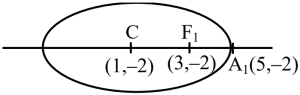
0 likes
View Solution741
DifficultMCQ
Let each of the two ellipses $E_1: \frac{x^2}{a^2} + \frac{y^2}{b^2} = 1, (a > b)$ and $E_2: \frac{x^2}{A^2} + \frac{y^2}{B^2} = 1, (A < B)$ have eccentricity $\frac{4}{5}$. Let the lengths of the latus recta of $E_1$ and $E_2$ be $\ell_1$ and $\ell_2$,respectively,such that $2\ell_1^2 = 9\ell_2$. If the distance between the foci of $E_1$ is $8$,then the distance between the foci of $E_2$ is:
A
$\frac{96}{5}$
B
$\frac{32}{5}$
C
$\frac{16}{5}$
D
$\frac{8}{5}$
Solution
(B) For $E_1$,the distance between foci is $2ae = 8$. Given $e = \frac{4}{5}$,we have $2a(\frac{4}{5}) = 8 \Rightarrow a = 5$.
Using $b^2 = a^2(1 - e^2)$,we get $b^2 = 25(1 - \frac{16}{25}) = 25(\frac{9}{25}) = 9$.
The length of the latus rectum $\ell_1 = \frac{2b^2}{a} = \frac{2 \times 9}{5} = \frac{18}{5}$.
For $E_2$,$A < B$,so the eccentricity formula is $A^2 = B^2(1 - e^2) = B^2(1 - \frac{16}{25}) = \frac{9}{25}B^2$,which gives $A = \frac{3}{5}B$.
The length of the latus rectum $\ell_2 = \frac{2A^2}{B} = \frac{2(9/25)B^2}{B} = \frac{18}{25}B$.
Given $2\ell_1^2 = 9\ell_2$,we have $2(\frac{18}{5})^2 = 9(\frac{18}{25}B) \Rightarrow 2 \times \frac{324}{25} = \frac{162}{25}B$.
Solving for $B$,$B = \frac{2 \times 324}{162} = 4$.
The distance between the foci of $E_2$ is $2Be = 2 \times 4 \times \frac{4}{5} = \frac{32}{5}$.
Using $b^2 = a^2(1 - e^2)$,we get $b^2 = 25(1 - \frac{16}{25}) = 25(\frac{9}{25}) = 9$.
The length of the latus rectum $\ell_1 = \frac{2b^2}{a} = \frac{2 \times 9}{5} = \frac{18}{5}$.
For $E_2$,$A < B$,so the eccentricity formula is $A^2 = B^2(1 - e^2) = B^2(1 - \frac{16}{25}) = \frac{9}{25}B^2$,which gives $A = \frac{3}{5}B$.
The length of the latus rectum $\ell_2 = \frac{2A^2}{B} = \frac{2(9/25)B^2}{B} = \frac{18}{25}B$.
Given $2\ell_1^2 = 9\ell_2$,we have $2(\frac{18}{5})^2 = 9(\frac{18}{25}B) \Rightarrow 2 \times \frac{324}{25} = \frac{162}{25}B$.
Solving for $B$,$B = \frac{2 \times 324}{162} = 4$.
The distance between the foci of $E_2$ is $2Be = 2 \times 4 \times \frac{4}{5} = \frac{32}{5}$.
0 likes
View Solution742
MediumMCQ
Let $(h, k)$ lie on the circle $C: x^2 + y^2 = 4$ and the point $(2h + 1, 3k + 2)$ lie on an ellipse with eccentricity $e$. Then the value of $\frac{5}{e^2}$ is equal to . . . . . . .
A
$5$
B
$7$
C
$9$
D
$11$
Solution
(C) Let the point $(h, k)$ on the circle $x^2 + y^2 = 4$ be represented as $(2 \cos \theta, 2 \sin \theta)$.
Let the point $(x, y) = (2h + 1, 3k + 2)$.
Substituting $h = 2 \cos \theta$ and $k = 2 \sin \theta$,we get $x = 4 \cos \theta + 1$ and $y = 6 \sin \theta + 2$.
Rearranging,we have $\cos \theta = \frac{x - 1}{4}$ and $\sin \theta = \frac{y - 2}{6}$.
Using the identity $\cos^2 \theta + \sin^2 \theta = 1$,we get $(\frac{x - 1}{4})^2 + (\frac{y - 2}{6})^2 = 1$.
This is the equation of an ellipse with semi-major axis $a = 6$ and semi-minor axis $b = 4$.
The eccentricity $e$ is given by $e^2 = 1 - \frac{b^2}{a^2} = 1 - \frac{16}{36} = 1 - \frac{4}{9} = \frac{5}{9}$.
Therefore,$\frac{5}{e^2} = \frac{5}{5/9} = 9$.
Let the point $(x, y) = (2h + 1, 3k + 2)$.
Substituting $h = 2 \cos \theta$ and $k = 2 \sin \theta$,we get $x = 4 \cos \theta + 1$ and $y = 6 \sin \theta + 2$.
Rearranging,we have $\cos \theta = \frac{x - 1}{4}$ and $\sin \theta = \frac{y - 2}{6}$.
Using the identity $\cos^2 \theta + \sin^2 \theta = 1$,we get $(\frac{x - 1}{4})^2 + (\frac{y - 2}{6})^2 = 1$.
This is the equation of an ellipse with semi-major axis $a = 6$ and semi-minor axis $b = 4$.
The eccentricity $e$ is given by $e^2 = 1 - \frac{b^2}{a^2} = 1 - \frac{16}{36} = 1 - \frac{4}{9} = \frac{5}{9}$.
Therefore,$\frac{5}{e^2} = \frac{5}{5/9} = 9$.
0 likes
View Solution743
DifficultMCQ
Let the length of the latus rectum of an ellipse $\frac{x^{2}}{a^{2}}+\frac{y^{2}}{b^{2}}=1$ $(a>b)$ be $30$. If its eccentricity is the maximum value of the function $f(t)=-\frac{3}{4}+2t-t^{2}$,then $(a^{2}+b^{2})$ is equal to -
A
$516$
B
$256$
C
$496$
D
$276$
Solution
(C) The function is $f(t) = -t^{2} + 2t - \frac{3}{4}$.
To find the maximum value,we complete the square: $f(t) = -(t^{2} - 2t + 1) + 1 - \frac{3}{4} = -(t-1)^{2} + \frac{1}{4}$.
The maximum value is $e = \frac{1}{4}$,so $e^{2} = \frac{1}{16}$.
For an ellipse,$e^{2} = 1 - \frac{b^{2}}{a^{2}}$,so $\frac{b^{2}}{a^{2}} = 1 - \frac{1}{16} = \frac{15}{16} \Rightarrow b^{2} = \frac{15}{16}a^{2}$.
The length of the latus rectum is $\frac{2b^{2}}{a} = 30$,so $b^{2} = 15a$.
Equating the expressions for $b^{2}$: $\frac{15}{16}a^{2} = 15a$.
Since $a \neq 0$,we have $\frac{a}{16} = 1 \Rightarrow a = 16$.
Then $b^{2} = 15(16) = 240$.
Thus,$a^{2} + b^{2} = 16^{2} + 240 = 256 + 240 = 496$.
To find the maximum value,we complete the square: $f(t) = -(t^{2} - 2t + 1) + 1 - \frac{3}{4} = -(t-1)^{2} + \frac{1}{4}$.
The maximum value is $e = \frac{1}{4}$,so $e^{2} = \frac{1}{16}$.
For an ellipse,$e^{2} = 1 - \frac{b^{2}}{a^{2}}$,so $\frac{b^{2}}{a^{2}} = 1 - \frac{1}{16} = \frac{15}{16} \Rightarrow b^{2} = \frac{15}{16}a^{2}$.
The length of the latus rectum is $\frac{2b^{2}}{a} = 30$,so $b^{2} = 15a$.
Equating the expressions for $b^{2}$: $\frac{15}{16}a^{2} = 15a$.
Since $a \neq 0$,we have $\frac{a}{16} = 1 \Rightarrow a = 16$.
Then $b^{2} = 15(16) = 240$.
Thus,$a^{2} + b^{2} = 16^{2} + 240 = 256 + 240 = 496$.
0 likes
View Solution744
DifficultMCQ
If the line $\alpha x+4y=\sqrt{7}$,where $\alpha \in R$,touches the ellipse $3x^{2}+4y^{2}=1$ at the point $P$ in the first quadrant,then one of the focal distances of $P$ is:
A
$\frac{1}{\sqrt{3}}-\frac{1}{2\sqrt{11}}$
B
$\frac{1}{\sqrt{3}}+\frac{1}{2\sqrt{5}}$
C
$\frac{1}{\sqrt{3}}-\frac{1}{2\sqrt{5}}$
D
$\frac{1}{\sqrt{3}}+\frac{1}{2\sqrt{7}}$
Solution
(D) The equation of the line is $\alpha x+4y-\sqrt{7}=0$. This line touches the ellipse $3x^{2}+4y^{2}=1$,which can be written as $\frac{x^{2}}{1/3} + \frac{y^{2}}{1/4} = 1$.
Comparing with the condition of tangency $c^{2}=a^{2}m^{2}+b^{2}$,where $m = -\frac{\alpha}{4}$ and $c = \frac{\sqrt{7}}{4}$:
$(\frac{\sqrt{7}}{4})^{2} = (\frac{1}{3})(\frac{-\alpha}{4})^{2} + \frac{1}{4} \implies \frac{7}{16} = \frac{\alpha^{2}}{48} + \frac{1}{4} \implies \frac{\alpha^{2}}{48} = \frac{3}{16} \implies \alpha^{2} = 9 \implies \alpha = \pm 3$.
Since $P$ is in the first quadrant,the tangent is $3x+4y=\sqrt{7}$.
The point of contact $P(x_{1}, y_{1})$ for the tangent $3x+4y=\sqrt{7}$ is given by $\frac{3x}{x_{1}} = \frac{4y}{y_{1}} = \frac{1}{1/7}$ is not correct,rather using $3xx_{1}+4yy_{1}=1$,we get $3x_{1} = \frac{3}{\sqrt{7}}$ and $4y_{1} = \frac{4}{\sqrt{7}}$,so $P = (\frac{1}{\sqrt{7}}, \frac{1}{\sqrt{7}})$.
For the ellipse $\frac{x^{2}}{1/3} + \frac{y^{2}}{1/4} = 1$,$a^{2} = 1/3$ and $b^{2} = 1/4$. Eccentricity $e = \sqrt{1-\frac{b^{2}}{a^{2}}} = \sqrt{1-\frac{1/4}{1/3}} = \sqrt{1-\frac{3}{4}} = \frac{1}{2}$.
The focal distances are $a \pm ex_{1} = \frac{1}{\sqrt{3}} \pm \frac{1}{2}(\frac{1}{\sqrt{7}}) = \frac{1}{\sqrt{3}} \pm \frac{1}{2\sqrt{7}}$.
Thus,one of the focal distances is $\frac{1}{\sqrt{3}}+\frac{1}{2\sqrt{7}}$.
Comparing with the condition of tangency $c^{2}=a^{2}m^{2}+b^{2}$,where $m = -\frac{\alpha}{4}$ and $c = \frac{\sqrt{7}}{4}$:
$(\frac{\sqrt{7}}{4})^{2} = (\frac{1}{3})(\frac{-\alpha}{4})^{2} + \frac{1}{4} \implies \frac{7}{16} = \frac{\alpha^{2}}{48} + \frac{1}{4} \implies \frac{\alpha^{2}}{48} = \frac{3}{16} \implies \alpha^{2} = 9 \implies \alpha = \pm 3$.
Since $P$ is in the first quadrant,the tangent is $3x+4y=\sqrt{7}$.
The point of contact $P(x_{1}, y_{1})$ for the tangent $3x+4y=\sqrt{7}$ is given by $\frac{3x}{x_{1}} = \frac{4y}{y_{1}} = \frac{1}{1/7}$ is not correct,rather using $3xx_{1}+4yy_{1}=1$,we get $3x_{1} = \frac{3}{\sqrt{7}}$ and $4y_{1} = \frac{4}{\sqrt{7}}$,so $P = (\frac{1}{\sqrt{7}}, \frac{1}{\sqrt{7}})$.
For the ellipse $\frac{x^{2}}{1/3} + \frac{y^{2}}{1/4} = 1$,$a^{2} = 1/3$ and $b^{2} = 1/4$. Eccentricity $e = \sqrt{1-\frac{b^{2}}{a^{2}}} = \sqrt{1-\frac{1/4}{1/3}} = \sqrt{1-\frac{3}{4}} = \frac{1}{2}$.
The focal distances are $a \pm ex_{1} = \frac{1}{\sqrt{3}} \pm \frac{1}{2}(\frac{1}{\sqrt{7}}) = \frac{1}{\sqrt{3}} \pm \frac{1}{2\sqrt{7}}$.
Thus,one of the focal distances is $\frac{1}{\sqrt{3}}+\frac{1}{2\sqrt{7}}$.
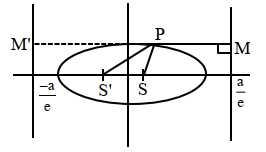
0 likes
View Solution745
DifficultMCQ
Let $S$ and $S^{\prime}$ be the foci of the ellipse $\frac{x^2}{25}+\frac{y^2}{9}=1$ and $P(\alpha, \beta)$ be a point on the ellipse in the first quadrant. If $(SP)^2+(S^{\prime}P)^2-SP \cdot S^{\prime}P=37$,then $\alpha^2+\beta^2$ is equal to:
A
$15$
B
$11$
C
$17$
D
$13$
Solution
(D) Given the ellipse $\frac{x^2}{25}+\frac{y^2}{9}=1$,we have $a^2=25$ and $b^2=9$,so $a=5$ and $b=3$.
Eccentricity $e = \sqrt{1-\frac{b^2}{a^2}} = \sqrt{1-\frac{9}{25}} = \frac{4}{5}$.
The foci are $S(ae, 0) = (4, 0)$ and $S^{\prime}(-ae, 0) = (-4, 0)$.
Since $P(\alpha, \beta)$ lies on the ellipse,$SP+S^{\prime}P=2a=10$.
Given $(SP)^2+(S^{\prime}P)^2-SP \cdot S^{\prime}P=37$.
Using $(SP+S^{\prime}P)^2 = (SP)^2+(S^{\prime}P)^2+2SP \cdot S^{\prime}P$,we substitute $(SP)^2+(S^{\prime}P)^2 = (SP+S^{\prime}P)^2-2SP \cdot S^{\prime}P$.
So,$(SP+S^{\prime}P)^2-3SP \cdot S^{\prime}P=37$.
$10^2-3SP \cdot S^{\prime}P=37$ $\Rightarrow 100-3SP \cdot S^{\prime}P=37$ $\Rightarrow 3SP \cdot S^{\prime}P=63$ $\Rightarrow SP \cdot S^{\prime}P=21$.
For any point $P(\alpha, \beta)$ on the ellipse,$SP = a-e\alpha$ and $S^{\prime}P = a+e\alpha$.
$SP \cdot S^{\prime}P = a^2-e^2\alpha^2 = 25-\frac{16}{25}\alpha^2 = 21$.
$\frac{16}{25}\alpha^2 = 4 \Rightarrow \alpha^2 = \frac{100}{16} = \frac{25}{4}$.
From $\frac{\alpha^2}{25}+\frac{\beta^2}{9}=1$,we have $\frac{25/4}{25}+\frac{\beta^2}{9}=1$ $\Rightarrow \frac{1}{4}+\frac{\beta^2}{9}=1$ $\Rightarrow \frac{\beta^2}{9}=\frac{3}{4}$ $\Rightarrow \beta^2=\frac{27}{4}$.
Thus,$\alpha^2+\beta^2 = \frac{25}{4}+\frac{27}{4} = \frac{52}{4} = 13$.
Eccentricity $e = \sqrt{1-\frac{b^2}{a^2}} = \sqrt{1-\frac{9}{25}} = \frac{4}{5}$.
The foci are $S(ae, 0) = (4, 0)$ and $S^{\prime}(-ae, 0) = (-4, 0)$.
Since $P(\alpha, \beta)$ lies on the ellipse,$SP+S^{\prime}P=2a=10$.
Given $(SP)^2+(S^{\prime}P)^2-SP \cdot S^{\prime}P=37$.
Using $(SP+S^{\prime}P)^2 = (SP)^2+(S^{\prime}P)^2+2SP \cdot S^{\prime}P$,we substitute $(SP)^2+(S^{\prime}P)^2 = (SP+S^{\prime}P)^2-2SP \cdot S^{\prime}P$.
So,$(SP+S^{\prime}P)^2-3SP \cdot S^{\prime}P=37$.
$10^2-3SP \cdot S^{\prime}P=37$ $\Rightarrow 100-3SP \cdot S^{\prime}P=37$ $\Rightarrow 3SP \cdot S^{\prime}P=63$ $\Rightarrow SP \cdot S^{\prime}P=21$.
For any point $P(\alpha, \beta)$ on the ellipse,$SP = a-e\alpha$ and $S^{\prime}P = a+e\alpha$.
$SP \cdot S^{\prime}P = a^2-e^2\alpha^2 = 25-\frac{16}{25}\alpha^2 = 21$.
$\frac{16}{25}\alpha^2 = 4 \Rightarrow \alpha^2 = \frac{100}{16} = \frac{25}{4}$.
From $\frac{\alpha^2}{25}+\frac{\beta^2}{9}=1$,we have $\frac{25/4}{25}+\frac{\beta^2}{9}=1$ $\Rightarrow \frac{1}{4}+\frac{\beta^2}{9}=1$ $\Rightarrow \frac{\beta^2}{9}=\frac{3}{4}$ $\Rightarrow \beta^2=\frac{27}{4}$.
Thus,$\alpha^2+\beta^2 = \frac{25}{4}+\frac{27}{4} = \frac{52}{4} = 13$.
0 likes
View Solution746
DifficultMCQ
Let the line $y-x=1$ intersect the ellipse $\frac{x^{2}}{2}+\frac{y^{2}}{1}=1$ at the points $A$ and $B$. Then the angle subtended by the line segment $AB$ at the center of the ellipse is:
A
$\pi-\tan^{-1}(\frac{1}{4})$
B
$\frac{\pi}{2}+\tan^{-1}(\frac{1}{4})$
C
$\frac{\pi}{2}+2\tan^{-1}(\frac{1}{4})$
D
$\frac{\pi}{2}-\tan^{-1}(\frac{1}{4})$
Solution
(B) The equation of the line is $y = x + 1$. Substituting this into the ellipse equation $\frac{x^2}{2} + y^2 = 1$:
$\frac{x^2}{2} + (x+1)^2 = 1$
$\frac{x^2}{2} + x^2 + 2x + 1 = 1$
$\frac{3x^2}{2} + 2x = 0$
$x(\frac{3x}{2} + 2) = 0$
So,$x = 0$ or $x = -\frac{4}{3}$.
If $x = 0$,then $y = 1$,so $A = (0, 1)$.
If $x = -\frac{4}{3}$,then $y = -\frac{4}{3} + 1 = -\frac{1}{3}$,so $B = (-\frac{4}{3}, -\frac{1}{3})$.
The center of the ellipse is $O(0, 0)$.
The slope of $OA$ is $m_1 = \frac{1-0}{0-0} = \infty$ (vertical line,angle is $\frac{\pi}{2}$).
The slope of $OB$ is $m_2 = \frac{-1/3 - 0}{-4/3 - 0} = \frac{1}{4}$.
The angle $\theta$ that $OB$ makes with the negative $x$-axis is $\tan^{-1}(\frac{1}{4})$.
The angle $\angle AOB$ is the angle between the $y$-axis and the line $OB$,which is $\frac{\pi}{2} + \tan^{-1}(\frac{1}{4})$.
$\frac{x^2}{2} + (x+1)^2 = 1$
$\frac{x^2}{2} + x^2 + 2x + 1 = 1$
$\frac{3x^2}{2} + 2x = 0$
$x(\frac{3x}{2} + 2) = 0$
So,$x = 0$ or $x = -\frac{4}{3}$.
If $x = 0$,then $y = 1$,so $A = (0, 1)$.
If $x = -\frac{4}{3}$,then $y = -\frac{4}{3} + 1 = -\frac{1}{3}$,so $B = (-\frac{4}{3}, -\frac{1}{3})$.
The center of the ellipse is $O(0, 0)$.
The slope of $OA$ is $m_1 = \frac{1-0}{0-0} = \infty$ (vertical line,angle is $\frac{\pi}{2}$).
The slope of $OB$ is $m_2 = \frac{-1/3 - 0}{-4/3 - 0} = \frac{1}{4}$.
The angle $\theta$ that $OB$ makes with the negative $x$-axis is $\tan^{-1}(\frac{1}{4})$.
The angle $\angle AOB$ is the angle between the $y$-axis and the line $OB$,which is $\frac{\pi}{2} + \tan^{-1}(\frac{1}{4})$.
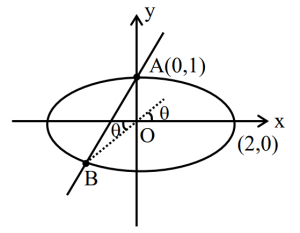
0 likes
View Solution747
DifficultMCQ
Let $x = 9$ be a directrix of an ellipse $E$,whose centre is at the origin and eccentricity is $1/3$. Let $P(\alpha, 0), \alpha > 0$,be a focus of $E$ and $AB$ be a chord passing through $P$. Then the locus of the mid point of $AB$ is :
A
$9y^2 = 8x(1 - x)$
B
$3y^2 = 4x(1 - x)$
C
$9y^2 = 8x(x - 1)$
D
$3y^2 = 4x(x - 1)$
Solution
(A) Given the directrix $x = a/e = 9$ and eccentricity $e = 1/3$,we find $a = 9 \times (1/3) = 3$.
The focus $P$ is at $(ae, 0) = (3 \times 1/3, 0) = (1, 0)$,so $\alpha = 1$.
The equation of the ellipse is $x^2/a^2 + y^2/b^2 = 1$,where $b^2 = a^2(1 - e^2) = 9(1 - 1/9) = 8$.
Thus,the ellipse is $x^2/9 + y^2/8 = 1$.
The locus of the midpoint $(h, k)$ of a chord passing through a point $(x_0, y_0)$ for an ellipse $x^2/a^2 + y^2/b^2 = 1$ is given by $T = S_1$,which is $xh/a^2 + yk/b^2 = h^2/a^2 + k^2/b^2$.
Since the chord passes through $(1, 0)$,the equation of the chord with midpoint $(h, k)$ is $xh/9 + yk/8 = h^2/9 + k^2/8$.
Substituting $(x, y) = (1, 0)$ into this equation,we get $h/9 = h^2/9 + k^2/8$.
Multiplying by $72$,we get $8h = 8h^2 + 9k^2$,which simplifies to $9k^2 = 8h(1 - h)$.
Replacing $(h, k)$ with $(x, y)$,the locus is $9y^2 = 8x(1 - x)$.
The focus $P$ is at $(ae, 0) = (3 \times 1/3, 0) = (1, 0)$,so $\alpha = 1$.
The equation of the ellipse is $x^2/a^2 + y^2/b^2 = 1$,where $b^2 = a^2(1 - e^2) = 9(1 - 1/9) = 8$.
Thus,the ellipse is $x^2/9 + y^2/8 = 1$.
The locus of the midpoint $(h, k)$ of a chord passing through a point $(x_0, y_0)$ for an ellipse $x^2/a^2 + y^2/b^2 = 1$ is given by $T = S_1$,which is $xh/a^2 + yk/b^2 = h^2/a^2 + k^2/b^2$.
Since the chord passes through $(1, 0)$,the equation of the chord with midpoint $(h, k)$ is $xh/9 + yk/8 = h^2/9 + k^2/8$.
Substituting $(x, y) = (1, 0)$ into this equation,we get $h/9 = h^2/9 + k^2/8$.
Multiplying by $72$,we get $8h = 8h^2 + 9k^2$,which simplifies to $9k^2 = 8h(1 - h)$.
Replacing $(h, k)$ with $(x, y)$,the locus is $9y^2 = 8x(1 - x)$.
0 likes
View Solution10-2. Parabola, Ellipse, Hyperbola — Ellipse · Frequently Asked Questions
1Are these 10-2. Parabola, Ellipse, Hyperbola questions useful for JEE and NEET?
Yes. All questions in this section are mapped to JEE Main and NEET exam patterns. Previous year questions from JEE Main, NEET, GUJCET and state-level exams are included with full solutions.
2Can I switch to Hindi or Gujarati for these questions?
Yes. Use the language tabs in the hero section or the sidebar to view the same questions and solutions in English, Hindi or Gujarati.
3How do I generate a question paper from this subtopic?
Use the Vedclass Exam Paper Generator — select the chapter and subtopic, set difficulty, and generate Sets A, B, C, D automatically. First 3 chapters of every subject are free.
Vedclass Products
For Students
Vedclass Test Series
Mock tests in real JEE/NEET style with performance analysis. 5-day free trial.
Start Free TrialFor Teachers
Exam Paper Generator
Generate Set A/B/C/D papers from this chapter in 2 minutes. 3 chapters free.
Try FreeFor Institutes
Online Exam Module
Live online exams with unlimited students, 360° analytics & white-label branding.
See DemoFor Teachers & Institutes
Generate a 10-2. Parabola, Ellipse, Hyperbola Exam Paper in 2 Minutes
Select subtopic & difficulty — Sets A, B, C, D auto-generated with No Repeat logic.
First 3 chapters of every subject are free — no payment required.