
A English
Alkaline earth metals Questions in English
Class 11 Chemistry · s-Block Elements · Alkaline earth metals
592+
Questions
English
Language
100%
With Solutions
Showing 50 of 592 questions in English
401
Medium
Give a brief note on the oxides of alkaline earth metal elements.
Solution
(N/A) The alkaline earth metals burn in oxygen to form the monoxide,$MO$,which,except for $BeO$,have a rock-salt structure.
The $BeO$ is essentially covalent in nature. The enthalpies of formation of these oxides are quite high,and consequently,they are very stable to heat.
$BeO$ is amphoteric,while the oxides of other elements are ionic in nature.
The $BeO$ is essentially covalent in nature. The enthalpies of formation of these oxides are quite high,and consequently,they are very stable to heat.
$BeO$ is amphoteric,while the oxides of other elements are ionic in nature.
0 likes
View Solution402
Medium
Explain how to obtain hydroxides of alkaline earth metal elements. Also,discuss the properties of these hydroxides.
Solution
(N/A) The hydroxides of alkaline earth metals are obtained by the reaction of their oxides with water:
$MO + H_2O \rightarrow M(OH)_2$
Properties of these hydroxides:
$1$. The solubility,thermal stability,and basic character of these hydroxides increase down the group from $Mg(OH)_2$ to $Ba(OH)_2$.
$2$. Alkaline earth metal hydroxides are less basic and less stable than alkali metal hydroxides.
$3$. $Be(OH)_2$ is amphoteric in nature,reacting with both acids and bases:
- With bases: $Be(OH)_2 + 2OH^{-} \rightarrow [Be(OH)_4]^{2-}$ (Beryllate ion)
- With acids: $Be(OH)_2 + 2HCl + 2H_2O \rightarrow [Be(H_2O)_4]Cl_2$
$MO + H_2O \rightarrow M(OH)_2$
Properties of these hydroxides:
$1$. The solubility,thermal stability,and basic character of these hydroxides increase down the group from $Mg(OH)_2$ to $Ba(OH)_2$.
$2$. Alkaline earth metal hydroxides are less basic and less stable than alkali metal hydroxides.
$3$. $Be(OH)_2$ is amphoteric in nature,reacting with both acids and bases:
- With bases: $Be(OH)_2 + 2OH^{-} \rightarrow [Be(OH)_4]^{2-}$ (Beryllate ion)
- With acids: $Be(OH)_2 + 2HCl + 2H_2O \rightarrow [Be(H_2O)_4]Cl_2$
0 likes
View Solution403
Medium
Write a note on halides of alkaline earth metal elements.
Solution
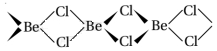
(N/A) Except for beryllium halides,all other halides of alkaline earth metals are ionic in nature. Beryllium halides are essentially covalent and soluble in organic solvents. Beryllium chloride has a chain structure in the solid state as shown below:
In the vapour phase $BeCl_{2}$ tends to form a chloro-bridged dimer which dissociates into the linear monomer at high temperatures of the order of $1200 \ K$.
The tendency to form halide hydrates gradually decreases (for example,$MgCl_{2} \cdot 8 H_{2} O$,$CaCl_{2} \cdot 6 H_{2} O$,$SrCl_{2} \cdot 6 H_{2} O$,$BaCl_{2} \cdot 2 H_{2} O$) down the group.
The dehydration of hydrated chlorides,bromides and iodides of $Ca$,$Sr$ and $Ba$ can be achieved on heating; however,the corresponding hydrated halides of $Be$ and $Mg$ on heating suffer hydrolysis. The fluorides are relatively less soluble than the chlorides owing to their high lattice energies.
In the vapour phase $BeCl_{2}$ tends to form a chloro-bridged dimer which dissociates into the linear monomer at high temperatures of the order of $1200 \ K$.
The tendency to form halide hydrates gradually decreases (for example,$MgCl_{2} \cdot 8 H_{2} O$,$CaCl_{2} \cdot 6 H_{2} O$,$SrCl_{2} \cdot 6 H_{2} O$,$BaCl_{2} \cdot 2 H_{2} O$) down the group.
The dehydration of hydrated chlorides,bromides and iodides of $Ca$,$Sr$ and $Ba$ can be achieved on heating; however,the corresponding hydrated halides of $Be$ and $Mg$ on heating suffer hydrolysis. The fluorides are relatively less soluble than the chlorides owing to their high lattice energies.
0 likes
View Solution404
Difficult
Give a detailed explanation of the oxoacid salts of alkaline earth metal elements.
Solution
(A) Salts of oxoacids: The alkaline earth metals form various salts of oxoacids,including: $(a)$ Carbonates,$(b)$ Sulphates,and $(c)$ Nitrates.
$(a)$ Carbonates: Carbonates of alkaline earth metals are insoluble in water and can be precipitated by adding sodium or ammonium carbonate to a solution of their soluble salts. The solubility of these carbonates in water decreases as the atomic number of the metal ion increases. All carbonates decompose on heating to yield carbon dioxide and the metal oxide. $BeCO_{3}$ is unstable and must be stored in an atmosphere of $CO_{2}$. Thermal stability increases with increasing cationic size.
$(b)$ Sulphates: The sulphates of alkaline earth metals are white solids and are stable to heat. $BeSO_{4}$ and $MgSO_{4}$ are readily soluble in water,while solubility decreases from $CaSO_{4}$ to $BaSO_{4}$. The high hydration enthalpies of $Be^{2+}$ and $Mg^{2+}$ ions overcome the lattice enthalpy,making their sulphates soluble.
$(c)$ Nitrates: Nitrates are prepared by dissolving carbonates in dilute nitric acid. $Mg(NO_{3})_{2}$ crystallizes with six molecules of water,whereas $Ba(NO_{3})_{2}$ crystallizes as an anhydrous salt. This reflects a decreasing tendency to form hydrates as the cationic size increases and hydration enthalpy decreases. All nitrates decompose on heating to form the corresponding oxide: $2 M(NO_{3})_{2} \rightarrow 2 MO + 4 NO_{2} + O_{2}$ (where $M = Be, Mg, Ca, Sr, Ba$).
$(a)$ Carbonates: Carbonates of alkaline earth metals are insoluble in water and can be precipitated by adding sodium or ammonium carbonate to a solution of their soluble salts. The solubility of these carbonates in water decreases as the atomic number of the metal ion increases. All carbonates decompose on heating to yield carbon dioxide and the metal oxide. $BeCO_{3}$ is unstable and must be stored in an atmosphere of $CO_{2}$. Thermal stability increases with increasing cationic size.
$(b)$ Sulphates: The sulphates of alkaline earth metals are white solids and are stable to heat. $BeSO_{4}$ and $MgSO_{4}$ are readily soluble in water,while solubility decreases from $CaSO_{4}$ to $BaSO_{4}$. The high hydration enthalpies of $Be^{2+}$ and $Mg^{2+}$ ions overcome the lattice enthalpy,making their sulphates soluble.
$(c)$ Nitrates: Nitrates are prepared by dissolving carbonates in dilute nitric acid. $Mg(NO_{3})_{2}$ crystallizes with six molecules of water,whereas $Ba(NO_{3})_{2}$ crystallizes as an anhydrous salt. This reflects a decreasing tendency to form hydrates as the cationic size increases and hydration enthalpy decreases. All nitrates decompose on heating to form the corresponding oxide: $2 M(NO_{3})_{2} \rightarrow 2 MO + 4 NO_{2} + O_{2}$ (where $M = Be, Mg, Ca, Sr, Ba$).
0 likes
View Solution405
Difficult
Give a brief explanation of the carbonate,sulphate,and nitrate compounds of alkaline earth metal elements.
Solution
(N/A) Salts of Oxoacids: The alkaline earth metals form salts of oxoacids,including: $(a)$ Carbonates,$(b)$ Sulphates,and $(c)$ Nitrates.
$(a)$ Carbonates: Carbonates of alkaline earth metals are insoluble in water and are precipitated by adding sodium or ammonium carbonate to a solution of a soluble salt of these metals. The solubility of carbonates in water decreases as the atomic number of the metal ion increases. All carbonates decompose on heating to give carbon dioxide and the metal oxide. $BeCO_{3}$ is unstable and can only be stored in an atmosphere of $CO_{2}$. Thermal stability increases with increasing cationic size.
$(b)$ Sulphates: The sulphates of alkaline earth metals are white solids and are stable to heat. $BeSO_{4}$ and $MgSO_{4}$ are readily soluble in water; the solubility decreases from $CaSO_{4}$ to $BaSO_{4}$. The high hydration enthalpies of $Be^{2+}$ and $Mg^{2+}$ ions overcome the lattice enthalpy,making their sulphates soluble.
$(c)$ Nitrates: Nitrates are prepared by dissolving carbonates in dilute nitric acid. $Mg(NO_{3})_{2}$ crystallizes with six molecules of water,while $Ba(NO_{3})_{2}$ crystallizes as an anhydrous salt. This reflects a decreasing tendency to form hydrates with increasing size and decreasing hydration enthalpy. All nitrates decompose on heating to form the oxide: $2M(NO_{3})_{2} \rightarrow 2MO + 4NO_{2} + O_{2}$ (where $M = Be, Mg, Ca, Sr, Ba$).
$(a)$ Carbonates: Carbonates of alkaline earth metals are insoluble in water and are precipitated by adding sodium or ammonium carbonate to a solution of a soluble salt of these metals. The solubility of carbonates in water decreases as the atomic number of the metal ion increases. All carbonates decompose on heating to give carbon dioxide and the metal oxide. $BeCO_{3}$ is unstable and can only be stored in an atmosphere of $CO_{2}$. Thermal stability increases with increasing cationic size.
$(b)$ Sulphates: The sulphates of alkaline earth metals are white solids and are stable to heat. $BeSO_{4}$ and $MgSO_{4}$ are readily soluble in water; the solubility decreases from $CaSO_{4}$ to $BaSO_{4}$. The high hydration enthalpies of $Be^{2+}$ and $Mg^{2+}$ ions overcome the lattice enthalpy,making their sulphates soluble.
$(c)$ Nitrates: Nitrates are prepared by dissolving carbonates in dilute nitric acid. $Mg(NO_{3})_{2}$ crystallizes with six molecules of water,while $Ba(NO_{3})_{2}$ crystallizes as an anhydrous salt. This reflects a decreasing tendency to form hydrates with increasing size and decreasing hydration enthalpy. All nitrates decompose on heating to form the oxide: $2M(NO_{3})_{2} \rightarrow 2MO + 4NO_{2} + O_{2}$ (where $M = Be, Mg, Ca, Sr, Ba$).
0 likes
View Solution406
Medium
How is beryllium anomalous from other alkaline earth metal elements?
Solution
(N/A) Beryllium,the first member of the Group-$2$ metals,shows anomalous behaviour compared to magnesium and the rest of the members. Further,it shows a diagonal relationship with aluminium.
$(i)$ Beryllium has exceptionally small atomic and ionic sizes and thus does not compare well with other members of the group. Because of its high ionisation enthalpy and small size,it forms compounds which are largely covalent and get easily hydrolysed.
$(ii)$ Beryllium does not exhibit a coordination number greater than four because its valence shell has only four orbitals. The remaining members of the group can have a coordination number of six by making use of $d$-orbitals.
$(iii)$ The oxide and hydroxide of beryllium,unlike the hydroxides of other elements in the group,are amphoteric in nature.
$(i)$ Beryllium has exceptionally small atomic and ionic sizes and thus does not compare well with other members of the group. Because of its high ionisation enthalpy and small size,it forms compounds which are largely covalent and get easily hydrolysed.
$(ii)$ Beryllium does not exhibit a coordination number greater than four because its valence shell has only four orbitals. The remaining members of the group can have a coordination number of six by making use of $d$-orbitals.
$(iii)$ The oxide and hydroxide of beryllium,unlike the hydroxides of other elements in the group,are amphoteric in nature.
0 likes
View Solution407
Medium
Explain the anomalous behavior of beryllium.
Solution
(N/A) Beryllium,the first member of the Group-$2$ metals,shows anomalous behavior compared to magnesium and the rest of the members. It also shows a diagonal relationship with aluminium.
$(i)$ Beryllium has an exceptionally small atomic and ionic size,which makes it distinct from other members of the group. Due to its high ionisation enthalpy and small size,it forms compounds that are largely covalent and easily hydrolysed.
$(ii)$ Beryllium does not exhibit a coordination number greater than four because its valence shell contains only four orbitals. Other members of the group can achieve a coordination number of six by utilizing $d$-orbitals.
$(iii)$ The oxide and hydroxide of beryllium are amphoteric in nature,unlike the hydroxides of other elements in the group,which are basic.
$(i)$ Beryllium has an exceptionally small atomic and ionic size,which makes it distinct from other members of the group. Due to its high ionisation enthalpy and small size,it forms compounds that are largely covalent and easily hydrolysed.
$(ii)$ Beryllium does not exhibit a coordination number greater than four because its valence shell contains only four orbitals. Other members of the group can achieve a coordination number of six by utilizing $d$-orbitals.
$(iii)$ The oxide and hydroxide of beryllium are amphoteric in nature,unlike the hydroxides of other elements in the group,which are basic.
0 likes
View Solution408
Medium
Write a note on: anomalous behavior of beryllium compared to other alkaline earth metal elements.
Solution
(N/A) Beryllium,the first member of the Group-$2$ metals,shows anomalous behavior compared to magnesium and the rest of the members. Further,it shows a diagonal relationship with aluminium.
$(i)$ Beryllium has exceptionally small atomic and ionic sizes and thus does not compare well with other members of the group. Because of high ionisation enthalpy and small size,it forms compounds which are largely covalent and get easily hydrolysed.
$(ii)$ Beryllium does not exhibit a coordination number greater than four as its valence shell has only four orbitals. The remaining members of the group can have a coordination number of six by making use of $d$-orbitals.
$(iii)$ The oxide and hydroxide of beryllium,unlike the hydroxides of other elements in the group,are amphoteric in nature.
$(i)$ Beryllium has exceptionally small atomic and ionic sizes and thus does not compare well with other members of the group. Because of high ionisation enthalpy and small size,it forms compounds which are largely covalent and get easily hydrolysed.
$(ii)$ Beryllium does not exhibit a coordination number greater than four as its valence shell has only four orbitals. The remaining members of the group can have a coordination number of six by making use of $d$-orbitals.
$(iii)$ The oxide and hydroxide of beryllium,unlike the hydroxides of other elements in the group,are amphoteric in nature.
0 likes
View Solution409
Medium
Compare the properties of beryllium with other alkaline earth metal elements.
Solution
(N/A) Beryllium,the first member of the Group-$2$ metals,shows anomalous behaviour compared to magnesium and the rest of the members. Further,it shows a diagonal relationship with aluminium.
$(i)$ Beryllium has exceptionally small atomic and ionic sizes and thus does not compare well with other members of the group. Because of high ionisation enthalpy and small size,it forms compounds which are largely covalent and get easily hydrolysed.
$(ii)$ Beryllium does not exhibit a coordination number greater than four as its valence shell has only four orbitals. The remaining members of the group can have a coordination number of six by making use of $d$-orbitals.
$(iii)$ The oxide and hydroxide of beryllium,unlike the hydroxides of other elements in the group,are amphoteric in nature.
$(i)$ Beryllium has exceptionally small atomic and ionic sizes and thus does not compare well with other members of the group. Because of high ionisation enthalpy and small size,it forms compounds which are largely covalent and get easily hydrolysed.
$(ii)$ Beryllium does not exhibit a coordination number greater than four as its valence shell has only four orbitals. The remaining members of the group can have a coordination number of six by making use of $d$-orbitals.
$(iii)$ The oxide and hydroxide of beryllium,unlike the hydroxides of other elements in the group,are amphoteric in nature.
0 likes
View Solution410
Medium
Discuss the diagonal relationship between beryllium and aluminum metals.
Solution
(N/A) The ionic radius of $Be^{2+}$ is estimated to be $31 \text{ pm}$; the charge/radius ratio is nearly the same as that of the $Al^{3+}$ ion. Hence, beryllium resembles aluminum in some ways. Some of the similarities are:
$(i)$ Like aluminum, beryllium is not readily attacked by acids because of the presence of an oxide film on the surface of the metal.
$(ii)$ Beryllium hydroxide dissolves in excess of alkali to give a beryllate ion, $[Be(OH)_{4}]^{2-}$, just as aluminum hydroxide gives an aluminate ion, $[Al(OH)_{4}]^{-}$.
$(iii)$ The chlorides of both beryllium and aluminum have $Cl^{-}$ bridged chloride structures in the vapor phase. Both chlorides are soluble in organic solvents and are strong Lewis acids. They are used as Friedel-Crafts catalysts.
$(iv)$ Beryllium and aluminum ions have a strong tendency to form complexes like $[BeF_{4}]^{2-}$ and $[AlF_{6}]^{3-}$.
$(i)$ Like aluminum, beryllium is not readily attacked by acids because of the presence of an oxide film on the surface of the metal.
$(ii)$ Beryllium hydroxide dissolves in excess of alkali to give a beryllate ion, $[Be(OH)_{4}]^{2-}$, just as aluminum hydroxide gives an aluminate ion, $[Al(OH)_{4}]^{-}$.
$(iii)$ The chlorides of both beryllium and aluminum have $Cl^{-}$ bridged chloride structures in the vapor phase. Both chlorides are soluble in organic solvents and are strong Lewis acids. They are used as Friedel-Crafts catalysts.
$(iv)$ Beryllium and aluminum ions have a strong tendency to form complexes like $[BeF_{4}]^{2-}$ and $[AlF_{6}]^{3-}$.
0 likes
View Solution411
Medium
Give similarities between beryllium and aluminum metal.
Solution
(N/A) The ionic radius of $Be^{2+}$ is estimated to be $31 \ pm$; the charge/radius ratio is nearly the same as that of the $Al^{3+}$ ion. Hence,beryllium resembles aluminium in some ways. Some of the similarities are:
$(i)$ Like aluminium,beryllium is not readily attacked by acids because of the presence of an oxide film on the surface of the metal.
$(ii)$ Beryllium hydroxide dissolves in excess of alkali to give a beryllate ion,$[Be(OH)_{4}]^{2-}$,just as aluminium hydroxide gives an aluminate ion,$[Al(OH)_{4}]^{-}$.
$(iii)$ The chlorides of both beryllium and aluminium have $Cl^{-}$ bridged chloride structures in the vapour phase. Both the chlorides are soluble in organic solvents and are strong Lewis acids. They are used as Friedel-Crafts catalysts.
$(iv)$ Beryllium and aluminium ions have a strong tendency to form complexes like $[BeF_{4}]^{2-}$ and $[AlF_{6}]^{3-}$.
$(i)$ Like aluminium,beryllium is not readily attacked by acids because of the presence of an oxide film on the surface of the metal.
$(ii)$ Beryllium hydroxide dissolves in excess of alkali to give a beryllate ion,$[Be(OH)_{4}]^{2-}$,just as aluminium hydroxide gives an aluminate ion,$[Al(OH)_{4}]^{-}$.
$(iii)$ The chlorides of both beryllium and aluminium have $Cl^{-}$ bridged chloride structures in the vapour phase. Both the chlorides are soluble in organic solvents and are strong Lewis acids. They are used as Friedel-Crafts catalysts.
$(iv)$ Beryllium and aluminium ions have a strong tendency to form complexes like $[BeF_{4}]^{2-}$ and $[AlF_{6}]^{3-}$.
0 likes
View Solution412
Difficult
Give the preparation,properties,and uses of calcium oxide or quick lime $(CaO)$.
Solution
(N/A) Preparation: It is prepared on a commercial scale by heating limestone $(CaCO_{3})$ in a rotary kiln at $1070-1270 \ K$.
$CaCO_{3} \xrightarrow{\text{heat}} CaO + CO_{2}$
The carbon dioxide is removed as soon as it is produced to enable the reaction to proceed to completion.
Properties: Calcium oxide is a white amorphous solid. It has a melting point of $2870 \ K$. On exposure to the atmosphere,it absorbs moisture and carbon dioxide.
$CaO + H_{2}O \rightarrow Ca(OH)_{2}$
$CaO + CO_{2} \rightarrow CaCO_{3}$
The addition of a limited amount of water breaks the lump of lime. This process is called slaking of lime. Quick lime slaked with soda gives solid soda lime. Being a basic oxide,it combines with acidic oxides at high temperatures.
$CaO + SiO_{2} \rightarrow CaSiO_{3}$
$6CaO + P_{4}O_{10} \rightarrow 2Ca_{3}(PO_{4})_{2}$
Uses: $(i)$ It is an important primary material for manufacturing cement and is the cheapest form of alkali. $(ii)$ It is used in the manufacture of sodium carbonate from caustic soda. $(iii)$ It is employed in the purification of sugar and in the manufacture of dye stuffs.
$CaCO_{3} \xrightarrow{\text{heat}} CaO + CO_{2}$
The carbon dioxide is removed as soon as it is produced to enable the reaction to proceed to completion.
Properties: Calcium oxide is a white amorphous solid. It has a melting point of $2870 \ K$. On exposure to the atmosphere,it absorbs moisture and carbon dioxide.
$CaO + H_{2}O \rightarrow Ca(OH)_{2}$
$CaO + CO_{2} \rightarrow CaCO_{3}$
The addition of a limited amount of water breaks the lump of lime. This process is called slaking of lime. Quick lime slaked with soda gives solid soda lime. Being a basic oxide,it combines with acidic oxides at high temperatures.
$CaO + SiO_{2} \rightarrow CaSiO_{3}$
$6CaO + P_{4}O_{10} \rightarrow 2Ca_{3}(PO_{4})_{2}$
Uses: $(i)$ It is an important primary material for manufacturing cement and is the cheapest form of alkali. $(ii)$ It is used in the manufacture of sodium carbonate from caustic soda. $(iii)$ It is employed in the purification of sugar and in the manufacture of dye stuffs.
0 likes
View Solution413
Medium
Give the preparation,properties,and uses of Calcium Hydroxide (Slaked lime) $[Ca(OH)_2]$.
Solution
(N/A) Preparation: Calcium hydroxide is prepared by adding water to quick lime,$CaO$.
$CaO + H_2O \rightarrow Ca(OH)_2$
Properties: It is a white amorphous powder. It is sparingly soluble in water. The aqueous solution is known as lime water,and a suspension of slaked lime in water is known as milk of lime. When carbon dioxide is passed through lime water,it turns milky due to the formation of calcium carbonate.
$Ca(OH)_2 + CO_2 \rightarrow CaCO_3 + H_2O$
On passing an excess of carbon dioxide,the precipitate dissolves to form calcium hydrogen carbonate.
$CaCO_3 + CO_2 + H_2O \rightarrow Ca(HCO_3)_2$
Milk of lime reacts with chlorine to form hypochlorite,a constituent of bleaching powder:
$2Ca(OH)_2 + 2Cl_2 \rightarrow CaCl_2 + Ca(OCl)_2 + 2H_2O$
Uses: $(i)$ It is used in the preparation of mortar,a building material. $(ii)$ It is used in white washing due to its disinfectant nature. $(iii)$ It is used in glass making,in the tanning industry,for the preparation of bleaching powder,and for the purification of sugar.
$CaO + H_2O \rightarrow Ca(OH)_2$
Properties: It is a white amorphous powder. It is sparingly soluble in water. The aqueous solution is known as lime water,and a suspension of slaked lime in water is known as milk of lime. When carbon dioxide is passed through lime water,it turns milky due to the formation of calcium carbonate.
$Ca(OH)_2 + CO_2 \rightarrow CaCO_3 + H_2O$
On passing an excess of carbon dioxide,the precipitate dissolves to form calcium hydrogen carbonate.
$CaCO_3 + CO_2 + H_2O \rightarrow Ca(HCO_3)_2$
Milk of lime reacts with chlorine to form hypochlorite,a constituent of bleaching powder:
$2Ca(OH)_2 + 2Cl_2 \rightarrow CaCl_2 + Ca(OCl)_2 + 2H_2O$
Uses: $(i)$ It is used in the preparation of mortar,a building material. $(ii)$ It is used in white washing due to its disinfectant nature. $(iii)$ It is used in glass making,in the tanning industry,for the preparation of bleaching powder,and for the purification of sugar.
0 likes
View Solution414
Difficult
Write the preparation,properties,and uses of calcium carbonate $(CaCO_3)$.
Solution
(N/A) Preparation: Calcium carbonate occurs in nature in several forms like limestone,chalk,and marble. It can be prepared by passing carbon dioxide through slaked lime or by the addition of sodium carbonate to calcium chloride.
$Ca(OH)_2 + CO_2 \rightarrow CaCO_3 + H_2O$
$CaCl_2 + Na_2CO_3 \rightarrow CaCO_3 + 2NaCl$
Excess of $CO_2$ leads to the formation of water-soluble calcium hydrogen carbonate.
Properties: It is a white fluffy powder and is almost insoluble in water. When heated to $1200 \ K$,it decomposes to evolve $CO_2$.
$CaCO_3 \xrightarrow{1200 \ K} CaO + CO_2$
It reacts with dilute acids to liberate carbon dioxide.
$CaCO_3 + 2HCl \rightarrow CaCl_2 + H_2O + CO_2$
$CaCO_3 + H_2SO_4 \rightarrow CaSO_4 + H_2O + CO_2$
Uses: $(i)$ It is used as a building material in the form of marble and in the manufacture of quick lime. (ii) $A$ mixture of $CaCO_3$ and $MgCO_3$ is used as a flux in the extraction of metals such as iron. (iii) Specially precipitated $CaCO_3$ is extensively used in the manufacture of high-quality paper. (iv) It is also used as an antacid,mild abrasive in tooth-paste,a constituent of chewing gum,and a filler in cosmetics.
$Ca(OH)_2 + CO_2 \rightarrow CaCO_3 + H_2O$
$CaCl_2 + Na_2CO_3 \rightarrow CaCO_3 + 2NaCl$
Excess of $CO_2$ leads to the formation of water-soluble calcium hydrogen carbonate.
Properties: It is a white fluffy powder and is almost insoluble in water. When heated to $1200 \ K$,it decomposes to evolve $CO_2$.
$CaCO_3 \xrightarrow{1200 \ K} CaO + CO_2$
It reacts with dilute acids to liberate carbon dioxide.
$CaCO_3 + 2HCl \rightarrow CaCl_2 + H_2O + CO_2$
$CaCO_3 + H_2SO_4 \rightarrow CaSO_4 + H_2O + CO_2$
Uses: $(i)$ It is used as a building material in the form of marble and in the manufacture of quick lime. (ii) $A$ mixture of $CaCO_3$ and $MgCO_3$ is used as a flux in the extraction of metals such as iron. (iii) Specially precipitated $CaCO_3$ is extensively used in the manufacture of high-quality paper. (iv) It is also used as an antacid,mild abrasive in tooth-paste,a constituent of chewing gum,and a filler in cosmetics.
0 likes
View Solution415
Difficult
Write down the preparation,properties,and uses of Calcium sulphate $(CaSO_{4} \cdot \frac{1}{2} H_{2} O)$ (Plaster of Paris).
Solution
(N/A) Preparation: It is a hemihydrate of calcium sulphate. It is obtained when gypsum $(CaSO_{4} \cdot 2 H_{2} O)$ is heated to $393 \ K$.
$2(CaSO_{4} \cdot 2 H_{2} O) \rightarrow 2(CaSO_{4}) \cdot H_{2} O + 3 H_{2} O$
Above $393 \ K$,no water of crystallisation is left and anhydrous calcium sulphate $(CaSO_{4})$ is formed. This is known as 'dead burnt plaster'.
Properties: It has a remarkable property of setting with water. On mixing with an adequate quantity of water,it forms a plastic mass that sets into a hard solid in $5$ to $15$ minutes.
Uses: $(i)$ The largest use of Plaster of Paris is in the building industry as well as in plasters. $(ii)$ It is used for immobilising the affected part of an organ where there is a bone fracture or sprain. $(iii)$ It is also employed in dentistry,in ornamental work,and for making casts of statues and busts.
$2(CaSO_{4} \cdot 2 H_{2} O) \rightarrow 2(CaSO_{4}) \cdot H_{2} O + 3 H_{2} O$
Above $393 \ K$,no water of crystallisation is left and anhydrous calcium sulphate $(CaSO_{4})$ is formed. This is known as 'dead burnt plaster'.
Properties: It has a remarkable property of setting with water. On mixing with an adequate quantity of water,it forms a plastic mass that sets into a hard solid in $5$ to $15$ minutes.
Uses: $(i)$ The largest use of Plaster of Paris is in the building industry as well as in plasters. $(ii)$ It is used for immobilising the affected part of an organ where there is a bone fracture or sprain. $(iii)$ It is also employed in dentistry,in ornamental work,and for making casts of statues and busts.
0 likes
View Solution416
Medium
What happens when:
$(i)$ Magnesium is burnt in air
$(ii)$ Quick lime is heated with silica
$(iii)$ Chlorine reacts with slaked lime
$(iv)$ Calcium nitrate is heated?
$(i)$ Magnesium is burnt in air
$(ii)$ Quick lime is heated with silica
$(iii)$ Chlorine reacts with slaked lime
$(iv)$ Calcium nitrate is heated?
Solution
$(i)$ Magnesium burns in air with a dazzling light to form $MgO$ and $Mg_{3}N_{2}$.
$2Mg + O_{2} \xrightarrow{\Delta} 2MgO$
$3Mg + N_{2} \xrightarrow{\Delta} Mg_{3}N_{2}$
$(ii)$ Quick lime $(CaO)$ combines with silica $(SiO_{2})$ to form calcium silicate (slag).
$CaO + SiO_{2} \xrightarrow{\Delta} CaSiO_{3}$
$(iii)$ When chlorine is added to slaked lime,it gives bleaching powder.
$Ca(OH)_{2} + Cl_{2} \longrightarrow CaOCl_{2} + H_{2}O$
$(iv)$ Calcium nitrate,on heating,decomposes to give calcium oxide,nitrogen dioxide,and oxygen.
$2Ca(NO_{3})_{2(s)} \xrightarrow{\Delta} 2CaO_{(s)} + 4NO_{2(g)} + O_{2(g)}$
$2Mg + O_{2} \xrightarrow{\Delta} 2MgO$
$3Mg + N_{2} \xrightarrow{\Delta} Mg_{3}N_{2}$
$(ii)$ Quick lime $(CaO)$ combines with silica $(SiO_{2})$ to form calcium silicate (slag).
$CaO + SiO_{2} \xrightarrow{\Delta} CaSiO_{3}$
$(iii)$ When chlorine is added to slaked lime,it gives bleaching powder.
$Ca(OH)_{2} + Cl_{2} \longrightarrow CaOCl_{2} + H_{2}O$
$(iv)$ Calcium nitrate,on heating,decomposes to give calcium oxide,nitrogen dioxide,and oxygen.
$2Ca(NO_{3})_{2(s)} \xrightarrow{\Delta} 2CaO_{(s)} + 4NO_{2(g)} + O_{2(g)}$
0 likes
View Solution417
Medium
What is the basic composition and origin of cement?
Solution
(N/A) Cement is an important building material. It was first introduced in England in $1824$ by Joseph Aspdin.
It is commonly called Portland cement because it resembles the natural limestone quarried in the Isle of Portland,England.
Cement is a product obtained by combining a material rich in lime $(CaO)$ with other materials such as clay,which contains silica $(SiO_{2})$ along with the oxides of aluminium,iron,and magnesium.
It is commonly called Portland cement because it resembles the natural limestone quarried in the Isle of Portland,England.
Cement is a product obtained by combining a material rich in lime $(CaO)$ with other materials such as clay,which contains silica $(SiO_{2})$ along with the oxides of aluminium,iron,and magnesium.
0 likes
View Solution418
Medium
Give the biological importance of calcium and magnesium.
Solution
(N/A) An adult body contains about $25 \ g$ of $Mg$ and $1200 \ g$ of $Ca$,compared with only $5 \ g$ of iron and $0.06 \ g$ of copper. The daily requirement in the human body is estimated to be $200-300 \ mg$.
All enzymes that utilize $ATP$ in phosphate transfer require magnesium as a cofactor. The main pigment for the absorption of light in plants is chlorophyll,which contains magnesium. About $99 \%$ of body calcium is present in bones and teeth. It also plays important roles in neuromuscular function,interneuronal transmission,cell membrane integrity,and blood coagulation.
The calcium concentration in plasma is regulated at about $100 \ mg \ L^{-1}$. It is maintained by two hormones: calcitonin and parathyroid hormone.
Bone is not an inert and unchanging substance but is continuously being solubilized and redeposited to the extent of $400 \ mg$ per day in humans. All this calcium passes through the plasma.
All enzymes that utilize $ATP$ in phosphate transfer require magnesium as a cofactor. The main pigment for the absorption of light in plants is chlorophyll,which contains magnesium. About $99 \%$ of body calcium is present in bones and teeth. It also plays important roles in neuromuscular function,interneuronal transmission,cell membrane integrity,and blood coagulation.
The calcium concentration in plasma is regulated at about $100 \ mg \ L^{-1}$. It is maintained by two hormones: calcitonin and parathyroid hormone.
Bone is not an inert and unchanging substance but is continuously being solubilized and redeposited to the extent of $400 \ mg$ per day in humans. All this calcium passes through the plasma.
0 likes
View Solution419
MediumMCQ
Which one of the alkaline earth metal carbonates is thermally the most stable?
$MgCO_{3}, CaCO_{3}, SrCO_{3}, BaCO_{3}$
$MgCO_{3}, CaCO_{3}, SrCO_{3}, BaCO_{3}$
A
$MgCO_{3}$
B
$CaCO_{3}$
C
$SrCO_{3}$
D
$BaCO_{3}$
Solution
(D) Thermal stability of alkaline earth metal carbonates increases as the size of the cation increases.
The ionic radii of the alkaline earth metal cations follow the order: $Mg^{2+} < Ca^{2+} < Sr^{2+} < Ba^{2+}$.
Therefore,the thermal stability increases in the order: $MgCO_{3} < CaCO_{3} < SrCO_{3} < BaCO_{3}$.
Thus,$BaCO_{3}$ is the most thermally stable carbonate.
The ionic radii of the alkaline earth metal cations follow the order: $Mg^{2+} < Ca^{2+} < Sr^{2+} < Ba^{2+}$.
Therefore,the thermal stability increases in the order: $MgCO_{3} < CaCO_{3} < SrCO_{3} < BaCO_{3}$.
Thus,$BaCO_{3}$ is the most thermally stable carbonate.
0 likes
View Solution420
Medium
$Beryllium$ and $magnesium$ do not give colour to flame whereas other alkaline earth metals do so. Why?
Solution
(N/A) When an alkaline earth metal is heated,the valence electrons get excited to a higher energy level.
When this excited electron returns to its ground state,it releases energy in the form of light.
If this energy corresponds to the visible region of the electromagnetic spectrum,a characteristic colour is observed.
In $Be$ and $Mg$ atoms,the valence electrons are very strongly bound to the nucleus due to their small size and high ionization enthalpy.
The energy required to excite these electrons to a higher energy level is very high,which is not available in a standard Bunsen flame.
Consequently,the energy released upon their return to the ground state does not fall within the visible region,and thus,no colour is observed in the flame.
When this excited electron returns to its ground state,it releases energy in the form of light.
If this energy corresponds to the visible region of the electromagnetic spectrum,a characteristic colour is observed.
In $Be$ and $Mg$ atoms,the valence electrons are very strongly bound to the nucleus due to their small size and high ionization enthalpy.
The energy required to excite these electrons to a higher energy level is very high,which is not available in a standard Bunsen flame.
Consequently,the energy released upon their return to the ground state does not fall within the visible region,and thus,no colour is observed in the flame.
0 likes
View Solution421
EasyMCQ
Why are the elements of group-$2$ known as alkaline earth metals?
A
They are found in the earth's crust and their oxides are acidic.
B
They are found in the earth's crust and their oxides/hydroxides are alkaline.
C
They are found in the atmosphere and their oxides are basic.
D
They are found in the earth's core and their hydroxides are neutral.
Solution
(B) The elements of group-$2$ are known as alkaline earth metals because their oxides and hydroxides are alkaline in nature.
Furthermore,these metal oxides are widely found in the earth's crust.
Furthermore,these metal oxides are widely found in the earth's crust.
0 likes
View Solution422
Medium
Match column-$I$ with column-$II$ :
| Column-$I$ | Column-$II$ |
| $(a)$ Calcium | $(p)$ Crimson red |
| $(b)$ Barium | $(q)$ Brick red |
| $(c)$ Strontium | $(r)$ Apple green |
| - | $(s)$ Yellow |
Solution
(A) The flame test colors for alkaline earth metals are as follows:
$(a)$ Calcium $(Ca)$ imparts a brick red color to the flame.
$(b)$ Barium $(Ba)$ imparts an apple green color to the flame.
$(c)$ Strontium $(Sr)$ imparts a crimson red color to the flame.
Therefore,the correct matching is: $a-q, b-r, c-p$.
$(a)$ Calcium $(Ca)$ imparts a brick red color to the flame.
$(b)$ Barium $(Ba)$ imparts an apple green color to the flame.
$(c)$ Strontium $(Sr)$ imparts a crimson red color to the flame.
Therefore,the correct matching is: $a-q, b-r, c-p$.
0 likes
View Solution423
Medium
Match Column $(A)$ with the appropriate options in Column $(B)$.
| Column $(A)$ | Column $(B)$ |
| $(a)$ $BeO$ | $(p)$ Amphoteric |
| $(b)$ $MgCO_3 \cdot CaCO_3$ | $(q)$ Dolomite |
| $(c)$ $BeCl_2$ | $(r)$ Covalent |
| $(d)$ $Al(OH)_3$ | $(s)$ Basic |
Solution
(A) $(a)-(p, s), (b)-(q), (c)-(r), (d)-(p)$
$1$. $BeO$ is amphoteric and basic in nature.
$2$. $MgCO_3 \cdot CaCO_3$ is known as Dolomite.
$3$. $BeCl_2$ is a covalent compound due to the small size and high polarizing power of $Be^{2+}$ ion.
$4$. $Al(OH)_3$ is amphoteric in nature.
$1$. $BeO$ is amphoteric and basic in nature.
$2$. $MgCO_3 \cdot CaCO_3$ is known as Dolomite.
$3$. $BeCl_2$ is a covalent compound due to the small size and high polarizing power of $Be^{2+}$ ion.
$4$. $Al(OH)_3$ is amphoteric in nature.
0 likes
View Solution424
MediumMCQ
Match the following:
| Metal | Uses |
|---|---|
| $1. \text{Be}$ | $c. \text{To prepare windows of X-rays}$ |
| $2. \text{Ca}$ | $d. \text{To remove air from vacuumized tubes}$ |
| $3. \text{Mg}$ | $a. \text{To prepare Grignard reagent}$ |
A
$1-c, 2-d, 3-a$
B
$1-c, 2-a, 3-d$
C
$1-d, 2-c, 3-a$
D
$1-a, 2-d, 3-c$
Solution
(A) The correct matches are as follows:
$1. \text{Be (Beryllium)}$: Used to prepare windows of $X$-ray tubes because of its low atomic number and high transparency to $X$-rays $(1-c)$.
$2. \text{Ca (Calcium)}$: Used to remove air from vacuumized tubes as a getter $(2-d)$.
$3. \text{Mg (Magnesium)}$: Used to prepare Grignard reagents $(R-Mg-X)$ $(3-a)$.
Therefore,the correct sequence is $1-c, 2-d, 3-a$.
$1. \text{Be (Beryllium)}$: Used to prepare windows of $X$-ray tubes because of its low atomic number and high transparency to $X$-rays $(1-c)$.
$2. \text{Ca (Calcium)}$: Used to remove air from vacuumized tubes as a getter $(2-d)$.
$3. \text{Mg (Magnesium)}$: Used to prepare Grignard reagents $(R-Mg-X)$ $(3-a)$.
Therefore,the correct sequence is $1-c, 2-d, 3-a$.
0 likes
View Solution425
EasyMCQ
Complete the following equation: $CaCO_3 \cdot MgCO_{3(s)} \xrightarrow{\Delta }$
A
$CaO + MgO + 2CO_2$
B
$CaCO_3 + MgO + CO_2$
C
$CaO + MgCO_3 + CO_2$
D
$Ca + Mg + 2CO_2 + 2O_2$
Solution
(A) The given compound is dolomite,$CaCO_3 \cdot MgCO_3$.
Upon heating (calcination),both carbonates decompose to form their respective oxides and release carbon dioxide gas.
The balanced chemical equation is:
$CaCO_3 \cdot MgCO_{3(s)} \xrightarrow{\Delta } CaO_{(s)} + MgO_{(s)} + 2CO_{2(g)}$
Upon heating (calcination),both carbonates decompose to form their respective oxides and release carbon dioxide gas.
The balanced chemical equation is:
$CaCO_3 \cdot MgCO_{3(s)} \xrightarrow{\Delta } CaO_{(s)} + MgO_{(s)} + 2CO_{2(g)}$
0 likes
View Solution426
Medium
Provide the chemical formulas for Gypsum,Epsom salt,and Barite.
Solution
(N/A) The chemical formulas are as follows:
$1$. Gypsum: $CaSO_4 \cdot 2H_2O$
$2$. Epsom salt: $MgSO_4 \cdot 7H_2O$
$3$. Barite: $BaSO_4$
$1$. Gypsum: $CaSO_4 \cdot 2H_2O$
$2$. Epsom salt: $MgSO_4 \cdot 7H_2O$
$3$. Barite: $BaSO_4$
0 likes
View Solution427
EasyMCQ
Give the name of group-$2$ elements.
A
Alkali metals
B
Alkaline earth metals
C
Halogens
D
Noble gases
Solution
(B) The group-$2$ elements are known as alkaline earth metals. These elements include beryllium $(Be)$,magnesium $(Mg)$,calcium $(Ca)$,strontium $(Sr)$,barium $(Ba)$,and radium $(Ra)$.
0 likes
View Solution428
Easy
Give two uses of beryllium and magnesium.
Solution
(N/A) Beryllium is used in the manufacture of alloys,particularly copper-beryllium alloys,which are used in the preparation of high-strength springs. It is also used in making windows for $X$-ray tubes.
Magnesium is used in flash powders and bulbs,incendiary bombs,and signals. $A$ suspension of magnesium hydroxide,$Mg(OH)_2$,in water (known as milk of magnesia) is used as an antacid in medicine.
Magnesium is used in flash powders and bulbs,incendiary bombs,and signals. $A$ suspension of magnesium hydroxide,$Mg(OH)_2$,in water (known as milk of magnesia) is used as an antacid in medicine.
0 likes
View Solution429
Easy
Why is beryllium amphoteric in nature?
Solution
(N/A) Beryllium exhibits amphoteric character because its oxide $(BeO)$ and hydroxide $(Be(OH)_2)$ can react with both acids and bases to form salts and water.
For example,it reacts with $HCl$ (acid) to form $BeCl_2$ and with $NaOH$ (base) to form sodium beryllate $(Na_2[Be(OH)_4])$.
For example,it reacts with $HCl$ (acid) to form $BeCl_2$ and with $NaOH$ (base) to form sodium beryllate $(Na_2[Be(OH)_4])$.
0 likes
View Solution430
Easy
List the important compounds of calcium.
Solution
(N/A) The important compounds of calcium are:
$1$. Calcium oxide $(CaO)$
$2$. Calcium hydroxide $(Ca(OH)_2)$
$3$. Calcium carbonate $(CaCO_3)$
$4$. Calcium sulphate $(CaSO_4 \cdot 2H_2O)$
$5$. Cement
$1$. Calcium oxide $(CaO)$
$2$. Calcium hydroxide $(Ca(OH)_2)$
$3$. Calcium carbonate $(CaCO_3)$
$4$. Calcium sulphate $(CaSO_4 \cdot 2H_2O)$
$5$. Cement
0 likes
View Solution431
Easy
What is slaking of lime?
Solution
(N/A) The addition of a limited amount of water to quicklime $(CaO)$ causes it to break into a powder,forming calcium hydroxide $(Ca(OH)_2)$. This process is known as slaking of lime. The chemical reaction is: $CaO(s) + H_2O(l) \rightarrow Ca(OH)_2(s)$.
0 likes
View Solution432
Easy
Give two uses of quick lime.
Solution
(N/A) $i$. It is an important primary material for manufacturing cement.
$ii$. It is employed in the purification of sugar and in the manufacture of dye stuffs.
$ii$. It is employed in the purification of sugar and in the manufacture of dye stuffs.
0 likes
View Solution433
EasyMCQ
How is calcium hydroxide prepared?
A
By heating calcium carbonate
B
By adding water to quick lime $(CaO)$
C
By reacting calcium with oxygen
D
By electrolysis of calcium chloride
Solution
(B) Calcium hydroxide,also known as slaked lime,is prepared by the addition of a limited amount of water to quick lime $(CaO)$.
This process is known as slaking of lime.
The chemical reaction is: $CaO(s) + H_2O(l) \rightarrow Ca(OH)_2(aq)$.
This process is known as slaking of lime.
The chemical reaction is: $CaO(s) + H_2O(l) \rightarrow Ca(OH)_2(aq)$.
0 likes
View Solution434
Easy
Give two uses of $Ca(OH)_2$.
Solution
(N/A) $(i)$ It is used in the preparation of mortar,a building material.
$(ii)$ It is used in the manufacture of sodium carbonate from caustic soda.
$(ii)$ It is used in the manufacture of sodium carbonate from caustic soda.
0 likes
View Solution435
Easy
Give two uses of $calcium \ carbonate$ $(CaCO_3)$?
Solution
(N/A) $Calcium \ carbonate$ $(CaCO_3)$ is used in the manufacture of high-quality paper. It is also used as an antacid in medicine to neutralize excess stomach acid.
0 likes
View Solution436
EasyMCQ
How is calcium sulphate obtained?
A
By heating limestone
B
By heating gypsum to $393 \ K$
C
By reacting calcium carbonate with sulphuric acid
D
By electrolysis of calcium chloride
Solution
(B) Calcium sulphate is obtained by heating gypsum,$CaSO_{4} \cdot 2H_{2}O$,to $393 \ K$.
The reaction is: $CaSO_{4} \cdot 2H_{2}O \xrightarrow{393 \ K} CaSO_{4} \cdot \frac{1}{2}H_{2}O + \frac{3}{2}H_{2}O$.
The reaction is: $CaSO_{4} \cdot 2H_{2}O \xrightarrow{393 \ K} CaSO_{4} \cdot \frac{1}{2}H_{2}O + \frac{3}{2}H_{2}O$.
0 likes
View Solution437
Easy
What is dead burnt plaster?
Solution
(N/A) Above $393 \ K$,no water of crystallization is left and anhydrous calcium sulphate,$CaSO_{4}$,is formed. This is known as 'dead burnt plaster'.
0 likes
View Solution438
Easy
Give two uses of Plaster of Paris.
Solution
(N/A) $(i)$ It is used in the building industry for plastering walls and ceilings.
(ii) It is used in dentistry and for making casts of statues,toys,and busts.
(ii) It is used in dentistry and for making casts of statues,toys,and busts.
0 likes
View Solution439
Easy
Why is cement known as Portland cement?
Solution
(N/A) Cement is known as Portland cement because its hardened form resembles the natural limestone quarried on the Isle of Portland in England.
0 likes
View Solution440
Easy
Give the composition of Portland cement.
Solution
(N/A) The average composition of Portland cement is as follows:
$CaO: 50-60 \%$,$SiO_{2}: 20-25 \%$,$Al_{2}O_{3}: 5-10 \%$
$MgO: 2-3 \%$,$Fe_{2}O_{3}: 1-2 \%$,$SO_{3}: 1-2 \%$
$CaO: 50-60 \%$,$SiO_{2}: 20-25 \%$,$Al_{2}O_{3}: 5-10 \%$
$MgO: 2-3 \%$,$Fe_{2}O_{3}: 1-2 \%$,$SO_{3}: 1-2 \%$
0 likes
View Solution441
EasyMCQ
Which are the important ingredients present in Portland cement?
A
Dicalcium silicate,tricalcium silicate,and tricalcium aluminate
B
Calcium carbonate,magnesium oxide,and silica
C
Calcium sulfate,iron oxide,and alumina
D
Sodium silicate,potassium carbonate,and calcium oxide
Solution
(A) The important ingredients present in Portland cement are dicalcium silicate $(Ca_2SiO_4)$ $(26 \%)$,tricalcium silicate $(Ca_3SiO_5)$ $(51 \%)$,and tricalcium aluminate $(Ca_3Al_2O_6)$ $(11 \%)$.
0 likes
View Solution442
EasyMCQ
Why is gypsum added to cement?
A
To increase the rate of setting
B
To slow down the process of setting
C
To make the cement waterproof
D
To increase the strength of the cement
Solution
(B) The purpose of adding gypsum $(CaSO_4 \cdot 2H_2O)$ to cement is to slow down the process of setting of the cement.
This allows the cement to remain in a plastic state for a longer duration,ensuring it gets sufficiently hardened and gains proper strength.
This allows the cement to remain in a plastic state for a longer duration,ensuring it gets sufficiently hardened and gains proper strength.
0 likes
View Solution443
EasyMCQ
Give the uses of cement.
A
Construction of houses
B
Construction of dams
C
Construction of bridges
D
All of the above
Solution
(D) Cement is a vital material for national infrastructure,second only to iron and steel.
It is primarily used in the following ways:
$1$. In the preparation of concrete and reinforced concrete.
$2$. In plastering walls and surfaces.
$3$. In the construction of major infrastructure such as bridges,dams,and buildings.
It is primarily used in the following ways:
$1$. In the preparation of concrete and reinforced concrete.
$2$. In plastering walls and surfaces.
$3$. In the construction of major infrastructure such as bridges,dams,and buildings.
0 likes
View Solution444
Difficult
Fill in the blanks:
$(1)$ Calcium and beryllium have flame colors of ...... and ....... respectively.
$(2)$ Quantitative analysis of calcium is carried out by ........
$(3)$ Beryllium powder on combustion burns brightly in air and gives ...... and .......
$(4)$ Beryllium hydroxide on dissolving in alkali gives .......
$(1)$ Calcium and beryllium have flame colors of ...... and ....... respectively.
$(2)$ Quantitative analysis of calcium is carried out by ........
$(3)$ Beryllium powder on combustion burns brightly in air and gives ...... and .......
$(4)$ Beryllium hydroxide on dissolving in alkali gives .......
Solution
(N/A) $(1)$ Brick red,light green
$(2)$ Flame photometry
$(3)$ $BeO$ and $Be_{3}N_{2}$
$(4)$ Beryllate ion $[Be(OH)_{4}]^{2-}$
$(2)$ Flame photometry
$(3)$ $BeO$ and $Be_{3}N_{2}$
$(4)$ Beryllate ion $[Be(OH)_{4}]^{2-}$
0 likes
View Solution445
Difficult
Fill in the blanks:
$(1)$ Calcium oxide is commonly known as .......
$(2)$ $A$ suspension of calcium hydroxide in water is known as ....
$(3)$ The common name of calcium hydroxide is .......
$(4)$ The general name of calcium sulphate hemihydrate is ......
$(1)$ Calcium oxide is commonly known as .......
$(2)$ $A$ suspension of calcium hydroxide in water is known as ....
$(3)$ The common name of calcium hydroxide is .......
$(4)$ The general name of calcium sulphate hemihydrate is ......
Solution
(N/A) $(1)$ Quick lime
$(2)$ Milk of lime
$(3)$ Slaked lime
$(4)$ Plaster of Paris
$(2)$ Milk of lime
$(3)$ Slaked lime
$(4)$ Plaster of Paris
0 likes
View Solution446
Difficult
Fill in the blanks:
$(1)$ Cement is also known as......
$(2)$ Cement was first introduced by......
$(1)$ Cement is also known as......
$(2)$ Cement was first introduced by......
Solution
(N/A) $(1)$ Portland cement
$(2)$ Joseph Aspdin
$(2)$ Joseph Aspdin
0 likes
View Solution447
Difficult
State True or False:
$(1)$ $90 \ g \ Na$ and $170 \ g \ K$ are present in a person with $70 \ kg$ of body weight.
$(2)$ Ionization enthalpy of alkaline earth metals increases on moving top to bottom.
$(3)$ In vapour phase,$BeCl_2$ possesses a polymer-like arrangement.
$(4)$ $CaCO_3$ is used in the preparation of mortar.
$(1)$ $90 \ g \ Na$ and $170 \ g \ K$ are present in a person with $70 \ kg$ of body weight.
$(2)$ Ionization enthalpy of alkaline earth metals increases on moving top to bottom.
$(3)$ In vapour phase,$BeCl_2$ possesses a polymer-like arrangement.
$(4)$ $CaCO_3$ is used in the preparation of mortar.
Solution
(A) $(1)$ True statement.
$(2)$ False statement: In a group,when moving top to bottom,atomic size increases and hence,ionization enthalpy decreases.
$(3)$ False statement: $BeCl_2$ possesses a polymer-like arrangement in the solid state,whereas it exists as a dimer or monomer in the vapour phase.
$(4)$ False statement: $Ca(OH)_2$ (slaked lime) is used to prepare mortar.
$(2)$ False statement: In a group,when moving top to bottom,atomic size increases and hence,ionization enthalpy decreases.
$(3)$ False statement: $BeCl_2$ possesses a polymer-like arrangement in the solid state,whereas it exists as a dimer or monomer in the vapour phase.
$(4)$ False statement: $Ca(OH)_2$ (slaked lime) is used to prepare mortar.
0 likes
View Solution448
Medium
State whether the following statements are True or False:
$(1)$ Plaster of Paris is used to join fractured bones and keep them immobilized.
$(2)$ Calcium carbonate and soil are the raw materials for cement production.
$(1)$ Plaster of Paris is used to join fractured bones and keep them immobilized.
$(2)$ Calcium carbonate and soil are the raw materials for cement production.
Solution
(A) $(1)$ True: Plaster of Paris $(CaSO_4 \cdot \frac{1}{2}H_2O)$ sets into a hard mass when mixed with water,making it useful for orthopedic casts.
$(2)$ True: Cement is manufactured by heating a mixture of limestone $(CaCO_3)$ and clay (which provides soil components like silica,alumina,and iron oxide) in a rotary kiln.
$(2)$ True: Cement is manufactured by heating a mixture of limestone $(CaCO_3)$ and clay (which provides soil components like silica,alumina,and iron oxide) in a rotary kiln.
0 likes
View Solution449
Medium
Name an element from Group $2$ which forms an amphoteric oxide and a water soluble sulphate.
Solution
(BERYLLIUM) Beryllium $(Be)$ is the element from Group $2$ that forms an amphoteric oxide,$BeO$,and a water-soluble sulphate,$BeSO_{4}$.
$BeO$ reacts with both acids and bases:
$BeO + 2HCl \rightarrow BeCl_{2} + H_{2}O$
$BeO + 2NaOH + H_{2}O \rightarrow Na_{2}[Be(OH)_{4}]$
$BeSO_{4}$ is soluble in water because its high hydration energy compensates for its lattice energy.
$BeO$ reacts with both acids and bases:
$BeO + 2HCl \rightarrow BeCl_{2} + H_{2}O$
$BeO + 2NaOH + H_{2}O \rightarrow Na_{2}[Be(OH)_{4}]$
$BeSO_{4}$ is soluble in water because its high hydration energy compensates for its lattice energy.
0 likes
View Solution450
Medium
Discuss the trend of the following:
$(i)$ Thermal stability of carbonates of Group $-2$ elements.
$(ii)$ The solubility and the nature of oxides of Group $-2$ elements.
$(i)$ Thermal stability of carbonates of Group $-2$ elements.
$(ii)$ The solubility and the nature of oxides of Group $-2$ elements.
Solution
(N/A) $(i)$ Thermal stability increases down the group. On heating,these carbonates decompose to give $CO_{2}$ and the corresponding oxide of the Group $-2$ element.
$BeCO_{3} < MgCO_{3} < CaCO_{3} < SrCO_{3} < Ba_{CO_{3}}$
$BeCO_{3}$ is unstable and is kept stable in an atmosphere of $CO_{2}$.
$BeCO_{3} \rightleftharpoons BeO + CO_{2}$
$(ii)$ All oxides are basic and ionic in nature except $BeO$,which is amphoteric and covalent. Lattice energy of oxides decreases as the size of the cation increases. Basic nature increases down the group.
Except $BeO$ and $MgO$,all oxides are soluble in water and produce a large amount of heat upon dissolution. $BeO$ and $MgO$,due to their high lattice energy,are insoluble in water.
$BeCO_{3} < MgCO_{3} < CaCO_{3} < SrCO_{3} < Ba_{CO_{3}}$
$BeCO_{3}$ is unstable and is kept stable in an atmosphere of $CO_{2}$.
$BeCO_{3} \rightleftharpoons BeO + CO_{2}$
$(ii)$ All oxides are basic and ionic in nature except $BeO$,which is amphoteric and covalent. Lattice energy of oxides decreases as the size of the cation increases. Basic nature increases down the group.
Except $BeO$ and $MgO$,all oxides are soluble in water and produce a large amount of heat upon dissolution. $BeO$ and $MgO$,due to their high lattice energy,are insoluble in water.
0 likes
View Solutions-Block Elements — Alkaline earth metals · Frequently Asked Questions
1Are these s-Block Elements questions useful for JEE and NEET?
Yes. All questions in this section are mapped to JEE Main and NEET exam patterns. Previous year questions from JEE Main, NEET, GUJCET and state-level exams are included with full solutions.
2Can I switch to Hindi or Gujarati for these questions?
Yes. Use the language tabs in the hero section or the sidebar to view the same questions and solutions in English, Hindi or Gujarati.
3How do I generate a question paper from this subtopic?
Use the Vedclass Exam Paper Generator — select the chapter and subtopic, set difficulty, and generate Sets A, B, C, D automatically. First 3 chapters of every subject are free.
Vedclass Products
For Students
Vedclass Test Series
Mock tests in real JEE/NEET style with performance analysis. 5-day free trial.
Start Free TrialFor Teachers
Exam Paper Generator
Generate Set A/B/C/D papers from this chapter in 2 minutes. 3 chapters free.
Try FreeFor Institutes
Online Exam Module
Live online exams with unlimited students, 360° analytics & white-label branding.
See DemoFor Teachers & Institutes
Generate a s-Block Elements Exam Paper in 2 Minutes
Select subtopic & difficulty — Sets A, B, C, D auto-generated with No Repeat logic.
First 3 chapters of every subject are free — no payment required.