
A English
Redox reaction and Method for balancing Redox reaction Questions in English
Class 11 Chemistry · Redox Reactions · Redox reaction and Method for balancing Redox reaction
382+
Questions
English
Language
100%
With Solutions
Showing 50 of 382 questions in English
101
DifficultMCQ
What is the ratio of the stoichiometric coefficient of $N_2H_4$ to $Cl^-$ in the following balanced redox reaction?
$ClO_3^- + N_2H_4 \to NO_3^- + Cl^-$
$ClO_3^- + N_2H_4 \to NO_3^- + Cl^-$
A
$8/15$
B
$1$
C
$2/3$
D
$6/14$
Solution
(C) To balance the reaction $ClO_3^- + N_2H_4 \to NO_3^- + Cl^-$,we use the oxidation number method:
$1$. Oxidation half-reaction: $N_2H_4 \to NO_3^- + 12e^- + 16H^+$
$2$. Reduction half-reaction: $ClO_3^- + 6H^+ + 6e^- \to Cl^- + 3H_2O$
$3$. Multiplying the reduction half-reaction by $2$ to balance electrons: $2ClO_3^- + 12H^+ + 12e^- \to 2Cl^- + 6H_2O$
$4$. Adding both half-reactions: $2ClO_3^- + N_2H_4 \to 2Cl^- + 2NO_3^- + 4H^+ + 2H_2O$
(Note: The provided solution in the prompt was incorrect. The balanced equation is $2ClO_3^- + N_2H_4 \to 2NO_3^- + 2Cl^- + 4H^+ + 2H_2O$.)
$5$. The stoichiometric coefficient of $N_2H_4$ is $1$ and for $Cl^-$ is $2$.
$6$. The ratio is $1/2$. Since $1/2$ is not in the options,let us re-examine the reaction stoichiometry. The balanced equation is $2ClO_3^- + N_2H_4 \to 2NO_3^- + 2Cl^- + 4H^+ + 2H_2O$. The ratio of $N_2H_4$ to $Cl^-$ is $1:2$.
$1$. Oxidation half-reaction: $N_2H_4 \to NO_3^- + 12e^- + 16H^+$
$2$. Reduction half-reaction: $ClO_3^- + 6H^+ + 6e^- \to Cl^- + 3H_2O$
$3$. Multiplying the reduction half-reaction by $2$ to balance electrons: $2ClO_3^- + 12H^+ + 12e^- \to 2Cl^- + 6H_2O$
$4$. Adding both half-reactions: $2ClO_3^- + N_2H_4 \to 2Cl^- + 2NO_3^- + 4H^+ + 2H_2O$
(Note: The provided solution in the prompt was incorrect. The balanced equation is $2ClO_3^- + N_2H_4 \to 2NO_3^- + 2Cl^- + 4H^+ + 2H_2O$.)
$5$. The stoichiometric coefficient of $N_2H_4$ is $1$ and for $Cl^-$ is $2$.
$6$. The ratio is $1/2$. Since $1/2$ is not in the options,let us re-examine the reaction stoichiometry. The balanced equation is $2ClO_3^- + N_2H_4 \to 2NO_3^- + 2Cl^- + 4H^+ + 2H_2O$. The ratio of $N_2H_4$ to $Cl^-$ is $1:2$.
0 likes
View Solution102
DifficultMCQ
$KMnO_4 + HCl \rightarrow MnCl_2 + Cl_2 + KCl + H_2O$. In the above reaction,how many moles of $H_2O$ would be formed for each mole of $Cl_2$ liberated?
A
$\frac{5}{4}$
B
$\frac{4}{5}$
C
$\frac{5}{8}$
D
$\frac{8}{5}$
Solution
(D) The balanced chemical equation for the reaction is:
$2KMnO_4 + 16HCl \rightarrow 2MnCl_2 + 5Cl_2 + 2KCl + 8H_2O$
From the balanced equation,we can see that $5 \text{ moles of } Cl_2$ are produced along with $8 \text{ moles of } H_2O$.
Therefore,for $1 \text{ mole of } Cl_2$ liberated,the number of moles of $H_2O$ formed is:
$\frac{8}{5} \text{ moles}$.
$2KMnO_4 + 16HCl \rightarrow 2MnCl_2 + 5Cl_2 + 2KCl + 8H_2O$
From the balanced equation,we can see that $5 \text{ moles of } Cl_2$ are produced along with $8 \text{ moles of } H_2O$.
Therefore,for $1 \text{ mole of } Cl_2$ liberated,the number of moles of $H_2O$ formed is:
$\frac{8}{5} \text{ moles}$.
0 likes
View Solution103
DifficultMCQ
Moles of $K_2Cr_2O_7$ used to oxidise $1$ $mole$ of $Fe_{0.92}O$ to $Fe^{3+}$ are -
A
$\frac{0.92}{6}$
B
$\frac{70}{92} \times \frac{1}{6}$
C
$\frac{0.76}{6}$
D
$\frac{70}{92} \times \frac{1}{3}$
Solution
(C) In $Fe_{0.92}O$,let the oxidation state of $Fe$ be $x$. Since the oxidation state of $O$ is $-2$,we have $0.92x + (-2) = 0$,so $x = \frac{2}{0.92}$.
When $1$ $mole$ of $Fe_{0.92}O$ is oxidized to $Fe^{3+}$,the change in oxidation state of $Fe$ is $(3 - \frac{2}{0.92}) \times 0.92 = 3 \times 0.92 - 2 = 2.76 - 2 = 0.76$.
$K_2Cr_2O_7$ acts as an oxidizing agent where $Cr$ changes from $+6$ to $+3$,a change of $3$ per $Cr$ atom,or $6$ per $K_2Cr_2O_7$ molecule.
Equating the total change in oxidation states: $n \times 6 = 0.76$.
Therefore,$n = \frac{0.76}{6}$ $moles$.
When $1$ $mole$ of $Fe_{0.92}O$ is oxidized to $Fe^{3+}$,the change in oxidation state of $Fe$ is $(3 - \frac{2}{0.92}) \times 0.92 = 3 \times 0.92 - 2 = 2.76 - 2 = 0.76$.
$K_2Cr_2O_7$ acts as an oxidizing agent where $Cr$ changes from $+6$ to $+3$,a change of $3$ per $Cr$ atom,or $6$ per $K_2Cr_2O_7$ molecule.
Equating the total change in oxidation states: $n \times 6 = 0.76$.
Therefore,$n = \frac{0.76}{6}$ $moles$.
0 likes
View Solution104
MediumMCQ
What is formed when Iodine is absorbed by hypo solution?
A
$NaI_3$
B
$Na_4S_4O_6$
C
$Na_2S_4O_6$
D
$Na_3S_4O_6$
Solution
(C) Iodine reacts with sodium thiosulfate (hypo solution) to form sodium tetrathionate and sodium iodide.
The balanced chemical equation is:
$I_2 + 2Na_2S_2O_3 \rightarrow Na_2S_4O_6 + 2NaI$
Thus,the product formed is sodium tetrathionate $(Na_2S_4O_6)$.
The balanced chemical equation is:
$I_2 + 2Na_2S_2O_3 \rightarrow Na_2S_4O_6 + 2NaI$
Thus,the product formed is sodium tetrathionate $(Na_2S_4O_6)$.
0 likes
View Solution105
DifficultMCQ
$A$ solution of $Na_2S_2O_3$ is standardized iodometrically against $0.167 \ g$ of $KBrO_3$ where $BrO_3^-$ changes to $Br^-$. This process requires $45 \ mL$ of the $Na_2S_2O_3$ solution. What is the strength of the $Na_2S_2O_3$ in $N$?
$[Mw \text{ of } KBrO_3 = 167]$
$[Mw \text{ of } KBrO_3 = 167]$
A
$\frac{2}{15} \ N$
B
$\frac{2}{30} \ N$
C
$\frac{1}{30} \ N$
D
$\frac{1}{60} \ N$
Solution
(A) The reaction involves the reduction of $BrO_3^-$ to $Br^-$. The change in oxidation state of $Br$ is from $+5$ to $-1$,so the $n$-factor for $KBrO_3$ is $6$.
Equivalents of $KBrO_3 = \frac{\text{mass}}{\text{Equivalent mass}} = \frac{0.167}{167/6} = \frac{0.167 \times 6}{167} = 0.001 \times 6 = 0.006 \ eq$.
Since equivalents of $KBrO_3$ = equivalents of $Na_2S_2O_3$,we have:
$N_1 V_1 = N_2 V_2$
$0.006 = N \times 45 \times 10^{-3} \ L$
$N = \frac{0.006}{0.045} = \frac{6}{45} = \frac{2}{15} \ N$.
Equivalents of $KBrO_3 = \frac{\text{mass}}{\text{Equivalent mass}} = \frac{0.167}{167/6} = \frac{0.167 \times 6}{167} = 0.001 \times 6 = 0.006 \ eq$.
Since equivalents of $KBrO_3$ = equivalents of $Na_2S_2O_3$,we have:
$N_1 V_1 = N_2 V_2$
$0.006 = N \times 45 \times 10^{-3} \ L$
$N = \frac{0.006}{0.045} = \frac{6}{45} = \frac{2}{15} \ N$.
0 likes
View Solution106
MediumMCQ
The number of moles of acidified $KMnO_4$ required to convert one mole of sulphite ion into sulphate ion is
A
$2/5$
B
$3/5$
C
$4/5$
D
$1$
Solution
(A) The balanced chemical reaction is:
$2 MnO_{4}^{-} + 5 SO_{3}^{2-} + 6 H^{+} \rightarrow 2 Mn^{2+} + 5 SO_{4}^{2-} + 3 H_{2}O$
From the balanced chemical equation,we can observe that:
$5$ moles of $SO_{3}^{2-}$ react with $2$ moles of $KMnO_4$.
Therefore,$1$ mole of $SO_{3}^{2-}$ reacts with $2/5$ moles of $KMnO_4$.
Hence,the correct option is $A$.
$2 MnO_{4}^{-} + 5 SO_{3}^{2-} + 6 H^{+} \rightarrow 2 Mn^{2+} + 5 SO_{4}^{2-} + 3 H_{2}O$
From the balanced chemical equation,we can observe that:
$5$ moles of $SO_{3}^{2-}$ react with $2$ moles of $KMnO_4$.
Therefore,$1$ mole of $SO_{3}^{2-}$ reacts with $2/5$ moles of $KMnO_4$.
Hence,the correct option is $A$.
0 likes
View Solution107
MediumMCQ
$1$ mole of $Fe^{2+}$ ions are oxidised to $Fe^{3+}$ ions with the help of $KMnO_4$ in acidic medium. How many moles of $KMnO_4$ are required?
A
$1/5$ moles of $KMnO_4$
B
$5/3$ moles of $KMnO_4$
C
$2/5$ moles of $KMnO_4$
D
$5/2$ moles of $KMnO_4$
Solution
(A) The oxidation half-reaction is: $Fe^{2+} \rightarrow Fe^{3+} + e^-$.
The reduction half-reaction for $KMnO_4$ in acidic medium is: $MnO_4^- + 8H^+ + 5e^- \rightarrow Mn^{2+} + 4H_2O$.
To balance the electrons,multiply the oxidation half-reaction by $5$: $5Fe^{2+} \rightarrow 5Fe^{3+} + 5e^-$.
Adding the two half-reactions gives the balanced redox equation: $5Fe^{2+} + MnO_4^- + 8H^+ \rightarrow 5Fe^{3+} + Mn^{2+} + 4H_2O$.
From the stoichiometry,$5$ moles of $Fe^{2+}$ require $1$ mole of $KMnO_4$.
Therefore,$1$ mole of $Fe^{2+}$ requires $1/5$ moles of $KMnO_4$.
The reduction half-reaction for $KMnO_4$ in acidic medium is: $MnO_4^- + 8H^+ + 5e^- \rightarrow Mn^{2+} + 4H_2O$.
To balance the electrons,multiply the oxidation half-reaction by $5$: $5Fe^{2+} \rightarrow 5Fe^{3+} + 5e^-$.
Adding the two half-reactions gives the balanced redox equation: $5Fe^{2+} + MnO_4^- + 8H^+ \rightarrow 5Fe^{3+} + Mn^{2+} + 4H_2O$.
From the stoichiometry,$5$ moles of $Fe^{2+}$ require $1$ mole of $KMnO_4$.
Therefore,$1$ mole of $Fe^{2+}$ requires $1/5$ moles of $KMnO_4$.
0 likes
View Solution108
MediumMCQ
Number of moles of $SnCl_2$ required for the reduction of $1$ mole of $K_2Cr_2O_7$ into $Cr^{3+}$ (in acidic medium) is:
A
$3$
B
$2$
C
$1$
D
$1/3$
Solution
(A) The balanced redox reaction in acidic medium is:
$K_2Cr_2O_7 + 3 SnCl_2 + 14 HCl \rightarrow 2 CrCl_3 + 3 SnCl_4 + 2 KCl + 7 H_2O$
From the stoichiometry of the balanced equation,$1$ mole of $K_2Cr_2O_7$ reacts with $3$ moles of $SnCl_2$.
$K_2Cr_2O_7 + 3 SnCl_2 + 14 HCl \rightarrow 2 CrCl_3 + 3 SnCl_4 + 2 KCl + 7 H_2O$
From the stoichiometry of the balanced equation,$1$ mole of $K_2Cr_2O_7$ reacts with $3$ moles of $SnCl_2$.
0 likes
View Solution109
DifficultMCQ
$A_2O_x$ is oxidised to $AO_3^-$ by $MnO_4^-$ in acidic medium. If $1.5 \times 10^{-3} \text{ mole of } A_2O_x$ requires $40 \text{ mL}$ of $0.03 \text{ M } KMnO_4$ solution in acidic medium,which of the following statement$(s)$ is/are correct?
A
The value of $x = 1$
B
The value of $x = 3$
C
Empirical formula of oxide is $AO_3$
D
Empirical formula of oxide is $A_2O$
Solution
(B) In the reaction,$A$ in $A_2O_x$ is oxidized to $AO_3^-$. Let the oxidation state of $A$ in $A_2O_x$ be $n$. Then $2n + x(-2) = 0$,so $n = x$. In $AO_3^-$,the oxidation state of $A$ is $y$. Then $y + 3(-2) = -1$,so $y = +5$.
Change in oxidation state per atom of $A = 5 - x$. Since there are $2$ atoms of $A$ in $A_2O_x$,total change $= 2(5 - x) = 10 - 2x$.
For $MnO_4^-$ in acidic medium,$Mn^{+7}$ is reduced to $Mn^{+2}$,so the change in oxidation state is $5$.
Equating equivalents: $n_{A_2O_x} \times (10 - 2x) = n_{KMnO_4} \times 5$.
$1.5 \times 10^{-3} \times (10 - 2x) = (0.03 \times 0.040) \times 5$.
$1.5 \times 10^{-3} \times (10 - 2x) = 0.006$.
$10 - 2x = 4 \implies 2x = 6 \implies x = 3$.
Thus,the value of $x$ is $3$ and the oxide is $A_2O_3$.
Change in oxidation state per atom of $A = 5 - x$. Since there are $2$ atoms of $A$ in $A_2O_x$,total change $= 2(5 - x) = 10 - 2x$.
For $MnO_4^-$ in acidic medium,$Mn^{+7}$ is reduced to $Mn^{+2}$,so the change in oxidation state is $5$.
Equating equivalents: $n_{A_2O_x} \times (10 - 2x) = n_{KMnO_4} \times 5$.
$1.5 \times 10^{-3} \times (10 - 2x) = (0.03 \times 0.040) \times 5$.
$1.5 \times 10^{-3} \times (10 - 2x) = 0.006$.
$10 - 2x = 4 \implies 2x = 6 \implies x = 3$.
Thus,the value of $x$ is $3$ and the oxide is $A_2O_3$.
0 likes
View Solution110
AdvancedMCQ
In the redox reaction
$x \ MnO + y \ PbO_2 + z \ HNO_3 \to a \ HMnO_4 + b \ Pb(NO_3)_2 + c \ H_2O$
Find the values of $x, y, z$.
$x \ MnO + y \ PbO_2 + z \ HNO_3 \to a \ HMnO_4 + b \ Pb(NO_3)_2 + c \ H_2O$
Find the values of $x, y, z$.
A
$x = 2, y = 5, z = 10$
B
$x = 2, y = 7, z = 8$
C
$x = 2, y = 5, z = 8$
D
$x = 2, y = 5, z = 5$
Solution
(A) The redox reaction is: $x \ MnO + y \ PbO_2 + z \ HNO_3 \to a \ HMnO_4 + b \ Pb(NO_3)_2 + c \ H_2O$.
Step $1$: Assign oxidation states. $Mn$ in $MnO$ is $+2$,$Mn$ in $HMnO_4$ is $+7$ (change of $+5$). $Pb$ in $PbO_2$ is $+4$,$Pb$ in $Pb(NO_3)_2$ is $+2$ (change of $-2$).
Step $2$: Balance the change in oxidation states. Multiply $MnO$ by $2$ and $PbO_2$ by $5$ to balance the electrons ($2 \times 5 = 10$ and $5 \times 2 = 10$).
This gives: $2 \ MnO + 5 \ PbO_2 + z \ HNO_3 \to 2 \ HMnO_4 + 5 \ Pb(NO_3)_2 + c \ H_2O$.
Step $3$: Balance Nitrogen atoms. There are $5 \times 2 = 10$ nitrogen atoms on the right,so $z = 10$.
Step $4$: Balance Hydrogen atoms. There are $10$ hydrogen atoms on the left,so $c = 4$ to give $4 \ H_2O$.
The balanced equation is: $2 \ MnO + 5 \ PbO_2 + 10 \ HNO_3 \to 2 \ HMnO_4 + 5 \ Pb(NO_3)_2 + 4 \ H_2O$.
Step $1$: Assign oxidation states. $Mn$ in $MnO$ is $+2$,$Mn$ in $HMnO_4$ is $+7$ (change of $+5$). $Pb$ in $PbO_2$ is $+4$,$Pb$ in $Pb(NO_3)_2$ is $+2$ (change of $-2$).
Step $2$: Balance the change in oxidation states. Multiply $MnO$ by $2$ and $PbO_2$ by $5$ to balance the electrons ($2 \times 5 = 10$ and $5 \times 2 = 10$).
This gives: $2 \ MnO + 5 \ PbO_2 + z \ HNO_3 \to 2 \ HMnO_4 + 5 \ Pb(NO_3)_2 + c \ H_2O$.
Step $3$: Balance Nitrogen atoms. There are $5 \times 2 = 10$ nitrogen atoms on the right,so $z = 10$.
Step $4$: Balance Hydrogen atoms. There are $10$ hydrogen atoms on the left,so $c = 4$ to give $4 \ H_2O$.
The balanced equation is: $2 \ MnO + 5 \ PbO_2 + 10 \ HNO_3 \to 2 \ HMnO_4 + 5 \ Pb(NO_3)_2 + 4 \ H_2O$.
0 likes
View Solution111
DifficultMCQ
For the balanced redox reaction $aZn + b \, HNO_3 \to c \, Zn(NO_3)_2 + d \, NH_4NO_3 + 3H_2O$,the value of $b$ is:
A
$6$
B
$8$
C
$10$
D
$12$
Solution
(C) The oxidation half-reaction is: $Zn \to Zn^{2+} + 2e^-$.
The reduction half-reaction is: $NO_3^- + 10H^+ + 8e^- \to NH_4^+ + 3H_2O$.
To balance electrons,multiply the oxidation half-reaction by $4$: $4Zn \to 4Zn^{2+} + 8e^-$.
Adding the two half-reactions: $4Zn + NO_3^- + 10H^+ \to 4Zn^{2+} + NH_4^+ + 3H_2O$.
Adding nitrate ions to both sides to balance the equation: $4Zn + 10HNO_3 \to 4Zn(NO_3)_2 + NH_4NO_3 + 3H_2O$.
Comparing this with the given equation $aZn + b \, HNO_3 \to c \, Zn(NO_3)_2 + d \, NH_4NO_3 + 3H_2O$,we get $b = 10$.
The reduction half-reaction is: $NO_3^- + 10H^+ + 8e^- \to NH_4^+ + 3H_2O$.
To balance electrons,multiply the oxidation half-reaction by $4$: $4Zn \to 4Zn^{2+} + 8e^-$.
Adding the two half-reactions: $4Zn + NO_3^- + 10H^+ \to 4Zn^{2+} + NH_4^+ + 3H_2O$.
Adding nitrate ions to both sides to balance the equation: $4Zn + 10HNO_3 \to 4Zn(NO_3)_2 + NH_4NO_3 + 3H_2O$.
Comparing this with the given equation $aZn + b \, HNO_3 \to c \, Zn(NO_3)_2 + d \, NH_4NO_3 + 3H_2O$,we get $b = 10$.
0 likes
View Solution112
AdvancedMCQ
When $CrI_3$ oxidises to $Cr_2O_7^{2-}$ and $IO_4^-$,the equivalent mass of $CrI_3$ will be :-
A
$\frac{M}{33}$
B
$\frac{M}{27}$
C
$\frac{M}{28}$
D
$\frac{M}{24}$
Solution
(B) The oxidation states change as follows: $\mathop{CrI_3}\limits^{(+3)(3 \times -1)} \to \mathop{Cr_2O_7^{2-}}\limits^{(2 \times +6)} + \mathop{3IO_4^-}\limits^{(3 \times +7)}$.
For $Cr$: The change in oxidation state is $(+6 - (+3)) = +3$ per $Cr$ atom.
For $I$: The change in oxidation state is $(+7 - (-1)) = +8$ per $I$ atom. Since there are $3$ iodine atoms,the total change is $3 \times 8 = 24$.
Total $n$-factor $= 3 + 24 = 27$.
Equivalent mass $E = \frac{M}{n\text{-factor}} = \frac{M}{27}$.
For $Cr$: The change in oxidation state is $(+6 - (+3)) = +3$ per $Cr$ atom.
For $I$: The change in oxidation state is $(+7 - (-1)) = +8$ per $I$ atom. Since there are $3$ iodine atoms,the total change is $3 \times 8 = 24$.
Total $n$-factor $= 3 + 24 = 27$.
Equivalent mass $E = \frac{M}{n\text{-factor}} = \frac{M}{27}$.
0 likes
View Solution113
DifficultMCQ
How many moles of hydrazine $(N_{2}H_{4})$ can be oxidized into $N_{2}$ using $\frac{2}{3}$ mole of bromate ions $(BrO_{3}^{-} \to Br^{-})$ :-
A
$\frac{1}{3}$
B
$1$
C
$1.5$
D
$\frac{2}{3}$
Solution
(B) The reduction half-reaction is: $BrO_{3}^{-} \to Br^{-}$. The change in oxidation state of $Br$ is from $+5$ to $-1$,so the $n$-factor is $6$.
For $\frac{2}{3}$ mole of $BrO_{3}^{-}$,the total electrons gained $= \frac{2}{3} \times 6 = 4 \, e^{-}$.
The oxidation half-reaction is: $N_{2}H_{4} \to N_{2}$. The change in oxidation state of $N$ is from $-2$ to $0$. Since there are two $N$ atoms,the $n$-factor is $2 \times 2 = 4$.
Let $n$ be the moles of $N_{2}H_{4}$. Total electrons lost $= n \times 4$.
Equating total electrons lost and gained: $n \times 4 = 4$.
Therefore,$n = 1 \, \text{mole}$.
For $\frac{2}{3}$ mole of $BrO_{3}^{-}$,the total electrons gained $= \frac{2}{3} \times 6 = 4 \, e^{-}$.
The oxidation half-reaction is: $N_{2}H_{4} \to N_{2}$. The change in oxidation state of $N$ is from $-2$ to $0$. Since there are two $N$ atoms,the $n$-factor is $2 \times 2 = 4$.
Let $n$ be the moles of $N_{2}H_{4}$. Total electrons lost $= n \times 4$.
Equating total electrons lost and gained: $n \times 4 = 4$.
Therefore,$n = 1 \, \text{mole}$.
0 likes
View Solution114
DifficultMCQ
The equivalent weight of $Na_2S_4O_6$ in the reaction $2Na_2S_2O_3 + I_2 \to Na_2S_4O_6 + 2NaI$ is :-
A
$M$
B
$\frac{M}{8}$
C
$\frac{M}{0.5}$
D
$\frac{M}{2}$
Solution
(D) In the reaction $2Na_2S_2O_3 + I_2 \to Na_2S_4O_6 + 2NaI$,the oxidation state of sulfur in $Na_2S_2O_3$ is $+2$ and in $Na_2S_4O_6$ is $+2.5$.
The change in oxidation state per sulfur atom is $|2.5 - 2| = 0.5$.
Since there are $4$ sulfur atoms in $Na_2S_4O_6$,the total $n$-factor is $0.5 \times 4 = 2$.
The equivalent weight $E$ is given by the formula $E = \frac{M}{n\text{-factor}}$.
Therefore,$E = \frac{M}{2}$.
The change in oxidation state per sulfur atom is $|2.5 - 2| = 0.5$.
Since there are $4$ sulfur atoms in $Na_2S_4O_6$,the total $n$-factor is $0.5 \times 4 = 2$.
The equivalent weight $E$ is given by the formula $E = \frac{M}{n\text{-factor}}$.
Therefore,$E = \frac{M}{2}$.
0 likes
View Solution115
DifficultMCQ
In the redox reaction $xMnO + yPbO_2 + zHNO_3 \to HMnO_4 + Pb(NO_3)_2 + H_2O$,determine the values of $x, y,$ and $z$.
A
$x = 2, y = 5, z = 10$
B
$x = 2, y = 7, z = 8$
C
$x = 2, y = 5, z = 8$
D
$x = 2, y = 5, z = 5$
Solution
(A) The given reaction is: $xMnO + yPbO_2 + zHNO_3 \to HMnO_4 + Pb(NO_3)_2 + H_2O$.
Assign oxidation states: $Mn$ in $MnO$ is $+2$,in $HMnO_4$ is $+7$. Change in $Mn = +5$.
$Pb$ in $PbO_2$ is $+4$,in $Pb(NO_3)_2$ is $+2$. Change in $Pb = -2$.
To balance the electron transfer,multiply $Mn$ by $2$ and $Pb$ by $5$: $2MnO + 5PbO_2 + zHNO_3 \to 2HMnO_4 + 5Pb(NO_3)_2 + H_2O$.
Now balance $N$ atoms: There are $5 \times 2 = 10$ nitrogen atoms on the right,so $z = 10$.
Finally,balance $H$ and $O$: $2MnO + 5PbO_2 + 10HNO_3 \to 2HMnO_4 + 5Pb(NO_3)_2 + 4H_2O$.
Thus,$x = 2, y = 5, z = 10$.
Assign oxidation states: $Mn$ in $MnO$ is $+2$,in $HMnO_4$ is $+7$. Change in $Mn = +5$.
$Pb$ in $PbO_2$ is $+4$,in $Pb(NO_3)_2$ is $+2$. Change in $Pb = -2$.
To balance the electron transfer,multiply $Mn$ by $2$ and $Pb$ by $5$: $2MnO + 5PbO_2 + zHNO_3 \to 2HMnO_4 + 5Pb(NO_3)_2 + H_2O$.
Now balance $N$ atoms: There are $5 \times 2 = 10$ nitrogen atoms on the right,so $z = 10$.
Finally,balance $H$ and $O$: $2MnO + 5PbO_2 + 10HNO_3 \to 2HMnO_4 + 5Pb(NO_3)_2 + 4H_2O$.
Thus,$x = 2, y = 5, z = 10$.
0 likes
View Solution116
AdvancedMCQ
In an experiment,$50 \ mL$ of $0.1 \ M$ solution of a metal salt reacted with $25 \ mL$ of $0.1 \ M$ solution of sodium sulphite. The half-equation for the oxidation of sulphite ion is $SO_3^{2-}{(aq)} + H_2O_{(l)} \to SO_4^{2-}{(aq)} + 2H^{+}{(aq)} + 2e^-$. If the oxidation number of the metal in the salt was $3$,what would be the new oxidation number of the metal?
A
$0$
B
$1$
C
$2$
D
$4$
Solution
(C) The reaction involves the reduction of the metal ion and the oxidation of the sulphite ion.
For the metal ion: $M^{3+} + (3-n)e^- \to M^{n+}$ (Reduction).
The $n$-factor for the metal is $(3-n)$.
For the sulphite ion: $SO_3^{2-} \to SO_4^{2-} + 2e^-$.
The $n$-factor for the sulphite ion is $2$.
Using the principle of equivalence: $M_1 V_1 n_1 = M_2 V_2 n_2$.
$(0.1 \ M) \times (50 \ mL) \times (3-n) = (0.1 \ M) \times (25 \ mL) \times (2)$.
$5 \times (3-n) = 5$.
$3-n = 1$.
$n = 2$.
Thus,the new oxidation number of the metal is $2$.
For the metal ion: $M^{3+} + (3-n)e^- \to M^{n+}$ (Reduction).
The $n$-factor for the metal is $(3-n)$.
For the sulphite ion: $SO_3^{2-} \to SO_4^{2-} + 2e^-$.
The $n$-factor for the sulphite ion is $2$.
Using the principle of equivalence: $M_1 V_1 n_1 = M_2 V_2 n_2$.
$(0.1 \ M) \times (50 \ mL) \times (3-n) = (0.1 \ M) \times (25 \ mL) \times (2)$.
$5 \times (3-n) = 5$.
$3-n = 1$.
$n = 2$.
Thus,the new oxidation number of the metal is $2$.
0 likes
View Solution117
EasyMCQ
In a weak alkaline medium,iodide is changed into which of the following compounds by $KMnO_4$?
A
$I_2$
B
$KI$
C
$IO_2^{-}$
D
$IO_3^{-}$
Solution
(D) In a weak alkaline medium,$KMnO_4$ acts as an oxidizing agent and oxidizes iodide $(I^{-})$ to iodate $(IO_3^{-})$.
The balanced chemical equation is:
$2 KMnO_4 + H_2O + KI \rightarrow 2 MnO_2 + 2 KOH + KIO_3$
In this reaction,the oxidation state of iodine changes from $-1$ in $KI$ to $+5$ in $KIO_3$.
The balanced chemical equation is:
$2 KMnO_4 + H_2O + KI \rightarrow 2 MnO_2 + 2 KOH + KIO_3$
In this reaction,the oxidation state of iodine changes from $-1$ in $KI$ to $+5$ in $KIO_3$.
0 likes
View Solution118
MediumMCQ
What will be the coefficients $x, y, z$ in the balanced form of the following redox equation: $xIO_3^- + yHSO_3^- \to zI^{-} + pH^{+} + qSO_4^{2-}$?
A
$1, 3, 3$
B
$5, 3, 1$
C
$1, 3, 1$
D
$1, 2, 1$
Solution
(C) The given unbalanced equation is: $IO_3^- + HSO_3^- \to I^- + SO_4^{2-} + H^+$.
Step $1$: Assign oxidation states. $I$ in $IO_3^-$ is $+5$,$I$ in $I^-$ is $-1$. $S$ in $HSO_3^-$ is $+4$,$S$ in $SO_4^{2-}$ is $+6$.
Step $2$: Write half-reactions.
Reduction: $IO_3^- + 6H^+ + 6e^- \to I^- + 3H_2O$.
Oxidation: $HSO_3^- + H_2O \to SO_4^{2-} + 3H^+ + 2e^-$.
Step $3$: Multiply oxidation half-reaction by $3$ to balance electrons: $3HSO_3^- + 3H_2O \to 3SO_4^{2-} + 9H^+ + 6e^-$.
Step $4$: Add the two half-reactions: $IO_3^- + 3HSO_3^- + 6H^+ + 3H_2O \to I^- + 3SO_4^{2-} + 9H^+ + 3H_2O$.
Step $5$: Simplify: $IO_3^- + 3HSO_3^- \to I^- + 3SO_4^{2-} + 3H^+$.
Comparing with $xIO_3^- + yHSO_3^- \to zI^- + pH^+ + qSO_4^{2-}$,we get $x=1, y=3, z=1$.
Step $1$: Assign oxidation states. $I$ in $IO_3^-$ is $+5$,$I$ in $I^-$ is $-1$. $S$ in $HSO_3^-$ is $+4$,$S$ in $SO_4^{2-}$ is $+6$.
Step $2$: Write half-reactions.
Reduction: $IO_3^- + 6H^+ + 6e^- \to I^- + 3H_2O$.
Oxidation: $HSO_3^- + H_2O \to SO_4^{2-} + 3H^+ + 2e^-$.
Step $3$: Multiply oxidation half-reaction by $3$ to balance electrons: $3HSO_3^- + 3H_2O \to 3SO_4^{2-} + 9H^+ + 6e^-$.
Step $4$: Add the two half-reactions: $IO_3^- + 3HSO_3^- + 6H^+ + 3H_2O \to I^- + 3SO_4^{2-} + 9H^+ + 3H_2O$.
Step $5$: Simplify: $IO_3^- + 3HSO_3^- \to I^- + 3SO_4^{2-} + 3H^+$.
Comparing with $xIO_3^- + yHSO_3^- \to zI^- + pH^+ + qSO_4^{2-}$,we get $x=1, y=3, z=1$.
0 likes
View Solution119
MediumMCQ
In the balanced chemical reaction
$IO_3^- + aI^- + bH^+ \to cH_2O + dI_2$
$a, b, c, d$ respectively correspond to
$IO_3^- + aI^- + bH^+ \to cH_2O + dI_2$
$a, b, c, d$ respectively correspond to
A
$5, 6, 3, 3$
B
$5, 3, 6, 3$
C
$3, 5, 3, 6$
D
$5, 6, 5, 5$
Solution
(A) The given reaction is a redox reaction: $IO_3^- + aI^- + bH^+ \to cH_2O + dI_2$.
Step $1$: Assign oxidation states.
In $IO_3^-$,$I$ is $+5$. In $I^-$,$I$ is $-1$. In $I_2$,$I$ is $0$.
Step $2$: Write half-reactions.
Reduction: $IO_3^- + 6H^+ + 5e^- \to \frac{1}{2}I_2 + 3H_2O$
Oxidation: $I^- \to \frac{1}{2}I_2 + e^-$
Step $3$: Balance electrons by multiplying the oxidation half-reaction by $5$:
$IO_3^- + 6H^+ + 5e^- \to \frac{1}{2}I_2 + 3H_2O$
$5I^- \to \frac{5}{2}I_2 + 5e^-$
Step $4$: Add the half-reactions:
$IO_3^- + 5I^- + 6H^+ \to 3I_2 + 3H_2O$
Comparing this with the given equation $IO_3^- + aI^- + bH^+ \to cH_2O + dI_2$,we get $a = 5, b = 6, c = 3, d = 3$.
Step $1$: Assign oxidation states.
In $IO_3^-$,$I$ is $+5$. In $I^-$,$I$ is $-1$. In $I_2$,$I$ is $0$.
Step $2$: Write half-reactions.
Reduction: $IO_3^- + 6H^+ + 5e^- \to \frac{1}{2}I_2 + 3H_2O$
Oxidation: $I^- \to \frac{1}{2}I_2 + e^-$
Step $3$: Balance electrons by multiplying the oxidation half-reaction by $5$:
$IO_3^- + 6H^+ + 5e^- \to \frac{1}{2}I_2 + 3H_2O$
$5I^- \to \frac{5}{2}I_2 + 5e^-$
Step $4$: Add the half-reactions:
$IO_3^- + 5I^- + 6H^+ \to 3I_2 + 3H_2O$
Comparing this with the given equation $IO_3^- + aI^- + bH^+ \to cH_2O + dI_2$,we get $a = 5, b = 6, c = 3, d = 3$.
0 likes
View Solution120
MediumMCQ
The values of coefficients to balance the following reaction are
$Cr(OH)_3 + ClO^{-} + OH^{-} \to CrO_4^{2-} + Cl^{-} + H_2O$
Find the coefficients for $Cr(OH)_3$,$ClO^{-}$,$CrO_4^{2-}$,and $Cl^{-}$ respectively.
$Cr(OH)_3 + ClO^{-} + OH^{-} \to CrO_4^{2-} + Cl^{-} + H_2O$
Find the coefficients for $Cr(OH)_3$,$ClO^{-}$,$CrO_4^{2-}$,and $Cl^{-}$ respectively.
A
$2, 3, 2, 3$
B
$2, 4, 3, 2$
C
$2, 4, 4, 2$
D
$2, 3, 3, 3$
Solution
(A) The unbalanced equation is: $Cr(OH)_3 + ClO^{-} + OH^{-} \to CrO_4^{2-} + Cl^{-} + H_2O$
Step $1$: Assign oxidation states. $Cr$ changes from $+3$ to $+6$ (oxidation,loss of $3$ electrons). $Cl$ changes from $+1$ to $-1$ (reduction,gain of $2$ electrons).
Step $2$: Balance the electrons. Multiply the $Cr$ half-reaction by $2$ and the $Cl$ half-reaction by $3$: $2Cr(OH)_3 + 3ClO^{-} \to 2CrO_4^{2-} + 3Cl^{-}$.
Step $3$: Balance the charge using $OH^{-}$. The left side has a charge of $-3$ and the right side has a charge of $-4 - 3 = -7$. Adding $4OH^{-}$ to the left side balances the charge: $2Cr(OH)_3 + 3ClO^{-} + 4OH^{-} \to 2CrO_4^{2-} + 3Cl^{-} + 5H_2O$.
The coefficients are $2, 3, 2, 3$.
Step $1$: Assign oxidation states. $Cr$ changes from $+3$ to $+6$ (oxidation,loss of $3$ electrons). $Cl$ changes from $+1$ to $-1$ (reduction,gain of $2$ electrons).
Step $2$: Balance the electrons. Multiply the $Cr$ half-reaction by $2$ and the $Cl$ half-reaction by $3$: $2Cr(OH)_3 + 3ClO^{-} \to 2CrO_4^{2-} + 3Cl^{-}$.
Step $3$: Balance the charge using $OH^{-}$. The left side has a charge of $-3$ and the right side has a charge of $-4 - 3 = -7$. Adding $4OH^{-}$ to the left side balances the charge: $2Cr(OH)_3 + 3ClO^{-} + 4OH^{-} \to 2CrO_4^{2-} + 3Cl^{-} + 5H_2O$.
The coefficients are $2, 3, 2, 3$.
0 likes
View Solution121
DifficultMCQ
$Cr _2 O _7^{2-} \rightarrow Cr ^{3+}_{aq}$
How many moles of $Sn^{2+}$ will be oxidized by $1 \ mol \ Cr_2O_7^{2-}$ into $Sn^{4+}$?
How many moles of $Sn^{2+}$ will be oxidized by $1 \ mol \ Cr_2O_7^{2-}$ into $Sn^{4+}$?
A
$2/3$
B
$1.5$
C
$2$
D
$3$
Solution
(D) The balanced redox reaction in acidic medium is:
$Cr_2O_7^{2-} + 14H^+ + 6e^- \to 2Cr^{3+} + 7H_2O$
$Sn^{2+} \to Sn^{4+} + 2e^-$
To balance the electrons,multiply the second equation by $3$:
$3Sn^{2+} \to 3Sn^{4+} + 6e^-$
Adding the two half-reactions:
$Cr_2O_7^{2-} + 3Sn^{2+} + 14H^+ \to 2Cr^{3+} + 3Sn^{4+} + 7H_2O$
From the stoichiometry,$1 \ mol$ of $Cr_2O_7^{2-}$ reacts with $3 \ mol$ of $Sn^{2+}$.
Therefore,the number of moles of $Sn^{2+}$ oxidized is $3$.
$Cr_2O_7^{2-} + 14H^+ + 6e^- \to 2Cr^{3+} + 7H_2O$
$Sn^{2+} \to Sn^{4+} + 2e^-$
To balance the electrons,multiply the second equation by $3$:
$3Sn^{2+} \to 3Sn^{4+} + 6e^-$
Adding the two half-reactions:
$Cr_2O_7^{2-} + 3Sn^{2+} + 14H^+ \to 2Cr^{3+} + 3Sn^{4+} + 7H_2O$
From the stoichiometry,$1 \ mol$ of $Cr_2O_7^{2-}$ reacts with $3 \ mol$ of $Sn^{2+}$.
Therefore,the number of moles of $Sn^{2+}$ oxidized is $3$.
0 likes
View Solution122
MediumMCQ
One of the products formed due to the reaction between $KMnO_4$ and $HCl$ is
A
red liquid,$CrO_2Cl_2$
B
black powder,$MnO_2$
C
greenish yellow gas,$Cl_2$
D
colourless liquid,$HClO_4$
Solution
(C) The reaction between potassium permanganate $(KMnO_4)$ and hydrochloric acid $(HCl)$ is a redox reaction where $KMnO_4$ acts as an oxidizing agent.
The balanced chemical equation is: $2KMnO_4 + 16HCl \to 2KCl + 2MnCl_2 + 8H_2O + 5Cl_2$.
In this reaction,$Cl^-$ ions are oxidized to chlorine gas $(Cl_2)$,which is a greenish-yellow gas.
The balanced chemical equation is: $2KMnO_4 + 16HCl \to 2KCl + 2MnCl_2 + 8H_2O + 5Cl_2$.
In this reaction,$Cl^-$ ions are oxidized to chlorine gas $(Cl_2)$,which is a greenish-yellow gas.
0 likes
View Solution123
MediumMCQ
Which of the following is a redox reaction?
A
$2Na[Ag(CN)_2] + Zn \to Na_2[Zn(CN)_4] + 2Ag$
B
$BaO_2 + H_2SO_4 \to BaSO_4 + H_2O_2$
C
$N_2O_5 + H_2O \to 2HNO_3$
D
$AgNO_3 + KI \to AgI + KNO_3$
Solution
(A) redox reaction is one in which oxidation and reduction occur simultaneously,involving a change in the oxidation states of the elements.
In the reaction $2Na[Ag(CN)_2] + Zn \to Na_2[Zn(CN)_4] + 2Ag$:
$1$. The oxidation state of $Ag$ changes from $+1$ to $0$ (reduction).
$2$. The oxidation state of $Zn$ changes from $0$ to $+2$ (oxidation).
Since both oxidation and reduction occur,this is a redox reaction.
Other options represent double displacement or acid-base type reactions without changes in oxidation states.
In the reaction $2Na[Ag(CN)_2] + Zn \to Na_2[Zn(CN)_4] + 2Ag$:
$1$. The oxidation state of $Ag$ changes from $+1$ to $0$ (reduction).
$2$. The oxidation state of $Zn$ changes from $0$ to $+2$ (oxidation).
Since both oxidation and reduction occur,this is a redox reaction.
Other options represent double displacement or acid-base type reactions without changes in oxidation states.
0 likes
View Solution124
EasyMCQ
The product of $I^-$ with $MnO_4^-$ in acidic medium is
A
$I_2$
B
$IO_3^-$
C
$IO^-$
D
$IO_4^-$
Solution
(A) In an acidic medium,the permanganate ion $(MnO_4^-)$ acts as a strong oxidizing agent.
It oxidizes the iodide ion $(I^-)$ to iodine $(I_2)$.
The balanced chemical equation for this reaction is:
$10I^- + 2MnO_4^- + 16H^+ \rightarrow 5I_2 + 2Mn^{2+} + 8H_2O$.
Therefore,the product formed from $I^-$ is $I_2$.
It oxidizes the iodide ion $(I^-)$ to iodine $(I_2)$.
The balanced chemical equation for this reaction is:
$10I^- + 2MnO_4^- + 16H^+ \rightarrow 5I_2 + 2Mn^{2+} + 8H_2O$.
Therefore,the product formed from $I^-$ is $I_2$.
0 likes
View Solution125
DifficultMCQ
In the balanced chemical equation $MnO_4^- + Br^- + H_2O \to MnO_2 + BrO_3^- + OH^-$,the coefficients of $MnO_4^-$,$BrO_3^-$,and $OH^-$ are respectively:
A
$1, 1, 2$
B
$2, 1, 4$
C
$2, 1, 2$
D
$1, 2, 2$
Solution
(C) The oxidation half-reaction is: $Br^- + 6OH^- \to BrO_3^- + 3H_2O + 6e^-$
The reduction half-reaction is: $MnO_4^- + 2H_2O + 3e^- \to MnO_2 + 4OH^-$
To balance the electrons,multiply the reduction half-reaction by $2$:
$2MnO_4^- + 4H_2O + 6e^- \to 2MnO_2 + 8OH^-$
Adding the two half-reactions:
$2MnO_4^- + Br^- + 4H_2O \to 2MnO_2 + BrO_3^- + 3H_2O + 2OH^-$
Simplifying the water molecules:
$2MnO_4^- + Br^- + H_2O \to 2MnO_2 + BrO_3^- + 2OH^-$
The coefficients of $MnO_4^-$,$BrO_3^-$,and $OH^-$ are $2, 1, 2$ respectively.
The reduction half-reaction is: $MnO_4^- + 2H_2O + 3e^- \to MnO_2 + 4OH^-$
To balance the electrons,multiply the reduction half-reaction by $2$:
$2MnO_4^- + 4H_2O + 6e^- \to 2MnO_2 + 8OH^-$
Adding the two half-reactions:
$2MnO_4^- + Br^- + 4H_2O \to 2MnO_2 + BrO_3^- + 3H_2O + 2OH^-$
Simplifying the water molecules:
$2MnO_4^- + Br^- + H_2O \to 2MnO_2 + BrO_3^- + 2OH^-$
The coefficients of $MnO_4^-$,$BrO_3^-$,and $OH^-$ are $2, 1, 2$ respectively.
0 likes
View Solution126
DifficultMCQ
For the redox reaction $xP_4 + yHNO_3 \to H_3PO_4 + NO_2 + H_2O$,find the values of $x$ and $y$.
A
$x = 1, y = 5$
B
$x = 2, y = 10$
C
$x = 1, y = 20$
D
$x = 1, y = 15$
Solution
(C) The given redox reaction is: $xP_4 + yHNO_3 \to H_3PO_4 + NO_2 + H_2O$.
First,identify the oxidation and reduction half-reactions:
Oxidation: $P_4^0 \to 4P^{+5} + 20e^-$.
Reduction: $N^{+5} + 1e^- \to N^{+4}$.
To balance the electrons,multiply the reduction half-reaction by $20$:
$P_4 + 20HNO_3 \to 4H_3PO_4 + 20NO_2 + 4H_2O$.
Comparing this with the given equation $xP_4 + yHNO_3 \to H_3PO_4 + NO_2 + H_2O$,we get $x = 1$ and $y = 20$.
First,identify the oxidation and reduction half-reactions:
Oxidation: $P_4^0 \to 4P^{+5} + 20e^-$.
Reduction: $N^{+5} + 1e^- \to N^{+4}$.
To balance the electrons,multiply the reduction half-reaction by $20$:
$P_4 + 20HNO_3 \to 4H_3PO_4 + 20NO_2 + 4H_2O$.
Comparing this with the given equation $xP_4 + yHNO_3 \to H_3PO_4 + NO_2 + H_2O$,we get $x = 1$ and $y = 20$.
0 likes
View Solution127
MediumMCQ
Equivalent mass of the oxidizing agent in the reaction $SO_2 + 2H_2S \to 3S + 2H_2O$ is
A
$8$
B
$16$
C
$32$
D
$64$
Solution
(B) In the reaction $SO_2 + 2H_2S \to 3S + 2H_2O$,the oxidation state of $S$ in $SO_2$ changes from $+4$ to $0$ in $S$.
Thus,$SO_2$ acts as the oxidizing agent.
The change in oxidation number per molecule of $SO_2$ is $|4 - 0| = 4$.
Therefore,the $n$-factor for $SO_2$ is $4$.
The molar mass $(M_W)$ of $SO_2$ is $32 + (2 \times 16) = 64 \ g/mol$.
The equivalent mass $(E)$ is given by $E = \frac{M_W}{n\text{-factor}} = \frac{64}{4} = 16$.
Thus,$SO_2$ acts as the oxidizing agent.
The change in oxidation number per molecule of $SO_2$ is $|4 - 0| = 4$.
Therefore,the $n$-factor for $SO_2$ is $4$.
The molar mass $(M_W)$ of $SO_2$ is $32 + (2 \times 16) = 64 \ g/mol$.
The equivalent mass $(E)$ is given by $E = \frac{M_W}{n\text{-factor}} = \frac{64}{4} = 16$.
0 likes
View Solution128
AdvancedMCQ
$6 Fe_3O_4 + 2 MnO_4^- + H_2O \to 9 Fe_2O_3 + 2 MnO_2 + 2 OH^-$ Calculate the equivalent weight of $Fe_3O_4$ in the above equation.
A
$M$
B
$\frac{3M}{8}$
C
$\frac{M}{2}$
D
$\frac{M}{6}$
Solution
(A) In $Fe_3O_4$,the average oxidation state of $Fe$ is $+\frac{8}{3}$.
In $Fe_2O_3$,the oxidation state of $Fe$ is $+3$.
The change in oxidation state per $Fe$ atom is $3 - \frac{8}{3} = \frac{1}{3}$.
Since there are $3$ atoms of $Fe$ in one molecule of $Fe_3O_4$,the total change in oxidation state ($n$-factor) is $3 \times \frac{1}{3} = 1$.
The equivalent weight $E_w = \frac{\text{Molar mass } (M)}{n\text{-factor}} = \frac{M}{1} = M$.
In $Fe_2O_3$,the oxidation state of $Fe$ is $+3$.
The change in oxidation state per $Fe$ atom is $3 - \frac{8}{3} = \frac{1}{3}$.
Since there are $3$ atoms of $Fe$ in one molecule of $Fe_3O_4$,the total change in oxidation state ($n$-factor) is $3 \times \frac{1}{3} = 1$.
The equivalent weight $E_w = \frac{\text{Molar mass } (M)}{n\text{-factor}} = \frac{M}{1} = M$.
0 likes
View Solution129
MediumMCQ
In the given half-reaction $Cr_2O_7^{2-} + ZH^{+} + e^- \to Cr^{3+} + H_2O$,find the value of $Z$.
A
$6$
B
$5$
C
$8$
D
$14$
Solution
(D) To balance the half-reaction $Cr_2O_7^{2-} + ZH^{+} + e^- \to Cr^{3+} + H_2O$:
$1$. Balance the $Cr$ atoms: $Cr_2O_7^{2-} + ZH^{+} + e^- \to 2Cr^{3+} + H_2O$.
$2$. Balance the $O$ atoms by adding $H_2O$: $Cr_2O_7^{2-} + ZH^{+} + e^- \to 2Cr^{3+} + 7H_2O$.
$3$. Balance the $H$ atoms: There are $14$ hydrogen atoms on the right side,so $Z = 14$.
$4$. Balance the charge: The left side has $-2 + 14 = +12$ charge (assuming $6$ electrons are added). The right side has $2 \times (+3) = +6$. To balance,we need $6$ electrons: $Cr_2O_7^{2-} + 14H^{+} + 6e^- \to 2Cr^{3+} + 7H_2O$. Thus,$Z = 14$.
$1$. Balance the $Cr$ atoms: $Cr_2O_7^{2-} + ZH^{+} + e^- \to 2Cr^{3+} + H_2O$.
$2$. Balance the $O$ atoms by adding $H_2O$: $Cr_2O_7^{2-} + ZH^{+} + e^- \to 2Cr^{3+} + 7H_2O$.
$3$. Balance the $H$ atoms: There are $14$ hydrogen atoms on the right side,so $Z = 14$.
$4$. Balance the charge: The left side has $-2 + 14 = +12$ charge (assuming $6$ electrons are added). The right side has $2 \times (+3) = +6$. To balance,we need $6$ electrons: $Cr_2O_7^{2-} + 14H^{+} + 6e^- \to 2Cr^{3+} + 7H_2O$. Thus,$Z = 14$.
0 likes
View Solution130
DifficultMCQ
How many electrons are involved in the following redox reaction?
$Cr_2O_7^{2-} + Fe^{2+} + C_2O_4^{2-} \to Cr^{3+} + Fe^{3+} + CO_2$ (Unbalanced)
$Cr_2O_7^{2-} + Fe^{2+} + C_2O_4^{2-} \to Cr^{3+} + Fe^{3+} + CO_2$ (Unbalanced)
A
$3$
B
$4$
C
$6$
D
$5$
Solution
(C) The given unbalanced reaction is $Cr_2O_7^{2-} + Fe^{2+} + C_2O_4^{2-} \to Cr^{3+} + Fe^{3+} + CO_2$.
Step $1$: Oxidation half-reactions:
$Fe^{2+} \to Fe^{3+} + e^-$ $(i)$
$C_2O_4^{2-} \to 2CO_2 + 2e^-$ $(ii)$
Adding $(i)$ and $(ii)$: $Fe^{2+} + C_2O_4^{2-} \to Fe^{3+} + 2CO_2 + 3e^-$.
Step $2$: Reduction half-reaction:
$Cr_2O_7^{2-} + 14H^+ + 6e^- \to 2Cr^{3+} + 7H_2O$ $(iii)$.
Step $3$: To balance the electrons,multiply the oxidation half-reaction by $2$ and the reduction half-reaction by $1$:
$2(Fe^{2+} + C_2O_4^{2-} \to Fe^{3+} + 2CO_2 + 3e^-) \implies 2Fe^{2+} + 2C_2O_4^{2-} \to 2Fe^{3+} + 4CO_2 + 6e^-$.
Step $4$: Adding the balanced half-reactions:
$Cr_2O_7^{2-} + 2Fe^{2+} + 2C_2O_4^{2-} + 14H^+ \to 2Cr^{3+} + 2Fe^{3+} + 4CO_2 + 7H_2O$.
The total number of electrons involved in the balanced redox reaction is $6$.
Step $1$: Oxidation half-reactions:
$Fe^{2+} \to Fe^{3+} + e^-$ $(i)$
$C_2O_4^{2-} \to 2CO_2 + 2e^-$ $(ii)$
Adding $(i)$ and $(ii)$: $Fe^{2+} + C_2O_4^{2-} \to Fe^{3+} + 2CO_2 + 3e^-$.
Step $2$: Reduction half-reaction:
$Cr_2O_7^{2-} + 14H^+ + 6e^- \to 2Cr^{3+} + 7H_2O$ $(iii)$.
Step $3$: To balance the electrons,multiply the oxidation half-reaction by $2$ and the reduction half-reaction by $1$:
$2(Fe^{2+} + C_2O_4^{2-} \to Fe^{3+} + 2CO_2 + 3e^-) \implies 2Fe^{2+} + 2C_2O_4^{2-} \to 2Fe^{3+} + 4CO_2 + 6e^-$.
Step $4$: Adding the balanced half-reactions:
$Cr_2O_7^{2-} + 2Fe^{2+} + 2C_2O_4^{2-} + 14H^+ \to 2Cr^{3+} + 2Fe^{3+} + 4CO_2 + 7H_2O$.
The total number of electrons involved in the balanced redox reaction is $6$.
0 likes
View Solution131
MediumMCQ
Given the redox reaction:
$X Na_2HAsO_3 + Y NaBrO_3 + Z HCl \longrightarrow NaBr + H_3AsO_4 + NaCl$
The values of $X$,$Y$,and $Z$ in the balanced equation are respectively:
$X Na_2HAsO_3 + Y NaBrO_3 + Z HCl \longrightarrow NaBr + H_3AsO_4 + NaCl$
The values of $X$,$Y$,and $Z$ in the balanced equation are respectively:
A
$2, 1, 2$
B
$2, 1, 3$
C
$3, 1, 6$
D
$3, 1, 4$
Solution
(C) The unbalanced equation is: $Na_2HAsO_3 + NaBrO_3 + HCl \longrightarrow NaBr + H_3AsO_4 + NaCl$
$1$. Identify oxidation states:
$As$ in $Na_2HAsO_3$ is $+3$,and in $H_3AsO_4$ is $+5$ (oxidation,change of $+2$).
$Br$ in $NaBrO_3$ is $+5$,and in $NaBr$ is $-1$ (reduction,change of $-6$).
$2$. Balance the change in oxidation states:
To balance the electron transfer,multiply the $As$ half-reaction by $3$ and the $Br$ half-reaction by $1$.
$3 Na_2HAsO_3 + 1 NaBrO_3 \longrightarrow 3 H_3AsO_4 + 1 NaBr$
$3$. Balance the remaining atoms:
Total $Na$ on the left is $3 \times 2 + 1 = 7$. On the right,we have $1$ from $NaBr$ and $6$ from $NaCl$ to make $7$.
Total $Cl$ on the right is $6$,so $Z = 6$.
The balanced equation is: $3 Na_2HAsO_3 + 1 NaBrO_3 + 6 HCl \longrightarrow 1 NaBr + 3 H_3AsO_4 + 6 NaCl$
Thus,$X = 3$,$Y = 1$,and $Z = 6$.
$1$. Identify oxidation states:
$As$ in $Na_2HAsO_3$ is $+3$,and in $H_3AsO_4$ is $+5$ (oxidation,change of $+2$).
$Br$ in $NaBrO_3$ is $+5$,and in $NaBr$ is $-1$ (reduction,change of $-6$).
$2$. Balance the change in oxidation states:
To balance the electron transfer,multiply the $As$ half-reaction by $3$ and the $Br$ half-reaction by $1$.
$3 Na_2HAsO_3 + 1 NaBrO_3 \longrightarrow 3 H_3AsO_4 + 1 NaBr$
$3$. Balance the remaining atoms:
Total $Na$ on the left is $3 \times 2 + 1 = 7$. On the right,we have $1$ from $NaBr$ and $6$ from $NaCl$ to make $7$.
Total $Cl$ on the right is $6$,so $Z = 6$.
The balanced equation is: $3 Na_2HAsO_3 + 1 NaBrO_3 + 6 HCl \longrightarrow 1 NaBr + 3 H_3AsO_4 + 6 NaCl$
Thus,$X = 3$,$Y = 1$,and $Z = 6$.
0 likes
View Solution132
DifficultMCQ
In the following balanced reaction,
$X\,MnO_4^- + Y\,C_2O_4^{2-} + Z\,H^+ \rightleftharpoons X\,Mn^{2+} + 2Y\,CO_2 + \frac{Z}{2}\,H_2O$
values of $X, Y$ and $Z$ respectively are
$X\,MnO_4^- + Y\,C_2O_4^{2-} + Z\,H^+ \rightleftharpoons X\,Mn^{2+} + 2Y\,CO_2 + \frac{Z}{2}\,H_2O$
values of $X, Y$ and $Z$ respectively are
A
$2, 5, 16$
B
$8, 2, 5$
C
$5, 2, 16$
D
$5, 8, 4$
Solution
(A) The given reaction is a redox reaction involving the reduction of permanganate and oxidation of oxalate.
Reduction half-reaction:
$MnO_4^- + 8H^+ + 5e^- \to Mn^{2+} + 4H_2O$ ... $(i)$
Oxidation half-reaction:
$C_2O_4^{2-} \to 2CO_2 + 2e^-$ ... $(ii)$
To balance the electrons,multiply equation $(i)$ by $2$ and equation $(ii)$ by $5$:
$2MnO_4^- + 16H^+ + 10e^- \to 2Mn^{2+} + 8H_2O$
$5C_2O_4^{2-} \to 10CO_2 + 10e^-$
Adding these two equations gives:
$2MnO_4^- + 5C_2O_4^{2-} + 16H^+ \to 2Mn^{2+} + 10CO_2 + 8H_2O$
Comparing this with the given equation $X\,MnO_4^- + Y\,C_2O_4^{2-} + Z\,H^+ \rightleftharpoons X\,Mn^{2+} + 2Y\,CO_2 + \frac{Z}{2}\,H_2O$,we get:
$X = 2$,$Y = 5$,$Z = 16$.
Reduction half-reaction:
$MnO_4^- + 8H^+ + 5e^- \to Mn^{2+} + 4H_2O$ ... $(i)$
Oxidation half-reaction:
$C_2O_4^{2-} \to 2CO_2 + 2e^-$ ... $(ii)$
To balance the electrons,multiply equation $(i)$ by $2$ and equation $(ii)$ by $5$:
$2MnO_4^- + 16H^+ + 10e^- \to 2Mn^{2+} + 8H_2O$
$5C_2O_4^{2-} \to 10CO_2 + 10e^-$
Adding these two equations gives:
$2MnO_4^- + 5C_2O_4^{2-} + 16H^+ \to 2Mn^{2+} + 10CO_2 + 8H_2O$
Comparing this with the given equation $X\,MnO_4^- + Y\,C_2O_4^{2-} + Z\,H^+ \rightleftharpoons X\,Mn^{2+} + 2Y\,CO_2 + \frac{Z}{2}\,H_2O$,we get:
$X = 2$,$Y = 5$,$Z = 16$.
0 likes
View Solution133
MediumMCQ
In the reaction of oxalate with permanganate in acidic medium,the number of electrons involved in producing one molecule of $CO_2$ is
A
$1$
B
$10$
C
$2$
D
$5$
Solution
(A) The balanced chemical equation for the reaction is:
$5C_2O_4^{2-} + 2MnO_4^- + 16H^{+} \to 10CO_2 + 2Mn^{2+} + 8H_2O$
In this reaction,the oxalate ion $(C_2O_4^{2-})$ is oxidized to $CO_2$.
The half-reaction for the oxidation is:
$C_2O_4^{2-} \to 2CO_2 + 2e^-$
This shows that $2$ electrons are released when $2$ molecules of $CO_2$ are produced.
Therefore,for the production of one molecule of $CO_2$,the number of electrons involved is $2/2 = 1$.
$5C_2O_4^{2-} + 2MnO_4^- + 16H^{+} \to 10CO_2 + 2Mn^{2+} + 8H_2O$
In this reaction,the oxalate ion $(C_2O_4^{2-})$ is oxidized to $CO_2$.
The half-reaction for the oxidation is:
$C_2O_4^{2-} \to 2CO_2 + 2e^-$
This shows that $2$ electrons are released when $2$ molecules of $CO_2$ are produced.
Therefore,for the production of one molecule of $CO_2$,the number of electrons involved is $2/2 = 1$.
0 likes
View Solution134
MediumMCQ
For the reaction $Cr_{2}O_{7}^{2-} \xrightarrow{H^{+}} Cr^{3+}$,the equivalent weight of $Cr_{2}O_{7}^{2-}$ is:
A
Molecular weight $/ 6$
B
Molecular weight $/ 3$
C
Molecular weight $/ 4$
D
Molecular weight $/ 2$
Solution
(A) The equivalent weight is calculated as: $\text{Equivalent weight} = \frac{\text{Molecular mass}}{n\text{-factor}}$.
In an acidic medium,the reduction half-reaction for the dichromate ion is:
$Cr_{2}O_{7}^{2-} + 14H^{+} + 6e^{-} \rightarrow 2Cr^{3+} + 7H_{2}O$.
Here,the total number of electrons gained per mole of $Cr_{2}O_{7}^{2-}$ is $6$.
Therefore,the $n\text{-factor} = 6$.
Thus,the equivalent weight is $\frac{\text{Molecular weight}}{6}$.
In an acidic medium,the reduction half-reaction for the dichromate ion is:
$Cr_{2}O_{7}^{2-} + 14H^{+} + 6e^{-} \rightarrow 2Cr^{3+} + 7H_{2}O$.
Here,the total number of electrons gained per mole of $Cr_{2}O_{7}^{2-}$ is $6$.
Therefore,the $n\text{-factor} = 6$.
Thus,the equivalent weight is $\frac{\text{Molecular weight}}{6}$.
0 likes
View Solution135
MediumMCQ
In dilute alkaline solution,$MnO_4^-$ changes to:
A
$MnO_4^{2-}$
B
$MnO_2$
C
$Mn_2O_3$
D
$MnO$
Solution
(B) In a dilute alkaline or neutral medium,the permanganate ion $(MnO_4^-)$ is reduced to manganese dioxide $(MnO_2)$.
The balanced half-reaction is:
$MnO_4^- + 2H_2O + 3e^- \rightarrow MnO_2 + 4OH^-$
The balanced half-reaction is:
$MnO_4^- + 2H_2O + 3e^- \rightarrow MnO_2 + 4OH^-$
0 likes
View Solution136
DifficultMCQ
The number of moles of $K_2Cr_2O_7$ reduced by $1 \ mol$ of $Sn^{+2}$ is:
A
$\frac{1}{6}$
B
$\frac{1}{3}$
C
$\frac{2}{3}$
D
$1$
Solution
(B) The balanced redox reaction involves the reduction of $Cr_2O_7^{2-}$ to $Cr^{3+}$ and the oxidation of $Sn^{2+}$ to $Sn^{4+}$.
For $K_2Cr_2O_7$: The change in oxidation state of $Cr$ is from $+6$ to $+3$. Since there are two $Cr$ atoms,the total change is $2 \times (6 - 3) = 6$. Thus,the $n$-factor is $6$.
For $Sn^{2+}$: The change in oxidation state of $Sn$ is from $+2$ to $+4$. The change is $4 - 2 = 2$. Thus,the $n$-factor is $2$.
Using the law of equivalence: $\text{Equivalents of } K_2Cr_2O_7 = \text{Equivalents of } Sn^{2+}$
$n_{K_2Cr_2O_7} \times 6 = n_{Sn^{2+}} \times 2$
Given $n_{Sn^{2+}} = 1 \ mol$,we have:
$n_{K_2Cr_2O_7} \times 6 = 1 \times 2$
$n_{K_2Cr_2O_7} = \frac{2}{6} = \frac{1}{3} \ mol$.
For $K_2Cr_2O_7$: The change in oxidation state of $Cr$ is from $+6$ to $+3$. Since there are two $Cr$ atoms,the total change is $2 \times (6 - 3) = 6$. Thus,the $n$-factor is $6$.
For $Sn^{2+}$: The change in oxidation state of $Sn$ is from $+2$ to $+4$. The change is $4 - 2 = 2$. Thus,the $n$-factor is $2$.
Using the law of equivalence: $\text{Equivalents of } K_2Cr_2O_7 = \text{Equivalents of } Sn^{2+}$
$n_{K_2Cr_2O_7} \times 6 = n_{Sn^{2+}} \times 2$
Given $n_{Sn^{2+}} = 1 \ mol$,we have:
$n_{K_2Cr_2O_7} \times 6 = 1 \times 2$
$n_{K_2Cr_2O_7} = \frac{2}{6} = \frac{1}{3} \ mol$.
0 likes
View Solution137
DifficultMCQ
What is the equivalent weight of hydrochloric acid in the given redox reaction $MnO_2 + 4HCl \to MnCl_2 + 2H_2O + Cl_2$?
If the molar mass of hydrochloric acid is $M$.
If the molar mass of hydrochloric acid is $M$.
A
$M$
B
$M/2$
C
$3M/4$
D
$2M$
Solution
(D) In the reaction $MnO_2 + 4HCl \to MnCl_2 + 2H_2O + Cl_2$,the oxidation state of $Cl$ changes from $-1$ in $HCl$ to $0$ in $Cl_2$.
The change in oxidation number for one $Cl$ atom is $1$. Since there are $2$ $Cl$ atoms in $Cl_2$,the total change in oxidation number for $4$ moles of $HCl$ is $2$.
Therefore,the $n$-factor for $4 \ mol$ of $HCl$ is $2$.
The $n$-factor for $1 \ mol$ of $HCl$ is $\frac{2}{4} = \frac{1}{2}$.
Equivalent weight of $HCl = \frac{\text{Molar mass}}{\text{n-factor}} = \frac{M}{1/2} = 2M$.
The change in oxidation number for one $Cl$ atom is $1$. Since there are $2$ $Cl$ atoms in $Cl_2$,the total change in oxidation number for $4$ moles of $HCl$ is $2$.
Therefore,the $n$-factor for $4 \ mol$ of $HCl$ is $2$.
The $n$-factor for $1 \ mol$ of $HCl$ is $\frac{2}{4} = \frac{1}{2}$.
Equivalent weight of $HCl = \frac{\text{Molar mass}}{\text{n-factor}} = \frac{M}{1/2} = 2M$.
0 likes
View Solution138
MediumMCQ
In the balanced chemical reaction $IO_3^- + aI^- + bH^+ \longrightarrow cH_2O + dI_2$,the values of $a, b, c,$ and $d$ are respectively:
A
$5, 6, 3, 3$
B
$5, 3, 6, 3$
C
$3, 5, 3, 6$
D
$5, 6, 5, 5$
Solution
(A) The given unbalanced equation is: $IO_3^- + aI^- + bH^+ \longrightarrow cH_2O + dI_2$
To balance the redox reaction:
$1$. Oxidation half-reaction: $2I^- \longrightarrow I_2 + 2e^-$
$2$. Reduction half-reaction: $IO_3^- + 6H^+ + 5e^- \longrightarrow \frac{1}{2}I_2 + 3H_2O$
Multiplying the oxidation half-reaction by $5$ and the reduction half-reaction by $2$ to balance electrons:
$10I^- \longrightarrow 5I_2 + 10e^-$
$2IO_3^- + 12H^+ + 10e^- \longrightarrow I_2 + 6H_2O$
Adding them together:
$2IO_3^- + 10I^- + 12H^+ \longrightarrow 6I_2 + 6H_2O$
Dividing by $2$ to simplify:
$IO_3^- + 5I^- + 6H^+ \longrightarrow 3H_2O + 3I_2$
Comparing with the given equation,we get $a=5, b=6, c=3, d=3$.
Thus,the correct option is $A$.
To balance the redox reaction:
$1$. Oxidation half-reaction: $2I^- \longrightarrow I_2 + 2e^-$
$2$. Reduction half-reaction: $IO_3^- + 6H^+ + 5e^- \longrightarrow \frac{1}{2}I_2 + 3H_2O$
Multiplying the oxidation half-reaction by $5$ and the reduction half-reaction by $2$ to balance electrons:
$10I^- \longrightarrow 5I_2 + 10e^-$
$2IO_3^- + 12H^+ + 10e^- \longrightarrow I_2 + 6H_2O$
Adding them together:
$2IO_3^- + 10I^- + 12H^+ \longrightarrow 6I_2 + 6H_2O$
Dividing by $2$ to simplify:
$IO_3^- + 5I^- + 6H^+ \longrightarrow 3H_2O + 3I_2$
Comparing with the given equation,we get $a=5, b=6, c=3, d=3$.
Thus,the correct option is $A$.
0 likes
View Solution139
MediumMCQ
$KMnO_4$ oxidises oxalic acid to $CO_2$ in acidic medium. The equivalent weight of $KMnO_4$ is $(Mn = 55, K = 39, O = 16)$:
A
$158$
B
$31.6$
C
$39.6$
D
$52.67$
Solution
(B) In acidic medium,$KMnO_4$ acts as an oxidizing agent and undergoes reduction as follows:
$MnO_4^- + 8H^+ + 5e^- \rightarrow Mn^{2+} + 4H_2O$
The change in oxidation state of $Mn$ is from $+7$ to $+2$,which is a change of $5$ units.
Molecular mass of $KMnO_4 = 39 + 55 + (4 \times 16) = 158 \ g/mol$.
Equivalent weight = $\frac{\text{Molecular mass}}{\text{n-factor}} = \frac{158}{5} = 31.6$.
$MnO_4^- + 8H^+ + 5e^- \rightarrow Mn^{2+} + 4H_2O$
The change in oxidation state of $Mn$ is from $+7$ to $+2$,which is a change of $5$ units.
Molecular mass of $KMnO_4 = 39 + 55 + (4 \times 16) = 158 \ g/mol$.
Equivalent weight = $\frac{\text{Molecular mass}}{\text{n-factor}} = \frac{158}{5} = 31.6$.
0 likes
View Solution140
MediumMCQ
The set of coefficients of $P_4$,$OH^{\Theta}$ and $H_2PO_2^{\Theta}$ in the balanced reaction $P_4 + OH^{\Theta} \to PH_3 + H_2PO_2^{\Theta}$ is
A
$1, 3, 3$
B
$2, 4, 4$
C
$1, 4, 4$
D
$2, 5, 3$
Solution
(A) The given reaction is a disproportionation reaction: $P_4 + OH^{\Theta} \to PH_3 + H_2PO_2^{\Theta}$.
Step $1$: Oxidation half-reaction: $P_4 \to H_2PO_2^{\Theta}$. Balancing $P$ atoms: $P_4 \to 4 H_2PO_2^{\Theta}$. Balancing $O$ and $H$ atoms using $OH^{\Theta}$ and $H_2O$: $P_4 + 8 OH^{\Theta} \to 4 H_2PO_2^{\Theta} + 4 e^-$.
Step $2$: Reduction half-reaction: $P_4 \to PH_3$. Balancing $P$ atoms: $P_4 \to 4 PH_3$. Balancing $H$ atoms: $P_4 + 12 H_2O + 12 e^- \to 4 PH_3 + 12 OH^{\Theta}$.
Step $3$: Multiply the oxidation half-reaction by $3$ to equalize electrons: $3 P_4 + 24 OH^{\Theta} \to 12 H_2PO_2^{\Theta} + 12 e^-$.
Step $4$: Add the two half-reactions: $(3 P_4 + 24 OH^{\Theta}) + (P_4 + 12 H_2O + 12 e^-) \to (12 H_2PO_2^{\Theta} + 12 e^-) + (4 PH_3 + 12 OH^{\Theta})$.
Simplifying: $4 P_4 + 12 OH^{\Theta} + 12 H_2O \to 4 PH_3 + 12 H_2PO_2^{\Theta}$.
Dividing by $4$: $P_4 + 3 OH^{\Theta} + 3 H_2O \to PH_3 + 3 H_2PO_2^{\Theta}$.
The coefficients for $P_4$,$OH^{\Theta}$,and $H_2PO_2^{\Theta}$ are $1, 3, 3$ respectively.
Step $1$: Oxidation half-reaction: $P_4 \to H_2PO_2^{\Theta}$. Balancing $P$ atoms: $P_4 \to 4 H_2PO_2^{\Theta}$. Balancing $O$ and $H$ atoms using $OH^{\Theta}$ and $H_2O$: $P_4 + 8 OH^{\Theta} \to 4 H_2PO_2^{\Theta} + 4 e^-$.
Step $2$: Reduction half-reaction: $P_4 \to PH_3$. Balancing $P$ atoms: $P_4 \to 4 PH_3$. Balancing $H$ atoms: $P_4 + 12 H_2O + 12 e^- \to 4 PH_3 + 12 OH^{\Theta}$.
Step $3$: Multiply the oxidation half-reaction by $3$ to equalize electrons: $3 P_4 + 24 OH^{\Theta} \to 12 H_2PO_2^{\Theta} + 12 e^-$.
Step $4$: Add the two half-reactions: $(3 P_4 + 24 OH^{\Theta}) + (P_4 + 12 H_2O + 12 e^-) \to (12 H_2PO_2^{\Theta} + 12 e^-) + (4 PH_3 + 12 OH^{\Theta})$.
Simplifying: $4 P_4 + 12 OH^{\Theta} + 12 H_2O \to 4 PH_3 + 12 H_2PO_2^{\Theta}$.
Dividing by $4$: $P_4 + 3 OH^{\Theta} + 3 H_2O \to PH_3 + 3 H_2PO_2^{\Theta}$.
The coefficients for $P_4$,$OH^{\Theta}$,and $H_2PO_2^{\Theta}$ are $1, 3, 3$ respectively.
0 likes
View Solution141
DifficultMCQ
Manganese ions $(Mn^{2+})$ can be oxidised by persulphate ions $(S_2O_8^{2-})$ according to the following half-equations:
$S_2O_8^{2-} + 2e^- \longrightarrow 2SO_4^{2-}$
$Mn^{2+} + 4H_2O \longrightarrow MnO_4^- + 8H^+ + 5e^-$
How many moles of $S_2O_8^{2-}$ are required to oxidise $1 \ mole$ of $Mn^{2+}$?
$S_2O_8^{2-} + 2e^- \longrightarrow 2SO_4^{2-}$
$Mn^{2+} + 4H_2O \longrightarrow MnO_4^- + 8H^+ + 5e^-$
How many moles of $S_2O_8^{2-}$ are required to oxidise $1 \ mole$ of $Mn^{2+}$?
A
$2.5$
B
$2.0$
C
$11.0$
D
$0.4$
Solution
(A) To balance the redox reaction,the number of electrons lost in the oxidation half-reaction must equal the number of electrons gained in the reduction half-reaction.
Reduction half-reaction: $S_2O_8^{2-} + 2e^- \longrightarrow 2SO_4^{2-}$ (Gain of $2e^-$)
Oxidation half-reaction: $Mn^{2+} + 4H_2O \longrightarrow MnO_4^- + 8H^+ + 5e^-$ (Loss of $5e^-$)
To equate the electrons,multiply the reduction half-reaction by $5$ and the oxidation half-reaction by $2$:
$5S_2O_8^{2-} + 10e^- \longrightarrow 10SO_4^{2-}$
$2Mn^{2+} + 8H_2O \longrightarrow 2MnO_4^- + 16H^+ + 10e^-$
From the balanced equation,$2 \ moles$ of $Mn^{2+}$ require $5 \ moles$ of $S_2O_8^{2-}$.
Therefore,$1 \ mole$ of $Mn^{2+}$ requires $5/2 = 2.5 \ moles$ of $S_2O_8^{2-}$.
Reduction half-reaction: $S_2O_8^{2-} + 2e^- \longrightarrow 2SO_4^{2-}$ (Gain of $2e^-$)
Oxidation half-reaction: $Mn^{2+} + 4H_2O \longrightarrow MnO_4^- + 8H^+ + 5e^-$ (Loss of $5e^-$)
To equate the electrons,multiply the reduction half-reaction by $5$ and the oxidation half-reaction by $2$:
$5S_2O_8^{2-} + 10e^- \longrightarrow 10SO_4^{2-}$
$2Mn^{2+} + 8H_2O \longrightarrow 2MnO_4^- + 16H^+ + 10e^-$
From the balanced equation,$2 \ moles$ of $Mn^{2+}$ require $5 \ moles$ of $S_2O_8^{2-}$.
Therefore,$1 \ mole$ of $Mn^{2+}$ requires $5/2 = 2.5 \ moles$ of $S_2O_8^{2-}$.
0 likes
View Solution142
EasyMCQ
The product of $I^-$ with $MnO_4^-$ in alkaline medium is
A
$I_2$
B
$IO_3^-$
C
$IO^-$
D
$IO_4^-$
Solution
(B) In an alkaline medium,the permanganate ion $(MnO_4^-)$ acts as an oxidizing agent and is reduced to manganese dioxide $(MnO_2)$.
The iodide ion $(I^-)$ is oxidized to the iodate ion $(IO_3^-)$ in the presence of an alkaline medium.
The balanced chemical equation for this reaction is:
$I^- + 2MnO_4^- + H_2O \rightarrow IO_3^- + 2MnO_2 + 2OH^-$
The iodide ion $(I^-)$ is oxidized to the iodate ion $(IO_3^-)$ in the presence of an alkaline medium.
The balanced chemical equation for this reaction is:
$I^- + 2MnO_4^- + H_2O \rightarrow IO_3^- + 2MnO_2 + 2OH^-$
0 likes
View Solution143
MediumMCQ
When $SO_2$ gas is passed through an acidic solution of $K_2Cr_2O_7$,what is the change in the oxidation state of chromium?
A
$+3$ to $+6$
B
$+6$ to $+3$
C
$+12$ to $+3$
D
$+6$ to $+2$
Solution
(B) The chemical reaction is: $K_2Cr_2O_7 + H_2SO_4 + 3SO_2 \to K_2SO_4 + Cr_2(SO_4)_3 + H_2O$.
In $K_2Cr_2O_7$,the oxidation state of $Cr$ is calculated as: $2(+1) + 2(x) + 7(-2) = 0 \implies 2 + 2x - 14 = 0 \implies 2x = 12 \implies x = +6$.
In $Cr_2(SO_4)_3$,the oxidation state of $Cr$ is calculated as: $2(x) + 3(-2) = 0 \implies 2x = 6 \implies x = +3$.
Thus,the oxidation state of chromium changes from $+6$ to $+3$.
In $K_2Cr_2O_7$,the oxidation state of $Cr$ is calculated as: $2(+1) + 2(x) + 7(-2) = 0 \implies 2 + 2x - 14 = 0 \implies 2x = 12 \implies x = +6$.
In $Cr_2(SO_4)_3$,the oxidation state of $Cr$ is calculated as: $2(x) + 3(-2) = 0 \implies 2x = 6 \implies x = +3$.
Thus,the oxidation state of chromium changes from $+6$ to $+3$.
0 likes
View Solution144
EasyMCQ
Which of the following reactions involves both oxidation and reduction?
A
$H_2 + Br_2 \to 2HBr$
B
$HBr + AgNO_3 \to AgBr + HNO_3$
C
$NaBr + HCl \to NaCl + HBr$
D
$Na_2O + H_2SO_4 \to Na_2SO_4 + H_2O$
Solution
(A) In a redox reaction,the oxidation state of at least one element increases (oxidation) and another decreases (reduction).
For the reaction $H_2 + Br_2 \to 2HBr$:
- The oxidation state of $H$ changes from $0$ to $+1$ (oxidation).
- The oxidation state of $Br$ changes from $0$ to $-1$ (reduction).
Therefore,this reaction involves both oxidation and reduction.
For the reaction $H_2 + Br_2 \to 2HBr$:
- The oxidation state of $H$ changes from $0$ to $+1$ (oxidation).
- The oxidation state of $Br$ changes from $0$ to $-1$ (reduction).
Therefore,this reaction involves both oxidation and reduction.
0 likes
View Solution145
EasyMCQ
What is the result of the reaction between $KMnO_4$ and $HCl$?
A
Oxidation of $Mn$ in $KMnO_4$ and production of $Cl_2$
B
Reduction of $Mn$ in $KMnO_4$ and production of $H_2$
C
Oxidation of $Mn$ in $KMnO_4$ and production of $H_2$
D
Reduction of $Mn$ in $KMnO_4$ and production of $Cl_2$
Solution
(D) The reaction between potassium permanganate $(KMnO_4)$ and hydrochloric acid $(HCl)$ is a redox reaction.
In this reaction,$Mn$ in $KMnO_4$ is reduced from an oxidation state of $+7$ to $+2$ in $MnCl_2$.
Simultaneously,$Cl^-$ ions from $HCl$ are oxidized to chlorine gas $(Cl_2)$.
The balanced chemical equation is: $2KMnO_4 + 16HCl \to 2KCl + 2MnCl_2 + 8H_2O + 5Cl_2$.
In this reaction,$Mn$ in $KMnO_4$ is reduced from an oxidation state of $+7$ to $+2$ in $MnCl_2$.
Simultaneously,$Cl^-$ ions from $HCl$ are oxidized to chlorine gas $(Cl_2)$.
The balanced chemical equation is: $2KMnO_4 + 16HCl \to 2KCl + 2MnCl_2 + 8H_2O + 5Cl_2$.
0 likes
View Solution146
DifficultMCQ
The number of moles of $K_2Cr_2O_7$ reduced by $1 \, mol$ of $Sn^{2+}$ is:
A
$\frac{1}{6}$
B
$\frac{1}{3}$
C
$\frac{2}{3}$
D
$1$
Solution
(B) The balanced redox reaction involves the reduction of $Cr_2O_7^{2-}$ to $Cr^{3+}$ and the oxidation of $Sn^{2+}$ to $Sn^{4+}$.
For $K_2Cr_2O_7$: $Cr$ changes from $+6$ to $+3$. The $n$-factor $= 2 \times (6 - 3) = 6$.
For $Sn^{2+}$: $Sn$ changes from $+2$ to $+4$. The $n$-factor $= 4 - 2 = 2$.
According to the law of equivalence,the equivalents of $K_2Cr_2O_7$ must equal the equivalents of $Sn^{2+}$.
Let $x$ be the moles of $K_2Cr_2O_7$.
$x \times (n\text{-factor of } K_2Cr_2O_7) = \text{moles of } Sn^{2+} \times (n\text{-factor of } Sn^{2+})$.
$x \times 6 = 1 \times 2$.
$x = \frac{2}{6} = \frac{1}{3} \, mol$.
For $K_2Cr_2O_7$: $Cr$ changes from $+6$ to $+3$. The $n$-factor $= 2 \times (6 - 3) = 6$.
For $Sn^{2+}$: $Sn$ changes from $+2$ to $+4$. The $n$-factor $= 4 - 2 = 2$.
According to the law of equivalence,the equivalents of $K_2Cr_2O_7$ must equal the equivalents of $Sn^{2+}$.
Let $x$ be the moles of $K_2Cr_2O_7$.
$x \times (n\text{-factor of } K_2Cr_2O_7) = \text{moles of } Sn^{2+} \times (n\text{-factor of } Sn^{2+})$.
$x \times 6 = 1 \times 2$.
$x = \frac{2}{6} = \frac{1}{3} \, mol$.
0 likes
View Solution147
DifficultMCQ
In the balanced reaction $xBrO_3^- + yCr^{3+} + zH_2O \to aBr_2 + bHCrO_4^- + cH^+$,the coefficients $x, y$ and $z$ are
A
$6, 8, 22$
B
$6, 10, 22$
C
$6, 7, 14$
D
$7, 10, 20$
Solution
(B) The given redox reaction is: $xBrO_3^- + yCr^{3+} + zH_2O \to aBr_2 + bHCrO_4^- + cH^+$.
Step $1$: Identify oxidation and reduction half-reactions.
Reduction: $BrO_3^- \to Br_2$ (Bromine changes from $+5$ to $0$).
Oxidation: $Cr^{3+} \to HCrO_4^-$ (Chromium changes from $+3$ to $+6$).
Step $2$: Balance the half-reactions.
Reduction: $2BrO_3^- + 12H^+ + 10e^- \to Br_2 + 6H_2O$.
Oxidation: $Cr^{3+} + 4H_2O \to HCrO_4^- + 7H^+ + 3e^-$.
Step $3$: Multiply to equalize electrons.
Multiply reduction by $3$ and oxidation by $10$:
$6BrO_3^- + 36H^+ + 30e^- \to 3Br_2 + 18H_2O$.
$10Cr^{3+} + 40H_2O \to 10HCrO_4^- + 70H^+ + 30e^-$.
Step $4$: Add the equations.
$6BrO_3^- + 10Cr^{3+} + 22H_2O \to 3Br_2 + 10HCrO_4^- + 34H^+$.
Comparing with the given equation,$x = 6$,$y = 10$,and $z = 22$.
Step $1$: Identify oxidation and reduction half-reactions.
Reduction: $BrO_3^- \to Br_2$ (Bromine changes from $+5$ to $0$).
Oxidation: $Cr^{3+} \to HCrO_4^-$ (Chromium changes from $+3$ to $+6$).
Step $2$: Balance the half-reactions.
Reduction: $2BrO_3^- + 12H^+ + 10e^- \to Br_2 + 6H_2O$.
Oxidation: $Cr^{3+} + 4H_2O \to HCrO_4^- + 7H^+ + 3e^-$.
Step $3$: Multiply to equalize electrons.
Multiply reduction by $3$ and oxidation by $10$:
$6BrO_3^- + 36H^+ + 30e^- \to 3Br_2 + 18H_2O$.
$10Cr^{3+} + 40H_2O \to 10HCrO_4^- + 70H^+ + 30e^-$.
Step $4$: Add the equations.
$6BrO_3^- + 10Cr^{3+} + 22H_2O \to 3Br_2 + 10HCrO_4^- + 34H^+$.
Comparing with the given equation,$x = 6$,$y = 10$,and $z = 22$.
0 likes
View Solution148
MediumMCQ
What will be the value of $x$ and $y$ by balancing the reaction
$C_2H_5OH + xI_2 + yOH^{-} \to CHI_3 + HCO_2^- + 5I^{-} + 5H_2O$
$C_2H_5OH + xI_2 + yOH^{-} \to CHI_3 + HCO_2^- + 5I^{-} + 5H_2O$
A
$4, 6$
B
$2, 6$
C
$2, 4$
D
$4, 4$
Solution
(A) To balance the given redox reaction:
$C_2H_5OH + xI_2 + yOH^{-} \to CHI_3 + HCO_2^- + 5I^{-} + 5H_2O$
$1$. Oxidation half-reaction:
$C_2H_5OH + 5OH^{-} \to HCO_2^- + 4H_2O + 4e^-$
$2$. Reduction half-reaction:
$I_2 + 2e^- \to 2I^-$
To balance electrons,multiply the reduction half-reaction by $2$:
$2I_2 + 4e^- \to 4I^-$
Adding the two half-reactions:
$C_2H_5OH + 2I_2 + 5OH^{-} \to CHI_3 + HCO_2^- + 4I^- + 4H_2O$
Wait,checking the stoichiometry for $I$ atoms:
Reactants: $2I_2$ ($4I$ atoms) + $5I^-$ (from the provided equation structure).
Balancing the full equation:
$C_2H_5OH + 4I_2 + 6OH^{-} \to CHI_3 + HCO_2^- + 5I^{-} + 5H_2O$
Comparing with the given equation,$x = 4$ and $y = 6$.
$C_2H_5OH + xI_2 + yOH^{-} \to CHI_3 + HCO_2^- + 5I^{-} + 5H_2O$
$1$. Oxidation half-reaction:
$C_2H_5OH + 5OH^{-} \to HCO_2^- + 4H_2O + 4e^-$
$2$. Reduction half-reaction:
$I_2 + 2e^- \to 2I^-$
To balance electrons,multiply the reduction half-reaction by $2$:
$2I_2 + 4e^- \to 4I^-$
Adding the two half-reactions:
$C_2H_5OH + 2I_2 + 5OH^{-} \to CHI_3 + HCO_2^- + 4I^- + 4H_2O$
Wait,checking the stoichiometry for $I$ atoms:
Reactants: $2I_2$ ($4I$ atoms) + $5I^-$ (from the provided equation structure).
Balancing the full equation:
$C_2H_5OH + 4I_2 + 6OH^{-} \to CHI_3 + HCO_2^- + 5I^{-} + 5H_2O$
Comparing with the given equation,$x = 4$ and $y = 6$.
0 likes
View Solution149
MediumMCQ
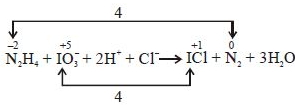
$N_2H_4 + IO_3^- + 2H^+ + Cl^- \to ICl + N_2 + 3H_2O$
The equivalent masses of $N_2H_4$ and $KIO_3$ respectively are:
The equivalent masses of $N_2H_4$ and $KIO_3$ respectively are:
A
$8$ and $35.6$
B
$8$ and $87$
C
$8$ and $53.5$
D
$16$ and $53.5$
Solution
(C) In the reaction,the oxidation state of $N$ in $N_2H_4$ changes from $-2$ to $0$. The change per atom is $2$,and for $2$ atoms of $N$,the total change in oxidation state is $4$. Thus,the $n$-factor for $N_2H_4$ is $4$.
Equivalent mass of $N_2H_4 = \frac{\text{Molar mass}}{n\text{-factor}} = \frac{32}{4} = 8$.
The oxidation state of $I$ in $IO_3^-$ changes from $+5$ to $+1$ in $ICl$. The change in oxidation state is $5 - 1 = 4$. Thus,the $n$-factor for $KIO_3$ is $4$.
Equivalent mass of $KIO_3 = \frac{\text{Molar mass}}{n\text{-factor}} = \frac{214}{4} = 53.5$.
Equivalent mass of $N_2H_4 = \frac{\text{Molar mass}}{n\text{-factor}} = \frac{32}{4} = 8$.
The oxidation state of $I$ in $IO_3^-$ changes from $+5$ to $+1$ in $ICl$. The change in oxidation state is $5 - 1 = 4$. Thus,the $n$-factor for $KIO_3$ is $4$.
Equivalent mass of $KIO_3 = \frac{\text{Molar mass}}{n\text{-factor}} = \frac{214}{4} = 53.5$.
0 likes
View Solution150
MediumMCQ
In the reaction
$x BrO_3^- + y Cr^{3+} + z H_2O \to Br_2 + CrO_4^{2-} + H^{+}$
the coefficients $x, y, z$ are
$x BrO_3^- + y Cr^{3+} + z H_2O \to Br_2 + CrO_4^{2-} + H^{+}$
the coefficients $x, y, z$ are
A
$6, 10, 11$
B
$6, 10, 20$
C
$6, 8, 22$
D
$6, 10, 22$
Solution
(D) The given reaction is: $x BrO_3^- + y Cr^{3+} + z H_2O \to Br_2 + CrO_4^{2-} + H^{+}$
Step $1$: Identify oxidation and reduction half-reactions.
Reduction: $BrO_3^- \to Br_2$ (Bromine oxidation state changes from $+5$ to $0$)
Oxidation: $Cr^{3+} \to CrO_4^{2-}$ (Chromium oxidation state changes from $+3$ to $+6$)
Step $2$: Balance the half-reactions.
Reduction: $2 BrO_3^- + 12 H^+ + 10 e^- \to Br_2 + 6 H_2O$
Oxidation: $Cr^{3+} + 4 H_2O \to CrO_4^{2-} + 8 H^+ + 3 e^-$
Step $3$: Equalize electrons by multiplying reduction by $3$ and oxidation by $10$.
$6 BrO_3^- + 36 H^+ + 30 e^- \to 3 Br_2 + 18 H_2O$
$10 Cr^{3+} + 40 H_2O \to 10 CrO_4^{2-} + 80 H^+ + 30 e^-$
Step $4$: Add the two half-reactions.
$6 BrO_3^- + 10 Cr^{3+} + 22 H_2O \to 3 Br_2 + 10 CrO_4^{2-} + 44 H^{+}$
Comparing with the given equation,$x = 6$,$y = 10$,and $z = 22$.
Step $1$: Identify oxidation and reduction half-reactions.
Reduction: $BrO_3^- \to Br_2$ (Bromine oxidation state changes from $+5$ to $0$)
Oxidation: $Cr^{3+} \to CrO_4^{2-}$ (Chromium oxidation state changes from $+3$ to $+6$)
Step $2$: Balance the half-reactions.
Reduction: $2 BrO_3^- + 12 H^+ + 10 e^- \to Br_2 + 6 H_2O$
Oxidation: $Cr^{3+} + 4 H_2O \to CrO_4^{2-} + 8 H^+ + 3 e^-$
Step $3$: Equalize electrons by multiplying reduction by $3$ and oxidation by $10$.
$6 BrO_3^- + 36 H^+ + 30 e^- \to 3 Br_2 + 18 H_2O$
$10 Cr^{3+} + 40 H_2O \to 10 CrO_4^{2-} + 80 H^+ + 30 e^-$
Step $4$: Add the two half-reactions.
$6 BrO_3^- + 10 Cr^{3+} + 22 H_2O \to 3 Br_2 + 10 CrO_4^{2-} + 44 H^{+}$
Comparing with the given equation,$x = 6$,$y = 10$,and $z = 22$.
0 likes
View SolutionRedox Reactions — Redox reaction and Method for balancing Redox reaction · Frequently Asked Questions
1Are these Redox Reactions questions useful for JEE and NEET?
Yes. All questions in this section are mapped to JEE Main and NEET exam patterns. Previous year questions from JEE Main, NEET, GUJCET and state-level exams are included with full solutions.
2Can I switch to Hindi or Gujarati for these questions?
Yes. Use the language tabs in the hero section or the sidebar to view the same questions and solutions in English, Hindi or Gujarati.
3How do I generate a question paper from this subtopic?
Use the Vedclass Exam Paper Generator — select the chapter and subtopic, set difficulty, and generate Sets A, B, C, D automatically. First 3 chapters of every subject are free.
Vedclass Products
For Students
Vedclass Test Series
Mock tests in real JEE/NEET style with performance analysis. 5-day free trial.
Start Free TrialFor Teachers
Exam Paper Generator
Generate Set A/B/C/D papers from this chapter in 2 minutes. 3 chapters free.
Try FreeFor Institutes
Online Exam Module
Live online exams with unlimited students, 360° analytics & white-label branding.
See DemoFor Teachers & Institutes
Generate a Redox Reactions Exam Paper in 2 Minutes
Select subtopic & difficulty — Sets A, B, C, D auto-generated with No Repeat logic.
First 3 chapters of every subject are free — no payment required.