
A English
Water or hydride of oxygen Questions in English
Class 11 Chemistry · Hydrogen · Water or hydride of oxygen
264+
Questions
English
Language
100%
With Solutions
Showing 50 of 264 questions in English
151
EasyMCQ
When zeolite (hydrated sodium aluminium silicate) is treated with hard water,the sodium ions are exchanged with:
A
$H^{+}$ ions
B
$Ca^{2+}$ ions
C
$SO_4^{2-}$ ions
D
$OH^{-}$ ions
Solution
(B) Zeolite,represented as $Na_2Ze$,acts as an ion exchanger. When hard water containing $Ca^{2+}$ or $Mg^{2+}$ ions is passed through it,the sodium ions $(Na^+)$ in the zeolite are replaced by these hardness-causing ions.
The reaction is: $Na_2Ze(s) + Ca^{2+}(aq) \to CaZe(s) + 2Na^+(aq)$.
The reaction is: $Na_2Ze(s) + Ca^{2+}(aq) \to CaZe(s) + 2Na^+(aq)$.
0 likes
View Solution152
DifficultMCQ
An inorganic salt $(A)$ is decomposed on heating to give two products $(B)$ and $(C)$. Compound $(C)$ is a liquid at room temperature and is neutral to litmus,while the compound $(B)$ is a colourless neutral gas. Compounds $(A)$,$(B)$ and $(C)$ are:
A
$NH_4NO_3, N_2O, H_2O$
B
$NH_4NO_2, NO, H_2O$
C
$CaO, H_2O, CaCl_2$
D
$Ba(NO_3)_2, H_2O, NO_2$
Solution
(A) The thermal decomposition of ammonium nitrate $(NH_4NO_3)$ is given by the following reaction:
$NH_4NO_3(s) \xrightarrow{\Delta} N_2O(g) + 2H_2O(l)$
Here,$(A)$ is $NH_4NO_3$,$(B)$ is $N_2O$ (a colourless neutral gas),and $(C)$ is $H_2O$ (a liquid at room temperature which is neutral to litmus).
Thus,the correct option is $(A)$.
$NH_4NO_3(s) \xrightarrow{\Delta} N_2O(g) + 2H_2O(l)$
Here,$(A)$ is $NH_4NO_3$,$(B)$ is $N_2O$ (a colourless neutral gas),and $(C)$ is $H_2O$ (a liquid at room temperature which is neutral to litmus).
Thus,the correct option is $(A)$.
0 likes
View Solution153
EasyMCQ
The method used to remove temporary hardness of water is
A
Calgon's method
B
Clark's method
C
Ion-exchange method
D
Synthetic resins method
Solution
(B) Clark's method is used to remove temporary hardness of water by adding lime $(Ca(OH)_2)$.
The chemical reaction is:
$Ca(HCO_3)_2 + Ca(OH)_2 \rightarrow 2 CaCO_3 \downarrow + 2 H_2O$
The chemical reaction is:
$Ca(HCO_3)_2 + Ca(OH)_2 \rightarrow 2 CaCO_3 \downarrow + 2 H_2O$
0 likes
View Solution154
AdvancedMCQ
In comparison to the zeolite process for the removal of permanent hardness,the synthetic resins method is
A
less efficient as it exchanges only anions
B
more efficient as it can exchange only cations
C
less efficient as the resins cannot be regenerated
D
more efficient as it can exchange both cations as well as anions
Solution
(D) The zeolite process is limited to the exchange of cations ($Ca^{2+}$ and $Mg^{2+}$) only.
$2 NaZ_{(s)} + M^{2+}_{(aq)} \rightarrow MZ_{2(s)} + 2 Na^{+}_{(aq)}$
(where $M = Ca, Mg$)
In contrast,the synthetic resin method is more efficient because it utilizes both cation exchange resins (to remove $Ca^{2+}$ and $Mg^{2+}$) and anion exchange resins (to remove $Cl^{-}$,$HCO_{3}^{-}$,$SO_{4}^{2-}$,etc.),resulting in demineralized water.
$I$. Cation exchange: $2 RNa_{(s)} + M^{2+}_{(aq)} \rightarrow R_{2}M_{(s)} + 2 Na^{+}_{(aq)}$
$II$. Anion exchange: $RNH_{3}^{+}OH^{-}_{(s)} + X^{-}_{(aq)} \rightarrow RNH_{3}^{+}X^{-}_{(s)} + OH^{-}_{(aq)}$
(where $X = Cl^{-}, HCO_{3}^{-}, SO_{4}^{2-}$)
$2 NaZ_{(s)} + M^{2+}_{(aq)} \rightarrow MZ_{2(s)} + 2 Na^{+}_{(aq)}$
(where $M = Ca, Mg$)
In contrast,the synthetic resin method is more efficient because it utilizes both cation exchange resins (to remove $Ca^{2+}$ and $Mg^{2+}$) and anion exchange resins (to remove $Cl^{-}$,$HCO_{3}^{-}$,$SO_{4}^{2-}$,etc.),resulting in demineralized water.
$I$. Cation exchange: $2 RNa_{(s)} + M^{2+}_{(aq)} \rightarrow R_{2}M_{(s)} + 2 Na^{+}_{(aq)}$
$II$. Anion exchange: $RNH_{3}^{+}OH^{-}_{(s)} + X^{-}_{(aq)} \rightarrow RNH_{3}^{+}X^{-}_{(s)} + OH^{-}_{(aq)}$
(where $X = Cl^{-}, HCO_{3}^{-}, SO_{4}^{2-}$)
0 likes
View Solution155
EasyMCQ
Amongst the following,the form of water with the lowest ionic conductance at $298 \ K$ is
A
distilled water
B
water from a well
C
saline water used for intravenous injection
D
sea water
Solution
(A) Ionic conductance is directly proportional to the concentration of dissolved ions in water.
Distilled water is purified through distillation,which removes dissolved salts and minerals,resulting in the lowest concentration of ions.
Therefore,distilled water exhibits the lowest ionic conductance compared to well water,saline water,or sea water,which contain significant amounts of dissolved electrolytes.
Distilled water is purified through distillation,which removes dissolved salts and minerals,resulting in the lowest concentration of ions.
Therefore,distilled water exhibits the lowest ionic conductance compared to well water,saline water,or sea water,which contain significant amounts of dissolved electrolytes.
0 likes
View Solution156
EasyMCQ
How many hydrogen-bonded water molecule$(s)$ are associated in $CuSO_{4} \cdot 5H_{2}O$?
A
$1$
B
$2$
C
$4$
D
$5$
Solution
(A) The structure of $CuSO_{4} \cdot 5H_{2}O$ is represented as $[Cu(H_{2}O)_{4}]SO_{4} \cdot H_{2}O$.
In this structure,four water molecules are coordinated directly to the $Cu^{2+}$ ion.
The fifth water molecule is held by hydrogen bonding between the $SO_{4}^{2-}$ ion and the coordinated water molecules.
Therefore,only $1$ water molecule is hydrogen-bonded.
In this structure,four water molecules are coordinated directly to the $Cu^{2+}$ ion.
The fifth water molecule is held by hydrogen bonding between the $SO_{4}^{2-}$ ion and the coordinated water molecules.
Therefore,only $1$ water molecule is hydrogen-bonded.
0 likes
View Solution157
Easy
Describe the structure of the common form of ice.
Solution
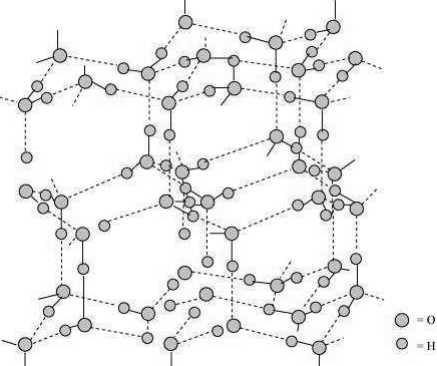
(N/A) Ice is the crystalline form of water. It takes a hexagonal form if crystallized at atmospheric pressure, but condenses to a cubic form if the temperature is very low.
The three-dimensional structure of ice is highly ordered and involves hydrogen bonding.
Each oxygen atom is surrounded tetrahedrally by four other oxygen atoms at a distance of $276 \, pm$.
The structure also contains wide holes that can hold molecules of appropriate sizes interstitially.
The three-dimensional structure of ice is highly ordered and involves hydrogen bonding.
Each oxygen atom is surrounded tetrahedrally by four other oxygen atoms at a distance of $276 \, pm$.
The structure also contains wide holes that can hold molecules of appropriate sizes interstitially.
0 likes
View Solution158
Medium
What causes the temporary and permanent hardness of water?
Solution
(N/A) Temporary hardness of water is due to the presence of soluble salts of magnesium and calcium in the form of hydrogen carbonates $(M(HCO_3)_2, \text{ where } M = Mg, Ca)$ in water.
Permanent hardness of water is due to the presence of soluble salts of calcium and magnesium in the form of chlorides and sulfates $(CaCl_2, MgCl_2, CaSO_4, MgSO_4)$ in water.
Permanent hardness of water is due to the presence of soluble salts of calcium and magnesium in the form of chlorides and sulfates $(CaCl_2, MgCl_2, CaSO_4, MgSO_4)$ in water.
0 likes
View Solution159
Difficult
Discuss the principle and method of softening of hard water by synthetic ion-exchange.
Solution
(N/A) The process of treating permanent hardness of water using synthetic resins is based on the exchange of cations (e.g.,$Na^{+}$,$Ca^{2+}$,$Mg^{2+}$) and anions (e.g.,$Cl^{-}$,$SO_{4}^{2-}$,$HCO_{3}^{-}$) present in water by $H^{+}$ and $OH^{-}$ ions respectively.
Synthetic resins are of two types:
$1)$ Cation exchange resins
$2)$ Anion exchange resins
Cation exchange resins are large organic molecules that contain the $-SO_{3}H$ group. The resin is firstly changed to $RNa$ (from $RSO_{3}H$) by treating it with $NaCl$. This resin then exchanges $Na^{+}$ ions with $Ca^{2+}$ and $Mg^{2+}$ thereby making the water soft.
$2RNa + M_{(aq)}^{2+} \to R_{2}M_{(s)} + 2Na_{(aq)}^{+}$
There are cation exchange resins in $H^{+}$ form. The resins exchange $H^{+}$ ions for $Na^{+}$,$Ca^{2+}$ and $Mg^{2+}$ ions.
$2RH + M_{(aq)}^{2+} \leftrightarrow MR_{2(s)} + 2H_{(aq)}^{+}$
Anion exchange resins exchange $OH^{-}$ ions for anions like $Cl^{-}$,$HCO_{3}^{-}$,and $SO_{4}^{2-}$ present in water.
$RNH_{2(s)} + H_{2}O_{(l)} \leftrightarrow RNH_{3}^{+}.OH_{(s)}^{-}$ $\xrightarrow{+X_{(aq)}^{-}} RNH_{3}^{+}.X_{(s)}^{-} + OH_{(aq)}^{-}$
During the complete process,water first passes through the cation exchange process. The water obtained after this process is free from mineral cations and is acidic in nature. This acidic water is then passed through the anion exchange process where $OH^{-}$ ions neutralize the $H^{+}$ ions and de-ionize the water obtained.
Synthetic resins are of two types:
$1)$ Cation exchange resins
$2)$ Anion exchange resins
Cation exchange resins are large organic molecules that contain the $-SO_{3}H$ group. The resin is firstly changed to $RNa$ (from $RSO_{3}H$) by treating it with $NaCl$. This resin then exchanges $Na^{+}$ ions with $Ca^{2+}$ and $Mg^{2+}$ thereby making the water soft.
$2RNa + M_{(aq)}^{2+} \to R_{2}M_{(s)} + 2Na_{(aq)}^{+}$
There are cation exchange resins in $H^{+}$ form. The resins exchange $H^{+}$ ions for $Na^{+}$,$Ca^{2+}$ and $Mg^{2+}$ ions.
$2RH + M_{(aq)}^{2+} \leftrightarrow MR_{2(s)} + 2H_{(aq)}^{+}$
Anion exchange resins exchange $OH^{-}$ ions for anions like $Cl^{-}$,$HCO_{3}^{-}$,and $SO_{4}^{2-}$ present in water.
$RNH_{2(s)} + H_{2}O_{(l)} \leftrightarrow RNH_{3}^{+}.OH_{(s)}^{-}$ $\xrightarrow{+X_{(aq)}^{-}} RNH_{3}^{+}.X_{(s)}^{-} + OH_{(aq)}^{-}$
During the complete process,water first passes through the cation exchange process. The water obtained after this process is free from mineral cations and is acidic in nature. This acidic water is then passed through the anion exchange process where $OH^{-}$ ions neutralize the $H^{+}$ ions and de-ionize the water obtained.
0 likes
View Solution160
Medium
Write chemical reactions to show the amphoteric nature of water.
Solution
(N/A) The amphoteric nature of water can be described on the basis of the following reactions:
$1)$ Reaction with $H_2S$ (Water acts as a base):
$H_2O_{(l)} + H_2S_{(aq)} \rightleftharpoons H_3O^{+}_{(aq)} + HS^{-}_{(aq)}$
$2)$ Reaction with $NH_3$ (Water acts as an acid):
$H_2O_{(l)} + NH_{3_{(aq)}} \rightleftharpoons OH^{-}_{(aq)} + NH^{+}_{4_{(aq)}}$
$3)$ Self-ionization of water:
In this reaction,one water molecule acts as an acid and another as a base:
$H_2O_{(l)} + H_2O_{(l)} \rightleftharpoons H_3O^{+}_{(aq)} + OH^{-}_{(aq)}$
$1)$ Reaction with $H_2S$ (Water acts as a base):
$H_2O_{(l)} + H_2S_{(aq)} \rightleftharpoons H_3O^{+}_{(aq)} + HS^{-}_{(aq)}$
$2)$ Reaction with $NH_3$ (Water acts as an acid):
$H_2O_{(l)} + NH_{3_{(aq)}} \rightleftharpoons OH^{-}_{(aq)} + NH^{+}_{4_{(aq)}}$
$3)$ Self-ionization of water:
In this reaction,one water molecule acts as an acid and another as a base:
$H_2O_{(l)} + H_2O_{(l)} \rightleftharpoons H_3O^{+}_{(aq)} + OH^{-}_{(aq)}$
0 likes
View Solution161
Medium
What is meant by 'demineralised' water and how can it be obtained?
Solution
(N/A) Demineralised water is free from all soluble mineral salts. It does not contain any anions or cations.
Demineralised water is obtained by passing water successively through a cation exchange (in the $H^+$ form) and an anion exchange (in the $OH^-$ form) resin.
During the cation exchange process,$H^+$ exchanges for $Na^+, Mg^{2+}, Ca^{2+},$ and other cations present in water.
$2RH_{(s)} + M^{2+}_{(aq)} \leftrightarrow MR_{2(s)} + 2H^+_{(aq)} \dots (1)$
In the anion exchange process,$OH^-$ exchanges for anions such as $CO_3^{2-}, SO_4^{2-}, Cl^-, HCO_3^-$ etc. present in water.
$RNH_{2(s)} + H_2O_{(l)} \leftrightarrow RNH_3^+OH^-_{(s)}$
$RNH_3^+OH^-_{(s)} + X^-_{(aq)} \leftrightarrow RNH_3^+X^-_{(s)} + OH^-_{(aq)} \dots (2)$
$OH^-$ ions liberated in reaction $(2)$ neutralize $H^+$ ions liberated in reaction $(1)$,thereby forming water.
$H^+_{(aq)} + OH^-_{(aq)} \longrightarrow H_2O_{(l)}$
Demineralised water is obtained by passing water successively through a cation exchange (in the $H^+$ form) and an anion exchange (in the $OH^-$ form) resin.
During the cation exchange process,$H^+$ exchanges for $Na^+, Mg^{2+}, Ca^{2+},$ and other cations present in water.
$2RH_{(s)} + M^{2+}_{(aq)} \leftrightarrow MR_{2(s)} + 2H^+_{(aq)} \dots (1)$
In the anion exchange process,$OH^-$ exchanges for anions such as $CO_3^{2-}, SO_4^{2-}, Cl^-, HCO_3^-$ etc. present in water.
$RNH_{2(s)} + H_2O_{(l)} \leftrightarrow RNH_3^+OH^-_{(s)}$
$RNH_3^+OH^-_{(s)} + X^-_{(aq)} \leftrightarrow RNH_3^+X^-_{(s)} + OH^-_{(aq)} \dots (2)$
$OH^-$ ions liberated in reaction $(2)$ neutralize $H^+$ ions liberated in reaction $(1)$,thereby forming water.
$H^+_{(aq)} + OH^-_{(aq)} \longrightarrow H_2O_{(l)}$
0 likes
View Solution162
Easy
Is demineralised or distilled water useful for drinking purposes? If not,how can it be made useful?
Solution
(N/A) No,demineralised or distilled water is not useful for drinking purposes because it lacks essential minerals like $Ca^{2+}$ and $Mg^{2+}$ ions,which are necessary for the human body.
It can be made useful by adding essential minerals in controlled amounts or by mixing it with a small amount of mineral-rich water to restore the required mineral balance.
It can be made useful by adding essential minerals in controlled amounts or by mixing it with a small amount of mineral-rich water to restore the required mineral balance.
0 likes
View Solution163
Easy
Describe the usefulness of water in the biosphere and biological systems.
Solution
(N/A) Water is essential for all forms of life. It constitutes around $65 \%$ of the human body and $95 \%$ of plants. Water plays an important role in the biosphere owing to its high specific heat,thermal conductivity,surface tension,dipole moment,and dielectric constant. The high heat of vaporization and heat capacity of water help in moderating the climate and body temperature of all living beings. It acts as a carrier of various nutrients required by plants and animals for various metabolic reactions.
0 likes
View Solution164
Medium
What properties of water make it useful as a solvent? What types of compound can it $(i)$ dissolve,and $(ii)$ hydrolyse?
Solution
Water is a universal solvent primarily due to its high dielectric constant $(78.39 \, C^{2} / Nm^{2})$ and high dipole moment.
$(i)$ Water dissolves ionic compounds through ion-dipole interactions and covalent compounds that are capable of forming hydrogen bonds with water.
$(ii)$ Water hydrolyzes various compounds including metallic and non-metallic oxides,hydrides,carbides,phosphides,and nitrides. During hydrolysis,the $H^{+}$ and $OH^{-}$ ions of water react with the substrate.
Examples of hydrolysis reactions:
$CaO + H_{2}O \longrightarrow Ca(OH)_{2}$
$NaH + H_{2}O \longrightarrow NaOH + H_{2}$
$CaC_{2} + H_{2}O \longrightarrow C_{2}H_{2} + Ca(OH)_{2}$
$(i)$ Water dissolves ionic compounds through ion-dipole interactions and covalent compounds that are capable of forming hydrogen bonds with water.
$(ii)$ Water hydrolyzes various compounds including metallic and non-metallic oxides,hydrides,carbides,phosphides,and nitrides. During hydrolysis,the $H^{+}$ and $OH^{-}$ ions of water react with the substrate.
Examples of hydrolysis reactions:
$CaO + H_{2}O \longrightarrow Ca(OH)_{2}$
$NaH + H_{2}O \longrightarrow NaOH + H_{2}$
$CaC_{2} + H_{2}O \longrightarrow C_{2}H_{2} + Ca(OH)_{2}$
0 likes
View Solution165
Easy
How can saline hydrides remove traces of water from organic compounds?
Solution
(N/A) Saline hydrides are ionic in nature. They react with water to form a metal hydroxide along with the liberation of hydrogen gas.
The reaction of saline hydrides with water can be represented as:
$AH_{(s)} + H_2O_{(l)} \to AOH_{(aq)} + H_{2(g)}$
(where,$A = Na, Ca, \dots$)
When added to an organic solvent,they react with water present in it. Hydrogen gas escapes into the atmosphere,leaving behind the metallic hydroxide. The dry organic solvent can then be distilled over.
The reaction of saline hydrides with water can be represented as:
$AH_{(s)} + H_2O_{(l)} \to AOH_{(aq)} + H_{2(g)}$
(where,$A = Na, Ca, \dots$)
When added to an organic solvent,they react with water present in it. Hydrogen gas escapes into the atmosphere,leaving behind the metallic hydroxide. The dry organic solvent can then be distilled over.
0 likes
View Solution166
Medium
Can you use soaps and synthetic detergents to check the hardness of water?
Solution
(N/A) Soaps form a precipitate (scum) in hard water due to the presence of $Ca^{2+}$ and $Mg^{2+}$ ions,but they do not form a precipitate in soft water. Therefore,soaps can be used to check the hardness of water.
Synthetic detergents,on the other hand,do not form a precipitate in either hard water or soft water because their calcium and magnesium salts are soluble in water. Therefore,synthetic detergents cannot be used to check the hardness of water.
Synthetic detergents,on the other hand,do not form a precipitate in either hard water or soft water because their calcium and magnesium salts are soluble in water. Therefore,synthetic detergents cannot be used to check the hardness of water.
0 likes
View Solution167
Medium
Describe the usefulness of water in the biosphere and biological systems.
Solution
$A$ major part of all living organisms is made up of water. The human body contains about $65 \%$ water,and some plants contain as much as $95 \%$ water.
It is a crucial compound for the survival of all life forms.
It acts as a solvent of great importance.
The high heat of vaporization and high heat capacity of water are responsible for the moderation of the climate and the regulation of body temperature in living beings.
It serves as an excellent solvent for the transportation of ions and molecules required for plant and animal metabolism.
The distribution of water over the earth's surface is not uniform. The estimated world water supply is given in the following table:
It is a crucial compound for the survival of all life forms.
It acts as a solvent of great importance.
The high heat of vaporization and high heat capacity of water are responsible for the moderation of the climate and the regulation of body temperature in living beings.
It serves as an excellent solvent for the transportation of ions and molecules required for plant and animal metabolism.
The distribution of water over the earth's surface is not uniform. The estimated world water supply is given in the following table:
| Source | $\%$ of Total |
| Oceans | $97.33$ |
| Saline lakes and inland seas | $0.008$ |
| Polar ice and glaciers | $2.04$ |
| Ground water | $0.61$ |
| Lakes | $0.009$ |
| Soil moisture | $0.005$ |
| Atmospheric water vapour | $0.001$ |
| Rivers | $0.0001$ |
0 likes
View Solution168
Medium
Provide general information about water $(H_2O)$.
Solution
(N/A) major part of all living organisms is made up of water. The human body contains about $65 \%$ water,and some plants contain as much as $95 \%$ water.
It is a crucial compound for the survival of all life forms.
It is a solvent of great importance.
The distribution of water over the earth's surface is not uniform. The estimated world water supply is given in the following table.
The high heat of vaporization and heat capacity are responsible for the moderation of the climate and the body temperature of living beings.
It is an excellent solvent for the transportation of ions and molecules required for plant and animal metabolism.
Estimated World Water Supply
It is a crucial compound for the survival of all life forms.
It is a solvent of great importance.
The distribution of water over the earth's surface is not uniform. The estimated world water supply is given in the following table.
The high heat of vaporization and heat capacity are responsible for the moderation of the climate and the body temperature of living beings.
It is an excellent solvent for the transportation of ions and molecules required for plant and animal metabolism.
Estimated World Water Supply
| Source | $\%$ of Total |
| Oceans | $97.33$ |
| Saline lakes and inland seas | $0.008$ |
| Polar ice and glaciers | $2.04$ |
| Ground water | $0.61$ |
| Lakes | $0.009$ |
| Soil moisture | $0.005$ |
| Atmospheric water vapour | $0.001$ |
| Rivers | $0.0001$ |
0 likes
View Solution169
Medium
Explain the importance of water for living organisms.
Solution
$A$ major part of all living organisms is made up of water. The human body contains about $65 \%$ water,and some plants contain as much as $95 \%$ water.
It is a crucial compound for the survival of all life forms.
It acts as a solvent of great importance for biological processes.
The high heat of vaporization and high heat capacity of water are responsible for the moderation of the climate and the maintenance of body temperature in living beings.
It serves as an excellent solvent for the transportation of ions and molecules required for plant and animal metabolism.
The distribution of water over the earth's surface is not uniform. The estimated world water supply is given in the following table:
It is a crucial compound for the survival of all life forms.
It acts as a solvent of great importance for biological processes.
The high heat of vaporization and high heat capacity of water are responsible for the moderation of the climate and the maintenance of body temperature in living beings.
It serves as an excellent solvent for the transportation of ions and molecules required for plant and animal metabolism.
The distribution of water over the earth's surface is not uniform. The estimated world water supply is given in the following table:
| Source | $\%$ of Total |
| Oceans | $97.33$ |
| Saline lakes and inland seas | $0.008$ |
| Polar ice and glaciers | $2.04$ |
| Ground water | $0.61$ |
| Lakes | $0.009$ |
| Soil moisture | $0.005$ |
| Atmospheric water vapour | $0.001$ |
| Rivers | $0.0001$ |
0 likes
View Solution170
Medium
What properties of water make it useful as a solvent? What types of compounds can it $(i)$ dissolve and $(ii)$ hydrolyse?
Solution
(N/A) Water is a polar molecule with a high dielectric constant ($78.39$ at $298 \ K$),which allows it to dissolve ionic compounds by weakening the electrostatic forces between ions. It also forms hydrogen bonds with polar covalent molecules,enabling the dissolution of substances like alcohols and carbohydrates.
$(i)$ Water dissolves ionic compounds (e.g.,$NaCl$) and polar covalent compounds (e.g.,glucose,ethanol) through ion-dipole and hydrogen bonding interactions.
$(ii)$ Water hydrolyses many covalent and ionic compounds,such as metal oxides,non-metal oxides,and halides. For example,$P_4O_{10} + 6H_2O \rightarrow 4H_3PO_4$ and $SiCl_4 + 2H_2O \rightarrow SiO_2 + 4HCl$.
$(i)$ Water dissolves ionic compounds (e.g.,$NaCl$) and polar covalent compounds (e.g.,glucose,ethanol) through ion-dipole and hydrogen bonding interactions.
$(ii)$ Water hydrolyses many covalent and ionic compounds,such as metal oxides,non-metal oxides,and halides. For example,$P_4O_{10} + 6H_2O \rightarrow 4H_3PO_4$ and $SiCl_4 + 2H_2O \rightarrow SiO_2 + 4HCl$.
0 likes
View Solution171
Medium
Describe the physical properties of water.
Solution
(N/A) Water is a colourless and tasteless liquid. The unusual properties of water in the condensed phase (liquid and solid states) are due to the presence of extensive hydrogen bonding between water molecules.
This leads to high freezing point,high boiling point,high heat of vaporisation,and high heat of fusion in comparison to $H_{2}S$ and $H_{2}Se$.
In comparison to other liquids,water has a higher specific heat,thermal conductivity,surface tension,dipole moment,and dielectric constant.
These properties allow water to play a key role in the biosphere.
It is an excellent solvent for the transportation of ions and molecules required for plant and animal metabolism.
Due to hydrogen bonding with polar molecules,even covalent compounds like alcohol and carbohydrates dissolve in water. Physical properties of $H_{2}O$ and $D_{2}O$ are summarized below:
This leads to high freezing point,high boiling point,high heat of vaporisation,and high heat of fusion in comparison to $H_{2}S$ and $H_{2}Se$.
In comparison to other liquids,water has a higher specific heat,thermal conductivity,surface tension,dipole moment,and dielectric constant.
These properties allow water to play a key role in the biosphere.
It is an excellent solvent for the transportation of ions and molecules required for plant and animal metabolism.
Due to hydrogen bonding with polar molecules,even covalent compounds like alcohol and carbohydrates dissolve in water. Physical properties of $H_{2}O$ and $D_{2}O$ are summarized below:
| Property | $H_{2}O$ vs $D_{2}O$ |
| Molecular mass $(g \ mol^{-1})$ | $H_{2}O: 18.0151, D_{2}O: 20.0276$ |
| Melting point $(K)$ | $H_{2}O: 273.0, D_{2}O: 276.8$ |
| Boiling point $(K)$ | $H_{2}O: 373.0, D_{2}O: 374.4$ |
| Enthalpy of formation $(kJ \ mol^{-1})$ | $H_{2}O: -285.9, D_{2}O: -294.6$ |
| Enthalpy of vaporisation $(373 \ K)$ $(kJ \ mol^{-1})$ | $H_{2}O: 40.66, D_{2}O: 41.61$ |
| Enthalpy of fusion $(kJ \ mol^{-1})$ | $H_{2}O: 6.01, D_{2}O: 6.28$ |
| Temp of max. density $(K)$ | $H_{2}O: 276.98, D_{2}O: 284.2$ |
| Density $(298 \ K)$ $(g \ cm^{-3})$ | $H_{2}O: 1.0000, D_{2}O: 1.1059$ |
| Viscosity (centipoise) | $H_{2}O: 0.8903, D_{2}O: 1.107$ |
| Dielectric constant | $H_{2}O: 78.39, D_{2}O: 78.06$ |
| Electrical conductivity $(293 \ K)$ $(ohm^{-1} \ cm^{-1})$ | $H_{2}O: 5.7 \times 10^{-8}, D_{2}O: 3.0 \times 10^{-8}$ |
0 likes
View Solution172
Medium
Explain the structure of water.
Solution
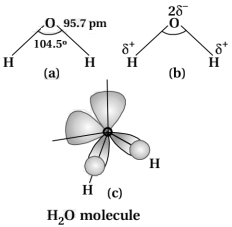
(N/A) In the gas phase, water is a bent molecule with a bond angle of $104.5^{\circ}$ and an $O-H$ bond length of $95.7 \text{ pm}$.
It is a highly polar molecule due to the electronegativity difference between oxygen and hydrogen atoms.
In the liquid phase, water molecules are associated together by hydrogen bonds.
The crystalline form of water is ice. At atmospheric pressure, ice crystallizes in the hexagonal form, but at very low temperatures, it condenses to a cubic form.
The density of ice is less than that of water, which is why an ice cube floats on water.
In the winter season, ice formed on the surface of a lake provides thermal insulation, which ensures the survival of aquatic life.
It is a highly polar molecule due to the electronegativity difference between oxygen and hydrogen atoms.
In the liquid phase, water molecules are associated together by hydrogen bonds.
The crystalline form of water is ice. At atmospheric pressure, ice crystallizes in the hexagonal form, but at very low temperatures, it condenses to a cubic form.
The density of ice is less than that of water, which is why an ice cube floats on water.
In the winter season, ice formed on the surface of a lake provides thermal insulation, which ensures the survival of aquatic life.
0 likes
View Solution173
Medium
Describe the structure of the common form of ice.
Solution
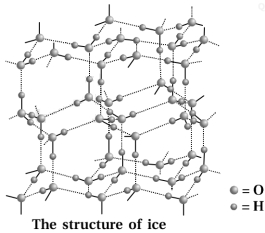
(N/A) Ice has a highly ordered three-dimensional hydrogen-bonded structure.
Examination of ice crystals with $X$-rays shows that each oxygen atom is surrounded tetrahedrally by four other oxygen atoms at a distance of $276 \text{ pm}$.
Hydrogen bonding gives ice a rather open-type structure with wide holes. These holes can hold some other molecules of appropriate size interstitially.
Examination of ice crystals with $X$-rays shows that each oxygen atom is surrounded tetrahedrally by four other oxygen atoms at a distance of $276 \text{ pm}$.
Hydrogen bonding gives ice a rather open-type structure with wide holes. These holes can hold some other molecules of appropriate size interstitially.
0 likes
View Solution174
Medium
Explain the structure of ice.
Solution
(N/A) Ice has a highly ordered three-dimensional hydrogen-bonded structure as shown in the figure.
Examination of ice crystals with $X$-rays shows that each oxygen atom is surrounded tetrahedrally by four other oxygen atoms at a distance of $276 \text{ pm}$.
Hydrogen bonding gives ice a rather open-type structure with wide holes. These holes can hold some other molecules of appropriate size interstitially.
Examination of ice crystals with $X$-rays shows that each oxygen atom is surrounded tetrahedrally by four other oxygen atoms at a distance of $276 \text{ pm}$.
Hydrogen bonding gives ice a rather open-type structure with wide holes. These holes can hold some other molecules of appropriate size interstitially.
0 likes
View Solution175
Difficult
Describe the chemical properties of water.
Solution
Water reacts with a large number of substances. Some of the important reactions are given below.
$(i)$ Amphoteric Nature: It has the ability to act as an acid as well as a base,i.e.,it behaves as an amphoteric substance. In the Br\u00f6nsted sense,it acts as an acid with $NH_{3}$ and a base with $H_{2}S$.
$H_{2}O_{(l)} + NH_{3(aq)} \rightleftharpoons OH^{-}_{(aq)} + NH_{4(aq)}^{+}$
$H_{2}O_{(l)} + H_{2}S_{(aq)} \rightleftharpoons H_{3}O^{+}_{(aq)} + HS^{-}_{(aq)}$
The auto-protolysis (self-ionization) of water takes place as follows:
$H_{2}O_{(l)} + H_{2}O_{(l)} \rightleftharpoons H_{3}O^{+}_{(aq)} + OH^{-}_{(aq)}$
$(ii)$ Redox Reactions Involving Water: Water can be easily reduced to dihydrogen by highly electropositive metals.
$2H_{2}O_{(l)} + 2Na_{(s)} \longrightarrow 2NaOH_{(aq)} + H_{2(g)}$
Thus,it is a great source of dihydrogen. Water is oxidised to $O_{2}$ during photosynthesis.
$6CO_{2(g)} + 12H_{2}O_{(l)} \longrightarrow C_{6}H_{12}O_{6(aq)} + 6H_{2}O_{(l)} + 6O_{2(g)}$
With fluorine also,it is oxidised to $O_{2}$:
$2F_{2(g)} + 2H_{2}O_{(l)} \longrightarrow 4H^{+}_{(aq)} + 4F^{-}_{(aq)} + O_{2(g)}$
$(i)$ Amphoteric Nature: It has the ability to act as an acid as well as a base,i.e.,it behaves as an amphoteric substance. In the Br\u00f6nsted sense,it acts as an acid with $NH_{3}$ and a base with $H_{2}S$.
$H_{2}O_{(l)} + NH_{3(aq)} \rightleftharpoons OH^{-}_{(aq)} + NH_{4(aq)}^{+}$
$H_{2}O_{(l)} + H_{2}S_{(aq)} \rightleftharpoons H_{3}O^{+}_{(aq)} + HS^{-}_{(aq)}$
The auto-protolysis (self-ionization) of water takes place as follows:
$H_{2}O_{(l)} + H_{2}O_{(l)} \rightleftharpoons H_{3}O^{+}_{(aq)} + OH^{-}_{(aq)}$
$(ii)$ Redox Reactions Involving Water: Water can be easily reduced to dihydrogen by highly electropositive metals.
$2H_{2}O_{(l)} + 2Na_{(s)} \longrightarrow 2NaOH_{(aq)} + H_{2(g)}$
Thus,it is a great source of dihydrogen. Water is oxidised to $O_{2}$ during photosynthesis.
$6CO_{2(g)} + 12H_{2}O_{(l)} \longrightarrow C_{6}H_{12}O_{6(aq)} + 6H_{2}O_{(l)} + 6O_{2(g)}$
With fluorine also,it is oxidised to $O_{2}$:
$2F_{2(g)} + 2H_{2}O_{(l)} \longrightarrow 4H^{+}_{(aq)} + 4F^{-}_{(aq)} + O_{2(g)}$
0 likes
View Solution176
Medium
Explain the difference between hard water and soft water.
Solution
Rain water is almost pure. Being a good solvent,when it flows on the surface of the earth,it dissolves many salts.
Presence of calcium and magnesium salts in the form of hydrogencarbonate,chloride,and sulphate in water makes water 'hard'.
Hard water does not give lather with soap. Water free from soluble salts of calcium and magnesium is called 'soft' water. It gives lather with soap easily.
Hard water forms scum/precipitate with soap. Soap containing sodium stearate $(C_{17}H_{35}COONa)$ reacts with hard water to precipitate out $Ca^{2+}$ or $Mg^{2+}$ stearate.
$2 C_{17}H_{35}COONa_{(aq)} + M^{2+}_{(aq)} \longrightarrow (C_{17}H_{35}COO)_{2} M_{(s)} \downarrow + 2 Na^{+}_{(aq)}$
Here,$M$ represents $Ca^{2+}$ or $Mg^{2+}$.
It is,therefore,unsuitable for laundry. It is also harmful for boilers because of the deposition of salts in the form of scale,which reduces the efficiency of the boiler. The hardness of water is of two types: $(i)$ temporary hardness,and $(ii)$ permanent hardness.
Presence of calcium and magnesium salts in the form of hydrogencarbonate,chloride,and sulphate in water makes water 'hard'.
Hard water does not give lather with soap. Water free from soluble salts of calcium and magnesium is called 'soft' water. It gives lather with soap easily.
Hard water forms scum/precipitate with soap. Soap containing sodium stearate $(C_{17}H_{35}COONa)$ reacts with hard water to precipitate out $Ca^{2+}$ or $Mg^{2+}$ stearate.
$2 C_{17}H_{35}COONa_{(aq)} + M^{2+}_{(aq)} \longrightarrow (C_{17}H_{35}COO)_{2} M_{(s)} \downarrow + 2 Na^{+}_{(aq)}$
Here,$M$ represents $Ca^{2+}$ or $Mg^{2+}$.
It is,therefore,unsuitable for laundry. It is also harmful for boilers because of the deposition of salts in the form of scale,which reduces the efficiency of the boiler. The hardness of water is of two types: $(i)$ temporary hardness,and $(ii)$ permanent hardness.
0 likes
View Solution177
Medium
Describe methods to remove the temporary hardness of water: $(i)$ Boiling $(ii)$ Clark's method.
Solution
(N/A) $(i)$ Boiling: During boiling,the soluble $Mg(HCO_{3})_{2}$ is converted into insoluble $Mg(OH)_{2}$ and $Ca(HCO_{3})_{2}$ is changed to insoluble $CaCO_{3}$. Because the solubility product of $Mg(OH)_{2}$ is lower than that of $MgCO_{3}$,$Mg(OH)_{2}$ precipitates out. These precipitates can be removed by filtration to obtain soft water.
$Mg(HCO_{3})_{2} \xrightarrow{\Delta} Mg(OH)_{2} \downarrow + 2CO_{2} \uparrow$
$Ca(HCO_{3})_{2} \xrightarrow{\Delta} CaCO_{3} \downarrow + H_{2}O + CO_{2} \uparrow$
$(ii)$ Clark's method: In this method,a calculated amount of lime $(Ca(OH)_{2})$ is added to hard water. It precipitates calcium carbonate and magnesium hydroxide,which can be filtered off.
$Ca(HCO_{3})_{2} + Ca(OH)_{2} \longrightarrow 2CaCO_{3} \downarrow + 2H_{2}O$
$Mg(HCO_{3})_{2} + 2Ca(OH)_{2} \longrightarrow 2CaCO_{3} \downarrow + Mg(OH)_{2} \downarrow + 2H_{2}O$
$Mg(HCO_{3})_{2} \xrightarrow{\Delta} Mg(OH)_{2} \downarrow + 2CO_{2} \uparrow$
$Ca(HCO_{3})_{2} \xrightarrow{\Delta} CaCO_{3} \downarrow + H_{2}O + CO_{2} \uparrow$
$(ii)$ Clark's method: In this method,a calculated amount of lime $(Ca(OH)_{2})$ is added to hard water. It precipitates calcium carbonate and magnesium hydroxide,which can be filtered off.
$Ca(HCO_{3})_{2} + Ca(OH)_{2} \longrightarrow 2CaCO_{3} \downarrow + 2H_{2}O$
$Mg(HCO_{3})_{2} + 2Ca(OH)_{2} \longrightarrow 2CaCO_{3} \downarrow + Mg(OH)_{2} \downarrow + 2H_{2}O$
0 likes
View Solution178
Advanced
Describe the methods to remove the permanent hardness of water.
Solution
(N/A) Permanent hardness is due to the presence of soluble salts of magnesium and calcium in the form of chlorides and sulphates in water.
Permanent hardness is not removed by boiling. It can be removed by the following methods:
$(i)$ Treatment with washing soda (sodium carbonate): Washing soda reacts with soluble calcium and magnesium chlorides and sulphates in hard water to form insoluble carbonates.
$MCl_{2} + Na_{2}CO_{3} \longrightarrow MCO_{3} \downarrow + 2NaCl$ $(M = Mg, Ca)$
$MSO_{4} + Na_{2}CO_{3} \longrightarrow MCO_{3} \downarrow + Na_{2}SO_{4}$
$(ii)$ Calgon's method: Sodium hexametaphosphate $(Na_{6}P_{6}O_{18})$,commercially called 'calgon',when added to hard water,the following reactions take place:
$Na_{6}P_{6}O_{18} \longrightarrow 2Na^{+} + Na_{4}P_{6}O_{18}^{2-}$
$M^{2+} + [Na_{4}P_{6}O_{18}]^{2-} \longrightarrow [Na_{2}MP_{6}O_{18}]^{2-} + 2Na^{+}$ $(M = Mg, Ca)$
The complex anion keeps the $Mg^{2+}$ and $Ca^{2+}$ ions in solution.
$(iii)$ Ion-exchange method: This method is also called the zeolite/permutit process. Hydrated sodium aluminium silicate is zeolite/permutit.
For the sake of simplicity,sodium aluminium silicate $(NaAlSiO_{4})$ can be written as $NaZ$. When this is added to hard water,exchange reactions take place:
$2NaZ_{(s)} + M^{2+}_{(aq)} \longrightarrow MZ_{2(s)} + 2Na^{+}_{(aq)}$ $(M = Mg, Ca)$
Permanent hardness is not removed by boiling. It can be removed by the following methods:
$(i)$ Treatment with washing soda (sodium carbonate): Washing soda reacts with soluble calcium and magnesium chlorides and sulphates in hard water to form insoluble carbonates.
$MCl_{2} + Na_{2}CO_{3} \longrightarrow MCO_{3} \downarrow + 2NaCl$ $(M = Mg, Ca)$
$MSO_{4} + Na_{2}CO_{3} \longrightarrow MCO_{3} \downarrow + Na_{2}SO_{4}$
$(ii)$ Calgon's method: Sodium hexametaphosphate $(Na_{6}P_{6}O_{18})$,commercially called 'calgon',when added to hard water,the following reactions take place:
$Na_{6}P_{6}O_{18} \longrightarrow 2Na^{+} + Na_{4}P_{6}O_{18}^{2-}$
$M^{2+} + [Na_{4}P_{6}O_{18}]^{2-} \longrightarrow [Na_{2}MP_{6}O_{18}]^{2-} + 2Na^{+}$ $(M = Mg, Ca)$
The complex anion keeps the $Mg^{2+}$ and $Ca^{2+}$ ions in solution.
$(iii)$ Ion-exchange method: This method is also called the zeolite/permutit process. Hydrated sodium aluminium silicate is zeolite/permutit.
For the sake of simplicity,sodium aluminium silicate $(NaAlSiO_{4})$ can be written as $NaZ$. When this is added to hard water,exchange reactions take place:
$2NaZ_{(s)} + M^{2+}_{(aq)} \longrightarrow MZ_{2(s)} + 2Na^{+}_{(aq)}$ $(M = Mg, Ca)$
0 likes
View Solution179
Difficult
What is meant by 'demineralised' water and how can it be obtained?
Solution
(N/A) Demineralised water is water that is free from all soluble mineral salts,such as those containing $Ca^{2+}$,$Mg^{2+}$,$Na^{+}$,$Cl^{-}$,$SO_{4}^{2-}$,and $HCO_{3}^{-}$ ions.
It is obtained by passing water successively through a cation exchange resin (in the $H^{+}$ form) and an anion exchange resin (in the $OH^{-}$ form).
$1.$ In the cation exchange process,$H^{+}$ ions are exchanged for $Na^{+}$,$Ca^{2+}$,$Mg^{2+}$,and other cations present in the water:
$2RH_{(s)} + M^{2+}_{(aq)} \longrightarrow MR_{2(s)} + 2H^{+}_{(aq)}$
$2.$ In the anion exchange process,$OH^{-}$ ions are exchanged for anions like $Cl^{-}$,$HCO_{3}^{-}$,and $SO_{4}^{2-}$:
$R'NH_{2(s)} + H_{2}O_{(l)} \longrightarrow R'NH_{3}^{+}OH^{-}_{(s)}$
$R'NH_{3}^{+}OH^{-}_{(s)} + X^{-}_{(aq)} \longrightarrow R'NH_{3}^{+}X^{-}_{(s)} + OH^{-}_{(aq)}$
Finally,the $H^{+}$ and $OH^{-}$ ions released in the process combine to produce water:
$H^{+}_{(aq)} + OH^{-}_{(aq)} \longrightarrow H_{2}O_{(l)}$
It is obtained by passing water successively through a cation exchange resin (in the $H^{+}$ form) and an anion exchange resin (in the $OH^{-}$ form).
$1.$ In the cation exchange process,$H^{+}$ ions are exchanged for $Na^{+}$,$Ca^{2+}$,$Mg^{2+}$,and other cations present in the water:
$2RH_{(s)} + M^{2+}_{(aq)} \longrightarrow MR_{2(s)} + 2H^{+}_{(aq)}$
$2.$ In the anion exchange process,$OH^{-}$ ions are exchanged for anions like $Cl^{-}$,$HCO_{3}^{-}$,and $SO_{4}^{2-}$:
$R'NH_{2(s)} + H_{2}O_{(l)} \longrightarrow R'NH_{3}^{+}OH^{-}_{(s)}$
$R'NH_{3}^{+}OH^{-}_{(s)} + X^{-}_{(aq)} \longrightarrow R'NH_{3}^{+}X^{-}_{(s)} + OH^{-}_{(aq)}$
Finally,the $H^{+}$ and $OH^{-}$ ions released in the process combine to produce water:
$H^{+}_{(aq)} + OH^{-}_{(aq)} \longrightarrow H_{2}O_{(l)}$
0 likes
View Solution180
Medium
Is demineralised or distilled water useful for drinking purposes? If not,how can it be made useful?
Solution
(N/A) Demineralised water is not suitable for drinking because it lacks essential minerals like $Ca^{2+}$,$Mg^{2+}$,and other trace elements required by the human body. Distilled water is also not ideal for drinking as it lacks these essential minerals. To make such water useful for drinking,it must be remineralized by adding controlled amounts of essential minerals and salts,and it should be aerated to improve its taste.
0 likes
View Solution181
Advanced
Explain the methods to remove permanent hardness of water.
Solution
(N/A) Permanent hardness of water is due to the presence of soluble salts of magnesium and calcium in the form of chlorides and sulfates in water.
$(i)$ Treatment with washing soda (sodium carbonate): Washing soda reacts with soluble calcium and magnesium sulfates and chlorides in hard water to form insoluble carbonates.
$MCl_{2} + Na_{2}CO_{3} \longrightarrow MCO_{3} \downarrow + 2NaCl$ $(M = Mg, Ca)$
$MSO_{4} + Na_{2}CO_{3} \longrightarrow MCO_{3} \downarrow + Na_{2}SO_{4}$
$(ii)$ Calgon's method: Sodium hexametaphosphate $(Na_{6}P_{6}O_{18})$,commercially called 'Calgon',is added to hard water. The reactions are as follows:
$Na_{6}P_{6}O_{18} \longrightarrow 2Na^{+} + Na_{4}P_{6}O_{18}^{2-}$
$M^{2+} + Na_{4}P_{6}O_{18}^{2-} \longrightarrow [Na_{2}MP_{6}O_{18}]^{2-} + 2Na^{+}$ $(M = Mg, Ca)$
This complex anion keeps $Mg^{2+}$ and $Ca^{2+}$ ions in solution.
$(iii)$ Ion-exchange method: This is also known as the zeolite/permutit process. Hydrated sodium aluminium silicate is known as zeolite/permutit. Represented as $NaZ$,when added to hard water,an exchange reaction occurs:
$2NaZ_{(s)} + M^{2+}_{(aq)} \longrightarrow MZ_{2(s)} + 2Na^{+}_{(aq)}$ $(M = Mg, Ca)$
When all sodium in the zeolite is used up,it becomes ineffective,but it can be regenerated by treatment with an aqueous sodium chloride solution:
$MZ_{2(s)} + 2NaCl_{(aq)} \longrightarrow 2NaZ_{(s)} + MCl_{2(aq)}$
$(iv)$ Synthetic resin method: Currently,synthetic cation exchangers are used to soften hard water. This method is more efficient than the zeolite process.
Synthetic resins contain a large organic molecule with a $-SO_{3}H$ group. The resin $(RSO_{3}H)$ is changed to $RNa$ by treatment with $NaCl$. When hard water is passed through this resin $(RNa)$,$Ca^{2+}$ and $Mg^{2+}$ ions are exchanged for $Na^{+}$ ions:
$2RNa_{(s)} + M^{2+}_{(aq)} \longrightarrow R_{2}M_{(s)} + 2Na^{+}_{(aq)}$
The resin can be regenerated by treatment with aqueous sodium chloride solution.
$(i)$ Treatment with washing soda (sodium carbonate): Washing soda reacts with soluble calcium and magnesium sulfates and chlorides in hard water to form insoluble carbonates.
$MCl_{2} + Na_{2}CO_{3} \longrightarrow MCO_{3} \downarrow + 2NaCl$ $(M = Mg, Ca)$
$MSO_{4} + Na_{2}CO_{3} \longrightarrow MCO_{3} \downarrow + Na_{2}SO_{4}$
$(ii)$ Calgon's method: Sodium hexametaphosphate $(Na_{6}P_{6}O_{18})$,commercially called 'Calgon',is added to hard water. The reactions are as follows:
$Na_{6}P_{6}O_{18} \longrightarrow 2Na^{+} + Na_{4}P_{6}O_{18}^{2-}$
$M^{2+} + Na_{4}P_{6}O_{18}^{2-} \longrightarrow [Na_{2}MP_{6}O_{18}]^{2-} + 2Na^{+}$ $(M = Mg, Ca)$
This complex anion keeps $Mg^{2+}$ and $Ca^{2+}$ ions in solution.
$(iii)$ Ion-exchange method: This is also known as the zeolite/permutit process. Hydrated sodium aluminium silicate is known as zeolite/permutit. Represented as $NaZ$,when added to hard water,an exchange reaction occurs:
$2NaZ_{(s)} + M^{2+}_{(aq)} \longrightarrow MZ_{2(s)} + 2Na^{+}_{(aq)}$ $(M = Mg, Ca)$
When all sodium in the zeolite is used up,it becomes ineffective,but it can be regenerated by treatment with an aqueous sodium chloride solution:
$MZ_{2(s)} + 2NaCl_{(aq)} \longrightarrow 2NaZ_{(s)} + MCl_{2(aq)}$
$(iv)$ Synthetic resin method: Currently,synthetic cation exchangers are used to soften hard water. This method is more efficient than the zeolite process.
Synthetic resins contain a large organic molecule with a $-SO_{3}H$ group. The resin $(RSO_{3}H)$ is changed to $RNa$ by treatment with $NaCl$. When hard water is passed through this resin $(RNa)$,$Ca^{2+}$ and $Mg^{2+}$ ions are exchanged for $Na^{+}$ ions:
$2RNa_{(s)} + M^{2+}_{(aq)} \longrightarrow R_{2}M_{(s)} + 2Na^{+}_{(aq)}$
The resin can be regenerated by treatment with aqueous sodium chloride solution.
0 likes
View Solution182
Easy
Knowing the properties of $H_2O$ and $D_2O$,do you think that $D_2O$ can be used for drinking purposes?
Solution
(N/A) Heavy water $(D_2O)$ is injurious to human beings,plants,and animals because it slows down the rates of biochemical reactions occurring in them.
Thus,heavy water does not support life and is not suitable for drinking.
Heavy water $(D_2O)$ is an oxide of deuterium,an isotope of hydrogen. It is extensively used as a moderator in nuclear reactors and in exchange reactions for the study of reaction mechanisms.
It can be prepared by the exhaustive electrolysis of water or as a by-product in some fertilizer industries.
Chemical reactions of $D_2O$:
$CaC_2 + 2 D_2O \longrightarrow C_2D_2 + Ca(OD)_2$
$SO_3 + D_2O \longrightarrow D_2SO_4$
$Al_4C_3 + 12 D_2O \longrightarrow 3 CD_4 + 4 Al(OD)_3$
Thus,heavy water does not support life and is not suitable for drinking.
Heavy water $(D_2O)$ is an oxide of deuterium,an isotope of hydrogen. It is extensively used as a moderator in nuclear reactors and in exchange reactions for the study of reaction mechanisms.
It can be prepared by the exhaustive electrolysis of water or as a by-product in some fertilizer industries.
Chemical reactions of $D_2O$:
$CaC_2 + 2 D_2O \longrightarrow C_2D_2 + Ca(OD)_2$
$SO_3 + D_2O \longrightarrow D_2SO_4$
$Al_4C_3 + 12 D_2O \longrightarrow 3 CD_4 + 4 Al(OD)_3$
0 likes
View Solution183
Medium
What is heavy water? Give its uses.
Solution
(N/A) Heavy water,denoted as $D_{2}O$,is an oxide of deuterium,which is an isotope of hydrogen.
Heavy water is injurious to human beings,plants,and animals because it slows down the rates of biochemical reactions occurring in them. Consequently,it does not support life and is not suitable for drinking.
Uses of heavy water:
$1$. It is extensively used as a moderator in nuclear reactors to slow down fast-moving neutrons.
$2$. It is used in exchange reactions to study reaction mechanisms.
$3$. It serves as a tracer compound in various chemical and biological studies.
Chemical reactions involving heavy water:
$CaC_{2} + 2D_{2}O \longrightarrow C_{2}D_{2} + Ca(OD)_{2}$
$SO_{3} + D_{2}O \longrightarrow D_{2}SO_{4}$
$Al_{4}C_{3} + 12D_{2}O \longrightarrow 3CD_{4} + 4Al(OD)_{3}$
Heavy water is injurious to human beings,plants,and animals because it slows down the rates of biochemical reactions occurring in them. Consequently,it does not support life and is not suitable for drinking.
Uses of heavy water:
$1$. It is extensively used as a moderator in nuclear reactors to slow down fast-moving neutrons.
$2$. It is used in exchange reactions to study reaction mechanisms.
$3$. It serves as a tracer compound in various chemical and biological studies.
Chemical reactions involving heavy water:
$CaC_{2} + 2D_{2}O \longrightarrow C_{2}D_{2} + Ca(OD)_{2}$
$SO_{3} + D_{2}O \longrightarrow D_{2}SO_{4}$
$Al_{4}C_{3} + 12D_{2}O \longrightarrow 3CD_{4} + 4Al(OD)_{3}$
0 likes
View Solution184
Easy
What is "Calgon"? Give its molecular formula.
Solution
(N/A) Sodium hexametaphosphate is commercially known as 'Calgon'.
Its molecular formula is $Na_{6}P_{6}O_{18}$.
Its molecular formula is $Na_{6}P_{6}O_{18}$.
0 likes
View Solution185
EasyMCQ
Which compound is used to remove the temporary hardness of water in Clark's method?
A
Calcium carbonate $(CaCO_3)$
B
Calcium hydroxide $(Ca(OH)_2)$
C
Sodium carbonate $(Na_2CO_3)$
D
Magnesium hydroxide $(Mg(OH)_2)$
Solution
(B) In Clark's method,lime water,which is calcium hydroxide $(Ca(OH)_2)$,is added to water containing temporary hardness.
It reacts with calcium bicarbonate to precipitate calcium carbonate:
$Ca(HCO_3)_2 + Ca(OH)_2 \rightarrow 2CaCO_3 \downarrow + 2H_2O$.
It reacts with calcium bicarbonate to precipitate calcium carbonate:
$Ca(HCO_3)_2 + Ca(OH)_2 \rightarrow 2CaCO_3 \downarrow + 2H_2O$.
0 likes
View Solution186
Medium
Give reason: The density of water is higher than the density of ice.
Solution
(N/A) The density of water is higher than the density of ice because of the structure formed by hydrogen bonding. In ice,water molecules are arranged in a highly ordered,three-dimensional open cage-like structure due to hydrogen bonding,which creates large empty spaces. When ice melts,these hydrogen bonds break,and the molecules occupy these empty spaces,leading to a more compact structure in liquid water. Consequently,for the same mass,liquid water occupies less volume than ice,resulting in a higher density.
0 likes
View Solution187
EasyMCQ
Which pairs of ions are responsible for hardness of water?
A
$Ca^{2+}$ and $Mg^{2+}$
B
$Na^{+}$ and $K^{+}$
C
$Cl^{-}$ and $SO_4^{2-}$
D
$Fe^{2+}$ and $Mn^{2+}$
Solution
(A) The hardness of water is primarily caused by the presence of dissolved calcium and magnesium ions. Specifically,$Ca^{2+}$ and $Mg^{2+}$ ions are responsible for both temporary and permanent hardness of water.
0 likes
View Solution188
EasyMCQ
Give reason: Hard water is not suitable for washing clothes.
A
It contains dissolved $Ca^{2+}$ and $Mg^{2+}$ ions.
B
It forms scum with soap.
C
It prevents the formation of lather.
D
All of the above.
Solution
(D) Hard water contains dissolved salts of calcium $(Ca^{2+})$ and magnesium $(Mg^{2+})$ ions.
These ions react with soap (sodium stearate,$C_{17}H_{35}COONa$) to form an insoluble precipitate known as scum ($ (C_{17}H_{35}COO)_2Ca $ or $ (C_{17}H_{35}COO)_2Mg $).
Due to the formation of this insoluble scum,soap is wasted and cannot form lather,which is necessary for cleaning clothes.
Therefore,hard water is not suitable for washing clothes.
These ions react with soap (sodium stearate,$C_{17}H_{35}COONa$) to form an insoluble precipitate known as scum ($ (C_{17}H_{35}COO)_2Ca $ or $ (C_{17}H_{35}COO)_2Mg $).
Due to the formation of this insoluble scum,soap is wasted and cannot form lather,which is necessary for cleaning clothes.
Therefore,hard water is not suitable for washing clothes.
0 likes
View Solution189
Medium
If the same mass of liquid water and a piece of ice is taken,why is the density of ice less than that of liquid water?
Solution
(N/A) Density is defined as mass per unit volume $(d = \frac{m}{V})$.
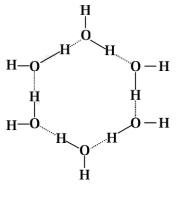
When water freezes to form ice,the water molecules are held together by hydrogen bonds in a three-dimensional,open,hexagonal honeycomb-like structure.
This structure creates large empty spaces between the water molecules,which increases the volume of the ice compared to an equal mass of liquid water.
Since the volume $(V)$ of ice is greater than the volume of an equal mass of liquid water,the density of ice is lower than that of liquid water.
This is why ice floats on water.
When water freezes to form ice,the water molecules are held together by hydrogen bonds in a three-dimensional,open,hexagonal honeycomb-like structure.
This structure creates large empty spaces between the water molecules,which increases the volume of the ice compared to an equal mass of liquid water.
Since the volume $(V)$ of ice is greater than the volume of an equal mass of liquid water,the density of ice is lower than that of liquid water.
This is why ice floats on water.
0 likes
View Solution190
Medium
Give reasons.
$(i)$ Lakes freeze from top towards bottom.
$(ii)$ Ice floats on water.
$(i)$ Lakes freeze from top towards bottom.
$(ii)$ Ice floats on water.
Solution
(N/A) $(i)$ During winter,the temperature of lake water decreases. Since cold water is denser,it sinks to the bottom,while warmer water rises to the surface. This continues until the entire lake reaches $277 \ K$ $(4^{\circ}C)$. Below $277 \ K$,the surface water becomes less dense as it cools further,causing it to remain at the top and eventually freeze.
$(ii)$ The density of ice is lower than that of liquid water due to its open cage-like structure formed by hydrogen bonding,which causes it to float on water.
$(ii)$ The density of ice is lower than that of liquid water due to its open cage-like structure formed by hydrogen bonding,which causes it to float on water.
0 likes
View Solution191
Medium
Discuss briefly the demineralization of water by ion exchange resin.
Solution
(N/A) Demineralization of water is achieved by passing water through cation and anion exchange resins.
$1$. Cation exchange resin: These resins contain large organic molecules with $-SO_{3}H$ groups. In the $H^{+}$ form,they exchange $H^{+}$ ions for cations like $Na^{+}, Ca^{2+},$ and $Mg^{2+}$ present in water.
$2 RH_{(s)} + M^{2+}_{(aq)} \rightleftharpoons MR_{2(s)} + 2H^{+}_{(aq)}$
This process makes the water acidic due to the release of $H^{+}$ ions.
$2$. Anion exchange resin: These resins contain basic groups like $-NH_{2}$ or $-OH$ groups. They exchange $OH^{-}$ ions for anions like $Cl^{-}, HCO_{3}^{-},$ and $SO_{4}^{2-}$ present in water.
$RNH_{2(s)} + H_{2}O_{(l)} \rightleftharpoons RNH_{3}^{+}OH^{-}_{(s)}$
$RNH_{3}^{+}OH^{-}_{(s)} + X^{-}_{(aq)} \rightleftharpoons RNH_{3}^{+}X^{-}_{(s)} + OH^{-}_{(aq)}$
$3$. Neutralization: The $OH^{-}$ ions released from the anion exchange resin neutralize the $H^{+}$ ions released from the cation exchange resin to form pure water.
$H^{+}_{(aq)} + OH^{-}_{(aq)} \longrightarrow H_{2}O_{(l)}$
The exhausted resins are regenerated using dilute acid and alkali solutions.
$1$. Cation exchange resin: These resins contain large organic molecules with $-SO_{3}H$ groups. In the $H^{+}$ form,they exchange $H^{+}$ ions for cations like $Na^{+}, Ca^{2+},$ and $Mg^{2+}$ present in water.
$2 RH_{(s)} + M^{2+}_{(aq)} \rightleftharpoons MR_{2(s)} + 2H^{+}_{(aq)}$
This process makes the water acidic due to the release of $H^{+}$ ions.
$2$. Anion exchange resin: These resins contain basic groups like $-NH_{2}$ or $-OH$ groups. They exchange $OH^{-}$ ions for anions like $Cl^{-}, HCO_{3}^{-},$ and $SO_{4}^{2-}$ present in water.
$RNH_{2(s)} + H_{2}O_{(l)} \rightleftharpoons RNH_{3}^{+}OH^{-}_{(s)}$
$RNH_{3}^{+}OH^{-}_{(s)} + X^{-}_{(aq)} \rightleftharpoons RNH_{3}^{+}X^{-}_{(s)} + OH^{-}_{(aq)}$
$3$. Neutralization: The $OH^{-}$ ions released from the anion exchange resin neutralize the $H^{+}$ ions released from the cation exchange resin to form pure water.
$H^{+}_{(aq)} + OH^{-}_{(aq)} \longrightarrow H_{2}O_{(l)}$
The exhausted resins are regenerated using dilute acid and alkali solutions.
0 likes
View Solution192
Medium
How is heavy water prepared? Compare its physical properties with those of ordinary water.
Solution
(N/A) Heavy water $(D_{2}O)$ is prepared by the prolonged electrolysis of ordinary water $(H_{2}O)$. Since $H_{2}O$ is electrolyzed faster than $D_{2}O$,the remaining water becomes enriched in $D_{2}O$.
The physical properties of $H_{2}O$ and $D_{2}O$ are compared in the table below:
The physical properties of $H_{2}O$ and $D_{2}O$ are compared in the table below:
| Property | $H_{2}O$ | $D_{2}O$ |
| Molecular mass $(g \ mol^{-1})$ | $18.0151$ | $20.0276$ |
| Melting point $(K)$ | $273.0$ | $276.8$ |
| Boiling point $(K)$ | $373.0$ | $374.4$ |
| Enthalpy of formation $(kJ \ mol^{-1})$ | $-285.9$ | $-294.6$ |
| Enthalpy of vaporisation at $373 \ K$ $(kJ \ mol^{-1})$ | $40.66$ | $41.61$ |
| Enthalpy of fusion $(kJ \ mol^{-1})$ | $6.01$ | $6.28$ |
| Temperature of max. density $(K)$ | $276.98$ | $284.2$ |
| Density at $298 \ K$ $(g \ cm^{-3})$ | $1.0000$ | $1.1059$ |
| Viscosity (centipoise) | $0.8903$ | $1.107$ |
| Dielectric constant $(C^{2} / Nm^{2})$ | $78.39$ | $78.06$ |
| Electrical conductivity at $298 \ K$ $(ohm^{-1} \ cm^{-1})$ | $5.7 \times 10^{-8}$ | $3.0 \times 10^{-8}$ |
0 likes
View Solution193
Easy
Why is water used as a medium for chemical reactions?
Solution
(N/A) Water is widely used as a reaction medium due to the following reasons:
$1$. It has a high specific heat capacity,which helps in absorbing heat generated during exothermic reactions.
$2$. It is a polar solvent,making it excellent for dissolving ionic and polar covalent compounds.
$3$. It is chemically stable and relatively inert under many reaction conditions.
$4$. It is inexpensive,non-toxic,and easy to handle.
$1$. It has a high specific heat capacity,which helps in absorbing heat generated during exothermic reactions.
$2$. It is a polar solvent,making it excellent for dissolving ionic and polar covalent compounds.
$3$. It is chemically stable and relatively inert under many reaction conditions.
$4$. It is inexpensive,non-toxic,and easy to handle.
0 likes
View Solution194
EasyMCQ
Hydrogen and oxygen are both gases. What compound is formed by their combination?
A
Water $(H_2O)$
B
Hydrogen peroxide $(H_2O_2)$
C
Hydroxyl radical $(OH)$
D
Ozone $(O_3)$
Solution
(A) When hydrogen gas $(H_2)$ and oxygen gas $(O_2)$ combine,they react to form water $(H_2O)$.
The chemical equation for this reaction is: $2H_2(g) + O_2(g) \rightarrow 2H_2O(l)$.
Water is a liquid at room temperature.
The chemical equation for this reaction is: $2H_2(g) + O_2(g) \rightarrow 2H_2O(l)$.
Water is a liquid at room temperature.
0 likes
View Solution195
Medium
Give an example of a substance that can exist in different physical states. State its physical properties,chemical composition,and characteristics.
Solution
(N/A) Water is an example of a substance that exists in three different physical states: solid (ice),liquid (water),and gas (water vapor or steam).
The physical properties of ice,water,and steam are significantly different.
However,the chemical composition of all three states is identical,represented by the formula $H_2O$.
The characteristics of these three states depend on the energy of the molecules and the arrangement of the water molecules.
The physical properties of ice,water,and steam are significantly different.
However,the chemical composition of all three states is identical,represented by the formula $H_2O$.
The characteristics of these three states depend on the energy of the molecules and the arrangement of the water molecules.
0 likes
View Solution196
Difficult
Explain: Proton $(H^{+})$ does not exist in aqueous solution.
Solution
(N/A) hydrogen ion $(H^{+})$ by itself is a bare proton with a very small size $(\sim 10^{-15} \ m$ radius) and an intense electric field.
Therefore,the proton binds itself to a water molecule at one of the two available lone pairs via a coordinate covalent bond,forming the hydronium ion $(H_{3}O^{+})$.
This hydronium ion $(H_{3}O^{+})$ has a trigonal pyramidal geometry. The existence of the $H_{3}O^{+}$ species has been confirmed in various compounds,such as $H_{3}O^{+}Cl^{-}$ in the solid state.
Similarly,the hydronium ion can be further hydrated to form several other ionic species,such as $H_{5}O_{2}^{+}$,$H_{7}O_{3}^{+}$,and $H_{9}O_{4}^{+}$.
Thus,a proton does not exist independently in an aqueous solution; instead,it exists as a hydronium ion or other hydrated oxonium ions.
Therefore,the proton binds itself to a water molecule at one of the two available lone pairs via a coordinate covalent bond,forming the hydronium ion $(H_{3}O^{+})$.
This hydronium ion $(H_{3}O^{+})$ has a trigonal pyramidal geometry. The existence of the $H_{3}O^{+}$ species has been confirmed in various compounds,such as $H_{3}O^{+}Cl^{-}$ in the solid state.
Similarly,the hydronium ion can be further hydrated to form several other ionic species,such as $H_{5}O_{2}^{+}$,$H_{7}O_{3}^{+}$,and $H_{9}O_{4}^{+}$.
Thus,a proton does not exist independently in an aqueous solution; instead,it exists as a hydronium ion or other hydrated oxonium ions.
0 likes
View Solution197
Medium
Melting point,enthalpy of vaporisation and viscosity data of $H_2O$ and $D_2O$ is given below.
On the basis of this data,explain in which of these liquids intermolecular forces are stronger?
| $Property$ | $H_2O$ vs $D_2O$ |
| $Melting$ $point/K$ | $273.0$ vs $276.8$ |
| $Enthalpy$ $of$ $vaporisation$ $at$ $(373 \ K) / kJ \ mol^{-1}$ | $40.66$ vs $41.61$ |
| $Viscosity/centipoise$ | $0.8903$ vs $1.107$ |
On the basis of this data,explain in which of these liquids intermolecular forces are stronger?
Solution
(N/A) The melting point,enthalpy of vaporization,and viscosity are physical properties that depend on the magnitude of intermolecular forces of attraction.
As observed from the data,the values for $D_2O$ are consistently higher than those for $H_2O$.
This indicates that the intermolecular forces of attraction (specifically hydrogen bonding) are stronger in $D_2O$ compared to $H_2O$.
As observed from the data,the values for $D_2O$ are consistently higher than those for $H_2O$.
This indicates that the intermolecular forces of attraction (specifically hydrogen bonding) are stronger in $D_2O$ compared to $H_2O$.
0 likes
View Solution198
MediumMCQ
When the first element of the periodic table is treated with dioxygen,it gives a compound whose solid state floats on its liquid state. This compound has an ability to act as an acid as well as a base. What products will be formed when this compound undergoes autoionisation?
A
$H_3O^+$ and $OH^-$
B
$H_2O_2$ and $O_2$
C
$H^+$ and $O^{2-}$
D
$H_3O^{2+}$ and $O^{2-}$
Solution
(A) The first element of the periodic table is hydrogen $(H)$. When it reacts with dioxygen $(O_2)$,it forms water $(H_2O)$.
Ice (solid $H_2O$) has a lower density than liquid water,which is why it floats on its liquid state.
Water is amphoteric,meaning it can act as both an acid and a base.
Water undergoes autoionisation (also known as self-protolysis) according to the following equilibrium reaction:
$H_2O_{(l)} + H_2O_{(l)} \rightleftharpoons H_3O^{+}_{(aq)} + OH^{-}_{(aq)}$
Thus,the products formed are hydronium ions $(H_3O^+)$ and hydroxide ions $(OH^-)$.
Ice (solid $H_2O$) has a lower density than liquid water,which is why it floats on its liquid state.
Water is amphoteric,meaning it can act as both an acid and a base.
Water undergoes autoionisation (also known as self-protolysis) according to the following equilibrium reaction:
$H_2O_{(l)} + H_2O_{(l)} \rightleftharpoons H_3O^{+}_{(aq)} + OH^{-}_{(aq)}$
Thus,the products formed are hydronium ions $(H_3O^+)$ and hydroxide ions $(OH^-)$.
0 likes
View Solution199
Easy
What is the importance of heavy water?
Solution
(N/A) $i$. Heavy water $(D_2O)$ is extensively used as a moderator in nuclear reactors to slow down fast-moving neutrons.
$ii$. It is widely used as a tracer compound for studying the reaction mechanisms of various chemical and biochemical processes.
$iii$. Heavy water is used in the preparation of other deuterium compounds such as $CD_4$,$D_2SO_4$,etc.
$ii$. It is widely used as a tracer compound for studying the reaction mechanisms of various chemical and biochemical processes.
$iii$. Heavy water is used in the preparation of other deuterium compounds such as $CD_4$,$D_2SO_4$,etc.
0 likes
View Solution200
Easy
Why does hard water not form lather with soap?
Solution
(N/A) Hard water contains dissolved bicarbonates,chlorides,and sulphates of calcium $(Ca^{2+})$ and magnesium $(Mg^{2+})$ ions. These ions react with soap (sodium stearate,$C_{17}H_{35}COONa$) to form insoluble precipitates of calcium and magnesium stearates.
$2 C_{17}H_{35}COONa_{(aq)} + M^{2+}_{(aq)} \rightarrow (C_{17}H_{35}COO)_2M_{(s)} \downarrow + 2Na^{+}_{(aq)}$
(Where $M = Ca$ or $Mg$)
Because the soap is consumed in forming these insoluble precipitates,it is not available to form lather with water.
$2 C_{17}H_{35}COONa_{(aq)} + M^{2+}_{(aq)} \rightarrow (C_{17}H_{35}COO)_2M_{(s)} \downarrow + 2Na^{+}_{(aq)}$
(Where $M = Ca$ or $Mg$)
Because the soap is consumed in forming these insoluble precipitates,it is not available to form lather with water.
0 likes
View SolutionHydrogen — Water or hydride of oxygen · Frequently Asked Questions
1Are these Hydrogen questions useful for JEE and NEET?
Yes. All questions in this section are mapped to JEE Main and NEET exam patterns. Previous year questions from JEE Main, NEET, GUJCET and state-level exams are included with full solutions.
2Can I switch to Hindi or Gujarati for these questions?
Yes. Use the language tabs in the hero section or the sidebar to view the same questions and solutions in English, Hindi or Gujarati.
3How do I generate a question paper from this subtopic?
Use the Vedclass Exam Paper Generator — select the chapter and subtopic, set difficulty, and generate Sets A, B, C, D automatically. First 3 chapters of every subject are free.
Vedclass Products
For Students
Vedclass Test Series
Mock tests in real JEE/NEET style with performance analysis. 5-day free trial.
Start Free TrialFor Teachers
Exam Paper Generator
Generate Set A/B/C/D papers from this chapter in 2 minutes. 3 chapters free.
Try FreeFor Institutes
Online Exam Module
Live online exams with unlimited students, 360° analytics & white-label branding.
See DemoFor Teachers & Institutes
Generate a Hydrogen Exam Paper in 2 Minutes
Select subtopic & difficulty — Sets A, B, C, D auto-generated with No Repeat logic.
First 3 chapters of every subject are free — no payment required.